Archive for the ‘1920s’ Category

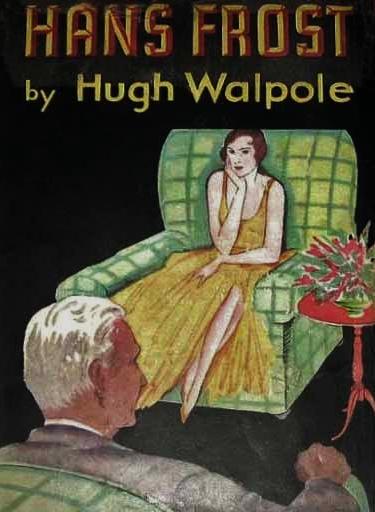
hans frost dj hugh walpoleHans Frost by Hugh Walpole ~1929. This edition: Doubleday, Doran & Co., 1929. Stated First Edition. Hardcover. 356 pages.

My rating: 8.5/10.

*****

No one perhaps in the United Kingdom was quite so frightened as was Nathalie Swan on the third day of November, 1924, sitting in a third-class carriage about quarter to five of a cold, windy, darkening afternoon. Her train was drawing her into Paddington Station, and how she wished that she were dead!

She sat in a corner on the hard, dusty seat, her hands clenched, her heart beating with hot, thick, hammering throbs. She wished that she were dead. She was an orphan. No one in the world needed her. The Proudies whom she was abandoning had been very, very good to her, but certainly did not need her. The famous Mrs. Frost to whom she was going would almost surely not be good to her–and as to needing her . . .

Open upon her lap was a number of that shiny geographically illustrated paper the London News, and among other portraits was one of Hans Frost, and under it was written:

Mr. Hans Frost, whose Seventieth Birthday occurs on November 3. His friends and admirers are marking the occasion with a suitable presentation.

She had had this face in front of her, framed in a neat black frame for the last six years, had carried it with her everywhere, had had it always in her bedroom wherever she might be. For was he not her uncle, her famous, marvellous uncle whom she had never seen but had made her hero, her conception of God, indeed, ever since she could remember?

Nineteen-year-old Nathalie arrives at her Aunt Ruth’s and Uncle Hans’ house, only to find that this is the night of that gala 70th birthday dinner. She’s tremendously relieved that she isn’t expected to attend, and after she is shown to her room, finally breaks down into tears of homesickness and apprehension, after her bags have been unpacked and her dinner delivered on a tray.

Meanwhile Hans Frost, the great writer, has received his guests and graciously accepted the wonderful gift his admirers have pooled together to purchase for him:

And it was a lovely thing! It was a very small oil painting and the artist was Manet.

The picture had for its subject two ladies and a gentleman outside a print shop in Paris. One lady wore a blue crinoline and the other a white; there was a little fuzzy white dog, the glass windows shone in the afternoon light, and beyond the pearl-grey wall of the old house there was a sky of broken blue and swollen white cloud. It was a very lovely little Manet. . . .

“Oh!” cried Hans Frost … He saw only the picture. He had always adored Manet, a painter closer to his soul than any other. He entered into the heart of a Manet at once, as though it had been painted for himself alone. He could be critical about everything else in the world (and was so), but not about Manet. When he was depressed or troubled by his liver he went and looked at Manet. . . . And now he would have a Manet all of his own, his very own–that deep and tender beauty, that blue crinoline, that fuzzy little dog, that white cloud against the gentle blue; these were his forever.

The dinner has been given, kind words have been spoken, Ruth has been a spectacular hostess – as always – but tonight an essential something has changed in Hans Frost’s world. He has unexpectedly met his niece, for, hearing her crying, he has gone into her room and comforted her – something of a surprise to both of them, especially Hans as he had not even known she was coming. The unexpected meeting has affected him strangely, triggering deep within him one of the creative impulses which have in the past led to the some of his best fictional creations. Hans feels like something is about to happen, an immense upheaval of his predictable, comfortable world, and of course, this being a novel, he is completely correct!

Hans, much to Ruth’s dismay, takes Nathalie under his wing and squires her about town. Ruth is deeply jealous of this new interest, this infatuation with the lovely young niece. She had assumed Nathalie would be far below Hans’ notice, and she immediately fears the worst, that the affection Hans feels for Nathalie is romantic, possible even sexual, though Hans has long since laid aside that part of his life, at least as far as Ruth is aware. But the relationship that has sprung into existence is something even more dangerous to Ruth’s peace of mind. Nathalie and Hans find they are true kindred spirits, and an idealized father-daughter, or rather, meeting-of-two-minds-as-equals friendship is quickly evolving.

Hans introduces Nathalie into the rather messy world of the striving writers, musicians and artists which Ruth has always scorned – at least until success and renown add a stamp of respectability to the untidy bohemians. Nathalie soon falls in love with a Russian refugee – London in 1924 is packed with “orphans of the storm” from the recent revolution – and Hans finds himself acting as benevolent advisor and rather bemused sponsor to the young lovers. Meanwhile, his own marriage is in deep trouble, as he decides that the only way he can return to a semblance of his former creativity as a writer is to break away from his comfortable life and his socially ambitious wife and retreat to some place of solitude to await the return of his muse.

Hans and Nathalie solve their respective dilemmas, but not before much drama, most of it involving an offended and officious Ruth. The ending of the story is delicately poignant and emotionally satisfying, and the author has a few surprises for his readers in how he tidies up all his many loose ends.

An engaging story, which I have enjoyed with renewed appreciation each time I’ve read it. Very much a period piece, but of a superior type, in that the modern reader can fully enter into and embrace the world that the author has created and captured for those of us willing to experience it almost a century later.

The author has a well-developed sense of the absurd, which he uses to create satirical observations of the more outrageous characters and habits of the time he’s portraying, all the while maintaining a rather sentimental tone regarding his sympathetic protaganists, while setting up his antagonists for their eventual rout. Walpole maintains a good balance throughout, showing the internal struggles which make even the least likeable characters very understandably human, and worthy of at least a morsel of our sympathy.

I wish I could express in words the special quality of Hugh Walpole’s writing in this novel, and why I find it so appealing, but I won’t bother with over-analysis for fear of destroying my affection for it by too much probing. No deep messages or life-and-death dramas, merely an entertaining tale, competently told, focussing on various human relationships. Not much more – but in this case that is quite enough.
Read Full Post »

the enchanted april elizabeth von arnim 001The Enchanted April by Elizabeth von Arnim ~ 1922. This edition: Simon & Schuster, 1992. Afterword by Terrence de Vere White. Paperback. ISBN: 0-671-86864-0. 316 pages.

My rating: 6/10. I’ve now read this twice, plus watched the lush 1992 movie. Still my least favourite von Arnim, of the three I’ve read.

The others:

*****

I guess the thing to remember with this one, and the thing I had to keep reminding myself of, was that this fluffy little tale is supposed to be a romantic comedy. Or is it? Away from the comical sunniness there are pockets of dark shadow. The decided element of genuine sadness in the four heroines’ circumstances, especially during the first part of the book, jarred with the eventual descent of the tale into musical comedy style farce.

I honestly could not get a true sense of which goal the author was aiming at. There are certainly times when an author, especially one of proven calibre of Elizabeth von Arnim, can successfully blend serious social commentary, light satire, and downright silliness, but I don’t feel that von Arnim pulled it off in this case.

I realize that this book has a tremendously strong following, and I will temper my criticism to say that it was a decent enough read for its genre, which I’m pegging at romantic comedy. Or perhaps serio-comedy? It wasn’t ultimately at all dark, though there were clues early on that it might go that way. If anything, I wish the author would spent more time in the darkness with her creations. I’d have liked her to maintain the initial tone set with the first sensitive depictions of the emotionally troubled lives of Lotty Wilkins and Rose Arbuthnot, which made their yearning for an obligation-free (and husband-less) month in the Italian sun so moving. And the solitary Mrs. Fisher and Lady Caroline – what were the real back stories there? It didn’t feel like we ever really got a handle on those, making their eventual epiphanies on the terraces of San Salvatore contrived to the extreme.

The Enchanted April felt to me to be just a little bit off; I was never quite able to close my inner critic’s eyes enough to wholeheartedly accept the inconsistencies and silly situations of the plot, though many sections of the book were immensely enjoyable to read, despite the cringe-engendering gushings of Lotty once she’s crossed the Italian border. “Tub of love”? Oh, Elizabeth! I wish you’d spared me that!

*****

It began in a Woman’s Club in London on a February afternoon – an uncomfortable club, and a miserable afternoon – when Mrs. Wilkins, who had come down from Hampstead to shop and had lunched at her club, took up The Times from the table in the smoking-room, and running her listless eye down the Agony Column saw this:

To Those Who Appreciate Wistaria and Sunshine.  Small mediaeval Italian Castle on the shores of the Mediterranean to be Let furnished for the month of April.  Necessary servants remain. Z, Box 1000, The Times.

That was its conception; yet, as in the case of many another, the conceiver was unaware of it at the moment.

So entirely unaware was Mrs. Wilkins that her April for that year had then and there been settled for her that she dropped the newspaper with a gesture that was both irritated and resigned, and went over to the window and stared drearily out at the dripping street.

Not for her were mediaeval castles, even those that are specially described as small.  Not for her the shores in April of the Mediterranean, and the wisteria and sunshine.  Such delights were only for the rich.  Yet the advertisement had been addressed to persons who appreciate these things, so that it had been, anyhow addressed too to her, for she certainly appreciated them; more than anybody knew; more than she had ever told.  But she was poor.

***

She turned away from the window with the same gesture of mingled irritation and resignation with which she had laid down The Times, and crossed the room towards the door with the intention of getting her mackintosh and umbrella and fighting her way into one of the overcrowded omnibuses and going to Shoolbred’s on her way home and buying some soles for Mellersh’s dinner – Mellersh was difficult with fish and liked only soles, except salmon – when she beheld Mrs. Arbuthnot, a woman she knew by sight as also living in Hampstead and belonging to the club, sitting at the table in the middle of the room on which the newspapers and magazines were kept, absorbed, in her turn, in the first page of The Times.

Mrs. Wilkins stops and strikes up a conversation with Mrs. Arbuthnot, and as they delicately sound each other out on the desirability of an Italian escapade, the small germ of an idea begins to form. Mrs. Wilkins has a small “nest egg” of ninety pounds; Mrs. Arbuthnot, though she doesn’t come right out and say it, is well-supplied with money by her husband, though she feels guilty about spending it on anything but “good works” – Mrs. Arbuthnot is a devotee of charities for the poor. Eventually the two decide to go ahead and contact the castle’s owner; they also advertise for two more women to share in the holiday, and when only two people respond, the party is made up.

So off to the small castle of San Salvatore in Italy go:

  • Mrs. Wilkins (Lotty) – seeking respite from her scornful husband, Mellersh, who feels that his wife has not exactly improved in the years since their marriage, and is becoming more odd and shy by the day, to the detriment to his flourishing occupation as a popular solicitor.
  • Mrs. Arbuthnot (Rose) – privately despairing that the love she and her husband once felt for each other is long gone, as they cannot agree on moral issues. Mr. Arbuthnot is the best-selling author (under a pseudonym) of salacious biographies of kings’ mistresses; Mrs. Arbuthnot is deeply religious and feels that she is being supported by “dirty” money, hence her many charitable works and contributions to the poor, as a form of penance.
  • Mrs. Fisher – an elderly wealthy widow, who is convinced that the world is a much more inferior place now than when she was a girl. Her father was a friend of many great literary men – Carlyle, Matthew Arnold, Tennyson and the like – and she seeks a place of repose where she can sit alone without worrying about household cares, and remember the glorious past.
  • Lady Caroline Dester  – an extremely lovely, not-too-young socialite (though she’s the “baby” of the party, at twenty-eight) whose only current desire is to have a rest for a month far away from the demands of people who all want something from her – to look at her and talk to her, ask her for things and talk to her, and expect some sort of gracious response. Poor jaded Lady Caroline is at a point in her life where she has some serious decisions to make, including whether she is going to accept an important marriage proposal. A month among innocuous women who will not bother her will be a respite from her frantically hectic life.

As the four settle into their temporary holiday home and work out their relationships with their fellow escapees, they find that the glories of lovely San Salvatore are impacting their very souls in ways which no one could have anticipated.

Lotty spontaneously decides to invite her husband to join the party; Mr. Arbuthnot, ardently pursuing Lady Caroline, unexpectedly arrives without realizing his wife is in residence – Lotty and Rose had both been deliberately vague about their destination to their spouses; San Salvatore’s owner, Mr. Briggs, under the misconception that the gentle Mrs. Arbuthnot is a widow, and rather infatuated with her since their meeting to arrange the renting of the castle, decides to drop in for a “casual” visit. Needless to say, things begin to happen.

If you’ve not yet read the book, stop here. The next bit is addressed to those who’ve already experienced The Enchanted April, so if you haven’t you will be lost among the references. There also may be spoilers!

*****

Things I Really Didn’t Like About This Book:

  • The gushing tone once the magic of the romantic setting started doing its work. “Tub of love” – ack! Made me quiver all over, and not in a happy way, people.
  • The parody of the Italian servants. Was that really necessary? It wasn’t that funny.
  • Mellersh’s reason for joining the party was understandable (hoping to get up close and personal to high society Lady Caroline), but it bothered me a whole big bunch that his attitude towards his wife changed so drastically once he saw on what good terms she was with Lady C. Did she have no other qualities than as a “connection” to someone he was wanting to snag as a client? And his “cute” habit of fondly pulling her ears – oh, please. That was just lame. Ugh. Lotty, oh, Lotty – your poor dear thing – words fail me.
  • Frederick (Mr. Arbuthnot) – gee, where to start? He stumbled into the mix because he was pursuing another woman. Ding ding ding – that was more warning bells going off.
  • Mr. Briggs – wow – the epitome of shallow. He was instantly infatuated with Rose way back in London for her Madonna-like aura and appearance; one glimpse at the even more lovely Lady Caroline and he dropped allegiance to Rose in a heartbeat and transferred over to her companion.
  • Lady Caroline herself. Let’s see. Strange man you’ve never met before falls in love with your profile, so you decide to marry him, though one of the main reasons for your month-long Italian retreat is to mull over a proposal from another man, who now gets wiped off the list of spousal possibilities with nary a backward glance. Umm, okay. That was a deeply thought out decision, and a great thing to base your future happiness on. (Don’t lose your looks, Lady C.)
  • My biggest issue was how the author pushed the whole “pairing off” scenario so strongly. The husbands were all impressed by their new, improved wives. In Frederick’s case, I forgive him fairly easily, as Rose was the one being rather unreasonable in their relationship. But Mellersh is still a jerk. And a deep-dyed snob, and manipulative. Why couldn’t he change? And Lady Caroline and Briggs – maybe just a wee bit contrived? Just maybe? I couldn’t really get any sort of reading on why Briggs would be a grand catch, unless  of course you call hereditary castle ownership an accomplishment.

Things I Quite Liked About This Book:

  • The initial premise, about the escape from dreary London to an enchanted Italian castle. This is probably why this book has garnered its fandom. Oh yes, take me with you!
  • The character portraits of the four leading ladies were a lot of fun. Lotty, so shy and repressed, and so quick to respond to the magic of San Salvatore and blossom into confidence and warmth. Rose, so sincerely good, but so quick on the draw to respond to Mrs. Fisher’s bossy way of assuming hostess status. I loved the mealtime scenes with the counter-offers of passing the goodies and pouring the tea. Mrs. Fisher was so selfishly self-assured – her initial snobbish audaciousness was a treat to eavesdrop on. Lady Caroline – oh, poor lady! – so be so continually misunderstood because of the elegant shape of your face and the melodious sounds of your voice! (Though I felt like she perhaps should have been spanked more as a child, or at least told “no” occasionally by her adoring family; it might have improved her entitled attitude.)
  • The word pictures of the settings, from the dreary London women’s club to glorious San Salvatore. I could easily picture the sequence of bloom and the fragrances wafting about the terraced gardens, though I suspect a reader with less horticultural experience might not get the full picture; it’s basically a listing of flowers. Unless you know nicotiana, or jasmine, or stocks, how could you imagine the glories of their evening aromas? It felt very much like the castle bits were written from life, sitting on the terraces and taking notes, which turned out to be the case, according to the afterword. Elizabeth von Arnim based San Salvatore on a very real Portofino castello, which she had rented with a friend as an April of 1921 writer’s retreat.
  • The happy ending. I know, I know – I moaned on about that aspect earlier. But I did appreciate that both of the troubled marriages were given new life. (I’m all for happy marriages, though not for either spouse being continually downtrodden or repressed to “make it work”.) And of course the new Mrs. Briggs can always invite her friends back to the castle for immersion in the Tub of Love when reality sets in too harshly once again!

Well, there’s my take on this most popular and perennially in-print (and on-stage – it’s an exceedingly popular play among amateur theatrical companies, too) von Arnim. I’m still very much looking forward to reading the rest of her novels, an enjoyment which will I anticipate will stretch ahead for the next few years as I slowly track them all down. No library borrowings here; I’m intending to purchase them all sight unseen, because I’m confident that they will be worthy of owning, even if bits of them occasionally annoy!

Read Full Post »

the cutters bess streeter aldrichThe Cutters by Bess Streeter Aldrich ~ 1922. This edition: Grosset & Dunlap, 1926. Hardcover. 276 pages.

My rating: 7.5/10

This novel bookends Mother Mason; both are episodic individual and family portraits; I read them back to back and there were decided similarities of style and content, though each book has enough variation to keep things fresh.

I rated Mother Mason higher; though The Cutters is a charming read as well. However, in this novel, the morals in the little stories within are laid on with a much broader brush.

Motherhood, Home, Family – yes – we understand their importance, dear author, to the fabric of a happy nation, but the insistence that these are the only things which bring fulfillment to a womanly heart jars a bit with our modern-day emancipated female reality!

A tiny bit preachy, and very much a period piece; most obvious perhaps in the chapter on alternative ways of child discipline which ends with the family’s mother soundly thrashing her two naughty sons, with the author’s blatant assumption that this will meet with her readers’ full approval!

*****

This novel depicts a short period in the life of the Cutter family of the fictional small town of Meadows in an unspecified mid-western U.S. state. Father Ed, a successful lawyer; Nell, a busy hausfrau; 12-year-old Josephine; Craig and Nicolas, 7 and 9; baby Leonard; and mild matriarch Grandma Cutter make up the seven points of the Cutter family star.

The time is the early years of the 1920s; the shadows of the coming Depression are faint but ominously lurking. The Cutters struggle financially, and much of Nell’s part of the narrative is driven by her wistful yearnings for things which she can’t quite afford. Her husband teases her with a running joke about champagne tastes on a beer budget; Nell inwardly bristles while admitting to herself that this is indeed one of her personal Waterloos.

The incidents which make up the book are mild and domestically based for the most part. A wealthy client and his wife come to stay for  a few days, throwing the Cutter household into turmoil top to bottom; The Woman’s Club invites a speaker on “Perfect Parenthood, or Trained Motherhood”, whose ideas Nell tries to emulate with less than stellar success; a decision to take a family “dream vacation” reveals some surprising preferences; Josephine’s schoolgirl crush disrupts her young world; Nell’s ambitions for a newer, better, bigger house look like they will finally be realized; Grandma Cutter looks forward to a reunion with all of her far-flung sons; Nell enters a contest to try to win some “easy money”.

Likeable characters; relatable situations, a lot of humour and some very wise words coming from unexpected quarters – Aldrich is truly in fine form here. She bobbles a bit with the last chapter, which jumps ahead several years to the time of Josephine’s wedding, and hurriedly fills us in on how everyone else is turning out. Aldrich didn’t need to do that; she could have left us in the here and now, and it would have been just fine, but I suspect she couldn’t quite resist tidying things up.

Though not quite up to its predecessor, Mother Mason, The Cutters is an ideal nostalgic comfort read. I liked it a lot.

Read Full Post »

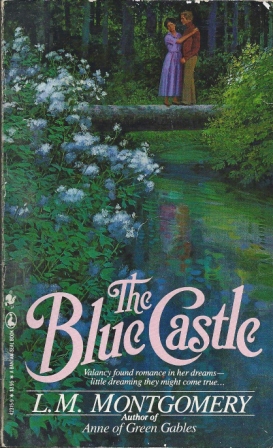
The Blue Castle by L.M. Montgomery ~ 1926. This edition: McClelland-Bantam (Seal), 1988. ISBN: 0-7704-2315-9. Paperback. 218 pages.

My rating: After reading Kilmeny of the Orchard, an easy 10, but stepping back a bit, for general comparison to other novels of this vintage and genre (I’m thinking D.E. Stevenson here, I must admit, because I’ve been discovering her light romantic novels these past few months) how about a nice solid 8/10. Will that do, Blue Castle fans? I did enjoy re-reading this one, after a hiatus of many years.

*****

Though often referred to as one of Lucy Maud Montgomery’s “forgotten” books, the internet abounds with reviews – its page on Goodreads – The Blue Castle  alone has over one thousand reviews, and seven thousand plus ratings. It scores an extremely respectable 4.22/5. This is a well-loved book!

Anything I say here would be superfluous to the discussion; I know others have covered this ground before, often with great eloquence and passionate approval. I’ll put forward my opinion nevertheless.

Montgomery’s stories tend to be full of stuffy matriarchs and patriarchs making life miserable for their cowed extended families; the worm turning sets the narrative in motion and has the reader cheering for the underdog; if all goes well we come to the end with a better appreciation for what makes everyone in that fictional little world tick. The Blue Castle is no exception; it follows the pattern perfectly, and with satisfying results. This story almost defines the comfort read, and I suspect that is how most of its advocates use it, to administer a little boost of fantasy and happy ending to real lives fraught – and whose life is completely free of these? – with anxiety and sadness.

*****

Valancy Stirling is having her twenty-ninth birthday, and her level of depression couldn’t be much lower. Living with her emotionally distant mother and whiny, elderly Cousin Stickles, Valancy’s days are a repetitive round of dusting and duty jobs; the attic chests overflow with the quilts the three have spent their countless hours piecing together, and every moment of Valancy’s time must be accounted for and justified.

Idleness was a cardinal sin in the Stirling household. When Valancy had been a  child she had been made to write down every night, in a small, hated, black notebook, all the minutes she had spent in idleness that day. On Sundays her mother made her tot them up and pray over them.

But Valancy has an even more insistent woe. In a world which values a woman by her achievement of a “good” marriage, Valancy is a confirmed spinster. No man has so much as looked at her with interest, and as her unvoiced desire for love increases with the years, so does her drabness and depression. Valancy is very much on the shelf, an unwanted piece of merchandise, and her large extended family, from her own bullying mother, to her perennially teasing rich bachelor Uncle Benjamin, to her gorgeous, patronizing, engaged-to-be-married cousin Olive, don’t let her forget it for a second.

Valancy’s only escape is into daydreams of a fantasy life.

Valancy, so cowed and subdued and overridden and snubbed in real life, was wont to let herself go rather splendidly in her day-dreams. Nobody in the Stirling clan, or its ramifications, suspected this, least of all her mother and Cousin Stickles. They never knew that Valancy had two homes–the ugly red brick box of a home, on Elm Street, and the Blue Castle in Spain. Valancy had lived spiritually in the Blue Castle ever since she could remember. She had been a very tiny child when she found herself possessed of it. Always, when she shut her eyes, she could see it plainly, with its turrets and banners on the pine-clad mountain height, wrapped in its faint, blue loveliness, against the sunset skies of a fair and unknown land. Everything wonderful and beautiful was in that castle. Jewels that queens might have worn; robes of moonlight and fire; couches of roses and gold; long flights of shallow marble steps, with great, white urns, and with slender, mist-clad maidens going up and down them; courts, marble-pillared, where shimmering fountains fell and nightingales sang among the myrtles; halls of mirrors that reflected only handsome knights and lovely women–herself the loveliest of all, for whose glance men died. All that supported her through the boredom of her days was the hope of going on a dream spree at night. Most, if not all, of the Stirlings would have died of horror if they had known half the things Valancy did in her Blue Castle.

For one thing she had quite a few lovers in it. Oh, only one at a time…At twelve, this lover was a fair lad with golden curls and heavenly blue eyes. At fifteen, he was tall and dark and pale, but still necessarily handsome. At twenty, he was ascetic, dreamy, spiritual. At twenty-five, he had a clean-cut jaw, slightly grim, and a face strong and rugged rather than handsome. Valancy never grew older than twenty-five in her Blue Castle, but recently–very recently–her hero had had reddish, tawny hair, a twisted smile and a mysterious past.

Aha! That last lover has a counterpart in the real world, who shall soon be introduced. In the tradition of all romantic novels, something is about to happen.

In Valancy’s case, the immediate something is her independent decision to go secretly to a doctor for a consultation about her increasingly severe heart pains, which she has kept hidden from her overbearing family. She can’t go to the family doctor, as word would soon be out, so she decides instead to consult old Dr. Trent, a noted heart specialist who lives in the same (fictional) Ontario town of Deerwood as the Stirling clan.

Dr. Trent doesn’t say much during the examination, and while Valancy waits for his return to the consulting room, a phone call sends the doctor rushing away on another emergency. Valancy goes home no more enlightened as to her condition than she was before the appointment, but some weeks later a letter comes from Dr. Trent. He is sorry that he had to leave her hanging, but he has some bad news for her. Miss Sterling has an incurable heart condition, and could die at any moment. She might last a year at most, with extreme care and good luck. In the meantime, avoid all exertion and strong sentiment, and hope for the best. (Those of you with keen eyes will spot a clue in this paragraph. It’s there in the book, too.)

The diagnosis of imminent death sends Valancy over the edge. With nothing to lose, she immediately starts to voice the many thoughts regarding her relatives which she has kept hidden all these years. They are taken aback at mousy little Valancy’s sudden outspokenness. Not sure how to handle her, they retreat into enclaves to murmur “Crazy!”, but by and large they back off and observe her with startled eyes, an improvement of sorts from the previous incessant teasing.

Valancy then goes one further. She decides to move in with a childhood friend who has been a victim of circumstance (summer job away from home, love affair, illegitimate baby which only lives for a year etc.) and is now dying of “consumption” (tuberculosis). The good people of Deerfield have distanced themselves from the sad fate of Cissy Abel, especially since her father just happens to be the town drunk, “Roaring Abel”. The only person who has shown any sympathy for poor Cissy is another social outcast, the mysterious Barney Snaith, who is a reclusive type who lives alone on an island in nearby Lake Mistawis, showing up occasionally to beat around town in his decrepit old car in the company of Abel.

Valancy has only seen Barney twice before, but has been intrigued by his oddly handsome appearance and devil-may-care attitude. Wonder if that means anything? What do you think, dear fellow readers?

So that’s the set-up. (And oops, I forgot to mention that Valancy’s only other emotional outlet in her long, dreary twenty-nine years, other than her Blue Castle daydreams, has been reading the works of a certain John Foster, who writes romantically about the wonders of the natural world. Valancy has whole passages of his works memorized; she has been surreptitiously reading his books for years, as often as she can smuggle them from the sympathetic librarian and past her eagle-eyed mother.)

Poor Cissy dies. The Deerwood townspeople, influenced by the Stirling clan who have decided they need to regularize Valancy’s move to the Abel home by rallying round her, hypocritically show up in great force for the funeral. With Cissy dead and buried, Valancy is now rather at loose ends, and, to prevent having to return to her stifling old life, she comes up with an audacious idea.

And here I will leave you. I’m sure you will be able to make some good guesses as to what happens next. Or maybe not!

*****

Super-sentimental, but with a goodly leaven of outspoken criticism of societal and moral hypocrisies. Valancy speaks out and we cheer her on, wondering only that it took her so long to cast off the shackles of manners to do so. No, that’s not quite right. Valancy stays terribly polite; she merely exposes the sugar-coated – and sometimes blatantly naked – rudeness of the other people who have been immune to comment because of their aggressive superiority.

The plot has some cute twists and turns, and a not very surprising (but perfectly fitting) “surprise” ending.

Valancy’s island cabin to me is much more of a daydream ideal than her lavish Blue Castle in Spain; I sighed a bit over the thought of a cozy, tiny house on an island, with no need to earn an income or worry about the drains,  or deal with obnoxious neighbours or bossy family members (not saying that I have either – oh no! – but Valancy has had them, in spades, so my pleasure in her escape was purely vicarious in that aspect) – anyway – the vision of her island idyll is pure comfortable fantasy and I wish I could go there occasionally in real life versus merely through the escape of reading.

A more mature book in many ways than the earlier novels featuring Anne, Emily and the residents of Avonlea and other P.E.I. environs. It is often mentioned that this was written “for adults”, but there is nothing objectionable which a teen of today couldn’t handle; I’d say age range twelve and upwards would be just right. Definitely a “romance novel”, and could be classified as something of a “girls’/women’s book”,  though the men in my life have read and enjoyed it for the humour and the gently diverting story. Happy ending, in the best fairytale tradition.

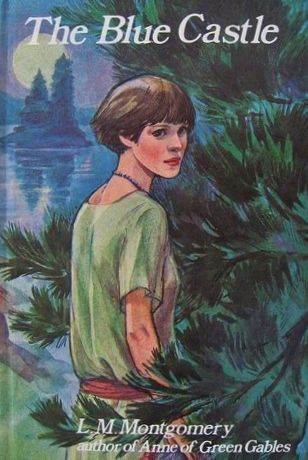
And check out this Pinterest page, which I stumbled upon while searching out a picture of the probably fictional Grey Slosson car which Barney drives. Some lovely images collected here which I thought added greatly to this quite charming novel. And look at this lovely cover illustration, found on that page. I thought this was much better than that on the cover of my own paperback copy!

Blue Castle Images – Valancy’s World

Read Full Post »

Peter West by D.E. Stevenson ~ 1923. This edition: Isis Publishing, 2007. Hardcover. Large Print. ISBN: 978-0-7531-7824-9. 213 pages.

My rating: 6.5/10. Very much reads like a first novel, which it is. The author tries hard, and ultimately succeeds, in telling her soberly romantic little story. I had been warned not to expect much from this obscure first work, but I was pleasantly surprised by its readability once I learned to navigate the flowery language and the bits of Scots dialogue from the local lassies, crones and crofters.

A point off for the constant references to the heroine’s figurative gossamer wings. Urgh!

Also lost a point for excessive use of the convenient plot device of the random hand of death. Deus ex machina, dear author? Please don’t make that a habit!

*****

This was now-esteemed and very collectible romantic fiction writer Dorothy Emily Stevenson’s first published novel. According to the BOOKRIDE rare book guide website, it was first released in magazine serial form.

Bookride, 12 February, 2007:

‘Peter West’ is the first of over 40 novels by the popular writer. Her sister married into the Chambers publishing family, and Ms Stevenson got this novel serialized in ‘The Chambers Journal’, and published by them in book form in 1923, but it wasn’t a success. Dorothy Emily Stevenson was born in Edinburgh in 1892, she was related to Robert Louis Stevenson, who was her father’s first cousin. She was 24 when she married Captain James Reid Peploe of the 6th Gurkha Rifles in 1916. Created the immortal characters Mrs Tim and Miss Buncle published by Herbert Jenkins. Can find nothing on ‘Peter West’ except that it is much wanted and highly elusive.

Almost ten years were to pass before D.E.Stevenson’s second novel was published. Mrs. Tim of the Regiment, 1932, inspired by Stevenson’s personal diary as an army wife,  proved much more successful and is one of the very few of her forty-odd books currently in print.

But we want to talk about Peter West. Apparently it is quite obscure, though the copy before me, obtained from my local library, is a very recent (2007) large print edition from Isis Publishing, so there must be a few of these in circulation. The following review contains spoilers, so if you want to search out Peter West for yourself and be surprised, stop reading now.

*****

Dedication by the author:

Dedicated to all who love Scotland, her tears and smiles, her dark woods and sunlit moors, and the plain and homely folk in the lonely villages of the north.

And the first few paragraphs of the Prologue, to give you a taste of the author’s descriptive style:

Mr. Maclaren loved Kintoul. Ever since he had come there, nigh on twenty years ago, the place had “grown on him,” as the saying goes. It had seemed a paradise of rest and quiet to the town-weary minister – a place where a man might regain health and strength of mind and body; where a man might forget the ugly striving and pushing of the city, and steep his very soul in the peace of God.

It was, on the whole, an easy thing to fall in love with Kintoul. There was something alluring about it, something mysteriously feminine. Even in the depths of winter, when the pure white snow covered all the hill-side, hanging on the pine-trees like fleecy blankets, and the river (the only non-white thing in the whole valley) ran like a narrow snake between jagged ice – even then there was something soft about Kintoul. The hills were friendly sentinels for all their rugged crests; the long dark nights were lighted by misted stars; the very snowflakes seemed to caress one’s cheek as they fell.

When spring came, soft, blustery winds blew primroses and cowslips into the sheltered hollows, still moist and green from the late melting of the snows. Soft white clouds drifted across the blue, blue sky, throwing patches of moving shadows on the newly awakening hills.

Summer brought long. drowsy days – days which seemed to have forgotten how to fade into night; when the emerald turf paled to a soft dun colour, and heather bloomed like a purple mist under the golden sun.

Autumn came as a king in the full panoply of state, and, in a single night of frost the hill-side glowed with colour like the dream of a demented artist. Here rowan and beech, with their clashing tones, mingled harmoniously, and the dark unchanging pines stood like quiet tokens of immortality among the gay but transitory foliage of their neighbours. And over all was the mist, the cool, soft white mist, lying sometimes in the valley hollows, sometimes capping only the hills, eddying hither and thither, and enhancing the beauties of the landscape by revealing them afresh and unexpectedly through rents in its clinging folds.

The stage is set, and in this idyllic scene Mr. Maclaren muses and reminisces about a certain local romance which he has taken a great interest in. Romantic Mary Simpson, lovely young daughter of Mr. Maclaren’s predecessor as Kintoul’s church minister, fell in love with the rough and ruggedly handsome John Kerr, ferryman at the river crossing. Against her parents’ wishes Mary married John, and found all of their dire predictions coming true. Sheltered Mary was unprepared for John’s practical and brusque ways. Mary found herself in the unenviable position of being shunned by her former friends, who felt she had lowered herself by her marriage to a common working man, and viewed with suspicion by the villagers as having stepped down out of her proper class and therefore not adhering to the proper social code. Poor Mary “did her duty” as a wife, had three children, and then died of a decline – a “bruised heart” – when her youngest child, her only daughter, was eight years old.

Elizabeth – Beth – is that daughter, and she is the focus, along with the titular Peter West, of this story. Turns out that Mary, and then Beth, were befriended by a local upper-class Englishwoman, Prudence West, who recognized “something unusual” in the young Beth. When Prudence died, her son Peter, sensitive and gentle, and the possessor of a “bad heart” which precluded normal manly activities, carried on his mother’s patronage of young Beth. (I must add here that I stopped to do the math, and as this story starts Beth is sixteen, and Peter thirty-five. You may wish to remember this as the tale progresses.)

So here we have “sprite-like” Beth and sensitive Peter, thrown together by circumstances with predictable results. Beth’s father John is deeply suspicious of the “meddlings” of Peter, and when the opportunity to arrange his daughter’s marriage to a neighbouring farmer arises, he pushes his daughter into an early wedding. Beth, who has experienced a dawning suspicion of romantic love for Peter, is apathetic and goes to the church without a fuss, because Peter has become romantically involved with another woman, and Beth has witnessed a scene of passion between the two (they kissed!) which has left her stunned and heartbroken.

I’ll back up a bit to explain. Peter is possessed of a bossy elder sister, who occasionally descends upon him and makes a great ruckus and meddlement in his affairs. She has suspected an attachment with the unsuitable village girl, so she has brought along a lovely young woman to distract him; her ultimate goal is to marry Peter off to a bride of her choosing, and she quickly succeeds.

Peter’s new wife, the former Natalie Horner, is not quite the lovely, intelligent, playful creature she appears to be. Apparently she is heir to a family curse of insanity, and she also has a wee bit of a drinking problem. Peter learns of this too late, and he does the best he can with his wife, though her quick descent into full-blown depression shocks and saddens him. Eventually she runs into the night and tragically perishes in the river. Peter returns to his solitary life, giving up hope of romance and steeling himself for whatever the future brings. (The weak heart seems to be ticking along not too badly, by the way.)

Meanwhile Beth’s abusive husband Alec and her harsh-mother-in-law Mrs. Baines have between the two of them almost broken the spirit of sweet little Beth. She eventually runs away and ends up in Peter West’s study, where the two of them have a poignant scene and finally admit their mutual attraction. Beth is offered a way out of her difficult situation by another older man, Brownlow Forth, who was once in love with her mother, Mary, and has since cherished a deep interest in her daughter. Brownlow is in the neighbourhood staying with Mr. Maclaren, and while visiting Peter he becomes enmeshed in the dilemma of Beth’s desertion of her husband, and offers to take her to London to get a job and live independently though under his (Brownlow’s) protection.

So off they go in the night, leaving the village agog with Beth’s mysterious disappearance. Peter is eyed suspiciously, as his affection for Beth and hers for him are naturally well-known to the local gossips, but as Beth is not anywhere in evidence, he stands up to investigation and the rumours die down.

Fast forward a few months, and a flu epidemic strikes peaceful Kintoul. Both Beth’s father and husband are stricken, and Beth, hearing of this, returns at once to care for her now-remorseful father. She pulls him through, but Alec, weakened by his self-indulgent lifestyle, succumbs.

Their first spouses handily disposed of, Peter and Beth are now free to resume their interrupted courtship. The novel’s ending is not quite as expected, though it will satisfy the most romantic-minded of readers, and I will leave that a secret, though I’ve given away most of the high points of the plot already.

A fast little read, and full of melodrama and romantic situations – perfect serial fare.

Rather a solemn story, missing the humorous touches of D.E. Stevenson’s later books, but I thought it a quite respectable first novel, and a more enjoyable read than I had first anticipated. I’m glad it was a short one, though – that was definitely a point in favour!

Recommended for the D.E. Stevenson fan who would like to check off every one of her books from their reading list, but probably not a good sample of her larger bibliography, and not a place to start for the fledgling Stevenson reader, unless they are willing to take a leap of faith and trustily go on to the much more light-hearted Mrs. Tim and her literary descendents.

Read Full Post »

Sonnet III

Not with libations, but with shouts and laughter
We drenched the altars of Love’s sacred grove,
Shaking to earth green fruits, impatient after
The launching of the colored moths of Love.
Love’s proper myrtle and his mother’s zone
We bound about our irreligious brows,
And fettered him with garlands of our own,
And spread a banquet in his frugal house.
Not yet the god has spoken; but I fear
Though we should break our bodies in his flame,
And pour our blood upon his altar, here
Henceforward is a grove without a name,
A pasture to the shaggy goats of Pan,
Whence flee forever a woman and a man.
 

From Second April, 1921

Edna St. Vincent Millay

*****

Tomorrow is our 25th wedding anniversary, and we are off to celebrate by hiking up a mountainside. This space may be quiet for a few days, as we ramble together, revisit favourite places, and reminisce far from the wired-in world.

Read Full Post »

Ann and Her Mother by O. Douglas (pseudonym of Anna Buchan) ~ 1922. This edition: Nelson, circa 1940s. Hardcover. 283 pages.

My rating: 8/10.

This is Anna Buchan’s literary tribute to her beloved mother. The story is almost completely biographical; the author has written it in the form of a fictional conversation between daughter and mother as the daughter is attempting to record the mother’s memoirs. Though a little awkward at times as one shifts between past and present, on the whole it works quite well. I found it a very moving story; the Buchans were a very close family with a strong moral sense and, to leaven that morality, a keen sense of humour.

The family had its share of tragedies, including the deaths of their adored daughter Violet at the age of 5, eldest son William in India of illness at the age of 32, and youngest son Alistair killed in action in France in 1917, aged 22. Anna’s father died suddenly in 1911 at the age of 64, leaving his widow and surviving children Anna, John and James to sincerely mourn his passing.

Ann and Her Mother takes place some years after Reverend John Buchan’s death. Nostalgic flashbacks detail the courtship and marriage of “Ann’s” parents and her father’s establishment as a respected and beloved Scottish Free Church minister, and the childhood of their five children.

A very quiet story, probably best appreciated by those already familiar with Anna Buchan’s more obviously fictional tales, though she was frank in declaring that she was an observational writer and her fictions were drawn very directly from real life and the people she knew. This gives a background setting to the life of the novelist herself, and I recognized the inspirations for many of the incidents and characters portrayed in her other works.

Anna Buchan also wrote about her father’s life in fictionalized form in her novel The Setons.

Read Full Post »

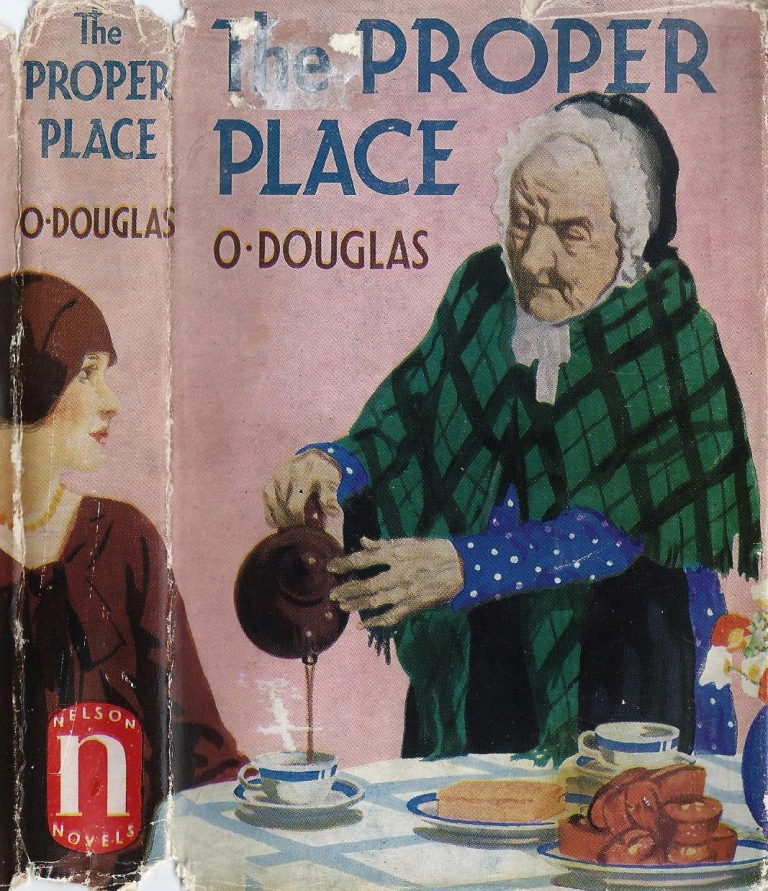
The Proper Place by O. Douglas (Pseudonym of Anna Buchan) ~ 1926. This edition: Nelson, no date, circa 1940s. Hardcover. 378 pages.

My rating: 9.5/10

This has been a week for seeking out “comfort reads”, and who better to provide such than the low-key Scottish writer, Anna Buchan. She wrote under the pseudonym O. Douglas, in order to modestly distance herself from her more prominent brother, the renowned thriller writer (and Governor-General of Canada from 1935 to 1940, when he died in office) John Buchan, a.k.a. Lord Tweedsmuir.

I am therefore dusting off and slightly editing this old post from July of 2012, in which I talk about one of my favourite O. Douglas novels, The Proper Place.

This is my favourite of Anna (writing as O. Douglas) Buchan’s  books which I’ve read to date. The first time I read this, I had already read the sequel, The Day of Small Things, so I knew what had happened to a great extent before the characters did, if that makes sense. But I think it enhanced rather than detracted from my reading experience; I came to the story with a pre-existing knowledge of and fondness for the characters and greatly enjoyed expanding my acquaintance with them.

As the story opens, the sole surviving offspring of the aristocratic Scottish Rutherfurd family, Nicole, is showing the family home to a prospective buyer. Of its twenty bedrooms, “twelve quite large, and eight small”, only three are now occupied; with Nicole’s two brothers perished in the Great War and her father dead soon after, the family now consists only of Nicole, her mother, Lady Jane, and a orphaned cousin, Barbara Burt, who was raised by Lady Jane from childhood.

The three women are finding it impossible to carry on financially, and have reluctantly but sensibly decided that their only option is to sell the Rutherfurd estate and establish themselves in more modest accommodations. Lady Jane has retreated into a gently passive acceptance of her fate; Barbara is resentful but more or less compliant, and Nicole is very much making the best of things and looking hard for a silver lining in their cloud of sorrow and difficult circumstances.

The prospective buyers, Mr. and Mrs. Jackson of Glasgow, having attained great wealth after many years of striving, are ready for the next step in their social advancement, and hope with their purchase of Rutherfurd Hall to establish their son Andy as a “county” gentleman.

This is where the story departs a bit from the expected norm. One would expect the nouveau riche Jacksons to be portrayed as interlopers and figures of mild scorn; instead we find that the author takes us into their world for a bit and gives an insight into their motivations and intentions that puts us fully on their side. Nicole herself, after her initial, well-hidden resentment, finds herself viewing out-spoken Mrs. Jackson first with quiet humour and soon after with sincere affection, with interesting repercussions further along in the story.

The Rutherfurds find a new home in the seaside town of Kirmeikle, and rent the old and stately but much more reasonably sized Harbour House for a year to see if they will adapt to the life of the town dweller, and to give themselves a bit of breathing space to ponder their futures. They are still very well-off, with sizeable incomes coming from their investments, and they enter easily into the upper strata of Kirkmeikle society.

For a story in which not much really happens, the author packs it full of likeable, often amusing characters, and quietly intriguing situations. Though the tone is relentlessly optimistic, somehow this tale escapes being “too sweet” by the pervasive presence of loss, grief and hardship resulting from the war, and by the occasionally pithy observations of many of the characters.

Nicole and Lady Jane are most decidedly our heroines throughout; Barbara is perhaps the least likeable character due to her deep-seated snobbishness and condescending attitude, but we get to know her well enough to understand the basis of her sometimes negative outlook. O. Douglas is a very fair-minded author; she always allows her characters the grace of a deep enough glimpse into their lives and thoughts to allow us to place their words and actions in full context; something I fully appreciated in this story.

I greatly enjoyed this book.

Another, very nicely written, much more detailed review is here, from the I Prefer Reading  blog of Lyn, from Melbourne, Australia. Lyn says everything I wanted to say, and much better!

http://preferreading.blogspot.ca/2010/09/proper-place-o-douglas.html

Read Full Post »

Here’s another Martin Armstrong poem I remembered when searching out the “Honey” poem. Marked in another one of our rather embarrasssingly large collection of vintage poetry anthologies is this gently humorous narrative poem. Some years ago we “collected” a number of Martin Armstrong poems and read them aloud to each other;  Miss Thompson was a favourite.

The time we spent together taking turns reading aloud is one of my favourite memories and one of the greatest joys of our homeschooling time. As everyone is now very much going their separate ways, read-aloud times are a thing of the past; I will need to wait for grandchildren now, I suppose… Hopefully some years in the future, but I find myself pleasantly anticipating a new audience of small rapt listeners, begging for “one more chapter!” Until then, I’m still adding to the story and poetry collections. But I think I may track down a family member or two and see if they would like to indulge in a nostalgic read-aloud session, just to humour their sentimental mom…

MISS THOMPSON GOES SHOPPING

Miss Thompson at Home

In her lone cottage on the downs,
With winds and blizzards and great crowns
Of shining cloud, with wheeling plover
And short grass sweet with the small white clover,
Miss Thompson lived, correct and meek,
A lonely spinster, and every week
On market-day she used to go
Into the little town below,
Tucked in the great downs’ hollow bowl
Like pebbles gathered in a shoal.

She goes a-Marketing

So, having washed her plates and cup
And banked the kitchen-fire up,
Miss Thompson slipped upstairs and dressed,
Put on her black (her second best),
The bonnet trimmed with rusty plush,
Peeped in the glass with simpering blush,
From camphor-smelling cupboard took
Her thicker jacket off the hook
Because the day might turn to cold.
Then, ready, slipped downstairs and rolled
The hearthrug back; then searched about,
Found her basket, ventured out,
Snecked the door and paused to lock it
And plunge the key in some deep pocket.
Then as she tripped demurely down
The steep descent, the little town
Spread wider till its sprawling street
Enclosed her and her footfalls beat
On hard stone pavement, and she felt
Those throbbing ecstasies that melt
Through heart and mind, as, happy, free,
Her small, prim personality
Merged into the seething strife
Of auction-marts and city life.

She visits the Boot-maker.

Serenely down the busy stream
Miss Thompson floated in a dream.
Now, hovering bee-like, she would stop
Entranced before some tempting shop,
Getting in people’s way and prying
At things she never thought of buying:
Now wafted on without an aim,
Until in course of time she came
To Watson’s bootshop. Long she pries
At boots and shoes of every size —
Brown football-boots with bar and stud
For boys that scuffle in the mud,
And dancing-pumps with pointed toes
Glossy as jet, and dull black bows;
Slim ladies’ shoes with two-inch heel
And sprinkled beads of gold and steel —
‘How anyone can wear such things!’
On either side the doorway springs
(As in a tropic jungle loom
Masses of strange thick-petalled bloom
And fruits mis-shapen) fold on fold
A growth of sand-shoes rubber-soled,
Clambering the door-posts, branching, spawning
Their barbarous bunches like an awning
Over the windows and the doors.
But, framed among the other stores,
Something has caught Miss Thompson’s eye
(O worldliness! O vanity!),
A pair of slippers — scarlet plush.
Miss Thompson feels a conscious blush
Suffuse her face, as though her thought
Had ventured further than it ought.
But O that colour’s rapturous singing
And the answer in her lone heart ringing!
She turns (O Guardian Angels, stop her
From doing anything improper!)
She turns; and see, she stoops and bungles
In through the sand-shoes’ hanging jungles,
Away from light and common sense,
Into the shop dim-lit and dense
With smells of polish and tanned hide.

Mrs. Watson

Soon from a dark recess inside
Fat Mrs. Watson comes slip-slop
To mind the business of the shop.
She walks flat-footed with a roll —
A serviceable, homely soul,
With kindly, ugly face like dough,
Hair dull and colourless as tow.
A huge Scotch pebble fills the space
Between her bosom and her face.
One sees her making beds all day.
Miss Thompson lets her say her say:
‘So chilly for the time of year.
It’s ages since we saw you here.’
Then, heart a-flutter, speech precise,
Describes the shoes and asks the price.
‘Them, Miss? Ah, them is six-and-nine.’
Miss Thompson shudders down the spine
(Dream of impossible romance).
She eyes them with a wistful glance,
Torn between good and evil. Yes,
Wrestles with a Temptation;

For half-a-minute and no less
Miss Thompson strives with seven devils,
Then, soaring over earthly levels

And is Saved

Turns from the shoes with lingering touch —
‘Ah, six-and-nine is far too much.
Sorry to trouble you. Good day!’

She visits the Fish-monger

A little further down the way
Stands Miles’s fish-shop, whence is shed
So strong a smell of fishes dead
That people of a subtler sense
Hold their breath and hurry thence.
Miss Thompson hovers there and gazes:
Her housewife’s knowing eye appraises
Salt and fresh, severely cons
Kippers bright as tarnished bronze:
Great cods disposed upon the sill,
Chilly and wet, with gaping gill,
Flat head, glazed eye, and mute, uncouth,
Shapeless, wan, old-woman’s mouth.
Next a row of soles and plaice
With querulous and twisted face,
And red-eyed bloaters, golden-grey;
Smoked haddocks ranked in neat array;
A group of smelts that take the light
Like slips of rainbow, pearly bright;
Silver trout with rosy spots,
And coral shrimps with keen black dots
For eyes, and hard and jointed sheath
And crisp tails curving underneath.
But there upon the sanded floor,
More wonderful in all that store
Than anything on slab or shelf,
Stood Miles, the fishmonger, himself.

Mr. Miles

Four-square he stood and filled the place.
His huge hands and his jolly face
Were red. He had a mouth to quaff
Pint after pint: a sounding laugh,
But wheezy at the end, and oft
His eyes bulged outwards and he coughed.
Aproned he stood from chin to toe.
The apron’s vertical long flow
Warped grandly outwards to display
His hale, round belly hung midway,
Whose apex was securely bound
With apron-strings wrapped round and round.
Outside, Miss Thompson, small and staid,
Felt, as she always felt, afraid
Of this huge man who laughed so loud
And drew the notice of the crowd.
Awhile she paused in timid thought,
Then promptly hurried in and bought
‘Two kippers, please. Yes, lovely weather.’
‘Two kippers? Sixpence altogether:’
And in her basket laid the pair
Wrapped face to face in newspaper.

Relapses into Temptation

Then on she went, as one half blind,
For things were stirring in her mind;
Then turned about with fixed intent
And, heading for the bootshop, went
And Falls.
Straight in and bought the scarlet slippers
And popped them in beside the kippers.

She visits the Chemist

So much for that. From there she tacked,
Still flushed by this decisive act,
Westward, and came without a stop
To Mr. Wren the chemist’s shop,
And stood awhile outside to see
The tall, big-bellied bottles three —
Red, blue, and emerald, richly bright
Each with its burning core of light.
The bell chimed as she pushed the door.
Spotless the oilcloth on the floor,
Limpid as water each glass case,
Each thing precisely in its place.
Rows of small drawers, black-lettered each
With curious words of foreign speech,
Ranked high above the other ware.
The old strange fragrance filled the air,
A fragrance like the garden pink,
But tinged with vague medicinal stink
Of camphor, soap, new sponges, blent
With chloroform and violet scent.

Mr. Wren.

And Wren the chemist, tall and spare,
Stood gaunt behind his counter there.
Quiet and very wise he seemed,
With skull-like face, bald head that gleamed;
Through spectacles his eyes looked kind.
He wore a pencil tucked behind
His ear. And never he mistakes
The wildest signs the doctor makes
Prescribing drugs. Brown paper, string,
He will not use for any thing,
But all in neat white parcels packs
And sticks them up with sealing-wax.
Miss Thompson bowed and blushed, and then
Undoubting bought of Mr. Wren,
Being free from modern scepticism,
A bottle for her rheumatism;
Also some peppermints to take
In case of wind; an oval cake
Of scented soap; a penny square
Of pungent naphthaline to scare
The moth. And after Wren had wrapped
And sealed the lot, Miss Thompson clapped
Them in beside the fish and shoes;
‘Good day,’ she says, and off she goes.
Is Led away to the Pleasure of the Town,
Beelike Miss Thompson, whither next?
Outside, you pause awhile, perplext,
Your bearings lost. Then all comes back
Such as Groceries and Millinery,
And round she wheels, hot on the track
Of Giles the grocer, and from there
To Emilie the milliner,
There to be tempted by the sight
Of hats and blouses fiercely bright.
(O guard Miss Thompson, Powers that Be,
From Crudeness and Vulgarity.)

And other Allurements

Still on from shop to shop she goes
With sharp bird’s-eye, enquiring nose,
Prying and peering, entering some,
Oblivious of the thought of home.
The town brimmed up with deep-blue haze,
But still she stayed to flit and gaze,
Her eyes ablur with rapturous sights,
Her small soul full of small delights,
Empty her purse, her basket filled.

But at length is Convinced of Indiscretion
The traffic in the town was stilled.
The clock struck six. Men thronged the inns.
Dear, dear, she should be home long since.

And Returns Home

Then as she climbed the misty downs
The lamps were lighted in the town’s
Small streets. She saw them star by star
Multiplying from afar;
Till, mapped beneath her, she could trace
Each street, and the wide square market-place
Sunk deeper and deeper as she went
Higher up the steep ascent.
And all that soul-uplifting stir
Step by step fell back from her,
The glory gone, the blossoming
Shrivelled, and she, a small, frail thing,
Carrying her laden basket. Till
Darkness and silence of the hill
Received her in their restful care
And stars came dropping through the air.

But loudly, sweetly sang the slippers
In the basket with the kippers;
And loud and sweet the answering thrills
From her lone heart on the hills.

Martin Armstrong, 1921

Read Full Post »

 HONEY HARVEST

Late in March, when the days are growing longer
And sight of early green
Tells of the coming spring and suns grow stronger,
Round the pale willow-catkins there are seen
The year’s first honey-bees
Stealing the nectar: and bee-masters know
This for the first sign of the honey-flow.

Then in the dark hillsides the Cherry-trees
Gleam white with loads of blossom where the gleams
Of piled snow lately hung, and richer streams
The honey. Now, if chilly April days
Delay the Apple-blossom, and the May’s
First week come in with sudden summer weather,
The Apple and the Hawthorn bloom together,
And all day long the plundering hordes go round
And every overweighted blossom nods.
But from that gathered essence they compound
Honey more sweet than nectar of the gods.

Those blossoms fall ere June, warm June that brings
The small white Clover. Field by scented field,
Round farms like islands in the rolling weald,
It spreads thick-flowering or in wildness springs
Short-stemmed upon the naked downs, to yield
A richer store of honey than the Rose,
The Pink, the Honeysuckle. Thence there flows
Nectar of clearest amber, redolent
Of every flowery scent
That the warm wind upgathers as he goes.

In mid-July be ready for the noise
Of million bees in old Lime-avenues,
As though hot noon had found a droning voice
To ease her soul. Here for those busy crews
Green leaves and pale-stemmed clusters of green strong flowers
Build heavy-perfumed, cool, green-twilight bowers
Whence, load by load, through the long summer days
They fill their glassy cells
With dark green honey, clear as chrysoprase,
Which housewives shun; but the bee-master tells
This brand is more delicious than all else.

In August-time, if moors are near at hand,
Be wise and in the evening-twilight load
Your hives upon a cart, and take the road
By night: that, ere the early dawn shall spring
And all the hills turn rosy with the Ling,
Each waking hive may stand
Established in its new-appointed land
Without harm taken, and the earliest flights
Set out at once to loot the heathery heights.

That vintage of the Heather yields so dense
And glutinous a syrup that it foils
Him who would spare the comb and drain from thence
Its dark, full-flavoured spoils:
For he must squeeze to wreck the beautiful
Frail edifice. Not otherwise he sacks
Those many-chambered palaces of wax.

Then let a choice of every kind be made,
And, labelled, set upon your storehouse racks —
Of Hawthorn-honey that of almond smacks:
The luscious Lime-tree-honey, green as jade:
Pale Willow-honey, hived by the first rover:
That delicate honey culled
From Apple-blossom, that of sunlight tastes:
And sunlight-coloured honey of the Clover.
Then, when the late year wastes,
When night falls early and the noon is dulled
And the last warm days are over,
Unlock the store and to your table bring
Essence of every blossom of the spring.
And if, when wind has never ceased to blow
All night, you wake to roofs and trees becalmed
In level wastes of snow,
Bring out the Lime-tree-honey, the embalmed
Soul of a lost July, or Heather-spiced
Brown-gleaming comb wherein sleeps crystallised
All the hot perfume of the heathery slope.
And, tasting and remembering, live in hope.

Martin Armstrong, 1920

After waiting many years for its maturing enough to finally blossom, the linden tree we planted to commemorate our teenage daughter’s birth is loaded with clusters of intoxicatingly fragrant “lime-flowers”. It is also alive with insects – honey-, bumble- and other wild bees; ants, wasps, and butterflies- a veritable cloud of sound and activity. Today it hit 32°Celsius measured in the shade – very high summer indeed, and all of the honey makers and nectar drinkers are out in full force.

My son works with a local beekeeper, and we are so very fortunate in our ready access to the very freshest and most delectable local honey. Here is a photo they snapped a few weeks ago at the peak of the dandelion nectar flow; I thought it was appropriate to this favourite old poem. An ode to the abiding mystery of honeybees, and the product of their diligent labours!

Read Full Post »

« Newer Posts - Older Posts »