Archive for the ‘1920s’ Category

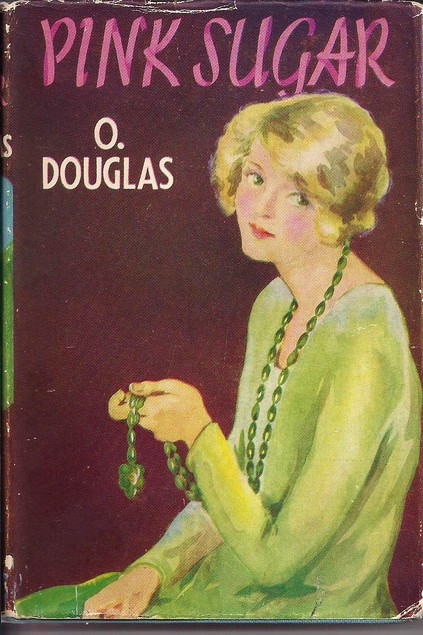
pink sugar o douglas anna buchanPink Sugar by O. Douglas ~ 1924. This edition: Hodder and Stoughton, 1936. Hardcover. 312 pages.

My rating: 7.5/10

A rather sweet book, but not mawkishly so in the way the title suggests. I wasn’t sure what to expect from this one, but I came away feeling beautifully contented, in an “all’s right in that fictional world” sort of way. The heroine sorted herself out nicely, and we have high hopes for her future if she can just retain that hard-won sensibility to the absurdity of playing Lady Bountiful to an oblivious populace!

I guess I should backtrack a bit, and summarize the plot for those of you not already familiar with this gentle novel.

“Spinster without encumbrances” Kirsty Gilmour is thirty and a free woman for the first time in her life, after the recent death of her stepmother, a woman described as “sweet and friendly and quite intolerable”. The second Lady Gilmour was an absolutely selfish creature whom Kirsty has stuck with from charitable impulse and deep inner goodness – Kirsty is the inheritor of her late father’s fortune, and has financially supported and accompanied her stepmother through that woman’s preferred social whirl in the years since Sir Gilmour’s death.

Kirsty’s older friend, Blanche Cunningham, reminisces about the unregretted Lady Gilmour.

Thinking of Lady Gilmour, Blanche was conscious again of the hot wave of dislike that had so often engulfed her when she had come across that lady in life. She remembered the baby-blue eyes, the appealing ways, the smooth sweet voice that could say such cruel things, the too red lips, the faint scent of violets that had clung to all of her possessions, the carefully thought out details of all she wore, her endless insistent care of herself and her own comfort, her absolute carelessness as to the feelings of others…

‘Kirsty,’ Blanche laid her hand on her friend’s arm. ‘However did you stand it all those years? What an intolerable woman she was!’

Kirsty sat looking in front of her.

‘She’s dead,’ was all she said.

‘Well,’ Mrs. Cunningham retorted briskly, ‘being dead doesn’t make people any nicer, does it?’

Now, freed of the superficial social whirl, Kirsty has joyously fled to the country, her true emotional habitat and the place of her birth, to the Borders of Scotland, to the little village of Muirburn, just outside of Priorsford.  (O. Douglas aficionados will recognize the reference.) Here she has rented a house, “Little Phantasy”, on the grounds of a larger estate. The manor house itself, rather quaintly named “Phantasy”,  is the abode of curmudgeonly bachelor Colonel Home, forty-ish and set in his ways, by all accounts. Kirsty doesn’t expect to see much of him, and is rather glad of that.

Kirsty has decided that she will now embrace the country life, and that she will devote herself, in true “good spinsterish” fashion, to “living for others”. Sensible Blanche rolls her eyes at this, and tells Kirsty not to be silly, but Kirsty means this in the very best way, taking under her wing as soon as possible a number of  dependents. First comes elderly Aunt Fanny, mild and gentle and perpetually knitting, and then the three motherless children of Blanche’s sister, for an extended rural stay while their recently widowed father travels abroad “to forget his grief”.

Kirsty’s foray into country life is not as smooth as anticipated, and she soon finds that people don’t necessarily like to be “lived for”; some of her most well-meant patronages are soundly snubbed, but there is enough encouragement that she soldiers on. Her tenacity and truly well-meaning sweet nature win over the most resentful of those around her. Kirsty was initially viewed as a frivolous bit of a thing, merely playing at enjoying her new role as householder and surrogate mother to the adorable Barbara and Specky, and the wickedly appealing “Bad” Bill, but as the months go by it is apparent that Kirsty’s innate inner goodness and staunch Scottish good sense will see her settled down and competently filling an important niche in Muirburn society, though not the role that she initially saw herself in.

There are some lovely character portraits in this appealing tale, and I will pass you along to several other reviewers, who also found much to admire in this pleasing novel. Please visit and read these excellent reviews, if you are at all intrigued by what I have said above. (And browse around the blogs a bit while you’re there – there are many more authors and titles highlighted worthy of rediscovery!)

The Book Trunk – Pink Sugar

Letters From a Hill Farm – Pink Sugar

I Prefer Reading – Pink Sugar

Pink Sugar was republished by Greyladies in 2009, and though that edition appears to be currently out of print, it should still be fairly easy to acquire through the second hand book trade. The novel was very popular in its day – my own copy is a vintage 1936 edition, stating that it is the twenty-first printing – so there are many still circulating around at reasonable prices.

Read Full Post »

the man in the brown suit agatha christie 8

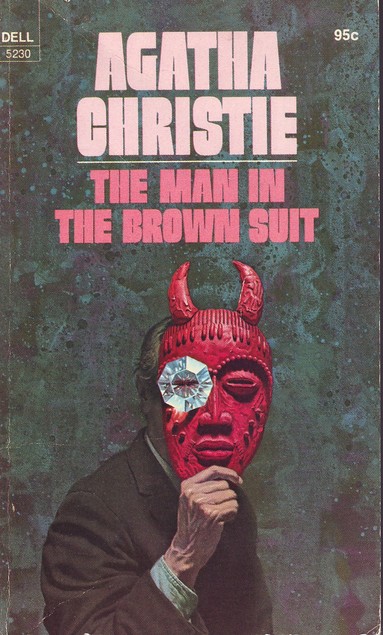
The paperback cover of my high school era copy. The mask and faceted diamond are an interesting depiction; neither appears in the story so we’ll have to assume that their presence is purely symbolic.

The Man in the Brown Suit by Agatha Christie ~ 1924. This edition: Dell, 1974. Paperback. ISBN: 440-05230. 223 pages.

My Rating: 8.5/10

Setting: London; the steamship Kilmorden Castle en route to Africa; South Africa; Rhodesia.

Detection by: MISS ANNE BEDDINGFELD; the strong, silent and slightly mysterious COLONEL RACE makes a first appearance.

Final Body Count: 2

Method(s) of Death: FALLING UNDER A TRAIN; STRANGLING

100 Word Plot Summary:

Newly orphaned archaeologist’s daughter Anne Beddingfeld is off to see the world. After witnessing a gruesome and fatal “accident”, following a suspected murderer, and finding a mysterious clue on a scrap of paper, Anne sets sail for South Africa. Sinister happenings ensue, but her newly acquired paternalistic protector, Sir Eustace, will surely see that she comes to no permanent harm. But which of the two masterful men sharing the voyage, Colonel Race and the elusive Man in the Brown Suit, can she trust? Who strangled the dancer Nadina back in England? And what about that film canister of raw diamonds?

*****

This is another thriller versus a simple murder-mystery story. While there are two suspicious deaths, one of which is an undeniably hands-on murder (a celebrated dancer is strangled in an empty English country house), the focus of the action is not so much on the details of that death, but rather of a much larger picture involving a mysterious master criminal, two young Englishmen possibly unjustly charged with diamond theft from a Kimberley mine, a rather sketchily described African political conflict, and the impetuous adventures of one Anne Beddingfeld as she seeks to discover the true identity of the seemingly sinister “Man in the Brown Suit”.

The story opens with a short Parisian episode, with a celebrated Russian dancer, Nadina, being visited in her dressing room.

The dancer stretched out a languid hand, but at the sight of the name on the card, Count Sergius Paulovitch, a sudden flicker of interest came into her eyes.

“I will see him. The maize peignoir, Jeanne, and quickly. And when the Count comes, you may go.”

Bien, Madame.”

Jeanne brought the peignoir, an exquisite wisp of corn-coloured chiffon and ermine. Nadina slipped into it, and sat smiling to herself, while one long white hand beat a slow tattoo on the glass of the dressing table.

The Count was prompt to avail himself of the privilege accorded to him – a man of medium height, very slim, very elegant, very pale, extraordinarily weary. In feature, little to take hold of, a man difficult to recognize again if one left his mannerisms out of account. He bowed over the dancer’s hand with exaggerated courtliness.

“Madame, this is a pleasure indeed.”

So much Jeanne heard before she went out, closing the door behind her. Alone with her visitor, a subtle change came over Nadina’s smile.

“Compatriots though we are, we will not speak Russian, I think,” she observed.

“Since we neither of us know a word of the language, it might be as well,” agreed her guest…

The two go on to discuss the imminent retirement of their joint employer, a master criminal known only as “The Colonel”. About to be cut adrift without his direction, Nadina in particular is fomenting a scheme to ensure her future well-being and wealth; the Count warns her of the dangers of double-crossing such a clever man; and on that note we embark on the main narrative.

Young (twentyish) Anne Beddingfeld introduces herself in Chapter Two; she is writing in her diary, and it is in this diarist’s voice that half of the story is told. The other half is told by a certain Sir Eustace Pedlar, writing in turn in his diary; a parallel tale emerges as Anne and Sir Eustace find themselves sharing a voyage to South Africa, and then a train journey to Rhodesia.

Anne has been left rather suddenly orphaned by her archeologist father’s sudden death; her father’s solicitor offers her a temporary home, and so she finds herself in London, rather at loose ends. Witnessing the tragic death of a man in the Underground – he steps backward off the edge of the platform just as a train is coming in – Anne notes that the bystander who professes to be a doctor is rather quite professionally going through the dead man’s pockets. When a slip of paper flutters to the ground, Anne picks it up, and, following investigation of the clue it gives her, ends up a passenger on a steamship bound for South Africa.

Here Anne’s natural charm and appealing appearance bring her several benevolent protectors, in the form of wealthy Mrs. Blair, the strong, silent, and very manly Colonel Race, and a jocular British M.P., Sir Eustace Pedlar, who is travelling to South Africa to investigate some vague political situation; something about labour unrest, which has an improbable part to play in the latter stages of the story. And protectors it appears are needed, as Anne is thrown into repeated contact with a belligerent and dangerous young man, who seeks refuge in Anne’s cabin one night, hides from a searcher, and leaves without explanation and minus some blood from an apparent fresh wound. He reappears in the guise of one of Sir Eustace’s secretaries, but not much secretarying appears to be happening, and Anne begins to suspect that he is instead an escaping murderer, fleeing England after strangling a woman (later identified as the dancer Nadina) in Sir Eustace’s unoccupied country mansion, Mill House.

Much activity ensues, before all becomes clear and the identity of “The Colonel” is determined and the details of the Mill House murder revealed. Oh, yes, there are also quantities of uncut diamonds floating about, first appearing in a film canister dropped through Anne’s transom one night early in her journey. These are the object of a number of increasingly desperate searches, but Anne cleverly manages to keep their location suppressed until the crucial moment.

This is a rather fun story to read; Anne’s travels are described in vivid detail, and understandably so, as they are taken from the real-life, ten-month, round-the-world journey which Agatha Christie and her husband took in 1922 , travelling in the entourage of British businessman Major Belcher to South Africa, and onwards to Australia, New Zealand, Hawaii, Canada and back to Britain.

There is abundant romance, predictable as the sun rising, and a lavish amount of melodrama. Anne is buffeted about but always manages to rise up in one piece; she is threatened, assaulted, kidnapped, tied up, lured into falling off a cliff (over the brink of Victoria Falls, no less!), and shot at, before finding true love and lasting happiness in a suitably exotic locale.

Though the reader is expected to take a lot of the shaky plot on faith, the writer obviously had a grand time developing her rambunctiously improbable tale; this was one of Agatha Christie’s favourites among her early stories, “more fun” to write (according to her autobiography) than her detective novels. It shows. The Man in the Brown Suit was one of the first Christies I read, and it remains one of my sentimental favourites, though I notice my sympathy for Anne’s romantic yearnings has lessened a bit, perhaps because I am now well out of my teens!

On to our cover gallery.

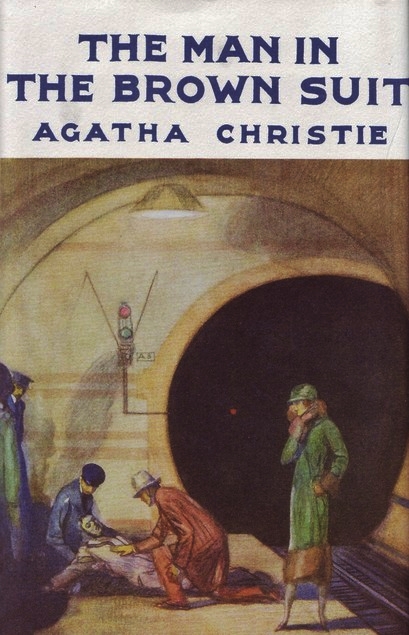
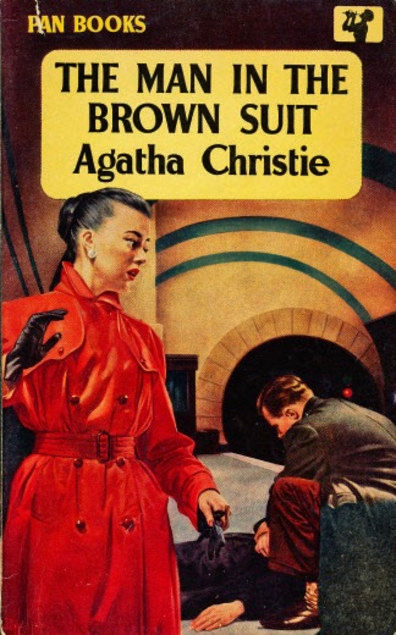
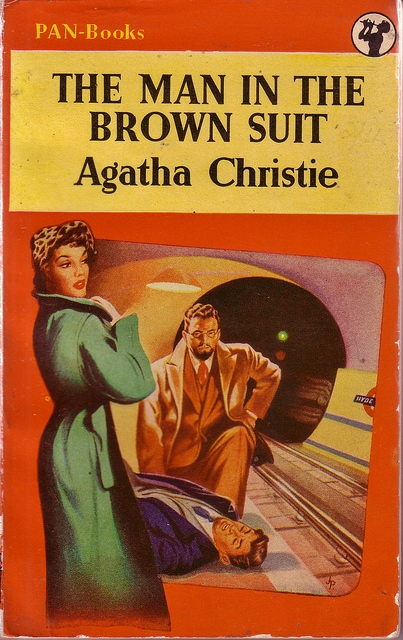
An early edition dustjacket, showing the incident which starts Anne on her merry way. Glaring error: Anne has black hair in the narrative; she looks pretty fair in this picture!

An early edition dust jacket, showing the incident which starts Anne on her merry way. Illustrator’s error: Anne has a mane of long black hair in the narrative; she looks pretty fair in this picture, don’t you think? (Or, on second glance, perhaps that is a fur collar?)

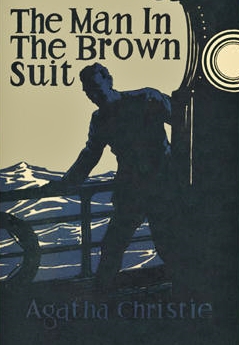
Another early dust jacket, this one circa 1926. Suitably mysterious!

Another early dust jacket, this one circa 1926. Suitably mysterious!

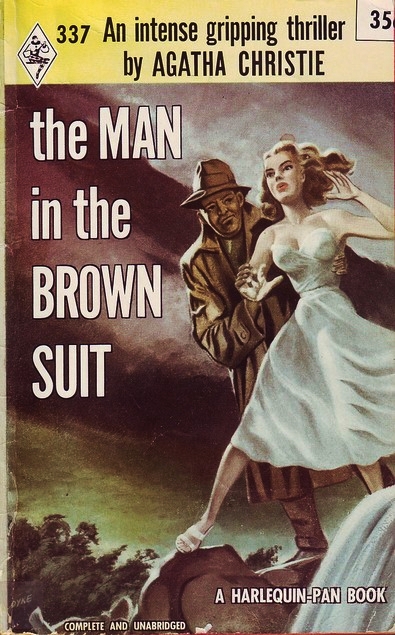
Not quite sure what this illustration is depicting; obviously the Victoria Falls episode, but the details don't match the incident as described by the author. (Plus her hair is all wrong.) But in that dress, who's to notice a mere detail like hair colour, nudge nudge wink wink?!

Not quite sure what this illustration is depicting; obviously the Victoria Falls episode, but the details don’t match the incident as described by the author. (Plus her hair is all wrong.) But in that dress, who’s to notice a mere detail like hair colour, nudge nudge wink wink?!

This one appears to be illustrated by someone who actually read the book. Anne is depicted in her London phase, hair (of the correct shade) dragged back unflatteringly in order to minimize her attractiveness as a courtesy to her reluctant hostess.

This one appears to be illustrated by someone who actually read the book. Anne is depicted in her London phase, hair (of the correct shade) dragged back unflatteringly in order to minimize her attractiveness as a courtesy to her reluctant hostess.

The illustrator did a good job with the mysterious brown-suited man, but bobbled (yet again!) on the heroine's hair colour.

The illustrator did a good job with the mysterious brown-suited man – who incidentally looks a lot like one of my in-laws during a gently regrettable bearded phase some years ago – with Anne showing a suitably shocked countenance. Not quite sure on the hair; it might be right; can’t really tell, so the artist gets a pass.

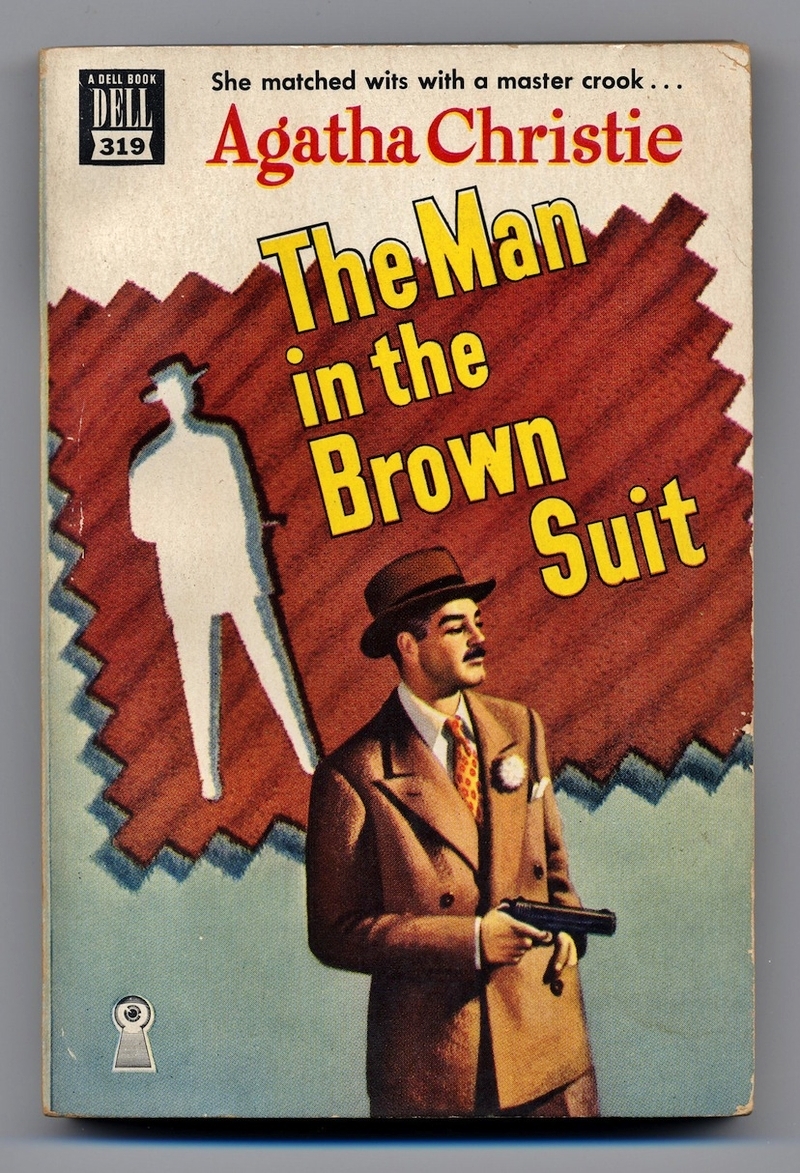
I like this one - a bit different, isn't it? Nice bit of graphic design.

I quite like this one – a bit different, isn’t it? Nice bit of vintage cover graphic design.

Read Full Post »

Tthe murder on the links agatha christie 1he Murder on the Links by Agatha Christie ~ 1923. This edition: Dell, 1967. Paperback. 224 pages.

My Rating: 7.5/10

Setting: Mostly in the vicinity of Merlinville, France, at the estate of expatriate English millionaire Mr. Renauld.

Detection by: HERCULE POIROT with continual accompaniment and occasional assistance by CAPTAIN HASTINGS. A fellow detective, MONSIEUR GIRAUD of the Paris Sûreté, is in official charge of the case; he and Poirot despise each other instantly.

Final Body Count: 2

Method(s) of Death: STABBING – both times with a paper knife made from airplane wire. (But all may be not as it as first seems.)

100 Word Plot Summary:

Hercule Poirot receives a panicked letter from an English millionaire living in France: “For God’s sake, come!” Poirot and Hasting hasten to France, but arrive mere hours after Mr. Renauld’s stabbed corpse is found, in a half-dug grave on the unfinished golf course next to his estate. Mrs. Renauld is found bound and gagged in her bedroom; two bearded thugs are the suspects. But why can’t they be tracked? Why was the dead man’s son secretly in the neighbourhood that night? And what is the connection with a number of beautiful women who continually pop up, including Hastings’ latest crush?

*****

The author hits her stride with this excellent murder mystery, packed as full of red herrings as a 1920s’ millionaire’s wall safe is of banknotes. (Or secret documents.) And yes, this time we are dallying with a millionaire, albeit a very dead one, with a suitably convoluted past.

Captain Hastings and Hercule Poirot, after forging a friendship while jointly dealing with The Mysterious Affair at Styles, are now sharing a London flat. Hastings is acting as a private secretary to a M.P., while Poirot employs himself as a private detective, chasing down lost lap dogs and stolen pearls for the wealthy dowager classes. Neither is particularly content with the status quo, so when a letter comes from a certain wealthy financier, Mr Renauld, formerly of England, Canada and Chile, now residing in France, referring to his life being in danger and a secret that he possesses, and begging for Poirot’s immediate aid, the bait is taken.

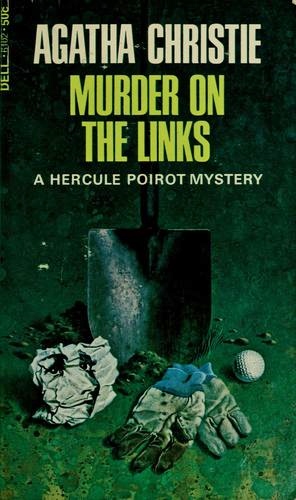
Across the Channel they go, only to find that they are mere hours too late. Mr. Renault is already dead, stabbed and left to die in a partially dug grave on the golf course under construction next to his country estate. (And, or the record, the site of the murder is the only connection this story has to golf in any way, shape or form. Please ignore all of the lurid paperback covers one will find with the body dressed in plus fours, or with a golf club or golf balls or any such nonsense. No one has played on the course yet! It is under construction! The title picks up on the most minor element of the story; careless illustrators assume something which isn’t in the story.)

Where was I? Oh, yes. The plot.

So: Mr Renauld is dead; his wife has been found tied and gagged in their bedroom. She claims that two bearded men tied her up and abducted her husband, and at first the story seems plausible, especially after Mrs. Renault faints in an excess of emotion after viewing her husband’s body. But there are just a few loose ends. Where did the bearded men come from, and where have they vanished to? What is the “secret” referred to in the letter to Poirot, and by the abductors? What part did the Renauld’s son Jack play in the events of the day leading up to the murder? Why is the elegantly mysterious neighbour’s beautiful daughter so anxious? Who was really dallying with the lovely young acrobat whom Hastings has already met back in England, and who shows up most unexpectedly at the site of the murder? And what’s all this about a SECOND body???!

The characters in general are not particularly sympathetic or memorable; the victim(s) and the criminal(s) appear as stereotyped set pieces, included merely to move the puzzle along. The egotistical French detective, Monsieur Giraud, pops in and out to sneer at Poirot and muddle the clues, but I could not even bring myself to dislike or scorn him; he just “was”, as manufactured a plot element as the murdered man, himself merely a lay figure labelled “the body”. The person I liked the most here was Poirot himself; I came away from this story with an increased appreciation both for his intelligence and his sense of humour. Hastings appears even more of a buffoon in this novel than he did in the Styles case; his actions in several cases act in direct opposition to the true murderer being discovered, at least in the short term. His romantic impulses were in full bloom throughout; only Poirot’s continual gentle mockery kept them in perspective to the reader, if not to Hastings himself.

Agatha Christie in this, only her third mystery novel, creates a most convoluted plot. She provides all of the needed clues, holding nothing back, but it will be a clever reader who guesses the true solution before the big reveal at the end. I had read this novel several times in the past, but even then could not quite get it sorted out until the final events, when my memory revived and I said to myself, “Of course!” Click, click, click, and it all makes a completed picture.

Final analysis: a strong puzzle mystery, well thought out, and an enjoyable light read ninety years after its first appearance.

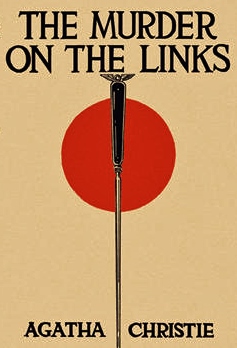
Elegantly simple is this first edition cover from 1923.

Elegantly simple is this first edition cover from 1923. (And not a golf ball in sight!)

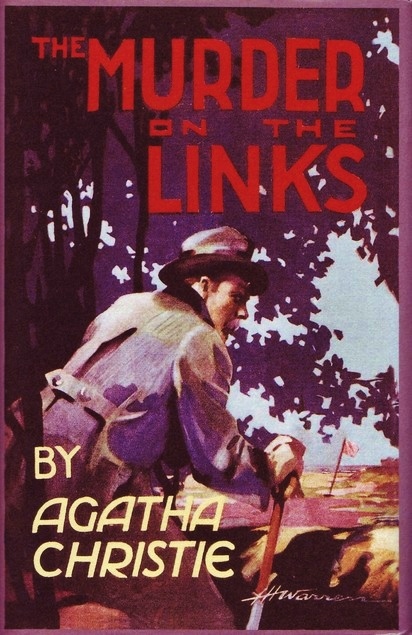
This is another 1920s' cover, nicely indicative of the plot within.

This is another 1920s’ cover, nicely indicative of the plot within, though I have my qualms about that flag on the golf course; it really shouldn’t be there, considering that the links are still under construction, and no one is golfing there yet.

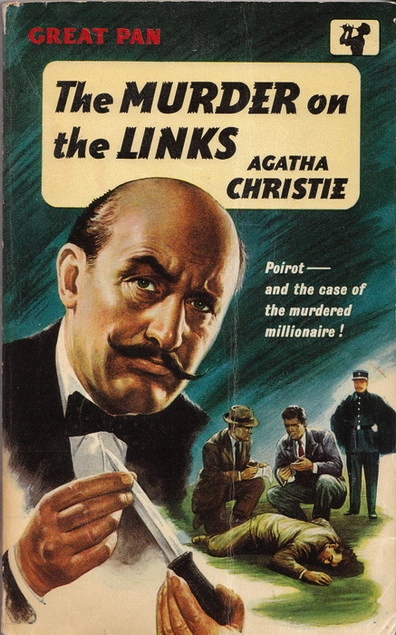
Jumping ahead several decades, this paperback cover at least does not include a golf ball. Our brilliant detective features prominently, little grey cells working furiously, one would assume from his serious expression.

Jumping ahead several decades, this paperback cover at least does not include a golf ball. Our brilliant detective features prominently, little grey cells working furiously, or so one would assume from his serious expression. My only major issue with this one is the dagger itself; in the story it is a letter opener made of airplane wire, a war souvenir. Check out the first cover for what it might really look like.

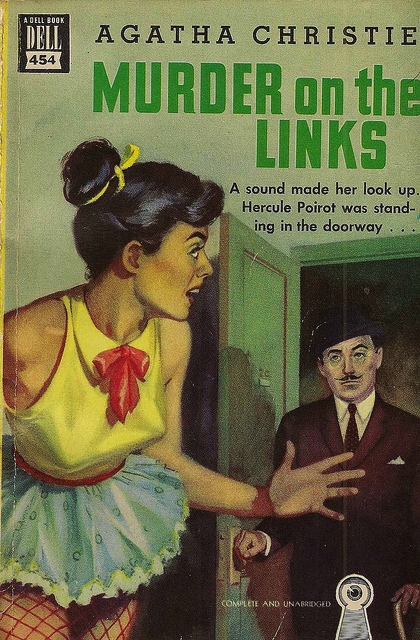
Ooh, la, la! Poirot confronts one of the beautiful women who so abundantly decorate the story. This particular one is Hastings' acrobatic charmer. I am rather uneasy about the era-correct authenticity of that stage costume, but I doubt it was a strong consideration with the artist; he was more interested in the physical attributes of the girl in question, don't you think?

Ooh, la, la! Poirot confronts one of the beautiful women who so abundantly decorate the story. This particular one is Hastings’ acrobatic charmer. I am rather uneasy about the era-correct authenticity of that stage costume, but I doubt it was a strong consideration with the artist; he was more interested in the physical attributes of the girl in question, don’t you think?

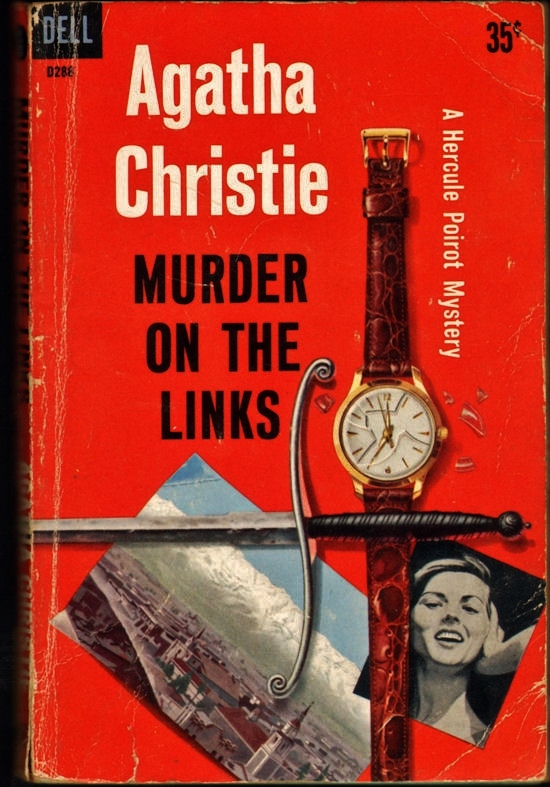
A nice collection of clues presented here, in this still more recent (1970s, perhaps) paperback cover.

A nice collection of clues presented here, in this still more recent (1960s, perhaps) paperback cover.

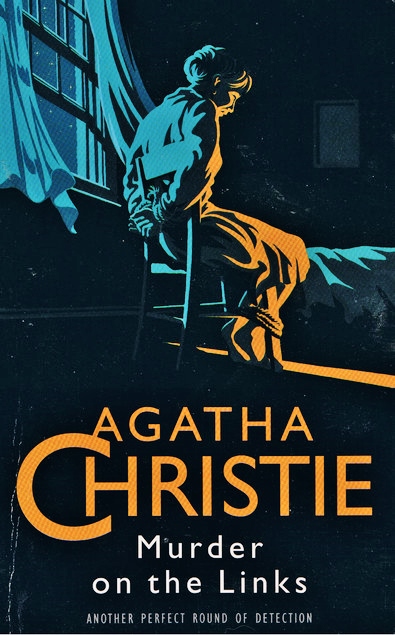
A modern cover illustration, very classy in its detailed simplicity, and focussing on a key plot element which other cover illustrators have seemingly ignored until now.

A modern cover illustration, very classy in its simplicity, and focussing on a key plot element which other cover illustrators have seemingly ignored until now. (There’s no gag, though – my only complaint. Details, details!)

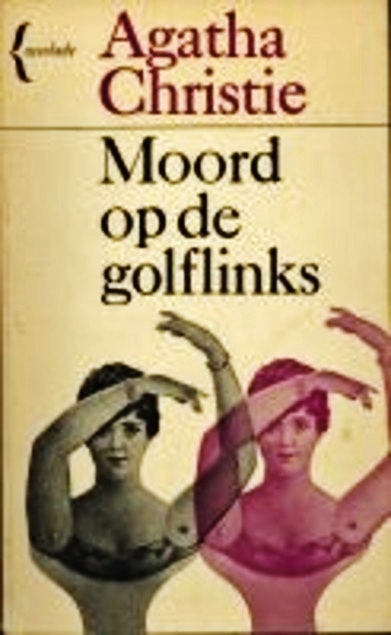
And here, as a sort of cover illustration bonus, is a Dutch cover illustration. This is a very clever one indeed, and the cover designer picked up on a major clue, which you will appreciate once you've finished the story. Very nice, and possibly y favourite cover of all, right up there with the simple dagger of the first edition pictured at the start of this cover art gallery.

And here, as a bonus, is a Dutch cover illustration. This is quite clever, and the illustrator picked up on a major clue, which you will appreciate once you’ve finished the story. Very nice, and possibly one of my favourites, right up there with the simple dagger of the first edition pictured at the start of this cover art gallery.

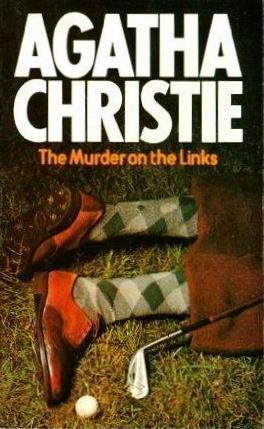
And here, at the bottom of the collection, is an entry for the Hall of Cover Illustration Shame. A completely wrong depiction of the scenario and the corpse. Maddening!

Now for an entry for the Hall of Cover Illustration Shame. A completely wrong depiction of the scenario and the corpse. Maddening!

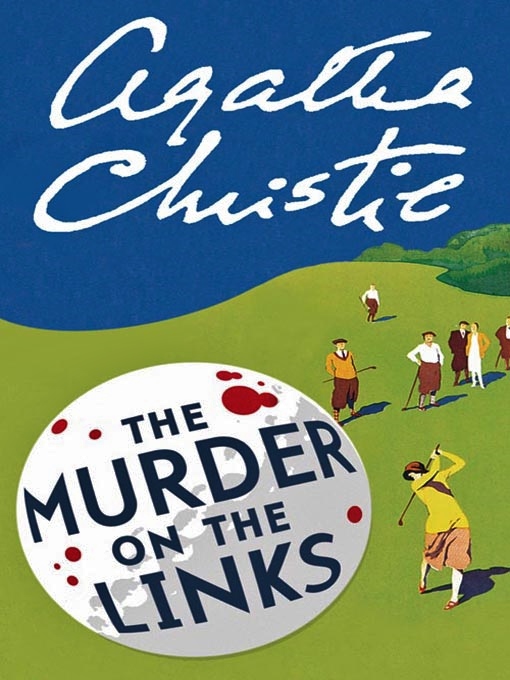
And this contemporary illustration, which gets it completely wrong as well. The only thing the least bit appropriate is the period attire, but otherwise the picture is completely foreign to the novel. Boo, hiss.

Also shameful is this contemporary illustration, which gets it completely wrong as well. The only thing the least bit appropriate is the period attire, but otherwise the picture is completely foreign to the novel. Boo, hiss.

Read Full Post »

the secret adversary agatha christie 2The Secret Adversary by Agatha Christie ~ 1922. This edition: Bantam, 1986. Paperback. ISBN: 0-553-26477-X.  215 pages.

My Rating: 7/10

Setting: Mostly London, with a few excursions into the countryside; immediately post Great War, 1919.

Detection by: Thomas Beresford (TOMMY) and Prudence Cowley (a.k.a. TUPPENCE)

Final Body Count: 2

Method(s) of Murder: POISON – death #1 from an overdose of chloral , and death #2 by cyanide

100 Word Plot Summary:

Who is Jane Finn, and why has she vanished after escaping from the sinking Lusitania with a secret document entrusted to her by its doomed courier? That paper could have changed the course of the war, but why is the British Secret Service still keen to recover it now, 5 years later? Why the competing hunt by a group of Bolshevik anarchists, led by the mysterious “Mr Brown”? Tommy Beresford and “Tuppence” Cowley, newly demobbed and desperate for jobs, join forces and market their services to Jane Finn’s rich American cousin, whose interest in her seems just a little overenthusiastic…

*****

Agatha Christie’s second published work is a slightly more ambitious story than The Mysterious Affair at Styles; and it’s changed in style as well: dramatic thriller rather than sedate country house murder mystery. The tone is breathless, the plot improbable, the villains all degrees of wicked (urbane to thuggish), and the “women in question” suitably mysterious – as well as stunningly beautiful. What a grand little period piece of colourful writing, silly though the whole scenario is.

Here’s the devious (and exotically lovely)  Mrs Vandemeyer, who, incidentally, knows more about “Mr Brown” than is healthy for her long-term survival:

A woman was standing by the fireplace. She was no longer in her first youth, and the beauty she undeniably possessed was hardened and coarsened. In her youth she must have been dazzling. Her pale gold hair, owing a slight assistance to art, was coiled low on her neck, her eyes, of a piercing electric blue, seemed to possess a faculty of boring into the very soul of the person she was looking at. Her exquisite figure was enhanced by a wonderful gown of indigo charmeuse. And yet, despite her swaying grace, and the almost ethereal beauty of her face, you felt instinctively the presence of something hard and menacing, a kind of metallic strength that found expression in the tones of her voice and in that gimlet-like quality of her eyes.

Gimlet eyes and indigo charmeuse; obviously up to no good. Beware!

Young adventurers Tommy and Tuppence are a rollicking change from the pompous Poirot and sober Hastings of her first novel; Agatha Christie was to follow The Secret Adversary with four other books featuring the pair, spaced throughout the years, with the characters aging appropriately.

Though I found this an amusing enough read, with plenty of nostalgia value, I couldn’t quite buy into the whole Bolshevist plot side of things; too many vagaries and improbabilities. (Even at my first reading as a young teenager, I recall a feeling of cynical disbelief; this was never one of my favourite Christies.) But so much scope of course for all sorts of shenanigans – secret identities, people vanishing, other people being tied up in windowless rooms, threats of torture, beautiful girls, invisible ink, car chases, shots fired that just miss our heroes – it’s all in here.

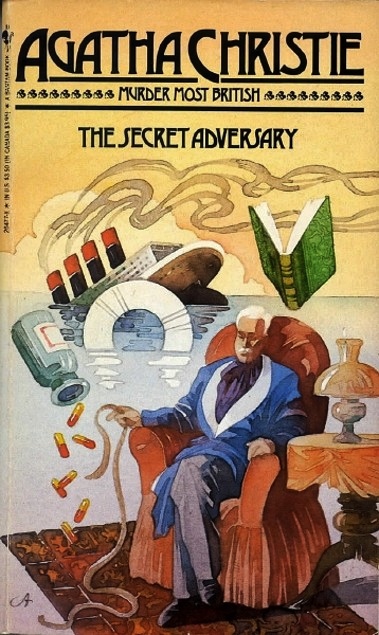
An early dustjacket - possibly from the first edition. Note the red flag and the Russian bear behind the mask of "Mr Brown"!

An early dustjacket – possibly from the first edition*. Note the red flag and the Russian bear behind the mask of “Mr Brown”! (February 2017 – A reader has just commented that this is not the first edition cover; that one apparently has a picture of a woman – presumably Jane Finn? – on it. I’ll keep an eye out for that one in my internet travels.)

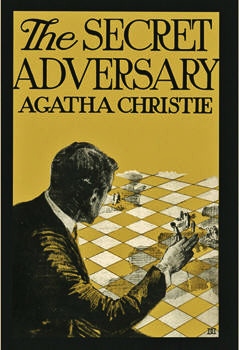
Another early dustjacket, with "Mr Brown" as the chess master moving his human pieces about the board.

Another early dustjacket, with “Mr Brown” as the chess master moving his human pieces about the board.

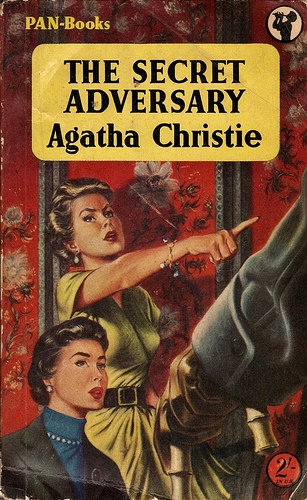
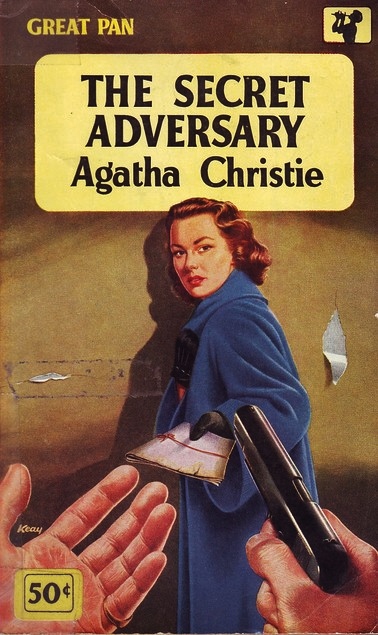
Tuppence with a tidy hairdo and a string of pearls; her companion much more appropriately tousled, considering the revolver covering them both... I'm guessing 1950s for this dramatic paperback jacket.

Tuppence with a tidy hairdo and a sedate string of pearls; her companion just a wee bit more appropriately tousled – though not much, considering the threatening figure in the foreground!  I’m guessing 1950s for this dramatic paperback cover.

Another view from behind the handgun.

Another Pan paperback, this one for the North American market, and possibly released a few years later than the one just above. Great villains-eye view from behind the handgun.

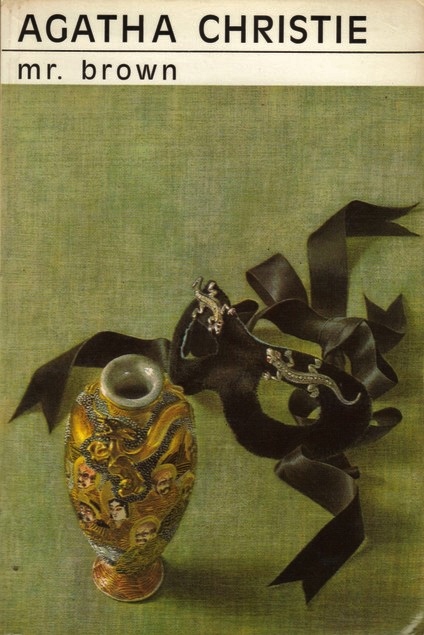
I couldn't resist including this gorgeous paperback cover, from a French edition.

I couldn’t resist including this rather elegant paperback cover, from a more recent (I’m guessing 1970s or 1980s) French edition.

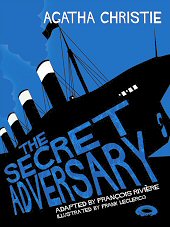
And from 2008, the cover of a graphic novel version, playing up the Lusitania connection.

And from 2008, this attractive poster-like cover of a graphic novel version, playing up the Lusitania connection.

Read Full Post »

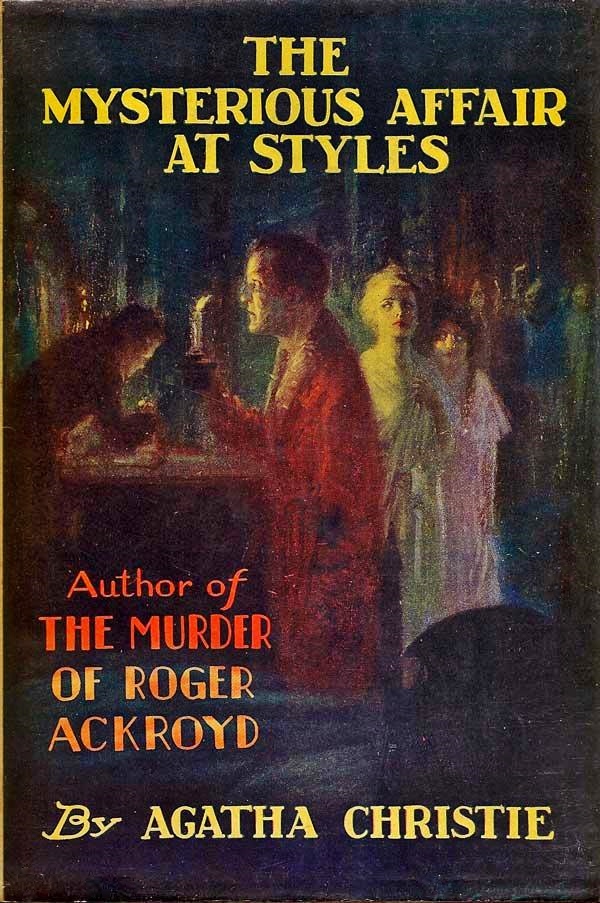
the mysterious affair at styles agatha christie 001The Mysterious Affair at Styles by Agatha Christie ~ 1920. This edition: Grosset & Dunlap, 1927. Fourth printing. Hardcover. 296 pages.

My Rating: 7/10

Setting: An English country House, Styles Court in Essex, sometime during the Great War.

Detection by: HERCULE POIROT, with “assistance” from CAPTAIN HASTINGS (narrator); INSPECTOR JAPP of Scotland Yard is introduced.

Final Body Count: 1

Method(s) of Murder: POISON – strychnine

100 Word Plot Summary:

When wealthy Mrs. Inglethorpe succumbs to a dose of strychnine, suspicion immediately falls upon her much younger (and forbiddingly black-bearded) second husband, Albert. But the philandering Albert has an ironclad alibi, as do all of the other members of the Styles Court ménage. Could it be the sweet young pharmacy assistant, with her easy access to poisons? Or either of Mrs. Inglethorpe’s adult sons, hard up for cash and living on their mother? Her daughter-in-law, cool and unemotional? Her lady housekeeper, outspoken and jealously loyal? Or perhaps the sinister German-Jewish doctor, who just happens to be an expert on poisons?

*****

Agatha Christie’s first published novel. Her very first, a romantic drama set in Cairo and sent out under the working title Snow Upon the Desert, was read and favourably remarked upon but ultimately refused by the publishers she sent it to.  The Mysterious Affair at Styles was inspired by her sister Madge’s comments that Agatha couldn’t possibly write a decent murder mystery. Written while working as a pharmaceutical dispenser during and just after the close of World War I, The Mysterious Affair at Styles is a classic puzzle mystery, with all clues revealed to the reader, and a generosity of suspects. The most unlikely person, of course, might ultimately be revealed as the murderer.

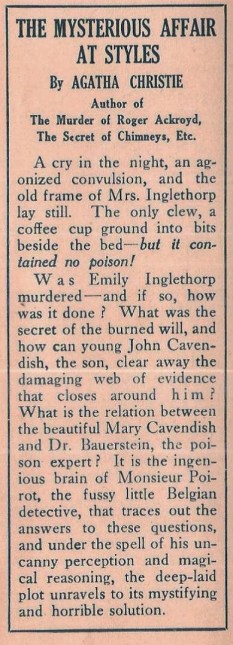
Front fold blurb from 1927 Grosset & Dunlap edition.

Front fold blurb from 1927 Grosset & Dunlap edition.

Narrated by a young Captain Hastings, who has been invalided out of active service, and is recuperating at his friend’s mother’s country home, Styles Court, the novel introduces Hercule Poirot, a finicky and eccentric Belgian ex-policeman. Poirot is living with several other Belgian refugees, and is eager to provide his investigative services when his generous sponsor, Mrs. Inglethorpe, dies mysteriously. Inspector Japp of Scotland Yard is also introduced; he and Poirot already know and like each other, and their collaboration, along with Captain Hastings’ inadvertent contributions, results in the solving of the murder plot.

Though decidedly dated and just a bit awkwardly plotted in spots, this is a very creditable mystery novel. The puzzle is truly hard to sort out; suspicion falls on each of the suspects in turn, and the ending is cleverly worked out. Poirot is not quite solidified into his final form, whom we come to know so well in future years – he was eventually to figure in thirty-three of Christie’s mysteries, and something like fifty short stories. The characters in general are puppet-like; aside from the narrator Hastings, we never get to know any of them – including Poirot – beyond their superficial appearances and stereotypical roles.

The murder itself occurs early on in the narrative, and Mrs. Inglethorpe’s horrible death is quite fully described, as Hastings is one of the witnesses. The brief mourning period for the victim is very soon over as the characters scramble to defend themselves against allegations of wishing for and ultimately causing her demise.

This is not at all a “literary” detective novel, such as those penned only a few years later by the other great “Golden Age” female mystery novelists Dorothy L. Sayers and Josephine Tey, but it is a well-constructed first attempt at the genre, and a grand little period piece, especially when considered in the context of Christie’s astoundingly prolific and successful later body of work.

Dust jacket of the 1927 Grosset and Dunlap edition. Can you see all seven of the suspects?

Dust jacket of the 1927 Grosset and Dunlap edition. Can you see six of the seven suspects? (Captain Hastings is also present, but he is apparently never considered as a possibility, due to lack of motive, I presume.)

Read Full Post »

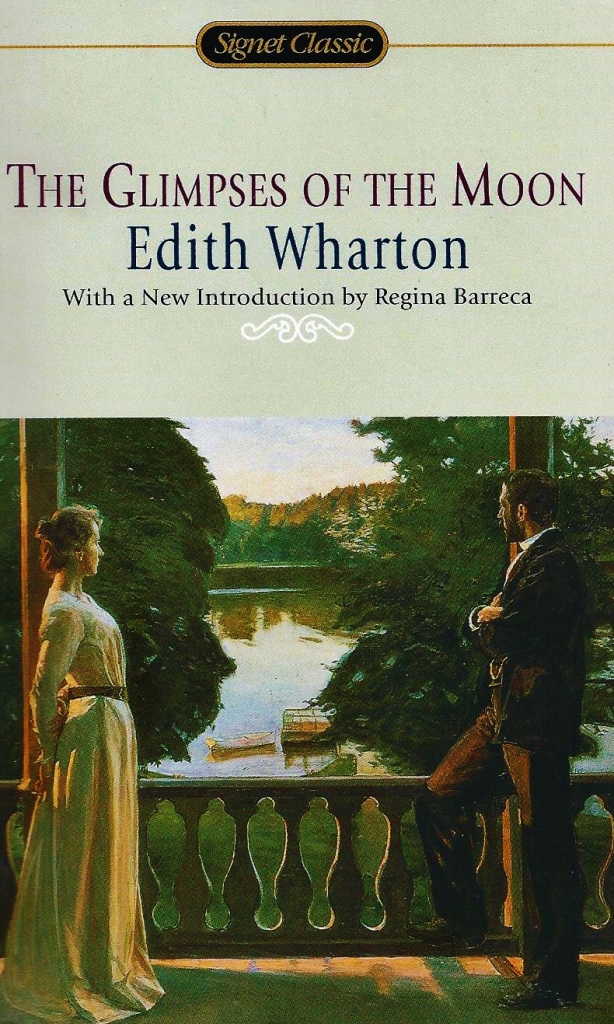
glimpses of the moon edith wharton 001The Glimpses of the Moon by Edith Wharton ~ 1922. This edition: Signet, 2000. Introduction by Regina Barreca. Paperback. ISBN: 0-451-52668-6. 252 pages.

My rating: 6/10.

This one started out very well, but I felt it lost steam as it went on, and the ending was, in my opinion, more than slightly weak. But it’s decidedly readable, especially if one is interested in comparing it to the much stronger The House of Mirth, with which it shares some common themes, though the author takes her characters in a different direction, and the tone of The Glimpses of the Moon frequently approaches farce.

I’m going to give you a transcription of the opening page and a general overview – SPOILER ALERT: the ending is divulged – before sending you off to visit several other more thoughtful reviews, both of which much more fully reference The Glimpses of the Moon in relation to The House of Mirth.

*****

It’s been many years since I read Edith Wharton’s tragic American Lit classic, The House of Mirth, but I retain enough memory of it to be able to say that The Glimpses of the Moon is, in comparison, one of Wharton’s minor novels. Coming to it with that initial expectation, I asked myself how it appealed to me as a stand-alone novel. If I had never read any of Edith Wharton’s Big Important Novels, and had picked this one up cold, what would I think? So I won’t be comparing Susy Lansing to Lily Bart, obvious counterparts though they may be.

Here’s the set-up. A young couple is on their honeymoon, and as they linger in the moonlight reflecting off Lake Como, their thoughts are not so much on each other as on their great good fortune in being there at all…

It rose for them—their honey-moon—over the waters of a lake so famed as the scene of romantic raptures that they were rather proud of not having been afraid to choose it as the setting of their own.

“It required a total lack of humour, or as great a gift for it as ours, to risk the experiment,” Susy Lansing opined, as they hung over the inevitable marble balustrade and watched their tutelary orb roll its magic carpet across the waters to their feet.

“Yes—or the loan of Strefford’s villa,” her husband emended, glancing upward through the branches at a long low patch of paleness to which the moonlight was beginning to give the form of a white house-front.

“Oh, come – when we’d five to choose from. At least if you count the Chicago flat.”

“So we had—you wonder!” He laid his hand on hers, and his touch renewed the sense of marvelling exultation which the deliberate survey of their adventure always roused in her…. It was characteristic that she merely added, in her steady laughing tone: “Or, not counting the flat—for I hate to brag—just consider the others: Violet Melrose’s place at Versailles, your aunt’s villa at Monte Carlo—and a moor!”

She was conscious of throwing in the moor tentatively, and yet with a somewhat exaggerated emphasis, as if to make sure that he shouldn’t accuse her of slurring it over. But he seemed to have no desire to do so. “Poor old Fred!” he merely remarked; and she breathed out carelessly: “Oh, well—”

His hand still lay on hers, and for a long interval, while they stood silent in the enveloping loveliness of the night, she was aware only of the warm current running from palm to palm, as the moonlight below them drew its line of magic from shore to shore.

Nick Lansing spoke at last. “Versailles in May would have been impossible: all our Paris crowd would have run us down within twenty-four hours. And Monte Carlo is ruled out because it’s exactly the kind of place everybody expected us to go. So—with all respect to you—it wasn’t much of a mental strain to decide on Como.”

His wife instantly challenged this belittling of her capacity. “It took a good deal of argument to convince you that we could face the ridicule of Como!”

“Well, I should have preferred something in a lower key; at least I thought I should till we got here. Now I see that this place is idiotic unless one is perfectly happy; and that then it’s – as good as any other.”

She sighed out a blissful assent. “And I must say that Streffy has done things to a turn. Even the cigars—who do you suppose gave him those cigars?” She added thoughtfully: “You’ll miss them when we have to go.”

“Oh, I say, don’t let’s talk to-night about going. Aren’t we outside of time and space…? Smell that guinea-a-bottle stuff over there: what is it? Stephanotis?”

“Y-yes…. I suppose so. Or gardenias…. Oh, the fire-flies! Look…there, against that splash of moonlight on the water. Apples of silver in a net-work of gold….” They leaned together, one flesh from shoulder to finger-tips, their eyes held by the snared glitter of the ripples.

“I could bear,” Lansing remarked, “even a nightingale at this moment….”

A faint gurgle shook the magnolias behind them, and a long liquid whisper answered it from the thicket of laurel above their heads.

“It’s a little late in the year for them: they’re ending just as we begin.”

Susy laughed. “I hope when our turn comes we shall say good-bye to each other as sweetly.”

It was in her husband’s mind to answer: “They’re not saying good-bye, but only settling down to family cares.” But as this did not happen to be in his plan, or in Susy’s, he merely echoed her laugh and pressed her closer.

The spring night drew them into its deepening embrace. The ripples of the lake had gradually widened and faded into a silken smoothness, and high above the mountains the moon was turning from gold to white in a sky powdered with vanishing stars. Across the lake the lights of a little town went out, one after another, and the distant shore became a floating blackness. A breeze that rose and sank brushed their faces with the scents of the garden; once it blew out over the water a great white moth like a drifting magnolia petal. The nightingales had paused and the trickle of the fountain behind the house grew suddenly insistent.

When Susy spoke it was in a voice languid with visions. “I have been thinking,” she said, “that we ought to be able to make it last at least a year longer.”

Her husband received the remark without any sign of surprise or disapprobation; his answer showed that he not only understood her, but had been inwardly following the same train of thought.

“You mean,” he enquired after a pause, “without counting your grandmother’s pearls?”

“Yes—without the pearls.”

He pondered a while, and then rejoined in a tender whisper: “Tell me again just how.”
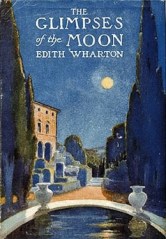
the glimpses of the moon edith wharton 2For Nick and Susy are wallowing in borrowed luxury, on borrowed time, and their future consists of one big question mark. Both of them are as poor as church mice, and the last person each should have married was the other, according to the mores of the wealthy social circle they have been delicately moving in, charming parasites tolerated because of their physical attractiveness and gift for amusing repartee. But Susy and Nick have, most unwisely, fallen in love with each other, and when Susy comes up with a plan to enjoy the best of both worlds – to marry her impoverished counterpart and to continue to enjoy the decadent lifestyle which her wealthier contacts have accustomed her to – they take the leap together. And for a while it seems to be working…

Charming her rich friends with the novelty of a poor marriage, Susy has asked outright for cash in lieu of wedding presents, and has let it be known that she and Nick will be most grateful for loaned accommodation. They are set up for a good year or so, if they’re very careful, thinks Susy, with their main expenses being the tips on departure from each borrowed villa or chalet to their borrowed servants – whose salaries are, of course, paid by the owners of these lavish residences. And during that year they will indulge themselves in the luxury of each other’s most desirable company. Nick, an aspiring writer, will perhaps be able to finish the manuscript which will launch him on a successful and lucrative authorial career, and if this works as planned the two will be set. If the worst happens, and Nick’s plans go awry, the two have agreed that they will take whatever better opportunities arise – ie. a new (and, as it goes without saying, wealthier) romantic partner – and amicably part ways to allow each other to take advantage of the new situation.

Though Nick comes across as being the more passive partner in this sophisticated relationship, he is as complicit as Susy in viewing their joint reliance on the generosity of others as his due, so his moral qualms when Susy pops a few things into her luggage on departure from the Italian villa – such as the marvelous cigars mentioned in the excerpt – seem rather ingenious. But Nick insists on maintaining a moral high ground just a little more elevated than Susy’s, and, when Susy allows herself to be part of a marital deception at their next place of residence, the fragile marriage disintegrates, and Nick and Susy go their separate ways, each finding a convenient patron-slash-potential new spouse to sponge off of while their lawyers start the separation proceedings.

But absence does, in this case, make the heart grow fonder, and the two find themselves yearning for what they briefly experienced, a meeting of minds and a true affection for each other. After various heart rendings the two come together again, this time with much more likelihood of making it work, after Nick’s book has been accepted (for he’s been working on it all this time, in his bedroom on the yacht on which he’s been cruising) and Susy’s surprising embrace of domestic life (she’s bizarrely ended up as the temporary caretaker of five lovable children).

I just couldn’t quite swallow Susy’s about face, from self-indulgent, entitled, and materialistic to meek and domestically minded, all in the space of a few months. And the ending chapter, well, it was pure sentimental dribble. Susy, Nick, and the five children Susy is still shepherding around, off for a second honeymoon. Too cute for words, and almost toss-it-across-the-room disappointing. (But I didn’t, because the majority of the book was rather captivating, and Susy’s scheming kept me interested, to see what she would come up with next.)

There are a few little twists and kinks which display the reliably cynical Edith Wharton hand, but by and large this is simply a mildly melodramatic and slightly farcical relationship drama. If updated from the jazz-age Europe of the perennially cruising American expatriates – the jetsetters of their time – it could well be one of those lavish Rich People summer bestsellers so popular in their stereotyped glory today. The Glimpses of the Moon has also been recently (2010) turned into a “comedic romantic musical”, so there you go! Can’t quite imagine the iconic The House of Mirth being so treated…

Still, an interesting read, which kept me amused for several summer afternoons. I did just unearth my copy of The House of Mirth, but I’m not sure if I’m quite in the mood to face the tragedy of poor, self-doomed Lily Bart quite yet; I need to rest a bit, mentally speaking, from this other aspect of Edith Wharton’s authorial oeuvre.

Here are the other reviews promised at the beginning of the post, each rather more scholarly and wise than mine. Enjoy!

His Futile Preoccupations – Guy Savage Reviews Glimpses of the Moon

Seeing the World Through Books –  Mary Whipple Reviews Glimpses of the Moon

Read Full Post »
Delphiniums in the nursery garden, Hill Farm, July 7, 2013

Delphiniums in the nursery garden, Hill Farm, July 7, 2013

FRAGMENTARY BLUE

Why make so much of fragmentary blue
In here and there a bird, or butterfly,
Or flower, or wearing-stone, or open eye,
When heaven presents in sheets the solid hue?

Since earth is earth, perhaps, not heaven (as yet)—
Though some savants make earth include the sky;
And blue so far above us comes so high,
It only gives our wish for blue a whet.

~ Robert Frost, 1920

Read Full Post »

crewe train by rose macaulay 001Crewe Train by Rose Macaulay ~ 1926. This edition: W. Collins Sons & Co., Ltd, 1926. (One Shilling Library Series.) Hardcover. 307 pages.
My rating: A solid 9/10. It’s been several weeks since I read this rather shabby, more than slightly foxed edition of Crewe Train, but the character of Denham has walked beside me ever since.

TO

THE PHILISTINES,

THE BARBARIANS,

THE UNSOCIABLE,

AND

THOSE WHO DO NOT CARE TO TAKE
ANY TROUBLE.

I must admit that after that introduction I was already more than half won over, which was a good thing, for my initial impression of the characters in this quirky novel was that they were sincerely unlikeable. Our heroine in particular.

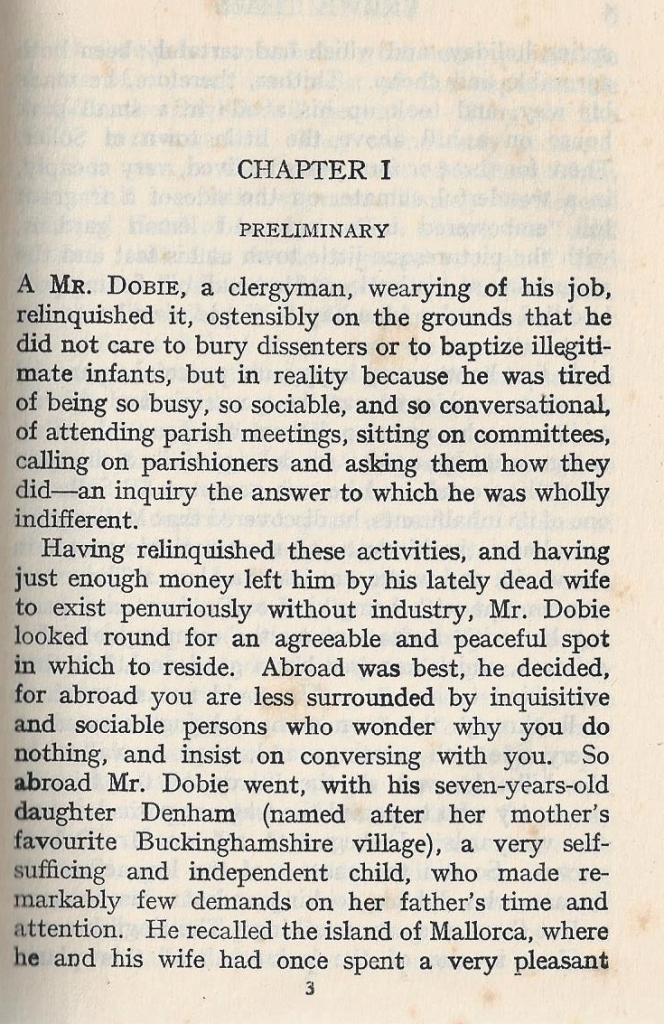
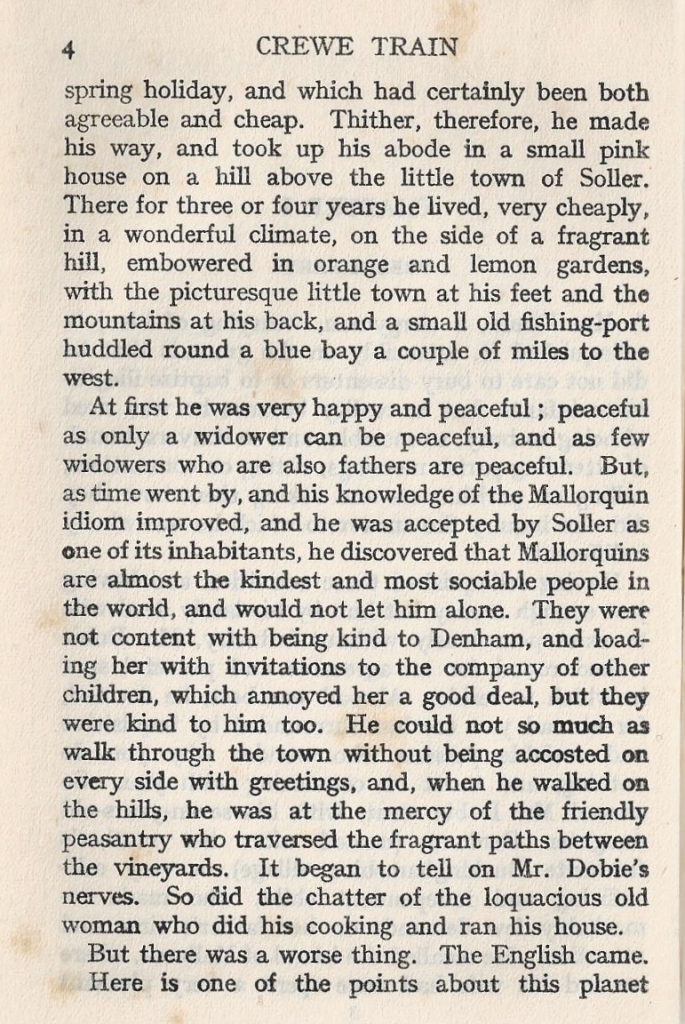
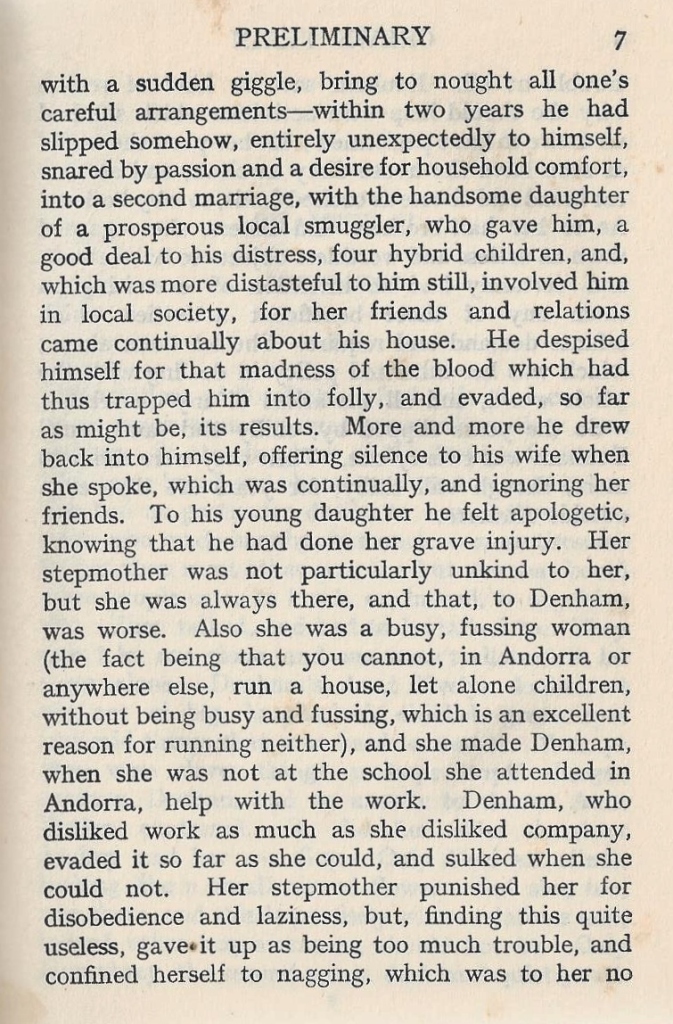
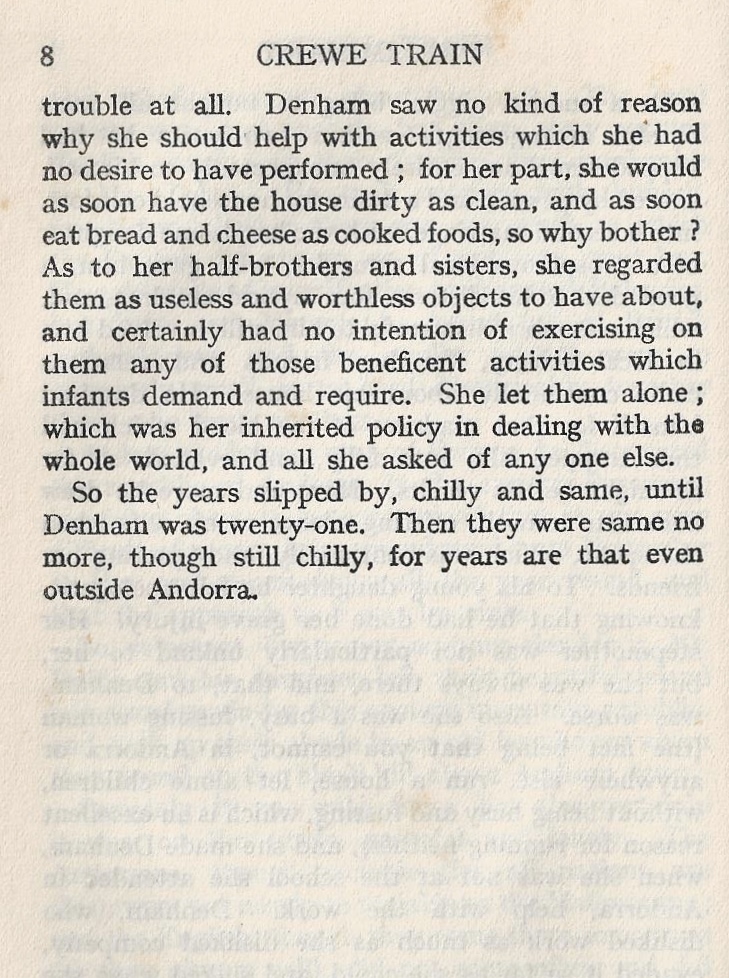
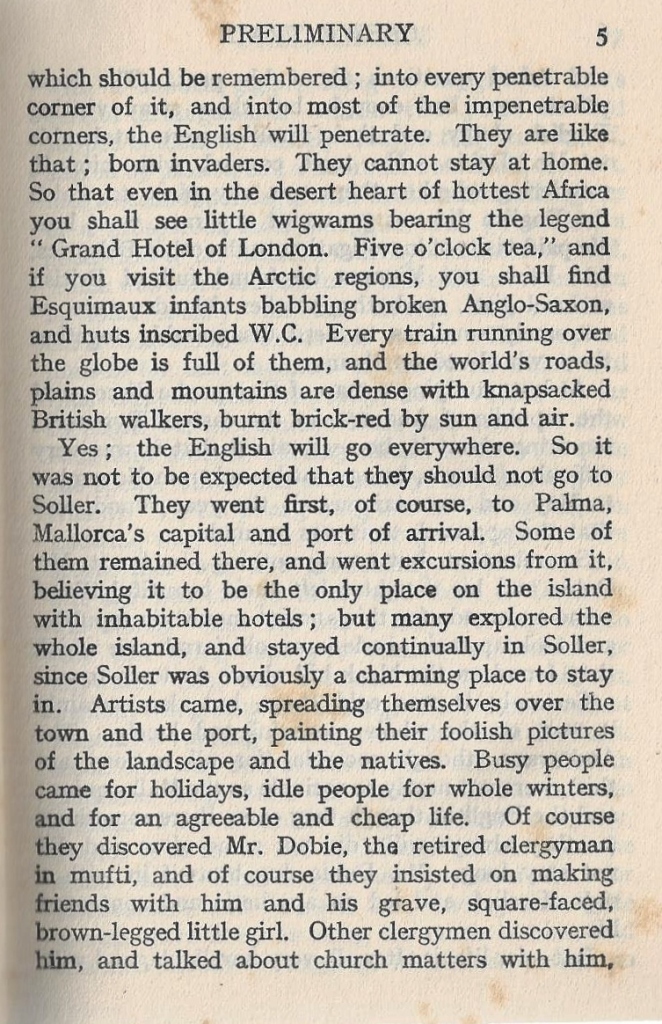
crewe train macaulay page 1 001crewe train macaulay page 2  001crewe train macaulay page 3 001 (2)crewe train macaulay pg 4 001crewe train macaulay pg 5 001 (2)crewe train macaulay pg 6 001And yes, in her twenty-first year, everything changes for Denham. Her father’s in-laws, the Greshams, the family of his first wife, descend upon the Andorran establishment for a visit, and, perhaps brought on by the unwonted stress of having to socialize so strenuously after a self-imposed life of seclusion, Mr. Dobie fatally succumbs to a stroke in the night.

Denham’s stepmother makes no bones about her distaste for her sullen stepdaughter; in her loquacious outpouring of hurt at her new widowhood she presses the responsibility for Denham upon the Gresham family. “You had better take her away with you to England!”

So they do.

Culture shock does not adequately describe Denham’s introduction to English society after her lifetime of relative seclusion. She allows herself to be tidied up and dressed up and trained up in the social conventions; these do not take particularly well though the continually bemused Denham does not actively resist her attempted makeover into a more socially acceptable “young lady”. She merely remains stoic under her Aunt Evelyn’s well-meaning ministrations and her cousins’ continual encouragements. She processes all she’s being exposed to, and does her best in her slow, wordless way to try to live up to the Greshams’ expectations; her success is not noteworthy.

Time moves inexorably on. Denham meets a certain young man, Arnold Chapel, a junior partner in the Gresham family’s publishing firm. Arnold and Denham experience something of a meeting of minds, though Arnold’s quicker intellect runs rings around the plodding progression of Denham’s thought processes. The two embark upon a shared life, and the novel details the peaks and valleys the two must traverse – some literal, most strictly figurative – before coming to a place of joint repose.

A very clever book, this one. I frequently felt much in common with Denham as Macaulay writes her own rings around my own rather plodding (though appreciative) thought process. I identified tremendously well with Denham; I wonder if this is a universal response? Or do the rest of you see her as the unrelateable (though ultimately sympathetic) stranger within the gates of intelligent society?

I suspect we all have something of Denham in us, as onlookers and inner critics of the chatter and occasional excesses perpetuated by the self-proclaimed intellectual classes of our own time. Perhaps this explains the lasting appeal of this mocking (but frequently tender) confection of a tale?

Crewe Train is definitely on my personal short list of “Most Memorable Books of 2013”, even though the year is not quite half over. I am very keen indeed to explore more of Macaulay’s fiction; this novel has wet my appetite for something more of her creative style.

Read Full Post »

A happy find yesterday while book-shopping! Two volumes of poetry by Edna St. Vincent Millay, Collected Lyrics and Collected Sonnets, both published by Harper & Row mid-2oth Century, with poems chosen by Millay herself. And while peacefully reading Lyrics this rainy, windy morning, the following struck me as almost too perfectly appropriate.

Enjoy.

Raindrops turn to icedrops as the wind comes from the north ... Hill Farm, April 5, 2013

Raindrops turn to icedrops as the wind comes from the north … Hill Farm, April 5, 2013

Northern April


O mind, beset by music never for a moment quiet, –

The wind at the flue, the wind strumming the shutter;

The soft, antiphonal speech of the doubled brook, never for a moment quiet;

The rush of the rain against the glass, his voice in the eaves-gutter!


Where shall I lay you to sleep, and the robins be quiet?

Lay you to sleep – and the frogs be silent in the marsh?

Crashes the sleet from the bough and the bough sighs upward, never for a moment quiet.

April is upon us, pitiless and young and harsh.


O April, full of blood, full of breath, have pity upon us!

Pale, where the winter like a stone has been lifted away, we emerge like yellow grass.

Be for a moment quiet, buffet us not, have pity upon us,

Till the green comes back into the vein, till the giddiness pass.


Edna St. Vincent Millay ~ 1928

Read Full Post »

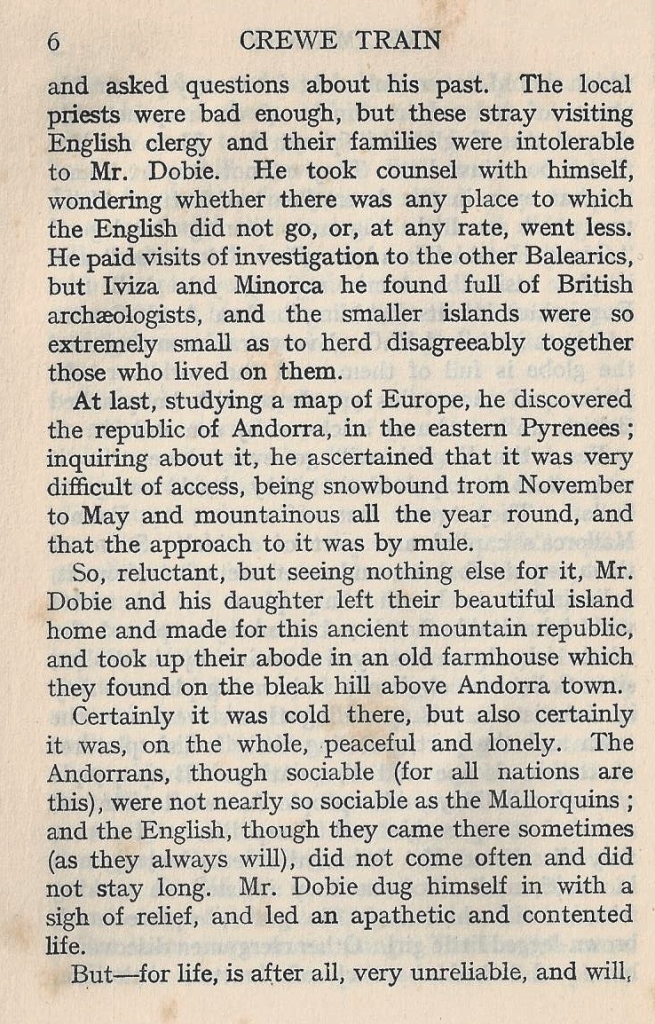
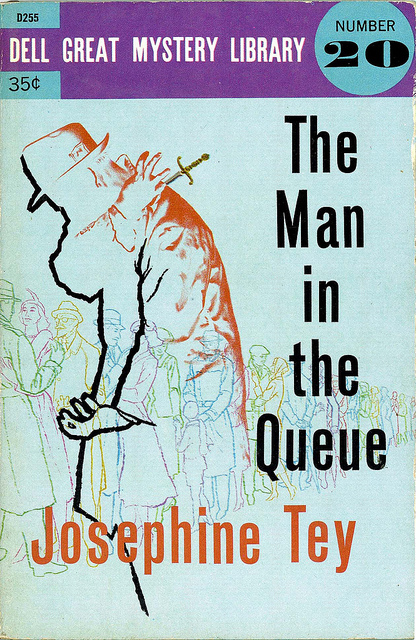
the man in the queue josephine tey b001The Man in the Queue by Josephine Tey ~ 1929. This edition: Berkely Medallion, 1971. Paperback. ISBN: 425-01873-3. 223 pages. Originally published as The Killer in the Crowd by Gordon Daviot, and released with the new title under the Josephine Tey pseudonym after author Elizabeth Macintosh’s death in 1959.
My rating: 7.5/10.

*****

This was Josephine Tey’s (to use the author’s best-known pseudonym, though she apparently preferred “Gordon Daviot”) first full-length book, written very quickly, reputedly in two weeks, according to this internet source,  Josephine Tey: A Very Private Person:

Tey started writing almost as soon as she could walk, according to a note from her literary agent, which also states that “writing was always her greatest amusement.” She published short stories and poems during the late 1920s in Scottish newspapers and in the English Review. Her first novel, The Man in the Queue, was published in 1929. It was reportedly written in two weeks for a competition sponsored by the publisher Methuen.

Tey’s first detective novel, The Man in the Queue – dedicated ‘To Brisena, who actually wrote it’ – Brisena was a nickname she gave to her typewriter – was a highly accomplished piece of work for a beginner.   Winning the Dutton Mystery Prize, it was published in 1929 under the pseudonym of Gordon Daviot—the name by which she preferred to be known, in both public and private.

Considering the time in which it was written, and the time frame it was written in, this novel is an accomplished piece of work, though it is far from flawless. I easily forgive the inconsistencies, because the writing is very good indeed, and I love seeing how the author progresses in her novels from the slight occasional awkwardnesses of this one to the sophistication of something like Brat Farrar, which I’ve just read as well, written twenty years later. This was a writer who continually honed and improved her craft; an admirable – and far from universal – thing.
The Man in the Queue starts out in front of popular London theatre, with a crowded line of hopeful people waiting for hours for a chance to see the most popular musical comedy show of the season, Didn’t You Know?, starring the lovely actress and dancer Ray Marcable (say it out loud – yes, it is what it looks like, though I didn’t twig myself until much later on in the story, when it was explained to me) in her last week of appearing in England before setting sail to try her luck in America.

It was between seven and eight o’clock on a March evening, and all over London the bars were being drawn back from pit and gallery doors. Bang, thud, and clank. Grim sounds to preface an evening’s amusement. But no last trump could have so galvanized the weary attendants on Thespis and Terpsichore standing in patient column of four before the gates of promise. Here and there, of course, there was no column. At the Irving, five people spread themselves over the two steps and sacrificed in warmth what they gained in comfort; Greek tragedy was not popular. At the Playbox there was no one; the Playbox was exclusive, and ignored the existence of pits. At the Arena, which had a three weeks’ ballet season, there were ten persons for the gallery and a long queue for the pit. But at the Woffington both human strings tailed away apparently into infinity. Long ago a lordly official had come down the pit queue and, with a gesture of his outstretched arm that seemed to guillotine hope, had said, “All after here standing room only.” Having thus, with a mere contraction of his deltoid muscle, separated the sheep from the goats, he retired in Olympian state to the front of the theatre, where beyond the glass doors there was warmth and shelter. But no one moved away from the long line. Those who were doomed to stand for three hours more seemed indifferent to their martyrdom. They laughed and chattered, and passed each other sustaining bits of chocolate in torn silver paper. Standing room only, was it? Well, who would not stand, and be pleased to, in the last week of Didn’t You Know? Nearly two years it had run now, London’s own musical comedy, and this was its swan song …

As the theatre doors finally open and the surging queue moves forward, another swan song is played out. A man gently slumps to the ground, having been held up by the press of the crowd. “He’s fainted!” is the murmur from the bystanders, until one of them noticed that between his shoulder-blades gleams the hilt of a silver dagger!the man in the queue josephine tey

And we’re off. For the man in undeniably very dead indeed, and it appears that he has been so for some time. But who could have stabbed him in front of so many potential witnesses, and why didn’t he cry out? Who is the man, anyway, and why is he carrying no identification? And is that a loaded revolver in his pocket?!

Scotland Yard immediately takes charge, and it is up to Inspector Grant, guaranteed dependable and with a certain flair for successfully solving his cases, to identify the victim and inexorably hunt down the missing killer.

An excellent piece of “Golden Age” mystery writing, chock full of appalling-to-the-modern-sensibility racial profiling and sexist commentary, but great fun to any lover of this most engaging genre. I must say I was completely stumped by the surprise ending; I was completely taken with the huge, stinking red herring which the author paraded about to confuse the plot; I did NOT guess the murderer until the final denouncement and explanation.

Inspector Grant, in his first appearance on the page, is rather Holmesian in style, consulting with the examining surgeon and coming up with some rather surprising assumptions, based on appearances alone. “Scientific”? Oh, dear …

“Can you tell me anything about the dead man himself?” asked Grant, who liked to hear a scientific opinion on any subject.

“Not much. Well nourished – prosperous, I should say.”

“Intelligent?”

“Yes, very, I should think.”

“What type?”

“What type of occupation, do you mean?”

“No, I can deduce that for myself. What type of – temperament, I suppose you’d call it?”

“Oh, I see.” The surgeon thought for a moment. He looked doubtfully at his interlocutor. “Well, no one can say that for a certainty – you understand that?” And when Grant had acknowledged this qualification: “but I should call him one of the ‘lost cause’ type.” He raised his eyebrows interrogatively at the inspector and, assured of his understanding, added, “He had practical enough qualities in his face, but his hands were a dreamer’s. You’ll see for yourself.”

Together they viewed the body. It was that of a young man of twenty-nine or thirty, fair-haired, hazel-eyed, slim, and of medium height. The hands, as the doctor had pointed out, were long and slim and not used to manual work …

Nice “scientific” work, you two. And if you thought this was a little too good to be true, just wait until you read about the assumptions made once the murder weapon is considered…

Very good stuff, in a completely “vintage read” sort of way. A definite must-read for the Tey fan, to track where the author came from, as it were, and to realize the huge strides she made in her writing career. Decidedly decent indeed for a first book; the others only get better.

And here, for your enjoyment and further enlightenment, are some grand reviews by other bloggers:

Fleur Fisher – The Man in the Queue

Stewartry ( A Gold of Fish) – The Man in the Queue

Read Full Post »

« Newer Posts - Older Posts »