Archive for the ‘1910s’ Category

COOL TOMBS

When Abraham Lincoln was shoveled into the tombs he forgot the copperheads and the assassin . . . in the dust, in the cool tombs.

And Ulysses Grant lost all thought of con men and Wall Street, cash and collateral turned ashes . . . in the dust, in the cool tombs.

Pocahontas’ body, lovely as a poplar, sweet as a red haw in November or a pawpaw in May, did she wonder? does she remember? . . . in the dust, in the cool tombs?

Take any streetful of people buying clothes and groceries, cheering a hero or throwing confetti and blowing tin horns . . . tell me if the lovers are losers . . . tell me if any get more than the lovers . . . in the dust . . . in the cool tombs.

by Carl Sandburg, Cornhuskers, 1918

Read Full Post »

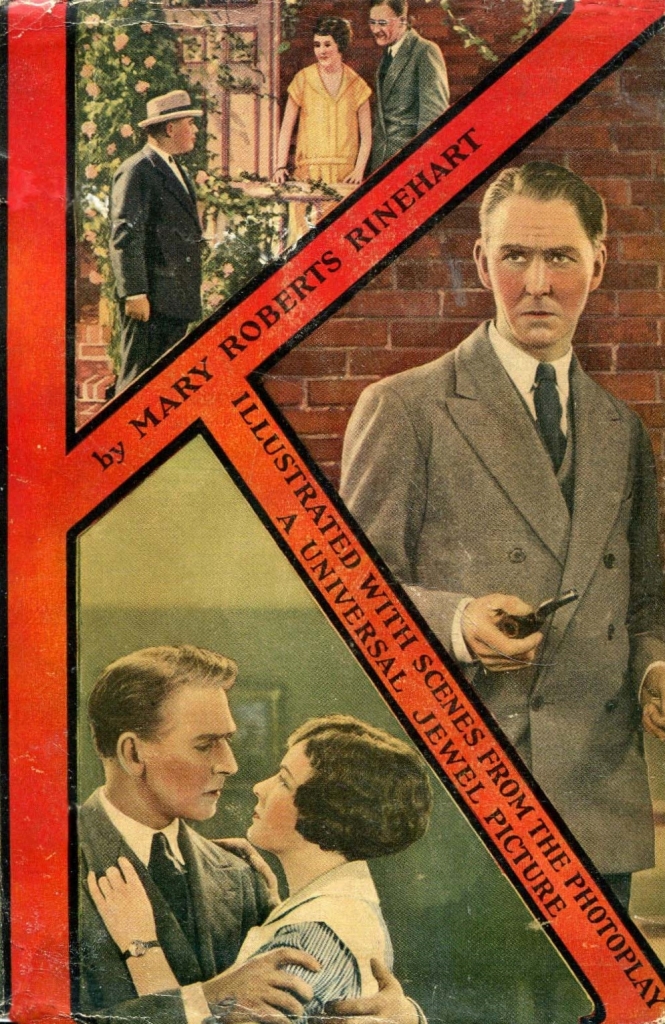
k mary roberts rinehart p

This is not my personal copy, but the dust jacket of an older edition. Apparently “K” was made into a movie at one point.

“K” by Mary Roberts Rinehart ~ 1914. This edition: Blakiston 1944. Hardcover. 407 pages.

My rating: 6.5/10

A melodramatic and exceedingly improbable story of an absolutely perfect heroine – beautiful, morally upright, self-sacrificing, pure through and through – you know the type! – and her three lovers. First is youthful and impetuous Joe, followed by brilliant (and fickle) young surgeon Max, and ultimately (somehow I doubt this will be a spoiler; especially as the cover pictured here completely gives it away) the mysterious “K”.

This vintage read was surprisingly good, considering the ridiculous storyline. The author has a lot to say about roles of women, the roles of marriage and child-bearing in female self-fulfillment, and the hypocrisy of society to those caught out in wrongdoing – the unmarried mother, the bastard child, the alcoholic rich man – and how each is viewed and sometimes excused merely on the basis of social status. How does that old song go? “It’s the same the whole world over, It’s the poor what gets the blame, It’s the rich what gets the pleasure, Ain’t that a blooming’ shame?”

Here we have a lovely young eighteen-year-old girl, Sidney, who decides to turn her back on marriage as offered by the infatuated Joe, and to make a career as a nurse. She is accepted as a probationer, and immediately falls head-over-heels in love with Doctor Max, a brilliant young surgeon whom she has known since childhood, but who has never realized what a lush young thing Sidney is until she pops up under his nose in nurse’s garb. Max is notoriously a lady’s man, with another love interest on the side, so the relationship seems questionable from the start, but Sidney succumbs (partially) to Max’s passionate advances. Her virtue remains intact, however, and she is saved from herself by the intervention of dark horse “K”.

K. Le Moyne – he never gives a first name – shows up one evening at Sidney’s mother’s house to rent a room, and though he is tenaciously reticent about his past, his quiet charm and readiness to help out with a myriad of domestic situations – from nurturing a pet ground squirrel to helping with the cooking – makes him the friend of all.

But what is K hiding? And why does Max reel in shock when the two men finally meet? What are they discussing behind closed doors on their subsequent nightly meetings? Did Sidney really mix up her medications and poison that pathetic young patient? Why is her superior Carlotta (incidentally Max’s main squeeze before Sidney’s entry) so alternately friendly and harsh to Sidney? And where did Joe get that gun?

See? Told you it was melodrama!

The cast of supporting characters is almost more interesting than the interconnected love triangles (quadrangles?) of the main protagonists.

Here we have a couple of middle-aged lovers, one a cook and the other a deaf-and dumb book salesman, communicating by notes to each other as they sit out each evening on the back steps. Another middle-aged spinster goes off to live in sin with a man whose wife is languishing in a mental home; her decision to put herself beyond society’s pale by her last-chance clutching at love is most sympathetically portrayed.

A young woman marries beneath herself socially, to a man with a drinking problem and a history of amorous dalliances; she knows this before she marries, and she knows she doesn’t truly love her husband-to-be, but she goes ahead anyway, to repent at leisure. (Subtext: Is marriage really such a socially desirable state that an intelligent well-off young woman will willingly enter into a questionably wise bond, particularly if love is not there?)

Dr. Ed, Dr. Max’s elder brother, is an old-school practical doctor in contrast to his younger brother’s cutting edge cleverness as a specialized surgeon. Dr. Ed, wiping his scalpel on his pant leg (sterilization dulls the edge, he maintains), proudly admires his brother’s accomplishments, and regards the sacrifice of his own career, his own never-attained wife and family as a worthy price to pay for his brother’s success. Dr. Ed has never married and has spent every penny he’s earned supporting his brilliant brother through medical school; his role in the story is as sort of a benevolent father figure, dispersing wisdom and keeping a high moral standard as an example to his friends and neighbours.

Sidney’s Aunt Harriet is one of my favourites. Long the drab neighbourhood seamstress, Harriet pursues a long-held ambition to design clothes for the local haut monde, and after borrowing money to set herself up, eventually makes it to Paris, from whence she sends engraved circulars to the customers eagerly awaiting her return. I absolutely loved the glimpses of practical yet creative Harriet getting dress-designing inspiration from crocuses in snow, or the colours of the early morning city sunrise. A happy spinster, Harriet, illustrating an independent womanhood and its rewards, in a world which still maintains that marriage and motherhood is a female’s highest calling.

Mary Roberts Rinehart was an exceedingly prolific writer of dramatic novels and mysteries, and a well-known feminist of her time. In “K”, her views on the rights of women come through loud and clear, though mixed rather oddly with this very traditional romance. She does allow her heroine to complete her goal to become a fully fledged nurse, though marriage awaits at the end of her qualification. I rather wonder what the after-story would turn out to be?

Read Full Post »

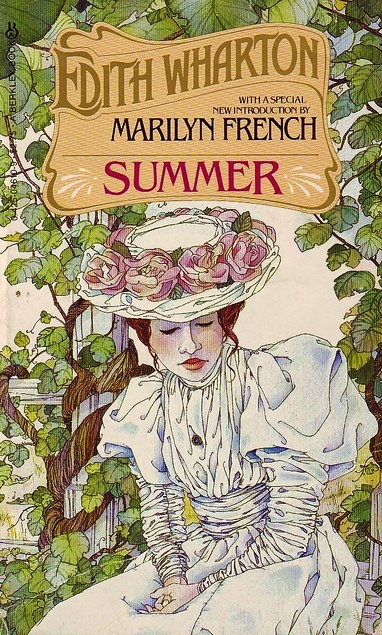
summer edith whartonSummer by Edith Wharton ~ 1917. This edition: Berkley, 1981. Introduction by Marilyn French. Paperback. ISBN: 0-425-04610-9. 205 pages.

My rating: 8.5/10

I couldn’t quite remember how many years ago I read this novel for the first time, but from the bookstore stamp (The Emporium – “New and Old” – Olds, Alberta) it must have been back in the late 1980s.

I have retained favorable memories of this rather Thomas Hardy-esque story right up until my re-reading this past week. There were a few gaps and blurring of details which I hadn’t remembered, but in essence my impressions of the book were identical this time around.

This was one of Edith Wharton’s favourites among her novels, according to Marilyn French’s Introduction, which I read, as is my habit – I prefer to come to my reading without too much prior analysis, as a rule – only after I’d finished the book.  Summer nonetheless has not been viewed as one of Wharton’s major accomplishments. It is a slight thing compared to her masterworks such as The Age of Innocence and The House of Mirth, but it shares with those the same elements of examining how characters are trapped within a closed society’s defined roles, and, even more deeply examined, their moral struggles surrounding surrender to romantic and sexual desires.

Summer’s heroine is Charity Royall, foster child of one of her small, rural New England village’s leading citizens, Lawyer Royall. Charity is just that, a charity-child, brought into the village from the nearby “Mountain”, a loose community of social outcasts. In the words of Lawyer Royall:

“The Mountain? The Mountain?… Why, the Mountain’s a blot… That scum up there ought to have been run in long ago—and would have, if the people down here hadn’t been clean scared of them… there’s a gang of thieves and outlaws living over there, in sight of us, defying the laws of their country. Why, there ain’t a sheriff or a tax-collector or a coroner’d durst go up there. When they hear of trouble on the Mountain the selectmen look the other way, and pass an appropriation to beautify the town pump…”

Charity is now nineteen years old, and has been living alone with her foster father since her foster mother’s death some years ago. She’s a dark-eyed, dark-haired, lushly lovely young thing, poised on the brink of womanhood; her main emotion is of frustration at the bleakness of her present life, and the absence of any sort of prospects. Since her foster father’s tentative advances one night some time ago, Charity has made a few changes in her life. She’s approached the town’s most prominent citizen (after Lawyer Royall), Miss Hatchard, and asked for a position as librarian in the dusty little library; Charity hopes to earn enough money to get out of town, though her actual plans are nebulous. An elderly woman has also been hired to live in and provide chaperonage; Lawyer Royall, notoriously tight-fisted, has been shamed into paying for this after his alcohol-fueled faux pas.

When a handsome young relative of Miss Hatchard’s unexpectedly shows up one bright June day, Charity falls hard. Her romance follows the course of the season, from innocently blushing June through the breathless days of July to full fruition in sultry August. And, predictably, to a anti-climactic close in the fall, when Lucius Harney, betrothed to another woman, must abandon his summer love to return to his real life; worlds away from Charity’s.

But Charity is, predictably, left in a decidedly compromised position. Though her foster father and neighbours are willing to turn a blind eye to her summer love affair, the souvenir her lover has left her will change her life completely. If, that is, she doesn’t take steps to rid herself of her liability.

What a fascinating glimpse of early 20th century women’s private lives this story gives! The discussion about young women “losing their virtue”, and the choices then open to them is frank and vivid, even though voiced only in  Wharton’s veiled allusions. Charity visits an abortionist, a woman doctor who specializes in helping women deal with their indiscretions – for a price – and, once her pregnancy is confirmed, greatly surprises the doctor by her next decision.

This is a story that hangs greatly on a series of coincidences; it is abundantly obvious that the author has planned her narrative carefully; every incident has a connection to the whole. A brief meeting in chapter one, or a mention of a seemingly minor event or a character’s idiosyncrasy is invariably followed up later on. And much as I appreciated Wharton’s meticulous approach, after a while I started looking for those connections; I ended my reading with a strong sensation of having read something completely contrived and separated from any sort of organic flow.

This novel felt like the author deliberated every last word. Is this a good thing? Well, in my opinion, sort of. As a piece of literary art this sort of hyper-detail can certainly be appropriate, but as a reader I found myself becoming aware too often of the creative master hand; it did disturb the narrative flow as I increasingly mulled over the place of each incident in the broader web.

Summer is often referred to as Wharton’s “erotic novel”, and the description is apt, if one considers that the most powerful eroticism comes from one’s own mind, as the reader builds an emotional picture upon open-ended suggestion. We never get the actual details of what Charity and Lucius are up to, but it’s very obvious what is about to happen every time the curtain of propriety drops; Charity’s general state of being at the beginning of the novel can rightly be described as “ready for love”; her naturally sensuous nature (sensuous in the most genuine sense – she glories in every physical and emotional stimulus around her – the warmth of the sun, the feel of the wind, the fragrance of flowers, the sight and texture of a piece of lovely fabric) leaves her open to the experience of sensual (and ultimately sexual) pleasure when at last she has the opportunity in her more than sheltered life.

What Charity is not is any sort of an intellectual. Despite her librarianship, books leave her cold, and her foster father’s and lover’s lively shared conversations bemuse her completely; she escapes their verbal gymnastics by quiet emotional retreat into her own small inner world which is governed by feelings rather than ideas. But when ideas do start to form, Charity’s actions are gloriously individualistic. She becomes completely self-centered in her responses to the situations she finds herself in, moving by sure inner instinct rather than by “appropriate” societal response.

The novel’s ending (which I am not going to reveal in detail; I do think this is a novel which rewards a reader’s personal discovery) and Charity’s ultimate decision regarding herself and her unborn child is surprising, and could, to some, be easily seen as a failure on the author’s part to allow her character to continue on her path to personal self-fulfillment. This is, naturally, as seen by our 21st Century eyes. But Charity is not of our time; she is doing the best she can in the place she comes from; I don’t believe it is fair to judge her actions and decisions in light of the choices women have a century later. I came away feeling that Charity’s future might well be a reasonably content and fulfilling one, though doubtless many will not agree, seeing her fate as infinitely dreary, with regards to “happiness” as we might define it today.

A must-read for anyone who has dabbled in Edith Wharton’s more prominent pieces, and an excellent summer read (so appropriately titled!) for the connoisseur of vintage fiction.

Read Full Post »

the alpine path l m montgomeryThe Alpine Path: The Story of My Career by L.M. Montgomery ~ 1917. This edition: Fitzhenry & Whiteside, 1975. Hardcover. ISBN: 0-88902-019-1. 96 pages.

My rating: Probably an 8/10 – it’s a slender little thing, and tells nothing very new, deep, or startling, but it is nonetheless an enjoyable excursion into the life of the renowned author, written in the relatively early years of her successful career.

A must-read for the L.M. Montgomery aficionado, just to say you’ve read it; a gentle, happy overview of the author’s life for those new to her; a pleasant “light” memoir with only a few mentions of the very real and frequently tragic difficulties the author faced in her childhood, teen and adult years.

The book is a compilation of a series of six autobiographical essays which L.M.M. wrote for the Toronto magazine Everywoman’s World in 1917, ten years after the stunning success of Anne of Green Gables had made her a worldwide household name.

Many years ago, when I was still a child, I clipped from a current magazine a bit of verse, entitled “To the Fringed Gentian”, and pasted it on the corner of the little portfolio on which I wrote my letters and school essays. Every time I opened the portfolio I read one of those verses over; it was the key-note of my every aim and ambition:

“Then whisper, blossom, in thy sleep
How I may upward climb
The Alpine path, so hard, so steep,
That leads to heights sublime;
How I may reach that far-off goal
Of true and honoured fame,
And write upon its shining scroll
A woman’s humble name.”

It is indeed a “hard and steep” path; and if any word I can write will assist or encourage another pilgrim along that path, that word I will gladly and willingly write.

The first half of this slender book is devoted to childhood reminiscences, many of which the author mentions as having been used as inspiration and worked-over anecdotes for her personal favourite of her novels, The Story Girl. Then follows some discussion of the years when she attempted to establish herself as a published, and more importantly, paid author, and of course, the story of the manuscript of Anne, which was flatly rejected numerous times, and laid away

in an old hat-box in the clothes room, resolving that some day when I had the time I would take her and reduce her to the original seven chapters of her first incarnation. In that case I was sure of getting thirty-five dollars for her at least, and perhaps even forty.

The manuscript lay in the hat-box until I came across it one winter day while rummaging. I began turning over the leaves, reading here and there. It didn’t seem so very bad. “I’ll try once more”, I thought. The result was that a couple of months later an entry appeared in my journal to the effect that my book had been accepted. After some natural jubilation I wrote: “The book may or may not succeed. I wrote it for love, not money, but very often such books are the most successful, just as everything in the world that is born of true love has life in it, as nothing constructed for purely mercenary ends can ever have.”

And then there’s this comment, which I rather smiled at; the author having too-late second thoughts after killing off a character:

Many people have told me that they regretted Matthew’s death in Green Gables. I regret it myself. If I had the book to write over again I would spare Matthew for several years. But when I wrote it I thought he must die, that there might be a necessity for self-sacrifice on Anne’s part, so poor Matthew joined the long procession of ghosts that haunt my literary path.

After the evocative descriptions of her Prince Edward Island childhood, the part of the book I enjoyed the very most was the selection of journal entries from L.M.M.’s winter in 1901 of working on the staff of the Halifax Daily Echo, where she performed all sorts of different roles, from chasing down advertisers for copy – once unexpectedly scoring a new hat from a satisfied client – to proof-reading, and making up endings for serials whose manuscripts are inexplicably incomplete. Grand training for an aspiring writer, as L.M.M. points out, with much good humour!

Read Full Post »

Mother Mason by Bess Streeter Aldrich ~ 1916. This edition: Grosset & Dunlap, 1924. Hardcover. 269 pages.

My rating: 9/10. What a sweet book! A fast-reading pick-me-up, full of gentle humour and most likeable characters.

Reminiscent of Lucy Maud Montgomery’s early stories, in the very best way.

*****

Molly Mason sits down at her bedroom dressing table, feeling very much fat, fifty-two and fidgety. She can’t quite put her finger on the reason, though. Her life has evolved along pleasant lines; from humble beginnings her husband has progressed from clerkdom to bank president over the decades of their happy marriage. Molly’s five children, eleven-year-old Junior, sixteen-year-old Eleanor, twenty-one year old Marcia, twenty-two-year-old Katherine, and twenty-five-year-old Bob, are healthy, bright and brimful of fire and ambition in their various very individual ways. A girlhood friend, fallen on hard times, lives in as companion and paid household help; the two get along famously well. Her marriage is deeply happy in a quiet, contented way; her husband doesn’t say much but he’s always ready to support her when needed and obviously loves Molly deeply though undemonstratively.

A happy home life, no money worries, a respected social position, lots of useful and generally pleasant work to occupy her time and energy – what could possibly be causing Molly’s middle-aged angst? Could it be the constant demands on her time both in the family and the community? Complimentary though the people around her are of her constant contributions, Molly is tired of always being the dependable one without whom things just can’t seem to happen. She can’t help herself, though she knows she has a darned good life – right now she feels like running away.

So she does.

Upon her return from several days in the city, which she has spent in a hotel, dining out, visiting the theatre and art gallery and, very briefly, having a tiny bit of dental work done – her erstwhile reason for the trip, misrepresented by Molly as more complicated than it actually is to buy her the time away – she is greeted with a long list of the occasions she was supposed to preside over in her absence; they’ve all been rescheduled so she wouldn’t miss a single one. To do her credit, Molly Mason sees the humour, and ruefully laughs.

This is an example of the mild adventures described in this book. Each chapter follows a member of the Mason household as they face their particular challenges and find a happy resolution.

This is an appealingly written, cleverly humorous domestic drama. It may sound ho-hum described like that, but I found that I enjoyed it greatly. Bess Streeter Aldrich tends to deal with extended flashbacks and rushed narrative to get her characters from the start to the finish of their lives within the period of her books; this book is an exception. It is very much in the here and now, with all activity narrated in the present tense. And it works exceedingly well; a similar approach might have addressed some of the flaws in certain of her other books, which I felt packed too much time-gone-by into too small a narrative package.

A feel-good book, easily polished off in an evening or two. I would recommend it for the L.M. Montgomery fan, or anyone else needing a fictionally gentle trip back in time to an absolutely decent American small town, just post World War I.

The copyright date in this book, 1916, disagrees with the publishing date found elsewhere, usually 1924, which is the latest publication date in my edition, following 1916, 1918, 1919 and 1920; I then discovered that some of these chapters originally appeared as magazine stories, which would explain the episodic nature of the book.

Read Full Post »

Parnassus on Wheels by Christopher Morley ~ 1917. This edition: J.B. Lippincott, 1955. Introduction by John T. Winterich. Illustrations by Douglas Gorsline. Hardcover. 160 pages.

My rating: 9/10. An unexpected story, boisterously told. The point off is for narrator Helen’s continued refrain of “I’m so fat and plain! I’m so dull and unintellectual!” Well, Helen, if you continue to sell yourself short like that, don’t be surprised if people treat you like a doormat. A minor issue, but one that I ground my teeth at a bit. Helen’s actions negated her sorry opinion of herself, by the way.

*****

This is the prequel to the perennially popular 1919 bestseller, The Haunted Bookshop. Though the books share a certain joie de vivre, they are quite different in style and presentation. Parnassus on Wheels is much less consciously intellectual; the narrator has a distinctive voice which is exclusive to her story, while Bookshop is a different kettle of fish entirely. I liked them both, in different ways.

Thirty-nine-year-old spinster Helen McGill lives a contented life on the small farm she owns with her brother Andrew. At least, it was contented, a happy contrast from her previous occupation as a governess in the city, which she joyfully left in order to join her brother in his quest for a more congenial way of life to combat his ill-health. The farm was just the ticket; Andrew has been usefully occupied with crops and pigs and mild rural pleasures, while Helen has kept the home fires burning and her chickens productively producing eggs.

But something has happened to change all of that. An elderly great-uncle has died, leaving the two his library, and Andrew, stimulated by the sudden abundance of literature at his disposal, has decided to become a writer himself. He pens an ode to the rural life, Paradise Regained, and sends it off to a New York publisher. The book catches the fancy of the jaded city dwellers everywhere, and Andrew is suddenly a best-selling author. He has started neglecting the farm to hob nob with the urban literati, and between city visits tramps the countryside looking for new material. Happiness and Hayseed follows, and then a book of poems. Through all of this Helen keeps the home fires burning and the farm on an even keel, but she is starting to get rather jaded herself in her role as “rural Xantippe” and “domestic balance-wheel that kept the great writer close to the homely realities of life”, as she has seen herself described by one of Andrew’s doting biographers.

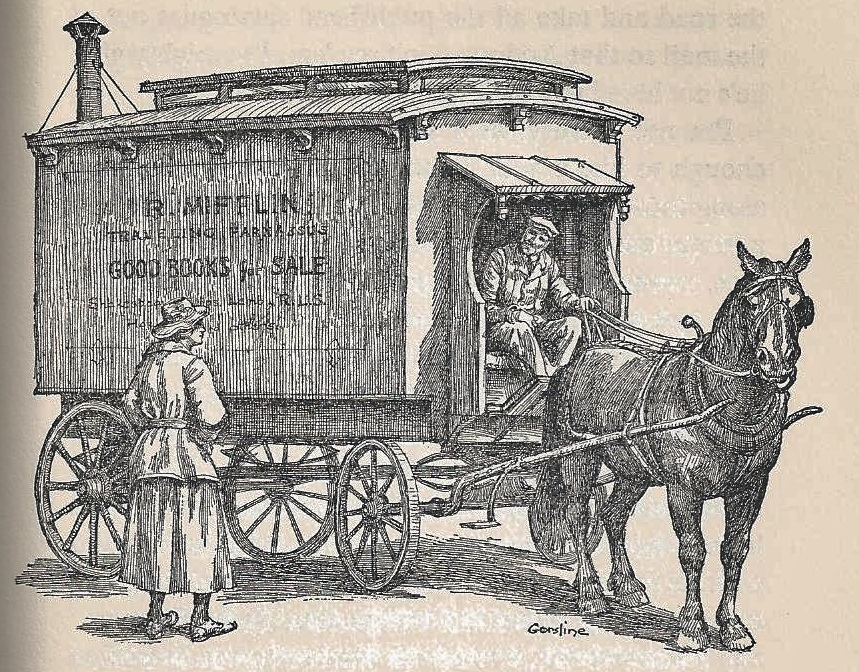
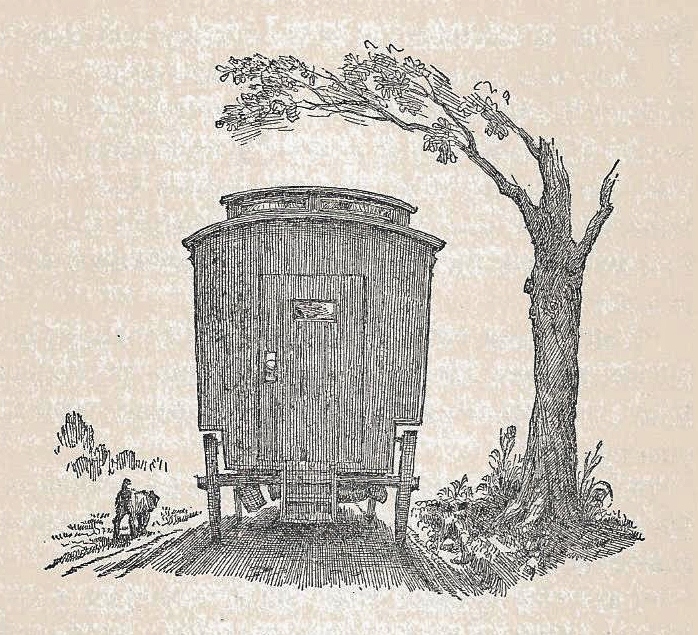
Helen is ripe for rebellion, and when her chance to shake her brother up a bit comes she seizes it with both hands. Andrew is out one day, when up drives a horse-drawn van, with the following legend painted on its side:

R. MIFFLIN’S

TRAVELLING PARNASSUS

GOOD BOOKS FOR SALE

SHAKESPEARE, CHARLES LAMB, R.L.S.

HAZLITT, AND ALL OTHERS

The driver of the van, one Roger Mifflin, is looking for Andrew McGill. He presents Helen with his card:

         ROGER MIFFLIN’S
TRAVELLING PARNASSUS
 
Worthy friends, my wain doth hold
Many a book, both new and old:
Books, the truest friends of man,
Fill this rolling caravan.
Books to satisfy all uses,
Golden lyrics of the Muses,
Books on cookery and farming,
Novels passionate and charming,
Every kind for every need
So that he who buys may read.
What librarian can surpass us?

Helen chuckles, and is immediately interested. She does, after all, appreciate a good book herself, though not to the excess her brother has shown. And Roger Mifflin has a business proposition of sorts. The van is a travelling bookshop, and he thinks it would be just the thing for Andrew to take over. Roger announces his intention of selling his business, lock, stock, horse Peg (short for Pegasus), and all.

Helen, imagining an even more complete neglect of the farm should her brother take on this attractive offer, is aghast. She tries to send Mifflin on his way, with no success.

The two joust back and forth, and Helen gets the gleam of an idea. She will purchase the travelling bookstore, and leave Andrew to watch the farm. She has some money saved, and turn-about is fair play, after all…

The deed is duly done, and, leaving the Swedish hired lady in charge, Helen hits the road with Roger along to show her the ropes. Needless to say, Andrew is flabbergasted at his sister’s sudden whim, and sets out in hot pursuit.

Hi-jinks ensue for numerous chapters, until a satisfyingly romantic conclusion is reached.

A grand little romp of a book, something of a period piece, but happy and playful, and well worth the short few hours it takes to gobble it up.

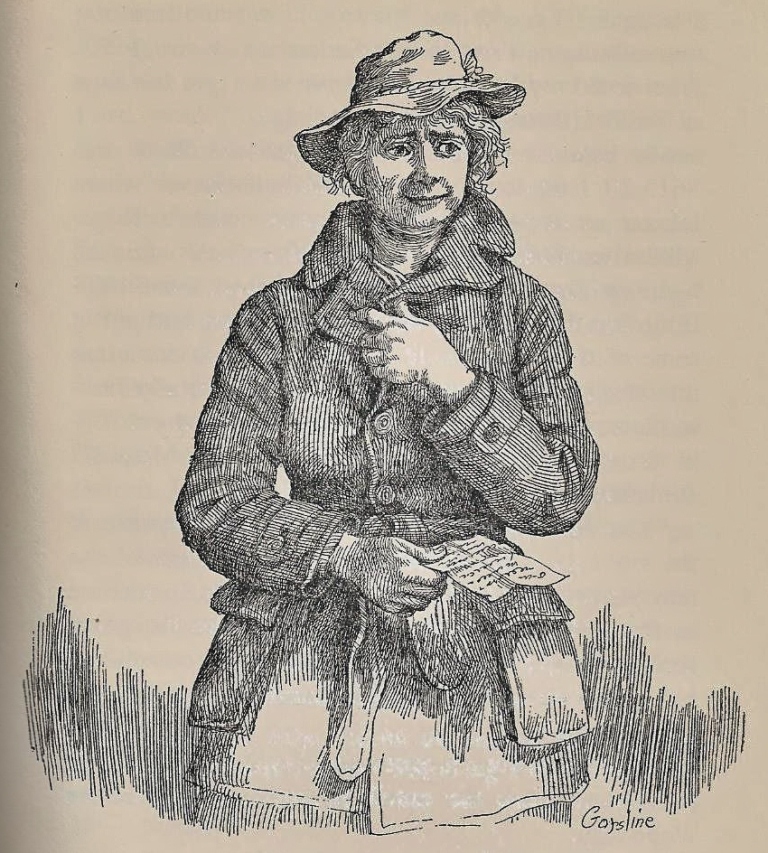
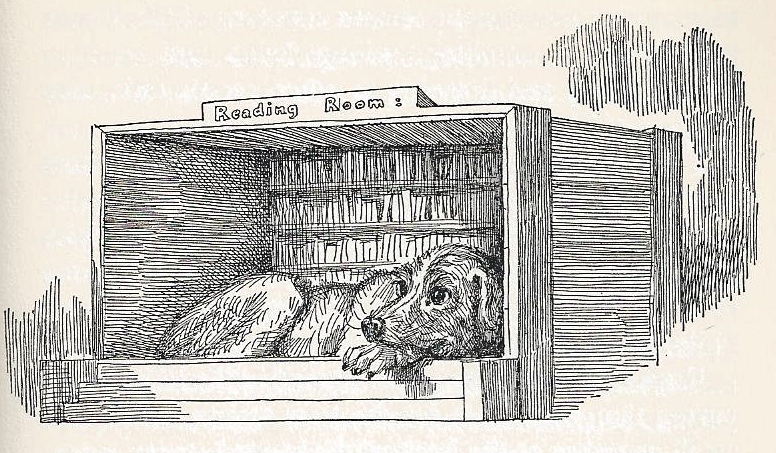
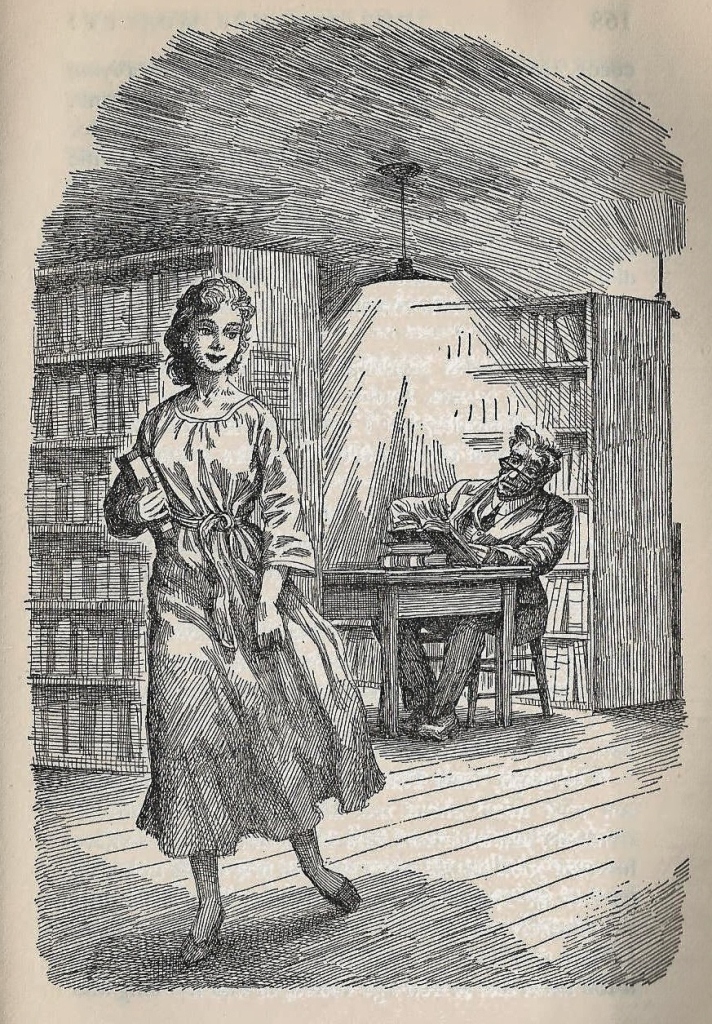
Lippincott’s 1955 edition, which I was lucky enough to stumble upon in Langley last week, has the extra bonus of a very informative explanatory foreword by John Winterich, which added greatly to my understanding and enjoyment of both Parnassus on Wheels and The Haunted Bookshop – I believe it was written to accompany the omnibus volume of both stories which I’ve seen listed on ABE – though this is a stand-alone volume. Clever line illustrations by Douglas Gorsline added an extra fillip to the tale.

*****

After I’d read Parnassus, I stumbled upon a little bit of interesting news regarding Christopher Morley’s inspiration for the story. Turns out that this novel is a send-up of another contemporary novelist of best-selling “rural odes”, one Ray Stannard Baker, writing under the pseudonym David Grayson. Baker-Grayson’s 1907 book, Adventures in Contentment, was immensely popular and gained a large following of people yearning after “the simple life”; it was followed by eight other volumes.  Though Baker himself lived a completely urban lifestyle, as a hard-hitting newspaper reporter and journalist, his alter-ego “Grayson” fictionally left the city for the peaceful rural life of a small farm, where he was joined by his sister “Harriet”; the two enjoyed a rural idyll centered on the simple pleasures of country life and wholesome labour.

A detailed exposé of Baker-Grayson can be found here . Fascinating stuff!

And I’m also linking to a great review of Parnassus by Christine at The Book Trunk.

Read Full Post »

The Story Girl by L.M. Montgomery ~ 1911. This edition: 1st World Library, 2007. Hardcover. ISBN: 978-1-4218-4202-8. 312 pages.

My rating: 9/10. What a delicious period piece. Loved it! Why have I not read this one before?

Beautifully evocative of golden childhood summers in a faraway time. Sweet, but never cloying; the very human children keep it real.

*****

An absolutely charming set piece about a group of cousins and friends spending a mostly idyllic summer together on Prince Edward Island.

The narrator is a grown man, Beverley King, looking back on his childhood, when he and his brother Felix travelled from their home in Toronto to spend the summer on the old family farm while their widowed father travelled to Rio de Janeiro on business. They are to stay with their Aunt Janet and Uncle Alec, and cousins Felicity, Cecily and Dan. Nearby is another motherless cousin, Sara Stanley, living with her Uncle Roger and Aunt Olivia, with a father in Paris. Uncle Roger’s hired boy, Peter Craig, and a neighbourhood friend, Sara Ray, round out the group of children.

Nothing much happens in this book, but the days are nonetheless filled to the brim with interesting incidents. The cousins and friends do their chores, play, squabble and run wild as often as they are able. They are generally good children, but not unreasonably so, and their numerous falls from grace drive the narrative, along with the endless succession of tales told by cousin Sara Stanley, the self-named Story Girl, who has an endless collection of anecdotes from a myriad of sources – local and family fables, legends, fairy tales and Greek myths – something for every occasion. Gifted with a natural dramatic ability, Sara Stanley could “make the multiplication table sound fascinating”, as she does on one memorable occasion.

Observant, restless Bev; chubby, sensitive Felix; self-confident, proud Dan;  beautiful, bossy, domestically talented Felicity; sober, stubborn, peace-loving Cecily; plain, imaginative Sara Stanley; over-protected, tear-prone Sara Ray; self-sufficient, passionate Peter – these are the eight personalities which make up the core group, though other family members and friends – and a few animals – take their part as well. Ranging in age from eleven up into the early teens, glimpses of the young men and women the children will become are very much in evidence, though childhood emotions and interests still hold sway.

Tragic (and joyful) family love affairs, a mysterious locked blue chest filled with a disappointed bride’s prize possessions, magic seeds, poison berries, various “hauntings”, a neighbourhood “witch woman”, reports of the end of the world, a competition regarding dreams, adolescent crushes, a brush or two with death – all of these (and more) serve to add spice to this halcyon summer, looked back on with fond memory by the adult narrator. A few clues as to what the future holds are given – hired boy Peter is deeply in love with beautiful, scornful Felicity; the Story Girl will perform before royalty in Europe – but by and large the narrator stays focussed on that brief time between heedless childhood and care-filled adult life.

*****

This book, along with The Golden Road, The Chronicles of Avonlea and The Further Chronicles of Avonlea, was the basis for a highly successful CBC-Disney television series co-production, Road to Avonlea, which was widely broadcast from 1990 to 1996. I completely missed this one, having by then entered my “no television” years, but reports by L.M. Montgomery aficionados claim that the show departed drastically from the books, both in characters and plot. Canadian actress (and now screenwriter and film director) Sarah Polley played the Story Girl in the series.

The Story Girl is followed by The Golden Road, another Montgomery book which has been on my shelf for some time, but which I have also not yet read – I will be remedying that this winter. If it is as charming and amusing as The Story Girl, I am in for another nostalgic literary treat.

Read-Aloud: The Story Girl would likely work well as a Read-Aloud for ages about 8 and up – there will be some rather long-winded parts here and there as episodes as set up, so you may need to self edit depending on your listeners. A few of the stories are a wee bit gruesome – in one reference a lost child is found the following spring as only a “SKELETON –  with grass growing through it”; ghosts are often referred to; there is a neighbourhood eccentric thought by the children to be a witch – if you are at all concerned over such themes it would be best to read ahead a bit to see if the material is acceptable to your listener’s sensibilities. Many references to and some plots centered on religion. All very era-appropriate. Nothing too extreme, in my opinion, but you may want to preview, especially before starting this with younger children.

Read-Alone: For reading alone, this one is most likely best for older children, say 11 or 12, to adult.

The largest challenge the reader will find themselves faced with, though, is envisioning, or, in the case of a Read Aloud, replicating the Story Girl’s magical talent for tale telling. Good luck! (And enjoy.)

Read Full Post »

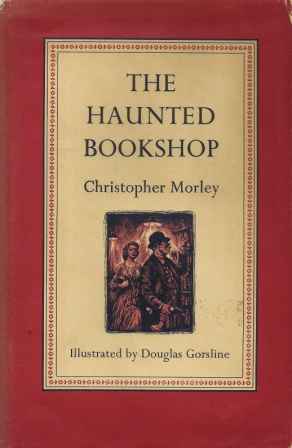
The Haunted Bookshop by Christopher Morley ~ 1919. This edition: Lippincott, 1955. Illustrated by Douglas Gorsline. Hardcover. 253 pages.

My rating: The bookish bits are an easy 10/10. The mystery bits, pretty bad, so only a 5/10. Okay, maybe a 6. Reflecting the time of writing and all that. The romance between the married couple, definitely a 10/10. Aubrey and Titania, hmm, they can have a 9. Another 10 for Bock the dog. It’s looking pretty good, here. Grand illustrations, too. How about an enthusiastic 9/10, with the note that this is very much a period piece, so proceed to read with that caveat in mind.

*****

If you are ever in Brooklyn, that borough of superb sunsets and magnificent vistas of husband-propelled baby-carriages, it is to be hoped you may chance upon a quiet by-street where there is a very remarkable bookshop.

This bookshop, which does business under the unusual name “Parnassus at Home,” is housed in one of the comfortable old brown-stone dwellings which have been the joy of several generations of plumbers and cockroaches. The owner of the business has been at pains to remodel the house to make it a more suitable shrine for his trade, which deals entirely in second-hand volumes. There is no second-hand bookshop in the world more worthy of respect.

It was about six o’clock of a cold November evening, with gusts of rain splattering upon the pavement, when a young man proceeded uncertainly along Gissing Street, stopping now and then to look at shop windows as though doubtful of his way. At the warm and shining face of a French rotisserie he halted to compare the number enamelled on the transom with a memorandum in his hand. Then he pushed on for a few minutes, at last reaching the address he sought. Over the entrance his eye was caught by the sign:

PARNASSUS AT HOME R. AND H. MIFFLIN BOOKLOVERS WELCOME! THIS SHOP IS HAUNTED

He stumbled down the three steps that led into the dwelling of the muses, lowered his overcoat collar, and looked about.

It was very different from such bookstores as he had been accustomed to patronize. Two stories of the old house had been thrown into one: the lower space was divided into little alcoves; above, a gallery ran round the wall, which carried books to the ceiling. The air was heavy with the delightful fragrance of mellowed paper and leather surcharged with a strong bouquet of tobacco. In front of him he found a large placard in a frame:

     THIS SHOP IS HAUNTED by the ghosts
     Of all great literature, in hosts;

     We sell no fakes or trashes.
     Lovers of books are welcome here,
     No clerks will babble in your ear,

     Please smoke--but don't drop ashes!
                             ----
     Browse as long as you like.
     Prices of all books plainly marked.
     If you want to ask questions, you'll find the proprietor
           where the tobacco smoke is thickest.
     We pay cash for books.
     We have what you want, though you may not know you want it.

     Malnutrition of the reading faculty is a serious thing.

     Let us prescribe for you.

     By R. & H. MIFFLIN,
                                     Proprs.

The shop had a warm and comfortable obscurity, a kind of drowsy dusk, stabbed here and there by bright cones of yellow light from green-shaded electrics. There was an all-pervasive drift of tobacco smoke, which eddied and fumed under the glass lamp shades. Passing down a narrow aisle between the alcoves the visitor noticed that some of the compartments were wholly in darkness; in others where lamps were glowing he could see a table and chairs. In one corner, under a sign lettered ESSAYS, an elderly gentleman was reading, with a face of fanatical ecstasy illumined by the sharp glare of electricity; but there was no wreath of smoke about him so the newcomer concluded he was not the proprietor.

As the young man approached the back of the shop the general effect became more and more fantastic. On some skylight far overhead he could hear the rain drumming; but otherwise the place was completely silent, peopled only (so it seemed) by the gurgitating whorls of smoke and the bright profile of the essay reader. It seemed like a secret fane, some shrine of curious rites, and the young man’s throat was tightened by a stricture which was half agitation and half tobacco. Towering above him into the gloom were shelves and shelves of books, darkling toward the roof. He saw a table with a cylinder of brown paper and twine, evidently where purchases might be wrapped; but there was no sign of an attendant.

“This place may indeed be haunted,” he thought, “perhaps by the delighted soul of Sir Walter Raleigh, patron of the weed, but seemingly not by the proprietors.”

His eyes, searching the blue and vaporous vistas of the shop, were caught by a circle of brightness that shone with a curious egg-like lustre. It was round and white, gleaming in the sheen of a hanging light, a bright island in a surf of tobacco smoke. He came more close, and found it was a bald head.

This head (he then saw) surmounted a small, sharp-eyed man who sat tilted back in a swivel chair, in a corner which seemed the nerve centre of the establishment. The large pigeon-holed desk in front of him was piled high with volumes of all sorts, with tins of tobacco and newspaper clippings and letters. An antiquated typewriter, looking something like a harpsichord, was half-buried in sheets of manuscript. The little bald-headed man was smoking a corn-cob pipe and reading a cook-book.

“I beg your pardon,” said the caller, pleasantly; “is this the proprietor?”

Mr. Roger Mifflin, the proprietor of “Parnassus at Home,” looked up, and the visitor saw that he had keen blue eyes, a short red beard, and a convincing air of competent originality.

“It is,” said Mr. Mifflin. “Anything I can do for you?”

*****

So begins this charming story, which was literally forced upon me by the proprietor of Murdoch’s Bookshoppe  in Mission, B.C., during a recent visit. “Have you read that?” he demanded of me as I browsed through it at the front desk while he was totting up my other purchases, giving me a stern look after he plunked each tempting hardcover down after noting the pencilled-in price. “No!? What do you mean, you’ve heard of it? You must READ it. Buy it!”

So I did. And I have. Bought it and read it.

How to describe this? Well, first off, it’s a stand-alone sequel to an earlier book, Parnassus on Wheels, in which our hero apparently operates a kind of travelling bookshop. Haven’t read that one yet, but it’s on my to-acquire list. (Though I see it is recently available via Project Gutenberg, as is The Haunted Bookshop itself and a number of Morley’s other works. I still prefer a physical book, after having experimented with a friend’s e-reader, and after reading a number of works online through Gutenberg. Print on the paper page, please, though I firmly believe that Gutenberg is providing a crucial resource by making available so many out of print gems. I occasionally do some proofreading for Gutenberg projects, which is an incredibly satisfying volunteer pastime. Maybe I should write a post about that one day.)

I am digressing, which is appropriate, as The Haunted Bookshop is a great series of digressions itself.

It is also a love story (or two), a mystery story, an ode to the printed page and the ideas found between covers, and, most vividly, an anti-war tirade, being published immediately post World War I, when the world was still reeling from the brutality of that event.

Roger Mifflin and his wife Helen have settled down in New York to pursue the bookselling trade from a fixed location. They are about to take into their household the daughter of a wealthy friend, who wishes young Titania to sober herself from her frivolous ways by learning what it is to toil and earn her living by her labour. Titania turns out to be a true treasure, and she soon attracts a swain – a certain Aubrey Gilbert, who has come into the shop to attempt to sell advertising to Mr. Mifflin, and, though turned down on this front, becomes attached to happily eccentric Roger and makes the shop something of a second home

A mystery regarding the continual disappearance and reappearance of a Thomas Carlyle’s Oliver Cromwell on the shop’s shelves leads to encounters with sinister Germans, and a plot to assassinate Woodrow Wilson on his way to a Peace Conference. All’s well that ends well (except for a casualty or two in the final dramatic scene.)

This is quite the period piece, as I mentioned earlier, but is more than redeemed by the glorious bits of rambling prose. I will leave you with another sample, which made me laugh out loud – not sure what that says about the nature of my sense of humour, but I found this very funny.  I won’t force this book upon anyone in the forthright way of Mr. Murdoch, but I will give it a cheerful recommendation. And here is the author describing one of Roger’s domestic weaknesses.

I hesitate to touch upon a topic of domestic bitterness, but candor compels me to say that Roger’s evening vigils invariably ended at the ice-box. There are two theories as to this subject of ice-box plundering, one of the husband and the other of the wife. Husbands are prone to think (in their simplicity) that if they take a little of everything palatable they find in the refrigerator, but thus distributing their forage over the viands the general effect of the depredation will be almost unnoticeable. Whereas wives say (and Mrs. Mifflin had often explained to Roger) that it is far better to take all of any one dish than a little of each; for the latter course is likely to diminish each item below the bulk at which it is still useful as a left-over. Roger, however, had the obstinate viciousness of all good husbands, and he knew the delights of cold provender by heart. Many a stewed prune, many a mess of string beans or naked cold boiled potato, many a chicken leg, half apple pie, or sector of rice pudding, had perished in these midnight festivals. He made it a point of honour never to eat quite all of the dish in question, but would pass with unabated zest from one to another. This habit he had sternly repressed during the War, but Mrs. Mifflin had noticed that since the armistice he had resumed it with hearty violence. This is a custom which causes the housewife to be confronted the next morning with a tragical vista of pathetic scraps. Two slices of beet in a little earthenware cup, a sliver of apple pie one inch wide, three prunes lowly nestling in a mere trickle of their own syrup, and a tablespoonful of stewed rhubarb where had been one of those yellow basins nearly full—what can the most resourceful kitcheneer do with these oddments? This atrocious practice cannot be too bitterly condemned.

I do believe I will print that passage off and attach it to my fridge, in the hopes that my own domestic affairs will see an improvement in this area!

Read Full Post »

Kilmeny of the Orchard by L.M. Montgomery ~ 1910. This edition: Ryerson Press, 1968. 5th Canadian Printing. Hardcover. 256 pages.

My rating: 3/10. (And I’m being generous.)

*****

Boo, hiss.

I’m going to say this straight away. I did not like this book. If it were authored by anyone other than the iconic Lucy Maud Montgomery, it would already be in the box out in the porch, heading for the charity shop next trip to town. As it is, I will keep it just because I do like complete collections of things, and I have many (most?) of L.M. Montgomery’s other novels and short story collections, but I will not be re-reading it any time soon, if ever.

Oh, this book is so dismal, in so many ways.

Here I extend an apology to those of you who love this story, and see it as a sweet fairytale, and are able to accept it as a product of the time it was written in. That’s all well and good, and I often do the same, but in this case I look at the author in question, see that this novel was published two years after Anne of Green Gables – which is a very different (and much better) book in every conceivable way – and shake my head at the author. How could she?!

In the interests of full disclosure, I did read a number of reviews before I tackled this story, and I was prompted to read this for the Canadian Book Challenge by these two bloggers, Nan at Letters From a Hill Farm, and Christine at The Book Trunk.

Letters From a Hill Farm Review – Kilmeny of the Orchard

The Book Trunk Review – Kilmeny of the Orchard

Nan and Christine between them eloquently present the “for” and “against” arguments, and I was truly curious to see in which camp I would make my home.

Nan, Kilmeny’s all yours.

Hi there, Christine. Is there room for me by your fire?!

Spoilers follow. If you want to read and judge for yourself without my input stop here.

*****

“Kilmeny looked up with a lovely grace,
        But nae smile was seen on Kilmeny’s face;
        As still was her look, and as still was her ee,
        As the stillness that lay on the emerant lea,
        Or the mist that sleeps on a waveless sea.
        .   .   .   .   .   .   .   .   .   .   .   .   .
        Such beauty bard may never declare,
        For there was no pride nor passion there;
        .   .   .   .   .   .   .   .   .   .   .   .   .
        Her seymar was the lily flower,
        And her cheek the moss-rose in the shower;
And her voice like the distant melodye
        That floats along the twilight sea.”

                                  — _The Queen’s Wake_
                                                 JAMES HOGG

Wonderfully promising start with a quote from James Hogg’s narrative poem about the lovely Kilmeny who spends seven years in fairy land and comes back mutely unable to tell what she has seen. So far, so good.

And the first few chapters are quite promising as well. We meet a young man, Eric Marshall, as he graduates from college one glorious springtime day, and we nod and smile at Montgomery’s flowery description of the scene.

The sunshine of a day in early spring, honey pale and honey sweet, was showering over the red brick buildings of Queenslea College and the grounds about them, throwing through the bare, budding maples and elms, delicate, evasive etchings of gold and brown on the paths, and coaxing into life the daffodils that were peering greenly and perkily up under the windows of the co-eds’ dressing-room.

A young April wind, as fresh and sweet as if it had been blowing over the fields of memory instead of through dingy streets, was purring in the tree-tops and whipping the loose tendrils of the ivy network which covered the front of the main building.  It was a wind that sang of many things, but what it sang to each
listener was only what was in that listener’s heart.  To the college students who had just been capped and diplomad by “Old Charlie,” the grave president of Queenslea, in the presence of an admiring throng of parents and sisters, sweethearts and friends, it sang, perchance, of glad hope and shining success and high achievement.  It sang of the dreams of youth that may never be quite fulfilled, but are well worth the dreaming for all that. God help the man who has never known such dreams–who, as he leaves his alma mater, is not already rich in aerial castles, the proprietor of many a spacious estate in Spain.  He has missed his birthright.

And here’s our young hero:

Eric Marshall, tall, broad-shouldered, sinewy, walking with a free, easy stride, which was somehow suggestive of reserve strength and power, was one of
those men regarding whom less-favoured mortals are tempted seriously to wonder why all the gifts of fortune should be showered on one individual.  He was not only clever and good to look upon, but he possessed that indefinable charm of personality which is quite independent of physical beauty or mental ability.
He had steady, grayish-blue eyes, dark chestnut hair with a glint of gold in its waves when the sunlight struck it, and a chin that gave the world assurance of a chin.  He was a rich man’s son, with a clean young manhood behind him and splendid prospects before him.  He was considered a practical sort of fellow, utterly guiltless of romantic dreams and visions of any sort.

Eric has decided to join his father in the family retail business – his father is a successful department store mogul – much to the dismay of Eric’s older cousin, Dr. David Baker, who feels Eric’s talents would be better used if he were to pursue a law degree. But Eric nobly holds out that his father’s occupation is good enough for him. What a good son, I thought. Attaboy!

But before Eric can settle into his life in business, he receives a letter from a close friend who is working as a teacher on Prince Edward Island. The friend has fallen ill, and must take a leave of absence from his position. Will Eric please come and take over the school for the last part of the term?

Eric happily agrees, and off he goes to the Island. He is much taken by the beauty of the setting, and by the quaint friendliness of the natives. The only jarring note is struck one evening when he sees an elderly man and a young man together.

Eric surveyed them with some curiosity.  They did not look in the least like the ordinary run of Lindsay people.  The boy, in particular, had a distinctly foreign appearance, in spite of the gingham shirt and homespun trousers, which seemed to be the regulation, work-a-day outfit for the Lindsay farmer lads.  He
had a lithe, supple body, with sloping shoulders, and a lean, satiny brown throat above his open shirt collar.  His head was covered with thick, silky, black curls, and the hand that hung down by the side of the wagon was unusually long and slender. His face was richly, though somewhat heavily featured, olive
tinted, save for the cheeks, which had a dusky crimson bloom. His mouth was as red and beguiling as a girl’s, and his eyes were large, bold and black.  All in all, he was a strikingly handsome fellow; but the expression of his face was sullen, and he somehow gave Eric the impression of a sinuous, feline creature basking in lazy grace, but ever ready for an unexpected spring.

The other occupant of the wagon was a man between sixty-five and seventy, with iron-gray hair, a long, full, gray beard, a harsh-featured face, and deep-set hazel eyes under bushy, bristling brows.  He was evidently tall, with a spare, ungainly figure, and stooping shoulders.  His mouth was close-lipped and
relentless, and did not look as if it had ever smiled.  Indeed, the idea of smiling could not be connected with this man–it was utterly incongruous.  Yet there was nothing repellent about his face; and there was something in it that compelled Eric’s attention.

Eric shrugs and moves on. That evening, his landlord fills him in on the story. The elderly man Thomas Gordon, a local farmer, and the boy is an Italian orphan whose mother died at his birth. His father immediately deserted and has not been seen since. He was raised up by the Gordons, bachelor Thomas and his spinster sister Janet, but nature is apparently proving stronger than nurture.

“Anyhow, they kept the baby.  They called him Neil and had him baptized same as any Christian child. He’s always lived there.  They did well enough by him.  He was sent to school and taken to church and treated like one of themselves.  Some folks think they made too much of him.  It doesn’t always do with that kind, for ‘what’s bred in bone is mighty apt to come out in flesh,’ if ‘taint kept down pretty well.  Neil’s smart and a great worker, they tell me.  But folks hereabouts don’t like him.  They say he ain’t to be trusted further’n you can see him, if as far… 

Later this same evening, Eric goes for a walk and stumbles upon an old orchard, trees in full bloom. Wandering through the fragrant dusk, he hears the delicate strains of a violin, and, tracing them to their source, startles a lovely young maiden playing ethereal and perfectly in-tune music among the apple trees. Eric thinks she’s the most beautiful thing he’s ever seen, and eagerly approaches her but the girl gasps in terror and flees, uttering not a word or a sound.

More investigation reveals that this is the mysterious Kilmeny Gordon, niece of the afore-mentioned Thomas and Janet Gordon, and house mate of Italianate Neil. She lives in seclusion and seldom appears in public; apparently she is mute, and also is cursed by being an illegitimate child. Her mother was married to a man, Ronald Fraser, whose first wife was mistakenly thought to be dead; when the first wife showed up very much alive. Ronald abandoned wife number two and went off with wife number one, to die “of a broken heart” shortly thereafter. Kilmeny is born  into an atmosphere of grief and resentment, and has been unable to speak since birth, though apparently her “organs of speech” are normal enough. Kilmeny’s mother is quite a piece of work – sullen and angry at her sad fate, she takes it out on everyone in the family, and I can’t help but think her death, which has occurred three years prior to the opening of the story, was probably a huge relief to all concerned.

I’m going to condense the rest of the story, though you can probably figure out what happens next.

Neil is already in love with Kilmeny. Eric falls in love with her and dismisses the prior claim of the shifty Italian fellow. Kilmeny communicates through the strains of her violin music (Neil, also innately musically gifted by his inborn heritage, apparently only had to show her how to hold the bow and her vast natural ability did the rest) and by writing on a slate hung around her neck. The courtship proceeds with Eric marvelling at this luscious find – a pure, innocent, beautiful girl – all his! Oh, go slow, do not frighten the shy little thing! – and with Kilmeny totally in awe of this handsome, obviously noble, manly man from another world.

And oh yes, the locals all call Eric “Master”, presumably because of his schoolmaster role, but it sounds a little odd in daily conversation, as if it should be accompanied (and it often is) by forelock tugging of the peasant-before-nobility type.

Eric is predictably infatuated with Kilmeny, and persists in haunting the orchard in her company, until his landlady mentions that perhaps it would be nice if Eric would go to Kilmeny’s guardians and mention his interest. “Never thought of that!” says Eric (I’m paraphrasing) and off he goes to immediately win over the dour and suspicious Gordons with his shining goodness and innate nobility. (Neil glowers in the corner.)

What else? Let’s see. Oh – Kilmeny wonders at why Eric is so taken with her – “I’m so ugly!” she moans – oops, sorry – writes on her slate. Turns out that she has never looked in a mirror in her whole eighteen years – her mother broke them all in a fit of pique after her abandonment, and Janet and Thomas have never thought to replace them.

Eric proposes, because despite Kilmeny’s “great affliction” he can’t wait to get his hands on this delectable young creature. Kilmeny refuses him. Scritch, scritch, scritch -“I will only marry you if I gain the power of speech!”

Eric calls in his old friend Dr. Baker, who examines Kilmeny and decides, along with her aunt and uncle, that her affliction has been caused by her mother’s trauma, visited in some mysterious way upon the newborn babe. If a great surge of desire to speak were to come over Kilmeny, she would at long last be able to utter! But as this doesn’t seem likely to happen, Kilmeny and Eric decide to part.

Both mope around, until Eric, unable to withstand the desire to see his love one more time, ventures into the orchard. He passes sullen Neil, building a fence. He sees Kilmeny, and is overcome with grief and sorrow at his imminent loss. Kilmeny sees him, and she sees something else – the hot-blooded Italian is coming up behind Eric with axe upraised!

Do I need to go on?

Voice is achieved. Neil drops the axe in horrified remorse and promptly leaves the Island, removing himself permanently from the picture, to the relief of absolutely everyone. (Poor Neil. He is the one sympathetic character in this whole thing.) The engagement is back on. Eric’s father sees Kilmeny and is immediately smitten with his son’s bucolic sweetheart. Birds sing, etc. etc. etc. and the curtain sweeps shut.

*****

There are so many objectionable elements to this melodrama. The characters are impossibly stereotyped, and the situations are contrived to the nth degree.

What was all the nonsense about Neil and his ethnic “stain”? He was raised from babyhood as a member of the family, but his demotion from Kilmeny’s foster “brother” to merely an inconvenient hired boy is swift and brutal, with no visible consequences except to Neil himself. The xenophobic comments regarding Neil’s heritage come straight from the author, via the mouths of her characters. Nowhere is there any indication that this is a plot device, except for one or two mentions that Neil’s perpetual sullenness is a reaction to the way he is viewed and treated by everyone else in his community. Damned from birth, and by birth.

And poor Kilmeny – she too is damned by birth. Because of her mother’s “sin” – rejection of her dying father’s request for a reconciliation, plus a poor marital choice – the innocent baby is doomed by some supernatural power to muteness. That doesn’t make any sort of sense whatsoever, but all of the characters meekly accept it as a viable reason and a fair enough fate.

Eric’s infatuation with the virginal Kilmeny, and his desire to teach her about love and the world is more than a little creepy, as is his willingness to abandon her because of her “affliction”. I mean, the girl has everything – unearthly beauty, musical ability approaching genius, and perfect (if tiny) handwriting! What’s a mere voice matter when she has so many other sterling qualities and delicious possibilities to offer?

The whole thing creeped me out, and I’m hard pressed to find any excuse for Lucy Maud Montgomery’s authorial sloppiness and moral negligence in this particular effort. It did remind me of some of the more forgettable of her short stories, so all I can think is that she popped it off one thoughtless day and sent it out into the world and had it accepted because of the previous excellence and best-sellerism of Anne of Green Gables and Anne of Avonlea.

Not recommended.

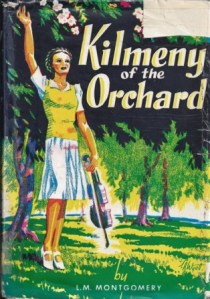
Oh – one more thing. What is with that awful cover, pictured way above? Kilmeny looks dressed for 1940s’ tennis, but for the improbable shoes. This novel was set in horse and buggy times, dear illustrator – it was originally published in 1910! And she looks like a sturdy, athletic Nordic blond – in the book she is a delicately featured, blue-eyed, black-haired, “fairy child”. Apparently a cover illustration with only a tenuous relation to the text within is not a modern phenomenon.

Read Full Post »

« Newer Posts