Archive for the ‘1900s’ Category

Love’s Shadow by Ada Leverson ~ 1908. This edition: Bloomsbury, 2010. Softcover. ISBN: 978-1-60819-050-8. 225 pages.

My rating: 7.5/10. An enjoyable diversion; cleverly amusing; my only quibble is the abrupt ending, but there are two books which continue the story.

I found myself mentally running to keep up with these bright young (and not so young) things in the early days of the 20th Century.

Off to ABE I go, to scope out the sequel situation, though once there I know I will be seduced into searching for other more pressing desires – I still have a bit of a Margery Sharp wish list going on, and Elizabeth von Arnim, and I did want to pick up one or two of those as presents-to-myself for over-Christmas reading, in case the book parcels don’t stretch far enough; really promising books attract a line-up here, with all four of us elbowing each other out of the way. I prefer to majestically withdraw to peruse my back-ups; saves such effort and eases the crush!

But back to Edwardian London, and Ada Leverson’s romantic upper-class circle game.

*****

Love like a shadow flies

When substance love pursues;

Pursuing that that flies,

And flying what pursues.

~Shakespeare

Lovable Edith is married to dreadfully vain civil servant Bruce Ottley; she views her truly tiresome husband with a gently cynical eye and takes comfort in amusing herself with her adorable young son, conferring with her likeable and wise mother-in-law on how best to manage Bruce’s more obnoxious traits, and innocently dallying with her wealthier, socially superior, but truly nice and sweetly affectionate friend, the beautiful Hyacinth Verney.

As the story opens, Hyacinth is in the throes of an apparently hopeless passion for handsome and unreachable Cecil Reeve; Cecil is in romantic thrall to Mrs. Raymond, a widow ten years his senior. Hyacinth is in turn the focus of the unrequited love of a number of characters: her companion, the eccentric and emotionally tormented Anne Yeo; her elderly guardian, Lord Cannon (married to the majestically obtuse and perennially self-satisfied Lady Cannon); and even Edith’s snobbish husband Bruce. Edith has her own admirer, the exceedingly eccentric F.J. Raggett, who has been introduced into the household by Bruce for reasons I never was quite clear on.

Edith and Mr. Raggett:

‘What is your work, exactly?’ she asked, with polite interest.

‘It’s difficult to explain, Mrs Ottley. It takes a great many forms.’

‘Oh, yes.’

‘Just at this moment I’m a Legitimist – you understand, don’t you? We drink to Queen Mary over the water – and put violets on the statue of King Charles the Martyr in February, and so forth.’

‘Ah. That must be very hard work.’

‘Oh, it isn’t only that – I’m a kind of Secretary, you see, to the Society.’

‘Really? Really? What fun it must be; I mean how interesting. Can I belong?’

‘Oh, dear yes, of course, Mrs Ottley. If you like.’

‘What should I have to do?’

‘Well, first of all you would have to pay a shilling.’

‘Yes?’

‘And then you would be eligible for a year’s probation.’

‘And what should we do after that?’

‘Well, after that, you see, we shall have to bide our time.’

‘That doesn’t sound very hard,’ said Edith thoughtfully. ‘Just to pay a shilling and bide your time.’

‘I’ll send you some papers about it, if you really take an interest.’

‘Thanks. Thanks, very much. Yes, do send them.’

‘Do you really think you would care to become a member, Mrs Ottley?’

‘Oh, yes; yes, I should think so. I always hated Oliver Cromwell.’

He looked doubtful.

‘Yes, of course – but that alone, I’m afraid, would hardly be … you see there might be a revolution at any moment.”

Mrs. Raymond eventually spurns Cecil, who after much prodding by everyone finally sees the light and turns to court the receptive Hyacinth. Cecil’s wealthy and eccentric aristocratic uncle, Lord Selsey, then decides to capture Mrs. Raymond for himself, as he feels she would be a suitably low-maintenance companion and a willing custodian for his extensive art collection.

By the end of the novel we have a marvelous appreciation of the way in which Edith Ottley is coping both with awful Bruce and persistent Mr. Raggett; Hyacinth and Cedric are married and are fighting their way through the inevitable jealousy engendered by the Cecil’s still-existing Mrs. Raymond infatuation; Mrs. Raymond, now Lady Selsey, does the decent thing and withdraws from the scene by taking her new husband on a year-long visit to the Greek islands; Lord Cannon is managing his tiresome wife with continued aplomb; and Anne Yeo, my own personal favourite of all of the characters, has decided to take her bruised heart away with her to an unknown country; our last view of her is as she is heading to Cook’s; she has decided to emigrate.

Scads of loose ends dangle; perfectly set up for a continuation of the farce.

Followed by Tenterhooks (1912) and Love at Second Sight (1916); the trilogy was also published in a Virago omnibus edition, The Little Ottleys, in 1982.
*****

Not my usual reading fare, but I enjoyed it. It rather reminded me of Nancy Mitford, whom I indulge in in rationed amounts from time to time. Oscar Wilde is the connection most reviewers mention, and as Ada Leverson was one of Wilde’s close friends and the comparison is fitting.

Read Full Post »

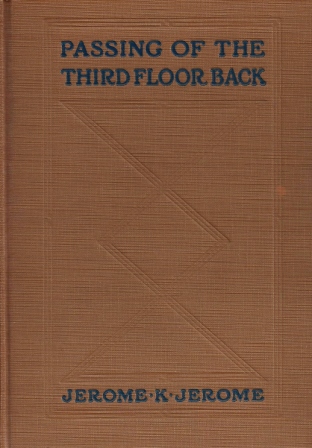
Passing of the Third Floor Back by Jerome K. Jerome ~ 1904. This edition: Dodd, Mead & Co., 1928. Hardcover. 186 pages.

My rating: This is one of those complicated-to-rate books. In context with other short story collections of its time, I thought it fairly typical. Not perhaps outstanding, but a solid little group of era-correct (love that term – it comes from the vintage car world, in which I have a tiny involvement) pieces. Did I enjoy them, though, on a purely reading-for-pleasure level? Some yes, others not so much. I thought the short stories herein were reasonably well written – if a bit wordy – and quite moralistic. No doubt as to what we’re supposed to be thinking at the end of each!

So, taking everything into consideration, how about  7/10. I don’t know if I would recommend this small collection as purely pleasure reading suitable for modern tastes, but the stories do possess a certain curiousity value, and several are quite humorous, in an “era-correct” (there, I got to use that again!) sort of way.

*****

Jerome K. Jerome, 1859-1927, is, as you’ll know unless you’ve been residing under a literary rock all your adult days, best-known for his 1889 comic novel, Three Men in a Boat (To Say Nothing of the Dog), still very much in print 123 years after its first publication. This was my own first introduction to this author some years ago, and I found the story mildly diverting. A pleasant memory persisted, so when I chanced upon this book of short stories in a pile of vintage hardcovers on the deliciously over-crowded shelves of At Second Glance in Kamloops, I eagerly added it to my pile of acquisitions.

Apparently the title story, Passing of the Third Floor Back, was made into a quite successful movie in 1935, starring Conrad Veidt. I must admit I’d never heard of it until I did a bit of background research on this book for reasons of this review, but from the Wikipedia article it looks as though Jerome’s story was very much a starting point – the movie plot as described seems nothing like the story I’ve just read, but for the boarding house setting and the idea of the mysterious stranger changing the lives of those about him.

Six stories make up this collection.

Passing of the Third Floor Back ~  A mysterious stranger moves into a squalid boarding house and changes the lives of everyone who comes into contact with him.

The Philosopher’s Joke ~ What if you could go back to your younger days, but still remember everything you’d learned through your maturity? I liked the premise, but found the handling rather awkward. An intriguing idea – very thought-provoking.

The Soul of Nicolas Snyders, or The Miser of Zandam ~ An exchange of souls has predictable results, and a few surprises. Moralistic but smile-provoking.

Mrs. Korner Sins Her Mercies ~ The most purely humorous story of the collection. A clever friend puts an interesting spin on a marital crisis.

The Cost of Kindness ~ A good deed sets off a chain reaction, with very different results than first anticipated. Another humorous piece.

The Love of Ulrich Nebendahl ~ Self-sacrifice taken to the extreme. This was the most serious story of the lot; a rather shocking conclusion, which the author attempts to soften with a Biblical tag.

*****

I am going to leave my review right there – a simple report – so sorry, but I can’t quite bring off a deeper analysis. Limited computer time this week, and so much going on in my real life that my thinking capacity is all used up by the time I sit down to type!

Read Full Post »

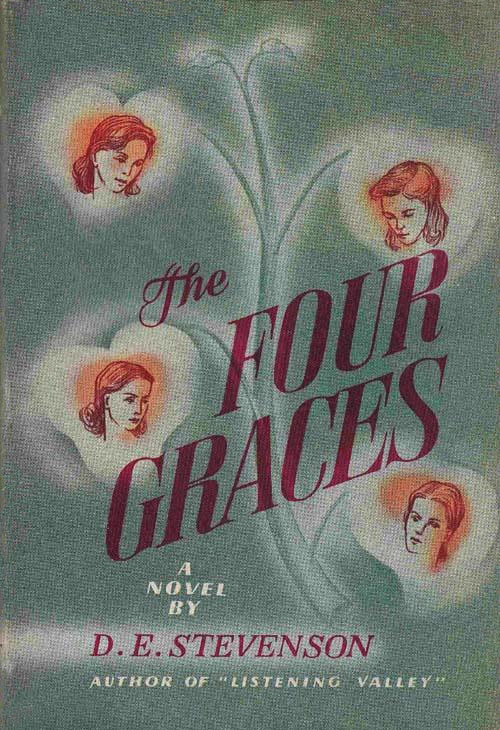
The Four Graces by D.E. Stevenson ~ 1946. This edition: Ulverscroft, 1975. Hardcover. Large Print – 370 pages.

My rating: For purely cozy, exceedingly nostalgic, “English village” escape literature, easily a 9/10. Literary merit – well, we won’t go there! I am actually quite impressed by the assumption that the author makes that her readers are very familiar indeed with the literary greats, as well as the current bestsellers of the day. References and quotations appear without any explanation, with, I’m quite certain, the belief that the reader as well as the characters of the story will “get it” immediately. Rather reminiscent of D.L. Sayers, and her own high-handed assumption that her readers are coming from the same erudite place as she is!

*****

This is my second D.E. Stevenson, after my initial introduction to this author’s esteemed Miss Buncle’s Book . I can understand how Dorothy Emily has garnered such a devoted following over the years. My elderly mother (87) would just love this one. I browsed ABE to see if I could perhaps pick it up for her, but was shocked at what  I thought were astronomical prices for this type of book – $22 and up for worn paperbacks to an unbelievable $246 for an ex-library hardcover. Who knew?!

Someone needs to get going on republishing this author – obviously there is a demand. I know Persephone has recently re-released, in 2009 and 2011 respectively, Miss Buncle’s Book and Miss Buncle Married, but those are the tip of a very large iceberg. According to my research – okay, to be honest, I looked at Wikipedia – this author’s career extended from 1923 to 1970, with a very respectable forty-six titles to her credit.

*****

The Reverend Mr. Grace is Vicar of a country parish, and is blessed with four now-motherless grown-up daughters. Adeline – Addie – the eldest, is a W.A.A.F. officer now living in London, but the three younger sisters remain at home. Matilda (Tilly), Sarah (Sal) and Elizabeth (Liz) all keep extremely busy, both by assisting their father in his many duties and helping with the war effort, for the story is set mid-World War II, and much of its charm is in seeing how the villagers live their lives and gamely make adjustments for the current reality.

Romance enters the sisters’ lives as two suitors suddenly appear – one quite traditionally, and the other much more insidiously. The reader never has a moment of doubt as to the eventual outcome, and though there are gentle setbacks to both romances everything inevitably works out as it should. A very sweet little story, which I found surprisingly appealing. Tiny touches of cynicism and humour kept it from being too saccharine, though it was a rather close thing.

From the Author’s Preface:

The author has been asked whether this is a funny book or true to life, and has some difficulty in answering the question, for life is a funny business altogether (both funny-peculiar and funny-ha-ha, as Elizabeth would say). The story covers less than a year in the life of a family and during this comparatively short period many things happen, some serious and important, others cheerful and gay. It is summertime – a summer during the greatest and most terrible f the wars – but the author felt disinclined to bring such a grave and desperate matter into a light-hearted tale; here, then, are to be found only the lighter side and the small inconveniences of Total War; the larger issues are ignored…

Read Full Post »

The Benefactress by Elizabeth von Arnim ~ 1901. This edition: Dodo Press, 2012. Softcover. ISBN: 978-1-4099-8059-9. 338 pages.

My rating: 9/10. Or maybe even 9.5? Very good stuff.

I searched out this book on the recommendation of Claire at The Captive Reader, and I am ever so pleased that I did. It was a most delightful read during my recent trip to “The Coast” – Interior British Columbia code for “The Lower Mainland” or “Vancouver”, for you non-Canadians and Easterners. (For of course most of Canada is East of B.C., something we like to smugly tease our friends from Alberta about as they go on about “The West thinks…” this and that, though they rather rudely reply with comments to the effect that the Rocky Mountains were put there for a reason, to keep the eccentric inhabitants of B.C. safely segregated from the rest of Canada!)

My daughter was attending a dance intensive and working with a choreographer; I spent a fair bit of time parked outside her venue waiting for the brief breaks which required sporadic maternal nurturing in the area of rides back to the hotel for showers, food, band aids and sympathy. She was, as happens every summer, feeling the pain of strenuous dancing after relaxing a bit too much over the previous month of home-studio summer break, and, yes, the maternal words “I told you so!” did leave my lips occasionally, but she easily ducked under them – water off a duck’s sweaty little back – we’ve been doing this a long, long time and we both know our roles inside and out and could run this perennial dialogue in our sleep!

The Benefactress was a perfect car-in-parking-lot and hotel room read; just engrossing enough that it was easy to re-enter at a moment’s notice and just complex enough that I could happily mull it over as I crouched meekly in the darkest corner of the dance space waiting for my cues to videotape the completed choreo as it progressed.

I am feeling a bit behind on reviews this week – a minor bobbling as I reach to attain my self-imposed goals. I spent way too much time reading, and driving – the trip to the coast, one-way, takes a good seven hours, not counting stops to refuel and stretch our car-cramped legs. Time out to visit a few secondhand bookstores in the towns we pass through is built into our itinerary; my daughter is the perfect travelling and book-browsing companion and I am relishing this year in her company; our next-to-last dance season together before she moves on to the bigger world of college and work and her ensuing “adult” life.

We’re back home now, with a stack of new-to-us books which I’m gleefully looking forward to exploring and talking about, so I’m going to cheat a bit on this review and refer you straight to Claire. Her take on The Benefactress is spot-on; I don’t feel like I could add to it in any way except to repeat that I loved this book and it was well worth seeking out.  Very highly recommended.

The Benefactress Review from The Captive Reader

Read Full Post »

« Newer Posts