Keep the Aspidistra Flying by George Orwell ~ 1936. This edition: Penguin, 1975. Paperback. 264 pages.
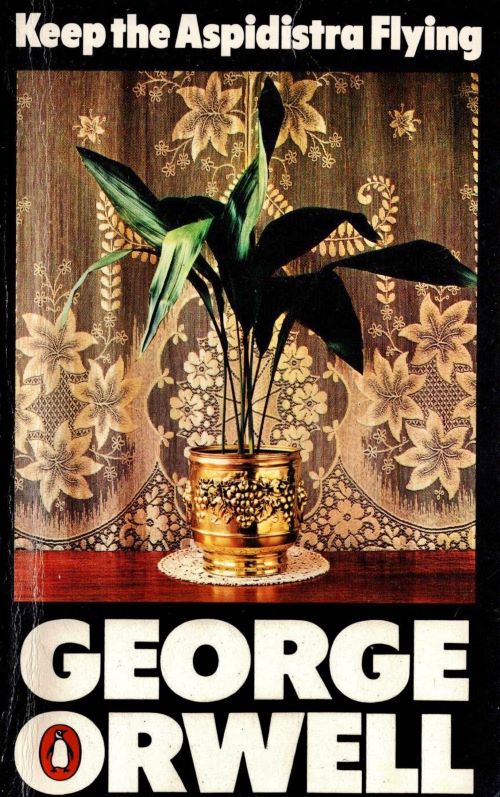
I’m starting my 2024 Century of Books with this satirical novel, centered around a petulantly angry young man who almost manages to succeed at failure by deliberately refusing to take advantage of every chance he is given to advance himself, from his school days onward.
Gordon Comstock, on the cusp of his thirtieth birthday, is the last scion of a large, once-prosperous, middle-class English family. He’s a bit of a weedy chap, living unnecessarily squalidly by his own choice, and he’s very much on a downward spiral.
Having a modest aptitude for literary creativity, Gordon has achieved a small success as a poet, though his one published volume of verse, Mice, is now languishing on the remainder shelves of the bookstore he works at, after selling a meager one hundred and fifty-three copies in the two years since its debut.
Gordon is pretty miffed about this. He can’t quite come to terms with his unsuccess as a writer, which he wraps up with his bitter condemnation of what he sees as a universal fixation on degrees of social rank, economic status, and the push to attain more money, more things. He feels that if only he were free to concentrate on his writing without the whole wage-slave thing, he would flower forth into his full intellectual potential.
Gordon’s psyche seems to be deeply scarred by his recognition that, as the years go by and the family money disappears – whisked away by the increasing cost of living and unwise investments – his family’s financial status is desperately inadequate to meet with the costs of maintaining a suitable social position without its members seeking paid employment. His way of dealing with this is to “defy the money-god” of conventional society by refusing to play the middle-class game of climbing-the-ladder-and-getting-ahead. Much as he would reject that description, Gordon’s a snob at heart.
Despite the best efforts of his few surviving family members and a stalwart handful of friends and well-wishers to see him settled in a “good job” with “good prospects” for future advancement, Gordon has sworn an oath against participating in what he sees as a dirty game. If he can strip his life of inessentials, take on the most minimal employment possible to provide for his most basic needs, and dedicate his leftover hours to his literary ambitions, he’s sure he will do great things and receive the recognition he secretly desires.
Unfortunately, Gordon lacks the touch of genius which would enable this wishful thinking to become reality, and he is peeved to find that a life of voluntary poverty gets in the way of creative work because of sheer physical discomfort and the desperate realities of being a poor person in sub-par lodgings.
Paradoxically, while rejecting conventional behaviour and scorning those who have, as he sees it, compromised their integrity by embracing the middle class live-to-work ethos, Gordon is bitterly jealous of anyone with money, and passionately wishes that he had some himself.
This is a richly written novel, and even though I had an increasingly strong desire for someone to just give our protagonist a bone-jarring shaking, I was wooed and held by the brilliance of Orwell’s powers of description, his deft character sketches, and his willingness to delve into some very deep places, literally and figuratively.
Oh, and what about the aspidistra of the title? Yes, that’s the ubiquitous Victorian-era houseplant, and the reader of this tale will become well-acquainted with its characteristics and its symbolic importance to Gordon Comstock as he pursues his unhappy spiral into self-inflicted misery.
Am I still rating my reads? Yes, I think I am.
Not a “must read” by any stretch, but I found this little novel intriguing and ultimately enjoyable, though I’m not quite sure about my response to the author’s choice of an ending. I’ll give no spoilers – read it yourself and see what you think!
Let’s give this an 8/10.






 Leaves & Pages
Oh golly. Thanks for reading this for me, so I will never have to, despite my recent interest in dipping into Orwell.
This saga sounds truly dismal and I’m impressed you made it to the end. Yes, it sounds like a kick in the pants is in order here.
It is pretty dismal on one level, but it’s also very funny, in particular at the beginning when Gordon is sourly working in a bookstore. Orwell apparently drew from his own sales clerking experience for many of his vignettes and descriptions in ‘Aspidistra’, and the detail is fantastic.
And I didn’t highlight – or even really mention – Gordon’s long-suffering and almost impossibly saintly girlfriend Rosemary, who puts up with an awful lot from her cranky love interest. Talk about my urge to administer a firm shake to these characters – Rosemary is right in line after Gordon!
Let me say that if in the right mood, this is a good read. If you’re exploring Orwell, I’d highly recommend it. The ending is … interesting.
I’ve meant to read this book for about half a century, and it sounds interesting enough that I’ll keep meaning to! Glad to see you back, you’ve always been a favorite of mine. I was very sorry to hear about your health challenges and send you every good wish.
I read this years ago and I remember that I loved it. Have you seen the movie with Richard Grant and Helena Bonham-Carter? I watched it recently, on Amazon Prime and I enjoyed it. The movie title is A Merry War.
It would be interesting how this has translated to the screen. Thank you for the suggestion – will keep that in mind for one of these long winter evenings.
I’m afraid Orwell is one of those authors I’ve never looked at since leaving school but between this review and the recent Slightly Foxed podcast, I am feeling enticed.
I read this many moons ago, and I know I enjoyed it, but I had forgotten everything about it. It is definitely not a cheery novel though.
One of three novels I remember my university flatmate reading and finding hilarious. The other two were Notes from the Underground and McTeague. All these years later, the only one I’ve yet to read is Keep the Apidistra Flying. Much as I love the Dostoyevsky and Norris novels, and recognize humour in each, I found both horribly bleak. Says something about me, I suppose. That friend went on to write for David Letterman, Comedy Central, and is currently a writer and co-executive producer for Real Time with Bill Maher.
I have read this a couple of times, although not recently, but I do get his terrible poem stuck in my head if I go near it. Glad you got a decent amount out of it!
I thought it was brilliant but, my goodness, Gordon is annoying!
I read this satirical novel a couple of years ago and liked it very much. Definitely glad I read it. Thank you for your lovely review. Grier
I kind of love George Orwell but I’m not a completist so I’ve not read this one. A writer of great perception, I think.