Archive for August, 2014

Dear Phyllis A. Whitney: I’ve given you so three good chances, with Seven Tears For Apollo (1963), Sea Jade (1964) and Columbella (1966), and I must say I have found you lacking. One last chance was a just-abandoned attempt to read 1991’s Woman Without a Past, with me thinking that perhaps several more decades of writing experience might result in something more to my taste.

I regret to say that this hasn’t proven to be the case. I made it to mid-way in the book, but was at last defeated by the psychic cat (“Miss Kitty” – how blandly lame is that?!), the old black “servant” (described as such by P.A.W.) speaking the author’s conception of “black person Southern dialect” (while all the white Southerners appear to be speaking “normal” English), the secret letter hidden behind the tail of the wooden rocking horse (what an appropriate place, I caught myself thinking, because the plot was fast degenerating into, well, you know…), and the absolutely flatness of the writing. Fingernails on the chalkboard of my mind. Screeeeech.

That’s it. Phyllis is being top-shelfed. And possibly set to be purged, despite sentimental feelings about ridding myself of my late mother’s books. Rosamund Pilcher is on the probation shelf, too, as is Maeve Binchy. And Catherine Cookson. Helen Forrester should be getting worried, too. Joanna Trollope, you might want to keep a lowish profile; the last few of yours I read left me thinking you’ve worn out all of your best Aga Saga scenarios.

My husband says that Miss Read should join these others in exile, but I have an inexplicably deep affection for Dora Saint’s pleasantly innocuous stories, so those aren’t even up for debate.

Absolutely sacred.

So there.

Darling.

Where was I?

Oh, yes. Norah Lofts.

Because while I was trying to read Phyllis Whitney, I was concurrently actually reading and hugely enjoying yet another gorgeously dark domestic drama by Norah Lofts. (See The Little Wax Doll  (1960) and Lovers All Untrue (1970).)

Norah writes big, shiny, sparkling rings around plodding Phyllis.

Sorry, Phyllis.

You lose.
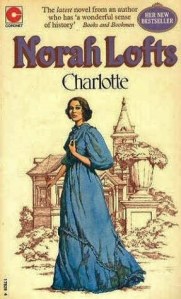
charlotte norah lofts out of the dark 1972Charlotte by Norah Lofts ~ 1972. American title: Out of the Dark. This edition: Coronet, 1973. Paperback. ISBN: 0-340-17826-4. 254 pages.
My rating: 9.5/10

The author notes that this story was inspired by the notorious real life situation of an English teenager, 16-year-old Constance Kent, who in 1860 was accused of the brutal murder of her young stepbrother.

Though the scenario in the first section of the book borrows heavily from the historical case, Norah Lofts states in her beginning Author’s Note that:

The characters…are my own; and whereas those who write factually about a crime – especially one never satisfactorily solved – can only speculate about the motives and, indeed, the identity of the murderer, the writer of fiction, dealing in a more plastic medium, is able to say: This is how it happened.

Part Two owes nothing to the Case of Constance Kent. Incredible as it may seem, it is based on a first-hand account of a school in which my sister once tried to teach, a mere forty years ago. Here again the characters are my own; but I did not invent the oil-stove that was carried up and down…

This is a dark little tale, of deep injustice done to the innocent by those who should have been the most concerned with their protection. Our author puts her titular heroine through a grueling ordeal which stretches on for years, before allowing a resolution (of sorts) which (possibly) rewards her (and our) quietly righteous perseverance.

How much should I tell about the plot? My impulse is to keep it fairly quiet, as this sort of story rewards readerly discovery. I’ve already given out some of the major points, which are indeed no secret, and are revealed very early on.

16-year-old Charlotte Cornwall, her younger brother Thomas, and older twin sisters Adelaide and Victoria live with their father, stepmother and young half-brother Vincent in outwardly respectable but secretly straitened circumstances. The first Mrs. Cornwall was possessed of a large private income; this came to a halt upon her tragic (and questionably natural) death some years earlier; the twins and Charlotte are to inherit their mother’s money when they each turn 21, under the terms of their maternal grandfather’s will.

Money concerns are just part of the unspoken tension in the Cornwall household; the second Mrs. Cornwall, who was previously the children’s nanny, is deeply jealous of her gentle predecessor’s lasting influence. Her own small son is the apple of her maternal eye, and she is again pregnant, leading to a situation of history repeating itself as Mr. Cornwall’s attention is caught by the latest nursemaid who has replaced her mistress in the household hierarchy in more ways than one.

When four-year-old Vincent is discovered gruesomely murdered, his body hidden in the muck heap in the stable yard, suspicion is directed at a nebulous night time prowler, but soon evidence comes to light which leads back into the heart of the family, and ultimately straight to Charlotte. But several people in the household know the real story of what happened that dreadful night. Surely the truth will come out; surely the culprit or culprits will confess, to save an innocent who is being wrongly accused…

Nope. Charlotte is completely sold up the creek, and by a person (or persons) who should have been willing to protect her at their own expense.

Charlotte’s youth and social status and some inconsistencies in the evidence lead to her acquittal, but her trials aren’t yet over. Not by a long shot. Seeking to escape a situation made increasingly unbearable by the dark stain on her name and her stepmother’s increasing hatred, Charlotte takes a position in a country girl’s school as an assistant mistress, a situation which at first appears to be a welcome refuge, but which soon puts her into still more nightmarish situation, as the school’s headmistress exploits her knowledge of Charlotte’s past to her own advantage…

Just when things are darkest, a gleam of hope appears, and our heroine at last has a chance to clear her name. But will she turn against the real murderer(s), once she discovers the true story of her betrayal?

Well, I guess you’ll just have to read it yourself to find out.

Multiple characters, multiple story strands, all beautifully handled and full of fabulous period detail. What I’ve divulged above is the briefest overview of this richly written noir tale.

Charlotte is most competently plotted and presented; a deeply engaging read of the chillingly almost-plausible sort. Abundant wry humour, too. Despite its grim theme, this is not at all a depressing read; I frequently found myself chuckling quietly to myself as the author sends up various stereotypes and scenarios with perfect comic timing, and without quite crossing the line into farce.

Thank you, Norah.

You had me just a tiny bit worried for most of the book; I wasn’t sure where we were going for quite some time there. Good job on stringing the reader along!

Oh – the half point docked was for several not very veiled homosexual side stories. Those felt possibly just the tiniest bit mean-spirited, just vaguely “off”. But possibly they weren’t meant to be, and were intended more in the nature of ironic natural revenge? Maybe? However, I felt these were a bit too similar to the Sudden Evil Lesbian who shows up to wield retribution in Lovers All Untrue – too unnaturally manufactured; even in such a highly fictionalized thing such as Charlotte turns out to be.


Read Full Post »

the sea-gull cry robert nathan 001The Sea-Gull Cry by Robert Nathan ~ 1942. This edition: Knopf, 1942. Softcover, with French flaps. First edition. 214 pages.

My rating: 3/10

A short, lightweight novella by the onetime-popular Robert Nathan. I confess that I have in the past read and quite enjoyed his most famous publication, 1940’s Portrait of Jennie (see condensed spoiler-laden précis here), but The Sea-Gull Cry is infinitely more sentimental, and, to be brutally honest, not particularly memorable, either in plot or in execution.

Nineteen-year-old Louisa and her seven-year-old brother Jeri are refugees newly in America, from war-torn Poland via England. Children of an English mother and a Polish nobleman, they are in reality a countess and count, but the family castle has been bombed, leaving their mother interned forever in its rubble, while Papa has perished defending his country against the evil German invaders.

Louisa and Jeri are bravely making a new sort of life for themselves. Desiring to get out of the crowded American city they arrived at some short time ago, they have taken their refugee relief money and are looking for a place to live along the seaside for the summer. They make it to Cape Cod, where they fall in with a gruff-mannered but hearts-of-gold older couple, the Baghots, who rent them an abandoned scow beached on an isolated stretch of sand.

Onto this strip of sand precipitously arrives one “Smith”, a jaded, middle-aged history teacher, (and a not very experienced sailor), who has just purchased an old sloop with the view to cruising up and down the coast for the summer, to escape from the stress of his unsatisfying job and the pervasive gloom of the situation in Europe. (The story is set just before American entry into World War II.)

Smith is caught up in a squall and violently beaches his boat, putting an end to his summer plans. But when he meets lovely Louisa he is immediately smitten; even more so when she pops out of her faded blue overalls to swim in a teeny tiny homemade bikini. Smith feels that maybe life isn’t so dull after all…but wait…why would Louisa look at a man old enough to be her father…?

Maybe because she is seeking something of a father-substitute, a romantically-older man?

It takes them a few chapters to get it all worked out, chapters in which small Jeri provides a side plot as he fights with the local children, makes friends with the Baghots’ young niece Meg, and has a brush with death as he sets out to sea with Meg on an old raft, seeking to sail back to Europe to rescue “the children” from the conflict.

Aw, how sweet.

Sure.

A little of that goes a very long way, and luckily this was a lightning fast read, being presented by the publisher with a large font, immense margins, and thick paper. It clocks in at 214 pages, but could probably quite happily fit onto 50 or so. (One speculates therefore that this was before any sort of wartime paper restrictions hit the American publishing market.)

That’s it; that’s the story; well whitewashed with slosh.

I don’t quite get Robert Nathan’s obvious popularity in his time, because this was pretty sub-par stuff in the great scheme of literature-of-the time, unless it was as a writer of escape-lit-light for the stressed-out housewives of the 1940s and 50s. The Sea-Gull’s Cry seems the sort of thing that would be found serialized in the Good Housekeeping type of magazine of the day.

A contemporary review by Rose Feld of The New York Times had this to say:

‘The Sea-Gull Cry’ tells a tale that will hold you until the last page is turned. It will hold you because of Nathan’s rare art of drawing you into his own mood of tender contemplation of human beings and because you cannot let them go until you know what happens to them… And you will decide that this is more than a tender little love story exquisitely written; that it is a tale of exile and valor and spiritual rebellion that has more than surface significance.

I suspect I am myself a bit too jaded and cynical to really appreciate this sort of fiction; I find myself lifting an eyebrow when I read these other quotes by the author himself regarding his authorial motivation:

What I really want is to give comfort to people in this wilderness of death and trouble. And to myself, too. So, when I can, I take the poison and hate out of my books; but I hate, just the same. I hate violence, and tyranny, and vulgarity. I hate despair and destruction, and the writers who insist that that is all there is, there isn’t anything else.

and

It seems to me that I have always wanted to say the same things in my books: that life is one, that mystery is all around us, that yesterday, today and tomorrow are all spread out in the pattern of eternity, together, and that although love may wear many faces in the incomprehensible panorama of time, in the heart that loves it is always the same.

Fair enough; Nathan’s readers obviously responded to his style.

As you can see from my brutal rating, I didn’t.


Read Full Post »


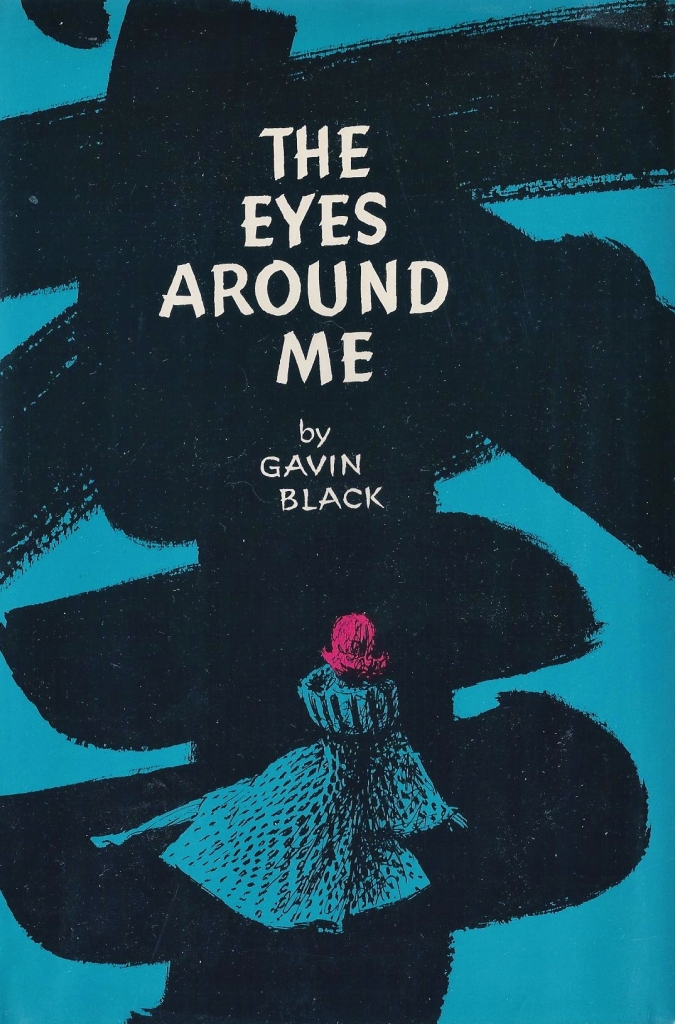
the eyes around me gavin black 001The Eyes Around Me by Gavin Black ~ 1964. This edition: Harper & Row, 1964. Hardcover. 216 pages.

My rating: 8.5/10

Okay, why have I never come across this writer before? This murder mystery novel set in Red-era Hong Kong was pretty darned fabulous. Instant fan, I am. Now I must track down more…

From his obituary notice in The Independent, August 6, 1998:

Oswald Wynd was a modest man who had little to be modest about. As Gavin Black he wrote superior and literate thrillers – school of Stevenson and Buchan – which were at the same time witty and clever, and moved at a by no means gentlemanly pace…

A “superior and literate thriller” describes this fast-paced novel exceedingly well.

Middle-aged, recently divorced, lush living Scottish shortbread heiress Ella Bain lives in Hong Kong, in a lavish seaside mansion. An outside staircase to her bedroom allows her to receive gentleman callers without offending the sensibilities of old family retainer Kirsty, and by all reports it is a well-used piece of domestic architecture.

Ella is loud, she drinks too much, and though she has proven herself an astute businesswoman, enlarging her already substantial fortune by her occasional managerial visits back to the family factory in Scotland, she occasionally raises eyebrows by her larger than life actions. Long-time platonic friend Paul Harris views Ella with sometimes-exasperated affection; he has turned down her marriage proposal, but remains in Ella’s will as her chief beneficiary, cutting out Ella’s only brother Angus, who enjoys a fortune of his own.

So when Ella is found dead in her bed on New Year’s Day morning by Paul, who squired Ella about town the night before and stayed over at her house, both the police and the intimately entwined Hong Kong society crowd look at Paul with more than a little speculation.

Paul Harris, wealthy in his own right through a series of past speculations and questionably legal activities which I shan’t reveal to you here, resents the assumption that he murdered his friend, and sets out on a quest to clear his name.

This is a vividly atmospheric mystery novel, with a finely detailed setting and memorable (if occasionally rather unlikely) characters. One forgives the over-the-topness because the thing is so gloriously well written for this type of light fiction; Oswald Wynd/Gavin Black spins an exceedingly readable tale.

Paul Harris comes across as a greatly  improved version of Ian Fleming’s James Bond. Paul is suave, fast on his feet, good in a fight, exceedingly attractive and attracted to gorgeous women, and (one feels) truly a good guy at heart, despite his somewhat shady backstory. The arrogance which emanates from his fictional counterpart Bond is completely missing; one likes Paul Harris, despite our doubt that he is now a purely lily-white boy, gone all straight and narrow.

I guessed the murderer with surprising ease; I foretold the romantic clinch at the end; as a mystery the thing is decidedly clichéd and predictable, but despite these drawbacks I greatly liked this book.

The author wrote a rather respectable number of novels and thrillers, most set in Asia. I am keen to follow up on my introduction to Paul Harris, who apparently features in all of the Gavin Black-authored thrillers; the Oswald Wynd novels sound intriguing, too, if perhaps a bit “deeper” in theme.

1977’s The Ginger Tree was made into a well-received Masterpiece Theatre 4-part miniseries, and Wynd’s depiction of cross-cultural and mixed race relationships is spoken of very highly in reviews.

For future investigation:

As Oswald Wynd:

  • Black Fountains (1947) (1st novel, winner of $20,000 Doubleday prize for fiction)
  • Red Sun South (1948)
  • Friend of the Family (1949)
  • The Stubborn Flower (1949)
  • When Ape is King (1949) (Wynd’s lone speculative fiction, very rare )
  • The Gentle Pirate (1951)
  • Stars in the Heather (1956)
  • Moon of the Tiger (1958)
  • Summer Can’t Last (1960)
  • Death, the Red Flower (1965)
  • Walk Softly, Men Praying (1967)
  • Sumatra Seven Zero (1968)
  • The Hawser Pirates (1970)
  • The Forty Days (1972)
  • The Ginger Tree (1977)

As Gavin Black:

  • Suddenly at Singapore (1961)
  • The Devil Came on Sunday (1961)
  • Dead Man Calling (1962)
  • A Walk in the Long Dark Night (1962)
  • A Dragon for Christmas (1963)
  • The Eyes around Me (1964)
  • You Want to Die, Johnny? (1966)
  • A Wind of Death (1967)
  • The Cold Jungle (1969)
  • A Time for Pirates (1971)
  • The Bitter Tea (1972)
  • The Golden Cockatrice (1974)
  • A Big Wind for Summer (aka Gale Force) (1975)
  • A Moon for Killers (aka Killer Moon) (1976)
  • Night Run from Java (1979)
  • The Blazing Air (1981)
  • The Fatal Shadow (1983)
  • A Path for Serpents (1991)

Read Full Post »

As fleeting as poppy flowers, these too-fast-gone summer days...

As fleeting as poppy flowers, these too-fast-gone summer days…

Flipping the pages on the calendars this morning, several days past the turn into August, and rather in shock that we are in the eighth month of the year. What happened? Where did the time go?!

Looking over my Century of Books Project list of completed reads, it occurs to me that I may have to buckle down and do some more strategic reading to fill in some of the yawning gaps, namely those in the last three decades of my century, which I decided would cover the years 1900 to 1999. To date I have been reading largely at whim, with oodles of “double-up” years. It’s been fun, but now I need to get serious. 😉

By the numbers:

  • Years read and reviewed: 56/100
  • “Extra” books read/reviewed: 28
  • Grand total to date of Century reviews: 84
  • Century years left: 44
  • Months of 2014 left: 5/12
  • Books-per-month I need to read and review to meet my goal: 9-ish

I do have some qualifiers already read but not yet reviewed, which I haven’t counted, so the last number is not quite as scary as it could be. Though I have just completed my first re-read of the century, too much time having passed since the original reading to allow for a good post. (The Little Straw Wife, by Margaret Belle Houston, first read way back in February.)

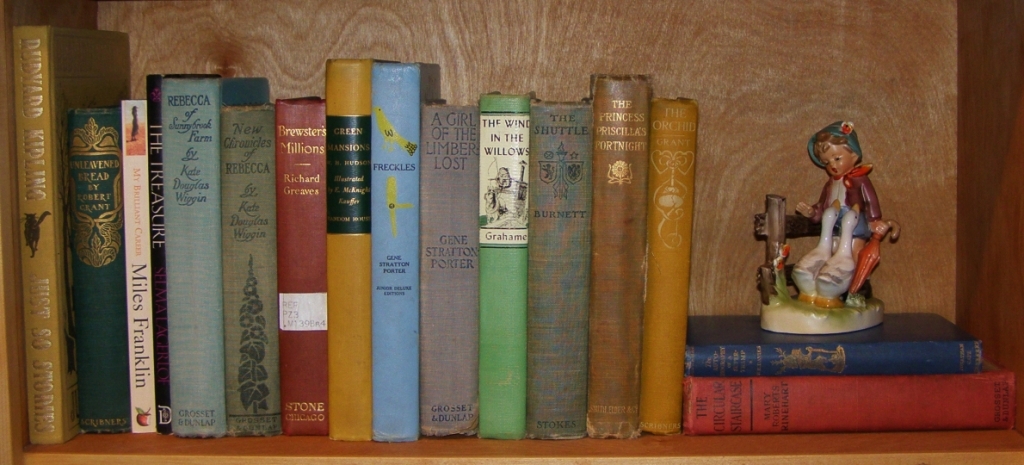
And here they are - the first decade books, minus (The Wonderful Adventures of) Nils, who is unaccountably missing (maybe off on another adventure?) and is represented by the pseudo-Hummel boy-with-geese.

And here they are – the first decade books, minus (The Wonderful Adventures of) Nils, who is unaccountably missing (maybe off on another adventure?) and is represented by the pseudo-Hummel boy-with-geese.

I’ve finished one decade of the Century, 1900-1909, and a mostly pleasant one it was, too. A nice mix of classic children’s stories and vintage bestsellers and completely new-to-me discoveries. Here’s the briefly annotated list. (Scroll down for my “best” and “worst” awards.)

  • 1900 ~ Unleavened Bread by Robert Grant ~ My rating: 8/10. A self-centered, humourless and hypocritical woman claws her way to the society position she claims to be hers by right of birth. An interesting American novel which foreshadows similar works by Sinclair Lewis.
  • 1901 ~  My Brilliant Career by Miles Franklin ~ My rating: 8.5/10. Teenage Sybylla struggles against an unkind fate, is wooed, and rejects conventional relationships with men, all set against the blazing background of Australia’s drought-stricken bush in New South Wales.
  • 1902 ~ Just So Stories by Rudyard Kipling ~ My rating: 7.5/10. A collection on fables explaining how things got the way they are: the Whale with his baleen throat, the Camel with his hump, and the Alphabet’s origin, among others. Some are wonderful for reading out loud to the young ones, others are best enjoyed as interesting period pieces. Good reading for the adults of the family, if you are at all a Kipling aficionado
  • 1903 ~ Rebecca of Sunnybrook Farm by Kate Douglas Wiggin ~ My rating: 7.5/10. The classic juvenile novel about an eleven-year-old girl coming to live with two strict spinster aunts.
  • 1904 ~ The Treasure by Selma Lagerlöf  ~ My rating: 10/10.  An excellent short novella about love and revenge. A 16th Century Scandinavian winter setting and ghosts. Brrr.
  • 1905 ~ The Princess Priscilla’s Fortnight  by Elizabeth von Arnim ~ My rating: 7.5/10. German Princess Priscilla escapes the courtly life with her elderly friend, the palace librarian. The two set up house in rural England, but soon run into unplanned-for difficulties. A witty light farce with a mildly predictable moral.
  • 1906 ~ The Shuttle by Frances Hodgson Burnett ~ My rating: 8.5/10. A gorgeous gothic thriller/romance following the varied adventures of two wealthy American sisters as they travel to England ten years apart. Gentle Rosy marries a wicked nobleman; ten years later her younger sister Betty mounts a rescue mission.
  • 1907 ~  New Chronicles of Rebecca by Kate Douglas Wiggin ~ My rating: 6.5/10. Further details on Riverboro life, with eventual strong hints as to the ongoing evolution of the relationship between Rebecca and much-older “friend” Adam Ladd.
  • 1908 ~ The Circular Staircase by Mary Roberts Rinehart ~ My rating: 5.5/10. Super-confusing and not very mysterious American country house mystery, salvaged somewhat by the amusing narrator, a middle-aged, opinionated, self-described spinster, Miss Rachel Innes. A classic of crime fiction which I’m happy to have ticked off the list, but this reading will likely do me for many years to come. Though I am still keen to read more of MRR’s mysteries; they are definitely enjoyable as well as slightly annoying.
  • 1909 ~ A Girl of the Limberlost by Gene Stratton-Porter ~ My rating: 6/10. Downtrodden but plucky half-orphan Elnora roams the Limberlost Swamp hunting leaves and bugs to finance her higher education.

And the bonus books:

  • 1903 ~ Also: Brewster’s Millions by Richard Greaves aka George Barr McCutcheon ~ My rating: 7.5/10. A young man inherits two fortunes, but under strange conditions. He must spend one million dollars – without divulging the existence of the second legacy, and under strict conditions – in order to inherit seven million. Needless to say, his friends think he has gone mad, and much hilarity ensues as they try to save Monty Brewster from himself.
  • 1904 ~ Also: Green Mansions by W.H. Hudson ~ My rating: 3.5/10. Thousands loved this when it was first published. One hundred and ten years later, I am less than impressed. An Amazonian jungle romantic tragedy between an aristocratic Venezuelan hiding out from the consequences of a failed political coup, and a mysterious “bird girl” who guards her section of the forest against all intruders.
  • 1904 ~ Also: Freckles by Gene Stratton-Porter ~ My rating: 7.5/10. One-handed but plucky orphan Freckles wins hearts, vanquishes evildoers, and wins love while employed as a timber guard in the Limberlost Swamp.
  • 1905 ~ Also: The Orchid by Robert Grant ~ My rating: 6.5/10. A socialite sells her child to her first husband to finance her second marriage.
  • 1906 ~ Also: The Wonderful Adventures of Nils by Selma Lagerlof ~ My rating: 10/10. An appealing vintage children’s classic. Swedish farm boy Nils is transformed for his misdeeds into elf-size, and is now able to understand the speech of animals. His quest for redemption and a way to break the curse carries him over Sweden on the back of the farm’s white gander. A marvelous read-aloud, standing up well over a hundred years after its original publication.
  • 1908 ~ Also: The Autobiography of a Super-Tramp by W.H. Davies ~ My rating: 9/10. The famous poet’s early years as a tramp in Britain and North America.
  • 1908 ~ Also: The Wind in the Willows by Kenneth Grahame ~ My rating: 10/10. Rat and Mole “messing about in boats”; Toad getting up to no good in his dreadfully large motorcar; Badger coming to everyone’s rescue; absolute bookish delight for adults and children alike.

Top 3 “I know I’ll read it again” Books:

  1. Unleavened Bread by Robert Grant ~ 1900.
  2. Rebecca of Sunnybrook Farm by Kate Douglas Wiggin ~ 1903.
  3. The Princess Priscilla’s Fortnight  by Elizabeth von Arnim  ~ 1905.

Melodrama Award:

  1. A Girl of the Limberlost by Gene Stratton-Porter ~ 1909, tied with Green Mansions by W.H. Hudson ~ 1904.
  2. Runner Up: Freckles by Gene Stratton-Porter ~ 1904.

Hidden Gem Award:

  1. The Autobiography of a Super-Tramp by W.H. Davies ~ 1908, tied with My Brilliant Career by Miles Franklin ~ 1901.
  2. Runner Up: The Treasure by Selma Lagerlof ~ 1904.

Great Big Disappointment:

  1. Green Mansions by W.H. Hudson ~ 1904.

Read Full Post »

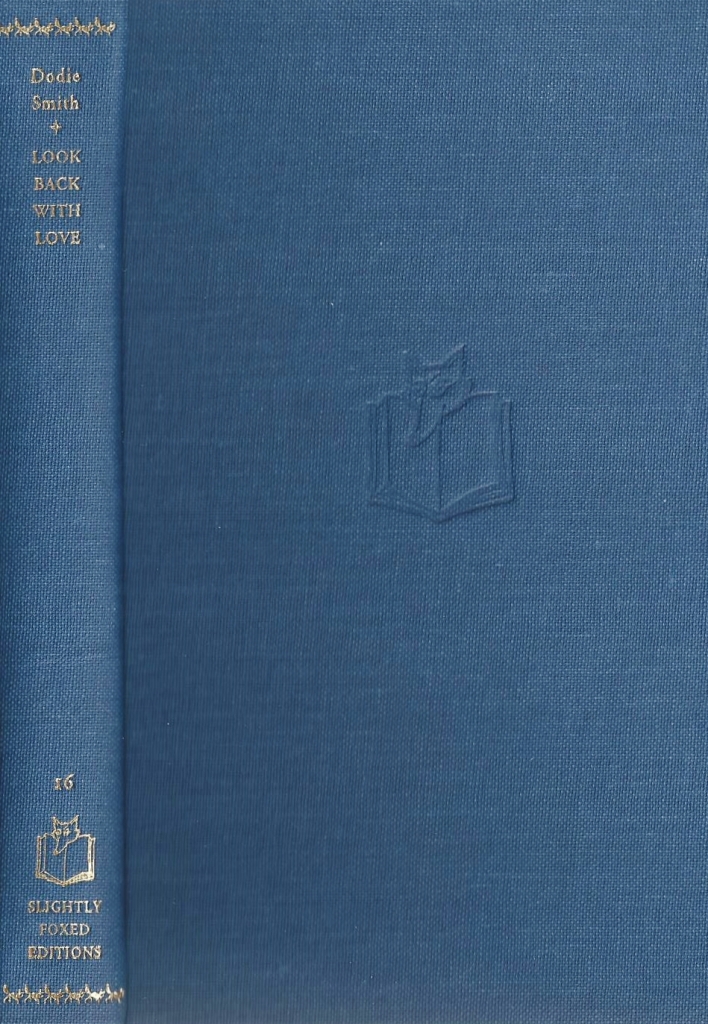
look back with love cover slightly foxed dodie smith 001Look Back with Love: A Manchester Childhood by Dodie Smith ~ 1974. This edition: Slightly Foxed, 2011. Hardcover. ISBN: 978-1-906562-30-4. 272 pages.

My rating: An easy 10/10. A pleasure first page to last.

This post should be extremely easy to write, as it is merely meant to be an enthusiastic recommendation of two things.

First and foremost, this stellar memoir by Dodie Smith (I capture the Castle, The Hundred and One Dalmations), detailing with immense good humour her childhood days in Manchester, when she lived with her widowed mother in a series of family homes.

Before reading this book I had come across several excellent and detailed reviews which inspired my search-and-purchase. I shall not attempt to add to their number, but instead will encourage you to follow these links to the several posts which led to this happy acquisition.

Geranium Cat’s Bookshelf  – a wonderful review, with generous quotes from the text.

Simon’s Stuck-in-a-Book post is disarmingly chatty and wholly enthusiastic.

And from Elaine at Random Jottings, this excellent advice:

I beg you, please do get hold of a copy. If you are feeling miserable, it will cheer you up, if you are feeling ill (as I was when it arrived) it will make you feel better and, if you are already well and happy, it will make you even more so.

Sheer and utter delight from start to finish.  I will end as I started. This is a lovely lovely lovely book.

Yes, indeed.

Which leads me to the second recommendation I have for everyone, which is of a bookseller.

Look Back in Love in the original being fairly scarce and rather highly priced when found, the book I have in hand is a beautifully produced reprint from Slightly Foxed Editions, who specialize in (among other things) “pocket hardback reissues of classic memoirs.”

Take a good look at their list of offerings. I’ve read enough of these to be able to say that whoever is searching out these memoirs to republish has a keen eye for an excellent read. Well done, Slightly Foxed! If I’m ever in London my bookish pilgrimage will include their store (either before or after a sure-to-be-costly visit to Persephone – how can one possibly choose?!) to bow down at the source (as it were) of some of the best-chosen and best-produced vintage reprints currently available.

While not exactly cheap – a postpaid copy to Canada set me back a rather sobering £19, or about $35 Canadian dollars – I justified the cost with the thought that I was supporting a most worthwhile enterprise.

My Slightly Foxed edition is a joy to handle and to read, being compact and neatly cloth bound with a handy ribbon marker, a text block of smooth, creamy paper, and a nicely legible font. My only regret is that it does not contain the photographs included in the original edition; I love the inclusion of photos in memoirs as it adds so much to be able to see the characters and places referred to. But Dodie Smith’s words give such a wonderfully clear picture of both people and surroundings that one can envision the scenes perfectly well without visual aids.

I was so very pleased with this first volume of Dodie Smith’s memoirs – which takes her to the age of fourteen – that I have just tracked down and ordered the middle two volumes of the remaining three autobiographical books, Look Back with Mixed Feelings, and Look Back with Astonishment. I had already acquired Look Back with Gratitude, the last of the four, and though I have leafed through it with anticipation I am being stern with myself and will be saving it to read last, to maintain a chronological order.

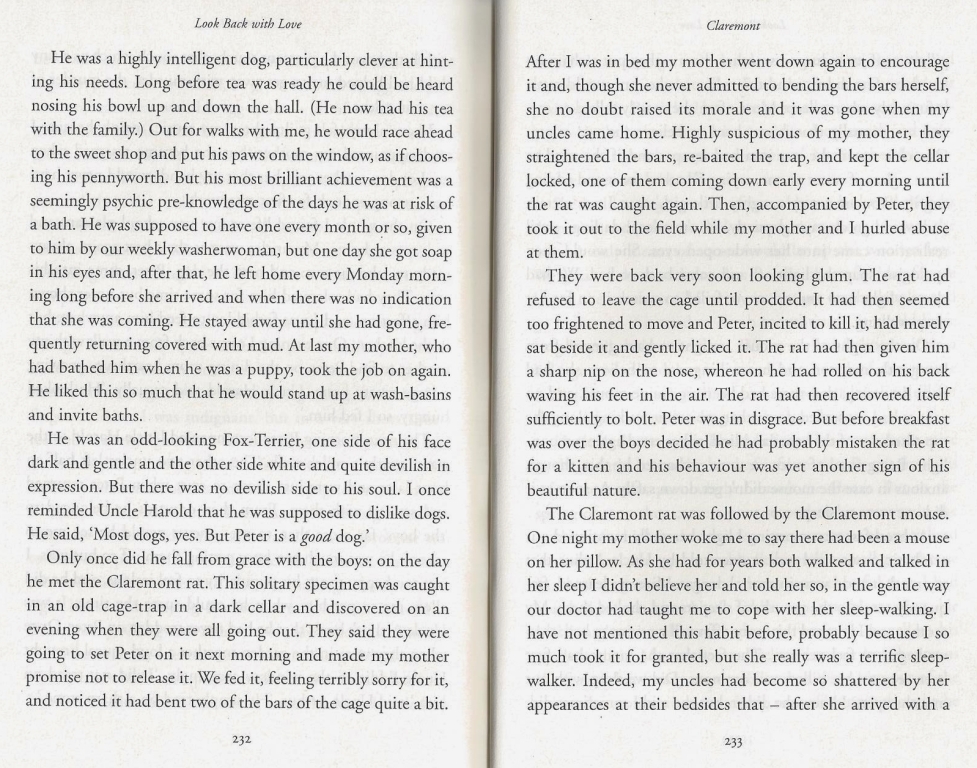
And here, to further pique your interest (those few of you who haven’t already discovered this gem for yourselves) is a random page scan. Open this book anywhere and similar anecdotes abound. Even out of context, isn’t this a joy?

Click to enlarge for ease of reading.

(Click to enlarge for ease of reading.)

Read Full Post »

« Newer Posts