Archive for March, 2014

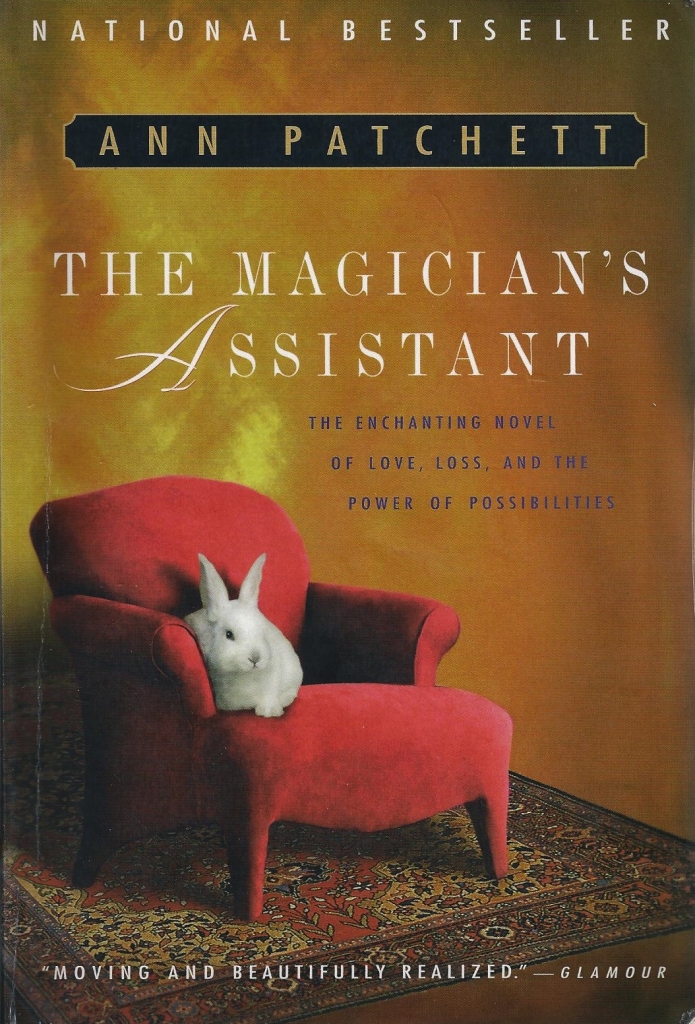
the magician's assistant ann patchett 001The Magician’s Assistant by Ann Patchett ~ 1997. This edition: Harcourt Brace and Company, 1997. Softcover. ISBN: 0-15-600621-9. 357 pages.

My rating: Tough call. Loved the lead-in; increasingly despised the last half. It declined from an 7-ish sort of thing in the first 100 pages to maybe a 2 or thereabouts, with the nadir being the screamingly predictable lesbian kiss scene. So averaging the two together, I offer you a rather generous 4.5/10.

Another Century of Books novel, chosen because I’d not yet read an Ann Patchett title and I keep seeing them everywhere and I needed to find some 1990s candidates.

Caution: I may not be able to avoid including a spoiler or two down below.

Well now. I’m all conflicted about this one. It started off quite brilliantly – so much so that I stayed up into the wee hours last night because I couldn’t put it down. I forced myself to leave our heroine just as she was heading from sunny L.A. to wintry Nebraska, and when I picked it up again a few hours later, everything had changed. On multiple fronts.

Using the handy “Life’s too short” cop-out, I’m going to dodge discussing this one in too much depth. Because after a quick internet review search, I realize I’m apparently the only person who found this one less than fabulous. I’m going to refer you instead to one of many glowing reviews, this one from Publishers Weekly of October, 1997.

An excerpt here:

… Sabine had been assistant to L.A. magician Parsifal for 22 years when they finally married. She knew he was homosexual; both had mourned the death of his gentle Vietnamese lover, Phan. What she didn’t know until Parsifal’s sudden death only a short time later was that Parsifal’s real name was Guy Fetters, that had he lied when he claimed to have no living relatives and that he has a mother and two sisters in Alliance, Nebraska. When these four women meet each other, their combined love for Parsifal helps Sabine to accept the shocking events in  Parsifal’s life that motivated him to wipe out his past. In finding herself part of his family, she discovers her own desires, responsibilities and potential, and maybe her true sexual nature…

Good enough?

The initial depiction of Sabine’s grief at the loss of her partner Parsifal was poignant and believable; the details Ann Patchett emphasized were heart-rendingly real. The sudden insertion of unsuspected relations moved things up a notch, and I was truly curious as to where the author was planning to take us all. The possibilities seemed intriguing. I even bought into the magical-realism dream sequences where Sabine makes contact with Phan in the ever-shifting afterworld; it seemed like these were going to go somewhere as well.

But all of the interesting leads fizzled out, leaving us with a common old relationship drama once Sabine left exotic L.A. and forayed forth into the depths of Middle America in the 1990s, where Wal-Mart is the only place to shop in town, and they don’t seem to carry Perrier, and where all the folks are pasty white in ethnic monotone.

A major sticking point that really soured the second part of the book for me was the over-simplified and patronizing depiction of the Nebraskans. Sabine’s new in-laws are completely awed by her sophistication and readily bow down to her California cool; she in turn is completely thrown out of kilter at their drab lives of blue-collar jobs, modest bungalows, and pitiful acceptance of their wife-beating redneck spouses.

But it all comes out sweet and life-affirming in the end, because luckily Sabine has plenty of dollars from her inheritance of software genius Phan’s legacy through her late husband Parsifal/Guy Fetters, so she can scoop everyone away from their drab Nebraska lives to sunny L.A. At least that is what I gathered at the end, though the details were pretty fuzzy at that point, what with the burgeoning (?) relationship between Sabine and Parsifal/Guy’s sister Kitty.

Moving on, I am. I suspect this writer can do better, for she has all the technical tools in her toolbox and her writing ability is undoubtedly well developed.

Thoughts?

Am I being too mean? Should I give Ann Patchett another go? Or are the rest of her tales of a muchness to this one?


Read Full Post »

main street sinclair lewisMain Street by Sinclair Lewis ~ 1920. This edition: Penguin, 1991. Afterword by Mark Schorer. Softcover. ISBN: 0-14-018124-5. 432 pages.

My rating: 8/10

This is decidedly one of those books which deserves sober consideration and scholarly discussion. Luckily it has been so treated by so many people that I can justify this very casual review of it by referring anyone eager to delve deeper to the many other discussions which abound in print and online.

I had read Main Street several times before, though not very recently, so was wondering if my impressions would change this time around. And the answer to my musings was no, not at all. I still feel exactly the same about Carol Kennicott’s emotional journey, even though I am now at the far end of the arc myself in regards to age and situation in relation to Carol, compared to our shared optimistic youth the first time I made her acquaintance.

Carol Milford, college girl, strides eagerly forward into her future. Anything might happen, and the world is full of potentially wonderful things – art, literature, poetry, travel!

Contemplating but reluctant to commit to a career as a teacher, Carol ends up spending a year in Chicago hobnobbing with the local bohemians, then moves on to a position as a librarian in St. Paul, Minnesota, with her lofty ideals slightly rattled though not at all dulled. She meets Dr. Will Kennicott, some years older than herself, rising young physician in the (fictional) prairie town of Gopher Prairie, and is wooed both by handsome Will’s physical appeal and by his readiness to bow down before Carol’s intellectual superiority.

Come to Gopher Prairie, pleads Will. Show us how to bring culture into our lives. You could do such good…

Already rather jaded by the workaday routines of her not-very-exciting job, Carol allows herself to be romanced, and off she goes to Gopher Prairie, as Mrs. Doctor Kennicott, full of ideas and ideals.

Gopher Prairie raises a collective eyebrow at Carol and her effervescent cultural improvement projects, and sturdily attempts to put her in her place, an enterprise which takes some years but which is eventually mostly successful.

I found Main Street to be rather slow going this time round, and I found myself putting it down for a day or two here and there and turning to other diversions. But I always returned, and towards the end of the extended read, I found myself wondering if the long, slow tone were in fact a deliberate attempt by Sinclair Lewis to demonstrate the long, slow taking down of Carol Kennicott from her uppity ideals to a state of intellectual dullness acceptable to her fellow Gopher Prairie-ites.

Carol Kennicott is very much a woman written by a man, and though Sinclair Lewis did a stellar job in putting himself in his character’s shoes, there are authorial lapses here and there, as Lewis conveniently skips over the time around Carol’s pregnancy and new motherhood with a few (admittedly apt) paragraphs:

The baby was coming. Each morning she was nauseated, chilly, bedraggled, and certain that she would never again be attractive; each twilight she was afraid. She did not feel exalted, but unkempt and furious. The period of daily sickness crawled into an endless time of boredom. It became difficult for her to move about, and she raged that she, who had been slim and light-footed, should have to lean on a stick, and be heartily commented upon by street gossips. She was encircled by greasy eyes. Every matron hinted, “Now that you’re going to be a mother, dearie, you’ll get over all these ideas of yours and settle down.” She felt that willy-nilly she was being initiated into the assembly of housekeepers; with the baby for hostage, she would never escape; presently she would be drinking coffee and rocking and talking about diapers.

… She alternately detested herself for not appreciating the kindly women, and detested them for their advice: lugubrious hints as to how much she would suffer in labor, details of baby-hygiene based on long experience and total misunderstanding, superstitious cautions about the things she must eat and read and look at in prenatal care for the baby’s soul, and always a pest of simpering baby-talk. Mrs. Champ Perry bustled in to lend “Ben Hur,” as a preventive of future infant immorality. The Widow Bogart appeared trailing pinkish exclamations, “And how is our lovely ‘ittle muzzy today! My, ain’t it just like they always say: being in a Family Way does make the girlie so lovely, just like a Madonna. Tell me—” Her whisper was tinged with salaciousness—”does oo feel the dear itsy one stirring, the pledge of love? I remember with Cy, of course he was so big——”

… Then the baby was born, without unusual difficulty: a boy with straight back and strong legs. The first day she hated him for the tides of pain and hopeless fear he had caused; she resented his raw ugliness. After that she loved him with all the devotion and instinct at which she had scoffed… For two years nothing else existed…

The baby grows, life steadily grinds on. Carol loses one of her best friends – her ex-maid Bea – to typhoid, and finds her neighbours casually dismissive of her emotional pain. Will strays into a casual relationship with a neighbour’s wife, though Carol is unaware of it; she herself goes through a period of infatuation with a beautiful younger man, a Swedish farm boy with high aspirations working as a tailor’s apprentice. Gopher Prairie sees all, and files it all away for future reference. The Great War creates a few ripples; Carol eventually uses it as an excuse to break away with Hugh and take on a job in Washington, DC, while Will remains in Gopher Prairie.

main street 1st edition sinclair lewisIs the Kennicott marriage dissolving? Is Carol on the path at last that she was forced off of so many years ago? Apparently not, as her return to Gopher Prairie in a sleet storm with her husband at her side brings her full circle, back again to the place she could not change, and which has done its stolid best to change her into the acceptable pattern of a Gopher Prairie matron.

We end with Carol looking to her child – sorry, children – she does pop out another baby right at the very end of the saga, this one too without much obvious effort or appreciable comment by Lewis – with speculative eyes. Surely he/she will go out into the world and bring about the change which Carol herself has so far been unable to pull off…

For all of its hype as one of the Great American Novels – so often a foreboding designation of excessive earnestness – Main Street is a very readable thing, cynically amusing and cleverly analytical in its satire of Every Town, U.S.A. And though Carol fails to fully engage me as a relatable heroine – she never becomes quite real, for she is as terminally misguided as the rest of the Gopher Prairie characters and as stereotyped in her way as they are – her struggles are thought provoking and her situations cleverly staged.

What does Carol really want? We never do find that out, for she doesn’t know herself, and that is perhaps the most real and relatable thing about Main Street.

This remains to me a book not so much about the mythical Carol Kennicott as it is about the real man Sinclair Lewis, based as it is on his own experiences of growing up in Sauk Center, Minnesota. Discussing Lewis this morning with my husband, we both agreed that cynically enjoyable though his writings are, there is a certain spirit of – well – meanness showing through, as though Lewis never really got over some slight of his early days, and is always hitting back at the place he came from. Escaped from, is the implication. (In our joint opinion, anyway.) Too much of that kind of thing rather gets the reader down; I’ll be taking a breather before going on to another of Sinclair Lewis’s eminently readable but slightly depressing tomes.

And there I will leave you. A worthwhile read for its detailed portrait of a time and (generic) place; a fascinating piece of Americana.

Read Full Post »

the wonderful adventures of nils selma lagerlof 001The Wonderful Adventures of Nils by Selma Lagerlöf ~ 1906. This edition: J.M. Dent and Sons, 1950. Illustrated by H. Baumhauer. Hardcover. 294 pages.

My rating: 10/10

My biggest regret upon turning the last page of this book is that I did not discover it when my children were in the midst of the read-aloud years. They would have loved it, voraciously appreciative little listeners that they were.

It has everything – a magical transformation (as punishment for a misdeed), a quest for redemption, animals wild and tame, a deeply dastardly villain, continual and varied adventures, restrained amounts of sentimentality, and absolutely painless lectures on natural history, geography and Swedish folk legends.

Hey, homeschooling parents – take a look! The cross-curricular connections are many and quite brilliant. And I think it would be hugely enjoyable for the reader-alouder as well.

Fourteen-year-old farm boy Nils is beloved by his hard-working parents but also a huge disappointment to them. He neglects his chores, he lies, he torments the animals, and he dodges going to church. What will become of him, they sigh to each other in sorrow? Will he ever see the error of his ways?

Apparently not, but fate takes a hand when Nils offends the farmstead elf, who then transforms Nils into tiny elf-size himself. As Nils runs hither and yon about the farmyard in absolute distress, he realizes that he can now understand the language of the animals. They in turn are pleased to see that their tormentor has had his comeuppance, and let him know a few home truths about their views on his past behaviour.

Nils is at first shocked and resentful, but then as the true consequences of his fourteen years of misbehaviour become clear, he experiences something of an epiphany. “I am sorry!” he cries. “Please forgive me!” But the animals ignore his pleas.

As Nils mourns his sad fate, a flock of wild geese fly over, and the farm’s big white gander, stirred to wanderlust by their call, rouses himself up and prepares to take flight. Nils, with his newly aroused conscience, immediately grasps what a tragedy the loss of the gander would be for his parents, and leaps onto the gander’s back in an attempt to hold him back. The gander – very predictably, as we already know what is going to happen – manages to take flight with Nils on his back, and we are off on the wonderful adventures promised in the title.

This book is a marvelous series of dramatic vignettes, tied together by Nils’ desire to redeem himself so he may break the elf’s curse and be returned to human size, and by his acquisition of a mortal enemy who follows him over sea and land, Smirre Fox.

Even without an audience of enthralled young listeners, I found this book immensely appealing as a private read-to-my-adult-self story. Selma Lagerlöf avoid excessive sentimentality, and while she makes it obvious that Nils is being taught a lesson and that he is working towards repentance to his parents, to the animal world, and ultimately to God (for Nils’ previous neglect of religious observances), she never preaches. The morals are discussed, and then let go – the reader is given the respect by the author that he or she will “get it” without being pounded over the head by repetition. And Nils is believably far from perfect, even after his epiphany, and lapses from grace frequently, usually with bitter consequences to himself and to others, though occasionally an outside party will intervene just as things seem to be going most desperately awry.

Smirre Fox is a gloriously frightening villain, almost supernatural in his powers as he follows the flight of the wild geese, and the sense of danger that we feel for Nils and his companions is intensely real throughout.

This books transcends its origins – it is a very Swedish book, and I feared would be a bit unrelatable to the non-Scandinavian reader – and its age – it is well over one hundred years old – to be fresh and engaging. While there are the expected styles and attitudes of its era of writing, it is a very worthwhile read for anyone at all interested in the “fairy tale transformation” type of genre. This is decidedly a classic.

Oh, and the ending is not what one would expect, leaving us still in mid-air, as it were, though with some good clues as to the final resolution to Nils’ greater quest for redemption.

I loved this one, and will be saving it for my (at this point extremely hypothetical) grandchildren.

One last note. I would hesitate to give this to a youngish child to read to himself/herself. Though the interest level I anticipate would be from 5 or 6 years of age through the primary years, the text would be hard going for such a young reader, what with the general old-fashioned phrasings and grammar and the many Swedish place and character names and terms. There is a handy glossary of pronunciation in the back of the Dent edition, and it would be well to refer to that before starting on your read-aloud.

wonderful adventures of Nils selma lagerlof illustr h baumhauer 001

The illustrations in my 1950 Dent edition are by H. Baumhauer, and add a pleasant touch to the story. I would think that the variety of illustrators is vast, as this book has had countless editions over the past century, so it would be well worth the effort to investigate if possible before purchasing a copy to share with your child(ren)-in-question to make sure you find a nicely-illustrated one.

Read Full Post »

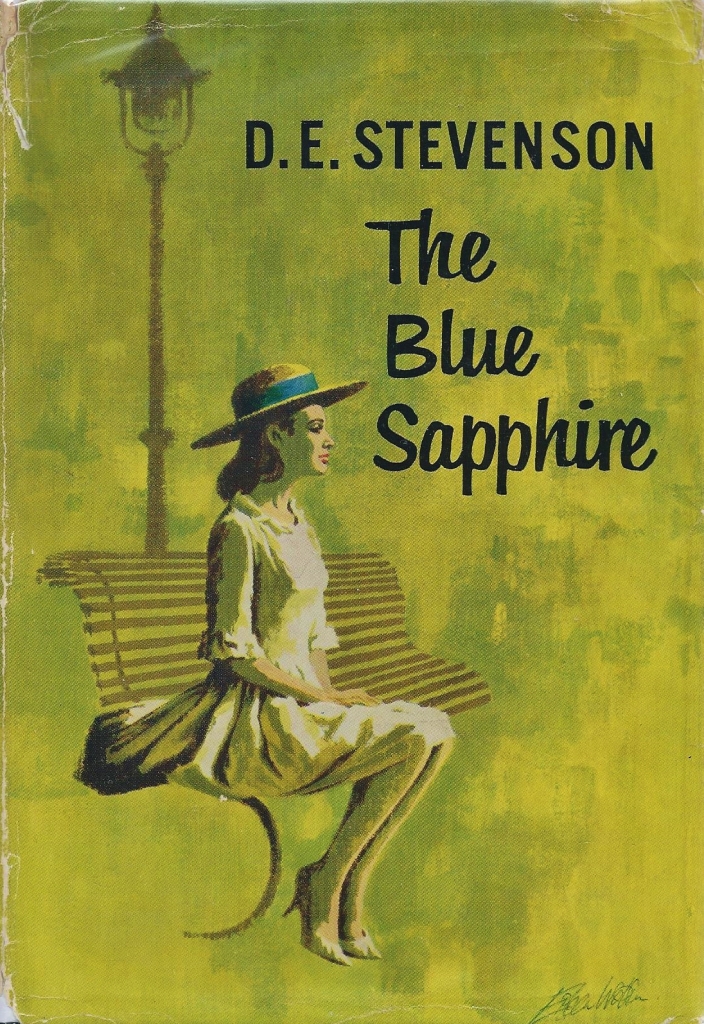
the blue sapphire d e stevenson 001The Blue Sapphire by D.E. Stevenson ~ 1963. This edition: Collins, 1963. Hardcover. 320 pages.

My rating: 9/10

Yesterday’s post was all supercilious and disapproving of D.E. Stevenson’s 1969 novel Gerald and Elizabeth, but happily I am able to balance that with a much more enthusiastic opinion of this also far-fetched but charmingly engaging 1963 effort.

There are several parallels between the two stories, which makes their comparison and my views of one as “good” (The Blue Sapphire) and the other as “not-very-good” (Gerald and Elizabeth) an interesting micro-study in perception and the ambiguities of personal taste. I won’t delve any more deeply into this aspect of these two books, but will zip right into a brief discussion of the book itself.

Dust jacket blurb:

The blue sapphire is a gem which the Ancients called the hyacinthus and which Solinus described as ‘a gem which feels the influence of the air and sympathises with the heavens and does not shine equally if the sky is cloudy or bright’.

On a beautiful spring day, Julia Harburn sat on a seat in Kensington Gardens enjoying the sunshine. She was wearing a white frock and a large straw hat with a sapphire-blue ribbon which exactly matched her eyes – a strange coincidence, as it turned out, for the blue sapphire was to have a far-reaching influence upon her life. So far, her life had been somewhat dull and circumscribed; but quite suddenly her horizons were enlarged. She began to make new friends – and enemies – and she began to discover new strength and purpose in her own nature. This development of her character led her into strange adventures, some amusing, others full of sorrow and distress. The story is itself a blue sapphire story, of clouds and sunshine.

As pretty Julia sits on her park bench waiting for her tardy fiancé Morland to appear for their teatime rendezvous, she is increasingly worried that she will be “annoyed” by the numerous questionable masculine types who have started closing in on her, like hopeful jackals surrounding a tender little gazelle. Luckily a rescuer appears in the person of tall, handsome and very forthcoming Stephen Brett, newly arrived in London after some years away in South Africa overseeing a gemstone mining operation. At first Julia snubs the friendly Stephen, but she soon warms to his innocent cheerfulness, and the two part on mutually appreciative terms just as Morland grumpily hoves into view.

Julia is waiting to break some rather big news to Morland. She has decided to move out of her father’s house and find a job and take a room in a boarding house. Some years ago Julia’s mother had died, and her new stepmother, while not at all cruel, is making it increasingly obvious that she would be happier if she were the only woman in the household.

Morland loftily dismisses Julia’s intentions of independence, but she holds firm, eventually ending up in an attic room in the fabulously Victorian-styled boarding house of the inestimable Miss Martineau, ex-actress and current patroness to “resting” theatrical folk. Miss Martineau takes a shine to Julia, and sets her up in a job at a posh hat shop, where Julia proceeds to thrive, becoming a very special chum to her new boss, the ex-Parisian Madame Claire, to the deep resentment of Julia’s several jealous co-workers.

Meanwhile Stephen Brett pops in and out of Julia’s life, adding some much-needed good humour and friendliness as Julia finds her way as a working girl and tries to cope with Morland’s moodiness and reluctance to set a date for their marriage. Stephen is embroiled in a complicated situation involving a potential sapphire mine back in South Africa; he finds relief from his worries in his growing friendship with Julia.

A turning point in the plot occurs as Julia receives a letter from her father’s estranged brother in Scotland, begging Julia to come and see him before he dies. Off she goes, against Morland’s advice, to find in her Uncle Randal the loving relationship she has never been able to attain with her own father. But Uncle Randal is declining rapidly, and it seems as though Julia will tragically lose him just when she has found him…

Stopping right here, because this is a sweet story which you will want to finish up for yourself. D.E. Stevenson is in her usual form, mixing unlikely scenarios with sunny-natured heroines, grumpy-but-ultimately-innocuous villains, salt-of-the-earth old family retainers, and a knight-in-shining-armour (or two) who appear(s) at just the right time.

The mixture-as-usual, but just what is needed in a book of this gentle genre. Highly recommended to those of you who like this sort of thing; everyone else, tactfully glance away!

Another Look Book liked it, too. As did Claire and Susan, who recommended it to me in the comments to my last year’s post about this other DES, also featuring the incorrigibly snoopy but divinely maternal Miss Martineau, 1966’s The House on the Cliff.

Read Full Post »

gerald and elizabeth d e stevenson 001Gerald and Elizabeth by D.E. Stevenson ~ 1969. This edition: Holt, Rinehart and Winston, 1969. Hardcover. ISBN: 03-066555-8. 245 pages.

My rating: 4/10

I hadn’t noticed a lot of discussion regarding this mild romance-suspense novel by the generally esteemed D.E. Stevenson in my online travels, and as it seemed to be widely available and very reasonably priced (for a DES book) in the second-hand book trade, I rather wondered why.

Well, I wonder no longer. The answer appears quite clear. It is my humble opinion that this book is not very good, and DES fans are keeping a discreet silence, spending their reviewing energies instead on the author’s top end novels.

While it’s sufficiently readable to keep one’s interest gently engaged, and there are charming passages and likeable characters galore, the whole thing is something of a stretch in numerous ways, even allowing for the DES formula of everyone ending up romantically paired up with all “mysteries” neatly resolved.

Dust jacket blurb:

Gerald Brown is young, good-looking, personable, but he holds himself aloof from the other passengers aboard the Ariadne, a small passenger ship returning to London from Cape Town, South Africa. In fact, his behavior is so extremely antisocial that he appears on deck only late at night, rarely venturing from his cabin during the day. Something is troubling him deeply, something that happened while he was working as an engineer in a Cape Town diamond mine that has left him spent and hopeless.

After the Ariadne docks in London, Gerald, desperately in need of a job, decides to contact his sister, the beautiful and famous actress, Elizabeth Burleigh, whose current play is the hit of the London theater season. As he reveals to her his haunting past in South Africa, he learns that she too is suffering, that behind her facade of gaiety and sophistication lurks a nagging suspicion about her mental health that is threatening to destroy her career and her love affair as well.

What are the forces that seem bent on these destroying these young people who have so much to live for? Can the mysteries surrounding their lives be solved – and in time to prevent irreversible consequences?

D.E. Stevenson reveals the answers to these questions in a way that will hold her thousands of fans breathless until the very end…

A glaringly obvious diamond-theft frame-up has our hero fleeing the gossip and speculative glances of South Africa to end up under the protective wing of his older half-sister Elizabeth, star of a rather goofy-sounding London stage play – Elizabeth plays a princess from the planet Venus marooned on Earth, to the delight of the hypothetical crowds who pack each performance during the play’s astoundingly successful run.

But all is not well in Elizabeth’s world either. Though feted by the all and vigorously courted by a kind, handsome and wealthy Scottish shipyard owner, Elizabeth fears that she has inherited the “melancholia” which plagued her long-deceased mother. How can she marry with such a doom hanging over her head? – for naturally it will be passed along to her own children!

As Gerald seeks to make a new start he also strives to delve into the background of Elizabeth’s mother, hoping to make some sort of discovery which will ease his sister’s worries and smooth the rocky path of her romance.

A wartime bombing raid on the night Elizabeth was born and an enterprising maternity nurse hold the key to the actress’s future happiness, and the events surrounding her birth are as spectacularly far-fetched as D.E. Stevenson’s conception of mental illness. Shades of the bizarre insanity scenario of Rochester’s Wife, published thirty years earlier, made me cringe in readerly discomfort for the author’s lack of research and her apparent clinging to archaic superstitions.

The mysteries aren’t very mysterious, and the characters never truly come to life. The author could and did do much better in many of her other novels. In my eyes, this is a book to round out one’s DES collection, but otherwise I feel that it is without a lot of merit. Please don’t give it to a neophyte Dessie; it might endanger one’s contention that this is indeed an author to spend time and energy tracking down!

Read Full Post »

my mother in law celeste andrews seton 001My Mother-in-Law by Celeste Andrews Seton ~ 1954. This edition: Michael Joseph, 1954. Hardcover. 239 pages.

My rating: 8/10

Foreword

Jay Gould died at his home at 579 Fifth Avenue, New York, in 1892. During his lifetime he amassed one of the largest fortunes in the United States. It is estimated that at one time his ownership of stocks and bonds in railways covering 18,000 miles of track, transatlantic cables, mining, land and industrial corporations, totaled over a thousand million dollars.

This story is based on the life of Jay Gould’s eldest daughter, Helen Gould Shepard. Her four adopted children agree that this book s an emotional and spiritual image of their foster-mother. They disagree, however, about some of the facts. Helen Anna says that the sweet peas did not win a prize at the flower show – the lilies did. Finley Jay says he doesn’t remember the flower show at all. Louis will not commit himself. Olivia says she is, frankly, a little fuzzy about it, but doesn’t see what difference it makes…

Attracted by its quietly elegant spine decoration, I pulled this slender hardcover off a crowded shelf in one of Vancouver several deluxe emporiums of used tomes, Lawrence Books (on the corner of Dunbar and 41st). Raising an eyebrow slightly at the pencilled price on the inner flyleaf – this is a store that thinks very highly of its dusty treasures, few bargains to be had here – I nevertheless was charmed enough by a few moments leafing through to add it to my small pile of promising finds.

Upon arriving home, My Mother-in-Law gravitated immediately to my bedside table, providing me with several late nights of soothing diversion during a hectic week full of all sorts of frantic activity.

The daughter-in-law who has penned this loving memoir first met her prospective husband while on vacation with her mother in the Adirondacks. Celeste finds the surprisingly accomplished Louis Seton less than forthcoming about his antecedents, but as she is twenty-one and nicely independent she abandons herself to the course of true love, eventually accepting Louis’ marriage proposal in a New York taxi. Only while preparing to break the news of her betrothal to her bemused parents – “Who is this Louis Seton, and why does his name sound vaguely familiar, even though we’ve never come across his parents in our society visits?” – does Louis rather shamefacedly spill the beans.

He is the foster-son of the richest woman in the United States, Helen Gould Shepard, eldest daughter of the incredibly rich “American robber baron” Jay Gould.

All right, then.

Celeste goes to meet her prospective in-laws with more than a little apprehension, and what she finds when she goes to that first afternoon tea is just a bit unnerving. Louis’ mother is, as Louis warns Celeste, perhaps a tiny bit eccentric.  Mother Shepard not only knows her Bible inside and out, she believes in it as the Literal Truth, and is prone to discuss it at any time, and to prescribe passages to memorize, which she will later examine her visitor upon. Celeste is put on the spot and manages to trot out the 23rd Psalm, the only Bible passage she knows by heart. Mother Shepard gently approves, but her mild manner does not mask her keen eye, and Celeste realizes that she had better brush up on her Bible reading, amongst other things.

Mother Shepard approves of Herbert Hoover – there is a huge jigsaw puzzle of his profile in a state of semi-completion in the parlour – and disapproves of communism. She sadly condemns Celeste’s alma mater, Smith College, as a hotbed of communist plotting: “They have parades there. By torchlight. And they don’t believe in God. It’s too bad…”

Celeste is presented with a peacock-feather quill pen and ordered to sign the massive guest book. She is plied with tea and avocado sandwiches, and watches in wonder as Mother Shepard feeds her Pekinese dog, Chinky, as he reclines on a velvet footstool. (Later we are to learn that this Chinky is merely one of a long line of identically named pets; as each expires from the effects of unsuitable diet and lack of exercise, another takes its place; the name stays the same while the actual dogs succeed each other, victims of a benignly intended but ultimately fatal pampering.)

Upon parting Celeste is presented with a huge corsage of white orchids, grown in one of the fabulous Shepard greenhouses, and she stumbles out into the real world feeling like she has been on another planet. But a most cozy and well-upholstered one, though there is something a bit tense in the atmosphere.

Helen Gould Shepard, unable to have children of her own, had adopted four foster children and raised them in her own unique manner. Though her generosity is boundless, the now-adult children are all still just a tiny bit terrified of their benevolent mother, whose ideas on child-rearing included “punishments” of memorizing poetry and foreign languages and operatic passages. Louis is most accomplished in all of these , as Celeste has already discovered, leading her to speculate uneasily upon the “naughtiness” of his childhood…

Though his foster-mother is exceedingly wealthy, Louis himself is not an heir to the Gould fortune, as Jay Gould’s will included a clause regarding the necessity for his ancestors to be “blood-issue”, but there does appear to be a substantial trust fund, easing Celeste and Louis’ setting up housekeeping in the darkest days of the Depression.

Many visits to the various Shepard residences follow in the years to come, and Celeste, while remaining slightly bemused at her mother-in-law’s thought processes, comes to love Mother Shepard deeply and to admire her sincere urges to do good, even while realizing that occasionally Mother Shepard’s philanthropies are subject to whim and arbitrary judgement.

This is an entertaining, kindly humorous and rather unusual memoir. It presents a one-of-a-kind picture of both a unique personality and of a way of life that was exclusive to only a very tiny percentage of the American population – the wealthiest of the exceedingly wealthy – in their specific moment in history.

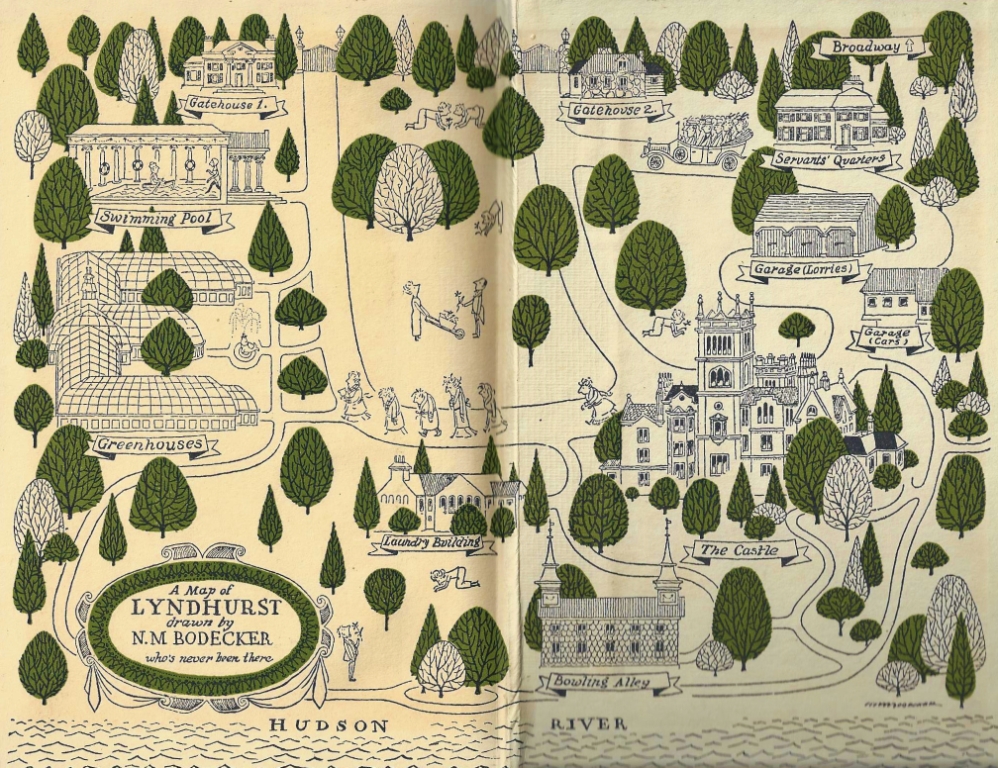
Gorgeous endpaper illustrations show a map of Helen Gould Shepard's favourite "home", the family country estate of Lyndhurst. Small illustrations depict incidents described in the memoir: the nighttime procession of the entire household to see the fabulous night-blooming cereus in the conservatory; grubbing up dandelions in the lawn under Mother Shepard's watchful eye; going to church en masse packed into one of the nine Shepard motorcars; swimming in the Greek-columned pool, watched over by a full-time lifeguard, whose main claim to usefulness was that he had once rescued one of the many Chinkys from a watery death!

The delightful endpaper illustrations show a map of Helen Gould Shepard’s favourite “home”, the family country estate of Lyndhurst. Small illustrations depict incidents described in the memoir: the nighttime procession of the entire household to see the fabulous night-blooming cereus in the conservatory, grubbing up dandelions in the lawn under Mother Shepard’s watchful eye, going to church en masse packed into one of the nine Shepard motorcars, and swimming in the vast Greek-columned pool, watched over by a full-time lifeguard, whose main claim to fame was that he had once rescued one of the many Chinkys from a watery death!

Read Full Post »

The view out the window upon arrival at UBC last week - what's up with the SNOW?!

The view out the window upon arrival at UBC last week – what’s up with the SNOW?!

The last part of February passed in an absolute blur, and I’ve been away from the blog completely but for brief moments to reply to comments. But I’m back, and life promises to settle down a bit after the recent flurry, and my stack of to-discuss books is frighteningly tall. I’ll get back to my blogging routine very soon – I’ve missed you all!

Claire – I did make it to Vancouver, but it was literally a flying visit – I was there two days, visited Van Dusen and the UBC garden in the snow, stopped in at three bookstores – Pulp Fiction on Main (which I found well-organized but very high priced) and Lawrence Books on Dunbar (which was gloriously overstuffed and a bit chaotic, also very high-priced, but full of treasures) and of course the excellent Pages (now renamed) in Hope on the way home. That cup of tea – next time!

I came to Vancouver for a glimpse of green grass, but sadly found lots and lots of SNOW instead – but at least it wasn’t minus 25C like it was at home!

Multiple vet visits with our elderly dog, including one rather costly surgery (she’s recovered brilliantly – what a tough old girl she is), and minor surgery for one of the humans (three wisdom teeth removed – the person in question is in looks-like-chipmunk recovery mode today), and the regional dance festival ate up vast chunks of my time these past two weeks, but things are easing up a bit.

We have a two-day Vocal and Choral Festival to get through this coming weekend, but it promises to be a gentle diversion after the high-energy Dance Festival, and I am looking forward to just sitting back and listening to the music, in between my not-very-arduous duties as the local Provincial Festival representative. Kevin Zakresky, choral director of the Vancouver Symphony, Prince George Symphony, and Pacifica Singers, is our Vocal adjudicator, and it sounds like he will be a lot of fun, so very much looking forward to that.

I shall soon be back posting away as usual – I have been reading some very interesting books, which I’m keen to share thoughts on.

Van Dusen Garden in Vancouver, February 24, 2014 - There are spring flowers out there, buried for the most part under the unexpected snow.

Van Dusen Garden in Vancouver, February 24, 2014 – There are spring flowers out there – really! – I saw glimpses of them – buried for the most part under the unexpected snow. A very beautiful botanical garden, under any conditions.

Read Full Post »

« Newer Posts