Archive for January, 2014

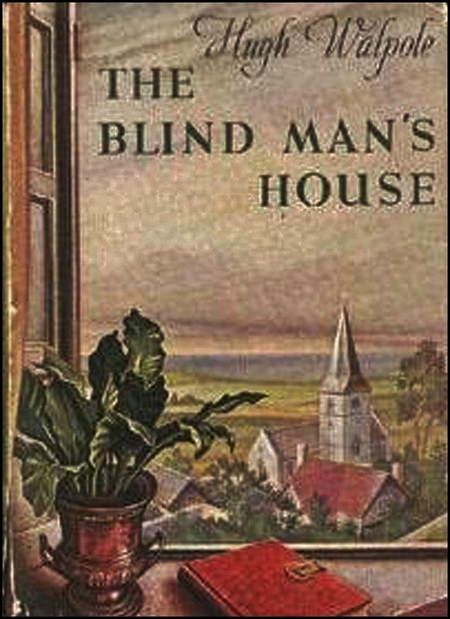
the blind man's house hugh walpoleThe Blind Man’s House by Hugh Walpole ~ 1941. This edition: Doubleday, Doran & Co., 1941. Hardcover. 337 pages.

My rating: 5.5/10

Sir Julius Cromwell, blinded many years before by a bullet to the head in the Great War, has recently married the lovely and impetuous Celia, fifteen years his junior. The two are still in the physically passionate honeymoon stage of their relationship, Celia’s husband adores and indulges her, and she worships him; they are moving to a country estate in the town where Sir Julius grew up; a warm welcome by the locals is anticipated. So why does Celia feel so apprehensive and sick with fear, and why does she cringe away from the sightless gaze of her husband’s beautiful blue eyes?

Everybody loves Sir Julius, from the youngest vicarage child to his servants to the one surviving member of the noble family whose ancestral home Sir Julius has just taken over. Even the handsome Jim Burke, well-born but looked down on with disdain for his wandering ways and philandering approach to the local young women, has settled into a remarkably stable relationship as a companion-odd job man to Sir Julius; the two are comfortable in each others’ company, and Jim reads aloud by the hour to Sir Julius and is his intellectual equal in their long shared talks together.

The young Mrs. Cromwell, on the other hand, is not going over so well. Her hasty temper and impulsive ways wreak domestic havoc and Sir Julius is frequently called upon to smooth ruffled feathers. Celia is well meaning and vivacious; she soon realizes that she is making some bitter enemies among the local ladies – most particularly and seemingly without cause with the vicar’s wife, but she is floundering with how best to make friends and handle her servants tactfully.

When it becomes obvious to all that Jim Burke is looking with admiring eyes at the lovely wife of his employer-friend, gossip starts to ferment and Celia’s popularity takes a further nosedive. When the two are witnessed in an embrace in the woods, whispers become outspoken words, and Sir Julius’ happy world starts to crumble around him.

This is a readable though occasionally melodramatic examination of the psychological effects of blindness both on the blind man and on everyone around him. Much as Sir Julius attempts to just get on with things, his injury is the elephant in the room, engendering endless speculation. Celia in particular can’t seem to get over her surprise that her husband’s other senses are so highly developed to make up for the loss of his sight; she is almost offended by the keenness of his hearing, by the delicacy of his touch, and by his uncanny ability to navigate through the darkest of rooms. Jim Burke has perhaps the most natural response to Sir Julius and the two mens’ friendship is sincere, despite the complications of the jointly admired Celia.

Just as I thought to myself that the story was taking on shades of Lady Chatterley’s Lover, what with the maimed husband, passionate young wife and handsome young retainer aspect and all, what does clever Walpole do but make reference to D.H. Lawrence in his own narrative, leading me to believe that the resemblance to the scenario is more than accidental.

It was as though (Celia) had been placed out of contact with everyone living. She picked up a book—a heavy brown volume on the table at her elbow. The Letters of D. H. Lawrence. There had been a time when it had been the fashion among her friends to read Lawrence, as though there were a new gospel here. And perhaps there was. She could never be sure, because so much of The Rainbow and Women in Love bored and wearied her, and sometimes there were magnificent things.

But now she read on and on and it was as though Lawrence screamed in her ear, telling her that catastrophe was on the way. She could not understand why he rejected everything and everybody—rejection, hate, misery. And then would come some passage of natural description so lovely and quiet that his voice dropped to a loving encouraging whisper. He rejected all living human beings. He said again and again with sickening reiteration that he trusted no one. His dearest friends he would embrace at one moment and reject with loathing at the next. Everything revolved around himself. He was sick, he was poor, he was betrayed, and he said so over and over again. But he had genius, that strange gift of seeing everything and everybody for the first time, as though no one had ever lived on this earth before himself.

But his thin nervous cry increased her own fear. He was right. The world was dreadful because the people in it were dreadful—dreadful and menacing…

Poor Celia, and poor Sir Julius. Poor Jim Burke, too! For this love triangle evaporates into nothingness, leaving the married couple still in partnership with each other and leaving Jim to make peace with himself on the outside of society’s charmed circle after his brief time of friendship with his fellow kindred spirit.

Hugh Walpole capably weaves numerous personal histories together on his way through this domestic saga, and some of his characterizations are clever and beautifully poignant, particularly concerning the three vicarage children.  But ultimately I felt that The Blind Man’s House was something of a minor work; too busy with incident and attempts at analysis to ever really settle down into story; personalities only carrying the thing so far.

The Blind Man’s House is available online at Project Gutenberg Canada.
Read Full Post »

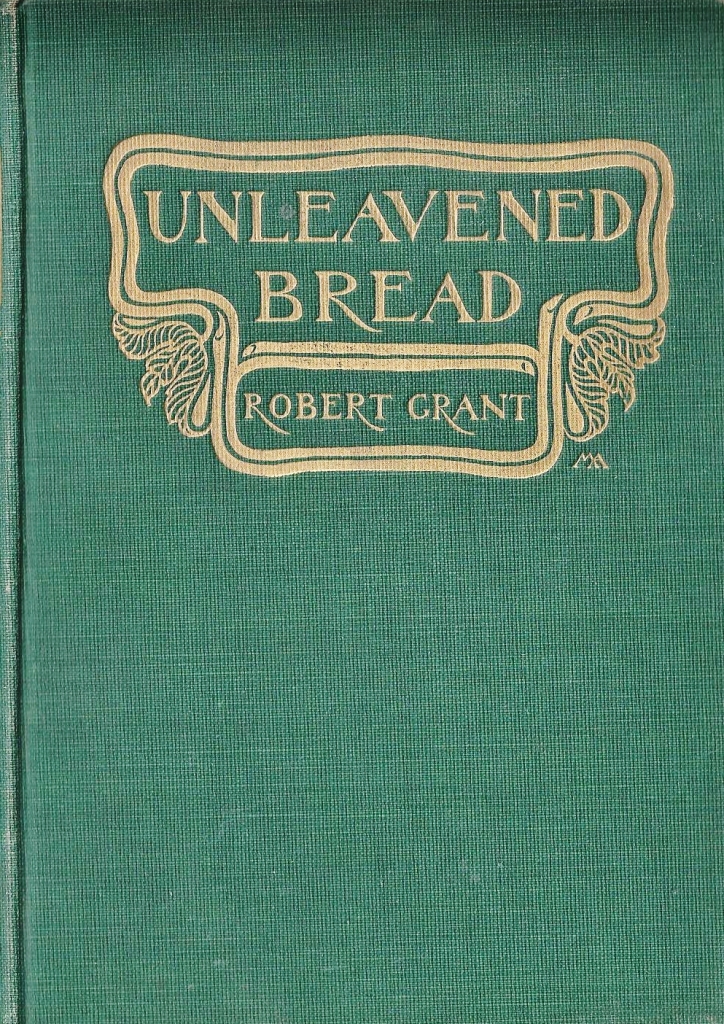
unleavened bread 1900 robert grant 001Unleavened Bread by Robert Grant ~ 1900. This edition: Charles Scribner’s Sons, 1900. Hardcover. 431 pages.

My rating: 8/10

This turn-of-the-century American novel is an ambitious three-stage portrayal of a woman’s rise from rural schoolteacher to Congressional Senator’s wife. While first and foremost an even-handed but deeply damning portrait of the protagonist, the ambitious and utterly humourless Selma White, the novel also acts as an intriguing picture of several decades of American social change.

Selma White was born with a high regard for herself and her abilities, and her position in the world has by and large supported that self-conception.

To be an American meant to be more keenly alive to the responsibility of life than any other citizen of civilization, and to be an American woman meant to be something finer, cleverer, stronger, and purer than any other daughter of Eve. Under the agreeable but sobering influence of this faith she had grown to womanhood, and the heroic deeds of the civil war had served to intensify a belief, the truth of which she had never heard questioned. Her mission in life had promptly been recognized by her as the development of her soul along individual lines, but until the necessity for a choice had arisen she had been content to contemplate a little longer. Now the world was before her…

Disillusioned by the less pleasant aspects of school teaching after only a short time presiding over a classroom of rural children, Selma has accepted the marriage proposal of an up and coming young man from the fictional small city of Benham, located somewhere along the Eastern seaboard, inland and presumably equidistant from Boston and New York. Lewis Babcock is a jolly, rather common sort of fellow, who is flourishing in the paint and varnish business during the post civil war building boom.

Without a backward glance Selma moves up a notch in the social scale, but is taken aback to find that she is a very small frog indeed in the larger pond of the city. A lightning fast learner, Selma ingratiates herself to all the right people and finds a measure of social success. She has a child, but though she does feel a certain fondness for her infant, she is relieved rather than heartbroken at the little girl’s death from croup. Having taken pains to prevent any more children – Selma has learned all about the current birth control methods through her friendship with a socially active suffragette – she eventually ditches the hapless Lewis (by divorce after his adultery) and attempts to support herself by writing for a newspaper.

Working for a living soon pales, and Selma is fortunate in that her ethereal appearance – she takes great pains to cultivate her thinness, scorning those who are “fleshy” as unintellectual and coarse – attracts the attentions of a young architect who soon becomes her second husband. (Lewis meanwhile is shattered by the death of his child and the dissolution of his marriage and turns to drink; the adultery was a minor glitch which foreshadowed his future decline.) This new marriage runs its predictable course until an early death releases Selma’s second unfortunate spouse. A third matrimonial experiment sees Selma united at last to a man of similar ambitions, and her rise to the top of her particular pile continues apace, built as it is on the happiness of those she has relentlessly crushed beneath her neatly shod feet.

This novel was a strong bestseller at the time of its publication, and I found that it held up well to a modern day reading. Selma is a fascinating character, being manipulative, selfish, humourless and an utter snob. An increasingly accomplished sociopath, one might say, to use modern day jargon. Robert Grant moves his mesmerizingly unsympathetic character through a variety of social settings, and provides not only an imaginative portrait of Selma but a keen and rather damning look at the “American way” which allows her to flourish at the expense of those more scrupulous in their moral states.

Not a particularly happy read, but deeply interesting, wryly well-written, and a worthy way to begin this year’s Century of Books Project.

Unleavened Bread felt rather reminiscent of the works of Sinclair Lewis, Main Street and Babbitt in particular, though a check of dates shows that Lewis was a mere teenager when Selma’s saga was having its popular success. Perhaps the seeds of inspiration were planted in the younger man by Grant’s work? In any event, I liked this novel well enough to order another by Robert Grant, The Orchid, which I intend to report on in due time.

Here is the only current review I could find of Unleavened Bread, at the Great Penformances blog.

The novel is also available through Project Gutenberg, along with several more of Robert Grant’s works.

Read Full Post »

the treasure selma lagerlof 1The Treasure by Selma Lagerlöf ~ 1904. Original title: Herr Arnes penningar (Herr Arne’s Hoard). Translated into English in 1923. This edition: Daughters, Inc., 1973. Foreword by June Arnold. Softcover. ISBN: 0-913780-01-4159 pages.

My rating: 10/10

“Why are they whetting knives at Branehog?”

So deep was the silence in the room that when the old lady asked this question all gave a start and looked up in fright. When they saw that she was listening for something, they kept their spoons quiet and strained their ears.

For some moments there was dead stillness in the room, but while it lasted the old woman became more and more uneasy. She laid her hand on Herr Arne’s arm and asked him: “How can it be that they are whetting such long knives at Branehog this evening?”

Torarin saw that Herr Arne stroked her hand to calm her. But he was in no mind to answer and ate on calmly as before.

The old woman still sat listening. Tears came into her eyes from terror, and her hands and her head trembled more and more violently.

Then the two little maids who sat at the end of the table began to weep with fear. “Can you not hear them scraping and filing?” asked the old mistress. “Can you not hear them hissing and grating?”

The crippled fish-seller, Torarin, who has stopped at the wealthy Herr Arne’s household to warm up and partake of the liberal hospitality of the household, is just as shocked as everyone else by the old woman’s outbreak. For didn’t his own little black dog, Grim, howl forebodingly and refuse to enter the gates of Herr Arne’s compound? Something sinister could well be afoot.

It is 16th Century Sweden, in the depths of winter. The sea is frozen; ships are trapped helplessly waiting for a thaw. Torarin hopes to take a shortcut home over the ice, and soon leaves. Grim rejoins him and Torarin shrugs off the omen. That night, however, a fiery glow lights up the night sky. Herr Arne’s buildings are on fire! Neighbours running to assist are shocked to find that the fire has been set from outside, and inside the hall Herr Arne, his wife, and their entire household lie dead in pools of blood; his famous treasure chest filled with silver is missing. A dying gasp from one man tells of three roughly dressed men coming down the chimney hole with long knives honed for the slaughter, surprising the household.

the treasure selma lagerlof 2One person has survived the massacre, a fourteen-year-old orphan girl, Elsalill, loving companion of Herr Arne’s daughter. She is dazed and at first will not speak; Torarin ends up taking her into his own poor home, where she soon learns to drudge along with Torarin’s mother cleaning fish on the harbourside.

Then three richly dressed Scottish mercenary soldiers, marking time with many others while waiting for the sea to thaw, overhear Elsalill telling the tale of that horrible night; they mock her weeping and her contention that she will be revenged upon the murderers who killed her beloved friend even as she pleaded for mercy. And as they walk away Elsalill thinks that somehow they look familiar, and this proves to be true.

Meanwhile, the unavenged dead are not resting peacefully these winter nights, and Herr Arne’s daughter returns to the land of the living in order to beg assistance from Elsalill in righting her great wrong. But Elsalill has fallen in love with the very man who murdered her friend…

What a great little ghost story this novella was, evocative of a bardish tale told round a flickering fire in a land of sunless winter.  Swedish writer (and articulate lesbian feminist) Selma Lagerlöf  was an accomplished teller of tales, winning the Nobel Prize for Literature in 1909 “in appreciation of the lofty idealism, vivid imagination and spiritual perception that characterize her writings”, and The Treasure is a fine small example of her much greater body of work.

Available for free online at Project Gutenberg, but perhaps best read out loud on a dark winter night with lights down low to a rapt audience of listeners.

Skål!

Read Full Post »

« Newer Posts