Archive for December, 2013

Three “relationship” novels read this month with varying degrees of enjoyment. All three are much discussed elsewhere, so I feel justified in giving them each what amounts to a very arbitrary micro-review. Of these three I doubt I will be returning to The Mistress of Nothing or Letter from Peking. Miss Pettigrew, however, will immediately be moving onto the keeper shelf.
the mistress of nothing kate pullingerThe Mistress of Nothing by Kate Pullinger ~ 2009.
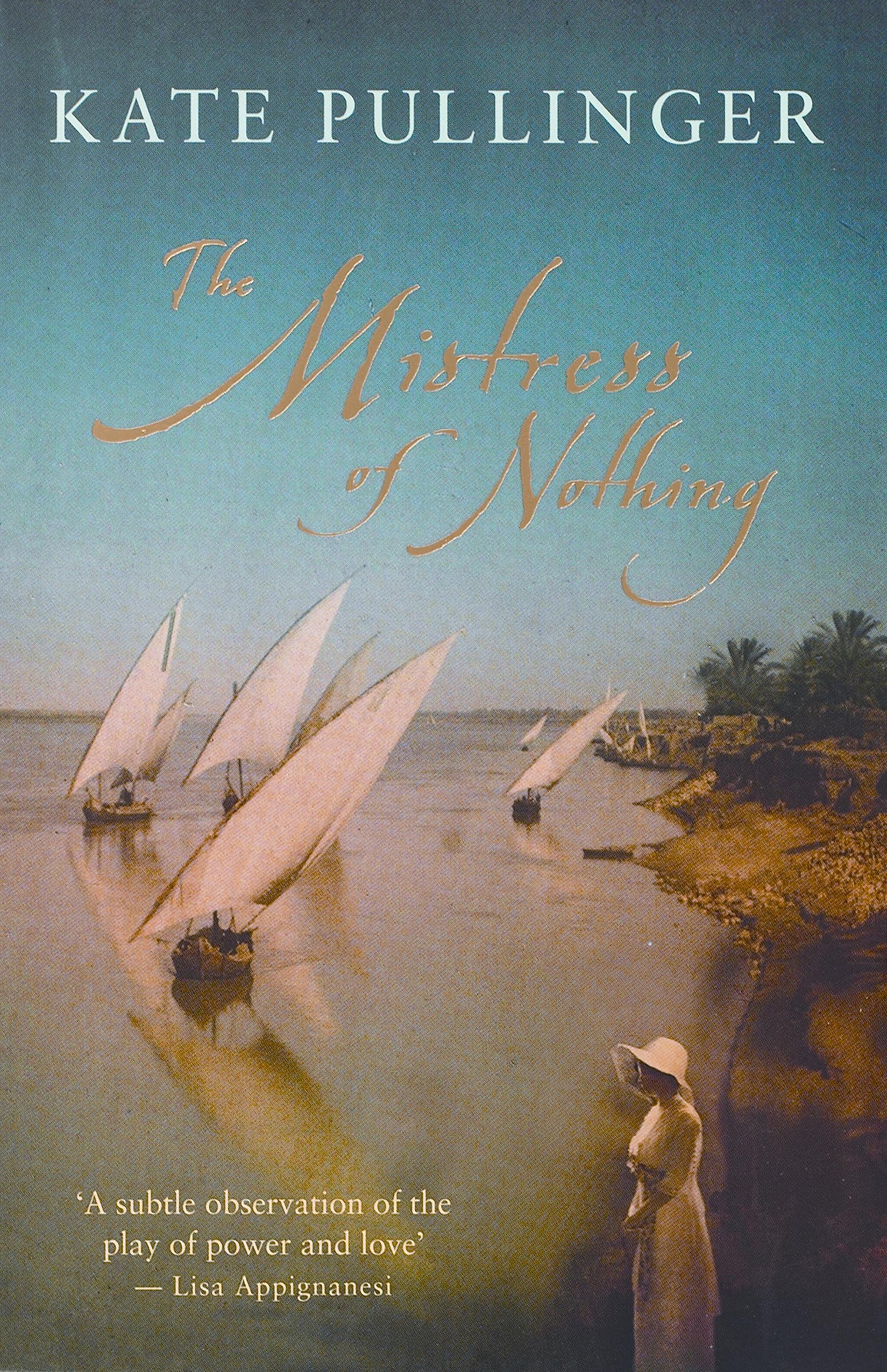
This edition: McArthur & Co., 2010. Softcover. ISBN: 978-1-55278-868-4. 248 pages.

My rating:  6ish/10.  (Mostly for the first half of the book, which was quite engrossing, and the fact that it sent me away curious to learn more about the real Lady Duff Gordon. The last half deteriorated to a 3 or maybe, generously, a 4.)

This book won the 2009 Canadian Governor General’s Award for Fiction, to which I can only say that it must have been a quiet year in publishing.

Somewhere as I did a bit of internet research on the author and the novel, I read that Kate Pullinger worked on this for ten years. I’m assuming that it was very much a peripheral project, though I also saw that she received an Author’s Society grant to travel to Egypt for her research, and a series of Fellowships from the Royal Literary Fund. I personally think that the author should also have spent some time working on how to write a convincing bedroom scene, because the sexy bits in this one were blush inducing for all the wrong reasons, reading as though they’d been grafted into a reasonably serious historical novel from something much more slight and bodice-ripperish.

Based closely on Lady Duff Gordon: Letters From Egypt, edited by Lady Duff Gordon’s mother, Sarah Austin, and daughter, Janet Ross, and published in several volumes between 1865 and 1875, The Mistress of Nothing is, first and foremost, well researched. It is also beautifully written for the most part, making the latter plot and stylistic inconsistencies all the more glaring.

Lucie, Lady Duff Gordon was well known for her beauty and sparkling wit and moved in the highest social circles in England, though she and her husband were, relatively speaking, not all that wealthy. Lady Duff Gordon was a noted scholar, and specialized in translations of German literature. She was also doomed to an early death, for she had at some point contracted tuberculosis, and, soon after the birth of her third child, was told she must leave England for a warmer, dryer climate. Travels to South Africa and then to Egypt brought some respite, and The Mistress of Nothing follows the Egyptian sojourn which ended in Lady Duff Gordon’s death in Cairo in 1869. She was 48.

The Mistress of Nothing provides an intriguing if superficial portrait of Lady Duff Gordon, but the focus of the novel is on another genuine character, her personal maid, Sally Naldrett. Sally accompanied her mistress on her travels, and on the trip to Egypt was Lady Duff Gordon’s sole companion, as limited finances precluded anything resembling an entourage.

When the two women reached Egypt, they were fortunate in acquiring an Egyptian dragoman/factotum, one Omar, who by all reports was a devoted and efficient assistant and of great aid in every way possible. At some point Sally and Omar developed an even closer relationship; Sally became pregnant and gave birth to Omar’s child, a development unrealized by Lady Duff Gordon until the actual birth. Her Ladyship reacted in an extreme manner, refusing to have anything  to do with Sally and stating that the child was to be given to Omar’s family (he was already married to an Egyptian woman) and that Sally was to return to England. Sally ended up marrying Omar – under Muslim law he was permitted multiple wives – but there was no reconciliation between her and her mistress, and Sally disappears from Lady Duff Gordon’s narrative, though she was very much still present at least on the fringes of the household for quite some time before Lady Duff Gordon’s eventual demise. Omar stayed on, and retained his position in the household as well as Lady Duff Gordon’s good graces, being recommended by her to serve in the Prince of Wales’ household after her death.

All of this is true to the historical record, and quite fascinating it is, too. It’s very easy to see why Kate Pullinger decided to elaborate on the real life framework of this dramatic trio of personalities; the story as it stands is enthralling.

Where the fictional treatment starts to unravel is where the real life letters leave off and Pullinger’s pure invention takes over. Once the (fictionalized) virginal Sally discovers the joy of sex with Omar, the narrative changes from an interesting examination of expatriate life in 1860s Egypt to a mushy pastiche of Sally’s (imagined) thoughts and emotions and Pullinger’s inventive fabrication of what Sally gets up to once cut adrift from her once-benevolent employer. Though willing to go along with the tale, I was unwillingly lost along the way, and closed the book with a feeling of deep disappointment. It was so close to being such an excellent read…

Well, I see the above got longer than the promised micro-review, though I really didn’t say too much; it’s a largish topic and there are all sorts of things I could say about the fascinating character of Lady Duff Gordon, and the roles of women in the 19th century, and class distinctions, and the vast gap between mistress and servant despite their years of physical intimacy, and the political situation in Egypt and the whole aristocratic British person living abroad thing. But others will have said it already, so I will (and not a moment too soon – the morning typing time is running out) move on to the next book on my list.
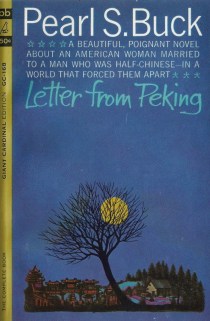
letter from peking pearl s buckLetter From Peking by Pearl S. Buck ~ 1957.

This edition: Cardinal, 1964. Paperback. 218 pages.

My rating: 3/10

Pearl S. Buck was a prolific writer, with a number of excellent novels to her credit – The Good Earth, The Living Reed, Peony – and a whole slew of other stuff. Some of which, sadly, is not very good at all. Like this one, which sounded promising, started out not too badly, and slid downhill fast.

This might have made a decent short story, but Pearl S. Buck, by dint of much repetition and needlessly florid meanderings, padded it out into a novel.

Here’s the gist of it.

An American woman, happily married for twenty years to a half-Chinese, half-American man, leaves China with her twelve-year-old son at the start of the Communist government takeover. Her husband, due to an extreme sense of duty, remains behind in his job. (He’s the head of a Chinese university; you know already from this that it’s not going to end terribly well, what with the whole Cultural Revolution thing on the horizon.)

Back in America, the woman settles into her family home in rural Vermont, which has been conveniently waiting for her in perfect order all these years, complete with faithful (if gruff) hired man. A letter arrives. Her husband has been pressured to take on a Chinese wife, to prove his loyalty to his country. The woman puts off answering it. The son runs into issues with his mixed race ethnicity. Much emotion ensues. The woman talks. A lot. Both to herself and to anyone else who will provide a shoulder to cry on. The son decides “enough of this already, Mom’s micromanaging my life. No more confidences.” More tears.

Then the woman, all on a sudden whim, decides to track down her father-in-law, and finds him in the most unlikely circumstance, living in a small shack under the protection of a local big-wheel landowner, having lost his memory but still being cognizant enough of things to insist on dressing himself in Chinese silk gowns, of which he apparently has a whole closet full. (The father-in-law lived in China many years, and left after the death of his Chinese wife – the heroine’s husband’s mother – which was highly unpleasant. She was a revolutionary activist, and was  put up against a wall and shot. Instant martyr stuff.)

Not one but two prospective suitors materialize. “Divorce your husband and marry again!” Oh, what to do, what to do???! By the time it all sort of resolved itself (sort of) I no longer cared.

Heroine is a deeply unpleasant woman, for all of her heartfelt moanings in this first-person monologue. She is a complete and utter snob, self congratulating herself on her amazing superiority in embracing the Chinese culture of her beautiful husband – long passages on how physically gorgeous mixed-race people are – while those around her are so gosh-darned bigoted. She insists that the good old days in China were absolutely wonderful; the peasants were happy; her servants loved her; her beautiful life was so fulfilling. Why did those nasty Commies have to ruin everything? In the meantime she bosses her son around, patronizes the Vermont people who fulfill all of the roles her Chinese peasants used to, and puts off dealing with her husband’s crucial issue. Eventually she gives permission for him to take on a wife-in-absence, giving her yet another lowly person to mercilessly critique.

By the end I hoped that neither of the suitors ended up with her; they seemed nice fellows. And I wished her new daughter-in-law best of luck, and rejoiced for her sake that the son had decided to move far, far away.

Over the years I’ve read a lot of Pearl S. Buck, and enjoyed most of it. This one, as you may have gathered, not very much.
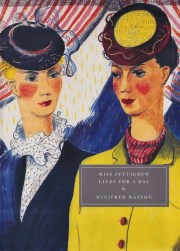
miss pettigrew lives for a day winifred watson 001Miss Pettigrew Lives for a Day by Winifred Watson~ 1938.

This edition: Persephone Press, 2000. Softcover. ISBN: 978-1-906462-02-4. 234 pages.

My rating: 8/10

What a relief to turn to this playfully frivolous novel after Pearl Buck’s dismal thing.

Middle-aged Miss Pettigrew, supremely inefficient governess, is on her uppers. Down to her last shilling, she knocks on the door of one Miss LaFosse, following up a lead from an employment agency.

Miss Pettigrew is welcomed in and definitely proves herself useful, but in a most unanticipated way. Dashing young men, cocktails, nightclubs…ooh, la la! Miss Pettigrew has never experienced such a whirl as she does in this utterly life-changing day.

That’s all I’m going to say. A whole lot of fun, this light and airy novel. If you haven’t already experienced this silly, happy thing, seek it out immediately, and enjoy!
Read Full Post »

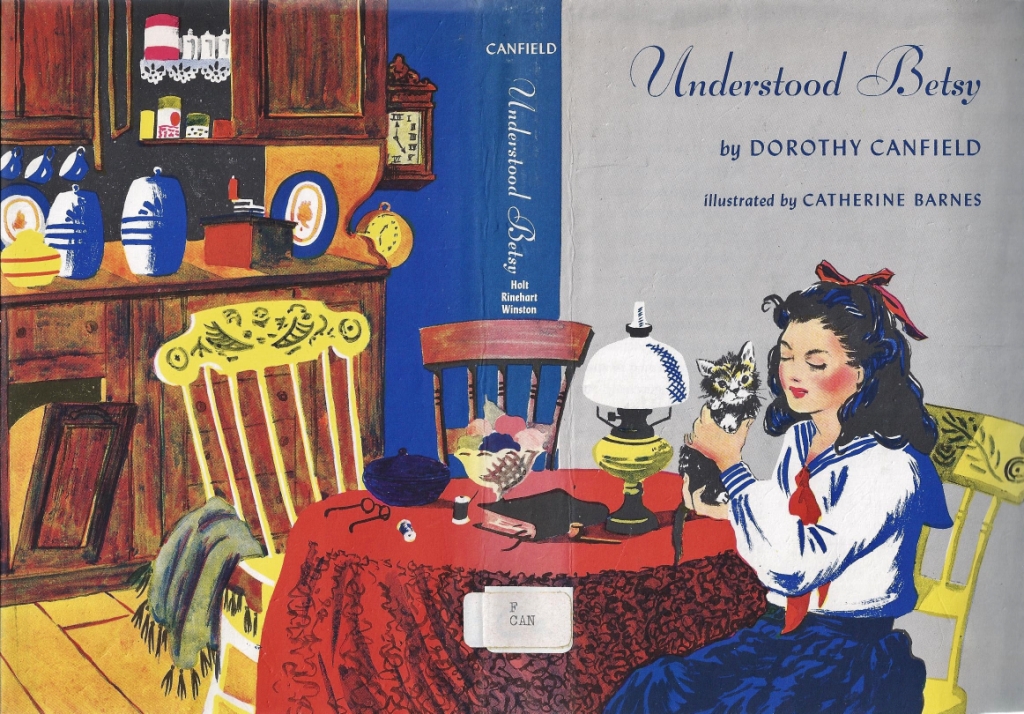
understood betsy dorothy canfield 001

Understood Betsy by Dorothy Canfield ~ 1916. This edition: Holt, Rinehart and Winston, 1964. Illustrated by Catherine Barnes. Hardcover. 213 pages.

My rating: 7.5/10

This is a charming juvenile novel written by Dorothy Canfield Fisher after she had become deeply interested in Maria Montessori’s innovative theories of child rearing and education while on a visit to Italy. The Montessori Method stressed self determination and self regulation in all aspects of a child’s life, and operated under the assumption that if given access to a suitable space with appropriate materials, tools, toys and books, a child would develop a high degree of self motivation and a natural sense of order.

Since Dorothy Canfield was already very involved in women’s rights and educational reform, the Montessori philosophy meshed well with her other interests, and Understood Betsy, which can be read simply as an amusing story, can also be interpreted as an enthusiastic promotion of allowing a child to self-educate and self-regulate, while under a benevolent hands-off adult mentorship.

Little Elizabeth Ann is orphaned at the tender age of six months, and is eagerly adopted by an aunt and great-aunt, Frances and Harriet. Younger Aunt Frances in particular becomes completely wrapped up in mothering the child, lavishing all of her vast reserves of unused adoration on Elizabeth Ann’s tiny person.

 As soon as the baby came there to live, Aunt Frances stopped reading novels and magazines, and re-read one book after another which told her how to bring up children. And she joined a Mothers’ Club which met once a week. And she took a correspondence course in mothercraft from a school in Chicago which teaches that business by mail. So you can see that by the time Elizabeth Ann was nine years old Aunt Frances must have known all that anybody can know about how to bring up children. And Elizabeth Ann got the benefit of it all.

She and her Aunt Frances were simply inseparable. Aunt Frances shared in all Elizabeth Ann’s doings and even in all her thoughts. She was especially anxious to share all the little girl’s thoughts, because she felt that the trouble with most children is that they are not understood, and she was determined that she would thoroughly understand Elizabeth Ann down to the bottom of her little mind. Aunt Frances (down in the bottom of her own mind) thought that her mother had never really understood her, and she meant to do better by Elizabeth Ann. She also loved the little girl with all her heart, and longed, above everything in the world, to protect her from all harm and to keep her happy and strong. and well.

Aunt Frances is well meaning, but her technique is more than questionable.

Aunt Frances was afraid of a great many things herself, and she knew how to sympathize with timidity. She was always quick to reassure the little girl with all her might and main whenever there was anything to fear. When they were out walking (Aunt Frances took her out for a walk up one block and down another every single day, no matter how tired the music lessons had made her), the aunt’s eyes were always on the alert to avoid anything which might frighten Elizabeth Ann. If a big dog trotted by, Aunt Frances always said, hastily: “There, there, dear! That’s a nice doggie, I’m sure. I don’t believe he ever bites little girls. … mercy! Elizabeth Ann, don’t go near him! … Here, darling, just get on the other side of Aunt Frances if he scares you so” (by that time Elizabeth Ann was always pretty well scared), “and perhaps we’d better just turn this corner and walk in the other direction.” If by any chance the dog went in that direction too, Aunt Frances became a prodigy of valiant protection, putting the shivering little girl behind her, threatening the animal with her umbrella, and saying in a trembling voice, “Go away, sir! Go away!”

Or if it thundered and lightened, Aunt Frances always dropped everything she might be doing and held Elizabeth Ann tightly in her arms until it was all over. And at night—Elizabeth Ann did not sleep very well—when the little girl woke up screaming with a bad dream, it was always dear Aunt Frances who came to her bedside, a warm wrapper over her nightgown so that she need not hurry back to her own room, a candle lighting up her tired, kind face. She always took the little girl into her thin arms and held her close against her thin breast. “Tell Aunt Frances all about your naughty dream, darling,” she would murmur, “so’s to get it off your mind!”

She had read in her books that you can tell a great deal about children’s inner lives by analyzing their dreams…

Well, as you  can see from this lengthy excerpt, Aunt Frances is well on her way to creating something of a monster, if timid, terrified, hapless Elizabeth Ann could be labelled with such a horrific term. But things are about to change.

Aunt Harriet takes ill; Aunt Frances must accompany her to a warm climate; there will be no time to spare for or a place to keep Elizabeth Ann. So off in haste she is sent to another branch of the family, efficiently turned away – so much fuss, having to suddenly take on an extra child! – and helter-skelter put on a train to remote Vermont, to be cared for by the country family connections at Putney Farm.

Now Elizabeth Ann is well aware that Aunts Harriet and Frances have always held the Putney relations in deep scorn – such common folk, with no understanding for children – and to think that they had originally wanted to adopt her!

But they (Aunt Harriet and Aunt Frances) thought that they chiefly desired to save dear Edward’s child from the other kin, especially from the Putney cousins, who had written down from their Vermont farm that they would be glad to take the little girl into their family. But “anything but the Putneys!” said Aunt Harriet, a great many times. They were related only by marriage to her, and she had her own opinion of them as a stiffnecked, cold-hearted, undemonstrative, and hard set of New Englanders. “I boarded near them one summer when you were a baby, Frances, and I shall never forget the way they were treating some children visiting there! … Oh, no, I don’t mean they abused them or beat them … but such lack of sympathy, such perfect indifference to the sacred sensitiveness of child-life, such a starving of the child-heart … No, I shall never forget it! They had chores to do … as though they had been hired men!”

Aunt Harriet never meant to say any of this when Elizabeth Ann could hear, but the little girl’s ears were as sharp as little girls’ ears always are, and long before she was nine she knew all about the opinion Aunt Harriet had of the Putneys. She did not know, to be sure, what “chores” were, but she took it confidently from Aunt Harriet’s voice that they were something very, very dreadful.

Elizabeth Ann is about to find out what chores are all about.

Needless to say her transformation from wimpy Elizabeth Ann to sturdy, competent Betsy begins at once. She’s not even at the farmhouse yet before Uncle Henry takes her in hand, by giving her the reins of the team and letting her worry out the techniques of guiding the steady farm horses along the quiet road. I need not go into details, only to say that immediately upon arrival at the farm the child learns to dress herself, comb her own hair, cook, milk a cow, and become wonderfully useful to have about, rather than a “charge”. And there are kittens and maple sugaring time and tug-of-wars at her tiny one-room school, best friends and a trip to the fair all of the usual rural delights to go along with the endless round of chores which make up farm life. And then Aunt Frances shows up to collect her former charge…

A sweetly old-fashioned sort of tale, with the lessons very evident but very easy to swallow. Dorothy Canfield treats her readers as if they too are sensible souls, and complicit in the process of salvaging Betsy from her disastrous first nine years of life, while never outright condemning the well-meaning Frances.

There is a lot of quiet humour in this short tale, and it is not at all a chore for an adult to read. In fact, it is a very nice read-aloud, suitable for the younger set, I would think ages up to 9 or 10 or so. (Older children might find it a mite too mild, and the tone just a bit too old-fashioned.) Betsy is a likeable heroine and as we follow her story we rejoice in her happy transformation.

Readers of Dorothy Canfield Fisher’s much more complex and serious adult novels may enjoy this quick side trip into childhood; a visit as crisply refreshing as its nostalgic Vermont country setting.

And here it is at Gutenberg, though it is very easy to find in book form, too, being almost continuously in print for the hundred or so years since its first publication.

Understood Betsy by Dorothy Canfield

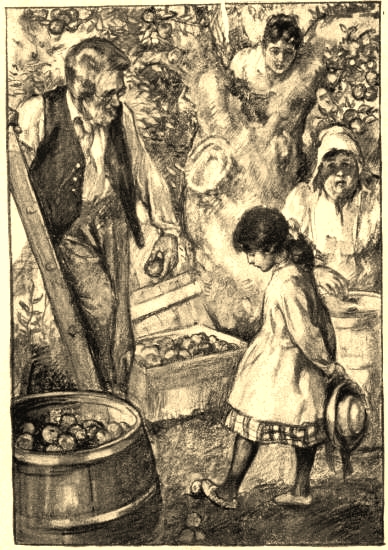
The Putney clan - Uncle Henry, Aunt Abigail and Cousin Ann - with Betsy, illustration by Ada C. Williamson, from the Gutenberg transcription.

The Putney clan – Uncle Henry, Aunt Abigail and Cousin Ann – with Betsy, illustration by Ada C. Williamson, from the Gutenberg transcription.

Read Full Post »

the little wax doll norah lofts 001The Little Wax Doll by Norah Lofts ~ originally published in 1960, and re-released under this title and author’s name in 1970.  Previously published as The Devil’s Own (1960) and The Witches (1966), under the pseudonym Peter Curtis. This edition: Corgi, 1971. Paperback. ISBN: 0-552-08782-3. 255 pages.

My rating: 9/10

This is definitely not a Christmas-time read. Hallowe’en, oh yes, indeed. But I am so tickled by my discovery of it that I’ve bumped down my review of D.E. Stevenson’s Charlotte Fairlie (which is an appropriate Christmas book for reasons I’ll enlarge on when I return to it) to talk about Norah Lofts’ village-with-dark-secrets instead.

I love these sorts of unexpected developments. Norah Lofts, mistress of the art of historical romance, occasionally let herself go in a very different direction and wrote a number of thrillers under the name Peter Curtis, adopting the pseudonym in order to avoid disappointing fans of the romances who would associate her name with a certain type of story.

I must say I would never have picked up this old paperback if it weren’t for Norah Lofts’ name on it; the cover illustration not being at all indicative of what a great read was hidden inside. I had recently read 1964’s How Far to Bethlehem? (with mixed reactions – good writing, but I had issues with the awkwardness of the Bible tie-in plot) so was tuned in to Lofts’ name, as it were, and a casual flip-through was intriguing enough that I squelched my qualms and brought it home.

Forty-something Miss Mayfield, a teacher by profession, is back in England after twenty years working at a friend’s private mission school in a remote part of Africa. She has had some health issues and a vaguely referenced “breakdown” so was sent back to England in the hopes that this would prove beneficial. Her health is better, but she harbours deep misgivings over her ability to cope with the stresses of her new teaching position at an inner city London school. When Miss Mayfield happens upon an advertisement for a teaching headmistress position at a rural private school she decides to try for it, never dreaming that she would be accepted.

An interview with the school’s benevolent sponsor, Canon Thornby of the village of Walyk, sees Miss Mayfield hired on the spot. Off she goes to the rural wilds, to a place very much out of the bustle of the modern world.

Miss Mayfield might want to watch her words when that friendly cat is hanging about...

Miss Mayfield might want to watch her words when that friendly cat is hanging about…

“Too good to be true,” is Miss Mayfield’s first impression of her new home. Not only is she being paid a generous salary, her position includes a wonderful cottage, an instant position of respect in the village hierarchy, and the society of wealthy Canon Thornby and his aristocratic sister. Miss Mayfield’s fellow teacher is competent and friendly, and the school children are polite, willing, and generally intelligent. The cottage even appears to come with an adorable resident cat, who purrs about with a welcoming attitude, and sleeps at the foot of the bed. Miss Mayfield settles in with a feeling of deep appreciation and relief, and counts her blessings every day.

The first inkling that something may not be all as lovely as it appears is when an anonymous note appears among the books on Miss Mayfield’s desk. “Ethel Rigby’s granny treat her something crool.” This shakes Miss Mayfield enough that she decides to investigate the allegation. Said Ethel Rigby is a well-cared for, meek and mild fourteen-year-old whose primary passion seems to be the care of her pet rabbits, and her granny openly dotes on her, having raised Ethel from babyhood, Ethel’s mother having run off and “gone wrong” in her own teenage years.

Though Ethel stoutly defends her grandmother’s innocence of any abuse, Miss Mayfield thinks that the maiden doth protest too much, and she comes away with the idea that Ethel is lying to protect the informer, who proves to be a school friend who claims to have witnessed Ethel’s grandmother push the girl’s hand deliberately into the rollers of a mangle. And Ethel’s hand is all bandaged up, though she insists her own clumsiness was at fault. And when the informing child falls mysteriously ill, only to recover just as mysteriously, and when Miss Mayfield discovers a little wax effigy of the child wrapped up and bandaged together – “healed” – hidden in Ethel’s school desk, the wheels really begin to turn.

Miss Mayfield decides to play detective and to find out what is going on behind all those brightly painted cottage doors. And what she discovers is most disquieting indeed.

What a marvelous heroine Miss Mayfield proved to be. Middle-aged and resigned to her life of perennial spinsterhood (though not unaware of the other sex, and recipient of at least one man’s interested advances) Miss Mayfield is unashamedly dowdy, choosing to focus her energies on doing her job well to the utmost of her ability. She fearlessly delves into the dark secrets of Walyk, is clever and creative in her investigative forays, and even after being brutally sidelined by an “accident” which results in a serious head injury and loss of memory, returns tenaciously to her original goal, which is to protect virginal Ethel from an unpleasant fate at the hands of Walyk’s wicked coven of witches.

The cover illustration of this 2008 reissue is just a wee bit misleading. I pity the poor teen who picks this one up expecting something Twightish, and instead finds herself sedately accompanying Miss Marple-ish Miss Mayfield on her earnest investigations!

The cover illustration of this 2008 reissue is just a wee bit misleading. I pity the poor teen who picks this one up expecting something Twilightish, and instead finds herself sedately accompanying Miss Marple-ish Miss Mayfield on her earnest investigations!

I was most pleased at the quiet humour throughout; the author appears to be enjoying herself thoroughly as she dashes this melodrama off.

Miss Mayfield, though primly proper even in her innermost thoughts, is not what one could call “prudish” – she is well aware of all elements of human nature, though she chooses to remain aloof from some of those aspects herself.  Even upon witnessing the penultimate scene of a full-blown witch’s Sabbath she mildly wishes that she could just close her eyes and avoid seeing the depravities of her neighbours, but she is not so much shocked as disgusted at their lack of proper dignity, and we never fear that this experience will shake her somewhat frail psyche. If anything, it strengthens her resolve to sort things out and bring everyone back into some semblance of decency, to protect the innocents, and to nobble future abuses and murders. Miss Mayfield’s inner dialogue proves that she is capable of appreciating the ridiculous aspects of the situation she has allowed herself to become embroiled in; we never fear for her sanity, but instead come away feeling that her future will be ever more assured. And as for Ethel, well, let’s just say that she appears well able to look after herself from this point forward!

There is also a perfect little twist at the very end.

This is an enjoyable “entertainment” read, rather nasty plot developments and all. If “Peter Curtis” did as well with “his” other three thrillers, I’m definitely keen to acquire them. Despite the absolutely stereotypical “black magic” theme, the author kept me engaged throughout, guessing a goodish bit of the time, and rather surprised here and there; very nicely done indeed.

In 1966 the book was turned into a horror-suspense thriller, starring none other than Joan Fontaine as a rather elegant Miss Mayfield. From the plot description and movie stills it appears that the African connection is played up to a greater degree than in the book, and that one of the background characters who leaps into prominence in the last chapter is given a larger early role, and that there is general tweaking of the storyline to make it more dramatic. For those of you with an interest in this vintage film genre, it might well be an enjoyable diversion. (But be sure the read the book as well; it has charms of its own, though the original Miss Mayfield is no Joan Fontaine!)

The Witches horror film peter curtis norah lofts hammer film

And here is a rather detailed synopsis and analysis of both book and movie, containing abundant spoilers. I would suggest you read the book first, because it gives away all of the key twists, but it is most interesting after one is finished.

Necromania BlogSpot: The Witches by Peter Curtis

Read Full Post »

TO A YOUNG WRETCH

(Boethian)

As gay for you to take your father’s ax
As take his gun – rod – to go hunting – fishing.
You nick my spruce until its fiber cracks,
It gives up standing straight and goes down swishing.
You link arm in its arm and you lean
Across the light snow homeward smelling green.

I could have bought you just as good a tree
To frizzle resin in a candle flame,
And what a saving it would have meant to me.
But tree by charity is not the same
As tree by enterprise and expedition.
I must not spoil your Christmas with contrition.

It is your Christmases against my woods.
But even where, thus, opposing interests kill,
They are to be thought of as opposing goods
Oftener than as conflicting good and evil;
Which makes the war god seem no special dunce
For always fighting on both sides at once.

And though in tinsel chain and popcorn rope
My tree, a captive in your window bay,
Has lost its footing on my mountain slope
And lost the stars of heaven, may, oh, may
The symbol star it lifts against your ceiling
Help me accept its fate with Christmas feeling.

OLYMPUS DIGITAL CAMERA

And here, to bookend “Christmas Trees”, as it were, is Robert Frost’s commentary on a tree that was cut down. This poem was sent out as his Christmas greeting  to his friends in 1937, and was included in A Witness Tree, published in 1942.

The subtitle “Boethian” refers to the Roman philosopher Boethius and his belief that humans often fail to recognize evil as part of a divine whole; we see only the immediate occurrence, and not its part in the greater scheme of things.  In this instance, Frost relates the immediate evil – the cutting down of the tree – to the greater thing, that of the celebration of the Christmas festival.

Read Full Post »

CHRISTMAS TREES

???????????????????????????????The city had withdrawn into itself
And left at last the country to the country;
When between whirls of snow not come to lie
And whirls of foliage not yet laid, there drove
A stranger to our yard, who looked the city,
Yet did in country fashion in that there
He sat and waited till he drew us out
A-buttoning coats to ask him who he was.
He proved to be the city come again
To look for something it had left behind
And could not do without and keep its Christmas.
He asked if I would sell my Christmas trees;
My woods—the young fir balsams like a place
Where houses all are churches and have spires.
I hadn’t thought of them as Christmas Trees.
I doubt if I was tempted for a moment
To sell them off their feet to go in cars
And leave the slope behind the house all bare,
Where the sun shines now no warmer than the moon.
I’d hate to have them know it if I was.
Yet more I’d hate to hold my trees except
As others hold theirs or refuse for them,
Beyond the time of profitable growth,
The trial by market everything must come to
I dallied so much with the thought of selling.
Then whether from mistaken courtesy
And fear of seeming short of speech, or whether
From hope of hearing good of what was mine,
I said, “There aren’t enough to be worth while.”
“I could soon tell how many they would cut,
You let me look them over.”

“You could look.
But don’t expect I’m going to let you have them.”
Pasture they spring in, some in clumps too close
That lop each other of boughs, but not a few
Quite solitary and having equal boughs
All round and round. The latter he nodded “Yes” to,
Or paused to say beneath some lovelier one,
With a buyer’s moderation, “That would do.”
I thought so too, but wasn’t there to say so.
We climbed the pasture on the south, crossed over,
And came down on the north.
He said, “A thousand.”

“A thousand Christmas trees!—at what apiece?”

He felt some need of softening that to me:
“A thousand trees would come to thirty dollars.”

Then I was certain I had never meant
To let him have them. Never show surprise!
But thirty dollars seemed so small beside
The extent of pasture I should strip, three cents
(For that was all they figured out apiece),
Three cents so small beside the dollar friends
I should be writing to within the hour
Would pay in cities for good trees like those,
Regular vestry-trees whole Sunday Schools
Could hang enough on to pick off enough.
A thousand Christmas trees I didn’t know I had!
Worth three cents more to give away than sell,
As may be shown by a simple calculation.
Too bad I couldn’t lay one in a letter.
I can’t help wishing I could send you one,
In wishing you herewith a Merry Christmas.

A Christmas circular letter

Sent out by Robert Frost to his friends, 1929

Read Full Post »

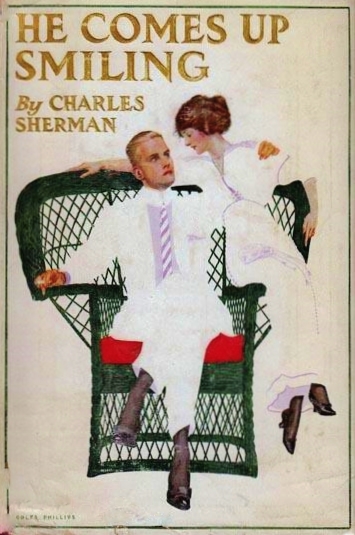
he comes up smiling charles shermanHe Comes Up Smiling by Charles Sherman ~ 1912. This edition: McLeod & Allen, 1912. Hardcover. 351 pages.

My rating: 5/10

Light as a feather and just as fluffy was this century-old bit of humorous fiction.

From the San Francisco Call, February 18, 1912 comes the following commentary.

Once begin this tale… and all thought of everything else will leave you. The tale is absorbing, exciting, clever, amusing and quite unusual… whimsical to a degree. It tells the story of a tramp—not a tramp in disguise, a real tramp, although he has a respectable ancestry and did have some “bringing-up,” though very poor.  He is a lazy, idle hound, and any amount of discomfort is preferable to work. Through a chapter of the most extraordinary occurrences a hero ever had he meets “the” girl, and the remainder of the story is fairly breathless in its excitement. After the reader is once acquainted with “Watermelon,” the affectionate nickname which other tramps call him, it is easy to see why he is a gentleman, though his hands are not clean and he is not above lying and stealing in a small way. He has the quaintest sense of humor and is forever making the most original remarks, always with the prefix “Father says.” A few follow:

  • ”Manners don’t count any more than the good apples on the top of the box to hide the rotten ones beneath.”
  • “If a man reached 40 without becoming a cynic, he was a fool and might never have reached 40.”
  • “A success can be a cynic, for cynicism is simply a pretty good idea of the meanness of human nature and no unfounded expectation of anything especially decent coming from it.”
  • “Nothing is more important than ourselves and what affects us.”
  • “Love is divine, hate devilish and meanness just cussed human nature, and a mixture of the three, in more or less degree, makes man.”
  • “A man who knows life never wrote about it. It would be too painful. It wouldn’t sell.”

Though the reviewer for the SF Call thought this was a grand bit of fiction, I am sorry to say that it did not travel through its ten decades with a whole lot of staying power. It has merit as a literary and cultural curiosity, and the first few chapters are quite delightful, but it petered out midway through and slid gently downhill to end in a well-cushioned and in no way fatal heap, rather like a slow speed accident with one of the vintage cars which the tale is so dependent on.

Three American tramps laze away a sunny summer Sunday morning, and in the course of conversation start a debate as to which of the two younger men would “clean up” better. They propose a beauty contest of sorts, to be judged by the corpulent Mike, and off go James and “Watermelon” (later found to be possessed of a proper name, Jerry, though it is as Watermelon that we follow him through his adventures) to town in search of a shave and brush-up and an upgrade in wearing apparel.

Watermelon is our unlikely hero from the very start, and we follow him into a barber shop where with a clever bit of smooth talking and a pinch of sleight of hand he obtains from the barber – who forks over quite willingly, which demonstrates the magic of Watermelon’s smooth patter – not only a shave, but the contents of the till.

Clothes are a bit more difficult to come by, but here luck is on Watermelon’s side, as he comes across a young man swimming in a small lake, with his elegant clothes placed neatly on the shore. Watermelon there and then “borrows” the improved apparel, hiding his own cast off garments nearby. He fully intends to come back and swap down, but he also wants to keep the naked swimmer in a position not to give pursuit once he returns to shore and realizes his predicament.

Proceeding on his way, now nattily attired in stylish new clothes, Watermelon happens upon a deserted car – obviously that of the oblivious swimmer – and climbs in to relax and daydream a bit. Along comes another car, carrying an elderly gentleman and his middle-aged daughter along with their chauffeur; they impulsively offer to rescue the “stranded” young man, and Watermelon, as is his phlegmatic way, goes along with the assumption that he is an unmechanical rich man out for a jaunt.

One thing leads to another, and when the time comes to make introductions, Watermelon hands over a card from the case in the borrowed suit, “revealing” himself as a certain young stock-broker who has just made a fortune on Wall Street, to great publicity. Taken off to dinner with his new friends, Watermelon is introduced to a “fellow” stock-broker and his lovely daughter, and once Watermelon sets eyes on the lovely Billy his fate is sealed.

Deciding that one afternoon with this angel on earth is worthy of continuing the masquerade for at least a few hours longer – he still intends to return the clothes and make all right with the swimmer – Watermelon makes himself agreeable to all. Little does he know that Billy’s father is hatching a mildly nefarious plot to kidnap the man whom he views as a business rival, and to carry him off for a week in the depths of the country, thereby leaving the coast clear for Billy’s father’s partner to triumph on Wall Street without interference.

And off we go on a farcical romp of mistaken identity, deliberate wrong directions, housebreaking, encounters with the law, much double entendre, hidden yearnings and unspoken but reciprocated love, as Billy has fallen just as hard for Watermelon as he has for her. (He does clean up rather well.)

The humour is relentless and the situations highly contrived, but Watermelon gently winkles his way into the hardest of readers’ hearts as well as that of susceptible Billy.

Billy herself was rather a waste of ink, being a completely frivolous rich girl with no evident depth to her. She’s cute as a button, but that’s about it. The older Henrietta, on the other hand, proves herself to be a witty foil to Watermelon’s quirky comments; I had high hopes that the two were going to dump the silly Billy and further develop their meeting of minds, but sadly this was not to be. (My opinion of the author took a nosedive when he let all three of us down in this way.)

The ending is broadly telegraphed from very early on; we fully expect to see Watermelon ‘fess up and buckle down to a life of honest toil in order to win the fair Billy’s hand. Though he does come clean, the honest toil bit doesn’t look to be in his future; the resolution is rather odd; it felt like the author cheated us of the expected rounding off of this ultra-light tale.

A  rather strange little reading experience, both more enjoyable than it sounds from my dismissive comments above, and less satisfying than it could have been if the author had been a bit braver with his character developments and multiple romantic interests. Definitely a throw-away sort of tale, a momentary diversion at best. Sort of a lightweight American P.G. Wodehouse of the B-list variety.

The story was made into a 1914 stage play, and then into a 1918 silent movie starring Douglas Fairbanks as Jerry Martin (the “Watermelon” of the book), though the plot was gingered up to make it more conventionally dramatic.

he comes up smiling 1918 movie poster

Read Full Post »

saturn over the water dj cbc j b priestleySaturn Over the Water by J.B. Priestley ~ 1961. This edition: The Companion Book Club, 1961. Hardcover. 255 pages.

My rating: I dunno. This is tough. It was a diverting read, but the ending was just too deus ex machine to swallow whole. What the hey, J.B.? Clairvoyants and psychics save the world at the eleventh hour?! Couldn’t they have stepped in a little earlier, like when the nefarious villains started their evil organization?

Oh. Right. No story.

Let me think. It was amusing in a campy sort of way, plus the hero was a moderately likeable sort. The action scenes were acceptable, though never with a fully developed edge. The women were a stumbling block, but I’ll waive objections to their overwhelming sexiness and sultry beauty because the author allowed them some competences. Okay, mostly that they were just good drivers. (And fireworks-inducing passionate kissers – does that count as a competence? In this novel, apparently so.) But he also made them just plain silly with men. Hm.

Full of goofy racial stereotypes; author Priestley/narrator Tim was particularly hard on the Germans; vestiges of the last war, obviously. And the Russians got some serious needling, too.

So with everything considered, and taking into account the other similar schlock that was being published at the time and the very real spy-versus-spy tenseness of the Cold War political situation, I think I can safely give this one a 7.5/10. Even with the cop-out ending. Because Priestley did an adequate job, and he had a few serious things to say hidden in the nonsense, and I appreciate his willingness to dabble in the genre. And it was rather a fun read, of the “so bad it’s good” school.

*****

So this was something unexpected. J.B. Priestley channels John Wyndham, with a dash of Ian Fleming, and a sprinkling of pure silliness. Here’s our story.

It all began with a call I had from Addenbrooke’s Hospital, Cambridge, where my cousin Isabel was dying of leukemia. The Hospital didn’t say she was dying of course – they never do – but I knew she was and she knew she was. The scientists who enjoy playing about with these filthy bombs tell us it’s all quite safe and have figures to prove it; but before these bombs came along I’d never known anybody who had died of leukemia, whereas now my cousin Isabel was the fourth person I’d known who had died of it.

saturn over the water dj 2 j b priestley

This handsome cover depicts Joe’s scribbled clues. Can you read his writing? If not, don’t feel too bad. Tim had trouble too.

Career artist Tim Bedford, standing by Isabel’s bedside, reluctantly takes on a commission for her. Some years ago her husband, Joe Farne, a biochemist, had gone out to Peru to work for the privately owned Arnaldos Institute, where research on various nebulous “beneficial projects” was being carried out. Isabel had stayed in England, because she and Joe were having marital issues, but they’d made up via letter and all was looking up when something disturbing occurred. Joe suddenly left his job at the Institute and vanished, Isabel’s letters started being returned unopened, and no one was able to say where he had gone.

Then another letter from Joe came, but from Chile, not Peru. Three pages of hastily scribbled reassurances that he loved her, and on the last page a collection of cryptic jottings, names and phrases that made no sense to Isabel at all, but that must have some meaning, otherwise why would Joe have sent them?

Could Tim please track Joe down, to see if he was all right, and to explain to him why Isabel herself was unable to come to him, and to give Joe her dying message of love? Well, what could Tim do, especially once he visited Isabel’s lawyer and found that there was a tidy sum of money for expenses at the ready.

Before departing England for South America, Tim does some intital groundwork by tracking down the widow of one of Joe’s fellow scientists at the Institute, and what she tells him gives him pause. Something deeply sinister was going on in Peru, and she urges him to start his search there, to find a clue to Joe’s departure and subsequent popping up several countries over.

Coincidences start to occur thick and fast, as Tim sets off on his quest, soon to encounter a stunning Russian countess, a wealthy English lord, a variety of Communist sympathizers, a beneficent New York art dealer, a Peruvian multimillionaire with a brooding and artistic granddaughter, pseudo-Nazis, evil scientists, corrupt policemen, and a motley crew of shady characters occasionally on his side in the ever-more-pressing race to discover what is going on in not only Peru, but the Emerald Lake in Chile and the Blue Mountains of Australia.

Will Tim find Joe, and incidentally help save the Northern Hemisphere from annihilation by the H-bomb?

Of course he will, and he’ll discover the cryptic meaning of the Wavy Eight symbol, too, and the significance of the mysterious phrase “Saturn Over the Water”. (It’s much more daft than you could ever imagine.)

A true period piece, this one. If you find it in your travels, give it a go. Says me.

saturn over the water dj j b priestley

Eye-catching first edition dust jacket.

Read Full Post »

Three quick reads this past few days ran the gamut from slightly-gosh-awful to thoughtfully-affirmative to poignantly-hilarious. All are deeply imbued with sense of place. Light reading, all three, easy to pick up and put down, though I must confess I read each one straight through. Without further ado, here they are.

one happy moment dj louise riley 001One Happy Moment by Louise Riley ~ 1951.

This edition: Copp Clark, 1951. Hardcover. 212 pages.

My rating: 4.5/10

I’m glad to have read this obscure Canadian novel, for it made me stop and muse on what makes a style of writing either a hit or a miss with a reader. This one felt awkward to me, stylistically and plot-wise, and even its glowing portrayal of a landscape I have personally known well didn’t quite make up for the clunky prose and the rather cardboard characters. I opened it up prepared to enjoy it; I closed it no longer wondering why this was the author’s only adult novel, and why it (apparently) never made it past that first printing.

She lifted her arms and pulled off her grey felt hat, shaking her head like a young horse, freed from his bridle. She ran to the lakeshore and tossed the hat into the lake, laughing at it as it bobbed primly over the ripples. She tore off the jacket of the grey suit and hesitated about throwing it after the hat. Instead she ran back to her suitcase, snapped it open, and took out a pair of plaid pants and a yellow sweater. Taking a last quick look about her, she pulled down the zipper on her skirt and stepped out of it, kicking it aside. Quickly she unbuttoned her grey blouse and took it off, tossing it on top of the skirt. She pulled her slip over her head and, as she stooped to take off her shoes and stockings, the warm sun felt like a caress on her back. She pulled on yellow knitted socks and heavy shoes. When she was dressed in slacks and yellow sweater, with a scarlet handkerchief knotted around her throat, she pulled the pins out of her fair hair, shook it free, and tied it back with a yellow ribbon.

And in case you didn’t quite catch the symbolism, there’s more.

Into the suitcase Deborah shoved the clothes she had taken off, added a few rocks, hauled the suitcase to the shore, and tossed it into the lake. She watched it sink. Her hat had floated several yards away from the shore, and she waved good-bye to it. Then, slinging her rucksack onto her back, she looked for the path up the mountain side.

The young woman so anxious to dispose of her city clothes – and, by inference, her dull, grey, prim and proper former life – is one Deborah Blair, and she’s about to hike nine miles up a trail to a tourist camp somewhere between Lake Louise and Lake O’Hara, on the Alberta side of the Rocky Mountains.

Her first encounter with another person is an old man just up the trail; he pops out of the bush, startling her greatly, and then proceeds to tell her that he knows she is running away from something, and that she is like a young doe, “…frightened…by a hunter, maybe, out of danger now, taking time to be proud of her speed and to taste her freedom, but still wary, remembering her fright…”

But the mountains will give her sanctuary, he goes on to say, and Deborah parts from him, mulling over what he has said, rehearsing her new role in preparation for meeting her fellow guest camp residents.

These are a motley crew indeed. Evangeline Roseberry is her hostess, an uninhibited, provocative and sultry woman of a certain age. Young ranch hand Slim appears to be very close indeed to his employer, and when Slim is not in attendance the male guests are often to be found in “Vangie’s” cozy cabin. Middle-aged Dr. Thornton is holidaying without his wife and apparently finding his hostess a suitable substitute; downtrodden Mr. Nelson is at the beck and call of his own formidable wife, though he glances hopefully at Vangie’s lush charms when Mrs. Nelson’s focussed gaze is elsewhere, and teenage Sue Nelson cherishes a passion for handsome, red-haired, flashing-eyed yet taciturn geologist Ben Kerfoot. In the kitchen brusque Mrs. Horton reigns supreme, dispensing pithy criticisms to all and sundry along with the bacon and eggs.

Deborah gravitates toward avuncular Dr. Thornton, as nosy Mrs Nelson attempts to probe into “Mrs. Blair’s” past, which appears to be decidedly mysterious, especially when an RCMP officer appears asking questions about why a suitcase with the initials D.B. was found floating in the lake at the bottom of the trail. The plot thickens, with heaving bosoms and flashing eyes from the female contingent all round, and lusty glances and/or darkly passionate glares from the men.

One after another, the people from whom Deborah seeks to hide track her down to her mountain fastness, but she gains strength from the purity of the air and the pristine beauty of the surrounding peaks – not to mention Mrs. Horton’s hearty cooking – and stands up for herself at long last.

Though this novel started out promisingly enough, but ultimately didn’t take me where I hoped it would, and most of that was the fault of the writing, and the lack of a cohesive plot.

Deborah’s vaporings are overplayed, and her flip-flopping between men left me bemused. She is decidedly attracted to both Dr. Thornton and Ben-the-geologist, who in turn steal embraces from whichever woman is present and willing, and, when a manipulative cad from her past appears she mulls over throwing her lot in with his, before the mountain breezes blow some sense into her head. An über-controlling mother appears and is finally confounded, and Deborah prepares to set her sights on making her fortune in Vancouver, being as far away across the continent as she can get from her previous life as a meek librarian in Montreal.

The author was a Calgary librarian and storyteller, and her work with children resulted in the naming of a library branch after her in her native city; the wealthy Riley family was well-known for their philanthropy and social conscience, and Louise by all reports was a fervent advocate for childhood literacy.

Four of Louise Riley’s books were published between 1950 and 1960, the juveniles The Mystery Horse, Train for Tiger Lily, and A Spell at Scoggin’s Crossing, as well as her only adult book, One Happy Moment. Though Train for Tiger Lily received the  Canadian Library Association Children’s Book of the Year Award in 1954, a quick glance into my standard go-to children’s literature reference, Sheila Egoff’s Republic of Childhood, finds that perceptive literary critic dismissing Louise Riley’s juveniles as “insipid and contrived”, which I can sympathise with after reading One Happy Moment. Interesting though it may be in a vintage aspect, this is not in any way inspired writing.

Worth taking a look at is the commentary at Lily Oak Books , where I first heard of One Happy Moment. Lee-Anne’s review is well-considered and thoughtful, and she includes some gorgeous pictures.

My copy of the book is going on the probation shelf; I’ll share it with my mom and then decide if it gets to stay or go. The attractive dust jacket will likely tip the balance. As it arrived in fragile shape, I went ahead and put it into Brodart, and its vintage appeal might be too tempting for me to part with, though the words inside the book are not of the highest rank.

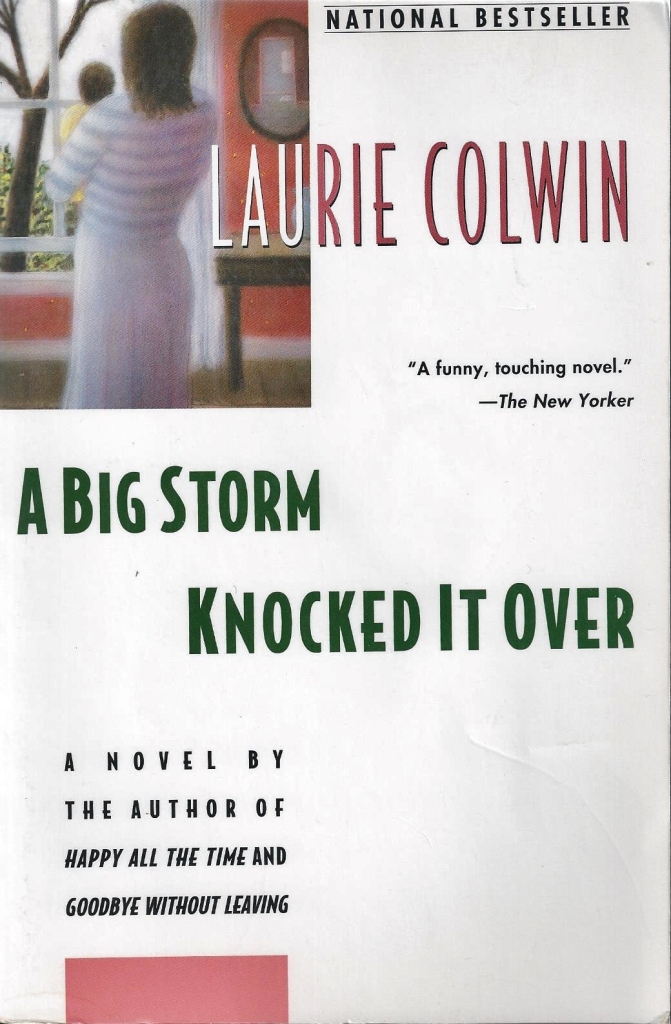
a big storm knocked it over laurie colwin 001A Big Storm Knocked It Over by Laurie Colwin ~ 1993.

This edition: Harper Collins, 1993. Softcover. ISBN: 0-06-092546-9. 259 pages.

My rating: 7/10

Moving right along to the other side of the continent and New England, for this gentle yet slyly cunning novel about love and friendship and transcending unhappy childhoods. It’s also about the terrifying act of bringing a child into the world, and an ode to the possibility of happiness, and our right to seek such out in an often unhappy world.

Does that sound impossibly twee and gaggingly chick lit? Well, it isn’t. (Okay, maybe just the tiniest bit. But it’s easy to get past. I liked this book.)

One Happy Moment has a stellar cover and ho-hum contents; A Big Storm Knocked It Over has a dreadful cover and a well-written inside. Ironically, for the protagonist of Big Storm is a graphic designer employed in the book trade, the blandness of the exterior presentation would not normally have received a second glance from me but for my previous encounter with this author. The late Laurie Colwin – she died suddenly in 1992, before this book was published – was a much-loved columnist for Gourmet magazine and  a bestselling cookbook author, novelist and short story writer. Big Storm was her fifth and last novel.

My first acquaintance with her was some twenty years ago, through Goodbye Without Leaving, about a white ex-backup singer for a black pop band – the token “White Ronette” on the tour bus – and her life after music. I read it just after my son was born, and it struck very close to home; Colwin perfectly captured that “now what?” atmosphere of the ultimate personal change of new motherhood and walking away from your past you, and I was comforted by the parallels between her fictional world and my own. It was also very funny.

In Big Storm, Jane Louise has just married her live-in boyfriend Teddy, and is surprised to find that marriage does indeed change things, even if all that is different is a piece of paper and a ring. We are introduced to an ever-widening circle of co-workers, friends and family, and watch with only slightly bated breath as Jane and Teddy find their new groove.

The gist of the novel is that sometimes family is rotten bad, but that you can always choose your friends. And that babies are quite amazing. And yes, life is terrifying, but if you can find someone to love, who also loves you, it still isn’t all shiny sparkly perfect, but it helps.

I don’t know what else to say. It was good. Not great, but definitely good. And there was a fair bit of to-ing and fro-ing from the countryside to the city, and a lot of emphasis is placed on where you’re from and ancestral homes and the clannishness of small New England towns, so I figure it counts in my vaguely themed geographical surroundings thing I’ve got going in this post.

Laurie Colwin was an interesting person and a more-than-just-good writer. I still feel sad when I think about her too-soon departure from our world.

mama makes up her mind bailey white 001Mama Makes Up Her Mind, and Other Dangers of Southern Living by Bailey White ~ 1993.

This edition: Addison Wesley, 1993. Hardcover. ISBN: 0-201-63295-o. 230 pages.

My rating: 9.5/10

The best is last, and what an unexpected book this turned out to be. I had picked it up along with a random selection of others at the Sally Ann one day, thinking it was a light novel suitable for dropping off with my mom for her entertainment, but not really intending to read it myself. (It reminded me of something by Fannie Flagg, from the title and the cover illustration and the blurbs about “absolute delight” and “like sitting on a porch swing.” Look away! my inner voice chirped, because I have to confess that Fannie Flag leaves me utterly cold, though Mom can handle her in well-spaced intervals.)

My husband was between books, picked it up off the stack by the door and chortled his way through it before pressing it on me. I sat down with it over dinner, and looked up two hours later after having read it through in one continuous session. Easy as picking daisies to prance through, this one was. And I must say a laugh or two escaped me as well.

This turned out to be a collection of short – some very short – anecdotes and vignettes, many centered on White’s mother, the “Mama” of the title, and others more concerned with Bailey White herself. They were originally presented on NPR in the United States, with the author reading her own pieces, but they work exceedingly well in print.

Bailey White was born in 1950 and still lives in her rural family home in Thomasville, Georgia. Until her mother’s death at the age of 80 in 1994, the two were close companions. Their joint adventures as  “a widow and a spinster” are the focus of some of these lively vignettes, but Bailey White’s scope is wide and she draws inspiration from a vast range of experiences. Bailey White worked as a Grade One teacher for over twenty years in the Thomasville school she herself attended as child, after returning to Georgia when her eleven-year-old California marriage ended in 1984.

Between the covers of this delectable smorgasbord of a book you will find tales of an antique spyglass, the best movie ever made (Midnight Cowboy, according to Mama), Road Kill (and how to decide if it’s edible), Pictures Not of Cows, an Armageddon of a storm and how prayer proved not all that useful, feral swans, an alligator which bellowed on cue, snakes lethal and benign, Great Big Spiders, the perfect wildflower meadow, how to travel unmolested by men (involving a maternity dress and a fake wedding ring), D.H. Lawrence as a life-saving substitute for The Holy Bible, and tales from the classroom.

And much, much more. Something like fifty little stories are stuffed into this book, and they are, without exception, quite excellent.

Apparently based on real people and incidents, there is likely a bit of embellishment to some of these; they have the well-polished feel of anecdotes often told, but that in no way lessens their deep charm.

Passionate, deeply revealing, kind, maliciously humorous – all of these can and do describe the author’s voice. Loved this.

And to think I almost missed it!

A great quick read for the bedside table, or to tuck into a pocket for a waiting room stint. Or to read at coffee break, or over a solitary lunch. Watch out for those spontaneous moments of glee, though. You might get some odd looks. (Or even get in trouble with your beverage.)

Read Full Post »

D.E. Stevenson’s 1961 novel Bel Lamington, featuring a young woman thrust out unprepared into a harsh world, Miss Beatrice Elizabeth Lamington – the “Bel” coming from her initials – left me just slightly underwhelmed.

I had first read the sequel to Bel’s titular saga, 1962’s Fletchers’ End, and references to Bel’s previous stint as a downtrodden secretary rather intrigued me. My eagerness to discover her prior story sent me off to the internet to purchase the book, and though I can’t say I’m disappointed by my latest D.E.S. acquisition, I’m not as thrilled as I’d hoped to be.

Bel Lamington links up with the earlier Vittoria Cottage/Music in the Hills/Shoulder the Sky (a.k.a. Winter and Rough Weather) trilogy, and the last third or so of the book concerns a number of characters whom the author assumes we have already met. Doubtless this was so for most readers at the time of Bel Lamington‘s publication; D.E.S. had her staunch following, and a nod to the readers-already-in-the-loop was doubtless the author’s intention here. But for those of us coming newly to the D.E.S. world some half-century after her heyday it can be a little disconcerting, though I must say it is fairly easy to pick up and follow the story threads.

It never seems like the author intends to leave things out, just that she assumes that we know the histories of the cameo role stars she features beside the up-and-coming ingénues. And Bel is very much a charming ingénue, in every sense of the word. Luckily her stellar qualities are recognized by just enough people to soften the blows that fall upon her tentative entry into a working girl’s world.

bel lamington d e stevensonBel Lamington ~ 1961.

This edition: Collins, 1961. Hardcover. 255 pages.

My rating: 6.5/10

Bel was orphaned at the tender age of three when both parents perished together in an automobile accident –  a “terrible motor smash” – but luckily she was taken in by a loving aunt and raised and cared for with tender affection. Her aunt has now died, and with it the small income they both lived on; there is nothing for it but for Bel to go out into the world and find employment.

She trains as a secretary and finds a job as a typist in a London shipping firm, and is soon promoted to private secretary to the firm’s chief partner, Ellis Brownlee. For Bel is one of those quietly competent types who excels at everything she attempts, and the author gets some digs in at the lackadaisical sorts whose office ambitions are more to do with flirtation and gossip than in dedication to their employers’ interests. Bel is definitely not cut from that pattern, and this inevitably leads to her being ostracized by the other female staff members, in particular the bullying Miss Goudge, who finds meek Miss Lamington a perfect target for her sarcastic jabs.

Bel’s private life is emotionally fraught as well. She is finding London exceedingly lonely, and has not made friends with anyone at all in the eighteen months she has been there. Her one comfort is the tiny rooftop garden she has created outside her top floor window, and lo and behold, this garden brings her into contact with a handsome young man.

Mark is an artist, and his discovery of Bel’s garden when he is scrambling about on the roofs outside his own top floor studio-flat leads to his painting of Bel’s portrait, and his impetuously offhand courtship of this hidden flower, this “charming little mouse” of a girl. Bel is initially bowled over, but soon finds that Mark’s enthusiasms wane as fast as they sprout up, and she sensibly keeps herself out of trouble when Mark’s casual advances become too forceful.

But it is hard to keep smiling, and Bel is descending into the depths of despair when a chance encounter with an old school friend at the exhibition of Mark’s painting of Bel brings her a happy respite, as she and Louise discover that they are kindred spirits.

Back at the office things are not going well at all. Bel’s mentor and protector Mr Brownlee has left on an extended overseas business trip, leaving Copping, Wills and Brownlee under the supervision of the over-emotional and verbally-abusive Mr Wills. Hand in glove with the manipulative Miss Goudge, Mr Wills ensures that Bel’s office days are numbered, and when the inevitable happens, she flees to Louise for refuge, ending up in Scotland, where everything gets itself all sorted out.

Fletchers’ End ~ 1962.

This edition: Fontana, 1971. Paperback. 256 pages.

My rating: 7.5/10

Spoiler alert: If you want to read Bel Lamington without knowing the results of her romance in book one, you should read no further. Here, I’ll pop in the cover illustration of Fletchers’ End to give you a chance to click away.

fletchers' end d e stevenson

Still here? Excellent. Here’s the next installment.

Bel and Ellis Brownlee are wed, and are now living in Bel’s tiny London flat and both working at Ellis’s office. They are also looking for a proper place of their own, preferably in the country but within easy commuting distance of London so Ellis can be handy to his shipping firm. Nothing suitable can be found, until Bel’s friend Louise sees potential in a dilapidated old house in a jungle of weeds, one Fletchers’ End in the village of Shepherdsford.

The absentee owner is desperate to sell, and Ellis and Bel purchase the house for a bargain price, though they are destined to make up for the initial savings in the ensuing renovation costs. This now becomes one of those “house books”, where the building is a character in its own right, and ultimately rewards its rescuers by becoming a warm and welcoming haven.

Bel’s adventures in renovation and restoration keep her occupied for the better part of the narrative, though there are side plots in the romance of Bel’s dear friend Louise, carried forward from the first installment, and the sudden appearance of the house’s previous owner, a young and handsome naval officer.

Mark-the-philandering-artist from Bel Lamington makes a brief appearance as well, as does the younger Copping from Ellis’s firm.

But not much really happens in this one, unless, of course, one appreciates the overwhelming busy-ness and architectural challenges and intrinsic rewards involved in a house renovation. The romance gets sorted out most satisfactorily, and all seems set for a happy ending when Bel and Ellis are suddenly faced with the possibility of having to walk away from Fletchers’ End: a will has been discovered which puts into question the legality of the house’s sale. Oh dear, whatever will happen now?!

Yes, it all comes out all right in the end.

(Was there ever any question?)

Nice parallel story of the elderly Mrs Warmer (what an apt name) who has been caretaking Fletchers’ End, and who stays on to provide a motherly presence in Bel’s kitchen, to the envy of all and sundry.

In both of these novels much is made of Bel’s timidity, her gentleness, and her overwhelming humility. D.E. Stevenson puts forward the argument that humility – true humility of spirit – is a worthy trait and should be viewed with respect. She therefore endows her heroine with appropriate rewards for her goodness and meekness. Though Bel occasionally shows that her inner core is of the toughest steel, her continual mildness is sometimes just the tiniest bit irritating; I can understand why Miss Goudge of the first book found her such a fitting target for perpetual scorn.

A very moralistic pair of tales, Bel Lamington and Fletchers’ End, with the author making very clear her opinions of how virtue and innate goodness should be rewarded, and how those who offend against the meek and well-meaning should be cast off into the outer darkness. All in all, a satisfying sort of point of view for this sort of blissfully simple fiction, for aren’t we all, fellow readers, on the side of the angels ourselves? 😉

Read Full Post »

the stormy petrel mary stewartThe Stormy Petrel by Mary Stewart ~ 1991. This edition: William Morrow & Co., 1991. Hardcover. ISBN:  978-0-688-11035-2. 176 pages.

My rating: 8.5/10

Short and refreshingly sweet, this pleasant contemporary romance reads like the author was in a confident and relaxed mood when she dashed it off. It’s smooth and seamless, and a fast and effortless read. I enjoyed it.

Twenty-seven-year-old Cambridge don Rose Fenemore is ready for a break from her busy life; as well as lecturing and tutoring, she is a published poet as well as a writer of popular science fiction – the poetry under her own name, the sci fi under a pseudonym. When she sees an ad for an “ivory tower” retreat, a cottage on a remote Scottish island, she is intrigued enough to convince her physician brother to join her there for a holiday. Crispin is an avid bird watcher and photographer in his rare free time, and he and Rose have a marvelous relationship, each allowing the other plenty of space on their trips together, but also happy companionship when their interests merge.

Off to the tiny (and apparently fictional) isle of Moila, then, where Rose finds a small community of welcoming villagers, a recently renovated seaside cottage, and a stunningly beautiful natural world. Steep cliffs, shingle beaches, a few sandy coves, stands of seagrass and wildflowers, tiny rockbound lochs, a ruined Iron Age stronghold (a “broch”), and an abundant population of seabirds, seals and otters all unite to make Moila a very special place indeed. The finest part of this likeable book is Mary Stewart’s very evident delight in describing all of the previous; if Moila is a fictional place, then it must be based on a reality which the author is very familiar with. Her descriptive prose has the authentic ring, from the scent of the sedums growing on the tumbled stones of the broch to the iniquities of the “Defenders of the Highlands”, the vicious clouds of biting midges which swarm in their thousands when the breeze dies down.

But no sooner has Rose settled into her quaint cottage than things begin to go sideways; her peaceful retreat is suddenly a hive of activity. Rose wakens one night to the sound of someone in her kitchen; and stumbling down to welcome her brother – she assumes he has unexpectedly arrived in the night – she finds a handsome and charming young man making tea as if he owns the place. Which, he claims, he does. Or did. The cottage was apparently his foster parents’, and he has no idea that they have moved away, as he himself has been out of touch in an unspecified location for several years. Many apologies and all the rest, but surely Rose will forgive his unwitting intrusion?

No sooner have Rose and the smooth-talking Ewen made tentative friends over tea than another young man tumbles in out of the rain. This arrival claims he is a camper chased out of his tent by the rising wind; he has seen the lights in the cottage and seeks refuge from the storm. He identifies himself as a visiting geologist, John Parsons, but there is something about the cold and calculating glances the two men exchange which suggests something may be up. Rose sensibly retreats to her room, leaving the two young men to make do as best they can on sofa and floor, and when she awakes to find them gone, she thinks she’s seen the last of them.

She hasn’t.

I admired this heroine. She is most sensible and cool as a cucumber when things begin to tumble down around her ears. She deeply appreciates the place she has found herself in, and her rhapsodies on nature are sincere and unsentimental. She is properly cynical regarding the things that require such a view, and her musings on integrity, artistic and otherwise, are well stated and generally spot on.

A slight novel, with little in the way of true suspense; we never really fear for our capable heroine, as emotionally and physically she proves she is able to fend for herself. The romance aspect is low key as well, but comfortably there; we don’t quite know where our characters are all going to end up, but we’re pretty sure at that last page that their futures bode well.

Bonus portrayals of Rose’s two visiting students, and an intriguing glimpse into Crispin’s world and his “his life-her life” marriage. What the author doesn’t follow up is as telling as what she includes.

Nicely done. Thank you, Mary Stewart.

Read Full Post »

« Newer Posts - Older Posts »