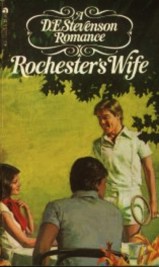
 Rochester’s Wife by D.E. Stevenson ~ 1940. This edition: Ace, circa 1970s. Paperback. ISBN: 978-0441733255. 335 pages.
My rating: 5/10.
*****
This is one of the “secondary” D.E. Stevensons, and, I believe, a “stand-alone” book, as none of the characters seem to reappear in any of the other stories. Though published in 1940, the time frame is pre-W.W. II, as there are only a few references to the “situation in Europe”, and, though the atmosphere is cloudy with foreboding, the focus is on the troubles of the individual characters, versus those of the wider world.
Young (in his late twenties) Dr. Kit Stone has returned to England after four years of travelling round the world seeking adventure. He had long cherished the ambition to become a sailor, but his (widowed) physician father had pressured him into studying medicine instead, with a view to taking over the family practice. The elder Dr. Stone died just as the younger Dr. Stone qualified, and the practice was instead sold, with the proceeds being split between the family’s two sons. The elder brother, Henry, had gone into business as a successful stockbroker and invested his share accordingly, while Kit, suddenly at loose ends, has decided to see something of the world.
Kit’s travels are touched on continually throughout the novel, and sound quite fascinating in and of themselves. He’s been in China, “looking for the war”, and has seen more of it than he had planned for. There is a reference, near the end of the book, to his standing in a marketplace when a shell fragment kills a mother and baby standing next to him; he is “spattered with their blood”, and there is a statement that he has seen quite a lot of blood in his travels. Strong stuff for this mild romance! Another incident, which has more bearing on the eventual plotline, is that Kit has had experience with diagnosing and treating a case of insanity while in America. One would rather like a full itinerary of his wanderings; he seems to have covered quite a lot of ground!
So now Kit is back in England, and though he still feels that he can’t bear to be “tied down”, he allows his brother to persuade him to try out steady employment for a while. Henry’s business partner, Jack Rochester, lives in the village of Minfield, just out of London. Jack’s wife, Mardie, is good friends with the elderly village doctor, who is getting overwhelmed with the demands of his practice, and when she hears of Henry’s brother’s sudden return, puts forward the idea that perhaps Kit might be interested in a position as assistant to the Minfield practice.
So Kit, rather reluctantly, agrees to try out life in an English village. Dr. Peabody welcomes him with gruff suspicion, which we (and Kit) immediately see as merely hiding hte proverbial heart of gold. The Peabody household consists of the elderly doctor, his bitter spinster daughter Ethel, and a grandson, precocious (and exceedingly likeable)young Jem, who is living in England for the “healthy climate” while his parents reside in Ceylon on a tea plantation. They are soon joined by another daughter, Dolly, recently married and, unbeknownst to her family, newly pregnant. Her husband, stationed in Malta, has asked her to stay in England because of her pregnancy, and Dolly’s reluctance to share this news with all and sundry has led to some speculation that perhaps her marriage is already in trouble, because otherwise why wouldn’t she be following her spouse?! Dolly and Ethel are the classic bickering sisters, and their feuding and continual cutting comments to each other add a lot of spice to this rather pedestrian tale.
The heart of the novel is an (apparently) doomed love triangle between Kit, the absolutely beautiful, charming and saintly Mrs. Rochester (Mardie), and her high-strung husband, Jack. Kit is immediately smitten with Mardie; Mardie is deeply in love with Jack; Jack depends on Mardie for emotional support as he deals with his stressful job, and much is made of how happy Mardie and Jack were in the first year or two of their marriage, though now, in year three, things are rather more difficult.
As young Dr. Stone is absorbed into the Minfield world, all seems to be going well with the “settling down” process, but for the unrequited love bit. Kit yearns for his unavailable love, and we start to see little hints that perhaps his passion isn’t exactly unappreciated and unreturned, but of course, there is that rather prominent husband in the picture. Jack, however, is showing signs of what could be charitably described as nervous tension; his personality is deteriorating by the day, and Kit and Dr. Peabody are soon looking up the characteristics of “insanity” in their medical books, and talking of bringing in a specialist.
The ending of this tale is a bit sloppy and unlikely, though everyone ends up neatly paired and with problems happily solved. I’m sorry to say that this is not one of D.E. Stevenson’s better efforts among those I’ve read so far, though there are many diverting situations throughout the book, mostly concerning secondary characters. We have the relationship between the Peabody sisters, young Jem with his brilliant talent for mimicry, an elderly Scottish housekeeper, Hoony, and her illegitimate grandson, Wattie, and, off in the background, the very happy marriage between Henry and his rather liberated wife, Mabel, who dabbles in the stock market quite successfully on her own, with her husband’s proud approval. The relationship between the two brothers, Kit and Henry, is nicely portrayed as well. They do seem a likeable family, with reassuringly human flaws fully recognized and easily forgiven by the reader.
A reasonably decent read, though I found myself groaning and figuratively smacking hand to forehead occasionally, especially regarding the whole “insanity” thing, and the remarkable (!) scenario the author has dreamt up for its resolution. Definitely worth reading as part of the D.E. Stevenson canon, though I’m afraid I closed the book and said farewell to the characters with a feeling more of relief than reluctance!
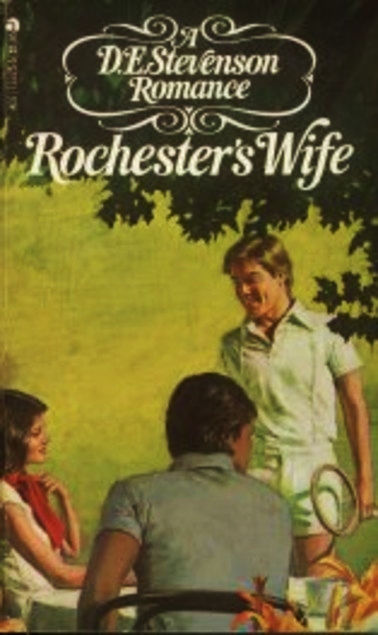
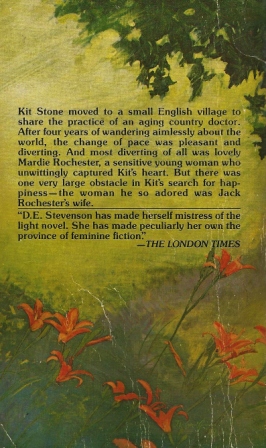 And I must say something about the dreadful paperback cover. (Cover illustrations being, as some of you may have gathered by my continual harping on the subject, something of an issue with me.) Why, oh why do publishing companies insist on putting “current” illustrations on books set in past times? The characters illustrated on the Ace cover are obviously from the 1970s in dress and hairstyle; I cringe when I look at it. The only thing that that I found attractive (and here is the hort in me speaking) is the rather lovely inclusion of a border of tall orange daylilies (probably Hemerocallis fulva ‘Europa’ from the looks of them), in the foreground of the trio of tennis players and extending around the back of the cover.
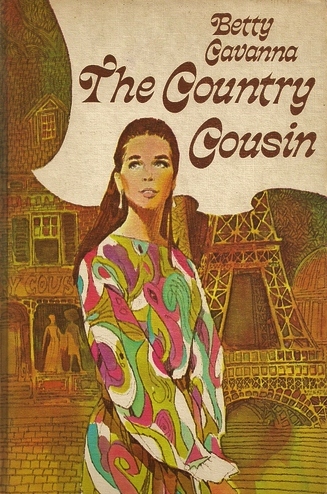
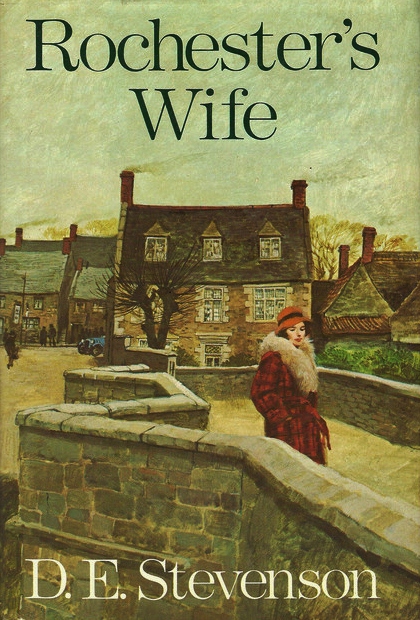
Much more appropriate is this other cover , which captures the mood and setting exceedingly well.
I am coming to the end of my personal stash of D.E. Stevensons, and the more I read of her the more eager I am to go on with building the collection. It’s going to be an expensive year, I fear. Even the tired old paperbacks are seriously overpriced, but I’m afraid I’m now hooked and will be playing the seeking game to the full extent that my pocketbook allows.
Part of the fun is the glorious awfulness of some of Stevenson’s scenarios – I just now have realized I’ve made no mention of the Jane Eyre references in this particular novel – nothing subtle about that, is there?!
D.E. Stevenson. When she is good, she is very, very good, but when she is bad … maybe she’s even more interesting!
Read Full Post »


















 Leaves & Pages