Archive for December, 2012

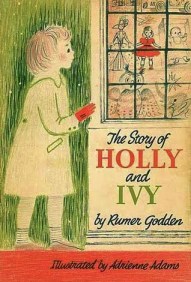
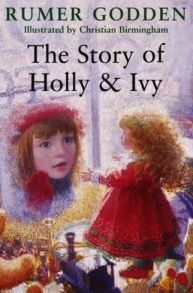
the story of holly and ivy rumer goddenThe Story of Holly and Ivy by Rumer Godden ~ 1958. This edition: Macmillan, 2005. Illustrated by Christian Birmingham. Softcover. ISBN: 0-330-43974-x. 58 pages.

My rating: 10/10. Pretty well perfect.

*****

This is a story about wishing. It is also about a doll and a little girl. It begins with the doll.

Her name, of course, was Holly.

It could not have been anything else, for she was dressed for Christmas in a red dress, and red shoes, though her petticoat and socks were green.

She was ten inches high and carefully jointed; she had real gold hair, brown glass eyes, and teeth like tiny china pearls.

The newest toy in Mr. Blossom’s shop in the village of Appleton, Holly is unpacked the day before Christmas Eve, and she is apprehensive as to what will happen next. The other toys are in a state of high excitement. “We must be sold today!” they whisper to each other, before the shop opens. “Wish, wish, wish!”

“What happens if I’m not sold?” wonders Holly.

“You will be put back into stock,” hisses Abracadabra, the sinister stuffed owl who broods over the store. “It is shut up and dark, and no one will see you or disturb you. You get covered with dust, and I will be there.”

Holly quivers in despair. “I wish, wish, wish for a little girl for Christmas!”

But Christmas Eve is here, and the shop is being closed up, and Holly is still on the shelf…

Meanwhile…

Far away in the city was a big house called St Agnes’s, where thirty boys and girls had to live together, but now, for three days, they were saying ‘Goodbye’ to St Agnes’s. ‘A kind lady – or gentleman – has asked you for Christmas,’ Miss Shepherd, who looked after them all, had told them, and one by one the children were called for or taken to the train. Soon there would be no one left in the big house but Miss Shepherd and Ivy.

Ivy was a little girl, six years old with straight hair cut in a fringe, blue-grey eyes, and a turned-up nose. She had a green coat the colour of her name, and red gloves, but no lady or gentleman had asked for her for Christmas. ‘I don’t care,’ said Ivy.

Sometimes in Ivy there  was an empty feeling, and the emptiness ached; it ached so much that she had to say something quickly in case she cried, and, ‘I don’t care at all,’ said Ivy.

‘You will care,’ said the last boy, Barnabas, who was waiting for a taxi. ‘Cook has gone, the maids have gone, and Miss Shepherd is going to her sister. You will care,’ said Barnabas.

‘I won’t,’ said Ivy, and she said more quickly, ‘I’m going to my grandmother.’

‘You haven’t got a grandmother,’said Barnabas. ‘We don’t have them.’ That was true. The boys and girls at St Agnes’s had no fathers and mothers, let alone grandparents.

‘But I have,’ said Ivy. ‘At Appleton.’

I do not know how that name came into Ivy’s head. Perhaps she had heard it somewhere. She said it again. ‘In Appleton.’

But Ivy is going to the Infants’ Home in the country, as Miss Shepherd must go to her sister, who has influenza. Ivy is loaded onto the train, with “a packet of sandwiches, an apple, a ticket, two shillings, and a parcel that was her Christmas present”, and on to Ivy’s coat was pinned a label with the address of the Infants’ Home.

As soon as Miss Shepherd leaves her, Ivy tears off the label and throws it out the window. ‘I’m going to my grandmother,’ she declares. ‘In Appleton.’ That is in just a few stops, a helpful lady tells her, and sure enough, as the train stops at Appleton station Ivy gets off, leaving her suitcase and her St Agnes-supplied gift – a pencil-case – on the seat, and, unnoticed by the busy ticket inspector, starts out on her quest.

Not far away, in the toyshop, Holly is wishing and wishing and crying out silently, ‘Stop. Stop. Oh, someone, stop.’ But in vain.

Only one person stopped, but it was not a boy or a girl. It was Mrs Jones, the policeman’s wife from down the street. She was passing the toyshop on her way home when Holly’s red dress caught her eye. ‘Pretty!’ said Mrs Jones and stopped.

You and I would have felt Holly’s wish at once, but Mrs Jones had no children and it was so long since she had known a doll that she did not understand; only a feeling stirred in her that she had not had for a long time, a feeling of Christmas, and when she got home she told Mr. Jones, ‘This year we shall have a tree.’

‘Don’t be daft,’ said Mr Jones, but when Mrs Jones had put her shopping away, a chicken and a small plum-pudding for her and Mr Jones’s Christmas dinner, a piece of fish for the cat, and a dozen fine handkerchiefs which were Mr Jones’s present, she went back to the market and bought some holly, mistletoe, and a Christmas tree.

The tree is decorated, but

‘Who is to look at it?’ asked Mr Jones.

Mrs Jones thought for a moment and said, ‘Christmas needs children, Albert.’ Albert was Mr Jones’s name. ‘I wonder,’ said Mrs Jones. ‘Couldn’t we find a little girl?’

‘What’s the matter with you today, my dear?’ said Mr Jones. ‘How could we find a little girl? You’re daft.’ And it was a little sadly that Mrs Jones put holly along the chimney shelf, hung mistletoe in the hall, tied a bunch of holly on the doorknocker, and went back to her housework.

*****

Need I go on? Of course not! You know what eventually happens, don’t you? But the path to wish-fulfillment is never so straight and easy …

This is a deliciously sweet story, perfect for a reasonably accomplished independent reader of 6 or 7 or maybe a bit older (my own daughter read it happily to herself for the first time at 10) and a marvelous Read-Aloud for all ages – it’s fairly text dense, so allow at least three good long sessions.

Ivy is a grand little heroine, misguidedly stubborn and with something of a temper, which makes her eventual fate even more emotionally satisfying. And because this is a fantasy – a Christmas fantasy – we do not worry about her wandering alone through a strange village; we know that she will come to no lasting harm, though an adventure or two may befall her.

Highly recommended, for the children in your life, and for a gentle treat for yourself, too!

*****

Holly-and-IvyIf you can, try to find the original, long out of print hardcovers illustrated first by Adrienne Adams, and then in another edition by Barbara Cooney. The currently in-print Christian Birmingham version is quite lovely, too, especially if gifting this book, where crisp and new is an issue, though it is without the vintage appeal of the older versions.Holly and Ivy

Read Full Post »

My World: More Post Updates

Roadside Sunset - Alexandria - wWnter 2012

Note to subscribers – the post updates continue – fixing my tagging – you may be getting duplicate posts! Hoping to complete “housekeeping” soon so it’s all tidy for the new year.

Read Full Post »

DSC04258

This is turning into one of those slightly weird weeks.

On the kind-of down-side, the dancer missed her last major Christmas recital rehearsal today because of terrible roads. As the all-day performance (she’s in four concerts, as part of a competitive “touring” dance troupe) is on Saturday, and as there is still last-minute choreography going on, this caused some stress. No worries, I’m sure they’ll all pull it off, seasoned performance veterans that they are! She’ll be learning the missed bits moments before she hits the stage; keeps it interesting!

On the “oh, well, an unexpected day at home” up-side, we were all here together (rare-ish situation lately), so we went out into the snowstorm to hunt down a Christmas tree. Funny how our farm’s private forest of tiny perfect fir trees have grown so dramatically in the twenty-one years since our first expedition up the hill in December, to the point where it’s hard to find something small enough to fit in our low-ceilinged living room!

And on the really down-side, we’ve just found out that our family’s main pay cheque may be seriously disrupted; my husband’s workplace is unexpectedly under immediate strike notice as employee contract negotiations have hit a neither-side-wants-to-budge brick wall. As of December 18th he may have an unanticipated and not particularly well-timed “holiday”. Something we definitely never saw coming!

Fingers crossed that it gets sorted out.

Otherwise, life is pretty good. Just a wee bit surreal, thinking of alternate possibilities and coping strategies in case things do come crashing down, money-wise.

At least the tree is checked off the list!

Read Full Post »

archer's goon dianna wynne jones 001Archer’s Goon by Dianna Wynne Jones ~ 1984.This edition: Greenwillow Books (William Morrow & Co.), 1984. Hardcover. First American edition. ISBN:0-688-02582-X. 241 pages.

My rating: 9/10. Lost a point at the end. Alpha Centauri – seriously?! Total cop-out, DWJ! But that’s such a minor quibble – I loved this book – slyly humorous the whole way through.

*****

I came to reading Dianna Wynne Jones late in life. Like right now. Of course I’ve long since met Howl (with a very serious anime-fan kid how could I miss Miyazaki’s amazing Howl’s Moving Castle? – and of course we had to read the book – loved both versions – wow wow WOW!) – and the Chrestromanci books, but the yet-to-reads vastly outnumber the already-reads. I’m remedying that.

DWJ’s books were not among the choices in my school library growing up, or, if they were, I was completely unaware of them. We had very well-stocked libraries in my grade school days – times in B.C. were good and there was plenty of school district budget money for books and such, much more so than at present. Looking at the publication dates in DWJ’s Bibliography, I now realize that she really hit her stride after I’d left school, so that logically explains the DWJ-shaped blank spot in my childhood reading experience.

Anyway – Archer’s Goon. Good stuff. Where to start, where to start?

*****

AUTHOR’S NOTE

This book will prove the following ten facts:

  1. A Goon is a being who melts into the foreground and sticks there.
  2. Pigs have wings, making them hard to catch.
  3. All power corrupts, but we need electricity.
  4. When an irresistible force meets an immovable object, the result is a family fight.
  5. Music does not always soothe the troubled breast.
  6. An Englishman’s home is his castle.
  7. The female of the species is more deadly than the male.
  8. One black eye deserves another.
  9. Space is the final frontier, and so is the sewage farm.
  10. It pays to increase your word power.

Got that?

Not quite?

Don’t worry, by the time you’ve finished this story, you will.

So, ultra-brief review, because this is one you’ll want to discover for yourself and figure out as you go.

Thirteen-year-old Howard Sykes comes home from school one day and finds the kitchen full of Goon. Not just any Goon, but this one comes, or so he says, from Archer.

“We don’t know anyone called Archer!” Howard snapped.

The Goon grinned, a daft, placid grin. “Your dad does,” he said, and went back to cleaning his nails.

Turns out Mr. Sykes – Quentin – owes Archer something. Words. Two thousand of them. The quarterly payment hasn’t reached its destination, and Archer is peeved, hence the Goon.

Howard, his little sister Anthea (known widely and appropriately as Awful), au pair Fifi, and Howard and Awful’s mother Catriona are stumped by this strange situation, and things just get more complicated when Quentin arrives. Disclaiming knowledge of anyone named Archer, he miffily remarks that Mountjoy gets the words, and that they were sent on time.

Tracking down the missing words, and the reason they are in such apparently high demand, brings Howard and the rest of the Sykes family into a strange parallel world, and puts them all at the mercy of the mysterious beings who “farm” different sections of the town infrastructure: Archer (Finances and Power, ie. Electricity), Hathaway (Roads, Records and Archives), Dillian (Law and Order), Shine (Industry and Crime), Torquil (Music, Religion, Sports and Commerce), Erskine (Water, Drains and Garbage) and Venturus (Housing, Education and Technology).

The human characters are outstanding, and family relationships (of all sorts) are a key focus of this wonderful story. Don’t let the “kid’s book” designation put you off – it’s a grand read for adults, and very, very funny.

I’m stopping right here, but if you want to know more, the internet abounds with rave reviews. Here are two good places to start.

Jenny’s Books – Archer’s Goon

Green Man – Archer’s Goon

Did I say highly recommended yet? If so, I repeat it. Highly recommended.

Read Full Post »

Love’s Shadow by Ada Leverson ~ 1908. This edition: Bloomsbury, 2010. Softcover. ISBN: 978-1-60819-050-8. 225 pages.

My rating: 7.5/10. An enjoyable diversion; cleverly amusing; my only quibble is the abrupt ending, but there are two books which continue the story.

I found myself mentally running to keep up with these bright young (and not so young) things in the early days of the 20th Century.

Off to ABE I go, to scope out the sequel situation, though once there I know I will be seduced into searching for other more pressing desires – I still have a bit of a Margery Sharp wish list going on, and Elizabeth von Arnim, and I did want to pick up one or two of those as presents-to-myself for over-Christmas reading, in case the book parcels don’t stretch far enough; really promising books attract a line-up here, with all four of us elbowing each other out of the way. I prefer to majestically withdraw to peruse my back-ups; saves such effort and eases the crush!

But back to Edwardian London, and Ada Leverson’s romantic upper-class circle game.

*****

Love like a shadow flies

When substance love pursues;

Pursuing that that flies,

And flying what pursues.

~Shakespeare

Lovable Edith is married to dreadfully vain civil servant Bruce Ottley; she views her truly tiresome husband with a gently cynical eye and takes comfort in amusing herself with her adorable young son, conferring with her likeable and wise mother-in-law on how best to manage Bruce’s more obnoxious traits, and innocently dallying with her wealthier, socially superior, but truly nice and sweetly affectionate friend, the beautiful Hyacinth Verney.

As the story opens, Hyacinth is in the throes of an apparently hopeless passion for handsome and unreachable Cecil Reeve; Cecil is in romantic thrall to Mrs. Raymond, a widow ten years his senior. Hyacinth is in turn the focus of the unrequited love of a number of characters: her companion, the eccentric and emotionally tormented Anne Yeo; her elderly guardian, Lord Cannon (married to the majestically obtuse and perennially self-satisfied Lady Cannon); and even Edith’s snobbish husband Bruce. Edith has her own admirer, the exceedingly eccentric F.J. Raggett, who has been introduced into the household by Bruce for reasons I never was quite clear on.

Edith and Mr. Raggett:

‘What is your work, exactly?’ she asked, with polite interest.

‘It’s difficult to explain, Mrs Ottley. It takes a great many forms.’

‘Oh, yes.’

‘Just at this moment I’m a Legitimist – you understand, don’t you? We drink to Queen Mary over the water – and put violets on the statue of King Charles the Martyr in February, and so forth.’

‘Ah. That must be very hard work.’

‘Oh, it isn’t only that – I’m a kind of Secretary, you see, to the Society.’

‘Really? Really? What fun it must be; I mean how interesting. Can I belong?’

‘Oh, dear yes, of course, Mrs Ottley. If you like.’

‘What should I have to do?’

‘Well, first of all you would have to pay a shilling.’

‘Yes?’

‘And then you would be eligible for a year’s probation.’

‘And what should we do after that?’

‘Well, after that, you see, we shall have to bide our time.’

‘That doesn’t sound very hard,’ said Edith thoughtfully. ‘Just to pay a shilling and bide your time.’

‘I’ll send you some papers about it, if you really take an interest.’

‘Thanks. Thanks, very much. Yes, do send them.’

‘Do you really think you would care to become a member, Mrs Ottley?’

‘Oh, yes; yes, I should think so. I always hated Oliver Cromwell.’

He looked doubtful.

‘Yes, of course – but that alone, I’m afraid, would hardly be … you see there might be a revolution at any moment.”

Mrs. Raymond eventually spurns Cecil, who after much prodding by everyone finally sees the light and turns to court the receptive Hyacinth. Cecil’s wealthy and eccentric aristocratic uncle, Lord Selsey, then decides to capture Mrs. Raymond for himself, as he feels she would be a suitably low-maintenance companion and a willing custodian for his extensive art collection.

By the end of the novel we have a marvelous appreciation of the way in which Edith Ottley is coping both with awful Bruce and persistent Mr. Raggett; Hyacinth and Cedric are married and are fighting their way through the inevitable jealousy engendered by the Cecil’s still-existing Mrs. Raymond infatuation; Mrs. Raymond, now Lady Selsey, does the decent thing and withdraws from the scene by taking her new husband on a year-long visit to the Greek islands; Lord Cannon is managing his tiresome wife with continued aplomb; and Anne Yeo, my own personal favourite of all of the characters, has decided to take her bruised heart away with her to an unknown country; our last view of her is as she is heading to Cook’s; she has decided to emigrate.

Scads of loose ends dangle; perfectly set up for a continuation of the farce.

Followed by Tenterhooks (1912) and Love at Second Sight (1916); the trilogy was also published in a Virago omnibus edition, The Little Ottleys, in 1982.

*****

Not my usual reading fare, but I enjoyed it. It rather reminded me of Nancy Mitford, whom I indulge in in rationed amounts from time to time. Oscar Wilde is the connection most reviewers mention, and as Ada Leverson was one of Wilde’s close friends and the comparison is fitting.

Read Full Post »

guard your daughters diana tutton 001Guard Your Daughters by Diana Tutton ~ 1953. This edition: The Reprint Society, 1954. Hardcover. 246 pages.

My rating: This is one of the more difficult ratings I’ve had to mull over in the eight months since I’ve started this blog. I’m going to say, after much consideration, 6/10.

That rating may change if I can get my hands on some of the author’s other works; I am curious to see her next developments as a writer.

I thought this was an ambitious and strongly written first novel. There were a few rough patches here and there, and I bogged down a bit about a third of the way through, but the narrative then picked up speed, and I had no trouble staying engaged until the bitter end.

The following review is divided into two sections, the first for those who haven’t yet read the book, and the second for those who have; I have some comments to add to the recent online discussion regarding Guard Your Daughters and, of course, its inevitable comparison to Dodie Smith’s I Capture the Castle.

*****

I’m very fond of my new friends, but I do get angry when they tell me how dull my life must have been before I came to London. We were queer, I suppose, and restricted, and we used to fret and grumble, but the one thing our sort of family doesn’t suffer from is boredom.

So speaks this novel’s narrator, Miss Morgan Harvey, looking back on the circumstances of her nineteenth year, the year when everything changed, and when she and her sisters finally emerged from their mother-woven cocoons and ventured out into the larger world.

“Queer” and “restricted” are apt descriptions of the Harvey ménage. Father is an immensely successful mystery story writer, distantly busy in his study churning out his manuscripts and emerging occasionally to pay the bills and blink short-sightedly at his daughters. Mother is an oddly attractive though emotionally needy and mentally fragile creature whom the other six treat with extreme care tinged with apprehension – “What if something should set her off?” they all whisper to each other – every word and action weighed with care to ensure the avoidance of a quivering, wailing breakdown. Friends are forbidden the house, and indeed the girls do not appear to even have friends; they were not allowed to attend school, and their last governess left four years ago. There is no telephone –  “it worried mother” – and no outings but for the necessary trips to the village shops and to the next door farm for illicit black market acquisitions of butter, cream and eggs (the story is set in post-World War II England, when food rationing was still in effect). And there are, most emphatically, no opportunities to meet young men.

The oldest sister, twenty-two-year-old Pandora, has unexpectedly escaped and been recently married. Now living in London, she’d caught the eye of a visiting young man, grasped her rare opportunity, and speedily carried out a courtship whilst officially occupied teaching Sunday School. To everyone’s surprise, the marriage was accepted relatively quietly by Mrs. Harvey, but the rest of the sisters are now even more aware of their restrictions, and are beginning to cast their glances speculatively around for their own chances to blossom forth.

Thisbe, second eldest, is twenty-ish, Morgan is nineteen, Cressida eighteen, and Teresa fifteen, but they all have the dual personality of the overly sheltered but mentally bright child, a combination of beyond-their-years intellectual sophistication and total social naïvety. Snobbishly proud of their status as daughters of a best-selling author, their good looks, their various “arts”, and above all their determined and deliberate “eccentricity”, they play these points up for all they’re worth when they do have their rare social interactions.

As the narrative starts, Morgan has just captured (apt term!) a young man whose car has broken down at the Harvey gate, and his enforced stay to tea allows us to sum up each sister’s particular persona.

Pandora is absent, though she arrives that evening for a visit and turns out to be wonderfully “normal”; bloomingly happy in her marriage and eager for her sisters to share in her good fortune. Thisbe is proud of her own witty tongue, and delights in shocking people with her cutting comments; she privately pursues the muse of poetry, shutting herself up to write with little care of the boring logistics of helping with household chores. Morgan is musical; she has occasional piano lessons and works away on her own, though not strenuously enough to gain the skill needed for her talked-of concert pianist’s career. Cressida is the handy sister, the practical one; yearning after normalcy and highly aware of her family’s general oddness, she cooks and cleans and mends and tries to keep her careless sisters as decent as she possibly can, to their frequent mild scorn. Teresa is a very young fifteen, and thrilled to have reached the age when the visits of the country education inspector need no longer be feared. She has surrounded herself with books and lives in an intellectually precocious world of her own, while clinging to her mother and indulged by her older sisters; a true baby of the family, talked of and treated as if she were five or six versus on the cusp of young womanhood.

The eventual implosion of the Harveys’ private little world and the true nature of their mother’s “ailment” forms the climax to which this hectic story builds. And though billed as a “social comedy”, there is a much darker undercurrent to the facetious surface story; I was uncomfortable as often as I was amused.

*****

This next bit is addressed to those who’ve read the book – alert to others –  there may be spoilers.

I did enjoy the actual reading of this book; I was drawn into the story and I was decidedly curious as to what was going to happen next; my expectations changed drastically as the narrative moved on, and I began to pick up on darker elements of what initially seemed like merely an amusing “light” novel.

Paradoxically I did not like or admire most of the characters in any sort of personal way, and I found myself getting more and  more uncomfortable as the comically brittle farce turned into something much darker. I think this was a deliberate ploy by the author; in which case she deserves high marks – this novel, if viewed as a dawning-of-an-awful-light portrait of a severely dysfunctional family, is, in my opinion, decidedly a success.

If, on the other hand, I’m reading the author’s intentions completely wrong, and this was indeed meant to be an amusing romp, it fails utterly and dismally. This is not a feel-good book. I felt that the frenetic posturings of the narrator serve initially to hide, and later to sharply accentuate, the misery of her life and the psychological damage to all five of the siblings and their father by the emotional malfunctioning of the family’s mother. In turn, the mother has been deeply emotionally injured in her own earlier life; the five sisters of Guard Your Daughters are classic cases of victims of the victim; the “spiral of abuse” – that handy modern catch-phrase – applies most appropriately here. That the abuse is prompted by love – albeit love gone terribly wrong – in no way lessens its effects on the many victims, though it may excuse the perpetrators of deliberate viciousness and leave them guilty only of the lesser crime of thoughtlessness.

Though some reviewers (see links at the bottom of this post) have felt that this novel is strongly derivative of other stories, I felt that though it may have shared a few vague similarities of plotting with other “classics” of similar genre (and yes, I’m referring here to Dodie Smith’s I Capture the Castle), by and large I felt that it was an original work by a creative mind, not a copycat work by any stretch. There are only so many situations out there; the repetitive themes of young people (in this case young women) yearning after both romantic love and “suitable” mates, and, indeed, the struggle to break free of parental influence and to escape from childhood into the wider world of true maturity, are universal and repeated time after time after time, because writers and readers so strongly identify with them, whatever the era.

The frequent humourous situations were well portrayed, and they did make me smile; but my final impression of Guard Your Daughters is that this was not a happy book; the humour is not the point here, it merely fulfills the part of the curtain that refuses to stay drawn over the utter awfulness of the understory.

The Harvey sisters did not gain my instant affection as did Castle‘s Mortmains; Morgan as narrator was not nearly as charming and individualistic as Cassandra; I never could shake the feeling that I was being overtly manipulated into accepting Morgan’s point of view, while Cassandra’s narrative became an effortlessly absorbed voice in my head for the entire time of the reading of the novel.

While both sets of fictional sisters are snobbish, the Mortmains recognize this and admit it as a failing, while the Harveys revel in their snobbishness and deliberately mock anyone of lower social status who draws their attention, from their departed governess to their lone domestic to the farmer’s wife who sells them their black market eggs to the bookstore owner who promotes their father’s bestsellers.

This continual self-regard and deep snobbishness was what prevented me from embracing the Harvey sisters as truly “lovable” characters. All five had some good points, some complexity of character, but I never felt like we were equals. In their world, I fear very much I would be one of the mocked commoners, with boringly bourgeois views and the wrong ancestors and accent.

The continual selfishness of all of the Guard Your Daughters protagonists is the most difficult trait standing in the way of my sympathy for them; while they occasionally acted in a disinterested way towards the members of their inner circle, their inward-facing focus added to their greater problems; at some point in the story I felt like shaking each and every one of them and hissing “reality check, you fool!” in their silly faces. Morgan most of all!

I’m glad I read Guard Your Daughters, and I’m very curious to read more by this writer, though this novel will definitely not join the “comfort reads” in my personal stacks. I think it might best be placed with the ones on my “love-hate” shelf, alongside Muriel Spark, Margaret Atwood, Jeanette Winterson and their ilk, to be taken in small doses when the need for an emotional shake-up of sorts is desired; literary bitters to add piquancy to a milder, more easily digestible, dare I say, generally more enjoyable everyday reading diet.

*****

I’m not completely happy with my review above; it seems that my after-midnight thoughts have not all quite made it to the page, but I’ll leave it there for now – a new midnight is fast approaching! The following reviews are the ones that started me on this very interesting examination of Guard Your Daughters. If you haven’t already, please visit these for a wider discussion of this slightly controversial read.

Stuck in a Book – thought it was grand!

Jenny’s Books – generally enthusiastic with some reservations.

The Captive Reader – decided it wasn’t her thing.

Book Snob – loved it.

*****

And here, by way of a little bonus, are two teaser reviews for Diana Tutton’s second and much harder to locate novel, Mamma, published in 1955.

From Kirkus, April 1955:

A pleasant autumnal blooming for Joanna Malling has its problems which are fortuitously solved. For Joanna moves to a new house, after a widowhood of twenty years, only to find that she must ready it for her daughter’s (Elizabeth aged 20) wedding to Stephen Pryde, 35 and a Major expecting to be stationed abroad. Joanna, at 41, finds him stolid and slightly inimical. But when his orders do not come through and she must do the necessary and provide a home for them when he is assigned to her locality, she begins to find many things in common with Stephen which Elizabeth can never achieve. Stephen, too, is not unaware. The impasse is resolved when Stephen’s mother dies and there is a home of their own for Elizabeth, now pregnant, and Stephen, so Joanna, rid of her temptation, faces an undisturbed future. A British blend of feminine frailty and domesticity provides an amiable amble.

And from Jet, May 1955:

Attractive Joanna Malling, who at 41 had been a widow for 20 years, is appalled (and pleased) when she finds herself falling in love with the husband of her 20-year-old daughter Libby.

This is the core of Mamma, a novel by Diana Tutton (Macmillan, $3.50). It is a lean English novel that attempts to be “modern” in facing a basically tragic problem that Miss Tutton strains to solve as a “social comedy”.

Before she even met him, Joanna was prepared to dislike Steven Pryde, an English army major, primarily because Libby’s affection for her would be deflected. But when Steven and Libby visited Joanna at her little cottage outside of London, Joanna found her 35-year-old future son-in-law more than attractive. After the marriage, pneumonia felled Steven and Joanna had Libby bring him to her home to recover.

Proximity drew Joanna and Steven together but he never quite gave in to his impulse to take her into his arms. Joanna, on the other hand, plotted to culminate an affair, her conscience all the time reminding her that Steven was her own flesh and blood’s husband. Aching for one last fling, after so many barren years, Joanna almost gives in to indiscretion.

With a woman’s infallible intuition in these matters, Libby is not unaware of what is transpiring, but she makes no over moves, except to conveniently become pregnant before she can tell Joanna that she strongly suspects her of being in love with Steven and trying to steal him.

In what is described as a “social comedy”, Miss Tutton solves this three-pronged problem with cool English efficiency, but the reader is led to expect more than Mamma offers.

Well, are you as curious as I am to investigate this one? Methinks Diana Tutton may have had some “mother issues” of her own which she was working out on the page!

Read Full Post »
Last week I read several reviews of Diana Tutton’s Guard Your Daughters; most, but not all, enthusiastically and favourably comparing it to Dodie Smith’s I Capture the Castle. Now I am not alone in believing there is a special warmth in the sun that shines on the Mortmain family as depicted in that tale, so anything that is compared to it attracts my immediate attention.

After reading Claire’s review on The Captive Reader blog, I commented to her on how much I would like to sample Guard Your Daughters for myself, and Claire, who has decided this one is not a “keeper” for her, immediately popped it in the mail to me. I found a parcel card in my box yesterday, and being Sunday, was unable to collect it as our postmistress had the parcel room locked up tight, but this afternoon my teenage son kindly drove the fifteen minutes back out to our small rural post office to pick it up for me. (He picked up a tub of ice cream, too, as our post office is a tiny room at the back of a small country general store, so it wasn’t completely a disinterested trip!)

My husband is away working a night shift this evening, so I will have no qualms about retiring to bed and reading as late as I want without worrying about the light shining in his eyes. Actually, I think I might bow out early, to give my full attention to the task at hand. Will I love this one, or be disappointed? Either way, I am looking forward with great anticipation to finding out.

Thank you, Claire! An early Christmas present, indeed. A review shall follow post haste.

Book People are The Best!

Read Full Post »

the long winter john christopherThe Long Winter by John Christopher (pseudonym of Samuel Youd) ~ 1962. Alternate British Title: The World in Winter. This edition: Simon & Schuster, 1962. Hardcover. First American edition. Library of Congress #: 62-12411. 253 pages.

My rating: 7.5/10. This fifty-year-old post-apocalyptic novel was much more gripping than I had expected; the premise of a new ice age is chillingly depicted (pun intended). I thought this one was right up there with John Wyndham’s similarly themed works. I started it last night as a casual bedtime dip-into-and-check-it-out read, and I was quickly hooked and soldiered on until well after midnight to finish it, to my slightly groggy detriment today.

Good period piece and a fine example of the vintage speculative fiction genre, though with the expected true-to-the era misogynist attitudes and opinions. This would make an excellent film, in the right hands.

*****

Andrew Leedon rubbed his hands against the antique Victorian muff-heater Madeleine had given him. She had found it in an antique shop and presented it to him on his birthday, along with a supply of the small charcoal by which it was fueled. But even charcoal had become impossible to obtain, and its brief usefulness, after so many years, was almost at an end. He blew through the small holes on the side and watched the red glow brighten. A chair scraped and he turned his attention back to his fellow readers. He felt pity for them, but it was mixed with envy. The future was a current which soon, very soon now, must drag them down into the maelstrom; for the moment they bobbed like corks in this eddying backwater, but the deep tug of the undersurge was there and none would escape it. Yet they were indifferent. The red-eyed, gray-haired man across the aisle with his pile of volumes on King Arthur – he had always been there, in the same place, with the same books. When the end came to him, in however strange and incalculable a form, it would be irrelevant, as irrelevant as the pneumonia or heart attack or cancer which would otherwise have rendered his seat vacant. Soon all the seats would be vacant together until, as must happen, marauders broke in to rip up the wood and carry away the books that were left for fuel. Some of the rarest books had already gone, to the libraries in Cairo and Accra, in Lagos and Johannesburg, and more would go in the next few weeks; but there would still be enough to draw the mob. The people reading here were not so foolish as to expect a reprieve – for the library of for themselves. It was that he envied.

The main lights were off, conserving electricity. There were only the small reading lights, and, high up, the grayness that filtered in from outside. He thought of Africa; of sunshine, long beaches by a blue ocean, the green of trees and grass …

In the middle of the 20th Century a worldwide environmental catastrophe is occurring: the sun’s radiation is decreasing, and a new ice age is looming in the temperate zones. British television producer Andrew Leedon, happily married with a lovely wife and two young sons, catches a glimmer of the story as it first starts to break, but he, along with everyone else, pays little attention. Even if the predictions are correct, what would a degree or two difference in temperature really mean? Surely nothing to worry about; winters in England might even be more traditionally enjoyable again; skating on the Thames would make a pleasant Christmas diversion…

As the true impact of the swift and ever more severe solar cooling begins to be felt, Andrew’s marriage echoes the collapse of his planet’s future. His wife confesses that she has been continuously unfaithful since the first days of their marriage and is now leaving him for his good friend David Cartwell; as a consolation prize Andrew is thrown together with David’s discarded wife, the gentle Madeleine.

Those fortunate enough to have been able to plan ahead and liquidate their assets are moving towards the equatorial regions; Andrew’s now-estranged wife and sons leave for Nigeria without his initial knowledge. Stubbornly refusing to flee in his turn, Andrew is finally convinced to leave by Madeleine, and with David’s assistance the two obtain seats on one of the last air flights out of England. David himself remains behind, counting on his high position in the government to enable his escape if and when it becomes necessary. But for now he intends to stay and see England through this crisis to the best of his considerable ability.

In Africa, Andrew and Madeleine find themselves immersed in a society very different from that which they know. White-skinned Europeans and Britons are the new working class; their currency is worthless, their academic and professional qualifications ignored. Serving the ruling class Nigerians in the former British colony, the whites scrub toilets and wait tables and prostitute themselves to pick up enough money to eke out a precarious existence. Andrew and Madeleine settle into one of the worst of the slums, until a chance encounter with an African student whom Andrew had patronizingly but kindly treated to a dinner at his club back in the old days in London elevates him socially and professionally by making him a personal assistant.

This turn-about relationship leads to a morally challenging situation, when Andrew is asked to join a Nigerian military expedition force planned to explore England by Hovercraft, to assess the possibility of re-colonizing that now nearly abandoned territory under an African flag.

The first part of this post-apocalyptic tale is, in my opinion, the best-written, where Andrew struggles with the ethics and morality of his own behaviour in this unprecedented crisis, and keenly observes the reactions of those around him. As the novel progresses, and as the conditions in the frozen lands worsen, to martial law, brutal violence by the few elites with guns against the many without, and survival of the fittest by any means, including cannibalism, the story becomes much more intellectually shallow and far distant from the complex inner musings of the earlier days. To be fair, this might echo the increasing callousness of the strong as they jettison their finer feelings to ensure their own continued survival; ethics are a luxury no one can afford to indulge in any more.

The racial situation of blacks versus whites and their role reversals is cleverly presented; the tone remains “white” racially superior though, as the Africans ultimately are undone by their own “inborn” weaknesses, at least in the eyes of the staunchly patriotic Britons defending their frozen homeland.

This is indeed a very British book; the author assumes a strong familiarity with English landmarks and history, and knowledge of London neighbourhoods and architectural and physical features. The narration itself is very stiff-upper-lip, in the best stereotypical tradition.

I thought that Andrew lost some of his credibility as a character towards the latter part of the book; his continual fixation on his personal life while the world itself is crashing down around him strikes a false note.

Or does it? How would you react? Would you focus ever more inward, or would you harden your soul to pursue sheer survival over sentiment?

The ending of this epic is left open and vaguely optimistic, but though we may speculate on Andrew’s future, we are not at all assured that he will even survive, let alone thrive, in the changed world he is struggling to adapt to.

*****

John Christopher was the pseudonym of the late (1922-2012) prolific sci fi and speculative fiction writer Samuel Youd. His best-known works are perhaps the teen/young adult “Tripod Trilogy” concerning an alien invasion of Earth: The White Mountains (1967), The City of Gold and Lead (1968), and The Pool of Fire (1968). I read all three of these some years ago, and though I felt that they were often technically over-simplistic, they were emotionally gripping, thought-provoking and generally memorable.

This is an author worth investigating for the frequent excellence of his creative ideas and his sober examination of human emotional motivations, though his writing can be occasionally uneven, varying in quality even within the same book.

If you are a John Wyndham fan, you will find much to enjoy in John Christopher’s stories. In that case, recommended.

A note: The Long Winter was intended as an adult novel, even though this writer also wrote widely for teens.

Read Full Post »

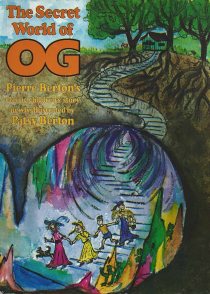
The Secret World of Og by Pierre Berton ~ 1961. This edition: McClelland & Stewart, 1984. Softcover. Illustrated by Patsy Berton. ISBN: 0-7710-1386-8. 159 pages.secret world of og cover pierre berton 001

My rating: 6/10. It has its moments, hence the rather generous “6” rating, but I’ve been exposed to Og three times now and I’m still not a complete convert. Sorry, Pierre. And Patsy. This one is a cute Berton family in-joke, and I appreciate your sharing it with the country at large, but my personal enthusiasm for Og and its viridian denizens remains restrained.

*****

My first exposure to this Canadian children’s “classic” was back in the early 1970s, when a keen grade school teacher read it out loud to our class over a series of afternoon reading breaks.

This tweaks my memory – does anyone else from B.C. remember those after-lunch U.S.S.R. periods – Uninterrupted Sustained Silent Reading? Occasionally these would morph into read-aloud sessions, to the great joy of most of the students in the class, except for those few of us hardcore bookworms who would really have preferred to be left alone to focus openly and with official permission on our own reading choices.

I even remember the book I was sneakily perusing as the teacher read Og. I was deeply engrossed in Jade by Sally Watson – an absolutely marvellous book about an upper-class teenage girl who ends up crewing on a pirate ship, with a desperately swoony captain <ah, sigh>  – a saga which I remember with great fondness and which I always meant to track down for sentimental reasons and to share with my own daughter, but which I haven’t yet gotten my adult hands on. Gosh, Sally Watson was (is! – now in her eighties, she’s still writing away, last time I heard) a wonderful writer. But I totally digress. Back to Mr. Berton’s fantasy-land.

I caught bits and pieces of Og but nothing that made me close my own book and listen with great attention. Little green people in a tunnel. And some dead rabbits. That’s about all that stuck.

Years later, as a mother gleefully equipping a children’s library for my own book-loving youngsters, The Secret World of Og kept showing up on all the “best books to share with your Canadian kids” lists I came across. “Well, why not?” I thought. “So many recommendations can’t be wrong.” So Og was duly acquired, in the great big edition illustrated profusely and with more enthusiasm than finesse (Camberwell Art School regardless) by Pierre Berton’s now grown up daughter Patsy.

secret world of og pierre patsy berton 001

Our own attempted Og read-aloud session died an early death, as the book was replaced after only an evening or two by Kipling’s Just So Stories, which were a much greater hit with the listeners. Og was soon buried in the stacks, and eventually packed away out of sight. I found it again just last week when I was nostalgically going through boxes of children’s artwork and old lesson papers, preparatory to discarding most of them. Og was a the very bottom of a pile of Grade 3 math worksheets, which was quite a few years ago now. We hadn’t even missed it, or thought about it in the meantime, which is a rather telling state of affairs concerning a book in this household.

“Aha!” I thought. “This will be perfect for the Canadian Reading Challenge! Classic Canadian author, quickie-reading kid’s story – how can I go wrong?”

So, third time lucky, I have finally read The Secret World of Og with my full attention focussed on it, fully prepared, after Captive Reader Claire’s enthusiastic review, to find it at long last quite wonderful myself.

Oh, dear. It wasn’t to be. I liked it well enough, and I can see why others love it, but it still didn’t totally 100% click with me.

I happily admit that I laughed out loud at the best bits: the hilarious Lucy Lawless titles, the marvelous relationship between Paul (the Polliwog), his Pablum, and Earless Osdick the cat, and Yukon King, the small dog who thinks he’s a huge husky. A continually witty commentary comes very obviously straight from Father (our Mr. Berton himself), but I just couldn’t bring myself to much very care for those darned annoying children. And Og itself isn’t a much of a fantasy world, nothing like Alice’s rabbit hole, or the secret rooms of Mary Norton’s Borrowers, both of which seem to have influenced this Berton family fairy tale.

Here’s the story in brief.

The five Berton children – Penny, Pamela, Patsy, Peter, and Paul (aka the Pollywog) – have a playhouse in the woods. One day Pamela looks up from her comic book to see a very small, very sharp saw outlining a trapdoor in the playhouse floor. A small green creature pops up, looks at her, and promptly disappears. Pamela, living in a world of imagination most of the time, and well used to the scornful dismissal of those around her to her observations about unlikely things, neglects to tell anyone about this.

Until, that is, the afternoon when the Polliwog is left alone in the playhouse for a few moments, and vanishes, along with Osdick, into what seems to be thin air. Pamela remembers the trapdoor then, and the siblings manage to worry it open and descend into what turns out to be a tunnel leading underground, to a land surrounding a luminescent river and forests of coloured mushrooms, and populated by hundreds of little green people whose only word appears to be “Og”. Pause for much rambling on about the details of all of this.

The cat is destined for the butcher block; the locals think he is some sort of exotic rabbit, (which quadruped they much love to eat, having discovered the gourmet glories of mushrooms with rabbit sauce); the Polliwog is, as usual, in jail. Needless to say a rescue is effected and everyone returns to the surface in one piece. And that is that.

*****

Some of you might remember the headlines a few years ago, shortly before the revered Pierre Berton’s death at the age of 84 in 2004, when he stated, in a CBC television interview, that he had been recreationally smoking marijuana “since the sixties”. Though he insisted that he didn’t use it when he was “working”, the trippy aspect of the World of Og suddenly looks a little suspicious of something more than mere fatherly imagination!

Okay, okay, I apologize for casting such aspersions. (If you could see me, you’d know that I’m grinning like mad in a conciliatory way right now.) Pierre Berton was awesome; he wrote great books, and by and large was a worthy Canadian literary icon. But you have to kind of wonder… 😉

Some bits of this book are absolutely brilliant; much of it is truly very funny. Give it a look, decide for yourself. Me, maybe I’ll pack it far away again and bring it out to try on the (very much speculative at this point in time) grandchildren. Or maybe not. 🙂

Read Full Post »

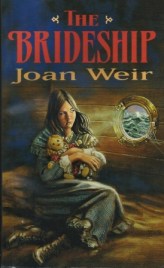
the brideship joan weir 001The Brideship by Joan Weir ~ 1998. This edition: Stoddart, 1998. Paperback. ISBN: 0-7736-7474-8. 218 pages.

My rating: 4.5/10. This one gets a “just missed” from me. It was marred by a seemingly unlikely but at the same time groaningly predictable plot, and a selection of overly stereotyped characters.

I initially questioned the historical accuracy, which didn’t quite ring true to me: a group of teenage girls is apparently sent by the Anglican Church to be prospective brides in the female-starved British Columbia and Vancouver Island colonies in the 1860s. This was indeed correct; I obviously do not know quite as much B.C. history as I like to think I do!

The writing is competent enough but the whole package didn’t do much for me. Some teens may find this an acceptable read, but I would hesitate to recommend it, except for its dramatic focus on a little-known chapter of British Columbia and Cariboo Gold Rush history.

*****

Fifteen-year-old Sarah is an orphan in England in 1862. Uncooperative and outspoken, she is a disruptive presence in the orphanage where she has ended up after the death of her parents and then her uncle, so is recommended with great relief by the orphanage head to join a group of teenage girls who are being sent to the western Canadian gold fields as prospective brides for the miners. This arbitrary emigration is presided over by a (hopefully atypical!) prospective Anglican Church minister, the sinister and vicious Mr. Dubonnet. Sarah’s frail older cousin Maud is also part of the group, as are a number of the usual variety of orphans in this type of fiction, including Lizzie, the cockney ex-pickpocket with a heart of gold, and Arabella, the mean-spirited snooty beauty.

Sarah makes the trip in fine fettle, despite continual run-ins with Mr. Dubonnet and various adventures on board. Poor Maud makes it only as far as the Falkland Islands, before succumbing to her constant cough, as we’ve expected from very early on in the narrative – the girl very obviously has the cloud of doom hanging over her right from the first chapter, with her meek disposition and delicate consitution. The surviving orphans weather the rest of the voyage, which is marked with melodramatic incidents to keep things interesting. They eventually arrive at Vancouver Island, are off-loaded at Esquimalt, and are then shipped up the Cariboo Road to Barkerville.

Sarah refuses to accept her prospective husband, and teams up with Lizzie to start an enterprise of her own as a laundress. Justice in the form of Judge Begbie nails Mr. Dubonnet, true love arrives for Lizzie and Sarah, and everything is looking up as we close the last page.

I was curious as to the verity of the “bride ship” angle, so I did a bit of research, and found that the author did base this tale on true events. See Victoria History – the British Columbia Emigration Society, for a brief discussion.

I’ve included several articles from other sources to balance my not terribly enthusiastic review. The Brideship isn’t a bad book, but compared to other similar works in the genre it is on the lower end of the spectrum, in my one-person’s opinion.

I’ve just been reading Marianne Brandis’ stellar 1830s’ Ontario trilogy of The Tinderbox, The Quarter-Pie Window, and The Sign of the Scales (reviews pending), as well as Suzanne Martel’s The King’s Daughter, following a French fille du roy sailing to Canada from France among a similar shipment of “brides to be” in the 1600s. These other books stand head and shoulders above Weir’s Brideship, at least for this reader, reading like properly engaging novels which just happen to be set in historically important and interesting times versus a packaged up collection of “teachable moments” clothed in stereotype and unlikely melodrama.

*****

In a University of Manitoba author profile, Kamloops, B.C. writer and retired college creative writing instructor Joan Weir talks about some aspects of the process of writing The Brideship.

“Usually when I start, I feel very strongly that, when the whole thing is over, I want to have made some sort of comment that is worth making. (I)n Brideship, I wanted very much to get across the idea for modern kids that, no matter where you find yourself, life’s an adventure and you’ve got to seize the moment and take it and go with and make something out of it… I start with that, and from there I go to character, but I have to know ‘why’ I’m writing the book before I start. I don’t know the ending. I think the ending has to grow out of what happens as your characters suddenly take on a life of their own which is greater than you thought when you started. It’s out of their growth that the ending grows, and very often the ending isn’t what you thought, even in a sort of vague way, that it was going to be at all. It surprised me very much what happened to Lizzie in Brideship. Lizzie becomes almost the strongest character in the book, something I didn’t intend at all when I started. I thought she was going to be very much a secondary character. So many readers, when they talk about Brideship, say, ‘Oh, I really liked Lizzie.’

“In the actual historical story of those girls who came over on the Tynemouth, one girl did die, and I felt committed to put that in because I felt so badly about that poor little orphan, Elizabeth Buchanan, who was buried at sea. Sarah’s cousin, Maud, in Brideship is patterned on Elizabeth. I didn’t dare use Elizabeth’s name because this is fiction, and I didn’t want to get involved in ‘this is true and this isn’t true,’ for Elizabeth didn’t have a cousin with her or someone back in England to marry, as my Maud character does. The Anglican Church organized and sent over three boatloads of girls from orphanages, but the first trip is the only one that there was any sort of information about at all. The conditions were absolutely like I’ve described them in the book. I’ve got an artist’s sketch of the ship which was drawn from pictures on file in the museum. It was a tiny little craft that had over 300 people on it. The girls really were housed down below in the hold compartment with only these little tiny portholes.

“The book’s cover was interesting because often publishers don’t give authors any input at all on covers. Kathryn Cole was wonderful because she sent me sketches of what they wanted to do with the cover which was a picture of Lizzie and Sarah dolled up in Mrs. Worthing’s clothes, with parasols and fancy hats, smiling and tripping around the ship’s deck. When Kathryn asked, ‘What do you think of it?’ I replied, ‘We’ll, it’s a very pretty picture, but I’m afraid that it sets the wrong tone for the book. When you look at it, you’ll think it was a happy journey, and it wasn’t.'” Kathryn then asked Joan for her cover ideas. “‘I would like a picture of Sarah below decks in the storage compartment in which they’re living, looking out that one little porthole. And, if possible I’d like her holding her doll.’ Even though that detail makes Sarah look younger than she is, that doll was the only thing that she owned. I was delighted because the artist did exactly what I wanted. The cover sets the tone, and it was not a happy trip. But, if you’d have had the title Brideship and these girls on the original cover dancing around, you would have thought it was like a Love Boat.

And here is an edited excerpt from the CanLit.ca review of The Brideship.

Four dozen orphans, some of them as young as sixteen, are sent off to the West Coast of Canada on the vague promise that they will find work there. Sarah eagerly volunteers to go; she will do anything to get out of the hated orphanage. An Anglican clergyman has organized the emigration, and this fact alone seems to guarantee that the promised positions will materialize, and that the four dozen girls are in good hands.

Appearances, however, deceive. A few days before their arrival in Canada, the girls find out that “there aren’t as many jobs available” as had originally been thought, and that they are to be “brides instead.” The clergyman, too, is not what he seems: aside from being responsible for deceiving the girls, he is also a thief. He triumphs in the short run, but his dishonesty eventually catches up with him. Sarah, however, never gets to meet the man intended for her. She escapes to Barkerville, sets up a laundry business there, and falls in love with someone she chooses for herself.

The Brideship concentrates more on action than on emotion. Sarah gets somewhat pushed into the background by the question of whether the Anglican Church really did organize shiploads of female orphans under the pretense of getting them positions as governesses, then offering them as brides to the miners working in British Columbia instead. And if, as Weir contends, the answer is “yes,” then one wonders why the author neglects to show some outrage in at least one of the unfortunate “brides.” Not even the heroine expresses any offense at such a monumental deception; she is worried that the husband the clergyman has chosen for her might be a brute, but it does not seem to enter her mind that the clergyman had no right to choose a husband for her in the first place. Although The Brideship has a lot of action, it is short on psychological realism.

Read Full Post »

« Newer Posts - Older Posts »