Archive for August, 2012

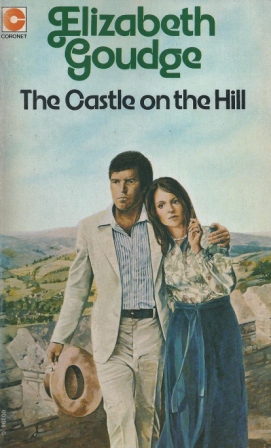
The Castle on the Hill by Elizabeth Goudge ~ 1941. This edition: Coronet, 1975. Paperback. ISBN: 0-340-00396-0. 256 pages.

My rating: 8/10. Rating based on the author’s body of work; I’ve read most of her books, and thought this one was one of the “upper end” in accessibility and lack of long, rambling, philosophical-religious side paths. I enjoyed it.

This is a deeply poignant story, written in the early years of World War II when the outcome was still very much in question, and the author and her fellow countrymen, along with her characters in the novel, were steeling themselves to bravely face their possibly horrific fates under a sea invasion of England. As she penned this novel, Elizabeth Goudge was living in a small country cottage near the village of Marldon, Devonshire with her frail, elderly mother; their days and nights were punctuated by the droning of fighter planes and bombers passing overhead, and the sound of explosions as German bombs exploded in the nearby coastal cities of Torquay and Paignton. Though Marldon itself escaped direct bombing, the inhabitants were extremely aware of their very real danger, and the stresses of living in wartime are very evident in this novel.

*****

Miss Dolores Brown is in a bad place, both literally and figuratively. Her home and source of income, the boarding house she has established in the family home she inherited upon the death of her parents, has been requisitioned by the government for wartime use. A relocation to London and attempts to find a job have proven fruitless; no one much needs or wants a quiet, unassertive forty-year-old woman with only her domestic skills to recommend her. Her friends and relatives are tired of hosting her; she needs to move on. Now news has come that her house and all of her stored possessions have been destroyed in a bombing raid. A train ticket to travel to stay with a relation for a day and a few coins remain between Miss Brown and utter destitution; her predominant emotion is an overwhelming fear of what will happen to her now.

As she sits outwardly proper but inwardly forlorn on a bench in front of the London Free Library, a strain of music catches her ear. Somewhere nearby someone is playing the violin, and Miss Brown rises to find the source of the music, and comes upon Jo Isaacson playing for coins in the street. Miss Brown impulsively puts one of her last shillings in the fiddler’s hat; they have a short exchange, and she goes on her way cheered and encouraged by the brief encounter.

Mr. Isaacson, born in England but musically trained in Leipzig and then settled on the Continent, was once a celebrated musician.  Now fallen on hard times both through his predilection for drinking and the growing persecution of the Jews which forced his flight from Germany, Austria and then Italy, Mr. Isaacson fears that even his old homeland England will reject him next. He has determined to earn a shilling to use in the gas fire in his room to commit suicide; due to Miss Brown’s impetuous generosity, the means to his end is now at hand.

Through a series of coincidences and under the sheltering hand of fate, Jo Isaacson does not use the shilling for his fatal final intention. He ends spending some of it for taking his landlady’s two small children to the train; they are being evacuated to the relative safety of the country. Ending up on the train himself, Mr. Isaacson has set in motion a series of events which will lead to his ultimate attainment of his longed-for place of peace.

In another part of the train, Miss Brown has just met and been taken under the wing of a prosperous historian, Mr. Birley. Mr. Birley has been to London to try to engage a housekeeper for his stately home, Birley Castle, and its household of men: himself, nephews Richard and Stephen, respectively a dashing fighter pilot and an emotionally tormented pacifist conscientious objector, and butler Boulder and gardener Pratt. Not to mention the elderly Alsatian dog Argos, and Steven’s fiery horse, Golden Eagle. But once Miss Brown has unburdened herself of her tale of woe to sympathetic Mr. Birley, he looks at her with calculating surmise. Could she, would she… ?

She certainly could and would. Bucked up by sympathy, a substantial dinner and the prospects of a job, Miss Brown brightens up considerably, and optimistically tackles the daunting task of bringing order to a heedless masculine world.

Meanwhile the two daughters of Mr. Isaacson’s landlady are also on their way to Torhaven, location of Birley Castle, to be billeted with a foster family there, as is Mr. Isaacson himself, who has been taken under the wing of Mr. Holly, the railway guard who discovered him collapsed in the baggage car after the express train left London. Mr. Holly offers him a chance to get settled and find a job “somewhere near the kiddies” – he has mistakenly thought that the children Mr. Isaacson was escorting are his own.

Add in Prunella, the lovely doctor’s daughter who has been the romantic interest of first peaceful Stephen and now exciting Richard, and elderly Mrs. Heather, endlessly smiling inhabitant of the cottage at the Castle gates, and you have all the players assembled on the stage.

Elizabeth Goudge loves to bring her characters together by impossibly convenient coincidence, and this novel is a prime example. The two little girls are billeted at the Castle, and Miss Brown eventually meets Mr. Isaacson; they are united in common memory and relief at each finding at least a temporary haven. Mr. Isaacson is modestly successful as a street musician and music teacher, and Miss Brown has settled nicely into her niche as the housekeeper of the Castle.

Mr. Birley returns to his creative solitude untroubled by household concerns; Stephen prepares for his upcoming hearing to allow him to avoid military service by working at rescue and recovery in the bombed sections of London; Richard comes and goes between missions, dallying with the passionate Prue whenever chance allows; Miss Brown wins over the initially hostile Boulder by her gentle good nature and hard work; Pratt gets on with things much as usual; Mrs. Heather keeps smiling.

Tragedy and turmoil turn this newly peaceful world upside down, and the responses of all concerned show the best qualities that lie buried in everyone to be brought forth under adversity, another favourite Elizabeth Goudge theme.

This condensation leaves out everything that makes this book so appealing: the glimpses into the inner thoughts and deeper motivations of every character involved. Stephen is handled particularly well as he wrestles with his decision to be a non-combatant; his brother and uncle are fiercely and actively patriotic, and though they treat him with respect and affection it is clear that they are impatient rather than understanding of his dilemma.

The character of the quiet and dedicated Miss Brown serves to highlight the divisions and expectations of the class system, soon to be changed forever by the new equality of the war and post-war years. She feels something more than subservient and feudal affection for the Birley family; they however regard her as an appreciated and respected but somehow not-quite-equal being. Miss Brown hides her feelings well; her pride lets her go forward with head held high even when the oblivious Birleys unintentionally disregard her occasional attempts at a deeper friendship.

Mr. Isaacson resolves his feelings of anger towards the world and its unfairness and is able to move onward in his life. (And I would like to mention that I thought he was one of the most awkward characters, as his creator did not seem sure of how she should portray him – he is inconsistent throughout, one moment gruff and earthy, and the next full of academically poetic musings.)

Elizabeth Goudge likes to sort out her couples and pair them off in their proper order. Children are inevitably provided with the best possible homes; damaged marriages are salvaged; family rifts are healed; happy spinsters and bachelors regain their peaceful solitude and worthwhile occupations. The Castle on the Hill runs true to form, but it has much to recommend it in its thoughtful passages and articulate characters. The setting is lovingly described, and most of the characters are fully realized and allowed their chance to show their full and complex humanity.

Given that the book was written in wartime, in the very time that it portrays, it acts as an interesting and quite readable realistic-idealistic period piece. The horrors and tragedies of the war are true to life; the human response of the heroes and heroines is certainly the ideal.

The last few pages have numerous references to the comforts of religion and the role of God in human lives, but this is not at all a “preachy” book.  I thought it was one of the less rambling and more focussed adult novels by this often-underrated writer. I could definitely see shades of some of the characters of Goudge’s most well-known and beloved books, the Damerosehay novels (The Bird in the Tree – 1940, The Herb of Grace – 1948, and The Heart of the Family – 1953) which were written during and after the war years; The Castle on the Hill is something of a dress rehearsal, though it stands alone as a story complete unto itself, with characters whom we never again meet, though their soul sisters and brothers reappear in different guise in her many other books.

Note: I am here including, with some reluctance, the cover shot from the 1975 paperback re-release. The cover at the beginning is from an earlier edition. I am not sure who these illustrated people are supposed to portray; in my opinion they do not represent actual characters of the story, but instead have strayed onto the cover from an Eaton’s mail-order catalogue, Misses and Gents section, circa the polyester era! Quite one of the ugliest covers possible for this book, and not at all indicative of the content. A dire reminder not to judge a book by its outward appearance!
Read Full Post »

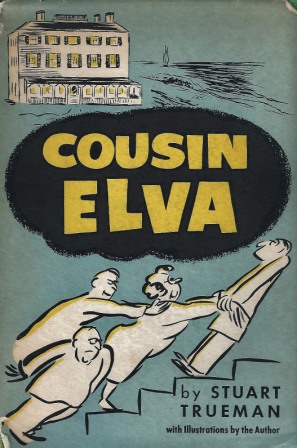
Cousin Elva by Stuart Trueman ~ 1955. This edition: McClelland and Stewart, 1955. First edition. Hardcover. 224 pages.

My rating: This is tough. I almost was going to say un-rateable, but on second thoughts I will give it maybe a 5.5/10. It’s a first book, and the author went on to write many more. There’s nothing really wrong with it, and I did read it with mild enjoyment, but I found it very easy to put down and I had to consciously pick it up and finish it. Probably a keeper, but on the bottom shelf or exiled to the “B”-reads boxes, I’m thinking.

*****

Cousin Elva is a humourous, satirical light novel about a fictional couple, Penelope and Frank Trimble, who purchase a large house in the (also fictional?) community of Quisbis on the Bay of Fundy, and proceed to open a boarding house – “Mr. and Mrs. Trimble’s Tourist Rest Haven”. The only catch is that the house comes with a pre-existing resident, Miss Elva Thwaite, granddaughter of the original owner.

Miss Thwaite, or “Cousin” Elva as she insists on being called, is a blatantly eccentric, sixty-ish,”old maid” who refuses to be put on the shelf, taking an active interest in everyone and everything that crosses her path. She’s also keen to catch herself a man. Hi-jinks ensue as a motley assortment of visitors to Trimble’s Rest Haven fall into Cousin Elva’s clutches.

The humour is, at its best, rather understated and wry, but too often over-the-top farcical. I did enjoy the many regional and Canadian references; those did much to keep me reading when I occasionally got overloaded with the slapstick action.

A well-meaning attempt by an author new to me. The kind of book you perhaps enjoy best when scanning the meagerly stocked shelves at an isolated lakeside cabin in summer. In other words, welcome if you’re fairly desperate for amusement and it’s too far to go to town…

Stuart Trueman (1911-1995) was a Canadian writer from New Brunswick. He won the Steven Leacock Memorial Medal for Humour in 1969. I had never heard of him before picking up this book, but as you can see from his biography he had a long and prolific writing career. I would definitely be interested in reading some of his other work, but only if it was easily obtainable; I don’t think I’d go to a lot of effort to seek it out.

From the New Brunswick Literary Encyclopedia:

Stuart Trueman (writer, editor, historian,  reporter, cartoonist, and humorist) was born in 1911 in Saint John, New Brunswick,  the son of the late John MacMillan and Annie Mae (Roden) Trueman. He was  the husband of Mildred Kate (Stiles) and a father to Mac and Douglas, his two  sons; he was also a grandfather of four, and a great-grandfather to one.  Growing up, he had two sisters and three brothers, along with a countless  number of friends whom he believed shaped him into the man that he was. He  passed away in his home in Saint John,   New Brunswick, on 25 April 1995  after a period of failing health.

Trueman was known  for being a great representative of journalism, and he garnered a lot of  respect and credibility in all that he accomplished. Straight out of high  school, he started out as a cartoonist and reporter at the Telegraph Journal in Saint    John, where he stayed for forty-two years, later  becoming a sports writer. In 1951, Trueman became the editor-in-chief at the Telegraph Journal and Evening Times Globe, a position that he  would hold for the last twenty years of his working career. Upon retirement in  1971, he remained faithful to the newspapers that he had been involved with and  continued to contribute to weekly columns until 1993. He took writing, journalism,  and public speaking seriously, and had a keen insight into human character. He  was also known for being a stickler for details, always following the journalist’s  obsession with the “who,” “what,” “where,” and “how.”

Trueman was often  referred to as “Mr. New Brunswick”  because of his broad knowledge of the history of this province and of its  scenic and cultural attractions. He wrote many books about New Brunswick, its people, and its unique  history. Along with being a well-known author, Trueman was a part of New Brunswick history.  On 19 May 1932, he and co-worker Jack Brayley interviewed Amelia Earhart at the  Saint John Airport  as she was preparing for her historic flight across the Atlantic.  Another accomplishment for Trueman was when he and Brayley took a trip to Moncton, New    Brunswick, where they discovered an attraction that  many are familiar with today: Magnetic Hill. Trueman’s son Mac said that  despite the fame and development that has built up around Magnetic Hill, it was  always his father’s favourite natural phenomenon. The discovery of Magnetic  Hill gave way to the tourism industry within New Brunswick,  and it continues to be one of New    Brunswick’s most popular attractions.

Trueman published  fourteen books and wrote more than three hundred humorous articles for both  Canadian and American magazines. He thought of these articles as “light pieces,”  and although he never claimed they were funny, he was commonly referred to as a  funny man. One of his greatest accomplishments was winning the Stephen Leacock  Memorial Award for humour in 1969 for his book You’re Only as Old as You Act (1968). Other books Trueman produced  include: Cousin Elva (1955); The Ordeal of John Giles: Being an Account  of his Odd Adventures; Strange Deliverances, etc. as a Slave of the Maliseets (1966); An Intimate History of New  Brunswick (1970); My Life as a  Rose-Breasted Grosbeak (1972); The  Fascinating World of New Brunswick (1973); Ghosts, Pirates and Treasure Trove: The Phantoms that Haunt New  Brunswick (1975); The Wild Life I’ve Led (1976); Tall Tales and True Tales from  Down East: Eerie Experiences, Heroic Exploits, Extraordinary Personalities,  Ancient Legends and Folklore from New Brunswick and Elsewhere in the Maritimes (1979); The Colour of New Brunswick (1981); Don’t Let Them Smell the Lobsters Cooking:  The Lighter Side of Growing Up in the Maritimes Long Ago (1982); Life’s Odd Moments (1984); and Add Ten Years to Your Life: A Canadian  Humorist Looks at Florida (1989). Many of his books include light-hearted  stories that have been adapted from Trueman’s popular columns in the Telegraph Journal, Weekend, and the Saturday Evening Post.

Trueman’s wife,  Mildred, played an important role in his overall success as an author in New Brunswick. She  supported him throughout his career, and the couple collaborated on two  cookbooks: Favourite Recipes from Old New Brunswick Kitchens (1983) and Mildred Trueman’s New Brunswick Heritage Cookbook: With  Age-Old Cures and Medications, Atlantic Fishermen’s Weather Portents and  Superstitions (1986).

Amanda Palmer     St. Thomas University

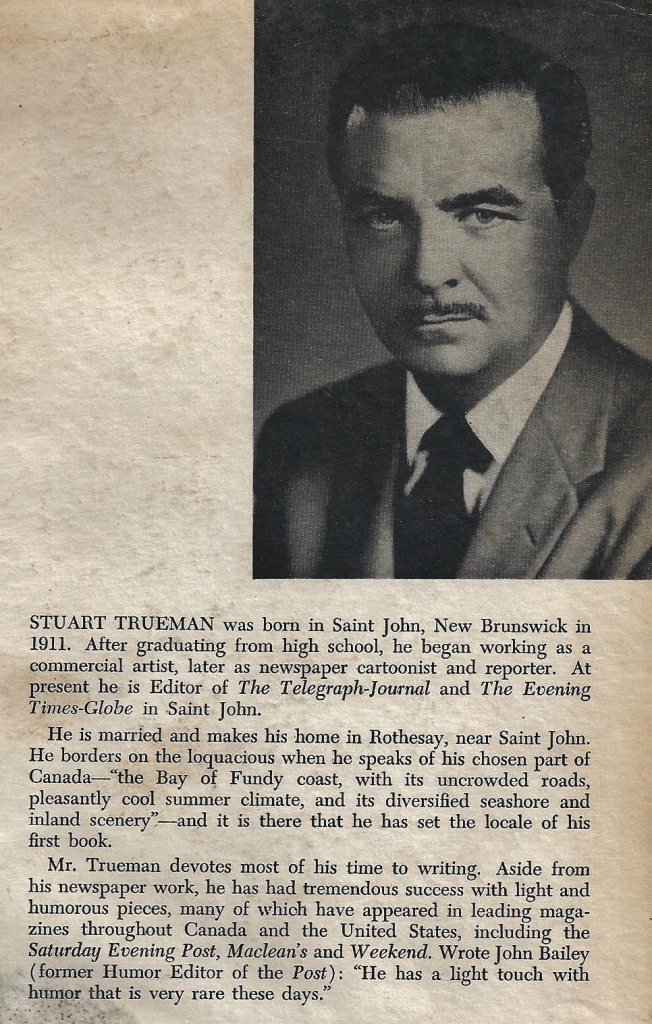
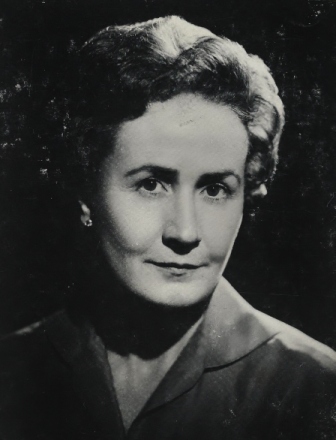
And here is the author photo and biography from the back cover of Cousin Elva:

Read Full Post »

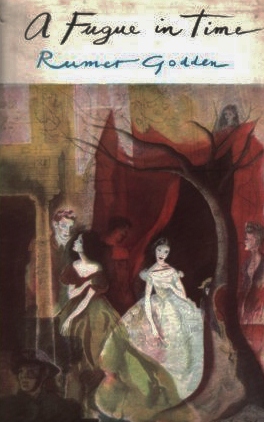
Take Three Tenses: A Fugue in Time by Rumer Godden ~ 1945. This edition: Macmillan, 1976. Hardcover. ISBN: 333-19366-0. 176 pages.

My rating: 6.5/10 for the overall story, 10/10 for the writing. The first rating really should be higher but I am comparing it to its successor, China Court (1958), which used the same idea expanded to five generations, with a much stronger story thread. This one felt a bit experimental, which the author herself notes. It took a few pages to get into the rhythm and figure out all the characters, but after that it was easy to follow, perhaps because I am already very familiar with this author’s use of concurrent and intertwining times in many of her novels. An unusual and ambitious book. Beautifully written.

*****

This book is prime Rumer Godden; an example of why I keep returning to her works time after time; as I’ve mentioned before, even a “poor” Godden is worth the time it takes to read it; her “top end” books are little masterpieces.

Take Three Tenses: A Fugue in Time is, in my opinion, almost a little masterpiece, or perhaps more aptly, the not-quite-finished work of a master artist, still needing a few final touches, but interesting to examine in the context of the artist’s body of work, to get a glimpse into how their mind works. A very experimental piece of work, and decidedly the precursor of the much longer and stronger China Court, which isprobably my favourite Rumer Godden book to date, though I still need to search down a few of her more obscure titles. Though China Court uses the same technique and many similar characters, Take Three Tenses is an entirely different story, except possibly for the theme of the importance of the house itself as a character with a life of its own.

Originally published in 1945, and with the War itself driving much of the story, this novel was reissued in 1975 with this note by the author:

This novel was the first in which I used a theme that has always intrigued me, Dunne’s Experiment With Time, i.e., that time is not consecutive, divided into past, present and future, but that these are all co-existent if only we could see it: if you are in a boat on a river you can only see the stretch on which your boat is travelling – a picnic party on the bank perhaps: a kingfisher diving. What you traversed before, passing willows, a barge tied up, cows in a field, as far as you are concerned, is gone; what lies around the next corner – a lock working, a man fishing – is hidden but, were you up in an aeroplane, you could see all these at once – the willows, the barge, the cows, the picnic party, the diving kingfisher, the lock, the man fishing.

In a Fugue in Time I have taken the part of being up in the aeroplane, seeing three generations of a family at once, all living in a house in London, their stories interweaving, as do themes in a fugue. The difficulty was, of course, not to confuse the reader and it was not until the eighth or ninth try that I found the right way; that it was right seems shown by the fact that, with few exceptions, neither critics nor readers have noticed it, only what Chaucer calls “the thinne subtil kinittinges of thinges”. Some years later I used the same technique with five generations, not three, living in a country house, China Court.

September 1975 R.G.

And from the frontispiece:

…two, three or four simultaneous melodies which are constantly on the move, each going its own independent way. For this reason the underlying harmony is often hard to decipher, being veiled in a maze of passing notes and suspensions…. Often chords are incomplete: only two tones are sounded so that one’s imagination has to fill in the missing third tone.

A SENTENCE DESCRIBING BACH’S FUGUES WRITTEN BY LAWRENCE ABBOT

*****

And for Rolls personally the poem he found:

Home is where one starts from. As we grow older
The world becomes stranger, the pattern more complicated
Of dead and living. Not the intense moment
Isolated, with no before and after,
But a lifetime burning in every moment
And not the lifetime of one man only
But of old stones that cannot be deciphered.
There is a time for the evening under starlight,
A time for the evening under lamplight
(The evening with the photograph album).
Love is most nearly itself
When here and now cease to matter.
Old men ought to be explorers
Here or there does not matter
We must be still and still moving
Into another intensity
For a further union, a deeper communion…
…In my end is my beginning.

T.S. Eliot (East Coker)

*****

Man that is born of a woman has but a short time to live…He cometh up, and is cut down like a flower; he fleeth as it were a shadow, and never continueth in one stay.

Children and the fruit of the womb are a heritage and a gift …. Like as arrows in the hand of a giant even so are the young young children.

THE BOOK OF COMMON PRAYER

*****

The story starts with the disclosure that a house that has been home to a family for almost a century is about to be pulled down as soon as the ninety-nine-year lease is up. The elderly lone occupant, apparently the last survivor of a once flourishing family, Sir Roland (Rolls) Dane, is shocked and appalled at the thought of having to give up his  home.

The house, it seems, is more important than the characters. ‘In me you exist’,’ says the house.

For almost a hundred years, for ninety-nine years, it has enhanced, embraced and sheltered the family, but there is no doubt it can go on without them. “Well” the family might have retorted, “We can go on without you.” There should be no question of retorts nor of acrimony. The house and family are at their best and most gracious together.

The question of their parting had arisen. The lease was up. “And the owners are not prepared to renew,” said Mr. Willoughby, putting his despatch case on the table.

“But they can’t pull down my house!” cried Rolls; but he cried it silently because he was perfectly sensible of the fact that they could and that it was not his house. He was sensible, and at the same time he was outraged. Outraged he said in a voice that was muffled for all its calm, “I don’t want the family to go out of the house.”

The only remaining family was Rolls himself, but Mr. Willoughby could hardly point that out. He wondered what there was slightly unusual about the sentence Rolls had just said, and presently, pondering, h thought it would have been more usual if Rolls had said, “I don’t want the house to go out of the family.” Families possessed houses: not houses the family…

So Rolls reluctantly accepts his fate, and, with his manservant Proutie (himself a life-long devotee of No. 99 Wiltshire Place), slowly starts to prepare for the unthinkable change.

And here the author sets the stage and starts to introduce the many characters whose lives and times make up the story’s “fugue”. We don’t yet know who they are or how they fit in, but their names are teasingly mentioned: Selina, Lark, Verity, Griselda…

In the house the past is present.

It is the only house in the Place that has a plane tree in the garden; for many years a Jewish family lives next door, and every year on the Feast of Tabernacles they would ask for the branches of the tree and built a little Succah on their balcony. All the houses have balconies, long ones across the French doors of the drawing-rooms at the back, and all the balconies have scrolled iron steps that lead down into the garden. The gardens are narrow and long, various in their stages of cultivation and neglect, heavily sooted as well. The gardens have an unmistakable London smell from the closed-in walls, and the earth that is heavy and old, long undisturbed; the smell has soot in it too, and buried leaves, and the ashes of bonfires, and the smell of cat; any child, sent out to play, comes in with the smell; it is part of the memory of Selina and Rolls and the other children and Lark…

The roots of the plane tree are under the house. Rolls likes to fancy sometimes, lately, that the plane tree is himself. ‘Its roots are in the house and so are mine,’ he said. …He flattered himself. The plane tree is more than Rolls, as is another tree of which Rolls is truly a part: it is a tree drawn on parchment, framed and hung over the chest in the hall by the grandfather clock. Selina draws it, marking the Danes in their places as they are born and die, making a demarcation line in red ink for the time they come to live in the house in the autumn of eighteen forty-one.

“We existed before you, you see,” the family might have said to the house; and the house, in its tickings, its rustlings, its creaking as its beams grow hot, grow cold: as its ashes fall in its grates, as its doorbells ring, as the trains in passing underneath it vibrate in its walls, as footsteps run up and down the stairs; as dusters are shaken, carpets beaten, beds turned down and dishes washed; as windows are opened or shut, blinds drawn up, pulled down; as the tap runs and is silent; as the lavatory is flushed; as the piano is played and books are taken down from the shelf, and brushed picked up and then laid down again on the dressing-table, and flowers are arranged in a vase; as the medicine bottle is shaken; as, with infinite delicate care, the spillikins are lifted in the children’s game; as the mice run under the wainscot the house might steadfastly reply, “I know! I know! All the same, in me you exist.”

And against the melodious pattern of the house and its many inhabitants there comes a stronger strain, as the story of the current time appears and plays itself out, with continual references to what lies before and behind. The doorbell rings, and Proutie announces the appearance of an unsuspected great-niece, Grisel Dane, come to England in this early year of the war as a member of a volunteer corps of woman ambulance drivers. Grisel is unhappy in her billet, and has remembered that she has a London relative. Savagely resentful of this disturbance, Rolls refuses to see her, but Grisel is fully as determined a person as her great-uncle, and she moves in to one of the empty bedrooms, determined at first merely to gain some physical comfort in, but soon becoming immersed in her ancestral family’s history for the few months remaining before the move.

Another important family connection also appears, and the inevitable love story plays itself out to the backdrop of the increasing violence of the war. We sense that an inevitable doom of some sort is coming, but we are not sure quite who or what will be lost.

Rumer Godden creates some well-drawn characters among the Danes and their associates. I found Griselda, mother of Rolls and his eight siblings, the most appealing of them all, with her yearnings for a larger world than that which she is trapped in, and her eventual attainment of a rich inner life which compensates in a small way for her over-possessive husband, her long succession of loved and cared-for yet not particularily welcome children, and the continual frustrations of her life as a Victorian upper class woman with strong societal strictures of behaviour to follow.

The strength of this book is in its style rather than its plot or characters; while they are well enough handled, they are secondary to the overall pattern. I almost think that this is intentional on the author’s part, but I was disappointed in her handling of the conclusion; it felt a little too pat; everything came predictably full circle. I fully understand the satisfaction that the author might feel in neatly winding things up, but sometimes a strong, even discordant climax is more memorable to even the most melodious composition than an easily anticipated, repetitive ending phrase.

Highly recommended for Rumer Godden fans, especially if you liked China Court. One of the lesser-known works of this author; I had something of a challenge finding a reasonably priced copy; they’re out there but in nothing like the abundance of many of her other titles.

Read Full Post »

The Ideal and the Actual Life


Forever fair, forever calm and bright,

Life flies on plumage, zephyr-light,

For those who on the Olympian hill rejoice—

Moons wane, and races wither to the tomb,

And ‘mid the universal ruin, bloom

The rosy days of gods—With man, the choice,

Timid and anxious, hesitates between

The sense’s pleasure and the soul’s content;

While on celestial brows, aloft and sheen,

The beams of both are bent.


Seekest thou on earth the life of gods to share,

Safe in the realm of death?—beware

To pluck the fruits that glitter to thine eye;

Content thyself with gazing on their glow—

Short are the joys possession can bestow,

And in possession sweet desire will die…


Friedrich Schiller, circa 1790

(Poem fragment, translated from the German.)

*****

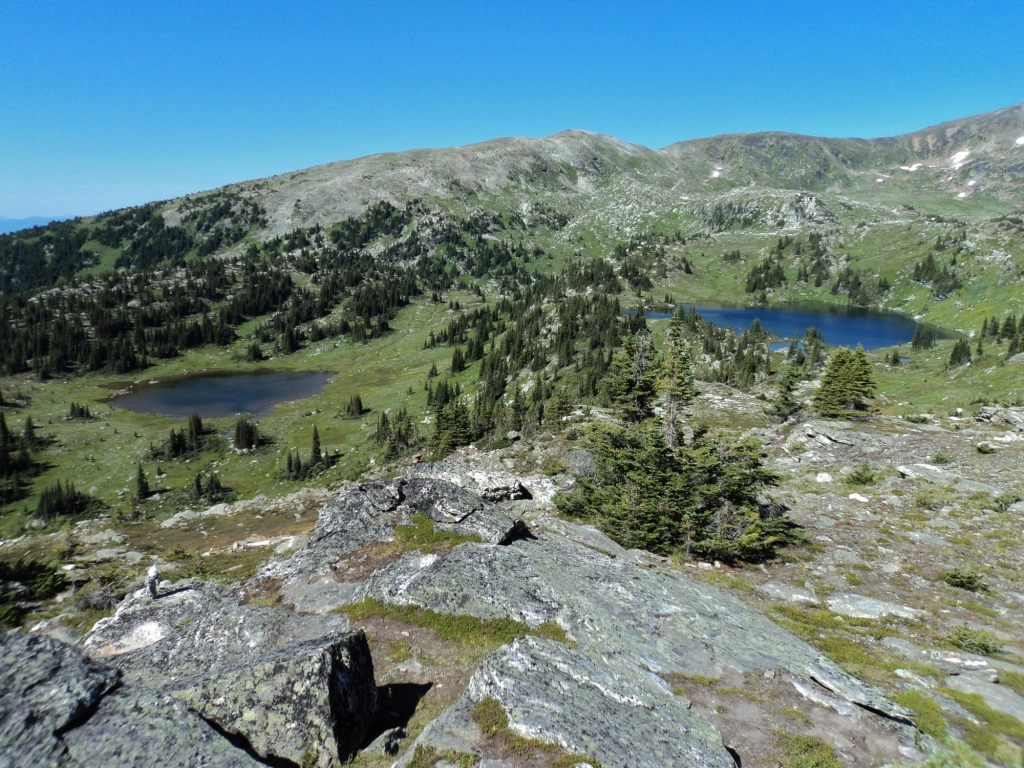
We have been up to our mountaintop and safely – though sore-footed! – back down. Home late last night and today we are, in memory, still walking among the heights, not wanting to return to the prosaic world quite yet. It is seldom that the fulfillment of a small dream is better than hoped for; this was one of those rare occasions. The ideal and the actual, at one with each other!

Read Full Post »

Sonnet III

Not with libations, but with shouts and laughter
We drenched the altars of Love’s sacred grove,
Shaking to earth green fruits, impatient after
The launching of the colored moths of Love.
Love’s proper myrtle and his mother’s zone
We bound about our irreligious brows,
And fettered him with garlands of our own,
And spread a banquet in his frugal house.
Not yet the god has spoken; but I fear
Though we should break our bodies in his flame,
And pour our blood upon his altar, here
Henceforward is a grove without a name,
A pasture to the shaggy goats of Pan,
Whence flee forever a woman and a man.
 

From Second April, 1921

Edna St. Vincent Millay

*****

Tomorrow is our 25th wedding anniversary, and we are off to celebrate by hiking up a mountainside. This space may be quiet for a few days, as we ramble together, revisit favourite places, and reminisce far from the wired-in world.

Read Full Post »

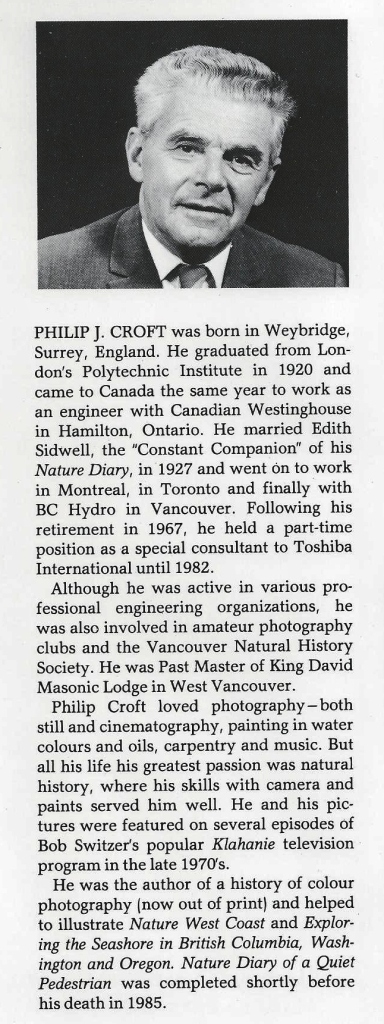
Nature Diary of a Quiet Pedestrian by Philip Croft ~ 1986. This edition: Harbour Publishing, 1986. Hardcover, illustrated by the author. ISBN: 0-920080-87-1. 141 pages.

My rating: 8/10. Occasionally a tiny bit stilted as the author tries hard to keep up his literary momentum, but for the most part the prose flows along just fine. An appealing glimpse into one man’s life, and into the natural history of his personal world.

*****

I spent some days in the Vancouver area earlier this week, and though my free time was limited I did manage to visit several used book stores – used bookstores? used-book stores? – for some reason this does not look right this morning! I am still a bit groggy from sleep, and this is very much a stolen hour at the start of what promises to be a very busy day… Anyway, on the holiday Monday (B.C. Day) evening, when most of the interesting small shops were closed up tight, I nipped into the Langley Value Village to browse their large book section, and, casting about for that elusive 5th book – the “freebie” – this one just sort of slid off the shelf at me in a shyly appealing “Hey, look at me” sort of way. From the title I was thinking – “Hmmm, probably British, another one of those made-for-tourists, Edwardian Lady take-offs, get ready to put it back…” so imagine my delight in finding that it was instead a very appropriate British Columbia book, written about the very region I was visiting.

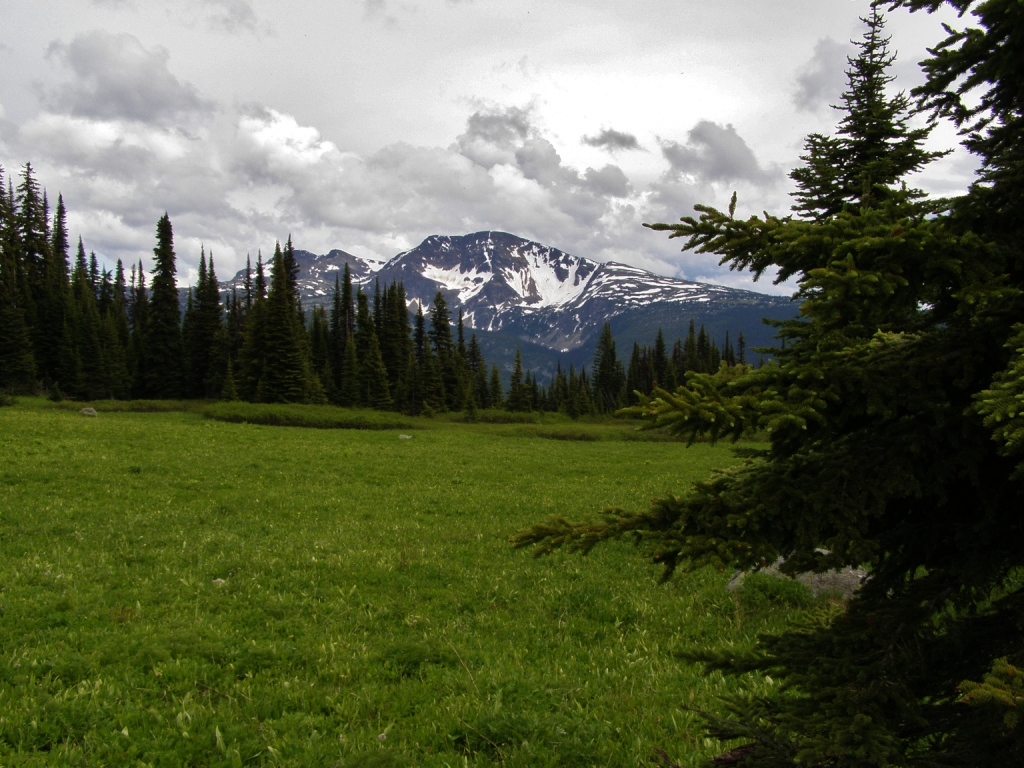
Amateur naturalist Philip Croft kept a diary of his regular daily walks through his West Vancouver neighbourhood, through a section of forest and down to the beach. Blessed with a keenly observational eye, an artistic hand for illustration, and a gentle sense of humour, Mr. Croft’s year as recorded in this handsome book is very readable indeed. I have visited the coastal areas of B.C. enough to be generally familiar with the setting, but I have often been curious as to some of the interesting plants, insects and seashore creatures unfamiliar to me as a native of the very different, dryland fir zone interior of the province. I found myself browsing through the book in my next few evenings in my hotel room, during breaks from my delighted absorption in The Benefactress by Elizabeth von Arnim.

From the Preface:

I am an inveterate pedestrian. I walk daily for pleasure, exercise and control of the waistline. But mostly for pleasure… I like to walk alone: I prefer to be a quiet pedestrian, to walk and think, not walk and converse. In this respect my hour afoot is apt to be the most useful and productive hour of my day, for it is a time in which I am able, to a measured footfall, to think many things through uninterruptedly, to a logical or practical conclusion… It is my time for meditation and reflection…

…It is not necessary to travel to the out of the way wilderness areas of our province to be confronted by the year-long pageant of natural events in the life cycles of common plants, insects, birds and animals. It is surprising how many species inhabit roadside ditches, patches of woodland, vacant lots, railway embankments and cuttings and similar waste places throughout our area. By following the same limited selection of routes day after day, week in and week out throughout the year, one is enabled to note every phase in the development of wild plants as they spring, grow, flower, seed and make their appearance; when the birds that feed on the insects appear and when they congregate for their annual migrations… a never-ending source of wonder and pleasure…

Something that never ceases to please me is the abundance of natural life surviving and thriving in pockets of our crowded cities; as a dedicated country-dweller who enjoys occasional immersion in city life, I always give silent homage to the urban dandelions growing through cracks in the sidewalk, the fireweed colonizing the sagging roofs and windowsills of derelict buildings, the small birds opportunistically gleaning the road-killed insects from the grills of parkaded cars. And though I view the rural areas as my natural habitat, I have also lived in towns and cities; long enough to appreciate what Mr. Croft is speaking about; that nature surrounds us and goes about its inevitable business quietly and inexorably; if we pause for a moment now and then we can get much joy and encouragement from the steady adaptation of all sorts of organisms in our concrete-filled urban worlds.

This quick trip I noticed the ripening masses of blackberries, the last few foxglove flowers on their impossibly long, seedpod-lined stems, and the forests of Himalayan impatiens and buddleia along the roadsides. Parked in a busy industrial area, waiting for my daughter to emerge from a cavernous, ex-warehouse dance studio, I noticed several small brown rabbits lolloping among the blackberry vines at the edge of the parking lot. A large transport truck pulled up; the driver emerged holding a small plastic container and, without hesitating a moment, went bravely into the thorny thicket and started to pluck the berries; one in the mouth, one in the tub… I chuckled to myself and mentally went through my own belongings; sadly I had no suitable container or I might have joined him!

What joy to then read about Philip Croft’s August ode to walking in blackberry time, taking along a container to fill on the return trip to be subsequently made into a delectable pie, and his investigations of bumblebees pollinating the ubiquitous impatiens! The writer documents his observations, and enriches the narrative with philosophical mullings over of the state of the world and of human endeavour.

This book will join my collection of B.C. natural history titles which we delve into beforehand and take with us on trips and refer to later to answer queries triggered by things we see in our travels. A most enjoyable read. Mr. Croft must have been a delightful person to know; I am glad I stumbled across his natural history memoir.

Read Full Post »

One Woman’s Arctic by Sheila Burnford ~ 1973. This edition: McClelland and Stewart, 1973. Hardcover. ISBN: 0-7710-1825-8. 222 pages.

My rating: 7/10.

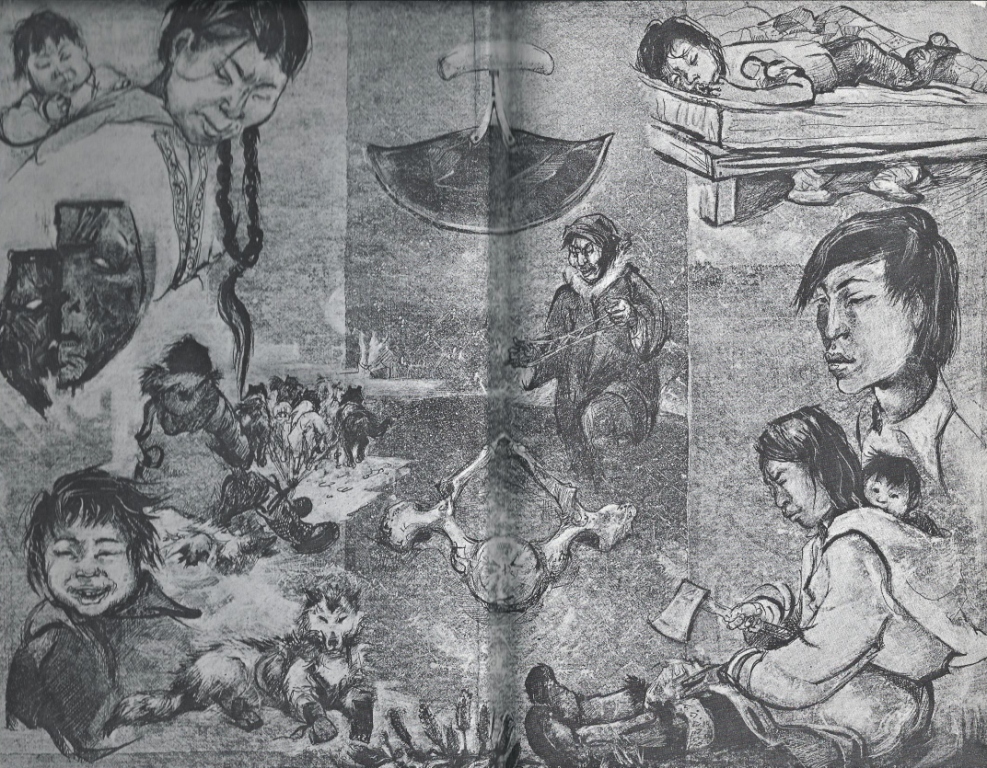
This is the account of writer Sheila Burnford’s personal impressions of two summers spent in and around Pond Inlet on Baffin Island, in 1971 and 1972. Burnford had received a Canada Council of the Arts grant to gather material for a book; she accompanied celebrated artist Susan Ross who had been commissioned by the Royal Ontario Museum to create work for an exhibition of art depicting Indian and Eskimo life. The two were longtime friends and travelling companions, having previously spent time living together among the Ojibway of northern Ontario, which she wrote about in 1969’s Without Reserve.

This was a time of cultural shift, as the Inuit embraced and were influenced by modern culture and innovations, while still practicing their traditional way of life to a great extent. Burnford describes her personal impressions, and occasionally tries to pat the larger picture into context, but this is exactly what it says it is in the title – one person’s take on a place too large and complex for generalities to be made, though of course the author occasionally writes as though her observations and conclusions about this small piece of the Arctic apply more broadly. In general, the author keeps to her mandate, which is to tell us about her impressions during her short excursion into the far northern world.

Though it took me a while to work my way through it, now that I’ve completed it I find that ultimately I liked this book, and I enjoyed filling in a few more of the pieces of the author’s life. But it could have been better. What Burnford did so well in The Fields of Noon, though, was talk about herself, her life, her childhood, her family; always in reference to her subject, which made that collection of memoirs so very readable. In One Woman’s Arctic there seems to be more distance between writer and subject, while at the same time the tone is uneven – we’re never sure what “voice” the writer is using because she shifts around so much.

Burnford sometimes maintains an onlooker’s dispassionate view, describing the landscape and the animals and the indigenous people of the small part of the Arctic she visits with a writer’s eye, painting pictures with words. These episodes are very nicely done indeed, and I found that my vision of the scenes from her words were borne out by the pictures I later searched out of the places she visited. Burnford had a rare ability to capture the visual in words.

The weakest parts of the book were when Burnford left the realm of observation and description and ventured into the difficult area of analysis of what she is seeing in regards to the behaviours and motivations of the Inuit (“Eskimos”) she came into brief contact with, or, in the case of the two white mens’ graves at Quilalukan, researched in some depth. Sometimes, as John Mutford points out in his own not particularly favorable review of this book – One Woman’s Arctic by Sheila Burnford – The Book Mine Set Review – the writer falls into the “white man bad/Eskimo good by default” trap. But I felt that she salvaged the situations where she did this by continually acknowledging that she didn’t know if her interpretation was correct; that she was mulling over the situation and trying to make sense of it from her perspective as a very superficial onlooker, and a member of the invading, paternally patronizing race. Burnford never seems to lose sight of the fact that she is a visitor in an alien landscape, and that her comfort and safety rely on the kindness of others.

The episodes I enjoyed the most were when Burnford described the individuals she travelled and stayed with and got to know more intimately. The residents of Pond Inlet, where Burnford and her companion, artist Susan Ross, made their home base in the community’s kindergarten building, are described in lively anecdotal style; Burnford remarks on the fact that no one seems to have anything bad to say about each other, and that she thinks that this is the result of conscious effort on their parts. Referring to the non-Inuit residents of Pond Inlet, the group she and Ross associated with and socially fit in with:

Those who lived here all year round whether teacher, nurse, game warden, R.C.M.P. or administrator, had seemingly developed a safe preservation of peace (outwardly, anyway) attitude to their fellows. One very, very seldom heard any criticism of personalities, but only he/she is so nice/does so much/is wonderful at/ – etc. Occasionally, because one’s antennae were more acutely tuned through being an outsider, one was conscious of tension between certain individuals, but this was rare. I gathered that they had all worked it out during the six months of twenty-four hour darkness…Activities, such as bridge, over which people in cities can tend to become rather maniacal sometimes, were recognized as potential trouble-makers and avoided; and anything involving competition. A good, safe activity, capable of being shared, arousing no jealousy or competition, was that of photography: practically everyone was madly interested in this, and many did their own developing and printing. I have never seen such an impressive array of Hasselblads, Pentaxes, Leicas, etc. as I had up there.

Another contributing factor of harmony – which of course had its overall impact on the general community – was the average age, which was around thirty or under. An age more exposed to today’s precepts of ‘doing your own thing’ and Make Love Not War – precepts very much more in line with the outlook of the Inuit, who have always been a non-aggressive people; and also an age which avoids that difficult menopausal age group, universal elsewhere among those who have made it up to positions of authority, during which strife is commonplace and mayhem (verbal or otherwise) frequent…

An interesting take on the situation, especially as Burnford and Ross were older than the Pond Inlet “white person” average, being in their mid-fifties; one wonders if the menopausal comment was coming from personal experience, or merely through prior observations in the southern world!

Also very readable were the descriptions of the archeological dig at Button Point on Bylot Island under the auspices of the venerable Father Guy Mary-Rousselière; Burnford was present at the discovery of the second Dorset culture (A.D. 500-1000) shaman’s mask found at that site and vividly describes the unique challenges of archaeological exploration in a permafrost zone. Dorset Masks – Canadian Museum of Civilization Treasures Gallery

I found One Woman’s Arctic to be interesting read from my perspective as someone who has never personally experienced the Arctic, though I found it easier to lay aside and read other things concurrently than I did with her other memoirs, Without Reserve and The Fields of Noon. Even though it has some unresolved and unsatisfactory conclusions about northern life and Inuit culture, I think there is much to learn from Burnford’s observations, purely on the natural history aspect of the area she visited. Her descriptions of the human impact on the area, both Inuit and white, are frank and outspoken; Burnford may be looking through wishful rose-coloured glasses occasionally, but she mostly has them off, the better to turn a sharp eye on the details of her surroundings, and she is not afraid to share what she sees.

A snapshot of a time and place now lost in time, from the perspective of a thoughtful and very individual observer. The quality of the writing is excellent through most of the book, though there are occasional awkward phrasings and strangely punctuated passages which I suspect point to lapses on the editor’s part; Burnford, from my past experience with her work, is an accomplished writer not prone to sloppiness.

I would recommend this book to anyone interested in exploring the different regions of Canada, and in particular the far north, though with a reminder that it should be kept in context as one individual’s impressions, and is, unavoidably, now very dated, being written forty years ago.

Read Full Post »

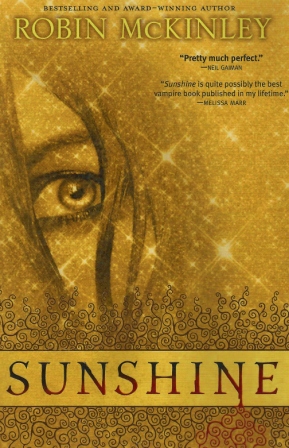
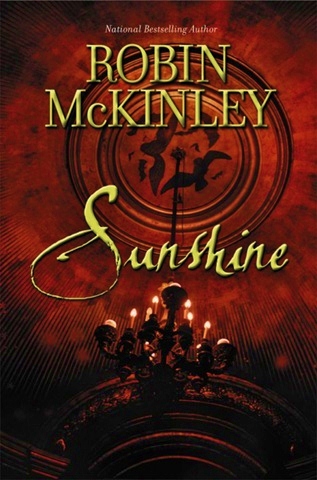
Sunshine by Robin McKinley ~ 2003. This edition: Penguin Speak, 2010. Softcover. ISBN: 978-0-14-241110-0. 405 pages.

My rating: 8/10. Points lost because it tends to ramble; points added because the author unapologetically lets herself go on rambling! And because the vampires perish messily and satisfactorily in sunlight. My son and I, both McKinley aficionados, like to refer to this one as the “anti-Twilight” – no sparkling vampires here, though Sunshine’s heroine gets all silly about her undead crush occasionally, which we agreed was one of our our biggest objections to Twilight – Bella’s sheer stupidity regarding the worst choice ever for boyfriend material. (That, and the terrible writing. And the sparkling.) But, as usual, I digress.

Ah, Robin McKinley. Something of a comfort read author for me, ever since I first read the Damar stories, The Blue Sword(1982) and The Hero and the Crown(1985) quite a few years ago. I have lost track of the number of times I have now read these two books, and I’ve also read everything else she’s ever produced with varying degrees of enthusiasm, with the lone exception of her 2010 novel, Pegasus. I might be losing a bit of my enthusiasm for McKinley’s more recent stuff; her editors are letting her spread herself out a bit too much, the drawback to being such a huge bestseller-producer;  too many times quantity becomes confused with quality, when what they really need to do is refine, cut, and tighten things up. (Someday I will share my opinions on J.K. Rowling and the later Harry Potter books…)

The internet abounds in reviews of all of McKinley’s works; Sunshine is no exception. If you want to see a various range of opinions, just check out the Goodreads page: Goodreads – Sunshine by Robin McKinley  Over 2000 reviews! So I don’t think I need to add to this in any substantial way.

McKinley creates an interesting alternative world to Earth as we know it; she uses much of what we are already familiar with and tweaks it just enough to keep us paying attention – a technique she uses in all of her novels. Her heroine is a bit of a loner and a social misfit – no surprises here – and she also owes some unsuspected abilities to her ancestral bloodlines, which no one has seen fit to tell her about, leaving her to discover her powers for herself. Again, very much a McKinley trademark. The setting is almost dystopian, but people have adapted to the new, post-apocalyptic normal, and go about their business for the most part cheerfully and optimisically, which is something else I like about this tale.

The first time I read Sunshine I was totally engrossed – it was a “stay up till it’s finished” enterprise; this week’s reading was my third, and I am now seeing flaws and tweakable bits here and there, but all in all the story is holding its own.

A heads-up to those familiar with McKinley’s earlier “young adult” novels. Sunshine has lots of sex, some of it graphic. Probably best for the older teenage crowd, and of course McKinley’s legions of adult fans. Oh, and lots of blood. And chocolate! Kind of a weird book, in retrospect. But I’m still a fan.

The cover at the top is from the latest edition, obviously aimed at the teen girl market. I much prefer the original cover art, which I’ve included here as well.

Read Full Post »

The Benefactress by Elizabeth von Arnim ~ 1901. This edition: Dodo Press, 2012. Softcover. ISBN: 978-1-4099-8059-9. 338 pages.

My rating: 9/10. Or maybe even 9.5? Very good stuff.

I searched out this book on the recommendation of Claire at The Captive Reader, and I am ever so pleased that I did. It was a most delightful read during my recent trip to “The Coast” – Interior British Columbia code for “The Lower Mainland” or “Vancouver”, for you non-Canadians and Easterners. (For of course most of Canada is East of B.C., something we like to smugly tease our friends from Alberta about as they go on about “The West thinks…” this and that, though they rather rudely reply with comments to the effect that the Rocky Mountains were put there for a reason, to keep the eccentric inhabitants of B.C. safely segregated from the rest of Canada!)

My daughter was attending a dance intensive and working with a choreographer; I spent a fair bit of time parked outside her venue waiting for the brief breaks which required sporadic maternal nurturing in the area of rides back to the hotel for showers, food, band aids and sympathy. She was, as happens every summer, feeling the pain of strenuous dancing after relaxing a bit too much over the previous month of home-studio summer break, and, yes, the maternal words “I told you so!” did leave my lips occasionally, but she easily ducked under them – water off a duck’s sweaty little back – we’ve been doing this a long, long time and we both know our roles inside and out and could run this perennial dialogue in our sleep!

The Benefactress was a perfect car-in-parking-lot and hotel room read; just engrossing enough that it was easy to re-enter at a moment’s notice and just complex enough that I could happily mull it over as I crouched meekly in the darkest corner of the dance space waiting for my cues to videotape the completed choreo as it progressed.

I am feeling a bit behind on reviews this week – a minor bobbling as I reach to attain my self-imposed goals. I spent way too much time reading, and driving – the trip to the coast, one-way, takes a good seven hours, not counting stops to refuel and stretch our car-cramped legs. Time out to visit a few secondhand bookstores in the towns we pass through is built into our itinerary; my daughter is the perfect travelling and book-browsing companion and I am relishing this year in her company; our next-to-last dance season together before she moves on to the bigger world of college and work and her ensuing “adult” life.

We’re back home now, with a stack of new-to-us books which I’m gleefully looking forward to exploring and talking about, so I’m going to cheat a bit on this review and refer you straight to Claire. Her take on The Benefactress is spot-on; I don’t feel like I could add to it in any way except to repeat that I loved this book and it was well worth seeking out.  Very highly recommended.

The Benefactress Review from The Captive Reader

Read Full Post »

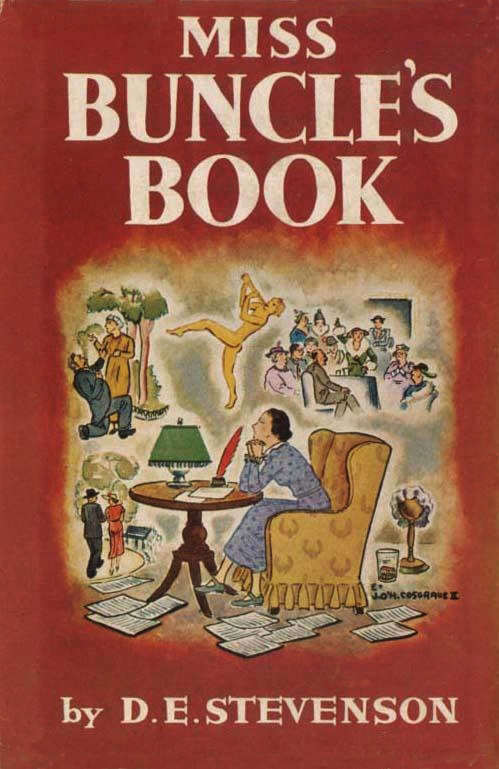
Miss Buncle’s Book by D.E. Stevenson ~ 1934.  This edition: Buccaneer Books, 1983. Hardcover. ISBN: 0-89966-168-8. 224 pages.

My rating: 8/10. A slight work, good for, at most, several evenings’ diversion. I would definitely re-read it after a decent interval, when wanting something “fluff”-ish to take my mind off the frequently depressing nastinesses of the our own 21st century world. Good for what it is – a tale as innocuous and amusing as Miss Buncle’s was intended to be, and not at all “clever”, though, as Miss Buncle herself found, those wishing to project their own imaginations into this simple fairytale could have a field day with hidden meanings, unintended by the author(s), I’m quite certain!

So, after seeing so many enthusiastic reviews of this book (and a few noncommittal “it was okay”s) I did at last manage to track down a library copy. I fall somewhere in between the two camps, but am probably most at home in the “in favour” crowd. I thought the story was light and fun, and I’m going to search out the sequels, Miss Buncle Married and The Two Mrs. Abbots, but I’m in no hurry.  Miss Buncle’s Book was pleasant enough but did not trigger a “must own it” compulsive visit to Amazon and ABE, though I did browse through both hoping to strike a bargain. Not much luck there; inter-library loan it shall be, though I was attracted enough to add D.E.Stevenson to my look-for list for used bookstore shelf scanning. In particular a series of stories concerning a certain “Mrs. Tim”, a soldier’s wife, who seems a good sort to get to know by all reports.

*****

Dowdy, almost-40, kind and peace-loving spinster Miss Barbara Buncle, facing financial difficulties as the dividends from her investments shockingly decrease in the post-WW I years, decides to write a book to gain some spending money. Not having “any imagination”, she draws her characters directly from life, changing only tiny details and, of course, their names. (The village Silverstream becomes Copperfield, Mr Fortnum is now Mr. Mason, Colonel Weatherhead becomes Major Waterfoot, Miss Pretty is Miss Darling, and so on, in a game of renaming by association.) As her tale progresses, she sends her “fictional” friends and neighbours off on some surprising adventures, causing much consternation when the inhabitants of Miss Buncle’s village eventually read the book and recognize themselves.

As the real-life inhabitants of Silverstream-Copperfield meet to decry the parody, and to discover and expose the Judas in their midst, they continually pass over innocuous Miss Buncle, even after she drops broad hints and, in a fit of conscience, even confesses to an unbelieving set of ears. For how could silly Barbara Buncle write even a borrowed epic? She’s not nearly clever enough…

The worm turns with a (mild) vengeance, and Miss Buncle gets the last laugh, as her life takes an unexpecteded turn due to her literary efforts.

Read Full Post »

« Newer Posts - Older Posts »