Archive for July, 2012

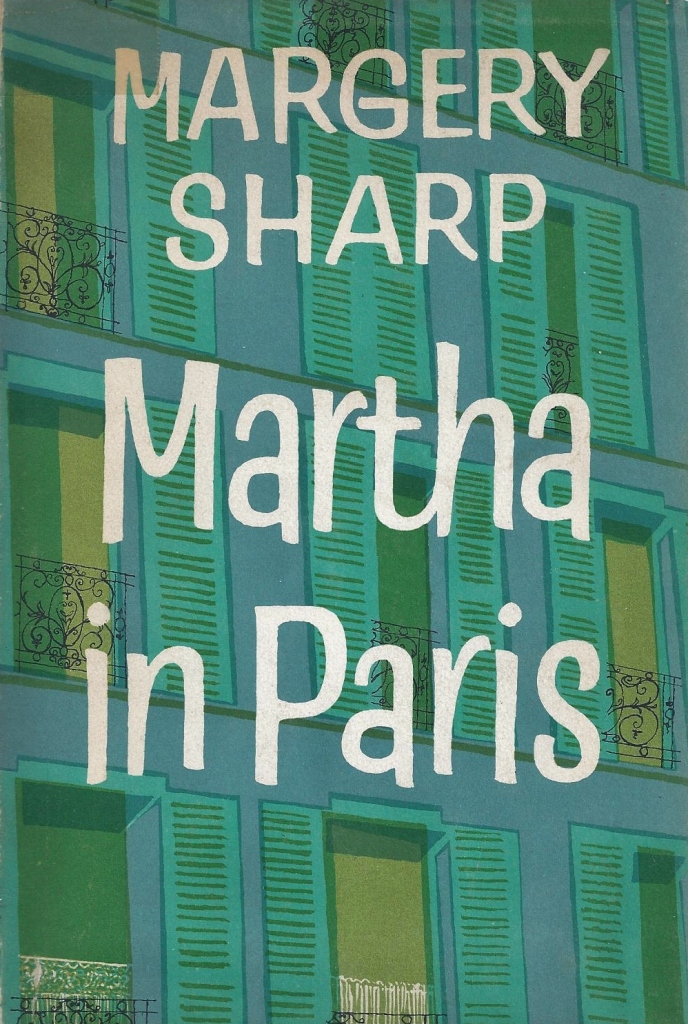
Martha in Paris by Margery Sharp ~ 1962. This edition: Little,Brown, 1962. Hardcover. First American Edition. 166 pages.

My rating: 9/10

From the front flyleaf:

In this “portrait of the artist as a young woman,” Margery Sharp uses all her individual observation – humorous, tender and astringent – to recount a climacteric twelve months in the life of eighteen-year-old Martha, who was sent to Paris to learn to paint, and learned a great deal else besides.

Readers who first met Martha as the stolid, matter-of-fact and altogether memorable child  in The Eye of Love and wondered what would happen to this truly independent spirit when confronted with Life now have an opportunity to find out.

Oblivious to the glamour and temptation of Paris, Martha’s single-minded pursuit of creativity and her matronly appearance seem to protect her from her Aunt Dolores’s delicately-put fear that “Martha might come to some harm…” Once called the Young Pachyderm by a friend back home near Paddington Station, perhaps because he glimpsed something tough-carapaced about her even then, Martha is now Mother Bunch to her fellow art students. Apparently the threat of Paris is to be lost ton her as she at once sets herself up in a doggedly methodical routine of working, eating and sleeping.

But Paris has an outrageous joke to play on Martha. It all begins with her somewhat unconventional adoration of deep, hot baths, after which she always looked her most attractive, or as the French say, “appetizing.” Nice hot baths involve Martha in an experience with a young Englishman (City of London Bank, Paris Branch) which would challenge the resources of a far more sophisticated girl than Martha. How she triumphantly copes with the resulting situation is the them of this engaging novel.

That about sums it up. I greatly enjoyed this next installment in Martha’s life-journey. Margery Sharp has settled into her story nicely; she champions Martha’s artistic cause and incidentally tramples over the gender-based lines of common behaviours; Martha is a true feminist, or perhaps we should say humanist; she has zero tolerance for the conventions which govern the behaviours of more conventional beings. Such as, for instance, her would-be lover Eric, and his doting mother. Their persistence in viewing Martha through their own rose-tinted spectacles of wishful thinking as to her personality and motivations lead to an ironically comedic situation, which Martha single-handedly sorts out in a most pragmatic way.

Martha is a deeply unusual heroine; regardless of her lack of sentiment and socially acceptable behaviour I found myself fully on her side in her Parisian adventures, and have no doubt that her ambitions will be fulfilled.

Highly recommended. If you can at all manage to find these three titles, read them in order. This is the middle book of a trilogy. The preceding book is The Eye of Love; the following book is Martha, Eric and George.

The Eye of Love is presently in print, in softcover from Virago Press. Martha in Paris and Martha, Eric and George are readily available and generally reasonably priced through ABE.

Read Full Post »

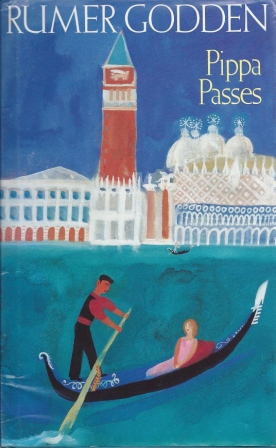
Pippa Passes by Rumer Godden ~ 1994. This edition: Macmillan, 1994. First Edition. Hardcover. ISBN: 0-333-60817-8. 172 pages.

My rating: 5/10

This was a really quick read, so I’ll give it a really quick review.

Seventeen-year-old Phillipa, “Pippa”, is a ballet dancer in a British troupe visiting Venice. Über-talented both in dance and voice, Pippa has led the sheltered life of a cloistered and protected performing arts student, so her first trip abroad, and to romantic Venice at that, finds her wide-eyed and naïve. She immediately encounters a handsome young gondolier, and falls deeply in love. He is attracted in turn, but his motivations are slightly different than purely romantic.

In the meantime, Pippa’s ballet mistress has become infatuated with her, leading to much scheming and heartache and culminating in an attempted lesbian rape scene; a bit of a shocker from this particular author, but in retrospect not all that surprising; Rumer Godden was never shy of acknowledging the power of sex and using it as a motivator for her characters over the years; I think that the fairly graphic incident here is merely the well-experienced 87-year-old author keeping up with the times.

This was Godden’s second to last published novel before her death in 1998, and while not one of her top-rank tales it is certainly competently written and acceptable as a light read. Don’t expect another House of Brede, though! This one is fluff straight through.

Very nice evocation of Venice; as usual Godden handles her setting with great skill.

Weakest point, aside from the rather lame plot, is that the characters are all quite one-dimensional. We are continually told that Pippa is wonderfully talented and oh-so-special; we must take the author at her word as we never really get too close to Pippa herself. Things seem to happen just a little too easily throughout; there is a lot of glossing over of motivations and actions. This almost feels like a moderately fleshed-out outline of what could perhaps be a much longer and more interesting story.

I wouldn’t recommend this novel as anything but a momentary diversion. It definitely belongs in a Godden collection, and is interesting enough to have limited re-read status, but it really isn’t up to the standard of some of Godden’s masterworks. As I’ve said before, Godden had a great range in her stories; this is on the pallid end of the spectrum. Still better than some of the present-day chick lit I’ve attempted, so extra points for that. Even at her worst, Godden is still good. If you can get this one cheap, take it to the beach, but don’t forget to tuck something else in your bag as well, because slight little  Pippa, at less than 200 pages, will pass by very quickly!

Read Full Post »

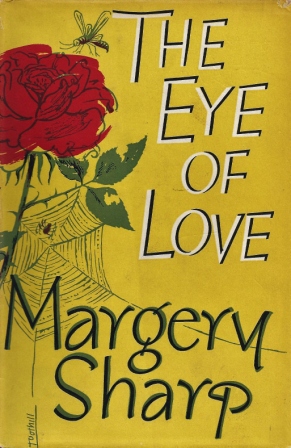
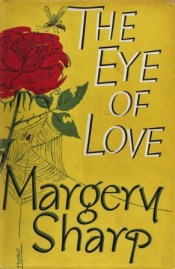
The Eye of Love by Margery Sharp ~ 1957. This edition: Collins, 1957. Hardcover. 1st Edition. 256 pages.

My rating: 9/10

I have been on an unapologetic reading binge these past few days; waking at my husband’s 5 AM alarm to blink the sleep from my tired eyes and reach groggily for the book I laid down the night before –  or, technically, earlier in the morning; too many times it’s been past midnight – foolish me!  A perfectly made cup of tea is always delivered to my bedside or chairside table by a man who values silence above conversation on workday mornings, and is himself stealing some precious reading time over his breakfast before heading out the door at the last possible moment. Our morning exchanges are brief; after thirty years together the pattern is predictably set, and it suits us very well. “What’re you reading?” and “Here, I’m done. You give it a try. Not bad…” and, so often,  “Hey, did you steal my book? I was still working on that one…”

Lately I have had an extravagant number of book-shaped packages from far-flung purveyors, so that like the proverbial child in the candyshop I am overwhelmed by choices and am greedily consuming each treat with an anticipatory eye on the next one. All are light fiction; summer reading at its best.

Trickling in much too slowly are a number of new-to-me vintage books by my beloved Margery Sharp. Margery wrote a trilogy of sorts between 1957 and 1964: The Eye of Love, Martha in Paris, and Martha, Eric and George. Naturally, the third book came first, then the second, with a dreadfully long lag before the first one showed up just a few days ago. I had been nobly holding off on reading them out of sequence, and I’m glad I did. These definitely need to be read in order to get a full appreciation of the journey of our unlikely heroine Martha. I am surprised that these do not appear in an omnibus edition; that would be kindest to the reader, and not unmanageable, as the three books are individually short and quick reads. Having gobbled them up, I will now review them in order, with a probably doomed attempt at brevity, and place them together on my dedicated Margery Sharp shelf in our bedroom (where all the “chuck out the window in case of house fire” treasures reside) to await happy re-reading in future.

Ladies of ambiguous status have by convention hearts of gold, and Miss Diver was nothing if not conventional; but a child in an irregular household is often an embarrassment. It had been wonderfully kind of Miss Diver to save her brother’s child from an orphanage, but not surprising; what was surprising was how well the arrangement had worked out.

It is 1929; Miss Dolores Diver’s widowed brother Richard Hogg has just died, leaving behind nothing of worldly value to his six-year-old-child, Martha, now a bona-fide orphan with an uncertain future. Miss Diver gallantly steps in.

She had never seen the child until an hour earlier; she had never before visited the shabby Brixton lodging-house in whose shabby parlour the thinly-attended wake was being held. – A dozen or so of Richard Hogg’s ex-colleagues from the post office stared inquisitively; this meeting between the two chief mourners provided a touch of drama, something to talk about afterwards, otherwise conspicuously lacking. (As Doctor Johnson might have said, it wasn’t a funeral to invite a man to: only one bottle of sherry and fish-paste sandwiches. Richard Hogg, with his motherless daughter, had lodged two full years in Hasty Street; but a landlady never does these things so wholeheartedly as relations, even with the Burial Club paid up and the next week’s rent in hand.)

Several years pass in complete amiability; young Martha is a rather odd but markedly placid child, and the Diver ménage, financed and patronized by Harry Gibson, head of a small furrier’s establishment, absorbs her without a hitch. Things are about to change, though. Harry’s business is struggling in the depths of the financial depression, and to save it he has contracted to marry one Miranda Joyce, hitherto-unmarriageable daughter of a very successful, upper-end furrier. Her father, in return for getting his daughter finally settled, is willing to re-finance Gibson’s. Harry decides to do the right thing by his prospective fiancé and renounce his mistress and his comfortable routine: five days of the week living quietly with his doting mother, with the weekend secretly spent in the little house with faithful Dolores and a tactful Martha, with the story to the rest of the world that he has continual weekend business in Leeds.

Since their meeting ten years earlier, at a Chelsea Arts Ball, Dolores and Harry have grown even more deeply in love. Now, on the eve of their parting, they cling together and reminisce.

“I’m sorry, Harry, but I can’t bear it,” said Dolores.

She huddled closer against his solid chest. It was his solidness shed always loved, as he her exotic fragility. For ten years they’d given each other what each most wanted out of life: romance. Now both were middle-aged, and if they looked and sounded ridiculous, it was the fault less of themselves than of time.

To be fair to Time, each had been pretty ridiculous even  at the Chelsea Ball. Miss Diver, in her second or third year as a Spanish Dancer, was already known to aficionados as Old Madrid. Mr. Gibson, who had never attended before, found the advertised bohemianism more bohemian than he’s bargained for. To the young devils from the Slade, unwrapping him, [Harry has come dressed as a brown paper parcel],his humiliated cries promised bare buff rather than pyjamas. Naked, indeed, he might have made headlines by being arrested; in neat Vyella, he was merely absurd.

Dolores, Old Madrid, not only pitied his condition but also lacked a partner. She’s have been glad to dance with anyone, all the rest of the night. But though rooted in such unlikely soil their love had proved a true plant of Eden, flourishing and flowering, and shading from the heat of day – not Old Madrid and Harry Gibson, but King Hal and his Spanish rose.

So they had rapidly identified each other – he so big and bluff, she so dark and fragile: as King Hal and his Spanish rose. Of all the couples who danced that night in the Albert Hall, they were probably the happiest.

Off Harry goes, to reluctantly propose to the very willing Miranda.

A quarter of an hour passed long as a century. To an impatient lover it would no doubt have seemed longer: Mr. Gibson was impatient only as a man about to be shot might be impatient. (Why hadn’t he been shot, in ’17?) The bitter parenthesis, by the memories it evoked, nonetheless helped his courage: when at last the door opened, like an officer and a gentleman Mr. Gibson clutched his carnations and stood bravely up to meet the firing squad.

Curiously enough, Miranda Joyce bore a marked physical resemblance to Miss Diver. Both were tall, black-haired, and bony. They were about the same age. Miss Joyce had even certain advantages: her make-up was better, she hadn’t Dolores’ slight moustache, and she was far better dressed. But whereas Mr. Gibson saw Dolores with the eye of love, he saw Miss Joyce as she was, and whereas the aspect of Old Madrid made his heart flutter with delicious emotion, the aspect of Miss Joyce sunk it to his boots.

But Harry Gibson soldiers on. The proposal is duly made and predictably accepted; the necessary conventions are observed.

Kissing her had been like kissing a sea-horse. Mr. Gibson knocked back his drink thankfully. (“I shall turn into a sozzler,” thought Mr. Gibson – dispassionate as a physician diagnosing the course of a disease.)

Fortunately Harry finds consolation in a growing friendship with his father-in-law to be. Mr. Joyce becomes a kindred spirit, and the one bright spot in Harry’s dark night of the soul.

Meanwhile Martha and Dolores are also soldiering on gamely. Dolores soon finds that she is unemployable; her only resource seems to be to let out rooms in her house. Fortunately for aunt and niece, Martha is quick to seize a chance while visiting her old home, and is instrumental in bringing home the perfect boarder. Bachelor Mr. Phillips, clerk of an insurance company, is at first innocuously quiet and reliable with the rent money. However, Dolores’ broken heart and subsequent stand-offish attitude soon have the effect on her boarder of rousing in him a great curiosity as to her personal situation, and, quite soon, a desire to wed this woman whom he very wrongly perceives to be financially independent and a property owner to boot.  What Mr. Phillips doesn’t know is that the house is merely leased, with the term coming up; hence Dolores’ desperate need for Mr. Phillips’ financial contribution, and her reluctance to snub his distasteful though so-far polite advances

The games of in-and-out and false pretences escalate, and while her elders are torturing themselves with emotional gymnastics, young Martha is single-mindedly pursuing her one interest. She is teaching herself to draw. Martha sees the world as a series of shapes; capturing images, fitting them into those categories, and transferring them from her eyes to her mind to paper takes up every waking moment.

Dismissed as merely a scribbling child, Martha stolidly ignores the adult world, and it in turn takes little notice of her. Until one day Mr. Joyce, through a series on coincidences, happens upon Martha drawing a tree. He is a connoisseur of the arts; he recognizes a budding young talent when he sees it. He offers Martha his patronage, and buys her much-desired paper, charcoal and chalks, which she unemotionally accepts while refusing the offer of  a longer-term artistic relationship and sincere, friendly interest which Mr. Joyce extends.

These complicated relationships get more tangled as time goes on; their multiple resolutions are a typically Margery Sharp juggling act. The tale winds up with a combination of most satisfactory endings, and we leave Martha in particular with the hopeful idea that her future, if not exactly easy, will be extremely interesting.

A cleverly written, very smart, satirical, darkly amusing novel. On par with Something Light, though not quite as gentle; the humour of The Eye of Love is decidedly savage at times.

I’m not at all sure if Margery Sharp planned at first to continue Martha’s saga, as The Eye of Love is a decidedly stand-alone novel, but I am so glad she did. Very highly recommended. Next book in the trilogy: Martha in Paris.

Read Full Post »
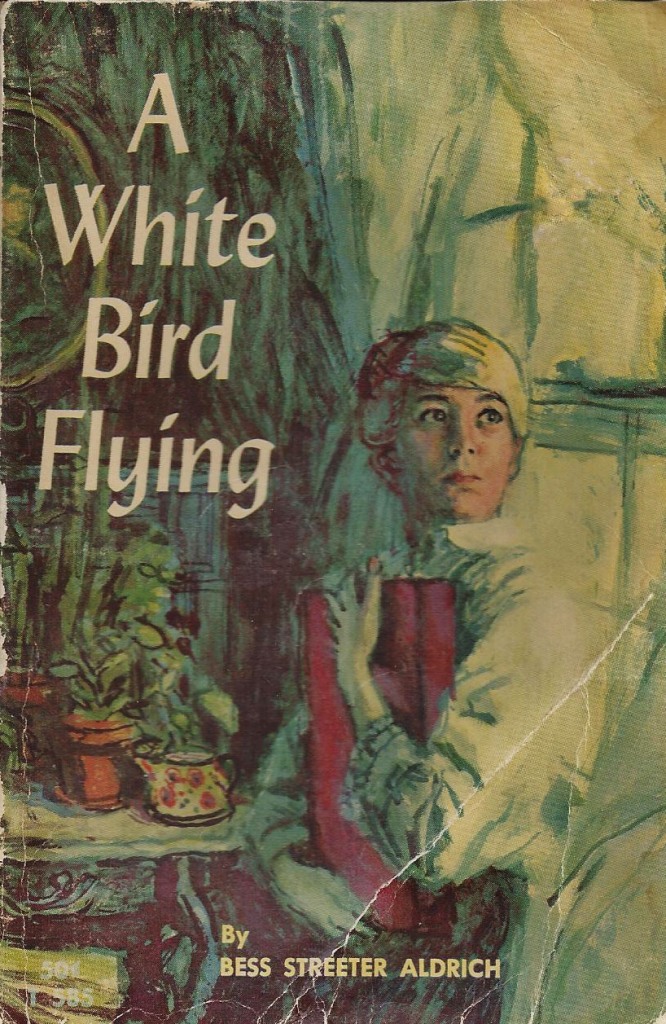
A White Bird Flying by Bess Streeter Aldrich ~ 1931. This edition: Scholastic, 1964. Paperback. 318 pages.

My rating: 5.5/10

American writer Bess Streeter Aldrich (1881-1954) is likely best known for her popular novel, A Lantern in Her Hand, the story of Nebraska pioneer Abbie Deal. I had read and greatly enjoyed that novel, so was quite looking forward to reading A White Bird Flying, which follows Abbie’s granddaughter, Laura Deal, on her own coming-of-age journey.

I am sorry to say that strong Abbie’s granddaughter is a wishy-washy little thing, and that I was generally disappointed in this lightweight  novel. It reminded me of some of the more sentimental twaddle perpetrated by our iconic Canadian author Lucy Maud Montgomery, who wrote in a similar time period and genre; much as I love some of her stronger novels, she was also capable of churning out some dreadful slush; ditto Aldrich.

The first part of the book is perhaps the strongest. Abbie Deal has died and been buried with due ceremony; young Laura stands in her beloved grandmother’s house a few days after the funeral, and tries to come to terms with death and what will happen next. Laura is a deeply emotional, imaginative child; at twelve she already aspires to one day be a writer, and she thinks in those terms.

She was half enjoying herself in an emotional way. There was a sort of gruesome ecstasy in making herself sad with memories. She would like to write about it. “The girl moved about from room to room, touching the things lovingly,” went through her mind. She was in one of those familiar moods when she looked upon life in a detached way as though she herself were not a part of it. She could never talk to anyone about it, but in some vague way she felt withdrawn from the world. She lived with people, but she was not one of them.

Perfectly captures the essence of an introspective adolescence.

Laura goes on her dreamy way, often at odds with her practical, striving mother who is often bewildered by her introverted, sentimental daughter. Laura continues to pursue her private ambition, turning out poems and stories and seeing the world through detached eyes.  She often thinks of her grandmother, and of how Abbie had given up her own ambitions to dedicate herself to full wife- and motherhood; Laura is appalled at the thought of a similar fate for herself and resolves to form her own life quite differently. She decides that she will turn her back on love, and particularly marriage; instead she will dedicate herself to her art and become truly fulfilled in a way a mere housewife can never attain.

Well, the inevitable happens. Laura dreams her way through college, and attracts the attention of a boy from her own home town, Allen Rinemiller, who has strong ambitions to improve the family farm with modern ideas, and has a rather interesting philosophy himself, which Laura scornfully dismisses.

Allen proposes; Laura naturally declines.

“…I can’t think of anything more prosaic than settling down here…and sort of letting the world go by.”

“I don’t call it letting the world go by,” he returned quickly. “I call it tackling a small piece of the world and making something of it. You admit Morton and his bride and all the rest of the old pioneers did a great thing when they crossed he river and started their settlements. You’ve said it was romantic and intensely interesting, and quite worthwhile. You think their own love lay at the bottom of their acts of courage and bravery. All right – did you ever stop to think that maybe we’re pioneers, too? Haven’t you the vision to see that? Why isn’t it something of pioneering that I’m trying to do? Agriculture in most quarters has been a hard, wearisome proposition…I’m pioneering, too – and a whole lot of other young fellows from colleges and universities, we have visions, too – a new outlook on the whole thing…We’re pioneering…starting a new class…the master farmers who are attempting to develop agriculture to the nth degree. Why couldn’t you enter into that in the same spirit your grandmother did? …Because you’re rooted in the soil, need you be a nonentity?”

Allen’s stirring words fall on deaf ears; Laura has already decided to pursue the celibate life, and has even promised her wealthy, childless aunt and uncle that she will remain unmarried and look after them as a daughter would, in return for inheriting their fortune, justifying this strangely unromantic and mercenary agreement by the excuse that it will allow her to pursue her writer’s career without worry and interruption.

The only fly in this particular ointment is that Laura is no prodigy; her talent is modest at best, as she is slowly beginning to realize.

The rest of the story follows its predictable-from-the-first-page path; no surprises here. Laura does marry Allen and dedicate herself to the farm; there are some tough years, but even through these Laura`s issues are not on par with those of her grandmother’s generation. Laura bemoans the fact that she cannot afford new curtains, and a new carpet, and a new dress; Abbie Deal dealt with life and death concerns and had a much more elemental notion of what the truly important things in life were than her grandchild ever faces up to.

I do get the feeling, however, that Aldrich portrays this dichotomy deliberately; the decadence of the descendents of the pioneers, though sympathetically portrayed, is a common undercurrent of her books I’ve read so far. She was obviously very interested in the generational and cultural shifts of the pioneer-to-modern era, and by and large captures the essence of the succeeding generations and their attitudes towards those who came before.

I will be reading more of this author’s works, as opportunity allows, though I doubt I will go to a lot of effort to seek them out. And while White Bird was not a particularly strong novel, it had its generally well-written and thoughtful moments, and I will overlook my vague annoyance at self-centered Laura and her self-created melodramas to classify it merely as a lesser entry into the long-respected Aldrich canon.

I am editing this review to add a Young Adult classification. It was re-published by Scholastic, after all, and the subject matter may be of interest to teenage readers, though I suspect many of them will be as annoyed at Laura as I am.

Read Full Post »

The Baler

You tourist composed upon that fence
to watch the quaint farmer at his quaint task
come closer, bring your camera here 
or fasten your telescopic lens 
if you're too indolent; all I ask 
is that when you go home you take 
a close-up among your color slides 
of vacationland, to show we pay the price 
for hay, this actual panic: no politic fear 
but tumbling wild waves down the windrows, tides 
of crickets, grasshoppers, meadow mice, 
and half-feathered sparrows, whipped by a bleeding snake.
 
Hayden Carruth, circa 1970

Read Full Post »

My World: Summer Blues

A glimpse into my world. Red melic and delphinium against a blue blue July sky, early morning. We are haying after all – got called in to harvest 20 acres for a neighbour a few miles down the road – I am enjoying the brief lull this morning before the hours of heat and dust and rattling around on our ancient tractor which await me this afternoon. Summertime – while the living ain’t necessarily easy, it does feel pretty darned good!

Read Full Post »

Leaves of Grass, Flowers of Grass

Leaves of grass, what about leaves of grass?
Grass blossoms, grass has flowers, flowers of grass
dusty pollen of grass, tall grass in its midsummer maleness
hay-seed and tiny grain of grass, graminiferae
not far from the lily, the considerable lily;
 
even the blue-grass blossoms;
even the bison knew it;
even the stupidest farmer gathers his hay in bloom, in blossom
 just before it seeds.
 
Only the best matters; even the cow knows it;
grass in blossom, blossoming grass, risen to its height and its natural pride
in its own splendour and its own feathery maleness
the grass, the grass.
 
Leaves of grass, what are leaves of grass, when at its best grass blossoms.
 

D.H. Lawrence, circa 1920

Read Full Post »

An American Girl in London by Sara Jeannette Duncan ~ 1891. This edition: Rand, McNally & Co., circa 1900. Inscription: “To another American girl – Mary Couch Huntington, Xmas 1900.” Hardcover. 290 pages.

My rating: 7.5/10

This is that most pleasant of things, a book purchased on a whim for a for a minor sum, which turns out to be a grand read, and then, even better, to add another author to the “keep an eye out for” list.

I paid 50 cents for this “genuine antique”; it was half-price book day at the local Sally Ann; I dipped into the gilt-edged, obviously well-read volume and it looked promising, well worth a tiny monetary gamble. I had initially thought that it was a volume of genuine reminiscences, but early in I realized that it was instead a gently satirical fiction. I found myself completely drawn into Miss Mamie Wick’s fresh and frank dialogue, and I eagerly followed her as she solitarily travels from Chicago to New York, and sets sail for England.

What a grand period piece this amusing novel is! Written in the late 1800s, the narrator is not shy of poking gentle fun at herself and the thousands of her American compatriots who are eager to explore England’s historical places and partake of whatever social whirl they can shoehorn themselves into.

Our own Miss Wick is extremely fortunate in her shipboard acquaintances; she makes a strong impression on a young British aristocrat (how strong becomes quite apparent to us early on, and to Mamie herself at long last, near the end of the story), as well as on an initially frosty elderly ladyship who completely unthaws under the influence of Mamie’s unusual charm, with interesting further consequences.

Mamie does all of the typical American tourist things; she visits Madame Tussaud’s, the London Zoo, the Epsom Derby, boat races at Oxford, and all the rest, but her aristocratic acquaintances smooth her way to higher levels and grander experiences than most American tourists ever attain, and she shares every impression with us. I did truly get a vivid picture of what the England of the time (at least in the relatively “higher” circles in which Mamie’s social class moved) looked, sounded and felt like through Mamie’s eyes; the author, while maintaining a delicately cynical tone, obviously had a great fondness for all of the best aspects of contemporary and historical England and her inhabitants.

The protagonist is thoroughly likeable and full of little unexpected insights and surprises; I laughed out loud several times at her philosophizing and her witty internal voice; she doesn’t miss much, but she continually minds her manners and behaves with impeccable politeness, much to her credit, as the same cannot be said of some of the people she encounters.

My only complaint was that the ending was much too sudden; it was the only part of the story that felt a bit forced; but as we could have gone on with Mamie forever I suppose it was a necessary break.

I was so impressed by this story and its unexpected quality that I researched the author. Lo and behold – Sara Jeannette Duncan turns out to be a well-respected and quite well-known turn of the century Canadian author and journalist. Here she is:

http://en.wikipedia.org/wiki/Sara_Jeannette_Duncan

http://www.biographi.ca/009004-119.01-e.php?&id_nbr=7912

Several of Sara Jeannette Duncan’s works are available on Project Gutenberg, and many of her works are still in print; she is apparently a staple of Canadian women’s studies courses at our universities. Who knew?! (Well, obviously a lot of people. Just not me. But I know now!)

And I am mildly thrilled to discover that An American Girl has a sequel,  A Voyage of Consolation. I started reading this on Gutenberg last night, and then decided to quit with that and try instead to find a print copy; I want to read it in perfect comfort, meaning not on a screen, and then place it on my shelf next to my newest antique, ready for re-reading at my leisure.

Sara Jeannette Duncan’s more serious works, fictional and journalistic, are now top of my look-for list, and if these light novels are any indication, she will be a smooth and witty read in any genre.

Bonus: I can add this review as my second entry in the 6th Canadian Book Challenge: http://www.bookmineset.blogspot.ca/2012/06/6th-annual-canadian-book-challenge-what.html

This author is authentically Canadian, despite the title of this piece, which had led me to initially assume she was American, and her body of work reflects her native land, though she did leave Canada both to travel widely in her journalistic career and to accompany her British husband on his postings abroad. Sara Jeannette Duncan died in England in 1922, at the much-too-young age of 62.

Read Full Post »

The sun is finally shining after several weeks of rain, with a forecast of a week of sun and heat, and the Cariboo is alive with the sound of swathers as everyone scrambles to cut their hay. I was out early this morning “looking at the sky” as the ranchers would say, and rather wishing I could be getting ready to cut as well. This year we are grazing off our hayfields in preparation for mid-summer reseeding, so we are feeling a bit anticlimactic as this is the first time in 20-some years the tractor is sitting idle as all around us the farming year hits a high peak of activity.

As I leaned on the fence and mused on summers past, the first lines of this poem, relic of a childhood affection for an old anthology titled Best-Loved American Poems, came suddenly into my head. Rather than  searching through the shelves for the book itself, I turned to the trusty internet. And here she is –  Maud Muller in her innocent glory. A little trip down memory lane, in honour of sun and summer and the sweet smell of hay.

Enjoy!

MAUD MULLER

Maud Muller, on a summer’s day,
Raked the meadows sweet with hay.
 
Beneath her torn hat glowed the wealth
Of simple beauty and rustic health.
 
Singing, she wrought, and her merry glee
The mock-bird echoed from his tree.
 
But, when she glanced to the far-off town,
White from its hill-slope looking down,
 
The sweet song died, and a vague unrest
And a nameless longing filled her breast–
 
A wish, that she hardly dared to own,
For something better than she had known.
 
The Judge rode slowly down the lane,
Smoothing his horse’s chestnut mane.
 
He drew his bridle in the shade
Of the apple-trees, to greet the maid,
 
And ask a draught from the spring that flowed
Through the meadow across the road.
 
She stooped where the cool spring bubbled up,
And filled for him her small tin cup,
 
And blushed as she gave it, looking down
On her feet so bare, and her tattered gown.
 
“Thanks!” said the Judge, “a sweeter draught
From a fairer hand was never quaffed.”
 
He spoke of the grass and flowers and trees,
Of the singing birds and the humming bees;
 
Then talked of the haying, and wondered whether
The cloud in the west would bring foul weather.
 
And Maud forgot her briar-torn gown,
And her graceful ankles bare and brown;
 
And listened, while a pleasant surprise
Looked from her long-lashed hazel eyes.
 
At last, like one who for delay
Seeks a vain excuse, he rode away,
 
Maud Muller looked and sighed: “Ah, me!
That I the Judge’s bride might be!
 
“He would dress me up in silks so fine,
And praise and toast me at his wine.
 
“My father should wear a broadcloth coat;
My brother should sail a painted boat.
 
“I’d dress my mother so grand and gay,
And the baby should have a new toy each day.
 
“And I’d feed the hungry and clothe the poor,
And all should bless me who left our door.”
 
The Judge looked back as he climbed the hill,
And saw Maud Muller standing still.
 
“A form more fair, a face more sweet,
Ne’er hath it been my lot to meet.
 
“And her modest answer and graceful air
Show her wise and good as she is fair.
 
“Would she were mine, and I to-day,
Like her, a harvester of hay:
 
“No doubtful balance of rights and wrongs,
Nor weary lawyers with endless tongues,
 
“But low of cattle, and song of birds,
And health, and quiet, and loving words.”
 
But he thought of his sisters, proud and cold,
And his mother, vain of her rank and gold.
 
So, closing his heart, the Judge rode on,
And Maud was left in the field alone.
 
But the lawyers smiled that afternoon,
When he hummed in court an old love-tune;
 
And the young girl mused beside the well,
Till the rain on the unraked clover fell.
 
He wedded a wife of richest dower,
Who lived for fashion, as he for power.
 
Yet oft, in his marble hearth’s bright glow,
He watched a picture come and go:
 
And sweet Maud Muller’s hazel eyes
Looked out in their innocent surprise.
 
Oft when the wine in his glass was red,
He longed for the wayside well instead;
 
And closed his eyes on his garnished rooms,
To dream of meadows and clover-blooms.
 
And the proud man sighed, with a secret pain,
“Ah, that I were free again!
 
“Free as when I rode that day,
Where the barefoot maiden raked her hay.”
 
She wedded a man unlearned and poor,
And many children played round her door.
 
But care and sorrow, and child-birth pain,
Left their traces on heart and brain.
 
And oft, when the summer sun shone hot
On the new-mown hay in the meadow lot,
 
And she heard the little spring brook fall
Over the roadside, through the wall,
 
In the shade of the apple-tree again
She saw a rider draw his rein,
 
And, gazing down with timid grace,
She felt his pleased eyes read her face.
 
Sometimes her narrow kitchen walls
Stretched away into stately halls;
 
The weary wheel to a spinnet turned,
The tallow candle an astral burned;
 
And for him who sat by the chimney lug,
Dozing and grumbling o’er pipe and mug,
 
A manly form at her side she saw,
And joy was duty and love was law.
 
Then she took up her burden of life again,
Saying only, “It might have been.”
 
Alas for maiden, alas for Judge,
For rich repiner and household drudge!
 
God pity them both! and pity us all,
Who vainly the dreams of youth recall;
 
For of all sad words of tongue or pen,
The saddest are these: “It might have been!”
 
Ah, well! for us all some sweet hope lies
Deeply buried from human eyes;
 
And, in the hereafter, angels may
Roll the stone from its grave away!

John Greenleaf Whittier, 1856

Read Full Post »

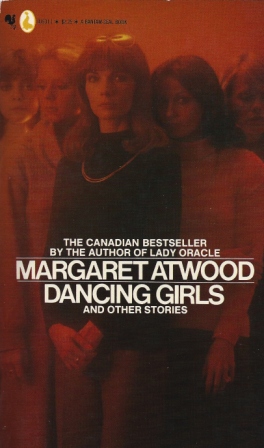
Dancing Girls by Margaret Atwood ~1977. This edition: Bantam Seal, 1978. Paperback. ISBN: 0-7704-1531-1. 245 pages.

My rating: 5.5/10. A few too many misses for a really high rating.

*****

A collection of short stories written early in the career of Canadian icon Atwood.

I have an ambiguous relationship with Margaret Atwood, or, rather, her work. I greatly admire the real person; Atwood has become an outspoken and lucid critic of much of what is troublesome about Canadian societal, political and environmental issues. I have heard many of her interviews and lectures via our venerable CBC Radio, lifeline of many Canadian rural dwellers far from the bright lights of the cities which have absorbed the majority of the population in this vast and still-wilderness-filled land. Just thinking about her, Atwood’s distinctive voice fills my head; nasal, cynical, with a deadpan delivery that would make her a knock-out stand-up comic if she were ever to desire to switch careers at this late date.

But… I am not completely comfortable with much of her written work. I’ve read all the novels dutifully as they’ve appeared through the years, as a typical middle-aged, literate, Canadian liberal feminist (as good a description of my demographic as any) should. I can nod and smile knowingly during literary discussions with the local intelligentsia, though I add little to the conversation myself; I am very aware of my value as an audience to my much more vocal acquaintances and have no real desire to step into the conversational limelight myself much of the time; it’s simpler to stand by and listen…but I digress.

Atwood. How to describe my feelings? Well… ambiguous… I guess. There is no doubt that the woman can write. Her words flow, dance, surprise, shock – grand stuff indeed! But too often I put down the latest Atwood feeling a vague dissatisfaction. Are things really that bad? Are all of our relationships – friendly, familial, societal and particularly sexual and marital – as deeply flawed as Atwood continually portrays? A course of Margaret Atwood often drives me to the other extreme; to the literary arms of, say, Elizabeth Goudge, with her encouragements of perseverance and sacrifice rewarded, versus Atwood’s cynical view that it doesn’t really matter how hard you try, you’re pretty well screwed from the get-go. (I rather agree, but all in all, it’s not that bad; most of us muddle along with a fair amount of happiness despite the inevitable rough bits. Don’t we?)

But this woman can write.

Here is what you’ll find in Dancing Girls.

***  =  the ones I greatly enjoyed.

*  =  Worth reading.

The rest I rather wish I hadn’t subjected myself to, though opinions obviously will differ.

  • The War in the Bathroom – A week in the life of a woman who has apparently descended into some form of mental illness; she has split into two personalities; the intellectual (controlling) and the physical (responding). Typically depressing; not one of the gems of this collection.
  • ***The Man From Mars – An unattractive student is targeted by a stalker, “a person from another culture”.  I liked this one. Melancholy (of course!) but very well presented; cynically amusing; I can hear Atwood’s best voice loud and clear.
  • Polarities – A woman goes slowly mad. Dreary as the winter setting and the doomed relationships it describes.
  • Under Glass – Another doomed love affair. Sad, sad, sad.
  • The Grave of the Famous Poet – A journey becomes a metaphor for another imploding relationship.
  • ***Rape Fantasies – This one story is probably worth buying the book for. Four young women discuss rape fantasies. Atwood at her wickedly humorous best.
  • ***Hair Jewellery – Beautifully written. Another relationship unravelling, but the protagonist moves successfully on. Or at least so we think.
  • ***When It Happens – An elderly woman prepares for the end of the world. Haunting.
  • A Travel Piece – A travel writer on a trip that goes terribly wrong. Taps into all of my worst-case flight scenario fears. Wish I hadn’t read this one – personal nightmare stuff!
  • The Resplendent Quetzal – Too many details about an unhappy marriage and the petty meannesses that bitter people resort to.
  • *Training – A young man examines his motivations and innermost feelings as he deals with his family’s and his own expectations for his future.
  • *Lives of the Poets – This one feels autobiographical. Another relationship tragedy, enhanced by the futility of struggling artistic careers.
  • *Dancing Girls – Culture clashes in a rooming house.
  • ***Giving Birth – The ambiguities of expectant and new motherhood. Excellent.

Read Full Post »

« Newer Posts - Older Posts »