Posts Tagged ‘Youth’

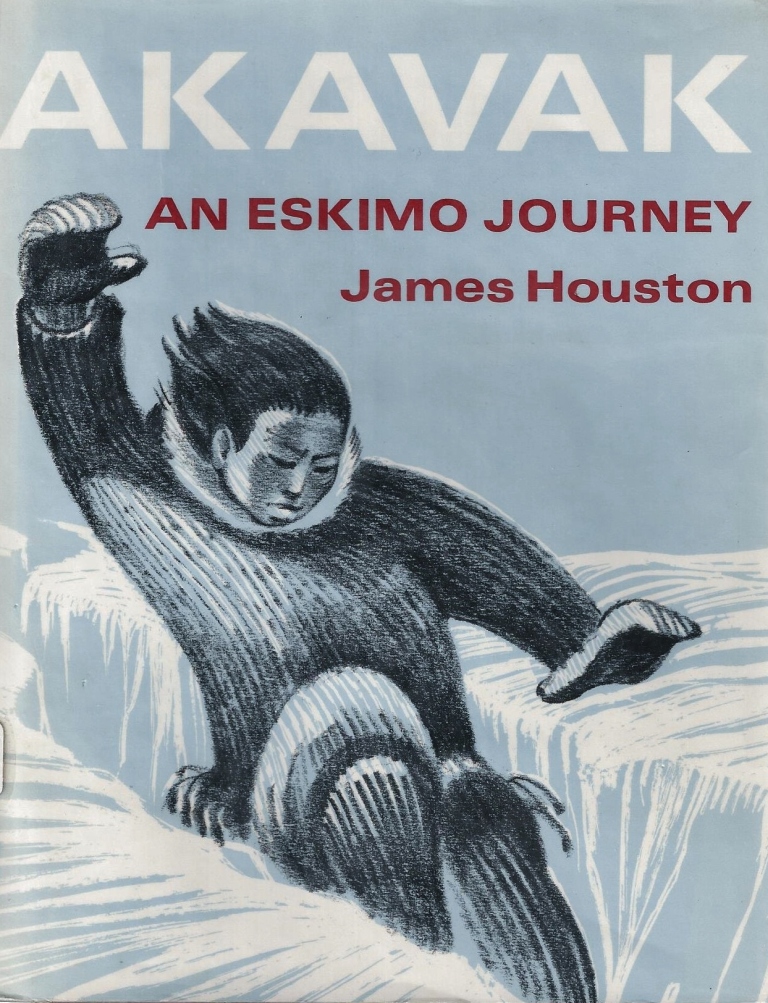
akaval james houston cover 1 001Akavak: An Eskimo Journey by James Houston ~ 1968. This edition: Longmans Canada Limited, 1968. Hardcover. 80 pages.

My rating: 8.5/10

Akavak is a slight but punchy short novel from Canadian artist and writer James Houston. Akavak was Houston’s fourth published fictional work, preceded by the award-winning Tikta’liktak in 1965, as well as The Eagle Mask (1966) and The White Archer (1967). Aimed at a youth readership, Houston’s short juvenile novels garnered high praise for their depictions of pre-European contact  Eskimo (as the Inuit were called at that time) and Indian (First Nations) life. Houston went on to write and illustrate a number of other juvenile adventure novels, most set in contemporary times, as well as several ambitious and well-received adult novels, all set in the North, and frequently featuring strong Inuit and First Nations characters.

In Akavak, a fourteen-year-old Inuit boy (Akavak) is asked to accompany his grandfather on a perilous journey along the coastline in order to fulfill the elderly man’s final wish, to see his beloved brother one more time before it is too late. Warned by his father that though Grandfather is still a master traveller and skilled hunter he occasionally shows flawed judgement due to his great age, Akavak must assess his grandfather’s moods and instructions as the journey proceeds, and find tactful ways to prevent the old man from putting himself and Akavak in danger.

At first the journey goes well, but soon a series of increasingly serious disasters threatens the expedition, and Akavak’s and Grandfather’s very survival; Akavak must finally take the lead and make some difficult decisions. The two ultimately attain their destination, but the ending of the story is bittersweet.

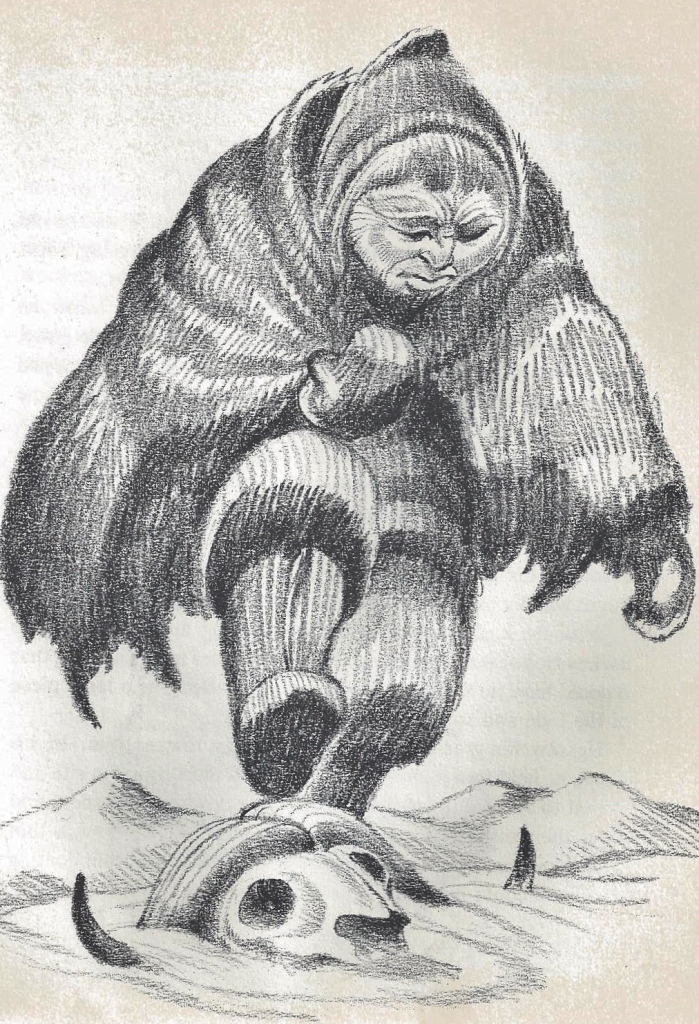
akavak james houston illust 2 001Well depicted details of traditional Inuit skills, as well as a compelling storyline make this novel a good read-alone or read-aloud for primary and intermediate grades, and it will work well as part of a Canadian/Arctic/Inuit Life social studies/humanities unit. The novel is set pre-European-contact (or perhaps in an isolated location); while there is a slightly educational tone to a few of the author’s explanations of customs or habits, the story is very respectful of Inuit culture without over-emphasizing its “exotic” nature to readers not of the North.

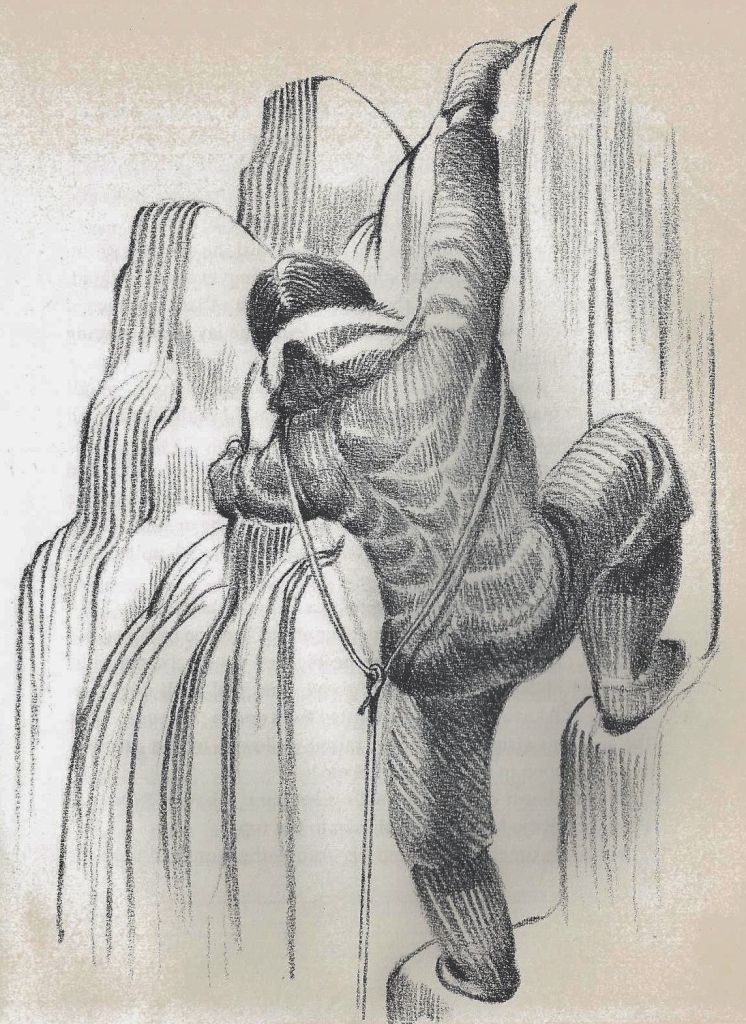
James Houston was a talented artist; while not meaning to downplay the vigorous story, I have to say that for me the illustrations are perhaps the best part of this short novel. Simplistic charcoal drawings, they brilliantly capture mood and movement, and are detailed enough to provide a clear picture of the places and people of Houston’s dramatic tale.

akavak james houston illust 1 001The story itself provides not much in the way of surprises; the adventuring pair overcome their frequent setbacks with predictable success. There is a very real sense of the peril that they find themselves in; Houston, though allowing the titular hero to attain his goal in the end, never guarantees a happy ending to any of the incidents he depicts, adding a dash of plausibility to a highly dramatized adventure story.

I would think that ages 8 to 12 or so would enjoy this story as a read-alone; add a few years onto each end of that range if using as a read-aloud. There are no chapter breaks, but I would suggest that it be broken into perhaps three or four sections if reading aloud, though an ambitious and well-seasoned narrator with an attentive audience could probably pull it off in less.

Akavak has been continually reprinted in numerous editions throughout the years, and so should be fairly easy to find in most Canadian library systems, or through the second-hand book trade.

Read Full Post »

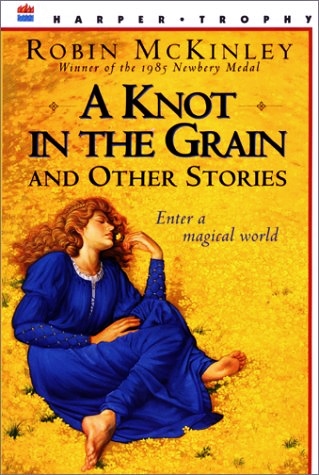
a knot in the grain robin mckinleyA Knot in the Grain and Other Stories by Robin McKinley ~ 1994. This edition: Harper Trophy, 1995. Softcover. ISBN: 0-06-44064-0. 192 pages.

My rating: 8/10, with the aside that these five short stories are über-fantasy-romantic, perhaps a tiny bit too fantastical for anyone past the age of about, oh, probably 13 or so.

Or maybe not. For anyone, teen to adult, this is total escape lit. Especially nice if you’ve already spent time in Damar.

I seriously love the cover illustration on this one, all romantically Burne-Jonesy. It’s by someone named Bryan Leister, and kudos to him, because it is perfect.

This is a collection of five short stories, three of which were previously published in other anthologies. Two are obviously set in the alternative-reality world Damar of The Hero and the Crown and The Blue Sword, two more are set in an unnamed alternative world, which could be Damar, and the last is set in the “real” world, in contemporary times. All feature completely sympathetic, strong female characters, and their male counterparts.

The Healer (1982)

The child was born just as the first faint rays of dawn made their way through the cracks between the shutters. The lantern-wick burned low. The new father bowed his head over his wife’s hands as the midwife smiled at the mite of humanity in her arms. Black curls framed the tiny face; the child gave a gasp of shock, then filled its lungs for its first cry in this world; but when the little mouth opened, no sound came out. The midwife tightened her hands on the warm wet skin as the baby gave a sudden writhe, and closed its mouth as if it knew that it had failed at something expected of it. Then the eyes stared up into the midwife’s own, black, and clearer than a newborn’s should be, and deep in them such a look of sorrow that tears rose in the midwife’s own eyes.

The baby, Lily, has been born without a voice, but she has another trait that more than makes up for that lack, at least in the eyes of the world: the gift of healing. Lily grows up beloved of her parents and ever-increasing siblings, and at the age of twelve she becomes apprentice to the midwife who was present at her birth. The two live together in love and harmony, until one day, when Lily is twenty, and she encounters a mysterious stranger on the road who can communicate with her mind-to-mind, without spoken words. Turns out that Sahath is an ex-mage, a once-accomplished master of the arcane arts, who has inexplicably lost most of his powers. One thing leads to another, and soon Lily and Sahath are sharing not just unspoken conversations but shyly blushing glances. And when Sahath puts forward the suggestion that perhaps his old mage-master could help Lily find her lost voice, the resulting journey to the mountain lake of the mysterious Luthe (yes, fellow Damar fans, that Luthe) brings all sorts of potentials to fruition.

The Stagman (1984)

She grew up in her uncle’s shadow, for her uncle was made Regent when her father was placed beside her mother in the royal tomb. Her uncle was a cold, proud man, who, because he chose to wear plain clothing and to eat simple food, claimed that he was not interested in worldly things, but this was not so…

The princess grows up under the oppressive shadow of her quietly malicious uncle, until, on her name day, when she is to be declared queen, she is instead offered as a living sacrifice to the mysterious Stagman, half-man, half-deer, who has been summoned forth by the Regent’s magicings in a swirl of ominous storms. The people of the kingdom raise no objection to the sacrifice of their princess; it is well known that she is a poor thing, of weak mind, for has not the Regent himself tried his hardest to educate her, without notable success? Into the cave then goes the maiden, to be chained to the stone wall to await her sacrificial fate. But things don’t go quite as the Regent has planned…

Luthe reappears in this story, offering succour to the Princess Ruen, unnamed until the end of her desperate journey to the inevitable mountain lake.

Touk’s House (1985)

In the best fairy tale tradition, a woodcutter steals into a witch’s garden for herbs to save his beloved youngest daughter’s life, is caught, and forfeits his next child to the witch, who claims she wants an apprentice to pass along her herb lore to. And then, still in best fairy tale tradition, things do not turn out as one would anticipate. For starters, the child in question, young Erana, has absolutely no aptitude for messing about with plants…

That’s all I’m going to say about this one; it is quite delightful, and my favourite story of the five in this book. You’ll just need to read it for yourself! (And, one more thing, because it’s by Robin McKinley – you probably don’t need me to tell you this – but it predictably morphs into a love story.)

Buttercups (1994)

There was an old farmer who married a young wife…

… but contrary to predictions, all goes well. At least until the farmer’s curiosity arouses a sleeping power emanating from Buttercup Hill…

A lovely story of a May-December romance, with two genuinely good people at its heart. A rather unusual story, this one, which doesn’t turn to tragedy as it so easily might in another author’s hands.

A Knot in the Grain (1994)

The last story in the collection returns from not-quite-here lands to contemporary times. High school student Annabelle reluctantly accompanies her family to their new home in a quiet New England town. She’s left all of her lifelong friends behind, and is having a hard time finding her new groove. Spending her summer visiting the library and rereading childhood favourites (thus giving the author a nice venue for mentioning her own favourites, from E. Nesbit to Mary Norton to Diana Wynne Jones, with a tiny shameless plug for McKinley’s partner, fellow author Peter Dickinson – I admit I chuckled a bit at that one, though I’m not much of a Dickinson fan) Annabelle is just plain ready for something to happen.

Which it does. One day, while staring at the ceiling in her attic hideaway, Annabelle notices an interesting knot in the wooden beam, which turns out to be the key to a hidden staircase, and another room. And in the room Annabelle finds a box. A box full of… well, I can’t tell you. (Nor can Annabelle.) But interesting things transpire, in a low-key sort of way.

A cute story, with a very likeable bunch of teenagers, including our heroine. Very nice. Just a titch too good to be true, though? (Says Inner Cynic.) Well, nice is a legitimate state of being, too…

*****

I feel like I should say something to sum up this collection. It’s a competently written group of stories, and very typical of the author’s early work, before she got into the edgier, darker, more adult realms of Deerskin and Sunshine. These fairy tales are aimed at the young teen reader and up, and the first four are strongly tinted with the veiled eroticism which is present in all of her longer novels. These heroines definitely all have hidden depths, and their male counterparts tend to be of the smoldering passion, glance-full-of-meaning type. Nothing to make one even blush, but it’s definitely there.

All in all, there’s not much to criticize. No masterpieces here, but it definitely should be on the shelf of every McKinley fan. I find myself rereading this one every so often; one day I’ll replace my battered ex-library paperback discard with a better, preferably hardcover copy. So – probably a recommendation, if you need it!

Read Full Post »

hazel rye vera bill cleaver 001Hazel Rye by Vera and Bill Cleaver ~ 1983. This edition: Harper Trophy, 1985. Softcover. ISBN: 0-06-440156-1. 178 pages.

My rating: 5/10.

A short novel published for the older elementary school ages – it says so right there on the back cover – ages 10 to 12 – and please don’t get me started on such narrowly prescriptive recommendations! Useful as these are to teachers and librarians when “targeting” the books they select for their students, I often wonder how many readers miss out on reading truly diverting and worthwhile stories because they are past the “age limit” so prominently displayed.

Not that I am suggesting that this particular novel is a masterpiece. Far from it. Hazel Rye is a slight novel, one of those “relationship”-slash-“issues”-slash-“problem” tales so common in elementary school libraries. The idea, it seems, is to make sure that any particular problem a child might be facing in his or her life can be eased by referring said child to a book featuring a similar situation. Want to be a football star but didn’t make the team? Here, read this. Being bullied at school because you’re fat/thin/gay/gawky/smart/slow? Super popular but still unhappy because your friends are all so shallow? Adopted and having issues with it? Foster kid? Mom and Dad divorcing?  Pregnant? Big brother dying of AIDS? Best friend dying of cancer? Mother dying of cancer? YOU’RE dying of cancer? You name it, there’s a story that addresses it, usually with a Big Helpful Conclusion of some sort to help the reader cope with the issue by learning that even though bad stuff happens, he/she is not alone.

All of the above being great topics to drive a novel, but so terribly often the storytelling gets lost in the shuffle, what with The Issue taking precedence. The characters exist merely to mouth the words; they’re frequently merely the framework The Issue gets draped over;  we never get to know them, let alone form any sort of personal relationship with them.

What I’m aiming at with my opinionated dismissal of so much well-meaning but misses-its-mark-as-good-fiction juvenile literature is to say that though this particular book fits into the category of an “issues” book, it’s just a little bit different, and it works well as a purely enjoyable read. It also seems aimed at perhaps a more mature audience than that stated on the cover, or maybe I should say “likely to be appreciated by”, rather than aimed at. For Hazel Rye – the book as well as the character – is a bit out of the ordinary.

The titular protagonist is an eleven-year-old girl living in a small community surrounded by orange groves in central Florida. Hazel’s Big Obvious Issue is that she’s slow in school; we find out on the first page that she’s just flunked sixth grade, and though she pretends not to mind all of the evidence points to a sorely bruised psyche.

Hazel’s eighteen-year-old brother Donnie has just been married; he lives nearby and is doing just fine taxi-driving; Hazel holds his financial success in high regard and likes to think that she too could do as well in a few years, once this bothersome school time is over; Donnie dropped out at sixteen and no one seems too concerned about it. Her mother is a fragile hypochondriac, too involved in her woes to take much interest in housekeeping, let alone mothering her daughter. As the story starts, Ona Rye is about to leave for a prolonged visit to her family in Tennessee.  The parental mantle in the household rests firmly on the shoulders of Hazel’s father, Millard, a hard-working and successful carpentry contractor. He and Hazel are not just father-and-daughter but also very close friends – “buddies” – with occasional bouts of flash-in-the-pan violent squabbles to keep things interesting between them. It was after one of these arguments that Millard transferred ownership of his small, neglected orange grove to Hazel, to woo back her attention and affection by an important gift.

Hazel rather likes the idea of being a property owner, though she’s not much interested in the farming aspect of things – too much work, and Hazel is all about taking things as easy as possible – and when an itinerant, fatherless family shows up asking to rent the rundown shack in Hazel’s grove, she enters into an agreement with the Poole family to let them live in her grove in return for young Felder Poole’s assistance in bringing the damaged trees back into production.

Felder Poole is close in age to Hazel, but aside from this similarity he is everything that she is not. Extremely bright, fond of all sorts of learning, he is an accomplished autodidact with a talent and propensity for making things grow. Hazel is at first suspicious and then enthralled with Felder’s plans for the grove; she becomes fascinated with the whole Poole ménage, much to her father’s dismay.

For Millard Rye’s Great Big Issue – which is really part and parcel of Hazel’s Great Big Issue, too – is that he is so emotionally attached to his daughter that he can’t bear to share her with anyone else. As Hazel’s horizons widen with the entry of Felder and the rest of the Pooles into her life, she is continually confronted with her father’s veiled but genuinely deep jealousy, and rather than being flattered by his attachment to her as she has been in the past, is beginning to see that this is an emotionally unhealthy situation for the both of them.

Let me hasten to say that Millard’s interest in Hazel is purely filial; there is no shadow of anything improper in his attachment to her; Millard is also deeply attached to his “nervous” wife Ona, and yearns for her happiness, indulging her in every way possible, hence his willingness to send her off to her parents to regain her fragile equilibrium while Millard and Hazel keep the home fires burning. She’s definitely coming back; whatever the Ryes’ other issues, a permanently split and unhappy family life does not appear to be among them.

As Hazel becomes more and more interested in the orange grove, and in the inner workings of the happy, loving, poor-but-ambitious Poole family, she is moved to change her own life in various ways. The sudden and unexpected resolution of the story rather surprised me, as did Hazel’s reaction to it; a welcome situation for this old cynic where this particular juvenile genre is concerned. Actually, I shouldn’t say “resolution”, as there really isn’t one; Hazel is left poised for her next step as the curtain closes on this brief period in her life.

The language in the book, coming from a third person perspective, is unusual and unique, using what I can only assume is a local Florida dialect and its very distinctive phraseology. Husband-and-wife writing team Vera and Bill Cleaver already had a respectable number of well-reviewed juvenile novels to their credit when they came up with Hazel Rye, and regional emphasis and use of dialect was one of their specialities. (You may find the authors’ names familiar if you were in grade school in the 1970s, as their award-winning Appalachian novel, Where the Lilies Bloom, was ubiquitous in libraries and frequently used for novel study classes. I read it way back then, and remember it vaguely but with admiration; I will be seeking it out for an adult re-read.)

Hazel Rye pleased me. Though it belongs in a genre I frequently hold up to scorn, I happily admit that it was a gently diverting read. The serious themes – the “issues” – were treated with respect and common sense, and the book was jam-packed with good nature and understated humour. A novel perhaps best appreciated by more mature readers than the target identified by the publishers; I would think a lot of the more enjoyable aspects of the language and scenarios would fly right over the head of the typical grade-schooler, and the plot itself isn’t really strong enough to be memorable, among so many other books with much more dramatic storylines.

I wouldn’t suggest that anyone rush out an acquire this one – it’s a very minor story in a read-once-and-move-on sort of way – but if you or your bookish adolescent come across it in your library travels, I’d say that you should give it a go.

Read Full Post »

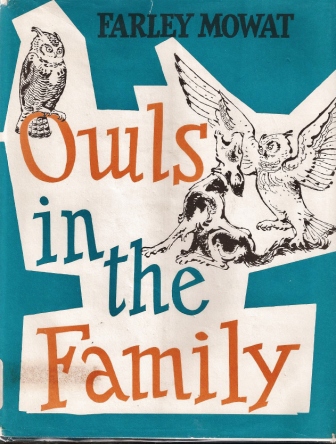
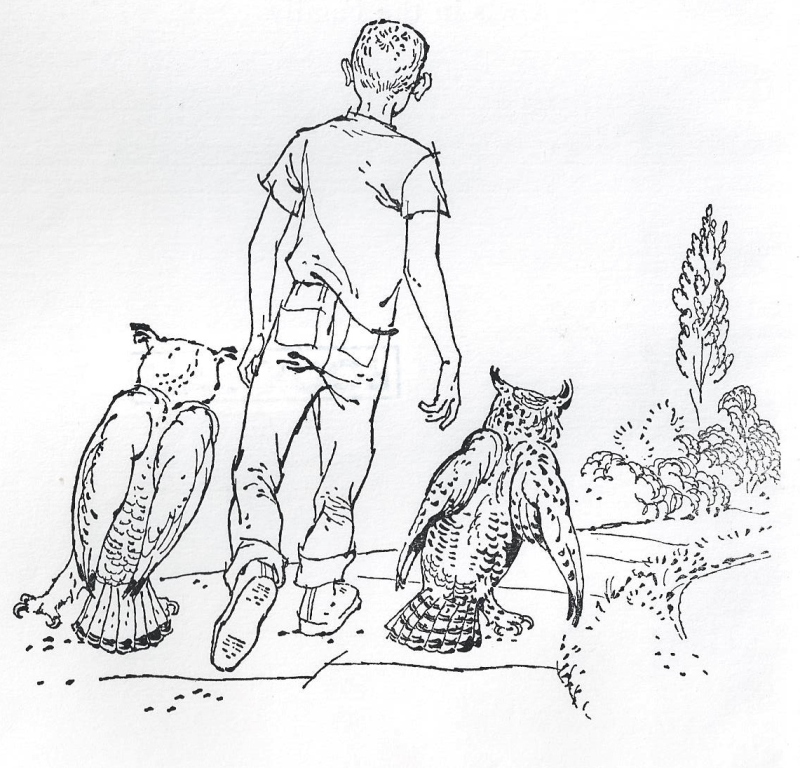
owls in the family farley mowat 001Owls in the Family by Farley Mowat ~ 1961. This edition: Little, Brown & Co., 14th printing. Illustrated by Robert Frankenberg. Hardcover. 107 pages.

My rating: 5/10 as an adult re-read; easily an 8/10 for a juvenile Can-Lit read-alone or read-aloud.

My kids swear I read this to them out loud way back in the murky depths of time; I can’t say that I remember doing so, but we read a lot of books together, so there’s a strong possibility that they are correct. They also say that they loved it, so…? (That has to stand for some sort of a recommendation!)

School teachers love this one, too. Just go ahead and Google “Owls in the Family novel studies”, and then stand back. Generations of Canadian school children have “done” and are still “doing” this slightly fanciful tale, ostensibly about young Farley’s true experiences as a Saskatchewan schoolboy.

Are you catching a slightly cynical tone to my words? I am sad to say that I have something of a love-hate relationship with Farley Mowat. I truly enjoy some of his fictions, and happily read and re-read his famous Lost in the Barrens and The Curse of the Viking Grave all through grade school, though luckily I dodged ever having to do a novel study on either of these; I read them purely for pleasure. But as the years went on, and I became more and more aware of the Canadian literary scene in a much broader sense, I often came across Mowat (in print) laying down the law and making grand pronouncements upon this, that and the other, which in itself is not all that offensive, but for his strident dismissals of other opinions than his own. Grand Old Man of Canadian letters as he may have become, but he is not universally loved in his home country. See this article in Up Here magazine, Farley Mowat: Liar or Saint?, for an interesting discussion of the Mowat paradox.

All of this aside, in looking at his juvenile fiction, Owls in the Family may well be his most beloved and widely read work, perhaps because of its suitability as a read-alone for novice readers, and its affectionate portrayal of an idealized mid-20th Century boyhood on the Canadian prairies.

The gist of the book is that at some point in his youth, the narrator, one Billy (widely accepted to be a stand-in for Farley himself, though why the renaming, none can tell), along with his friends Bruce and Murray, decide that they would like to capture and raise a young Great Horned Owl as a pet. They wander out into the cottonwood groves, find an owls’ nest, and, after a farcical encounter with the mother owl while accompanying one of their teachers on an attempt to photograph the nest and the owlets, conveniently acquire one of the fledglings when a storm knocks the nest down a day or two later.

The boys take their find to Billy’s house, where the young owl, named Wol after Christopher Robin’s companion in the Pooh books, joins an existing menagerie of various creatures such as gophers and white rats. Wol settles in to become one of the family, and is soon joined by a companion, the smaller and much more meek Weeps, rescued by Billy from certain death by torture by two other boys.

Several chapters of various adventures are described – canoeing on the slough, a pet parade gone hilariously awry, various encounters with unsuspecting individuals whom the owls universally upset and oust – until the story’s sudden ending with Billy and his family moving away, leaving the owls under Bruce’s care.

Perhaps I’ve become too cynical in my middle-aged years, but I’m afraid a lot of the humour didn’t raise much more than a reluctant smile this time around. Robbing birds’ nests, shooting crows, finding the neighbour’s cat dead in Wol’s claws – these are examples of the anecdotes we are asked to smile at. A less critical readership will no doubt take it all in stride.

From Farley Mowat's 'Owls in the Family' frontispiece; illustration by Robert Frankenberg.

From Farley Mowat’s ‘Owls in the Family’ frontispiece; illustration by Robert Frankenberg.

The illustrations by Robert Frankenberg are gloriously typical of the best juvenile books of the era, and it is well worth seeking out a copy with the original artwork if sharing this with a young reader, or, for that matter, reading it for yourself. Eleven short chapters and just over one hundred pages make this a fast and easy read-aloud; one could easily knock back three or four chapters at a sitting. Suitable for all ages, as long as one is prepared to discuss some of the more questionable events (no longer perhaps seen as harmless amusement) referred to in the previous paragraph.

I would hesitate to inflict this upon children in the nature of a “novel study”, but it does make an interesting casual read, capturing as it does a very Canadian place in a now long-ago time. Recommended, with the stated personal reservations.

Read Full Post »

rowan farm margot benary-isbertRowan Farm by Margot Benary-Isbert ~ 1954. This edition: Peter Smith, 1990. Translated from the German by Richard and Clara Winston. Hardcover. ISBN: 0-8446-6475-8. 277 pages.

My rating: 10/10. A sequel/companion piece to The Ark.

A more mature, less “sentimental” book than the also very excellent The Ark, and a classic example of a bildungsroman – a “coming of age” story – set in 1948 and centered on 16-year-old Margret but involving many other characters as well as they react and adjust to their changing situations and the challenges of the immediate post-WW II world of defeated Germany.

*****

Rowan Farm continues the story of the Lechow family, war refugees from Pomerania who have settled into an abandoned and renovated railway carriage located on a rural farm in the Hesse region of Germany (near Frankfurt). The family’s father has made the long journey from the prison camp in Siberia where he has been interned, and the joy of the family’s reunification is still strong, though shadowed by the wartime death of one of the sons, and the emotional and physical damage Dr. Lechow is recovering from.

Other returning soldiers are finding their way home all over Germany, though for many there are literally no homes to return to. An unprecedenting readjustment of the entire population is taking place, as refugees seek a place to settle and get on with their lives, while those fortunate enough to still have their properties often grimly resent the official mandate that they must share their resources and often their homes and land with the incomers.

Bernd Almut, son of matriarch Anni Almut of Rowan Farm, has found his own way home, and having regained some of his physical strength is now trying to fit himself back into the farm life which his mother has capably managed without him for so many years. The eldest Lechow children, 17 year old Matthias and 16 year old Margret, are now integral members of the Rowan Farm hierarchy, Matthias working on the land, with Margret caring for the livestock and the sadly diminished breeding kennel of Great Danes which Rowan Farm was long famous for. Bernd and Matthias have become good friends, but that relationship founders when both become infatuated with lovely Anitra, a city girl on holiday from her studies at Franfurt University.  Margret is nurturing some romantic feelings of her own towards Bernd, and he had apparently returned them until flirtatious Anitra (who can’t be all so fluffy as she looks – she is a Mathematics major) shows up. Margret deeply feels her own intellectual shortcomings; because of the war she has had to leave school some years ago, and no longer even thinks of returning to the world of studies; life has taken her a very different direction, into practical labour with her hands.

Multiple subplots abound in this novel. 11-year-old Andrea is academically gifted and is fortunate enough to be a scholarship student in the Catholic Lyceum in the nearby town; her parents are hoping that she of all of their children will be able to attend university, but Andrea has been bitten by the stage bug and has her heart set on becoming an actress. 8-year-old Joey and now-adopted “twin” brother Hans Ulrich are involved in many boyish pursuits, including raising a family of prized Angora rabbits, and running wild through the countryside every chance they get; a favourite stop is the cottage of solitary and eccentric “bee-witch” Marri, who always has a slice of bread and honey for her young visitors. Marri’s war has been a tragic one. She is the widowed mother of a lone son, a gentle and pacifistic boy; upon conscription he had willingly put on the soldier’s uniform as was his duty, but he ultimately was unable to follow orders to shoot another person, and was court-martialled and executed. Marri’s grief has brought her to the edge of madness. Fearing for her sanity, the Almuts and Lechows have tried to refocus her interest by asking her to take in a returned veteran who has himself lost his wife in a bombing raid, and who is desperately searching for his baby son, who would now be a toddler of three, if he is still alive.

There is also a young, one-armed, returned war veteran schoolmaster who falls afoul of the village mayor by involving his students in establishing a refuge for homeless soldiers; an outspoken and controversial journalist who visits the soldiers’ home and turns out to be a very unexpected individual; a American Quaker aid worker who is interested in both the Great Danes Rowan Farm raises and in the possiblilities of sponsoring the young kennel maid for emigration to the U.S.A.; a gang of black market dealers stealing local livestock; a rescued Shetland pony mare which Margret and her father nurse back to health; and two young ex-soldiers who stay for a short time until suddenly moving on, with tragic results. Musical Dieter and his band of Cellar Rats come and go, bringing a breath of the city with them as they play for the village dances and help with the haying.

Re-reading this story as an adult, I was most impressed by how delicately the author portrayed the difficulties of the returning soldiers such as Dr. Lechow. Parted from his family in the very early days of the war when he was conscripted to serve as a military doctor; finding his beloved family home in Pomerania has been lost forever; losing one of his sons – Margret’s twin brother Christian – all of these are things he takes to heart. His delicate (in his view) wife and helpless (in his mind) children have survived work camps and refugee camps and untold dangers and hardships while he himself has been incarcerated in a brutal Siberian prison camp. He finds his family at last and once he has healed enough to take an interest in their affairs, he is slightly shocked to realize that they have been functioning exceedingly well without him. His occasional attempts to regain his “beneficient patriarch” status, and his wife’s tactful handling of his delicately bruised ego and his confusion at the “new normal” he finds himself coming back to is realistically portrayed.

This story, and its predecessor The Ark, are paeans to the steadfast strength of women throughout and after the war. The men leave, usually not by choice, and either fail to return or come back terribly altered physically and emotionally. The mothers, grandmothers, wives, daughters and girlfriends who have been viewed as secondary citizens – especially in patriarchial Germany – remember that this is the land and the time of the woman’s role being defined as Kinder, Küche, Kirche – children, kitchen, church – have had to take on traditionally male tasks and for the most part have managed exceedingly well. The horrors of the war are more openly referred to in this story, including references to the death camps, and there is very much an atmosphere of both acknowledging what has happened and hoping that the future will be a more just and positive time for the survivors from all segments of German society.

All in all, a sensitive and moving story for older children (possibly 10 and up?) and adults both, inspired by the personal experiences of the author. Very highly recommended. It should follow The Ark for best effect, but can also be read alone.

Read Full Post »

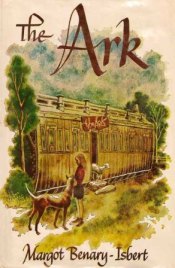
the ark margot benary-isbertThe Ark by Margot Benary-Isbert ~ 1948 (German edition: Die Arche Noah) ~ English edition, 1953. This edition: Harcourt, Brace & World, Inc., circa 1963. Translated from the German by Clara and Richard Winston. Hardcover. Library of Congress #: 52-13677. 246 pages.

My rating: 10/10. This is an excellent piece of juvenile historical fiction. Actually, that designation is not really correct, as it was written as a piece of “straight fiction”, being written during the time of its setting, but to readers today it is most definitely historical, so I will classify it as that.

While not a deliberately Christmas-themed book, The Ark features two Christmases as it covers a little more than a year in the lives of its characters, and it was one I thought of when I was pondering which fictional Christmases stand out as memorable in my mind.

*****

The Lechow family – Mother, 15-year-old Matthias, 14-year-old Margret, 10-year-old Andrea, and 7-year-old Joey – are apprehensively but optimistically looking forward to their new home. Since being displaced from their village in Pomerania in the early years of the war, they have been separated – Mother and Matthias to work camps and the younger children to various farms – but they are finally together again and have been travelling through Germany seeking some place of refuge amongst the hordes of other homeless, wretched, often-starving people. They had made it to Hamburg, for a brief respite among relatives, but with the city filled with Occupation troops they were unable to get a permit to stay, and were instead assigned to accommodation in a town in Hesse. Yet another boxcar ride, and then nine more months in a refugee barracks, and their turn for a housing assignment has finally come. Number Thirteen Parsley Street – the name sounds like something from a fairy tale, and they hold their breath in anticipation of what they will find there.

And they are looking forward as well to having some sort of permanent address to share with the Red Cross, for the family’s beloved father, a doctor serving with the German army, has last been heard from a year ago with a tattered postcard sent from a Russian prison camp. Every place they’ve stopped the Lechows have registered their names, “dropping breadcrumbs in the forest” like a fairytale tribe of lost children, hoping beyond hope that Father will one day be released, now that the long war is over, and will be able to track them down from the traces they have left behind.

The owner of the Parsley Street house is appalled and offended at having to receive five penniless refugees. Elderly widow Mrs. Verduz has weathered the war reasonably well, though her nerves are “shattered” from the noise of all the bombing. Her street has miraculously stayed mostly undamaged, and though food and fuel is in terribly short supply, she fully appreciates her good fortune in having a roof over her head and all of her beloved possessions around her. She grudgingly shows the Lechows the two attic rooms she has been ordered by the Housing Authority to allot to the Lechows, and muttering in thinly veiled disgust, she raids her well-equipped cupboards for sheets to cover the mattresses she’s had to provide, and a few dented pots and pans and some chipped dishes as well – the Lechows quite literally have nothing but the clothes on their backs and a blanket each.

Once the family is settled in to their new home, things do begin to look up.

Matthias is assigned work as a bricklayer’s flunky working on reconstruction, which, though far from his true interests, astronomy and nursery gardening, at least provides a small income, and the acquaintance of a co-worker – soon to be new friend – the musical Dieter, who lives in the cellar of a bombed-out house with his raggle-taggle refugee companions, who have started an increasingly successful band called “The Cellar Rats”.

Andrea goes to public school, and is fortunate in passing an examination and receiving a scholarship to a private school run by the nuns. Here she meets butcher’s daughter Lenchen, and the two become bosom friends, with Andrea exchanging help with homework for lunchtime sandwiches provided by Lenchen’s grateful mother. Andrea is sternly forbidden to angle for anything more, but the odd morsel falls her way – a boon in these very hungry times.

Young Joey also goes to school, with less enthusiasm than his sister; he reluctantly acquires a smattering of knowledge, but his happiest acquisition is a friend of his own, a perky orphan named Hans Ulrich – last name and birth date unknown, as his only childhood memory is of being bombed, and of his mother dying when they were travelling together in a boxcar in the early years of the war, when Hans was only two or three; he was unable to tell his last name so no family was able to be tracked down; he is a waif in the truest sense, though his foster-mother (who we suspect may be getting by as a prostitute) is kind enough in her careless way.

Mother gratefully settles into the small space she can at last call her own, and immediately sets about creating a home for her brood. She smooths down Mrs. Verduz, helps her with the housework, and begins to take in sewing jobs – she is an accomplished seamstress, and finds that this skill is in high demand as people start to once more have the interest in dressing themselves well, now that the fighting is over, and life is turning to a new normal. New clothes and cloth are impossible to get, but a skilled seamstress can do much with old curtains and various patches and pieces from worn-out garments tucked away in clothes chests. Mrs. Verduz has lent a sewing machine in return for mending work, and the two women are becoming partners in the challenge of keeping everyone clean and clothed and fed. Contrary to Mrs Verduz’s fears, having a family of children in residence is not such a bad thing. Matthias chops firewood and brings home the precious small coal ration, Margret has taken over the tedious job of standing in line for hours to collect food rations, Andrea washes dishes and sweeps the stairs, while Joey brightens her life with his happy disposition.

The only one who is left in limbo in this new life is Margret. She willingly does all that is asked up her, competently handling her many menial and tiresome chores, but she is just too old, at 14, for priority to return to school, and just too young to be assigned to a job, though her mother has suggested that an apprenticeship to a professional seamstress might  be a good next step. Margret is secretly appalled at the thought of spending her life bent over a sewing needle; her true life was left behind back on the Pomeranian farm which is now lost forever. There she was deeply immersed in gardening and in caring for her animals, and in rambling the countryside with her beloved twin brother Christian. A gaping hole in the family, and in Margret’s grieving heart, is carefully veiled over by everyone – Christian was shot and killed by a Russian soldier who broke into their house during the battle which ultimately displaced the family and started their years of wandering.

Christmas comes, and the family celebrates with true joy and gratitude. The Lechow children, Lenchen and Hans Ulrich and Dieter and his band decide to go Christmas carolling into the countryside, hoping for a few morsels of food or a coin or two from the relatively more prosperous farmers living around the outskirts of the town. In the course of their travels that wintry night they come to Rowan Farm, home of the widowed Mrs Almut and her elderly household. Anni Almut is a bit of a character in the neighbourhood. Endlessly energetic and outspoken, she forges ahead with whatever she sets her hand to. She has a few milk cows, raises milk sheep and ponies, and best of all to Margret’s startled recognition, keeps a breeding kennel of Great Danes. The Lechows kept Great Danes as well back in the good old days; Margret’s beloved dog Cosi was shot along with Christian, and that is another unhealed wound in her heart.

One thing leads to another, and six months later both Matthias and Margret are working and living at Rowan Farm. They have fixed up an old railcar on the farm as a dormitory, with bunk beds and a cookstove, and soon begin to fill it with the stray animals which are attracted to Margret as moths to a flame, and their town relations and friends, who are eager to come out to spend a day or two at “Noah’s Ark”, as the rail car has been christened, a refuge from the stormy seas of the outside world.

As this is a children’s book, everything continues to come together for the best, with the lost finding their way home, and old wounds healed, and the future looking positive. But the hardships and horrors of the war, though not detailed, are very much a part of the story, which ultimately celebrates the goodness that people find in the midst of the most terrible situations.

The returning soldiers are physically maimed and emotionally wounded, but they do start to heal; those who are lost are remembered with poignant sadness but not dwelled upon for the most part, as “life must go on”. The dreadful food and living conditions are dealt with creatively and are made the brunt of much humour. Our final impression is of a people and a country looking to the rising sun of a new day with optimism and hope, with a glance back to the horrors they have been involved in and a “never again” resolve.

This is a World War II book which does not reference the Holocaust and the Jewish displacement and slaughter, except by veiled allusions which most young readers will not catch. It does however in no way excuse what has happened. It rather focusses on the other innocent victims of the war, the common people, the small town shop shopkeepers, the peasants and farmers, the families and children of Germany who suffered horribly while the men were off fighting and the bombs exploded all around. People died in horrible ways, and froze and starved to death in the bitter winters even after the official truce was called. This is all in there, in the shadows behind the joy of the Lechow’s story of recovery and a happy ending.

Die Arche Noah was released to great acclaim in Germany in 1948. It caught the attention of American publishers, and was translated and released in an English edition in 1953, and was received with deep appreciation in North America. The author, beginning her writing career at the age of 59 – she was born in 1889 and had lived through the two great wars in Germany – went on to write several more children’s and young adult books, which were also translated and found ready sales overseas. Margot Benary-Isbert, herself having lost her family home and being displaced by the war, immigrated to the U.S.A. in 1952, becoming an American citizen in 1957. Her stories show her great love of both of her countries, the beloved Germany of her birth and the American haven which adopted her so graciously as it did so many other refugees from conflicts worldwide.

The Ark is often deeply sentimental and a bit “old-fashioned” in style and tone to modern ears, but the story is powerful and memorable, and strikes a strong chord with many of its readers. I was ten or eleven when I read it for the first time in my school library. I eagerly searched out the rest of Benary-Isbert’s works – our school libraries were lavishly stocked back in the 1970s – they had everything! – and when I settled into my own home and started building my book collection the Benary-Isbert books were among the first I thought I’d like to track down from my childhood favourites. Sadly they are mostly out of print, and long gone from library shelves, but were so popular in their time that they are still very readily obtainable in the online second-hand book marketplace, which is where you will have to search them out.

Read Full Post »
friendly gables hilda van stockum 001Friendly Gables by Hilda van Stockum ~ 1960. This edition: Viking Press, 1960. Hardcover. 186 pages.

My rating: 6/10.

An average to good example of the vintage juvenile “domestic drama” genre. I’ve happily re-read this book a few times, though if it disappeared from the shelves I wouldn’t be heartbroken, just mildly regretful.

*****

Living in a large house in Montreal, shortly after a move from the United States, the six Mitchell children, Joan, Patsy, Peter, Angela, Timmy, and Catherine, ranging in age from fifteen (Joan) to three (Catherine), are joined by twin brothers. Their mother has had a hard time with the birth, and is weak and confined to bed, so a strict English nurse, Miss Thorpe, is engaged to care for the babies and help run the household until Mother can recover enough to take on her usual role.

There are immediate conflicts. Only Joan finds favour in Miss Thorpe’s eyes as she proves herself both willing and very capable in helping with the babies and taking on much of the meal preparation; but the younger five are considered much too selfish, rambunctious, noisy, messy and careless by the strict nurse. Father is busy working and is seldom home; cash flow is definitely an issue in the household; which though comfortably middle-class is far from wealthy. There is nothing left for any extras after paying Miss Thorpe’s wages, and several plot lines focus on the children trying to earn enough money for various crucial things they need or desire.

The American Mitchells are still adjusting to life in French Canada. The children attend Catholic school, and their struggles with learning a second language, getting along with the Québécois children who occasionally toss a scornful “You Yankee!” their way, and trying to conform to the strict standards of the nuns and priests at their schools are nicely depicted.

The story focuses on each child in turn, while giving a broader picture of the inner workings of the family. The only child not given a starring role is young Catherine; each of the others has some sort of adventure. Joan falls in love, and attends her first dance; Patsy loses her glasses and disgraces herself deeply with the nuns at school in numerous ways; Peter falls afoul of a schoolmate and in the resulting fisticuffs knocks down and smashes a large plaster statue given by an important supporter of the school; Angela gets lost while attending a maple sugaring-off party; Timmy becomes infatuated with a girl at nursery school, and attempts to come up with a perfect gift for her.

Mother eventually gets better, the twins appear to be thriving after the month or so that we are in touch with the family, peace is made with Miss Thorpe, and we leave the family celebrating at the christening party.

*****

A pleasant though minor story, from an author who then went on to write several more serious and very well-regarded historical fictions set in Holland during World War II – most notably The Borrowed House and The Winged Watchman. Though there are superficial similarities to Elizabeth Enright’s The Saturdays, Friendly Gables does not attain the appeal and overall excellence of Enright’s creation, which defines the genre and deserves every word of its frequent praise.

The formula is also much like that of the Eleanor Estes’ Pye Family books in that it mostly relates a family’s daily life, sometimes in microscopic detail. As with the Pyes, the Mitchells are far from perfect, which is pleasantly reassuring to the reader. The morals in Friendly Gables are predictable but not terribly intrusive. And everything always comes out right in the end.

This story does have some lovely vignettes of parent-child and sibling relationships. Something I particularly appreciated was how independent the children were in sorting out their various dilemmas, and how confident the parents were in their children’s abilities to cope. Occasionally a child would go to Mother of Father to report the current happenings, and perhaps ask for assistance or advice (always cheerfully given), but often it was merely to report that the problem was solved, whereupon the parent would basically say “Well done!” and that would be the end of it – no muss, no fuss.

Friendly Gables is the last book in a series of three about the same family, so there are occasional references to off-stage characters and previous happenings, which left me a bit out of the loop, but those would make perfect sense to someone with access to the whole set. It certainly isn’t a big drawback, as the author sketches in enough information to pin it all together.

Friendly Gables is set in urban Montreal, and was preceded by two other novels about the fictional Mitchell family: The Mitchells, published in 1945 and set in Washington, D.C., and Canadian Summer, set in rural Quebec, published in 1948.

These three books are autobiographical, according to both the author and her now-adult children, and were inspired by and record incidents in the very real Marlin family’s life. Hilda van Stockum published her juvenile books and her many illustrations of other authors’ works under her maiden name, but was in her “everyday” life  Hilda Marlin: accomplished painter, U.S. Civil Service wife, and dedicated mother of six children, all of whom subsequently attained rewarding and creative careers of their own.

Hilda was born in 1908, in Rotterdam, Holland, to a Dutch father and an Irish mother, and spent her youth in both Holland and Ireland. She attended art school, where she apparently received much praise for her realistic paintings. Hilda married her brother’s college roommate, American Ervin Ross Marlin, in 1932, and travelled with him to New York. The couple and their steadily increasing family lived in various cities in the U.S.A.. They then spent six years in Canada, before moving to Ireland, and eventually to England, where Hilda died peacefully at the age of 98, still living in her own home, in 2006.

Hilda, child and grandchild of scientists, artists, philosophers, writers and intellectuals, was raised in an atheist household, but she embraced the Anglican faith in her teen years, converting to Catholicism in adulthood. Her devout faith appears in her books, including Friendly Gables, but more as a background to the story than in a “preachy” manner.

Hilda van Stockum’s strong belief in the importance of family also permeates her writings, making her a decided favourite of those seeking “wholesome” books to share with their children. A number of her titles are still in print, some more than seventy years after their first publication, so there are still eager readers. Hilda van Stockum’s works seem to be particularly in favour with “traditional” homeschoolers, which is understandable due to the author’s positive views on “family values” and religion. And “secular” readers – do not fear! These books can be enjoyed by all.

I’m including this book in the Canadian Book Challenge because of the Quebec setting, though the author is not Canadian, but Dutch-American, and the family in the story is American. National identities and prejudices play an important role in Friendly Gables; the author handles the topic very well.

Read Full Post »

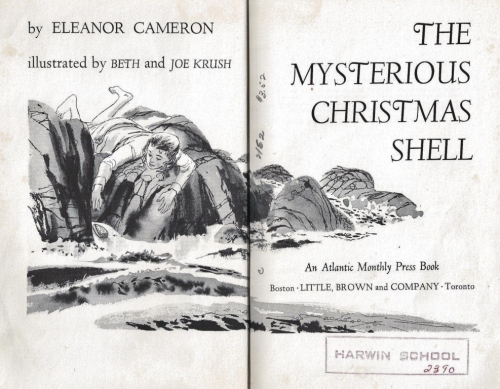
the mysterious christmas shell eleanor cameron 001The Mysterious Christmas Shell by Eleanor Cameron ~ 1961. This edition: Little, Brown & Co., 1961. First edition. Hardcover – Library Binding. Illustrated by Beth & Joe Krush. Library of Congress #: 61-9281. 184 pages.

My rating: 8/10. What a nicely written book this was! It restores my faith in the joys of reading juvenilia, sadly shaken by recent forays into several more modern disappointments in the youth-oriented fiction line.

This one was a recent impulse buy from the ever-changing and happily eclectic selection at the Bibles for Missions thrift store in Prince George. I try to get there once a month or so, and I always come away with a promising mixed bag of reading material. Some goes right back into the giveaway box, but there’ve been some small treasures found there, too.

The cover illustration was what grabbed my attention, though this grubby ex-school-library book showed much evidence of many readers, and was less than appealing at first glance. (It ultimately cleaned up nicely with a triple application of soapy cloth, rubbing alcohol and a tiny dash of benzene – not in combination, I hasten to add, but in delicately selective stages.)

“Those look like Krush children,” I thought to myself, and by golly, my instinct was right. Beth and Joe Krush were a husband-and-wife team of children’s book illustrators working industriously together from the 1950s through the following decades, and their marvelously detailed pen-and-ink-and-wash drawings perfectly depicted the characters of such classics as Mary Norton’s The Borrowers and its sequels, and Elizabeth Enright’s Gone-Away Lake books, among many others.

Here’s a sample. Isn’t this appealing?

the mysterious christmas shell frontispiece eleanor cameron 001

And Eleanor Cameron’s name chimed a little bell, too, though I didn’t really place it until I Googled her after I’d read the book. This is the famed Mushroom Planet creator, though those junior sci-fi fantasies were only one aspect of her widely varied output.

The Mysterious Christmas Shell is very much a plain and simple “domestic adventure” story, and it turns out that it is Cameron’s second book concerning the same brother-sister pair, Tom and Jennifer. Their earlier adventure, The Terrible Churnadryne, was published in 1959.

*****

Five days before Christmas, Jennifer and Tom arrive in the fictional town of Redwood Cove, California, on the Monterey Peninsula, to spend the holidays with their Grandmother Vining, and Aunts Vicky and Melissa. As soon as they walk into their aunts’ house, they realize something is terribly wrong. The tree hasn’t been decorated, the usual garlands are in a heap of green at the foot of the stairs, and everyone has a strained smile; occasionally they catch one or another of the adults huddled in a corner crying.

Turns out that the Vining family has had to sell its treasured piece of ancient redwood-forested seaside property, Sea Meadows, because of the year-ago death of the family partiarch, the children’s grandfather. Some investments have gone wrong, and outstanding debts needed to be paid. The purchaser, a boyhood friend of the family, was thought to want to keep the property unspoiled, to be the site of a single home, but recently troubling word has come that there will instead be major development. Hotels, a shopping centre, and a vacation community are planned; many of the ancient trees will be coming down, and No Trespassing signs will be going up barring the locals from their most pleasant seaside beaches and coves. The local townspeople are up in arms, and are angry at the Vinings for the sale; the Vinings are distraught at the prospective destruction of their well-beloved redwood forest.

An offer to re-purchase the property from the developer has been turned down, and a prospective reprieve of sorts has not come about. Grandfather Vining had intended to change his will to transfer Sea Meadows to the state as a nature reserve, but no one has any record of the will being registered, and no one knows if the envelope containing it was actually sent. If the will was indeed written, it would effectively cancel out the subsequent sale, and the property would go to the state once the buyer’s money was refunded. This seems like a way out of the dilemma, but where, oh where is the will?

As Jennifer and Tom ricochet around Redwood Cove looking for clues, we get a vivid picture of a large, loving family, each member trying to do the best for the others, though occasional misunderstandings occur.

The physical description of the California coastline, with its sea caves and pocket-handkerchief beaches, its tide pools and their glorious variety of sea life, is wonderfully well done; it is obvious that the author held the area in deep affection.

I do have an extra special reason for loving this story, having spent some weeks every year in California as a child, visiting grandparents, aunts, uncles and cousins in the Fresno area, and travelling out to San Jose, Monterey, and Carmel-by-the-Sea to visit family friends and to explore the still-unspoiled seashore along the more remote stretches of coastline. I even had my own similiar near-brush with death, once being washed out into the surf by a rogue wave; my father’s heroic rescue has become a piece of family folklore, and I blame my deep but reasonably well-disguised unease about any body of water much deeper than my knees on that terrifying childhood experience. Tom, Jennifer and Aunt Melissa’s being caught in the waves of the incoming tide sent chills down my spine! I could feel the sand burns …

The familiar setting was a marvelously unexpected surprise, but putting aside nostalgia and concentrating on the writing, I must say I was impressed by the quality of the prose, and by the author’s fine story-telling ability. While this is one of those stories where nothing huge really happens, with the adventures being small ones, and the solution to the mystery very apparent to the reader from early on – the Vinings, on the other hand, struggle on for strangely long time figuring out their clues – I found I couldn’t put the book down until the satisfyingly happy (though rather improbable) ending.

A grand vintage read for adults of a certain age wishing to revisit their youth through the pages of a book, though I’m not sure how much it would appeal to our more sophisticated 21st Century children.

Despite the Christmas-time setting, this is not really a Christmas book as such, though a glass tree ornament from Innsbruck plays a major part. Oops – just gave away a clue!

It was enjoyable to read about Christmas preparations in a place far from snow, and that brought back memories, too. We only spent one Christmas in California when I was a child, as most of our travelling took place in the early spring and the fall, but I remember how surreal it was that one time to be singing carols under the palm trees, with roses still blooming and lemons on the trees in my grandmother’s garden, while back at home, in interior British Columbia, icicles reaching the ground were our parting memory as we’d pulled out of the yard for the marathon three-day drive southwards. (Somewhere I have a picture from that trip of me and my sister standing, in our matching velvet-collared coats, in front of a huge Christmas tree at Disneyland, which was ornamented by coloured glass balls as large as our heads.)

This is an author decidedly worthy of further investigation. Investigating the titles and plots of some of her non-sci-fi “realistic” children’s/teens’ novels, I strongly suspect that I read some of those when I was in grade school, as two or three of the unusual plots sound very familiar, but The Mysterious Christmas Shell was an unfamiliar, unexpected and most welcome find, for all of the reasons detailed above.

*****

Oh – one more serendipitous thing. Eleanor Cameron turns out to be Canadian! She was born in Manitoba, and though she subsequently lived most of her life in California, she is widely identified in all of the material I was able to find online as a Canadian. So – another one, completely out of the blue, for the Canadian Book Challenge!

Read Full Post »

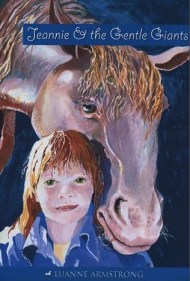
jeannie and the gentle giants luanne armstrongJeannie and the Gentle Giants by Luanne Armstrong ~ 2002. This edition: Ronsdale Press, 2002. Softcover. ISBN: 0-921870-91-4. 150 pages.

My rating: 4/10. A completely typical “problem novel” (single parenthood, mental illness, foster children) packed with contrived situations. An eleven-year-old heroine is placed in foster care after her mother has a mental breakdown.

Sadly this one didn’t quite fly. The horse bits were good – the best part of this novel, in my opinion –  but they couldn’t salvage the rest of the completely predictable, cookie cutter story. Despite the favorable back cover blurb by my up-the-hill neighbour, poet, writer, and horse-logger Lorne Dufour (aha! now here’s an interesting Canadian Reading Challenge author) it just didn’t click with anyone here. Too bad. Jeannie is set in Kelowna, B.C., and as a home-province, B.C. Interior-set youth novel I really wanted to love it. (Plus the cover image is fantastic.)

From the publisher’s website:

Jeannie and the Gentle Giants, a novel for readers eight to fourteen, deals with the problems experienced by children when they are taken from their parents and have to make a new life with foster parents in a new community. In Jeannie’s case, the problems begin when her mother falls ill and can no longer care for her. Taken from her home, placed with foster parents and unable to discover the whereabouts of her ill mother, young Jeannie withdraws into herself and can think only of running away.

Gradually her defences are breached by two immensely large and wonderful workhorses and their perceptive and humorous owner. Through the horses and her work on the farm, Jeannie develops new interests, learns to ride and becomes involved in the daily life of the farm, even helping with horse-logging. In turn, Jeannie learns about friendship, love and trust, and ultimately gains the maturity and self-confidence to accept the challenge of becoming herself a care-giver. In this sensitive and moving story, Luanne Armstrong draws us into a world of pain, growth and fulfilment.

Lorne Dufour’s back cover blurb:

In this story, the Gentle Giants slowly walk right through our hearts. We will forever remember their presence in Jeannie’s life and that the great Gentle Giants never forget.

 ~ Lorne Dufour, horse-logger & award-winning author

The author attempted an ambitious level of complexity here, by involving her young protagonist in a rather tangled combination of situations. We have: mentally ill mother, single-parent family with no father in sight, poverty, social stigma as child of mentally ill mother (handled quite well by author in providing heroine with staunch friends who immediately speak up in her favour to school bullies), foster parents who can’t have children, neighbour couple who find they are expecting a baby mid-way through book, heroine’s questioning as to what a family actually is and her conflicting desires to both be with her mother back in the city and to stay in her new, more fulfilling and interesting country life, doctors refusing to allow child to see ill mother – (this didn’t ring true – felt like a plot element to increase tension – mother was experiencing a psychotic episode, some mention of bipolar disorder/manic depression, but once the mother was capable of sending the first letters, why the heck WOULDN”T she be able to have visits from her daughter – wouldn’t that by emotionally beneficial to BOTH of them) – okay, moving on – learning to handle work horses, learning to ride, dealing with an injured horse all by herself, finding a lost child, guilt guilt guilt because heroine feels she has been the cause of the child being lost, feral stray dog tamed and made into pet …  My goodness, what a busy, busy girl.

As I said earlier, I really wanted to like this book, but it just didn’t ever feel “real”. Too much was chucked into the mix, Jeannie’s reactions were not very well portrayed – we were continually given the same set of outward clues that she was all bummed out – she had a “shy look”, “looked down”, “blinked to hold back tears”. The language throughout is overly simplistic, as if keeping it accessible to “poor readers” was a major goal.

Does this seem too critical? I feel like a big old meanie for picking this one apart, but, in all honesty, these were my thoughts as I read.

For the record, I really don’t care for “problem books”, for readers of any age, but in particular for young readers. “This is a book about DIVORCE! MENTAL ILLNESS! CEREBRAL PALSY! DOWN’S SYNDROME! BULLYING! ANOREXIA! ETHNICITY! PREJUDICE! BEING GAY! blah blah blah… If you, dear person/dear young child with a similar issue in your life, will only read this book you will feel so much better because you will see how this marvelous hero/heroine dealt with it in their fictional world and you won’t feel so alone.”

Dear youth authors: Write a STORY first. If there are side issues, so be it, for if naturally included those always interest, verisimilitude and richness to the mix. But don’t pick an “issue” and write a prescriptive “here’s how to deal with it, dear” contrived moral tale. Kids aren’t stupid. They don’t need to be told what to think in such a poorly written way. Yes, definitely acknowledge and include the issues, but don’t build a weak story around them, for the sake of marketing the book to the school library network! This whole “issue story” genre encourages sub-par story-telling.

In my opinion.

Jeannie and the Gentle Giants pushed a lot of my buttons, and not in a good way.

Rant over. (For today!)

Oh, hang on – not quite. “Foster” parents – I always thought that foster parents were those filling a long-term role in a child’s life. Jeannie is in what I would classify as “temporary care”, so the immediate (within days) placement of Jeannie with a new, albeit temporary, “mom” and “dad” didn’t ring true. It is continuously stated that Jeannie will be reunited with her mother once the doctors get her (mother’s) meds figured out. I mean, the actual family placement is okay, but the whole “this is your new family” thing felt rushed and phony. No wonder the poor kid is a basket case – “Here, Jeannie, meet your new mom!”

And another quibble, this with the publisher’s website and back cover plot outline. It sounds as though Jeannie doesn’t know where her mother is through all of this. She’s in the flipping hospital in Kelowna, people. Did you not read the book?!  Jeannie knows this, her social worker knows this, her “foster parents” know this – they make continual phone calls and Jeannie’s mom writes her letters, for crying out loud! So why is this presented in the promotional material as “child torn away from parent and searching for her”? The kid tries running away to go see her mother, but she knows where her mother is. She’s turned away as she tries to buy a bus ticket to Kelowna, to go to the hospital, to see her mother, because Jeannie knows she’s there.

Okay, now I’ll quit. I’d hesitated to review this book, because it let me down so sadly, but I did say I’d review and post every Canadian book I read, so here goes. There are a few more disappointing titles lined up for review, so a heads-up for those wondering why I’m so crabby today. I’ve just been pushing them back in the queue, but have decided to tick them off my deal-with list before 2013 hits.

Read Full Post »

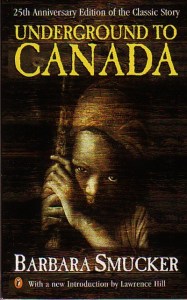
underground to canada barbara smuckerUnderground to Canada by Barbara Smucker ~ 1977. This edition: Puffin (Penguin), 1999. Introduction by Lawrence Hill. Paperback. ISBN: 0-14-130686-6. 144 pages.

My rating: 9/10  – A very good historical fiction novel for its intended audience, middle grade to young teen readers. Older readers may notice the simplified plotting and some plausibility gaps, but in general a well-written story with a gripping main character and dramatic situations, well-researched and well-presented.

*****

Author’s Note:

The escape from Mississippi to Canada by two fictitious characters, Julilly and Liza, could have happened. It is based on first-hand experiences found in the narratives of fugitive slaves; on a careful study of the Underground Railway routes; and on the activities of two Abolitionists: Alexander M. Ross of Canada and Levi Coffin of Ohio.

Twelve-year-old June Lilly – Julilly – is a slave on Massa Hensen’s Virginia plantation. He’s not a bad slave owner, comparatively speaking, but when he gets ill and can no longer oversee his cotton farm, his slaves are offered to a buyer from Mississippi, where conditions are notoriously the worst in the slave-owning states of the South.

Night music droned through the slave quarters of Jeb Hensen’s Virginia plantation. The words couldn’t be heard but they were there beneath the rise and fall of the melody.

Julilly hummed them as she sat in the doorway of her cabin, waiting for Mammy Sally to come home from cooking in the Big House kitchen. She was as still and as black as the night. The words of the song beat in her head.

When Israel was in Egypt’s land
Let my people go
Oppressed so hard, they could not stand
Let my people go.

Old Massa Hensen didn’t like this song. He said it came when there were whisperings and trouble around. There were whisperings tonight. They murmured beneath the chirping of the crickets. They crept from ear to ear as soundless as the flickering of the fireflies.

When the slave trader does indeed come, Julilly is separated from her mother and is sent with a group of other young slaves to a much harsher owner in Mississippi. When an opportunity to escape arises, Julilly and her new friend Liza grasp their chance and set out on an epic trek north, finding help through the network of the “underground railway”, hoping beyond hope to one day reach the far off land called “Canada”, where slavery is outlawed.

They succeed, but not without many hardships.

The ending of the story was realistic though rather optimistically contrived in its reconciliation scene between Julilly and her mother; I found it hard to accept so much “coincidence” in such widely separated characters reuniting with such apparent ease. That was really my only objection, though. Oh – and the lack of complexity with the secondary characters. Even though others share the stage, this book is very much centered on one character only – Julilly.

Julilly is a quite beautifully drawn character, and I found myself completely engaged with her story, much as I already knew the plot line both from previous readings and from the inevitability of the stereotyped story arc.

One of Barbara Smucker’s best novels for young readers, and the one which made her reputation as a writer. A very Canadian novel, though most of the action takes place in the United States. Canada’s presence as a destination for the escaping slaves, and the involvement of real Canadian Abolitionist Andrew Ross are key plot elements.

This would be good for independent readers 10 and older. This would also make a good Read-Aloud, for all ages, though the subject matter is intense and might not be suitable for sensitive younger listeners. Era appropriate use of the derogatory term “nigger” throughout; Lawrence Hill’s short Introduction is a must-read for its discussion of this aspect. Fast paced and engagingly written.

Recommended.

Read Full Post »

« Newer Posts - Older Posts »