Posts Tagged ‘Vintage’

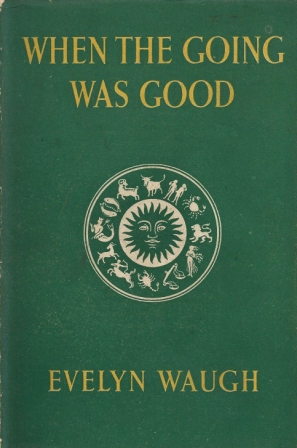
When the Going was Good by Evelyn Waugh ~ 1946. This edition: The Reprint Society, London, 1948. Hardcover. 314 pages.

My rating: 7.5/10. Held my interest throughout.

I’m not even sure where I picked this one up – it appeared in a stack of books gathered in this summer’s travels through B.C. I’m thinking either Kamloops or Vernon, though there is no price and bookseller code marked anywhere on the flyleaf. Possibly from the Sally Ann or a similar charity shop? No matter what it’s provenance, I’m most glad I’ve added it to my private collection. A most enjoyable read, consumed in goodly portions each evening for the last week just before closing my eyes.

*****

From the inner dustjacket:

About this book

It comprises all that the author wishes to preserve of the four travel books he wrote between 1929 and 1935: Labels, Remote People, Ninety-Two Days, and Waugh in Abyssinia. “These four books,” he writes, “here in fragments reprinted, were the record of certain journeys, chosen for no better reason than I needed money at the time of their completion; they were pedestrian, day-to-day accounts of things seen and people met, interspersed with commonplace information and some rather callow comments. In cutting them to their present shape, I have sought to leave a purely personal narrative in the hope there still lingers round it some traces of vernal scent … I never aspired to be a great traveller, I was simply a young man, typical of my age; we travelled as a matter of course. I rejoice that I went when the going was good.”

It’s vintage Waugh, and it’s well-written, the author’s disclaimers aside. Some of it is excellent; it’s all very readable, and it made me brush up on my history; Waugh was of course writing for a contemporary audience, and though I was pleased to realize his references were easy to place, I was quite vague on the details.

Here are the contents:

Preface

From 1928 until 1937 I had no fixed home and no possessions which would not conveniently go on a porter’s barrow. I travelled continuously, in England and abroad… We have most of us marched and made camp since then, gone hungry and thirsty, lived where pistols are flourished and fired. At that time it seemed like an ordeal, an initiation to manhood…”

Chapter One: A Pleasure Cruise in 1929 (From Labels) – London, Paris, Monte Carlo, Naples, Catania, Haifa, Cana (Galilee), Port Said, Cairo, Malta, Crete, Constantinople, Athens, Corfu, Gibraltar, Seville.

Chapter Two: A Coronation in 1930 (From Remote Peoples) – The coronation of Ethiopian Emperor Ras Tafari at Addis Ababa.

Chapter Three: Globe-Trotting in 1930-1 (From Remote Peoples) – Zanzibar, the Congo, Aden, Kenya (Nairobi, the Rift Valley), Tanganyika, Cape Town.

Chapter Four: A Journey to Brazil in 1932 (From Ninety-two Days) – Guiana and Brazil.

Chapter Five: A War in 1935 (From Waugh in Abyssinia) – The Italian invasion of Abyssinia, from a war correspondent’s perspective. Farce versus bloodshed.

*****

If you happen across this little account in your own travels, it is worth the time to read, especially if you are already a Waugh convert.

Read Full Post »

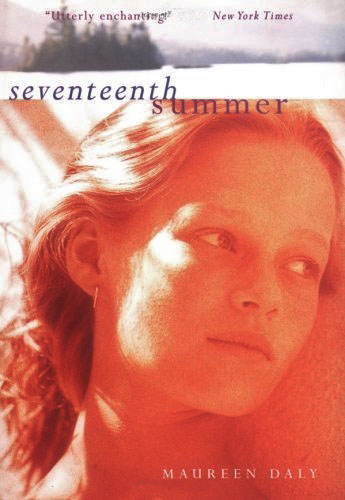
Seventeenth Summer by Maureen Daly ~ 1942. This edition: Simon & Shuster, 2002. Paperback. ISBN: 0-671-61931-4. 291 pages.

My rating: 9.5/10. Every time I re-read this book I love it all over again. I know I tend to overuse the term “evocative”, but if there’s any novel I’ve ever read that qualifies fully for that term, this is it. The young author started working on this book when she herself was seventeen; it was published when she was twenty. With the expected flaws due to the youth of the author, it does not stand up well to pure literary analysis, but as an emotionally appealing record of a teenage love affair it is a delicate little masterpiece.

I’m sitting here trying to think of other titles to compare it to, and I keep coming up with I Capture the Castle, by Dodie Smith, a book I love so much that I’m avoiding reviewing it because I don’t quite know how to put into words its very special quality and appeal.

Though the setting is completely different, and much more realistic – could I Capture the Castle be described as plausible? – I don’t think so! – Seventeenth Summer has a similar mood and delicacy of feeling. Innocent, sensual, agonizingly evocative of a girl’s romantic and yes – I’ll say it – sexual awakening – though anyone expecting the protagonist to actually go “all the way” will be shamefully disappointed. It’s all in there, though.

Maybe a girl’s, or a woman’s book, more than a man’s? Or maybe not. Anyway, I like it – a lot – and confidently recommend it to my fellow readers, at least those of you who think highly of Dodie Smith, Rumer Godden and their ilk.

*****

One early summer evening, in the small city of Fond du Lac, Wisconsin, the late 1930s, seventeen-year-old Angeline (Angie) Morrow, newly graduated from her all-girls Academy, catches a smile from public high-school grad Jack Duluth. A few days later they meet again; Angie is barefoot in the garden picking early radishes, and Jack, driving his father’s bakery delivery truck, stops to inquire about her mother’s bread order. Jack is as taken with Angie as she is with him; he invites her sailing, and the summer love affair is on. And off again, and then on, with all of the teenage angst and glorious peaks and abysmal valleys of emotion and “Does he like me? Really like me? And how much do I like him? And what’s next?”

As the flowers in the garden bud, flower, and reach their blowsy peak in late summer, the love affair follows its predicable natural course. The ending is not as expected, and is, in my opinion, perfectly fitted to what has gone before.

How much should I go into detail here? The internet abounds with reviews; it’s not hard to find a complete dissection of this novel with a minimum of effort. Somehow it has ended up on many high school reading lists, and has suffered far much over-analysis and way too many reluctant-student book reports.

Ignore all of these. Ignore the comments that “nothing happens in this book”, and “Angie is impossibly innocent”, and “how could a little thing like table manners condemn Jack if she really liked him?”, and “the metaphors are so obvious – tomatoes and radishes and poppies – we get it!”, and ” gee, they sure drink a lot of tea and eat a lot of ice cream”, and “what’s the matter with the mother, and why can’t her daughters talk to her?”, and “what about Lorraine (Angie’s older sister) and her parallel love affair with the abusive and manipulative Martin?”, and “what the heck is that ending all about – don’t we get to know what happens?!”

Ignore all of these. Pick up the book, remind yourself that the author was just seventeen herself when she first put these words on paper – because for a little while you will probably be thinking “What the heck? This is so lame!” – and surrender yourself in full to Angie and Jack’s golden summer of personal discovery, restrained passion, and first true love.

Read Full Post »

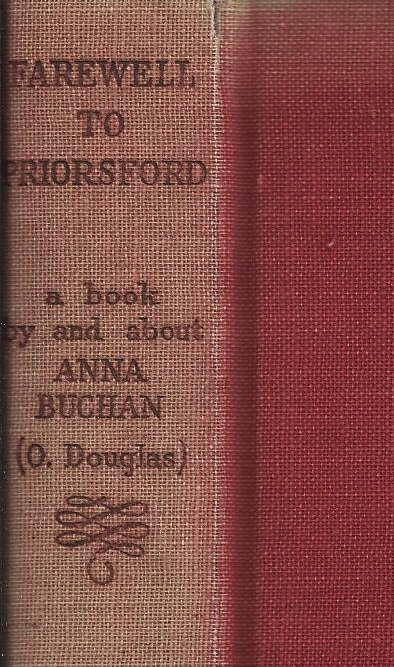
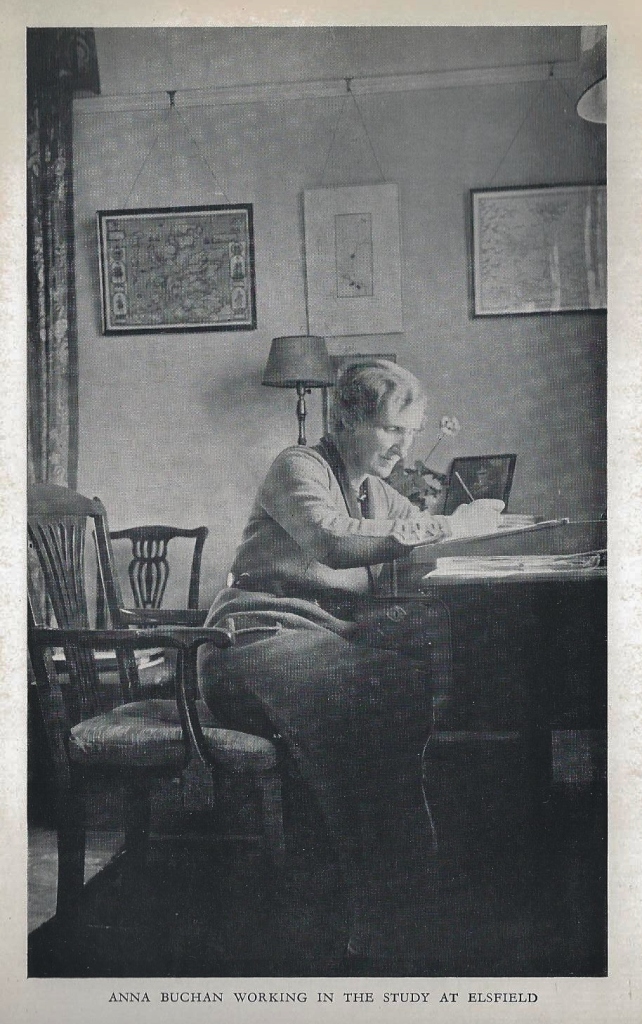
Farewell to Priorsford: a book by and about Anna Buchan (O. Douglas) ~ 1950. This edition: Hodder and Stoughton, 1950. Hardcover. With 5 photographs. 253 pages.

My rating: 10/10. Succeeds perfectly in its stated purpose, as noted in the Preface:

This book has been compiled at the request of the many who wish to know more about Anna Buchan by those privileged to enjoy her friendship.

This commemorative volume is presented in the hope that it will give to all who enjoy Anna Buchan’s books a share in the fun, the courage and the inspiration she gave to all who knew her.

*****

This book was published two years after Anna Buchan’s death, and is composed of several short biographical sketches, with the remainder a few collected short stories and anecdotes. There is also the fragment of the last novel Anna was working on, eight chapters of another Rutherfurd book, The Wintry Years.

This is a fascinating and enlightening glimpse into the world of this quiet yet eloquent author, and there are no surprises here for those who know the author through her fictional words, merely a confirmation of what we had hoped to find; that the author’s writings do indeed reflect her real life and her views that many people are indeed “good, gentle and scrupulous.” If this sounds too meek and wishy-washy, I hasten to add that Anna had a strong streak of cynical Scottish clear-headedness about her as well, and there is a leavening of wry humour and keen insight in her works to balance the goodness and gentleness.

The more I read of this author, the more I like her, both her works and the person she herself must have been. Farewell to Priorsford is a lovely memorial, and very much worth seeking out for O. Douglas fans. The eight chapters of The Wintry Years are an absolute treat to fans of the Rutherfurds, giving us a fleeting glimpse of their lives during the years of the second World War, and touching on many of the characters we came to know so well in The Proper Place, The Day of Small Things, and Jane’s Parlour, as well as teasingly introducing us to some new characters. Such a shame that Anna Buchan died so relatively young, at 71, and still very much at the peak of her writing years.

Here is what Farewell to Priorsford contains:

ANNA BUCHAN OF PRIORSFORD
 
I. A Biographical Introduction by A.G. Reekie
II. Anna by Susan Tweedsmuir
III. Olivia by Alice Fairfax-Lucy
IV. Author and Friend by Christine Orr
V. A Peebles Player by William Crichton
 
 
STORIES BY ANNA BUCHAN
 
I. Introductory Note
II. A Story for Young and Old:
          Jock the Piper
III. Broughton and Two Broughton Stories:
          An Upland Village
          An Echo
          Miss Bethia at the Manse
IV. Two Long Stories:
          A Tea-Party at Eastkirk
          Two Pretty Men
V. The First Eight Chapters of a Novel:
          The Wintry Years
 

*****

Highly recommended for O. Douglas – Anna Buchan fans.

Read Full Post »

The Lady or the Tiger, and Other Stories by Frank Stockton ~ circa 1882. This edition: Airmont Publishing Co., Ltd., 1968. Paperback. 160 pages.

My rating: Of this collection, I give the two stories The Lady or the Tiger and The Discourager of Hesitancy both a strong 10/10. The other stories in this little collection, a reasonable 7/10, allowing for their time of writing. Definitely period pieces, with the expected style and tone. Gently pleasant literary diversions.

Frank Stockton (1834 – 1902), though best known as the writer of the title short story, initially worked as a wood engraver and an editor, before settling to his productive and successful writing career. He wrote many short stories besides The Lady,  and several humorous novels, none of which are in print today.

*****

The Lady or the Tiger is a classic short story written in the 1880s, and still anthologized today as a prime example of the unsolvable “puzzle tale”. I am sure most people have read this at some point or another, most likely in a high school English class, but in case you haven’t, here is a complete plot summary courtesy of Wikipedia. I don’t know if a spoiler alert is needed, but if you want to read this for the first time yourself, stop now, and go instead to East of the Web – The Lady or The Tiger .

The “semi-barbaric” king of an ancient land uses a unique form of trial by ordeal for those in his realm accused of crimes significant enough to interest him. The accused is placed alone in an arena before two curtain-draped doors, as hordes of the king’s subjects look on from the stands. Behind one door is a beautiful woman appropriate to the accused’s station and hand-picked by the king; behind the other is a fierce (and nearly starved) tiger. The accused then must pick one of the doors. If by luck (or, if one prefers, the will of heaven) he picks the door with the woman behind it, he is declared innocent and set free, but he is required to marry the woman on the spot, regardless of his wishes or his marital status. If he picks the door with the tiger behind it, the tiger immediately pounces upon him–his guilt thus manifest, supposedly.

When the king discovers that his daughter, the princess, has taken a lover far beneath her station, the fellow is an obvious candidate for trial in the arena. On the day of his ordeal, the lover looks from the arena to the princess, who is watching in the stands, for some indication of which door to pick. Even the king doesn’t know which door hides the maiden, but the princess has made it her business to find out, as her lover knew she would. She makes a slight but definite gesture to the right, which the young man follows immediately and without hesitation. As the door opens, the author interjects, “Now, the point of the story is this: Did the tiger come out of that door, or did the lady?”

The author then playfully sets out for the reader the dimensions of the princess’s dilemma, and of the reader’s dilemma in answering the question he has posed. The reader is reminded that the princess knew and “hated” the waiting maiden, one of her attendants, whom she suspected of being infatuated with the princess’s lover. The princess, the reader must remember, is “semi-barbaric,” too, or she wouldn’t have come to witness the ordeal at all; and though she has shrieked often at the thought of her lover torn to bits before her eyes, the thought of his dancing out of the arena with his blushing bride has afflicted her more often. In either case, the princess knows her lover is lost to her forever. She has agonized over her decision, but by the time she arrives at the arena, she is resolute, and she makes her gesture to the right unhesitatingly. The author denies being in a position to answer his question with authority, and the story ends with the famous line, “And so I leave it all with you: Which came out of the opened door – the lady, or the tiger?”

Great little story. And I too have no idea which one it was! Worth reading and mulling over.

Full Table of Contents:

  • The Lady or the Tiger ~ outlined above.
  • The Griffin and the Minor Canon ~ a fable about a fearful griffin befriending a cleric, and about how the inhabitants of the cathedral town reacted to the griffin’s presence in their midst.
  • Love Before Breakfast ~ a romantic interlude, sweet as cherry pie.
  • “His Wife’s Deceased Sister” ~ a writer discovers the unexpected drawbacks to writing a bestselling story. Ironic and humorous, and very likely a comment on the author’s own most successful piece and the difficulties it brought about in his working life.
  • Our Story ~ another romantic interlude, with a little twist at the end.
  • Mr. Tolman ~ a successful businessman goes incognito to gain himself an interesting holiday, and ends up acting as Cupid to a couple of mathematical music students.
  • Our Archery Club ~ a gentle satire on proper form versus successful results, plus another romance.
  • The Discourager of Hesitancy ~ a sequel of sorts to The Lady or the Tiger, which promises at first to resolve that quandary, but which actually adds another dilemma to be wrestled with.

Read Full Post »

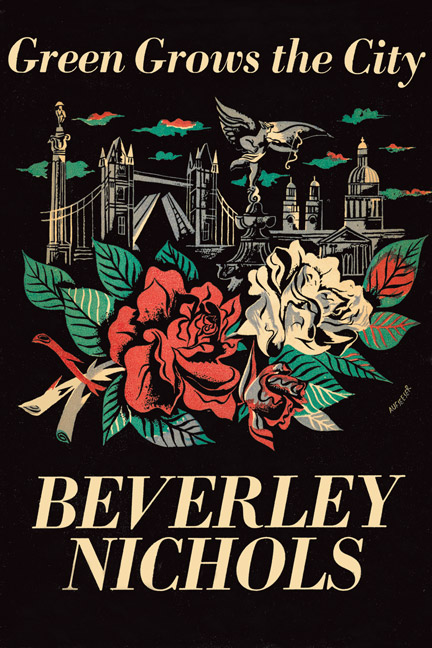
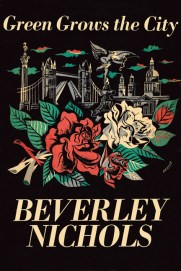
Green Grows the City by Beverley Nichols ~ 1939. This edition: Jonathan Cape, Ltd., 1939. Hardcover. First edition. 285 pages.

My rating: 8/10. A little lush in the prose department, but ultimately I found this semi-fiction quite a likeable diversion. The chapter devoted to the author’s black, half-Siamese felines, Rose and Cavalier, won me completely over; I had been wavering a bit as the human cattiness of the narrative was sometimes rather too precious. Nichols’ affection for and description of his pets is a lovely bit of writing, appealing to anyone who shares his predilection for cats as the perfect – though endlessly demanding – home and garden companions.

The author makes no pretensions about his preferred role as planner and onlooker rather than a get-dirty, hands-on gardener. A little light watering, the plucking of a few blooms to adorn the breakfast table, maybe a mite of flower arranging to while away a slow morning, while the hired gardener does the heavy stuff under our Mr. Nichols’ interested eye…

Oh, meow! Who’s being catty now?

*****

Beverley Nichols, in his long life (1898-1883) in which he acted out the roles of journalist, author, playwright, composer, lecturer, pianist, and gay (in every sense of the word) man-about-town, alternately amused and infuriated his audience, friends and, I suspect, more than a few enemies. Possessed of a very high opinion of himself, a keenly sarcastic tongue, and a decided willingness to share his lightly censored thoughts in print, Beverley Nichols remains as readable today as he was when first published. Especially popular are his garden books, as among all the chattering nonsense and superfluous frills there are passages of very authentic admiration and insight into the appeal of that cultivated “square of ground” so universally sought after the universal tribe of gardeners, and his portraits of the plants that struck his fey fancy are small treasures of descriptive prose.

Speaking in the chapter regarding ferns,  Rhapsody in Green, in Green Grows the City, of his introduction to the gold and silver ferns (Gymnogramme species) at Kew:

…(A)s I stooped to tie the (shoe)lace, I happened to glance upward. And the underside of this fern was coated with gold, pure gold, that glistened in the sunlight.

Perhaps it may sound silly to say that it was the loveliest thing that has ever come my way since I have seem life through the eyes of a gardener… I knelt down before it. The closer I came, the more lovely did the fern appear. There were no half-measures about the gold-dust with which it was so richly coated. It wasn’t just a yellow powder. It bore no sort of resemblance to the ochre make-up with which the lily is adorned. Nor was the gold dusted merely here and there – it covered every curve and crevice of the frond.

The tiny shoots that were springing up from the base were, if possible, even brighter. Since their leaves had not yet opened, and there was no green about them, they looked like delicate golden ornaments, daintily disposed about the parent plant.

And by the side of it was another excitement. A silver fern! As thickly coated with the metal of the moon as the other had been coated with the metal of the sun. If I had not realized the futility of comparisons at moments such as this, I would have dared to suggest that the silver fern was even more beautiful than the golden. For it seemed actually luminous with this magic dust. And again, there were no half-measures. It was silver. Not just white or grey, not in the least like, say, a centaurea. It was silver, hall-marked, pure and glistening from the inexhaustible mint of Nature.

What gardener could resist such a teasing description? Now in my botanical garden and specialty nursery visits I shall be forever watching for gold and silver ferns…

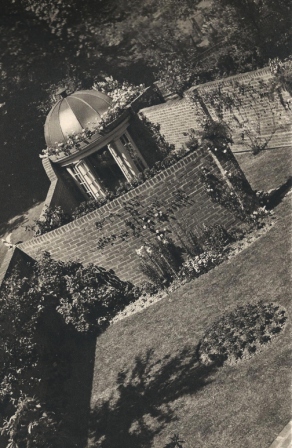
Green Grows the Garden is the fictionalized account of the creation of a very real garden. In 1936, after parting from his beloved country cottage and garden in the village of Glatton, Nichols tried the inner city life, living in a small, gardenless house in the Westminster district of London. Homesick for a bit of green, he tried without success to find a more suitable situation.

I had a hunger for green. I was lonely for the sound of trees by night. I longed to feel the turf beneath my feet, instead of the eternal pavement. Even if it were only a narrow strip of sooty grass, it would be resilient and alive, and would give me some of its own life.

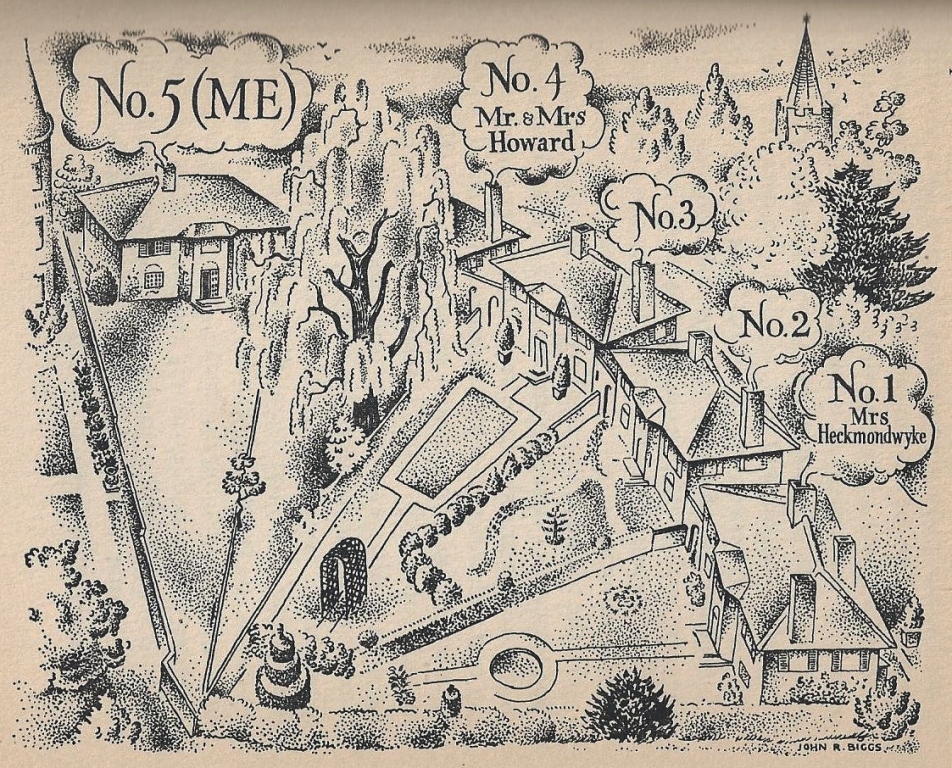
Finally a small semi-detached house is found, in a close in the suburb of Heathstead. There is a garden, of sorts, a triangular-shaped bit of ground which challenges the would-be garden-designer with its peculiar idiosyncracies.

The challenge is accepted, and the transformation begins. Struggles with the site abound, not least of which is the continual protestation of every one of Nichols’ projects by the overbearing “Mrs. Heckmondwyke” of No. 1. The feud between No. 5 and No. 1 drives much of the drama of this microcosmic enterprise, though in the end something of an uneasy truce is attained.

The book is dedicated “To My Friends Next Door”, probably to nip in the bud any idea that any of them were the actual prototype of the overwhelming Mrs. H, and Beverley Nichols quite freely admits, in an evasive forward, that perhaps some of his characters owe more to fiction than to real life. The garden was a real garden, though; as were the cats and the extraordinary, imperturbable, Jeeves-like manservant Gaskin.
As the story draws to a close, the shadow of World War II is looming, and in the last chapter there is sober reference made to the outside world. Watching newsreel footage, Nichols comments:

…Line after line of youths, in brown shirts, black shirts, red shirts, any sort of shirt…marching, always marching. Backwards and forwards, to the North, to the South, to the East and West. Marching with bigger and better guns, to louder and fiercer music. Marching with clenched fists or with outstretched arms, animated by the insane conviction that the fist that is clenched was made for the sole purpose of striking the arm that is outstretched. Marching, always marching, blind to the beauty that is around and above, deaf to all music save the snarl of the drum, marching to a destination that no man knows but all men dread.

And I suspect no one will be found to argue with the often quoted final words of this little book:

…(T)hat if all men were gardeners, the world at last would be at peace.

Read Full Post »
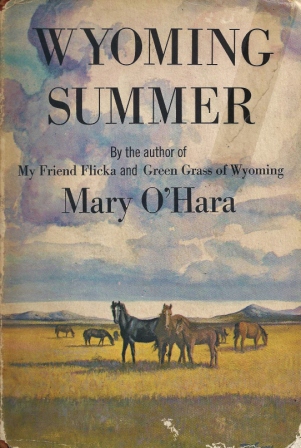
Wyoming Summer by Mary O’Hara ~1963. This edition: Doubleday & Company, 1963. Hardcover. 286 pages.

My rating: 7.5/10. An enlightening backstory of a short period of the author Mary O’Hara’s (1885-1980) life, and details the inspiration for My Friend Flicka, Thunderhead and The Green Grass of Wyoming. It felt rather self-congratulatory at times – my handsome husband, my great natural talent as a composer, my amazing sensitivity to the glories of nature, my important celebrity friends – but to excuse this it seems that most of Mary O’Hara’s boasts were indeed true. This account is also balanced with explanations, and details of the valleys as well as the peaks of the experiences within.

Presented as an autobiography, Mary O’Hara herself notes in the Preface that she has tinkered with her journal entries to make them more cohesive and readable. While the book has a reasonably strong narrative flow, there are frequent times when the entries are a bit disjointed, with out-of-place comments tacked onto longer vignettes. Perhaps this was done to maintain the feeling of a spontaneous journal, but since the work was already being edited I think it might have been stronger if these snippets had either been expanded upon or left out completely.

*****

This book was a surprising find last week in a quick scouting cruise through Nuthatch Books in 100 Mile House. The author’s name was immediately recognizable – for what horse-crazy child of my particular generation has not read My Friend Flicka? – but I was unfamiliar with the title. A lesser-known novel, perhaps? On closer investigation I found that this was an autobiographical account of part of a year spent on the Wyoming ranch that inspired the Flicka bestseller and its two sequels.

Mary O’Hara Alsop was a talented pianist, published composer, and Hollywood script writer when she turned her hand to writing fiction. Inspired by the rugged surroundings of the ranch which she and her second husband, Helge Sture-Vasa, purchased in Wyoming in 1930 and lived on for sixteen years, and the horses and other ranch animals she came to know intimately, O’Hara’s novel My Friend Flicka was published in 1941 to immediate acclaim. It was based on the journals O’Hara had been keeping of her life on the ranch, and the characters were very much drawn from her own family, friends and the ranch workers.

Wyoming Summer is set in the tenth year of she and her husband’s occupation of the Remount Ranch. Their initial scheme of sheep farminghad failed dismally, as prices for livestock dropped catastrophically during the Great Depression. Helge (referred to as “Michael” in Wyoming Summer, and the prototype for “Rob” in the Flicka books) was an experienced ex-Army cavalry officer, and the next enterprise that met with modest success was that of raising and training horses (“remounts”) for the U.S. Army. This was a precarious and not particularly prosperous undertaking, and Mary’s dairy herd and the establishment of a summer boy’s camp catering to the sons of her well-off music and film connections paid many of the bills.

Wyoming Summer details the challenging and exhausting juxtaposition of Mary’s dual worlds: ranch wife baking bread, hand-milking cows and dealing with daily chores combined with aspiring composer eagerly snatching the hours needed for piano practice and composition from her more prosaic duties.

Though this autobiography details both the rewards and drawbacks of life on a remote ranch, it decidedly glosses over the personal crises that Mary O’Hara dealt with throughout her life. A difficult first marriage resulted in two children, one of whom, a daughter, died tragically of cancer in her teens. After her divorce from her first husband, Mary’s second matrimonial attempt seemed happier, at least initially, but it was also doomed. Helge was a handsome, hard-working, hard-drinking man who was not above a certain amount of philandering, and that marriage ended, after the sale of the Remount Ranch and a move to California, in 1947.

Mary continued her work in composing music and working on stage and screen productions, as well as publishing several other novels. The journals kept while at the Remount Ranch had been set aside among Mary’s papers, and when they resurfaced in the 1960s Mary thought she could make something of them, hence the publication of Wyoming Summer. Several other novels met with modest success, but it was the Wyoming trilogy, and in particular the first installment, My Friend Flicka, that ensured Mary O’Hara’s longest lasting acclaim.

Wyoming Summer is interesting both for its window into a specific time and place, and for what its author leaves out. While we are allowed into certain areas of Mary O’Hara’s complex life, we are firmly shut out of others, leaving us with a definite feeling of being a spectator with limited access to the performance being played out.

These few reservations aside, Wyoming Summer is definitely worth reading, especially in tandem with the more purely fictional novels of the same setting.

Read Full Post »

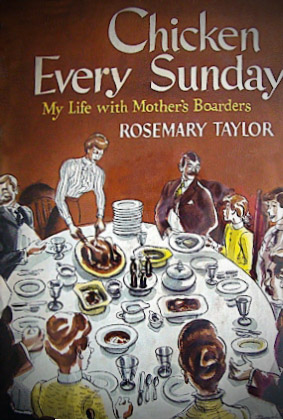
Chicken Every Sunday: My Life with Mother’s Boarders by Rosemary Taylor ~ 1943. This edition: Blakiston, 1945. Hardcover. Illustrated by Donald McKay. 307 pages.

My rating: 6.5/10.

A nostalgic trip down memory lane. This fictionalized autobiography fits well into the “humorous memoir” genre so popular a half-century ago. If you enjoyed Cheaper by the Dozen (Galbraith), and The Egg an I (MacDonald) you will find this a pleasing read. The rating feels a bit low, but it’s not meant to be a snub, just a reflection of where this book fits in with other similar works which I have read and enjoyed over the years. It’s pleasant enough and I will happily recommend it if you come across it “cheap and easy”, but I doubt I would deliberately search it down unless I were particularly interested in the era and setting.

*****

I purchased this old hardcover recently, for a reasonable $5, at Second Glance in Kamloops, B.C. – a WONDERFUL secondhand bookstore, by the way, for any of us local enough to visit it in person. The title rang a faint bell in deepest memory, and once I dipped into it I realized that I had indeed read it years ago. It must have been as part of my mother’s library, though she no longer owns it – it obviously did not survive her many give-ways as she prepared to move from her huge house (two stories plus a packed-full attic) to the much tinier “granny house” she lives in now.

I’m a bit mystified as to why Mom parted with it, as it is just the kind of light memoir she generally enjoys, so I’m going to surprise her with it the next trip in to town with a box of books. At a physically frail 87, one of her few remaining pleasures is reading, and she keeps me busy searching my own shelves and scouting the secondhand emporiums for reading material; a chore I must admit I take on with great pleasure – an excuse to book shop! How much better does it get than having permission from your mother?!

The setting is Tuscon, Arizona, during the first decade of the 2oth Century; the boarding house that the author’s mother ran with such success was built in 1906, “far out in the country”, though, as predicted, the city soon came out to surround it during the boom times of the “roaring twenties”.

The father of the family was quite the wheeler-dealer; finances swung like a pendulum as deals succeeded or fell through; the mother decided to take matters into her own hands to ensure a steady enough income to feed the family, so she began to take in boarders. The book details the succession of quirky characters that passed through the Drachman family doors, as seen through the eyes of young Rosemary.

The incidents are well-presented and the characters are well-portrayed; I did enjoy reading this period piece and I will be keeping it (once my mother finishes with it) with my largish collection of similar works. The humor works most of the time; I smiled (rather than full-out laughed) throughout; the writing is more than competent. The author wrote another book of memoirs focussed on her father’s many enterprises (Ridin’ the Rainbow: Father’s Life in Tuscon, 1944), and several novels.

Apparently very popular at its time of publication, the book inspired a comedic 1944 stage play and then a 1949 movie of the same title, starring Dan Dailey, Celeste Holm, and a young Natalie Wood. (I see that the movie gets lackadaisical reviews on the few online sites I browsed through; I’ve never seen it and don’t plan on searching it out, so that’s all I can tell you.)

Read Full Post »

« Newer Posts