Posts Tagged ‘Vintage’

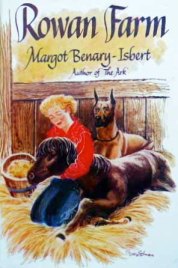
rowan farm margot benary-isbertRowan Farm by Margot Benary-Isbert ~ 1954. This edition: Peter Smith, 1990. Translated from the German by Richard and Clara Winston. Hardcover. ISBN: 0-8446-6475-8. 277 pages.

My rating: 10/10. A sequel/companion piece to The Ark.

A more mature, less “sentimental” book than the also very excellent The Ark, and a classic example of a bildungsroman – a “coming of age” story – set in 1948 and centered on 16-year-old Margret but involving many other characters as well as they react and adjust to their changing situations and the challenges of the immediate post-WW II world of defeated Germany.

*****

Rowan Farm continues the story of the Lechow family, war refugees from Pomerania who have settled into an abandoned and renovated railway carriage located on a rural farm in the Hesse region of Germany (near Frankfurt). The family’s father has made the long journey from the prison camp in Siberia where he has been interned, and the joy of the family’s reunification is still strong, though shadowed by the wartime death of one of the sons, and the emotional and physical damage Dr. Lechow is recovering from.

Other returning soldiers are finding their way home all over Germany, though for many there are literally no homes to return to. An unprecedenting readjustment of the entire population is taking place, as refugees seek a place to settle and get on with their lives, while those fortunate enough to still have their properties often grimly resent the official mandate that they must share their resources and often their homes and land with the incomers.

Bernd Almut, son of matriarch Anni Almut of Rowan Farm, has found his own way home, and having regained some of his physical strength is now trying to fit himself back into the farm life which his mother has capably managed without him for so many years. The eldest Lechow children, 17 year old Matthias and 16 year old Margret, are now integral members of the Rowan Farm hierarchy, Matthias working on the land, with Margret caring for the livestock and the sadly diminished breeding kennel of Great Danes which Rowan Farm was long famous for. Bernd and Matthias have become good friends, but that relationship founders when both become infatuated with lovely Anitra, a city girl on holiday from her studies at Franfurt University.  Margret is nurturing some romantic feelings of her own towards Bernd, and he had apparently returned them until flirtatious Anitra (who can’t be all so fluffy as she looks – she is a Mathematics major) shows up. Margret deeply feels her own intellectual shortcomings; because of the war she has had to leave school some years ago, and no longer even thinks of returning to the world of studies; life has taken her a very different direction, into practical labour with her hands.

Multiple subplots abound in this novel. 11-year-old Andrea is academically gifted and is fortunate enough to be a scholarship student in the Catholic Lyceum in the nearby town; her parents are hoping that she of all of their children will be able to attend university, but Andrea has been bitten by the stage bug and has her heart set on becoming an actress. 8-year-old Joey and now-adopted “twin” brother Hans Ulrich are involved in many boyish pursuits, including raising a family of prized Angora rabbits, and running wild through the countryside every chance they get; a favourite stop is the cottage of solitary and eccentric “bee-witch” Marri, who always has a slice of bread and honey for her young visitors. Marri’s war has been a tragic one. She is the widowed mother of a lone son, a gentle and pacifistic boy; upon conscription he had willingly put on the soldier’s uniform as was his duty, but he ultimately was unable to follow orders to shoot another person, and was court-martialled and executed. Marri’s grief has brought her to the edge of madness. Fearing for her sanity, the Almuts and Lechows have tried to refocus her interest by asking her to take in a returned veteran who has himself lost his wife in a bombing raid, and who is desperately searching for his baby son, who would now be a toddler of three, if he is still alive.

There is also a young, one-armed, returned war veteran schoolmaster who falls afoul of the village mayor by involving his students in establishing a refuge for homeless soldiers; an outspoken and controversial journalist who visits the soldiers’ home and turns out to be a very unexpected individual; a American Quaker aid worker who is interested in both the Great Danes Rowan Farm raises and in the possiblilities of sponsoring the young kennel maid for emigration to the U.S.A.; a gang of black market dealers stealing local livestock; a rescued Shetland pony mare which Margret and her father nurse back to health; and two young ex-soldiers who stay for a short time until suddenly moving on, with tragic results. Musical Dieter and his band of Cellar Rats come and go, bringing a breath of the city with them as they play for the village dances and help with the haying.

Re-reading this story as an adult, I was most impressed by how delicately the author portrayed the difficulties of the returning soldiers such as Dr. Lechow. Parted from his family in the very early days of the war when he was conscripted to serve as a military doctor; finding his beloved family home in Pomerania has been lost forever; losing one of his sons – Margret’s twin brother Christian – all of these are things he takes to heart. His delicate (in his view) wife and helpless (in his mind) children have survived work camps and refugee camps and untold dangers and hardships while he himself has been incarcerated in a brutal Siberian prison camp. He finds his family at last and once he has healed enough to take an interest in their affairs, he is slightly shocked to realize that they have been functioning exceedingly well without him. His occasional attempts to regain his “beneficient patriarch” status, and his wife’s tactful handling of his delicately bruised ego and his confusion at the “new normal” he finds himself coming back to is realistically portrayed.

This story, and its predecessor The Ark, are paeans to the steadfast strength of women throughout and after the war. The men leave, usually not by choice, and either fail to return or come back terribly altered physically and emotionally. The mothers, grandmothers, wives, daughters and girlfriends who have been viewed as secondary citizens – especially in patriarchial Germany – remember that this is the land and the time of the woman’s role being defined as Kinder, Küche, Kirche – children, kitchen, church – have had to take on traditionally male tasks and for the most part have managed exceedingly well. The horrors of the war are more openly referred to in this story, including references to the death camps, and there is very much an atmosphere of both acknowledging what has happened and hoping that the future will be a more just and positive time for the survivors from all segments of German society.

All in all, a sensitive and moving story for older children (possibly 10 and up?) and adults both, inspired by the personal experiences of the author. Very highly recommended. It should follow The Ark for best effect, but can also be read alone.
Read Full Post »

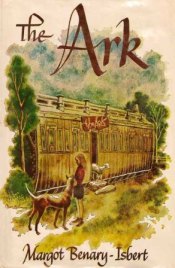
the ark margot benary-isbertThe Ark by Margot Benary-Isbert ~ 1948 (German edition: Die Arche Noah) ~ English edition, 1953. This edition: Harcourt, Brace & World, Inc., circa 1963. Translated from the German by Clara and Richard Winston. Hardcover. Library of Congress #: 52-13677. 246 pages.

My rating: 10/10. This is an excellent piece of juvenile historical fiction. Actually, that designation is not really correct, as it was written as a piece of “straight fiction”, being written during the time of its setting, but to readers today it is most definitely historical, so I will classify it as that.

While not a deliberately Christmas-themed book, The Ark features two Christmases as it covers a little more than a year in the lives of its characters, and it was one I thought of when I was pondering which fictional Christmases stand out as memorable in my mind.

*****

The Lechow family – Mother, 15-year-old Matthias, 14-year-old Margret, 10-year-old Andrea, and 7-year-old Joey – are apprehensively but optimistically looking forward to their new home. Since being displaced from their village in Pomerania in the early years of the war, they have been separated – Mother and Matthias to work camps and the younger children to various farms – but they are finally together again and have been travelling through Germany seeking some place of refuge amongst the hordes of other homeless, wretched, often-starving people. They had made it to Hamburg, for a brief respite among relatives, but with the city filled with Occupation troops they were unable to get a permit to stay, and were instead assigned to accommodation in a town in Hesse. Yet another boxcar ride, and then nine more months in a refugee barracks, and their turn for a housing assignment has finally come. Number Thirteen Parsley Street – the name sounds like something from a fairy tale, and they hold their breath in anticipation of what they will find there.

And they are looking forward as well to having some sort of permanent address to share with the Red Cross, for the family’s beloved father, a doctor serving with the German army, has last been heard from a year ago with a tattered postcard sent from a Russian prison camp. Every place they’ve stopped the Lechows have registered their names, “dropping breadcrumbs in the forest” like a fairytale tribe of lost children, hoping beyond hope that Father will one day be released, now that the long war is over, and will be able to track them down from the traces they have left behind.

The owner of the Parsley Street house is appalled and offended at having to receive five penniless refugees. Elderly widow Mrs. Verduz has weathered the war reasonably well, though her nerves are “shattered” from the noise of all the bombing. Her street has miraculously stayed mostly undamaged, and though food and fuel is in terribly short supply, she fully appreciates her good fortune in having a roof over her head and all of her beloved possessions around her. She grudgingly shows the Lechows the two attic rooms she has been ordered by the Housing Authority to allot to the Lechows, and muttering in thinly veiled disgust, she raids her well-equipped cupboards for sheets to cover the mattresses she’s had to provide, and a few dented pots and pans and some chipped dishes as well – the Lechows quite literally have nothing but the clothes on their backs and a blanket each.

Once the family is settled in to their new home, things do begin to look up.

Matthias is assigned work as a bricklayer’s flunky working on reconstruction, which, though far from his true interests, astronomy and nursery gardening, at least provides a small income, and the acquaintance of a co-worker – soon to be new friend – the musical Dieter, who lives in the cellar of a bombed-out house with his raggle-taggle refugee companions, who have started an increasingly successful band called “The Cellar Rats”.

Andrea goes to public school, and is fortunate in passing an examination and receiving a scholarship to a private school run by the nuns. Here she meets butcher’s daughter Lenchen, and the two become bosom friends, with Andrea exchanging help with homework for lunchtime sandwiches provided by Lenchen’s grateful mother. Andrea is sternly forbidden to angle for anything more, but the odd morsel falls her way – a boon in these very hungry times.

Young Joey also goes to school, with less enthusiasm than his sister; he reluctantly acquires a smattering of knowledge, but his happiest acquisition is a friend of his own, a perky orphan named Hans Ulrich – last name and birth date unknown, as his only childhood memory is of being bombed, and of his mother dying when they were travelling together in a boxcar in the early years of the war, when Hans was only two or three; he was unable to tell his last name so no family was able to be tracked down; he is a waif in the truest sense, though his foster-mother (who we suspect may be getting by as a prostitute) is kind enough in her careless way.

Mother gratefully settles into the small space she can at last call her own, and immediately sets about creating a home for her brood. She smooths down Mrs. Verduz, helps her with the housework, and begins to take in sewing jobs – she is an accomplished seamstress, and finds that this skill is in high demand as people start to once more have the interest in dressing themselves well, now that the fighting is over, and life is turning to a new normal. New clothes and cloth are impossible to get, but a skilled seamstress can do much with old curtains and various patches and pieces from worn-out garments tucked away in clothes chests. Mrs. Verduz has lent a sewing machine in return for mending work, and the two women are becoming partners in the challenge of keeping everyone clean and clothed and fed. Contrary to Mrs Verduz’s fears, having a family of children in residence is not such a bad thing. Matthias chops firewood and brings home the precious small coal ration, Margret has taken over the tedious job of standing in line for hours to collect food rations, Andrea washes dishes and sweeps the stairs, while Joey brightens her life with his happy disposition.

The only one who is left in limbo in this new life is Margret. She willingly does all that is asked up her, competently handling her many menial and tiresome chores, but she is just too old, at 14, for priority to return to school, and just too young to be assigned to a job, though her mother has suggested that an apprenticeship to a professional seamstress might  be a good next step. Margret is secretly appalled at the thought of spending her life bent over a sewing needle; her true life was left behind back on the Pomeranian farm which is now lost forever. There she was deeply immersed in gardening and in caring for her animals, and in rambling the countryside with her beloved twin brother Christian. A gaping hole in the family, and in Margret’s grieving heart, is carefully veiled over by everyone – Christian was shot and killed by a Russian soldier who broke into their house during the battle which ultimately displaced the family and started their years of wandering.

Christmas comes, and the family celebrates with true joy and gratitude. The Lechow children, Lenchen and Hans Ulrich and Dieter and his band decide to go Christmas carolling into the countryside, hoping for a few morsels of food or a coin or two from the relatively more prosperous farmers living around the outskirts of the town. In the course of their travels that wintry night they come to Rowan Farm, home of the widowed Mrs Almut and her elderly household. Anni Almut is a bit of a character in the neighbourhood. Endlessly energetic and outspoken, she forges ahead with whatever she sets her hand to. She has a few milk cows, raises milk sheep and ponies, and best of all to Margret’s startled recognition, keeps a breeding kennel of Great Danes. The Lechows kept Great Danes as well back in the good old days; Margret’s beloved dog Cosi was shot along with Christian, and that is another unhealed wound in her heart.

One thing leads to another, and six months later both Matthias and Margret are working and living at Rowan Farm. They have fixed up an old railcar on the farm as a dormitory, with bunk beds and a cookstove, and soon begin to fill it with the stray animals which are attracted to Margret as moths to a flame, and their town relations and friends, who are eager to come out to spend a day or two at “Noah’s Ark”, as the rail car has been christened, a refuge from the stormy seas of the outside world.

As this is a children’s book, everything continues to come together for the best, with the lost finding their way home, and old wounds healed, and the future looking positive. But the hardships and horrors of the war, though not detailed, are very much a part of the story, which ultimately celebrates the goodness that people find in the midst of the most terrible situations.

The returning soldiers are physically maimed and emotionally wounded, but they do start to heal; those who are lost are remembered with poignant sadness but not dwelled upon for the most part, as “life must go on”. The dreadful food and living conditions are dealt with creatively and are made the brunt of much humour. Our final impression is of a people and a country looking to the rising sun of a new day with optimism and hope, with a glance back to the horrors they have been involved in and a “never again” resolve.

This is a World War II book which does not reference the Holocaust and the Jewish displacement and slaughter, except by veiled allusions which most young readers will not catch. It does however in no way excuse what has happened. It rather focusses on the other innocent victims of the war, the common people, the small town shop shopkeepers, the peasants and farmers, the families and children of Germany who suffered horribly while the men were off fighting and the bombs exploded all around. People died in horrible ways, and froze and starved to death in the bitter winters even after the official truce was called. This is all in there, in the shadows behind the joy of the Lechow’s story of recovery and a happy ending.

Die Arche Noah was released to great acclaim in Germany in 1948. It caught the attention of American publishers, and was translated and released in an English edition in 1953, and was received with deep appreciation in North America. The author, beginning her writing career at the age of 59 – she was born in 1889 and had lived through the two great wars in Germany – went on to write several more children’s and young adult books, which were also translated and found ready sales overseas. Margot Benary-Isbert, herself having lost her family home and being displaced by the war, immigrated to the U.S.A. in 1952, becoming an American citizen in 1957. Her stories show her great love of both of her countries, the beloved Germany of her birth and the American haven which adopted her so graciously as it did so many other refugees from conflicts worldwide.

The Ark is often deeply sentimental and a bit “old-fashioned” in style and tone to modern ears, but the story is powerful and memorable, and strikes a strong chord with many of its readers. I was ten or eleven when I read it for the first time in my school library. I eagerly searched out the rest of Benary-Isbert’s works – our school libraries were lavishly stocked back in the 1970s – they had everything! – and when I settled into my own home and started building my book collection the Benary-Isbert books were among the first I thought I’d like to track down from my childhood favourites. Sadly they are mostly out of print, and long gone from library shelves, but were so popular in their time that they are still very readily obtainable in the online second-hand book marketplace, which is where you will have to search them out.

Read Full Post »

hometown angel reita lambertHometown Angel by Reita Lambert ~ 1940. This edition: Triangle Books, 1942. Hardcover. 272 pages.

My rating: 8/10 – To be taken with a grain of salt, please – this rating merely reflects my opinion of this story’s merits among others of its narrow genre – vintage American light romantic fiction.

*****

Handsome, urbane Gerry Miles, a modestly successful short story writer and aspiring novelist, and the deeply devoted beau of moderately successful and keenly aspiring stage actress Lola Leighton, is waiting at the train station in New York City for an unkown-to-him girl. Eudoxia Abbott is Lola’s old school friend from way back in rural Ohio, and is on a first-ever visit to the big city. Gerry’s been detailed to waylay Miss Abbott and let her know, tactfully of course, that Lola is in no position to act as hostess to a little country bunny, no matter what their prior close relationship.

Gerry surprises himself by being immediately quite taken with Eudoxia – Doxie – who shows herself to be self-possessed and sensible – as well as a pretty little thing – but he rembers his instructions and rather shamefacedly fulfills his commission, telling Doxie that Lola is so exceedingly busy with auditions and rehearsals that she’ll have no time for shepherding Doxie around New York, but that there are some good hotels nearby. But first a quick visit to dear Lola is in order, before Doxie finds herself on her own.

The bitter truth is that Lola is on her uppers, and is too ashamed to admit it to Doxie. Her last play has folded and she’s now jobless in the harsh city. Her chosen profession has no place for losers, and Lola’s getting desperate. A play that she thinks would be perfect for her has made the rounds, but no producer wants to touch it – it’s a bit of a dud, if truth be told, though all Lola can see is her potentially glorious starring role as the titular “Linda”. She’s got one last call out to a prospective backer, and the last thing she wants to do is to waste her time showing Doxie about; Lola can’t afford to feed herself at this point, let alone sponsor a non-theatrical friend temporarily in town.

When Gerry and Doxie arrive at Lola’s apartment, she’s made a supreme effort and appears perfectly poised and beautifully dressed (in a costume left over from a stage production), with newspaper clippings of glowing reviews from her two-plays-back success scattered carelessly about, and a profusion of flowers she’s somehow cadged from the reluctant florist to whom she already owes a huge debt.

“Golly, Lola, you’re living such a glamorous life! I always knew you’d be a famous actress!” gushes admiring Doxie, and Lola basks happily in the uncritical praise, while remembering to maintain her noncommittal attitude towards Doxie’s visit.

Lola is just edging Doxie out the door to seek that hotel room when Doxie blurts out her own big news. She’s just inherited a handsome sum of money from her recently deceased foster grandfather back home, and this trip to the city is by way of being a celebratory binge.

Lola freezes for just a moment, then effusively turns on the charm. Why, darling Doxie must stay with her! Why is silly old Gerry suggesting an impersonal hotel room in a strange city, when Lola just happens to have an empty couch? Why, if it makes Doxie feel better, she can contribute to expenses with a modest boarding fee, but goodness! – what’s mere money between friends?! “Darling, you must stay with me!”

Gerry, speechless at the about-face, meekly goes along with Lola’s change of heart, but can’t help but wonder if Lola’s motives aren’t just a mite self-serving. He secretly decides to keep an eye on innocent Doxie and keep her from being too badly fleeced by his egotistical girlfriend.

Gerry has few illusions as to Lola’s hyper-ambitious nature. He’s been proposing marriage for some time now, asking her to give up the stage, but Lola insists that she needs one more hit play first, so she can walk away from the stage on a high note. She just needs the right opportunity, the perfect starring role. But as far as Gerry’s concerned, a continued run of unemployment will drive Lola into his arms, so he’s not too upset about her failure in getting Linda into production.

Well, predictably enough, Doxie is almost immediately buffaloed into backing Linda, and she embraces her new role as a theatrical “angel” with gusto. Gerry, a bit stunned by Lola’s rapid grasp of this unlooked-for opportunity and her immediate willingness to part her old friend from her nest egg, lurks around predicting doom and gloom, and sharing his conflicted concerns with his friend Nigel Tucker, a wealthy and cynical party boy with a casual interest in the theatre. Nigel was at first condescendingly kind to, and then increasingly taken with this fresh little number from the wilds of Ohio; Gerry is initially relieved at Nigel’s protective stance towards Doxie, but then starts to wonder why he feels almost, well, jealous of Nigel and Doxie’s growing closeness. But there’s no reason for jealousy, because Gerry loves Lola! And if Doxie ends up broke, the happy solution would be a marriage to immensely rich Nigel. Right? Right. Okay then, no worries.

As the Linda rehearsals progress and the off-Broadway opening approaches, it is evident to everyone except Lola and Doxie that the play is indeed a right royal mess. Gerry and Nigel are becoming increasingly short with each other as Doxie gushes on about her newly fledged theatrical enthusiasms to both of them, and they both realize what a disastrous effect Linda‘s coming almost-certain flop will have on her – not to mention Lola’s – psyche.

Tension builds, the tangle gets more tangly, and Gerry attempts to deny his growing romantic feelings for Doxie by pressuring Lola into a formal engagement. Lola brushes him off again and again, and insists on setting her sights higher by the day, envisioning a trip to Hollywood once Linda brings her the inevitable (she is convinced) critics’ applause and her long-deserved artistic success.

Up, down, around and around the four main characters chase each other – much drama plays out on and off stage, until the very end when (almost) everyone reshuffles their attachments and priorities and ends up where they really wanted to be in the first place.

*****

This is a true light romance – “pure eiderdown” as a Kirkus reviewer called another of this author’s fluffy creations. Effortless to read, deeply predictable, and surprisingly enjoyable, despite the inner groans of readerly despair at the frequent sheer obtuseness of the characters. The author also isn’t taking any of this too seriously, and she plays her characters freely upon her own little stage, with a wink and a nod to the audience. The result is, as I’ve just said, fluff, but fluff is welcome occasionally, to lighten the mix.

Lambert herself was modest in her literary claims, and did not pretend her works were anything other than for sheer amusement, her own and her readers’. If that was her criteria for success, this story succeeds. Though the characters are almost universally one-dimensional, and occasionally ill-behaved, they are reasonably well drawn, and the sweet and innocent nice-girl heroine has us on her side from start to finish. (I still think she ended up with the wrong man, though. Though I knew it wouldn’t happen, I willed her to take the one who truly appreciated her the most.)

Reita Lambert was a prolific writer of her time, and apparently quite well-known, though I wasn’t familiar with her before I researched her work after reading Hometown Angel. She wrote hundreds of short stories for the popular magazines of the 1910s through the 1940s, as well as a number of successful novels, among them Beauty Incorporated, Lines to a Lady, Yesterday’s Daughter, They Who Have, Right to the Heart, and others. Lambert also wrote stage and screen plays, and was involved in New York’s theatre scene. She was married to American composer Arthur Nevin, who had a successful career of his own in composing operatic scores based on American Indian folklore; his work was particularly well received in Germany in the pre-WW I years of the 20th Century.

Hometown Angel certainly demonstrates Lambert’s easy familiarity with the theatre scene, and her portraits of the various Theatrical Types of the time are well drawn and amusing. She definitely keeps a humorous eyebrow cocked in this book. I quite enjoyed this read, and would gladly tackle another, though, as I’ve said in other contexts, it would have to come to me easily and affordably. The few Reita Lamberts available through ABE seem rather high-priced for the non-literary popular fiction that they are, and I suspect at those prices would be of most interest to collectors of  the vintage light romantic fiction genre versus the casual reader.

Read Full Post »

friendly gables hilda van stockum 001Friendly Gables by Hilda van Stockum ~ 1960. This edition: Viking Press, 1960. Hardcover. 186 pages.

My rating: 6/10.

An average to good example of the vintage juvenile “domestic drama” genre. I’ve happily re-read this book a few times, though if it disappeared from the shelves I wouldn’t be heartbroken, just mildly regretful.

*****

Living in a large house in Montreal, shortly after a move from the United States, the six Mitchell children, Joan, Patsy, Peter, Angela, Timmy, and Catherine, ranging in age from fifteen (Joan) to three (Catherine), are joined by twin brothers. Their mother has had a hard time with the birth, and is weak and confined to bed, so a strict English nurse, Miss Thorpe, is engaged to care for the babies and help run the household until Mother can recover enough to take on her usual role.

There are immediate conflicts. Only Joan finds favour in Miss Thorpe’s eyes as she proves herself both willing and very capable in helping with the babies and taking on much of the meal preparation; but the younger five are considered much too selfish, rambunctious, noisy, messy and careless by the strict nurse. Father is busy working and is seldom home; cash flow is definitely an issue in the household; which though comfortably middle-class is far from wealthy. There is nothing left for any extras after paying Miss Thorpe’s wages, and several plot lines focus on the children trying to earn enough money for various crucial things they need or desire.

The American Mitchells are still adjusting to life in French Canada. The children attend Catholic school, and their struggles with learning a second language, getting along with the Québécois children who occasionally toss a scornful “You Yankee!” their way, and trying to conform to the strict standards of the nuns and priests at their schools are nicely depicted.

The story focuses on each child in turn, while giving a broader picture of the inner workings of the family. The only child not given a starring role is young Catherine; each of the others has some sort of adventure. Joan falls in love, and attends her first dance; Patsy loses her glasses and disgraces herself deeply with the nuns at school in numerous ways; Peter falls afoul of a schoolmate and in the resulting fisticuffs knocks down and smashes a large plaster statue given by an important supporter of the school; Angela gets lost while attending a maple sugaring-off party; Timmy becomes infatuated with a girl at nursery school, and attempts to come up with a perfect gift for her.

Mother eventually gets better, the twins appear to be thriving after the month or so that we are in touch with the family, peace is made with Miss Thorpe, and we leave the family celebrating at the christening party.

*****

A pleasant though minor story, from an author who then went on to write several more serious and very well-regarded historical fictions set in Holland during World War II – most notably The Borrowed House and The Winged Watchman. Though there are superficial similarities to Elizabeth Enright’s The Saturdays, Friendly Gables does not attain the appeal and overall excellence of Enright’s creation, which defines the genre and deserves every word of its frequent praise.

The formula is also much like that of the Eleanor Estes’ Pye Family books in that it mostly relates a family’s daily life, sometimes in microscopic detail. As with the Pyes, the Mitchells are far from perfect, which is pleasantly reassuring to the reader. The morals in Friendly Gables are predictable but not terribly intrusive. And everything always comes out right in the end.

This story does have some lovely vignettes of parent-child and sibling relationships. Something I particularly appreciated was how independent the children were in sorting out their various dilemmas, and how confident the parents were in their children’s abilities to cope. Occasionally a child would go to Mother of Father to report the current happenings, and perhaps ask for assistance or advice (always cheerfully given), but often it was merely to report that the problem was solved, whereupon the parent would basically say “Well done!” and that would be the end of it – no muss, no fuss.

Friendly Gables is the last book in a series of three about the same family, so there are occasional references to off-stage characters and previous happenings, which left me a bit out of the loop, but those would make perfect sense to someone with access to the whole set. It certainly isn’t a big drawback, as the author sketches in enough information to pin it all together.

Friendly Gables is set in urban Montreal, and was preceded by two other novels about the fictional Mitchell family: The Mitchells, published in 1945 and set in Washington, D.C., and Canadian Summer, set in rural Quebec, published in 1948.

These three books are autobiographical, according to both the author and her now-adult children, and were inspired by and record incidents in the very real Marlin family’s life. Hilda van Stockum published her juvenile books and her many illustrations of other authors’ works under her maiden name, but was in her “everyday” life  Hilda Marlin: accomplished painter, U.S. Civil Service wife, and dedicated mother of six children, all of whom subsequently attained rewarding and creative careers of their own.

Hilda was born in 1908, in Rotterdam, Holland, to a Dutch father and an Irish mother, and spent her youth in both Holland and Ireland. She attended art school, where she apparently received much praise for her realistic paintings. Hilda married her brother’s college roommate, American Ervin Ross Marlin, in 1932, and travelled with him to New York. The couple and their steadily increasing family lived in various cities in the U.S.A.. They then spent six years in Canada, before moving to Ireland, and eventually to England, where Hilda died peacefully at the age of 98, still living in her own home, in 2006.

Hilda, child and grandchild of scientists, artists, philosophers, writers and intellectuals, was raised in an atheist household, but she embraced the Anglican faith in her teen years, converting to Catholicism in adulthood. Her devout faith appears in her books, including Friendly Gables, but more as a background to the story than in a “preachy” manner.

Hilda van Stockum’s strong belief in the importance of family also permeates her writings, making her a decided favourite of those seeking “wholesome” books to share with their children. A number of her titles are still in print, some more than seventy years after their first publication, so there are still eager readers. Hilda van Stockum’s works seem to be particularly in favour with “traditional” homeschoolers, which is understandable due to the author’s positive views on “family values” and religion. And “secular” readers – do not fear! These books can be enjoyed by all.

I’m including this book in the Canadian Book Challenge because of the Quebec setting, though the author is not Canadian, but Dutch-American, and the family in the story is American. National identities and prejudices play an important role in Friendly Gables; the author handles the topic very well.

Read Full Post »

just add water and stir pierre berton 001Just Add Water and Stir by Pierre Berton ~ 1959. This edition: McClelland & Stewart, 1966. Paperback. 221 pages.

My rating: 8.5/10.

*****

Here’s another well-read paperback from my late father’s bookshelves, boxed up and brought home six years ago as my just-widowed, elderly mother was preparing to downsize from a huge, rambling three-story house to a much smaller bungalow. Both homes, incidentally, were built in their entirety by my father, who was a foundation-to-roof master carpenter, among his other jack-of-all-trades and master-of-many accomplishments and interests.

One of his interests was books. Dad did love to read, and I like to think that this collection of mostly humorous, often over-the-top satirical, sometimes sincerely thoughtful short essays made him smile as they did me when I finally read this briskly paced book over the course of this potentially dreary day spent recovering from a brief bout with the latest flu bug.

Being a random collection of satirical essays, rude remarks, used anecdotes, thumbnail sketches, ancient wheezes, old nostalgias, wry comments, limp doggerel, intemperate recipes, vagrant opinions and crude drawings …

So says the front page, and it describes the ensuing contents well. Most of these short pieces appeared as columns in the Toronto Daily Star in the 1950s, and they are definitely indicative of the time in which they were written. As a cynically humorous portrait of the era, this book is an excellent little period piece, but it’s an enjoyable read even for those of us not familiar at first hand with the context of some of the references. Berton’s opinionated prose is seldom dull, and the shortness of each entry makes it good for dip-into reading as well. I read the whole thing in one go, and that likely wasn’t such a great idea, as I’m now feeling a bit light-headed, but I’ll blame that on my current bug as much as on the flippant nature of my reading matter.

The book is arranged into groupings of similarly themed articles and essays. These can be read in order, or sampled at will.

Five Modern Fables ~ Pure over-the-top satire starts us off. Berton skewers modern advertising techniques and ploys in his first three fables, lampoons the vicious cycle of competitive Christmas card lists, and ends with a cautionary tale about not heeding the omens and building too close to the volcano.

Seven Men and a Girl ~ Brief character portraits of eight people Berton met and interviewed: Ex-convict John Brown, pianist Glenn Gould, aviator Russ Baker, evangelist-turned-politician Charles Templeton, Canadian Communist Joe Salsberg, poet and writer Robert Service, entertainer Milton Berle, and call girl Jacqueline (no last name given).A Woman of "Vogue"

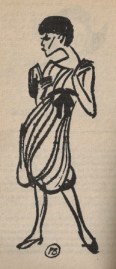
The Wayward Periodical Press ~ “Six periodical publications deserving of comment” – Vogue, Time, Mayfair, Playboy (and the rest of the Bosom Books), Mad, and Justice. What an interesting combination of companions these are. Vogue is, well, Vogue, and it apparently hasn’t changed much at all.

My favourite magazine, next to Screen Stars and Mad, is Vogue. The day it appears, I rush eagerly to the newsstand and, with the help of a couple of weightlifters, lug it off to my den. For sheer escape reading it beats the old Blue Fairy Book hollow. It chronicles a world so foreign and unreal that I would not believe it existed, if there weren’t photographs to prove it.

The women who grace Vogue’s pages are like no women I have ever known. I have tried to sketch one or two of them here, but my brush does not do them justice for their absolute and utter sexlessness defies reproduction. If they came from a far corner of the solar system they could not be more different than the blousy creatures one finds romping through Esquire and Playboy.

Am I all wet in my theory that a bosom craze is sweeping the country? In Vogue, there isn’t a bosom in a carload. These women are all eyes and cheekbones, and they do something with their necks that I haven’t seen since Leona, the Giraffe Girl, went into retirement.

At the end of the neck one finds a face that has overtones of Buchenwald about it – chalk-white and haggard, Vogue women do not have noses, only nostrils. Their eyes are enormous and decadent, their lips are thin and solemn. Their hair is always quite odd. They are shown thrust forward in inscrutable positions that suggest some curious doe-like animal at feeding time.

Time sets off a passionate diatribe in defense of Canadian content in “Canadian” versions of American magazines; Mayfair is a “high society” periodical seething with anachronistic class consciousness. Playboy and the rest of the “men’s magazines” are investigated as to the number and degrees of exposure of female body parts posed artistically for masculine delectation; Berton claims to be overwhelmed by sheer numbers.

The Cult of the Bosom has now reached its zenith in this continent, as a glance at any newsstand will show. In the seventeen magazines I examined, there were 503 photographs of well-endowed young women displaying their endowments.

In 125 of these photographs, many of them in glowing colour, the young ladies’ torsos were entirely exposed. In the remaining 378 photographs there was a certain roguish attempt at concealment.

I did not bother to count any photographs of women dressed for the street, because there were so few.

I did not bother to count any photographs of flat-chested young women, because here were none.

I did, however, make a count of the numbers of photographs of women with no pants on. There were sixty of them.

Mad magazine receives an enthusiastic nod of approval, for the “sophistication of the humour”, while Justice, an arcane periodical dedicated to the practices of sadomasochism and corporal “discipline”, garners strong words of scorn.

The Broadcasting Arts ~ Television and radio – including the already-venerable C.B.C. – come in for their turn in Berton’s critical spotlight.

Verse, Blank and Otherwise ~ Several parodies in verse of current events of the time. The Sixty-Five Days of Christmas struck a modern chord, though nowadays it would need to be retitled The Ninety Days of Christmas to approach a closer accuracy!

Christmas began last Tuesday
Just three days after Hallowe’en,
By which time the big emporiums,
Having disposed of the comic ghosts and candy pumpkins
And having burned all the second-hand witches,
Replaced them with more seasonal symbols:
A reindeer with a crimson nose,
A talking snowman and a terribly cute bear,
Fifty-seven varieties of Santa Claus,
And here and there, an inconspicuous plastic replica of the Christ-child,
 
Entirely non-denominational.
 

Intemperate Recipes ~ A plea for a return to real cooking versus the pre-packaged growing norm in the titular Just Add Water and Stir, and a heartfelt rant against instant coffee, obviously a newly popular abomination in Berton’s world. Plus four quite decent-sounding recipes – or, more accurately, anecdotal instruction pieces on how to best prepare these Berton standbys – Tomato Soup, Baked Beans, Corned Beef Hash, and Clam Chowder. Pierre Berton in the kitchen – what a grand thought!

The Passing Show ~ A satire from the viewpoint of the future, and musings on the status significance of offices and office furnishing, smoking, and divorce. Shopping for a Coffin is thought-provoking and quite serious, while Several Openings for Novels will make the aspiring writer nod in rueful recognition. A few more observations – paying to be published, the confusion of children’s toy assembly instructions, and a modern Red Riding Hood round out this section.

Certain Vagrant Opinions ~ Full rant mode! On Dick and Jane (Berton is against), On Advertising and the Press, On Racial Origins (none of the government’s business), On Thought Control (shades of Orwell’s Nineteen-Eighty-Four), and most passionately, On Flags and Anthem and On Modern Torture (prison reform), which is the most serious piece of the lot, and describes an execution by hanging which Berton was assigned to attend as a young reporter.

Some Old Nostalgias ~ Memoirs, 1927 to 1941, of Berton’s earlier days. Fascinating and charmingly written.

Read Full Post »

tip on a dead jockey irwin shaw 001Tip on a Dead Jockey and other stories by Irwin Shaw ~ 1957. This edition: Signet, 1957. Paperback. 176 pages.

My rating: 8/10. Very decent collection of mostly melancholic short stories about jaded Americans in post-war Europe and “back home”.

I found this disintegrating paperback on my dad’s workshop bookshelves when I was going through his papers after his death six years ago. Dad liked his reading straight-serious (think detailed war memoirs and biographies), and satirical-serious (John Steinbeck was a big favourite), and cynically humorous (Wilhelm Busch in the original German was there in a number of editions), and technical and creative (Popular Science and Popular Mechanics, heaps and heaps, dating back to the early 1950s – my son scooped these and they now reside in dusty, well-read, falling apart glory on the cabin bookshelves), and travel and historical (National Geographic, of course, another massive, complete collection. I think these start with the 1961 full year, though there are stray earlier ones.) The dramatic fictional bestsellers of the day were well-represented as well, lots of Irwin Shaw around when I was growing up, though I don’t remember this particular one. Must have been on a really high shelf!

This Shaw collection, from very early in the writer’s career – 1946 to 1957 being the publication dates mentioned on the copyright page – are crisp, clean, often cynically humorous, well written and definitely entertaining. Not all have conclusions, which while a bit cliffhangerish is not necessarily a handicap to appreciation. Good stuff. Thanks, Dad.

I’ve been reading other bloggers’ magnificent and thoughtful posts with great admiration recently, and am feeling decidedly sub-par in this regard tonight – I will not even try to get all deep and meaningful.

Here’s my review: I liked these stories. They were very readable. You may find yourself craving a glass of whiskey (with or without a mixer), or a bottle of harsh red French wine (glass optional). My usual beverage of choice, a “nice cup of tea”, felt rather too granny-ish; I was almost ashamed of myself. No, hang on – two of the stories had tea-drinking in them. Though one couple  added rum. Hm, that sounds fairly foul. Or maybe not?! Worked for the characters, apparently – it was followed by a night of passion!

*****

Tip on a Dead Jockey ~ In post-war Paris, pilot Lloyd Barber is offered a chance at some easy money, just one simple trip, flying a brand-new single-engine Beechcraft, from Egypt to Cannes.

“Alone?” Barber asked, trying to keep all the facts straight.

“Alone, that is,” Smith said, “except for a small box… When you take off from the airport in Cairo, the box is not on board. And when you land at the airport at Cannes, the box is not on board. Isn’t that enough?”

It’s not quite enough, or maybe it’s too much – Barber eventually turns the job down, but not before inadvertently introducing Smith to another pilot friend, the naïve and trusting Jimmy Richardson.

You didn’t have to speculate about Jimmy. If you bought Jimmy a drink, he was your friend for life. For all that he had been through – war and marriage and being a father and living in a foreign country – it had still never occurred to Jimmy that people might not like him or might try to do him harm. When you were enjoying Jimmy, you called it trustfulness. When he was boring you, you called it stupidity.

Choosing not to warn Jimmy about Smith’s “opportunities”, Barber is overwhelmed with guilt and unease when Jimmy’s distraught wife shows up begging for help in finding him; he’s been gone thirty-two days without a word. There’s a little twist in the tail of this tale.

This short story was worked up into a 1957 Metro-Goldwyn-Mayer movie, with loads of added elements; only the author’s original sketchy premise and a few of the names remained the same.

A Wicked Story ~ A wife’s unfounded  jealousy becomes a self-fulfilling prophecy.

In the French Style ~ Cynical Walter Beddoes, “career man in the foreign service”, returns to his home base in Paris from two months away in Egypt to find his reliable good time girlfriend has decided to move on to something more permanent. Beddoes had had his chance, but he’d ducked it:

It was lucky he was leaving, if she was moving into that phase. That was the pre-yearning-for-marriage phase, and you had to be on guard against it, especially late at night, in Paris, in darkened rooms where pianists and electric guitars played songs about dead leaves and dead loves and lovers who were separated by wars.

Beddoes had been married once, and he felt, for the time being, that that was enough. Wives had a tendency to produce children, and sulk and take to drink or other men when their husbands were called away to the other side of the earth for three or four months at a time on jobs.

Of course, there are regrets.

Peter Two ~ Thirteen-year-old Peter has a harsh foray into the fickleness of the adult world. This one almost cries out to be included in a high school short story anthology – maybe it has been? – I can imagine how joyfully an earnest teacher would pick it apart and spread out its “discussion points”! Lots of essay material here, oh yes indeed.

It was Saturday night and people were killing each other by the hour on the small screen, Policemen were shot in the line of duty, gangsters were thrown off roofs, and an elderly lady was slowly poisoned for her pearls, and her murderer was brought to justice by a cigarette company after a long series of discussions in the office of a private detective. Brave, unarmed actors leaped at villains holding forty-fives, and ingénues were saved from death by the knife by the quick thinking of various handsome and intrepid young men.

Peter sat in the big chair in front of the screen, his feet up over the arm, eating grapes. His mother wasn’t home, so he ate the seeds and all as he stared critically at the violence before him. When his mother was around, the fear pf appendicitis hung in the air and she watched carefully to see that each seed was neatly extracted and placed in an ashtray. Too, if she were home, there would be irritated little lectures on the quality of television entertainment for the young, and quick-tempered fiddling with the dials to find something that was vaguely defined as educational …

Suddenly, in the hall outside the apartment, a woman screams…

Age of Reason ~ A man’s repeated nightmare highlights uneasy aspects of his marriage, and forebodes a disaster which may or may not come to pass.

The Kiss at Croton Falls ~ Frederick Mull, trolley driver, “a huge rollicking man, with a russet mustache”, a drinking habit, and a supremely jealous wife who sneaks around spying on Mull’s lady passengers, dies at the height of his glory, leaving his wife to convene with his ghost, and his grown-up daughter Clarice to take a good hard look at her own husband. Grand little story, humorous and perfectly crafted.

Then We Were Three ~ American expatriates Munnie, Bert and Martha travel through France enjoying a platonic three-way friendship which lasts one day too long.

The Sunny Banks of the River Lethe ~ A man’s perfect memory dissolves. Irwin’s been reading Kafka.

The Wedding of a Friend ~ Ronny Biddell’s wedding brings back memories of his ill-fated, one-sided, first love affair during the war, with the duplicitous but delicious French Virginie. Light-hearted.

Voyage Out, Voyage Home ~ Lovely young American Constance is taking a quiet, solitary skiing vacation in Switzerland at her father’s expense, to mull over her prospective marriage to a much older man (Daddy doesn’t approve), when she meets the charming, reckless Englishman Pritchard. No surprises, but nicely done – a classic tale of  love and loss.

Read Full Post »

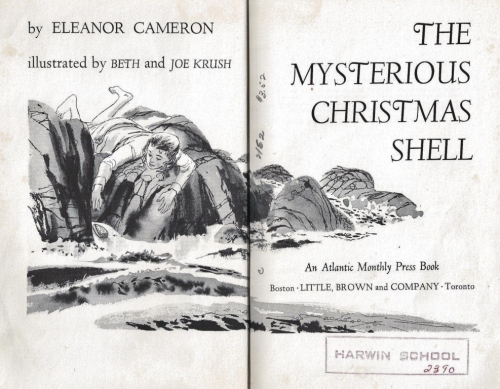
the mysterious christmas shell eleanor cameron 001The Mysterious Christmas Shell by Eleanor Cameron ~ 1961. This edition: Little, Brown & Co., 1961. First edition. Hardcover – Library Binding. Illustrated by Beth & Joe Krush. Library of Congress #: 61-9281. 184 pages.

My rating: 8/10. What a nicely written book this was! It restores my faith in the joys of reading juvenilia, sadly shaken by recent forays into several more modern disappointments in the youth-oriented fiction line.

This one was a recent impulse buy from the ever-changing and happily eclectic selection at the Bibles for Missions thrift store in Prince George. I try to get there once a month or so, and I always come away with a promising mixed bag of reading material. Some goes right back into the giveaway box, but there’ve been some small treasures found there, too.

The cover illustration was what grabbed my attention, though this grubby ex-school-library book showed much evidence of many readers, and was less than appealing at first glance. (It ultimately cleaned up nicely with a triple application of soapy cloth, rubbing alcohol and a tiny dash of benzene – not in combination, I hasten to add, but in delicately selective stages.)

“Those look like Krush children,” I thought to myself, and by golly, my instinct was right. Beth and Joe Krush were a husband-and-wife team of children’s book illustrators working industriously together from the 1950s through the following decades, and their marvelously detailed pen-and-ink-and-wash drawings perfectly depicted the characters of such classics as Mary Norton’s The Borrowers and its sequels, and Elizabeth Enright’s Gone-Away Lake books, among many others.

Here’s a sample. Isn’t this appealing?

the mysterious christmas shell frontispiece eleanor cameron 001

And Eleanor Cameron’s name chimed a little bell, too, though I didn’t really place it until I Googled her after I’d read the book. This is the famed Mushroom Planet creator, though those junior sci-fi fantasies were only one aspect of her widely varied output.

The Mysterious Christmas Shell is very much a plain and simple “domestic adventure” story, and it turns out that it is Cameron’s second book concerning the same brother-sister pair, Tom and Jennifer. Their earlier adventure, The Terrible Churnadryne, was published in 1959.

*****

Five days before Christmas, Jennifer and Tom arrive in the fictional town of Redwood Cove, California, on the Monterey Peninsula, to spend the holidays with their Grandmother Vining, and Aunts Vicky and Melissa. As soon as they walk into their aunts’ house, they realize something is terribly wrong. The tree hasn’t been decorated, the usual garlands are in a heap of green at the foot of the stairs, and everyone has a strained smile; occasionally they catch one or another of the adults huddled in a corner crying.

Turns out that the Vining family has had to sell its treasured piece of ancient redwood-forested seaside property, Sea Meadows, because of the year-ago death of the family partiarch, the children’s grandfather. Some investments have gone wrong, and outstanding debts needed to be paid. The purchaser, a boyhood friend of the family, was thought to want to keep the property unspoiled, to be the site of a single home, but recently troubling word has come that there will instead be major development. Hotels, a shopping centre, and a vacation community are planned; many of the ancient trees will be coming down, and No Trespassing signs will be going up barring the locals from their most pleasant seaside beaches and coves. The local townspeople are up in arms, and are angry at the Vinings for the sale; the Vinings are distraught at the prospective destruction of their well-beloved redwood forest.

An offer to re-purchase the property from the developer has been turned down, and a prospective reprieve of sorts has not come about. Grandfather Vining had intended to change his will to transfer Sea Meadows to the state as a nature reserve, but no one has any record of the will being registered, and no one knows if the envelope containing it was actually sent. If the will was indeed written, it would effectively cancel out the subsequent sale, and the property would go to the state once the buyer’s money was refunded. This seems like a way out of the dilemma, but where, oh where is the will?

As Jennifer and Tom ricochet around Redwood Cove looking for clues, we get a vivid picture of a large, loving family, each member trying to do the best for the others, though occasional misunderstandings occur.

The physical description of the California coastline, with its sea caves and pocket-handkerchief beaches, its tide pools and their glorious variety of sea life, is wonderfully well done; it is obvious that the author held the area in deep affection.

I do have an extra special reason for loving this story, having spent some weeks every year in California as a child, visiting grandparents, aunts, uncles and cousins in the Fresno area, and travelling out to San Jose, Monterey, and Carmel-by-the-Sea to visit family friends and to explore the still-unspoiled seashore along the more remote stretches of coastline. I even had my own similiar near-brush with death, once being washed out into the surf by a rogue wave; my father’s heroic rescue has become a piece of family folklore, and I blame my deep but reasonably well-disguised unease about any body of water much deeper than my knees on that terrifying childhood experience. Tom, Jennifer and Aunt Melissa’s being caught in the waves of the incoming tide sent chills down my spine! I could feel the sand burns …

The familiar setting was a marvelously unexpected surprise, but putting aside nostalgia and concentrating on the writing, I must say I was impressed by the quality of the prose, and by the author’s fine story-telling ability. While this is one of those stories where nothing huge really happens, with the adventures being small ones, and the solution to the mystery very apparent to the reader from early on – the Vinings, on the other hand, struggle on for strangely long time figuring out their clues – I found I couldn’t put the book down until the satisfyingly happy (though rather improbable) ending.

A grand vintage read for adults of a certain age wishing to revisit their youth through the pages of a book, though I’m not sure how much it would appeal to our more sophisticated 21st Century children.

Despite the Christmas-time setting, this is not really a Christmas book as such, though a glass tree ornament from Innsbruck plays a major part. Oops – just gave away a clue!

It was enjoyable to read about Christmas preparations in a place far from snow, and that brought back memories, too. We only spent one Christmas in California when I was a child, as most of our travelling took place in the early spring and the fall, but I remember how surreal it was that one time to be singing carols under the palm trees, with roses still blooming and lemons on the trees in my grandmother’s garden, while back at home, in interior British Columbia, icicles reaching the ground were our parting memory as we’d pulled out of the yard for the marathon three-day drive southwards. (Somewhere I have a picture from that trip of me and my sister standing, in our matching velvet-collared coats, in front of a huge Christmas tree at Disneyland, which was ornamented by coloured glass balls as large as our heads.)

This is an author decidedly worthy of further investigation. Investigating the titles and plots of some of her non-sci-fi “realistic” children’s/teens’ novels, I strongly suspect that I read some of those when I was in grade school, as two or three of the unusual plots sound very familiar, but The Mysterious Christmas Shell was an unfamiliar, unexpected and most welcome find, for all of the reasons detailed above.

*****

Oh – one more serendipitous thing. Eleanor Cameron turns out to be Canadian! She was born in Manitoba, and though she subsequently lived most of her life in California, she is widely identified in all of the material I was able to find online as a Canadian. So – another one, completely out of the blue, for the Canadian Book Challenge!

Read Full Post »

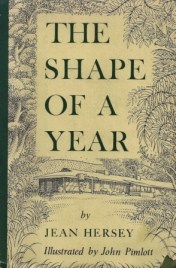
the shape of a year jean hersey 001The Shape of a Year by Jean Hersey ~ 1967. This edition: Scribner’s, 1967. Hardcover. Library of Congress# 67-13158. 243 pages.

My rating: 6/10.

This is not at all a poor book, but rather an unexceptional one. Set in the author’s rural homeplace of Weston, Connecticut, here are month-by-month musings and reportings of the little incidents of her life. These definitely have a certain appeal, but there is a creeping banality clothed in florid description to some of what she judges worthy of note. Most of it is all very well and good, but while readable this does not promise to become a favourite.

As a personal record it seems just a bit too good to be true, a shade too sweet and optimistic; there is little record of any sort of frustration, annoyance, disappointment or anger; it is all very “nice”, as if the author decided ahead of time to only include the more inspiring incidents of her days. I think this would be a much stronger memoir if it showed a broader range of emotion.

Golly, these comments sound a little harsher than I had intended. Here, I’ll share some of the author’s words with you so you can get a better picture of what this one is all about. I suspect this author will appeal most to the Gladys Taber crowd. (For the record, I like Gladys Taber; my mother had a number of her Stillmeadow books and I read them with deep delight during my teen years.)

Jean Hersey, born in 1902 and living in the Eastern United States, in Pennsylvania and Connecticut, was a prolific writer of magazine articles for Woman’s Day and various gardening and houseplant periodicals. She also authored something like a dozen non-fiction books dealing with gardening, homemaking, and semi-rural life.

*****

From The Shape of a Year: January, 1965.

January mornings at seven are like opals, soft, milky white and pink around the edges. The January sun rises silvery white, bright but not warm, and a mist like an aura hovers over the south meadow.

One morning early as we ate breakfast, Bob was eyeing a cluster of many colored Christmas tree balls lying in one of the upholstered chairs. We had dismantled the tree the day before.

“They look,” said he sipping his coffee, “as if they were waiting for a goose to come along and hatch them.”

“It would have to be a golden goose,” I replied watching the stars laid on their shiny surfaces by the early sun streaming in the windows. Obviously no ordinary goose could sit on these bits of Christmas magic.

May, 1965:

May sweeps in on a theme of daffodils. I gather armfuls from the meadow and next day so many more unfold that I cannot see where I have picked. Along the roadside the willows are tumbled masses of pale green foam, and forsythia, in streaming fountains of flowers, reflects the sun’s golden rays. Here a dusky pink weeping cherry adds a soft note of color. There a magnolia tree is a bouquet of pink blossoms, and everywhere maples are shaking out their tight fists of green into lacy green leaves.

July, 1965:

Where is our grandson? I am waiting on the station platform for this young thirteen-year-old who will be carrying a suitcase and I don’t see him. Other people get off, but no Jeff. There is a boy down the platform – or is it a boy – it seems more like a thatched roof moving along.

“Hi, Grandma, here I am.”

“Why, Jeff,” I gasp. “Hello, how good to see you.”

I gasp because here we have the Beatles incarnate. I have no war with these young Englishmen beyond what they have done to the hairdos of America…

October, 1965:

The fragrance of burning leaves is another autumn delight. Their delicious rustle and the scent of their smoke invariably carries me back to the days when my father used to rake great piles to burn. Before he lit them my friends and I would burrow deep and hide ourselves in the slightly scratchy heaps. From here we would look out at the world through tiny odd-shaped chinks of light …

December, 1965:

These days the car is always filled with Christmas presents on the way in or the way out. One time we were in New York City with presents to deliver and we parked our convertible. When we returned the presents were gone and the top neatly slit with a little triangle just large enough to reach in and draw things out. The gifts did look rather festive with their gay paper and ribbons. I’ve often considered though, what their effect was on the person who appropriated them. He overlooked a suitcase and overcoat on the back seat, and took instead a package of wild bird food destined for my brother-in-law and a book called The Power of Constructive Thinking by Emmet Fox. I’ve never ceased to wonder about the reaction of this particular thief as he opened his haul.

*****

And there are recipes.

While I wouldn’t search this author out, I also wouldn’t turn down another of her books if it came to me cheap and easy, as this one did – on the bargain rack at a used bookstore this autumn.

Read Full Post »

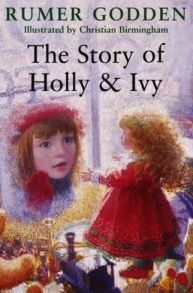
the story of holly and ivy rumer goddenThe Story of Holly and Ivy by Rumer Godden ~ 1958. This edition: Macmillan, 2005. Illustrated by Christian Birmingham. Softcover. ISBN: 0-330-43974-x. 58 pages.

My rating: 10/10. Pretty well perfect.

*****

This is a story about wishing. It is also about a doll and a little girl. It begins with the doll.

Her name, of course, was Holly.

It could not have been anything else, for she was dressed for Christmas in a red dress, and red shoes, though her petticoat and socks were green.

She was ten inches high and carefully jointed; she had real gold hair, brown glass eyes, and teeth like tiny china pearls.

The newest toy in Mr. Blossom’s shop in the village of Appleton, Holly is unpacked the day before Christmas Eve, and she is apprehensive as to what will happen next. The other toys are in a state of high excitement. “We must be sold today!” they whisper to each other, before the shop opens. “Wish, wish, wish!”

“What happens if I’m not sold?” wonders Holly.

“You will be put back into stock,” hisses Abracadabra, the sinister stuffed owl who broods over the store. “It is shut up and dark, and no one will see you or disturb you. You get covered with dust, and I will be there.”

Holly quivers in despair. “I wish, wish, wish for a little girl for Christmas!”

But Christmas Eve is here, and the shop is being closed up, and Holly is still on the shelf…

Meanwhile…

Far away in the city was a big house called St Agnes’s, where thirty boys and girls had to live together, but now, for three days, they were saying ‘Goodbye’ to St Agnes’s. ‘A kind lady – or gentleman – has asked you for Christmas,’ Miss Shepherd, who looked after them all, had told them, and one by one the children were called for or taken to the train. Soon there would be no one left in the big house but Miss Shepherd and Ivy.

Ivy was a little girl, six years old with straight hair cut in a fringe, blue-grey eyes, and a turned-up nose. She had a green coat the colour of her name, and red gloves, but no lady or gentleman had asked for her for Christmas. ‘I don’t care,’ said Ivy.

Sometimes in Ivy there  was an empty feeling, and the emptiness ached; it ached so much that she had to say something quickly in case she cried, and, ‘I don’t care at all,’ said Ivy.

‘You will care,’ said the last boy, Barnabas, who was waiting for a taxi. ‘Cook has gone, the maids have gone, and Miss Shepherd is going to her sister. You will care,’ said Barnabas.

‘I won’t,’ said Ivy, and she said more quickly, ‘I’m going to my grandmother.’

‘You haven’t got a grandmother,’said Barnabas. ‘We don’t have them.’ That was true. The boys and girls at St Agnes’s had no fathers and mothers, let alone grandparents.

‘But I have,’ said Ivy. ‘At Appleton.’

I do not know how that name came into Ivy’s head. Perhaps she had heard it somewhere. She said it again. ‘In Appleton.’

But Ivy is going to the Infants’ Home in the country, as Miss Shepherd must go to her sister, who has influenza. Ivy is loaded onto the train, with “a packet of sandwiches, an apple, a ticket, two shillings, and a parcel that was her Christmas present”, and on to Ivy’s coat was pinned a label with the address of the Infants’ Home.

As soon as Miss Shepherd leaves her, Ivy tears off the label and throws it out the window. ‘I’m going to my grandmother,’ she declares. ‘In Appleton.’ That is in just a few stops, a helpful lady tells her, and sure enough, as the train stops at Appleton station Ivy gets off, leaving her suitcase and her St Agnes-supplied gift – a pencil-case – on the seat, and, unnoticed by the busy ticket inspector, starts out on her quest.

Not far away, in the toyshop, Holly is wishing and wishing and crying out silently, ‘Stop. Stop. Oh, someone, stop.’ But in vain.

Only one person stopped, but it was not a boy or a girl. It was Mrs Jones, the policeman’s wife from down the street. She was passing the toyshop on her way home when Holly’s red dress caught her eye. ‘Pretty!’ said Mrs Jones and stopped.

You and I would have felt Holly’s wish at once, but Mrs Jones had no children and it was so long since she had known a doll that she did not understand; only a feeling stirred in her that she had not had for a long time, a feeling of Christmas, and when she got home she told Mr. Jones, ‘This year we shall have a tree.’

‘Don’t be daft,’ said Mr Jones, but when Mrs Jones had put her shopping away, a chicken and a small plum-pudding for her and Mr Jones’s Christmas dinner, a piece of fish for the cat, and a dozen fine handkerchiefs which were Mr Jones’s present, she went back to the market and bought some holly, mistletoe, and a Christmas tree.

The tree is decorated, but

‘Who is to look at it?’ asked Mr Jones.

Mrs Jones thought for a moment and said, ‘Christmas needs children, Albert.’ Albert was Mr Jones’s name. ‘I wonder,’ said Mrs Jones. ‘Couldn’t we find a little girl?’

‘What’s the matter with you today, my dear?’ said Mr Jones. ‘How could we find a little girl? You’re daft.’ And it was a little sadly that Mrs Jones put holly along the chimney shelf, hung mistletoe in the hall, tied a bunch of holly on the doorknocker, and went back to her housework.

*****

Need I go on? Of course not! You know what eventually happens, don’t you? But the path to wish-fulfillment is never so straight and easy …

This is a deliciously sweet story, perfect for a reasonably accomplished independent reader of 6 or 7 or maybe a bit older (my own daughter read it happily to herself for the first time at 10) and a marvelous Read-Aloud for all ages – it’s fairly text dense, so allow at least three good long sessions.

Ivy is a grand little heroine, misguidedly stubborn and with something of a temper, which makes her eventual fate even more emotionally satisfying. And because this is a fantasy – a Christmas fantasy – we do not worry about her wandering alone through a strange village; we know that she will come to no lasting harm, though an adventure or two may befall her.

Highly recommended, for the children in your life, and for a gentle treat for yourself, too!

*****

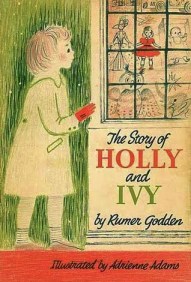
Holly-and-IvyIf you can, try to find the original, long out of print hardcovers illustrated first by Adrienne Adams, and then in another edition by Barbara Cooney. The currently in-print Christian Birmingham version is quite lovely, too, especially if gifting this book, where crisp and new is an issue, though it is without the vintage appeal of the older versions.Holly and Ivy

Read Full Post »

Love’s Shadow by Ada Leverson ~ 1908. This edition: Bloomsbury, 2010. Softcover. ISBN: 978-1-60819-050-8. 225 pages.

My rating: 7.5/10. An enjoyable diversion; cleverly amusing; my only quibble is the abrupt ending, but there are two books which continue the story.

I found myself mentally running to keep up with these bright young (and not so young) things in the early days of the 20th Century.

Off to ABE I go, to scope out the sequel situation, though once there I know I will be seduced into searching for other more pressing desires – I still have a bit of a Margery Sharp wish list going on, and Elizabeth von Arnim, and I did want to pick up one or two of those as presents-to-myself for over-Christmas reading, in case the book parcels don’t stretch far enough; really promising books attract a line-up here, with all four of us elbowing each other out of the way. I prefer to majestically withdraw to peruse my back-ups; saves such effort and eases the crush!

But back to Edwardian London, and Ada Leverson’s romantic upper-class circle game.

*****

Love like a shadow flies

When substance love pursues;

Pursuing that that flies,

And flying what pursues.

~Shakespeare

Lovable Edith is married to dreadfully vain civil servant Bruce Ottley; she views her truly tiresome husband with a gently cynical eye and takes comfort in amusing herself with her adorable young son, conferring with her likeable and wise mother-in-law on how best to manage Bruce’s more obnoxious traits, and innocently dallying with her wealthier, socially superior, but truly nice and sweetly affectionate friend, the beautiful Hyacinth Verney.

As the story opens, Hyacinth is in the throes of an apparently hopeless passion for handsome and unreachable Cecil Reeve; Cecil is in romantic thrall to Mrs. Raymond, a widow ten years his senior. Hyacinth is in turn the focus of the unrequited love of a number of characters: her companion, the eccentric and emotionally tormented Anne Yeo; her elderly guardian, Lord Cannon (married to the majestically obtuse and perennially self-satisfied Lady Cannon); and even Edith’s snobbish husband Bruce. Edith has her own admirer, the exceedingly eccentric F.J. Raggett, who has been introduced into the household by Bruce for reasons I never was quite clear on.

Edith and Mr. Raggett:

‘What is your work, exactly?’ she asked, with polite interest.

‘It’s difficult to explain, Mrs Ottley. It takes a great many forms.’

‘Oh, yes.’

‘Just at this moment I’m a Legitimist – you understand, don’t you? We drink to Queen Mary over the water – and put violets on the statue of King Charles the Martyr in February, and so forth.’

‘Ah. That must be very hard work.’

‘Oh, it isn’t only that – I’m a kind of Secretary, you see, to the Society.’

‘Really? Really? What fun it must be; I mean how interesting. Can I belong?’

‘Oh, dear yes, of course, Mrs Ottley. If you like.’

‘What should I have to do?’

‘Well, first of all you would have to pay a shilling.’

‘Yes?’

‘And then you would be eligible for a year’s probation.’

‘And what should we do after that?’

‘Well, after that, you see, we shall have to bide our time.’

‘That doesn’t sound very hard,’ said Edith thoughtfully. ‘Just to pay a shilling and bide your time.’

‘I’ll send you some papers about it, if you really take an interest.’

‘Thanks. Thanks, very much. Yes, do send them.’

‘Do you really think you would care to become a member, Mrs Ottley?’

‘Oh, yes; yes, I should think so. I always hated Oliver Cromwell.’

He looked doubtful.

‘Yes, of course – but that alone, I’m afraid, would hardly be … you see there might be a revolution at any moment.”

Mrs. Raymond eventually spurns Cecil, who after much prodding by everyone finally sees the light and turns to court the receptive Hyacinth. Cecil’s wealthy and eccentric aristocratic uncle, Lord Selsey, then decides to capture Mrs. Raymond for himself, as he feels she would be a suitably low-maintenance companion and a willing custodian for his extensive art collection.

By the end of the novel we have a marvelous appreciation of the way in which Edith Ottley is coping both with awful Bruce and persistent Mr. Raggett; Hyacinth and Cedric are married and are fighting their way through the inevitable jealousy engendered by the Cecil’s still-existing Mrs. Raymond infatuation; Mrs. Raymond, now Lady Selsey, does the decent thing and withdraws from the scene by taking her new husband on a year-long visit to the Greek islands; Lord Cannon is managing his tiresome wife with continued aplomb; and Anne Yeo, my own personal favourite of all of the characters, has decided to take her bruised heart away with her to an unknown country; our last view of her is as she is heading to Cook’s; she has decided to emigrate.

Scads of loose ends dangle; perfectly set up for a continuation of the farce.

Followed by Tenterhooks (1912) and Love at Second Sight (1916); the trilogy was also published in a Virago omnibus edition, The Little Ottleys, in 1982.

*****

Not my usual reading fare, but I enjoyed it. It rather reminded me of Nancy Mitford, whom I indulge in in rationed amounts from time to time. Oscar Wilde is the connection most reviewers mention, and as Ada Leverson was one of Wilde’s close friends and the comparison is fitting.

Read Full Post »

« Newer Posts - Older Posts »