Posts Tagged ‘Vintage’

river for my sidewalk gilean douglas 001River for My Sidewalk by Gilean Douglas ~ 1953. Originally published under the pseudonym Grant Madison. This edition: Sono Nis Press, 1984. Softcover. ISBN: 0-919203-41-8. 132 pages.

My rating: 7/10, after some consideration. Some of these short anecdotes and essays are solid 10s, some are not.

I’ve been slightly sidelined with a minor virus these past few days, and the upside is that while I’m just feeling sub-par enough to take a break from most of my more strenuous everyday chores, I’m perfectly able to putter about in the garden, do some gentle weeding, tomato-staking and pruning, watering, and definitely take advantage of the down time to read and type. So, having ambitiously started a number of reviews, I may just get a few more than usual launched in the next day or so. Or perhaps I’ll take advantage of the WordPress feature which allows us to schedule posts for future dates, something I’ve never yet had to do, as there is definitely no backlog of things ready to share! If anything, I frequently post before all of the final tweaking is done, catching typos and awkward phrasings after I’ve hit the “Publish” button. Luckily there is an “Edit” feature, too…

I picked up this particular book at The Final Chapter in Prince George last week, while browsing the excellent Canadiana section. Being rather partial to memoirs in general and British Columbia rural and wilderness settings and history in particular, River for My Sidewalk‘s back cover blurbs pretty well guaranteed my purchase.

About the Author

Gilean Douglas has been a newspaper reporter, copywriter, editor, columnist and, throughout and still, a freelancer. Her work has appeared in numerous periodicals both here and abroad, including Chatelaine, Saturday Evening Post, Canadian Business, Audubon, the New York Times and, by actual count, 144 other periodicals. She has five volumes of poetry to her name, one of light verse, and three nonfiction titles. Four of her poems were set to music and published by Schirmers and others received choral settings and have been performed at [various venues] and in concert. She edited Modern Pioneers for the B.C. Women’s Institute after holding local, district, provincial and national office in that organization.

Gilean Douglas now [in 1984] resides on Cortes Island, where she is a Weather Observer with Environment Canada (receiving four awards for her work) and a Search and Rescue Agent. In her spare time she raises plants, produce, and bulbs.

About the Book

Gilean Douglas spent close to a decade living alone in a small wilderness cabin in the Cascade mountains. River for My Sidewalk, first edition, was originally published…in October of 1953, under the male pseudonym of Grant Madison. The reading public of that time would have doubted the authenticity of a woman managing in the circumstances described. But Gilean Douglas did more than manage, she thrived in the isolation and completeness that solitude brings. Well before the days of liberated females, Ms. Douglas chose, lived, survived, and savoured a self-sufficient existence in an area that is still considered wild and inaccessible. Her story is timeless and the observations are lyrically clear…
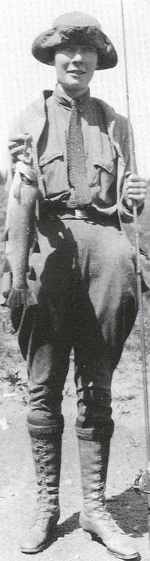
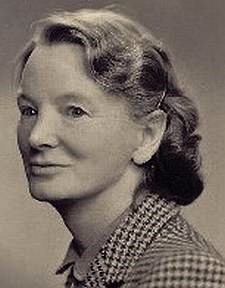
Gilean Douglas: Naturalist, feminist, farmer, poet, author.

Gilean Douglas: Naturalist, feminist, farmer, poet, author.

Well, I’d never heard of the woman myself, but who could resist finding out more? And, after reading River for My Sidewalk, I did just that. What an absolutely fascinating woman Gilean Douglas must have been! And not just fascinating, but, for all of her quirks and her unhappy history with husbands, apparently much admired and beloved by her friends and neighbours. Here is an excerpt from a longer biography in B.C. Bookworld:

Gilean Douglas, author of River for My Sidewalk (1953), was a female Thoreau of Canada. A loner from a well-to-do family, she retreated to wilderness cabins and became an environmentalist before the word existed, leaving four marriages behind her.

Gilean Douglas, born in Toronto in 1900, was orphaned at age 16 and soon became a reporter. She travelled extensively prior to her arrival in B.C. in 1938 where she first lived in a cabin on the Coquihalla River. She then moved to an abandoned miner’s shack on the Teal River near Duncan, B.C. “It was the great moment of my life when I waded the Teal River,” she wrote, “with my packboard on my back and stood at last on my own ground. I can never describe the feeling that surged up inside me then. . . I felt kinship in everything around me, and the long city years of noise and faces were just fading photographs.” Subsisting mainly on produce from her garden, Douglas began to write about her adventures but could not find acceptance as a woman writing about outdoor life. Adopting the male pseudonym Grant Madison did the trick—and she published River For My Sidewalk, her best-known book.

Gilean Douglas continued to use her male name until 1983 when she revealed herself in a Vancouver Sun interview. Douglas next moved to Cortes Island, near Campbell River. “I have spoken many times of ‘my land’ and ‘my property’, but how foolish it would be of me to believe that I possessed something which cannot be possessed,” she once wrote. Along with seven poetry books, she produced two more meditative memoirs, Silence is My Homeland: Life on Teal River (1978) and The Protected Place (1979). The latter describes life on her 140-acre homestead on Cortes Island where she was employed as an Environment Canada weather observer and a Search and Rescue agent. Her cottage was situated at Channel Rock on Uganda Pass. For nine years she served as the Cortes representative on the Comox-Strathcona Regional Board. Gilean Douglas also contributed a nature column called “Nature Rambles” to the Victoria Daily Colonist (which became the Times Colonist in 1980) for 31 years, from 1961 to 1992, a longevity for a B.C. columnist that places in her in the company of Eric Nicol and Arthur Mayse. She died on Cortes Island in 1993.

And for a much longer and much more detailed biography, Andrea Lebowitz’s well-researched and fascinating article, Narratives of Coming Home: Gilean Douglas and Nature Writing, is a must-read.

Well, this is all well and good, but how does River for My Sidewalk measure up to its author’s infinitely intriguing promise?

I must say that I had high expectations, just from reading the cover material and from my quick perusal of the contents before I purchased the book. And I did enjoy reading it, though it went in a little different direction than I had anticipated.

Something about the tone of the narrative voice struck me as a little bit odd, and occasionally forced, and it wasn’t until I twigged to the fact that the author was carefully phrasing her passages to make the book appear as if it were written by a man that the penny dropped. I had started out assuming that the reader was aware that the writer was indeed a woman, and once I revised this assumption and allowed for the time of writing and publication, the late 1940s and early 1950s, the rather coy slant was understandable, and therefore much more acceptable.

Gilean Douglas writes in a strongly opinionated manner. She lays down the law as she sees it, unapologetically critical of mankind’s abuse of nature, and eloquently defensive of the way in which she has chosen to retreat from the mainstream world. She never condemns the city dweller as such, acknowledging that it would be an impossibility for all to strive for her type of lifestyle, but she has little patience for the squeamish and feeble-hearted visitor to the bush who quails at the thought of coming across a cougar or bear, or of crossing a river on an open cable car, or of hiking miles for a casual neighbourly visit.

Much of the book is an enthusiastic tribute to the natural world, phrased in glowing and effusive tones. Possibly just a little too glowing and effusive? The style frequently seems a bit dated even for the time of writing, being perhaps more typical of the century before; it reminds me of those rather stilted memoirs one frequently comes across hiding behind ornate covers in the antique books section of the better second hand book stores.

Example:

The day is my friend. I meet it with outstretched hand and use every moment of it to the utmost. Sitting in the house I have partially built I eat the food which I have grown for myself. I have tried to learn everything there is to know about the trees, flowers, birds, animals, insects and rocks which are all around me. It has taken me years and will take more years, but I feel that every grain of such knowledge brings me closer to the great harvest of the universe.

The night is my love. Dusk comes with the benediction  of the thrush and the darkening of river water. The clearing is all shadow and the forest dim with mystery. The shade climbs higher and higher up the mountains which ring my valley, leaving only the peaks crested with sunlight. Everything becomes slower and more silent as the dusk deepens into night. Then stars burn silver in the sky and sometimes the moon sails a midnight sea to a port beyond the tall evergreens of Home Wood. This has been the way of night in the wilderness for untold eons. How few living now have ever known it as I do! Campers, fishermen, hunters come in here bringing their shouts and drinking and luxuries. They go home to boast of their wilderness adventures, but all they take away is a paste jewel in a plastic setting.

And then there are the passages like these:

Spring has swept away the last patch of her snow with her green-twigged broom and hung out the clouds to bleach…

and

When burning … fir and hemlock have their swan song of beauty… as needles become rosettes of flame which shimmer and fade along the twigs, transforming each one into a garland for some fire queen’s shining hair…

But for all the occasionally purple prose there is much beautifully phrased and sincerely presented, as Gilean Douglas documents the thoughts of her long solitudes. I buried all my qualms when I read this:

We are all strangers here, but no one more so than the person who is out of step with the time. If you are that person you will be understood – and then only imperfectly – by just one or two of all those you know and perhaps by none at all. To the others you will always be suspect. The timid will be afraid o be seen with you; the bold will say they cannot be bothered with anyone who is more interested in the future of the world than in whether today’s market is going up or the price of tomorrow’s whisky going down.

Most of this ostracism will bother you very little for there is nothing you like better than quietness and privacy. But not every moment of your life. In books you can find the comradeship and understanding you are denied by living men, but even so you are hungry for a good heart-to-heart talk with someone who comprehends you intellectually and emotionally. If you are lucky you will come across one or two people with whom you can exchange ideas, and if you are luckier still you will marry one of them…

…[An] urgent sense of the shortness of life, perhaps more than anything else, distinguishes the man out of step with his time from his fellow beings. He sees time wasting everywhere around him and he is disgusted and alarmed. He knows that it is all wrong; that life is precious and should be used for precious things. Not that he believes in all work and no play, but simply that his idea of play differs from the bridging, gossiping, clock-watching, pulp-reading average. To him play is a change of occupation – perhaps from writing to splitting wood – while relaxation is letting go completely in sleep, laughter or lying on a summer hill watching the clouds drift over and “growing soul”…

An unusual and admirable woman, this Gilean Douglas, and one whom I will be seeking to acquaint myself with more deeply through her other writings. Apparently the two 1970s memoirs are not quite so gushing, and are more contemporary in tone, though they are not as well known (relatively speaking) as River for My Sidewalk.
Read Full Post »

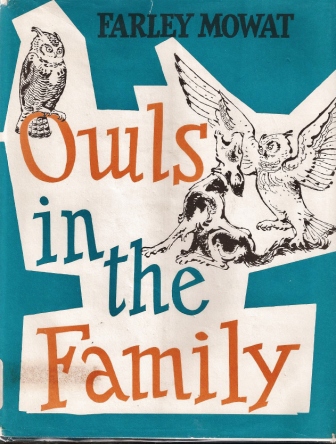
owls in the family farley mowat 001Owls in the Family by Farley Mowat ~ 1961. This edition: Little, Brown & Co., 14th printing. Illustrated by Robert Frankenberg. Hardcover. 107 pages.

My rating: 5/10 as an adult re-read; easily an 8/10 for a juvenile Can-Lit read-alone or read-aloud.

My kids swear I read this to them out loud way back in the murky depths of time; I can’t say that I remember doing so, but we read a lot of books together, so there’s a strong possibility that they are correct. They also say that they loved it, so…? (That has to stand for some sort of a recommendation!)

School teachers love this one, too. Just go ahead and Google “Owls in the Family novel studies”, and then stand back. Generations of Canadian school children have “done” and are still “doing” this slightly fanciful tale, ostensibly about young Farley’s true experiences as a Saskatchewan schoolboy.

Are you catching a slightly cynical tone to my words? I am sad to say that I have something of a love-hate relationship with Farley Mowat. I truly enjoy some of his fictions, and happily read and re-read his famous Lost in the Barrens and The Curse of the Viking Grave all through grade school, though luckily I dodged ever having to do a novel study on either of these; I read them purely for pleasure. But as the years went on, and I became more and more aware of the Canadian literary scene in a much broader sense, I often came across Mowat (in print) laying down the law and making grand pronouncements upon this, that and the other, which in itself is not all that offensive, but for his strident dismissals of other opinions than his own. Grand Old Man of Canadian letters as he may have become, but he is not universally loved in his home country. See this article in Up Here magazine, Farley Mowat: Liar or Saint?, for an interesting discussion of the Mowat paradox.

All of this aside, in looking at his juvenile fiction, Owls in the Family may well be his most beloved and widely read work, perhaps because of its suitability as a read-alone for novice readers, and its affectionate portrayal of an idealized mid-20th Century boyhood on the Canadian prairies.

The gist of the book is that at some point in his youth, the narrator, one Billy (widely accepted to be a stand-in for Farley himself, though why the renaming, none can tell), along with his friends Bruce and Murray, decide that they would like to capture and raise a young Great Horned Owl as a pet. They wander out into the cottonwood groves, find an owls’ nest, and, after a farcical encounter with the mother owl while accompanying one of their teachers on an attempt to photograph the nest and the owlets, conveniently acquire one of the fledglings when a storm knocks the nest down a day or two later.

The boys take their find to Billy’s house, where the young owl, named Wol after Christopher Robin’s companion in the Pooh books, joins an existing menagerie of various creatures such as gophers and white rats. Wol settles in to become one of the family, and is soon joined by a companion, the smaller and much more meek Weeps, rescued by Billy from certain death by torture by two other boys.

Several chapters of various adventures are described – canoeing on the slough, a pet parade gone hilariously awry, various encounters with unsuspecting individuals whom the owls universally upset and oust – until the story’s sudden ending with Billy and his family moving away, leaving the owls under Bruce’s care.

Perhaps I’ve become too cynical in my middle-aged years, but I’m afraid a lot of the humour didn’t raise much more than a reluctant smile this time around. Robbing birds’ nests, shooting crows, finding the neighbour’s cat dead in Wol’s claws – these are examples of the anecdotes we are asked to smile at. A less critical readership will no doubt take it all in stride.

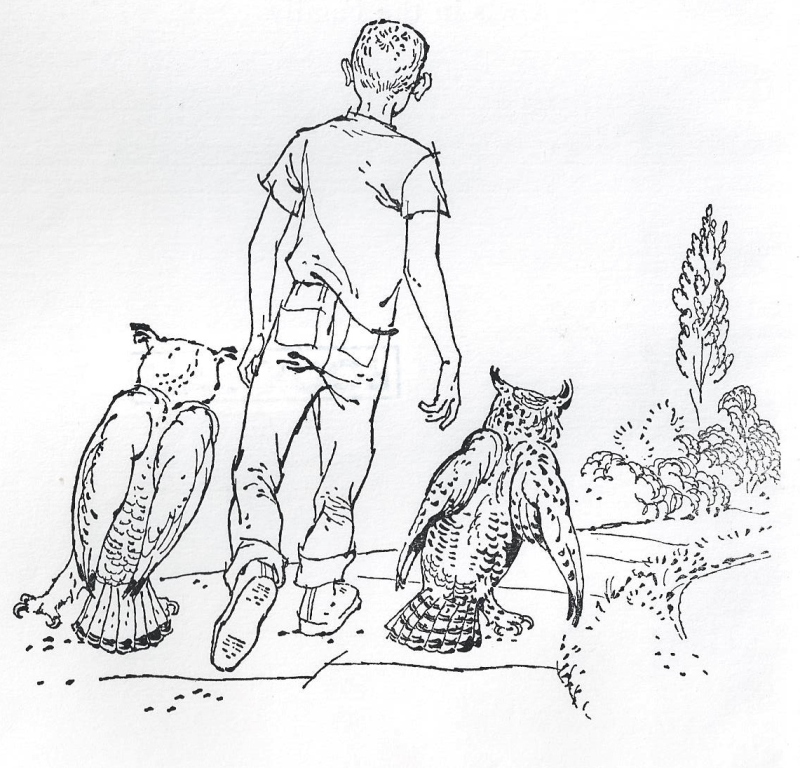
From Farley Mowat's 'Owls in the Family' frontispiece; illustration by Robert Frankenberg.

From Farley Mowat’s ‘Owls in the Family’ frontispiece; illustration by Robert Frankenberg.

The illustrations by Robert Frankenberg are gloriously typical of the best juvenile books of the era, and it is well worth seeking out a copy with the original artwork if sharing this with a young reader, or, for that matter, reading it for yourself. Eleven short chapters and just over one hundred pages make this a fast and easy read-aloud; one could easily knock back three or four chapters at a sitting. Suitable for all ages, as long as one is prepared to discuss some of the more questionable events (no longer perhaps seen as harmless amusement) referred to in the previous paragraph.

I would hesitate to inflict this upon children in the nature of a “novel study”, but it does make an interesting casual read, capturing as it does a very Canadian place in a now long-ago time. Recommended, with the stated personal reservations.

Read Full Post »

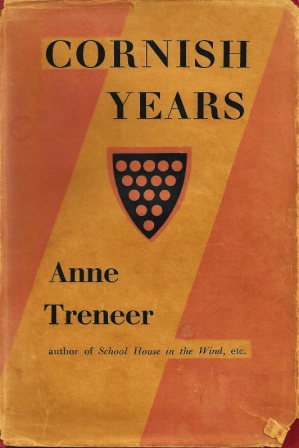
cornish years anne treneer 001Cornish Years by Anne Treneer ~ 1949. This edition: Jonathan Cape, 1949. Hardcover. 284 pages.

My rating: 8/10.

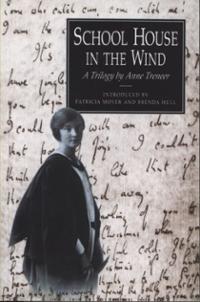
This is the second volume of Cornish writer and poet Anne Treneer’s trilogy of memoirs. The first, Schoolhouse in the Wind , was such an unexpected treat that I immediately decided to track this author’s other works down. I did all of the usual searches, and decided my best bet was to order the re-released trilogy published by the University of Exeter Press in 1998, under the (slightly altered) title of the first book, School House in the Wind.

Imagine then my delight upon finding this first edition copy of the second volume in a tiny antique store in the micro-community of Barriere, B.C. on a quickie road trip last week. We were out in our old Spitfire convertible, investigating promising narrow, winding (and must be paved – not a given in this part of the world) side roads in the Kamloops area, and were ready for a break from the wind and sun when a sign in the window captured our notice: “Used Books”. Well, that was irresistible, so I pulled a quick U-turn (an easy feat in a tiny little Triumph) and in we went. Lots of china and glassware, but the promised used books were only a shelf or two, quickly scanned and dismissed. However, as I made my way carefully out through the shelves of fragile treasures, something caught my eye in the showcase beside the cash register. There, side by side, were this book, and another, The Angels’ Alphabet by Hilda van Stockum, a first edition picture book by another author-illustrator I’m mildly interested in.

I’m guessing these were featured because of their intact dust jackets and general “vintage” appearance? Anyway, for well under twenty dollars I walked out of the store clutching my treasures with ill-disguised glee. And that proved to be the bookish highlight of the day, as our subsequent visit to our real destination, Kamloops’ excellent At Second Glance Used Books, source of so many wonderful finds over the past ten years, left us standing in bemusement peering through the windows of an empty store front.

“They’ve moved!” I said optimistically to my husband. Across the street to the Kamloops Art Gallery we trotted, and upon inquiry we were stunned to hear that the bookstore had indeed closed just a few months ago. “So many people are asking about it, and they’re all so disappointed,” said the helpful girls at the admissions counter.

Turns out that a steady decline in sales over the last few years had left the owner debating the state of the used book business. She sold off as much as she could in a series of escalating sales, and at the end had dumpsters brought in, and binned the remainder.

I am very sad. What a dismal ending to such a grand bookstore.

Two more of my local used book sources, Nuthatch Books in 100 Mile House, and The Final Chapter in Prince George, are also debating closure, as their margins are steadily decreasing. Every bookseller I’ve spoken to has blamed e-books for the decline in the print book business.

Meanwhile the charity shops are overflowing with books – most, admittedly, the epitome of “trashy” (in so many ways) – which may indeed be an indication of shelves being cleared as people embrace the new technology.

There is no adequate substitution for a well-established, well-organized used book store staffed by fellow book lovers. I tremble at the thought of more of these dying out, much as I understand the seduction of having your reading material to hand in a compact electronic format.

But used book sellers have grocery bills too, and once the point of too-little return is reached, what options do they really have? I know many are turning to internet sales, but to do that properly is a job in itself, and the competition is fierce unless you are prepared to vigorously establish a lucrative niche market of some sort, often not a very viable option for those in small communities with limited book-sourcing opportunities…

Ah, well. It is what it is. Back to this book.

*****

Cornish Years decidedly lived up to my high expectations. Ann Treneer continues her life story of the years between 1906 and 1932 with cheerfully pragmatic anecdotes about her own doings, and affectionate reminiscences of the places and people she rubbed up against. As in Schoolhouse, the narrative is never twee or gushing, but it is cheerfully positive in tone, and the mood feels genuine throughout.

As much as it is a personal narrative, Cornish Years is also a loving ode to place, both Treneer’s home region of Cornwall, and places farther afield. Anne Treneer spent time as an adult student pursuing studies at Lady Margaret Hall in Oxford, and her memories of those days are beautifully evocative and full of love and appreciation for her experiences there.

The snippets of Anne Treneer’s poetry in Cornish Years – she was a published poet from an early age – show much more style and polish than those in School House; I wonder if she has included these small samples of her work in some sort of chronological order? If so, I would be most interested to see what the third volume of memoir, A Stranger in the Midlands, contains, both in the way of poetry and in the continuation of Anne’s personal story.

school-house-in-wind-trilogy-by-anne-treneer-paperback-cover-artAs I can’t count on bookish serendipity to bring me the third book as it did the first and second, I have taken things into my own hands and ordered the 1998 trilogy. And if I do come across an old copy of Stranger, I will of course be more than happy to add it to the bookshelf.

In my internet travels, I came across an interesting reference to Anne Treneer at this blog, The After Life of Books, written by Gillian Thomas, an English literature teacher and resident of Cornwall. She writes about the experiences of her parents and grandparents in relation to the books they read. (Fascinating website, well worth a look-around.)

She (Gillian’s mother) was particularly proud of having a personal connection with another Cornish writer, Anne Treneer, author of the childhood memoir, Schoolhouse in the Wind, and Cornish Years, a reminiscence of her college education and early years as a schoolteacher. Treneer had been my mother’s English teacher at the local grammar school and, as well, had rented a cottage from my grandparents. They, along with other villagers, appear in one of the chapters of Cornish Years, and both my grandmother and mother often proudly mentioned these references. They were flattered to find their names in a book, even as faintly amusing village “characters.”

My mother’s pride in the Treneer connection may have originated in the prestige of a personal aquaintanceship with a published author, but it was sustained by her fascination with Anne Treneer’s apparent independence from conventional restrictions.  During the time the author taught at the grammar school she used a motorcycle to explore the area, a detail which always figured in my mother’s recollections of that time as well as in Treneer’s happy reminiscences about her Velocette in Cornish Years. Similarly, my mother recalled visiting her former teacher years later and finding her fuelling the fireplace in her rented seaside cottage with an enormous driftwood spar that she had just scavenged from the beach. In all these reminiscences Anne Treneer seemed to embody an insouciant air of independence, a relishing of her own solitary company and an unconcern about conventional behavior. In the letters and postcards from her that arrived from time to time throughout my childhood, she always seemed free to travel at will. We imagined, I think, that this apparently carefree independence, came with the role of being “an author.” It was, of course, mainly made possible  by Treneer’s generally frugal tastes and habits. Also, it’s likely that  travel funds came from the author’s older brother, Maurice, who had emigrated to the US and become senior chemist at Miles Laboratories in Elkhart, Indiana. He is credited with creating the original formula for Alka-Seltzer, a product whose launch was fortuitously timed to coincide with a flu epidemic as well as the end of Prohibition. While he does not seem to have personally owned the patent to that lucrative cure for hangovers and other malaises,a number of other patents in his name, as well as his salary as head chemist at Miles Laboratories, would have enabled him to be generous in funding holidays for his sister…

And here, as another side note, is the Wikipedia page regarding the Velocette motorcycle, one of which Anne Treneer tenaciously learned to master and rode about on with undisguised joy, which she so eloquently described in Cornish Years.

Read Full Post »

the shout & other stories robert graves 001The Shout and other stories by Robert Graves ~ 1965. This edition: Penguin, 1978. Paperback. ISBN: 0-14-00.4832-4. 300 pages.

My rating: 7/10.

A generous and widely eclectic sampling of Robert Graves’ short stories and personal anecdotes. While a bit uneven, as might be expected in an anthology spanning some forty years or so of one man’s writing career, but there is enough excellent reading in this book to make it a certain keeper.

The stories are grouped under three broad headings: English Stories, Roman Stories, and Majorcan Stories, but the first and third categories show quite a wide range in style, settings and topics. The three Roman Stories are the tightest grouping, theme-wise.

I enjoyed reading most of these, and came away feeling keen to continue to develop my acquaintanceship with the prolific Robert Graves. I do believe I might be ready to tackle his ambitious I, Claudius. If it is anything like the three Roman Stories in this collection, it will be very good indeed. I’ve been holding out for a better edition, as mine is a fat paperback with a cracked spine and tiny print (these unreliable middle-aged eyes are giving me grief lately), but I think I will dip in and see how it goes. If I like it I’ll upgrade to a physically nicer edition. Anyway, I’m straying off topic. Back to the volume at hand!

*****

From the author’s Introduction:

The first of these stories, The Shout, was written in 1924; and the last, Christmas Truce, in 1962. Most of them, including such improbable ones as Kill Them! Kill Them!, The Whitaker Negroes, Old Papa Johnson and A Toast to Ava Gardner, are true, though occasional names and references have been altered. Nor can I claim to have invented the factual details even of She Landed Yesterday, or An Appointment for Candlemas. In fact, a correspondent who read She Landed Yesterday reproached me for not mentioning the two French copper coins found in the coffin-doll’s pocket; and An Appointment for Candlemas brought members of the revived British witch cult to my door in search of information about flying ointments and such like. Pure fiction is beyond my imaginative range; I fetched back the main elements of The Shout from a cricket-match at Littlemore Asylum, Oxford.

ENGLISH STORIES: A variety of anecdotes and stories, most with some sort of “twist”.

  • The Shout ~ The otherwise seemingly normal resident of an insane asylum claims he has the power of the “terror shout”, which brings madness and even death to anyone within hearing range. Occultish and dark. Not one of my favourites, though it is memorable enough. 7/10.
  • Old Papa Johnson ~ “Old Papa Johnson” was once Crown Agent on Antarctica’s Desolation Island. His solitude is intruded upon by two uninvited guests, with dire consequences. 6/10.
  • Treacle Tart ~ In this short anecdote, eight-year-old Lord Julius Bloodstock unexpectedly descends upon a surprised prep school, but runs afoul of dietary rules, refusing his treacle tart and sparking something of a minor rebellion among the schoolboys. 6/10.
  • The Full Length ~ A portrait artist is asked to paint a picture of a recently deceased young lady whom he’s never seen, and who has never had her photograph taken. His solution is quite clever, and rather improbably lucky. 5/10.
  • Earth to Earth ~ A macabre little tale of an interest becoming an obsession. Dedicated composters, take warning! Queasily humorous; I laughed out loud with horrified glee at the ending. I *hope* this one was not true! This story would be right at home in a Roald Dahl (adult) story collection. 7/10.
  • Period Piece ~ A humorous little tale of a marital misunderstanding. 6/10.
  • Week-End at Cwm Tatws ~ Still channelling Roald Dahl at his darkest, Graves tells the story of a visit to a dentist gone very, very wrong. 6/10.
  • He Went Out to Buy a Rhine ~ A mysterious suicide turns out to have an esoteric explanation. 5/10.
  • Kill Them! Kill Them! ~ A poignant remembrance of a young man killed in the war. 6/10.
  • The French Thing ~ Gloriously funny tale of village life. Beware the vicarage daughter! Unexpected. Loved it. 10/10.
  • A Man May Not Marry His… ~ An odd little theological, medical and ethical debate about the implications of sex change operations. (I think.) 4/10.
  • An Appointment for Candlemas ~ An interview with a modern witch. Cheeky and funny. 8/10.
  • The Abominable Mr. Gunn ~ Memories of a sadistic schoolmaster. 6/10.
  • Harold Vesey at the Gates of Hell ~ An ironic little tale of village life. Nicely done. 7/10.
  • Christmas Truce ~ Christmas in the trenches, World War I. Enlightened commanders from the German and British sides arrange a temporary truce. 10/10.
  • You Win, Houdini! ~ The rise and fall and rise of a crooked minor magician turned army officer. 8/10.

ROMAN STORIES: That would be ancient Rome. These were all humorous in tone, and all excellent.

  • Epics Are Out of Fashion ~ Falling afoul of Emperor Nero is never a healthy idea, especially when one is a poet writing a thinly veiled mockery of that vindictive lord himself… 8/10
  • The Tenement: A Vision of Imperial Rome ~ This was my favourite story in the collection. An episode detailing daily life in ancient Rome. Brilliantly done; very funny, despite the tragic sudden ending! 10/10.
  • The Myconian ~ A provincial visitor from the island of Myconos is made acquainted with the dramatic and sporting diversions of Rome. Another 10/10.

MAJORCAN STORIES: Written during Graves’ long residence in Majorca, Spain.

  • They Say…They Say ~ gossip in the marketplace. 5/10.
  • 6 Valiant Bulls 6 ~ An epistolary episode detailing Spanish bullfighting, from “Margaret” to “Dearest Auntie May”. Not quite sure about this one; didn’t quite hit all its attempted high notes. 6/10.
  • A Bicycle in Majorca ~  The author’s personal anecdotal tale about civil bureaucracy in relation to the importation and retention of his sons’ British bicycles in Spain. Rather good. 8/10.
  • The Five Godfathers ~ Here’s Margaret gushing on to Auntie May again, this time detailing a confusing christening. Sort of amusing, but perhaps not as much as the author intended. 6/10.
  • Evidence of Affluence ~ A tale of revenge. This one works out very well, though I guessed the ending from a long way off. 8/10.
  • God Grant Your Honour Many Years ~ A misunderstanding and a happy resolution. Another amusing personal anecdote, well presented. 8/10.
  • The Viscountess and the Short-Haired Girl ~ A humorous tale of three Spaniards involved as witnesses in a slightly nefarious divorce case. In the end, everyone gets what they want. Complicated, but funny. 9/10.
  • A Toast to Ava Gardner ~ An appreciation of Ava Gardner, whom the author knew personally. Goes off on a divergent tangent or two. Rather sweet. 9/10.
  • The Lost Chinese ~ Another complicated tale, this time of playwrites and mistaken identities. Diverting. 7/10.
  • She Landed Yesterday ~ A nobleman commits suicide after dabbling in the occult. Love, betrayal and wounded pride move the narrative. 9/10.
  • The Whitaker Negroes ~ A horrifying portrait in an Irish antique shop leads back to America, and to a very strange story – part truth, part fable. 9/10.

*****

Note: Robert Graves is also the author of the recently reviewed Antigua, Penny, Puce, which I stumbled upon recently and subsequently found very diverting. A writer of broad range, well worth exploring.

Read Full Post »

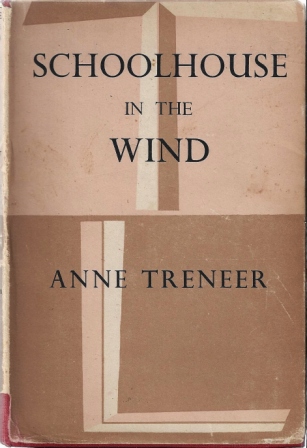
schoolhouse in the wind anne treneer 001Schoolhouse in the Wind by Anne Treneer ~ 1944. This edition: The Travellers’ Library, 1950. Hardcover. 221 pages.

My rating: 8/10.

A slight memoir which leapt into my hand as I was quickly browsing the back room bookshelves housing the “collectibles” during a recent visit to Hope’s lovely used book store, Pages. I’d never heard of Anne Treneer before, but I am so pleased to have made her unexpected acquaintance.

Intrigued initially by the title, and wondering rather why this volume had been shelved among the back room “treasures”, I had no idea what to expect, but a brief dipping-into let me know that this was one of those personal memoirs of childhood which can be such appealing reading, capturing as they do the very essence of an individual’s earliest memories, and frequently memorable glimpses of long-passed time and much-changed place.

*****

He panted to escape but I
As he was winding thin
And narrowly was slipping by
Gasped and drew him in.

~On Catching the Breath

Anne Treneer was born in 1891, in the small village of Gorran in England’s Cornwall (hotbed of so many writers and creative types), the very much unplanned-for sixth child of the family, born after the family of four boys and a longed-for daughter, Anne’s older sister Susan, was thought complete. The baby carriage had long been given away, so Anne was trundled about by her older brothers in whatever other conveyance was handy:

My brothers say they brought me up in a wheelbarrow, and that this accounts for certain bumps in my forehead and generally scrappy appearance. When I was small they used to tell me that old Mrs. Tucker brought me one winter night in a potato sack and left me on the front step; and that I squalled so loud that my father said to my mother, ‘For God’s sake bring the little Devil in and see if she’ll stop that noise’. So in I came and stayed…

Anne’s father was the local schoolmaster, and Schoolhouse in the Wind is an affectionate, humorous and occasionally poignant evocation of a small corner of Cornwall at the juncture of the 19th and 20th centuries.

Gorran School, with a house for ‘master’ glued to it, stood strong and symmetrical, without beauty but not mean, triumphantly facing the wrong way. It might have looked south over the distant Gruda and the sea; but this advantage was forgone in favour of presenting a good face to the road. Master’s room in school, the big room as we called it, caught the north wind while the closets at the back caught the sun. I have heard that Mr. Silvanus Trevail, the architect, who designed many Cornish schools, committed suicide in the end; but whether out of remorse for his cold frontages I do not know.

That last comment at the end of the book’s first paragraph filled me with quiet glee – obviously this was not to be a completely sweetly sentimental memoir, but something with a bit more bite! – and I read on with high expectations. Those expectations were well met and frequently exceeded.

a young Anne Treneer

A young Anne Treneer.

I could go on and quote many excerpts of Anne Treneer’s rather delicious writing, but I won’t. This book was recently (well, in the late 1990s, “recent” in the used book world, I feel) reissued along with its two companion memoirs, Cornish Years and A Stranger in the Midlands, as a one-volume trilogy. It should be fairly readily available in libraries – at least in British ones – and there are a number of copies available through ABE.

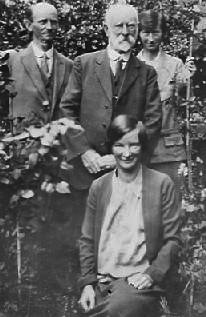
A young Anne Treneer (seated) with her father & sister Susan

A young Anne Treneer (seated) with her father & sister Susan

I recommend it on the strength of this first volume of the trilogy, and I will be buying the combined memoirs for my personal library. The first chapter of Schoolhouse in the Wind sets the stage, as it were, introducing the physical setting of the chapters of reminiscence to follow, and though it will perhaps be of greatest interest to those familiar with the area, even to me, a reader who has never visited England, the picture it draws is vivid and memorable. Also vivid are the character portraits the author paints of her family; with a few well chosen words they come alive on the page.

An internet search brought up a very few references to Treneer. Though she is described as a “prolific” writer, there appear to be few of her titles now available, aside from Schoolhouse in the Wind and the other two memoirs. Schoolhouse is also full of brief snippets of poetry; one assumes these are samples of the author’s work. Some are quite lovely; others seemingly aimed at perhaps a juvenile audience, which is understandable as Anne Treneer spent many years as a schoolteacher.

Anne Treneer

Anne Treneer

Anne Treneer never married, and seems to have led a happy and rather individualistic single life, pursuing her many interests with passion and good humour. She died in 1966.

I will leave the subject of Anne Treneer, at least for now, with this excerpt of a short biography from Maurice Smelt’s 2006 book, 101 Cornish lives.

 Anne Treneer pulled off a difficult trick; she wrote an autobiography that succeeds in enthralling despite its almost relentless happiness. Most writers would not even try, reminding themselves that ‘happiness writes white’. It came out as three books over a period of eight years – Schoolhouse in the Wind, Cornish Years, and A Stranger in the Midlands – and it runs from her earliest memories to a day in her late 50s when she went to America to visit her brother.

From her father’s village school she went to St Austell County School, then to a teacher training college in Truro and then taught in various schools in Cornwall. Ambitious to read deeper and wider she took an external course at London University during the First World War, later spent a year at Liverpool University, later still took a postgraduate degree at Oxford as a mature student. Her longest spell at any one school was a seventeen-year stint at King Edward’s in Birmingham, ending in 1946 with a year’s sabbatical leave. She had by then already written Schoolhouse in the Wind two years earlier, and her future was to be a writer, exiled but coming to her beloved Cornwall when she could. In those twenty post-war years she lived mostly in Devon. She was never married and died in 1966.

One reason why her life seems so tranquil is that she was so eccentric, and at the same time so commonsensical that she records what she did as if doing it were the most obvious thing. For example, she loved air with a passion. It is a word of power in her books, her poems especially; there it is, in slight disguise, in the title of Schoolhouse in the Wind. Hence her whizzing about the country in her young days on a Velocette motorbike, the air streaming past her nose like high-speed champagne. As a teacher in Birmingham she spent a summer term commuting (by Velocette) from a tent in Shropshire on Clent Hill. Tents also feature in later summer holidays in Gorran with her sister Susan – three tents, one for each of them and one for the saucepans… Her outdoorsness gave her the keenest eye for the particularity of place, and she could see several worlds in a single Cornish parish.

She claimed to hate crossings-out and third thoughts, but one would never know it as her books are easy reading, usually a sign of art concealing graft…

“Art concealing graft”… what an intriguing comment that one is, as well!

So, if you stumble upon anything by Anne Treneer in your travels, pick it up and peruse it. She has a lot – happily wry and generally unsentimental – to say.

This one gets a “hidden gem” tag.

Read Full Post »

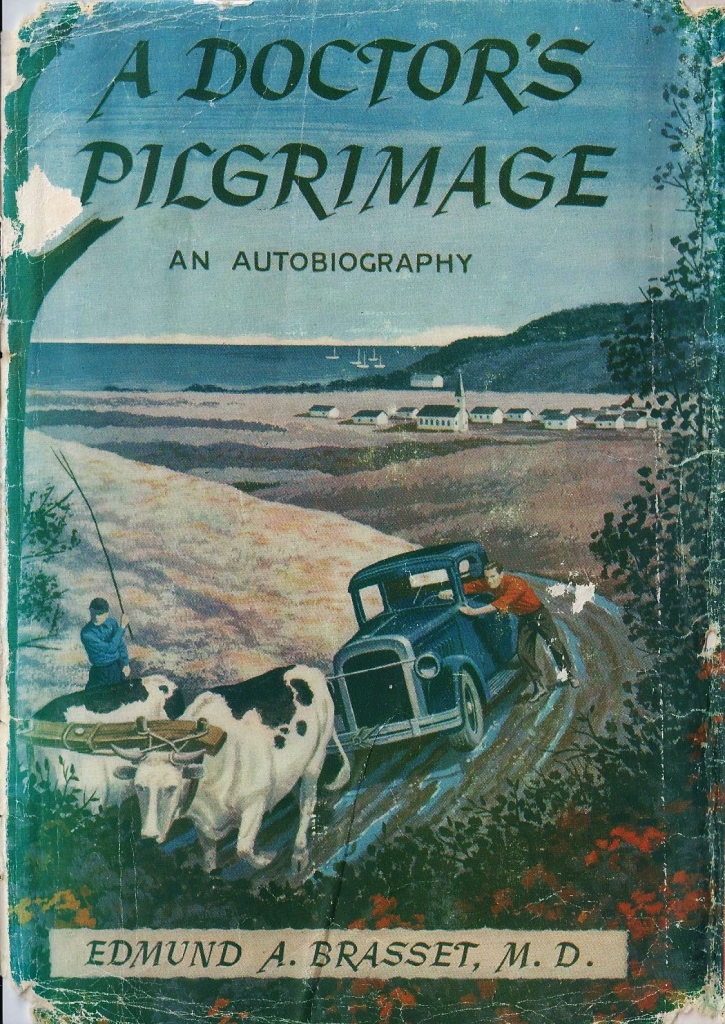
a doctor's pilgrimmage edmund a brasset 001A Doctor’s Pilgrimage: An Autobiography by Edmund A. Brasset, M.D. ~ 1951. This edition: J.B. Lippincott Company, 1951. First Edition. Hardcover. 256 pages.

My rating: 8/10.

What a great little autobiography this was! Totally unexpected. This was one of the books I picked up in Hope’s fabulous Pages bookstore recently; so far my eclectic selection of books from that source have been overwhelmingly rewarding.

A Doctor’s Pilgrimage covers only a small portion of the life of Nova Scotia physician Edmund Brasset’s life and career, and it appears, from a fairly involved internet book search, that this was Brasset’s only literary endeavour. One can only assume that the man was too busy with his career and family to continue writing, but this lone work is interesting and well written and gives a wonderful portrait of both the man and the time and place he was writing about.

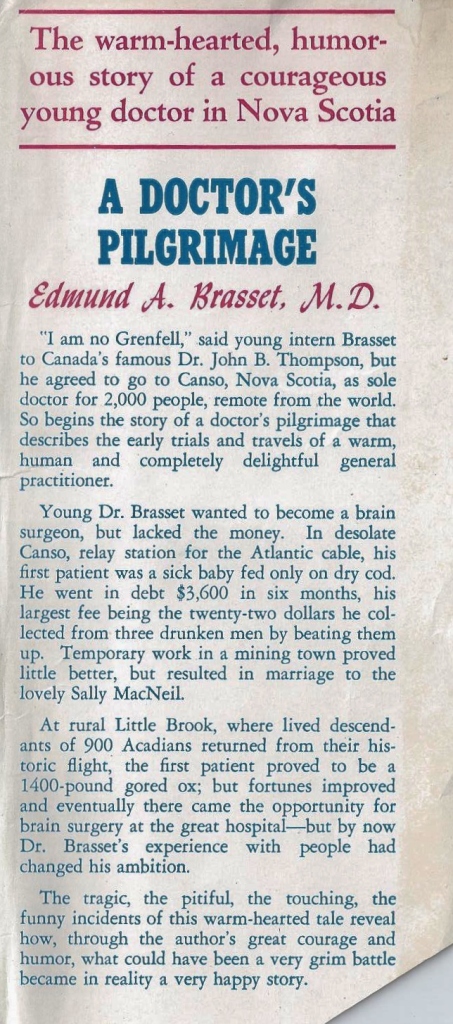
From the inner flyleaf:

a doctor's pilgrimmage edmund a brasset 001 (2)

The book consists of anecdotes of medical school, internship and work as a novice doctor in rural Nova Scotia, first in poverty-stricken Canso and later in a variety of other communities, ending in the almost utopian Acadian community of Little Brook, a posting which changed Dr. Brasset’s focus for the continuation of his medical career. Dr. Brasset never talks down to his readers; medical terminology is used with great abandon, but never to impress, merely to inform. Character portraits abound, as do retellings of local legends – a mysterious case of spontaneous combustion; the morning discovery on shore of an unconscious man with both legs recently amputated; a woman who believes that she is surrounded by ghosts – as well as asides referring to the author’s strong faith in both the goodness of humanity and the existence of a benevolent God. A very individualistic and opinionated (in a very good way) memoir.

A grand little book, in its happy minor key.

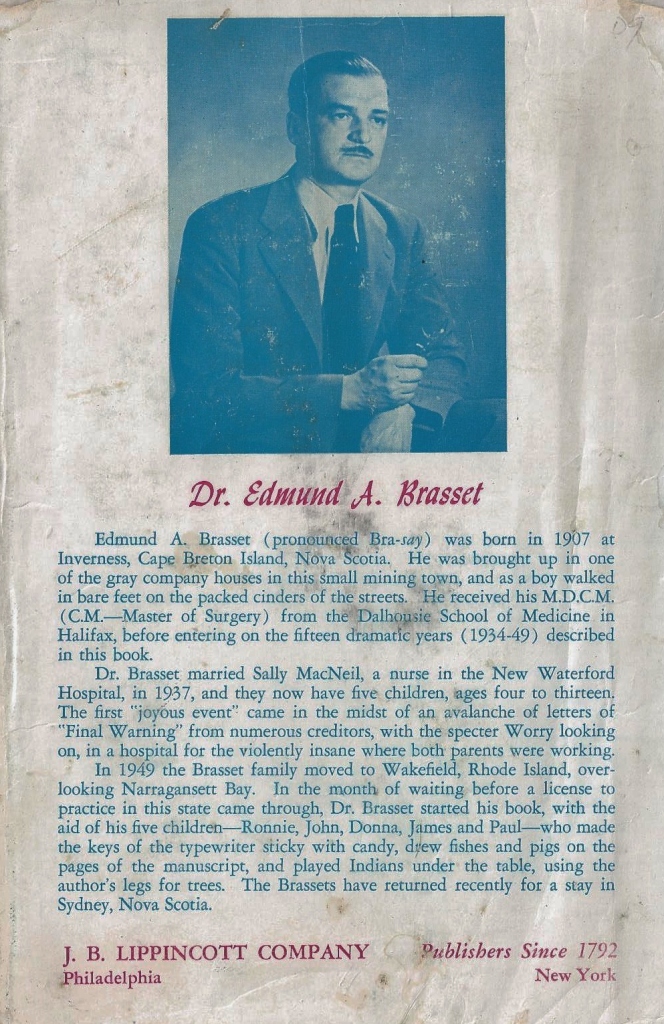
From the back cover, more on the author. (Aren’t these old dust jackets great?)

a doctor's pilgrimage back dj edmund brasset 001

And last but not least, the Kirkus Review entry for A Doctor’s Pilgrimage, from September of 1951.

A lively, likable record of a doctor’s rewarding if unrewarded first years in practice, and a little black bag full of fascinating cases, Brasset’s story starts when he left Halifax and the ambition to become a brain surgeon behind for Canso in Nova Scotia, where there was only fish and fog. After two years in Canso and a rising debt of several thousand dollars, Brasset was forced to leave for New Waterford where he married Sally, and his obligations increased in spite of a grateful mobster’s attempt to drum up business. A year on the staff of a mental institution widened his experience but did not increase his income, and finally he found a good practice in the remote French-Canadian village of Little Brook. Later given the chance to become a neurosurgical specialist, Brasset found the indifference and institutionalism of working with cases, as against people, less satisfying, made the decision to return to his country doctoring in Little Brook… A record of service which has warmth and humor.

The family eventually moved to the United States; during my internet research I found mention of Dr. Brasset’s son Paul, who is now a successful winemaker in California’s Somona Valley, even naming his winery after his childhood home: Bluenose Wines . (What an interesting little side note I found this to be. One reason I love the internet – such an abundance of rabbit trails one can happily follow!)

Read Full Post »

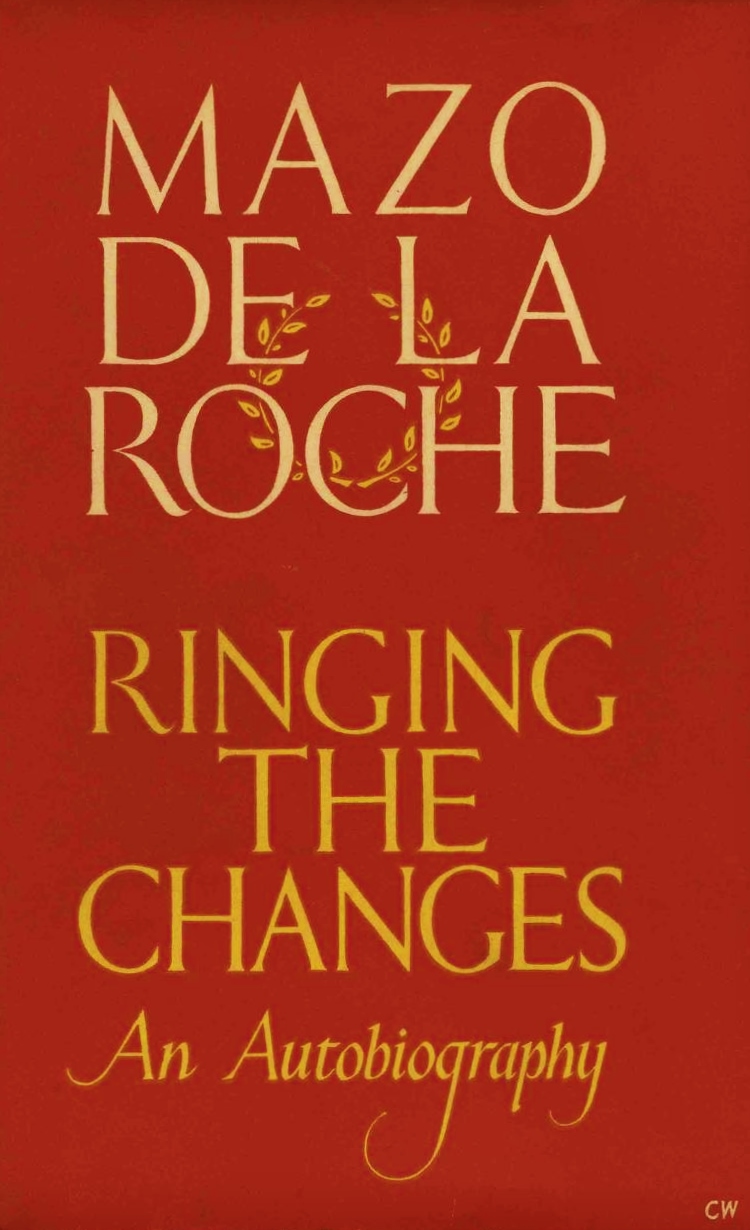
ringing the changes mazo de la rocheRinging the Changes: An Autobiography by Mazo de la Roche ~ 1957. This edition: Macmillan, 1957. First Canadian Edition. Hardcover. 304 pages.

My rating: 9/10. What a fascinating autobiography! It was definitely readable, and full of vivid vignettes, capably portrayed.

But is it factual? Perhaps not particularly, from what I’ve  found out in some very desultory online research. It is very much a created portrait rather than a true glimpse into what made its subject tick. Nonetheless, I found it a compelling read and I will be approaching my future reading of the author’s works with this self-portrait very much in mind.

*****

First, some background information for those of you (and I suspect there may be some) who have no idea who Mazo de a Roche was, and why I’m finding her story so interesting. Feel free to skip this section; my response to the autobiography itself follows at the bottom of the post. I’ve spent a fair bit of time this past few days doing something of a mini-study on de la Roche; I’m not at all what one would call a fan, though I’ve read a few of her books in the past, without feeling the urge to read everything the author has written. She’s not quite my thing, though I’m intending to explore her fiction more in the future, nudged on by the new knowledge I’ve just gained. An intriguing woman.

Mazo de la Roche was born in Ontario in 1879, the only child of parents who, while not exactly poverty-stricken, certainly experienced ongoing financial difficulties. Young Mazo was a self-described eccentric child, and an avid reader. She created an imaginary world peopled by invented characters which she referred to in her autobiography as “The Play”, and this world, expanded and lovingly detailed as the years went on, is thought to be at least partially the basis of de la Roche’s eventual epic sixteen-book series about a fictional Ontario family, the Whiteoaks, and their home estate, Jalna.

When Mazo was seven years old, her parents adopted her younger cousin Caroline, and the two became as close as sisters – and in some ways perhaps closer. Their intimate relationship was to persist until Mazo’s death in 1961. The young girls shared in the imaginary world originally created by Mazo, and as they grew up they built a shared life which seemed to preclude either of them marrying or living independently of the other for more than brief periods of time. Mazo had written stories and poetry throughout her life, but her ongoing bouts of ill health and the need to care for her invalid mother prevented her from spending as much time writing as she desired to. Caroline became the breadwinner of the family group, while Mazo stayed at home, nursed her mother, and wrote in her spare time.

Mazo had had some success selling occasional short stories to magazines, but her first real literary break came with the publication of a series of linked anecdotal stories, Explorers of the Dawn, in 1922. Mazo de la Roche was at that point forty-four years old, and her greater success was yet to come. Explorers of the Dawn made it onto bestseller lists of its time, alongside The Beautiful and Damned by F. Scott Fitzgerald and Louis Hémon’s Maria Chapdelaine. A foreword by Christopher Morley (best known nowadays for his humorous novels The Haunted Bookshop and Parnassus on Wheels, but a respected literary editor and critic in his own time) gave credence to de la Roche’s evident talent, and her distinctive authorial voice.

Two more promising novels followed, the critically acclaimed Possession, in 1923, and Delight, a less popularly successful Thomas Hardy-esque rural satirical romance, in 1926. In 1927, the work that was to launch Mazo de la Roche’s career into the Canadian and eventually worldwide literary stratosphere was published. Jalna was a a soap-opera-ish family saga centered on an old Ontario family, the Whiteoaks,  headed by a wealthy matriarch. Something about it caught readers’ imaginations, and, when Jalna unexpectedly won the prestigious Atlantic Monthly $10,000 cash award – a small fortune in 1927 – for “most interesting international novel of the year”, it assured its author’s financial security and allowed her the freedom to write full time. At the age of forty-eight, Mazo’s creative life was about to become very much the focus of an overwhelmingly adoring public and a varied group of intensely opinionated critics.

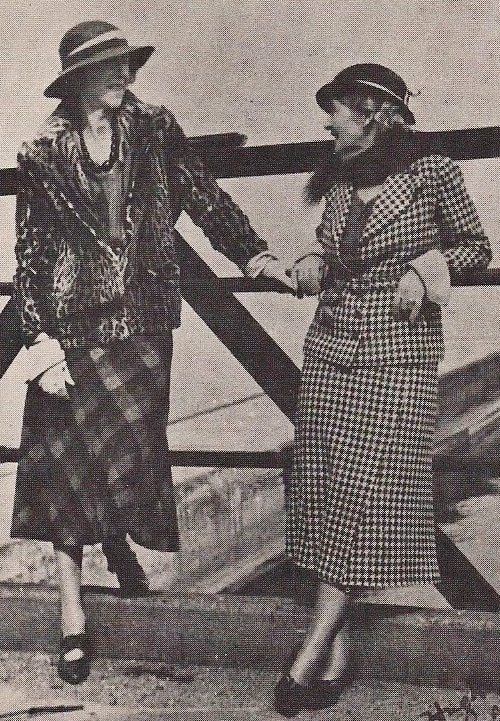
Mazo de la Roche and Caroline Clement, 1930s

Mazo de la Roche and Caroline Clement, 1930s

Caroline was now able to retire from wage-earning work and she took on the role of her suddenly-famous cousin’s housekeeper, editor, secretary, and collaborator in creativity. “The Play”, so precious to the two in childhood and maintained throughout the years, continued to expand in their leisure time, as the cousins ought respite from the pressures of fame in their shared imaginary world. Suffering continually from blinding headaches and trembling hands – and at least one bona fide nervous breakdown – Mazo found that the only way she could sometimes get her thoughts down on paper was to dictate them to Caroline. While Caroline always disclaimed any notion that she originated the plot lines and characterizations that Mazo was so famous for, both women were very open about Caroline’s role as a sounding board and critic.

Fifteen more “Whiteoaks of Jalna” novels were to follow that first astonishing bestseller, as well as more novels, plays, short stories and, eventually, several autobiographical memoirs, of which 1957’s Ringing the Changes is the last. Mazo de la Roche died four years later, at the age of 82. Caroline survived her cousin for some years; the two are buried side-by-side in an Anglican church cemetery in Sibbald Point, Ontario.

It is estimated that the Jalna novels have sold more than eleven million copies worldwide in the years since 1927. They have been translated into more than ninety languages, and were adapted for the stage, movies and television, with varying degrees of popular, commercial and critical success. Despite – or perhaps because of – their bestseller status,  the Jalna novels were increasingly viewed with scorn by the literary world as being too “popular”  and “melodramatic” in plot and execution.

Mazo de la Roche, in the decades since her death, has slipped into literary oblivion but for a few dedicated readers who staunchly read and reread the Jalna saga, and passed the books along to their children. Mostly daughters, one would assume, as de la Roche was seen as a “women’s writer”; her works were thought to appeal mostly to the bored housewife seeking sensation and emotional escape from the humdrum everyday round.

A recent (2012) documentary by Canadian film maker Maya Gallus has brought Mazo de la Roche into new focus. Both her ambitious novels and her unconventional and rather mysterious life are being examined with twenty-first century eyes. It will be interesting to see if there will be something of a “Jalna Revival”; I’m betting that we’ll be hearing much more of this not-quite-forgotten Canadian in the months and years to come.

Pertinent links regarding the recent docudrama:

NFB – The Mystery of Mazo de la Roche

Review: NFB docudrama: The Mystery of Mazo de la Roche

Quill & Quire – Interview with Maya Gallus

*****

(When reading) the autobiographies of other writers …  some appear as little more than a chronicle of the important people the author has known; some appear to dwell, in pallid relish, on poverty or misunderstanding or anguish of spirit endured. They overflow with self-pity. Others have recorded only the sunny periods of their lives, and these are the pleasantest to read.

~Mazo de la Roche ~ Ringing the Changes

Mazo de la Roche and her beloved Scottie, Bunty

Mazo de la Roche and her beloved Scottie, Bunty

Ringing the Changes itself is a diverting memoir, and, if the author indeed intended to record the frequent sunny hours of her life, she by and large succeeded. Tragedy both major and minor continually followed Mazo and her extended family, and while unhappy events are described, they are not dwelt on or singled out as an excuse for pathos. I never got the feeling that the author was “wallowing”, though I occasionally shook my head in wonder at the sad fates of so many of her relatives, and, frequently, of her family’s beloved animals. They did seem, so many of them, to come to such tragic ends…

I must confess that I knew very little about de la Roche before I read this book, though I had a pre-existing vision of her as a rather reclusive, mildly eccentric sort. I had read several of the Jalna novels way back during my teenage years, but had certainly not found them worthy of any sort of “fandom”, as so many others apparently have. I did pick up a number of the books quite recently in a library sale, thinking that my mother might enjoy them, but she was rather dismissive of the series, so they currently languish somewhere in a box.

In this memoir, Mazo looks back to her childhood, and, once a bit of genealogical discussion is gotten out of the way, launches into a compelling tale of gallantry, tragedy, heartrending anecdotes and humorous vignettes. “Gallant” is a term I kept saying to myself as I read Ringing the Changes; so many of the people in Mazo’s life demonstrated this trait, in particular her beloved cousin Caroline, who was the epitome of selfless devotion in numerous ways, though she appeared to have a full and satisfying independent life as well. The Mazo-Caroline relationship is still raising eyebrows – were they lesbians? what was Mazo’s hold on Caroline? who really wrote the books? – but, seriously, it does seem like that particular relationship was one of equals. Both women apparently had romantic interludes – with men – at various times throughout their lives; that they would choose to stay single and in a “family relationship” with each other and various other family members surely is a purely personal matter and rather understandable given their backgrounds and that of their extended family.

The argument for “closet lesbianism” for Mazo at least is quite strong, or perhaps one might go so far as to speculate that “cross-gendered” might be a more apt term. From her own statements in Ringing the Changes, in childhood she wanted to be a boy, she related on completely equal terms with her male editors and literary advisors, and, perhaps most tellingly, she frankly states that she identified extremely strongly with one of her male protagonists, Finch Whiteoak, who is portrayed as artistic, emotionally and physically fragile, and highly conflicted in his romantic yearnings.

In Ringing the Changes it does seem that Mazo de la Roche was continually striking back at her many critics, the ones who denied her work any place in the “literature” canon, due to its popular success and formulaic nature. She is highly defensive of her own motivations, and this oft-quoted passage sums up her rather hurt tone well:

I could not deny the demands of readers who wanted to know more of that [the Whiteoak] family. Still less could I deny the urge within myself to write of them. Sometimes I see reviews in which the critic commends a novelist for not attempting to repeat former successes, and then goes on to say what an inferior thing his new novel is. If a novelist is prolific he is criticized for that, yet in all other creative forms — music, sculpture, painting — the artist may pour out his creations without blame. But the novelist, like the actor, must remember his audience. Without an audience, where is he? Like the actor, an audience is what he requires — first, last and all the time. But, unlike the actor, he can work when he is more than half ill and may even do his best work then. Looking back, it seems to me that the life of the novelist is the best of all and I would never choose any other.

Ringing the Changes, read as a stand-alone book without reference to Mazo de la Roche’s fictional body of work, “works” as a memoir which can be read for the pleasure of the tale itself. Mazo de la Roche was, as even her harshest critics freely admitted, a “born storyteller”, and this account of incidents in her life, as deliberately selected and edited as they may be, is a very readable thing indeed.

Read Full Post »

my heart lies south elizabeth borton de trevino 001My Heart Lies South: The Story of My Mexican Marriage by Elizabeth Borton de Treviño ~ 1953. This edition: Thomas Y. Crowell, 1953. Hardcover. 248 pages.

My rating: 8/10.

*****

I found this book among my mother’s boxes in her attic which I was supposed to go through and “deal with” when she downsized from the too-many-staircases rambling family home to the tiny-but-manageable single-level house she’s in now. I almost put it into the Sally Ann box, but something stayed my hand. “Elizabeth Borton de Treviño…. I know that name, somehow,” I thought, and that was enough to put it into my keeper pile instead.

Some years passed (well, six years, to be exact, because Mom moved in 2007, and much of what I brought home is still in “temporary” storage here, still waiting to be “dealt with” – and honestly, the only boxes I’ve cracked open are the ones full of books) and then one day I looked at My Heart Lies South again. And the penny finally dropped.

Elizabeth Borton de Treviño. Of course! I, Juan de Pareja. The 1966 Newbery Award winning historical fiction about the Spanish painter Velazquez and his personal slave, Juan de Pareja. I’d read this some years ago, and found it a well-written juvenile historical fiction, and that was why the name of the author sounded so familiar.

I opened My Heart Lies South, as I should have done six years ago, and started reading bits here and there. Far from being the serious and sober biography I had expected from the rather unprepossessing dustjacket – (“Don’t judge a book by its cover” – I know, I know) –  the passages I read were wry and funny and interesting. And when I settled down to tread it cover to cover, it definitely did not disappoint. Another hidden bookish gem, I think we could safely say.

*****

Elizabeth Borton was born in 1904, in Bakersfield, California, and, encouraged by her parents, started writing at a very young age. After graduating from Stanford University in 1925 with a degree in Latin American History, Elizabeth went on to the Boston Conservatory of Music to study violin. She then worked as a reporter for the Boston Herald, and spent five seasons in Hollywood interviewing film personalities.

With her strong interest in all things Latin American, Elizabeth was continually talking about going to Mexico, and one day, in 1934, her editor broke down and sent her off with a handful of tickets, vouchers and contact lists, telling her to “just write something” once she got there. And with her eventual meeting with the representative of the Monterrey Chamber of Commerce, one Luis de Treviño, Elizabeth’s future, though she didn’t know it at the time, was about to take a very different turn from her life as an independent American career woman.

“Hello Luis!” said Bill. “This is Miss Borton. When you get to Vallecillo, buy her an ice-cold beer.”

Luis laughed nervously. There is nothing he likes better than a cold beer, but the lady he had taken across the border for the Chamber of Commerce two weeks before had resisted the beer with desperation as if it might be the first step in a seduction, and the lady last week had been Dorothy Dix, who was even then rather tired from pushing seventy or so and inclined to be tart with young men eager to waste her time in taverns.

I was turned over to the vaccination, immigration, and customs authorities, and at last, in a car which had been provided by the Chamber of Commerce, complete with chauffeur, we set out for Monterrey. I had my hair tied up in a scarf and I was wearing a large black hat as well as sun glasses. Now the sun began to go down and long violet shadows crept across the plain. I took off my hat.

“Ah,” breathed Luis.

I undid the scarf.

“So?” remarked Luis.

I took off the black glasses.

“Wonderful,” he decided, aloud. He leaned toward me and looked at me soulfully.

“Shall I sing you a song about love?” he asked.

“Why yes,” I agreed, thinking this must be a gag.

But he launched into “Palm Trees Drunk with the Sun,” went on to “The Sea Gulls,” and then sang “The Green Eyes,” in a light baritone voice.

“Very nice,” commented the chauffeur from the front seat. “Now sing ‘Farolito.'”

He sang it. After our beer in Vallecillo, Luis sang other songs. He sang all the way to Monterrey.

I didn’t realize it, but I was being courted.elizabeth borton de trevino 001

As you can see from the photo of the author, taken from the jacket of the book published eighteen years after her marriage, the initial attraction on looks alone is understandable!

Luis shows Elizabeth the attractions of Monterrey, including things definitely off the tourist track, such as his family ranchito, and, significance unknown to Elizabeth at the time, the private parlour of his beloved mother, Mamacita. He also takes her dancing, in company with a respectable engaged couple, a situation that made all of Monterrey society take note…

I was left at my hotel. But a sort of die had been cast. Luis had cast it and with his eyes open. He had taken a strange woman to dance. Just any strange woman, and the incident might have been passed over as a wild oat on the part of the fifth Trevino. But he had taken the strange woman in company with a pareja of his best friends, an engaged couple! Two plus two equals four. Dancing with one girl all evening, with an engaged pareja to make up the party, means something serious! Phones rang in Monterrey; the news went round. Only I was in the dark.

Formally on the afternoon of the next day, I was taken to call on Mamacita. While we sat in the sala, Luis disappeared, to return with a tray on which sat Mamacita’s best small silver liqueur glasses. In each was a thimbleful of sweet vermouth. On a plate there were some little yellow cakes that melted into a puff of flavour when bitten. These were Mamacita’s famous polvorones de maizena (cornstarch puff cookies), the engagement cake… They were a kind of symbol. All unknowing I ate the engagement cakes and tasted the engagement vermouth.

Later Luis brought me a small yellow-striped kitten and dropped it into my lap.

“Oh, the darling! I wish I could have him,” I cried. “But I am leaving tomorrow for Mexico City and I have lots of work to do. I won’t be home in California for weeks.”

Mamacita said calmly, “Galatea has kittens like these every four months. You will have a kitten.”

Paling visibly, Luis scooped up the kitten and left. I wondered what had happened, but it seemed he had only recognized his mother’s acceptance of me. Mamacita had decided that I was to come to Monterrey, marry Luis, and receive a kitten from the fecund Galatea. He had been working toward this, but it was serious, and it sobered him to realize he was practically a married man.

Elizabeth eventually catches on, and with the blessing of both sets of parents, the couple is married and sets up housekeeping in Monterrey, on a shoestring budget. Culture shock hits strong and hard, as Elizabeth is suddenly immersed in traditional Mexican society, and finds herself floundering more than a little in her new role as the wife of an established, upper class Mexican husband. Luckily Mamacita and Papacito, Elizabeth’s new parents-in-law, are firmly behind her, and guide Elizabeth through the maze of “proper” behaviour, and cover up her most blatant mistakes. Of which there are many, reported in full by the author.

I am afraid I am not at all familiar with Mexican society of the time period of the memoir – the 1930s – or even of the present day – but after reading My Heart Lies South I have a clear and mostly positive impression of a world in which family comes before all else, and in which women, though subject to the strictest of behavioural expectations from their menfolk, have an enormous influence and hidden power, which they can wield for either good or ill. Elizabeth’s family, visiting some years after her marriage, shake their heads in wonder and tell Elizabeth that she has wandered into a world frozen in the 1800s. Elizabeth, having carved out her domestic niche after significant struggle, agrees, but states that she is deeply happy, and that she now fully enjoys the more positive aspects of this steeped-in-tradition world.

This full acceptance of uber-traditional female roles may have modern-day feminists grinding their teeth in despair, and it also does appear, from the glowing reviews which this book receives on the “Godly womanhood” websites I’ve stumbled across while researching the author, that the more conservative “right-wing” types have embraced this memoir as an estimable example of true femininity.

I find that I fall somewhere in the middle of these two extremes. Elizabeth and Luis seemed, from all reports I’ve read, to have a most successful and happy marriage, which is an accomplishment worth celebrating, no matter in which society it is achieved. Elizabeth continued with her successful writing career after her marriage, managed to find time to keep up with her music, created a beloved home, and adapted very well to the expectations of her in-laws, while still staying in close contact with her American friends and relations. It seems to me that her life was most reasonably “fulfilled”; she certainly does not come across as downtrodden in any way, and she speaks of her integration into Mexican society with affection and sharp-eyed realism.

All of this to say that I enjoyed this book greatly.

There also exists an expurgated “Young People’s Edition” of My Heart Lies South, got up, I am sure, to piggyback on the perennial success of I, Juan de Pareja. Apparently all the more risqué bits are left out – and there are a few – so I can’t really see the point of that, as when Elizabeth shares some of her more “adult” anecdotes she’s really at her best. So look for the original version, which has been reprinted numerous times, instead. (And to add insult to injury, the cover of the junior version is not at all dignified, and hints at a jolly comedy, which, for all of its humour, this memoir is definitely not.)

My Heart Lies South has two companion memoirs, Where the Heart Is, and The Hearthstone of My Heart. I’m a bit taken aback by the Heart-y-ness of the titles – definitely working the theme to the utmost! –  but I’ll be keeping an eye out for these, as I’m sure they will be worth investigating.

Read Full Post »

A happy find yesterday while book-shopping! Two volumes of poetry by Edna St. Vincent Millay, Collected Lyrics and Collected Sonnets, both published by Harper & Row mid-2oth Century, with poems chosen by Millay herself. And while peacefully reading Lyrics this rainy, windy morning, the following struck me as almost too perfectly appropriate.

Enjoy.

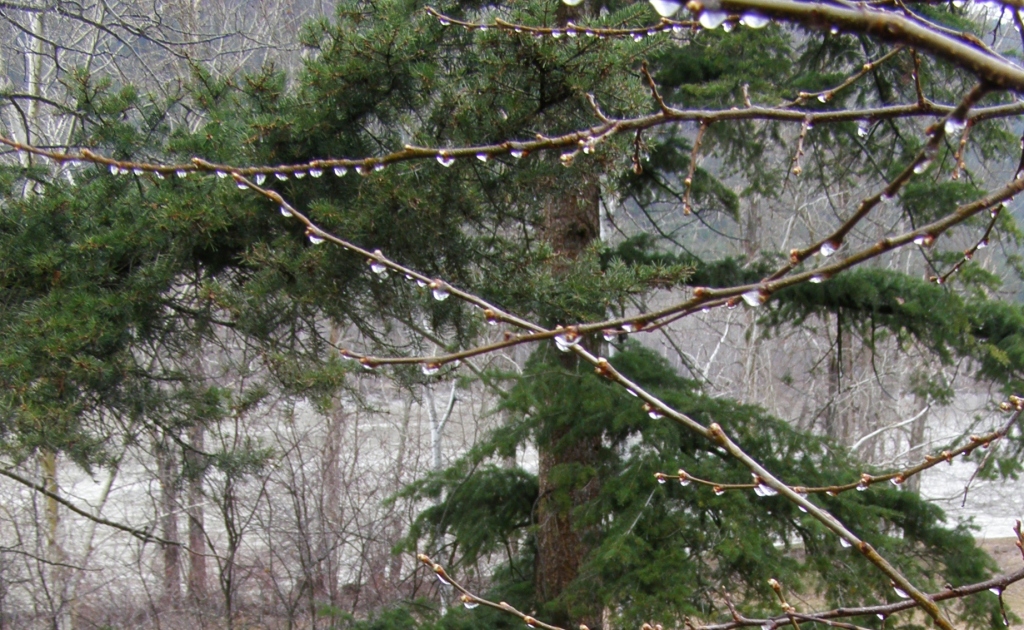
Raindrops turn to icedrops as the wind comes from the north ... Hill Farm, April 5, 2013

Raindrops turn to icedrops as the wind comes from the north … Hill Farm, April 5, 2013

Northern April


O mind, beset by music never for a moment quiet, –

The wind at the flue, the wind strumming the shutter;

The soft, antiphonal speech of the doubled brook, never for a moment quiet;

The rush of the rain against the glass, his voice in the eaves-gutter!


Where shall I lay you to sleep, and the robins be quiet?

Lay you to sleep – and the frogs be silent in the marsh?

Crashes the sleet from the bough and the bough sighs upward, never for a moment quiet.

April is upon us, pitiless and young and harsh.


O April, full of blood, full of breath, have pity upon us!

Pale, where the winter like a stone has been lifted away, we emerge like yellow grass.

Be for a moment quiet, buffet us not, have pity upon us,

Till the green comes back into the vein, till the giddiness pass.


Edna St. Vincent Millay ~ 1928

Read Full Post »

some buried caesar rex stoutSome Buried Caesar by Rex Stout ~ 1939. This edition: Contained in All Aces: A Nero Wolfe Omnibus, Viking Press, 1958. Hardcover. Also published as The Red Bull in some editions. 153 pages.

My rating: 8/10.

*****

What with the immense number to choose from, with over seventy novels and novellas to the author’s credit, I’m nowhere close to having read all of Rex Stout’s clever and generally complicated tales starring private investigator Nero Wolfe (the more than slightly eccentric orchid aficionado, world-class gourmet, and superior thinker, with a most well-functioning brain residing in a body famously weighing, as we are often informed, a full one-seventh of a ton – a much rarer bulk back in the 1930s when Wolfe was created by Stout than we are used to today; I am quite sure I have seen a few gentlemen of this poundage and beyond in our nearest large city, though Wolfe would no doubt eschew the shopping mall food courts where many of my sightings have take place) and his trusty Man Friday – as well as Saturday, Sunday, Monday, Tuesday, Wednesday and Thursday – Archie Goodwin. (Note to eagle-eyed readers and red-pencil holders, please forgive this complicated run-on sentence. I bemuse myself sometimes … punctuation scattered at will, stream-of-consciousness posting going full speed ahead …)

I am going to assume everyone reading this is at least generally familiar with Nero Wolfe, by reputation if not from personal experience, and from his rock solid position in the American mystery fiction canon, so I won’t go into too much background detail. Suffice it to say the Nero Wolfe is a superior thinker, doing all of his detective work sitting down, usually with eyes closed after a gourmet meal created by his private chef, Fritz. (Shades of Hercule Poirot’s “little grey cells”, but infinitely more cerebral, if that is possible.) Live-in employee Archie is the legs of the outfit, and, frequently, the eyes, ears and hands as well, especially when a female client calls. While Wolfe has a definite misogynist streak, Archie appreciates all things feminine, though he doesn’t allow a pretty figure and face to distract him from his duties. Well, most of the time, that is …

One thing for certain about Nero Wolfe is that he strongly dislikes having to leave his comfortable 4-story brownstone house in New York. He strongly distrusts the internal combustion engine, and assumes the worst of any vehicle, ascribing a sentient malevolence to the machinery, which mistrust is occasionally borne out, as in Some Buried Caesar. We are rather shocked to realize that not only is Nero Wolfe out and about in a car, but that the occurrence has satisfied his deepest misgivings, and the vehicle has indeed been involved in a crash. Archie is, as always, the narrator of the tale.

That sunny September day was full of surprises.

The first one came when, after my swift realization that the sedan was still right side up and the windshield and windows intact, I switched off the ignition and turned to look at the back seat. I didn’t suppose the shock of the collision would have hurled him to the floor, knowing as I did that when the car was in motion he always had his feet braced and kept a firm grip on the strap; what I expected was the ordeal of facing a glare of fury that would top all records. What I saw was him sitting there calmly on the seat with his massive round face wearing a look of relief – if I knew his face, and I certainly knew Nero Wolfe’s face. I stared at him in astonishment.

He murmured, “Thank God,” as if it came from his heart.

I demanded, “What?”

“I said thank God.” He let go of the strap and wiggled a finger at me. “It has happened, and here we are. I presume you know, since I’ve told you, that my distrust and hatred of vehicles in motion is partly based on my plerophory that their apparent submission to control is illusory and that they may at their pleasure, and sooner or later will, act on whim. Very well, this one has, and we are intact. Thank God the whim was not a deadlier one.”

Did you catch the obscure word  in this passage? Reading Rex Stout is an education all in itself, if you stop to take the time to investigate Nero Wolfe’s arcane terminology. I’ve never come across this one before: plerophory. According to my highly intellectual (ahem) search for a definition (I Googled it), plerophory means “a fullness, especially of conviction or persuasion; the state of being fully persuaded.”

All right, digressions aside, and on to the story. I’ll try to be as concise as possible. (The nice thing about writing up a post about a mystery novel, in my opinion, is that the reviewer shouldn’t really give too much away, so as to preserve the pleasure of discovery for those new to the tale.)

After crashing their car, Archie and Nero head off cross country to look for assistance. (They’re on their way to the big state fair, with a collection of rare albino orchids which Wolfe is planning on showing.) Crossing a pasture, they are distracted by a shouting man brandishing a shotgun, and, moments later, a large and very irate Guernsey bull.

The bull in question is the key player in the mystery to follow. He’s a prize herd sire raised by a neighbourhood farmer from a pup (okay, calf) and purchased by the present owner, entrepreneur owner of a highly successful restaurant chain, for the unheard-of sum of $45,000, as a publicity stunt. The bull is destined to be killed and barbecued and served to a large party of prominent people who are preparing to converge on the country estate in a few days. Needless to say, there is an upswelling of outrage among the farmers of the area, that an animal of such value as a breeder should be sacrificed at such a whim.

The plot gets really messy (literally) when the son of the next-door estate holder, a vocal opponent of the prospective barbecue, who has just advanced a $10,000 bet to the effect that the bull will NOT be killed and eaten, is found dead on the ground in the pasture being pushed around by the bull. Ah – but did the bull actually kill the young man? Nero Wolfe, reluctant witness to the scene, thinks not, and details his reasons.

As well as the (possibly) murderous bull, there are a pair of star-crossed lovers, an anthrax epidemic, a glorious description of a big state fair, and a second mysterious death – this one by pitchfork, so at least the bull is off the hook. This novel, only the sixth in the Nero Wolfe/Archie Goodwin canon, also introduces beautiful, witty, and wealthy socialite Lily Rowan, who figures prominently from here on in as our Archie’s soon-to-be close friend and love interest.

This is a classic vintage mystery read. Rex Stout stands alone; he’s in his own class entirely, though sometimes his stuff can be rather hit-and-miss.  Some Buried Caesar, good though it is, is far from my personal favourite of the Nero Wolfes I’ve read (I think The Mother Hunt might get that designation) – but this is an author worthy of exploration for any mystery lover. If your choice of book falls flat, try another; it may take an attempt or two to really get involved in Wolfe’s world, but once you’re won over, you’ll be a fan for life.

And this is what inspired me to pick up this book, after a Rex Stout hiatus of years. My sister, who recently celebrated a milestone birthday, is fond of orchids and has quite decent luck in keeping them happy and blooming, which can be something of a challenge. As a birthday gift, I gave her this handsome Cymbidium in full bloom, and, as I photographed it against the aqua walls of our newly painted enclosed porch, its temporary home awaiting the birthday party, I suddenly thought of orchidphile extraordinaire Nero Wolfe.

???????????????????????????????

Read Full Post »

« Newer Posts - Older Posts »