Posts Tagged ‘Memoir’

My Kingdom for a Donkey by Doris Rybot ~ 1963. This edition: Hutchinson & Co., 1963. First Edition. Hardcover. Line drawings by Douglas Hall. 128 pages.

My rating: Another unique book which is hard to rate. It’s centered on the author’s pet donkey, Dorcas, with predictable anecdotes about the creature itself, but it also ranges much more broadly into history, philosophy, animal rights and general opinionating by the author.

I liked it. I initially bought the book to give to a donkey-owning friend, but am finding it difficult to make up my mind to let it go just yet. And I love the illustrations. I should send it on its way back out into the world, but I strongly suspect I won’t.

Anyway – rating. I’m thinking 8/10. A slender little volume, but earnestly written, and beautifully sincere. Almost makes you yearn for a donkey of your own. (“Or not!” exclaims my reading-over-the-shoulder daughter, who has spent a number of sessions brushing out the knots in down-the-road Fanny’s woolly coat.)

*****

I’ve been carrying this one around with me for weeks, to the detriment of its rather fragile dustjacket, so I’ll try to pull off a quick review in my little window of time this evening so I can at last leave the poor thing on the shelf.

The author writes:

My own Dorcas is a plump, well-liking donkey. But even I – who can say of her as Sancho Panza said of his ass Dapple, she is the ‘delight of my eyes, my sweet companion’ – even I cannot call her beautiful. She is too like a child’s inexpert drawing, with her head absurdly big for the mouse-brown body that is at the same time neat and clumsy.

Poor grotesque beasts! Whose fault is it that they are as they are? From that day far down the increasing centuries, before the Pyramids, before Abraham, when the first wild ass was haltered and loaded. his kind have been abused, overweighted, beaten, ill-fed, chancily watered; kicks and goads have come their way more often than pats and praise. Little wonder they were reft of their real grace and swiftness to become the stunted toilers that we know, waifs of the world, clowns among horses, a byword for patience and humbleness.
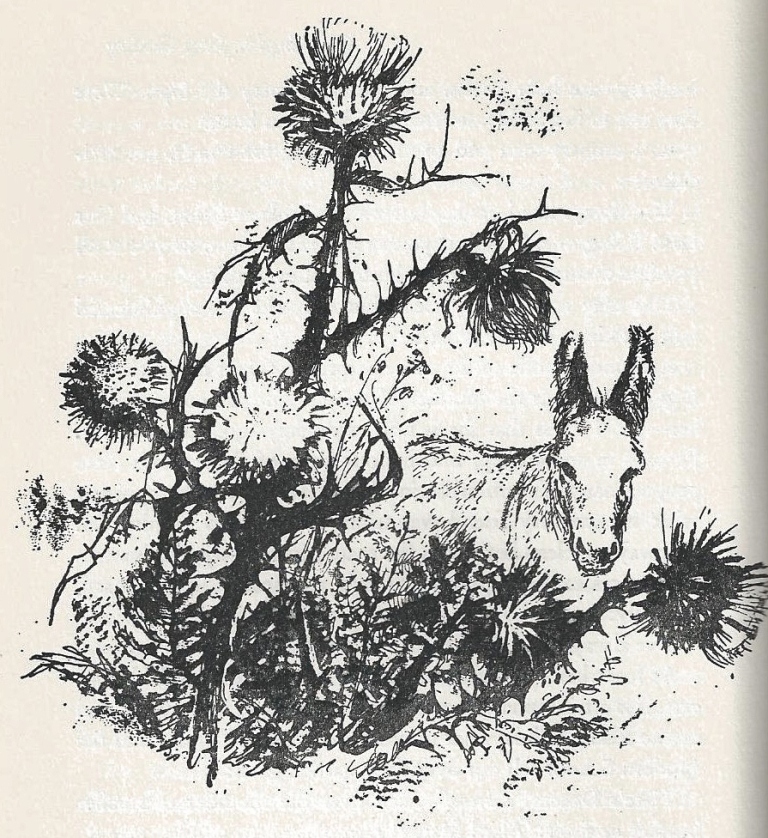
This particular donkey has been acquired to keep the grass down on a small country acreage. She has not been neglected or abused, but instead was deliberately sought out and purchased from a horse dealer who kept the little jenny among a herd of ponies in the New Forest of England’s Hampshire region. Dorcas was a costly acquisition, donkeys apparently being rare and hard to come by in this particular place and time – England in the late 1950s – but the transaction was made and Dorcas soon adapted to her new home.

Dorcas’ new life was in no way harsh or unhappy; her days were filled with peaceful grazing and visits over the fence with many passers-by, occasionally pulling a small cart, being taken for short rides by her owner and visiting children, and, on one memorable occasion, embarrassing her owner mightily by refusing to participate in a horse show in the most public fashion possible, by rooting herself immovably in the show ring as the rest of the participants circled round in perfect form.
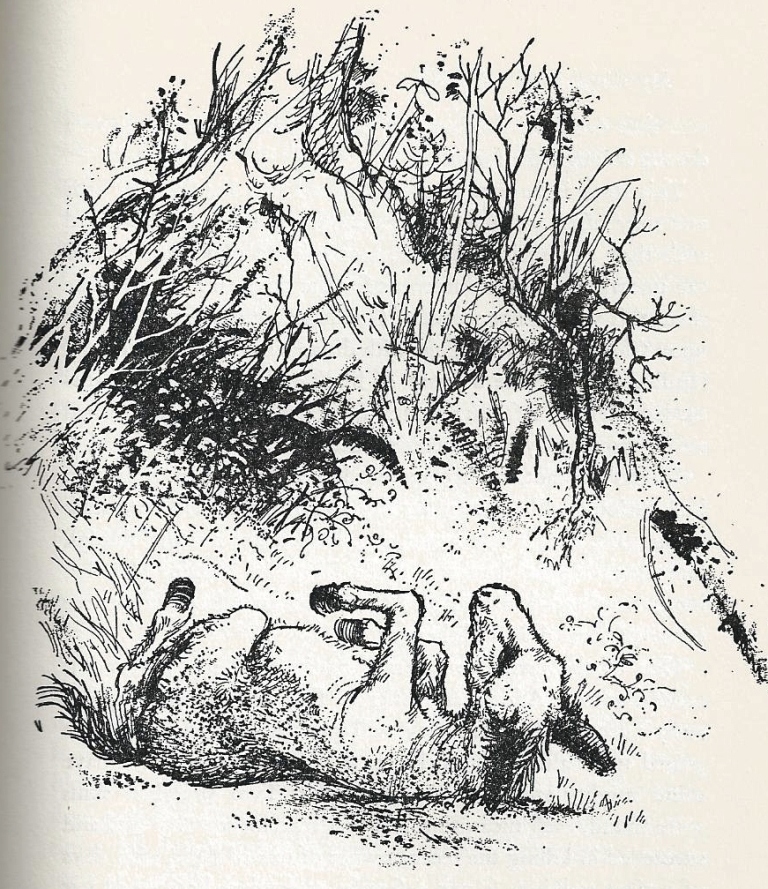
Dorcas provided her owner with years of interest and pleasure, mostly by her mere possession and the enjoyment of watching her carry on her natural inclinations and habits.

Doris Rybot tells the tale of Dorcas with the minimum of sentimentality – she sees her donkey and her own role as animal owner and caregiver through pragmatic eyes – but at the same time she speaks most movingly about the treatment of Dorcas’s tribe through the centuries, and expands this to a plea to treat all animals with respect. In between personal anecdotes featuring not only Dorcas but the other animals in her life, Doris retells a number of legends and Biblical stories in which the humble ass takes a prominent part.

An unusual and very heartfelt book, by a writer who has a deep and articulate love of all creatures from the lowliest insect to humankind itself. A hidden gem of a book, which I am quite thrilled (in a quiet way) to have come across.

I’ve done a little bit of background research on Doris Rybot, and have discovered little about her except that she did write at least one other book, It Began Before Noah, and that she also appears as Doris Almon Ponsonby, and that she was born in 1907.

Read Full Post »

Randy Bachman’s Vinyl Tap Stories by Randy Bachman ~ 2011. This edition: Penguin Canada, 2011. First edition. Hardcover. ISBN: 978-0-670-06579-0. 224 pages.

My rating: Oh boy. Another toughie to rate.

Because I’m already something of a Vinyl Tap fan, admittedly for Randy’s rambling anecdotes more so than some of the actual songs, and I’ve heard some – a lot! – of these stories before. The book perfectly captures his long-winded, continually-sidetracked, “Hey – I played with everyone you ever heard of” – and of course he did, he really DID! – very Canadian, very polite, and very funny style. I could hear his voice say every word I read.

Anyway, the rating. If I’d never heard a single episode of Vinyl Tap, I’d have to say a 6 or possibly a 7. Lot’s of name dropping, lots of references to both now-forgotten musicians and still-legendary rock stars, lots of eyes-glaze-over arcane musical stuff. As it is, and because I really like and admire Randy on a personal level – though I’ve never met the guy, and was definitely not a real fan of his music when growing up, except for the few chart toppers I inadvertently listened to – “American Woman”, “No Sugar Tonight” – you know, the standards – (I was always more into the Brits, like The Stones and The Who and Bowie and T. Rex, with a parallel affection for Jonie Mitchell and Bob Dylan and their ilk) – anyway, his voice on CBC Radio is a ton of fun to listen to, and the man seems genuinely nice.

Nice is good. We need way more nice in the world. And he’s a kid from Winnipeg. Who now lives in B.C. So he gets an 8.5/10. Rock on, Randy! Long may you ramble.

*****

I think maybe I already wrote my review. Let’s see, maybe a bit of background info for those of you Canadians who haven’t inadvertently or deliberately tuned into CBC Radio on a Saturday night driving along in the dark.

The Guess Who. Bachman Turner Overdrive. Ring any bells? If so, you may be a Canadian of a certain age.

Randy Bachman’s musical life started way back in his childhood, with violin lessons from the age of five. That was in the 1940s, and by the ’50s Randy had discovered another stringed instrument, the guitar – in particular the rock’n’roll guitar – and his future was set. Blessed with a hear-it-once-and-play-it mind – Randy calls it his “phonographic memory” – Randy forged ahead single-mindedly absorbing every new lick and chord and riff, and hanging out with the rest of the young wannabees in Winnipeg’s surprisingly fertile breeding ground for the rockers of the next few decades.

Teenage garage bands evolved and moved on, and the young musicians traded high school gyms for recording studios, doggedly saving their money to produce demos and singles and eventually albums, and one day, not too far into his musical journey, Randy found himself playing among the greats. Having converted to Mormonism when wooing his first wife, Randy was that rare figure: a rocker who embraced the third element of the stereotypical sex, drugs and rock’n’roll lifestyle while remaining a sober observer of the excesses of his compatriots in the first two departments. Perhaps that’s why his memory is so darned good?

And it – his memory – is amazing. The guy is a fount of trivial detail and anecdotes galore. To listen to him chatting away on Vinyl Tap, picking on his guitar to illustrate the details of what chord so-and-so played on his/her greatest hit/forgotten classic is mesmerizing. The guy is a literal sponge. He’s soaked up everything he’s ever heard or seen, music-wise. I repeat – amazing.

This book is a collection of Randy Bachman’s Vinyl Tap radio show monologues, expanded and cross referenced and generally polished up, with playlists of referenced songs at each chapter end, apparently available as collections on iTunes. (I haven’t checked this out personally, but I read that somewhere in the book end notes. It’s not prominently mentioned – a point in favour, in my opinion.) Another cool feature is the themed lists of songs at the end of the book, reflecting the themed Vinyl Tap shows where the featured “common thing” among diverse songs highlighted by Randy may be, say, cowbells, or songs for your funeral – how about “I Shall Be Released” by The Band, or “Wasn’t That a Party?” by the Irish Rovers, or “Another One Bites the Dust” by Queen, among all the sad and sobby tearjerkers also listed –  or food songs (“Catfish Blues”, “Cheeseburger in Paradise”, “I Want Candy”.) Sometimes a little bit silly, but a whole lot of fun.

Speaking of food, Randy shares some deep down and personal stuff here as well, like how his own appetite led him to the point where he weighed almost 400 pounds a few years ago, and his resolve to turn his life around. He opted for gastric bypass surgery, and it appears to have done wonders for him; he’s downright svelte in his later photos.

All in all, an interesting book for a Randy Bachman fan or a guitar aficionado – the guy’s a guitar monomaniac too, and there is a long, super-detailed chapter on rock guitars and their ins and outs and how to get various details of sound which, though fascinating in an “I’ll never use this information but it’s cool to see someone so passionate about it” way is something that was mostly lost on me, as I suspect it would be on most of us who aren’t aspiring rock band guitarists.

Would I recommend it? Hmm. Maybe one to check out from the library before buying it, though the song playlists are maybe worth having around, for those days with too much time on your hands and an iTunes gift card handy.

And here are some good links to recent interviews with Randy Bachman:

National Post – Randy Bachman Talks & Writes Vinyl Tap

Georgia Straight – Randy Bachman Remembers

Guitar International – Randy Bachman on Canadian Rock & Collecting Guitars

Read Full Post »

The Stars Grow Pale by Karl Bjarnhof ~ 1956. This edition: Penguin, 1960. Translated from the Danish by Naomi Walford. Paperback. 267 pages.

My rating: 7/10.

This early years autobiography left me curious as to the next stage in Bjarnhof’s life. The internet is curiously empty of much information about a man who became a celebrated member of Danish musical and intellectual society.

Desperately bleak in parts; often deeply moving.

*****

This is the story of a boy whose early years were filled with an array of tragic and challenging  issues, not the least of which is his growing blindness. Looking back on his childhood from many years in the future, the tone is stoic yet unsparing of the details of the situation and actions of Karl Bjarnhof’s family and childhood associates, and his own reactions and thoughts.

Karl, from his own self-description, was a stubborn and introspective child, occasionally impulsive, and often unable to explain his own actions or respond emotionally appropriately to the out-reaching of others. The deep love of his parents for their troubled child comes through clearly and poignantly, though Karl does not acknowledge those feelings in so many words in this account.

A gifted mathematician and musician from childhood, though these tendencies were initially dismissed, Karl went on in his adult life to gain international fame and respect as a cellist and organist, and later as a writer and radio broadcaster.

I can’t say I exactly “enjoyed” this autobiography. It immediately pulled me in and kept me enthralled, but it is a painful account to read, and it left me saddened, even knowing that Karl’s persistence in following his inner vision won through, and that he went on to lead a creative and fulfilling adult life. There is a certain understated humour to some of the anecdotes, but much of the book comes across as serious and unsmiling in tone. I suspect that some of the sparingly written vignettes will be etched in my memory for years to come.

Karl Bjarnhof was born in 1889, and died in 1980. His vision faded throughout his childhood and teen years; he became fully blind at the age of nineteen.

From the inner cover of this vintage 1960 Penguin edition:

Karl Bjarnhof in this brilliant autobiographical novel tells the story of a boy marked out from his fellows by the gradual onset of blindness.

The boy himself is not depressed, though other people may make him miserable: the boys in the yard will not play with him because he is too ‘stupid’ to see the ball; his mother nags at him for being ‘peculiar’; his schoolmaster punishes him for not being able to do the sums set on the blackboard. When eventually he is taken to an occulist he is told he has ‘eyes like a hawk’ because while he was waiting for his test he memorized the letters on the chart.

This story is devoid of self-pity or sentimentality. It gives a complete picture of a childhood in a small town in Denmark, with a gallery of unforgettable characters, both comic and pathetic. The book is profoundly moving, and deserves its outstanding success; the Danish book trade awarded the Golden Laurels (for the most outstanding book of the year) to Kark Bjarnhof in 1956 for The Stars Grow Pale; it has been published in nine countries, and was a Book Society Recommendation.

‘The book is a thing of beauty, of tenderness, and, at times, humour; which has, too, a strong adventurous streak.’ – Elizabeth Bowen in the Tatler

‘The sheer beauty of the writing … is exquisite …[The boy’s] world is completely his own, yet Mr. Bjarnhof, by his almost uncanny power of communication, puts the reader right into it.’ – Rumer Godden in the Bookman

From the back cover:

Karl Bjarnhof was born in 1898 in the small town of Vejle in Denmark. His family lived in very moderate circumstances and was hard put to provide proper medical assistance for the boy, who began to go blind at an early age. He has been totally blind for many years.

Bjarnhof’s musical talents and interests were manifest from the very beginning, and he developed into one of Denmark’s best violoncellists, although he no longer performs in public.

He is now known chiefly for his radio work as feature writer, music commentator and quizmaster, and above all for his exceptional talents as radio interviewer. He has been the editor of a Copenhagen newspaper, and has written several novels and numerous feature articles on a wide variety of subjects ranging from music, literature, art and the theatre to the state of the world in general.

The Good Light, published in 1960, continues Karl Bjarnhof’s story. Both books are readily available through ABE.

Though I personally found The Stars Grow Pale an interesting, and often compelling, read, I would hesitate to recommend it unless the reader is a serious collector of rather obscure autobiography, or has a previous interest in Bjarnhof’s early years. Well written, in a distinctive style – or at least well translated with clarity and artistic flair – it is nonetheless a work which may not appeal to the broadest range of readers.

Read Full Post »

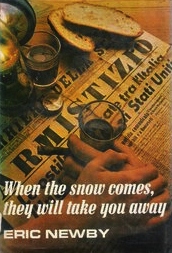
When the snow comes, they will take you away by Eric Newby ~ 1971. This edition: Charles Scribner’s Sons, 1971.  British title: Love and War in the Apennines. Hardcover. ISBN: 684-12486-6. 221 pages.

My rating: 9.5/10. Loses a bit for occasionally awkward phrasing which made me stop and re-read in an attempt to keep the story sorted out. It broke the flow a few times; nothing too serious. Otherwise, a very engaging and sincere memoir.

***** 

I said “sincere” just above, and that is my overall impression of this World War II prisoner-of-war account by the late British travel writer Eric Newby, best known perhaps for his month-long ramble in the Hindu Kush back in 1956. Fourteen years before that famous excursion, Newby was occupied with an even greater adventure after he was interned with his companions in German-occupied Italy after a British Special Forces sabotage mission against a German airfield in Sicily went completely awry.

We were captured off the east coast of Sicily on the morning of the twelfth of August, 1942, about four miles out of the Bay of Catania. It was a beautiful morning. As the sun rose I could see Etna, a truncated cone with a plume of smoke over it like the quill of a pen stuck in a pewter ink-pot, rising out of the haze to the north of where I was treading water.

After being dropped off by a submarine off the Sicilian coast, Newby and five companions had paddled their folbots – portable folding canoes – to the beach, and proceeded to attempt to sneak onto the German airfield and bomb as many of the planes as possible before escaping back to the beach and then a pick-up rendezvous with the sub. Unfortunately for the saboteurs, the Germans were very much on the alert, and the sneak attack ended in a hasty retreat. The canoes sank one by one during the night, leaving the men completely stranded at sea, where they were picked up by Italian fishermen. A year in a rather decent POW camp followed, with numerous unsuccessful escape attempts by various prisoners being attempted, before the Allied-Italian Armistice of 1943 which saw a mass exodus of Allied prisoners and Italian soldiers into the countryside just ahead of advancing German troops.

Eric had unluckily broken his ankle the night before the Armistice, which complicated his movements considerably. Ending up in an Italian hospital, waiting for the inevitable arrival of the Germans, Eric met a young Slovenian woman, Wanda, who initiated a series of language lessons – Italian in exchange for English – which soon led to something more than a disinterested friendly relationship.

When the Germans did show up, Eric was put under guard by Italian policemen, but he managed to escape out of a bathroom window, broken ankle and all, following Wanda’s instructions as to how to find assistance in the town. An underground movement of antifascist/anti-German civilians was mobilizing, and Eric came under their protection and was passed from house to house until his eventual haven in a small mountain village, where he ended up working for a farmer in exchange for shelter and meals.

Wanda kept in occasional contact, mostly by cryptic notes and once by a rare and risky visit, and Eric stayed one step ahead of his potential captors. But as the autumn progressed and the mountain snows began to fall, the period of freedom drew to a close, as it became impossible to hide the presence of Eric and the other temporarily free POWs from the investigative raids of the German patrols.

As the book ends, Eric has been recaptured and is heading to another internment camp, where he will be spending the rest of the war. He and Wanda managed to stay in contact, and were married after the war.

This book is a self-deprecating account of one man’s attempt at maintaining his freedom, though, as Eric himself notes several times, the best thing he could have done both for himself and for the Italian villagers who risked their lives to aid him would have been to surrender. And there was a very real danger to his hosts. Entire families were shot for harbouring fugitives, and though there were numerous people willing to run such a risk, there were others just as eager to turn in both escaped prisoners and those of their neighbours who aided them.

It is also a touching love story, both of a man and a woman who meet and fall in love in most uncongenial circumstances, and of Eric Newby’s deep affection and respect for the Italian peasants who sheltered and fed him at unbelievable risk to themselves and their families.

A sincere and grateful story, written in a modest tone with a good dose of wry humour.

This is one of the recommendations in Noel Perrin’s book about good books, , which I reviewed earlier this year.

I must agree. Highly recommended.

Read Full Post »

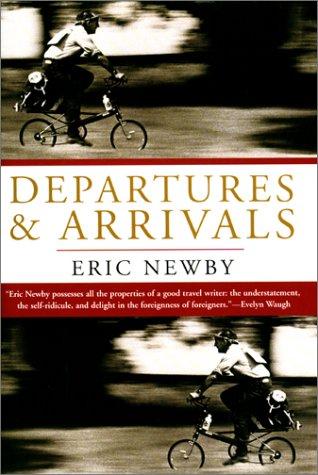
Departures and Arrivals by Eric Newby ~ 1999. This edition: The Lyons Press, 1999. Hardcover. ISBN: 1-58576-224-4. 192 pages.

My rating: 5/10. Some decent essays but not enough of them to swing the balance between “fair” and “very good” reading. A lot of reciting of railway schedules, and short, out of context snippets about trips which blurred together after a while. Travel writing “lite”. I expected more from this writer.

*****

A few essays into this book I was thinking to myself, “Okay, these are obviously excerpts from other works. Where’s the reference page?” Looking through the front and back material, there was no indication that this was the case; it apparently is a stand-alone collection of (mostly) travel tales and short reminiscences of the writer’s earlier life.

There is no context given more many of the trips referenced, which I found disconcerting. “Flying into Coober Pedy…” Yes – okay – so you’re in Australia – but WHY are you there? What bigger trip is this part of? And aside from discovering that opal miners like to be paid in cash, and certain of them have a fondness for personal architecture such as a revolving bed surrounded by mirrors, what other memorable things did you find there that we, your readers, might be interested in?

Though there are well-written, interesting, and amusing passages, the whole thing feels like a selection of truncated pages from a personal journal, bits and pieces of information jotted down in transit to aid in later memory of the trip. Perhaps it is, worked up with a minimum of added information.

I suspect this is a book which was commissioned and published on the strength of the author’s earlier, and much stronger, efforts. A case of selling the name, not the content.

It was readable, but  vaguely unsatisfying. One to borrow from the library for light diversion, hotel room reading on a road trip (which is how I’ve just experienced it), but I’m not left with an urge to rush out to buy it. Not recommended, unless you come by it for a bargain basement price.

Read Full Post »

I Was a Teenage Katima-Victim: A Canadian Odyssey by Will Ferguson ~ 1998. This edition: Douglas & McIntyre, 1998. Softcover. ISBN: 1-55054-652-x. 259 pages.

My rating: 9/10.Funny and thought provoking. This is the book that made me a Will Ferguson fan, way back in 1998, when I plucked it off the “New Releases” bookstore shelf solely for the reference to Katimavik. A few minutes browsing and I was sold. Liked it then, like it now. A very Canadian memoir.

*****

Funny, touching, and never maudlin . . .”     – Montreal Gazette

“A rollicking memoir”     – Globe & Mail

“A coming of age story with a fierce and nationalistic bite.”     – January Magazine

With Will Ferguson in the literary spotlight these days, due to his Booker Prize win for 419: A Novel  just a week ago, I felt the urge to dig through the bookshelves and re-read the my first ever Ferguson book, the now-obscure 1998 coming-of-age-Canadian-style memoir, I Was a Teenage Katima-Victim.

Ah, Katimavik! What a well-meaning and ambitious, oh so Canadian idea!

In my Grade 11 year I too went to one of those earnest presentations in the school gym, listened with deep interest to the bubbly recruiter, and, most importantly, mused over what I could do with the thousand dollar pay-off at the end.

I even went so far as to take a brochure home to my parents, who flicked through it with scornful dismissal. The airy-fairy notion of travelling and seeing Canada basically on the taxpayers’ dime was not something to countenance for one of their children. In my father’s eyes such programs were akin to “those deadbeats collecting welfare”, and he quite literally would have starved on the street rather than apply for a government handout, or anything which could be remotely conceived of as such. To top it off, Katimavik was supported by none other than “that Liberal bastard”,  Prime Minister Pierre Trudeau, who my father hated with a black passion, for reasons I’m still not quite clear on.

By the end of my Grade 12 year Katimavik was a distant memory, a momentary what-if? fairytale I had told myself. I had moved out of my parents’ home into a nasty and dank – but blessedly my own – basement suite in town, and was working full-time waitressing (nights and weekends) while struggling to make it through the tatters of my last high school year to collect that all-important graduation diploma. My love life had unexpectedly taken off, and I was deeply occupied in the here and now. The last thing I now wanted was to rip up those tentaively establishing adult roots and travel. But a soft spot remained for the grand ideas embodied in Katimavik, and my ears ever after were sensitive to the sound of the name.

Will Ferguson took the bait, made the plunge, and survived to tell the tale. Here is a 1999 interview in January magazine:

The book … is delightful: a coming of age story with a fierce and nationalistic bite.
To explain the reference, Katimavik was a Canadian government funded and sponsored program that blossomed in the 1970s. Of course. While the program was active, it brought thousands of young Canadians together to do “meaningful work.” Everything from soup kitchens to nature trails to heritage sites: over 20,000 “katima-victims” went through the program. “The scope of the program was staggering,” writes Ferguson. “1400 different communities across Canada, and more than 200,000 people directly involved or affected. For better of worse, Katimavik helped shape an entire generation.”
For the lavish sum of $1 a day and “all the granola you could eat” these 20,000 17 to 21 year-olds were taken far from their home towns for a year to see first-hand the cultural mosaic of which they were – by birth – a part.
“The thinking about Katimavik was that there is something redeeming about manual labor,” says Ferguson. “And the thing is, it just isn’t true at all. Anybody doing manual labor knows that it’s a tough gig and if they had the option not to do it, they wouldn’t. The second notion is that somehow once we get to know each other, we’ll like each other. This is the biggest flaw and it runs right through a lot of thinking. They think that, just because you and I are enemies, if we got to know each other, we’d like each other: that’s a big flawed premise because – quite often – the more you get to know each other, the more you realize that you have nothing in common.”
Despite his misgivings about the program’s principals, “Katimavik worked on a personal level, despite its good intentions. Just because any time you throw someone into something that big and that intense you come out of it with a rounder personality.”
Now 34, Ferguson’s personality is sufficiently rounded to take us along with him on great rollicking rides. Thus far he’s taken us from the wilds of Canada to the back roads of Japan. Whatever he has in store for us next is sure to be fun: and will hopefully raise still more eyebrows. | Linda L. Richards, January Magazine, February 1999

There is a certain irony in the fact that, soon after Ferguson’s participation in the now-iconic Canadian youth travel-service-work-cultural  program, it was axed in 1986 by the newly elected Mulroney Progressive Conservative government. Katimavik was resurrected in a slightly different form in 1994, and just this year, 2012, has been cut again, this time by the Conservative Harper government. Another rescue mission is afoot, to reimagine Katimavik for yet another generation of young Canadians. I hope it succeeds.

This book has been out of print for years, and is unaccountably ignored in most discussions of Ferguson’s work, which is a shame. Despite the graphically appalling cover, the tale told within is worth reading, especially for anyone who has memories of Katimavik in its sincere and slightly loopy heyday. A bit raw in spots – it was, after all, only Will Ferguson’s second published book, following hard on the heels of surprise bestseller Why I Hate Canadians – it nevertheless gets better and better as it goes along. Laugh out loud funny in places, there is a thread of sincerity running through it which is deeply appealing.

More than a mere curiousity piece and a relic of the author’s youth, it’s a rather grand little read. One of those “Proud to be Canadian” feel-good things. Recommended.

And here is link to the Goodreads page.

Read Full Post »

The Way of a Gardener: a life’s journey by Des Kennedy ~ 2010. This edition: Greystone Books, 2010. Softcover. ISBN: 978-1-55365-417-9. 271 pages.

My rating: 8/10. Beautifully written, but I found myself occasionally tuning out – just a tiny bit – in the later chapters. The author’s life has been so full that he just barely touches on many of the events in his later years. I would love to have seen this as a volume one of a multi-volume biography, ending at his leaving the seminary, or settling on Denman Island (one of the Gulf Islands in British Columbia’s Georgia Strait, between southern Vancouver Island and the mainland), because I think the last four decades on Denman plus all the environmental involvement could easily fill a book of its own.

*****

I remember when Des Kennedy first blipped onto my radar, through his 1990s columns in Gardens West magazine, a Canadian publication which is de rigueur reading in my fellow gardeners’ social circle. This was soon followed by my purchase of Kennedy’s first book, a collection of essays on unloved creatures – think rats, slugs, spiders and their ilk – called Nature’s Outcasts: Living Things We Love to Hate (1993),and the rest of his gardening books as they were published, the most recent, before this one, being 2008’s An Ecology of Enchantment, which hints at some of the backstory detailed in this current memoir.

He popped up here and there, speaking at a garden show, authoring an article in a gardening magazine, leading a well-advertised garden tour to Ireland – an instantly recognizable figure with his halo of unruly red hair, and his confident gaze straight into the camera.

Much has been made of his time spent as a Catholic seminarian and novice monk; Kennedy left the monastery before he took full vows after continually clashing with his superiors in matters concerning involvement with the secular and artistic world. (Kennedy was in favour of a degree of inter-mingling between the seminarians and the local population of artists, poets and musicians; his immediate supervisors were not.)

From the Greystone Books website:

A personal and revealing exploration of a life lived close to the earth, from one of Canada’s best-loved gardeners.

Called “a green-thumb rogue” (Star Tribune, Minneapolis), accomplished novelist, satirist, and garden writer Des Kennedy describes his life journey from a childhood of strict Irish Catholicism in Britain to a charmed existence amid the gardens of his Gulf Island home in British Columbia.

From his appearance as an innocent dressed in white for his First Holy Communion to his days as a young seminarian in black habit, through the Beat poetry scene in New York City and the social upheavals of the 1960s, this monk-turned-pilgrim pursues a quest for meaning and purpose.

After leaving monastic life and moving west, Kennedy takes up a new vocation in what has been called the Church of the Earth. On a rural acreage, he and his partner build their home from recycled and hand-hewn materials and create gardens that provide food as well as a symbiosis with the earth that is as profoundly spiritual as past religious rituals. Spiced with irreverence and an eye for the absurd, The Way of a Gardener ranges over environmental activism, Aboriginal rights, writing for a living, amateur wood butchery, the protocols of small community living, and the devilish obscenity of a billy goat at stud.

This book describes Kennedy’s childhood years in Liverpool, before his emigration with his family to Canada at the age of ten in 1955. Growing up in a strongly religious Roman-Catholic family, Kennedy convinced himself that a religious career was his vocation; he spent eight years studying and working towards this goal, and eventually graduated with a degree in Philosophy from the Passionist Monastic Seminary in New York in 1968.

He then left the religious life and drifted and travelled for a time, ending in Vancouver as a school teacher and social worker. There he met the love of his life, Sandy Lesyk, who has been his companion and partner ever since. In 1972 the couple moved to a rural acreage on quiet Denman Island, where they proceeded to pursue the not-terribly-simple “simple” life, building a house from salvaged materials and clearing the land to establish a large garden. The couple still live there today, and still pursue the same lifestyle, though the vegetables now share space with a unique and individualistic mature ornamental garden which has received many praises and was the site of a weekly television show in the 1990s.

Despite the title, this is most emphatically not a book about gardening. It is a highly personal memoir about the time before the gardener emerged, and a look backwards at the sometimes rough and twisted path the author travelled, before the arrival at the gates of the present very earthly “Eden”.

Those coming cold to this book, without knowing who the heck Des Kennedy is now, may wonder what it’s all about. I must confess that if I had not already had the context of knowing about the writer, I might not have found this partial autobiography as interesting as I did.

Definitely recommended for those already familiar with this author, as it gives a marvelous insight into the background of this mesmerizing British Columbia gardening and environmentally “green” figure.

Read Full Post »

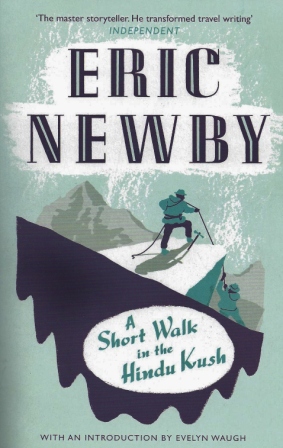
A Short Walk in the Hindu Kush by Eric Newby ~ 1958. This edition: Harper Collins, 2010. Introduction by Evelyn Waugh, Epilogue by Hugh Carless. Softcover. ISBN: 978-0-00-736775-7. 288 pages.

My rating: 8.5/10, after some inner debate. I have decided to overlook the more blatant “Eurocentric” passages, and to view this book as a product of its times, despite a vast change in standards of political correctness in the ensuing fifty-some years since its first publication. Very readable, in a dryly witty British way.

*****

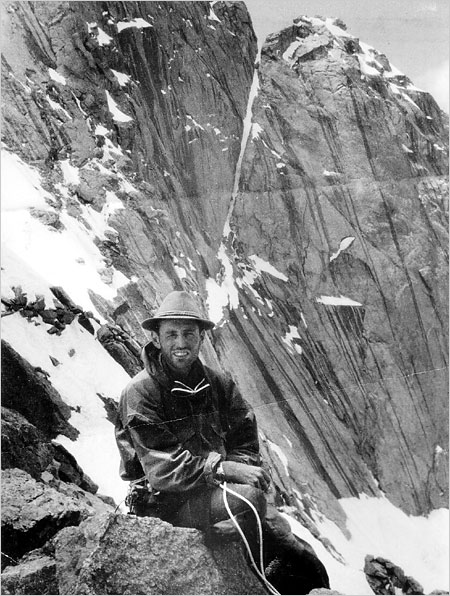
In 1956, 37-year-old Englishman Eric Newby, having received a publisher’s advance to write a travel book, contacted his friend, career diplomat Hugh Carless, and floated the idea of travelling to Afghanistan and trekking in the Hindu Kush mountains, an area where few Europeans had previously ventured. The two decided that the trek should have some definite aim, in part to enable them to request grants from various organizations to assist with expenses, so, without letting their lack of mountaineering experience stand in their way, they decided to focus on ascending 20,000 foot Mir Samir, which had not yet been climbed to its summit.

After a two-day crash course in basic alpine climbing at Snowdonia in Wales, the two felt they were marginally more prepared for the rigours ahead, and the trip was on. Each man brought a certain experience to the expedition.

Newby, though having spent the previous ten years working in his family’s ladies’ fashion business, had strong credentials as an outdoorsman. At the tender age of 19, he had spent time on a four-masted Finnish sailing ship, voyaging from Australia to Europe via Cape Horn, and his eventual book about this experience, The Last Grain Race, was responsible for the publisher’s advance which initiated the Hindu Kush journey. With the start of World War II, Newby served in the famous Black Watch regiment, and was involved in the Special Boat Section, making lightning commando raids on enemy airfields and the like. One of these expeditions went awry, and Newby was captured off Sicily and interned for the rest of the war, barring a brief period of freedom in the Italian mountains, where he met his future wife, a Slovenian village girl, Wanda, who aided him in an escape attempt. This period was also written about, in Love and War in the Apennines, published in North America as When the Snow Comes, They Will Take You Away. (I am currently reading this memoir, and it is fascinating, and helps put Eric Newby the Hindu Kush “explorer” into context.) Wanda wrote her own memoir, Peace and War: Growing Up in Fascist Italy, in 1992. Always strongly and competently athletic, and with a strong sense of humour and a forthright readiness to embrace new experiences, Newby’s intent to venture into the forbidding mountains of a somewhat hostile Afghanistan is more understandable than it appears from his account of the initial decision in A Short Walk, where it appears to be merely a whim of the moment.

Hugh Carless himself, while on one of his official postings in Kabul, had previous experience in the area, and it was his accounts of trekking in the region with Tajik guides which got Newby thinking about the possibilities of a more ambitious expedition. The 31-year-old Carless brought knowledge of local languages and on-the-ground diplomacy to the partnership, as well as a strong inclination to adventure which more than matched Eric Newby’s.

The entire adventure, the “short walk”, lasted only a month, but what a marathon that month was. The book details the trials and tribulations, as well as the rewards, of the journey first to Afghanistan, and then, after engaging local guides, into the mountains. Mir Samir was reached, and the climb attempted, but both Newby and Carless were so weakened by continual dysentery and altitude sickness that they were forced to turn back a mere 700 feet from the summit. (A German party of experienced climbers was the first to reach the summit, only three years later, in 1959.)

After descending Mir Samir, bloodied and bruised, the trekkers continued around the foot of the mountain, as Newby and Carless thought they would like to see it from the “other side”, which entailed the party entering the neighbouring province of Nuristan, to the trepidation of their guides; regional rivalries were intense and deadly, and there was a very real danger of violence to trespassers.

A safe return was made, and the two men were thereby provided with anecdotes for a lifelong series of dinner parties, not to mention a whole book. The guides returned to their normal lives, grateful, one would assume, that the whole darned thing was so quickly over.

Much is made of Newby’s playful, ironic tone in this book, and while I did appreciate the bantering tone, as it made for an enjoyable reading experience on a purely diversionary level, I did continually keep thinking to myself, “Why?” Why risk life and limb, not only of themselves but of their guides, on such a pointless journey? Because it was “there”? That does seem to be the chief motivation set forth in the book, and I am not sure whether learning from the afterword by Hugh Carless, special to the 50th anniversary edition of A Short Walk, that the trip was contrived at least partly in order to have an experience to write a book about, that I am any happier with that reasoning. I suppose it is no different from the contemporary trips in search of material by the likes of Michael Palin and Bill Bryson, and even the revered Paul Theroux. We do tend to love a good traveller’s tale, whether we are fellow adventurers or merely armchair voyeurs.

A Short Walk in the Hindu Kush is often referred to as the book that started that successful genre, but I must differ on that point, as the traveller’s tale form stretches back in popularity to pre-history. Think of The Odyssey, and the Nordic journey tales, and Marco Polo, and the countless accounts since then. This book is a worthy successor of its historical ancestors, but it very much walks in the shadow of what came before, versus branching out in any significant way.

Newby and Carless ultimately come across as being a wee bit arrogant (okay, in Carless’ case, hugely arrogant), with their snide comments on the personal habits of the natives of the area. To balance this they do poke continual fun at themselves, and there are numerous appreciative comments regarding the region and the people, so perhaps it is merely a case of the author being more honest than most in that he records his negative thoughts, rather than submerging them in the interests of political correctness as more modern writers have been trained to do. Whatever my criticism, the fact remains that these two men ventured where few others dared, and, in the face of overwhelming discomfort and very real danger, pushed forward to pursue their stated goals, with a great degree of success.

To sum up, I quite enjoyed reading this book, am eager to read more of Newby’s work, and would happily recommend A Short Walk to others, with the note that it represents the attitudes of the time it was written, and may jar the sensibilities of a more tactful and possibly better educated (in a worldly aware sense) time.

Read Full Post »

Bossypants by Tina Fey ~ 2011. This edition: Little, Brown & Co., 2012. Softcover. ISBN: 978-0-316-05687-8. 275 pages.

My rating: An easy 9/10. Loved it! Some parts are literally laugh out loud funny. Whips right along – a most enjoyable memoir of the childhood, teen, college and early career years of this exceedingly witty lady, up until the time of her notorious portrayal of Sarah Palin on Saturday Night Live.

*****

Picked this one up for a paltry dollar at the Sally Ann, shortly after I spent a happy ten minutes browsing it in front of its full-price display in one of the mega-marts. I couldn’t quite bring myself to spend the $17.50 sticker price, though I was seriously tempted, so finding it a few days later virtually free was one of those happy little serendipities of haunting the less posh side of the shopping world.

The first half of the book, the childhood-teen-college year memoirs, when Tina Fey was something of a self-described social outcast and romantic failure, is actually quite poignantly sad behind its comic mask. There is something – the only thing –  to be said for having a tortured school life; often it brings out the inner drive to “show them” that leads to stellar success later in life; the bitterness can be usefully channeled into humour, and Tina Fey does that perfectly. She keeps it from being mean-spirited, and I admire her for that; that line is a fine one.

I have only seen Fey’s Palin impersonation in short clips, not having actually owned a television for something over twenty years, but I saw enough to appreciate how darned good it was. The latter part of the book is very focussed on that charade, and I must say Palin herself comes out of it sounding much more likeable than I’d expected. Sarah Palin makes me shudder in real life, in so many ways, but after reading about how graciously she handled being parodied in full prime time view, I get a bit of what her admirers see in her. A very small bit, but it’s there. So Fey has done Palin something of a favour by her mocking portrayal, in my opinion.

This is a keeper; I’ll definitely read it again, which is saying a lot because I tend to be quite out of step on pop culture as a whole, and reading about people you aren’t a particular fan of, or even have much knowledge of, can be a bore. Not guilty in this case. Thumbs up; good read.

Bossypants Review – Time Magazine

Bossypants Review – New York Times

And of course, the Goodreads page, with a gazillion reviews.

Read Full Post »

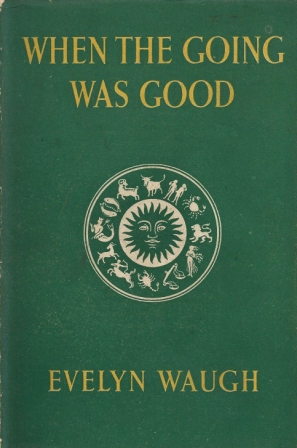
When the Going was Good by Evelyn Waugh ~ 1946. This edition: The Reprint Society, London, 1948. Hardcover. 314 pages.

My rating: 7.5/10. Held my interest throughout.

I’m not even sure where I picked this one up – it appeared in a stack of books gathered in this summer’s travels through B.C. I’m thinking either Kamloops or Vernon, though there is no price and bookseller code marked anywhere on the flyleaf. Possibly from the Sally Ann or a similar charity shop? No matter what it’s provenance, I’m most glad I’ve added it to my private collection. A most enjoyable read, consumed in goodly portions each evening for the last week just before closing my eyes.

*****

From the inner dustjacket:

About this book

It comprises all that the author wishes to preserve of the four travel books he wrote between 1929 and 1935: Labels, Remote People, Ninety-Two Days, and Waugh in Abyssinia. “These four books,” he writes, “here in fragments reprinted, were the record of certain journeys, chosen for no better reason than I needed money at the time of their completion; they were pedestrian, day-to-day accounts of things seen and people met, interspersed with commonplace information and some rather callow comments. In cutting them to their present shape, I have sought to leave a purely personal narrative in the hope there still lingers round it some traces of vernal scent … I never aspired to be a great traveller, I was simply a young man, typical of my age; we travelled as a matter of course. I rejoice that I went when the going was good.”

It’s vintage Waugh, and it’s well-written, the author’s disclaimers aside. Some of it is excellent; it’s all very readable, and it made me brush up on my history; Waugh was of course writing for a contemporary audience, and though I was pleased to realize his references were easy to place, I was quite vague on the details.

Here are the contents:

Preface

From 1928 until 1937 I had no fixed home and no possessions which would not conveniently go on a porter’s barrow. I travelled continuously, in England and abroad… We have most of us marched and made camp since then, gone hungry and thirsty, lived where pistols are flourished and fired. At that time it seemed like an ordeal, an initiation to manhood…”

Chapter One: A Pleasure Cruise in 1929 (From Labels) – London, Paris, Monte Carlo, Naples, Catania, Haifa, Cana (Galilee), Port Said, Cairo, Malta, Crete, Constantinople, Athens, Corfu, Gibraltar, Seville.

Chapter Two: A Coronation in 1930 (From Remote Peoples) – The coronation of Ethiopian Emperor Ras Tafari at Addis Ababa.

Chapter Three: Globe-Trotting in 1930-1 (From Remote Peoples) – Zanzibar, the Congo, Aden, Kenya (Nairobi, the Rift Valley), Tanganyika, Cape Town.

Chapter Four: A Journey to Brazil in 1932 (From Ninety-two Days) – Guiana and Brazil.

Chapter Five: A War in 1935 (From Waugh in Abyssinia) – The Italian invasion of Abyssinia, from a war correspondent’s perspective. Farce versus bloodshed.

*****

If you happen across this little account in your own travels, it is worth the time to read, especially if you are already a Waugh convert.

Read Full Post »

« Newer Posts - Older Posts »