Posts Tagged ‘Memoir’

zigzag james houstonZigzag: A Life on the Move by James Houston ~ 1998. This edition: McClelland and Stewart, 1998. Hardcover. ISBN: 0-7710-4208-6. 278 pages.

My rating: 9/10.

When we first visited Calgary’s Glenbow Museum in 1988 to take in the controversial but beautifully presented special exhibition on First Nations art and culture,  The Spirit Sings, we were impressed by the huge mobile, four stories in length, that hangs in the open foyer of the museum. “You should see it when it’s working!” we were told; plagued by continual malfunctions in the sound and lighting system, the mobile was hanging dim and silent. When artist James Houston installed the work in the newly opened Glenbow back in 1976, it was lit by moving lights coordinated to the strains of Debussy’s Snowflakes Are Falling. Though we visited the Glenbow numerous times during our Alberta sojourn, and again in 2005, we were never lucky enough to see the famed Aurora Borealis sculpture in its full glory, but it was a memorable sight nonetheless. (A bit more about the sculpture here. )
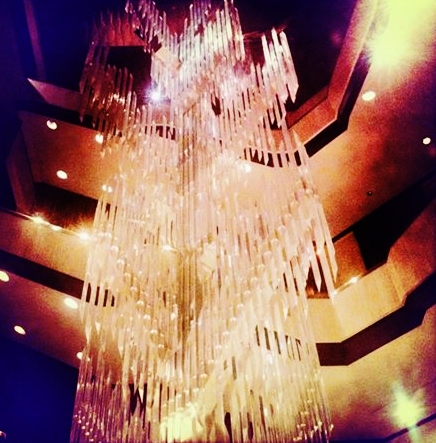
'Aurora Borealis', Glenbow Museum, Calgary, Alberta

‘Aurora Borealis’, Glenbow Museum, Calgary, Alberta

Several of the anecdotes in Zigzag concern the design of Aurora Borealis, and Houston and his son John’s personal transportation of the fragile, 5 to 7 foot long acrylic crystal “needles” by U-Haul truck from Rhode Island to Alberta. I will be looking at the sculpture with fresh appreciation on our next visit. (We are hoping to visit sometime this summer, to take in the current M.C. Escher exhibit before its closure in August.)

Joan Givner wrote in B.C. Bookworld, 1998:

James Houston’s second volume of autobiography, Zigzag: A Life On The Move begins as he leaves the Arctic to start a new life as a designer for Steuben Glass in New York. He has just spent 14 years working closely with the Inuit of the Arctic. [Houston is credited with discovering Inuit were producing great art and single-handedly creating a market for it. He also encouraged Inuit to adapt their work for North American buyers.] As he leaves Baffin Island, he receives two gifts from the Inuit: a carving of a walrus and a paper bag containing $33. “You’re going away, everyone says, to try and make more money,” they explain. “If at first you don’t have money in that foreign place, we thought to give some to you.”

The original purpose of Eskimo carvings was to bring luck and protection on hunting expeditions. Houston needs both luck and protection as he leaves a culture unconcerned with monetary gain (the market value of the walrus is $11,000) for one in which it is the be-all and end-all. In Manhattan in the 1960s, Houston at first has trouble adapting to the tyranny of clocks and schedules. Soon he becomes acclimatized and delights in the theatres, art shows, lavish parties and holidays on yachts where kings and presidents and Nelson Rockefeller casually drop by. Houston becomes a successful glass-designer, makes a fortune, teaches art in Harlem, becomes a successful writer, designs National Geographic’s centenary cover and even marries happily.

 It is, however, the Arctic which inspires and nurtures Houston. “I am thrilled by the frosted, Arctic-like appearance of deep engravings on glass,” he says. When the Glenbow Museum in Calgary asks him to design a sculpture, he creates his Aurora Borealis which is four storeys high. It is inspired by his memory of the spectacular ever-changing display of the Northern Lights. Either the protective qualities of the walrus carving or his years with the Inuit prevent him from succumbing completely to the glitzy life. He never confuses technological advances with civilization, nor economic gain with success. 

The final pages of the book describe his life in a cabin on another island, one of the Queen Charlottes now known as the Haida Gwaii, where he now lives part of every year. 

That anecdote about the paper bag filled with crumpled one dollar bills shows up in this collection of memoirs, as well as in the ending pages of Houston’s truncated account of his Arctic years, Confessions of an Igloo Dweller. It obviously moved him deeply at the time; it also made a “good story” and that, in essence, is something that James Houston liked to have under his hat.

Houston’s memoirs skirt extremely closely to the “If you want to know how good he is, just ask him” school of autobiography, but they are saved by his occasional self-effacing comments. He turns the laugh on himself as needed, and his frankness and willingness to comment openly on extremely intimate matters give small but crucial insights into his character. Whether that character comes across as intended is another story altogether; I frequently feel that there is a lot being left out of Houston’s story of himself.

What he does share is quite fascinating. Through Houston’s brief vignettes in both Zigzag and the earlier Confessions of an Igloo Dweller, we get glimpses of the Inuit world from the mid 20th century to the creation of Nunavut in 1999. We also get glimpses of what made this extremely driven and creative man “tick”; his great love for and pride in his two sons, and his lifelong dependence on touching base with the natural world to refuel him for his bouts of big city-based creativity.

He was an iconic figure in more ways than one in the numerous spheres he seems to have effortlessly inhabited. I suspect he might also have been a rather arrogant man to have bumped up against if one did not share his high opinion of himself, but I bet a dinner party with Houston at the table would have been a memorable thing.

Zigzag was a very good read; it lost a point merely because the vignette-style format jumped around an awful lot (to be expected, one supposes, from the very title of the work) and left me frequently wanting more than I was given.

Another volume of memoir, Hideaway, about the author’s cabin on Haida Gwaii, followed Zigzag and Confessions to form a trilogy of sorts. I will be reading this one when I come across it.

A memorable Canadian and a very gifted man; a complex persona in so many ways.

James Houston passed away in 2005. His artistic and literary legacy lives on.
Read Full Post »

ringing the changes mazo de la rocheRinging the Changes: An Autobiography by Mazo de la Roche ~ 1957. This edition: Macmillan, 1957. First Canadian Edition. Hardcover. 304 pages.

My rating: 9/10. What a fascinating autobiography! It was definitely readable, and full of vivid vignettes, capably portrayed.

But is it factual? Perhaps not particularly, from what I’ve  found out in some very desultory online research. It is very much a created portrait rather than a true glimpse into what made its subject tick. Nonetheless, I found it a compelling read and I will be approaching my future reading of the author’s works with this self-portrait very much in mind.

*****

First, some background information for those of you (and I suspect there may be some) who have no idea who Mazo de a Roche was, and why I’m finding her story so interesting. Feel free to skip this section; my response to the autobiography itself follows at the bottom of the post. I’ve spent a fair bit of time this past few days doing something of a mini-study on de la Roche; I’m not at all what one would call a fan, though I’ve read a few of her books in the past, without feeling the urge to read everything the author has written. She’s not quite my thing, though I’m intending to explore her fiction more in the future, nudged on by the new knowledge I’ve just gained. An intriguing woman.

Mazo de la Roche was born in Ontario in 1879, the only child of parents who, while not exactly poverty-stricken, certainly experienced ongoing financial difficulties. Young Mazo was a self-described eccentric child, and an avid reader. She created an imaginary world peopled by invented characters which she referred to in her autobiography as “The Play”, and this world, expanded and lovingly detailed as the years went on, is thought to be at least partially the basis of de la Roche’s eventual epic sixteen-book series about a fictional Ontario family, the Whiteoaks, and their home estate, Jalna.

When Mazo was seven years old, her parents adopted her younger cousin Caroline, and the two became as close as sisters – and in some ways perhaps closer. Their intimate relationship was to persist until Mazo’s death in 1961. The young girls shared in the imaginary world originally created by Mazo, and as they grew up they built a shared life which seemed to preclude either of them marrying or living independently of the other for more than brief periods of time. Mazo had written stories and poetry throughout her life, but her ongoing bouts of ill health and the need to care for her invalid mother prevented her from spending as much time writing as she desired to. Caroline became the breadwinner of the family group, while Mazo stayed at home, nursed her mother, and wrote in her spare time.

Mazo had had some success selling occasional short stories to magazines, but her first real literary break came with the publication of a series of linked anecdotal stories, Explorers of the Dawn, in 1922. Mazo de la Roche was at that point forty-four years old, and her greater success was yet to come. Explorers of the Dawn made it onto bestseller lists of its time, alongside The Beautiful and Damned by F. Scott Fitzgerald and Louis Hémon’s Maria Chapdelaine. A foreword by Christopher Morley (best known nowadays for his humorous novels The Haunted Bookshop and Parnassus on Wheels, but a respected literary editor and critic in his own time) gave credence to de la Roche’s evident talent, and her distinctive authorial voice.

Two more promising novels followed, the critically acclaimed Possession, in 1923, and Delight, a less popularly successful Thomas Hardy-esque rural satirical romance, in 1926. In 1927, the work that was to launch Mazo de la Roche’s career into the Canadian and eventually worldwide literary stratosphere was published. Jalna was a a soap-opera-ish family saga centered on an old Ontario family, the Whiteoaks,  headed by a wealthy matriarch. Something about it caught readers’ imaginations, and, when Jalna unexpectedly won the prestigious Atlantic Monthly $10,000 cash award – a small fortune in 1927 – for “most interesting international novel of the year”, it assured its author’s financial security and allowed her the freedom to write full time. At the age of forty-eight, Mazo’s creative life was about to become very much the focus of an overwhelmingly adoring public and a varied group of intensely opinionated critics.

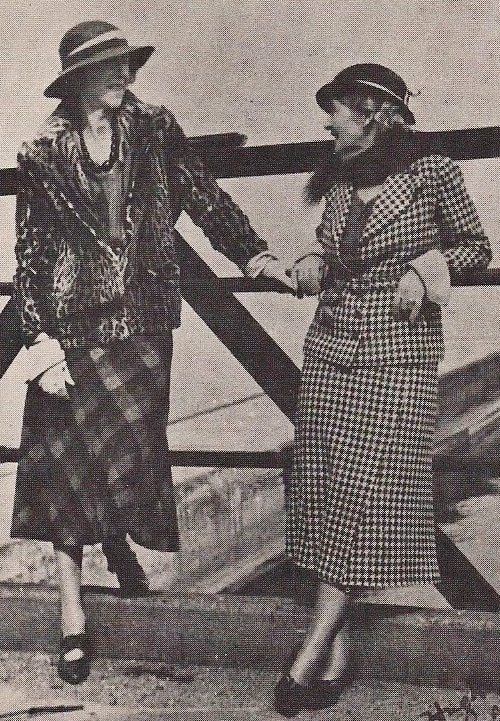
Mazo de la Roche and Caroline Clement, 1930s

Mazo de la Roche and Caroline Clement, 1930s

Caroline was now able to retire from wage-earning work and she took on the role of her suddenly-famous cousin’s housekeeper, editor, secretary, and collaborator in creativity. “The Play”, so precious to the two in childhood and maintained throughout the years, continued to expand in their leisure time, as the cousins ought respite from the pressures of fame in their shared imaginary world. Suffering continually from blinding headaches and trembling hands – and at least one bona fide nervous breakdown – Mazo found that the only way she could sometimes get her thoughts down on paper was to dictate them to Caroline. While Caroline always disclaimed any notion that she originated the plot lines and characterizations that Mazo was so famous for, both women were very open about Caroline’s role as a sounding board and critic.

Fifteen more “Whiteoaks of Jalna” novels were to follow that first astonishing bestseller, as well as more novels, plays, short stories and, eventually, several autobiographical memoirs, of which 1957’s Ringing the Changes is the last. Mazo de la Roche died four years later, at the age of 82. Caroline survived her cousin for some years; the two are buried side-by-side in an Anglican church cemetery in Sibbald Point, Ontario.

It is estimated that the Jalna novels have sold more than eleven million copies worldwide in the years since 1927. They have been translated into more than ninety languages, and were adapted for the stage, movies and television, with varying degrees of popular, commercial and critical success. Despite – or perhaps because of – their bestseller status,  the Jalna novels were increasingly viewed with scorn by the literary world as being too “popular”  and “melodramatic” in plot and execution.

Mazo de la Roche, in the decades since her death, has slipped into literary oblivion but for a few dedicated readers who staunchly read and reread the Jalna saga, and passed the books along to their children. Mostly daughters, one would assume, as de la Roche was seen as a “women’s writer”; her works were thought to appeal mostly to the bored housewife seeking sensation and emotional escape from the humdrum everyday round.

A recent (2012) documentary by Canadian film maker Maya Gallus has brought Mazo de la Roche into new focus. Both her ambitious novels and her unconventional and rather mysterious life are being examined with twenty-first century eyes. It will be interesting to see if there will be something of a “Jalna Revival”; I’m betting that we’ll be hearing much more of this not-quite-forgotten Canadian in the months and years to come.

Pertinent links regarding the recent docudrama:

NFB – The Mystery of Mazo de la Roche

Review: NFB docudrama: The Mystery of Mazo de la Roche

Quill & Quire – Interview with Maya Gallus

*****

(When reading) the autobiographies of other writers …  some appear as little more than a chronicle of the important people the author has known; some appear to dwell, in pallid relish, on poverty or misunderstanding or anguish of spirit endured. They overflow with self-pity. Others have recorded only the sunny periods of their lives, and these are the pleasantest to read.

~Mazo de la Roche ~ Ringing the Changes

Mazo de la Roche and her beloved Scottie, Bunty

Mazo de la Roche and her beloved Scottie, Bunty

Ringing the Changes itself is a diverting memoir, and, if the author indeed intended to record the frequent sunny hours of her life, she by and large succeeded. Tragedy both major and minor continually followed Mazo and her extended family, and while unhappy events are described, they are not dwelt on or singled out as an excuse for pathos. I never got the feeling that the author was “wallowing”, though I occasionally shook my head in wonder at the sad fates of so many of her relatives, and, frequently, of her family’s beloved animals. They did seem, so many of them, to come to such tragic ends…

I must confess that I knew very little about de la Roche before I read this book, though I had a pre-existing vision of her as a rather reclusive, mildly eccentric sort. I had read several of the Jalna novels way back during my teenage years, but had certainly not found them worthy of any sort of “fandom”, as so many others apparently have. I did pick up a number of the books quite recently in a library sale, thinking that my mother might enjoy them, but she was rather dismissive of the series, so they currently languish somewhere in a box.

In this memoir, Mazo looks back to her childhood, and, once a bit of genealogical discussion is gotten out of the way, launches into a compelling tale of gallantry, tragedy, heartrending anecdotes and humorous vignettes. “Gallant” is a term I kept saying to myself as I read Ringing the Changes; so many of the people in Mazo’s life demonstrated this trait, in particular her beloved cousin Caroline, who was the epitome of selfless devotion in numerous ways, though she appeared to have a full and satisfying independent life as well. The Mazo-Caroline relationship is still raising eyebrows – were they lesbians? what was Mazo’s hold on Caroline? who really wrote the books? – but, seriously, it does seem like that particular relationship was one of equals. Both women apparently had romantic interludes – with men – at various times throughout their lives; that they would choose to stay single and in a “family relationship” with each other and various other family members surely is a purely personal matter and rather understandable given their backgrounds and that of their extended family.

The argument for “closet lesbianism” for Mazo at least is quite strong, or perhaps one might go so far as to speculate that “cross-gendered” might be a more apt term. From her own statements in Ringing the Changes, in childhood she wanted to be a boy, she related on completely equal terms with her male editors and literary advisors, and, perhaps most tellingly, she frankly states that she identified extremely strongly with one of her male protagonists, Finch Whiteoak, who is portrayed as artistic, emotionally and physically fragile, and highly conflicted in his romantic yearnings.

In Ringing the Changes it does seem that Mazo de la Roche was continually striking back at her many critics, the ones who denied her work any place in the “literature” canon, due to its popular success and formulaic nature. She is highly defensive of her own motivations, and this oft-quoted passage sums up her rather hurt tone well:

I could not deny the demands of readers who wanted to know more of that [the Whiteoak] family. Still less could I deny the urge within myself to write of them. Sometimes I see reviews in which the critic commends a novelist for not attempting to repeat former successes, and then goes on to say what an inferior thing his new novel is. If a novelist is prolific he is criticized for that, yet in all other creative forms — music, sculpture, painting — the artist may pour out his creations without blame. But the novelist, like the actor, must remember his audience. Without an audience, where is he? Like the actor, an audience is what he requires — first, last and all the time. But, unlike the actor, he can work when he is more than half ill and may even do his best work then. Looking back, it seems to me that the life of the novelist is the best of all and I would never choose any other.

Ringing the Changes, read as a stand-alone book without reference to Mazo de la Roche’s fictional body of work, “works” as a memoir which can be read for the pleasure of the tale itself. Mazo de la Roche was, as even her harshest critics freely admitted, a “born storyteller”, and this account of incidents in her life, as deliberately selected and edited as they may be, is a very readable thing indeed.

Read Full Post »

Surfacing briefly from the May supreme busy-ness which only escalate in the coming weeks – I’m in the plant nursery business –  to talk a bit about a book. Much as I’d like to maunder on in-depth about everything I’ve been reading recently, there are those pesky time constraints…

A week ago it was below zero (Celsius) and snowing; today, in our region’s typical spring weather extremes fashion, it is forecast to hit the mid-plus-20s. The sun is coming across the valley (we’re nestled at the foot of the east side, tall hills behind us) so until it hits us directly I’m off-duty, as it were, from going out and tinkering with greenhouse ventilation systems. (Well, fans, windows, doors and roll-up hoop house side panels – not very fancy – but “ventilation systems” sounds much more professional, doesn’t it?) 😉

The second Sunday morning cup of tea is at hand – I’ve already consumed the first propped up in bed finishing a re-read of Tom’s Midnight Garden –  and I’ve a short but sweet guilt-free chunk of non-work-related computer time before I need to be really up and moving again. Here we go.

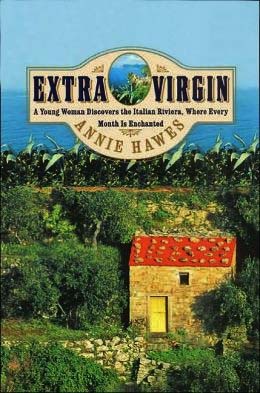
extra virgin annie hawesExtra Virgin: A Young Woman Discovers the Italian Riviera, Where Every Month Is Enchanted by Annie Hawes – 2001. This edition: Harper Collins, 2001. Hardcover, first American edition. ISBN: 0-06-019850-8. 337 pages.

My rating: 9/10.

I almost didn’t pick this one up, but was intrigued by the (presumably) Elizabeth von Arnim reference in the subtitle. What I found inside this densely written creative autobiography was a better reward than I deserved for my initial hesitation. It’s taken me a good week of hard-won reading breaks to get through it all, but I was never tempted to set it aside in exchange for something shorter and easier. This one was a quiet pleasure from Prologue to reluctantly-turned last page.

Back in the early 1980s, a young Englishwoman, recently turned down as a “poor risk” in her attempt to receive bank financing to buy her own home in England, is at loose ends and feeling rather sour about life in general. Her sister convinces her to come along on a working trip to Italy, grafting roses for a small commercial operation in the Ligurian hills, in the region of the “Italian Riviera”.

Annie is a rose-culture neophyte, but her obviously experienced sister coaches her through the first thorny weeks, after which, settled well into their temporary occupation, the two find themselves occasionally with time to explore the surrounding countryside. On one of their off-duty hill walks they come across a derelict stone house in a neglected olive grove, and when the local real estate entrepreneur scents their interest, they find themselves possessed of a rural Italian property for the unbelievably cheap sum of 2000 pounds. The facilities are primitive to the extreme – water is bucketed up from a shallow dug well, and an outdoor shower and “earth closet” are needed for sanitary purposes, but the two settle into their new life with optimistic tenacity.

This is a rather different tale from the usual “we bought a place in a foreign paradise and hired quaint locals to fix it up” lifestyle porn. Written several decades after the purchase, the tone is not at all cutesy and patronizing. The sisters go to and from England and Italy regularly for many years – England for the “real” jobs which earn the funds to return to Italy for the love of the place, and, increasingly, the people.

I’ll tease you by revealing that Annie is not all that forthcoming about personal details, but more than makes up for it in her portraits of others, and in her much too brief comments regarding her own family. As well as the sister of the Ligurian enterprise there are three brothers, several of whom chip in to provide much-needed labour and even fire-fighting assistance during the progressive slow Italian house and olive grove renovations which stretch over the years.

Other reviewers – I briefly scanned the book’s page on Goodreads – had issue with some of the stylistic devices the author used, but I found them to be a non-issue, personally. Extra Virgin is written from the “we” viewpoint throughout, only slipping into “I” near the end. Much ironic use of capitalized terms – the Sulky Bar, the Evil Sister, the Poor Stranger, and so on. Again, for me, not a problem. The Author stayed most consistently true to her Chosen Style.

I did just a bit of research on Hawes after finishing Extra Virgin, and was more than intrigued by what I found – Annie’s back story includes a teenage marriage and a residence in Portugal, a child of that (quickly dissolved) marriage, much travelling and a “real” career as a film editor. Not much of this comes out in the Italian tale, but apparently her succeeding books, Ripe for the Picking and A Journey to the South, are more personally revealing. There’s also a Moroccan memoir, A Handful of Honey.

Annie’s second career as a memoirist is a definite success, at least enough so that, according to an author interview which appeared on the Harper Collins website, she now has indoor plumbing in Liguria.

I enjoyed the author’s voice in Extra Virgin enough that I will be seeking out her other books as soon as I am able to. She writes with a wry, dry humour and a very individual style, just short of “travel writer” parody. In a very good way. Loved it.

Oh – one more point in favour. Annie Hawes can certainly write about food! Amazing descriptions of the wild-crafted, gardening and culinary abundance of Liguria. I absent-mindedly found myself lining out yet another flat of basil seedlings and potting up extra eggplant babies while musing on my ongoing reading of Extra Virgin while out in my own very earth(l)y paradise this past week. This book made me hungry. Again, in a very good way.

Read Full Post »

my heart lies south elizabeth borton de trevino 001My Heart Lies South: The Story of My Mexican Marriage by Elizabeth Borton de Treviño ~ 1953. This edition: Thomas Y. Crowell, 1953. Hardcover. 248 pages.

My rating: 8/10.

*****

I found this book among my mother’s boxes in her attic which I was supposed to go through and “deal with” when she downsized from the too-many-staircases rambling family home to the tiny-but-manageable single-level house she’s in now. I almost put it into the Sally Ann box, but something stayed my hand. “Elizabeth Borton de Treviño…. I know that name, somehow,” I thought, and that was enough to put it into my keeper pile instead.

Some years passed (well, six years, to be exact, because Mom moved in 2007, and much of what I brought home is still in “temporary” storage here, still waiting to be “dealt with” – and honestly, the only boxes I’ve cracked open are the ones full of books) and then one day I looked at My Heart Lies South again. And the penny finally dropped.

Elizabeth Borton de Treviño. Of course! I, Juan de Pareja. The 1966 Newbery Award winning historical fiction about the Spanish painter Velazquez and his personal slave, Juan de Pareja. I’d read this some years ago, and found it a well-written juvenile historical fiction, and that was why the name of the author sounded so familiar.

I opened My Heart Lies South, as I should have done six years ago, and started reading bits here and there. Far from being the serious and sober biography I had expected from the rather unprepossessing dustjacket – (“Don’t judge a book by its cover” – I know, I know) –  the passages I read were wry and funny and interesting. And when I settled down to tread it cover to cover, it definitely did not disappoint. Another hidden bookish gem, I think we could safely say.

*****

Elizabeth Borton was born in 1904, in Bakersfield, California, and, encouraged by her parents, started writing at a very young age. After graduating from Stanford University in 1925 with a degree in Latin American History, Elizabeth went on to the Boston Conservatory of Music to study violin. She then worked as a reporter for the Boston Herald, and spent five seasons in Hollywood interviewing film personalities.

With her strong interest in all things Latin American, Elizabeth was continually talking about going to Mexico, and one day, in 1934, her editor broke down and sent her off with a handful of tickets, vouchers and contact lists, telling her to “just write something” once she got there. And with her eventual meeting with the representative of the Monterrey Chamber of Commerce, one Luis de Treviño, Elizabeth’s future, though she didn’t know it at the time, was about to take a very different turn from her life as an independent American career woman.

“Hello Luis!” said Bill. “This is Miss Borton. When you get to Vallecillo, buy her an ice-cold beer.”

Luis laughed nervously. There is nothing he likes better than a cold beer, but the lady he had taken across the border for the Chamber of Commerce two weeks before had resisted the beer with desperation as if it might be the first step in a seduction, and the lady last week had been Dorothy Dix, who was even then rather tired from pushing seventy or so and inclined to be tart with young men eager to waste her time in taverns.

I was turned over to the vaccination, immigration, and customs authorities, and at last, in a car which had been provided by the Chamber of Commerce, complete with chauffeur, we set out for Monterrey. I had my hair tied up in a scarf and I was wearing a large black hat as well as sun glasses. Now the sun began to go down and long violet shadows crept across the plain. I took off my hat.

“Ah,” breathed Luis.

I undid the scarf.

“So?” remarked Luis.

I took off the black glasses.

“Wonderful,” he decided, aloud. He leaned toward me and looked at me soulfully.

“Shall I sing you a song about love?” he asked.

“Why yes,” I agreed, thinking this must be a gag.

But he launched into “Palm Trees Drunk with the Sun,” went on to “The Sea Gulls,” and then sang “The Green Eyes,” in a light baritone voice.

“Very nice,” commented the chauffeur from the front seat. “Now sing ‘Farolito.'”

He sang it. After our beer in Vallecillo, Luis sang other songs. He sang all the way to Monterrey.

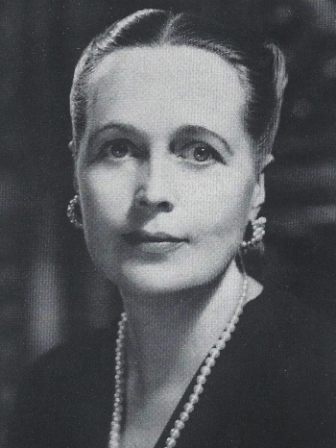
I didn’t realize it, but I was being courted.elizabeth borton de trevino 001

As you can see from the photo of the author, taken from the jacket of the book published eighteen years after her marriage, the initial attraction on looks alone is understandable!

Luis shows Elizabeth the attractions of Monterrey, including things definitely off the tourist track, such as his family ranchito, and, significance unknown to Elizabeth at the time, the private parlour of his beloved mother, Mamacita. He also takes her dancing, in company with a respectable engaged couple, a situation that made all of Monterrey society take note…

I was left at my hotel. But a sort of die had been cast. Luis had cast it and with his eyes open. He had taken a strange woman to dance. Just any strange woman, and the incident might have been passed over as a wild oat on the part of the fifth Trevino. But he had taken the strange woman in company with a pareja of his best friends, an engaged couple! Two plus two equals four. Dancing with one girl all evening, with an engaged pareja to make up the party, means something serious! Phones rang in Monterrey; the news went round. Only I was in the dark.

Formally on the afternoon of the next day, I was taken to call on Mamacita. While we sat in the sala, Luis disappeared, to return with a tray on which sat Mamacita’s best small silver liqueur glasses. In each was a thimbleful of sweet vermouth. On a plate there were some little yellow cakes that melted into a puff of flavour when bitten. These were Mamacita’s famous polvorones de maizena (cornstarch puff cookies), the engagement cake… They were a kind of symbol. All unknowing I ate the engagement cakes and tasted the engagement vermouth.

Later Luis brought me a small yellow-striped kitten and dropped it into my lap.

“Oh, the darling! I wish I could have him,” I cried. “But I am leaving tomorrow for Mexico City and I have lots of work to do. I won’t be home in California for weeks.”

Mamacita said calmly, “Galatea has kittens like these every four months. You will have a kitten.”

Paling visibly, Luis scooped up the kitten and left. I wondered what had happened, but it seemed he had only recognized his mother’s acceptance of me. Mamacita had decided that I was to come to Monterrey, marry Luis, and receive a kitten from the fecund Galatea. He had been working toward this, but it was serious, and it sobered him to realize he was practically a married man.

Elizabeth eventually catches on, and with the blessing of both sets of parents, the couple is married and sets up housekeeping in Monterrey, on a shoestring budget. Culture shock hits strong and hard, as Elizabeth is suddenly immersed in traditional Mexican society, and finds herself floundering more than a little in her new role as the wife of an established, upper class Mexican husband. Luckily Mamacita and Papacito, Elizabeth’s new parents-in-law, are firmly behind her, and guide Elizabeth through the maze of “proper” behaviour, and cover up her most blatant mistakes. Of which there are many, reported in full by the author.

I am afraid I am not at all familiar with Mexican society of the time period of the memoir – the 1930s – or even of the present day – but after reading My Heart Lies South I have a clear and mostly positive impression of a world in which family comes before all else, and in which women, though subject to the strictest of behavioural expectations from their menfolk, have an enormous influence and hidden power, which they can wield for either good or ill. Elizabeth’s family, visiting some years after her marriage, shake their heads in wonder and tell Elizabeth that she has wandered into a world frozen in the 1800s. Elizabeth, having carved out her domestic niche after significant struggle, agrees, but states that she is deeply happy, and that she now fully enjoys the more positive aspects of this steeped-in-tradition world.

This full acceptance of uber-traditional female roles may have modern-day feminists grinding their teeth in despair, and it also does appear, from the glowing reviews which this book receives on the “Godly womanhood” websites I’ve stumbled across while researching the author, that the more conservative “right-wing” types have embraced this memoir as an estimable example of true femininity.

I find that I fall somewhere in the middle of these two extremes. Elizabeth and Luis seemed, from all reports I’ve read, to have a most successful and happy marriage, which is an accomplishment worth celebrating, no matter in which society it is achieved. Elizabeth continued with her successful writing career after her marriage, managed to find time to keep up with her music, created a beloved home, and adapted very well to the expectations of her in-laws, while still staying in close contact with her American friends and relations. It seems to me that her life was most reasonably “fulfilled”; she certainly does not come across as downtrodden in any way, and she speaks of her integration into Mexican society with affection and sharp-eyed realism.

All of this to say that I enjoyed this book greatly.

There also exists an expurgated “Young People’s Edition” of My Heart Lies South, got up, I am sure, to piggyback on the perennial success of I, Juan de Pareja. Apparently all the more risqué bits are left out – and there are a few – so I can’t really see the point of that, as when Elizabeth shares some of her more “adult” anecdotes she’s really at her best. So look for the original version, which has been reprinted numerous times, instead. (And to add insult to injury, the cover of the junior version is not at all dignified, and hints at a jolly comedy, which, for all of its humour, this memoir is definitely not.)

My Heart Lies South has two companion memoirs, Where the Heart Is, and The Hearthstone of My Heart. I’m a bit taken aback by the Heart-y-ness of the titles – definitely working the theme to the utmost! –  but I’ll be keeping an eye out for these, as I’m sure they will be worth investigating.

Read Full Post »

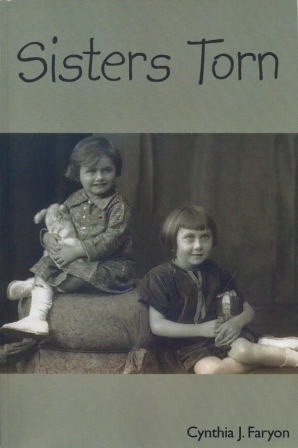
sisters torn cynthia faryon 001Sisters Torn by Cynthia J. Faryon ~ 2001. This edition: Caitlin Press, 2001. Softcover. ISBN: 0-920576-92-3. 297 pages.

My rating: 4/10.

A tragic family story, and much as I respected the author’s desire to record it, it didn’t quite come to life as it might have. Perhaps the attempts at dialect and dialogue didn’t really work out?

This has a small press, “self published” feel to it. It definitely could have used a stronger editorial presence, to clean up grammar, punctuation and proof reading errors, all of which were much too frequent, and got in the way of my fully appreciating the narrative.

*****

From the back cover:

“I promise I will always look afta’ my sista’ no matter what, I will never let go of her hand.”

Little did young Simone realize, as she made this promise to her aunt, that she and young Catherine would spend the next 65 years trying to reconnect.

Abandoned by their parents and separated by the British adoption system, these two young girls would face impersonal orphanages, brutal boarding-out homes, a world war, and separation by an ocean and two continents before they finally met again – in Victoria, B.C.

This is their story as told to the daughter of one of them. It is a story of pain and courage – and hope.

Born to a mismatched couple in the 1920s – their mother “married beneath her” – young Simone and Catherine were placed with relatives when their baby brother tragically died in a gruesome accident (vividly – perhaps too vividly! – recreated by the author) and the marriage dissolved. After a few years, the relatives were unable to financially manage the care of the sisters, so they were placed in a series of children’s homes, always with the proviso that they remain together.

Sadly, this request was not respected, and Catherine and Simone were separated suddenly and without explanation. Though they both attempted to find each other through the years to follow, they were completely unsuccessful, and all attempts at gaining information from the British children’s care ministry were met with stark refusals and, eventually, threats of prosecution.

A damning condemnation of the conditions and attitudes of the time which made such an abusive (and just plain wrong) situation possible.

The story does have a happy, late-in-the-day reunification. Both sisters were also fortunate in finding caring spouses and creating satisfying lives for themselves, but the thread of sadness at the loss of their “true family” wound through their lives, and influenced the lives of their children.

This is a work of creative non-fiction which works reasonably well; it is the author’s first published work. Cynthia Faryon originally wrote it as a family document, but at the request of the her mother, the “Simone” of the story, the author sought and found a publisher for it, Prince George, B.C.’s Caitlin Press.

Sadly, the publisher did not edit and polish the manuscript to the extent which it deserved; I feel that a much stronger editorial hand would have resulted in a more smooth and successful presentation of a fascinating and poignant family saga.

I will be passing this book along via a BookCrossing.com release sometime in the near future.

Read Full Post »

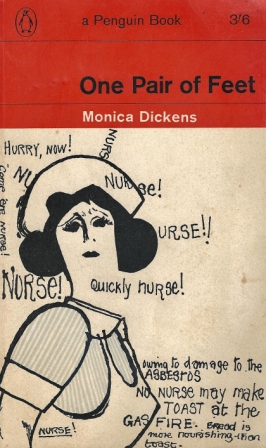
one pair of feet monica dickens 001One Pair of Feet by Monica Dickens ~ 1942. This edition: Penguin, 1964. Paperback. 221 pages.

My rating: 10/10.

One had got to be something; that was obvious. But what? It seemed that women, after having been surplus for twenty years, were suddenly wanted in a hundred different places at once. You couldn’t open a newspaper without being told that you were wanted in the Army, the Navy, or the Air Force; factory wheels would stop turning unless you rushed into overalls once; the A.F.S. could quench no fires without you, every hoarding beckoned you and even Marble Arch badgered you about A.R.P.

The Suffragettes could have saved themselves a lot of trouble if they had seen this coming. Men’s jobs were open to women and trousers were selling like hotcakes in Kensington High Street.

I could not make up my mind what to be. A lot of fanatics rushed into the most uncongenial jobs they could find, stimulated by a glow of self-sacrifice that lasted until the novelty wore off or the cold weather set in, but it seemed to me that, provided it was useful, it was no less patriotic to do something enjoyable. At first sight, the choice seemed so enormous that the trouble was to decide what not to be, but a closer inspection revealed so many snags that in the end the trouble was to find something to which I had a hope of sticking.

The Services? I didn’t think my hips would stand the cut of the skirt and I wasn’t too sure about my legs in wool stockings. Besides, I’d never been much good at drilling and all that. My school reports used to say: ‘Not amenable to discipline; too fond of organizing,’ which was only a kind way of saying: ‘Bossy.’ I might have been a success as a general but not as a private.

The A.F.S.? I did try that for a while, but at the beginning of the war there was not much doing and I got discouraged with sitting all day in the back room of a police station knitting and eating sticky buns with six assorted women and a man with a wooden leg. At the end of the week, we all knew each other’s life histories, including that of the woodenleg’s uncle, who lived at Selsey and had to be careful of his diet. Messenger Dickens had once been down to Roehampton to fetch the Commandant’s handbag and a small tube of soda-mints from the shelf in her bathroom.

A bus conductress? … The W.V.S.? … I worked in a canteen for a while, but had to leave after a terrible row with Mrs Templeton-Douglas, who could never subtract one-and-ninepence from half-a-crown. I sold some of her jam tarts for a penny instead of twopence, thinking they were the throw-outs we had bought at the back door of the A.B.C.

The Land Army? One saw oneself picking apples in a shady hat, or silhouetted against the skyline with a couple of plough horses, but a second look showed one tugging mangel-wurzels out of the frozen ground at five o’clock on a bitter February morning.

Ministries and Bureaux? Apart from the question of my hips again (sitting is so spreading), they didn’t seem to want me. Perhaps it was because I can only type with three fingers and it always keeps coming red.

The Censor’s Office I knew was in Liverpool, and I’d been there once.

Nursing? The idea had always attracted me, even in peace-time, but I suppose every girl goes through that. It’s one of those adolescent phases, like wanting to be a nun. It was reading Farewell to Arms, I think, that finally decided me, though what sort of hospital allowed such goings on, I can’t imagine. However, that was the last war…

So nursing it is, and Monica Dickens edgily and wittily documents the year she spent as a probationer at Queen Adelaide Hospital, and life on and off the wards, and the personalities she rubbed up against.

It is terribly difficult, I find, to write critically about an author whom one has read so often and with so much enjoyment, as I have read Monica Dickens. I will merely say that this book more than lives up to the first few pages excerpted above, and that it does not disappoint.

The author’s voice is two-thirds world-wearily cynical – as only a twenty-something writer can be! – and one-third completely sincere; “readable” is a mild recommendation, but very apt. Many of her sharper observations feel initially rather cruel, but Dickens is as hard on herself as on anyone, and often her most maligned characters are revealed to have redemptive qualities which the author displays with as much clarity as their failings.

Highly recommended.

Caveat lector: Several era-correct racial slurs in this one which may bring the modern reader up short. One character’s nickname is N_____, due to his curly hair, and several times the same term is used descriptively. There appears to be no intention to offend; I believe the usages here were completely accepted at the time of writing. I only mention them because it is a sensitive point with some modern readers.

Read Full Post »

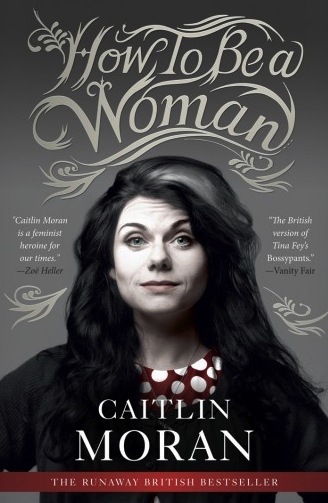
how to be a woman caitlin moranHow to Be a Woman by Caitlin Moran ~ 2011. This edition: Ebury Press, 2011. Softcover. ISBN: 978-0-06-212429-6. 305 pages.

My rating: This one was unrateable.

What can I say? It’s all been said. Multiple times.

Outspoken, thought-provoking, vulgar, romantic, profane, profound, controversial, brave, rude … and very, very funny. This is not a book I would give my mother! But I would leave it where my teenage daughter could find it.

I actually did just that, and she (the teenage daughter) dipped into it, and basically said “Ew. Too much information. And swearing. She’s a bit scary, Mom.” So that didn’t take. Which is just fine. We’ve already had all of the conversations that Caitlin missed with her mother. A lot of this one reads like a cautionary tale, a what-not-do-do manual, at least until Caitlin gets herself all grown up and out in the big world. Though even then her decisions aren’t exactly stellar one hundred percent of the time.

This is a big, bold, brassy memoir of British newspaper columnist and generally funny lady Caitlin Moran’s teenage years right up until the present. She has zero barriers; she discusses everything there is to discuss about being born with on the double X-chromosome side of the human sexual spectrum. This is Caitlin’s take on what it means to be a woman. While frequently prescriptive, it’s best taken with a good dash of salt. As one reviewer quipped, this one should perhaps have been titled How to be Caitlin Moran, because it certainly doesn’t apply – or appeal –  universally. Many are – and will be – sceptical, if not downright appalled, at Moran’s Technicolor rantings.

Menstruation, masturbation, obesity, body hair, pregnancy, childbirth –  full coverage of the biological range. Then there are drugs and alcohol and the over-the-top excesses these can lead too. Bad relationships. Good relationships. Marriage. Children. Abortion. Right along with the ethics of employing a cleaner.

And this is what seems to be getting all the attention in the reviews I’ve been reading. Capital-F Feminism. What it looks like today, and what Caitlin Moran thinks it should look like. In a nutshell, good old Golden Rule stuff. Do as you would be done by. Treat each other well.

I’ve been thinking about how to present this review for a few days now, ever since finishing the book, and since reading fellow blogger Claire’s take over on Captive Reader – How to Be a Woman . What I’ve decided is to not really say all that much about this one. The internet is crowded to overflowing with reviews; this one has received capital-H Hype, and some people are taking it really, really seriously.

Here’s the Goodreads – How to Be a Woman page. 2500 reviews. Go wild!

I’m not taking this one terribly seriously. I found it amusing, and I agreed with Caitlin Moran on her various opinions a good majority of the time. I particularly liked her chapters on marriage and motherhood, and the abortion chapter was something very unusual in its sincerity and refreshing lack of sensationalism. I don’t think I could be so detached and unemotional as Moran was, if it were me facing the same scenario, and my decision would likely have been the exact opposite, but her forthright acceptance of what she did felt genuine.

But I’m not about to bow down to her as our newest Feminist leader, our Womanly Great White Hope, as some enthusiastic fans seem to be. She’s not really breaking any new ground here, just repeating what’s already been said with a lavish dash of shazzam.

Moran is a very funny writer. I literally laughed out loud – a rarity for me when reading –  more than once – most notably during the bra and breastfeeding discussions – spot on! Loved it. I’ll likely purchase the book one day, but I’m in no rush. If I never read it again, no big deal. I’d never heard of the woman until a few weeks ago, and I strongly suspect I’ll not hear too much from her in future, but I’ve at least placed her in my personal “cultural literacy” file and can now nod knowingly if her name comes up.

And that’s good enough for me.

As a parting gift, here are some quotes I lifted from How to Be a Woman, courtesy of Goodreads. If anything here resonates, you’ll probably like this book.

*****

If you want to know what’s in motherhood for you, as a woman, then – in truth – it’s nothing you couldn’t get from, say, reading the 100 greatest books in human history; learning a foreign language well enough to argue in it; climbing hills; loving recklessly; sitting quietly, alone, in the dawn; drinking whisky with revolutionaries; learning to do close-hand magic; swimming in a river in winter; growing foxgloves, peas and roses; calling your mum; singing while you walk; being polite; and always, always helping strangers. No one has ever claimed for a moment that childless men have missed out on a vital aspect of their existence, and were the poorer, and crippled by it.

*****

I cannot understand anti-abortion arguments that centre on the sanctity of life.  As a species we’ve fairly comprehensively demonstrated that we don’t believe in the sanctity of life.  The shrugging acceptance of war, famine, epidemic, pain and life-long poverty shows us that, whatever we tell ourselves, we’ve made only the most feeble of efforts to really treat human life as sacred.

*****

Overeating is the addiction of choice of carers, and that’s why it’s come to be regarded as the lowest-ranking of all the addictions. It’s a way of fucking yourself up while still remaining fully functional, because you have to. Fat people aren’t indulging in the “luxury” of their addiction making them useless, chaotic, or a burden. Instead, they are slowly self-destructing in a way that doesn’t inconvenience anyone. And that’s why it’s so often a woman’s addiction of choice. All the quietly eating mums. All the KitKats in office drawers. All the unhappy moments, late at night, caught only in the fridge light.

Read Full Post »

one native life richard wagameseOne Native Life by Richard Wagamese ~ 2008. This edition: Douglas & McIntyre, 2008. Hardcover. ISBN: 978-1-55365-364-6. 257 pages.

My rating: 6.5/10.

*****

After reading Wagamese’s Indian Horse recently, one of the prominent Canada Reads 2013 finalists, I was curious enough about the author to search out what I could find of his other works. The library proved generously supplied, and I chose two biographies, One Native Life, and For Joshua, and have mentally checkmarked two fictions, Ragged Company and Dream Wheels, for a future time.

One Native Life is a collection of short, three to four page reminiscences, anecdotes and mini essays on First Nations identity. Richard Wagamese was removed from his home in childhood due to physical abuse by adults in his birth family, and lived with non-Native families as a foster child and then as an adopted child until he reached his mid teens, when he left home to live independently, with varied success.

Often the only First Nations person in his school and social circle, Wagamese, especially as he matured, frequently wondered about his “differences”, and pondered his inability to feel fully whole with his First Nations heritage treated either as a curiousity or a non-issue by his adoptive family and his friends.

Serious substance abuse, alternating with periods of sobriety, and career and social success, eventually took its toll, laying Wagamese so low that a complete rebuild of his life was essential to his survival. Richard Wagamese looks to have survived his crash to rock bottom, and has more than successfully rebuilt his life into something new and good, though it is obvious that he views this very much as an ongoing process, and not a “done deal” by any means.

One Native Life addresses the healing process of Wagamese coming to terms with his individual circumstance. He seldom comes across as angry or resentful; he is very ready to excuse the actions and attitudes of those in his life by looking at the reasoning – or, often, lack of thought – behind each situation. This is both a memoir and an attempt to address current social conflicts between Native and non-Native ways of thinking and being. From someone who has walked all of these paths, and who has experienced life as a member of both social groups, the thoughts laid out here are definitely deserving of respect and consideration.

Very nicely written, too, as I expected after the more-than-decent quality of Indian Horse. My one nagging problem with this book, the one that kept me from buying into it one hundred per cent, is that it is perhaps a bit too conciliatory and understanding. Wagamese is so darned nice. But he excuses this himself by stating throughout that he wants to see bridges built, not more barricades erected, hence the tone. But it might be easy to dismiss this one because of its gentleness, which is, paradoxically, one of its main strengths.

And I’m also reading another of Wagamese’s memoirs, For Joshua, written five years earlier than One Native Life, and addressed as an open letter to his young son, whom he became estranged from due to his alcoholism, which is plenty full of tragedy and anger and strong emotion. One Native Life, coming as it does later in the sequence, shows evidence of a further healing and a few more years of thinking things through.

An interesting memoir, from an interesting man.

For a much more specific review, go here:   The British Columbian Quarterly – One Native Life

Read Full Post »

the alpine path l m montgomeryThe Alpine Path: The Story of My Career by L.M. Montgomery ~ 1917. This edition: Fitzhenry & Whiteside, 1975. Hardcover. ISBN: 0-88902-019-1. 96 pages.

My rating: Probably an 8/10 – it’s a slender little thing, and tells nothing very new, deep, or startling, but it is nonetheless an enjoyable excursion into the life of the renowned author, written in the relatively early years of her successful career.

A must-read for the L.M. Montgomery aficionado, just to say you’ve read it; a gentle, happy overview of the author’s life for those new to her; a pleasant “light” memoir with only a few mentions of the very real and frequently tragic difficulties the author faced in her childhood, teen and adult years.

The book is a compilation of a series of six autobiographical essays which L.M.M. wrote for the Toronto magazine Everywoman’s World in 1917, ten years after the stunning success of Anne of Green Gables had made her a worldwide household name.

Many years ago, when I was still a child, I clipped from a current magazine a bit of verse, entitled “To the Fringed Gentian”, and pasted it on the corner of the little portfolio on which I wrote my letters and school essays. Every time I opened the portfolio I read one of those verses over; it was the key-note of my every aim and ambition:

“Then whisper, blossom, in thy sleep
How I may upward climb
The Alpine path, so hard, so steep,
That leads to heights sublime;
How I may reach that far-off goal
Of true and honoured fame,
And write upon its shining scroll
A woman’s humble name.”

It is indeed a “hard and steep” path; and if any word I can write will assist or encourage another pilgrim along that path, that word I will gladly and willingly write.

The first half of this slender book is devoted to childhood reminiscences, many of which the author mentions as having been used as inspiration and worked-over anecdotes for her personal favourite of her novels, The Story Girl. Then follows some discussion of the years when she attempted to establish herself as a published, and more importantly, paid author, and of course, the story of the manuscript of Anne, which was flatly rejected numerous times, and laid away

in an old hat-box in the clothes room, resolving that some day when I had the time I would take her and reduce her to the original seven chapters of her first incarnation. In that case I was sure of getting thirty-five dollars for her at least, and perhaps even forty.

The manuscript lay in the hat-box until I came across it one winter day while rummaging. I began turning over the leaves, reading here and there. It didn’t seem so very bad. “I’ll try once more”, I thought. The result was that a couple of months later an entry appeared in my journal to the effect that my book had been accepted. After some natural jubilation I wrote: “The book may or may not succeed. I wrote it for love, not money, but very often such books are the most successful, just as everything in the world that is born of true love has life in it, as nothing constructed for purely mercenary ends can ever have.”

And then there’s this comment, which I rather smiled at; the author having too-late second thoughts after killing off a character:

Many people have told me that they regretted Matthew’s death in Green Gables. I regret it myself. If I had the book to write over again I would spare Matthew for several years. But when I wrote it I thought he must die, that there might be a necessity for self-sacrifice on Anne’s part, so poor Matthew joined the long procession of ghosts that haunt my literary path.

After the evocative descriptions of her Prince Edward Island childhood, the part of the book I enjoyed the very most was the selection of journal entries from L.M.M.’s winter in 1901 of working on the staff of the Halifax Daily Echo, where she performed all sorts of different roles, from chasing down advertisers for copy – once unexpectedly scoring a new hat from a satisfied client – to proof-reading, and making up endings for serials whose manuscripts are inexplicably incomplete. Grand training for an aspiring writer, as L.M.M. points out, with much good humour!

Read Full Post »

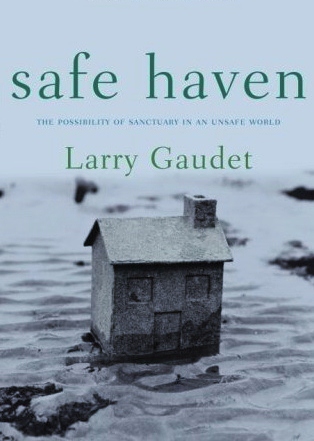
safe haven larry gaudeSafe Haven: The Possibility of Sanctuary in an Unsafe World by Larry Gaudet ~ 2007. This edition: Random House, 2007. Hardcover. ISBN: 978-0-679-31383-0. 274 pages.

My rating: 5.5/10.

*****

Here’s the promotional material from the publisher. Heads up for the predictably effusive tone.

“Sanctuary” is a beautiful word: philosophically rich, culturally intriguing and evocative of so much we cherish — protection, safety, contemplation, solitude. But lurking at the edges of this bright concept are some very dark associations: fear, paranoia, the slamming of gates to exclude the threat of other-ness. Whatever the word means to each of us, and whatever our ancestral legacies, the yearning for sanctuary is a malady we all share to varying degrees, a quest that is both our birthright and our affliction.

These are the assertions of award-winning author Larry Gaudet in Safe Haven, an unorthodox and highly engaging work of imaginative non-fiction. Sure to resonate with anyone who has dreamt of escaping from the pressures of the workaday world — that is, all of us — this book is a highly personal, funny and unflinchingly honest investigation of the power and allure of the idea of sanctuary.

Safe Haven begins and ends in the soft fog of coastal Nova Scotia, taking side trips into the ruined shrines of ancient Greece (with a fictional Bayou-born international spy serving as tour guide), journeying by rail through the frozen vistas and forlorn social realities of Canada’s north and dipping into Gaudet’s own Acadian heritage of displacement.

Booking a year for this project, Gaudet moved with his wife, Alison, and their two small boys to a newly constructed barn by the sea in the fictionally named community of Foggy Cove. His intent: to chart the meaning of sanctuary through the ages, using his family’s solitude as an idyllic jumping-off point. But the project becomes far more complicated than he’d envisioned, and far less idyllic. Envying his children who can oversee uncomplicated imaginary civilizations in a sandbox, Gaudet cannot shake the awareness that he is complicit in the very iniquities from which he seeks to shelter his family, from the environmental toll of their septic tank on this ecologically sensitive land, to the wince of a lobster he is about to boil for dinner. He must also contend with the guilt he feels for having hijacked his wife and children, potentially for naught. As Alison’s desire to return to the comforts and stimuli of urban life grows with every month spent in isolation, Gaudet knows their idyllic days in Foggy Cove are numbered.

In his search for the diverse meanings of sanctuary, Gaudet illuminates the dysfunctions and hidden costs of the way we live — and challenges us to find ways to bring down the walls that keep so many of us estranged from our own experiences. Safe Haven is an entertaining and illuminating romp through the fog-shrouded territory of sanctuary through ages and mythologies, guided by an engaging author who is not afraid to shine the light directly on his own fallible and highly likeable self.

My take:

This book is quite beautifully written, but my initial desire to totally enter into and embrace the author’s ideas was increasingly difficult to maintain as I learned more and more of the author’s personal life, and, in particular, his relationship with his wife, Alison. This seems deeply troubled, and Gaudet’s continual apologies to Alison for dragging her way out to the wilds of Nova Scotia, despite her yearnings for her “real life” of urban sophistication in the city, felt very passive-aggressive in a “this marriage may have issues” sort of way. Or perhaps a cigar is just a cigar, and it was all stream-of-consciousness writing with no below-the-surface vibe breaking through.

Some fascinating stuff in here, all about the author’s most complicated life and how he got to where he is today, but the continual first-person referencing ruined it for me. If one counted up all of the “me”s and the “I”s in this one, they’d outnumber every other word ten to one. Or at least that is the impression I am left with.

So – basically a vanity project, with some gorgeous passages worth anthologizing, or at least quoting in a blog, except that I didn’t mark those pages and I am very ready to part ways with this book and return it to the library shelves. Here’s the thing: it is stamped “Received 2007” by the library, and it appears to have been unread until my checking out of it in 2013. Absolutely crisp and clean and tight. That’s five years, and no one has apparently touched it, except for me on one of my random-selection forays into the non-fiction aisles.

What does that mean, I wonder? It’s not a bad book; some parts are truly excellent. The man can definitely write. Maybe the pervasive (though most probably non-intentional) self-promoting tone has prevented this one from being truly likeable and accessible to the vast majority of those of us unable, through the results of our own career and lifestyle choices, or by those unpreventable twists of fate, to sit out on a sabbatical year in our second home and ponder on the deeper universal concepts implicit in our lifestyles.

Am I glad I invested the time in reading this? Sure. It was thought-provoking and life affirming and occasionally mildly amusing. A lot of Gaudet’s thoughts resonated deeply with me; I felt much the same when I had small children under my care, as he did when writing this book, all broody and protective and suspicious of the world’s vast potential for hurting those I love. And Gaudet’s cutting comments on the prevalence of “sanctuary porn” in our society were absolutely spot-on. I liked him the very best when he probed delicately and accurately on what we choose to divert ourselves with, and how we feed, and are fed, on the stuff of fantastical escapist dreams.

Would I read this book again? Not very darned likely. Unless, of course, it would be to mark out those few memorable passages for future reference. Long ago in another time of my life I kept a series of journals, in which I frequently noted down personally-appealing bits of other people’s writing; I no longer do that, but I thought of it while reading Safe Haven.

Read Full Post »

« Newer Posts - Older Posts »