Posts Tagged ‘Hidden Gem’

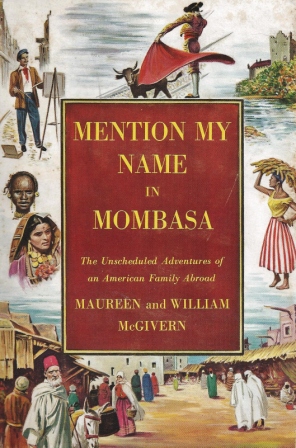
Mention My Name in Mombasa: The Unscheduled Adventures of an American Family Abroad by Maureen Daly McGivern & William McGivern ~ 1958. This edition: Dodd, Mead & Co., 1958. First Edition. Hardcover. 312 pages.

My rating: 7/10.

*****

This is a most interesting read; a travel memoir with a very 1950s’ feel – not surprising, seeing as it is a 1950s’ book! I enjoyed it.

The authors were literary figures of their time, and the travels herein described were, it seems from a few comments here and there, both to fulfill a personal desire for wanderlust and to collect material for future books, including this one.

If the name Maureen Daly rings a bell, it is most likely because of her extremely successful young adult novel, Seventeenth Summer, written when the author was herself just seventeen, and published in 1942. Some years later we find Maureen married to fellow writer William McGivern, a successful writer of crime-mystery novels (The Big Heat, Rogue Cop, war novel Soldiers of ’44, and almost 20 more) and film and television scriptwriter (Kojak, Adam-12, and Ben Casey, among others). They had their two children along, 6-year-old Megan and 2-year-old Patrick, when they left New York on New Year’s Eve to travel to Paris, the start of their extended travels.

Long, detailed and quite enthralling chapters describe the scenery, culture and especially the unique individuals the McGiverns came into contact with. The tone is a mixture of worldly-wise (but never condescending), travel guide (but merely to lay out the scene), and very 1950s’ American superiority (but innocent of bluster so therefore non-jarring – at least for the most part). The McGiverns were very eager to give credit where it was due regarding the superior aspects of their temporary homes and tourist destinations, which included Paris, and then a stay in the tiny fishing village of Torremolinos near Málaga, Spain, just on the verge of its discovery and development as a winter-tourist hotspot.

Then come several chapters on Spanish bullfighting, bullfighters and the ranches which raise and train the bulls. The tone here is journalistically non-judgemental much of the time; I never did get a grasp of whether the McGiverns were fully behind the “sport”, though from the farcical descriptions of a number of stereotypical bullfight aficionados which graces one of the chapters, I suspect they had marginally more sympathy for the bovine members of that elite yet widely populist pastime.

Next is a short visit (and hence a short chapter) in Gibraltar, where the McGiverns are rather disappointed in the elusiveness of the famous apes. On to Iceland, and a very travel-guide chapter this is, with loads of facts thrown at the reader, interspersed with short vignettes of some of the US Army families living on the vast NATO air base, and native Icelanders who opened their homes to our travellers.

Then comes the most memorable chapter of the book. During World War II, William had served as a US Army gunner in the European campaign, and his platoon had ended up entrenched on the mountainside near the tiny Belgian village of Fraipont, where the local people showed such generosity and warmth to their American allies that William had long planned to return in more peaceful times. Just over ten years later that sentimental visit took place, with the villagers overjoyed to recognize William and welcome his family. A poignant reminder that the war was not all that far in the past when this pilgrimage took place.

Back to Spain, and then a four-day voyage to the Canary Islands, a visit which seems not to have quite met the high expectations of the romance of the name. On to Morocco, where the McGiverns have several pleasant surprises regarding the locals, and then to Nigeria, on the cusp of independence as a full member of the British Commonwealth, after decades of colonial occupation.

A safari to Abadjan on the Ivory Coast and then to Fort Lamy in Chad doesn’t quite go as expected, but there are compensations in the people who the McGiverns meet as they wait for their travel visas to gain approval from the local bureaucracy. This does not happen, so back to Spain, through France, Belgium, and over to Ireland, where the Daly family is waiting to welcome their wayward relative and her family for an extended visit. Several months in Dublin follow, and then the trip is wound up, with a return to New York over a year after the original departure.

In this book there is a strong sense of how good it is to be an American at this point in history, and how welcome the traveller from the U.S.A. both feels and is made to feel; the McGiverns travel in their French-bought Citroën plastered with American flags fore and aft, and seldom seem to meet with a cold shoulder. Quite a change in the ensuing fifty years!

This is a fine book, and a literary time capsule of the post-war era, before things started to go wrong for the U.S.A., politically speaking.

I suspect it may be hard to come by (I ordered mine for a rather large sum from an online rare book dealer, for the Maureen Daly connection) but if your library happens to have a copy hidden in the stacks, or if you chance upon it in a used book store, it is well worth delving into.

Read Full Post »

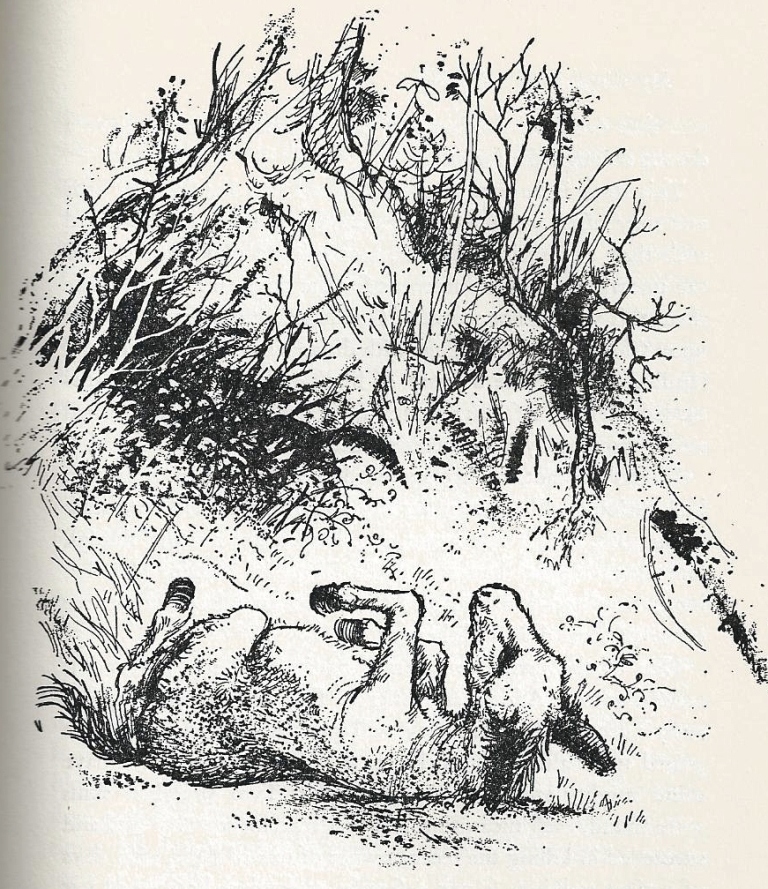
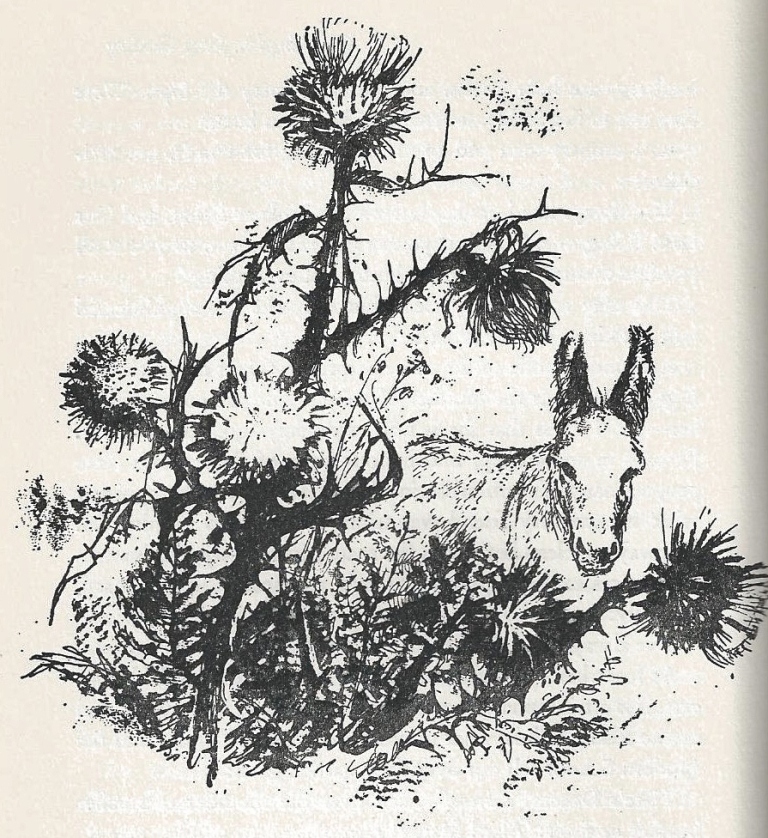
My Kingdom for a Donkey by Doris Rybot ~ 1963. This edition: Hutchinson & Co., 1963. First Edition. Hardcover. Line drawings by Douglas Hall. 128 pages.

My rating: Another unique book which is hard to rate. It’s centered on the author’s pet donkey, Dorcas, with predictable anecdotes about the creature itself, but it also ranges much more broadly into history, philosophy, animal rights and general opinionating by the author.

I liked it. I initially bought the book to give to a donkey-owning friend, but am finding it difficult to make up my mind to let it go just yet. And I love the illustrations. I should send it on its way back out into the world, but I strongly suspect I won’t.

Anyway – rating. I’m thinking 8/10. A slender little volume, but earnestly written, and beautifully sincere. Almost makes you yearn for a donkey of your own. (“Or not!” exclaims my reading-over-the-shoulder daughter, who has spent a number of sessions brushing out the knots in down-the-road Fanny’s woolly coat.)

*****

I’ve been carrying this one around with me for weeks, to the detriment of its rather fragile dustjacket, so I’ll try to pull off a quick review in my little window of time this evening so I can at last leave the poor thing on the shelf.

The author writes:

My own Dorcas is a plump, well-liking donkey. But even I – who can say of her as Sancho Panza said of his ass Dapple, she is the ‘delight of my eyes, my sweet companion’ – even I cannot call her beautiful. She is too like a child’s inexpert drawing, with her head absurdly big for the mouse-brown body that is at the same time neat and clumsy.

Poor grotesque beasts! Whose fault is it that they are as they are? From that day far down the increasing centuries, before the Pyramids, before Abraham, when the first wild ass was haltered and loaded. his kind have been abused, overweighted, beaten, ill-fed, chancily watered; kicks and goads have come their way more often than pats and praise. Little wonder they were reft of their real grace and swiftness to become the stunted toilers that we know, waifs of the world, clowns among horses, a byword for patience and humbleness.

This particular donkey has been acquired to keep the grass down on a small country acreage. She has not been neglected or abused, but instead was deliberately sought out and purchased from a horse dealer who kept the little jenny among a herd of ponies in the New Forest of England’s Hampshire region. Dorcas was a costly acquisition, donkeys apparently being rare and hard to come by in this particular place and time – England in the late 1950s – but the transaction was made and Dorcas soon adapted to her new home.

Dorcas’ new life was in no way harsh or unhappy; her days were filled with peaceful grazing and visits over the fence with many passers-by, occasionally pulling a small cart, being taken for short rides by her owner and visiting children, and, on one memorable occasion, embarrassing her owner mightily by refusing to participate in a horse show in the most public fashion possible, by rooting herself immovably in the show ring as the rest of the participants circled round in perfect form.

Dorcas provided her owner with years of interest and pleasure, mostly by her mere possession and the enjoyment of watching her carry on her natural inclinations and habits.

Doris Rybot tells the tale of Dorcas with the minimum of sentimentality – she sees her donkey and her own role as animal owner and caregiver through pragmatic eyes – but at the same time she speaks most movingly about the treatment of Dorcas’s tribe through the centuries, and expands this to a plea to treat all animals with respect. In between personal anecdotes featuring not only Dorcas but the other animals in her life, Doris retells a number of legends and Biblical stories in which the humble ass takes a prominent part.

An unusual and very heartfelt book, by a writer who has a deep and articulate love of all creatures from the lowliest insect to humankind itself. A hidden gem of a book, which I am quite thrilled (in a quiet way) to have come across.

I’ve done a little bit of background research on Doris Rybot, and have discovered little about her except that she did write at least one other book, It Began Before Noah, and that she also appears as Doris Almon Ponsonby, and that she was born in 1907.

Read Full Post »

I Was a Teenage Katima-Victim: A Canadian Odyssey by Will Ferguson ~ 1998. This edition: Douglas & McIntyre, 1998. Softcover. ISBN: 1-55054-652-x. 259 pages.

My rating: 9/10.Funny and thought provoking. This is the book that made me a Will Ferguson fan, way back in 1998, when I plucked it off the “New Releases” bookstore shelf solely for the reference to Katimavik. A few minutes browsing and I was sold. Liked it then, like it now. A very Canadian memoir.

*****

Funny, touching, and never maudlin . . .”     – Montreal Gazette

“A rollicking memoir”     – Globe & Mail

“A coming of age story with a fierce and nationalistic bite.”     – January Magazine

With Will Ferguson in the literary spotlight these days, due to his Booker Prize win for 419: A Novel  just a week ago, I felt the urge to dig through the bookshelves and re-read the my first ever Ferguson book, the now-obscure 1998 coming-of-age-Canadian-style memoir, I Was a Teenage Katima-Victim.

Ah, Katimavik! What a well-meaning and ambitious, oh so Canadian idea!

In my Grade 11 year I too went to one of those earnest presentations in the school gym, listened with deep interest to the bubbly recruiter, and, most importantly, mused over what I could do with the thousand dollar pay-off at the end.

I even went so far as to take a brochure home to my parents, who flicked through it with scornful dismissal. The airy-fairy notion of travelling and seeing Canada basically on the taxpayers’ dime was not something to countenance for one of their children. In my father’s eyes such programs were akin to “those deadbeats collecting welfare”, and he quite literally would have starved on the street rather than apply for a government handout, or anything which could be remotely conceived of as such. To top it off, Katimavik was supported by none other than “that Liberal bastard”,  Prime Minister Pierre Trudeau, who my father hated with a black passion, for reasons I’m still not quite clear on.

By the end of my Grade 12 year Katimavik was a distant memory, a momentary what-if? fairytale I had told myself. I had moved out of my parents’ home into a nasty and dank – but blessedly my own – basement suite in town, and was working full-time waitressing (nights and weekends) while struggling to make it through the tatters of my last high school year to collect that all-important graduation diploma. My love life had unexpectedly taken off, and I was deeply occupied in the here and now. The last thing I now wanted was to rip up those tentaively establishing adult roots and travel. But a soft spot remained for the grand ideas embodied in Katimavik, and my ears ever after were sensitive to the sound of the name.

Will Ferguson took the bait, made the plunge, and survived to tell the tale. Here is a 1999 interview in January magazine:

The book … is delightful: a coming of age story with a fierce and nationalistic bite.
To explain the reference, Katimavik was a Canadian government funded and sponsored program that blossomed in the 1970s. Of course. While the program was active, it brought thousands of young Canadians together to do “meaningful work.” Everything from soup kitchens to nature trails to heritage sites: over 20,000 “katima-victims” went through the program. “The scope of the program was staggering,” writes Ferguson. “1400 different communities across Canada, and more than 200,000 people directly involved or affected. For better of worse, Katimavik helped shape an entire generation.”
For the lavish sum of $1 a day and “all the granola you could eat” these 20,000 17 to 21 year-olds were taken far from their home towns for a year to see first-hand the cultural mosaic of which they were – by birth – a part.
“The thinking about Katimavik was that there is something redeeming about manual labor,” says Ferguson. “And the thing is, it just isn’t true at all. Anybody doing manual labor knows that it’s a tough gig and if they had the option not to do it, they wouldn’t. The second notion is that somehow once we get to know each other, we’ll like each other. This is the biggest flaw and it runs right through a lot of thinking. They think that, just because you and I are enemies, if we got to know each other, we’d like each other: that’s a big flawed premise because – quite often – the more you get to know each other, the more you realize that you have nothing in common.”
Despite his misgivings about the program’s principals, “Katimavik worked on a personal level, despite its good intentions. Just because any time you throw someone into something that big and that intense you come out of it with a rounder personality.”
Now 34, Ferguson’s personality is sufficiently rounded to take us along with him on great rollicking rides. Thus far he’s taken us from the wilds of Canada to the back roads of Japan. Whatever he has in store for us next is sure to be fun: and will hopefully raise still more eyebrows. | Linda L. Richards, January Magazine, February 1999

There is a certain irony in the fact that, soon after Ferguson’s participation in the now-iconic Canadian youth travel-service-work-cultural  program, it was axed in 1986 by the newly elected Mulroney Progressive Conservative government. Katimavik was resurrected in a slightly different form in 1994, and just this year, 2012, has been cut again, this time by the Conservative Harper government. Another rescue mission is afoot, to reimagine Katimavik for yet another generation of young Canadians. I hope it succeeds.

This book has been out of print for years, and is unaccountably ignored in most discussions of Ferguson’s work, which is a shame. Despite the graphically appalling cover, the tale told within is worth reading, especially for anyone who has memories of Katimavik in its sincere and slightly loopy heyday. A bit raw in spots – it was, after all, only Will Ferguson’s second published book, following hard on the heels of surprise bestseller Why I Hate Canadians – it nevertheless gets better and better as it goes along. Laugh out loud funny in places, there is a thread of sincerity running through it which is deeply appealing.

More than a mere curiousity piece and a relic of the author’s youth, it’s a rather grand little read. One of those “Proud to be Canadian” feel-good things. Recommended.

And here is link to the Goodreads page.

Read Full Post »

« Newer Posts