Posts Tagged ‘Children’s Fiction’

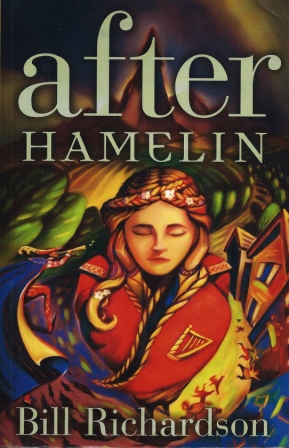
After Hamelin by Bill Richardson ~ 2000. This edition: Annick Press, 2000. Softcover. ISBN: 1-55037-628-4. 227 pages.

My rating: 6.5/10. Sorry, Bill. This one was a bit hit and miss with me. You got an extra point from me for old times’ sake, because I’ve been a (mostly) appreciative fan of yours since CBC Radio “Sad Goat” days.

I really liked parts of it, especially the character of Penelope, with her 101-year-old words of wisdom, and I admired the imagination of  the Frank L. Baum Oz-ish dream world, but I really had to push to see this one through to the end. I kept stopping and yawning and mentally saying “Where are we? Oh, yeah, she’s in the dream world now…”

And while the bizarre (and nicely imagined – I laughed at these) realms of the ski-footed flying creatures living in the land of perpetual ice and moonlight, and the rope-skipping, directionally challenged dragons next door were quirky and funny and sweet, the dark overtones of the menace waking from its sleep struck a harsh note. And I couldn’t really get what the Piper was all about. Even if he woke, what was going to happen? I mean, how bad was it going to be? Just another magician gone wrong…

And the whole turning-eleven thing. Obviously a puberty ritual, but surely a bit young for the whole “welcome-to-womanhood” chorus of the villagers? Or maybe I’m reading too much into that. Probably a cigar is just a cigar, and it’s merely a cute plot device.

This is not a bad book, and it had some great sequences, but I didn’t immediately love it. A pleasant, light diversionary read, for mature-ish children, say 10 and up, to adult. Well-constructed “after the end of the fairytale” story. Good discussion starter, or as part of an exploration of alternative fairy tales and such.

Oh, and an extra .5 point for the talking cat. (One of my personal weaknesses. I do so love a talking cat.)

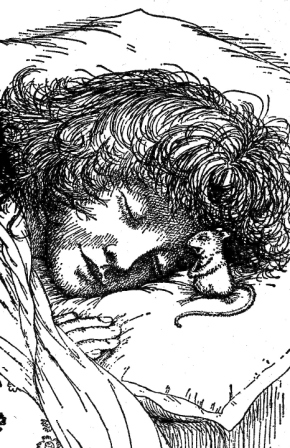
Gorgeous cover art, too!

*****

Everyone knows the story of the Pied Piper of Hamelin. How, in a town plagued with rats, there appeared a mysterious man who promised to rid the town of the creatures, and, after being promised a lavish reward, did just that, piping out a magical tune that drew them from every nook and cranny, as the piper led them far away. Coming back for his promised reward, the greedy town councillors refuse his pay, at which point the piper takes revenge by calling all of the children of the town after him, save one crippled child, who cannot keep up and so is spared. This is where the story ends. But what happens after?

After Hamelin is Bill Richardson’s fantasy about the next stage in the story. In his version, not one but two children remain behind. Penelope, who has just woken to a sudden deafness on the morning of her eleventh birthday, and Alloway, a blind harpist’s apprentice, who gets lost as the horde of children travel through a forest. Between Penelope and Alloway, Penelope’s elderly cat Scally, the village wise man Cuthbert, and his three-legged dog Ulysses, a rescue is carried out, through the medium of a trance state – Deep Dreaming – and the liberal use of magical skipping-rhymes.

Narrated by Penelope herself, who, at the age of one hundred-and-one, still looks back on her long life and unbelievable adventures with clarity and humour, the tale is told through a series of flashbacks and reminiscences.

A children’s story for all ages.

And here is an interview with the author, which puts everything into context.

Bill Richardson Interview – After HamelinJanuary Magazine

Read Full Post »

The Rescuers by Margery Sharp ~ 1959. Illustrations by Garth Williams. This edition: New York Review of Books, 2011. ISBN: 978-1-59017-460-9. 149 pages.

My rating: 7.5/10 for the story, 10/10 for the illustrations.

This is the first story in what eventually became a series of nine about the mice of the Prisoners’ Aid Society, and in particular the aristocratic white mouse Miss Bianca, and her admirer and co-adventurer, Bernard.

Everyone knows that the mice are the prisoner’s friends – sharing his dry bread crumbs even when they are not hungry, allowing themselves to be taught all manner of foolish tricks, such as no self-respecting mouse would otherwise contemplate, in order to cheer his lonely hours; what is less well-known is how spendidly they are organized. Not a prison in any land but has its own national branch of that wonderful, world-wide system…

In the un-specified (and purely imaginative) country these particular mice live in,

…(a country) barely civilized, a country of great gloomy mountains, enormous deserts, rivers like strangled seas…

… there exists the greatest, the gloomiest, prison imaginable: The Black Castle.

It reared up, the Black Castle, from a cliff above the angriest river of all. Its dungeons were cut in the cliff itself – windowless. Even the bravest mouse, assigned to the Black Castle, trembled before its great, cruel, iron-fanged gate.

And inside the Black Castle, in one of the windowless dungeons, is a prisoner that the Prisoners’ Aid Society has taken a special interest in.

“It’s rather an unusual case,” said Madam Chairwoman blandly. “The prisoner is a poet. You will all, I know, cast your minds back to the many poets who have written favorably of our race – Her feet beneath her petticoats, like little mice stole in and out – Suckling, the Englishman – what a charming compliment! Thus do not poets deserve especially well of us?”

“If he’s a poet, why’s he in jail?” demanded a suspicious voice.

Madam Chairwoman shrugged velvet shoulders.

“Perhaps he writes free verse,” she suggested cunningly.

A stir of approval answered her. Mice are all for people being free, so they too can be freed from their eternal task of cheering prisoners – so they can stay snug at home, nibbling the family cheese, instead of sleeping out in damp straw on a diet of stale bread.

“I see you follow me,” said Madam Chairwoman. “It is a special case. Therefore we will rescue him. I should tell you that the prisoner is a Norwegian. – Don’t ask me how he got here, really no one can answer for a poet! But obviously the first thing to do is to get in touch with a compatriot, and summon him here, so that he may communicate with the prisoner in their common tongue.”

Now, getting to Norway is a bit of a challenge, but the mice have a solution. They decide to call on the famous Miss Bianca, the storied white mouse who is the pamperd pet of the Ambassador’s son. Miss Bianca lives in a Porcelain Pagoda; she feeds on cream cheese from a silver dish; she is elegant and extremely beautiful and far, far removed from common mouse-dom. She also travels by Diplomatic Bag whenever the Ambassador and his family move – abd they have just been transferred to Norway. Perfect!

A pantry mouse in the Embassy, one young Bernard, is assigned the task of contacting Miss Bianca and enlisting her aid in the cause. She is to find “the bravest mouse in Norway”, and send him back to the Prisoners’ Aid Society so he may be briefed on the rescue mission.

Bernard successfully convinces Miss Bianca to assist, and then the real action starts. By a combination of careful planning, coincidence and sheer luck, the Norwegian sea-mouse Nils, Bernard and Miss Bianca venture forth to bring solace and freedom to the Norwegian poet.

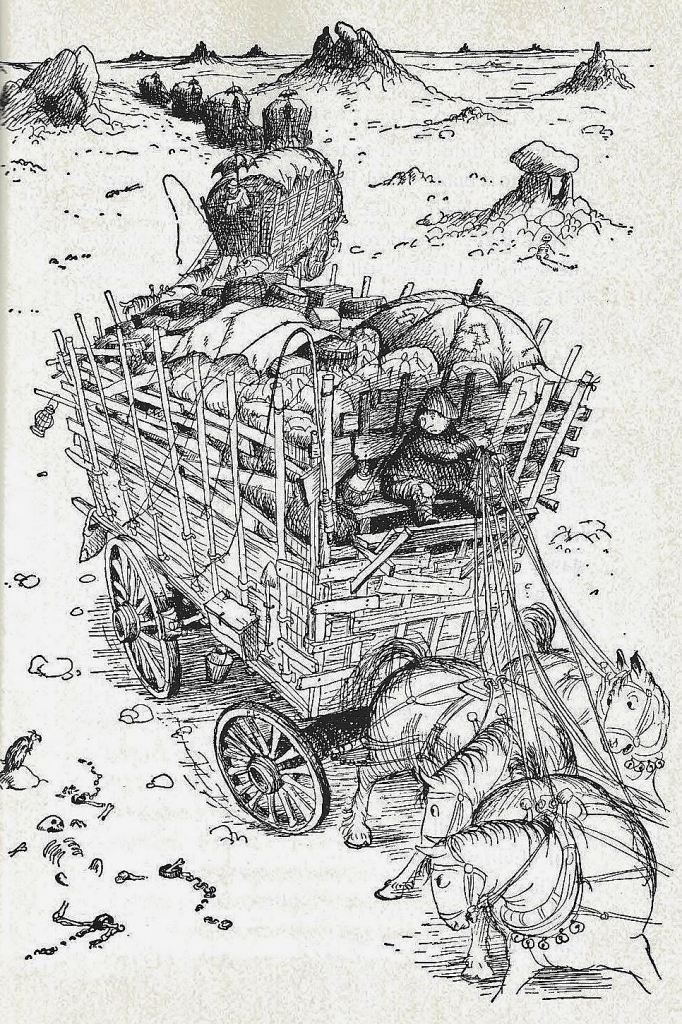
The illustrations by Garth Williams are absolutely perfect. Here is one of my favourites, of the journey to the Black Castle. Look carefully at the expressions on the horses’ faces, the fetters on the skeleton. Brrr! Danger lurks!

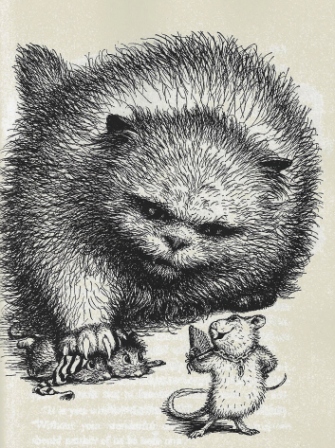
And here is Mamelouk, the Head Jailer’s wicked black half-Persian cat, whose favourite pasttime is spitting at the prisoners through the bars, and of course catching and tormenting any mouse who ventures into his dark domain.

Miss Bianca proves herself more than a match for Mamelouk, utilizing her special bravado and charm. Needless to say, the mission is successfully accomplished, though not without setbacks.

A light, rather silly (in the best possible way), rather enjoyable story.

Miss Bianca is a very “feminine” character, in the most awfully stereotyped way possible, but there are enough little asides by the author that we can see that this is not a reccomendation for behaviour to be copied but rather a portrait of a personality who uses the resources at hand (her charm, her beauty, her effect on others) to get things done.

Bernard is typical yeoman stock, earnest striving and quiet bravery in the face of adversity. He is attracted to Miss Bianca as dull and dusty moth to blazing flame, but quietly accepts that their places in the world are too far apart to ever allow him the audacity to woo her. Or possibly not…

Nils galumphs through the story in his sea boots, “Up the Norwegians!” his Viking cry. A reluctant (or, more appropriately, unwitting) hero, who has had his adventure thrust upon him, Nils typifies dauntless.

Read-Alone: I’m thinking 8 and up. Margery Sharp has written a children’s tale with completely “adult” language and references; a competent young reader will find this challenging but rewarding. Be prepared to clarify occasionally, if your reader is of an inquiring mind. (Hint: Better bone up on Lloyd’s Register of Shipping.)

Read-Aloud: I think this would be a very good read-aloud. Ages 6 and up. Reasonably fast-paced. The first few chapters set the scene and may be a bit slow going, and the dialogue will require careful reading; you’ll need to pay attention while performing this one – no easy ride for the reader! – but I think it could be a lot of fun.

Definitely worth a look. If this is a hit, there are eight more stories in the series. I have previously reviewed the second title here:    Miss Bianca

Read Full Post »

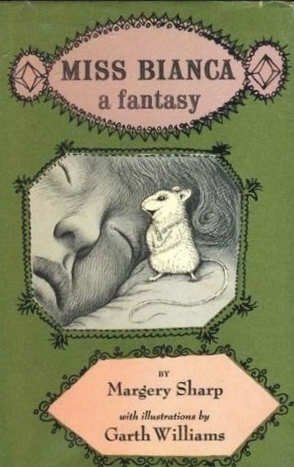
miss bianca margery sharp vMiss Bianca by Margery Sharp ~ 1962. Original title: Miss Bianca: A Fantasy. This edition: Fontana 1977. Paperback. Grand illustrations by Garth Williams. ISBN: 0-00-67-1235-5. 124 pages.

My rating: 7/10. The excellent illustrations raised it a few points.

I have a lot of good things to say about Margery Sharp, and her adult novels are among my most treasured books, but I must admit I have never previously read her once-popular children’s series about the little white mouse, Miss Bianca. The first two stories in the series were the inspiration behind the well-known Disney animated film The Rescuers (voiced, for those of you interested in such trivia, by Eva Gabor in the role of Miss Bianca and Bob Newhart as her partner Bernard) and its sequel. The paperback edition of Miss Bianca I have before me is the movie tie-in edition, with a cover still from the movie and this telling note on the title page:

Featuring characters from the Disney film suggested by the books by Margery Sharp, The Rescuers and Miss Bianca, published by William Collins & Co Ltd.

Don’t you just love that “suggested by” comment? So true! For the record, I am not a fan of the Disney bowdlerizations of otherwise excellent books. Several generations of children have now grown up with the Disney imagery of classic stories such as The Jungle Book, The Little Mermaid, and, heaven help us – The Hunchback of Notre Dame! – firmly in their heads versus the authors’ intended word-pictures.

So my beloved Margery Sharp is among the ranks of Disney’s “suggested” inspirations! I hope she got a generous settlement! It has just occurred to me that many of their take-off-of-classic stories authors were already dead at the time of the movie-making; Margery Sharp was very much alive in 1977, though I remember reading a quotation by her about not really being too interested in what happened during filming of her works (several of her adult novels were made into popular films); that her job was to write and that filmmakers were fine on their own without her input.

Back to the book at hand. A little way in I realized that Miss Bianca has a back story; so many references to what has “just happened” made me scratch my head until I realized that this is the *second* story in the series. The Rescuers is the first. I am thinking I need to get my hands on that one to fill in the gaps, and luckily that shouldn’t be a problem. New York  Review Books has just re-issued The Rescuers in hardcover, after its being out-of-print for ten years; I have several of their other beautifully rendered re-issues and I highly recommend them. Here’s the link: http://www.nybooks.com/books/imprints/childrens/the-rescuers/

So – Miss Bianca, Chairwoman of the Prisoners’ Aid Society (a charitable mousey organization dedicated to the comfort of incarcerated humans), has a new project to suggest. The last daring adventure, the rescue of a Norwegian poet from the infamous Black Castle (pause for ominous music) was obviously a great ego boost to the mice, and they are consequently quite boisterous and full of themselves. Miss Bianca, waiting for the Society’s latest meeting to come to order, muses that

“…their common adventure had given mice an unfortunate taste for flamboyance in welfare work. Not one, now, thought anything of sitting up to beg a prisoner’s crumb – in the long run one of the most useful acts a mouse can perform. Crumb-begging, like waltzing in circles (even with a jailer outside the door), was regarded as mere National Service stuff, barely worth reporting on one’s return from the regulation three weeks’ duty…”

The new mission is the rescue of a little girl who is being held in an abusive situation by the wicked Grand Duchess in the magnificent but icy-cold Diamond Palace. Miss Bianca appeals to the Ladies Guild of the Society to assist her in the daring rescue, and of course things do not go as planned. Miss Bianca is left behind in the general rout of the rest of the mice when the Duchess’ ladies-in-waiting, far from being tender creatures terrified of mice, turn out to be much more “hardened” than planned for!

This is a playful book; Margery Sharp indulged herself with a full flow of flowery and elaborate language, rather a challenge for young readers (but not necessarily a drawback), and the references are aimed rather at their elders over the heads of the child-audience; perhaps this was a book meant to be read aloud, with a nod to the parent as well as the child?

The villains in this little saga are properly villainous; the Duchess’ black-hearted Major-Domo, Mandrake, has committed “…a very wicked crime, of which only the Duchess now had evidence…” and he is her willing (though cringingly obsequious) partner in crime. Even her two unkempt carriage horses “…had criminal records; each having once kicked a man to death…” And so on.

If the story has a flaw (and it does have a few, being a slight work in every sense of the word) it is that the parody and melodrama are a bit too “over the top” for perfect comfort. The wee prisoner, the aptly named Patience,  is the latest in a long line of small children the Duchess has enslaved and apparently killed (!) –  though most children will shiver deliciously at the peril their two heroines find themselves in, my motherly brain says “Killed! Was that really necessary, dear author?!” And I don’t think we ever do get the full story on how the Duchess obtained Patience in the first place.

Ah, well. To sum up: a diverting little parody of an adventure story. I think it should definitely follow The Rescuers to make more sense to the reader; it has a very sequel-ish feel to it, though it could stand alone if need be. Quite nicely written in a very flamboyant voice (to use Miss Bianca’s own word); definitely not dumbed down to a younger audience vocabulary or style-wise.

This book #2 in a series, the first four of which are illustrated by the incomparable Garth Williams. I believe all except the newly re-released The Rescuers (New York Review Books, 2011) are out-of-print. Some are very easy to find second-hand, but the more obscure later titles may require some serious online sleuthing.

  • The Rescuers (1959)
  • Miss Bianca (1962)
  • The Turret (1963)
  • Miss Bianca in the Salt Mines (1966)
  • Miss Bianca in the Orient (1970)
  • Miss Bianca in the Antarctic (1971)
  • Miss Bianca and the Bridesmaid (1972)
  • Bernard the Brave (1977)
  • Bernard into Battle (1978)

Read-Aloud: I think so. Ages 6 and up, perhaps? The prisoner Patience is eight; much is made of her sad life and deceased predecessors and bleeding fingers, but the tone is optimistic – this is, after all, why the child very much needs a heroic rescue! Neatly tied up happy ending, with the mice going off to their next adventure.

Read-Alone: Hmmm. Maybe 8 and up? Or a very strong younger reader. Definitely can be appreciated by an older readership (including adults); Margery Sharp was an accomplished social satirist and this story is full of her wry observations, though they often escalate into full-blown parody much more so than in her adult novels.

Read Full Post »

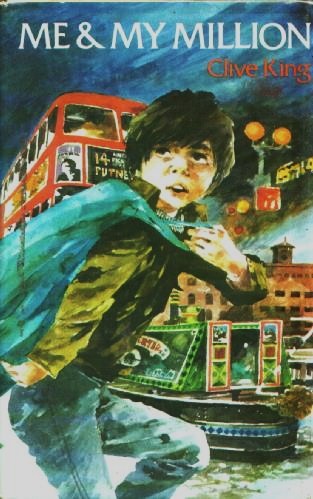
Me and My Million by Clive King ~ 1976. This edition: Kestrel (Penguin) 1979. Ex-lib hardcover. ISBN: 0-7226-5185-6. 133 pages.

My rating: 9/10.

From the front flyleaf:

Ringo knew he was carrying more in his laundry bag than just old socks. Whatever it was, his part in the job was a cinch – his brother Elvis had told him to leave it at the laundrette at the end of the 41 bus route. So how come Ringo found himself on the other side of London with a million pound picture in his bag and not so much as 10p in his pocket? Lost, broke, stuck on the pitch-black underground platform for the night – and scared witless by Angel Jim, all hairy and hippy, padding up beside him. Ringo’s troubles were just beginning…

Angel Jim took him home to his squat in the fire-station – all peace-loving and sharing. But sharing meant they wanted their cut of the million pound picture. And so did Uncle, the big dealer, and his chauffeur Eugene, and Glasses and his gang, not to mention Elvis! It looked like Ringo was cornered – until he fooled an old lady into holding onto the goods, and slithered down her drain-pipe to the canal – right onto Big Van’s barge – and what does he find? Big Van’s got the million pound picture, or one exactly like it. Big Van was just about to explain, when a copper knocks at the barge door. Ringo’s troubles were beginning again…

Cheerfully unrepentant  young delinquent Ringo tells of his part in the gone-wrong art heist master-minded by his junior-criminal brother Elvis. (Regretfully, we never get to meet the rest of their family.)

“Well, Elvis, he’s only half my brother really. So he’s half at home and half somewhere else. He’s old, more than twenty. They gave him this soppy name after some old pop star… Ringo, that’s what they call me. I think it’s some other old pop star that my mum liked…”

Clive King must have had a good time writing this fast-paced adventure story. Young Ringo, from the first sentence onward, never breaks character for an instant. Though we’d best not trust him alone for a minute with anything valuable around, his heart is nonetheless good deep down.

We willingly surrender our disbelief early on, when Elvis and his cohort Shane manage somehow to steal a valuable painting from a museum; Ringo is drafted as the receiver of the goods, and manages to totally mess up the hand-off to the next member of his brother’s gang. Ringo’s downfall is his obvious dyslexia – he struggles to read the simplest words, and numbers turn themselves around in his mind – hence his initial mistake in getting on the 14 bus versus the 41.

“It’s like this… It’s along of those figures and letters and words. I mean, like the buses. Elvis says forty-one and I get on a fourteen. But a forty-one coming towards you, and a fourteen going away, they look the same!”

Luckily Ringo’s mix-ups save his skin more than once as he careens through London bouncing off the most eclectic bunch of characters – a group of more-than-mellow peace-and-love hippies, a wealthy “picture collector” with less-than-legal connections, an artist-turned-(somewhat)-art-forger living on a canal boat, and a sinister group of animal liberationists with a dark agenda.

Happily everything turns up okay in the end. Ringo saves the day, and – water off a duck’s back – gets on with his life, which would appear to have taken a turn in a decidedly more positive (and distinctly more legal) direction due to his lively adventures and new acquaintances.

What a cheerfully loopy story this is! While it was written for a young(ish) audience, it is such a strong portrait of a certain kind of person at a certain point in time in a certain place that I suspect a young reader today would be rather at sea as to what’s going on and why the funny bits are so funny. The hippies in particular are such a period piece, gleefully and sympathetically portrayed by King. Or maybe there’d be no problem. My own offspring often surprise me by how sophisticated their understanding of the past sometimes is. And those of us who were young in the 1960s and 70s will “get it” completely. This book’s humour reminds me strongly of the classic 1969 British crime-and-car-chase movie The Italian Job, starring Michael Caine; Charlie Croker could have been Elvis’s role model!

Definitely share Me and My Million with your kids – it’s a neat little diversion of a book – but try it for yourself too. Enjoyable quick read.

Read-Aloud: I would say probably a “yes”, I’m thinking for 8 years old or so & up.  Definitely worth a try. 14 shortish chapters; fast paced. I think once you figured out a narrative “voice” it would be great fun to do, though we never tackled this one as a read-aloud ourselves.

Read-Alone: Probably 10 & up, and well into the teens. Depends on the individual reader and how good they are at catching inferences and figuring things out from prior knowledge; written in a bit of a challenging style; the reader has to fill in the blanks.

Read Full Post »

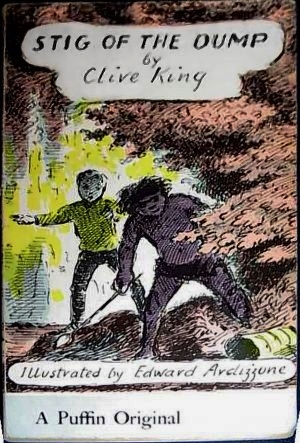
Stig of the dump clive kingStig of the Dump by Clive King ~ 1963. This edition: Puffin, 1993. Softcover. Illustrations throughout by Edward Ardizzone. Afterword by Kaye Webb. ISBN: 0-14-036450-1. 159 pages.

My rating: 10/10.

Probably the best-known of British author Clive King’s respectable list of interesting and well-written children’s books, this great little story is still in print forty years after its first publication.

A happy little story, touched with snippets of history, but mostly just a fun read. We willingly suspend our disbelief and embrace the “what if” world Clive King has created for Barney. Make sure you look for a copy with the Ardizzone pen-and-ink illustrations; these add greatly to the enjoyment of this story.

Young Barney and slightly older sister Lou are visiting their grandparents in the English countryside. Barney, exploring, becomes fascinated by an old chalk quarry used by the local inhabitants as a rubbish tip for unwanted items. While venturing too close to the edge, the crumbly chalk cliff gives way, tumbling Barney down into the midst of a concealed shelter built out of branches, rusty sheet iron and pieces of old carpet. He has found the den of the mysterious Stig, a “cave man” unexpectedly living in 20th Century Devon. Barney and Stig hit it off immediately, and various adventures ensue. Eventually Lou is drawn into the partnership, and the story culminates with a Midsummer Night time-travel back to Stig’s time.

Read-Aloud: Yes! A wonderful read-aloud. King’s writing flows beautifully, making life easy for the narrator. The 9 chapters are fairly long but are nicely episodic so each session ends off neatly while keeping the listener wanting more. Interest level probably 5-6 to 10-11, maybe even older, depending on the individual child(ren).

Read-Alone: Great early chapter book for developing and fluent readers 6-ish/7-ish and up. The author wrote this book to be read by his 8-year-old son, so it is fairly simply written, though not at all “dumbed-down”.

Read Full Post »

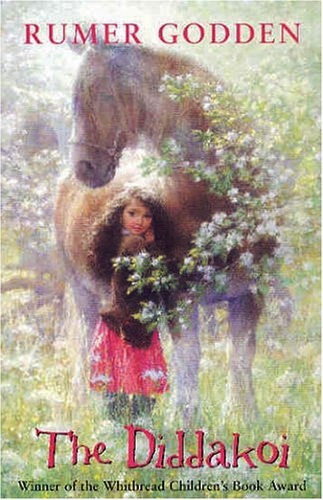
diddakoi rumer goddenThe Diddakoi by Rumer Godden ~ 1972. This edition: Macmillan, 2007.  Softcover. ISBN: 978-0-330-45330-1. 152 pages.

My rating: 6.5/10.

Also published as Gypsy Girl in some editions. Do not confuse with another of Rumer Godden’s titles – Gypsy, Gypsy (1940) – which is a decidedly adult novel.

I have a vaguely uneasy relationship with this small story of the half-Irish, half-Romani (“gypsy girl”) Kizzy. The writing is of very high quality (no surprise there; Rumer Godden seemed incapable of turning out a poorly written phrase) but the plot – oh! – the plot is terribly contrived, especially when read with today’s sensibilities.

Young Kizzy, about 6 or 7 years old (she doesn’t know her birthday), lives with her great-great grandmother in a shabby, blocked-up gypsy wagon on a corner of Admiral Sir Archibald Twiss’s estate. Ancient Joe, who used to pull the wagon, grazes away his days and is Kizzy’s favourite companion, and all is generally well, if occasionally cold and hungry, in Kizzy’s little world.

The village do-gooder, Mrs. Cuthbert, twigs  to the fact that Kizzy is school-age and decidedly not at school; she cries “neglect!” and calls in the welfare officer and the official wheels are set in motion. Off our wee heroine goes to the village school, where she immediately falls afoul of a village’s worth of young “mean girls” (ringleader none other than Mrs. Cuthbert’s daughter Prue) who set upon her as a ready-made victim for their taunts.

Kizzy copes as best she can, but things get even worse. Her Gran dies, relatives are located and called in to deal with things, the wagon is burned in accordance with Gran’s wishes (an old Romani custom upon a death), and Joe is destined for the knacker’s yard, while an argument erupts over who will take Kizzy in. No one much wants her.

Kizzy takes control of her own destiny, and of Joe’s, escaping in the night and ending up on Admiral Twiss’s doorstep begging sanctuary for her horse. Of course, in the proper melodramatic tradition, she now falls ill and “cannot be moved” (apparently there are no ambulances available in 1970s England to transport a gravely ill child to hospital!) and must be cared for by the Admiral and his two devoted retainers.

To condense: Kizzy is re-homed with understanding Miss Brooke, though with more than a little resistance from Kizzy who was quite content in the Admiral’s bachelor establishment. The bullying at school escalates into a physical episode where Kizzy is injured, bringing the situation at long last to the official notice of the village adults who had been letting things work themselves out. The young bullies are allowed their chance at redemption; Kizzy learns to love dedicated Miss Brooke; a proper home is providentially provided; and all’s well that ends well.

For all of the predictability and sometimes glaring flaws in the plot-line, this story works out quite well. We develop an affection and admiration for this stubbornly individual child who refuses to be a victim of fate, even while being tossed and turned by events beyond her control. Though the ending is a little too good to be true, we feel that justice has been done at last; it serves to satisfy the moral craving for “good to be rewarded, wicked to be punished” which lies at the heart of all classic story tales.

A bit of a period piece. Especially dated, in my opinion, is the episode of the young girl being left in the intimate care of three men completely unrelated to her, with the full approval of the local doctor and the child welfare officer – does anyone else raise an eyebrow at this unlikely nowadays scenario? A sentimental read for teens and adults, and a generally interesting and satisfying children’s book.

Read-Aloud:  Works well as a read-aloud for all ages of children, though prepare for discussion of the bullying as it is quite graphic. There are also two deaths (Granny and Joe), plus a nearly tragic episode involving a house fire. The narrative jumps around somewhat, making it challenging to follow for very young children; I’m thinking 6 or 7 and up is best though littler ones could certainly listen in. This story moves along at a good pace and holds interest well both for the reader and the listeners.

Read-Alone: Good chapter book for fluent readers in the 7-ish to 11-ish year-old age range. Written with an advanced (adult) style and vocabulary; not at all an “easy reader” but a “real book” for a novice bibliovore to tackle.

Read Full Post »

« Newer Posts