Posts Tagged ‘Canadian’

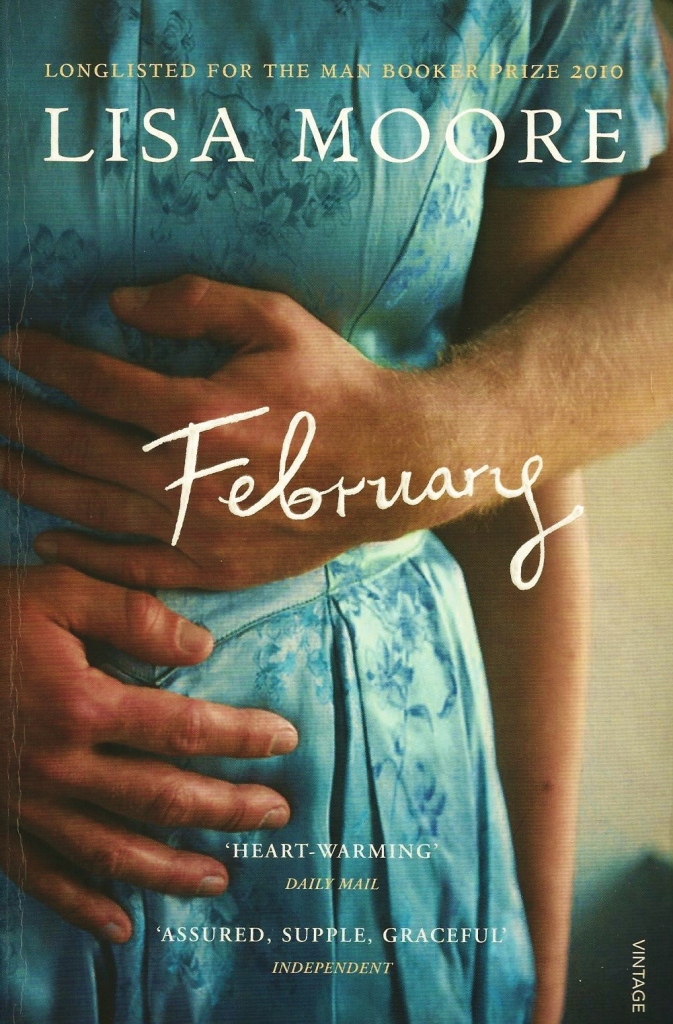
february lisa moore 001February by Lisa Moore ~ 2010. This edition: Vintage, 2011. Softcover. ISBN: 978-0-099-54628-3. 310 pages.

My rating: 9/10.

*****

An intense read. Absolutely impossible to put down.

February is a story about grief and memory and love and people coping with heartbreakingly dire situations the best way they can, which means not always particularly happily or successfully. The novel ends with optimism, but I could not call it happy. It is a keenly observant, uncomfortably bleak, very believable portrait of a woman and her family and their reaction to the brutally unexpected loss of their son, husband and father.

Lisa Moore has written, all clichés aside, a powerful book. Stark, often deeply uncomfortable, occasionally humorous, never maudlin, and, I suspect, one that will be quite unforgettable.

The novel is based on a true Canadian tragedy. On Valentine’s night in 1982, out on the Atlantic Ocean off Newfoundland, the oil drilling rig Ocean Ranger capsized and sank during a violent storm. All eighty-four men on board the rig died in the frigid waters, some apparently within hailing distance of a vessel which was unable to rescue them. The families of the dead learned of the disaster from news accounts on the radio; the oil company made no attempt to notify them.

Helen O’Mara loses her husband Cal that night. She has three young children and is pregnant with a fourth. Life for all of them becomes indelibly marked by their loss in ways both immediate and not always obvious until many years later.

The novel ranges from 2009 all the way back to the 1970s, when Helen and Cal were first married, in a series of memories, incidents, anecdotes, and flashbacks. A second storyline develops along with Helen’s, that of her now-adult son John, who has suddenly found out that he has fathered a child during a casual romantic encounter. As he attempts to come to grips with an adequate response to that situation, his story and that of his mother’s form a two-part composition of major and minor key, mingling and contrasting and bringing different incidents into sharp focus.

I thought this approach worked very well. A few reviewers have noted their irritation at John’s weakness as a character; I found him believable, though not at all likeable. Helen herself comes so vividly to life and we are taken so intimately into her thoughts, that everyone else pales just a bit in comparison. For that matter, I did not particularly like her, or most of the other characters, for that matter; many of their lifestyles are not at all in sympathy with my own, and I frequently caught myself getting all judgemental about some of their choices, but I will say that they all felt true and alive there on the page.

I’m cutting this review short right here, as other duties call, and I want to get it posted prior to this week’s Canada Reads debates on CBC Radio.

Would I recommend this book to “everybody”? No, definitely not.

It is an uncomfortable thing, and I’d want the reader to go in with expectations on high alert. In particular, women with husbands engaged in dangerous lines of work, heads up. This is a book you very likely should read, because it speaks bluntly to the situation and spotlights our every nightmare. The good thing about this is because it is fiction, it allows us to analyze the characters’ emotions and responses in relation to their fabricated stories, rather than agonize too deeply over what we would feel like if it were us instead.

Perhaps because it is one of the most contemporary and personally accessible of the five Canada Reads choices, I felt it was much the strongest. Every book on the list has its unique qualities, but for sheer emotional punch, this one wins hands down.

My ranking as of this evening:

  1. February by Lisa Moore
  2. Indian Horse by Richard Wagamese
  3. Away by Jane Urquhart (Actually, I’m undecided on how to place this one and Indian Horse. They’re running neck and neck, each with different strengths and types of appeal.)
  4. Two Solitudes by Hugh MacLennan
  5. The Age of Hope by David Bergen

I am going to work on completing Two Solitudes tonight and tomorrow, so a response to that one may be forthcoming in the next day or two as well, but no promises.

This is the first time I’ve attempted to read the Canada Reads contenders, and I must say that I have been introduced to novels I would not otherwise have chosen for myself. February I would likely have avoided because of the tragic storyline, The Age of Hope for its mediocre description as a novel of a “woman’s awakening”, and Indian Horse for its declared focus on hockey.

I’m glad I read them all. It will be interesting to see how they all fare in a “contest” situation. They are all quite different, though their universal bleakness is a point in common. So terribly sincere

Read Full Post »

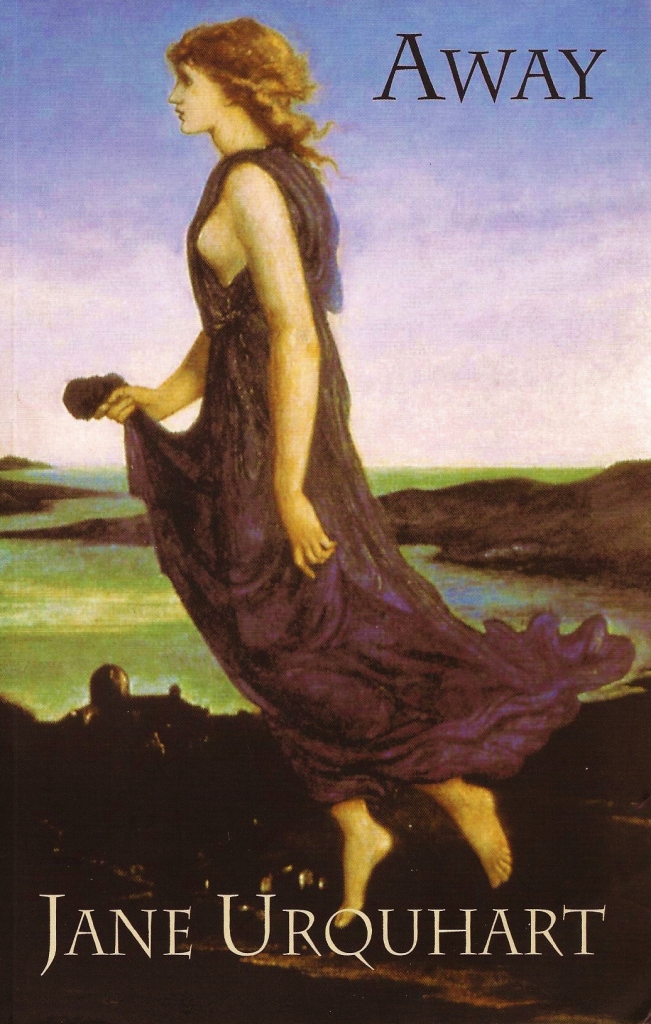
away jane urquhart 001Away by Jane Urquhart ~ 1993. This edition: McLelland & Stewart, 1997. Softcover. ISBN: 0-7710-8650-4. 356 pages.

My rating: 7.5/10

*****

What a beautifully written novel this one is. I am quite in awe of Urquhart’s lyrically gifted writer’s voice. But, I find myself musing, maybe a bit too much of a good thing? There is a story in this book as well, a normal narrative tale about an Irish family’s migration from the Old to the New World, which is in and of itself interesting and compelling, but which loses some of its power because of the gauzy, mystical clouds which the author shrouds her every scene in.

Away is a hybrid of historical fiction and magical realism, both genres which are notoriously hard to master all on their own, let alone in combination, as Urquhart has attempted ambitiously and generally successfully here.  The twin threads in this case do work surprisingly well. But – and here’s my biggest objection – so much is thrown at the reader both plot- and style-wise that it tends to dull one’s appreciation of the more delicate nuances of the intricate prose after a while.

Does one concentrate on the sober narrative for the story, or does one allow oneself to be swept away into the mystical bits? I tried to do both, but it felt an awful lot like work by mid-novel. I’m glad I read Away, because now I can tick it off my Must-Read Can Lit list, and I appreciated it as a work of art, but I’m not sure I will be re-reading it any time soon, if ever. I am definitely open to reading more by Jane Urquhart, but it would need to be at a time in my life when I could block off the necessary uninterrupted time to really concentrate and fully embrace the experience. Not quite sure when this magical time would be, though!

*****

The three most short-lived traces: the trace of a bird on a branch, the trace of a fish on a pool, and the trace of a man on a woman.

                                                                 -an Irish triad

The novel begins at the end of the story, with an elderly woman bidding farewell to her Ontario lakeshore home as it is about to be erased by the relentless expansion of a limestone quarry. As she wanders through the rooms of her doomed house, we see glimpses of artifacts of her life and the lives of her family and her ancestors. The author steps us back in time, one hundred and forty years before and thousands of miles away, to the storm-washed shores of an Irish island, where a teenage girl is about to stumble upon a scene which will mark her and her descendents irretrievably deeply, hence confounding the third line of the triad quoted at the beginning of the tale.

Irish Mary wades into the surf to pull out the body of a beautiful young man, barely alive and about to die. Before he expires, he opens his eyes and whispers a name – “Moira” – which the enchanted Mary embraces as her rightful new own. And when, some time later, Mary-now-Moira is found sleeping in the embrace of the dead man on the beach, she does not respond to the people around her, being lost in a dazed trance. The obvious explanation is that she has been bewitched by a daemon lover, and has lost her true soul, which has wandered “away” into the faery realm. She must be treated with care and compassion, in order that her soul may return to her one day.

Which it does, with the help of the local priest, who also sets her up with a suitably inclined husband, Moira-turned-back-to-Mary settles back into her normal life, though the edges of the other world are always visible to her. Mary has a son, and, when the potato famine inevitably strikes, sets sail for Canada with her husband and child. They go through all of the usual miseries, and fetch up eventually in the vast Canadian forest, where fellow immigrants surreally materialize from the woods to build the new family’s first shelter for them in a sort of dream sequence.

The family is successful in their new life, and a daughter joins the son, but Mary is being called by her other world once again, and one day slips away for good, following the call of the water wherein dwells her spirit lover.

More predictable historically fictional bits follow, as Mary’s children grow into adults and set off on lives of their own. Her son pragmatically moves ahead without bothering too much about the mystical heritage of his mother, but the daughter is a true creature of both worlds, and she finds her own beautiful young man, a charismatic Fenian rebel who has sworn himself to dance out the story of the Irish immigrants’ woes to the politicians deciding their fates. As may be supposed, this all ends most badly, but the line of daughters continues on, until we are back again in the doomed house with the rattlings of the quarry blastings shaking its foundations and its lone last inhabitant, Mary’s great-granddaughter.

*****

Is Away a book all Canadians should read? From the number of high school and college reading lists this one now appears on, it would seem that the powers-that-be would think so.

I don’t.

It’s certainly a gorgeous thing as a piece of literary art, but a rarefied type of read, I suspect best appreciated by those open to the fantastical elements so liberally used here. As a piece of historical fiction, the tale is flawed in that it assumes the reader will be coming to it from a place of prior knowledge, and is perhaps rather unreliable in its narration of actual events. It somehow misses feeling quite real. It could be tough going for many, especially those without the knowledge of context to separate fact from fantasy, or to fully appreciate the inferences the author relies on throughout.

Wonderfully lush and truly lovely, but too rich and paradoxically vague for everyday and everyperson consumption, I’m thinking.

*****

On to Lisa Moore’s February, for which I hold high hopes.

At present, here are my personal picks for the Canada Reads rankings.

For #1 spot, a tie between Indian Horse and Away. I may revise this once I’ve had some thinking time, but I’d better decide quickly, if I want to beat the debates!

Two Solitudes, in its half-read state, follows. It is rather too much of a period piece, but it is not necessarily a bad book, more of a product of its time in its earnest dullness.

The Age of Hope is at the bottom of the pile. It’s a common little thing, engaging and interesting enough, I willingly admit, but not worthy of the Canada Reads top laurels, in my opinion.

Dark horse February may shake things up.

Read Full Post »

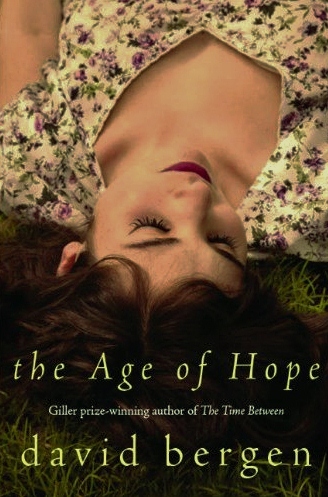
age of hope david bergenThe Age of Hope by David Bergen ~ 2012. This edition: Harper Collins, 2012. Softcover. ISBN: 978-1-44341-136-3. 287 pages.

My rating: 7/10.

A decent enough novel in that it is well written and readable, but is this really the best we could come up with for a Prairies (and “North”) regional choice for Canada Reads?

Here were the other choices for the Prairies and North region:

Okay, then, I guess the masses have spoken. We’ll work with what we’re given.

*****

This book is about my mother. No, seriously. It really is. My mom was born in 1925, to parents newly arrived during the second Mennonite diaspora from Russia, in a rural town in southern Manitoba. The titular Hope was born in 1930, in similar surroundings, and her young womanhood was much the same; the Mennonite Brethren picnics and bonfires for “young people” which Hope attended were a pleasant diversion from the usual round – school, household chores, church and Sunday visiting, potluck dinners and occasional movie nights – all of the trappings of the middle-class North American post-war world.

Hope is the representation of an entire generation of women who lived through one of the most change-filled centuries the world has yet known. Hope and her kindred fellow housewives are an almost extinct breed today; their everyday reality, so common for their generation, is almost completely foreign to the younger generations immediately succeeding them, and the tendency in many circles is to sneer a bit at the banal stay-at-home lives they appear to have lived.

What with the abundant Canada Reads 2013 discussions taking place right now in various literary venues right across Canada, I don’t think I’ll spend too much time going into the storyline of the novel. Here’s the promotional blurb:

Born in 1930 in a small town outside Winnipeg, beautiful Hope Koop appears destined to have a conventional life. Church, marriage to a steady young man, children – her fortunes are already laid out for her, as are the shiny modern appliances in her new home. All she has to do is stay with Roy, who loves her. But as the decades unfold, what seems to be a safe, predictable existence overwhelms Hope. Where – among the demands of her children, the expectations of her husband and the challenges of her best friend, Emily, who has just read The Feminine Mystique – is there room for her? And just who is she anyway? A wife, a mother, a woman whose life is somehow unrealized?

This beautifully crafted and perceptive work of fiction spans some fifty years of Hope Koop’s life in the second half of the 20th century, from traditionalism to feminism and beyond. David Bergen has created an indelible portrait of a seemingly ordinary woman who struggles to accept herself as she is, and in so doing becomes unique.

So this isn’t a proper review of The Age of Hope at all, I’m afraid. I’ll fast forward to my personal views on the book itself, my general feelings about it after having completed it a week or so ago.

Is this a book “every Canadian should read”? In a word, no.

To elaborate: it’s a fine domestic novel, and it does track the country’s historical progress through a good chunk of the twentieth century as a vague background to the progress of Hope, but it doesn’t really say anything terribly important about either the social group Hope was part of, or the country she lived in. There are many quite nicely drawn pictures of the settings and times Hope moved through, but really, she could have lived anywhere. This book could have taken place in any of the towns or small cities of the American mid-west, or the British industrial towns, or the suburbs of Sydney, Australia.

Though I recognized many of the references, because of my knowledge of my mother’s similar background, there is nothing that stands out as marking Hope’s nationality as Canadian. She’s the sub-fusc universal everywife-and-mother, moving in her little cloud of dull angst among the others of her kind. The unquestioning daughters, wives and mothers; the generation who did their duty, were all about self-effacement and not putting oneself forward, not imposing. And though Hope has a good friend who breaks away from the norm, to separate from her husband and live her life as an independent “liberated woman” in the city, Hope gently accepts that as what someone else does; I didn’t get that there was any sort of yearning coming from Hope for the same kind of “escape”. She nods and smiles and listens and plugs along in her same old groove. Which isn’t necessarily a bad thing, and I didn’t much like how it was implied that Hope’s was the less admirable choice. It was a viable option, was it not?

Hope’s mental anguishes, which land her in a psychiatric hospital to undergo shock therapy sessions, are not terribly well presented by the author, though I’m unclear as to what degree that is a deliberate literary choice in order to emphasize the constant dull fog that Hope walks in. It’s either a very clever choice by the author, or sheer authorial laziness.

This book is well written, and I appreciated the author’s stylistic skill. I “got” Hope, and I didn’t think her husband or children were all that unrealistically portrayed – well, except for the 6-foot tall, flagrantly gay, Olympic-athlete daughter – that was a bit of a plausibility stretch, I thought –  but none of them came to life for me. The whole novel had a distance about it, a very hands-off feel. I didn’t hate it, because that would be a strong emotion, and I don’t feel at all strongly about this one.  It’s such a mild drama. And I didn’t like or dislike any single character. I couldn’t care enough to invest my own emotions in any deep way. This is not a good thing in a novel.

I doubt The Age of Hope will have much of a shelf life after its brief prominence as a Canada Reads pick, though it may linger on for a year or two on the strength of that. And from reading this one, I have no urgent, burning desire to explore another work by the same author, though I understand he’s turned out a prizewinner or two. I’ll doubtless pick up his other novels at some point and read them with mild enjoyment, but my expectations are tempered.

Other reviews to peruse:

The Winnipeg Review – The Age of Hope – a generally positive review, highlighting the novel’s strengths.

Quilll & Quire – The Age of Hope  – nailed every negative thing I thought about the story and states them brutally succinctly.

Goodreads – The Age of Hope – a very broad range of opinions, all over the map, as the readers jump into the debate.

*****

With two of the Canada Reads books polished off and mulled over, I’d have to say that at this point Indian Horse by Richard Wagamese is strongly in the lead in my personal race.

I’m currently tackling Hugh McLennan’s Two Solitudes, and finding it rather dull going. It has its moments, but it’s very much a period piece, I’m finding. Perhaps too much so for a universally recommended “must read” choice?

I’m looking forward, though increasingly apprehensively, to the last two books in the Canada Reads Top Five. So far the choices have been just a bit ho-hum.

Read Full Post »

lake of the prairies warren cariouLake of the Prairies: A Story of Belonging by Warren Cariou ~ 2002. This edition: Doubleday Canada, 2002. Hardcover. ISBN: 0-385-25960-3. 318 pages.

My rating: 9/10.

A quite wonderful book, serendipitously unexpected. It’s only (very small) flaw was the very occasional not-quite-so-engaging historical passage, as Cariou delves into some of the histories of his ancestors. A little flat in those spots, a bit too much like sober research. Cariou quickly returned to his engaging anecdotal style. Very close to the perfect 10 of my ideal reading experience.

*****

And it was a real surprise, this one.

It was randomly chosen from the non-fiction stacks in close vicinity to the L.M. Montgomery biographies I was browsing, and I almost returned it without reading, due to the present supremely busy busy-ness of my life. However, quite fortuitously, I had a few minutes to fill while on hold on the phone, and this was the first thing I could reach, so I opened it up for what I assumed would be a mere few moments of casual browsing. Once started, I could not stop. It was much too good to put down unread. It’s taken several days to get through it, reading a chapter here and there, over lunch and tea breaks, but I was never tempted to abandon it, and found it very easy to jump back into each time.

Where do I come from?
 
The potato patch.
God in Heaven.
A falling star.
The stork.
A moonlit night.
A hole in the legs.
You were named for the doctor who delivered you.
 
Where, really?
 
From here. You’re from right here. The town of Meadow Lake, the province of Saskatchewan, the country of Canada, the planet of Earth. Just down the street at the Meadow Lake Union Hospital you were born, and we lived in the Carter Apartments until you were one, and then we moved to this house, and you grew like quackgrass in the backyard.
And that’s the story of you.

A beautifully written personal memoir, and a loving, often very funny, sometimes almost unbearably poignant, but never soppy ode to a town, region, and most importantly, a father and a family. As I was reading I found myself nodding in complete recognition of scenarios so many times. Flipping to the front of the book and examining the author’s information, I was not at all surprised to see that the author was born in 1966, only a year or so later than me; some of his memories of a childhood in rural Saskatchewan are stunningly similar to mine in rural B.C.

I too grew up along the rural fringes of a working class town. Cariou’s Meadow Lake and my own Williams Lake could almost be twin communities, though separated by an immense stretch of Canada. Northern towns, in relation to the cities hugging the 49th parallel, though not, of course, truly northern in a geographic sense, both being situated mid-province. North of us both the true bush country starts.

My town too had its fabulous (in every sense) rodeo, growing from a venue for the local cowboys to show off and celebrate their machismo and skills to another points-and-cash-prizes stop on the long summer tours of the professional rodeo circuit. Timber and ranching built and maintained both of our towns. His town had the Cold Lake military reserve, mine had Riske Creek. His town and mine were – are! –  a mix of “white people” – various European and pan-Asian bloodlines – and “Indians”. Meadow Lake is Cree territory; Williams Lake straddles the Carrier-Chilcotin divide.

The Indian kids chased the white kids in my schoolyard too, chock full of resentment for their demeaned social status of members of the oppressed race, the children of the reserves. Now, forty years later, the whites in both of our towns take open pride in their occasional Indian ancestors, basking in the trendy new cool status of First Nationhood, while in reality not much at all has changed, and the cultural divide betwen the races is as brutally deep as it ever was, with the occasional personal exceptions of individual friendships.

Perhaps this is why I identified so strongly with Cariou’s memoir; the parallels are strong in that and in other ways as well. Even when our general experiences diverged, as they did widely here and there, I remained fully engaged. This writer has a compelling voice.

Discovering as a young man that he was of Metís heritage, Cariou writes of that, and of how it changed all of his perceptions as to who he really was, where he really came from, and it is these passages which seem to have caught the attention of reviewers, making this out to be a book about First Nations identity. It is, and it isn’t.

There is no soapbox here, no grandstand. It remains a deeply personal story, and it feels genuine from start to finish. Those of us “whites” who grew up in similar settings through the ’60s, ’70s, and ’80s know exceedingly well what he is talking about, about our conflicted emotional relationships with the natives whose land we – the ancestral we as the descendants of immigrants and pioneers  – have taken over as our own. The reserve kids huddled at the back of the bus and the classroom, whispering together in indecipherable dialects, peering at the rest of us with well-deserved gleams of pure hatred, and we recognized that,  both the fact of the hatred and the reasoning behind it, and were terrified. Here was something bigger than us as individuals, and older, and more elemental. We’re still pretty scared, us grown-up white people, though we frequently hide it behind carefully political correct words – notice how I am now well-trained to put “Indian” in quotations, even though the “natives” I personally know call themselves “Indians” with no ironic inflection –  and a superficial acceptance and celebration of “First Nations” and “Aboriginal Pride”. Cariou captures that dichotomy brilliantly well.

This is such a small part of the narrative, though it does run through the entire book, as it rightly should. The majority of this memoir is personal reminiscences, gloriously focussed on Cariou’s father, and on the large extended family which sheltered and comforted and challenged and formed its younger generations, sending them out into the world to their various adult destinies with an ever-changing but ultimately supporting familial story behind them. I loved that atmosphere in this book. Cariou lovingly celebrates his family while fully recognizing their flaws, not always an easy task for a writer to pull off. He succeeds.

Here is a short excerpt from an early chapter that made me laugh out loud in joyful recognition. Holey gumboots and bread bags – oh yes, indeed! I have waded joyfully in those as well. “Flamingoed” – brilliant!

We stomped in puddles, waded across ditches, created little rivers between puddles, and sometimes made dams on the trenches that our parents had dug for drainage. We spent most of our time in rubber boots, which were largely ineffectual because either they were full of holes or we waded too deep in the puddles. Sometimes for whole summers we would have to put plastic bread bags on our feet before pulling on our boots. McGavin’s Bread bags were particularly popular for this. But they were prone to leaking, and worst of all, they made your feet slide around inside your boots, which were therefore more likely to slip off at the worst possible moment. The lost boot was a familiar sight: a kid standing one-legged, his bread-bagged foot held out tentatively, balancing himself there and staring back at he empty boot embedded in the muck. It was so common and so comical that we came up with a name for the predicament.

“Andrew flamingoed yesterday in Carlson’s ditch, you shoulda see him there crying for his boot. Lost his sock and his bread back too, and nobody;d get them for him so he had to step in, bare foot and all.”

And here are excerpts from two reviews. This first is by Allan Safarik, from the Books in Canada website.

Warren Cariou’s Lake of the Prairies is a beautifully written memoir about time and place and the nostalgia of a childhood growing up on the edge of the northern prairie in the parkland, a relatively uncelebrated area of Saskatchewan that is mostly dense forests, muskeg, rocky outcrops, marshes and lakes. Cariou’s maternal grandparents were immigrants who came to the harsh country near Meadow Lake and carved out pasture from the raw treed land. His family sank their roots into the place and Cariou grew up with his family legacy, particularly as remembered and influenced by his father, still relatively intact. Cariou is a skillful writer who weaves his father’s anecdotal adventures along with his own to recreate a marvelous pastiche …This is a book about nature as much as about anything. [Cariou] has a powerful lyrical way of describing the atmosphere and the details. He is an observer who is wonderfully educated about nature and as he grows up, he tells about his friendships and his adventures in an increasingly wider realm.

Cariou has given us a personal story about his family, skillfully injecting a second story about the way people live in his community and how they interact with one another. This incredibly crafted Canadian book might be about South Africa or many other countries. But no, this is Canada. Bustling Meadow Lake, Saskatchewan, a small town with big shoulders. Warren Cariou, in his coming-of-age memoir, writes like a naturalist/historian on a mission from God. The result is a distinctive style, a well-paced tale that leaves nothing out. Lake of the Prairie, a superb memoir about place, is also a powerful document about the human condition.

And from a review by Victor J. Raymond, University of Toronto Quarterly, 2004:

Place, family, history, belonging, home. Drawing on such ordinary words, Warren Cariou begins his memoir of growing up in northern Saskatchewan. The stories he recounts seem familiar: fishing, digging for arrowheads, moving to an old farm, learning about one’s family. But there are also deeper truths in these stories, rooted in hidden secrets, lost for generations.

One such story – Cariou’s discovery of his own Metís heritage – is central to the constellation of questions the author raises about identity and knowledge. But there is no thunderclap, no single moment of transition. Cariou’s heritage slowly emerges from his recounting of the stories others tell – his father, his uncles, his aunt, and others in his family. There is little remarkable about his initial self-description; at an early age, he is supposedly from ‘Norwayfrancenglandgermany.’… Interwoven with larger considerations of race and place is the author’s own story of growing up and leaving home. Beginning with his relationship with his parents and uncles, Cariou gradually reveals his own life growing up in Meadow Lake as a youth and then going to university and becoming a writer as an adult. Common life events … help reveal hidden complications of the seemingly easiest questions. Who am I? Where am I from?

Throughout Lake of the Prairies it is this sense of gradual revelation that shapes and reveals the landscape of identity, not only of what you know, but also of what you don’t know about yourself. In that, Lake of the Prairies is itself a story being told about our own identities and how we relate to one another – and we would be wise to listen carefully.

Read Full Post »


1982 jian ghomeshi1982 by Jian Ghomeshi ~ 2012. This edition: Viking, 2012. Hardcover. ISBN: 978-0-670-06648-3. 284 pages.

My rating: 4/10.

Sorry, Jian.

Love the radio show, and you’re a great interviewer, but as far as authoring memoirs goes, well, don’t quit the day job.

*****

Here’s the promotional material that had me all keen to read this memoir by star CBC Radio host Jian Ghomeshi.

In 1982 the Commodore 64 computer was introduced, Ronald Reagan survived being shot, the Falkland War started and ended, Michael Jackson released Thriller, Canada repatriated its Constitution, and the first compact disc was sold in Germany. And that’s not all. In 1982 I blossomed from a naive fourteen-year-old trying to fit in with the cool kids to something much more: a naive eyeliner-wearing, fifteen-year-old trying to fit in with the cool kids.

So writes Jian Ghomeshi in this, his first book, 1982. It is a memoir told across intertwined stories of the songs and musical moments that changed his life. Obsessed with David Bowie (“I wanted to be Bowie,” he recalls), the adolescent Ghomeshi embarks on a Nick Hornbyesque journey to make music the centre of his life. Acceptance meant being cool, and being cool meant being Bowie. And being Bowie meant pointy black boots, eyeliner, and hair gel. Add to that the essential all-black wardrobe and you have two very confused Iranian parents, busy themselves with gaining acceptance in Canada against the backdrop of the revolution in Iran.

It is a bittersweet, heartfelt book that recalls awkward moments such as Ghomeshi’s performance as the “Ivory” in a school production of Michael Jackson and Paul McCartney’s Ebony and Ivory; a stakeout where Rush was rehearsing for its world tour; and a memorable day at the Police picnic of 1982. Music is the jumping-off place for Ghomeshi to discuss young love, young heartache, conformity, and the nature of cool. At the same time, 1982 is an entertaining cultural history of a crazy era of glam, glitter, and gender-bending fads and fashions. And it is definitely the first rock memoir by a Persian-Canadian new waver.

All excited and looking forward to it – I’m a happy Q listener whenever I get the chance, and I too had (have!) a thing for the Thin White Duke – I requested this book for Christmas, and my family tried their best, but it was sold out at the local bookstore. So I was very happy last week to see it on the 7-day express shelf by the library door. (These are popular books available for one-week loan, no renewals. $1 a day for every day over the week, so there’s definitely an incentive to get them back asap.) My week is up on Tuesday, and I’ve made a concerted effort to push through it, but boy oh boy, it was tough going. (On the bright side, my family saved their $30.)

What’s wrong with it, you ask?

One word: Boring.

Boring, boring, boring.

And it wasn’t that Jian didn’t have an interesting teenage life. He did, in a tame sort of middle-class, upwardly mobile, successful immigrant family sort of way. In 1982, the year more or less profiled in this “creative autobiography”, Jian turned fifteen. He was in the throes of young love, was hanging out with a bunch of good friends, and was playing drums in a band – okay, it was the community band, but still… He was listening to all sorts of cool new music, had reinvented himself as a New Wave wannabe, and was having quite a time experimenting with hair dye and styling gel and eyeliner and dressing all in black. He had a loving and supportive family, abundant parental funding, and oodles of positive reinforcement from his teachers and the other adults in his life. He did stuff. He went places. He got into a few interesting situations, and made it through them in one piece. Easily enough stuff to write a memoir about.

A short memoir. A novella-length memoir. Not the almost-300 page thing that I have just gratefully slapped shut. Jian ran every single little incident of that year completely to death. And though it was interesting in bits here and there, ultimately I just couldn’t care.

Small sample of the prose to follow.

I will sacrifice a chunk of my evening and type this out, so you can read a bit and perhaps save yourself the heartbreak of discovering the banality that dwells within the covers of this book. Or, on the other hand, maybe you’ll love it, and wonder why I’m moaning on about the boringness of 1982. The book, that is. Not the year. Because, that would be, like, really tragic. If you like this kind of thing. And then didn’t read it. Because I was, like, panning it. Really badly. For some reason. Yeah.

Oh. No. It is catching. The prose style. You will see what I mean. In a minute. Uh huh.

Okay. Here’s Jian, describing his teenage Ontario home. Or sprinklers. Or middle-aged men. Or all three.

Thornhill was the quintessential suburb. I’ve never lived in any other suburb, but I imagine they all look like Thornhill, with people who act like they did in Thornhill. It was the kind of place where men watch sprinklers on their lawns. Have you ever noticed that men like to watch sprinklers? They do. Or at least, they did. But I think they probably still do.

When suburban men reach a certain age (let’s say, north of thirty-five), they like to stand at the foot of their front lawns and watch their sprinklers distributing water on them. This seems to be a biological need. It may look like a banal exercise, but men take it very seriously. You might expect that these men are involved in another activity while watching the lawn – like thinking. But I’m not so sure they are. I think they’re not thinking. Watching the lawn is like a middle-class, suburban form of meditation for men. It becomes more common as they age. Their heads are empty and they are just watching sprinklers. Sometimes men will rub their bellies while they watch their lawns. Perhaps these men are so tired from a busy week that this is their respite. Or maybe these men feel a sense of accomplishment and worth by looking at their lawns. Maybe, in the moments when their heads aren’t empty, they’re thinking, “This is MY lawn! Look what I’ve done. I’ve got myself a lawn with a working sprinkler! I don’t have to think. My belly feels good. I am feeling my belly.” Maybe that’s what suburban men are thinking…

This goes on, the sprinkler watching monologue, for three pages. It includes a list.

I have made a short list of the lawn sprinklers that were available in Thornhill in 1982:

  • stationary sprinkler
  • rotary sprinkler
  • oscillating sprinkler
  • pulsating(impulse) sprinkler
  • travelling sprinkler

As you can see, there were distinct and varied types of sprinklers to be utilized in the suburbs in the early ’80s…

There are a lot of lists in this book. Many more lists than there were types of sprinklers in Thornhill in 1982. And reading the lists are about as exciting as standing at the bottom of the lawn watching the grass get wet.

Okay, I guess you’ve twigged that I’m pretty underwhelmed by Jian’s little personal saga.

To be fair, it did have a certain time-travel charm; a certain nostalgia factor for those of us who shared that time on the planet with Jian. Yes, we remember Commodore 64s, and rotary dial phones and twisty phone cords, and some of the more intelligible words from the major AC/DC songs. We remember Boy George, and, yes, definitely David Bowie. But we now know, those of us who’ve read your teen years – oops, year – opus, way too much about what went on in your head, way back during the time span of your fifteenth trip round the sun.

Maybe this book is all avante garde ironic, and I’m just not hip enough to appreciate it. Maybe I’m not in the right demographic. It does seems targetted at a younger set of readers, because most of it is all, “Gee whiz, when I was a kid we didn’t have all these iPods and digital cameras and cell phones and stuff. Here, let me tell you about the pathetic technology of 1982.”

But I can’t imagine anyone younger than, say, thirty-five or forty or thereabouts finding it remotely interesting.

Anyone else read this one? Am I completely out of touch? Is is deeply cool and ironic? Or just deeply boring?

*****

I do forgive you, Jian. Just don’t do it again.

No 1983. Please.

(I still like the radio show.)

More reviews:

Goodreads – 1982 by Jian Ghomeshi

National Post – 1982 by Jian Ghomeshi

Read Full Post »

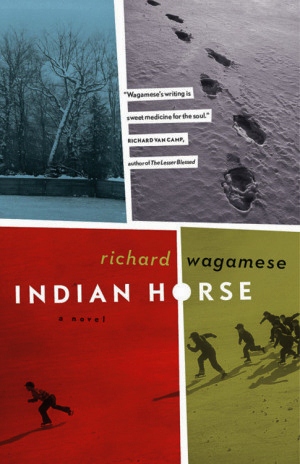
indian horse richard wagameseIndian Horse by Richard Wagamese ~ 2012. This edition: Douglas & McIntyre, 2012. Softcover. ISBN: 978-1-55365-402-5. 221 pages.

My rating: 7.5/10.

*****

Saul Indian Horse, a young Ojibway man in his thirties, has hit rock bottom and is crawling back up. He’s in a detox program after spending six weeks in hospital after collapsing in alcohol-induced tremors on a Winnipeg street. Part of the rehabilitation is bringing out old memories to get to the root of the issues behind the addictions, so Saul is writing down the story of his life.

Going back, waaaaay back, Saul starts with the anecdote about his great-grandfather which led to the family name.

The Ojibway were not people of the horse. Our land existed as an untamed thing, lakes, rivers, bogs and marshes surrounded by citadels of bush and rock and the labyrinthine weave of country. We had no need of maps to understand it. We were people of the manitous. The beings that shared our time and place were lynx, wolf, wolverine, bear, crane, eagle, sturgeon, deer, moose. The horse was a spirit dog meant to run in open places. There was no word for it in the old talk when my great-grandfather brought one back from Manitoba.

The traditional life of Saul’s immediate ancestors is changing, and the horse becomes a treasured and useful part of the tribal economy, pulling trees out of the bush to be floated down the river to the mill where they could be sold for cash, a necessity in the evolving way of things.

The negative side of progress is being felt as well. Children are being rounded up and forcibly taken away to mysterious locations where they are taught the ways of the Zhaunagush, the white people. The residential schools. Some – many – do not return. Those that find their way back are changed beyond comprehension of their parents and grandparents, and many, when they have children in their own turn, are emphatic in their fear of losing their own children to the schools. Saul’s parents were both residential school students, and the family  is constantly on the lookout for the floatplanes and motorboats carrying the armed white men intent on collecting the native children.

Despite their wariness, Saul’s sister Rachel is taken, and his brother Benjamin. Rachel never returns, but Benjamin runs away and finds his way home, though he is so sick from TB that he soon dies. The tragedy of finding and then losing their beloved son is too much for Saul’s parents. Against Grandmother’s pleas, they bundle up Benjamin’s body and set out by canoe to take him to the Catholic priest for “proper burial”.  Saul will never see them again.

Saul is only eight, and helpless to interfere. He and Grandmother are left behind, and as winter sets in and the parents do not return, are faced with a choice: stay in the bush and die during the winter, or travel out to the closest town, where there are relatives who will take them in.

Tragedy follows on tragedy, and Saul is eventually bereft of his grandmother as well; she freezes to death while sheltering Saul with her body. Saul is found and rescued, and is sent to “the school”, the regional Catholic residential school, where he joins the other traumatized native children who are in a state of walking apathy as everything they know is stripped away, and they are forcibly remade into “good, obedient, educated Christians.”

Saul already knows how to read and write in English, as his father had taught him from old schoolbooks, so that culture shock is minimized for him. But he desperately misses his family, and carries within him a core of grief that cannot be healed. Like most of the other children, Saul soon adapts to survival mode, learning how to avoid drawing attention to himself and cooperating in all demands made upon him.

A young priest joins the school the same year Saul is brought there, and his enthusiasm for the game of hockey brings interest and opportunity to the group of boys showing interest and ability. Saul is fascinated by the game, though he is considered too young to play. He sweeps the ice in the mornings, and surreptitiously teaches himself to skate and stick-handle, using to0-big skates stuffed with newspaper and frozen horse turds for pucks.

Of course, Saul is a natural. His progression is predictable, though fraught with emotional and physical challenges. Saul eventually gets too good for the Indian League, and is scouted, reaches Toronto, and plays for a top junior league team. Then it all blows up, as the stress of the constant racism – both brutally blatant and thinly veiled – he comes up against, and his deeply hidden bitterness about his tragic family and cultural losses finally push him over the edge.

*****

Richard Wagamese is an excellent writer, with an easy facility for words. I blazed through Indian Horse in one evening, willingly abandoning myself to Saul’s story. I’m not at all a hockey fan, and the description of this novel as a “hockey story” put me off much more than the residential school angle. My reluctance was needless; the saga of Saul did not require any stretch to understand in any of its elements.

I wonder if both the details of the game of hockey and the horrors of the residential schools are so ingrained into our combined Canadian psyches that we now immediately “get” the references? And does this therefore cushion the impact of a book detailing the atrocities done to First Nations people to a mere cultural reference, even when the author is most obviously a member of that cruelly wronged racial group?

For though I understood the points that the author was trying to wake us up on, I didn’t feel shocked. Nothing he brought up surprised me; the story of Saul is not unique, at least in the residential school survivor aspect. The hockey prodigy bit was where I had to stretch my “willing suspension of disbelief.” The kid was just a bit too awesome and magical through his whole short career. After a while his awesomeness, quite frankly, rather bored me. And then when he snaps, he beats up guys much bigger and stronger than he is, from sheer force of his rage. Yeah, okay. Fair enough. Next.

Wagamese himself says, about Indian Horse:

I think it is wonderful to be included in the top five [of Canada Reads 2013], mostly because it was Canadian readers who got me to the regional finalists and it shows me that they embraced a book that had a very dark, harrowing and hard theme.

I think it gives the opportunity for more clarity for the impact of residential schools on people, not only for the survivors themselves but the inter-generational impact on the children of the survivors. It allows Canadians the opportunity to have an emotional reaction to the story because it’s very direct and deliberately underwritten. It would have been really easy to go over the top and make it even more bleak and harrowing than it is, but my intention wasn’t to shock anybody or to cause anybody anger or anxiety.

The novel definitely didn’t feel over the top to me, though the atrocities are sprinkled liberally throughout. I guess what I’m feeling right now is that I should feel more “anger and anxiety.” What does it say about me, about our societal callousness, that stories such as this, even though fictional, do not stir us in a much deeper way?

Or maybe it’s just me.

I suspect this novel will do exceedingly well in the Canada Reads debates, both official and among the nation’s readers, because the topic is just so darned “politically correct”, especially with all of the recent “Idle No More” protests and rallies. I’m guessing that a collective “white guilt” will soften any criticism as to whether the book actually excels as a novel, a story.

It’s definitely engaging, and thought-provoking, and representative of an important Canadian issue, though I am not convinced it is better than the other four Canada Reads 2013 choices in being chosen as the book all Canadians should read. I’ll have more to say on that once I finish reading the five picks. I’m halfway through book number three. Not done with discussing this one quite yet!

Read Full Post »

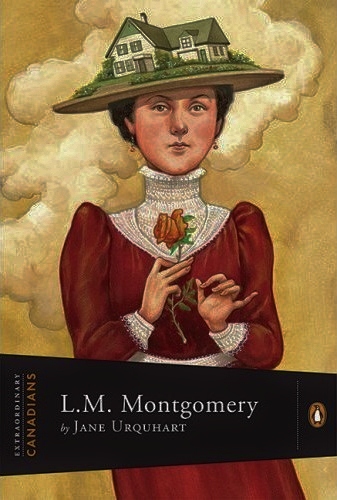
l m montgomery jane urquhartL.M. Montgomery by Jane Urquhart ~ 2009. This edition: Penguin Canada, 2009. Hardcover. ISBN: 978-0-670-06675-9. 161 pages.

My rating: 7.5/10.

A slender little biography which hits most of the high points of L.M. Montgomery’s life and career. Perhaps better as an overview or an introduction versus a definitive exploration of this Canadian literary figure.

A good addition to the many works about this iconic writer. Already familiar with the story of Montgomery’s life, I must say that the most interesting bits, to me, were where the author (Urquhart) writes about Montgomery’s influence on her own development as a writer.

Even if you have read other L.M. Montgomery biographies, Urquhart’s covers the same material in a very readable way, with a dash of creative flair.

*****

In the green master bedroom of a mock-Tudor house in the west end of the grey city of Toronto, a woman in late middle age lies dying, her pale arms almost as white as the sheet on which they are resting. It is April 24, 1942. Her failing body seems to her increasingly heavy, as if pulled by a great weight deeper and deeper into the flesh of the mattress. Outside, the air itself is weighted, saturated with the moisture of seasonal rain. Seeping into the room is the faintly discernible sound of the swollen river as it follows the path of the Humber Valley. The trees beyond the leaded windows have only just begun to show signs of spring.

In spite of what is about to happen, nothing in this room suggests struggle or discomfort: every cell of the woman’s body seems not so much in rebellion against life as dissolving into death, the way the rain outside her door is willingly dissolving into the earth…

The author almost lost me with her opening paragraphs. Urquhart’s biography of Lucy Maud Montgomery had received high praise when it was released several years ago as part of Penguin Canada’s 18-volume Extraordinary Canadians series, but this decidedly fictional opening shook me. Was this merely another “creative biography”? How on earth could Jane Urquhart have known any of these details, unless there somewhere exists a hyper-accurate account of Montgomery’s deathbed? There are no footnotes or references provided to suggest that this is the case.

The account of the expiration of Montgomery, and of her thoughts as she lies dying – the scene goes on for 9 pages – is purely speculative. Beautifully written, of course – it is Urquhart – but fiction.

Though the deathbed passages were pure fabrication, things improved considerably a bit further in. Though she never completely abandoned her occasional creative interpretations of Montgomery’s inner thoughts, those references became increasingly more plausible as Urquhart tells us of her reading of Montgomery’s diaries; we can more easily believe that the actual voice of Montgomery influenced Urquhart.

As I continued reading the biography, I appreciated the difficult task the author of it had taken on, to sort out the facts from the fictions of the life of this complicated, deeply troubled, rather tragically fated woman.

Urquhart cites Montgomery’s loss of her mother as a toddler, her cheerless upbringing by stoic grandparents, a dismal marriage to mentally disturbed husband, and beloved but disappointing children as reasons for her (Montgomery’s) continual efforts at reinvention of her own self through her personal writing. Montgomery’s diaries are known to have been continually edited and rewritten by the author as she progressed through her own life, which, though by no means devoid of joyful occurrences, close friends, and other good things, was so much less rosy than the fictional lives she created for her heroines.

Urquhart is a positively biassed – if occasionally “creative” – biographer in that she obviously admires her subject, and sympathizes with her, and seeks to understand what made her tick.

In spite of countless romantic references to moonlight and starlight in her fiction, and to rooms warmly lit by lamplight and by candlelight, it was shadow, not radiance, that most often claimed her once the sun had set. Her seeming addiction to detailing sunsets and twilights in her writing, if it sprang from anything at all beyond a poetic convention, may have come from a desire to hold on to the fading light. After the sunset came total, wide-awake darkness.

After my shaky initial start, I settled comfortably into reading the book, mentally sorting out the plums of fact from the lovely fictional bits and the author’s very interesting personal anecdotes. It was an enjoyable combination, but I would hesitate to rely on it as my only source of information on L.M. Montgomery’s life. It seems that Urquhart frequently assumes that the reader is already familiar with Montgomery’s body of work beyond the iconic Anne of Green Gables and its array of sequels; it assumes we are familiar with the era and the atmosphere in which the author lived and worked.

Keeping all of these things in mind, I would cheerfully recommend the book for those curious about L.M. Montgomery, and where she was “coming from” when she was crafting her overwhelmingly optimistic stories and novels. Montgomery’s truth, it turns out, is much darker and more compelling than her many fictions.

Read Full Post »

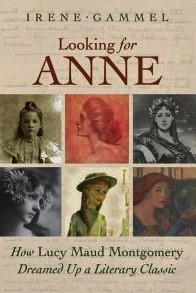
looking for anne irene gammelLooking for Anne: How Lucy Maud Montgomery Dreamed Up a Literary Classic by Irene Gammel ~ 2008. This edition: Key Porter, 2008. Hardcover. ISBN: 978-1-55263-985-6. 312 pages.

My rating: 4.5/10. I certainly wanted to like this book, and I picked it up with optimistic anticipation. Sadly I ended up feeling less than thrilled with my reading experience.

I did like bits and pieces – the factual bits and pieces – and I learned a few things about Lucy Maud Montgomery I didn’t know before, but the disjointed presentation and the frequent “It could have been like this” and “She must have felt like that” and the “I am certain that x was influenced by y, even though I have no proof” soon put me off.

While Irene Gammel is obviously a dedicated researcher and undoubtedly a well-informed Lucy Maud Montgomery scholar, I feel that her presentation of her theories in this book come across as unprofessional because of her continual admitted fabrications and assumptions.

Is it better if she admits it? Here’s a thought – why not stick to the facts? Or else drop the flowery, gushing, pseudo-Lucy Maud “voice”, which served merely to annoy rather than bewitch this particular reader.

*****

The questions Irene Gammel pose as the thesis statements for this book go something like this: What is the mystery behind the writing of Lucy Maud Montgomery’s magnum opus and incredibly successful book, Anne of Green Gables? Why did LMM not document the process of writing Anne much more thoroughly, and, while we’re on the topic, who actually inspired the red-haired heroine?

(Because of course it must have been a real person! There’s no way an author could just dream up a character out of her own head!)

Well, I must admit that such questions have never personally troubled me regarding Anne of Green Gables, a piece of entertaining fiction which I do indeed like a whole lot and which I re-read with deep pleasure every few years. I have always happily accepted that LMM just struck a lucky chord with this one, and that the character Anne was likely an amalgam of various personalities LMM knew in her daily life, with a good dash of artistic creativity rounding out the details.

Does it really matter if we don’t know the exact details of Anne’s origins? Well, it obviously bothered Irene Gammel enough so that she went ahead and assembled a vast array of evidence to support her own theories. Sometimes her enthusiasm carried her away. While the factual passages of this ambitious book are fascinating reading, they all too often degenerate into speculation. The author readily identifies her frequent forays into the imaginary, but they do detract from the value of the research.

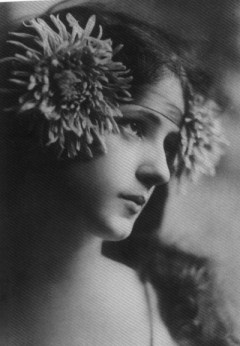
evelyn nesbitGammel theorizes that Anne’s key ancestor was young photographer’s model Evelyn Nesbit, identified many years after the publication of Anne of Green Gables as “the face of Anne” in one of LMM’s journals. I’m including the photo in question for your edification – see left.

Gammel then goes on to speculate about a vast number of other celebrities, acquaintances and fictional characters who might have added their characteristics to embryo Anne as her creator formed her and defined her in writing.

Fair enough, but these are all speculation, as the Gammel admits over and over. She throws out a daunting array of possibilities and mulls each one over in detail, before admitting that she just can’t quite be sure. I ended up feeling like the writing of this book, much like my reading of it, was a bit of an exercise in futility.

I think I’ll end with this. I could go on and share all sorts of annoying examples from the text – as well as some quite lovely and informative passages concerned LMM which are actually documented and provable by genuine references – but I’m full up to here with this one, so this is all my enthusiasm amounts to.

As usual, Goodreads – Looking for Anne has a wide selection of interesting reviews. I am quite relieved to find that I am not alone in my somewhat faint enthusiasm – others appear to feel the same, though there are some fans.

And if you are a serious LMM fan, by all means go ahead and tackle this ambitious personal project – it’s certainly interesting enough, if one can keep focussed – but keep the salt-cellar handy!

On the plus side: Some unusual LMM photographs are included, and the biographer does manage to give a wide-ranging picture of the time in which LMM was working on the book, and the artistic, literary and cultural mood of the era.

Oh – and a little heads-up – speculation as to LMM’s sexual proclivities abound in this one, though Gammel doesn’t come right out and say the “L-word” except to paradoxically refute the insinuation which she herself seems to make. Many salacious references to Sapphic friendships!

Now, to be quite honest, it doesn’t matter to me one whit what LMM’s sexual orientation was, but obviously it matters a whole lot to Gammel, as she teasingly parades this theme throughout the book. It got tiresome.

Read Full Post »

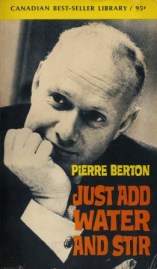
just add water and stir pierre berton 001Just Add Water and Stir by Pierre Berton ~ 1959. This edition: McClelland & Stewart, 1966. Paperback. 221 pages.

My rating: 8.5/10.

*****

Here’s another well-read paperback from my late father’s bookshelves, boxed up and brought home six years ago as my just-widowed, elderly mother was preparing to downsize from a huge, rambling three-story house to a much smaller bungalow. Both homes, incidentally, were built in their entirety by my father, who was a foundation-to-roof master carpenter, among his other jack-of-all-trades and master-of-many accomplishments and interests.

One of his interests was books. Dad did love to read, and I like to think that this collection of mostly humorous, often over-the-top satirical, sometimes sincerely thoughtful short essays made him smile as they did me when I finally read this briskly paced book over the course of this potentially dreary day spent recovering from a brief bout with the latest flu bug.

Being a random collection of satirical essays, rude remarks, used anecdotes, thumbnail sketches, ancient wheezes, old nostalgias, wry comments, limp doggerel, intemperate recipes, vagrant opinions and crude drawings …

So says the front page, and it describes the ensuing contents well. Most of these short pieces appeared as columns in the Toronto Daily Star in the 1950s, and they are definitely indicative of the time in which they were written. As a cynically humorous portrait of the era, this book is an excellent little period piece, but it’s an enjoyable read even for those of us not familiar at first hand with the context of some of the references. Berton’s opinionated prose is seldom dull, and the shortness of each entry makes it good for dip-into reading as well. I read the whole thing in one go, and that likely wasn’t such a great idea, as I’m now feeling a bit light-headed, but I’ll blame that on my current bug as much as on the flippant nature of my reading matter.

The book is arranged into groupings of similarly themed articles and essays. These can be read in order, or sampled at will.

Five Modern Fables ~ Pure over-the-top satire starts us off. Berton skewers modern advertising techniques and ploys in his first three fables, lampoons the vicious cycle of competitive Christmas card lists, and ends with a cautionary tale about not heeding the omens and building too close to the volcano.

Seven Men and a Girl ~ Brief character portraits of eight people Berton met and interviewed: Ex-convict John Brown, pianist Glenn Gould, aviator Russ Baker, evangelist-turned-politician Charles Templeton, Canadian Communist Joe Salsberg, poet and writer Robert Service, entertainer Milton Berle, and call girl Jacqueline (no last name given).A Woman of "Vogue"

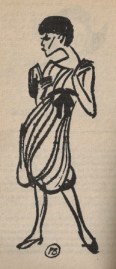
The Wayward Periodical Press ~ “Six periodical publications deserving of comment” – Vogue, Time, Mayfair, Playboy (and the rest of the Bosom Books), Mad, and Justice. What an interesting combination of companions these are. Vogue is, well, Vogue, and it apparently hasn’t changed much at all.

My favourite magazine, next to Screen Stars and Mad, is Vogue. The day it appears, I rush eagerly to the newsstand and, with the help of a couple of weightlifters, lug it off to my den. For sheer escape reading it beats the old Blue Fairy Book hollow. It chronicles a world so foreign and unreal that I would not believe it existed, if there weren’t photographs to prove it.

The women who grace Vogue’s pages are like no women I have ever known. I have tried to sketch one or two of them here, but my brush does not do them justice for their absolute and utter sexlessness defies reproduction. If they came from a far corner of the solar system they could not be more different than the blousy creatures one finds romping through Esquire and Playboy.

Am I all wet in my theory that a bosom craze is sweeping the country? In Vogue, there isn’t a bosom in a carload. These women are all eyes and cheekbones, and they do something with their necks that I haven’t seen since Leona, the Giraffe Girl, went into retirement.

At the end of the neck one finds a face that has overtones of Buchenwald about it – chalk-white and haggard, Vogue women do not have noses, only nostrils. Their eyes are enormous and decadent, their lips are thin and solemn. Their hair is always quite odd. They are shown thrust forward in inscrutable positions that suggest some curious doe-like animal at feeding time.

Time sets off a passionate diatribe in defense of Canadian content in “Canadian” versions of American magazines; Mayfair is a “high society” periodical seething with anachronistic class consciousness. Playboy and the rest of the “men’s magazines” are investigated as to the number and degrees of exposure of female body parts posed artistically for masculine delectation; Berton claims to be overwhelmed by sheer numbers.

The Cult of the Bosom has now reached its zenith in this continent, as a glance at any newsstand will show. In the seventeen magazines I examined, there were 503 photographs of well-endowed young women displaying their endowments.

In 125 of these photographs, many of them in glowing colour, the young ladies’ torsos were entirely exposed. In the remaining 378 photographs there was a certain roguish attempt at concealment.

I did not bother to count any photographs of women dressed for the street, because there were so few.

I did not bother to count any photographs of flat-chested young women, because here were none.

I did, however, make a count of the numbers of photographs of women with no pants on. There were sixty of them.

Mad magazine receives an enthusiastic nod of approval, for the “sophistication of the humour”, while Justice, an arcane periodical dedicated to the practices of sadomasochism and corporal “discipline”, garners strong words of scorn.

The Broadcasting Arts ~ Television and radio – including the already-venerable C.B.C. – come in for their turn in Berton’s critical spotlight.

Verse, Blank and Otherwise ~ Several parodies in verse of current events of the time. The Sixty-Five Days of Christmas struck a modern chord, though nowadays it would need to be retitled The Ninety Days of Christmas to approach a closer accuracy!

Christmas began last Tuesday
Just three days after Hallowe’en,
By which time the big emporiums,
Having disposed of the comic ghosts and candy pumpkins
And having burned all the second-hand witches,
Replaced them with more seasonal symbols:
A reindeer with a crimson nose,
A talking snowman and a terribly cute bear,
Fifty-seven varieties of Santa Claus,
And here and there, an inconspicuous plastic replica of the Christ-child,
 
Entirely non-denominational.
 

Intemperate Recipes ~ A plea for a return to real cooking versus the pre-packaged growing norm in the titular Just Add Water and Stir, and a heartfelt rant against instant coffee, obviously a newly popular abomination in Berton’s world. Plus four quite decent-sounding recipes – or, more accurately, anecdotal instruction pieces on how to best prepare these Berton standbys – Tomato Soup, Baked Beans, Corned Beef Hash, and Clam Chowder. Pierre Berton in the kitchen – what a grand thought!

The Passing Show ~ A satire from the viewpoint of the future, and musings on the status significance of offices and office furnishing, smoking, and divorce. Shopping for a Coffin is thought-provoking and quite serious, while Several Openings for Novels will make the aspiring writer nod in rueful recognition. A few more observations – paying to be published, the confusion of children’s toy assembly instructions, and a modern Red Riding Hood round out this section.

Certain Vagrant Opinions ~ Full rant mode! On Dick and Jane (Berton is against), On Advertising and the Press, On Racial Origins (none of the government’s business), On Thought Control (shades of Orwell’s Nineteen-Eighty-Four), and most passionately, On Flags and Anthem and On Modern Torture (prison reform), which is the most serious piece of the lot, and describes an execution by hanging which Berton was assigned to attend as a young reporter.

Some Old Nostalgias ~ Memoirs, 1927 to 1941, of Berton’s earlier days. Fascinating and charmingly written.

Read Full Post »

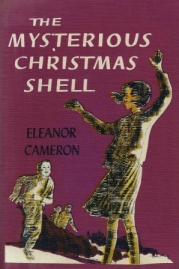
the mysterious christmas shell eleanor cameron 001The Mysterious Christmas Shell by Eleanor Cameron ~ 1961. This edition: Little, Brown & Co., 1961. First edition. Hardcover – Library Binding. Illustrated by Beth & Joe Krush. Library of Congress #: 61-9281. 184 pages.

My rating: 8/10. What a nicely written book this was! It restores my faith in the joys of reading juvenilia, sadly shaken by recent forays into several more modern disappointments in the youth-oriented fiction line.

This one was a recent impulse buy from the ever-changing and happily eclectic selection at the Bibles for Missions thrift store in Prince George. I try to get there once a month or so, and I always come away with a promising mixed bag of reading material. Some goes right back into the giveaway box, but there’ve been some small treasures found there, too.

The cover illustration was what grabbed my attention, though this grubby ex-school-library book showed much evidence of many readers, and was less than appealing at first glance. (It ultimately cleaned up nicely with a triple application of soapy cloth, rubbing alcohol and a tiny dash of benzene – not in combination, I hasten to add, but in delicately selective stages.)

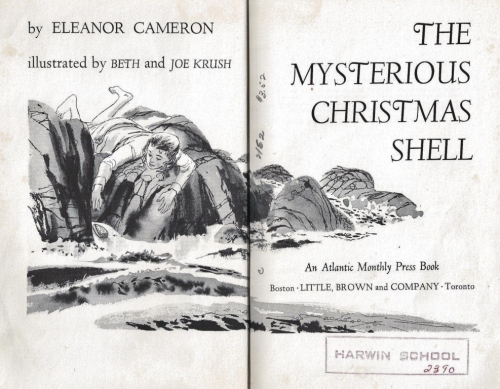
“Those look like Krush children,” I thought to myself, and by golly, my instinct was right. Beth and Joe Krush were a husband-and-wife team of children’s book illustrators working industriously together from the 1950s through the following decades, and their marvelously detailed pen-and-ink-and-wash drawings perfectly depicted the characters of such classics as Mary Norton’s The Borrowers and its sequels, and Elizabeth Enright’s Gone-Away Lake books, among many others.

Here’s a sample. Isn’t this appealing?

the mysterious christmas shell frontispiece eleanor cameron 001

And Eleanor Cameron’s name chimed a little bell, too, though I didn’t really place it until I Googled her after I’d read the book. This is the famed Mushroom Planet creator, though those junior sci-fi fantasies were only one aspect of her widely varied output.

The Mysterious Christmas Shell is very much a plain and simple “domestic adventure” story, and it turns out that it is Cameron’s second book concerning the same brother-sister pair, Tom and Jennifer. Their earlier adventure, The Terrible Churnadryne, was published in 1959.

*****

Five days before Christmas, Jennifer and Tom arrive in the fictional town of Redwood Cove, California, on the Monterey Peninsula, to spend the holidays with their Grandmother Vining, and Aunts Vicky and Melissa. As soon as they walk into their aunts’ house, they realize something is terribly wrong. The tree hasn’t been decorated, the usual garlands are in a heap of green at the foot of the stairs, and everyone has a strained smile; occasionally they catch one or another of the adults huddled in a corner crying.

Turns out that the Vining family has had to sell its treasured piece of ancient redwood-forested seaside property, Sea Meadows, because of the year-ago death of the family partiarch, the children’s grandfather. Some investments have gone wrong, and outstanding debts needed to be paid. The purchaser, a boyhood friend of the family, was thought to want to keep the property unspoiled, to be the site of a single home, but recently troubling word has come that there will instead be major development. Hotels, a shopping centre, and a vacation community are planned; many of the ancient trees will be coming down, and No Trespassing signs will be going up barring the locals from their most pleasant seaside beaches and coves. The local townspeople are up in arms, and are angry at the Vinings for the sale; the Vinings are distraught at the prospective destruction of their well-beloved redwood forest.

An offer to re-purchase the property from the developer has been turned down, and a prospective reprieve of sorts has not come about. Grandfather Vining had intended to change his will to transfer Sea Meadows to the state as a nature reserve, but no one has any record of the will being registered, and no one knows if the envelope containing it was actually sent. If the will was indeed written, it would effectively cancel out the subsequent sale, and the property would go to the state once the buyer’s money was refunded. This seems like a way out of the dilemma, but where, oh where is the will?

As Jennifer and Tom ricochet around Redwood Cove looking for clues, we get a vivid picture of a large, loving family, each member trying to do the best for the others, though occasional misunderstandings occur.

The physical description of the California coastline, with its sea caves and pocket-handkerchief beaches, its tide pools and their glorious variety of sea life, is wonderfully well done; it is obvious that the author held the area in deep affection.

I do have an extra special reason for loving this story, having spent some weeks every year in California as a child, visiting grandparents, aunts, uncles and cousins in the Fresno area, and travelling out to San Jose, Monterey, and Carmel-by-the-Sea to visit family friends and to explore the still-unspoiled seashore along the more remote stretches of coastline. I even had my own similiar near-brush with death, once being washed out into the surf by a rogue wave; my father’s heroic rescue has become a piece of family folklore, and I blame my deep but reasonably well-disguised unease about any body of water much deeper than my knees on that terrifying childhood experience. Tom, Jennifer and Aunt Melissa’s being caught in the waves of the incoming tide sent chills down my spine! I could feel the sand burns …

The familiar setting was a marvelously unexpected surprise, but putting aside nostalgia and concentrating on the writing, I must say I was impressed by the quality of the prose, and by the author’s fine story-telling ability. While this is one of those stories where nothing huge really happens, with the adventures being small ones, and the solution to the mystery very apparent to the reader from early on – the Vinings, on the other hand, struggle on for strangely long time figuring out their clues – I found I couldn’t put the book down until the satisfyingly happy (though rather improbable) ending.

A grand vintage read for adults of a certain age wishing to revisit their youth through the pages of a book, though I’m not sure how much it would appeal to our more sophisticated 21st Century children.

Despite the Christmas-time setting, this is not really a Christmas book as such, though a glass tree ornament from Innsbruck plays a major part. Oops – just gave away a clue!

It was enjoyable to read about Christmas preparations in a place far from snow, and that brought back memories, too. We only spent one Christmas in California when I was a child, as most of our travelling took place in the early spring and the fall, but I remember how surreal it was that one time to be singing carols under the palm trees, with roses still blooming and lemons on the trees in my grandmother’s garden, while back at home, in interior British Columbia, icicles reaching the ground were our parting memory as we’d pulled out of the yard for the marathon three-day drive southwards. (Somewhere I have a picture from that trip of me and my sister standing, in our matching velvet-collared coats, in front of a huge Christmas tree at Disneyland, which was ornamented by coloured glass balls as large as our heads.)

This is an author decidedly worthy of further investigation. Investigating the titles and plots of some of her non-sci-fi “realistic” children’s/teens’ novels, I strongly suspect that I read some of those when I was in grade school, as two or three of the unusual plots sound very familiar, but The Mysterious Christmas Shell was an unfamiliar, unexpected and most welcome find, for all of the reasons detailed above.

*****

Oh – one more serendipitous thing. Eleanor Cameron turns out to be Canadian! She was born in Manitoba, and though she subsequently lived most of her life in California, she is widely identified in all of the material I was able to find online as a Canadian. So – another one, completely out of the blue, for the Canadian Book Challenge!

Read Full Post »

« Newer Posts - Older Posts »