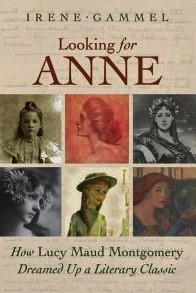
 Looking for Anne: How Lucy Maud Montgomery Dreamed Up a Literary Classic by Irene Gammel ~ 2008. This edition: Key Porter, 2008. Hardcover. ISBN: 978-1-55263-985-6. 312 pages.
My rating: 4.5/10. I certainly wanted to like this book, and I picked it up with optimistic anticipation. Sadly I ended up feeling less than thrilled with my reading experience.
I did like bits and pieces – the factual bits and pieces – and I learned a few things about Lucy Maud Montgomery I didn’t know before, but the disjointed presentation and the frequent “It could have been like this” and “She must have felt like that” and the “I am certain that x was influenced by y, even though I have no proof” soon put me off.
While Irene Gammel is obviously a dedicated researcher and undoubtedly a well-informed Lucy Maud Montgomery scholar, I feel that her presentation of her theories in this book come across as unprofessional because of her continual admitted fabrications and assumptions.
Is it better if she admits it? Here’s a thought – why not stick to the facts? Or else drop the flowery, gushing, pseudo-Lucy Maud “voice”, which served merely to annoy rather than bewitch this particular reader.
*****
The questions Irene Gammel pose as the thesis statements for this book go something like this: What is the mystery behind the writing of Lucy Maud Montgomery’s magnum opus and incredibly successful book, Anne of Green Gables? Why did LMM not document the process of writing Anne much more thoroughly, and, while we’re on the topic, who actually inspired the red-haired heroine?
(Because of course it must have been a real person! There’s no way an author could just dream up a character out of her own head!)
Well, I must admit that such questions have never personally troubled me regarding Anne of Green Gables, a piece of entertaining fiction which I do indeed like a whole lot and which I re-read with deep pleasure every few years. I have always happily accepted that LMM just struck a lucky chord with this one, and that the character Anne was likely an amalgam of various personalities LMM knew in her daily life, with a good dash of artistic creativity rounding out the details.
Does it really matter if we don’t know the exact details of Anne’s origins? Well, it obviously bothered Irene Gammel enough so that she went ahead and assembled a vast array of evidence to support her own theories. Sometimes her enthusiasm carried her away. While the factual passages of this ambitious book are fascinating reading, they all too often degenerate into speculation. The author readily identifies her frequent forays into the imaginary, but they do detract from the value of the research.
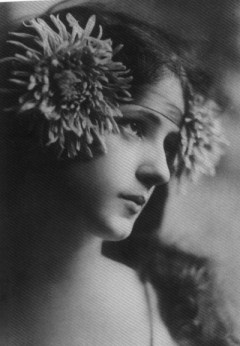 Gammel theorizes that Anne’s key ancestor was young photographer’s model Evelyn Nesbit, identified many years after the publication of Anne of Green Gables as “the face of Anne” in one of LMM’s journals. I’m including the photo in question for your edification – see left.
Gammel then goes on to speculate about a vast number of other celebrities, acquaintances and fictional characters who might have added their characteristics to embryo Anne as her creator formed her and defined her in writing.
Fair enough, but these are all speculation, as the Gammel admits over and over. She throws out a daunting array of possibilities and mulls each one over in detail, before admitting that she just can’t quite be sure. I ended up feeling like the writing of this book, much like my reading of it, was a bit of an exercise in futility.
I think I’ll end with this. I could go on and share all sorts of annoying examples from the text – as well as some quite lovely and informative passages concerned LMM which are actually documented and provable by genuine references – but I’m full up to here with this one, so this is all my enthusiasm amounts to.
As usual, Goodreads – Looking for Anne has a wide selection of interesting reviews. I am quite relieved to find that I am not alone in my somewhat faint enthusiasm – others appear to feel the same, though there are some fans.
And if you are a serious LMM fan, by all means go ahead and tackle this ambitious personal project – it’s certainly interesting enough, if one can keep focussed – but keep the salt-cellar handy!
On the plus side: Some unusual LMM photographs are included, and the biographer does manage to give a wide-ranging picture of the time in which LMM was working on the book, and the artistic, literary and cultural mood of the era.
Oh – and a little heads-up – speculation as to LMM’s sexual proclivities abound in this one, though Gammel doesn’t come right out and say the “L-word” except to paradoxically refute the insinuation which she herself seems to make. Many salacious references to Sapphic friendships!
Now, to be quite honest, it doesn’t matter to me one whit what LMM’s sexual orientation was, but obviously it matters a whole lot to Gammel, as she teasingly parades this theme throughout the book. It got tiresome.









 Leaves & Pages