Posts Tagged ‘Biography’

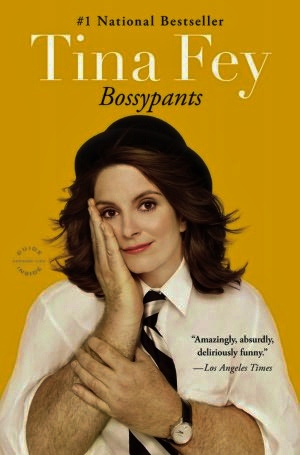
Bossypants by Tina Fey ~ 2011. This edition: Little, Brown & Co., 2012. Softcover. ISBN: 978-0-316-05687-8. 275 pages.

My rating: An easy 9/10. Loved it! Some parts are literally laugh out loud funny. Whips right along – a most enjoyable memoir of the childhood, teen, college and early career years of this exceedingly witty lady, up until the time of her notorious portrayal of Sarah Palin on Saturday Night Live.

*****

Picked this one up for a paltry dollar at the Sally Ann, shortly after I spent a happy ten minutes browsing it in front of its full-price display in one of the mega-marts. I couldn’t quite bring myself to spend the $17.50 sticker price, though I was seriously tempted, so finding it a few days later virtually free was one of those happy little serendipities of haunting the less posh side of the shopping world.

The first half of the book, the childhood-teen-college year memoirs, when Tina Fey was something of a self-described social outcast and romantic failure, is actually quite poignantly sad behind its comic mask. There is something – the only thing –  to be said for having a tortured school life; often it brings out the inner drive to “show them” that leads to stellar success later in life; the bitterness can be usefully channeled into humour, and Tina Fey does that perfectly. She keeps it from being mean-spirited, and I admire her for that; that line is a fine one.

I have only seen Fey’s Palin impersonation in short clips, not having actually owned a television for something over twenty years, but I saw enough to appreciate how darned good it was. The latter part of the book is very focussed on that charade, and I must say Palin herself comes out of it sounding much more likeable than I’d expected. Sarah Palin makes me shudder in real life, in so many ways, but after reading about how graciously she handled being parodied in full prime time view, I get a bit of what her admirers see in her. A very small bit, but it’s there. So Fey has done Palin something of a favour by her mocking portrayal, in my opinion.

This is a keeper; I’ll definitely read it again, which is saying a lot because I tend to be quite out of step on pop culture as a whole, and reading about people you aren’t a particular fan of, or even have much knowledge of, can be a bore. Not guilty in this case. Thumbs up; good read.

Bossypants Review – Time Magazine

Bossypants Review – New York Times

And of course, the Goodreads page, with a gazillion reviews.

Read Full Post »

Adventures of a Botanist’s Wife by Eleanor Bor ~ 1952. This edition: Hurst & Blackett Ltd, 1952. First edition. Inscribed by the author. Hardcover. 204 pages.

My rating: 5.5/10. Not a poor book, exactly, but not what I had hoped for, hence the low rating.

*****

A rare disappointment, this book. It had all the hallmarks of a find: rich red and gold vintage hardcover binding, gorgeous maps on front and rear end papers, photographs and line drawings by the author throughout, and an extremely promising first paragraph:

When I married, in 1931, a member of the Indian Forest Service I brought with me as a dowry two table-cloths and a bull terrier. Apart from these possessions I was a portionless bride. As his own contribution, the bridegroom brought with him a large number of books, a torn pink cotton curtain and two spaniels. Also a trouser press used for pressing botanical specimens. And some camp equipment.

How could one resist?

I had hoped for a fairly detailed account of the author’s travels with her husband through the Himalayan foothills, with lots of descriptions of the flora of the region. “Botanist’s Wife”, right? While Eleanor was obviously aware of the natural beauties of the region, she seldom describes the flora in the kind of detail I was hoping for – “a meadow of primula and gentians” is about as much as she ever says, except for a quite detailed description of a Sapria species, a type of carrion-scented flower, which was once used to decorate her bedroom by her native servants, in the mistaken belief that she and her husband, famed Irish-born botanist Norman Loftus Bor, would find it delightful – Norman had raved over a prime specimen earlier in the trip, but the foetid odour of the bloom was not at all pleasant in close quarters!

This “autobiography” does not go into much detail of the sort that makes such accounts so potentially vivid and interesting. It is something of an arm’s length travelogue, with Eleanor often commenting a bit distastefully on the hygiene (or lack thereof) of the natives of the area she happens to be passing through. To be fair, she also comments on their favorable aspects, but it is a very much “we” and “them” account.

Where she unbends the most, and where we see glimpses of her true passion, is when she talks about her beloved pet dogs – a bull terrier and several spaniels – which travelled with her, occasionally on horseback, and required an inordinate amount of special arrangement to feed and care for in a region known for its high incidence of rabies, as well as various toxic plants, predatory animals, and various nasty insects and internal parasites. Having no children, it would appear that Eleanor’s maternal affection was lavished on her pets.

This short memoir’s greatest value is that it is something of an intriguing – albeit limited – picture of the wilderness areas of northern India and southern Tibet in the time between the wars, and into the World War II years, when Norman left the forest service and was engaged in some sort of secret war work which we are never enlightened on.

I found that I had a difficult time fully engaging with the narrative. The writing is quite stilted, and throughout there are numerous very promising beginnings of anecdotes which are left hanging with no resolution or conclusion, resulting in my frequently paging back to see if I’d missed something. I never had – it just wasn’t there.

I suspect the reality of Eleanor’s life was much more interesting and varied than she was able to communicate in this book. She appears to have an excellent relationship with her husband, and numerous long-enduring friends throughout the region of her Indian travels and, indeed, throughout the world. There is a picture of the author standing next to Jon Godden (novelist Rumer Godden’s sister) and two of the “seven kings of Rupa” which is never referred to in the text, though the seven kings themselves are discussed. Was Eleanor a friend of Godden’s, or is this merely a “tourist snapshot”?

Eleanor very wanted to be a published author; she relates that she was continually writing, but hesitated to describe herself as a writer to acquaintances because she had not had anything published.

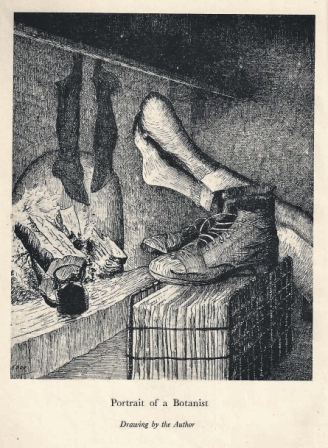
She was also a striving amateur artist; her drawings, six of which are reproduced, are capable but not particularly “good” – they look like the work of a hard-working, conscientious student – much care is taken with detail and cross-hatching, but something is a little off in perspective; they look somehow a bit lifeless.  The lovely end paper maps were drawn and illustrated by Ley Kenyon; Eleanor’s painstakingly stiff drawings suffer by the comparison.

The best and to me the most appealing of Eleanor’s efforts is this illustration used in the book’s frontispiece; it made me smile and soften somewhat in my criticism toward’s her authorial failings. She tried hard and did the best she could. And as this book shows, she did succeed in her quest for publication.
Would I recommend this book?

No, I don’t think I would, unless the reader is specifically interested in the ethnic groups and fast-changing lifestyles of the people of the area during the 1930s and 1940s. The author’s perspective might be a good addition to more detailed observations.

As an autobiography, it is not one of the better memoirs I have read, though I must repeat that it is not a “bad” book; it’s just that I had hoped for so much more. I will likely keep it for its curiousity value, to slip in beside E.H. Wilson’s Naturalist in Western China as an addendum of sorts to his vastly superior work written earlier in the century.

Read Full Post »
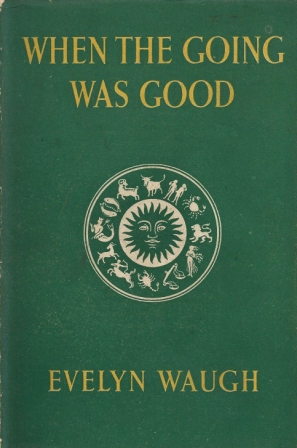
When the Going was Good by Evelyn Waugh ~ 1946. This edition: The Reprint Society, London, 1948. Hardcover. 314 pages.

My rating: 7.5/10. Held my interest throughout.

I’m not even sure where I picked this one up – it appeared in a stack of books gathered in this summer’s travels through B.C. I’m thinking either Kamloops or Vernon, though there is no price and bookseller code marked anywhere on the flyleaf. Possibly from the Sally Ann or a similar charity shop? No matter what it’s provenance, I’m most glad I’ve added it to my private collection. A most enjoyable read, consumed in goodly portions each evening for the last week just before closing my eyes.

*****

From the inner dustjacket:

About this book

It comprises all that the author wishes to preserve of the four travel books he wrote between 1929 and 1935: Labels, Remote People, Ninety-Two Days, and Waugh in Abyssinia. “These four books,” he writes, “here in fragments reprinted, were the record of certain journeys, chosen for no better reason than I needed money at the time of their completion; they were pedestrian, day-to-day accounts of things seen and people met, interspersed with commonplace information and some rather callow comments. In cutting them to their present shape, I have sought to leave a purely personal narrative in the hope there still lingers round it some traces of vernal scent … I never aspired to be a great traveller, I was simply a young man, typical of my age; we travelled as a matter of course. I rejoice that I went when the going was good.”

It’s vintage Waugh, and it’s well-written, the author’s disclaimers aside. Some of it is excellent; it’s all very readable, and it made me brush up on my history; Waugh was of course writing for a contemporary audience, and though I was pleased to realize his references were easy to place, I was quite vague on the details.

Here are the contents:

Preface

From 1928 until 1937 I had no fixed home and no possessions which would not conveniently go on a porter’s barrow. I travelled continuously, in England and abroad… We have most of us marched and made camp since then, gone hungry and thirsty, lived where pistols are flourished and fired. At that time it seemed like an ordeal, an initiation to manhood…”

Chapter One: A Pleasure Cruise in 1929 (From Labels) – London, Paris, Monte Carlo, Naples, Catania, Haifa, Cana (Galilee), Port Said, Cairo, Malta, Crete, Constantinople, Athens, Corfu, Gibraltar, Seville.

Chapter Two: A Coronation in 1930 (From Remote Peoples) – The coronation of Ethiopian Emperor Ras Tafari at Addis Ababa.

Chapter Three: Globe-Trotting in 1930-1 (From Remote Peoples) – Zanzibar, the Congo, Aden, Kenya (Nairobi, the Rift Valley), Tanganyika, Cape Town.

Chapter Four: A Journey to Brazil in 1932 (From Ninety-two Days) – Guiana and Brazil.

Chapter Five: A War in 1935 (From Waugh in Abyssinia) – The Italian invasion of Abyssinia, from a war correspondent’s perspective. Farce versus bloodshed.

*****

If you happen across this little account in your own travels, it is worth the time to read, especially if you are already a Waugh convert.

Read Full Post »

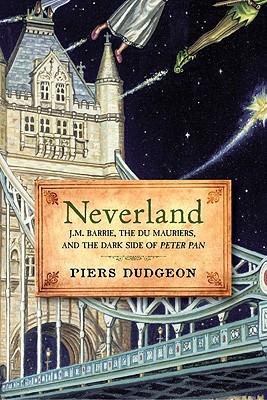
Neverland: J.M. Barrie, the Du Mauriers, and the Dark Side of Peter Pan by Piers Dudgeon ~ 2009. Originally published as Captivated: J.M. Barrie, the du Mauriers and the dark side of Neverland in Great Britain, Chatto and Windus, 2008. This edition: Pegasus Books, 2009. Hardcover. ISBN: 333 pages.

My rating: This is tough. I think 4.5/10. It certainly held my interest, but I have some issues with how the author presented some of his more far-fetched speculations as fact, without any of the language needed to make it clear that some conclusions were very much fabricated by the biographer. Not “good science”, if you get my meaning. Extra points for the vast amount of research that obviously went into this project. Points off for the blatant speculation, sometimes admitted to by the author, that makes “truth” out of shreds of fact.

*****

This was a recent library loan, picked up on a whim because of the du Maurier reference. I hadn’t realized there was any sort of connection, so was quite intrigued by the subtitle. And oh my gosh – what a can of worms this turned out to be.

It’s on the library stack for return today, so this will be a very brief summary.

In short, the author, Piers Dudgeon, has detailed the secret (or maybe not so secret?) obsession by the esteemed and exceedingly successful J.M. Barrie for the family of Arthur Llewelyn Davies and his wife, the former Sylvia du Maurier, and especially their five sons: George, John, Peter, Michael, and Nicholas. Whether the attraction was merely that of fascination for a vibrant and beautiful family, or whether the eventual focus on the five young boys was more sinister in nature, there was a decidedly – how shall I put it? – “focussed” situation going on there. After Arthur’s death of cancer in 1907, Sylvia leaned heavily on the family friend Barrie; her own tragic death three years later left the five children, then aged approximately from seven to seventeen, under the guardianship of Barrie, who, as “Uncle Jimmy”, became even closer in the pre-existing relationship to something of a foster-father.

All of this is clearly documented and not particularly newsworthy, but Dudgeon goes deeply into speculation and conjecture here about Barrie’s infatuation with the Llewelyn Davies family and the du Mauriers. Aside from the predictable insinuations about pedophiliac tendencies in Barrie, something that I was aware of, having read numerous references over the years to his infatuation with the real-life model(s) of his never-aging creation Peter Pan, Dudgeon goes even further into the murky psychological waters, claiming a sort of extra-sensory perception and an ability for “ill-wishing” that spelled doom to anyone upon whom Barrie became fixated. Dudgeon openly implies that Barrie had a hand in the deaths of Arthur and Sylvia L-D, as well as in the suicide of one of the boys as a young man, the death in action of another in World War I, and the suicide of a third as a middle-aged man.

Dudgeon goes out even further on his shaky limb and seems to claim that Daphne du Maurier in particular was deeply influenced by Barrie’s role in her life, and that her books reflect his deep (claimed by Dudgeon) importance in her world. Barrie did indeed come into (occasional) quite close contact with Daphne in her younger years, but I feel that Dudgeon has strongly overstated his influence, seeking to justify his own obsession with the “demonization” of Barrie.

I can easily believe Barrie was a man of morbid and unhealthy obsessions, though the muted accusation of  pedophilia has been emphatically denied by the very people who should know, the Llewelyn Davies sons themselves.

All in all, a rather disturbing read, in more ways than one. I’m not sure how reliable Piers Dudgeon’s conclusions are, though much of his research is quite fascinating when viewed with a disinterested eye. I certainly can’t recommend this book as the definitive account of Barrie and the Llewelyn Davies family, and definitely not as a Daphne du Maurier reference – I felt this was the most contrived part of the whole production. All I can say is that if you’re interested (and it is interesting to speculate and delve into Barrie’s dark world, behind the glitter of the stage productions) you should perhaps look into some more reviews – lots to choose from out in the cyberworld –  to get a clear idea of Dudgeon’s own infatuation with his theory, and then read away with an open mind.

A good place to start is here, the New York Times book review by Janet Maslin from October 25, 2009.

Read Full Post »

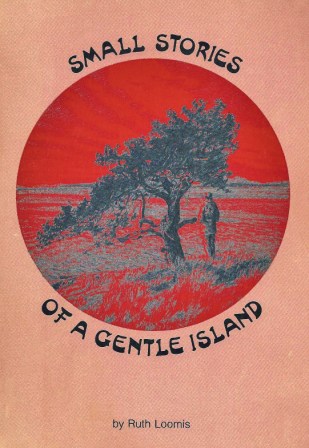
Small Stories of a Gentle Island by Ruth Loomis ~ 1986. This edition: Reflections, Ladysmith, British Columbia, 1986. Illustrated by Carol Evans. Softcover. ISBN: 0-9692570-0-7. 96 pages.

My rating: 7.5/10. I enjoy re-reading up this slight volume of memoirs every few years, and I suspect it will always remain in my permanent collection of British Columbia books. I do wish it were a bit longer; many of the stories stop short, leaving the reader yearning for more. Ruth Loomis doubtless has a fount of knowledge and stories of this area; I would be thrilled to read a longer, more in-depth volume going into more detail. A very personal memoir, this one, and one almost feels as if one were eavesdropping on a private conversation. Well done.

*****

In 1952, young and newly married Ruth Loomis moved with her husband from bustling Seattle to small Pylades Island in the Strait of Georgia, between Vancouver Island and mainland British Columbia. Here an alternative lifestyle moved from dream to reality. A home and garden were established, two babies born, and the challenges and joys of a life intimately connected with the sea and nature were embraced.

Time moved on, and twenty years later the marriage dissolved and the island was left behind. This was shortly followed by the tragic death of Ruth’s eldest daughter, and, after trying to cope with her multiple sorrows by immersing herself in the busy mainland world, Ruth decided to go back to the island alone.

She lived there until 1985, when she left for the last time. Pylades was sold, and Ruth moved to Vancouver Island. This book is a collection of reminiscences and a loving farewell to the dream and the reality.

A slender volume, only ninety-six pages, but it captures the essence of one woman’s thoughts and feelings about a very unique time and place. Having recently returned from a Vancouver Island visit, and after having leaned on the railings of the ferry crossing the Strait, yearning romantically for a chance to explore those wave-surrounded rocky isles glimpsed all too briefly in the ship’s swift passage, I sought out this book on my return. The smell of sea and cedar seem to waft from its pages, among other evocative aromas.

The Gulf Islands are famous for their free spirits and willing experimenters with various relaxants and hallucinogens, and it is apparent from this memoir that Ruth was no exception; some of the vignettes are very much tinted with a haze of unreality, though most are straightforward stories. There is a strong vein of melancholy and sorrow throughout, though it is balanced by remembrances of joy and healing.

In her Introduction, Ruth says

I survived, discovering that life has a healing balm alongside its searing forces. I needed time, time to feel my past dissolve into the present. That love of now Pylades gave, with its interplay of seasons and sea-life. The fantasy that I controlled my life vanished. I became interested in the essence of creation, slowly realizing I was not separate but part of it. Others occasionally came to this gentle island who needed time too, whether a few hours, days or months which Pylades gave.

The stories follow a chronological path, from 1957 to 1986, allowing brief and vivid glimpses of moments now lost in time. Along with the poignancy and the regrets there is plenty of humour and thoughtful musing. This is a slender little volume, an hour or two’s reading, but the stories stay in one’s head long after the book is put back on the shelf.

The Visitor ~ 1957

Butter Money ~ 1959

Today, Tomorrow and the Brother ~ 1961

Fog ~ 1968

Five Days of Nina ~ 1970

Appointment with God ~ 1974

Squatters ~ 1975

Susanne ~ 1978

Mushrooms and the Renaissance Man ~ 1979

Play with the Dolphin ~ 1980

Eagles ~ 1984

The Last Season ~ 1985

B.C. readers, keep an eye out for this one in secondhand book stores. If you find it, open it up and spend a few minutes in Ruth’s lost world, and perhaps give it a home on your own shelves among other records of our past.

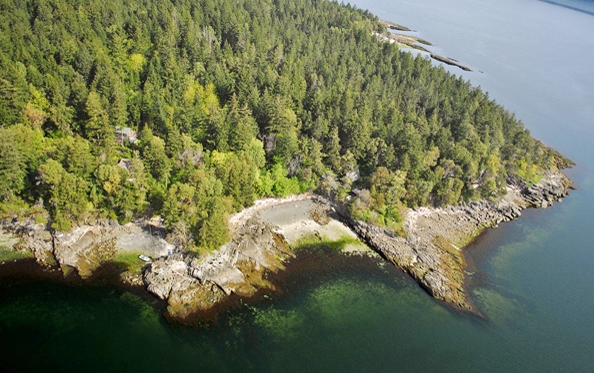
A postscript. We were curious about the eventual fate of Pylades Island, and did a bit of internet research. Pylades was on the market again  in 2009, and a lot comprising half of the island, with Ruth’s derelict old home on it, had just sold for something like $2,400,000. I hope Ruth profited to a like degree upon her departure. Here are several picture taken at the time of that sale. Dream away!

Read Full Post »

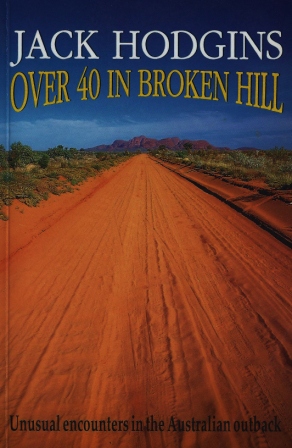
Over 40 in Broken Hill by Jack Hodgins ~ 1992. This edition: McClelland and Stewart, 1992. Softcover. ISBN: 0-7710-4192-6. 197 pages.

My rating: 8.5/10. Unpretentious and good-humoured, without stooping to farce. Jack can, as needed, poke a bit of fun at himself, but he keeps his self-respect and extends that regard to others.

*****

This is a book without a Great Big Purpose, which is too often rare in a travel book, into which category this work mainly falls. Over 40 is a rather elegantly presented account of two writers on the loose in Australia. One, Australian novelist Roger McDonald, is researching his next book, a non-fiction account of the politics and conflicts between New Zealand and Australian sheep shearers working the vast outback flocks, and the other is our own British Columbian Jack, tagging along with his friends and colleague for the four-week trip.

Jack finds himself taking notes throughout the journey, and ends by writing his own account of the fascinating people and unique places the two encounter. Quirky, often humorous, fair-minded and very readable. I enjoyed this travel memoir.

Jack Hodgins is well-known in B.C. literary circles for his fiction, from his now-iconic short story collection Spit Delaney’s Island in 1976 to his most recent novel, The Master of Happy Endings in 2010. Over 40 in Broken Hill was something of a departure from the fictional norm of this author, but it worked for me.

I’ve read a number of this author’s works over the years, and think very highly of his distinctive style. (He reminds me a bit of Robertson Davies, but without the aura of intellectual snobbery that Davies sometimes projects.) I am not alone in this regard, as Jack Hodgins was awarded an Order of Canada in 2010 for his lifetime contribution to Canadian literature. An author well worth exploring, if you are not already familiar with him.

Side note: The “40” referred to in the title has a double meaning. Think age, and then think degrees Celsius. There is a chapter midway through the book that clarifies the reference most engagingly.

Read Full Post »

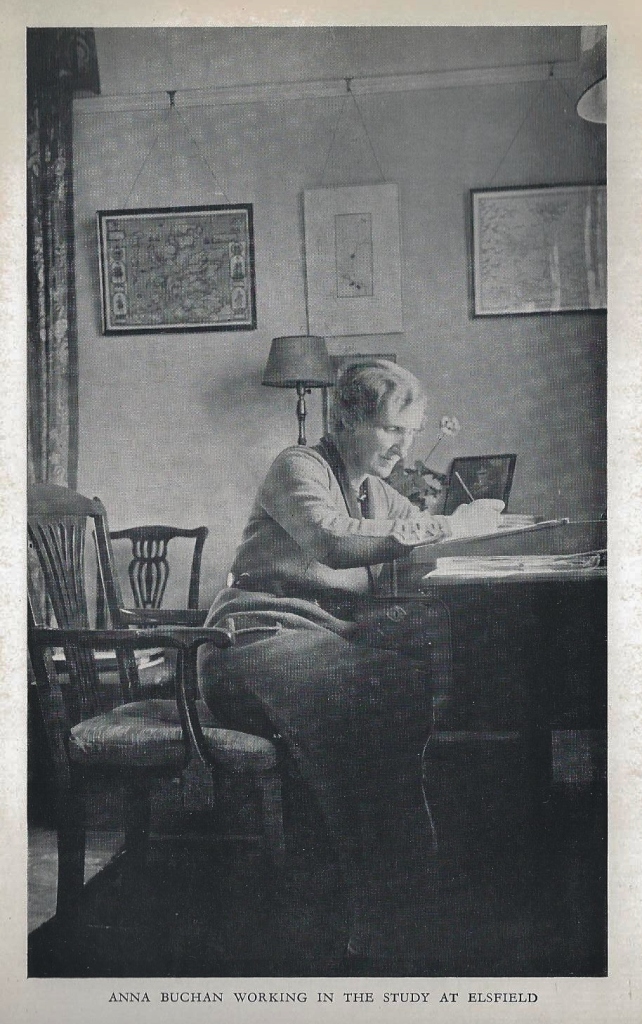
Farewell to Priorsford: a book by and about Anna Buchan (O. Douglas) ~ 1950. This edition: Hodder and Stoughton, 1950. Hardcover. With 5 photographs. 253 pages.

My rating: 10/10. Succeeds perfectly in its stated purpose, as noted in the Preface:

This book has been compiled at the request of the many who wish to know more about Anna Buchan by those privileged to enjoy her friendship.

This commemorative volume is presented in the hope that it will give to all who enjoy Anna Buchan’s books a share in the fun, the courage and the inspiration she gave to all who knew her.

*****

This book was published two years after Anna Buchan’s death, and is composed of several short biographical sketches, with the remainder a few collected short stories and anecdotes. There is also the fragment of the last novel Anna was working on, eight chapters of another Rutherfurd book, The Wintry Years.

This is a fascinating and enlightening glimpse into the world of this quiet yet eloquent author, and there are no surprises here for those who know the author through her fictional words, merely a confirmation of what we had hoped to find; that the author’s writings do indeed reflect her real life and her views that many people are indeed “good, gentle and scrupulous.” If this sounds too meek and wishy-washy, I hasten to add that Anna had a strong streak of cynical Scottish clear-headedness about her as well, and there is a leavening of wry humour and keen insight in her works to balance the goodness and gentleness.

The more I read of this author, the more I like her, both her works and the person she herself must have been. Farewell to Priorsford is a lovely memorial, and very much worth seeking out for O. Douglas fans. The eight chapters of The Wintry Years are an absolute treat to fans of the Rutherfurds, giving us a fleeting glimpse of their lives during the years of the second World War, and touching on many of the characters we came to know so well in The Proper Place, The Day of Small Things, and Jane’s Parlour, as well as teasingly introducing us to some new characters. Such a shame that Anna Buchan died so relatively young, at 71, and still very much at the peak of her writing years.

Here is what Farewell to Priorsford contains:

ANNA BUCHAN OF PRIORSFORD
 
I. A Biographical Introduction by A.G. Reekie
II. Anna by Susan Tweedsmuir
III. Olivia by Alice Fairfax-Lucy
IV. Author and Friend by Christine Orr
V. A Peebles Player by William Crichton
 
 
STORIES BY ANNA BUCHAN
 
I. Introductory Note
II. A Story for Young and Old:
          Jock the Piper
III. Broughton and Two Broughton Stories:
          An Upland Village
          An Echo
          Miss Bethia at the Manse
IV. Two Long Stories:
          A Tea-Party at Eastkirk
          Two Pretty Men
V. The First Eight Chapters of a Novel:
          The Wintry Years
 

*****

Highly recommended for O. Douglas – Anna Buchan fans.

Read Full Post »

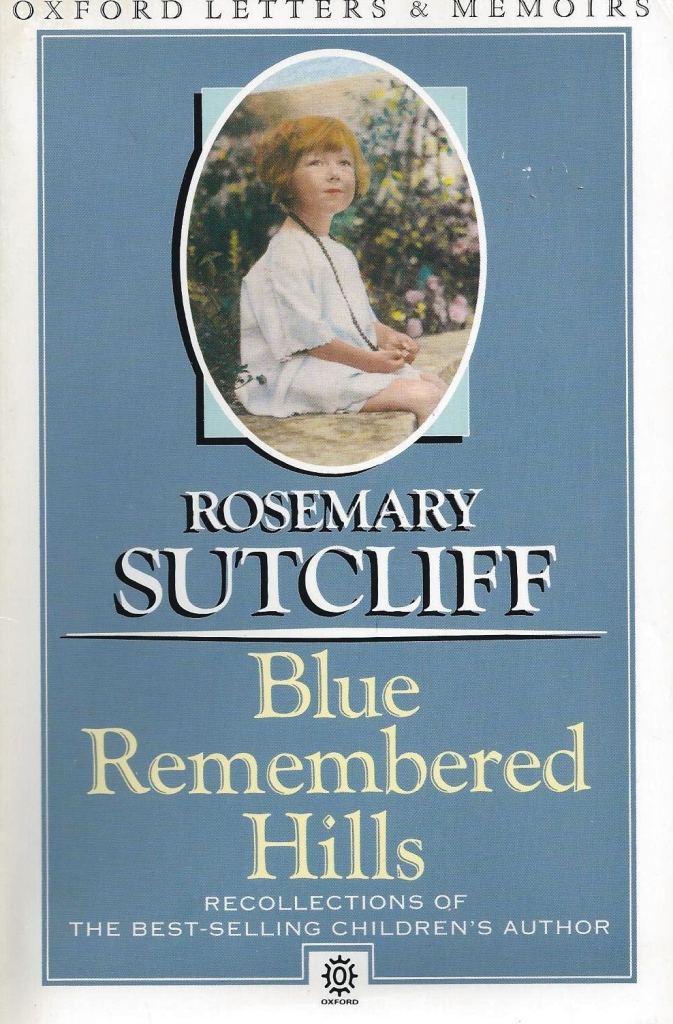
Blue Remembered Hills by Rosemary Sutcliff ~ 1983. This edition: Oxford University Press, 1988. Softcover. ISBN: 0-19-281420-6. 141 pages.

My rating: 10/10. Perfect. My only complaint is that it is too short. A stellar memoir by one of my favourite writers.

*****

Rosemary Sutcliff, 1920-1992, is still very much an icon of the historical fiction world. Author of something like fifty meticulously researched stories, many focussed on Roman-occupation-era Britain, Sutcliff created works which have lasting appeal and interest across a wide age range.

The Eagle of the Ninth (1954), The Silver Branch (1957), and The Lantern Bearers (1959) are possibly the best-known of her works, and have been continuously in print since their original publication.

Rosemary Sutcliff herself was a personality fully as fascinating as any of her fictional heroes and heroines. Her life was marked with great physical suffering, which she dealt with by immersing herself in her creative work. When she was only two years old, Rosemary developed Still’s Disease, a rare and extremely painful form of juvenile arthritis. After the disease subsided, the permanent damage to her joints severely curtailed Rosemary’s physical abilities. She spent most of her adult years dependent upon a wheelchair, and wrote using a modified pen to enable her hands to grasp it.

Her enforced inactivity made Rosemary a keen observer of the world around her, and a great seeker of solace in literature. To while away the long, bed-ridden hours, Rosemary’s mother actively read aloud to her, and Rosemary so enjoyed these dramatic performances that she resisted learning to read herself until she was nine years old. Rosemary’s first written works were retold versions of stories dramatically told to her by her mother.

Blue Remembered Hills is a remembrance of Rosemary’s earliest years, from her first memories until the publication of her first books, The Queen Elizabeth Story, and Robin Hood, in 1950, at which time she started keeping a written journal. These journals have never been published, though they are in the hands of Rosemary’s literary executor, her cousin and godson, Anthony Lawton. He curates a blog and has posted some of the entries from her diary here .

The memoir is wonderfully well written, and contains myriad details of Rosemary’s early life, with a frank sharing of her thoughts and feelings regarding her own situation and the people around her. Discussing her extended family, this passage rather made me chuckle, and is a good example of the subtle humour of Rosemary’s prose.

Aunt Edith was a handsome woman with straight thick brows which remained raven black even after her hair had turned swan’s-wing white, and the bitterest mouth that I have ever seen on anybody. She, alas for them both, had married Archie, weak-willed and amiable, who did not tell her beforehand that he was a quarter Indian – his mother being the product of an Indian Army colonel and a rajah’s daughter – what would have happened if he had told Aunt Edith before it was too late, there’s no knowing. Maybe she would still have married him, but I very much doubt it. As it was, finding out afterwards, she refused to have children – I very much doubt if she even allowed him into her bed! – and set out to make his life a cold hell to his dying day. I have been there at some family gathering myself, puzzled as a dog may be by stresses in the air, the electric discharge of things I did not understand, when he came into the room, and Aunt Edith sniffed loudly and said, ‘There’s a most peculiar smell in this room. One would almost think that somebody black had come into it.’

For many years, the family were quite seriously prepared for Uncle Archie to murder her one day, and prepared, if he did, to go into the witness-box on his behalf and swear that he did it under unendurable provocation.

Rosemary also refers to in the most poignant detail her doomed love affair with Rupert King; the true tragedy of their relationship not in Rosemary’s physical condition, but in Rupert’s polygamous nature. Already married to a much older woman, Rupert persisted in the love affair with Rosemary, and, upon achieving his divorce, immediately married a third woman, suggesting to Rosemary that they carry on some kind of platonic three-way relationship so he would not lose the pleasure of her company. Rosemary actually considered this, and went to London to meet Rupert’s new fiancée, but soon realized that this was not a feasible option for any of them, and the two permanently parted ways, with Rosemary thereafter directing her passion into her work. Though the affair brought her much emotional trauma, Rosemary insisted that she was glad that she had had the experience of being deeply in love, and being beloved in her turn, because it gave her a broader depth of experience and brought forward feelings which she had thought never to experience because of her disability. A gallant lady.

I do so wish that Rosemary Sutcliff had continued this memoir to discuss her later years; this is a teasingly slender though richly filled book. Very highly recommended.

*Edited November 18, 2012 to add a link to a wonderful review I’ve just happened upon, by Steve Donoghue at Steve Reads.

Read Full Post »

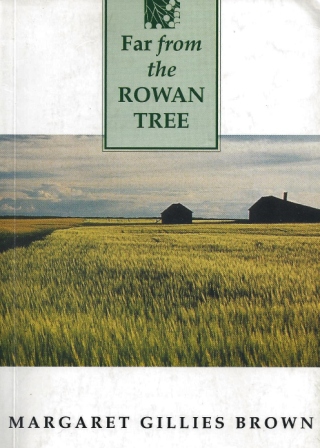
Far From the Rowan Tree by Margaret Gillies Brown ~ 1997. This edition: Argyll Publishing, 1998. Softcover. ISBN: 1-874640-696. 239 pages.

My rating: 8/10. I thought this quite an engrossing read, and an interesting perspective on a somewhat neglected era in Canadian history.

*****

In 1959 Margaret Gillies and her husband Ronald, with their three young boys, left Scotland to immigrate to Canada to try farming there. They left more for personal than financial reasons, seeking a new life and atmosphere far from what the stresses of working with Ronald’s demanding father, and with the sheltering hand of a Canadian Immigration program to encourage farm workers, they thought that their new life would be at least as congenial as the one they had just left.

This proved to be far from the case. Added to the environmental shock of landing in wintry Halifax in February, there was the unsettling trip by train across the vast stretch of country between the East coast and their first placement on a dairy farm in central Alberta, near Red Deer. This proved to be even more unsettling; the accommodation they were provided was an unfurnished shack with the barest amenities. There was electricity of a sort, but only an outside privy and hand-pump for water; Margaret, on top of having three children under six, was also half way through her fourth pregnancy. Ronald’s employer, whom they soon found was hard-pressed to find local help due to his foul temper and abusive manner, was of little assistance, and kept Ronald fully occupied except for a half day off a week.

Margaret and her family struggled through, and eventually were moved to a better situation on a mixed farm. Here they spent a happier summer, but found they were not able to manage on a farm labourer’s wages, especially with winter coming on and less pay because of reduced work hours. The family then moved to Edmonton, where Ronald took on a new career as a real estate salesman. This, though not a reliable income, allowed a rise in their standard of living, but there were still many challenges, and the family  returned to Scotland to take over Ronald’s family farm, as his father had in the meantime decided he was ready to retire and relinquish control to Ronald. The Canadian experiment had lasted three years.

The family, despite their dismal introduction to the country, had become happy in their adopted land, so this was not an easy decision. Margaret in this memoir speaks with great admiration and affection of the friends they made, and of the natural beauties that surrounded them, easing even the most uncomfortable of their several sub-standard homes.

A fifth baby was born in Canada, and it was with something like fond regret that the Gillies returned to their home country. Margaret would go on to have two more children, and several of her sons still operate the Scottish farm where she lives in retirement today.

Margaret had always been something of a writer, though she had set aside her “jottings” while training and working as a nurse, and later as a farmwife and busy mother. She had a few moments during her Canadian foray to create some poems, of which several are included in the book. Margaret took up her writing more seriously when her children grew up, and has become a highly respected Scottish poet and writer. Far From the Rowan Tree is the first in a number of memoirs and family histories she was inspired to write some thirty years after the Canadian years.

Margaret’s voice in this book is both romantic and vividly descriptive, as well as opinionated and matter-of-fact. It is most fascinating to see my own native country from an outsider’s eyes, especially as I am personally familiar with the areas of Alberta where the family resided, though their time their preceded my own by almost thirty years, and there were many changes in that time, as the oil industrry picked up speed and the standard of living even among the most struggling of the farms improved immensely.

Her story also reminds me in many ways of my father’s saga of coming to Canada as a German immigrant in the 1950s, working his own way across the country farm to farm until he ended up working in logging and construction in interior British Columbia. I am wondering now if perhaps he was involved in the same immigration program, placing farm workers? It is impossible to ask him, as he died several years ago, but I wouldn’t be at all surprised, as his experiences with various employers rather echo those of the Gillies’.

I found Margaret’s memoir hard to put down. It is nicely written, and kept my interest from start to finish. I would definitely read more of her literary works, as well as her poetry collections. I found some of her later poetry published online, and though it does not all appeal to my personal taste, some of it seems to me to be quite good, very evocative of setting and mood. Here is a sample from the frontispiece of Far From the Rowan Tree.

Emigrant Journey

There was the journey,
The endless coming on of the same wave,
The no-land time of ocean and high hopes
Until the icebergs rose
Like white snow palaces…
There were the moving days
And weary nights of train-hours overland,
The trees, the lakes, the straight and rolling plains
Until time stopped in sheer fantasy
Of a pre-dawn winter morning –
Gloved hand swinging the iron-hard handle
Of a frozen water pump
At the edge of a bark-rough cabin;
Above, the sky, moving strange magnificence,
Voile curtains of colour
Changing, shifting imperceptibly;
Below, the star-sparkled snow –
A virgin’s looking glass
Where spruce trees shot the only shadows
That made no movement –
Silence, immensity of silence,
Oil fires were burning brands
Reaching for chiffon robes
Of an aurora of dancers
Repeating dream sequences …
I tried to wake from unreality,
Felt my spine freeze,
Heard coyotes howling down the night.
 

~Margaret Gillies Brown~

Read Full Post »

Confessions of an Igloo Dweller by James Houston ~ 1995. This edition: McClelland and Stewart, 1996. Softcover. ISBN: 0-7710-4286-8. 320 pages.

My rating: 9/10. Enjoyable start to finish. Canadian by birth, the far-travelling Houston (1921-2005) was a great writer and storyteller, as well as an accomplished artist.

*****

Around here, I can tell if a book is really good because it often will disappear before I finish it. The usual culprits are my husband and my 18-year-old son. If it’s my son, no worries – he’s a speedy reader and I usually get it back in a day or two, but my husband has less free (meaning reading) time and he also tends to read a little more slowly, plus he also has a tendency to “hide” his current read (so he can find it again – he says we “move things” on him) – so, if he has the book, kiss it goodbye until he’s done.

I’ve been bugging him to let me have this one back for a few weeks now, as I wasn’t quite finished when he snuck it away from my reading pile.  He’s been working his way through it steadfastly, occasionally calling me to come and listen, and reading bits out loud. Something about this memoir really appealed to him, which is understandable, because it’s quite fascinating and very well written.

In 1948, 27-year-old James Houston managed to hitch a ride on a plane going on an urgent medical call from Moose Factory, Ontario to Canso Bay in northern Quebec. An experienced and talented artist, Houston had a keen interest in native peoples, and was in Moose Factory sketching and painting the local Indians. He had long wanted to travel further north into the Arctic, and he seized the chance when it came, staying behind in Canso Bay when the plane left to return to Montreal with the badly injured Inuit child it had come to evacuate.

This was the start of Houston’s fourteen or so years of Inuit artistic involvement. He had a keen eye for indigenous crafts, and was instrumental in the popularization of Inuit carvings for the southern markets, as well as introducing Japanese-style print-making to the Inuit, which was readily adopted as a new mode of expression for Inuit artistic vision.

Confessions of an Igloo Dweller is roughly chronological, and consists of personal anecdotes interspersed with vignettes from high Arctic life, and stories told to him during his travels.

Houston also wrote quite a number of novels for children as well as adults, most set in the Arctic or the far northern Canadian forests. Confessions reads like a novel, flowing seamlessly along from high point to high point. Houston was opinionated and extremely sure of himself; these qualities come through loud and clear, making for an especially strong narrative voice. The book is saved from shameless self-promotion by Houston’s ability to tell a humbling story on himself, and by his keen sense of humour.

We all liked it. Highly recommended.

Read Full Post »

« Newer Posts - Older Posts »