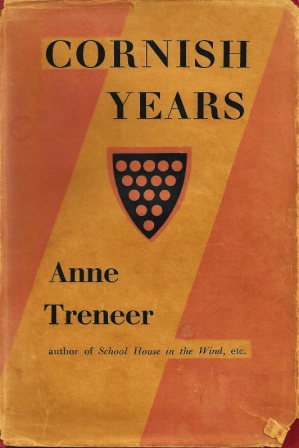
 Cornish Years by Anne Treneer ~ 1949. This edition: Jonathan Cape, 1949. Hardcover. 284 pages.
My rating: 8/10.
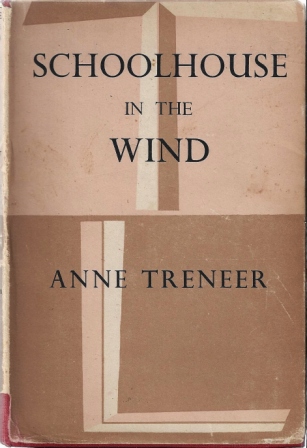
This is the second volume of Cornish writer and poet Anne Treneer’s trilogy of memoirs. The first, Schoolhouse in the Wind , was such an unexpected treat that I immediately decided to track this author’s other works down. I did all of the usual searches, and decided my best bet was to order the re-released trilogy published by the University of Exeter Press in 1998, under the (slightly altered) title of the first book, School House in the Wind.
Imagine then my delight upon finding this first edition copy of the second volume in a tiny antique store in the micro-community of Barriere, B.C. on a quickie road trip last week. We were out in our old Spitfire convertible, investigating promising narrow, winding (and must be paved – not a given in this part of the world) side roads in the Kamloops area, and were ready for a break from the wind and sun when a sign in the window captured our notice: “Used Books”. Well, that was irresistible, so I pulled a quick U-turn (an easy feat in a tiny little Triumph) and in we went. Lots of china and glassware, but the promised used books were only a shelf or two, quickly scanned and dismissed. However, as I made my way carefully out through the shelves of fragile treasures, something caught my eye in the showcase beside the cash register. There, side by side, were this book, and another, The Angels’ Alphabet by Hilda van Stockum, a first edition picture book by another author-illustrator I’m mildly interested in.
I’m guessing these were featured because of their intact dust jackets and general “vintage” appearance? Anyway, for well under twenty dollars I walked out of the store clutching my treasures with ill-disguised glee. And that proved to be the bookish highlight of the day, as our subsequent visit to our real destination, Kamloops’ excellent At Second Glance Used Books, source of so many wonderful finds over the past ten years, left us standing in bemusement peering through the windows of an empty store front.
“They’ve moved!” I said optimistically to my husband. Across the street to the Kamloops Art Gallery we trotted, and upon inquiry we were stunned to hear that the bookstore had indeed closed just a few months ago. “So many people are asking about it, and they’re all so disappointed,” said the helpful girls at the admissions counter.
Turns out that a steady decline in sales over the last few years had left the owner debating the state of the used book business. She sold off as much as she could in a series of escalating sales, and at the end had dumpsters brought in, and binned the remainder.
I am very sad. What a dismal ending to such a grand bookstore.
Two more of my local used book sources, Nuthatch Books in 100 Mile House, and The Final Chapter in Prince George, are also debating closure, as their margins are steadily decreasing. Every bookseller I’ve spoken to has blamed e-books for the decline in the print book business.
Meanwhile the charity shops are overflowing with books – most, admittedly, the epitome of “trashy” (in so many ways) – which may indeed be an indication of shelves being cleared as people embrace the new technology.
There is no adequate substitution for a well-established, well-organized used book store staffed by fellow book lovers. I tremble at the thought of more of these dying out, much as I understand the seduction of having your reading material to hand in a compact electronic format.
But used book sellers have grocery bills too, and once the point of too-little return is reached, what options do they really have? I know many are turning to internet sales, but to do that properly is a job in itself, and the competition is fierce unless you are prepared to vigorously establish a lucrative niche market of some sort, often not a very viable option for those in small communities with limited book-sourcing opportunities…
Ah, well. It is what it is. Back to this book.
*****
Cornish Years decidedly lived up to my high expectations. Ann Treneer continues her life story of the years between 1906 and 1932 with cheerfully pragmatic anecdotes about her own doings, and affectionate reminiscences of the places and people she rubbed up against. As in Schoolhouse, the narrative is never twee or gushing, but it is cheerfully positive in tone, and the mood feels genuine throughout.
As much as it is a personal narrative, Cornish Years is also a loving ode to place, both Treneer’s home region of Cornwall, and places farther afield. Anne Treneer spent time as an adult student pursuing studies at Lady Margaret Hall in Oxford, and her memories of those days are beautifully evocative and full of love and appreciation for her experiences there.
The snippets of Anne Treneer’s poetry in Cornish Years – she was a published poet from an early age – show much more style and polish than those in School House; I wonder if she has included these small samples of her work in some sort of chronological order? If so, I would be most interested to see what the third volume of memoir, A Stranger in the Midlands, contains, both in the way of poetry and in the continuation of Anne’s personal story.
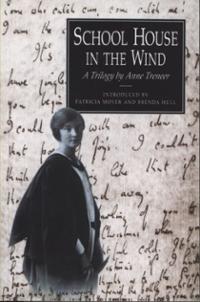 As I can’t count on bookish serendipity to bring me the third book as it did the first and second, I have taken things into my own hands and ordered the 1998 trilogy. And if I do come across an old copy of Stranger, I will of course be more than happy to add it to the bookshelf.
In my internet travels, I came across an interesting reference to Anne Treneer at this blog, The After Life of Books, written by Gillian Thomas, an English literature teacher and resident of Cornwall. She writes about the experiences of her parents and grandparents in relation to the books they read. (Fascinating website, well worth a look-around.)
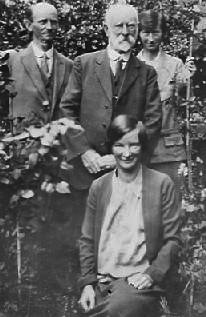
She (Gillian’s mother) was particularly proud of having a personal connection with another Cornish writer, Anne Treneer, author of the childhood memoir, Schoolhouse in the Wind, and Cornish Years, a reminiscence of her college education and early years as a schoolteacher. Treneer had been my mother’s English teacher at the local grammar school and, as well, had rented a cottage from my grandparents. They, along with other villagers, appear in one of the chapters of Cornish Years, and both my grandmother and mother often proudly mentioned these references. They were flattered to find their names in a book, even as faintly amusing village “characters.”
My mother’s pride in the Treneer connection may have originated in the prestige of a personal aquaintanceship with a published author, but it was sustained by her fascination with Anne Treneer’s apparent independence from conventional restrictions. During the time the author taught at the grammar school she used a motorcycle to explore the area, a detail which always figured in my mother’s recollections of that time as well as in Treneer’s happy reminiscences about her Velocette in Cornish Years. Similarly, my mother recalled visiting her former teacher years later and finding her fuelling the fireplace in her rented seaside cottage with an enormous driftwood spar that she had just scavenged from the beach. In all these reminiscences Anne Treneer seemed to embody an insouciant air of independence, a relishing of her own solitary company and an unconcern about conventional behavior. In the letters and postcards from her that arrived from time to time throughout my childhood, she always seemed free to travel at will. We imagined, I think, that this apparently carefree independence, came with the role of being “an author.” It was, of course, mainly made possible by Treneer’s generally frugal tastes and habits. Also, it’s likely that travel funds came from the author’s older brother, Maurice, who had emigrated to the US and become senior chemist at Miles Laboratories in Elkhart, Indiana. He is credited with creating the original formula for Alka-Seltzer, a product whose launch was fortuitously timed to coincide with a flu epidemic as well as the end of Prohibition. While he does not seem to have personally owned the patent to that lucrative cure for hangovers and other malaises,a number of other patents in his name, as well as his salary as head chemist at Miles Laboratories, would have enabled him to be generous in funding holidays for his sister…
And here, as another side note, is the Wikipedia page regarding the Velocette motorcycle, one of which Anne Treneer tenaciously learned to master and rode about on with undisguised joy, which she so eloquently described in Cornish Years.











 Leaves & Pages
Review: My Discovery of America by Farley Mowat
Posted in 1980s, Canadian Book Challenge #7, Read in 2013, tagged Biography, Canadian, Canadian Book Challenge 7, Political Rant, Social Commentary on July 30, 2013| Leave a Comment »
My rating: 6/10.
High marks for tackling this topic with such eloquent vigour, tweaked downward for the increasingly bombastic posturings of the author, which led me to a sneaking small sympathy for his unwary opponents. As I read I could envision the froth forming at the Mowat’s mouth, perhaps dribbling down his legendary beard, too, as he raved on and on and on. (The conciliatory last chapter, where he thanks his many supporters in the U.S.A., did seem a bit calmer, and appropriately sincere.)
Oh – adding another point back on for that first chapter, in which Mowat describes his airport encounter with the Forces of American Evil, a.k.a. the INS: Immigration and Naturalization Services of the United States of America. It was a truly funny piece of writing, and for this I will forgive the annoyance Mowat so often inspires in me by his ego-driven blusterings, which, in this instance, had plenty of justification.
Okay, here’s the story. On April 23, 1985, as Mowat was setting out on a trip to the West Coast of the U.S.A. on a joint lecture/promotion tour for his just-released Sea of Slaughter (a passionate indictment of the human-caused ecological devastation of the Atlantic shores of North America), he was escorted off the plane as it sat on the tarmac, and notified that he was persona non grata in the U.S.A. Forever and for always. And no, we can’t tell you why, sir. Just go away now, sir.
Mowat storms out of the airport terminal and into the arms of his publisher, where he is met with a shared indignation exceeding even his own. “This is war!” (or words to that effect) cries Jack McClelland, and a press deluge begins, spurred on by the very recent “Irish Eyes are Smiling” Reagan-Mulroney love-fest, and assurances by both leaders that the U.S.A. and Canada are dear, dear friends.
Why does the mighty United States feel that wolf-, whale- and generally nature-loving Mr. Mowat is a security threat? And why do the words “Commie sympathiser” keep coming up, though no one will let Mowat or anyone else take a look at his secret file, the one that led to its abrupt barring from the neighbouring country?
It seems that there is a McCarthy-era law on the books, the McCarran–Walter Act, which allows such arbitrary barring on the most microscopic past “offenses”, such as visiting the USSR (which Mowat had done some fifteen years earlier, to research his book Sibir), and – oh! that little incident in which Mr. Mowat reported a desire to shoot his .22 rifle at U.S. Air Force planes carrying (possibly) atomic warheads across Newfoundland air space…
125 pages later, not much has changed, except that Mowat is offered a “parole” to allow him a one-time entry into the U.S.A., which he scornfully turns down, “parole” implying some sort of wrong-doing.
In this post-9/11time of ever more stringent border examinations, and many more arbitrary black-listings for undisclosed reasons – “security risk” being the handy catch-all phrase – Mowat’s prior experience sounds sadly like something we’ve all heard before.
Mowat’s horrified indignation echoes so many others; his response was the one every wronged citizen dreams of pulling off. Lucky for Mr. Mowat that his celebrity and many connections allowed him to speak out so vibrantly without losing his livelihood or credibility, a real problem for so many others in the same position, as Mowat points out, and which is one of the reasons he puts forward for his strident rebuttal to his black-list barring.
An interesting read, and with chilling parallels to the situation today between the countries on both sides of the world’s longest – but for how much longer? – undefended border. The razor wire, both literal and figurative, is persistently going up.
Here, FYI, is a very partial list, courtesy Wikipedia and therefore including the related links, of some of the public figures joining Farley Mowat on the McCarran-Walter exclusion list, before its amendment (but not its dismantlement) in 1990:
Read Full Post »