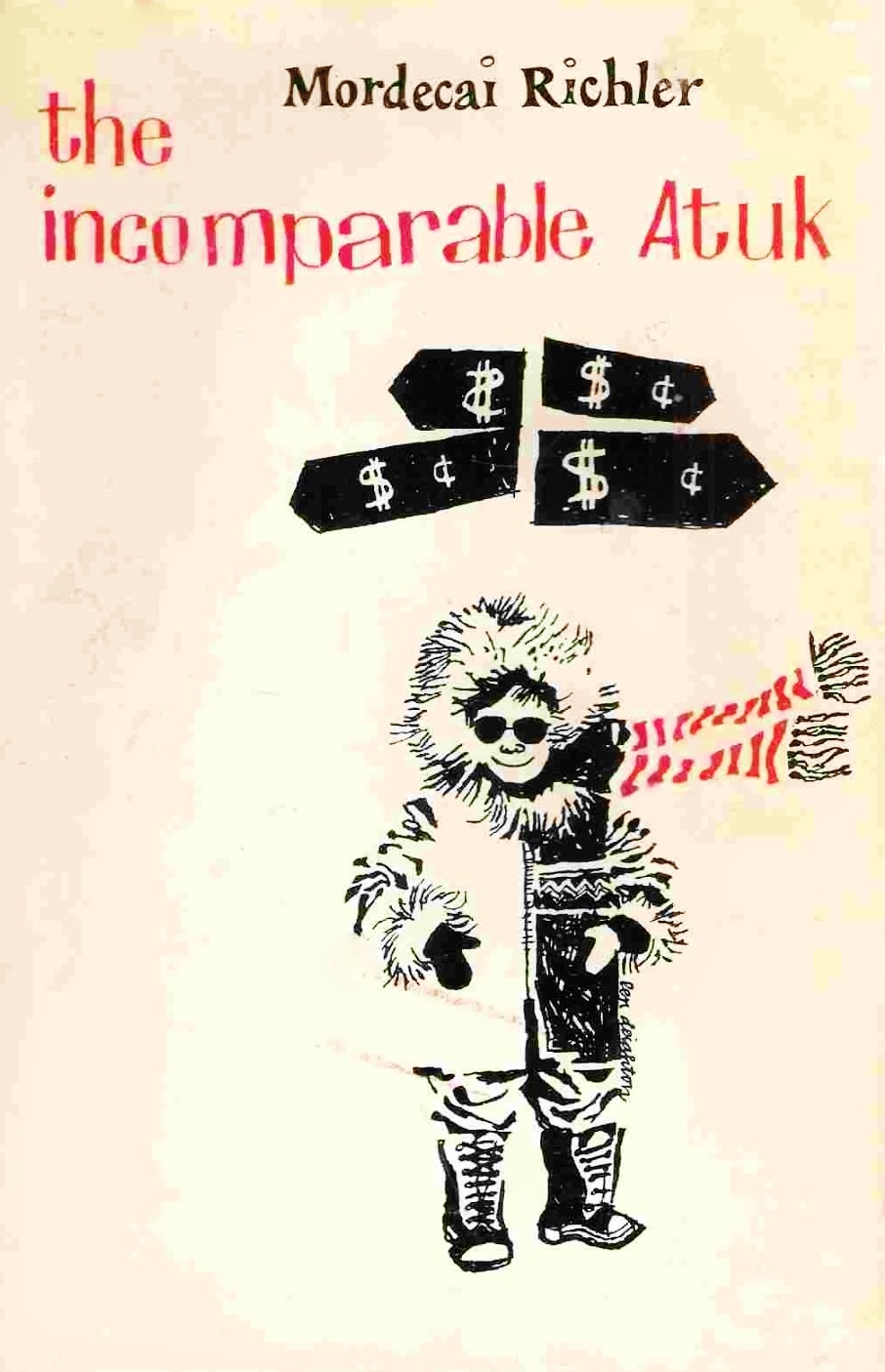
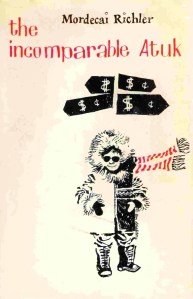
Tthe incomparable atuk mordecai richlerhe Incomparable Atuk by Mordecai Richler ~ 1963. This edition: McClelland and Stewart. Hardcover. 192 pages.

My rating: Unrateable. This is one strange little book. Repellant and mesmerizing in equal quantities.

Despite the post heading above – lifted from some pertinent dialogue in the book – I think I can safely say that this is one of Richler’s relatively more obscure works, though the title is sure to be more immediately recognizable than those of his first three brooding novels, The Acrobats(1954), Son of a Smaller Hero(1955) and A Choice of Enemies(1957).

Richler’s fourth novel, The Apprenticeship of Duddy Kravitz, was published in 1959, and its resounding success made readers and critics eager for more. What showed up next, after a four year hiatus, was this small but seethingly ultra-satirical novel. Duddy Kravitz, take a hike. Atuk the Eskimo is here.

Yes, I said Eskimo, because back in 1963 that was the term-in-use for people of Atuk’s ethnicity. Better let it roll right over you, because if you’re at all sensitive to what would nowadays be severe political incorrectness, this thing will have you breaking out in hives before you can say…well…never mind. Won’t go there.

Here is the front flyleaf blurb from my tattered ex-library first edition.

THE INCOMPARABLE ATUK

‘Eskimo poetry’ – words calculated to chill the blood of all but the devoutest Canadian egg-head patriot. So when Atuk, the Eskimo poet, first came to Toronto as the ‘discovery’ of a Twentyman Fur Company public relations officer, all he got out of it was a slim volume and a few literary cocktails. Prestigewise, as his new friends would have said, it was not too bad; moneywise it stank.

But Atuk did not focus the gentle savage’s traditionally innocent eye on the Toronto scene – far from it. One gimlet glance at the delights of civilization and he was on the ball. Soon his stocky figure was to be seen stepping out of a black Thunderbird at the doors of TV, movie and press magnates – or rolling on a divan with the country’s darling, Bette Dolan, record-breaking swimmer and the wholesomest girl in the land. Atuk’s downfall only came when …

But no: we cannot do this to you. The beauty of this book lies in its surprises: in its lunatic twists and turns, in the laughs it startles out of you by outrageous shock tactics. Because one of Canada’s most serious young writers has here turned a somersault and has come up with – we are weighing our words – a tour de force of comic invention unrivalled since Juan visited America. It is possible that, as a result, when he next sets foot on his native soil it will bounce him back into the sea – but whether Canada likes it or not, it has now produced a comic writer and satirist of whom any country in the world could be proud.

Atuk, playing the enigmatic Eskimo card for all it’s worth, runs rings around the Toronto intellectuals and artsy types and bleeding heart do-gooders keen to adopt him as this week’s picturesque indigenous person. He bluffs his way into an intimate relationship the ever-helpful and soon to be ex-virginal Bette Dolan, brings his extended family to Toronto to dwell in a basement sweatshop turning out crude specimens of “genuine Eskimo art”, and schmoozes his way into all sorts of circles, from upper-crust to deeply dodgy. But an incident from his past is about to catch up with him…

Mordecai Richler nails everyone in this midnight-black satirical romp, with the notable exception of that most expected Canadian target-of-scorn: Americans. By and large the field is made up of north-of-49thers, of every stripe and hue and political persuasion.

Deeply dated and terrifically politically incorrect by the standards of both then and now – a casual gang rape is played for cheap laughs, and there is an abundance of crude bedroom and bathroom humour – but I must say I laughed outright at several bits, most notably Atuk’s successful attempt at fratricide by traffic light.

Now that I’ve read this dark little period piece, I find myself quite happy to quietly slide it back onto the bookshelf. I don’t know as I’ll ever take it down again, but at least I’ve quelled my curiosity as to its contents.

Recommended? Probably not, unless you’re Canadian and keen on exploring the seedier back alleys of our national literary heritage.

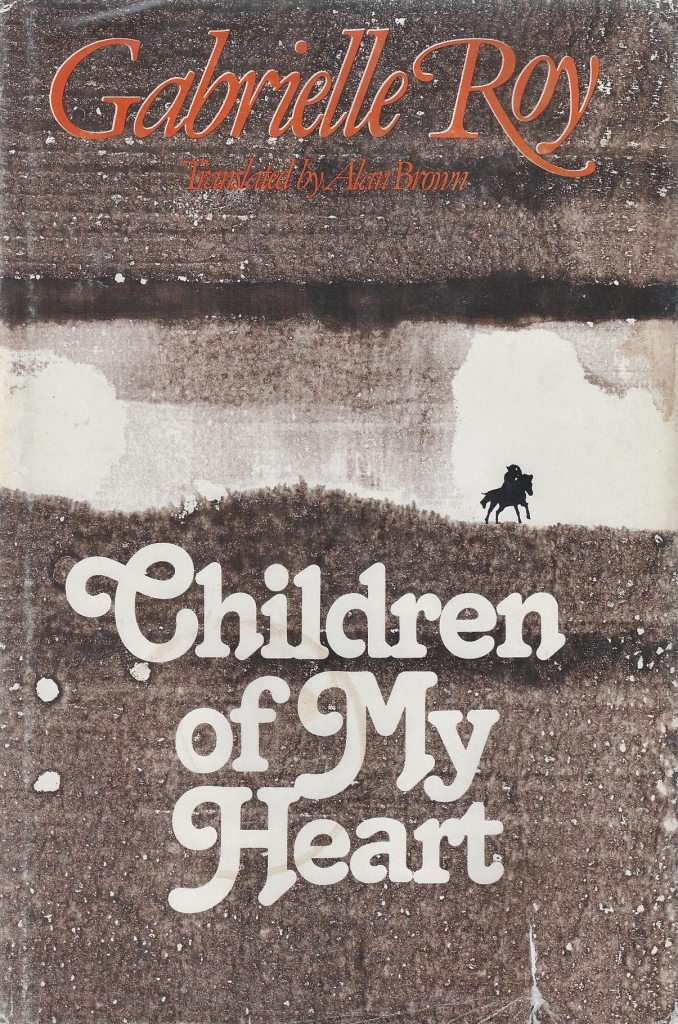
children of my heart gabrielle roy 001Children of My Heart by Gabrielle Roy ~ 1977. This edition: McClelland & Stewart, 1979. Translated from the French by Alan Brown. Hardcover. ISBN: 0-7710-7838-2. 171 pages.

My rating: 9/10

Gabrielle Roy’s writing has such a freshness to it, and such a rare delicacy of thought and feeling, that her works are quite unique. I can’t think of any other author to compare her to. (Though perhaps Ethel Wilson comes closest?)

Roy stands alone, off in a serene (but never sentimental) corner of the Can-Lit world, where one imagines her raising a gently cynical eyebrow at the often lewd and rude blusterings of her approximate contemporaries – the Mowats and Richlers and such-like sorts – whose works shared space with Roy’s on publishers’ lists of the 1950s, 60s and 70s.

Gabrielle Roy has been well-served by her translators. She wrote and was published in French, though she was fluently bilingual, and the English translations I have collected over the years are never awkwardly phrased or unclear in intent.

Children of My Heart is a sketchy sort of “novel”, in that it is actually a series of anecdotal recollections, based on Gabrielle Roy’s personal experiences as a young teacher in Manitoba in the 1930s. It reads like a conventional snippets-of-incident memoir, and only in the last episode do we have anything like a traditionally structured plot progression, as the young teacher – only eighteen – becomes involved in a chaste but emotionally passionate relationship with a thirteen-year-old pupil, the “bad boy” of a little prairie settlement, who is blessed with supreme physical beauty (not to mention uncanny violet eyes), equally supreme horsemanship abilities, and a romantically tragic backstory.

The earlier part of the book is composed of character portraits of various young students and their parents, as seen from the viewpoint of the naïvely optimistic young teacher, fresh out of Normal School and finding her way under the gently mocking protectorship of the only-slightly-older but much-more-experienced teachers she has come to join.

This is, in my opinion, a rather slight book in the author’s body of work. It was Roy’s last published fiction, and its glowing reviews reflect (one suspects) the high regard in which her earlier, more complex books were held. (It received a 1977 Governor General’s Award for French Language Fiction.)

I found The Children of My Heart a lovely thing, expectedly poignant and moving, but not nearly as strong as certain of Roy’s other novels. If you are expecting another Street of Riches or Tin Flute or Cashier, I would like to let you know that you will not find it here, though there are many moments of deeper reflection where the author is obviously looking back at the person she once was, and clear-sightedly analyzing how she may have affected her students’ lives by her words and actions, as they in turn left their marks upon the person she was to become.

With this in mind, I will say that I highly recommend it, both for those seeking to round out their experiences with this iconic French-Canadian writer, and those new to her work.


A week ago we set off on a journey to the mountains, travelling in our old blue sports car north to Prince George, then east towards Alberta. Down the Icefields Parkway from Jasper, and continuing through Banff National Park through Kootenay National Park, fetching up in the village of Radium Hot Springs, where we spent several days in exploring the surrounding roads and countryside, and participating in an all-British get-together and vehicle show hosted by the Calgary MG Club.

It was a wonderful trip, and we were sorry to have to race for home to be back for workaday obligations. (That whole earning-a-living thing can be a real drag, don’t you find?)

We stopped here and there to botanize by the roadside – the wildflowers are in full early summer glory – and to take a few pictures. Here is the merest glimpse of what we saw.

Athabasca Falls, Jasper National Park, Alberta.

Athabasca Falls, Jasper National Park, Alberta.

Mountaintop Thistle, Cirsium sp., Jasper National Park.

Mountaintop Thistle, Cirsium sp., Jasper National Park.

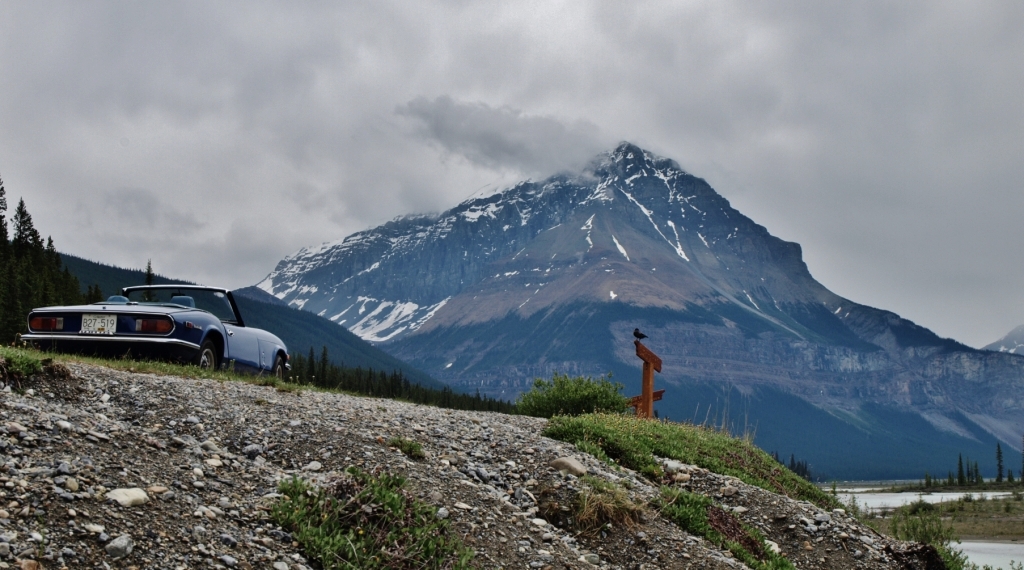
A glimpse of the dauntless Little Blue Car, Jasper National Park, Alberta.

A glimpse of the dauntless Little Blue Car, being looked over by a curious raven, Jasper National Park, Alberta.

Mountain Bluebells, Mertensia alpine, Jasper National Park.

Mountain Bluebells, Mertensia alpina, Jasper National Park.

The turqupose blue water of Bow Lake, Banff National Park, Alberta.

The turquoise blue waters of Bow Lake, Banff National Park, Alberta.

Vermillion River, Kootenay National Park, B.C.

Vermillion River, Kootenay National Park, B.C.

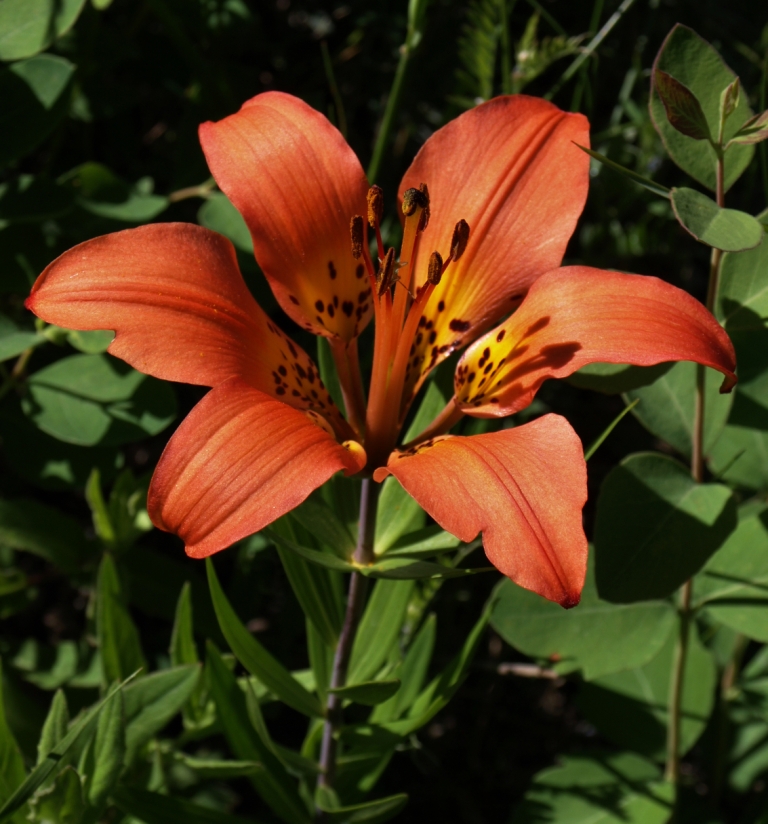
Western Red Lily, Lilium philadelphicum, Kootenay National Park.

Western Red Lily, Lilium philadelphicum, Kootenay National Park.

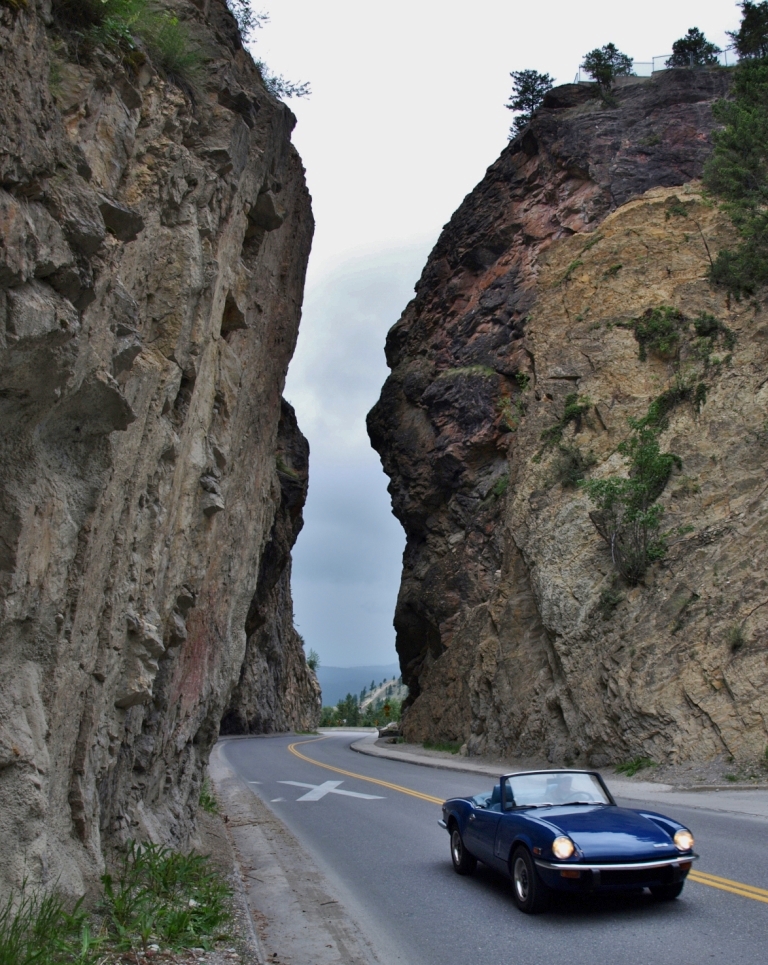
Sinclair Canyon, just outside of Radium Hot Springs, B.C. - a staged shot of the Spitfire in action.

Our cherished ’71 Triumph Spitfire in action, coming through the gap at Sinclair Canyon, just outside of Radium Hot Springs, B.C. (Vintage convertibles are more fun. Though on occasion one flirts with hypothermia, especially when pushing the whole must-keep-the-top-down thing a bit more rigorously than is sensible.)


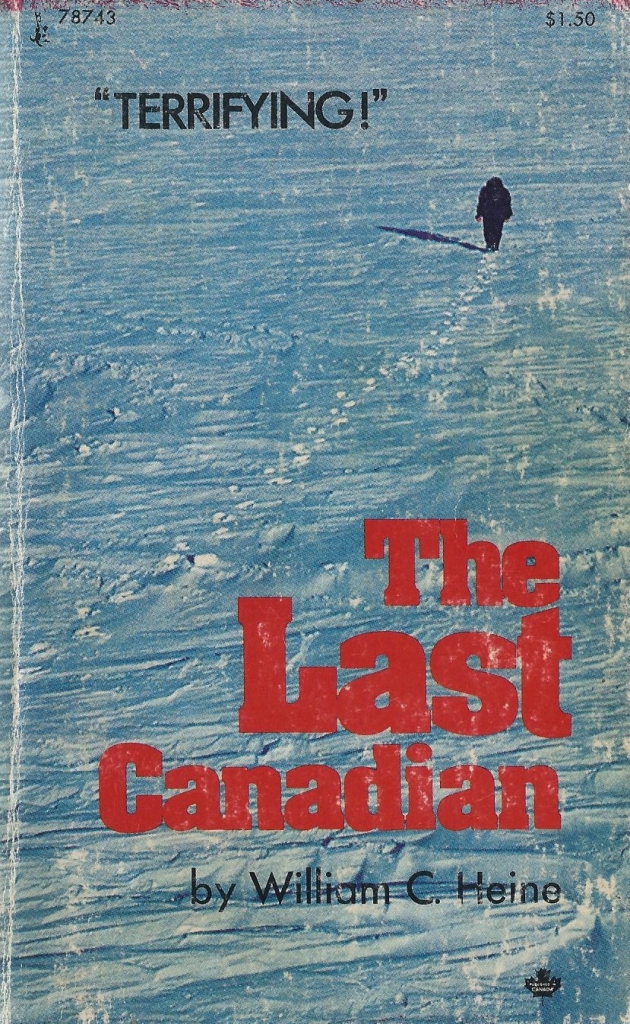
last canadian heine cover 001The Last Canadian by William C. Heine ~ 1974. This edition: Pocket Books, 1975, paperback. ISBN: 671-78753-8. 253 pages.

My rating: Oh, dear. Maybe a 2/10? But I did read it from beginning to end, so that argues for a certain mesmerizing appeal. After a certain amount of inner argument, here’s the final verdict: 5/10. Because something so strangely bad adds variety to one’s reading life, and Mr. Heine shows vast enthusiasm for his plaguey topic, even if he’s a bit unreliable on his science. And he’s occasionally very funny, though I’m not quite sure if that was by intention or merely happy accident.

Where to start?

Brian Busby and Grady Hendrix have both written gloriously gloves-off reviews on this well-forgotten* 1970s’ sci-fi-ish thriller, and they’ve pretty well said everything I’d like to say, so I’ll just give you my own (probably rambling) overview, then refer you over to them. Perhaps their reviews are best appreciated after reading the novel itself, but, on the other hand, you might find the book less of an awful shock if going into it forewarned.

Here’s the deal.

Ex-US air force pilot Eugene (Gene) Arnprior is now working as an engineer up in Canada. He likes it there in Montreal quite a lot, and has just received his naturalization papers, the day before everything goes to pieces.

Uncannily fast-thinking and forward-planning, Gene twigs immediately to the fact that something really, really bad is brewing when he hears radio reports of a cluster of mysterious deaths in rural Colorado. The ring of death expands from the centre, rippling outward like the waves created from an emerging underwater volcano, but well before it reaches Montreal, Gene is airborne in his company’s small plane, heading up to a remote northern Quebec fishing camp with his wife and two young sons. A lightning-fast shopping trip has provided the family with all of the supplies they’ll need for a prolonged retreat from the world – golly – I wish my shopping chores were as efficient as our Gene’s – he outfits a family of four with all wilderness survival needs in 40 minutes(!) – yesterday I took longer than this to pick up a few bags of groceries, but I digress – anyway, this guy is organized.

So – Gene and family are safely ensconced in the Quebec woods, in a remote fishing camp which is conveniently stocked with canned good, fuel, and lots and lots of guns and ammo. They pass their time in hunting the various wild critters, making flour substitute from cattail roots – “In a little while they had collected fifty pounds” – whoa – akin to the 40-minute shopping trip – if I didn’t already loathe Gene deeply – the wife-beater! (reference to an incident early on) – this would have done it – learning how to whittle, and, in the case of Gene and his lovely wife Jan, having lots and lots of enthusiastic sex. (Hopefully when the boys are out setting their bunny snares, I found myself thinking.)

Three years go by. La, la, la, la…but who is this coming across the lake? Oh, no – an Indian in a canoe! An alive person is bad, bad news – he has to be a plague carrier – yup – he is – and Gene keels over, as do Jan and the lads, felled by the virulent virus while the paddler is still well out on the lake. Some time later, Gene comes to, to find his little family stiff and cold, and himself now a “carrier”.

After burying his family, Gene fires up the airplane and heads back south, to investigate what’s going on in the rest of North America, now that he’s immune to the killer disease.

Various encounters with other survivors ensue, some ending badly for those underestimating Gene’s amazing foresight and lightning fast trigger finger. He picks up another female partner and proceeds to have lots and lots of enthusiastic sex, until an encounter with evil Russians results in her sudden demise.

Oh yes. There are evil Russians here and there, advance troops spying out the countryside for eventual full-scale invasion, because an America without people is a fantastic land-and-natural-resource jackpot for the greedy Soviets. Interestingly, the Russians seem to be ignoring the also-population-decimated Canada in their explorations, which I thought rather odd, seeing as it is also chock full of natural resources, closer to The Homeland, and much less likely to contain plague survivors. (If there is a certain percentage of natural immunity, wouldn’t that mean that Canada would only have ten percent of the number of roaming survivors as the USA has, based on pre-plague population numbers?)

But the Russians aren’t immune to the disease, as we find out when Gene stumbles onto a Soviet expedition, and, after failing to kill our hero with a barrage of gunfire and missiles(!), every man jack of the Russky battalion suddenly dies.

So Gene starts putting two and two together, and decides that the plague must have come from Russia, part of an evil takeover plot. And by golly, he’s right!

Lots of intrigue, lots of gunfire, the occasional nuclear warhead being detonated (goodbye Denver, Colorado!), the last-few-chapters introduction of a whole new array of characters – British and Russian scientists playing who’s-got-the-killer-virus games – and lots and lots of people dying. Good people, bad people, random in-between people. But Gene keeps plugging along, now single-mindedly focused on carrying out a single-man invasion of Russia, to infect the population there as revenge for all that’s gone before.

How will it all end?!

Any guesses?

Spoilers coming. Look away now if you’re honestly planning on reading this thing without knowing the final plot twist.

Okay, here it is.

The British have suddenly developed a successful vaccine (never mind the pesky details of how – which bugs me, because I was really curious) and the evil Russian government has suddenly been taken over by a more-cooperative bunch of politicos and the two countries – England and Russia – plus the surviving Americans (the President is in England, and there have been warships cruising the seas for the past three years carrying key US military and political personnel) plus China(!) all decide, in what must be the world’s fastest-ever international cooperative effort, to vaporize Gene, who has managed to evade all efforts to intercept him and has flown one final small plane across the Bering Strait and has now set foot on Russian soil.

Goodbye, Anadyr basin, and everything and everybody living there. Twenty-two missiles should do it. Nice try, Gene.

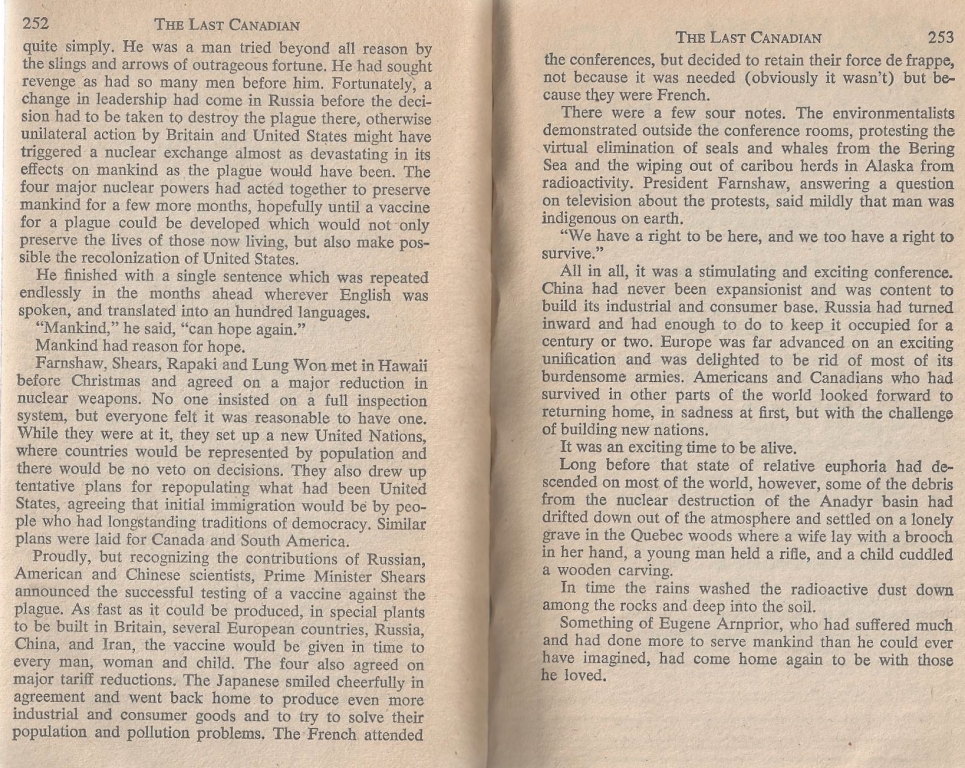
But hey, it was an exciting time to be alive. (Direct quote, last page, four paragraphs from the end. Here, see for yourself.)

last page last canadian heine 001

Wrapping things up, no need to get into boring detail!

If you’ve made it to here, you MUST go further.

Check out what these other readers thought:

Brian Busby tells it like it is at The Dusty Bookcase

Grady Hendrix is clever and cutting.

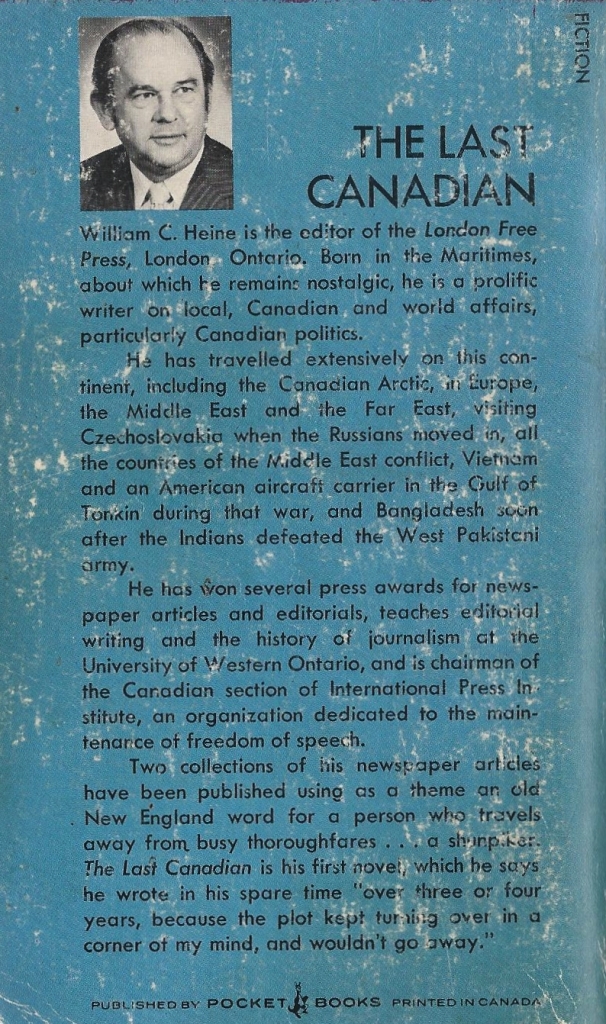
So who the heck was William C. Heine?

Here we go:

Everybody needs a hobby.

Everybody needs a hobby.

*Well-forgotten except by a cult following within the “survivalist” community, where it is apparently viewed as a classic bit of prognostic fiction and a useful how-to manual. Paperback copies of The Last Canadian (alternatively titled The Last American, and Death Wind) are listed on ABE starting at $20 and heading into the thousands. (Did this ever come out in hardcover? Methinks not.)

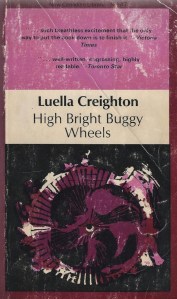
high bright buggy wheels luella creighton 001High Bright Buggy Wheels by Luella Creighton ~ 1951. This edition: McClelland and Stewart, New Canadian Library No. 147, paperback, 1978. Introduction by Rae McCarthy Macdonald. ISBN: 0-7710-9260-1. 352 pages.

My rating: 6.5/10

Tough call on the rating.

The book is undeniably well written, by an intelligent writer comfortably secure in her ability to portray scenes and moods more than competently in print.

But – and you knew there’d be a “but”, didn’t you? – there were a number of jarring moments, some editorial and some plot-related, and all made more obvious by the relative excellence of the workmanship displayed in the technical aspects of what is ultimately nothing more than a standard bildungsroman, albeit one embellished with abundant period detail and “exotic” (though slightly questionable regarding theological accuracy) Mennonite trappings.

Did you make it through that last bit all right?

Let me take a step back and give the details of the story.

It is the first decade of the 20th century, and in Ontario, Canada, in the southern region of prosperous farms, a Mennonite religious revival tent meeting is taking place. Here we meet our young heroine, 17-year-old Tillie Shantz, standing out from her lesser peers through her stately height, her exceptional beauty, and her remote air.

Tillie is the indulged oldest child of her family, and her doting father has seen that she has had plenty of leisure time to pursue such frivolous interests as piano playing, flower gardening, and wandering through the fields and woods daydreaming, all occupations which are acceptable enough in moderation but not in strong favour with the practical and hard-working Mennonite farmers to which “tribe” (Creighton’s term, used a number of times) our Tillie belongs.

Needless to say the lovely Tillie has attracted her fair share of the male gaze, and is being zeroed in on by one Simon Goudie. Simon is a few years older than Tillie, and, fervently pious, has already gained a reputation as a accomplished lay preacher. He’s heading off to theological college in the fall, but first he wants to secure the promise of Tillie’s hand in marriage. The local Mennonite community unanimously approves – this appears to be a suitable uniting of two prosperous and godly families.

Tillie is tempted by the thought of being mistress of her own home, and Simon’s avid gaze stirs her own latent sexual desires. The promise is made, though Tillie buys herself some time by asking her father to allow her to spend the winter in the nearest large town, taking a dressmaking course and more advanced piano lessons than she is able to come by out in the country. Luckily two spinster aunts are able to give Tillie a room, and for a while all goes well, with Tillie turning out to be a naturally accomplished seamstress and a a talented amateur artist as well as a potentially concert-level pianist. (Right about here is where I started to get annoyed at the author, for her heroine was becoming just a bit too wonderful to be true.)

Enter another man.

Tillie has already made the acquaintance of the town’s ambitious and dashing young drugstore owner, George Bingham, and their first mutual liking for each other predictably blossoms into something much more flammable. Poor Simon, we find ourselves thinking. You’re going to be in for a rude shock…

The tale follows its utterly predictable course. Tillie, after 200-some pages of soul-searching, at last gives Simon his walking papers – the thought of accompanying him to darkest Africa, to where he has decided that God has called him as a missionary, is the final straw stacked on Tillie’s should-I/shouldn’t-I load – and, to do things quite thoroughly, renounces her Mennonite faith in front of a massed congregation gathered for a special meeting in honour of Simon’s call. Simon reacts badly. One rather feels for him throughout this whole saga – he ends up being the sacrificial lamb on the altar of Tillie’s self-determination – almost literally so as a tragic accident leaves him physically and mentally broken within hours of his humiliating public rejection by the woman he thought was firmly his.

Estranged from her family, Tillie marries George, and immediately embraces the worldly things so gently set aside by the Mennonite community. She immerses herself in music, lovely clothes, novel-reading, dining (and drinking!) in posh city restaurants, driving one of George’s racehorses (another surprise talent that pops up is Tillie’s apparent superb horsemanship – who knew!) and, very shortly, her own automobile, which she also immediately masters with style and skill. There is plenty of money, for George is a dab hand at clever investments, and Tillie steps into her velvet-lined new life with utter aplomb.

But storm clouds are brewing, and Tillie’s sun is about to be obscured by sudden darkness, as her pregnancy ends in a tragic stillbirth.

Could God be punishing her for turning her back on the religion of her youth? Is this payback for the wrong she did to Simon? Should she renounce the world and turn back to the Church?

Well, it’s not quite that easy, as she finds out, when an emotional return to the church of her youth finds her met with patronizing forbearance and, even more disappointing, no sudden re-acquaintance with God.

And then George starts glancing about for comfort elsewhere, tired of his sady depressed and once-again dully religious wife.

Not to worry, a “surprise” happy ending is coming down the pike.

Points to the author for keeping it engaging for so long, because honestly this thing is a mass of stock scenarios and random bits of melodrama. One rather wonders at its inclusion in the serious-minded New Canadian Library series, but it appears that the period details and the Mennonite plot elements make it a desirable novel for earnest study, with its nuances soberly studied by the scholarly set.

What I liked about this book: the very relatable ponderings of Tillie regarding her place in the world, and her desire to be her own person, not just an invisible cog in the works of a farm and/or mission settlement.

Tillie’s “is that all?”angst rang true, and made her an ultimately sympathetic character, despite the off-putting (to this cynical reader) perfections of her face and figure, and her annoyingly instant easy mastery of every task she put her hand to.

What I didn’t like about this book: the author’s passive-aggressive tone towards the Mennonite community.

Methinks perhaps Creighton has a tiny smidgeon of baggage being unpacked here? I did read mention of the fact that Creighton had a Mennonite stepmother and that they did not always share the same philosophy of life.

While showing a lavish appreciation for the bucolic wonders of the well-run farms and the abundance of food set out at the communal Mennonite tables, Creighton adds little digs here and there, “the fat, round faces”and the “placid, unquestioning gazes” of the women being referenced over and over. Perhaps this was merely a writerly way of framing the characters in order for Tillie’s wondrous physical and mental superiority to stand out in sharper contrast, but if so it went too far. Did no other Mennonite female in Tillie’s very wide circle share any of her self-agonizing regarding one’s place in the world? Apparently not, for the only other Mennonite girl or woman who is given any significant amount of page-time is the Shantz family servant, Bertha, unmarriageable, unsightly and outspoken, who appears to be Tillie’s only friend until her breakout into the world, where she immediately finds a strong ally in her happy-single-lady employer, the proto-feminist town seamstress.

The activities of the people in Creighton’s Mennonite church settings are strongly caricatured. They frequently shout out to the Lord, and loudly pray long extempore prayers, and all but roll about on the floor in the ecstasies of their faith. Having a Mennonite background myself, with some experience of the stern moral tone of the stricter orders – and the Shantz household appears to belong to one of the more rigorous “old” branches of this sect – the scenes depicted both in the camp meeting scenes and at regular Sunday services seem more akin to the more dramatic of the Baptist sects, rather than accurate manifestations of the self-governed and deeply self-conscious Mennonites I have personally encountered throughout my life.

Though the “oddnesses” of the Mennonite religion are referenced again and again, the actual theology behind the more restrictive of the behaviours is never once discussed, and it is this lack which seems to me to leave the novel in the second rank.

That and the horribly contrived happy ending, in which all religious and family conflicts are suddenly and inexplicably resolved, a neat bit of authorial deus ex machine which left me grinding my teeth. I have nothing against a happy ending – on the contrary, I quite like things to end on a positive note whenever it makes artistic sense – but this one was too darned good to be believable, considering all that had gone on before.

In looking over this review, I see that I have concentrated mainly on the negatives, with not much to say about the novel’s many strengths.

I suspect this is because there was so much that I actually liked that the off-key aspects disappointed me more strongly than if I had found it lightweight from beginning to end. It was the breaking of the tone which made me so disappointed – it was so close to being something truly special, but some of the most thought-provoking bits were ruined for me by the author’s opinionating showing through.

For another opinion, here is a wonderful review from The Indextrious Reader, who was much more scholarly and ultimately more kind in her examination of the book.

I think we both agree that High Bright Buggy Wheels is well worth reading, for those interested in Canadiana, or even merely looking for a literary type of romance novel.


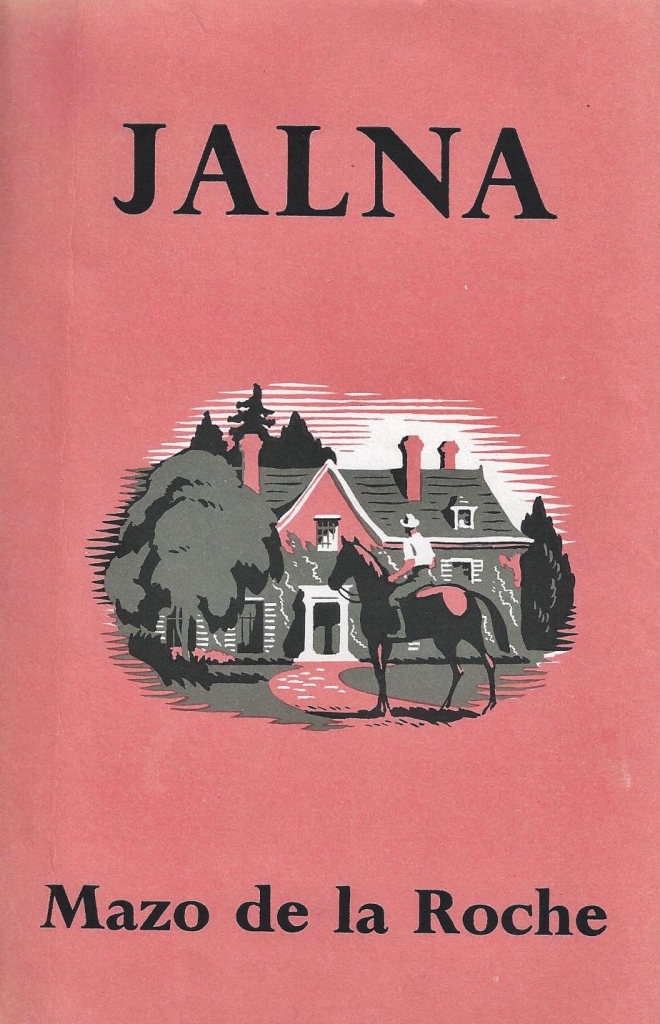
jalna mazo de la roche 1927 001Jalna by Mazo de la Roche ~ 1927. This edition: Macmillan, 1977. Hardcover. ISBN: 333-02528-8. 290 pages.

My rating: 5.5/10

This dramatically romantic novel by a young Canadian writer won a literary prize of $10,000 upon its publication nearly a century ago: an astonishing amount for the time, equivalent to something like $132,000 in today’s currency. (I looked that bit up using a handy-dandy inflation-indexed currency converter I found online.)

Spurred on by her success, Mazo de la Roche went on to write another fifteen Ontario-set installments in the Whiteoaks family saga, creating something of a literary cottage industry of sequential books, assorted editions and collections, and theatrical, radio and filmed productions for the next fifty years.

I was well aware of this novel and its reputation as an iconic bit of literary Canadiana, but I hadn’t actually read it until this year.

My verdict: I’m not stacking up the other 15 on my night table for essential reading, though I might possibly poke my nose into another one if the mood feels right. I do have a number of them stashed away, found at a library book sale some years ago. I gave them to my mother, and she returned them with not much comment, which should have been a bit of a tip-off.

No hurry on the others, though. Jalna was not particularly compelling. In fact, only okayish is as far as I’m willing to commit myself on this one.

The plot in a nutshell:  Wealthy matriarch Adeline Whiteoak is approaching her 100th birthday, and her various offspring and descendants circle round her angling for her slightly senile blessing.

One grandson unpopularily marries a local girl, by-blow of  the man who once unsuccessfully courted one of Adeline’s daughters, while another brings home an American bluestocking. Both brides soon come to think that perhaps they have chosen the wrong brothers. The eldest of Adeline’s grandsons, broodingly charismatic, ceaselessly womanizing and still-single Renny, catches the eye of the American wife, while her spouse in turn dallies with his brother’s bride. Much chewing of the scenery ensues, helped along by the unmarried members of the family, Adeline’s two elderly sons and her much-past-her-prime passive-aggressive daughter.

Absolute soap opera. Think a lowish-rent Gone With the Wind, sans Civil War and southern drawls and a horribly likeable heroine, but with similar over-the-top romantic heart-throbbings and dirty little secrets. (Perhaps not really the best comparison, but it was what popped into my mind. It’s not really like GWTW at all. Perhaps Mazo de la Roche does stand alone.)

And there’s an elderly parrot, and a cheeky young boy, to provide much-needed levity, though not enough to ultimately save this overwrought thing from itself.

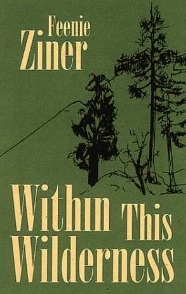
within this wilderness feenie zinerWithin This Wilderness by Feenie Ziner ~ 1978. This edition: Akadine Press, 1999. Softcover. ISBN: 1-888173-86-6. 225 pages.

My rating: 8.5/10

I read this book some months ago, and posted a brief mention of it as part of a round-up post. Expanded here, and re-posted in order to include this in the Canadian Book Challenge #8.

Within This Wilderness is an autobiographical account of Ziner’s final attempt to come to terms with her adult son’s rejection of society and his retreat to the remote coastal woods of British Columbia’s Vancouver Island.

The 1978 Kirkus review:

Feenie Ziner’s son Ben was one of those Vietnam war casualties who was never in uniform: spooked by the military buildup, repelled by the consumer culture, he dropped out of school and took off for the Northwest, talking of cosmic energy and inner space, drifting in and out of lack-limbed communes, ultimately settling on his own wilderness island. Anxious for his return or at least some answers, Ziner flew in after he’d been living alone for nearly two years, and her skillfully developed account of what transpired between them – a progressive disarmament – slips over the boundaries of personal experience. She masters the primitive flusher and inures herself to thoughts of wolves (“I’ve read Farley Mowat”); he points out handmade appliances and shares new wisdoms (“Plastic is to us what horses were to the Spanish”). They lie to each other, spar philosophically, and resume a fragile peace. Even the eccentric neighbors – classic misfits – find him difficult. “Why does he make himself so damned. . . inaccessible?” “Why does he live that way? As if he were expiating for some kind of a sin?” She draws on the tranquillity of the place, reads the I Ching with the beatific vegetarian round the bend (“The companion bites a way through the wrappings”), and waits. And eventually the staunch independence unmasks, the precarious self-esteem surfaces, a pained confession of inadequacy is spoken. One must suppress dark thoughts about the shaping of this material (could it have happened so smoothly? was she taking notes?) for the perfect curve of events seems almost too good to be true. But Ziner deftly renders the nature of their exchange and the nuances of her private adventure, and the illumination of his fringe benefits and her mainstream hollows will reach that audience attuned to generational discord and cultural reflections.

I found this book deeply moving, relating (of course!) to the mother-figure as she tries to figure out just what is going on with her son, and how much of it had to do with her. Her son’s back story leads one to speculate that it was not so much what his parents did as what he was in and of himself, but the mother-angst is no less because of this.

Feenie Ziner turns this very personal aspect of her life into something engagingly relatable. I myself found it comforting, being involved in the same stage in my life in relation to my own newly adult son – that point where they wander off and do slightly inexplicable things and leave you wondering just where you lost your place in the parenting manual – oh, hang on – was there a manual? – and the only thing one can cling to is the thought that your motherly experience is widely shared.

The worries in both of our cases, I hasten to add, are not as much about the moral state of the offspring as about the little details about how they are going to feed themselves, and the lack of any obvious-to-the-parental-eye long-term planning “career”-wise.

Within This Wilderness, along with its deeper moments, is permeated with wry humour, as the author turns her thoughtful gaze upon herself, and the various characters she encounters as she steps into her son’s out-of-the-mainstream world.

Curious about the whole Ziner ménage, I recently tracked down Feenie Ziner’s 1966 memoir, A Full House, detailing her life with her husband, acclaimed artist Zeke Ziner, their two young sons, and newborn triplets. I will be writing about this memoir in more depth in a future post.

“Ben” Ziner is in reality Joe Ziner, and he did stay on Vancouver Island, pursuing an eventual calling as an artist and printmaker. Joe Ziner founded Percolator Press in Courtenay, B.C., which specializes in graphic art and illustrated books.

Very much worth reading. Recommended.

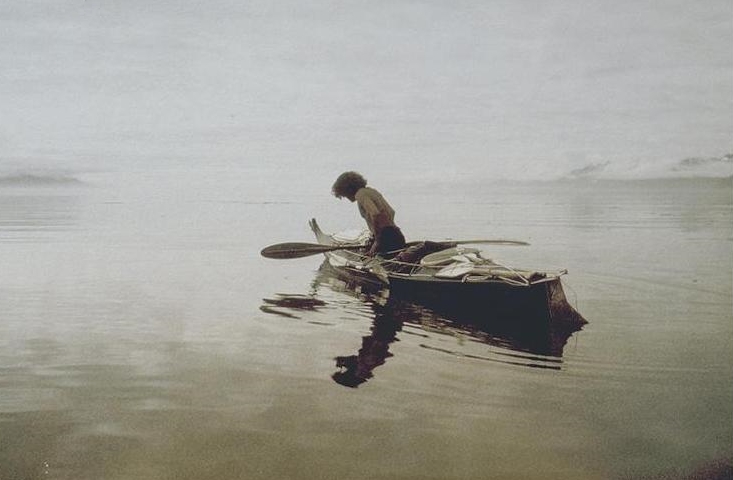
Joe Ziner in Chatham Strait - photographic image by George Dyson

Joe Ziner in Chatham Strait – photographic image by George Dyson


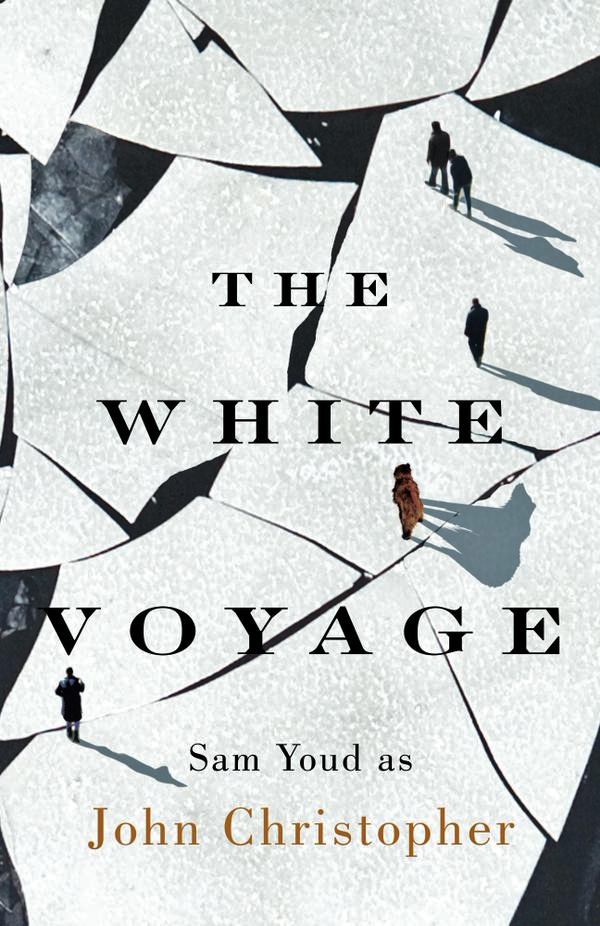
I received a comment on the blog this morning from the SYLE Press, announcing their eBook release of John Christopher’s obscure novel, 1960’s The White Voyage, latest in their collection of vintage re-releases by this well-regarded-in-his-time sci-fi writer.

Christopher’s publishing era was the 1950s-60s-70s, and his work is absolutely typical of its time, but he displays an interesting line in dystopian conjecture which makes his work worth dipping into, if only to see how well matched our present world is to his imagined future.

Though The White Voyage is not one of John Christopher’s most well-known works – this claim must go to his young adult Tripods sequence, as well as his chilling and violent The Death of Grass – it’s an interesting example of this writer’s line of speculative fiction, and it’s free today and tomorrow on Kindle, for those so equipped.

Here’s the link:
http://johnchristopher.org/the-white-voyage-2/

white voyage john christopher syle press

Some years ago I wrote the following post on another of John Christopher’s adult-oriented novels, 1962’s The Long Winter, and I’m reposting this today for those interested in this somewhat gloomy genre.

*****

the long winter john christopherThe Long Winter by John Christopher (pseudonym of Samuel Youd) ~ 1962. Alternate British Title: The World in Winter. This edition: Simon & Schuster, 1962. Hardcover. First American edition. Library of Congress #: 62-12411. 253 pages.

My rating: 7.5/10. This fifty-year-old post-apocalyptic novel was much more gripping than I had expected; the premise of a new ice age is chillingly depicted (pun intended). I thought this one was right up there with John Wyndham’s similarly themed works. I started it last night as a casual bedtime dip-into-and-check-it-out read, and I was quickly hooked and soldiered on until well after midnight to finish it, to my slightly groggy detriment today.

Good period piece and a fine example of the vintage speculative fiction genre, though with the expected true-to-the era misogynist attitudes and opinions. This would make an excellent film, in the right hands.

*****

Andrew Leedon rubbed his hands against the antique Victorian muff-heater Madeleine had given him. She had found it in an antique shop and presented it to him on his birthday, along with a supply of the small charcoal by which it was fueled. But even charcoal had become impossible to obtain, and its brief usefulness, after so many years, was almost at an end. He blew through the small holes on the side and watched the red glow brighten. A chair scraped and he turned his attention back to his fellow readers. He felt pity for them, but it was mixed with envy. The future was a current which soon, very soon now, must drag them down into the maelstrom; for the moment they bobbed like corks in this eddying backwater, but the deep tug of the undersurge was there and none would escape it. Yet they were indifferent. The red-eyed, gray-haired man across the aisle with his pile of volumes on King Arthur – he had always been there, in the same place, with the same books. When the end came to him, in however strange and incalculable a form, it would be irrelevant, as irrelevant as the pneumonia or heart attack or cancer which would otherwise have rendered his seat vacant. Soon all the seats would be vacant together until, as must happen, marauders broke in to rip up the wood and carry away the books that were left for fuel. Some of the rarest books had already gone, to the libraries in Cairo and Accra, in Lagos and Johannesburg, and more would go in the next few weeks; but there would still be enough to draw the mob. The people reading here were not so foolish as to expect a reprieve – for the library of for themselves. It was that he envied.

The main lights were off, conserving electricity. There were only the small reading lights, and, high up, the grayness that filtered in from outside. He thought of Africa; of sunshine, long beaches by a blue ocean, the green of trees and grass …

In the middle of the 20th Century a worldwide environmental catastrophe is occurring: the sun’s radiation is decreasing, and a new ice age is looming in the temperate zones. British television producer Andrew Leedon, happily married with a lovely wife and two young sons, catches a glimmer of the story as it first starts to break, but he, along with everyone else, pays little attention. Even if the predictions are correct, what would a degree or two difference in temperature really mean? Surely nothing to worry about; winters in England might even be more traditionally enjoyable again; skating on the Thames would make a pleasant Christmas diversion…

As the true impact of the swift and ever more severe solar cooling begins to be felt, Andrew’s marriage echoes the collapse of his planet’s future. His wife confesses that she has been continuously unfaithful since the first days of their marriage and is now leaving him for his good friend David Cartwell; as a consolation prize Andrew is thrown together with David’s discarded wife, the gentle Madeleine.

Those fortunate enough to have been able to plan ahead and liquidate their assets are moving towards the equatorial regions; Andrew’s now-estranged wife and sons leave for Nigeria without his initial knowledge. Stubbornly refusing to flee in his turn, Andrew is finally convinced to leave by Madeleine, and with David’s assistance the two obtain seats on one of the last air flights out of England. David himself remains behind, counting on his high position in the government to enable his escape if and when it becomes necessary. But for now he intends to stay and see England through this crisis to the best of his considerable ability.

In Africa, Andrew and Madeleine find themselves immersed in a society very different from that which they know. White-skinned Europeans and Britons are the new working class; their currency is worthless, their academic and professional qualifications ignored. Serving the ruling class Nigerians in the former British colony, the whites scrub toilets and wait tables and prostitute themselves to pick up enough money to eke out a precarious existence. Andrew and Madeleine settle into one of the worst of the slums, until a chance encounter with an African student whom Andrew had patronizingly but kindly treated to a dinner at his club back in the old days in London elevates him socially and professionally by making him a personal assistant.

This turn-about relationship leads to a morally challenging situation, when Andrew is asked to join a Nigerian military expedition force planned to explore England by Hovercraft, to assess the possibility of re-colonizing that now nearly abandoned territory under an African flag.

The first part of this post-apocalyptic tale is, in my opinion, the best-written, where Andrew struggles with the ethics and morality of his own behaviour in this unprecedented crisis, and keenly observes the reactions of those around him. As the novel progresses, and as the conditions in the frozen lands worsen, to martial law, brutal violence by the few elites with guns against the many without, and survival of the fittest by any means, including cannibalism, the story becomes much more intellectually shallow and far distant from the complex inner musings of the earlier days. To be fair, this might echo the increasing callousness of the strong as they jettison their finer feelings to ensure their own continued survival; ethics are a luxury no one can afford to indulge in any more.

The racial situation of blacks versus whites and their role reversals is cleverly presented; the tone remains “white” racially superior though, as the Africans ultimately are undone by their own “inborn” weaknesses, at least in the eyes of the staunchly patriotic Britons defending their frozen homeland.

This is indeed a very British book; the author assumes a strong familiarity with English landmarks and history, and knowledge of London neighbourhoods and architectural and physical features. The narration itself is very stiff-upper-lip, in the best stereotypical tradition.

I thought that Andrew lost some of his credibility as a character towards the latter part of the book; his continual fixation on his personal life while the world itself is crashing down around him strikes what seems to me an off-key note.

Or does it? How would you react? Would you focus ever more inward, or would you harden your soul to pursue sheer survival over sentiment?

The ending of this epic is left open and vaguely optimistic, but though we may speculate on Andrew’s future, we are not at all assured that he will even survive, let alone thrive, in the changed world he is struggling to adapt to.

*****

John Christopher was the pseudonym of the late (1922-2012) prolific sci fi and speculative fiction writer Samuel Youd. His best-known works are perhaps the teen/young adult “Tripod Trilogy” concerning an alien invasion of Earth: The White Mountains (1967), The City of Gold and Lead (1968), and The Pool of Fire (1968). I read all three of these some years ago, and though I felt that they were often technically over-simplistic, they were emotionally gripping, thought-provoking and generally memorable.

This is an author worth investigating for the frequent excellence of his creative ideas and his sober examination of human emotional motivations, though his writing can be occasionally uneven, varying in quality even within the same book.

If you are a John Wyndham fan, you will find much to enjoy in John Christopher’s stories. In that case, recommended.

A note: The Long Winter was intended as an adult novel, even though this writer also wrote widely for teens.

Well, now. May 2015 has followed April 2015 into history, pretty well unrecorded by me. Here’s hoping June will be the month I get it all back together. But it’s not looking all that good, my bookish friends, for the following reasons.

#1 – We’re about to start tearing the roof off of our house. And then we will be replacing it, with a newer, better roof. New trusses, more insulation, a much steeper pitch (no more shovelling it off in winter – hurray!) and superior metal cladding. Also two more skylights (hurray again!) to brighten the gloomier corners. The downside is that our satellite dish will be coming off for the duration, which means that we will probably have no internet service for the time of the project, unless we can prop it up somewhere where it can still receive a signal. Won’t know until we experiment, so if an even more total online silence ensues it might be for this reason.

#2 – Road tripping. All work and no play makes Jack (and Jill) a dull boy (and girl), so in the midst of our construction we will be heading off into the mountains on a driving trip in our little Spitfire convertible. We’re aiming for the Jasper-Banff parkway right through the heart of the beautiful Canadian Rockies, with a side trip into the Kootenays and Selkirks. Winding mountain roads, beautiful scenery, and a meet-up at the end with a group of like-minded Little British Car people. Fingers crossed for sunshine!

Fingers also crossed for an actual book post soon. I’ve been writing them in my head, just not quite making it to the computer with them.

Onward and (quite literally) upward!

Bye for now.

The road beckons! Looking down the bonnet of the Little Blue Car.

The road less travelled beckons! Here’s to the special joy of looking down the bonnet of the Little Blue Car…  (Don’t be too terribly envious, though. We travel with a full tool kit, and the very real possibility of rather more adventure than we want. One of the less-publicized aspects of long-distance driving in a vintage car.)

“So, read any good books lately?” my friend cheerfully asked me yesterday when we were playing catch-up on personal news at the first Farmers’ Market of the season. “I’ve noticed you haven’t been posting on the blog for quite a while.”

I hung my head in bibliophilic shame, and dissembled not very cleverly. “Well, so busy, you know. And I’ve been doing a lot of re-reading. Hard to focus this time of year, what with the garden and all. You know, so busy!”

To be absolutely honest, it’s about the normal state of busy (which translates to quite well occupied indeed), but the book blog has indeed slipped into the neglected category on the want-to-do list, and that makes me most unhappy, because I do truly like rambling on about what obscure gems (or otherwise) I’ve just dragged home from my latest book-hunting excursion.

The sad thing is that I am sitting here and not remembering what I’ve been reading – it’s all lost in the fog of that part of my brain. Wait, the mist is parting… (Aided by a pass through the house and an examination of the main reading spots.)

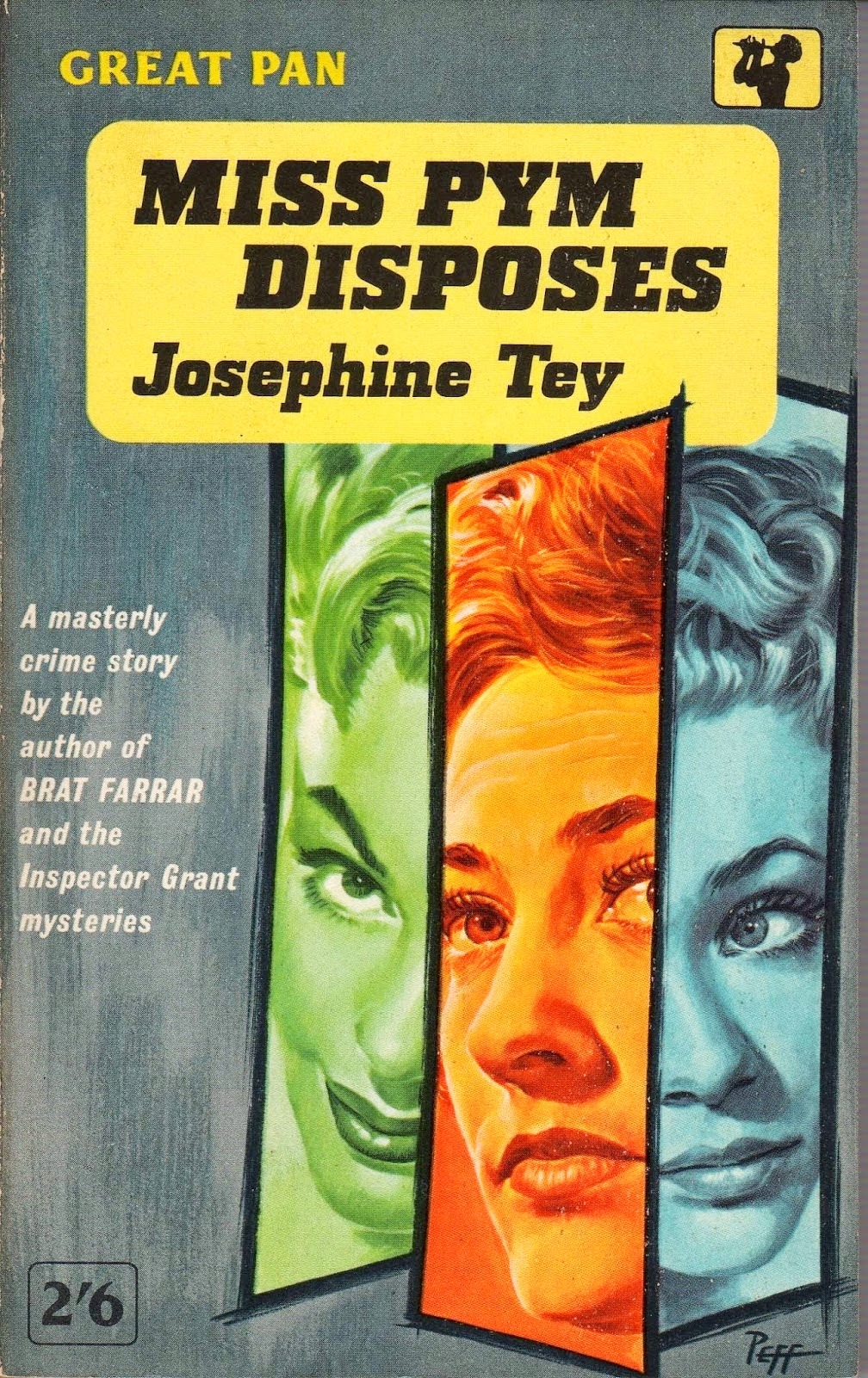
miss pym disposes josephine tey 1946 pan coverFirst off, the book in hand at present, Miss Pym Disposes by Josephine Tey  (1946). My ???th time reading, as Tey is a fixture on the favourites shelf. Miss Pym, amateur psychologist and unexpectedly bestselling author, visits an old school friend’s “physical training” college, and finds herself observing much more than mere gymnastics. A quietly humorous mystery story which works just as well as a “proper” novel, as do all of Tey’s too-few puzzle tales.  The details are wonderful. I haven’t yet properly reviewed Miss Pym Disposes, but I have previously said a few things about Pym’s first novel, The Man in the Queue (1929), and her later “double life” suspense novel, To Love and Be Wise (1950). As with everything by Josephine Tey, highly recommended. Late Golden Age mystery fiction at its very best.

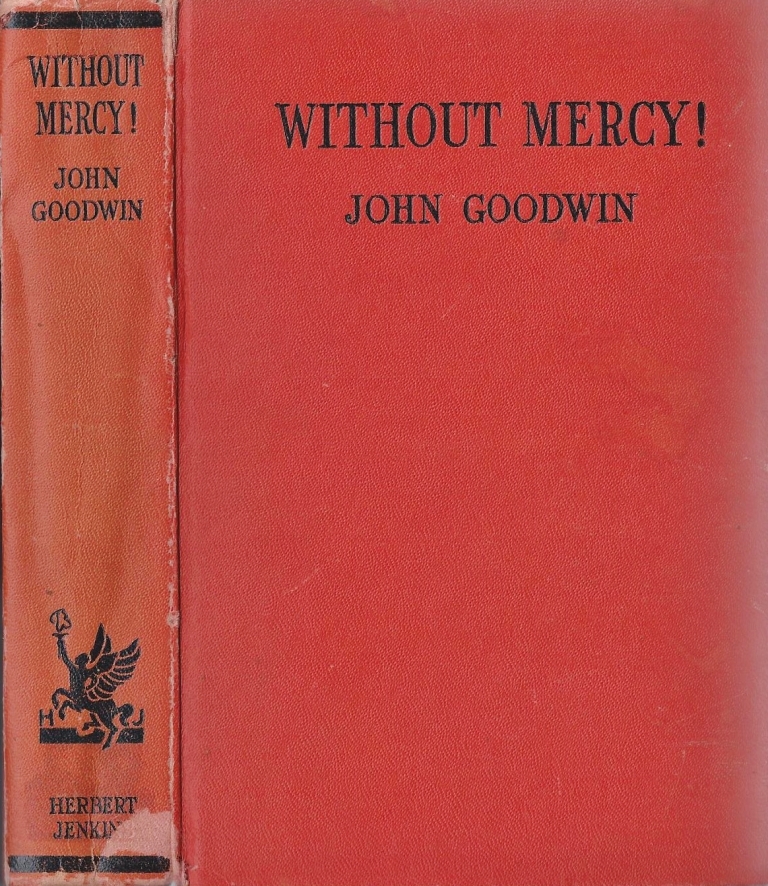
without mercy john goodwin 1920 001Without Mercy: The Story of a Mother’s Vengeance by John Goodwin (1920). This old thriller was pretty bad, but I did read it cover to cover, so it must have had some redeeming qualities. Its sheer melodrama kept me interested enough to follow the improbable twists and turns right up to the satisfyingly clichéd ending.  A beautiful virgin falls into hands of evil men in the South American jungle, is stripped naked and lashed with whips until point of death and then (by implication) raped, or at least threatened with rape. Fast forward some years, to the meeting of the ex-virgin and her chief assaulter, both now moving in London’s high society. Cue emotional confrontations, kidnappings, financial and political skulduggery, a barge on the Thames full of high explosives (BOOM!!!), incredible rescues (numerous), and a generous sloshing of chloroform (refer back to kidnappings: in aid of.) Eventually (page 300 or thereabouts) the bad dude gets his fatal comeuppance: “You have a revolver; you know what to do with it, Sir X. I will give you an hour to settle your affairs and write out a full confession before revealing all to the authorities!” (Or words to that effect.) The hero gets the lovely girl: “Go forward, children, and drink deep of the cup of Life. For me, at last, there is peace.” (Direct quote.) I think we could safely call this a period piece, and gently change the subject. Promotional note facing title page:

WHAT THIS STORY IS ABOUT

Mrs. Garth is the head of the last of the great private banks, Garth, Garth and Trelawnes. She has a genius for finance, and is also a great personage in the social world.

Madame Vampire, the director of Gordon’s Limited, the notorious moneylenders, is also a power; but not for good.

No one suspects the truth, that Mrs. Garth and Madame Vampire are one and the same woman.

Sir Melmouth Craven, of the sinister Sternberg Syndicate, desires to marry Mrs. Garth’s beautiful daughter, Margaret. He is humiliated, and determines to be revenged upon the mother versus the daughter.

The story is full of thrilling situations and exciting incidents.

Indeed.

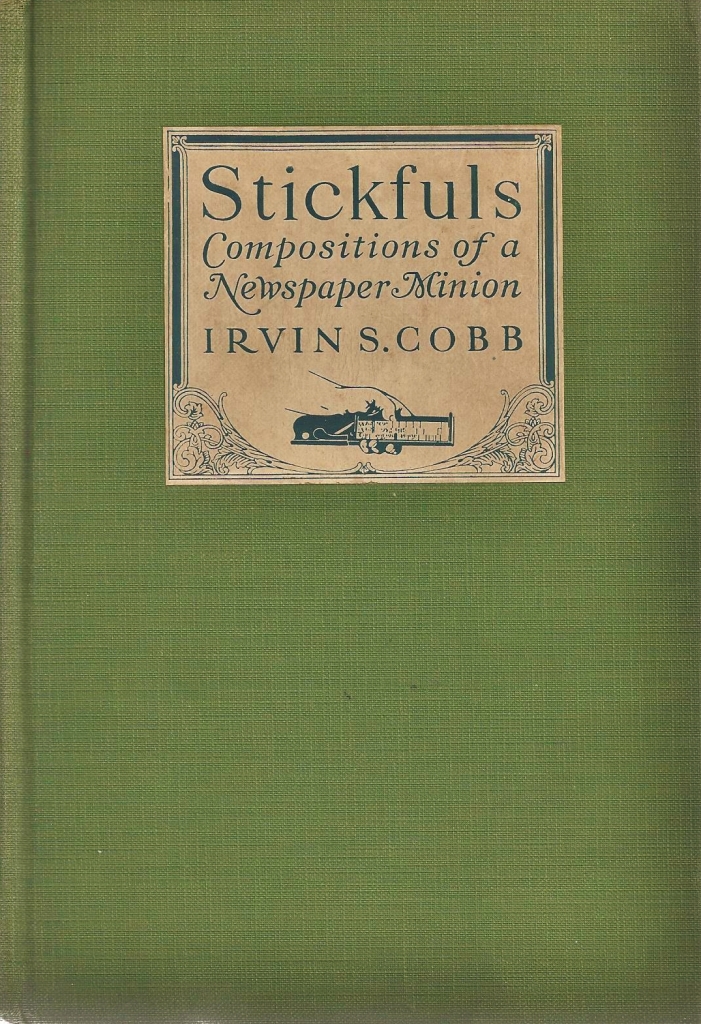
stickfuls irvin s cobb 1923 001Now for something rather different. Stickfuls: Compositions of a Newspaper Minion by Irvin S. Cobb (1923). (Later editions bear the title Myself – To Date.) This was a very enjoyable read, being the autobiographical account of the writer’s youth and early years making his way in journalism. Wryly humorous, self-revealingly honest, sometimes poignant, and always opinionated, this is a quietly glowing example of what memoir can be. I had no idea who Irvin S. Cobb was when I picked this book up last year in one of Vancouver’s overflowing used and rare book emporiums, Lawrence Books on the corner of Dunbar and West 41st (situated conveniently en route between the UBC Botanical Garden and Van Dusen Botanical Garden – fellow bookish horts take note), but a few moments browsing between its green linen covers convinced me to add it to my armful of vintage treasures. Now that I have made Mr. Cobb’s acquaintance, I find myself inclined to keep an eye open for some of his other writings, which I am sure will be very readable, if Stickfuls is a typical sample of this man’s smooth and clean prose.

A Wikipedia page details Cobb’s exceedingly full life and productive career. A very condensed summation:

Irvin Shrewsbury Cobb (June 23, 1876 – March 11, 1944) was an American author, humorist, editor and columnist from Paducah, Kentucky who relocated to New York during 1904, living there for the remainder of his life. He wrote for the New York World, Joseph Pulitzer’s newspaper, as the highest paid staff reporter in the United States.

Cobb also wrote more than 60 books and 300 short stories. Some of his works were adapted for silent movies. Several of his Judge Priest short stories were adapted for two feature films during the 1930s directed by John Ford.

That’s all for this morning, but now that I’ve broken the long silence I hope to get back into the habit of posting a bit more frequently.

Off to dig a few more post holes on the horribly steep hillside – a rather daunting but sorely overdue project, replacing a very tired split-rail Russell fence with something rather more sheep- and farm-dog-proof, to keep the critters properly confined.

Cheerio! And happy Sunday.