the house of the seven gables 1851 nathaniel hawthorneThe House of the Seven Gables by Nathaniel Hawthorne ~ 1851This edition: Aerie Books, 1988. Foreword and Afterword by Andre Norton. Paperback. ISBN: unknown. 330 pages.

My rating: 6/10

It is midway through the 1800s, and some two centuries after the notorious Salem witch trials, the venerable New England town has settled down into sedate respectability. Its weathered old buildings slumber in the summer sun, shudder in the winter storms, and bear silent witness to the relentless march of time and of an eclectic array of local characters, whose passage through the life of the town is memorialized in local legend.

The now-mouldering House of the Seven Gables is one of the most legend-ridden of the town’s many antique structures. Built on a piece of ground once owned by a reputed “wizard” who was executed during the 1600s’ purges amidst whispered rumours of a personal vendetta and frame-up by a wealthy townsman, the building and its inhabitants are associated with a violent curse pronounced upon the accuser and his future family. Here’s Hawthorne:

Old Matthew Maule, in a word, was executed for the crime of witchcraft. He was one of the martyrs to that terrible delusion, which should teach us, among its other morals, that the influential classes, and those who take upon themselves to be leaders of the people, are fully liable to all the passionate error that has ever characterized the maddest mob. Clergymen, judges, statesmen,—the wisest, calmest, holiest persons of their day stood in the inner circle round about the gallows, loudest to applaud the work of blood, latest to confess themselves miserably deceived. If any one part of their proceedings can be said to deserve less blame than another, it was the singular indiscrimination with which they persecuted, not merely the poor and aged, as in former judicial massacres, but people of all ranks; their own equals, brethren, and wives. Amid the disorder of such various ruin, it is not strange that a man of inconsiderable note, like Maule, should have trodden the martyr’s path to the hill of execution almost unremarked in the throng of his fellow sufferers. But, in after days, when the frenzy of that hideous epoch had subsided, it was remembered how loudly Colonel Pyncheon had joined in the general cry, to purge the land from witchcraft; nor did it fail to be whispered, that there was an invidious acrimony in the zeal with which he had sought the condemnation of Matthew Maule. It was well known that the victim had recognized the bitterness of personal enmity in his persecutor’s conduct towards him, and that he declared himself hunted to death for his spoil. At the moment of execution—with the halter about his neck, and while Colonel Pyncheon sat on horseback, grimly gazing at the scene Maule had addressed him from the scaffold, and uttered a prophecy, of which history, as well as fireside tradition, has preserved the very words. “God,” said the dying man, pointing his finger, with a ghastly look, at the undismayed countenance of his enemy,—”God will give him blood to drink!” After the reputed wizard’s death, his humble homestead had fallen an easy spoil into Colonel Pyncheon’s grasp. When it was understood, however, that the Colonel intended to erect a family mansion-spacious, ponderously framed of oaken timber, and calculated to endure for many generations of his posterity over the spot first covered by the log-built hut of Matthew Maule, there was much shaking of the head among the village gossips. Without absolutely expressing a doubt whether the stalwart Puritan had acted as a man of conscience and integrity throughout the proceedings which have been sketched, they, nevertheless, hinted that he was about to build his house over an unquiet grave. His home would include the home of the dead and buried wizard, and would thus afford the ghost of the latter a kind of privilege to haunt its new apartments, and the chambers into which future bridegrooms were to lead their brides, and where children of the Pyncheon blood were to be born. The terror and ugliness of Maule’s crime, and the wretchedness of his punishment, would darken the freshly plastered walls, and infect them early with the scent of an old and melancholy house.

A bit wordy, do you think? Oh, yes, very much so. This book requires more than a little perseverance to get through, and a very high tolerance for wading through lushly ornate passages such as that reproduced above.

One is rewarded for the attempt by gems of genuine humour and authorial playfulness among all the ponderous pronouncements. Though his writing is dauntingly dense reading, I found myself won over by Hawthorne’s paradoxical charm, in particular his habit of stating the obvious over and over again, driving home his points not by mighty sledgehammer blows, but by a persistent and relentless tap-tap-tapping.

Backing up a bit, to the plot of the story. The wizard is dead, the accursed murderer is about to build the titular house upon the tainted plot of land. And who should Colonel Pyncheon choose as head architect and carpenter but the son of the murdered man! Young Thomas Maule fulfills his commission with admirable expertise, and is luckily not seen lurking about the day of the grand house-warming, which goes horribly awry upon the discovery of the Colonel dead in his sitting room of an apparent hemorrhage, mouth horribly full of blood, chest covered in gore.

“The curse! The curse!” is whispered all about, and a coroner’s jury comes up with the unarguably accurate (though not very enlightening) verdict of “Sudden Death”.

The scene is now set for generations of rising and falling Pyncheon fortunes, as the Colonel’s descendants variously flourish and decline, with occasional inexplicable tragedies occurring, bring back whispers of “The curse!”

The House of the Seven Gables is now occupied by one of the few remaining Pyncheon descendants. Elderly spinster Miss Hepzibah resides alone in the massive and musty old mansion but for a boarder residing in a remote gable, a young man engaged in the profession of daguerreotype photography.

The two enjoy a cordial though far from intimate relationship, and live their lives remote from each other, though young Mr. Holgrave appears to view his landlady with a certain humorous benevolence. He appears this morning of the opening passages of the story to wish her luck upon her present endeavour, that of opening up a room of the house as a “cent shop”, a sort of notions-and-snacks corner store locally common to those women needing to earn a few pennies by their personal labours of baking, knitting, sewing and minor retailing of odds and ends – needles, yarn, tea and coffee, small packets of sugar, flour and yeast and the like for housewives caught short.

What a comedown in the world for poor Miss Hepzibah! Gently raised, a New England “lady”, Miss H has run out of financial resources right when she needs money the most, for her younger brother Clifford suddenly has need of her shelter and assistance.

For Clifford was convicted of murder some thirty years earlier, when the uncle then in charge of the House of Seven Gables was found dead, mouth full of blood, chest covered in gore (hey! does this remind you of anything?) but this time with a damning bloody handprint found at the scene, ostensibly that of young Clifford’s. Clifford has steadfastly maintained his innocence, and apparently there were some doubts as to his complete guilt, because he has quietly been released from jail, to flee to his sister’s sheltering arms, an almost-insane, weeping, cringing wreck of a man.

Add to this ménage a young relation fresh from the country, lovely Phoebe, who is deeply good and conveniently competent and proves a godsend to Hepzibah as she struggles with the dual challenges of shop-keeping and brother-sitting.

And, entering from Stage Left, a villainous uncle, the continuously smiling but deeply evil Judge Pyncheon, spitting image of long-dead ancestor Colonel Pyncheon, complete to grasping nature and apparent lack of conscience.

There follows a not very plausible drama concerning a long-hidden secret document, complicated by the continual efforts of the wicked Judge to confront the mentally fragile Clifford regarding the circumstances of the thirty-years-ago murder.

Phoebe adds a sweetly winsome element to the soberness of the story by her innocent charm and her artless forays into gardening and chicken-keeping in the overgrown gardens surrounding the house, and rather predictably becomes involved in a romance with the handsome daguerreotypist boarder Mr Holgrave, who turns out to be not quite what he seems.

A main character dies in identical circumstances to the demise of the first cursed Pyncheon, and the townspeople gather to gossip and cast blame (“The curse! The curse!”) until all is unravelled, with various truths revealed. The bones of the wizard may now rest easy in the grave. Goodness is rewarded, and the innocent are vindicated, while the evil are indicted of their heinous crimes.

All’s well that ends well, and we close the book with vast relief at having made our laborious way through. Tick it off the list, and move on, meanwhile pitying those poor students who must read, re-read and analyze this dense period piece of a gothic novel in the interests of garnering marks for their literature classes.

Is this really a classic, or merely an example of vintage genre fiction? After this reading I incline to the second designation, for despite its inclusion on numberless literary reading lists, the book is really quite a minor novel, a fluff piece despite its wordy immensity. Its main theme – if there must be one – seems to me to be all about ancestral guilt, but the occasional supernatural occurrences used to move the story along muddy the waters enough to defy its being classified as any one thing. It’s a combination of mild horror story, clichéd romance novel, chest-thumping melodrama, and ironic morality tale.

This said, here and there the author strikes pure gold, with memorable incidents and passages of prose, and to add to its appealing aspects there is abundant humour amongst all of the curses, hand-wringings, bloodshed and drama.

In conclusion I must say that I generally enjoyed the novel, and am glad I read it. I will not however recommend it as a must-read, because it is truly a ponderous hodge-podge of a book, more gobbledy-gook than substance when one views it from a little distance after finally attaining its end.

Here’s an excellent essay by Jason Pettus on the Chicago Center for Literature and Photography website, detailing Jason’s opinion regarding The House of the Seven Gables’ inclusion on classics lists, and its historical literary significance.
House_of_the_Seven_Gables_(2)cond

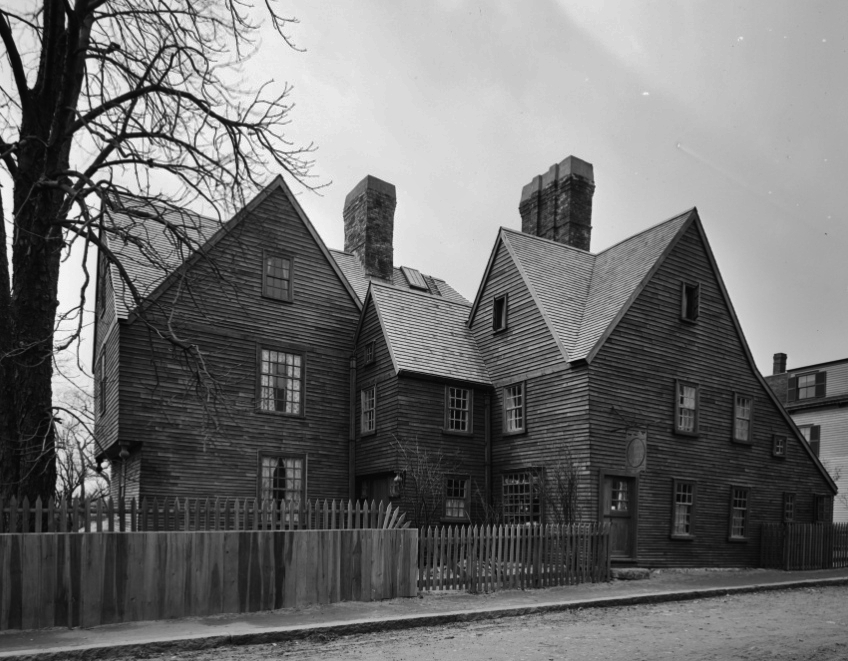
The house which inspired Nathaniel Hawthorne’s gothic romance, the Turner-Ingersoll mansion in Salem, built in 1668, and now restored as part of a collection of historic buildings associated with Hawthorne in his home city. Photo taken in the early 1900s.
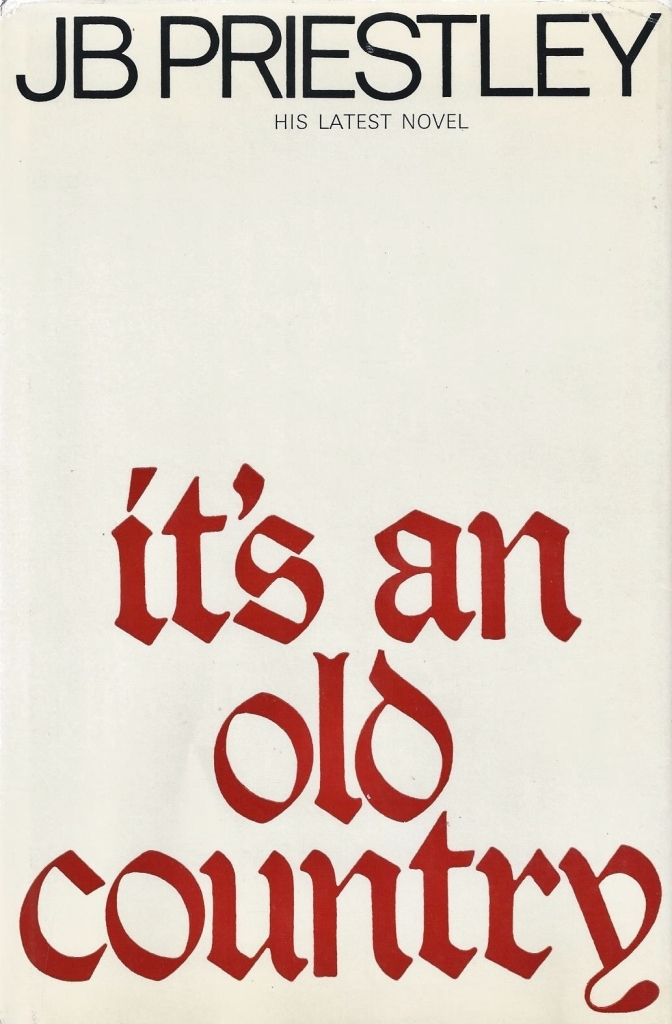


it's an old country j.b. priestley 001It’s An Old Country by J.B. Priestley ~ 1967. This edition: Heinemann, 1967. Hardcover. 247 pages.

My rating: 2.5/10

I’m a sincere J.B. Priestley fan, so this rating and following review pain me greatly. I’ll try to get it over with quickly, so I can put the book away (far away) and not have to look at it and be reminded of my disappointment.

It’s 1960-something, and 35-year-old economic historian Tom Adamson has just buried his mother in a Sydney, Australia graveyard. Tom is by birth English, having come to Australia as a toddler with his embittered mother and wee sister when his actor-artist father suddenly abandoned his family back in the old country.

Raised to scorn his absent parent, Tom has had a disquieting experience when, in her last days of illness, his mother hints that there was some sort of mystery as to why Dad cut all ties, and a deeper reason behind it all.

So Tom takes leave from his job as a Colonial Economic History professor at the local university, flies to England, and proceeds to seek his father, whom he feels is still alive (he’d know if it weren’t so, our author assures us, Tom being apparently blessed with some sort of superior filial intuition) and perhaps yearning for his long-lost son.

Tom falls in with a ne’er-do-well cousin, who in the intervals of between hitting Tom up for substantial “loans” of cash actually proves fairly useful in providing introductions to people who can give snippets of information regarding Tom’s elusive father. We meet a vast array of potentially intriguing characters – a seedy private enquiry agent, a senile noblewoman, an elegant European jetsetter (with whom Tom has an ultimately unsatisfying sexual escapade), various actors, artists, writers, pub-owners, ex-lovers of the father, ex-employers of the father, fellow workers of the father’s numerous jobs – an immense cast of secondary characters, and each one as sketchily portrayed and forgettable as the last.

I’ll tell you what Tom discovers, to save you from plodding through this thing for yourself. (Consider this your spoiler alert, though that very term implies something suspenseful or exciting, which is far from what occurs in the book.)

Turns out that Dad’s letters home were suppressed by a jealous lover – he’d really meant to return to his wife at some point but said lover maneuvered weak-willed Dad in a different direction. After failing at reaching success as either an actor or a painter, Dad enlisted in the army, fought in the 2nd World War, came out to a dismal civilian life, passed dud cheques, served time in jail, changed his name, and worked at a series of progressively less rewarding jobs until Tom finds him slaving away as an underpaid waiter in a South Devon hotel.

There is an underwhelming reunion, notable for its über-masculine soberness. Tom promises to set Dad up with an annuity and a new life in London, with the intimation that one of Dad’s old girlfriends who still carries a torch for the ineffectual but generally decent old guy will step in to provide female companionship.

Tom himself has found a love interest in a 25-year-old book editress, and the two find they share a sniffy dislike of the way English society is sliding into chaos – beatnicks versus the old guard – and decide that the happiest future shared career will be in working for the U.N. In a more developed part of the world of course: “(D)oes it have to be Ghana or Cambodia or Ecuador?…Couldn’t we make it Austria or Thailand or Mexico, my darling?”

The end.

It’s an Old Country fails to live up to expectation on every front. The plot is boring. The characters are strictly cardboard – even our “hero” Tom fails to come across as multi-dimensional in any way, shape or form. The dialogue is stilted. The style throughout reads like a first draft, a mere roughed-out outline without any living detail.

Even Priestley’s “big idea” – a reliable trope with this author is his inclusion of an intellectual motif to each book – is vague  and understated. In this novel, the gist seems to be that the youth of the day are sloppy and unambitious, a bunch of guitar-playing beatnicks, but perhaps that’s to be expected after the way the elder generation has mucked up the world with its wars and class divisions, and that the old guard is overdue for toppling. The “old country” – England, and also its colonial partner Australia – is fixed in its downward spiral – time for a forward-thinking man (that would be our Tom) to abandon ship. Hurray for tradition, it’s been swell but it’s over, see you later.

There are tiny glimpses here and there of the author’s true potential – micro-episodes and lonely glistening, gliding phrases – but so few and far between that they merely serve to remind the reader of how much better this book should be.

One could charitably excuse the absolute flatness of this dull, dull novel by maintaining that after over forty years of plugging out work after work after work the author was scraping the bottom of the barrel, getting old and tired. How then to explain the excellence of the book before this one, the quite stellar Lost Empires, published in 1965? Two years shouldn’t make that much difference. We know the man still has it in him, so where is it here?

It’s an Old Country is a hack piece, trading on the author’s good name, an underwritten, too sparse yet plodding novel that should never have made it to print.

In my opinion.

Over and out.


goodbye to all that robert graves 1929 001Goodbye to All That by Robert Graves ~ 1929. This edition: Penguin, 1977. Revised edition, with text amendments, Prologue and Epilogue added by the author in 1957. Paperback. ISBN: 0-14-001443-8. 282 pages.

My rating: 10/10

Robert Graves’ memoir has already received much publicity and is, I believe, frequently used in schools and colleges. Don’t let that discourage you – it’s not at all a “boring school book”, and it is very much worth reading for the highly opinionated voice of the author as much as for its historical context.

Robert von Ranke Graves was born in 1895 to a mother with connections to the German nobility (hence the von Ranke), and an Anglo-Irish father, the respected Gaelic folklorist and scholar Alfred Perceval Graves. This made him just the right age to head off to war as soon as he exited his prep school (Charterhouse) in 1914.

Graves served as an officer on active duty for the entire duration of the war, though he almost didn’t make it through. He was wounded so horrifically at one point that his commanding officer, assessing the bloody mess of his officer draped upon a stretcher with a gaping and presumably fatal chest wound, wrote and sent off a letter of condolence to Graves’ mother, telling her of her son’s brave and “mercifully swift and painless” demise.

Graves pulled through that episode, and later had the pleasure of being able to read his own prematurely-published obituary, and to grimly chuckle over fulsome letters of condolence sent to his parents by certain bosom enemies of school days.

Goodbye to All That was the result of Robert Grave’s bitter disillusionment with the horrors of the Great War, and with the society which bred the “good sportsmen” who perished in their wasteful thousands. Supremely sensitive and articulate – Graves was a published poet while still in his teens – he communicates his disgust at the whole British system – the “All That” of the title – which not only allowed but which actively encouraged (in his mind) the kind of blindered thinking which allowed this to happen.

Goodbye to All That details Graves’ youth and school years, the war years, and his unconventional 1918 marriage to the just- eighteen-year-old Nancy Nicholson. The narrative reads like a Who’s Who of Big Names of the time: Siegfried Sassoon, T.E. Lawrence (late of Arabia), and John Masefield (whose garden cottage Robert and Nancy and their four young children gratefully occupied for some years), among many others.

There’s a whole lot Graves doesn’t tell in this memoir, including the details of his marriage breakup and his subsequent decision to scrape the dust of England off of his feet with bitter finality. Robert Graves moved to Majorca in 1929, a week before the publication of Goodbye to All That, and from there he shrugged off the numerous shouts of dismay his then-controversial tell-all work engendered. Graves lived in Majorca until his death at the age of 90 in 1985. His life-work was an astounding 140-plus volumes of poetry, biography, personal memoir, and novels.

Full of questionable truthfulness as some bits may be – accounts of others-who-were-there occasionally vary – Goodbye to All That is superb.

Very highly recommended.

A note: Robert Graves edited the 1929 edition of Goodbye to All That in 1957, replacing pseudonyms with real names, and adding to and tightening up many of the details. He later said that nobody noticed that he had essentially rewritten the book, and that readers reported themselves surprised by “how well it had held up” since its original publication. Since the 1957 edition is the one we are most likely to encounter (my own copy is of that vintage) it might be rather interesting to at some point to also read an earlier version, if one were so inclined.

Note # 2: This post was originally part of a 3-book review published in December 2014 – 1914 and All That – Reports from The Great War: O. Douglas, Rose Macaulay & Robert Graves – and has been split off and reposted to aid in its inclusion in the Classics Club list.


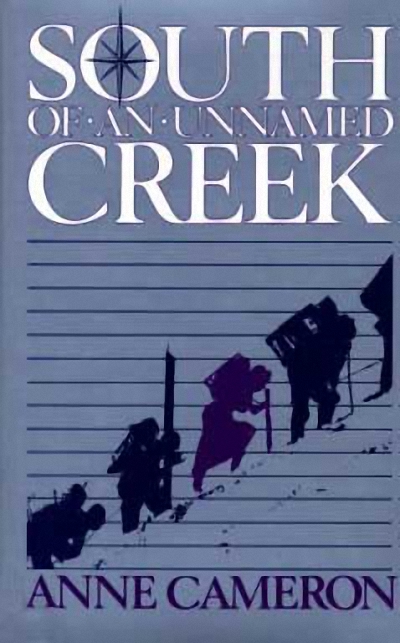
Ssouth of an unnamed creek anne cameronouth of an Unnamed Creek by Anne Cameron ~ 1989. This edition: Harbour Publishing, 1989. Hardcover. ISBN: 1-55017-013-9. 199 pages.

My rating: 4/10

Six (actually seven, plus a girl child) downtrodden women are brought together by circumstance and end up as business partners (and more! much more!) during the 1890s’ Klondike Gold Rush.

Sounds like a promising storyline, doesn’t it? I thought so, and opened the book all ready-prepped to enjoy – well-known B.C. writer, strong female leads, historical setting – what could be better? I happily thought.

Anne Cameron, B.C.’s rather fascinating angry-feminist-lesbian kidlit/adult novel writer, in South of an Unnamed Creek combines period drama with a liberal helping of revenge fantasy, placing her characters deep in the mire before providing them with opportunities for turning the tables on their oppressors, and the heck with plausibility. I have to say that the parts that put me off the most were not necessarily the abundant incidents of rape and physical abuse, but the utter unlikeliness of the revenge bits, which are set out by Cameron with salacious glee.

It reads to me as if the author let her opinions get in the way of her craftsmanship.

The following post is loaded with plot spoilers. Stop here if you don’t want to know. Also if you can’t handle rape scenes, conventional and otherwise.

So here’s what I came away with.

  • All women are born victims.
  • All men are natural oppressors of women.
  • And “respectable” white men are the worst.
  • All First Nations people are wonderfully spiritual and secretly heroic. (But especially the women. Who are universally victimized by society as well as by the male members of their families/communities.)
  • Ditto people of “Celestial” origin. (Cameron’s code word for Chinese.) (And especially the women. Ditto the natural victim thing.)
  • But once the female victim is pushed too far – the rape thing, in most cases – superhuman strength and cunning is magically granted, and the oppressors are chopped down (sometimes literally) at the peak of their oppressive prime.
  • And revenge feels good.
  • And men are overrated as bed partners, anyway.

Yes, dear readers, the brushes in this uneven saga are very broad indeed, and dripping with non-nuanced primary colours.

Main characters and the long, complicated setup:

  • Ceileigh is an expatriate Scottish fiddle player who has ended up in some unnamed Canadian settlement, plying her musical trade and saving her bits of copper for passage to who-knows-where. She’s followed home from a New Year’s Eve gig and brutally raped by two men, but once they are sated, the Celtic priestess element in Ceileigh’s nature awakens, and she beats them both senseless with her violin case, disfiguring at least one of her assaulters for life. She’s now on the run from the rapists and the authorities. And she’s pregnant.


  • Aggie is the feral child of drunken parents living on the Fraser River mudflats near (presumably) Vancouver. While still a wee child, Aggie attracts the eye of a pedophilic “Uncle”, but she soon learns how to trade sexual services for various favours, such as a dress and (I’m not kidding) shoes good for tapping. For Aggie is a naturally accomplished dancer, and is soon working the streets as an entertainer, dancing for pennies. She is taken pity on by a noble First Nations woman, adopted into a native village, and initiated into the Salish lifestyle and spirituality. It can’t last. The hapless villagers are soon wiped out en masse by smallpox, and Aggie heads back to her squalid old life and occupation.


  • Su Gin is the daughter of poor Chinese farmers. When bandits attack her village and kill almost everybody, she hides in the mud of the rice paddy, surfacing when it’s safe. Her uncle, coming to take over the family holdings, welcomes her warmly, then immediately drugs her and sells her into slavery. Su Gin comes to on a ship headed for the west coast of Canada, fated for a new life as a prostitute. (Being a virgin, her initial price is set high. Cameron uncharacteristically spares us the details of Su Gin’s deflowering.)


  • Lily is the child of a rather simple-minded, money-grasping white prostitute somewhere in middle Canada. At a still-tender age Lily is rescued by her great-grandmother, taken off to an affluent life in the city, and civilized and educated. But everyone in the family (except Great-grandmother) despises Lily for her origins and her outspoken ways. When Lily is in her teens, Granny dies, and Lily, knowing her life will change for the worse without Granny’s protection, loads up with cash (left to her in the will, to the anger of the other relatives) and with a string of the best horses in the stable (the family servants are all on Lily’s side) trots off into the wider world, heading west.


  • Mary is the loving daughter of a widowed coal miner somewhere on Vancouver Island. Daddy is brusque and occasionally violent, due to his hard life and perpetual state of fatigue and hunger. Mary lucks upon an Indian canoe and soon masters the craft of paddling about and fishing. This is a good thing all round, except presumably for the people now missing their canoe, but we won’t get into that. Daddy when well fed is a much cheerier person to be around, and Mary starts bringing in some extra cash with her fish sales. But things are getting too comfy to be sustained. A mine collapse leaves Mary orphaned, and she is kicked out of the company house. Making her way down the coast, Mary does quite nicely with the fishing trade, but jealous men smash her boat. (“This t’isn’t the occupation for a mere woman. Y’er puttin’ us out of business. Go back to yer sewing.”) Luckily Mary has hidden resources. She takes her savings and heads to the mainland on a ship, but only after cleverly (and fatally) revenging herself on her main oppressor. (Glub, glub.)


  • Cora is the eldest daughter of a family of dirt-poor prairie settlers. She loves her patient mother with daughterly affection, but desperately yearns to be a close pal to her stern father, who continually overlooks Cora and favours the boys of the family instead. But Cora has developed a strong skill set, shooting and riding as well (actually, better) than the boys, as well as becoming accomplished in all of the womanly arts. When a wealthy, widowed neighbour-man comes questing for Cora’s hand, her father pushes her to accept. Cora demurs, but the neighbour takes things into his own hands, brutally rapes the teenager, and loads her up into his wagon, with her father’s full approval. Cora, now the physically abused sex-slave of an older man, despairs of her future. When her father is killed in a brothel brawl, Cora’s still-young mother comes to live with her, and it’s not long before Cora’s unofficial husband (they never were properly married) is sampling the sexual delights of Mum as well. So Cora bides her time, organizes her escape plans, and one night packs up a substantial nest egg liberated from her husband’s secret stash, loads up food and a rifle, and rides away with two fine horses, heading west.

Much journeying now occurs, with all of the characters eventually convening in Dawson City or thereabouts. The white characters have bonded together in a business partnership – they set up a hotel/restaurant/trading enterprise catering to the gold miners. They’ve also acquired a male sidekick, a First Nations guide who becomes more than a friend to one of the party. They are joined by Su Gin, who has picked up a random white child in her travels – fellow victim of a brutal train hijacking – as well as another “Celestial” woman, Ling Ying.

Things are going wonderfully well, and the women are coining money hand over fist. Ceileigh’s baby (a girl) is born. Some time (a few years?) goes by. Then – disaster! Mary falls in love with a wicked Englishman, who absconds with the communal hidden stash of gold. Ceileigh’s male partner follows to try to retrieve it, and ends up very dead. Aggie then takes things into her own hands, pulls off a reverse coup in San Francisco, and comes home with the recovered cash, just in time for another crisis, as a gang of slick gamblers blackmail the women into signing over control of their flourishing business. (The reason for the blackmail is the illegal presence of the Chinese women in Canada. Or at least that was the case according to Cameron, though by this point I was no longer relying on her research to be completely accurate in all of its details, as it seemed to me that she was picking and choosing at will from the historical record, context be damned.)

So the women decide to yield to the blackmailers, because things are starting to decline in the business anyway, as the Klondike gold rush is coming to an end.

Off they go with their millions in gold dust, to settle down in kinder climes, some neatly paired off  – Su Gin and Aggie, Cora and Lily – and the others apparently just happy to hang out in sisterly companionship.

And the moral of the story is?

Ha. No prizes for figuring that one out.

Anne Cameron. My goodness. I wish she was a little less obvious in her agenda, because there is some interesting story-telling going on here, but I keep bumping up against the more bizarre bits, such as the sudden kung-fu powers of the Celestial prostitutes and the killer dog used in the revenge scenario in San Francisco and – probably most ick-inducing – the rape scene early on involving the use of a Chinese woman’s bound feet as a substitute vagina. (I even did a very little bit of superficial internet research on that last-mentioned scenario, because it sounded too weird to be true, and I’d never come across such an allegation before. My conclusion is that it is mostly imaginative on Cameron’s part. Perhaps?)

Anyway, I tried my darnedest to appreciate the nuances of this character-heavy, over-plotted yet paradoxically over-simplified tale. As you can see by my rating, it didn’t quite convince me to enter into its world.

Anne Cameron is perhaps most well known for her acclaimed and controversial Daughters of Copper Woman, 1981.


Not my own copy, but a dust jacket of an early edition.

Not my own copy, but a dust jacket of an early edition.

The Old Ladies by Hugh Walpole ~ 1924. This edition: McClelland and Stewart, 1924. Hardcover. 305 pages.

My rating: 5/10

Ah, Hugh Walpole.

Protégé of Henry James, friend and compatriot of such disparate fellow writers as J.B. Priestley, Joseph Conrad and Virginia Woolf, yet, unlike them, mostly forgotten today. Hugh Walpole in his time enjoyed tremendous popularity, though the crueler critics dismissed his work as too facile, too easy to read, too – well – popular.

During his peak writing years, 1909 to 1941, Walpole produced a volume a year (sometimes more) of novels and story collections ranging in tone from the romantic to the dramatic, with ventures into the macabre. Some of his works are small masterpieces of their type.

Some, not so much. A prime example of the B-list is this overlong novel, wherein Walpole takes the material for (at best) a novella, and stretches it out to three hundred pages, when half that would likely have sufficed.

I must say points to the man for keeping it readable, for though The Old Ladies in their uncomfortable dotage got a bit tiresome I was never tempted to abandon them completely, though I had a moment at the close where the urge to give the book a sharp shake (in lieu of its long-defunct author) was only resisted with a strong effort. Walpole brings his tale to a tragically overwrought conclusion, then tacks on a cheerful “prodigal’s return” to the very end, which I must admit is soothing to the reader worried about the most likeable of the titular old ladies, but which was just too darned convenient for my comfort.

The plot:

Three elderly ladies (all are in their seventies) who have fallen on hard times find themselves living in a shabby rooming house in the cathedral town of Polchester (imaginary setting of many of Hugh Walpole’s tales) presided over by a mostly benevolent landlady.

One, the sweet-natured and mild-tempered Mrs. Amorest, is the widow of a poet, who died quite suddenly (in the best tradition of his kind) leaving behind nothing but manuscripts and debts.

The next, also-widowed Mrs. Payne, slovenly and indolent, regrets nothing of her slightly sordid past. She thinks back seldom of her weakly abusive husband and her deserting lover and her long-dead child, concentrating her energies instead upon the comforts of the now, indulging herself with sweets and rich food and dashes of brilliant colour – a ribbon, an ornament, an illustration – which she hoards like an obese dragon in her over-filled lair.

Joining the modest ménage is spinster Miss Beringer, who creeps into the refuge of the old house with her shivering little dog. Miss Beringer has been cheated out of her modest investment capital; her small savings are running out; her future is beyond bleak. She owns one item of beauty and value, an amber carving given to her by her one friend as a remembrance upon the friend’s marriage and subsequent removal to India.

Gentle Mrs. Amorest takes slightly-lower-class Miss Beringer under her wing, not letting on that her own prospects are also desperately declining. Mrs. Payne scorns both of the other residents of the house, despising their meekness and their willingness to run errands for her as evidence of their mental inferiority. She uses them both to the utmost of her cunning ability, and when an ailing cousin of Mrs. Amorest promises a fortune in his will, and Miss Beringer’s amber ornament catches Mrs. Payne’s eye, she begins turn her mental energies to the question of how she can obtain these treasures from her housemates.

Walpole paints a sharply detailed picture of the come-down-in-the-world existences of his three characters. Their thoughts and feelings, their many small economies and occasional overwhelming temptations, their midnight worries and daytime attempts at hiding those fears from the world around them are all sympathetically portrayed.

Small daily drama turns to smouldering melodrama when Mrs. Amorest’s cousin dies and the will is read. Balked of her bad intentions towards one of her neighbours, Mrs. Payne turns her malignant focus upon the other, with devastating results. Only one of the old ladies will walk away from the house with her sanity intact and her future provided for, even if it takes an authorial intervention to bring this about…

Recommended only for those who are already admirers of Hugh Walpole’s eclectically prolific oeuvre. All others, perhaps best to start elsewhere, with The Joyful Delaneys (1938), or Hans Frost (1929), or the critically acclaimed early novel Mr Perrin and Mr Traill (1911), or perhaps the recently rediscovered and dramatized Rogue Herries (1930), first of a four book sequence, and thought by many to be the crème-de-la-crème of Hugh Walpole’s dramatic novels.

My rather unenthusiastic rating of The Old Ladies aside, even a B-list Walpole stands up well to the interested scrutiny of a modern reader. One wishes him a revival, which does indeed seem to be occurring in a low-key way. I add my voice to those who quietly extol his better qualities, and who collect and read his many works with mild enthusiasm.


boo neil smithBoo by Neil Smith ~ 2015. This edition: Vintage, 2015. Paperback. ISBN: 978-0-8041-7136-6. 310 pages.

My rating: 8.5/10

Hot off the press is this “young adult” novel by Montrealler Neil Smith.

It’s 1979, and in a high school hallway in an unnamed city in the United States, a thirteen-year-old boy has just died while standing in front of his locker. Oliver “Boo” Dalrymple wakes up in what can only be Heaven, but it is a Heaven utterly at odds with any preconceptions he or the other occupants might have had.

The place looks like a slightly run-down inner city housing development, it is surrounded by twenty-five-story-tall concrete walls, the weather is always pleasant, food and supplies show up as needed, things (including buildings) heal themselves when damaged, and every single person in the place is a thirteen-year-old American. After fifty years’ residence, during which the occupants mentally grow and mature but physically stay in their teenage form, a person (angel?) suddenly vanishes, though to where or what state no one knows.

Oliver adapts remarkably well to this new environment, though he has always been an agnostic and had not expected any sort of an afterlife. He’s not terribly shocked to have died, for he was in a life-long fragile state of health due to a heart defect. He misses his parents, and is writing an account of his experience in the faint hope that he can somehow, someday communicate with them.

Then another boy shows up, a schoolmate of Oliver’s, and as the two boys compare notes as to how they’ve perished, a troubling scenario begins to emerge, involving gunfire in the school hallway. Was there a killer, and if so who was it? Where is he (she?) now? Maybe right here in Heaven?

Stopping right here, because you’ll want to unravel this one for yourself.

Boo is firmly in the YA genre, but as with the best of these sorts of books, it easily crosses age-defined boundaries.

I liked it. For what it is, it’s very good, and I’m keen to see what my one remaining teenager has to say about it. I suspect she’ll find it as intriguing as I have.

I’d seen mention of it here and there during recent internet travels in search of other things, and thought it sounded darkly interesting, but I wasn’t moved to actively seek it out until I read more about the author and the background of the story here:

Montreal Review of Books: Boo by Neil Smith

My local indie bookstore didn’t (yet) have Boo in stock, but ordered me a copy which arrived just a few days ago. I read it in one long session, staying up into the wee hours to finish it, and I put it down with rather mixed emotions. The ending was quite neatly handled, and I was completely engaged from start to finish, but the book has some flaws, too. Mostly a certain amount of predictability, though that aspect was, as I’ve already said, well clothed with creativity.

Looking at it dispassionately, the big-reveal plot twists were not terribly surprising, and I saw the most crucial of them coming from quite some distance away, but the author has incorporated so many imaginative details that it really doesn’t matter. If you were a child of the 1960s and 1970s, you’ll catch the many pop culture references, and either smile or groan at the memories they inspire. If you’re a child of the new century, some of these might float right over. It also helps to be familiar with young adult literature of that era: Neil Smith indulges in some name-dropping which just might be playing to his contemporaries (he’s fifty)versus teens of right now.

There is, predictably, redemption of a sort after the reveal of the big and angsty main event, but it didn’t get sloppy, and – rather satisfyingly in an artistic sense –  all of the questions weren’t resolved. Some random stuff is just left there, throbbing gently in dark corners of the room, never explained. And – huge point in favour – some bits are very funny.

Several days after my reading, and after quite a lot of pondering, I’ve decided that Boo is a winner.  It’s a fine thing just as it stands. I hope to high heaven (pun intended) that the author can resist the temptation to concoct a sequel. I don’t regret my $20 investment, and I hope the writer gets a decent royalty check, because he’s put a ton of work into this book and it shows.

This is Neil Smith’s first novel, though he has also written a prize-winning collection of short stories, 2008’s Bang Crunch. That one’s on my wish list as of right now.

Buy this for your teen, and then borrow it back for yourself. And keep an eye on this writer.

Another review well worth checking out is here:

The Indextrious Reader – Boo by Neil Smith


9th Canadian Book Challenge Logo flag

The book blogging world abounds with tempting book challenges, some of ambitious proportions, and others rather more modest. John Mutford′s Annual Canadian Book Challenge falls nicely into the middle ground – why, how completely Canadian! 😉

It′s exceedingly simple. In the year stretching from Canada Day – July 1 – to the eve of the following Canada Day – June 30 – read and post/link a review of 13 (or more) Canadian books.

This will be my 4th year participating, and I must say that it is an immensely enjoyable challenge, having put me on high alert for Canadian content in everything I read (villainous cousin Walter from D.E. Stevenson′s The House on the Cliff, I′m thinking of you, though I didn’t include the book in the challenge as the connection was rather too tenuous) and leading me to ever-more-obscure Canadian B-list books (such as The Last Canadian, a recent superb example of why this thing is truly a “reading challenge”) and even some much more recent things (looking forward to Neil Smith′s freshly published Boo, winging its way to me via my local indie bookstore as I type this).

What constitutes a Canadian book is generously broadminded – no need to read the collected works of Pierre Berton to qualify(though of course there′s no reason why one couldn’t – hmmm – now there′s an idea for an ambitious reading challenge) and you’re sure to find some surprises along the way.

Check it out:

The 9th Annual Canadian Book Challenge

And please do join us.

Happy Canada Day!

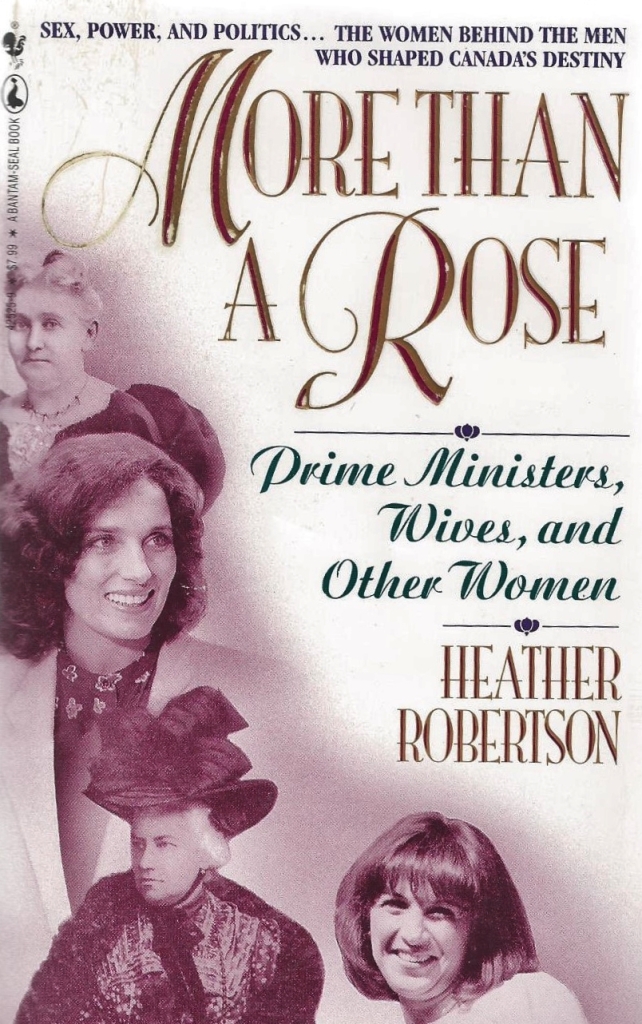
nore than a rose heather robertson 001More Than a Rose: Prime Ministers, Wives, and Other Women by Heather Robertson ~ 1991. This edition: McClelland Bantam, 1992. Paperback. ISBN: 0-7704-2525-9. 439 pages.

My rating: 7.5/10

This may well be my one of my shorter book posts of the year, for the best of reasons. More Than a Rose delivers just what it promises on the package, as it were, and very well, too.

The title comes from a passionate statement by the unforgettable Margaret Trudeau back in 1976, when she stated in a newspaper interview that she wanted to be “more than a rose in my husband’s lapel!” Maggie then went on to demonstrate that the quiet seclusion of an Ottawa wife was not for her, becoming increasingly outspoken on all sorts of subjects (and incidentally causing her husband and his political party no end of tense moments) until the marriage irretrievably broke down. Margaret Trudeau is still very much in the news, now as a spokeswoman on mental health issues (she has been very frank about her own bipolar condition in two memoirs), and as the mother of Justin Trudeau, currently poised to take his own run at the Prime Ministership of Canada in the next federal election.

More Than a Rose consists of condensed portraits of many the supporting (and occasionally not-so-supporting) women in Canadian politics, from Isabella Macdonald (wife of Sir John A.) to Mila Mulroney, who was still fulfilling her role as the lavish-living Canadian “First Lady” in 1991, when this book was published. There are a few mistresses, mothers, and female politicians profiled as well, and every vignette offers a deeper glimpse into the world of Canadian politics.

I took this book along as my holiday reading on our recent road trip, and I enjoyed it greatly. It is impeccably referenced, and I found the anecdotes and the words of the subjects – there is much use made of letters and journal entries – quite engrossing.

Isn’t it interesting how the more we read, the more details we discover to enrich our view of history and the world around us? This is one of those books, adding another layer to our country’s story.

Author Heather Robertson had a long and stellar career as a journalist, novelist, and non-fiction writer. Those interested in Canadiana should take note of that name; her writing on any topic is easy reading.

Rated as 7.5 and not higher only because so much had to be left out. Each one of the women profiled would be worthy of a book-length treatment; the constraints of this project must have made editing a challenge.


i heard the owl call my name margaret craven 001

I Heard the Owl Call My Name by Margaret Craven ~ 1967. This edition: Clarke, Irwin & Co., 1977. Softcover. ISBN: 0-7720-0617-2. 138 pages.

My rating: 7.5/10

This is a slight, quiet, non-sentimental though rather romanticized novel about a young, terminally ill Anglican priest and his short residence in the Tsawataineuk (First Nations) village at the head of remote Kingcome inlet, on the southwestern British Columbia coast, opposite the northern tip of Vancouver Island. The time frame is contemporary with its writing, in the mid 1960s.

The doctor said to the Bishop, “So you see, my lord, your young ordinand can live no more than three years and doesn’t know it. Will you tell him, and what will you do with him?”

The Bishop said to the doctor, “Yes, I’ll tell him, but not yet. If I tell him now, he’ll try too hard. How much time has he for an active life?”

“A little less than two years if he’s lucky.”

“So short a time to learn so much? It leaves me no choice. I shall send him to my hardest parish. I shall send him to Kingcome on patrol of the Indian villages.”

“Then I hope you’ll pray for him, my lord.”

But the Bishop only answered gently that it was where he would wish to go if he were young again, and in the ordinand’s place.

So off goes young Mark Brian, the new vicar of Kingcome, under the able supervision of a young native man of similar age, Jim Wallace. Mark and Jim gravely size each other up, setting the tone for the rest of the story. Mark’s only authority is in the religious arena – the villagers respect him as a symbolic leader representing the church – but in every other aspect of his daily life he is as a child compared to the capable and wilderness-savvy people around him.

Mark is in some ways wise beyond his years – perhaps it is because of prospective hand of death stretched over him? – yes, this is slightly cynical but one can’t help but feel that our young protagonist is just  the tiniest bit too good to be entirely true – and he settles down to learn from the people of Kingcome how best to deal with this strange new place he has found himself in.

Various incidents occur, and Mark comes nicely up to scratch in the eyes of the villagers, who by the end of Mike’s worldly tenure (he does indeed perish, though not of his mysterious ailment) have accepted him as one of their own. And Mike himself has apparently succeeded in preparing his soul for the life everlasting which his religion promises, and has done some earthly good in the meantime.

Margaret Craven has created a novel which is deeply appreciative of the region in which the story is set, and calmly descriptive of the very real problems of the Tsawataineuk people as their ancient culture is quickly being changed by the influx of modern ways and the influence of the non-native colonizers and religious missionaries.

Each incident is treated with sober even-handedness, as the author succeeds in seeing each angle to every encounter. The “old native ways” are perhaps seen through slightly rose-tinted spectacles, but by and large this is a very fair depiction of an extended culture clash.

The story is overly simplistic in many ways, of course – the book is, after all, extremely short – and I found it just a little hard to wrap my head around a fatal illness with no obvious signs except for a progressive weakness.

Everyone in Mark’s world appears to know of his fate – his church superiors because of the doctor’s diagnosis, and his twin sister because someone has obviously tipped her off, and the motherly native ladies of the village because of some special intuitiveness – but the man himself is clueless until very close to the end. He appears to be experiencing no pain or obvious symptoms, and there is no mention of any sort of palliative treatment. What the heck is wrong with him?! Inquiring minds (okay, mine) want to know! I can only surmise that it is that special fictional fatal ailment we run across here and there, diagnosed by clever physicians who can accurately predict the likely time frame of their subject’s demise. Would that our real doctors were this wise…

But that is my only real complaint against this likeable story. It hits all of the buttons, and was a commercial success some years after its low-key first publication, when a reissue sent it rocketing up bestseller lists.

Author Margaret Craven was an American journalist, and she travelled in the area of the setting of  I Heard the Owl Call My Name for some months in 1962, which experience inspired the story. The novel was very well received in the Pacific Northwest, and in British Columbia in particular, where it remains a recommended novel in the B.C. high school English curriculum. It was also made into a modestly successful television movie in 1973.

The novel receives a rare favourable mention for a book by a non-native writer on the American Indians in Children’s Literature list – see Debbie Reese’s AICL blog – though it is also sometimes viewed by modern critics as depicting outdated attitudes and ideas.

I Heard the Owl Call My Name is indeed a dated book, published almost 50 years ago as it was, but it retains merit for its articulate and admiring depiction of a people and a place. The gentle fictional melodrama of the doomed priest seems to me slightly secondary to the “capture” of the very real setting.

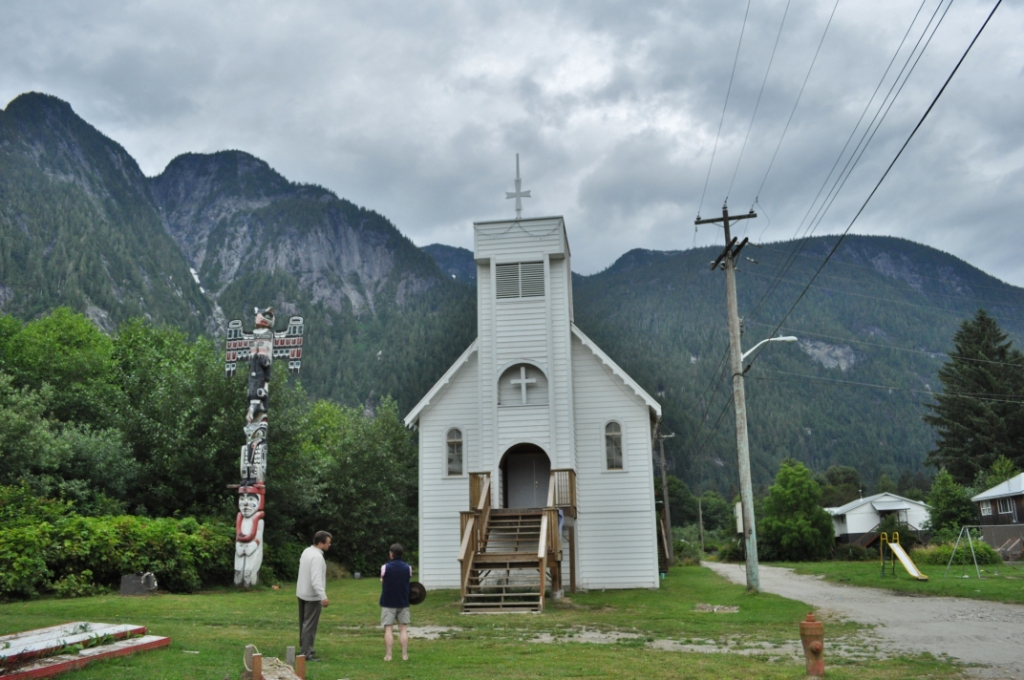
Here is arecent photo of St. George's Anglican Church in Kingcome Village.

Here is a recent photo of St. George’s Anglican Church in Kingcome Village, consecrated in 1938. The totem pole beside the church which depicts the four First Nations of Kingcome Inlet was dedicated in 1958 as a memorial to King George V.


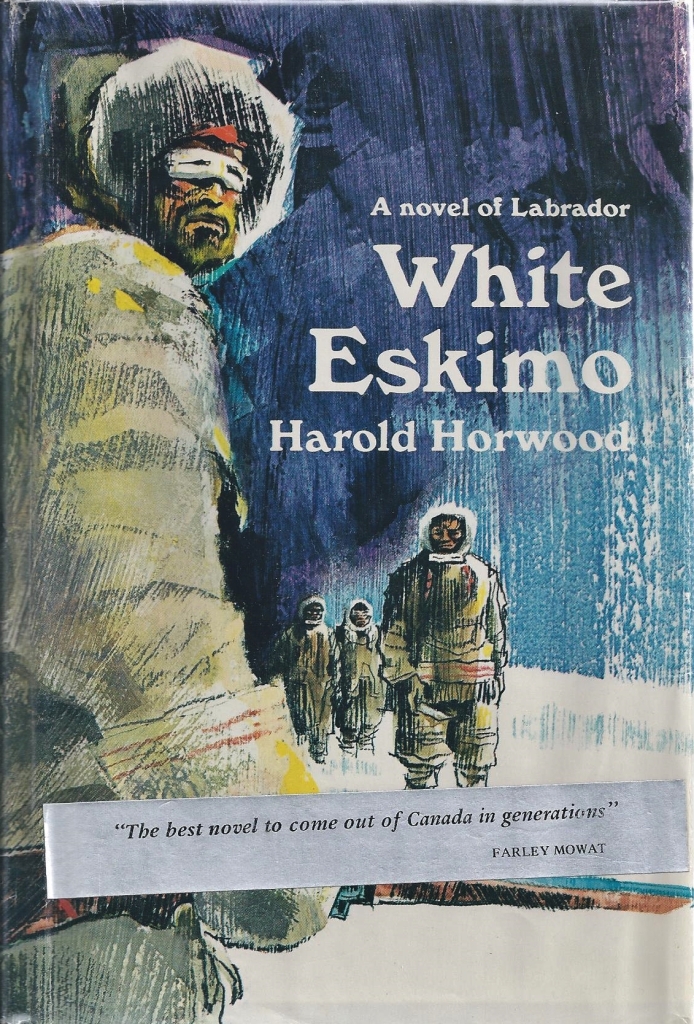
white eskimo harold horwod 001White Eskimo by Harold Horwood ~ 1972. This edition: Doubleday, 1972. Hardcover. ISBN: 0-385-04346-0. 228 pages.

My rating: 4/10

Oh, gosh, here’s another one.

A candidate for Canada’s stupidest novel, that is. (see The Last Canadian for the reference.)

I wanted to give credit to the author for his strong points: an interesting set-up framing the telling of the tale (eight people travelling in a supply ship along the northern Labrador coast start reminiscing abut the titular character), his strong descriptive passages regarding the natural features of the setting – land, sea, various wild creatures, his keen social conscience (many of his allegations regarding the damage inflicted upon indigenous peoples by paternalistic Caucasian interlopers are bang-on), and his obvious passion for his fictional subject.

But it is that very passion which goes too far by expecting the reader to swallow whole some bizarre allegations, which the author goes on about at great length with ever increasing vehemence.

To whit:

  • All religious and medical missionaries are weak, evil, power-hungry, greedy effetes, motivated in their travels to the furthest reaches of the Arctic lands by an unquenchable thirst for controlling every thought and action of their native congregations. (European Protestants being the most evil; the Catholics get a conditional pass.)
  • All Eskimos (Inuit to us now; this was written in 1972) are beautifully childlike and trusting in nature, prepared by their innate belief in magic to follow anyone who presents well. They can be given some responsibilities, but because of their simplistic thought processes are apt to lose focus and wander off-task. Some very highly advanced individuals may be trusted with supervisory roles, but these are the exception.
  • All Eskimo women make excellent wives/bed partners, being by nature compliant and soft-spoken. They are sexually eager and ready to accommodate any man who wishes to make use of their bodies, which is handy, because they are (in this tale) shared about among the men as a matter of course.
  • The old Eskimo ways are the best. Period. Oh, except that it is okay to use European-introduced guns, steel traps and other various innovations versus traditional hunting tools. (But we won’t go there, because that would be inconsistent with the premise that The Old Ways are The Best.)
  • Returning to traditional ways (though of course with aforementioned guns, steel traps etc.) means a return to a utopian way of existence.
  • But because of his beautifully childlike and innocent nature, the Eskimo must be led in this direction (the return to utopia) by a designated leader, in this case a Great Hunter, an über-Eskimo (or would that be a pseudo-Eskimo, because he’s actually a white guy?) who is admirable because of his superior size, strength, hunting abilities, and undoubted “magical” powers.
  • Oh – almost forgot this one – all policemen are corrupt. They can however denounce their corruption by leaving the police force and rehabilitating themselves in another occupation.
  • Ditto most government officials. Except for the exceptions.

Here’s the story.

In a remote Labrador outpost, a stranger suddenly appears:

He descended upon Labrador as though from heaven. The Eskimos still talk of the morning the giant stranger came down out of the hills in the dead of winter dressed in the skin of a white bear, driving a team of white dogs with a long sled on the Eskimo pattern – a komatik as we call it – and bringing the biggest single load of white fox pelts anyone had ever seen.

The big white stranger (for he is indeed Caucasian under all those furs) proceeds to make friends with the local fur trader (an intellectual atheist) and enemies with the local missionary (a soft, luxury-loving German Protestant) and devotees of the entire local Eskimo population (due to his obviously magical powers, what with his coming from the spirit-infested interior mountains where hunters do not go etcetera etcetera).

Within days he has become “song brother” with the most prominent of the local Eskimos, and has started learning to speak the language with wonderful fluency. No surprises there, for Gillingham, the “White Eskimo”, is a dab hand at everything he attempts.

Pleased by his reception, Gillingham comes up with a clever idea. The Eskimos now gathered at the missionary post must return to the wilds, casting off the white man’s religious and societal constraints. Under his leadership, they will set up a series of traplines in an area shunned by all since the death of its previous inhabitants in a flu epidemic. Gillingham’s “magic” will keep the bad spirits away.

The Eskimos agreeably play along, and all goes well.

For a while.

Back at the settlement, the villainous Mr. Kosh (the missionary) is frothing with rage at the loss of the main core of his congregation. He swears vengeance upon Gillingham, and calls in the provincial police on a trumped up complaint against Gillingham: incitement of the Eskimos to pagan rituals and human sacrifice! The police arrive in full riot gear, and for a while things are tense, until the fur trader (Gillingham’s new pal and soon-to-be partner in the fur dealing enterprise) points out that no one is actually missing, so the human sacrifice thing was an exaggeration. (Mr. Kosh obviously mistook people comatose from their excessive revels for dead men.)

But soon there is a dead man, as Gillingham’s song brother is found under suspicious circumstance with a neat bullet hole in the centre of his forehead. There are no witnesses to the murder, but Mr. Kosh calls in the police again, swearing that Gillingham must be the murderer, for he is the only one capable of such an accurate shot. (In a community of skilled hunters, no one else is able to accurately hit a target at close range? Really, Mr. Horwood and fictional Mr. Kosh? Really?!)

The Eskimos all say, “Oh, no, couldn’t be Gillingham! A man does not kill his song brother, because he himself would then die!” The police, under Kosh’s influence, arrest Gillingham anyway. No one else is suggested as the murderer, and there is no attempt at investigation.

Long story short: the murder charge is dismissed on a technicality, and Gillingham serves several months in a southern prison on a lesser charge.

After getting out of jail and working his way around the world doing various menial jobs, Gillingham returns to Labrador, makes the rounds of his Eskimo protégés, gets his Eskimo wife pregnant, and then sets off alone into the mysterious mountainous interior from whence he came, leaving behind his own legend and a bunch of newly motivated Eskimo chaps, who go on to fulfill the White Eskimo’s legacy by succeeding at everything they put their hands to.

We never do find out who the murderer is.

What a stupid story this turned out to be, Farley Mowat’s glowing blurb on the front cover to the contrary. (“The best novel to come out of Canada in generations.”)

Turns out upon further investigation that Mowat and fellow author Horwood were buddies. Enough said.

Harold Horwood was quite the guy. He was politically active in Newfoundland politics, and represented Labrador as an MLA for a term. He travelled widely in the north, and became, as years went on, a passionate critic of what he saw as governmental abuses of power, especially in the support given to the religious orders in their administration of Eskimo affairs, and the complicity of the provincial police and RCMP in upholding that administration.

Horwood wrote a number of well received books, including a fictionalized 1966 memoir – Tomorrow Will be Sunday – also strongly critical of organized religion.

Here’s the Kirkus review for Sunday:

Embedded in excellent, chilly description of Newfoundland village life is a tangled sex story that is convincing at every turn but somewhat overplotted as a whole. In spite of honest characterizations, a story with as many twists as this begins to beg the reader’s already willingly given sympathies. Caplin Bight is populated by 250 brethren of the Church of the Firstborn. Hell-fearing, mean-spirited and paleolithic, these Stone Age Christian fisher folk expect the Day of Wrath imminently. They propagate only while fully clothed in bed in the dark of night. One day their pastor seduces fifteen year old Eli Pallisher. Eli’s closest friend and mentor is a young schoolteacher, engaged to the town’s only freethinking girl. Eli and his friend are discovered by the pastor, innocently wrestling in the nude after a swim. Charges are lodged and the schoolteacher goes to jail. While he is serving his sentence, Eli falls in love with the fiancee and she becomes pregnant. The friend is more open-minded than the town and returns finally to win his girl back…. Horwood keenly renders the vicious brutalization of the townsfolk by their religious mores; the rigors of cod and salmon fishing; and the benighted narrowness of a community such as this.

I seem to sense a sameness of theme with White Eskimo, though Tomorrow Will be Sunday‘s characters come from a bit farther south.

White Eskimo was undeniably an interesting read, but, sadly, I feel that I can’t recommend it, as its strengths were outweighed by the ridiculous plot, and the oversimplified depictions of the characters (all missionaries are bad, all Eskimos are good and noble, if slightly stupid). There’s also an attempt to portray the hero as a modern Gilgamesh, but it doesn’t come off very convincingly.

I’m open to exploring more of Horwood’s writing, but I will be approaching with caution versus enthusiasm.