I must share my little gloat. Lovely book-luck day today!

I was in town fulfilling some rather ho-hum errands, namely picking up plumbing supplies and visiting the dentist, and, with a half hour to kill, I wandered into a little antique store just down from the building supply store. As is my usual habit, I automatically perused the “antique” books used for set dressing in such emporiums, and bingo! -an unexpected bookish jackpot.

Two Rafael Sabatini novels, The Lion’s Skin (1911) and Bardelys the Magnificent (1906). One of Noel Streatfeild’s “adult” novels, Grass in Piccadilly (1947). And – so unexpected and so very perfectly timed, because I’ve just finished reading Helene Hanff’s memoir Q’s Legacy – a handsome 1921 copy of On the Art of Writing, by Sir Arthur Quiller-Couch.

And a fantastic little book from Herbert Jenkins Ltd, published in 1952, The Crossword Companion, by “M.R.W.” This being a book of word lists useful to the crossword aficionado – what a helpful concept. Love it already.

I’ve dipped into the Streatfeild, though I must stiffen my resolve and set it aside in order to finish my current book, Edna Ferber’s okayish-so-far-though-not-stunningly-wonderful Showboat.

Mulling over the possibility of undertaking another Century of Books project – the Sabatini oldies in particular would be perfect candidates for some of those elusive early years.

I’ll keep you posted on that, and I’ll report back on the Piccadilly thing as soon as I finish it. Two chapters in, and the tone is very slightly sordid and more than a little cynical – if you’ve read The Whicharts, you’ll be familiar with the style.

That’s it for now – over and out.


the fire and the wood by r c hutchinson 1940The Fire and the Wood. A Love Story. by R.C. Hutchinson ~ 1940. This edition: The Literary Guild of America, 1940. Hardcover. 440 pages.

My rating: 9/10

Hidden gem alert!

I have just stumbled upon a now-obscure, once-bestselling British novelist. Why have I not heard of  Ray Coryton Hutchinson before?

Seventeen books published between 1930 and 1975. The third, 1933’s The Unforgotten Prisoner, sold over 150,000 copies in its first month. A Child Possessed, 1964, won the W.H. Smith Literary Award, and is the inspiration behind a 2012, 2-act orchestral opera composed by Robert Paterson. The last, 1975’s posthumously published Rising, made it to the Booker Prize shortlist.

The Fire and the Wood, apparently regarded as merely one of Hutchinson’s “average” efforts, is a downright excellent piece of authorial work, being utterly relevent to its period, chock-full of easily absorbed “message”, and, best of all, compulsively readable. I couldn’t put the thing down. The writing flows, the whole transcends its parts. Brilliant work.

In the opening days of World War II, a novel was published in Great Britain with the following dedication:

To M. H. CHURCHILL

My Dear Jeremy,

You will remember that I told you Josef’s story one evening, the summer before last, in the Half Moon at Clare. You thought then that it was worth putting on paper, and I still think it was. But the time, between now and then, has not been a good one for the job: the means by which we know what is happening round the world have become so efficient that it’s increasingly hard to concentrate, for several hours a day, on the fortunes of one or two people. The excuse, of course, is not valid: no excuse is valid. The masters of the trade have done it as well, and sometimes better, when the hubbub was loudest. But I myself find difficulty, with these cold winds blowing incessantly against the mind, in raising it to that temperature which seems to me necessary for work which has the smallest pretension to seriousness; and I fancy that some others among the feebler-hearted brethren may be in the same case.

I mention the handicap as an apology for dedicating such a book as this to you, an amateur suckled by Turgenev and weaned on Henry James. Will you take the gesture as one of gratitude for many kindnesses, and for twenty years of friendship?

Yours ever,

R.C.H.

Infantry Training Centre,

R——

March, 1940.

What follows this elaborately modest introduction is a dense but never staid novel, approaching farce in its humorous opening scenes, darkening by imperceptible degrees into a nightmare scenario, a Kafkaesque dream sequence, appalling reality and delirious fever-dreams ever more entwined.

In the mid-1930s, young Doctor Josef Zeppichmann, newly qualified, joins the staff of a prestigious hospital in a large German city. Coming with glowing references which are at odds with his awkward manner, lumpy countenance, and country-lad ways, Zeppichmann proves to be an exceedingly competent doctor, though his bedside manner is brusque to the extreme, and his concentration on the ailments of his patients with the casual exclusion of all unimportant details such as name (or even gender) soundly shocks the nurses.

For Josef Zeppichmann is at heart a medical researcher, a bacteriologist concentrating on an audaciously risky cure for tuberculosis. Pursuing a pet theory during the latter years of his medical internship, he has progressed to the point of wishing to experiment on human patients – his guinea pig and rat trials have been remarkably successful – in most cases – but Josef runs up against a brick wall in the strict Moltke hierarchy; he is not even permitted to examine the patients in the TB ward, and is restricted to junior doctor duties in the general wards.

But Josef is made of stern, single-minded stuff. He bullies his way into the best room in his new boarding house, and sets up his own private laboratory. And what’s this? Close at hand, the kitchenmaid Minna is showing unmistakable signs of an advanced lung complaint. When she collapses one day while working, Josef is quick to grasp the heaven-sent opportunity of a human guinea pig. He takes advantage of the boarding house owners’ strict economy to offer treatment free of charge in return for exclusive access to the girl, and the real experiment is on.

Meanwhile, on the post-Weimar Republic mean streets outside the hospital, civil unrest is brewing between various political factions. The roving bands of young thugs running under the banner of  the National Socialist German Workers Party are becoming more and more efficient in striking out at anyone they suspect of being in less than perfect sympathy with the cause of Germany’s new Chancellor, a certain Adolf Hitler. Josef inadvertently runs afoul of a group of these young “Nazis”, and repercussions are swift to follow.

For Josef Zeppichmann is a Jew.

As Minna moans in fevered agony, emaciated body struggling to cope with Josef’s escalating injections, a series of increasingly somber blows fall upon our protagonist, culminating in his dismissal from his hospital post and his arrest and subsequent detainment in a political prisoner internment camp.

Luckily for Minna, Joesf has had time to give her the last vaccination in his series, and it has apparently proven successful. She and Josef have also formed a strong attachment, with the doctor-patient bond turning at the eleventh hour from pure need of each other in an elemental sense – Josef needing a subject for his research, Minna needing a cure –  to unanticipated love, just in time for Minna to see Josef dragged away in handcuffs, leaving behind his precious medical notes in her care.

The suspense continues to build, escalating to a daring rescue-escape of the damaged lovers via canal boat to Holland, and thence to England. But their troubles are far from over, for Josef has in turn contracted TB in the prison camp, and Minna herself is still weak from her long ailment.

The mood and style of the novel evolves along with the misfortunes of its two main characters; as the once utterly in control Josef sinks into fevered oblivion we increasingly see the action from Minna’s point of view. Her own grip on reality is far from strong, though, and the ending sequence, seen through her eyes, is decidedly surreal. (I’m not quite sure what’s going on with the bit at the very end, and if you’ve read it and have an interpretation I’d be most interested to compare notes, but the lapse from logical story progression doesn’t really matter – in this case it works.)

R.C. Hutchinson had an agenda, which was to bring the horrific pre-war social conditions in Germany to his reading public’s attention. Fascinating to read what is basically a propaganda novel, published in 1940 before the worst of the Nazi Party’s subsequent excesses became common knowledge. It’s a clever piece of work, brilliant even, and as I mentioned earlier, a page-turner from start to finish.

So, R.C. Hutchinson. Ever heard of him before?

I hadn’t. And I should have, I think. He’s unaccountably fallen by the literary wayside, though Bloomsbury has recently released a number of his novels in e-book format, and his long list of out-of-print bestsellers are easy enough to find in numerous editions through online booksellers.

The quest is on.

R.C. Hutchinson in an undated publicity photo.

R.C. (Ray Coryton) Hutchinson, 1907-1975, in an undated publicity photo.
 

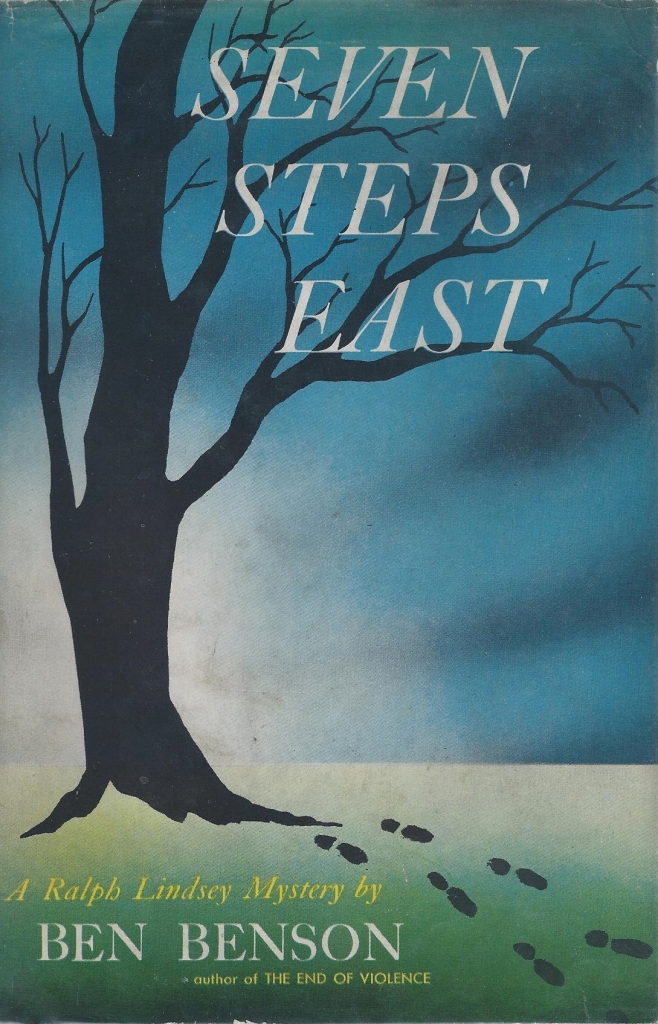
seven steps east ben benson 1959 001Seven Steps East by Ben Benson ~ 1959. This edition: M.S. Mill Co., 1959. Hardcover. 189 pages.

My rating: 5/10*

Nice cover, isn’t it?

Summertime, and the reading is easy.

This reasonably diverting police procedural is my first encounter with this writer, and I’d cheerfully pick up another if it showed up in front of me. It worked well for kick-back time yesterday. Enough puzzle element and moral dilemma discussion going on to keep it from being too black and white, and characters with enough personality to keep them straight in one’s head for the time needed to polish off this slender and more than slightly unlikely mystery.

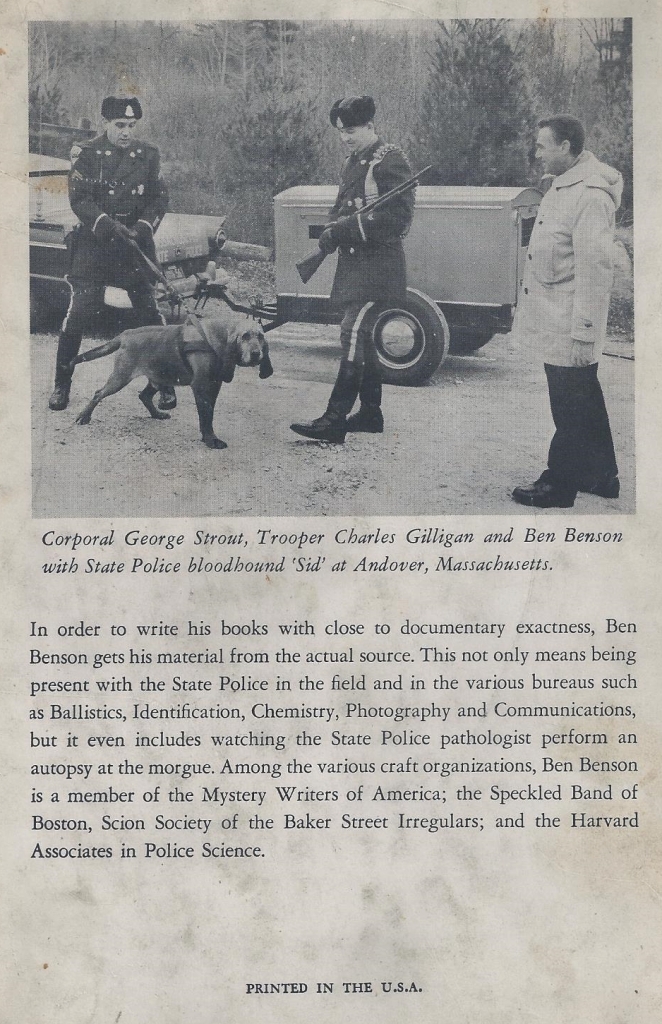
Seven Steps East is the last title by Ben Benson, who started writing as therapy after spending three years in hospital due to war injuries sustained during his 1943-45 U.S. Army stint of active combat. He wrote something like 17 mystery novels between 1951 and his death at the too-young age of forty-four in 1959, sharing the key investigative roles between two fictional members of the Massachusetts State Police: Trooper Ralph Lindsey and Detective Inspector Wade Paris.

In brief, our main character Ralph Lindsey is given leave to investigate the disappearance of one of his star students, Kirk Chanslor – coincidentally a childhood acquaintance now engaged to be married to Lindsey’s ex-girlfriend – when the young man fails to return from a weekend’s leave from the State Police Training Academy where Lindsey is a part-time instructor.

An anonymous phone call leads Lindsey to Kirk Chanslor’s body, hidden beneath a pile of leaves in the forest, and the hunt is on for the killer.

Benson quickly takes us through the steps of a murder investigation, giving a willing nod to each member of the homicide team. Surprisingly for the genre, Ralph Linsey apparently gets along just fine with everyone in his department; there are no internal feuds or personality conflicts; everyone cooperates wonderfully, united in their goal to nail the bad people of their precinct. No question as to which side the cops are on – they hang out with the angels from start to finish.

Chasing down leads among hotel waitresses and bellboys, the investigation has Lindsey making himself unpopular with a powerful ex-gangster-turned-hotelier. Illegal gambling and a highly successful con-artist – someone who can change their eye colour at will, according to the one clue Kirk Chanslor has left behind – hold the key to the solution.

I guessed the gambling con early on, but the actual killer was a bit tougher to pin down, though when the big reveal came I wasn’t at all surprised.

All in all, a workmanlike piece of writing, with moments of flair and the promise of an interesting development for Trooper Lindsey’s future. A shame this turned out to be Ben Benson’s last book.

*The lowish rating reflects that while the book is readable enough, it is nowhere close to the top of the high standard set by the best in the mystery-thriller genre of its era. Raymond Chandler, Josephine Tey, Margery Allingham, Rex Stout, among so many others.

seven steps east ben benson back cover bio 1959 001


Here's one from 1961.

The Nylon Pirates by Nicholas Monsarrat ~ 1960. This edition: Cassell, 1960. 2nd edition. Hardcover. 314 pages.

My rating: 4.75/10

Ex-Royal Navy Commander and British diplomat Nicholas Monsarrat wrote some really decent books in his alternate role as a fiction writer – such as the bestselling war novels The Cruel Sea (1951) and The Kapillan of Malta (1973), to name two of the best-regarded – and some relative stinkers. Guess where I’m placing this one?

Yup.

B-List, pretty well all the way, from the awkwardly salacious sex scenes hastily set up and then shied away from by an apparently last-minute-squeamish creator, to the gruesome penultimate scene in which ironic justice is visited upon a key character.

Published in 1960, this is a book your father might have had on his shelf, to match the Jacqueline Susann on the distaff side of the twin-bed room. It’s determinedly smutty, though, as I mentioned earlier, it seems that Nicholas Monsarrat couldn’t quite bring himself to go into the detail hinted at by his doggedly sexy set-ups.

Which was a relief, because it was blush-inducing enough as it was, albeit for the awkwardness of the plot and the single-dimension characters rather than for anything really naughty in the way of sex-prose.

Brutal panning of those last few paragraphs aside, I need to back down and fairly admit that Monsarrat is decidedly readable, even at his worst. The Nylon Pirates did have its moments, and I rather enjoyed the quietly omnipotent sea captain overlooking all of the shenanigans on his ocean liner with patient calm; the dialogue among the sailors was a high point of this minor novel.

I’ll just quickly sketch out the plot. It won’t take long.

A career criminal who has made a profession of preying on society comes up with a scheme to part a group of wealthy cruise ship travellers from some of their abundant cash.

Our anti-hero Carl assembles a small team of like-minded predators to make up a loosely connected “family group” all travelling together.

Masquerading as a benevolent uncle is 50-year-old Carl. His “niece” is Diane, a wanton, exotically-talented brunette seductress detailed to reel in the men, as “nephew” Louis, an Italian-American gigolo-type, targets the yearning-for-love older women. The Professor, an aged confidence man whom Carl has teamed up with in past scams, comes along to scout prospects, handle the proceeds and keep the books. Carl’s just-come-of-age mistress, Kathy, is passed off as his stepdaughter. She’s a cooly beautiful blonde, whom much-older Carl seduced as a 16-year-old virgin some five years earlier. The trip is supposed to be something of a maiden voyage for lovely Kathy to break into the sex-for-money/threats-of-blackmail con-game trade, while Carl uses his superior poker skills to fleece the card-playing millionaires on board.

Complications ensue.

A generous number of editions are out there in used book land, with prices varying from dirt cheap to stupidly expensive. My advice: save your serious cash for something less likely to engender the book-fling urge, which this one did with me a number of times, mostly in the first and last chapters. Once committed to the read, the middle bits were the most amusing. A beach-blanket read, perhaps?

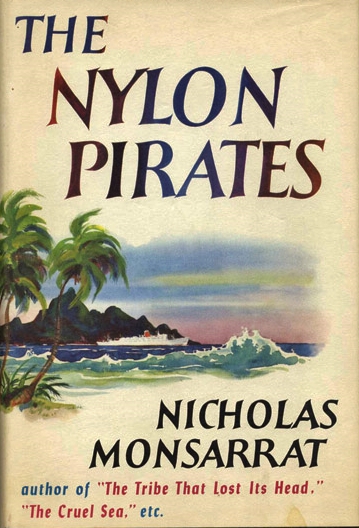
A 1960- first edition cover. Downright restrained, this image, comparatively speaking.

A 1960- first edition cover. Downright restrained, this image, comparatively speaking.

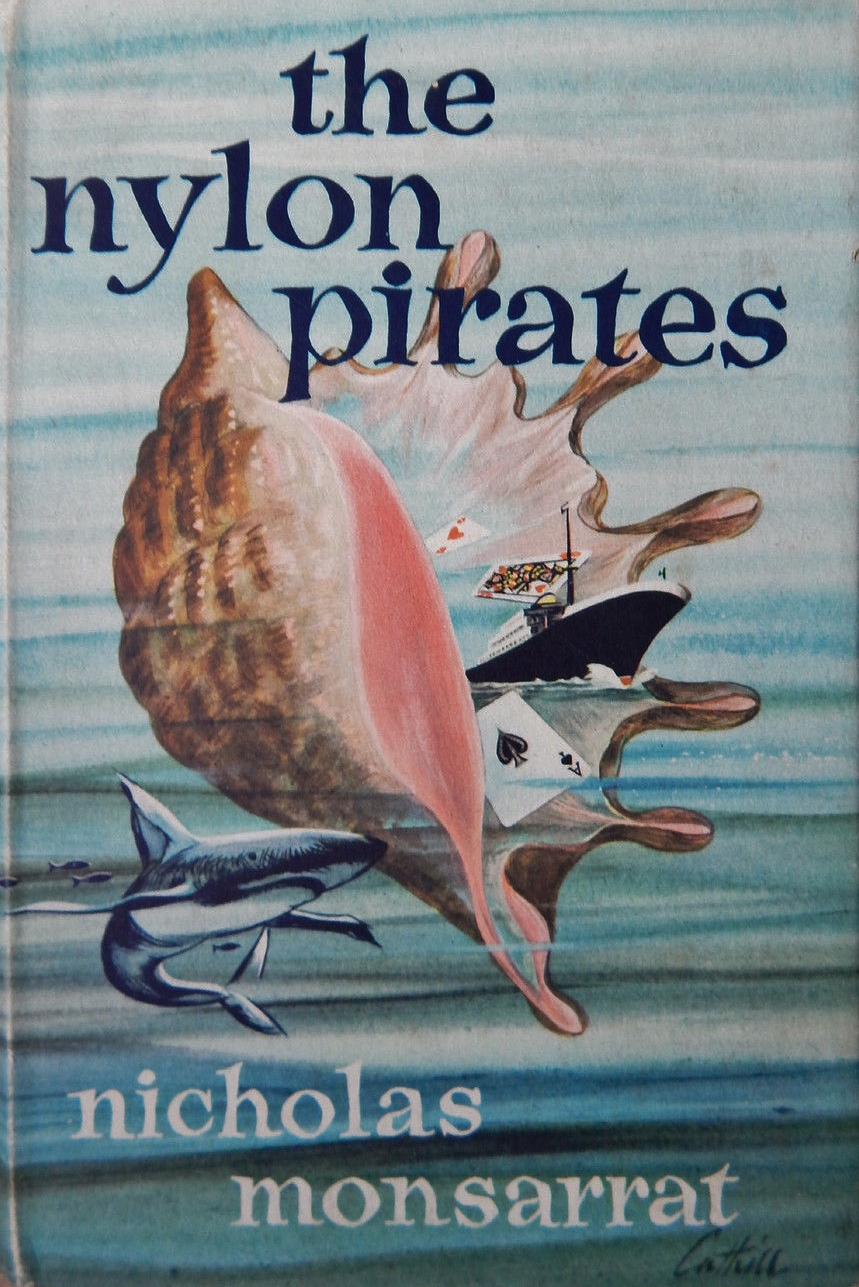
My favourite cover, from 1960.

My favourite cover, also from 1960.

A 1962 Pocket Books edition, working hard to entice the reader.

A 1962 Pocket Books edition, working hard to entice the reader.

The back of the '62 Pocket Book.

The back of the ’62 Pocket Book.

A 1963 Pan paperback edition, cover blurb appealing to the readers' prurient curiousity.

A 1963 Pan paperback edition, cover blurb appealing to the reader’s prurient curiousity.


Well, this has been a rather longer hiatus than I’d ever intended.

What a goofy spring. Weird weather, and an overwhelming continuation of “little things” keeping me from ever feeling quite in control of my very own life.

Sunday, June 19th we had our last plant sale day (we operate a small perennial plant nursery); 48 hours later I was on the operating table undergoing a mite of abdominal surgery, which I’d been supposed to undergo back in April but which I’d postponed till a “better” time – after the spring planting season. Luckily everything held together until now!

All is as well as it could be expected to be. I am rather sore but less so than I could be, and several weeks of “light duty” stretch in front of me. Perhaps an opportunity to take up the blogging habit once again? I do miss it.

So, what have I been reading this strangely subfusc spring? Not a whole lot, I’m sad to say. Too busy and too distracted for anything terribly challenging, though I did recently manage a trio of Gavin Maxwells – Ring of Bright Water, The Rocks Remain, and Raven Seek Thy Brother. (Now there’s a chap with issues!) Maxwell deserves more than I can give him at present, so he’s back on the shelf for now.

Lying on the gurney the other day, waiting for the surgeon, I did manage to immerse myself to a reasonably deep degree in Barbara Pym’s Less Than Angels. “Good book?” asked one of the nurses. “Not particularly,” I replied. And it really isn’t, is it? Not one of her strongest. I insist on reading Pym from time to time, and occasionally sparks are struck, but she’s so darned…I dunno…cynical is too strong a term…not particularly cheering, anyway, to someone in a fragile state of mind.

So it’s been O. Douglas the last few days, as something of a Barbara Pym antidote. Taken by the Hand, and The House That is Our Own. Good old friends, these have become. But I’m ready for something new.

I see that Margaret Kennedy (The Constant Nymph, The Feast, Together and Apart et al) is getting some positive press in book blogger world. Time to order some new-to-me summer reading? But according to CBC News a possible postal strike is looming, so I might want to hold off.

Back to the high shelves here at home it is! (Well, not literally. I’ll send someone else up the stepladder.)

Hope you’ve all been having a lovely spring. Mine has had its magical moments, despite everything. And now it’s truly summer, longest day just past and all. Cheers, book friends!


Well, just when you think you have it all under control, you realize you’re not actually steering your life – it’s taking you for a ride and all the pushing on the brakes and spinning the steering wheel is pretty well pointless.

Other Dessies will understand the state of my mind these busy, busy spring days when I reveal that I have just started my thirteenth (fourteenth?) consecutive D.E. Stevenson book. I have even stooped to read some of the more regrettable ones, such as Rochester’s Wife, which was pretty well as bizarre as I’d remembered it to be. (Not always the case – occasionally one gets a pleasant re-reading surprise.)

No matter! They are just the right level of engaging for just-before-sleep reading, and they are definitely soothing to my ruffled soul.

I’m just about finished my personal stash of these curiously addictive mini-sagas, just starting Vittoria Cottage and looking forward to the rest of that particular trio, and then I really must tackle something by somebody else. Something a little bit deeper, as it were.

Any ideas, fellow middlebrow fans? Suggestions always welcome! What do you read when your personal world is spinning a bit too quickly for perfect comfort?

Tomorrow's nursery chore. Here you see approximately 500 tomato seedlings, begging to be put into larger pots NOW. We are having a tremendously early spring, and the plants are going wild - I can't keep up!

Tomorrow’s nursery chore. Here you see approximately 500 tomato seedlings, begging to be put into larger pots RIGHT NOW. (And just a bit farther along the bench are 3 or 4 times as many to follow. Not to mention all the other things we grow.) We are having a tremendously early spring, and the plants are going wild – I can’t keep up! Ah, well, there are much worse occupations than being a plant person. I complain occasionally, but it’s not that bad. (Understatement – it’s quite wonderful!)

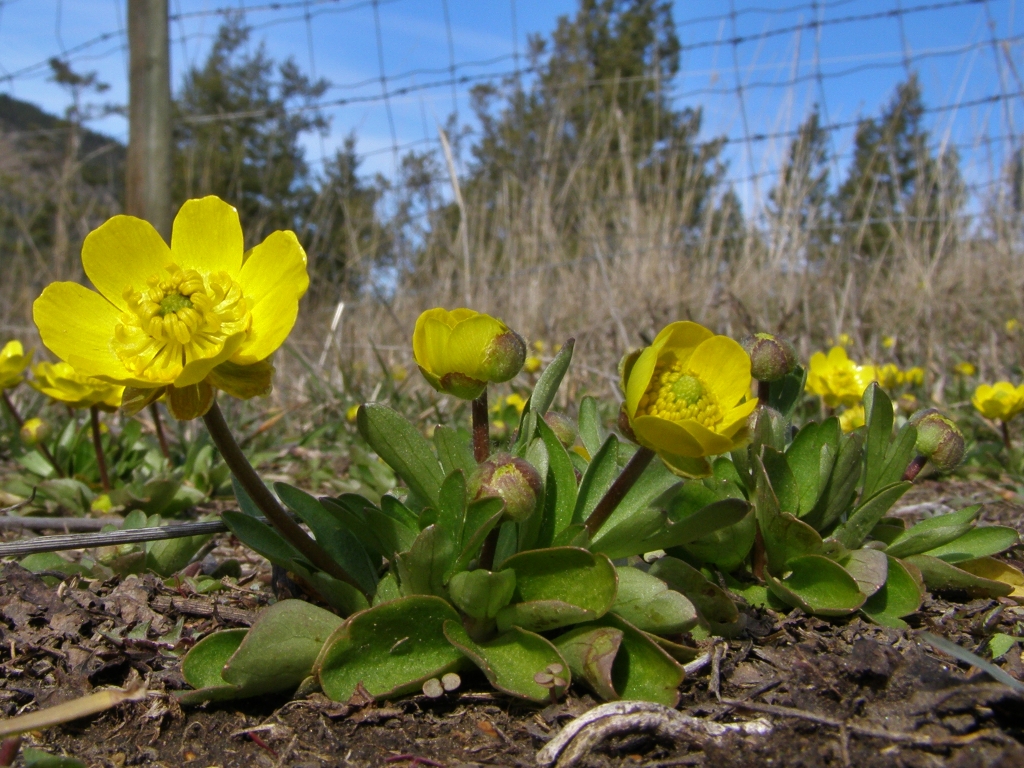
Wild Sagebrush Buttercups on the hillsides of our farm - weeks ahead of normal. Soo cheerful! When these come out, we know we've made it through the cold time once again.

Wild Sagebrush Buttercups on the hillsides of our farm – weeks ahead of normal. So cheerful! When these come out, we know we’ve made it through the cold time once again.

Greetings, all.

Another post and dash – or maybe a dash and post?

I have been terribly guilt-ridden about neglecting this blog these past few months, but I am still hoping the situation is temporary.

We are in the throes of an incredibly early spring – at least three weeks ahead of normal! – which means that the pressure is on to get out into the garden. As we operate a small perennial nursery, this means that all of the digging and dividing which generally starts early April is suddenly crucially time sensitive, starting right now, as plants are bursting out of the ground and growing inches per day.

In the meantime, all of the normal greenhouse chores are accelerated as well, what with the work being quite literally doubled. The days are much too short for everything I need to pack into them, and I won’t even go into the complexities of this being something of a re-start year after a two-year sabbatical from the nursery, or the brand-new greenhouse still being finished with the propagation house bursting at the seams with things ready for the transfer to the growing-out house. And then there’s the new partnership with a retailer in the city (“no pressure” – ha! – it seemed like such a grand idea last fall…well, it still seems like a win-win scenario, but I’m getting a bit jittery with this new learning curve) and an important tomato plant order from the market garden down the road.

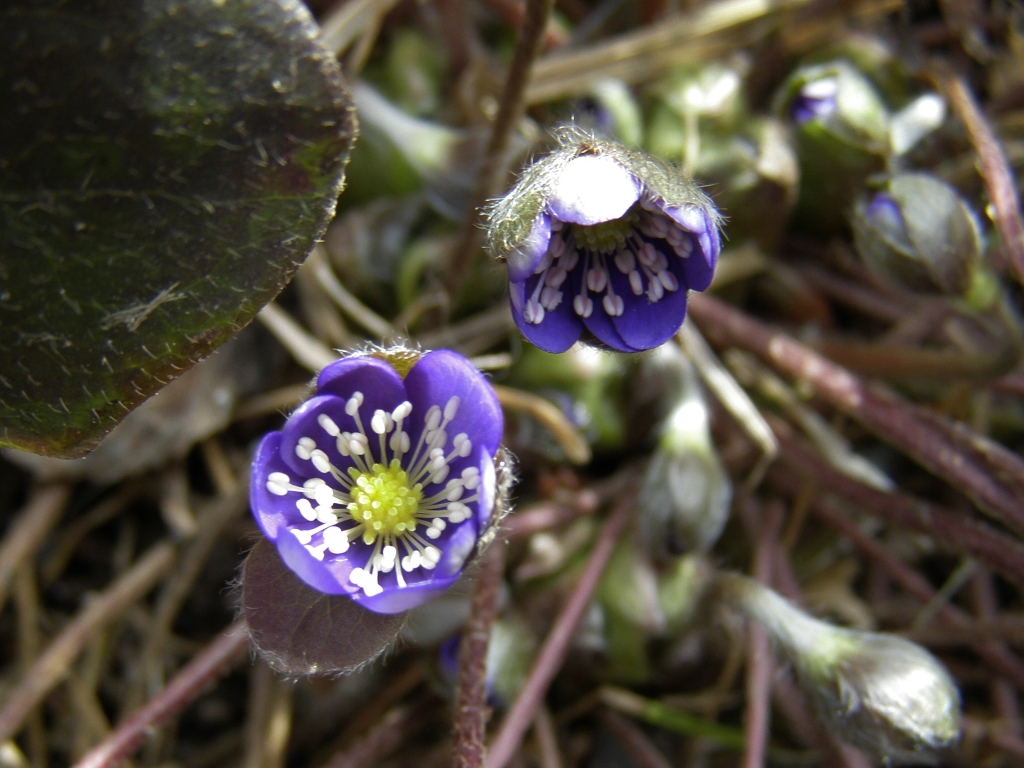
And look - beautiful Hepatica! My daughter was out with the camera today, capturing our early spring.

And look – beautiful Hepatica! My daughter was out with the camera today, capturing our early spring.

What else? Still involved in a major way with our regional performing arts festival, with events running through March, April and May. A rewarding involvement, but definitely time consuming at a time of year when the hours are extra precious.

A few health issues, with family members and myself, sobering reminders of how quickly our physical equilibrium can be set a-rocking.

Well, after all the above, you might be excused for thinking I’m complaining, but I’m really not. Just explaining why the book posts have come to an almost complete stop. I’m still reading for a stolen hour at night, mostly old friends and nothing too challenging – Elizabeth von Arnim, J.B. Priestley, O. Douglas, Elizabeth Goudge, D.E. Stevenson, and an eclectic selection of short stories from a serendipitous boxful of 1960s’ Argosy magazines found in a local thrift store.

Life certainly isn’t boring. And it’s mostly full of good stuff. Just a wee bit over full right now…

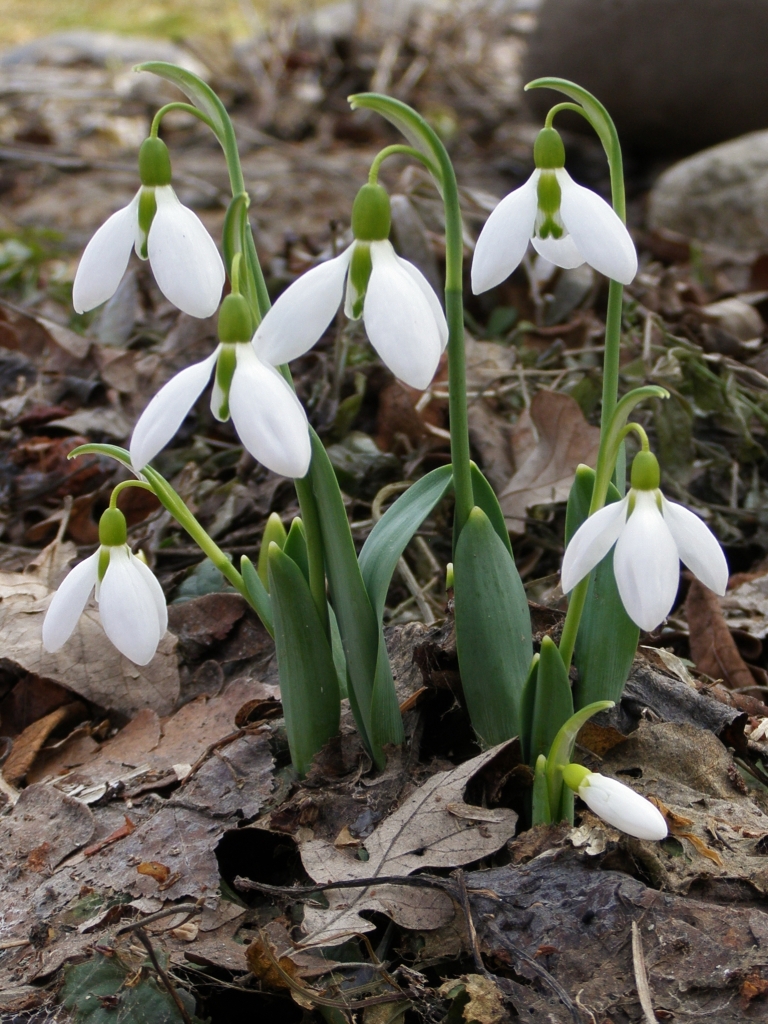
Snowdrops are a borderline-hardy plant for us, but we treasure our small colonies and rejoice when they burst through the protective cover of last autumn's fallen leaves. A far cry from the vast drifts of milder climes, but in their quiet way a reminder of other beloved gardens we've visited, real and literary.

Snowdrops are a borderline-hardy plant for us, but we treasure our small colonies and rejoice when they burst through the protective cover of last autumn’s fallen leaves. A far cry from the vast drifts of milder climes, but in their quiet way a reminder of other beloved gardens we’ve visited, real and literary.

If anyone wants to keep up with my other life – the gardening one – I do occasionally post snippets of personal stuff on our nursery website/blog – http://www.hillfarmnursery.com. Though right now I’m mostly updating the plant lists, getting ready to post the year’s offerings and adding descriptions and photos to the pages.

I promise I’ll come back to posting book things at some point, because I do miss that so very much. Many thanks to the rest of you for providing me with lots of food for thought; I try to keeep up with reading your wonderful posts, and though I’m not commenting much I sure do appreciate all of your words!

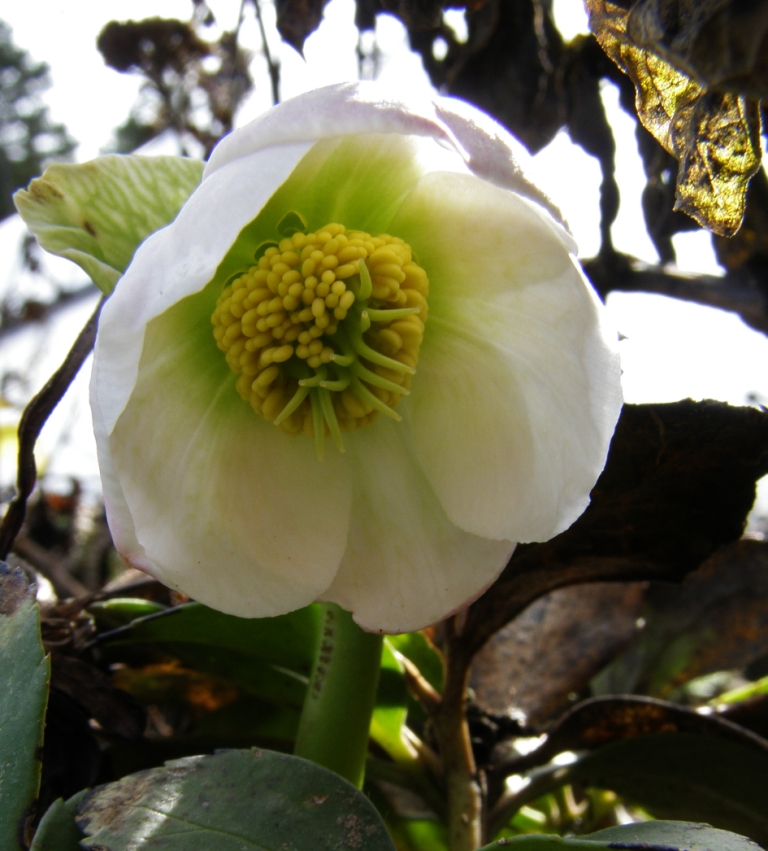
The first Hellebore of the season - here in central British Columbia the Christmas Roses bloom in March and April!

The first Hellebore of the season – here in central British Columbia the Christmas Roses bloom in March and April.


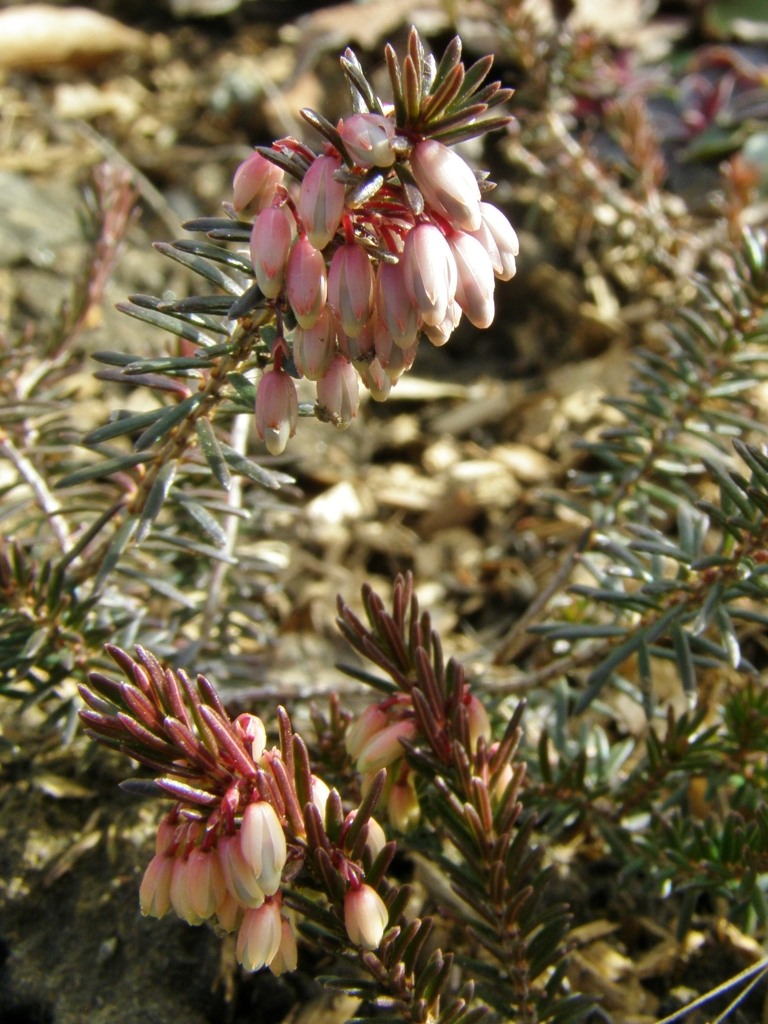
And one last glimpse of my spring garden. This heather came from one of my mother's friends, with a bit of an interesting backstory - it was smuggled to Canada tucked into her purse from a visit to Austria many decades ago - before the current security inspections in airports made such horticultural transgressions too fraught with potential trouble to attempt!

And one last glimpse of my spring garden. This heather came from one of my mother’s friends, with a bit of an interesting backstory – it was smuggled to Canada tucked in her purse from a visit to Austria many decades ago – before the current security inspections in airports made such illicit horticultural importations too fraught with potential trouble to attempt!


The book blog has been sluggish lately because my world is utterly crowded with all sorts of crucially time-voracious real-life stuff, but a wicked virus has knocked me around enough this past week to give me some enforced down time and I have happily read my way through a number of okayish novels. Norah Lofts et al., suitably light but reasonably intelligent amusement for someone under the weather.

And then this one.

Greenbanks by Dorothy Whipple. Written in 1932, this was Whipple’s second published novel, and the third I’ve now read.

They Knew Mr. Knight (1934) and Because of the Lockwoods (1949) were highly enjoyable, if slightly melodramatic, but Greenbanks was something on a different level.

Greenbanks by Dorothy Whipple. Not my copy - mine is a lovely greyt Persephone - but stolen shamelessly from the internet for the sake of the glowing cover blurb by Hugh Walpole.

Greenbanks by Dorothy Whipple. Not my own copy – mine is a lovely grey Persephone – but borrowed shamelessly from the internet (thank you, Milady’s Boudoir) for the sake of the glowing cover blurb by Hugh Walpole.

Ostensibly a sedate family saga, it evolves into a deeply convincing manifesto on the rights of women to self-determination and social, educational, financial and sexual equality. Set in the decades before, during, and immediately after the Great War, centre stage is shared between a family matron and her granddaughter, representatives of the old world and the new, with sporadic but telling secondary roles played by the adult children of the household, their various spouses, lovers, friends and acquaintances.

The ending was unexpected, and deeply satisfying in its blunt refusal to neaten things up in a conventional way; it shocked me because I’d rather expected Whipple to manufacture an eleventh-hour cluster of pleasantly innocuous solutions to its most pressing dilemmas, and she didn’t go there at all.  And it worked.

I am starting to see why Persephone Press is so dead keen on this writer; those first two books piqued my interest but this third one has given rise to real enthusiasm.

If you’re already a Dorothy Whipple person – and I know many of you are – I’d be most pleased to hear your personal opinions on Greenbanks as it stands in her body of work. Is this as good as she gets? Or am I in for some more unexpected readerly surprises?

Someone at a Distance is here on the shelf; it came in the package with Greenbanks just the other day and I am torn between diving right in, and, alternatively, allowing myself some cooling off time, because I’m still processing the deeper nuances of the book I’ve just devoured with such paradoxically reluctant speed.

It’s time to choose my evening’s reading-in-bed book, and I am at a loss at what to attempt, not wanting to diminish the mood. I’m thinking Elizabeth Cambridge, or maybe Rose Macaulay, or perhaps even a return to one of the previously-read Whipples, sure to be well sauced with the piquancy of this fresh appreciation.

The “Whipple Line”, indeed! Virago, hang your metaphorical head in shame!

Margery Sharp Day 2016 – how could I have missed this? I knew it was happening, but I forgot to do anything about it. I console myself by reading the appreciations of the others, in particular those new to the joys of this clever, clever writer.

Here’s a link to Margery Sharp appreciator and special day organizer Beyond Eden Rock’s post. This year Jane happily chose one of my very favourites, The Innocents, as her own book. A roundup is promised; I look forward to reading everyone’s thoughts.

Happy 111th Birthday, Margery Sharp! May the re-publishers please get going on bringing you back into print. Someone? Persephone? Grey Ladies? Virago? The early works are quite simply stellar, though I admit there are some minor bobbles later on.

And here is my own reviewlet of The Innocents which I wrote back in 2013:

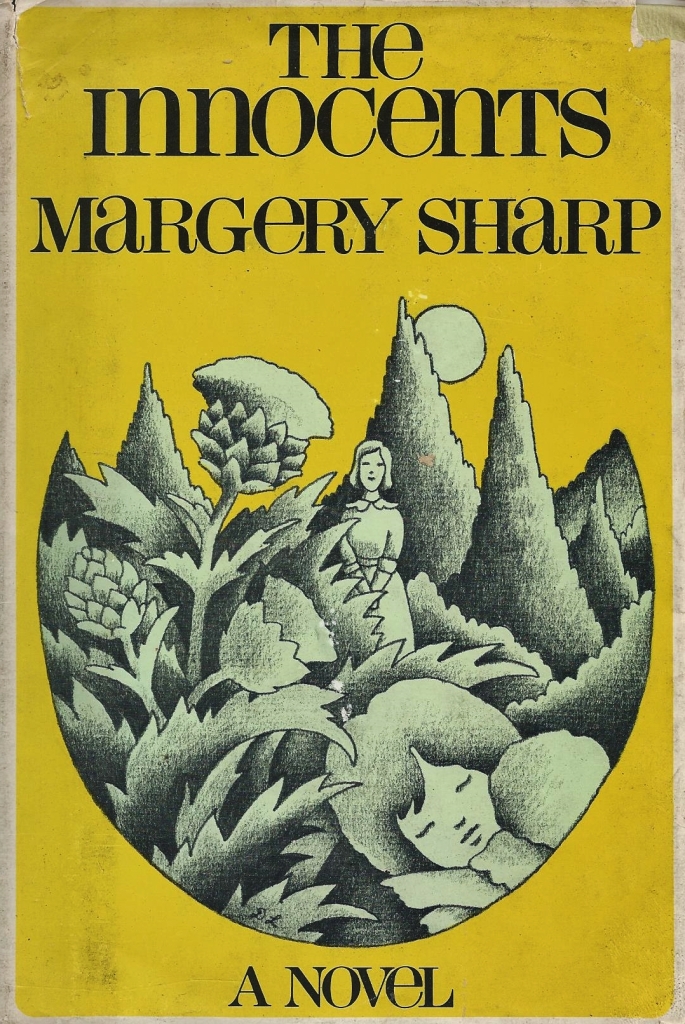
the innocents margery sharp 001The Innocents by Margery Sharp ~ 1972

This edition: Little, Brown & Co., 1972. Hardcover. 183 pages.

My rating: 11/10. I think this may well be my very favourite Margery Sharp, and, as you all may have guessed by now, I am seriously enthusiastic about this author to start with.

This was my second time reading The Innocents; I will be rationing myself to revisiting it, oh, maybe once a year or so, because I don’t want to wear out its already special status in my favourites list. For all of that enthusiasm, this is a very quiet book, one of those minor tales concerning a few people only, with nothing terribly exciting going on within it. But it is a compelling read, and I was completely on the side of the angels right from the get go, though fully cognizant of their failings.

In brief, then.

A middle-aged spinster living in a quiet English village is visited by a younger friend who has married very well indeed, and who is now living in America. It is immediately pre-WW II, and the married couple are hoping to squeeze in a Continental holiday before things cut loose. They are also travelling with their small child, and the unstated purpose of the visit-to-an-old-friend soon becomes clear: they are hoping that they can leave the child in the peace of the country while they continue on their tour.

All is arranged, and spinster and child settle in to a peaceful routine, which quietly turns into a longer-term arrangement as war intervenes and the parents return to America without stopping to collect their child.

Here’s the hook. The young child is very obviously mentally retarded, and though the father suspects this, the beautiful and vivacious mother refuses to even consider that her offspring may be in any way “sub normal”. The child and her caregiver form a deep and complex bond in the ensuing years before the now-widowed mother returns to collect her daughter and return with her to America, to launch into society, as it were, as a charming sidekick to her fashionable mother.

The reality is much different than the dream, and the subsequent events are absolutely heart-rending. The author lets us all suffer along with the brutally dazed child until bringing things to a rather shocking conclusion, which she has already told us about on the very first page.

Margery Sharp is at her caustic best in this late novel. Loved it. A longer review shall one day follow, full of excerpts and much more detail.

*****

In lieu of a new review, here are some more of my past posts from the archives. May I say “highly recommended”?

Rhododenron Pie, 1930

The Flowering Thorn, 1933

Four Gardens, 1935

Harlequin House, 1939

The Eye of Love, 1957

Something Light, 1960

Martha in Paris, 1962

Martha, Eric and George, 1964

The Sun in Scorpio, 1965

And two of the juveniles, for good measure:

The Rescuers, 1959

Miss Bianca, 1962


Today stretches before me as a day of great endeavour, for it has been cleared of all other minor duties – painting those cupboard doors, for example, and cleaning off my desk in preparation for getting at my tax papers – in order for me to finalize the last few seed lists.

As most of you who have frequented this space know by now, I am something of a gardener, and I am chief operater of a small old-style plant nursery – meaning that we grow the plants ourselves, most from seed, versus acting as a retailer for plants grown by larger wholesale enterprises.

The seed lists, therefore, are of immense importance, for they are where everything starts, and the yearly process of chosing what to try has as much agony involved as ecstasy, mainly because there are so many things out there that we want to try, and we must remind ourselves to be practical and go with tried and true – and saleable! – with only a modest breaking out into tricksy and obscure little alpines from faraway countries, and quite frankly weedy-ish wildflowery things which have an exceedingly limited appeal to the public at large, who mostly just want a petunia or a geranium, and who are often already the tiniest bit bemused at the concept of the perennial plant, let alone the biennial – these last two being my staple in trade, with a handful of annuals showing up on my tables, but seldom anything as immediately familiar as a marigold.

My goodness. I am running on a bit. Sentence-wise, and otherwise.

So. Today. Seed lists. They will be done. Most are long since sent and received, but this last crucial lot will fill in the gaps, and I intend also to do a bit of gambling, gardener-wise, by ordering some things I know I likely won’t succeed with, but will get much quiet enjoyment out of attempting.

What a great pleasure then to read the words of a gardener from the past, as she describes her own thought processes while listing her wished-for seeds.

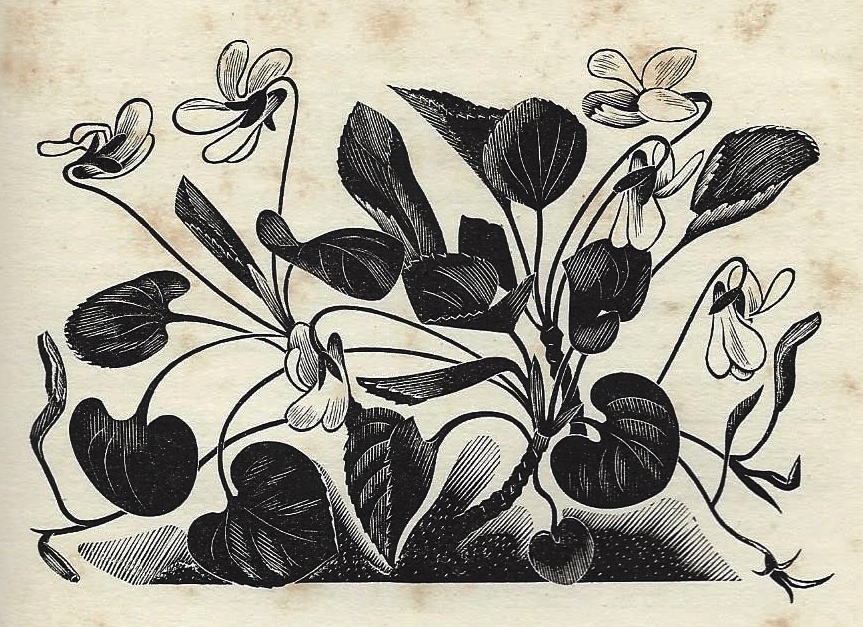
Violet - by John Farleigh - from A Country Garden by Ethel Armitage, 1936

Violet – engraving by John Farleigh – from A Country Garden by Ethel Armitage, 1936

The following excerpt is from Ethel Armitage’s wonderful 1936 A Country Garden, illustrated with engravings by John Farleigh. One of my most treasured “working library” posssessions, a pleasure to read, both for the information it contains regarding English country gardens of its era, and the writer’s highly individualistic voice, which resonates so strongly with me, sharing as we do our relative stage of life and our common occupation, though separated by eighty years. Here she is, on March 9, 1935.

9th. The much debated and discussed seed list has at last been got off, though it was not completed without a certain amount of difference of opinion.

Unfortunately, the world has progressed since those happy days when the choice of flowers was limited, and the belief still held that every seed sown was absolutely certain to come up, and all that was needed for the perfect garden was a nice broad riband of virginia stock backed by canary creeper growing up pea sticks.

Now we ponder over all the beautiful South African annuals, wondering if our soil is too cold for them; think we will try our old favourites, Shirley poppies and sweet sultans once again, as there have not been many slugs about recently; feel it is really scarcely worth while having giant sunflowers as there is no room for them, and no stakes strong enough to hold them up; decide not to raise delphiniums from seed, as the last time we did so all the drab ones flourished, while those we felt sure would be of a heavenly tender indescribable blue all got devoured.

But we agreed to have a packet of Collinsia again, a plant which hails from North America, having been called after Collins, a naturalist. We saw it for the first time growing in the school-children’s gardens. It is one of the prettiest, neatest and most reliable of annuals, and has the charming sobriquet of ‘Chinese houses’, and even looks quite appropriate in the rock garden.

Then blue pimpernel is hard to do without, and blue phacelia is almost a necessity, as is also blue nemophila, and of course neither mignonette nor night-scented stock can be omitted.

The rock garden needs ionopsidium, as well as the nice little Sedum coeruleum.

And so the list goes on increasing, until it grows to such large dimensions that when the little packets arrive, one is appalled at their number and can only hope a place will be found for everything, and they will not be left lying on a shelf in the potting shed until it is too late to do anything with them at all.

The greatest joy ever given by an individual seed packet was one which cost a penny and contained a solitary banana seed, which, when planted, actually came up and in time grew into a very fine plant. It had, of course, to be kept in the greenhouse, where for many years it was the pride of the place, though never a banana did it produce. But all hope of this miracle happening was not abandoned until the plant became too large for its surroundings and had to be cast out, which drastic deed was the cause of many tears and of unutterable, though temporary, despair.

We are now too old to plant banana seeds with the idea of getting any fruit from them, or even to entertain any hope of getting our oranges from the pips we have ourselves saved, or plums from stones that have been thoroughly sucked before planting. We have to content ourselves with things that give a quicker and more certain return, like the homely wallflower and the steady-going Sweet William.