British Columbiana: A Millennial in a Gold Rush Town by Josie Teed ~ 2023. This edition: Dundurn Press, 2023. Softcover. 253 pages. ISBN: 9781459750210
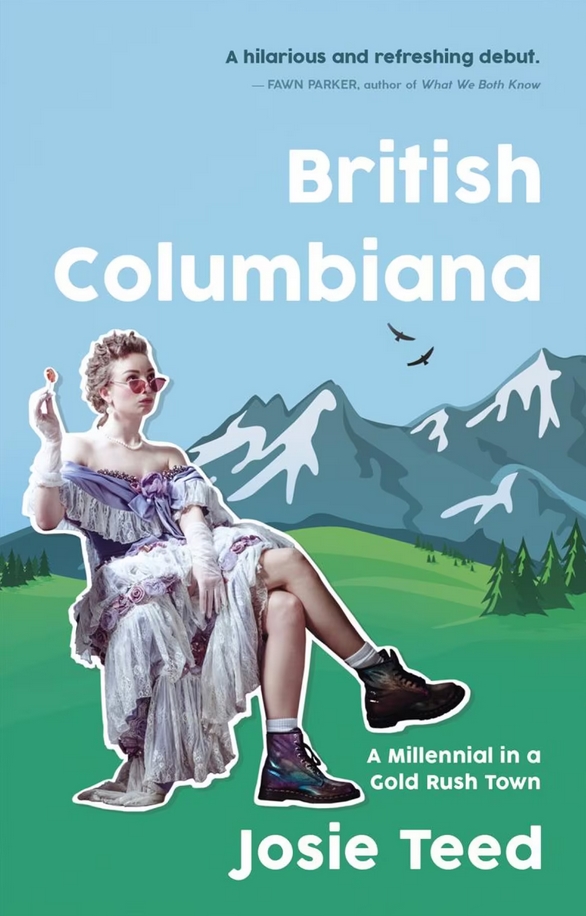 Josie Teed has been sitting on my desk for the past week, giving me the suspicious side-eye while others line up behind her. Josie doesn’t really care what I think, but yeah, wait a minute, she kinda does, and I’ll bet she’s wondering who the heck am I to have the nerve to critique her, all boring old boomer versus woke and anxious millennial.
British Columbiana is causing me no end of angst as I write, erase and rewrite its review. I feel like I have a lot to unpack about what Josie Teed’s Edna Staebler Award nominated creative non-fiction had to say, but as the days roll by, I find myself still struggling with this one, so I’ll just get this thing posted and move on.
Here’s the blurb from the Wilfred Laurier University write-up on the award nominees:
In her first published work, Josie Teed represents her generation’s aspirations and anxieties. What should one do with one’s life? Are feelings trustworthy? Are people genuine? Does this go with that? What does my therapist think? With a sharp comic eye, Teed chronicles her own coming-of-age during a year spent working in the heritage village of Barkerville, deep in the BC interior, dramatizing daily life in a 19th century gold rush town. But the real drama arises from the cast of eccentric Gen-Xers and cliquey Gen-Zedders who spend the summer bringing Barkerville’s past to life while pursuing—much to Teed’s consternation—their own generational predilections. From Boomers to Zedders, Teed’s narrative will engage, bemuse, and amuse readers in equal parts.
Josie Teed, a twenty-four-year-old university grad, freshly delivered of her master’s thesis in medieval archeology, finds a winter gig as an archival intern in Barkerville, British Columbia’s largest “living history” heritage site, situated in a very rural area in British Columbia’s central interior Cariboo region, an hour’s drive by twisting two-lane highway from the small city of Quesnel.
Teed finds shared accommodation in Barkerville’s tiny next-door service community of Wells, permanent population 250-ish, and settles in to her new digs and new job with a mixture of optimism and trepidation. Will this be where she finds some useful resume-padding, insight into next steps after school, a place to find community, and maybe even a yearned-for chance for love?
By the end of what turns into a year-long sojourn, with the internship morphing into a summer position as a costumed reenactor mingling with tourists in the kitchen of a historical home and in the one-room schoolhouse, Josie Teed has had the opportunity to get down deep with exploring all of these goals, and I’ll skip right to the end and tell you know that she mostly finds out what she doesn’t want to do, which is hang around in Wells.
I’m all up for delving into an interesting memoir, and this one had the added attraction of coming from a fresh young voice, sharing a spanking new impression of a community I am rather well acquainted with. Just a few pages in, I found myself taken aback to find that Teed pulled no punches in her snap character assessments regarding her new Barkerville-Wells co-workers and acquaintances, and that some of them were immediately identifiable. I said to myself, “No way! She can’t be going there!”, and I scanned the front pages of the book for the usual disclaimer about the characters not being actual people, but it was nowhere to be found.
Settling down to get a Josie’s-eye view of this corner of the world, another thing became very evident: it wasn’t about the place, or even the other people. It was all about Teed’s vision of herself, and her every reaction to each new person and experience, and all her various “feels” laid out for self examination.
A fellow reader of British Columbiana who I discussed this with rather sharply dismissed the whole thing as “over-the-top Millennial navel-gazing”, and I have to say they weren’t really wrong. But there were more than a few golden nuggets to be mined from amongst the pebbles of this particular literary stream-bed, certainly enough to keep me engaged and increasingly invested in figuring why some things about Teed annoyed me so much, and, paradoxically, how much I felt empathy with her intense and ongoing inner struggles with insecurity and social anxiety.
Upon finishing the last page, I headed straight to Google to find other insights on Josie Teed. I was immediately rewarded by finding this book review by Forrest Pass in The British Columbia Review, and what he had to say aligned so well with my own impression that I will refer the interested reader to him.
I wanted to love this book, and went into it with high hopes, as I personally have a long and mostly happy relationship with both Barkerville and Wells, and some of the people who live and work there. British Columbiana wasn’t what I had initially expected it to be, which was a more “place-based” sort of memoir, but it did turn out to be mildly compelling in a much different way.
British Columbiana almost went onto the giveaway pile after I finished it, but then I had a rethink. First novels – especially those self-described as “memoirs” – are notoriously about unpacking personal angst and getting in digs at the people who don’t really get you, so I’ll extend some grace to Teed, and I will be keeping an eye out for her next literary effort.
My rating: 6/10






 Leaves & Pages