Archive for the ‘Short Stories’ Category

the rendezvous other stories daphne du maurier 001The Rendezvous and other stories by Daphne du Maurier ~ 1980. This edition: Pan, 1981. Paperback. ISBN: 0-330-26554-7. 234 pages.

My rating: The first and last stories in this otherwise rather mild collection elevate my rating to an overall 7/10. Otherwise, probably not more than a 5, or maybe a 6. All are worth reading, but most are not quite top-of-the-line for this particular author.

In the Preface, the author briefly explains her inspirations, and mentions that these stories show her development as a writer. I think a nice addition to this collection would have been dates of writing or of original publication; this would have added much to my own enjoyment as a long-time Daphne du Maurier reader.

*****

Some excellent, some not so much in this 1980 collection of short stories from throughout the author’s long career. All are very well written; the “less excellent” ones are described as such only in comparison to this author’s absolutely brilliant “best”.

  • No Motive ~ Why would a sweet-natured, happily married, expectant mother fatally shoot herself ten minutes after cheerfully ordering new garden furniture? One of the longer stories in this collection, and nicely plotted out. 7/10.
  • Panic ~ A casual love affair goes terribly wrong. Fabulously atmospheric, but ultimately slight. The dénouement comes as no surprise. 5/10.
  • The Supreme Artist ~ An aging actor gives a most superb performance off stage, and comes abruptly to an intimation of his own mortality. 6/10.
  • Adieu Sagesse ~ Two men from the opposite ends of the social spectrum plot their escape from tedious lives. Loved this one; the right people “win”. 8/10.
  • Fairy Tale ~ A slight and unlikely snippet of a story of a ne’er-do-well husband and his adoring wife. “Fairy tale”, indeed! 3/10.
  • The Rendezvous ~ I expected much from the title story of this collection. A successful author who has spent his life in observation finally arranges an “experience” for himself, only to be disappointed at every turn. In general, well done. But I wanted something just a little bit more. 6/10.
  • La Sainte-Vierge ~ Innocence and corruption. A snippet of a story, but very evocative of both. 5/10.
  • Leading Lady ~ Cherchez la femme… Another theatrical setting. Daphne used her eyes and ears well when about the backstage world. 6/10.
  • Escort ~ A maritime ghost story set in World War II. It’s been done before, but this attempt is reasonably decent. Nice detail on board the ghost ship. 5/10.
  • The Lover ~ A damning portrait of a rather vicious “lady’s man”. Didn’t really go anywhere as a story. 4/10.
  • The Closing Door ~ A young man faces up to a dire diagnosis. His lover unknowingly twists the knife. No shortage of symbolic situation in this one; I suspect it is one of the earlier efforts of the author. 5/10.
  • Indiscretion ~ Be careful what you say and who you say it to. Three lives are changed by a single sentence. A mite too contrived for my full enjoyment. 4/10.
  • Angels and Archangels ~ Religion and hypocrisy. The hypocrites win. A bitter little tale. 5/10.
  • Split Second ~ This story is the definite high point of the book. A middle-aged woman goes out for a walk, and comes away from a brush with death to a very different world. Or does she? Brutally pathetic, and perfectly written. 9/10.

Here’s another assessment of this collection:

Savidge Reads – The Rendezvous and other stories

Read Full Post »

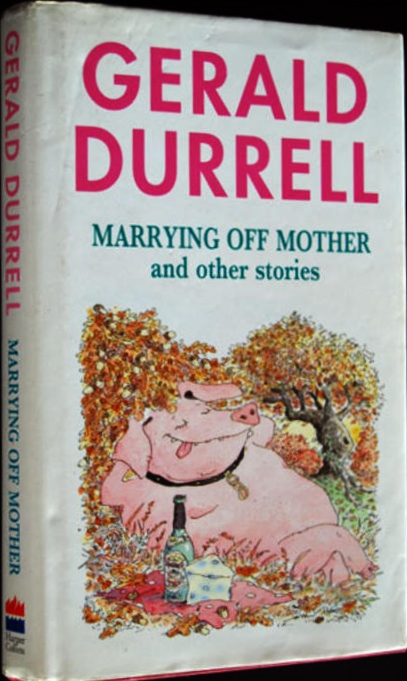
marrying off mother gerald durrellMarrying Off Mother and other stories by Gerald Durrell ~ 1991. This edition: Harper Collins, 1991. Hardcover. ISBN: 0-99-223808-X. 197 pages.

My rating: 8/10.

A quick, easy, and enjoyable read.

I have a strong fondness for Gerald Durrell’s self-aware, tongue-in-cheek, and humorously wry writings, stretching back to a childhood introduction to his books when my parents were given a copy of Catch Me a Colobus. My father had it on his night table, and was reading it with evident enjoyment, and when I asked him what it was about he handed it to me with a smile. I laboriously read it – I was of the tender age of 8 or 9 at the time – and was hooked.

Since then I do believe I’ve read every single thing the man wrote, with the exception of some of the juveniles of the writer’s last years. Obviously not an exclusive reaction, as Gerald Durrell was a best-selling author and eventually a household name in the English-speaking world –  right up there with the even more prominent David Attenborough –  though he (Durrell) bluntly stated in his later books that the income from his writing helped in great part to finance his pet project, the Jersey Zoo & Wildlife Preservation Trust , and that he continued to produce manuscripts only for the purpose of furthering his wildlife work.

Be that as it may, the man did have a decided literary talent, and in later years broadened his scope from the autobiographical to the more obviously fictional, with several novels and a number of short stories to his credit.  Many of Gerald Durrell’s fictional short stories show a decidedly macabre twist to the man’s mind; one in particular, The Entrance, the final story in The Picnic and Other Pandemonium – an otherwise quite light-hearted and delightful compilation – has the distinction of being one of the creepiest and most frightening tales I’ve ever read, and rather put me off Durrell completely for a while, giving an unwelcome insight into something other than the avuncular animal-loving anecdotist one innocently assumed. I got over it, though I still think of that particular book with a reminiscent shudder, and have studiously ignored it ever since. Though now that I’ve been reminded, I have the feeling that I should perhaps face my fears and re-read it and review it. Maybe. Or maybe not…

As usual, I’ve digressed. Back on track, then, with a rundown on this short story compilation, which, though a bit dark in places, was, as always, mostly just plain diverting reading, perfect for tea break consumption – engaging but not too challenging, and easy to take up and put down.

  • Esmeralda

Of all the many regions in La Belle France, there is one whose very name adds a lustrous glitter to the eye of a gourmet, a flush of anticipation to his cheeks, that drenches his taste buds with anticipatory saliva, and that is the euphonious name of Périgord. Here the chestnuts and walnuts are of prodigious size, here the wild strawberries are as heavily scented as a courtesan’s boudoir. Here the apples, the pears and the plums have sublime juices captured in their skins, here the flesh of chicken, duckling and pigeon is firm and white, here the butter is as yellow as sunshine and the cream on top of the churns is thick enough to balance a full glass of wine on. As well as all these riches, Périgord has one supreme prize that lurks beneath the loamy soil of her oak woods, the truffle, the troglodyte fungus that lives below the surface of the forest floor, black as a witch’s cat, delicious as all the perfumes of Arabia.

Enter one Esmeralda, a porcine lady graced with a delicate golden chain around her neck, and smelling delicately of the exclusive perfume Joy…

  • Fred – or A Touch of the Warm South

On a lecture tour of the American South, our author is hosted by a Traditional Southern Lady, and meets her butler Fred. By the by, the amount of ardent spirits consumed during this short foray into Tennessee give an insight into Durrell’s subsequent liver problems. The man did seem to enjoy tipping them back!

As the taxi drew up (the) handsome door was thrown open to the frame by a very large, very black gentleman with white hair in tail coat and striped trousers. He looked as though he might be the accredited Ambassador of practically any emerging nation. In the rich port-like tones that I remembered from the telephone he said, ‘Mr. Dewrell, welcome to Miz Magnolia’s residence.’ and then added as an afterthought, ‘Ahyam Fred.’

‘Glad to know you, Fred.’ I said. ‘Can you handle the luggage?’

‘Everything will be under control,’ said Fred.

The taxi driver had deposited my two suitcases on the gravel and driven off. Fred surveyed them as if they were offensive litter.

‘Fred,’ I said, interested, ‘do you normally wear that clothing?’

He glanced down his body with disdain.

‘No,’ he said, ‘but Miz Magnolia say ah was to greet yew in traditional costume.’

‘You mean that this is traditional costume here in Memphis?’ I asked.

‘No suh,’ he said bitterly, ‘it’s traditional costume where yew comes from.’

  • Retirement

A Scandinavian ship’s captain looks forward to his last voyage and retirement beside the sea, but his plans are tragically set at naught. A delicately appreciative tale with a chillingly memorable ending.

  • Marrying Off Mother

A return to the sunny Corfu of My Family and Other Animals, and an attempt by her children to bring some romance into Mrs. Durrell’s life.

‘I wonder if passion flowers would look nice on that east wall,’ said Mother, looking up from her seed catalogue. ‘They are so pretty. I can imagine that east wall just covered with passion flowers, can’t you?’

‘We could do with a bit of passion around here,’ said Larry. ‘Just recently, the place has been as chaste as a nunnery.’

‘I don’t see what passion flowers have got to do with nuns,’ said Mother.

Larry sighed and gathered up his mail.

‘Why don’t you get married again?’ he suggested. ‘You’ve been looking awfully wilted lately, rather like an overworked nun.’

‘Indeed I haven’t,’ said Mother indignantly.

‘You’re looking sort of shrewish and spinsterish,’ said Larry… ‘And all this mooning about passion flowers. It’s very Freudian. Obviously what you want is a dollop of romance in your life. Get married again.’

‘What rubbish you talk, Larry,’ said my mother, bridling. ‘Get married again! What nonsense! Your father would never allow it.’

‘Dad’s been dead for nearly twelve years. I think his objection could be overruled, don’t you? …’

Never fear. Mother competently turns the tables on her meddling family.

  • Ludwig

Do Germans, as a race,  have a sense of humour? The author attempts to answer this query with the cooperation of a willing-to-learn hotel manager, one Ludwig Dietrich.

  • The Jury

A former British public hangman is discovered to be living in a remote South American village. Though he has tried to make a new life for himself, he can’t outrun his past. An appropriately nasty ending awaits him, with our author as chief (fictional, one would hope and assume) witness.

  • Miss Booth-Wycherly’s Clothes

An ex-nun creatively and anonymously supports her old order’s orphanage, with the help of the bequest of the magnificent wardrobe of the deceased Miss Booth-Wycherly of Monte Carlo.

  • A Parrot for the Parson

The gift of a foul-mouthed parrot assists a defrocked vicar in his quest for replacements for the choirboys he longer has easy access to. Immensely politically incorrect, but rather funny in an “I shouldn’t be laughing at this” sort of way.

Read Full Post »

tip on a dead jockey irwin shaw 001Tip on a Dead Jockey and other stories by Irwin Shaw ~ 1957. This edition: Signet, 1957. Paperback. 176 pages.

My rating: 8/10. Very decent collection of mostly melancholic short stories about jaded Americans in post-war Europe and “back home”.

I found this disintegrating paperback on my dad’s workshop bookshelves when I was going through his papers after his death six years ago. Dad liked his reading straight-serious (think detailed war memoirs and biographies), and satirical-serious (John Steinbeck was a big favourite), and cynically humorous (Wilhelm Busch in the original German was there in a number of editions), and technical and creative (Popular Science and Popular Mechanics, heaps and heaps, dating back to the early 1950s – my son scooped these and they now reside in dusty, well-read, falling apart glory on the cabin bookshelves), and travel and historical (National Geographic, of course, another massive, complete collection. I think these start with the 1961 full year, though there are stray earlier ones.) The dramatic fictional bestsellers of the day were well-represented as well, lots of Irwin Shaw around when I was growing up, though I don’t remember this particular one. Must have been on a really high shelf!

This Shaw collection, from very early in the writer’s career – 1946 to 1957 being the publication dates mentioned on the copyright page – are crisp, clean, often cynically humorous, well written and definitely entertaining. Not all have conclusions, which while a bit cliffhangerish is not necessarily a handicap to appreciation. Good stuff. Thanks, Dad.

I’ve been reading other bloggers’ magnificent and thoughtful posts with great admiration recently, and am feeling decidedly sub-par in this regard tonight – I will not even try to get all deep and meaningful.

Here’s my review: I liked these stories. They were very readable. You may find yourself craving a glass of whiskey (with or without a mixer), or a bottle of harsh red French wine (glass optional). My usual beverage of choice, a “nice cup of tea”, felt rather too granny-ish; I was almost ashamed of myself. No, hang on – two of the stories had tea-drinking in them. Though one couple  added rum. Hm, that sounds fairly foul. Or maybe not?! Worked for the characters, apparently – it was followed by a night of passion!

*****

Tip on a Dead Jockey ~ In post-war Paris, pilot Lloyd Barber is offered a chance at some easy money, just one simple trip, flying a brand-new single-engine Beechcraft, from Egypt to Cannes.

“Alone?” Barber asked, trying to keep all the facts straight.

“Alone, that is,” Smith said, “except for a small box… When you take off from the airport in Cairo, the box is not on board. And when you land at the airport at Cannes, the box is not on board. Isn’t that enough?”

It’s not quite enough, or maybe it’s too much – Barber eventually turns the job down, but not before inadvertently introducing Smith to another pilot friend, the naïve and trusting Jimmy Richardson.

You didn’t have to speculate about Jimmy. If you bought Jimmy a drink, he was your friend for life. For all that he had been through – war and marriage and being a father and living in a foreign country – it had still never occurred to Jimmy that people might not like him or might try to do him harm. When you were enjoying Jimmy, you called it trustfulness. When he was boring you, you called it stupidity.

Choosing not to warn Jimmy about Smith’s “opportunities”, Barber is overwhelmed with guilt and unease when Jimmy’s distraught wife shows up begging for help in finding him; he’s been gone thirty-two days without a word. There’s a little twist in the tail of this tale.

This short story was worked up into a 1957 Metro-Goldwyn-Mayer movie, with loads of added elements; only the author’s original sketchy premise and a few of the names remained the same.

A Wicked Story ~ A wife’s unfounded  jealousy becomes a self-fulfilling prophecy.

In the French Style ~ Cynical Walter Beddoes, “career man in the foreign service”, returns to his home base in Paris from two months away in Egypt to find his reliable good time girlfriend has decided to move on to something more permanent. Beddoes had had his chance, but he’d ducked it:

It was lucky he was leaving, if she was moving into that phase. That was the pre-yearning-for-marriage phase, and you had to be on guard against it, especially late at night, in Paris, in darkened rooms where pianists and electric guitars played songs about dead leaves and dead loves and lovers who were separated by wars.

Beddoes had been married once, and he felt, for the time being, that that was enough. Wives had a tendency to produce children, and sulk and take to drink or other men when their husbands were called away to the other side of the earth for three or four months at a time on jobs.

Of course, there are regrets.

Peter Two ~ Thirteen-year-old Peter has a harsh foray into the fickleness of the adult world. This one almost cries out to be included in a high school short story anthology – maybe it has been? – I can imagine how joyfully an earnest teacher would pick it apart and spread out its “discussion points”! Lots of essay material here, oh yes indeed.

It was Saturday night and people were killing each other by the hour on the small screen, Policemen were shot in the line of duty, gangsters were thrown off roofs, and an elderly lady was slowly poisoned for her pearls, and her murderer was brought to justice by a cigarette company after a long series of discussions in the office of a private detective. Brave, unarmed actors leaped at villains holding forty-fives, and ingénues were saved from death by the knife by the quick thinking of various handsome and intrepid young men.

Peter sat in the big chair in front of the screen, his feet up over the arm, eating grapes. His mother wasn’t home, so he ate the seeds and all as he stared critically at the violence before him. When his mother was around, the fear pf appendicitis hung in the air and she watched carefully to see that each seed was neatly extracted and placed in an ashtray. Too, if she were home, there would be irritated little lectures on the quality of television entertainment for the young, and quick-tempered fiddling with the dials to find something that was vaguely defined as educational …

Suddenly, in the hall outside the apartment, a woman screams…

Age of Reason ~ A man’s repeated nightmare highlights uneasy aspects of his marriage, and forebodes a disaster which may or may not come to pass.

The Kiss at Croton Falls ~ Frederick Mull, trolley driver, “a huge rollicking man, with a russet mustache”, a drinking habit, and a supremely jealous wife who sneaks around spying on Mull’s lady passengers, dies at the height of his glory, leaving his wife to convene with his ghost, and his grown-up daughter Clarice to take a good hard look at her own husband. Grand little story, humorous and perfectly crafted.

Then We Were Three ~ American expatriates Munnie, Bert and Martha travel through France enjoying a platonic three-way friendship which lasts one day too long.

The Sunny Banks of the River Lethe ~ A man’s perfect memory dissolves. Irwin’s been reading Kafka.

The Wedding of a Friend ~ Ronny Biddell’s wedding brings back memories of his ill-fated, one-sided, first love affair during the war, with the duplicitous but delicious French Virginie. Light-hearted.

Voyage Out, Voyage Home ~ Lovely young American Constance is taking a quiet, solitary skiing vacation in Switzerland at her father’s expense, to mull over her prospective marriage to a much older man (Daddy doesn’t approve), when she meets the charming, reckless Englishman Pritchard. No surprises, but nicely done – a classic tale of  love and loss.

Read Full Post »

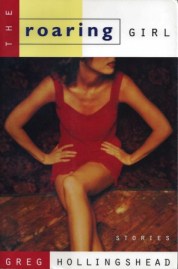
the roaring girl greg hollingshead 001The Roaring Girl: Stories by Greg Hollingshead ~ 1995. This edition: Somerville House, 1995. Softcover. ISBN: 1-895897-53-X. 196 pages.

My rating: 4/10. These are cleverly written, but a little too far out there for me. I wouldn’t re-read any of these anytime soon, and if I’d never heard of Greg Hollingshead it wouldn’t break my heart.

This collection won the 1995 Governor General’s Award for English Fiction – Short Stories, and the contents are undeniably well-written, but most of the stories left me feeling more than a mite confused, and usually a whole lot disturbed. Hollingshead has a creative mind and a grand way with words – some of his phrases lift up off the page and vigorously come to life – but it’s all kind of kinky. Often humorous, but definitely dark. Lots of sex – mostly of the “ew!” nature – and deeply twisted thoughts.

I’m not going to spend any time deeply reviewing this one, because it would require me to spend more time in Greg’s head (as it were) and, quite frankly, I don’t want to.  I’ll be moving The Roaring Girl along to see if it can find a more suitable home.

*****

  • The Side of the Elements – A couple rents out their home for the year they must be away. Stuff goes on in their absence. This one I rather liked.
  • The People of the Sudan – A family is maneuvered into taking temporary care of a box full of Canadian Christian Relief “supplies” for someone going to the Sudan; the rendezvous goes awry and the situation goes surreal. Another good one; downright humorous.
  • Rose Cottage – A young man becomes involved in trying to fix what he believes is an abusive relationship between a nurse and her elderly charge.
  • The Roaring Girl – A transient girl is given temporary haven by a family, deeply affecting the adolescent son.
  • The Age of Reason – Some sort of dysfunctional family saga. I have no idea what this was all about!
  • Rat With Tangerine –  Ditto.
  • A Night at the Palace – This one was a complete nightmare – couldn’t finish it. People behaving strangely. And badly. Hallucinogenic.
  • The Appraisal – Oh, thank goodness – an actual narrative arc! Well, relatively speaking. A cottage appraisal turns into a conversation on the nature of civilization, and its impending collapse. Awesome – loved it.
  • The Death of Brulé – A young boy becomes involved with the older girl next door. Ick.
  • The Naked Man – Another absolutely surreal family tale.
  • How Happy They Were – Sad people; love gone wrong.
  • Walking on the Moon – The view from a roof overlooking the people next door. Odd.

So – out of these twelve there were four I kind of, sort of, almost enjoyed reading. The Appraisal is the only one I’d willingly seek out again. Goodbye, Roaring Girl!

Read Full Post »

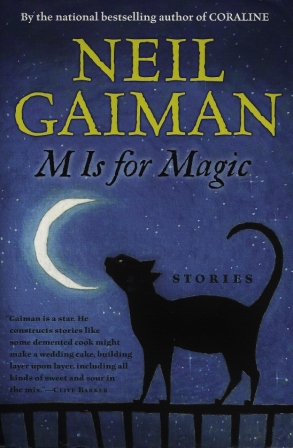
M is for Magic by Neil Gaiman ~ 2007. This edition: Harper Collins, 2007. First Edition. Hardcover. ISBN: 978-0-06-1186424-4. 260 pages.

My rating: 8/10. It’s Neil Gaiman – what else can I say? When he’s good, he’s great. Some of his stuff is a bit out there and twisty for my squeamish comfort, but mostly I’m a solid fan.

But I disagree with the marketing angle for this collection – this is not a book for children. The true audience here is teens and up, in my opinion. Some of the reference are totally aimed at adults. Not to say kids shouldn’t read this – not at all! Like most of Ray Bradbury’s work, whom this collection was inspired by according to Gaiman’s forward, the fact that some of the stuff is over their heads will be immaterial.

None of the material in this book is original to it; the pieces have all been published in other anthologies and collections, with the exception of  The Witch’s Headstone, which is an excerpt from and a teaser for The Graveyard Book, which was about to be published the next year, 2008,  and Gaiman’s Introduction.

*****

  • Introduction ~ “When I was a boy, Ray Bradbury picked stories from his books of short stories he thought younger readers might like, and he published them in R is for Rocket and S is for Space. Now I was doing the same thing, and I asked Ray if he’d mind if I called this book M is for Magic. (He didn’t.) M is for Magic. All the letters are, if you put them together properly. You can make magic with them, and dreams, and, I hope, even a few surprises…” ~ Neil Gaiman, August 2006
  • The Case of the Four and Twenty Blackbirds ~ 1984 ~ A take-off on the hardboiled detective story, a la Dashiell Hammett. The main conceit here is that the characters are nursery rhyme figures. Meh. Cute idea, but it doesn’t really work. (Starting on a low point. Don’t worry, it gets better.) 5/10.
  • Troll Bridge ~ 1993 ~ Omigosh. Angst Alert! A boy encounters a troll at the tender age of seven and bargains successfully for his life. But if you live long enough things may just come full circle. 8/10.
  • Don’t Ask Jack ~ 1995 ~ A pointless little vignette featuring a jack-in-the-box and Time. Methinks the author was reading too much Bradbury before he penned this one. 6/10.
  • How to Sell the Ponti Bridge ~ 1985 ~ Okay, now we’re warming up. The story of the perfect scam, and how to turn lust and greed back on itself. And I award this one a  perfect 10/10.
  • October in the Chair ~ 2002 ~ The Months are telling stories. Beautiful set up, and one of those endings which leaves you just hanging there gasping in mid-air. Nice. 9/10.
  • Chivalry ~ 1993 ~ Mrs. Whitaker finds the Holy Grail in an Oxfam Shop, and things get interesting. Gorgeous! And very funny.  Another 10/10.
  • The Price ~ 1997 ~ This one bothered me, being a cat person. An adopted Black Cat apparently guards his human family against the devil, but the battle is proving too much for him. Sad. 6/10.
  • How to Talk to Girls at Parties ~ 2006 ~ Vic and Enn crash the wrong party. These girls come from a long way away. 7/10.
  • Sunbird ~ 2005 ~ The Epicurean Club finds a new and mostly fatal dining experience. A strangely entrancing tale. 8/10.
  • The Witch’s Headstone ~ 2007 ~ An excerpted chapter from the yet-to-be-published (at the time of this collection) Graveyard Book. Young Bod falls in with the ghost of a witch, and does the perfect thing. 10/10.
  • Instructions ~ 2000 ~ A poem lays out the fairytale guide to life’s journey. 11/10. (No, that’s not a typo. Love this one that much. Hmm, maybe I should post it.)

Read Full Post »

Let the Day Perish by Christian Petersen ~ 1999. This edition: Beach Holme Publishing, 1999. First Edition. Softcover. ISBN: 0-88878-400-7. 136 pages.

My rating: 9/10. Strong, vivid and eloquent. “Beautifully crafted”  and “Powerful” may have become clichéd descriptions, but they apply in their most sincere sense to these punchy short stories.

*****

From the back cover:

Christian Petersen beautifully reins in the confusion and displacement of a diminishing band of men facing the daily spectre of an unforgiving land, men enslaved to the grind of the sawmill, hunkered on bar stools, high in the saddle of a John Deere, or wild behind the wheel speeding down dirt roads to the Fraser. Here are fathers, brothers, lovers in search of forsaken children, bygone loves, and memories long faded in the wash of fast-running streams and firelight. Here are the unpardoned, raging against what they might have been, what they are now, and where their paths have led them. Yet Petersen’s characters hollow out a quiet dignity, gentle in the silent truth that they are small in the face of pain – and of change.

Regional literature set in areas familiar to the reader is difficult to view in perspective. I find that I am often so caught up in nodding in recognition of places and people that a crucial distance is hard to maintain in attempting to judge merit of story and style. And this is a very local collection of stories, by a writer who closely shares my own experience of time and place in his formative years, growing up in Quesnel in the 1960s and 70s, leaving the Cariboo for a time, and eventually resettling in Williams Lake, where he has worked (is still working?) as a probation officer. He is obviously a keen observer of local “types” – they are instantly recognizable – but he looks past the superficial surface of the stereotypes to the turmoil within.

A quotation on the opening page gives a clue to the content within:

If a story is not to be about love or fear, then I think it must be about anger.

  • The Look of the Lightning, The Sound of the Birds ~ Diane Schoemperlen

Love, fear and anger are all represented here in their deepest intensity.

A very readable collection of stories, definitely for British Columbians familiar with the Cariboo-Chilcotin settings, and with a broader appeal to universal emotions which should resonate with readers everywhere.

  • Heart Red Monaco ~ Two unlikely friends search for some kind of meaning in their treading-water lives.
  • The Next Nine Hundred Years ~ Vignettes of “working at the mill.”
  • Horseshoes ~ Two brothers: rivalry, conflict and resolution.
  • Come Evening ~ A day with one of the fringe-dwelling “troopers” of Williams Lake.
  • Scout Island ~ From her house overlooking the nature reserve, a horse trainer deals with “getting by”, and a troubling situation initiated by her young son and her elderly great-aunt.
  • Country Boys ~ The brutal world of the high school bully, his victims and, ultimately, his tormenters.
  • Taseko ~ A boy goes moose hunting in the Chilcotin with his father and his father’s friend.
  • Let the Day Perish ~ Life, love and death on the ranch.
  • This is How It Is ~ A divorced father yearns for his young daughter.
  • Thibeau’s Crossing ~ Betrayal changes everything in a peaceful valley.
  • Charity ~ A sincere Baptist Church minister gives in to passion with far-reaching consequences.
  • Men’s Wear (after a fashion) ~ The venerable owner of the town’s “upper crust” men’s wear store is challenged by changed times, and undergoes an epiphany. Great ending note to this collection – left me smiling. Nice to quit on a high point; some of these stories (though not all) were dark.

Petersen has also written a mystery novel, Outside the Line (2009), and another collection of short stories, All Those Drawn to Me (2010). He is currently working on another book, a novel. I will be watching for it. Keep an eye out for this author. This first collection is excellent.

Read Full Post »

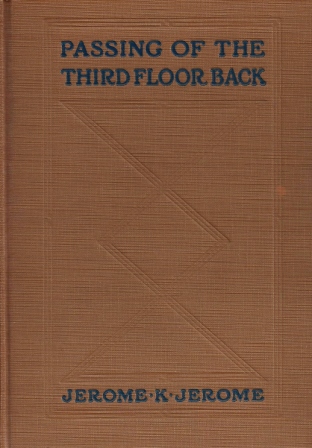
Passing of the Third Floor Back by Jerome K. Jerome ~ 1904. This edition: Dodd, Mead & Co., 1928. Hardcover. 186 pages.

My rating: This is one of those complicated-to-rate books. In context with other short story collections of its time, I thought it fairly typical. Not perhaps outstanding, but a solid little group of era-correct (love that term – it comes from the vintage car world, in which I have a tiny involvement) pieces. Did I enjoy them, though, on a purely reading-for-pleasure level? Some yes, others not so much. I thought the short stories herein were reasonably well written – if a bit wordy – and quite moralistic. No doubt as to what we’re supposed to be thinking at the end of each!

So, taking everything into consideration, how about  7/10. I don’t know if I would recommend this small collection as purely pleasure reading suitable for modern tastes, but the stories do possess a certain curiousity value, and several are quite humorous, in an “era-correct” (there, I got to use that again!) sort of way.

*****

Jerome K. Jerome, 1859-1927, is, as you’ll know unless you’ve been residing under a literary rock all your adult days, best-known for his 1889 comic novel, Three Men in a Boat (To Say Nothing of the Dog), still very much in print 123 years after its first publication. This was my own first introduction to this author some years ago, and I found the story mildly diverting. A pleasant memory persisted, so when I chanced upon this book of short stories in a pile of vintage hardcovers on the deliciously over-crowded shelves of At Second Glance in Kamloops, I eagerly added it to my pile of acquisitions.

Apparently the title story, Passing of the Third Floor Back, was made into a quite successful movie in 1935, starring Conrad Veidt. I must admit I’d never heard of it until I did a bit of background research on this book for reasons of this review, but from the Wikipedia article it looks as though Jerome’s story was very much a starting point – the movie plot as described seems nothing like the story I’ve just read, but for the boarding house setting and the idea of the mysterious stranger changing the lives of those about him.

Six stories make up this collection.

Passing of the Third Floor Back ~  A mysterious stranger moves into a squalid boarding house and changes the lives of everyone who comes into contact with him.

The Philosopher’s Joke ~ What if you could go back to your younger days, but still remember everything you’d learned through your maturity? I liked the premise, but found the handling rather awkward. An intriguing idea – very thought-provoking.

The Soul of Nicolas Snyders, or The Miser of Zandam ~ An exchange of souls has predictable results, and a few surprises. Moralistic but smile-provoking.

Mrs. Korner Sins Her Mercies ~ The most purely humorous story of the collection. A clever friend puts an interesting spin on a marital crisis.

The Cost of Kindness ~ A good deed sets off a chain reaction, with very different results than first anticipated. Another humorous piece.

The Love of Ulrich Nebendahl ~ Self-sacrifice taken to the extreme. This was the most serious story of the lot; a rather shocking conclusion, which the author attempts to soften with a Biblical tag.

*****

I am going to leave my review right there – a simple report – so sorry, but I can’t quite bring off a deeper analysis. Limited computer time this week, and so much going on in my real life that my thinking capacity is all used up by the time I sit down to type!

Read Full Post »

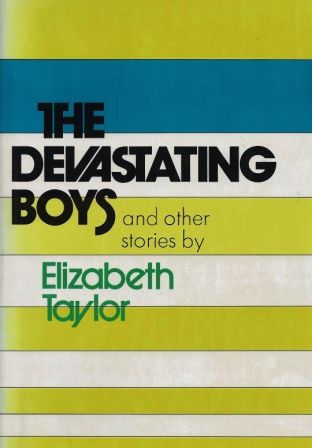
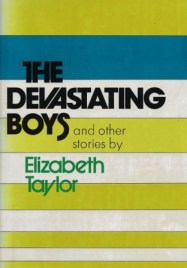
The Devastating Boys and Other Stories by Elizabeth Taylor ~ 1972. This edition: Viking Press, 1972. Hardcover. ISBN: 670-27067-9. 179 pages.

My overall rating: 7.5/10. Competently and beautifully written, this is a quietly memorable collection of subdued short stories, written between 1965 and 1972.

I’m not quite embracing the Jane Austen comparisons though, of which there are two from different reviewers on the dustjacket.

*****

Elizabeth Taylor. Hmm. As a broad statement, I very much like her work, but I don’t indiscriminately love it, with a few stellar exceptions. A mistress of concise, clean and crisply descriptive prose, I find I enjoy her voice the best when she lets herself go with keen, wry humour. The detail she picks up on is one of her best qualities. Thinking a little more about this author, I do think that perhaps her short stories are her best work. Like hyper-detailed miniatures they allow us to focus intensely for brief time on the minutiae which too often blurs in a larger, more ambitious narrative.

Here’s what we have in this collection. I’ve included first paragraphs and a brief summary of each short story.

The Devastating Boys

Laura was always too early; and this was as bad as being late, her husband, who was always late himself, told her. She sat in her car in the empty railway-station approach, feeling very sick, from dread.

It was half past eleven on a summer morning. The country station was almost spellbound in silence, and there was, to Laura, a dreadful sense of elf-absorption – in herself – in the stillness of the only porter standing on the platform, staring down the line: even – perhaps especially – in inanimate things; all were menacingly intent on being themselves, and separately themselves – the slanting shadow of railings across the platform, the glossiness of leaves, and the closed door of the office, looking more closed, she thought, than any door she had ever seen.

She got out of the car and went into the station, and walked up and down the platform in panic. It was a beautiful morning. If only the children weren’t coming, then she could have enjoyed it.

The children are two inner city six-year-olds, coming for a two-week country vacation to Laura and her university don husband. Nothing turns out as anticipated; the experiment refocuses Laura’s conception of her place in the world, and in her marriage. Unexpectedly upbeat ending. 8/10.

The Excursion to the Source

“England was like this when I was a child,” Gwenda said. She was fifteen years older than Polly, and had had a brief, baby’s glimpse of the gay twenties – though, as an infant, could hardly have been really conscious of their charms.

It was France – the middle of France – which so much resembled that unspoilt England. In the hedgerows grew all the wild-flowers that urbanization, ribbon-development, and sprayed insecticides had made delights of the past in the south of England where Gwenda and Polly lived.

Polly had insisted on Gwenda’s stopping the car so that she could get out and add to her bunch a new blue flower that she was puzzling over. She climbed the bank to get a good specimen and stung her bare legs on some nettles. Gwenda sat in the car with her eyes closed.

Gwenda acts as slightly simple, middle-aged Polly’s companion and guardian, and the trip to France is something of a journey into the past for Gwenda as the two retrace the course of Gwenda’s last journey with her late husband. An unexpected stopover in a French village gives Polly a chance to experiment with the pleasures of physical love, while Gwenda pursues her more sophisticated goals. The journey continues to its tragic (?) end. I quite liked this longish, rather rambling dual portrait. 7/10.

Tall Boy

This Sunday had begun well, by not having begun too early. Jasper Jones overslept – or, rather, slept later than usual, for there was nothing to get up for – and so had got for himself an hour’s remission from the Sunday sentence. It was after half past ten and he had escaped, for one thing, the clatter of the milk van, a noise which for some reason depressed him. But church bells had begun to toll – to him an even more dispiriting sound, though much worse in the evening.

West Indian expatriate Jasper leads a starkly solitary life as a labourer in the “better” world of London. A poignant portrait of loneliness. 6/10.

Praises

The sunlight came through dusty windows into Miss Smythe’s Gown Department on the first floor of the building. Across the glass were red-and-white notices announcing the clearance sale. It was an early summer’s evening, and the London rush hour at its worst. Rush hours were now over for Miss Smythe, and she listened to the hum of this one, feeling strange not to be stepping along the crowded pavement towards the Underground.

In a corner of the department some of the juniors had begun to blow up balloons. The last customers had gone, and several of the office staff came in with trays of glasses. With remarkable deftness, as soon as the shop was closed – for the last time – they had draped and decorated Miss Smythe’s display counter, and they set the trays down on this.

The great store, built in the 1860s, was due for demolition. As business slowly failed, like a tide on its way out, the value of the site had gone on growing. The building had lately seemed to be demolishing itself, or at least not hindering its happening. Its green dome still stood with acid clarity against the summer sky; but the stone walls had not been washed for many years and were black with grime and dashed by pigeons’ droppings.

Fastidious, self-contained Miss Smythe prepares for her enforced retirement. 7/10.

In and Out the Houses

Kitty Miller, wearing a new red hair ribbon,bounced along the vicarage drive, skipping across ruts and jumping over puddles. Visiting took up all her mornings during the school holidays. From kitchen to kitchen round the village she made her progress, and this morning she felt drawn towards the vicarage. Quite sure of her welcome, she tapped on the back door..

“Why, Kitty Miller!” said the vicar, opening the door. He looked quite different from in church, Kitty thought. He was wearing an open-necked shirt and an old, darned cardigan. He held a tea towel to the door handle because his fingers were sticky. He and his wife were cutting up Seville oranges for marmalade, and there was a delicious, tangy smell about he kitchen.

Kitty took off her coat, hung it on the usual peg, and fetched a knife from the drawer where they were kept.

“You are on your rounds again,” Mr. Edwards said. “Spreading light and succour about the parish.”

Kitty glanced at him rather warily. She preferred him not to be there, disliking men about her kitchens. She reached for an orange and, watching Mrs. Edwards for a moment out of the corners of her eyes, began to slice it up.

Precocious young Kitty is something of a disturbing element in her village, sharing her “innocent” observations and reporting happenings from house to house, cleverly pinpointing secret weaknesses and touching sensibilities on the raw. Perfect twist in the ending. Good one! 9/10.

Flesh

Phyl was always one of the first to come into the hotel bar in the evenings for what she called her apéritif, and which, in reality, amounted to two hours’ steady drinking. After that, she had little appetite for dinner, a meal to which she was not used.

On this evening she had put on one of her beaded tops, of the kind she wore behind the bar on Saturday evening in London, and patted back her tortoise-shell hair. She was massive and glittering and sunburnt – a wonderful sight, Stanley Barrett thought, as she came across the bar towards him.

Middle-aged barmaid Phyllis has been sent on a solitary holiday by her husband to recover from a hysterectomy; she and widower Stanley inevitably draw together as kindred spirits among the more staid fellow members of their group tour to Malta. Taylor keeps just on the kind side of parody while painting a brutally honest picture of their brief “affair”. 8/10.

Sisters

On a Thursday morning, soon after Mrs. Mason returned from shopping – in fact she had not yet taken off her hat – a neat young man wearing a dark suit and spectacles, half gold, half mock tortoise-shell, and carrying a rolled umbrella, called at the house and brought her to the edge of ruin…

Über-respectable Mrs. Mason’s skeleton in her closet is her long-ago cast-off sister, an author whose fanciful descriptions of their shared childhood brought writerly fame at the cost of familial shame. The young man in question brings up memories long buried, and casts Mrs. Mason into a state of panic. 6/10.

Hôtel du Commerce

The hallway, with its reception desk and hat-stand, was gloomy. Madame Bertail reached up to the board where the keys hung, took the one for Room Eight, and led the way upstairs.Her daughter picked up the heavier suitcase, and began to lurch lopsidedly across the hall with it until Leonard, blushing as he always (and understandably) did when he was obliged to speak French, insisted on taking it from her.

Looking offended, she grabbed instead Melanie’s spanking-new wedding-present suitcase, and followed them grimly, as they followed Madame Bertail’s stiffly corseted back. Level with her shoulder-blades, the corsets stopped and the massive flesh moved gently with each step she took, as if it had a life of its own.

A newlywed couple, nervous, impulsive Melanie and methodical, staid Leonard, are traumatized in their separate ways by an overheard argument in the room next door in their French honeymoon hotel. 6/10.

Miss A. and Miss M.

A new motorway has made a different landscape of that part of England I loved as a child, cutting through meadows, spanning valleys, shaving off old gardens, and leaving houses perched on islands of confusion. Nothing is recognizable now: the guest-house has gone, with its croquet-lawn; the cherry orchard; and Miss Alliot’s and Miss Martin’s week-end cottage. I should think that little is left anywhere, except in my mind.

Looking back to childhood summers forty years ago, the narrator paints telling portraits of the summer visitors she came to know, in particular two schoolteachers, sincere and quiet Miss M. and heedlessly vivacious, manipulative Miss A. Devastating. 9/10.

The Fly-Paper

On Wednesdays, after school, Sylvia took the bus to the outskirts of the nearest town for her music lesson. Because of her docile manner, she did not complain of the misery she suffered in Miss Harrison’s darkened parlour, sitting at the old-fashioned upright piano with its brass candlesticks and loose, yellowed keys. In the highest register there was not the faintest tinkle of a note, only the hollow sound of a key being banged down. Although that distant octave was out of her range, Sylvia sometimes pressed down one of its notes, listening mutely to Miss Harrison’s exasperated railings about her – Sylvia’s – lack of aptitude, or even concentration. The room was darkened in winter by a large fir-tree pressing against – in windy weather tapping against – the window, and in summer by holland blinds, half drawn to preserve the threadbare carpet. To add to all the other miseries, Sylvia had to peer shortsightedly at the music-book, her glance going up and down between it and the keyboard, losing her place, looking hunted, her lips pursed.

I’m not going to tell you anything about this one, except that it’s a perfectly crafted little shocker. 10/10.

Crêpes Flambées

Harry and Rose, returning to Mahmoud Souk, found it a great deal changed. Along the sea road there were neat beds of mesembryanthemum. There were lamp standards, too; branches of globes, in the Parisian manner. Four years before, there had been only a stretch of stony sand, a low sea wall, an unmade road. Now new buildings were glittering along the shore – a hospital, a cinema, a second hotel.

A young couple returns to a memorable holiday destination of the past, expecting a happy, nostalgic visit with their pet “locals”; they find instead that you truly can never go back again. While beautifully written as always, I did think this was perhaps the weakest story of this collection. 6/10.

Read Full Post »

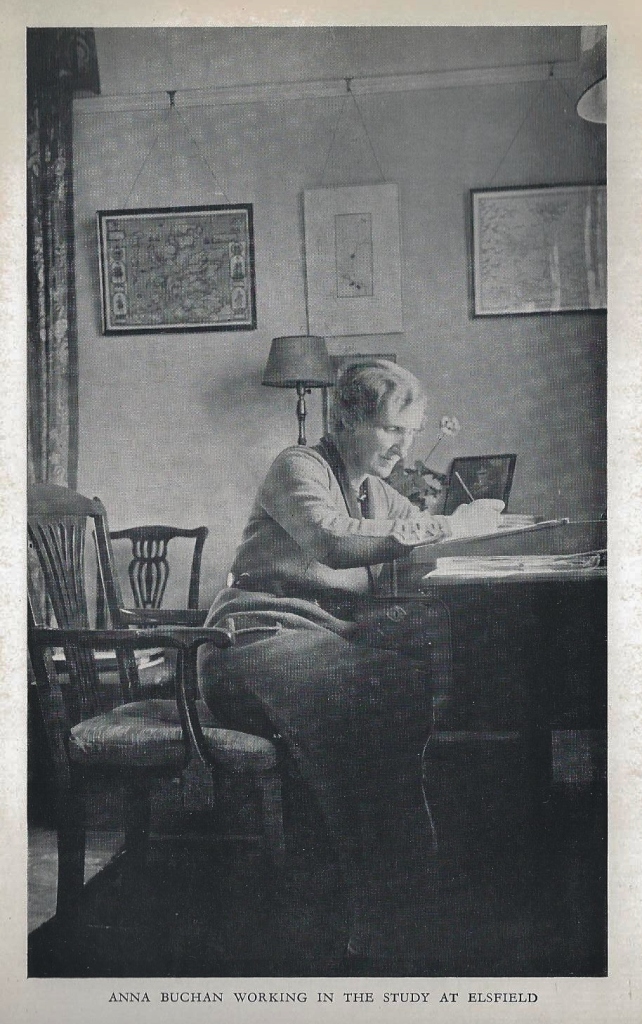
Farewell to Priorsford: a book by and about Anna Buchan (O. Douglas) ~ 1950. This edition: Hodder and Stoughton, 1950. Hardcover. With 5 photographs. 253 pages.

My rating: 10/10. Succeeds perfectly in its stated purpose, as noted in the Preface:

This book has been compiled at the request of the many who wish to know more about Anna Buchan by those privileged to enjoy her friendship.

This commemorative volume is presented in the hope that it will give to all who enjoy Anna Buchan’s books a share in the fun, the courage and the inspiration she gave to all who knew her.

*****

This book was published two years after Anna Buchan’s death, and is composed of several short biographical sketches, with the remainder a few collected short stories and anecdotes. There is also the fragment of the last novel Anna was working on, eight chapters of another Rutherfurd book, The Wintry Years.

This is a fascinating and enlightening glimpse into the world of this quiet yet eloquent author, and there are no surprises here for those who know the author through her fictional words, merely a confirmation of what we had hoped to find; that the author’s writings do indeed reflect her real life and her views that many people are indeed “good, gentle and scrupulous.” If this sounds too meek and wishy-washy, I hasten to add that Anna had a strong streak of cynical Scottish clear-headedness about her as well, and there is a leavening of wry humour and keen insight in her works to balance the goodness and gentleness.

The more I read of this author, the more I like her, both her works and the person she herself must have been. Farewell to Priorsford is a lovely memorial, and very much worth seeking out for O. Douglas fans. The eight chapters of The Wintry Years are an absolute treat to fans of the Rutherfurds, giving us a fleeting glimpse of their lives during the years of the second World War, and touching on many of the characters we came to know so well in The Proper Place, The Day of Small Things, and Jane’s Parlour, as well as teasingly introducing us to some new characters. Such a shame that Anna Buchan died so relatively young, at 71, and still very much at the peak of her writing years.

Here is what Farewell to Priorsford contains:

ANNA BUCHAN OF PRIORSFORD
 
I. A Biographical Introduction by A.G. Reekie
II. Anna by Susan Tweedsmuir
III. Olivia by Alice Fairfax-Lucy
IV. Author and Friend by Christine Orr
V. A Peebles Player by William Crichton
 
 
STORIES BY ANNA BUCHAN
 
I. Introductory Note
II. A Story for Young and Old:
          Jock the Piper
III. Broughton and Two Broughton Stories:
          An Upland Village
          An Echo
          Miss Bethia at the Manse
IV. Two Long Stories:
          A Tea-Party at Eastkirk
          Two Pretty Men
V. The First Eight Chapters of a Novel:
          The Wintry Years
 

*****

Highly recommended for O. Douglas – Anna Buchan fans.

Read Full Post »

The Lady or the Tiger, and Other Stories by Frank Stockton ~ circa 1882. This edition: Airmont Publishing Co., Ltd., 1968. Paperback. 160 pages.

My rating: Of this collection, I give the two stories The Lady or the Tiger and The Discourager of Hesitancy both a strong 10/10. The other stories in this little collection, a reasonable 7/10, allowing for their time of writing. Definitely period pieces, with the expected style and tone. Gently pleasant literary diversions.

Frank Stockton (1834 – 1902), though best known as the writer of the title short story, initially worked as a wood engraver and an editor, before settling to his productive and successful writing career. He wrote many short stories besides The Lady,  and several humorous novels, none of which are in print today.

*****

The Lady or the Tiger is a classic short story written in the 1880s, and still anthologized today as a prime example of the unsolvable “puzzle tale”. I am sure most people have read this at some point or another, most likely in a high school English class, but in case you haven’t, here is a complete plot summary courtesy of Wikipedia. I don’t know if a spoiler alert is needed, but if you want to read this for the first time yourself, stop now, and go instead to East of the Web – The Lady or The Tiger .

The “semi-barbaric” king of an ancient land uses a unique form of trial by ordeal for those in his realm accused of crimes significant enough to interest him. The accused is placed alone in an arena before two curtain-draped doors, as hordes of the king’s subjects look on from the stands. Behind one door is a beautiful woman appropriate to the accused’s station and hand-picked by the king; behind the other is a fierce (and nearly starved) tiger. The accused then must pick one of the doors. If by luck (or, if one prefers, the will of heaven) he picks the door with the woman behind it, he is declared innocent and set free, but he is required to marry the woman on the spot, regardless of his wishes or his marital status. If he picks the door with the tiger behind it, the tiger immediately pounces upon him–his guilt thus manifest, supposedly.

When the king discovers that his daughter, the princess, has taken a lover far beneath her station, the fellow is an obvious candidate for trial in the arena. On the day of his ordeal, the lover looks from the arena to the princess, who is watching in the stands, for some indication of which door to pick. Even the king doesn’t know which door hides the maiden, but the princess has made it her business to find out, as her lover knew she would. She makes a slight but definite gesture to the right, which the young man follows immediately and without hesitation. As the door opens, the author interjects, “Now, the point of the story is this: Did the tiger come out of that door, or did the lady?”

The author then playfully sets out for the reader the dimensions of the princess’s dilemma, and of the reader’s dilemma in answering the question he has posed. The reader is reminded that the princess knew and “hated” the waiting maiden, one of her attendants, whom she suspected of being infatuated with the princess’s lover. The princess, the reader must remember, is “semi-barbaric,” too, or she wouldn’t have come to witness the ordeal at all; and though she has shrieked often at the thought of her lover torn to bits before her eyes, the thought of his dancing out of the arena with his blushing bride has afflicted her more often. In either case, the princess knows her lover is lost to her forever. She has agonized over her decision, but by the time she arrives at the arena, she is resolute, and she makes her gesture to the right unhesitatingly. The author denies being in a position to answer his question with authority, and the story ends with the famous line, “And so I leave it all with you: Which came out of the opened door – the lady, or the tiger?”

Great little story. And I too have no idea which one it was! Worth reading and mulling over.

Full Table of Contents:

  • The Lady or the Tiger ~ outlined above.
  • The Griffin and the Minor Canon ~ a fable about a fearful griffin befriending a cleric, and about how the inhabitants of the cathedral town reacted to the griffin’s presence in their midst.
  • Love Before Breakfast ~ a romantic interlude, sweet as cherry pie.
  • “His Wife’s Deceased Sister” ~ a writer discovers the unexpected drawbacks to writing a bestselling story. Ironic and humorous, and very likely a comment on the author’s own most successful piece and the difficulties it brought about in his working life.
  • Our Story ~ another romantic interlude, with a little twist at the end.
  • Mr. Tolman ~ a successful businessman goes incognito to gain himself an interesting holiday, and ends up acting as Cupid to a couple of mathematical music students.
  • Our Archery Club ~ a gentle satire on proper form versus successful results, plus another romance.
  • The Discourager of Hesitancy ~ a sequel of sorts to The Lady or the Tiger, which promises at first to resolve that quandary, but which actually adds another dilemma to be wrestled with.

Read Full Post »

« Newer Posts - Older Posts »