Archive for the ‘Read in 2018’ Category

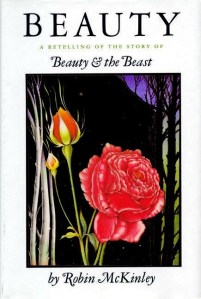
Beauty by Robin McKinley ~ 1978. This edition: Harper Collins, 1978. Hardcover. ISBN: 978-0-06-024149-0. 247 pages.

Robin McKinley’s first published novel, targeted at the pre-teen/teen readership of forty years ago.  (Can she really have been writing for that long? Golly!)

Surely we all know the outline of this fairytale:

  • rich shipping merchant loses his fleet in a storm
  • selfish children all except one daughter are peeved at new poverty
  • word comes that one of the merchant’s ships has survived
  • children all request rich gifts except good daughter who askes merely for rose
  • father, returning home without rose (it’s winter), is lost in blizzard and stumbles upon mysterious unpeopled castle where food and fire and yes, a blooming rose garden, appear by magic
  • father plucks rose and is confronted by horrific beast demanding penance
  • father trots home with rose and bad news and good daughter offers herself as sacrifice to beast to save father

Need I go on?

McKinley takes the traditional French fairy tale of La Belle et la Bête and twists it a little here and there to fit her own particular ethos – for example, the scenario in which the presumably doomed Beauty leaves behind a loving family flies in the face of the usual “selfish sisters” setup – but it is essentially the traditional story retold, with the additional romantic fillip of a triple wedding at the end (Beauty, her sister, and their widowed father all finding their One True Loves), plus horses.

Yes, horses.

Or, perhaps more accurately, one horse in particular, Beauty’s steed Greatheart, a massive warhorse stallion who was hand-raised by Beauty and thus imprinted on her to the point where he refuses to eat in her absence. He is noble, majestic, tireless, utterly obedient etcetera, and I am sure would affect the susceptible average thirteen year old reader like catnip affects a half-grown kitten. Pure intoxication.

This Beauty is a clever-sweet, trope-ridden novel. The heroine is the stock tomboy type who thinks she’s utterly homely – “Beauty” is a self-chosen (and eventually ironic) nickname because she doesn’t care for the stolid “Honour” which her mother christened her with – but of course she blossoms into loveliness just when it counts the most.  There is enough brooding romance to get the reader all warmed up, but nothing explicit enough to have it whisked away to the adult section of the library.

I first read Beauty a decade or so ago when I had my own pre-teen reader in residence. We shared the opinion that it was a nice enough story but a bit too perfectly peopled – there are zero villains, except for the nebulous non-human magician who works the original enchantment turning Man to Beast –  and even rather goopy here and there.

Nothing happened this time round to change my opinion.

Damning with faint praise? Yes, I suppose I am.

That said, it’s not that bad. Some parts are, in fact, excellent.

I would happily present this to a young reader, say between the ages of eleven and fifteenish, who is romantically inclined and fond of horses. And, much as I hate to use gender-based recommendations, I’m going to stick my neck out and say that this is likely to appeal the most to girls.

And of course to Robin McKinley fans of any age, and all those open to whiling away a few hours with a blatantly charming re-worked fairytale.

My rating: 7/10.


Read Full Post »

The No. 1 Ladies’ Detective Agency by Alexander McCall Smith ~ 1998. This edition: Abacus, 2003. Paperback. ISBN: 0-349-11675-X. 233 pages.

Mma Ramotswe had a detective agency in Africa, at the foot of Kgale Hill. These were its assets: a tiny white van, two desks, two chairs, a telephone, and an old typewriter. Then there was a teapot, in which Mma Ramotswe – the only lady private detective in Botswana – brewed redbush tea. And three mugs – one for herself, one for her secretary, and one for the client. What else does a detective agency really need? Detective agencies rely on human intuition and intelligence, both of which Mma Ramotswe had in abundance. No inventory could ever include those, of course.

(Is that an Isak Dinesen ripoff in the first line? I’m thinking so.)

Our heroine in this low-key character portrait/detective novel is one Precious Ramotswe, thirty-four years old, once married but long deserted by her handsome but brutal jazz musician husband, beloved daughter and sole heir of the late Obed Ramotswe, who sells her father’s prized herd of cattle (with his prior permission) in order to set herself up in business.

Always an observant sort of person, and provided by nature with a strong moral sense, Mma Ramotswe sets out to solve problems, to right wrongs, and perhaps to lay a few personal ghosts.

This likeable book full of homey snippets of wisdom caught the attention of the reading public – could it have been helped along by its two Booker Judges’ special citations? Its Times Literary Supplement International Book of the Year designation? – and took off like a small but blazing rocket. Seventeen sequels have followed, all of them with long and quirky titles, and all just as charmingly readable as the first.

Or at least so I am assuming; I think I stalled out at number six or seven, vaguely surfeited by the constant good-natured mullings and musings of this small-town wisewoman.

Don’t get me wrong, I fully intend to catch up to Precious and her companions one day. Just not quite yet.

I don’t think I need to get into plot synopsis and suchlike here; this is such a well-known tale that the internet is crowded with all sorts of reviews. Suffice it to say that it was a notable book way back in 1998, and so serves as an ideal Century of Books candidate for its year.

And it was fun to re-read this rainy Canadian Thanksgiving Sunday, as I sit in my comfiest chair and nurse a worsening head cold passed along to me by a friend’s winsome but overly affectionate (at least while contagious) youngsters.

My rating: 8/10.


Read Full Post »

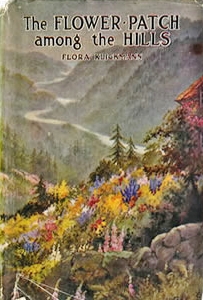
The Flower-Patch Among the Hills by Flora Klickmann ~ 1916. This edition: The Religious Tract Society, London, 1926. Hardcover. 316 pages.

So, fellow gardener-readers, who is familiar with Flora Klickmann?

I certainly wasn’t, before I inadvertently acquired one of her many cheerful books (Weeding the Flower-Patch, I believe it was) on a visit to The Bookman in Chilliwack, B.C., and read it and was intrigued and then went on to purposefully hunt down several more.

Flora Klickmann, 1867-1958, had a background in music, but health issues in her early twenties forced her to step away from the piano. Once recovered, she started writing well-received articles on musical subjects, and in 1904 became editor of a missionary magazine, followed some years later by an appointment to the editorship of the Religious Tract Society’s exceedingly popular Girl’s Own Paper, which she successfully oversaw from 1908 until 1931.

A nervous breakdown in 1912 due to overwork saw Flora convalescing in a country cottage. She found this change of venue to be so refreshing that, upon her marriage in 1913, she and her husband purchased the first of what would be a succession of rural retreats. Rosemary Cottage, home of the first “flower-patch”  was “perched on the hills overlooking the Wye Valley, with views of the Welsh hills, Tintern Abbey, the river, and a distant glimpse of the Bristol Channel.”

Flora Klickmann’s branching out into full-on authorship was somewhat inadvertent, and she details it here, in the first pages of The Flower-Patch Among the Hills:

I
Just to Explain

I. Who Everybody is

Virginia and her sister Ursula are my most intimate friends. Virginia—really quite a harmless girl—imagines she has a scientific bias. Ursula—domesticated to the backbone—led a strenuous life in the pursuit of experimental psychology, till she switched off to wash hospital saucepans.

It will be so obvious that I scarcely need add: What little common sense the trio possesses is centred in ME.

Abigail is my housemaid; her title to fame is the fact that she is the only servant I have ever been able to induce to remain more than a fortnight at one stretch in the country. The others, including those who are orphans, always have a parent who suddenly breaks its leg—after they have been about ten days away—and wires for them to come home at once.

The cook has discovered a number of cousins in the Naval Division at the Crystal Palace (detachments of which pass my London house hourly, while many units partake of my cake and lemonade), and, of course, you can’t neglect your relatives in war time.

“You never know whether that’ll be the last time you’ll see them,” she says, waving a tearful tea-towel at all and sundry who march past. Naturally, she doesn’t care to be away from town for many days at a time.

The parlourmaid was interested in a member of the L.C.C. Fire Brigade, when he enlisted, and incidentally married someone else—unfortunately the very week she was away with me. This has given her a marked distaste for the simple pleasures of rural life.

Abigail is unengaged. “What I ask is: What better off are you if you are?” she inquires of space. “Take my sister, now, with eight children, and——” But as I am not taking anyone with eight children just now, the sister’s biography is neither here nor there.

Abigail is a willing, kindhearted girl. Also she has a mania for trying to arrange every single household ornament in pairs. She would be invaluable to anyone outfitting a Noah’s Ark.


As for the other people who walk through these pages, they do not appertain exclusively to one district. I have had two cottages, one beyond Godalming, in Surrey, the other high up among the hills that border the river Wye. Some of the country folk live in the one village, some in the other; but the scenery, the little wild things, and the garden are all related to the cottage that overlooks Tintern Abbey.

II. Why the Cottage is

I took a cottage in the country on a day when I had got to the fag-end of the very last straw, and felt I could not endure for another minute the screech of the trains, the honking of motors, the clanging of bells, the clatter of milk-carts, the grind-and-screel of electric cars, the ever-ringing telephone, the rattle and roar of the general traffic, the all-pervading odour of petrol, and the many other horrors that make both day and night hideous in our great city, and reduce the workers to nervous wreckage.

The cottage has been so arranged that not one solitary thing within its walls shall bear any relation to the city left far behind; and nothing is allowed to remind the occupants of the business rush, the social scramble, and the electric-light-type of existence that have become integral parts of modern life in towns.

Here, to keep my idle hands from mischief, I made me a Flower-patch.

III. Why this Book is

I was viciously prodding up bindweed out of the cottage garden, with the steel kitchen poker, when the telegraph boy opened the gate.

Unhinging my back, and inducing it into the upright with painful care, I read a message from my office to the effect that there was some hitch in regard to the American copyright of a certain article I had passed for press before leaving; this would necessitate it being thrown out of the magazine that month. Would I wire back what should go in its place, as the machines were at a standstill?

Under ordinary circumstances I should merely have waved a hand, and instantly a suitable substitute would have been on the machines with scarcely a perceptible pause—that is, if I had been in London. But such is the witchery of the Flower-patch, that no sooner do I get inside the gate than I forget every mortal thing connected with my office. And try how I would, I couldn’t recall what possible articles I had already in hand that would make exactly six pages and a quarter—the length of the one held over.

And because I could think of nothing else on the spur of the moment, I threw down the poker (it was red-rust, alas, when I chanced upon it a week later) and went indoors and wrote about the cottage and the hills.

When it was published in the magazine, readers very kindly wrote by the bagful begging for a continuation. It has been continuing—with perennial requests for more—for some time now. This only shows how generously tolerant of editors are the readers of periodical literature.

Virginia merely sniffs, “What won’t people buy!”

I don’t think she need have put it so baldly as that.


If by some miraculous chance there should be any profits from the sale of this book, I intend to devote them to the purchase of a cow (or hen, if it doesn’t run to a cow), to aid the national larder. I shall call it “the Memorial Cow,” in memory of those who have been good enough to assist in its purchase.

Should any reader wish to have the cow (or hen) named specially after him—or her—self this could doubtless be arranged. Particulars on application to the publisher.

Here’s a snippet from the body proper of this book, regarding our author’s observations on country bouquets as seen at the typical small village railway station:

There are women with empty baskets returning from market, and women seeing off friends, each carrying a huge “bookey” of flowers, built up in the approved style, from the back: first a big background rhubarb leaf, or something equally green and spacious, then some striped variegated grass – gardeners’ garters, we call it; also some southernwood – better known as Old Man’s Beard; tall flowers like foxgloves, phlox, Japanese anemones, early dahlias and sunflowers follow; the shorter stems of pinks, calceolarias, sweet williams and roses are the next in succession; finishing off with some gorgeous pansies and a very fat cabbage rose with a short stem (that persists in tumbling out), a piece of sweetbriar, and a few silver and gold everlasting flowers down low in the front. If you have a geranium in your window, etiquette demands that you add the best spray – as a special offering – to the bunch, telling your friend all about the way you got that geranium cutting , and the trouble you had to rear it.

The Flower-Patch Among the Hills is very much a wartime book, and as such is of interest on a number of different levels, in that it matter-of-factly details English country life in this unprecedented time of turmoil and change, as the Great War sets the gears grinding for what will be a major shift in the long traditions of rural England. A number of the incidents detailed concern the efforts of stay-at-homes to help with the war effort, and there is a quite delightful sequence involving the purchase of vast quantities of onion seed for sowing in amongst the garden’s flowers.

The correct term to describe this book is “charming”, and I say that with sincere appreciation. There is enough gently acerbic bite in Flora’s style to keep things from being too sugary, and as period pieces these collections of anecdote and observation are quite fascinating.

You definitely don’t have to be a gardener to appreciate them, as there are perhaps even more human interest passages than those going on about wildflowers and cottage borders and such, but if you are a plant person you will find some gleaming gold nuggets of plant observation here.

And don’t let the Religious Tract Society connection put you off, for the books aren’t anything as “preachy” as that might lead one to believe. Secularites will find little to rub them wrong, though there are occasional (okay, rather frequent) references to church-going and to the author’s personal faith. The intent throughout is merely to interest and amuse, not to convert.

My rating: 7.5/10.

Almost a “curiousity” book. Though very close to being a “hidden gem”, I hesitate to designate it as such for fear fellow readers might sight-unseen invest in one of the sometimes rather pricey copies available through antiquarian book dealers, and then not find it to their liking. Before running out on my recommendation to purchase a hard copy, perhaps it might be best to dip into the online version at Project Gutenberg. I believe there are a number of Flora Klickmann’s other titles available to read for free on that invaluable site.

A short biography of Flora Klickmann can be found here.

And a Wikipedia biography and bibliography here.

Read Full Post »
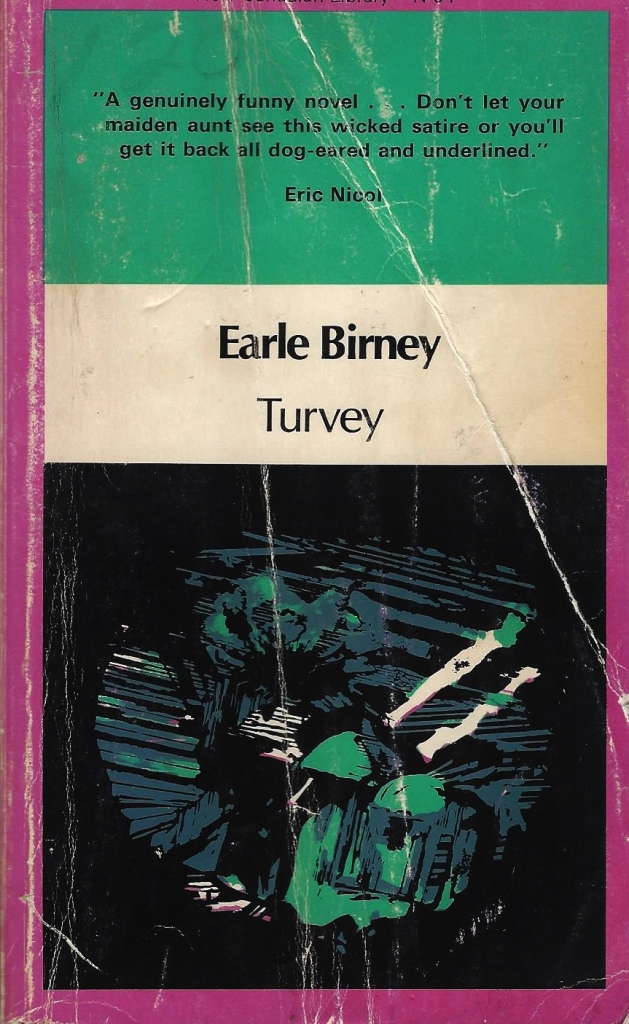
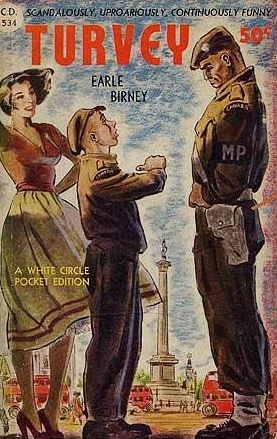
Turvey by Earle Birney ~ 1949. This edition: McClelland and Stewart, New Canadian Library N34, 1963. Introduction by George Woodcock. Paperback. 286 pages.

Earle Birney, Canadian master-poet of power, grace and poignant reflection, occasionally wrote off-genre.

Perhaps most notably so in 1949, just a few years after Birney’s service in the Canadian Army during World War II, when he produced this bawdy and satirical novel – “a military picaresque”, as it is sometimes subtitled – combining a farcical account of a common soldier’s adventures during his quest to get to the front lines in Europe with a critique of the absurdities of military bureaucracy (Birney served as a personnel officer so had an insider’s knowledge) and a scathing if understated depiction of the horrors and human toll of war.

We follow one Thomas Leadbeater Turvey, originally native to (fictional?) Skookum Falls, British Columbia, as he enlists in the Canadian Army and goes through an interminable saga of slow advancements and sudden setbacks on his mission to join his best friend Mac Macgillicuddy in the (fictional?) Kootenay Highlanders as they head to Europe to take on the Nazis.

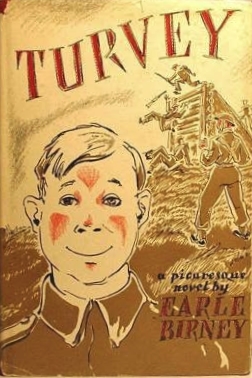
First edition dust jacket.

Private Turvey is of the species amiable innocent, and though he goes through an astounding series of mild-to-dire accidents and ailments, he always manages to crawl out from under with a sheepish grin. We are ever on his side, fingers tightly crossed, especially after he does eventually achieve Europe and a reunion with the ultimately ill-fated Mac.

Hedy Lamarr snuggled tighter into Turvey’s arms. The other dancers cleared the floor to watch, entranced with their grace. Her fingers slid down and caressed his wrist. Lifting her luminous eyes she murmured:

“Come on, lug. Open up your trap ‘n lift that tongue.”

Turvey awoke in time to gag before the little icicle of a thermometer could slide down his throat. The orderly, who had been holding Turvey’s wrist with a thumb and forefinger as if it were a piece of bad meat, dropped it. The time was 0600 hrs.  Turvey began his thirteenth day in Ward Two of Number Umpteen Basic Training Centre Hospital…

Turvey takes hit after hit and comes out each time a little bit wiser; on his post-VE Day return to Canada he finally develops a righteous sense of indignance (anger is too strong a term for this sweet-natured man) at the powers that control the fates of lowly privates and hies himself off in pursuit of his left-behind English sweetheart and a well-deserved happily ever after.

I thoroughly enjoyed this engaging and deeply funny novel; its serious moments hit hard in contrast to the lightheartedness; the combination works perfectly; Earle Birney’s touch is sure and precise.

Turvey won the Stephen Leacock Medal for Humour in 1950. Reviews of the book are easy to find online, and a short but interesting post on the novel appears here, at the Canus Humorous blog.

My rating: 9/10

Read Full Post »

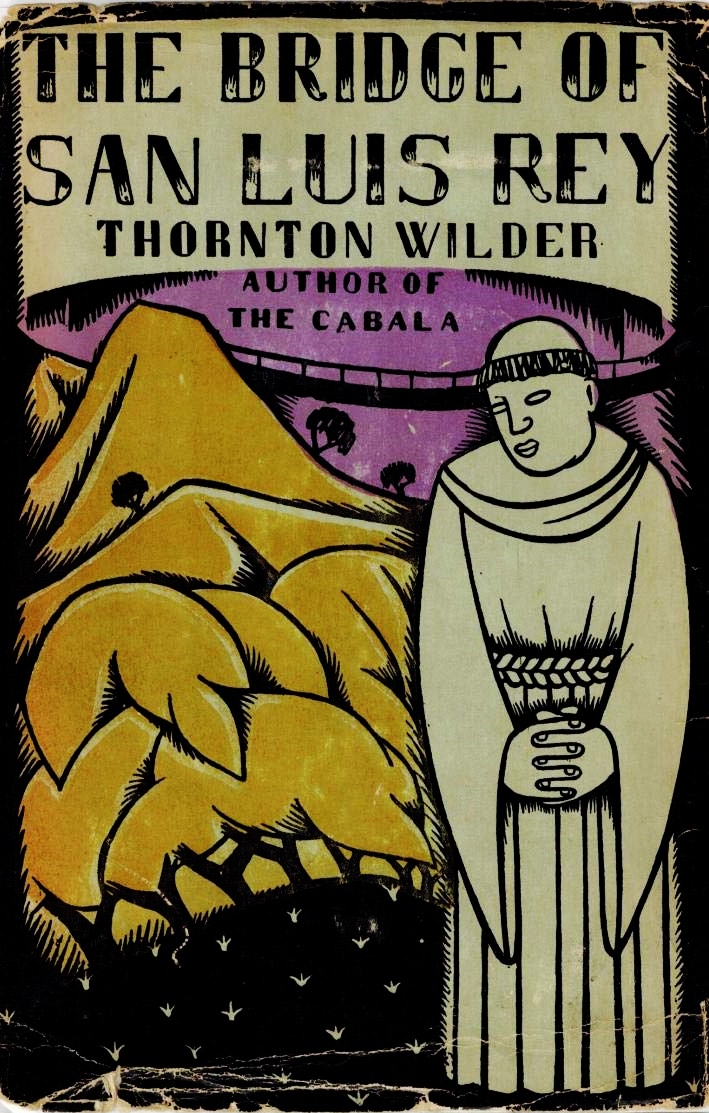
The Bridge of San Luis Rey by Thornton Wilder ~ 1927. This edition: Grosset & Dunlap, 1928 (later printing). Hardcover. 235 pages.

On Friday noon, July the twentieth, 1714, the finest bridge in all Peru broke and precipitated five travelers into the gulf below…

Thornton Wilder’s enduring classic (that clichéd phrase applies most pertinently) consists of a number of separate but increasingly entwined narratives. The accounts of the lives of the five travellers who perished are framed on each end by the ultimately tragic tale of Brother Juniper, who witnesses the disaster and in it finds a question: “Why did it happen to those five?”

If there were any plan in the universe at all, if there were any pattern in a human life, surely it could be discovered mysteriously latent in those lives so suddenly cut off. Either we live by accident and die by accident, or we live by plan and die by plan. And on that instant Brother Juniper made the resolve to inquire into the secret lives of those five persons, that moment falling through the air, and to surprise the reason of their taking off.

The Marquesa de Montemayor, obsessed mother, secret alcoholic, astonishingly accomplished letter writer. Orphaned Pepita, bright hope of her convent home’s Mother Superior, lent to the Marquesa as a maid. Pio, jack-of-all trades and committed non-committer, except for his devotion to one person, the once-famous actress Camila Perichole. Jaime, Camila’s young son, frail and epileptic. Esteban, one of a set of twins, whose brother’s recent death has made his own life worthless in his eyes.

Wilder goes on to detail the lives – secret and otherwise – of the five travellers on the bridge, and delves into why they were there at that particular moment. And yes, everything (and everyone) turns out to be connected.

Brother Juniper, six years of research undertaken, yet not being privy to a few intimate details, concludes that the deaths are not as he had intended to prove, the fitting conclusion to lives attaining “a perfect whole”, but instead that they were random interruptions of lives not yet fully lived. The Inquisition disagrees with his thought processes, and Father Juniper perishes by flame, along with all of the copies of his thesis, except for one…

What a beautifully crafted little novel this is.

I read it for the first time in high school, after finding a dusty stack of discarded English lit books in the farthest corner of a classroom bookcase. In retrospect, I’m very glad that I did not have to “study” The Bridge of San Luis Rey, instead being able to read it from end to end without stopping for analysis, and not needing to dissect it in any way. It was a purely emotional experience, and so memorable that now, forty years later, every phrase is still familiar.

My rating: 9/10


Read Full Post »

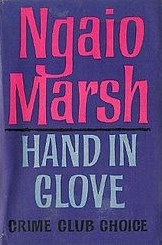
Hand in Glove by Ngaio Marsh ~ 1962. This edition: Collins (Crime Club), 1962. Hardcover. 256 pages.

Prissy Mr. Pyke Period, elderly confirmed bachelor, delights in his comfortable life and in his reputation as a skilled crafter of charming epistles, in particular the exquisitely tactful condolence letter.

Disturbing indeed to Mr. Period’s carefully nurtured savoir-faire is the discovery that his latest letter has gone somewhat astray, being delivered to the wrong party, whose loved one shortly thereafter turns up gruesomely dead, crushed to death under a sewer pipe in a drainage ditch right outside Mr. Period’s very window.

The usual disparate assortment of potentially suspicious characters for this sort of traditional whodunnit is on hand to spin out the tale and give Ngaio Marsh’s pet team of detectives – Alleyn and Fox – their usual round of interviews, before their inevitable and apparently effortless solving of the crime. (Even easier than usual, one presumes: the clues in this one were large and glaring.)

Suspects include the tittering Mr. Pike, the murderee’s objectionably hearty sister, a pair of vaguely “Beatnik” young degenerates (Moppett and Leonard), Mr. Pike’s sprig-of-the-minor-aristocracy secretary Nicola, aspiring young artist Andrew, Andrew’s mother (Desirée, Lady Bantling, who also happens to be the murderee’s ex-wife), Bimbo Dodds (Lady Bantling’s third and current husband), and a few etceteras.

There are minor red herrings and various complications, including a boisterous scavenger hunt to celebrate April Fool’s Day, during which the fatal event takes place, but it doesn’t take long for our detectives to zero in on the guilty party. Peace presumably now returns to the village.

All in all, not one of Ngaio Marsh’s A-list, though, as with Agatha Christie’s oeuvre, even the B-list is readable. As with most of Ngaio’s books, Hand in Glove is mildly humorous throughout, which makes up for a lot.

By midnight the winning pair had presented themselves with their prize, a magnum of champagne. They were inevitably, Moppett and Leonard, all smiles, but with a curious tendency to avoid looking at each other. Leonard was effulgent in the matter of cuff-links and lapels and his tie was large and plum-coloured. Bimbo looked upon him with loathing, gave them both drinks and put a jazz record on the machine. Leonard with ineffable grace extended his hands towards Desirée. “May we?” he said and in a moment was dancing with her. He was a superb dancer. “Much too good,” she said afterwards. “Like the really expensive gigolos used to be. He smells like them too: it quite took me back. I adored it.”

Bimbo, sulking, was then obliged to dance with Moppett who made business-like passes at him. These exercises were interrupted by the arrival in straggling pairs of the rest of the treasure-hunters, Nicola and Andrew being the last to come in: looking radiantly pleased with themselves…

My rating: 5/10

Read Full Post »

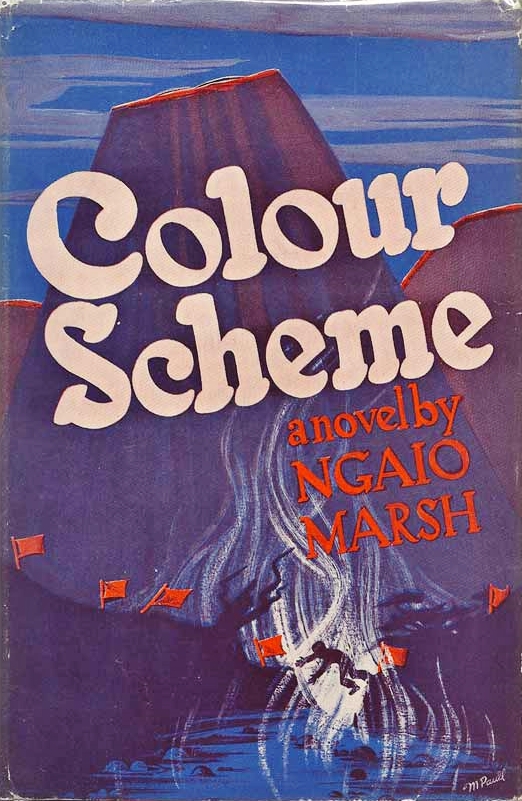
Colour Scheme by Ngaoi Marsh ~ 1943. This edition: Collins, 1943. Hardcover. 314 pages.

I have found myself dipping into Ngaio Marsh’s mysteries a bit this year, with mixed results. 1962’s Hand in Glove, read for the first time this summer, left me cold. At least on this my first reading.

Colour Scheme, on the other hand, pleased me quite a lot.

Being a classic mystery novel by a deservedly popular author, and sure to be on numerous reading lists, I won’t give much away. Here’s the general gist, as set out in the first edition endpaper blurb.

(M)ore a novel of character and character and atmosphere than it is a detective story. The scene is New Zealand, during World War II, the characters an ill-assorted, bizarre group of New Zealanders, Britishers and Maoris assembled in and around Wai-ata-tapu Hot Springs, a second-class thermal bath establishment belonging to Colonel Edward Claire. The Claires are a hardworking couple who have lost most of their modest inheritance in unsound investments. They have two children, Barbara, aged twenty-five, and Simon, twenty-one.

The family has a genius for collecting impossible people, and at the opening of the novel are burdened with two: a seedy individual named Herbert Smith, who is seldom completely sober; and Mr. Maurice Questing, an unscrupulous business man to whom the Colonel is under heavy financial obligations. The final member of the household is Mrs. Claire’s brother, Dr. James Ackrington, an irascible physician living with the Claires as a paying guest and therefore completely free to criticize and complain. Before long there are two more additions to the establishment, Geoffrey Gaunt, the famous Shakespearean actor, and his secretary, Dikon Bell.

Almost immediately Barbara is fascinated by Gaunt but at the same time Dikon Bell finds himself falling in love with her and Mr. Questing continues forcing his unwelcome attentions on her. The household are united in their dislike of Questing but at odds in practically everything else.

With the first chapter one senses something queer and something very wrong, and the tension mounts as irritations and hatreds grow and as strange signals go out from the cliff above the sea.

Throw in possible German agents, definite Nazi submarines prowling New Zealand shores, seething pools of fatally boiling volcanic mud, priceless Maori artifacts, an Eliza Doolittle scenario, an idealistic young Marxist immersed in the study of Morse Code, and oodles of artistic temperament. Result: a pleasantly nasty sort of Golden Age murder mystery.

My rating: 8/10

Read Full Post »

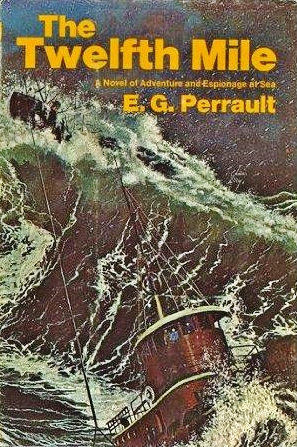
The Twelfth Mile by E.G. Perrault ~ 1972. This edition: Doubleday, 1972. Hardcover. 256 pages.

Look what showed up in the just-past summer’s book pile.

Well, I have to admit I hadn’t exactly forgotten about it, as it was definitely a memorable read, albeit in the “so compellingly baddish you can’t look away” category.

Seems like Vancouver writer E.G. Perrault threw everything he had at this one. A number of great ideas for disaster scenarios are stacked up high, with the result that the sheer improbability of it all leads to a certain sort of morbid humour through sheer overexposure to multiple horrible things happening.

Here’s the premise.

A Canadian tugboat captain, experiencing marital woes, decides to avoid fighting with his wife by taking on a contract to haul an American oil drilling rig working just inside the Canadian twelve mile limit into safer waters to avoid an impending hurricane. Little do we know that Mother Nature (and Mother Russia) are preparing some nasty surprises for Captain Westholme and his crew.

From the back dust jacket of my first edition copy:

Christy Westholme only took the assignment to get away from his wife to think things over. It was an absolutely routine job. Take Haida Noble out of Vancouver a few miles to the big off-shore drilling rig and tow it back into port. Nothing to it, compared with some of the other towing jobs he and Haida Noble had done all over the Pacific .

Then the hurricane struck, then the tidal wave. Somehow Haida Noble survived; battered but still afloat, butting its way through mountainous seas toward the oil rig. But the rig had disappeared – in its place was a liferaft containing three Americans, one of them dead. And nearby was a strange crippled ship in imminent danger of being swept onto the rocky shore,

In the nick of time Westholme got a line aboard the strange ship and began to tow it into the nearest port. A routine salvage tow. But then he discovered that this was a Russian ship whose captain had orders not to be captured at any cost – even if the cost involved defying the Canadian Navy and Air Force, and a U.S. battleship, and taking the world to the brink of war.

Did you catch all that? It understates things.

Let me sum up our disasters:

  • #1 – industrial sabotage of a British-American drill rig by the Russians (fifty workers dead!)
  • #2 – hurricane
  • #3 – massive tidal wave wiping out communities from California to Alaska (hundreds, maybe thousands of civilians dead!)
  • #4 – hostile takeover of our hero’s tugboat by Russian spy ship (more dead people!)
  • #5 – eventual destruction of spy ship including self-immolation of quite likeable Russian captain and his dedicated ship’s doctor, the luscious Dr. Larissa Lebedovitch
  • #6 – international crisis triggered by Russian presence in Canadian waters bringing World War III ever closer

I think those are the “high” points.

What a depressing story. Death and destruction galore. Luckily the characters are so flat that we really can’t believe in them in any meaningful way, so when they fall by the wayside it’s really not that emotionally involving.

At least Captain Westholme and his wife get back together at the end, swearing to be nicer to each other in future. With so many people dead all around them and dozens of coastal communities in ruins, isn’t it nice that our hero and his newly adoring wife are bound for domestic bliss? Ha.

Rating this wanna-be Hammond Innes-style action-disaster novel is tough. I did read it through to the end, albeit with frequent strong urges to chuck it across the room in its stupider moments. Oh, and it was sexist, too. Though I let that pass because of the era-expectedness of the he-man commentary regarding the few, mostly offstage female characters – those whiny wives back home and the buxom female Russian sailors.

My husband tried to read this book and bailed out partway through, saying that even the unintended humour of unlikely disaster after unlikely disaster wasn’t worth the energy needed to slog through the novel’s head-hurting blend of stodgy writing and dramatic hyperbole.

Obviously my family is not the target audience for this novel, though it appears that it appealed to enough readers to cause it to go into multiple editions and several international translations.

I’ll have to give The Twelfth Mile a point for its local flavour, as it were. British Columbia coastal landmarks were well referenced throughout, adding a certain degree of interest, though post-fictional-tsunami a bunch of them were basically wiped off the map. A couple of points also for the sheer bravado of E.G. Perrault for putting forward such an over-the-top collection of overlapping dramatic episodes.

My rating: 3/10

A bit more on the author, because I feel bad about slamming this ambitious work so hard, when the writer was so obviously well-meaning.

He sounds like he was a really nice guy, and it’s probably unfair to judge him so harshly on the strength of this one novel, which means I’ll likely be keeping an eye out for his other titles as I go about my travels.

E.G. (Ernest George) Perrault was born in Penticton, B.C. and attended the University of British Columbia, graduating in 1948. According to an old UBC Alumni magazine, Perrault was one of the first students to attend one of Earle Birney’s creative writing classes.

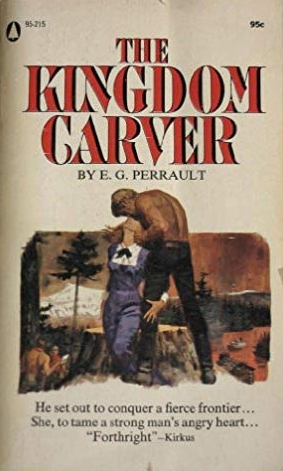
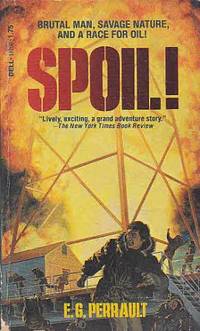
Perrault had some success as a newspaper reporter, short story and screenplay writer. He also wrote several non-fiction books about B.C. industry and personalities. Three action/disaster novels show up bearing his name: The Kingdom Carver (1968, lumber barons in turn of the century BC : “He set out to conquer a fierce frontier… She, to tame a strong man’s angry heart”), The Twelfth Mile (1972), and Spoil! (1976, what looks like an oil derrick disaster).

Here is E.G. Perrault’s rather poignant obituary, lovingly written by his daughter Michelle at her father’s death in 2010.

I was interested to note that Perrault did indeed have firsthand knowledge of life at sea, serving on a submarine during World War II. And yes, the strongest sections of The Twelfth Mile were those involving the mechanics of operating a tugboat, and the storm sequences.

His story began Feb. 9, 1922, the oldest of four children. His father, Ernest Perrault, succumbed to tuberculosis in 1935, leaving his wife Flossie with nothing but a small pension and a strong determination to make her children the best they could be.

Ernie always advised and abided by the saying “follow your bliss.” For him, this meant writing. His first short story was published in the Vancouver Sun before he was 12, when he won a children’s writing contest.

This achievement sparked a career that spanned more than 70 years, leaving his family and fans a legacy of books, plays, documentaries, short stories, radio plays, musicals and poetry that will be treasured forever. His most recent book, Tong: The Story of Tong Louie, Vancouver’s Quiet Titan, was published in 2002 and won the BC Book Prizes Roderick Haig-Brown Regional Prize. Ernie continued to write, and recently had been working on a collection of short stories.

At 18, Ernie joined the Air Force and was stationed in Yarmouth, N.S., where, as a member of 160 Squadron, he was a navigator assigned to submarine patrol off the Atlantic coast.

Ernie used his veteran’s grant to go to the University of British Columbia, where he became president of the Radio Society and wrote for the campus newsletter. He earned a double degree in English and sociology, graduating in 1948. Together with his brother Ray, Ernie received the Great Trekker Award in 1987, bestowed upon UBC alumni who have distinguished themselves in their field.

Ernie found a way to connect with everyone he met. He could carry on equally fascinating conversations with academics, business leaders, toddlers or teenagers. While he was a man of the written word, above all, Ernie was a good listener. He drew people out, helping them to appreciate and share their own unique stories.

As a city boy, Ernie had little exposure to the outdoors until a local charity gave him the opportunity to go to camp when he was 13. This experience changed his life and instilled in him a deep appreciation for nature and the wonders of the outdoors. He camped, fished, hiked and hunted. He loved sharing these experiences, especially with his four children – Lisa, Larry, Michelle and Steve – and six grandchildren, who, along with countless others, attribute catching their first fish to Ernie’s patient guidance.

Like one of his awesome campfire stories, Ernie has left us wanting more.

Michelle Perrault is Ernie’s daughter.


Read Full Post »

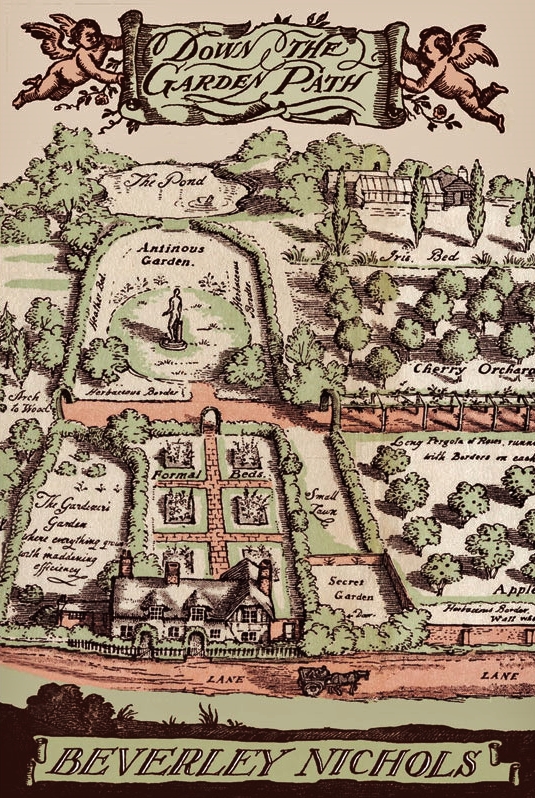
Down the Garden Path by Beverley Nichols ~ 1932. This edition: Doubleday, 1932. Decorations by Rex Whistler. Hardcover. 303 pages.

It’s rather nasty outside today, with a too-early cold snap blowing in, nipping the last flowers with frost, and whisking snowflakes around our chilly ears, so I have used this hopefully temporary weather event as an excuse to step away from my outdoor occupations and spend a lazy Sunday puttering about in the house.

I’ve been tracking down all of the various books I read this summer during my non-posting spell, with the idea of zipping off some reviews and helping my Century of Books project along. I bailed out on it last year; I have the idea that successfully completing it this year will be grand for my sometimes troubled morale.

Of course it is taking much longer than I thought to get my book thoughts into writing – I find myself re-reading all the best bits and flipping through things to reacquaint myself with what it was exactly that I wanted to highlight.

Bear with me over the next few weeks, as I hope to throw a number of these catch-up posts up at random as I steal the time to work them out.

Starting right here, with this happy offering from early on in Beverley Nichols’ four decade stint as a documentarian of the joys and tribulations of domestic and garden life in the four decades of the 1930s through the 1960s.

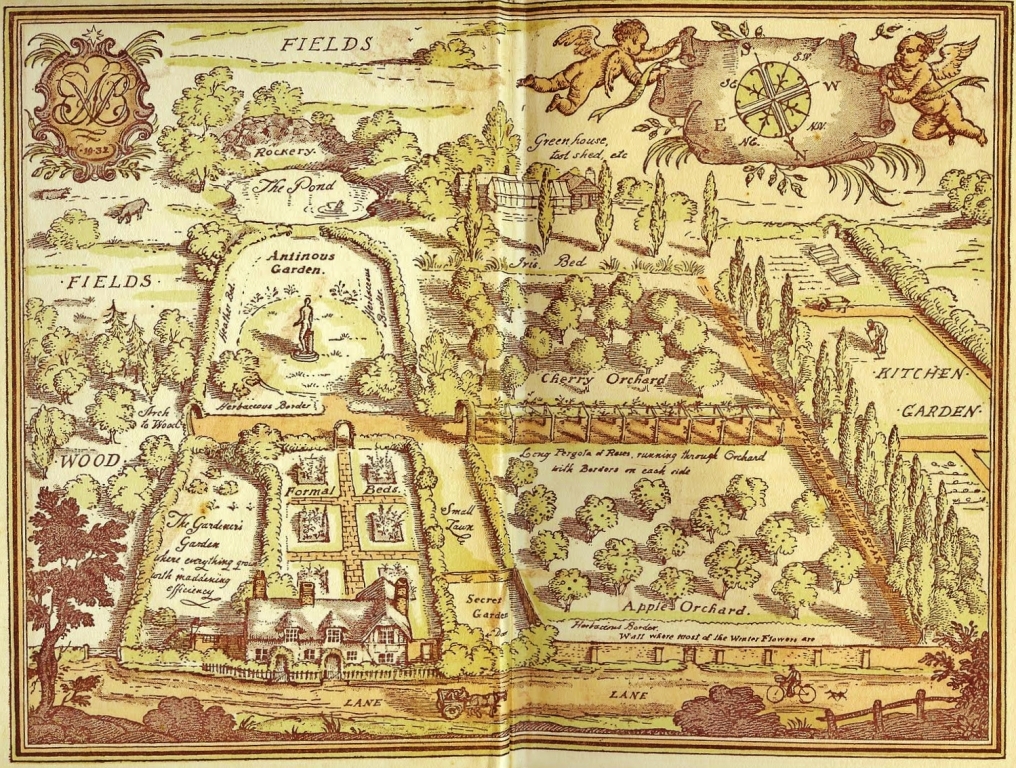
The only thing better than Beverley Nichols’ more than slightly pithy, sometimes precious prose in this delicious account of moving to a neglected country cottage and re-establishing a seriously ambitious garden is the inclusion of a whole slew of delightful Rex Whistler illustrations.

Anyone who is already familiar with Beverley Nichol’s style will know that it doesn’t matter what he writes about; he is readable in any key. He definitely comes across as thinking quite highly of his own intelligence, wit and charm, but just when you think he’s tooting his own horn a bit too loudly he throws in some humbling episode and undertakes to poke fun at himself, and all is forgiven.

In a nutshell, Beverley Nichols is inspired by memories of an idyllic visit to an acquaintance’s country cottage and garden. Seeing notice of this person’s obituary, our writer impulsively sends of an offer-to-purchase the cottage from the owner’s heirs; it is immediately accepted, and Nichols finds himself possessed not of the rose-smothered cottage of that summer day, but a neglected and dreary weed-infested mess. How he brings it back to beauty with the help of a number of paid and voluntary helpers and advisors makes up the framework of the tale, with numerous departures into character portraits of neighbours and visitors, and vivid descriptions of his own moods throughout.

It’s not all la-di-da and nice-nice-nice; there’s a fair bit of snark in Beverley Nichols’ nature, and it comes through loud and clear here, but it’s a funny sort of bitchiness, balanced by abundant sweet-natured enthusiasms.

Is this essentially a book for gardeners? No! Not at all, though if one is of that particular persuasion, one will find much to relate to in the descriptions of just how Mr Nichols and his various garden helpers went about the cultivation of their plot.

For more detail, I refer you to a post by Heavenali from earlier in 2018.

My rating: 8.5/10 for the prose, 10/10 for the pictures. Good stuff.

A modest country estate – Beverley Nichols’ cottage and grounds, circa 1932.


Read Full Post »

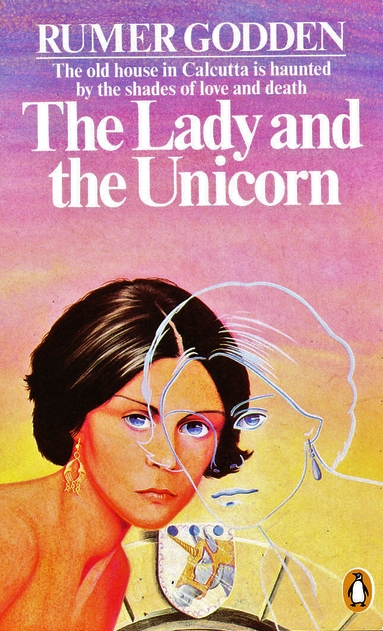
The Lady and the Unicorn by Rumer Godden ~ 1938. This edition: Penguin, 1982. Paperback. ISBN: 0-14-00-5523-1. 189 pages.

This was Rumer Godden’s second published book, appearing only a year or so after her first novel, the perhaps deservedly obscure Chinese Puzzle, which concerns reincarnation and Pekingese dogs. (More on that one at some future date. I own a copy, acquired long ago in the interests of indulging my completist tendencies in regards to favorite writers. An unusual first novel, to be sure.)

The Lady and the Unicorn follows a more traditional path, being generally a linear narrative tale, but it contains numerous elements which Godden was to use time and time again in her later, better known works.

There are flashback sequences, ghostly visitations, an emotionally complex child character, brilliantly observed descriptive passages utilizing all five senses, great swaths of irony, and a sharp-eyed examination of the social mores of its time and setting, all wrapped up in a fatalistic what-happens-happens sort of shroud. To my secret delight, there is also a short reference to J.W. Dunne’s Theory of Time, which fascinated Godden all of her life and played a major role in two later novels, Take Three Tenses and China Court.

Everything which comes later in Godden’s work is already here, serving to justify my opinion that Rumer Godden essentially wrote the same thing over and over throughout her long writing career, though her creative genius fleshed out the familiar skeleton of her One Big Idea to a varying but always lifelike form in each succesive novel.

So. This story.

The feckless Lemarchant family, consisting of a widowed father, twin teenage sisters Belle and Rosa, little sister Blanche, and a maternal aunt, live in a decayed European-built mansion in an Eurasian district of 1930s’ Calcutta. Father is “Anglo”, Mother was Indian, and their offspring exist in a sort of societal limbo, being betwixt and between their two ancestral cultures while belonging to neither.

When seventeen-year-old Belle, in the full throes of her burgeoning sexuality, makes eyes at the Catholic priest who has known her since babyhood, the twins are asked to leave their school. Father Ghezzi, trying to explain why he feels he must send them away for fear of their corrupting their peers, makes a passionate statement as to the difficulties facing those youth of mixed-race in India.

“I don’t know which is it that is worse to have in this country, Mr Lemarchant, boys or girls., sons or daughters. With the sons it is one thing; they cannot get work, the Indians squeeze them out from below, the English from above, so -” He brought his clenched hands together as if he were crushing a poor little man to death. “They cannot get work; before they begin they are failures. And with the girls it is another thing, they are too successful. Yes. There is always success for these girls, so smart, so nimble, so empty-headed. They take even the jobs that the boys might have; they go into offices, shops, and what happens? They get money, they get ideas, they are taken up by men – men in Calcutta society, faugh! – and then when they are in trouble they are flung back on their people; on those boys whose place they have taken, boys for whom they have now no use, and who could not marry them if they have.”

Prophetic words, as Belle goes on to become the mistress of a wealthy dilettante, and Rosa in her turn falls in love with a newly arrived Englishman, a relationship which dooms her to disaster when his family catches scent of a potential complication in their son’s life and sends his childhood sweetheart out to India to entice him away from the apparently wicked half-caste girl of his latest infatuation.

Ironically named Blanche, the dark-skinned “throwback” of the family, watches all of this from the shadows, while going through her own agonies of love and loss.

An intriguing small novel, beautifully written and deeply poignant. I am not sure why it isn’t more widely known; it is as good as anything which comes after it, and so deserves a full place in this iconic writer’s canon.

Here is the link to another review from Kat at Mirabile Dictu, which provides more details of the plot.

My rating: 8/10

Read Full Post »

« Newer Posts - Older Posts »