Archive for the ‘Read in 2012’ Category

Parnassus on Wheels by Christopher Morley ~ 1917. This edition: J.B. Lippincott, 1955. Introduction by John T. Winterich. Illustrations by Douglas Gorsline. Hardcover. 160 pages.

My rating: 9/10. An unexpected story, boisterously told. The point off is for narrator Helen’s continued refrain of “I’m so fat and plain! I’m so dull and unintellectual!” Well, Helen, if you continue to sell yourself short like that, don’t be surprised if people treat you like a doormat. A minor issue, but one that I ground my teeth at a bit. Helen’s actions negated her sorry opinion of herself, by the way.

*****

This is the prequel to the perennially popular 1919 bestseller, The Haunted Bookshop. Though the books share a certain joie de vivre, they are quite different in style and presentation. Parnassus on Wheels is much less consciously intellectual; the narrator has a distinctive voice which is exclusive to her story, while Bookshop is a different kettle of fish entirely. I liked them both, in different ways.

Thirty-nine-year-old spinster Helen McGill lives a contented life on the small farm she owns with her brother Andrew. At least, it was contented, a happy contrast from her previous occupation as a governess in the city, which she joyfully left in order to join her brother in his quest for a more congenial way of life to combat his ill-health. The farm was just the ticket; Andrew has been usefully occupied with crops and pigs and mild rural pleasures, while Helen has kept the home fires burning and her chickens productively producing eggs.

But something has happened to change all of that. An elderly great-uncle has died, leaving the two his library, and Andrew, stimulated by the sudden abundance of literature at his disposal, has decided to become a writer himself. He pens an ode to the rural life, Paradise Regained, and sends it off to a New York publisher. The book catches the fancy of the jaded city dwellers everywhere, and Andrew is suddenly a best-selling author. He has started neglecting the farm to hob nob with the urban literati, and between city visits tramps the countryside looking for new material. Happiness and Hayseed follows, and then a book of poems. Through all of this Helen keeps the home fires burning and the farm on an even keel, but she is starting to get rather jaded herself in her role as “rural Xantippe” and “domestic balance-wheel that kept the great writer close to the homely realities of life”, as she has seen herself described by one of Andrew’s doting biographers.

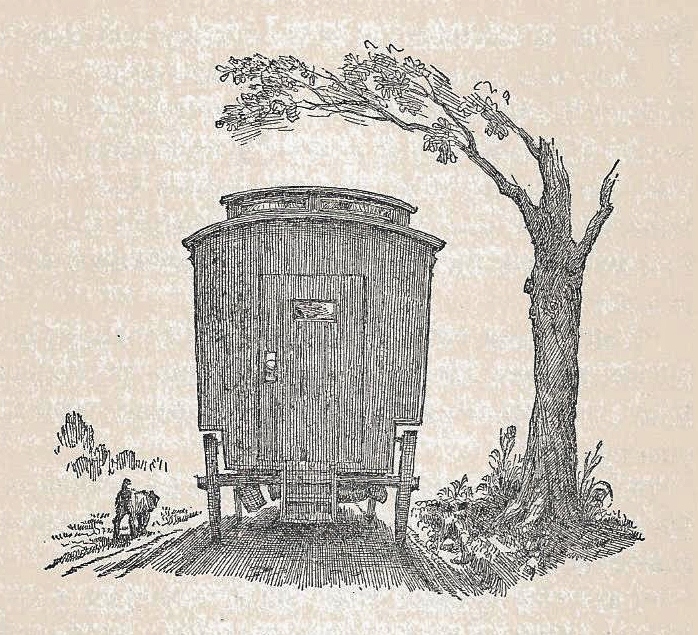
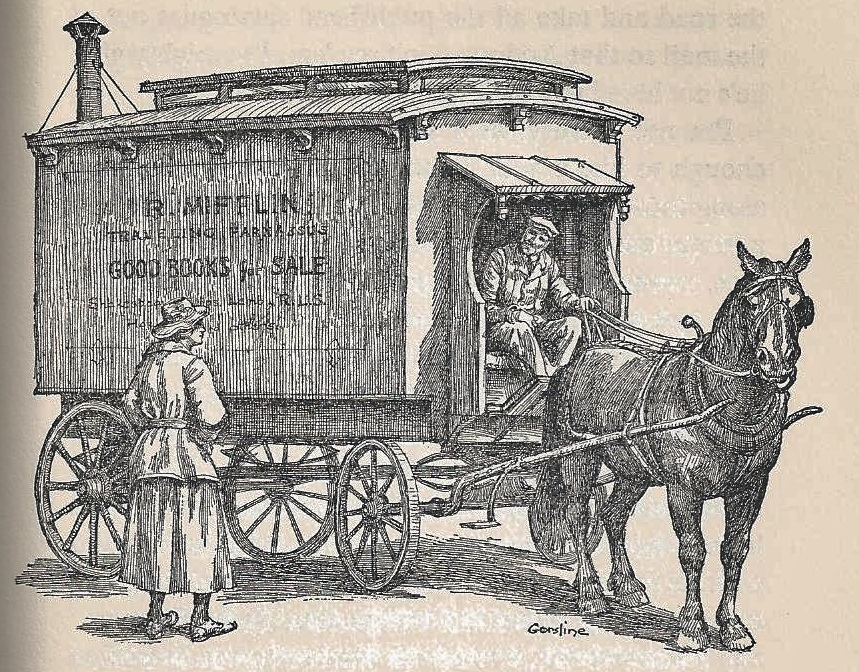
Helen is ripe for rebellion, and when her chance to shake her brother up a bit comes she seizes it with both hands. Andrew is out one day, when up drives a horse-drawn van, with the following legend painted on its side:

R. MIFFLIN’S

TRAVELLING PARNASSUS

GOOD BOOKS FOR SALE

SHAKESPEARE, CHARLES LAMB, R.L.S.

HAZLITT, AND ALL OTHERS

The driver of the van, one Roger Mifflin, is looking for Andrew McGill. He presents Helen with his card:

         ROGER MIFFLIN’S
TRAVELLING PARNASSUS
 
Worthy friends, my wain doth hold
Many a book, both new and old:
Books, the truest friends of man,
Fill this rolling caravan.
Books to satisfy all uses,
Golden lyrics of the Muses,
Books on cookery and farming,
Novels passionate and charming,
Every kind for every need
So that he who buys may read.
What librarian can surpass us?

Helen chuckles, and is immediately interested. She does, after all, appreciate a good book herself, though not to the excess her brother has shown. And Roger Mifflin has a business proposition of sorts. The van is a travelling bookshop, and he thinks it would be just the thing for Andrew to take over. Roger announces his intention of selling his business, lock, stock, horse Peg (short for Pegasus), and all.

Helen, imagining an even more complete neglect of the farm should her brother take on this attractive offer, is aghast. She tries to send Mifflin on his way, with no success.

The two joust back and forth, and Helen gets the gleam of an idea. She will purchase the travelling bookstore, and leave Andrew to watch the farm. She has some money saved, and turn-about is fair play, after all…

The deed is duly done, and, leaving the Swedish hired lady in charge, Helen hits the road with Roger along to show her the ropes. Needless to say, Andrew is flabbergasted at his sister’s sudden whim, and sets out in hot pursuit.

Hi-jinks ensue for numerous chapters, until a satisfyingly romantic conclusion is reached.

A grand little romp of a book, something of a period piece, but happy and playful, and well worth the short few hours it takes to gobble it up.

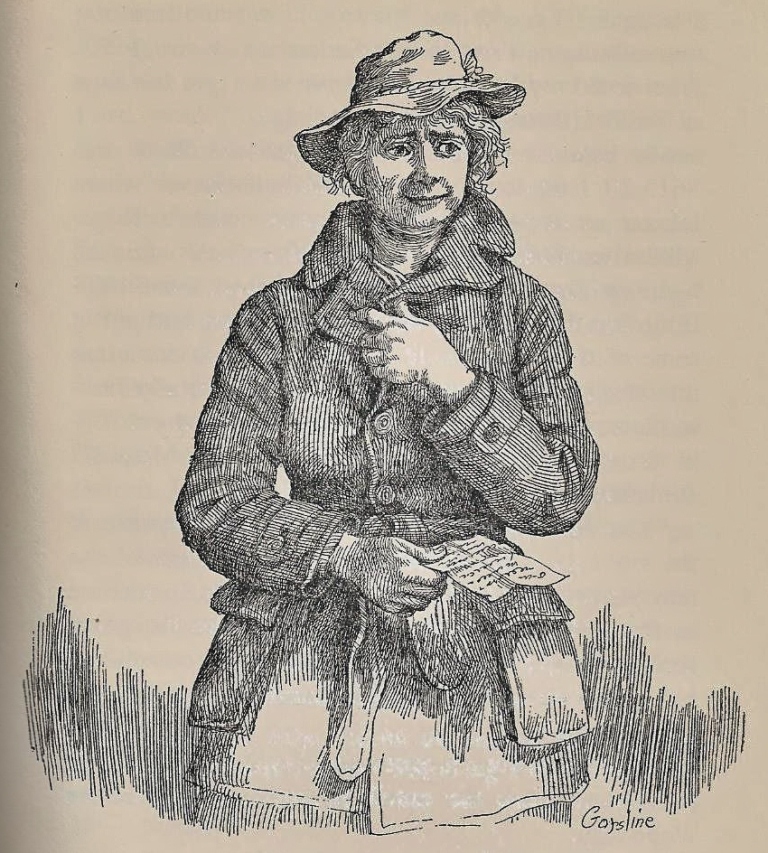
Lippincott’s 1955 edition, which I was lucky enough to stumble upon in Langley last week, has the extra bonus of a very informative explanatory foreword by John Winterich, which added greatly to my understanding and enjoyment of both Parnassus on Wheels and The Haunted Bookshop – I believe it was written to accompany the omnibus volume of both stories which I’ve seen listed on ABE – though this is a stand-alone volume. Clever line illustrations by Douglas Gorsline added an extra fillip to the tale.

*****

After I’d read Parnassus, I stumbled upon a little bit of interesting news regarding Christopher Morley’s inspiration for the story. Turns out that this novel is a send-up of another contemporary novelist of best-selling “rural odes”, one Ray Stannard Baker, writing under the pseudonym David Grayson. Baker-Grayson’s 1907 book, Adventures in Contentment, was immensely popular and gained a large following of people yearning after “the simple life”; it was followed by eight other volumes.  Though Baker himself lived a completely urban lifestyle, as a hard-hitting newspaper reporter and journalist, his alter-ego “Grayson” fictionally left the city for the peaceful rural life of a small farm, where he was joined by his sister “Harriet”; the two enjoyed a rural idyll centered on the simple pleasures of country life and wholesome labour.

A detailed exposé of Baker-Grayson can be found here . Fascinating stuff!

And I’m also linking to a great review of Parnassus by Christine at The Book Trunk.

Read Full Post »

Coromandel Sea Change by Rumer Godden ~ 1991. This edition: Macmillan London, 1991. Hardcover. ISBN: 0-333-55227-x. 246 pages.

My rating: 6.5/10. Not bad. Decidedly better than the author’s parallel book Cromartie v. The God Shiva Acting Through the Government of India, which I read and reluctantly panned a few weeks ago.

*****

Kirkus sums it up succinctly, in the June, 1991 review. Major plot spoiler in this review, by the way.

They don’t tend to write like this anymore, perhaps with good reason, but nonetheless the latest from Godden, unabashedly sentimental, is an entertaining if nostalgic read.

Patna Hall, a popular hotel on the Coromandel coast of southern India, is owned and run by Auntie Sanni, an Anglo-Indian whose family has been there for generations. Auntie Sanni, a stereotype like all the characters here, is a wise and wonderful old woman who knows exactly what to do with misbehaving guests and servants. In the week the novel covers, a party of scholarly American women, a British honeymoon couple, a British diplomat and his wife, a journalist, a mysterious unattached woman, and the managers of a local political campaign are all guests.

The hotel, right on the beach, where the waves are strong and the sea shark- infested, becomes the stage for the unfolding drama with parts for everyone, including the servants, a donkey, and an elephant. It is soon apparent to all–but especially to Auntie Sanni and Sir John and Lady Fisher, the diplomats–that the young leads, honeymooners Mary and Blaise, are having problems. Mary, entranced with the hotel and all things Indian, gets involved in the political campaign and is especially drawn to the candidate, handsome English-educated Krishnan, who is everything that snobby and insensitive husband Blaise is not. The campaign has its ups and downs as Mary gets closer to Krishnan–which is terrific because they are meant for each other–a(highlight the rest of this section to reveal spoiler)nd as poor Blaise, obviously doomed, conveniently exits in a nasty accident just in time for Auntie Sanni to get the hotel ready for the next week’s guests.

Godden’s lively narrative and her vivid descriptions of the people, places, and customs of a country she loves are more than fair compensation for dated style and stock characters.

I’m rather sorry to say that the only surprise here was which of the characters was doomed; I initially had picked the l(highlight to reveal my choice if you so wish) lovely young Indian hotel manager Kuku as the expendable, but I was wrong.

All of the stock characters from a Godden Indian novel are here, the only ones missing are nuns. We have a young, emotionally mismatched married couple, an intellectual and physically beautiful young man, a sexy, sultry young Indian woman (sometimes she’s Eurasian), precocious children, personable animals, worldly-wise observers – in this case an older Anglo-Indian couple and the omniscient Auntie Sanni – and last, but definitely not least, a sensually rich setting.

The setting is, as always in a Godden tale, almost a character in its own right. Godden’s sharp observational skills and her stellar descriptive talents are put to good use here: the sights, sounds, smells, tastes and textures of this beautifully depicted corner of the world are the best part of this otherwise rather unremarkable story.

This was one of the last novels in Godden’s long list, and, in company with the others of this winding-down period of the writer’s career, is broadly sketched with less of the care and detail of some of her earlier masterpieces. It also has more of an upbeat, consciously humorous tone than some of the older books, especially regarding the shenanigans which the political combatants get up to – a vow of silence, a rally prank involving old umbrellas to discomfit a rival candidate – and even the climactic tragedy is presented with a farcical twist.

Loved the cover illustration, especially the illustrative references on the back, which the reader will appreciate much more deeply after completing the book.

Recommended for Godden fans rounding out their collections, and for “light” reading. No emotional challenges or deeply moving characters here, but the writing itself  is more than adequate, and sometimes very good indeed.

Read Full Post »

The Lost Continent: Travels in Small Town America by Bill Bryson ~ 1989. This edition: Abacus, 1990. Paperback. ISBN: 0-349-10198-1. 293 pages.

My rating: 7.5/10. An averaged-out rating. I’ll award a 10/10 for the cutting humour, which is frequently snicker-out-loud funny, and sheer readability, but balance that with a 5/5 for the frequently vicious tone, the relentless mockery of almost everyone the author sees through his car window – fat ladies and people driving motorhomes come in for the nastiest comments – and the often needless vulgarity of some of the prose.

He could tone the rudeness down a mite – which he’s done in his later books – and still be clever and funny. I was frequently uncomfortable with myself for reading and enjoying this, as it felt like I was condoning Bryson’s mean streak, but I honestly never even came close to putting it down, and I know I will re-read it.

Bryson’s snark mellows somewhat as his journey progresses, and there are some genuinely poignant moments, mostly regarding his late father, his widowed mother, and his own family, whom he has temporarily abandoned back in England while he pursues his solo journey through America.

*****

This one snuck into my reading pile a few days ago. I’d just purchased it while on a road trip of my own, remembering when I saw it on the revolving rack that this was one Bryson I hadn’t yet read, and also remembering that it had a reputation for being the most offensively outspoken of his decidedly unshy travel memoirs. I opened it just to browse, and was firmly hooked. Undeniably readable, though it made me squirm. I wouldn’t give this one to my dear old mother, or really anyone else, unless I intimately knew their tolerance for crossing-the-line humour.

*****

In September of 1987, 36-year-old Bill Bryson got into the small red Chevette he had borrowed from his mother and headed out on a road trip to re-discover the America of his childhood. His father had recently died, and the subsequent nostalgic angst this engendered spurred Bryson to bid a temporary farewell to his wife and children in England – where he had lived for the past ten years – and take on a solo trip through “small town America”, echoing his childhood’s epic holiday road trips.

Keeping a journal of his pilgrimage, Bryson then wrote up his impressions in this opinionated and brash travelogue, his second book after the now-obscure and outdated The Palace under the Alps and Over 200 Other Unusual, Unspoiled and Infrequently Visited Spots in 16 European Countries (1985). (Here’s a side note for used bookstore browsers. That forgotten travel gem, which introduces the writer as William Bryson, starts at a respectable $40 on ABE, and proceeds well up into the hundreds. Something to keep in mind it if shows up in your travels. Just saying. I’d definitely buy a copy; the reviews on this one are encouraging, and it would be neat to round out the Bryson collection.)

But back to the book at hand.

13,978 miles and cursory stops – or at least drive-throughs – in thirty-eight states make up the sum of Bryson’s expeditions, over two separate periods, one in the fall and the other in the spring. Small towns are the focus, as Bryson searches for the fantasy ideal of the backdrop of the Hollywood movies of his childhood. Looking for utopia, Bryson is predictably and perennially disappointed, and he vents his chagrin freely and scornfully. There are plenty of good experiences, too, but almost every compliment has a bite behind it, of the “truth stings” variety. Bill targets himself as well, and it’s a good thing he does; it is the only thing that makes him bearable when he’s in full sarcastic cry.

Here’s an example of why I kept reading. Morbidly, awfully, very funny, probably because I know a few of these digitally damaged guys too. Bill Bryson sits in a roadside cafe in Palmyra, Missouri, and theorizes as to why so many farmers seem to have missing digits. The farmer sitting next to him has only three fingers on one hand, and Bill realizes that this isn’t terribly unusual.

(T)here is scarcely a farmer in the Midwest over the age of twenty who has not at some time or other had a limb or digit yanked off and thrown into the next field by some noisy farmyard implement.  To tell you the absolute truth, I think farmers do it on purpose.  I think working day after day beside these massive threshers and balers with their grinding gears and flapping fan belts and complex mechanisms they get a little hypnotized by all the noise and motion.  They stand there staring at the whirring machinery and they think, ‘I wonder what would happen if I just stuck my finger in there a little bit.’  I know that sounds crazy.  But you have to realize that farmers don’t have whole lot of sense in these matters because they feel no pain.  It’s true.  Every day in the Des Moines Register you can find a story about a farmer who has inadvertently torn off an arm and then calmly walked six miles into the nearest town to have it sewn back on.  The stories always say, ‘Jones, clutching his severed limb, told his physician, ‘I seem to have cut my durn arm off, Doc.’  It’s never:  ‘Jones, spurting blood, jumped around hysterically for twenty minutes, fell into a swoon and then tried to run in four directions at once,’ which is how it would be with you or me.”

The scope of Bryson’s travels is truly staggering; he does cover an awful lot of ground, and though there are plenty of places he blasts right through, he stops often enough to give glimpses of back road, small-town America in the not-so-distant past. Ronald and Nancy were in the White House, “Say No to Drugs” was the slogan of the moment, a frightening new disease called AIDS was making headlines, and the Black Monday stock market crash of October, 1987 rattled economic foundations worldwide, though Bryson reports that it seemed a no-news event in the towns he drove through, meriting only a passing mention on the small radio stations, while CBC Radio in Canada, which he picked up on his car radio, was broadcasting extensive, serious and sober coverage.

The book ends on a surprisingly optimistic note. Though Bryson finds he can’t find the America of his childhood, he does admit, after all his carping and critiquing, that there are still places in America’s hinterlands where life is slow, good and sweet. This doesn’t quite excuse some of the more bitter commentary that came before, but it helps.

Interesting book, in what it reveals about the author as well as his native land. Recommended, with reservations as stated above. Don’t say I didn’t warn you!

Read Full Post »

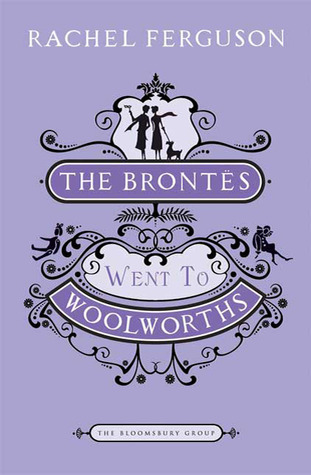
The Brontës Went to Woolworths by Rachel Ferguson ~ 1931. This edition: Bloomsbury, 2010. Softcover. ISBN: 978-1-60819-053-9. 188 pages.

My rating: 7.5/10. Cleverly imagined, if a bit high-strung. I found it rather a sad story, behind the relentlessly bright chatter of the heroines.

*****

How to start with this one? Well, first off, I must confess that I had a truly difficult time finding my stride here. I started reading one night when I was, admittedly, very tired, and made it to Chapter 5, about twenty-five pages in, when I gave up in utter dismay. What was this frenetically paced, brittle, self-complimentary mess all about, anyway? And who in their right mind would recommend it?!

A few days later, in a much less sleep-deprived state of mind, I tried again, starting from the very beginning, a thing I seldom do – most books get one chance and one chance only – but I really wanted to see what this one was all about, because I’d heard it praised so highly be several other bloggers whose tastes I often share: ShannonJenny, and Simon Savidge, to name just a few.

*****

Three fatherless sisters and their recently widowed mother live an upper middle-class life in the London of the time between the two World Wars. The eldest, Deirdre, is an aspiring novelist with a day job as a newspaper writer. Middle sister Katrine is a drama student, and young Sheil (not short for Sheila, by the way, but rather named for the Scottish birthplace of her father) is a schoolgirl under the tutelage of an earnest governess, Miss Agatha Martin.

The three sisters, as well as their gently witty mother, Mrs. Carne, are doing the best they can after the death of their obviously beloved father and husband. They have created a vivid fantasy world which runs parallel to their real world; they make no distinction between the real and the imagined in their conversations with each other, and the reader is thrown into the melee with few only a few clues to go by that this is not all as it seems. I sympathized with the sober governess Miss Martin, who continually tried to make sense of the nonsense, until finally giving up in dismay and fleeing to a more traditional, if bleaker, refuge as a parish worker, two-thirds of the way through the story

Imaginary members of the Carne circle are Dion Saffyn, based on a real-life figure of a pierrot entertainer glimpsed during a summer holiday, and his family, and the imaginary Ironface, a childhood doll, who has morphed into the snobbish wife of a member of the French nobility. Even the family’s raffish terrier, Crellie, leads a double existence as the Pope, with some off-putting doggish habits and tendencies.

But the most elaborate of the characters the Carnes have created is a take-off on the very real Judge Herbert Toddington, “Toddy” as they familiarly style him, ever since Mrs. Carne’s jury duty brought the elderly justice into their focus. When Deidre meets the real Judge Toddington, through his wife Lady Mildred’s attendance at a charity bazaar which Deidre is covering for her newspaper, fantasy becomes something much more solid.

All of the nonsense and make-believe are, it seems to me, a way for the four Carnes to deal with their deep grief at the loss of their fifth member. Deidre makes no secret of her interest in placing Toddy in the role of an auxiliary “man of the family”, as she has felt her own fulfillment of that position extremely difficult.

The fairy tale aspect of the story has its sobering moments, brought into focus by the confused governess Miss Martin, who cannot cope with the continued “weirdness” of her charge, the sisters, and Mrs. Carne, who plays along with the rest of the family in their complex game. Once Miss Martin flees in despair, a replacement, Miss Ainslie, is reduced to confusion in her turn, being soundly snubbed when she seeks to play along.

And that brings me to the only thing I did not like about the Carne family, once I allowed myself to enter their story: their extreme snobbishness. I realize that this was a commonplace trait of people in their position and their time, but it bothered me that they were so scornful in attitude to people like their governesses, not giving them any sort of explanation as to the goings on with the imaginary characters, and relentlessly shutting them out of the game. And when Katrine falls in love with a truly good man of a decidedly lower social class, her elder sister advises her to harden her heart, which Katrine obediently does – “It just wouldn’t do” seems an acceptable reason to deny what seems like true love.

The Brontës come into the story in a rather mysterious way towards the end of the book, and if you make it that far their appearance will make sense, as you’ll have suspended your considerable disbelief and will be enjoying the hectic ride which this novel takes you on.

I ended up liking this book much more than I thought I would from my initial experience with it. It will be given a permanent position on my shelf, though I would like to read some of the author’s other novels before I allow myself to claim any sort of Rachel Ferguson fandom.

Often compared to classics such as I Capture the Castle (Dodie Smith, 1949), and Cold Comfort Farm (Stella Gibbons, 1932), I will admit a certain resemblance, but feel this novel is not as sincere as the first, and not as satirical as the second. It is in the same genre, though – young heroines muddling their way into their inevitably adult lives.

Recommended, with reservations. Not for everyone, and may take a few tries to fully engage.

Read Full Post »

The Golden Mean by Annabel Lyon ~ 2009. This edition: Vintage Canada (Random House), 2010. Softcover. ISBN: 978-0-307-35621-5. 284 pages.

My rating: 9/10. I didn’t give this one a 10, though I considered it,  because it pushed me a bit past my personal comfort level regarding contemporary idiom used in historical fiction. In this particular case, after I got into the story, it worked.

Oh yeah, that, and the very graphic descriptions of sex, and human dissections. But once I was fully engaged, and became comfortable with the “voice” of the narrator, it also worked.

It’s almost a 10. I’m not sure if I’ll re-read it any time soon, but it was genuinely diverting while it was happening, and I’ll be reading the sequel of sorts, The Sweet Girl (2012) when it crosses my path. A keeper.

*****

I came to this book expecting to dislike it, if not downright hate it. After all, my personal standard for ancient Greece era historical fiction is measured by the excellence of Mary Renault‘s works. It is my current opinion that Annabel Lyon, with this book, proves worthy of standing in the same room as Renault. And in her (Lyon’s) acknowledgments she mentions Renault’s stellar Fire From Heaven, so that was another point in favour.

Lyons is no Renault, which isn’t a condemnation. She is a writer of another time altogether, speaking to the readers of her time as Renault spoke to the readers of hers. Whether Annabel Lyon’s work will have the staying power of Renault’s historical fiction classics, time will tell. I suspect perhaps not, but we shall see. I suspect that Lyons will be a writer to watch out for in the years to come, though her blazingly sudden fame (notoriety?) may be something of a detriment to considered reflection of the merit of her subsequent work.

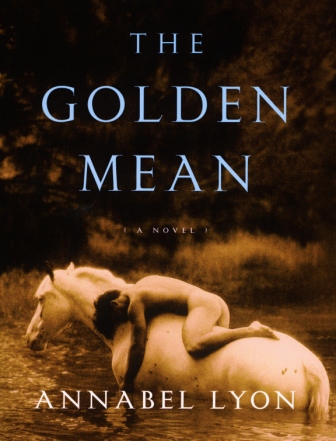
The Golden Mean made the Giller short list in 2009, was plastered all over the mainstream book pages, and was praised for its “sensuous and muscular prose” – it says that right on the front flyleaf – so I was, paradoxically, quite suspicious of what I would find behind that attention-getting cover. (And here’s a snippet of trivia for you: The book was at one point pulled from the shelves of the B.C. Ferries gift shops because of the nudity on the cover. Well, there’s no such thing as “bad” publicity! Personally, I lke the cover, and I “get” why it was chosen. To be completely true to the book though, the horse should be black, and the young man at least partially clothed. But I digress.)

<Several days go by …>

I’m finishing up this review away from home, without the book in front of me. It is, sadly, in the side pocket of my laptop case, which is sitting on the floor next to the kitchen door some 200 kilometers away. I walked out of the house with that naggy “I’m forgetting something” feeling, and was too far to swing back when the penny dropped. Luckily, courtesy of public library internet terminals, I can get onto my WordPress account, and with an hour of time to fill, I’m going to try to get this review off the “waiting” sidebar.

Browsing other readers’ comments in the hopes of freeing up my stuck thought processes, I came upon the review I wish I’d written, by Patricia Robertson on the Canadian Notes and Queries website. Nothing I can come up with this evening can match the scope of this review, so I’m completely cheating and pasting most of it (and it’s long) into this post. Good stuff. I bow in humble admiration. Here’s where the link to the full March, 2010 review: Aristotle Among the Barbarians

And here is a lengthy excerpt. It’s detailed, so I probably should give a possible spoilers warning.

As the book opens, Aristotle is travelling to his homeland of Macedonia after a twenty-five-year absence. “The rain falls in black cords, lashing my animals, my men, and my wife, Pythias, who last night lay with her legs spread while I took notes on the mouth of her sex, who weeps silent tears of exhaustion now, on this tenth day of our journey.” This sentence, the first, functions as a microcosm of the entire novel. The “black cords” that “lash” the little entourage (and Aristotle himself) foreshadow the dark choice he must soon make. When his boyhood friend, King Philip of Macedon, asks him to stay on to tutor his young son Alexander, Aristotle is horrified. He has loftier ambitions: to return to Athens, to the Academy where he was once Plato’s student and which he hopes one day to lead. Compared to the Athenians, the Macedonians are barbarians. Yet how can he refuse Philip?

The same image prefigures Aristotle’s depressive episodes – “his old usual,” he calls it, describing it as “sucking colour from the sky and warmth from the world.” Whether the actual Aristotle suffered from clinical depression, history doesn’t tell us, but Lyon’s intuitive attribution of this disorder to her highly gifted protagonist feels right. As for her wonderful phrase about Aristotle’s notetaking, it can be interpreted two ways: metaphorically – Aristotle the rationalist, making mental notes in the midst of fucking – and literally – Aristotle the empiricist, writing detailed descriptions of the world around him. Already he is a modern, grounding his rationalism in that most modern of enterprises, the scientific method. Poor Pythias, whom he will often treat in the same clinical way, and who (in the same sentence but twenty-four hours later) “weeps silent tears of exhaustion”!

The brilliantly evoked relationship at the heart of the novel is a long way from the Hollywood paradigm – the charismatic and indefatigable instructor who succeeds in catalyzing his pupils against overwhelming odds. Alexander is, sometimes, deeply engaged by Aristotle’s demonstrations of science, drawn in almost against his will by his teacher’s Socratic method. But he’s also of royal birth, destined to rule a kingdom; though he admires Aristotle, he doesn’t (perhaps cannot) flatter him through imitation. To Lyon’s credit she doesn’t pander to contemporary taste by hinting at homosexual attraction, though she makes it clear that homosexual relationships are an accepted norm. (Alexander’s relationship with his lifelong companion Hephaestion is one such.)

The Golden Mean, in fact, shows us just how narrow our dramatic expectations have become. Though sex and intrigue and violence are present, the focus is on two men who exemplify two great life choices: contemplation versus action. Aristotle comes down squarely on the side of apollonian reason against unreason, thinking against unthinking instinct. Early in the book his nephew and apprentice, Callisthenes, recounts an incident from a night out when he’s witnessed the killing of one man by another over a drink. “What kind of a people is that?” he asks his uncle, who says, “You tell me.” “Animals,” Callisthenes answers. “And what separates man from the animals?” asks Aristotle, ever the teacher. “Reason,” Callisthenes dutifully replies. “Work. The life of the mind.” To which Aristotle’s ironic answer – “Out again tonight?” – underlines Callisthenes’ lack of real commitment, in Aristotle’s terms, to being human.

Moments like this – moments that demand full reader engagement to comprehend – occur throughout the novel. We’re forced to pause, to re-read, to think more deeply. Lean, taut, stripped down, The Golden Mean is dense with meaning while also managing to be crisp, direct, and contemporary. Lyon has a poet’s eye without allowing her prose to become poetically languorous. She’s especially good at verbs: “The Athenians sharked up and down the coast,” for example. But she also understands that metaphors in abundance do not make a novel literary – that instead they’re best used sparingly, like salt (a lesson apparently lost on a number of highly acclaimed Canadian writers).

She also rips up the conventions of the historical novel. Instead of the pseudo-realistic “at your service, my liege” school of dialogue, the voices here roar along like a freight train. These are men who use words like “fuck” and “balls” and “bitch,” whose language has the crude vitality it must have had then. Lyon succeeds in making ideas and argument exhilarating, sexy even. She also risks deliberate anachronisms, although occasionally she pushes too hard. “It’s not that he has no boundaries,” Aristotle tells Pythias at one point, speaking of Alexander – using an analyst’s terminology some twenty-odd centuries before Freud! Late in the novel, when Alexander suggests assassinating the new director of the Academy (chosen over Aristotle), Philip’s regent in his absence, a general named Antipater, tells him no. “You are not going alone to Athens to snuff some hundred-year-old egghead with a protractor for a dick. You’re a prince of Macedon. That particular freak show is not for you.” All of this worked for me, except for “freak show.” A matter of individual reader taste, perhaps, but after “snuff” and “egghead” and “dick,” it seemed forced and over the top.

Lyon uses flashback rarely, but late in the book we meet Aristotle as a young man of eighteen when he first entered the Academy. We’re aware of the parallelism here between Aristotle and Alexander, the poignancy of this glimpse of Plato’s potential (but forever thwarted) heir. He’s also a typical adolescent, avid for sexual experience; the chapter ends with “The girl had licked and bitten, licked and bitten, until I didn’t know myself.” It’s a vigour echoed throughout the book, both in Aristotle’s relationship with Pythias, given to him as a gift when she was fifteen – “gods forgive me but I went at her like a stag in rut” – and in his later attraction to Herpyllis, Pythias’s maidservant, whom he marries after his wife’s death.

Lyon’s wonderfully complex Aristotle spends little time simply writing or thinking, apart from those long bouts of depression. He is in the world, even if not always fully of it, as shown by the emotional detachment, almost cruelty, that accompanies his elevation of reason as a virtue above all others. When Pythias is dying, she tells her husband of recurring dreams, sent by the gods, that foreshadow her death. Aristotle, who has never had such dreams – “My mind is too busy in waking,” he tells us, arrogantly, “to suck for fuel during sleep” – treats this as yet another teaching opportunity. He uses scientific explanations rather than affection to comfort her – explanations that, amusingly to us now, are not “scientific” at all. “The body’s sense-organ, the heart, needs natural intermissions, called sleep;… the goal is to give rest to the senses,” he tells her. Pythias, calmed, repeats an earlier lesson about the heavens and “all the spheres, and the outermost sphere that was black but all full of pin-holes, so that the great fire behind shone through as stars.” How foolish, we think condescendingly. And then, as I’m sure Lyon intends, we catch ourselves. What misguided beliefs do we hold today that, centuries hence, will be scoffed at by a more “enlightened” world?

Alexander, too, is a vivid portrait: an impetuous, sulky adolescent, used to getting his own way, yet with a quick and resourceful mind. Along with ethics and rhetoric, astronomy and botany, he studies zoology with Aristotle, who dissects a chameleon for Alexander’s benefit, cutting it open with his surgeon father’s knives. “I detach the bloody nut of the lizard’s heart and hold it out to him. He takes it slowly, looks at me, and puts it in his mouth. ‘I’m sorry I’m late,’ he says. ‘I was with my mother.’ ”

Once again Lyon demonstrates the depth of her characterization and her seamless fusing of image, gesture, and dialogue. How apt that Alexander, in a display of bravado, eats that symbol of courage! And does so while staring defiantly at his teacher, thus undermining his apology. How disturbing, too, that this gesture is linked with his mother, giving his relationship with her an erotic edge. In fact his parents are estranged and he’s been forbidden to see her, so he’s defied his father, too. The same oedipal relationship is played out between Aristotle and Alexander throughout the novel – Alexander wants Aristotle’s approval, yet is ultimately contemptuous of a life of inaction. “You must look for the mean between extremes, the point of balance,” Aristotle tells his student – the golden mean that gives the book its title. But Alexander doesn’t. He chooses an extreme – chooses, in fact, to become his father, as perhaps he must. “I want to fight,” he tells Aristotle, dismissing diplomacy as useless. “War is the greatest means to the greatest end, the glory of Macedon.”

Still, he learns those early lessons all too well. In a searing episode, when Aristotle (for scientific purposes) dissects an enemy corpse after a battlefield victory, Alexander arrives, clearly traumatized by the fighting, and uses those same skills to skin the man’s face. A horrified Philip says to Aristotle, “You teach him this shit. What kind of animal are you, anyway? Who does this to a body?” Another irony, since Philip himself is arguably an animal, a soldier operating not from reason but instinct. And what about Aristotle? Is he self-deluding, just an animal after all? Worst of all, is that what he’s really taught Alexander? It’s clear that the boy, for the second time in the novel, is suffering from post-traumatic stress disorder – “soldier’s heart,” Aristotle calls it. Is it possible to be civilized and a warrior, or does one have to choose? It’s a dilemma we still haven’t resolved.

In real life, Alexander led his father’s troops into battle at sixteen, became king at twenty, and was dead at thirty-two, having conquered Persia and Egypt and reached as far as India. He was also, by then, an alcoholic, prone to depression and fits of violent rage. As for Aristotle, he returned to Athens and founded his own school, the Lyceum, dying in exile on the island of Euboea a year after Alexander, at the age of sixty-one. The novel, however, ends with his departure from Macedonia soon after Philip’s death, with Alexander now king. “No more doctoring, politicking, teaching children; no more dabbling,” Aristotle tells himself. “Soon I’ll be alone in a quiet room where, for the rest of my life, I can float farther and farther out into the world; while my student, charging off the end of every map, falls deeper and deeper into the well of himself.”

Is Aristotle merely justifying his own choices here? Or is he expressing a paradox – that the real act of courage is the journey that leads to knowledge of the Other through engagement with self, while a life of outer engagement leads only to self-entrapment? Perhaps he’s doing both. In any event it’s an apt description of the novelist’s art, that image of floating farther out into the world. But Lyon has already announced her intention, and her novelist’s credo, in the quotation from Plutarch she chooses for the novel’s epigraph. “The most glorious exploits do not always furnish us with the clearest discoveries of virtue or vice in men; sometimes a matter of less moment, an expression or a jest, informs us better of their characters and inclinations, than the most famous sieges, the greatest armaments, or the bloodiest battles whatsoever.

And here are several good web articles about the author, which I found appreciably increased my enjoyment of the book by giving me the background picture of the author’s intentions.
Read Full Post »

When the snow comes, they will take you away by Eric Newby ~ 1971. This edition: Charles Scribner’s Sons, 1971.  British title: Love and War in the Apennines. Hardcover. ISBN: 684-12486-6. 221 pages.

My rating: 9.5/10. Loses a bit for occasionally awkward phrasing which made me stop and re-read in an attempt to keep the story sorted out. It broke the flow a few times; nothing too serious. Otherwise, a very engaging and sincere memoir.

***** 

I said “sincere” just above, and that is my overall impression of this World War II prisoner-of-war account by the late British travel writer Eric Newby, best known perhaps for his month-long ramble in the Hindu Kush back in 1956. Fourteen years before that famous excursion, Newby was occupied with an even greater adventure after he was interned with his companions in German-occupied Italy after a British Special Forces sabotage mission against a German airfield in Sicily went completely awry.

We were captured off the east coast of Sicily on the morning of the twelfth of August, 1942, about four miles out of the Bay of Catania. It was a beautiful morning. As the sun rose I could see Etna, a truncated cone with a plume of smoke over it like the quill of a pen stuck in a pewter ink-pot, rising out of the haze to the north of where I was treading water.

After being dropped off by a submarine off the Sicilian coast, Newby and five companions had paddled their folbots – portable folding canoes – to the beach, and proceeded to attempt to sneak onto the German airfield and bomb as many of the planes as possible before escaping back to the beach and then a pick-up rendezvous with the sub. Unfortunately for the saboteurs, the Germans were very much on the alert, and the sneak attack ended in a hasty retreat. The canoes sank one by one during the night, leaving the men completely stranded at sea, where they were picked up by Italian fishermen. A year in a rather decent POW camp followed, with numerous unsuccessful escape attempts by various prisoners being attempted, before the Allied-Italian Armistice of 1943 which saw a mass exodus of Allied prisoners and Italian soldiers into the countryside just ahead of advancing German troops.

Eric had unluckily broken his ankle the night before the Armistice, which complicated his movements considerably. Ending up in an Italian hospital, waiting for the inevitable arrival of the Germans, Eric met a young Slovenian woman, Wanda, who initiated a series of language lessons – Italian in exchange for English – which soon led to something more than a disinterested friendly relationship.

When the Germans did show up, Eric was put under guard by Italian policemen, but he managed to escape out of a bathroom window, broken ankle and all, following Wanda’s instructions as to how to find assistance in the town. An underground movement of antifascist/anti-German civilians was mobilizing, and Eric came under their protection and was passed from house to house until his eventual haven in a small mountain village, where he ended up working for a farmer in exchange for shelter and meals.

Wanda kept in occasional contact, mostly by cryptic notes and once by a rare and risky visit, and Eric stayed one step ahead of his potential captors. But as the autumn progressed and the mountain snows began to fall, the period of freedom drew to a close, as it became impossible to hide the presence of Eric and the other temporarily free POWs from the investigative raids of the German patrols.

As the book ends, Eric has been recaptured and is heading to another internment camp, where he will be spending the rest of the war. He and Wanda managed to stay in contact, and were married after the war.

This book is a self-deprecating account of one man’s attempt at maintaining his freedom, though, as Eric himself notes several times, the best thing he could have done both for himself and for the Italian villagers who risked their lives to aid him would have been to surrender. And there was a very real danger to his hosts. Entire families were shot for harbouring fugitives, and though there were numerous people willing to run such a risk, there were others just as eager to turn in both escaped prisoners and those of their neighbours who aided them.

It is also a touching love story, both of a man and a woman who meet and fall in love in most uncongenial circumstances, and of Eric Newby’s deep affection and respect for the Italian peasants who sheltered and fed him at unbelievable risk to themselves and their families.

A sincere and grateful story, written in a modest tone with a good dose of wry humour.

This is one of the recommendations in Noel Perrin’s book about good books, , which I reviewed earlier this year.

I must agree. Highly recommended.

Read Full Post »

Death by Degrees by Eric Wright ~ 1993. This edition: Bantam/Seal (Doubleday), 1995. Paperback. ISBN: 0-7704-2601-8. 192 pages.

My rating: 5.5/10. A minor effort by well-established Canadian “regional mystery” writer Wright. It has its moments, mostly in the personal narrative sections, and is mildly enjoyable for those already acquainted with Charlie Salter, but that’s about it. I doubt anyone coming to Eric Wright for the first time through this one would be strongly tempted to continue.

*****

From Kirkus, August 1993:

Here, in an outing reminiscent of Final Cut (1991), Toronto Inspector Charlie Salter’s personal life is more absorbing than his caseload–which now includes the murder of moderately unlikable Maurice Lyall, a teacher at Bathurst Community College, and the alibis of various of Lyall’s colleagues on the Search Committee that had just nominated him for Dean of Related Studies. But the case keeps Charlie distracted from his major worry: the progress, or lack of it, that his father is making since suffering a stroke. Days spent listening to academic backbiting and nights spent in a hospital waiting room, peeking in on his dad between stints of writing up a case-in-progress journal, keep Charlie on edge, but a bit of luck narrows the suspect list–just as Charlie’s father’s health rebounds.

Minimalist plot, and few will care about the faculty and its infighting. As a father-son study, however, there’s much to recommend in Charlie’s guilt over not liking his dad, and his sensitive son Seth’s love and liking of both his father and grandfather.

That sums it up well.

This is the tenth installment in the eleven volume Charlie Salter mystery series by Wright, which started with 1984’s award-winning The Night the Gods Smiled. In Salter, Wright has created a flawed but ultimately good protagonist; Charlie’s dilemmas in both his personal and working life are immediately recognizable and relatable to the reader. I find I follow his personal progress through the books with much more interest than the mildly diverting mysteries trigger. A very human and very Canadian hero: conflicted, self-analyzing, often inarticulate, more than mildly cynical, and always polite.

I have never lived in Toronto, so I cannot speak as to the accurate depiction of this book’s setting, but it seems as though the city is as much a character as the humans. The story has its fair share of in-the-know references. Most are easily picked up on, especially if you’ve already read the earlier books in the series, but a non-Ontarian and especially a non-Canadian might well find himself occasionally lost and missing the subtle jokes which abound.

While I appreciated the hospital drama and Charlie’s emotional agony as he faced his father’s potential demise, I initially didn’t care for the lazy solution the author dumped on us. “Oh – he’s recovered surprisingly quickly. You can pick him up tomorrow.” Until I thought about it a little more deeply, and realized that this is indeed what can occur. It has happened to our own family. An elderly person quite literally at death’s door one day – “You should think about making some arrangements” – makes a rather sudden recovery, and without a “Sorry to have worried you so much” apology the dazed relations are informed that the almost-deceased is being released, and needs to be “out of the room by noon – someone else needs the bed.” Charlie’s reaction of confusion and resentment at the offhand attitude of some of the nursing staff, allied with relief at the prospective recovery, and worry about the next stage in the convalescence, now suddenly the family’s responsibility as the medicos turn away, perfectly reflects the real-life scenario we found ourselves in.

Eric Wright was an English professor at Ryerson Polytechnic in Toronto for many years, and he often saves his most satiric “insider” barbs for the educational establishment. I often get the impression that the writer is much more at home in the halls of academe than in the police station with his hero, and that he uses Charlie’s frequent naïvety as an opening to mount his personal hobby-horse and to expound on the ins and outs of the world of “higher education” to his “gee whiz” audience, in this case Salter and by extention the rest of us.

As mentioned above in the Kirkus review, the “mystery” in this mystery is the least of our concerns. The victim is unsympathetic; the murderer, when discovered, faces nothing particularly severe in the way of potential punishment. In general, life goes on.

In the real world, a violent murder such as the one described in this book would have much more traumatic consequences. I know it’s not the fashion for “cozy” murder mysteries to delve too deeply into the after-effects of the murder on everyone concerned, including the neighbours of the murdered man, who seem to view his brutal demise at the hands of what is suspected to be an opportunistic burglar with phlegm verging on cow-like stupidity. In real life, if your neighbour was randomly murdered in the night and if the culprit was still at large, lurking, one would assume, in the same neighbourhood, would you not be a gibbering mass of nerves? I think I would.

Ah well, it’s fiction.

Would I recommend this one? Only to those already interested in the series. Those new to Eric Wright, definitely start at the beginning with The Night the Gods Smiled, and follow along in order. In this case it pays to get to know Charlie Salter and his likeable and sometimes quirky family right from the beginning.

This is a mildly diverting series, for those times when you don’t want to feel too challenged. The violence is generally non-graphic, and though awful things happen we aren’t subjected to too many gruesome details. There’s a bit of sex here and there, often as part of the plot twist, and occasionally as “too much information” about Charlie’s personal life, but again, nothing too graphic. The author drops in a word like “penis” and then immediately shies back, as if in shock at his own temerity in discussing such things.

I keep a stack of Eric Wrights among the huge collection of mystery novels we’ve accumulated over the years, and have no plans on getting rid of them, though if they were to vanish I don’t think I’d be terribly heartbroken, as I would be if I lost my Josephine Tey and Dorothy L. Sayers collections – Wright isn’t anywhere in the same league, though he’s not at all bad reading if your expectations are adjusted suitably.

For those curious about more deeply investigating Eric Wright’s Charlie Salter, here are the books in the series in order of appearance:

  • The Night the Gods Smiled (1984)
  • Smoke Detector (1984)
  • Death in the Old Country (1985)
  • A Single Death (1986)
  • A Body Surrounded by Water (1987)
  • A Question of Murder (1988)
  • A Sensitive Case (1990)
  • Final Cut (1991)
  • A Fine Italian Hand (1992)
  • Death by Degrees (1993)
  • The Last Hand (2002)

Read Full Post »

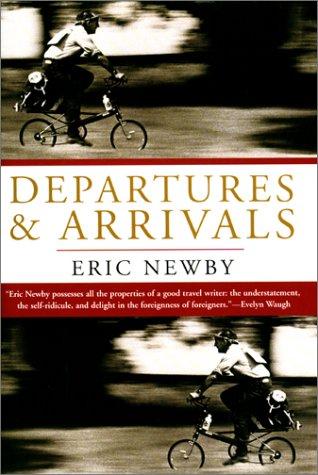
Departures and Arrivals by Eric Newby ~ 1999. This edition: The Lyons Press, 1999. Hardcover. ISBN: 1-58576-224-4. 192 pages.

My rating: 5/10. Some decent essays but not enough of them to swing the balance between “fair” and “very good” reading. A lot of reciting of railway schedules, and short, out of context snippets about trips which blurred together after a while. Travel writing “lite”. I expected more from this writer.

*****

A few essays into this book I was thinking to myself, “Okay, these are obviously excerpts from other works. Where’s the reference page?” Looking through the front and back material, there was no indication that this was the case; it apparently is a stand-alone collection of (mostly) travel tales and short reminiscences of the writer’s earlier life.

There is no context given more many of the trips referenced, which I found disconcerting. “Flying into Coober Pedy…” Yes – okay – so you’re in Australia – but WHY are you there? What bigger trip is this part of? And aside from discovering that opal miners like to be paid in cash, and certain of them have a fondness for personal architecture such as a revolving bed surrounded by mirrors, what other memorable things did you find there that we, your readers, might be interested in?

Though there are well-written, interesting, and amusing passages, the whole thing feels like a selection of truncated pages from a personal journal, bits and pieces of information jotted down in transit to aid in later memory of the trip. Perhaps it is, worked up with a minimum of added information.

I suspect this is a book which was commissioned and published on the strength of the author’s earlier, and much stronger, efforts. A case of selling the name, not the content.

It was readable, but  vaguely unsatisfying. One to borrow from the library for light diversion, hotel room reading on a road trip (which is how I’ve just experienced it), but I’m not left with an urge to rush out to buy it. Not recommended, unless you come by it for a bargain basement price.

Read Full Post »

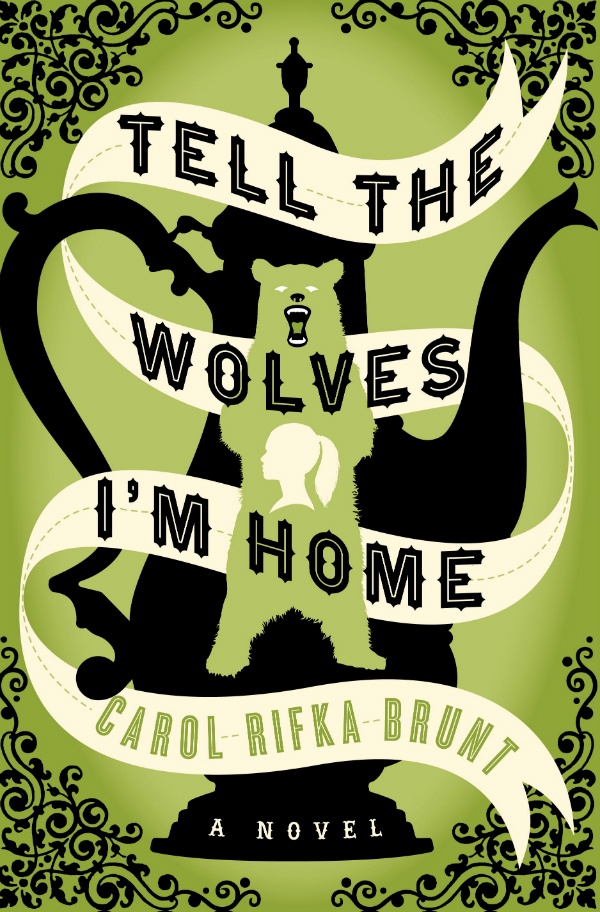
Tell the Wolves I’m Home by Carol Rifka Brunt ~ 2012. This edition: Random House, 2012. Hardcover. ISBN: 978-06796-4419-4. 355 pages.

My rating: 8/10. Very nicely done, especially for a first novel.

I’m sure this one will deeply appeal to the YA crowd, though I found it in the Adult section of the library. There’s nothing here that a modern teen couldn’t handle with one hand tied between her (or his, though this feels rather like a girl’s book, if I may be so bold as to stereotype it) back.

*****

I’m considering tagging this one historical fiction, because the sense of a very particular time is so strong, and it captures those early days of the AIDS epidemic so well, when we were all more than a little scared and confused, and traded rumours in whispers. The story is set in 1987, twenty-five years ago.

The internet is swarming with reviews on this one; I’ll try to keep this simple.

Young June Elbus, fourteen years old and deeply embroiled in the angst of adolescence, has one person she can count on unconditionally, her Uncle Finn. Finn, a renowned painter, now leads a semi-reclusive life in New York; he hasn’t exhibited anything for years, though he is still painting. He’s working, in fact, on a dual portrait of June and her older sister Greta.

The portrait is of supreme importance to everyone concerned; it is likely the last work Finn will ever complete, for he is dying of that mysterious and deadly new disease, AIDS.

Finn’s sister, June’s mother, is brutally shaken by Finn’s death early on in the story, as she has some unfinished business with her brother. She vents her anger at Finn’s lover, the unknown man who she claims has deliberately infected Finn and who is now, in her eyes, his murderer.

June has some baggage of her own. She has been secretly in love – full-blown romantic love – with her uncle, a middle-aged gay man (and June knows this), who, to further complicate things, is June’s godfather. The two share a deeply emotional connection, though Finn has many secrets which June is only to find out about after his death.

With Finn’s demise, and the entry of the mysterious lover, Toby, into the plot, things crank up a notch, and the narrative moves from completely believable to slightly fantastic, in the stretching-of-belief-and-probability sort of fantastic. But it makes for a good story, so allowances can easily be made.

All in all, a very likeable, suitably complex heroine and an interesting plot. I did find it quite predictable in many ways; people did what I thought they would, and the big secrets were telegraphed fairly clearly; clues were distributed with a generous hand.

Beautifully written, with an abundance of heart-tugging emotion. Though I didn’t personally tear up at all, old cynic that I am, as so many of the reviwers over on Goodreads did.

What else?

Good handling of the gay characters; this can be hard to get right without straying, even unintentionally, into parody, and I think Brunt did a very good job with that.

Absolutely gorgeous cover, which reflects the excellent content within. One to share with your teens, and borrow to read yourself.

Read Full Post »

I Was a Teenage Katima-Victim: A Canadian Odyssey by Will Ferguson ~ 1998. This edition: Douglas & McIntyre, 1998. Softcover. ISBN: 1-55054-652-x. 259 pages.

My rating: 9/10.Funny and thought provoking. This is the book that made me a Will Ferguson fan, way back in 1998, when I plucked it off the “New Releases” bookstore shelf solely for the reference to Katimavik. A few minutes browsing and I was sold. Liked it then, like it now. A very Canadian memoir.

*****

Funny, touching, and never maudlin . . .”     – Montreal Gazette

“A rollicking memoir”     – Globe & Mail

“A coming of age story with a fierce and nationalistic bite.”     – January Magazine

With Will Ferguson in the literary spotlight these days, due to his Booker Prize win for 419: A Novel  just a week ago, I felt the urge to dig through the bookshelves and re-read the my first ever Ferguson book, the now-obscure 1998 coming-of-age-Canadian-style memoir, I Was a Teenage Katima-Victim.

Ah, Katimavik! What a well-meaning and ambitious, oh so Canadian idea!

In my Grade 11 year I too went to one of those earnest presentations in the school gym, listened with deep interest to the bubbly recruiter, and, most importantly, mused over what I could do with the thousand dollar pay-off at the end.

I even went so far as to take a brochure home to my parents, who flicked through it with scornful dismissal. The airy-fairy notion of travelling and seeing Canada basically on the taxpayers’ dime was not something to countenance for one of their children. In my father’s eyes such programs were akin to “those deadbeats collecting welfare”, and he quite literally would have starved on the street rather than apply for a government handout, or anything which could be remotely conceived of as such. To top it off, Katimavik was supported by none other than “that Liberal bastard”,  Prime Minister Pierre Trudeau, who my father hated with a black passion, for reasons I’m still not quite clear on.

By the end of my Grade 12 year Katimavik was a distant memory, a momentary what-if? fairytale I had told myself. I had moved out of my parents’ home into a nasty and dank – but blessedly my own – basement suite in town, and was working full-time waitressing (nights and weekends) while struggling to make it through the tatters of my last high school year to collect that all-important graduation diploma. My love life had unexpectedly taken off, and I was deeply occupied in the here and now. The last thing I now wanted was to rip up those tentaively establishing adult roots and travel. But a soft spot remained for the grand ideas embodied in Katimavik, and my ears ever after were sensitive to the sound of the name.

Will Ferguson took the bait, made the plunge, and survived to tell the tale. Here is a 1999 interview in January magazine:

The book … is delightful: a coming of age story with a fierce and nationalistic bite.
To explain the reference, Katimavik was a Canadian government funded and sponsored program that blossomed in the 1970s. Of course. While the program was active, it brought thousands of young Canadians together to do “meaningful work.” Everything from soup kitchens to nature trails to heritage sites: over 20,000 “katima-victims” went through the program. “The scope of the program was staggering,” writes Ferguson. “1400 different communities across Canada, and more than 200,000 people directly involved or affected. For better of worse, Katimavik helped shape an entire generation.”
For the lavish sum of $1 a day and “all the granola you could eat” these 20,000 17 to 21 year-olds were taken far from their home towns for a year to see first-hand the cultural mosaic of which they were – by birth – a part.
“The thinking about Katimavik was that there is something redeeming about manual labor,” says Ferguson. “And the thing is, it just isn’t true at all. Anybody doing manual labor knows that it’s a tough gig and if they had the option not to do it, they wouldn’t. The second notion is that somehow once we get to know each other, we’ll like each other. This is the biggest flaw and it runs right through a lot of thinking. They think that, just because you and I are enemies, if we got to know each other, we’d like each other: that’s a big flawed premise because – quite often – the more you get to know each other, the more you realize that you have nothing in common.”
Despite his misgivings about the program’s principals, “Katimavik worked on a personal level, despite its good intentions. Just because any time you throw someone into something that big and that intense you come out of it with a rounder personality.”
Now 34, Ferguson’s personality is sufficiently rounded to take us along with him on great rollicking rides. Thus far he’s taken us from the wilds of Canada to the back roads of Japan. Whatever he has in store for us next is sure to be fun: and will hopefully raise still more eyebrows. | Linda L. Richards, January Magazine, February 1999

There is a certain irony in the fact that, soon after Ferguson’s participation in the now-iconic Canadian youth travel-service-work-cultural  program, it was axed in 1986 by the newly elected Mulroney Progressive Conservative government. Katimavik was resurrected in a slightly different form in 1994, and just this year, 2012, has been cut again, this time by the Conservative Harper government. Another rescue mission is afoot, to reimagine Katimavik for yet another generation of young Canadians. I hope it succeeds.

This book has been out of print for years, and is unaccountably ignored in most discussions of Ferguson’s work, which is a shame. Despite the graphically appalling cover, the tale told within is worth reading, especially for anyone who has memories of Katimavik in its sincere and slightly loopy heyday. A bit raw in spots – it was, after all, only Will Ferguson’s second published book, following hard on the heels of surprise bestseller Why I Hate Canadians – it nevertheless gets better and better as it goes along. Laugh out loud funny in places, there is a thread of sincerity running through it which is deeply appealing.

More than a mere curiousity piece and a relic of the author’s youth, it’s a rather grand little read. One of those “Proud to be Canadian” feel-good things. Recommended.

And here is link to the Goodreads page.

Read Full Post »

« Newer Posts - Older Posts »