Archive for the ‘Read in 2012’ Category

To Timbuktu for a Haircut by Rick Antonson ~ 2008. This edition: Dundurn, 2008. Softcover. ISBN: 978-1-55002-805-8. 256 pages.
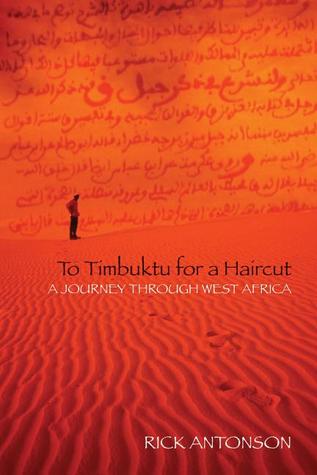
My rating: 6/10.

Uneven. The cover blurb references Bill Bryson and Michael Palin, and Antonson himself refers to Paul Theroux an awful lot, but he’s not anywhere in their league. Travel lit lite. The navel gazing equals Theroux’s, but is not nearly as interesting to this reader as Paul’s deep and/or often twisted musings. Antonson is no Bryson, and he really is no Theroux.

*****

Rick Antonson, CEO of Tourism Vancouver, is absolutely exhausted by his grueling efforts working on the 2010 Vancouver Olympics bid. Desiring to get away from it all, he mulls over where he can escape to for a month or so. His wife Janice rather flippantly suggests Timbuktu, in reference to Rick’s childhood curiosity about the place his father often joked about. Apparently Antonson Senior, when questioned by his offspring as to where he was going each day, would retort: “I’m going to Timbuktu to get my hair cut!” So there you have it – a destination for the trip and a catchy title all rolled up in one neat package.

Doing his research as a good traveller should, Rick loads up on guide books and bones up on Mali and on West African history, in particular the history recorded by the early European explorers. He makes internet contact with a Malian travel service owner, one Mohammed, and arrangements are put in place for a fairly modest itinerary, with Timbuktu as the ultimate destination, with perhaps a bit of local exploring.

To condense the saga, Rick makes it to Mali, finds out that Mohammed is a bit of a shady character, eventually makes it to Timbuktu despite being annoyed by other pesky Caucasian tourists sharing his space and treading on his dreams of solitary travel. He stays there all of ONE WHOLE DAY and then goes hiking in the Dogon region for another week or so, accompanied by a mini entourage of local guide and personal cook. Everything costs way more than he has anticipated, and he goes on at great length about how Mohammed has ripped him off, and paradoxically, how darned generous he is being to the locals, scattering selective largesse as his whims take him.

If this sounds like I didn’t much care for Rick Antonson’s tone, you’re right. Something about him just rubbed me the wrong way. Maybe the word I’m looking for is “smug”? And his writing style is all over the map. Sometimes it was very readable, especially in the descriptive passages about present-day Mali, and when he discusses  the explorers’ experiences. When he focusses on his personal thoughts and feelings he writes like a cross between Hemingway and Bryson – monosyllabic sentences and witty asides mingled in a mish-mash of would-be literary exposition.

All of this panning aside, To Timbuktu is not exactly a bad book. I learned quite a lot about both present-day and historical Mali. Rick’s travelling adventures were entertaining, and he is general reasonably kind in his evaluations of his fellow travellers; he did look for – and often found – the best qualities of both the Europeans and the Africans whom he encountered and spent time with. He is very willing to give credit to the Malians for their good-natured tolerance of the tourists in their country, and, obviously because of his involvement in the tourism industry himself, has pragmatic and very sensible views on how the tourist trade affects the local way of life. He puts forth some observations on how an already mutually beneficial two-way traffic might be improved.

Rick does stay pretty hung up on the perfidy of Mohammed, though, which I thought was something of an over reaction from someone with, as he boasts several times, only one blank page remaining in his passport. Rick’s irritation was quite blatantly personal – he was never actually left high and dry – the promised arrangements were always more or less in place, though they ended up costing more than first negotiated.

There is something of a greater purpose to the book, which Rick claims was inspired by his desire to help save a large collection of native Malian munuscripts, and a portion of the book sales are dedicated to the conservation effort, but it felt like this was more of a manufactured excuse for the visit than a true passion for the project.

I soldiered on to the end of this self-congratulatory effort, enjoying it in a mild way between moments of wanting to howl in annoyance. I relieved my ambiguous feelings somewhat by reading the most obnoxious bits out loud, like the bit where Rick tells of how wonderfully choosy his wife Janice is – she apparently goes ftrom table to table when dining out to ensure she has the best seat in the house, and examines multiple hotel rooms to ensure hers has the best features – bet she’s a real treat to serve!

This one’s going in the giveway box. An okay effort, but for this reader, once through was enough.
Read Full Post »

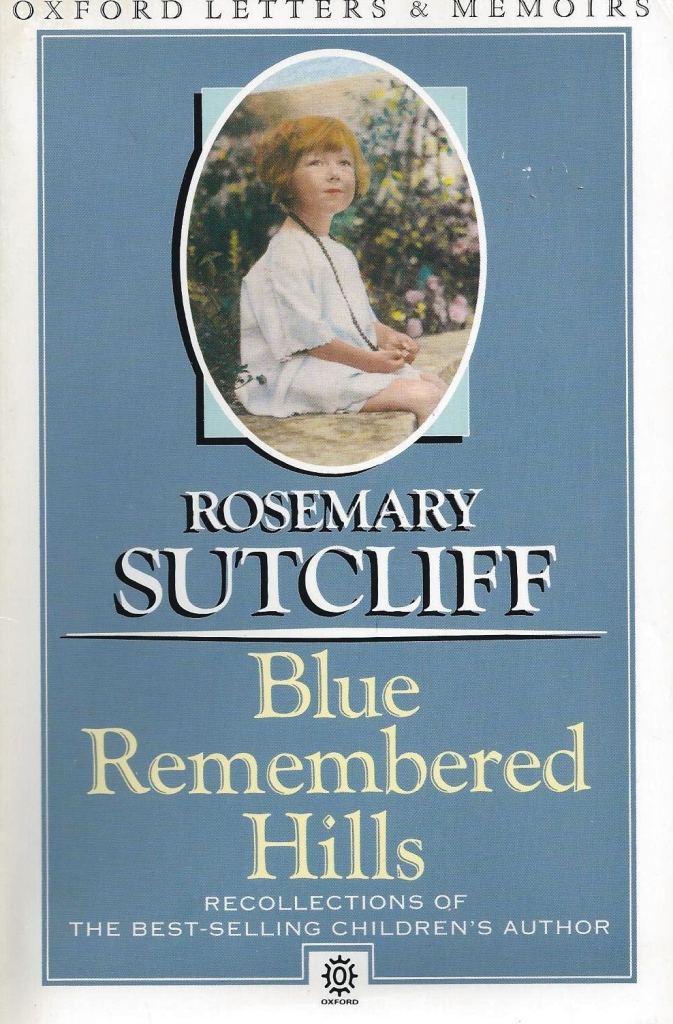
Blue Remembered Hills by Rosemary Sutcliff ~ 1983. This edition: Oxford University Press, 1988. Softcover. ISBN: 0-19-281420-6. 141 pages.

My rating: 10/10. Perfect. My only complaint is that it is too short. A stellar memoir by one of my favourite writers.

*****

Rosemary Sutcliff, 1920-1992, is still very much an icon of the historical fiction world. Author of something like fifty meticulously researched stories, many focussed on Roman-occupation-era Britain, Sutcliff created works which have lasting appeal and interest across a wide age range.

The Eagle of the Ninth (1954), The Silver Branch (1957), and The Lantern Bearers (1959) are possibly the best-known of her works, and have been continuously in print since their original publication.

Rosemary Sutcliff herself was a personality fully as fascinating as any of her fictional heroes and heroines. Her life was marked with great physical suffering, which she dealt with by immersing herself in her creative work. When she was only two years old, Rosemary developed Still’s Disease, a rare and extremely painful form of juvenile arthritis. After the disease subsided, the permanent damage to her joints severely curtailed Rosemary’s physical abilities. She spent most of her adult years dependent upon a wheelchair, and wrote using a modified pen to enable her hands to grasp it.

Her enforced inactivity made Rosemary a keen observer of the world around her, and a great seeker of solace in literature. To while away the long, bed-ridden hours, Rosemary’s mother actively read aloud to her, and Rosemary so enjoyed these dramatic performances that she resisted learning to read herself until she was nine years old. Rosemary’s first written works were retold versions of stories dramatically told to her by her mother.

Blue Remembered Hills is a remembrance of Rosemary’s earliest years, from her first memories until the publication of her first books, The Queen Elizabeth Story, and Robin Hood, in 1950, at which time she started keeping a written journal. These journals have never been published, though they are in the hands of Rosemary’s literary executor, her cousin and godson, Anthony Lawton. He curates a blog and has posted some of the entries from her diary here .

The memoir is wonderfully well written, and contains myriad details of Rosemary’s early life, with a frank sharing of her thoughts and feelings regarding her own situation and the people around her. Discussing her extended family, this passage rather made me chuckle, and is a good example of the subtle humour of Rosemary’s prose.

Aunt Edith was a handsome woman with straight thick brows which remained raven black even after her hair had turned swan’s-wing white, and the bitterest mouth that I have ever seen on anybody. She, alas for them both, had married Archie, weak-willed and amiable, who did not tell her beforehand that he was a quarter Indian – his mother being the product of an Indian Army colonel and a rajah’s daughter – what would have happened if he had told Aunt Edith before it was too late, there’s no knowing. Maybe she would still have married him, but I very much doubt it. As it was, finding out afterwards, she refused to have children – I very much doubt if she even allowed him into her bed! – and set out to make his life a cold hell to his dying day. I have been there at some family gathering myself, puzzled as a dog may be by stresses in the air, the electric discharge of things I did not understand, when he came into the room, and Aunt Edith sniffed loudly and said, ‘There’s a most peculiar smell in this room. One would almost think that somebody black had come into it.’

For many years, the family were quite seriously prepared for Uncle Archie to murder her one day, and prepared, if he did, to go into the witness-box on his behalf and swear that he did it under unendurable provocation.

Rosemary also refers to in the most poignant detail her doomed love affair with Rupert King; the true tragedy of their relationship not in Rosemary’s physical condition, but in Rupert’s polygamous nature. Already married to a much older woman, Rupert persisted in the love affair with Rosemary, and, upon achieving his divorce, immediately married a third woman, suggesting to Rosemary that they carry on some kind of platonic three-way relationship so he would not lose the pleasure of her company. Rosemary actually considered this, and went to London to meet Rupert’s new fiancée, but soon realized that this was not a feasible option for any of them, and the two permanently parted ways, with Rosemary thereafter directing her passion into her work. Though the affair brought her much emotional trauma, Rosemary insisted that she was glad that she had had the experience of being deeply in love, and being beloved in her turn, because it gave her a broader depth of experience and brought forward feelings which she had thought never to experience because of her disability. A gallant lady.

I do so wish that Rosemary Sutcliff had continued this memoir to discuss her later years; this is a teasingly slender though richly filled book. Very highly recommended.

*Edited November 18, 2012 to add a link to a wonderful review I’ve just happened upon, by Steve Donoghue at Steve Reads.

Read Full Post »

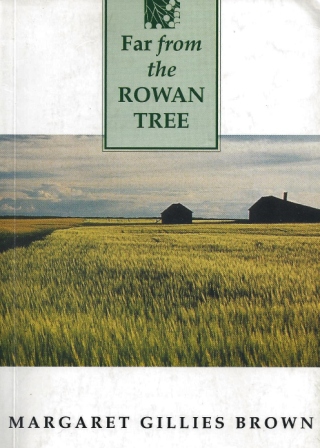
Far From the Rowan Tree by Margaret Gillies Brown ~ 1997. This edition: Argyll Publishing, 1998. Softcover. ISBN: 1-874640-696. 239 pages.

My rating: 8/10. I thought this quite an engrossing read, and an interesting perspective on a somewhat neglected era in Canadian history.

*****

In 1959 Margaret Gillies and her husband Ronald, with their three young boys, left Scotland to immigrate to Canada to try farming there. They left more for personal than financial reasons, seeking a new life and atmosphere far from what the stresses of working with Ronald’s demanding father, and with the sheltering hand of a Canadian Immigration program to encourage farm workers, they thought that their new life would be at least as congenial as the one they had just left.

This proved to be far from the case. Added to the environmental shock of landing in wintry Halifax in February, there was the unsettling trip by train across the vast stretch of country between the East coast and their first placement on a dairy farm in central Alberta, near Red Deer. This proved to be even more unsettling; the accommodation they were provided was an unfurnished shack with the barest amenities. There was electricity of a sort, but only an outside privy and hand-pump for water; Margaret, on top of having three children under six, was also half way through her fourth pregnancy. Ronald’s employer, whom they soon found was hard-pressed to find local help due to his foul temper and abusive manner, was of little assistance, and kept Ronald fully occupied except for a half day off a week.

Margaret and her family struggled through, and eventually were moved to a better situation on a mixed farm. Here they spent a happier summer, but found they were not able to manage on a farm labourer’s wages, especially with winter coming on and less pay because of reduced work hours. The family then moved to Edmonton, where Ronald took on a new career as a real estate salesman. This, though not a reliable income, allowed a rise in their standard of living, but there were still many challenges, and the family  returned to Scotland to take over Ronald’s family farm, as his father had in the meantime decided he was ready to retire and relinquish control to Ronald. The Canadian experiment had lasted three years.

The family, despite their dismal introduction to the country, had become happy in their adopted land, so this was not an easy decision. Margaret in this memoir speaks with great admiration and affection of the friends they made, and of the natural beauties that surrounded them, easing even the most uncomfortable of their several sub-standard homes.

A fifth baby was born in Canada, and it was with something like fond regret that the Gillies returned to their home country. Margaret would go on to have two more children, and several of her sons still operate the Scottish farm where she lives in retirement today.

Margaret had always been something of a writer, though she had set aside her “jottings” while training and working as a nurse, and later as a farmwife and busy mother. She had a few moments during her Canadian foray to create some poems, of which several are included in the book. Margaret took up her writing more seriously when her children grew up, and has become a highly respected Scottish poet and writer. Far From the Rowan Tree is the first in a number of memoirs and family histories she was inspired to write some thirty years after the Canadian years.

Margaret’s voice in this book is both romantic and vividly descriptive, as well as opinionated and matter-of-fact. It is most fascinating to see my own native country from an outsider’s eyes, especially as I am personally familiar with the areas of Alberta where the family resided, though their time their preceded my own by almost thirty years, and there were many changes in that time, as the oil industrry picked up speed and the standard of living even among the most struggling of the farms improved immensely.

Her story also reminds me in many ways of my father’s saga of coming to Canada as a German immigrant in the 1950s, working his own way across the country farm to farm until he ended up working in logging and construction in interior British Columbia. I am wondering now if perhaps he was involved in the same immigration program, placing farm workers? It is impossible to ask him, as he died several years ago, but I wouldn’t be at all surprised, as his experiences with various employers rather echo those of the Gillies’.

I found Margaret’s memoir hard to put down. It is nicely written, and kept my interest from start to finish. I would definitely read more of her literary works, as well as her poetry collections. I found some of her later poetry published online, and though it does not all appeal to my personal taste, some of it seems to me to be quite good, very evocative of setting and mood. Here is a sample from the frontispiece of Far From the Rowan Tree.

Emigrant Journey

There was the journey,
The endless coming on of the same wave,
The no-land time of ocean and high hopes
Until the icebergs rose
Like white snow palaces…
There were the moving days
And weary nights of train-hours overland,
The trees, the lakes, the straight and rolling plains
Until time stopped in sheer fantasy
Of a pre-dawn winter morning –
Gloved hand swinging the iron-hard handle
Of a frozen water pump
At the edge of a bark-rough cabin;
Above, the sky, moving strange magnificence,
Voile curtains of colour
Changing, shifting imperceptibly;
Below, the star-sparkled snow –
A virgin’s looking glass
Where spruce trees shot the only shadows
That made no movement –
Silence, immensity of silence,
Oil fires were burning brands
Reaching for chiffon robes
Of an aurora of dancers
Repeating dream sequences …
I tried to wake from unreality,
Felt my spine freeze,
Heard coyotes howling down the night.
 

~Margaret Gillies Brown~

Read Full Post »

Confessions of an Igloo Dweller by James Houston ~ 1995. This edition: McClelland and Stewart, 1996. Softcover. ISBN: 0-7710-4286-8. 320 pages.

My rating: 9/10. Enjoyable start to finish. Canadian by birth, the far-travelling Houston (1921-2005) was a great writer and storyteller, as well as an accomplished artist.

*****

Around here, I can tell if a book is really good because it often will disappear before I finish it. The usual culprits are my husband and my 18-year-old son. If it’s my son, no worries – he’s a speedy reader and I usually get it back in a day or two, but my husband has less free (meaning reading) time and he also tends to read a little more slowly, plus he also has a tendency to “hide” his current read (so he can find it again – he says we “move things” on him) – so, if he has the book, kiss it goodbye until he’s done.

I’ve been bugging him to let me have this one back for a few weeks now, as I wasn’t quite finished when he snuck it away from my reading pile.  He’s been working his way through it steadfastly, occasionally calling me to come and listen, and reading bits out loud. Something about this memoir really appealed to him, which is understandable, because it’s quite fascinating and very well written.

In 1948, 27-year-old James Houston managed to hitch a ride on a plane going on an urgent medical call from Moose Factory, Ontario to Canso Bay in northern Quebec. An experienced and talented artist, Houston had a keen interest in native peoples, and was in Moose Factory sketching and painting the local Indians. He had long wanted to travel further north into the Arctic, and he seized the chance when it came, staying behind in Canso Bay when the plane left to return to Montreal with the badly injured Inuit child it had come to evacuate.

This was the start of Houston’s fourteen or so years of Inuit artistic involvement. He had a keen eye for indigenous crafts, and was instrumental in the popularization of Inuit carvings for the southern markets, as well as introducing Japanese-style print-making to the Inuit, which was readily adopted as a new mode of expression for Inuit artistic vision.

Confessions of an Igloo Dweller is roughly chronological, and consists of personal anecdotes interspersed with vignettes from high Arctic life, and stories told to him during his travels.

Houston also wrote quite a number of novels for children as well as adults, most set in the Arctic or the far northern Canadian forests. Confessions reads like a novel, flowing seamlessly along from high point to high point. Houston was opinionated and extremely sure of himself; these qualities come through loud and clear, making for an especially strong narrative voice. The book is saved from shameless self-promotion by Houston’s ability to tell a humbling story on himself, and by his keen sense of humour.

We all liked it. Highly recommended.

Read Full Post »

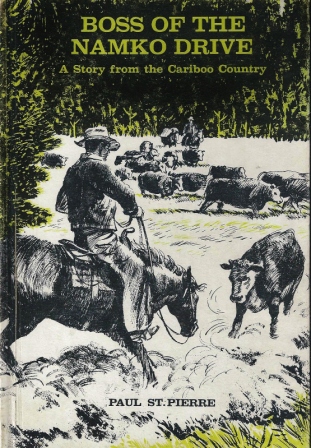
Boss of the Namko Drive by Paul St. Pierre ~ 1965. This edition: Ryerson Press, circa 1970. Hardcover. ISBN: 0-7700-3024-6. 117 pages.

My rating: 9.5/10. Paul St. Pierre perfectly captures the atmosphere and people of Interior British Columbia’s “Cariboo Country” Chilcotin Plateau. He’s dramatized things to make “good fiction”, but not so much as you would think. I live here. I know people – heck, I’m related to people (by marriage, that is – my husband’s family is venerable Cariboo-Chilcotin pioneer, 1860’s gold rush era) – who could have stepped into or out of this story.

My husband says he remembers reading this as an English class novel in the early 1970s, and I also remember a class set in one of my Williams Lake schoolrooms, though I never personally “studied” it. Reading this novel for the first time as an adult was a real treat, for I had read so much regional literature by then – stellar and otherwise –  about our personal stretch of country that I realized how good this fictional vignette really is; if not a sparkling gemstone, then at least a nicely polished, glowing golden agate from the banks of the Fraser River.

The story moves right along; a quick little read for teens and adults. Highly recommended.

*****

Author’s Note:

Young people for whom this story is written should not try to find Namko on the map of British Columbia. It is fictional. So are the characters in this book.

There is such a region, however. It is the westernmost extent of Canada’s cattle country, lying between the Fraser River and the Coast Mountains. The story is my attempt to tell the truth about life on these remote ranches. If it does not, the fault is mine.

15-year-old Delore Bernard starts out as the lowest hand on the 200-mile cattle drive led by his father Frenchie from the high Chilcotin to the stockyards in Williams Lake. Soon into the trip, before they’ve cleared the home ranch meadows, Frenchie breaks his leg as his horse bucks him off and falls on him. Frenchie, to everyone’s surprise, appoints Delore as “boss” in his place, a decision unquestioned by the rest of the cowboys, who for various personal reasons, are perhaps quite happy to have a young and green official leader.

Delore’s trip to the Lake is complicated by a stampede, cows caught in bogholes, packhorse wrecks, a runaway or two, an encounter with a murderer on the run, and the cowboys’ weakness for strong liquor, among other things. But, as Delore implies on the other end, it’s all in a day’s work for a Chilcotin cow boss: “Nothing to report.”

Read Full Post »

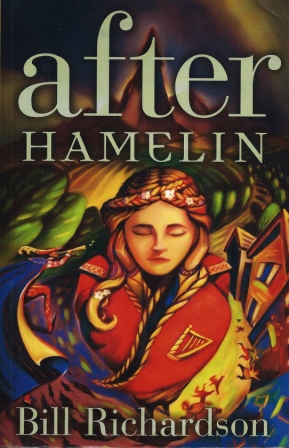
After Hamelin by Bill Richardson ~ 2000. This edition: Annick Press, 2000. Softcover. ISBN: 1-55037-628-4. 227 pages.

My rating: 6.5/10. Sorry, Bill. This one was a bit hit and miss with me. You got an extra point from me for old times’ sake, because I’ve been a (mostly) appreciative fan of yours since CBC Radio “Sad Goat” days.

I really liked parts of it, especially the character of Penelope, with her 101-year-old words of wisdom, and I admired the imagination of  the Frank L. Baum Oz-ish dream world, but I really had to push to see this one through to the end. I kept stopping and yawning and mentally saying “Where are we? Oh, yeah, she’s in the dream world now…”

And while the bizarre (and nicely imagined – I laughed at these) realms of the ski-footed flying creatures living in the land of perpetual ice and moonlight, and the rope-skipping, directionally challenged dragons next door were quirky and funny and sweet, the dark overtones of the menace waking from its sleep struck a harsh note. And I couldn’t really get what the Piper was all about. Even if he woke, what was going to happen? I mean, how bad was it going to be? Just another magician gone wrong…

And the whole turning-eleven thing. Obviously a puberty ritual, but surely a bit young for the whole “welcome-to-womanhood” chorus of the villagers? Or maybe I’m reading too much into that. Probably a cigar is just a cigar, and it’s merely a cute plot device.

This is not a bad book, and it had some great sequences, but I didn’t immediately love it. A pleasant, light diversionary read, for mature-ish children, say 10 and up, to adult. Well-constructed “after the end of the fairytale” story. Good discussion starter, or as part of an exploration of alternative fairy tales and such.

Oh, and an extra .5 point for the talking cat. (One of my personal weaknesses. I do so love a talking cat.)

Gorgeous cover art, too!

*****

Everyone knows the story of the Pied Piper of Hamelin. How, in a town plagued with rats, there appeared a mysterious man who promised to rid the town of the creatures, and, after being promised a lavish reward, did just that, piping out a magical tune that drew them from every nook and cranny, as the piper led them far away. Coming back for his promised reward, the greedy town councillors refuse his pay, at which point the piper takes revenge by calling all of the children of the town after him, save one crippled child, who cannot keep up and so is spared. This is where the story ends. But what happens after?

After Hamelin is Bill Richardson’s fantasy about the next stage in the story. In his version, not one but two children remain behind. Penelope, who has just woken to a sudden deafness on the morning of her eleventh birthday, and Alloway, a blind harpist’s apprentice, who gets lost as the horde of children travel through a forest. Between Penelope and Alloway, Penelope’s elderly cat Scally, the village wise man Cuthbert, and his three-legged dog Ulysses, a rescue is carried out, through the medium of a trance state – Deep Dreaming – and the liberal use of magical skipping-rhymes.

Narrated by Penelope herself, who, at the age of one hundred-and-one, still looks back on her long life and unbelievable adventures with clarity and humour, the tale is told through a series of flashbacks and reminiscences.

A children’s story for all ages.

And here is an interview with the author, which puts everything into context.

Bill Richardson Interview – After HamelinJanuary Magazine

Read Full Post »

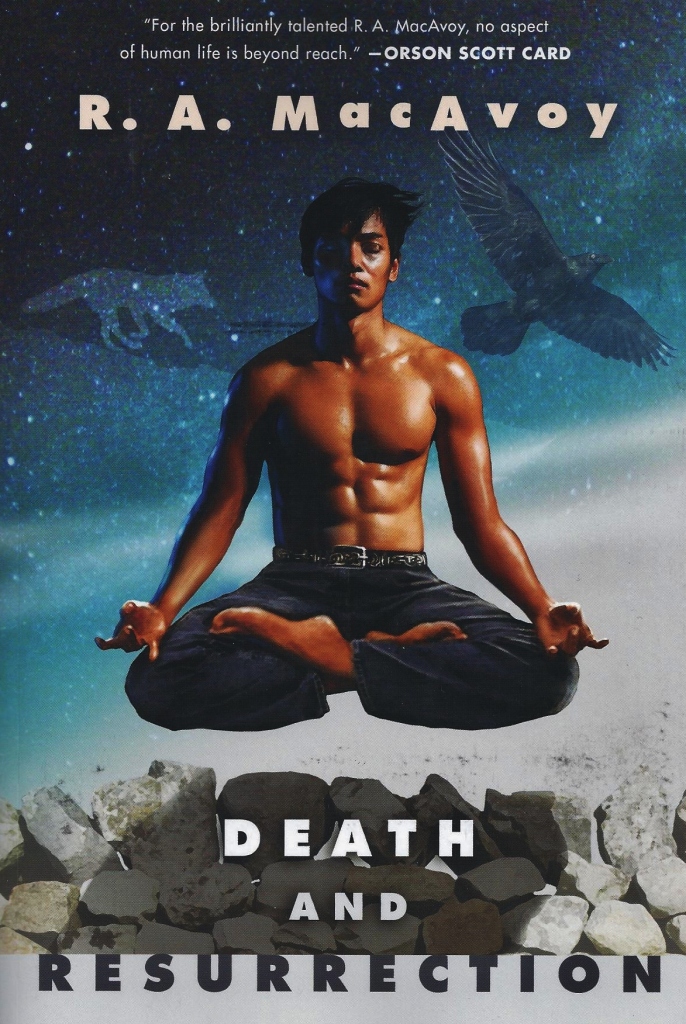
Death and Resurrection by R.A. MacAvoy ~ 2011. This edition: Prime Books, 2011. Second Printing. Softcover. ISBN: 978-1-60701-286-3. 333 pages.

My rating: 9/10. Probably a bit higher than it really deserves – it’s a far from flawless novel – but I’m just so happy that R.A. MacAvoy is back in the game after a very long hiatus due to ill-health (18 years), and because I really like the way this author thinks.

A few issues with dialogue and occasionally awkward phrasing, and some serious suspension of disbelief issues – I can handle the wendigo/spirit bear thing, and the travelling between life and death, but how do these working people with demanding jobs – veterinarian, psychiatrist – get so much time off, apparently consequence-free?

*****

A very hard-to-classify book. Fantasy, maybe? With thriller and murder mystery overtones. And there’s quite a sweet love story in there, too. And it’s funny. And violent. Death by bamboo! Katanas! Oh – but hang on – the main character is a pacifist Buddhist. Well, maybe things don’t always work out as planned…

You know, except for the messy fight scenes (and the katana) this one really reminds me of MacAvoy’s first novel, the highly regarded and award-winning Tea With the Black Dragon, though the characters in Death and Resurrection are completely different and the story is absolutely original.

And now I am going to completely cheat and steal the reviews from the publisher’s website, because, darn it anyway, it’s been a long, long day, and it feels like bedtime and I need to treat myself with some reading time.

From Prime Books:

The award-winning writer of Tea With the Black Dragon and other acclaimed novels returns to fantasy with the intriguing story of Chinese-American artist Ewen Young who gains the ability to travel between the worlds of life and death. This unasked-for skill irrevocably changes his life—as does meeting Nez Perce veterinarian Dr. Susan Sundown and her remarkable dog, Resurrection. After defeating a threat to his own family, Ewen and Susan confront great evils—both supernatural and human—as life and death begin to flow dangerously close together.

” I love R.A. MacAvoy’s books. Do yourself a favor and pick this up.”—Charles de Lint

“For the brilliantly talented R. A. MacAvoy, no aspect of human life is beyond reach.”—Orson Scott Card

About the Author: R.A. MacAvoy is the author of twelve novels. Her debut, Tea With the Black Dragon, won the John W. Campbell Award, the Locus Award for best first novel, and a Philip K. Dick Award special citation. It was also nominated for the Nebula Award, the Hugo Award, the Ditmar Award, and listed in David Pringle’s Modern Fantasy: The Hundred Best Novels. Born in Cleveland, Ohio, she has been married for thirty-three years to Ronald Cain. They live in the Cascade Foothills of Washington State.

Reviews:

MacAvoy clearly  still has the talent for the ingratiating characters and revealing detail that made her first novel so delightful; almost every character is handled with wit and grace…Death and Resurrection turns out to be far less portentous adventure romance than its title implies…and almost inevitably more enjoyable…it’s good to have her back.—Gary Wolfe, Locus

MacAvoy’s expansion of her 2009 novella “In Between” will please fans of her thoughtful hero Black Dragon, though new protagonist Ewen Young goes past philosophical to passive. Ewen, a Chinese Buddhist, just wants to be a painter and practice kung fu, but fate has other plans. He’s always had a touch of the spiritual, whether it’s an empathic bond with his twin sister or a psychic retreat he can share with others. When a brush with death kicks it up several notches, he ends up reluctantly guiding an investigation and a school as well as building a relationship with a strong-willed Native American vet and her body-hunting dog. Ewen’s (and MacAvoy’s) refusal to explore the origins of his powers takes the tone of the book further from most Western speculative fiction and toward magical realism or mysticism, which will delight some readers and irritate others.—Publishers Weekly

What they said. Good stuff. Check it out. More MacAvoy reviews coming in the future – I have everything she’s written to date; they all live on my favourites shelf.

Read Full Post »

Green Grows the City by Beverley Nichols ~ 1939. This edition: Jonathan Cape, Ltd., 1939. Hardcover. First edition. 285 pages.

My rating: 8/10. A little lush in the prose department, but ultimately I found this semi-fiction quite a likeable diversion. The chapter devoted to the author’s black, half-Siamese felines, Rose and Cavalier, won me completely over; I had been wavering a bit as the human cattiness of the narrative was sometimes rather too precious. Nichols’ affection for and description of his pets is a lovely bit of writing, appealing to anyone who shares his predilection for cats as the perfect – though endlessly demanding – home and garden companions.

The author makes no pretensions about his preferred role as planner and onlooker rather than a get-dirty, hands-on gardener. A little light watering, the plucking of a few blooms to adorn the breakfast table, maybe a mite of flower arranging to while away a slow morning, while the hired gardener does the heavy stuff under our Mr. Nichols’ interested eye…

Oh, meow! Who’s being catty now?

*****

Beverley Nichols, in his long life (1898-1883) in which he acted out the roles of journalist, author, playwright, composer, lecturer, pianist, and gay (in every sense of the word) man-about-town, alternately amused and infuriated his audience, friends and, I suspect, more than a few enemies. Possessed of a very high opinion of himself, a keenly sarcastic tongue, and a decided willingness to share his lightly censored thoughts in print, Beverley Nichols remains as readable today as he was when first published. Especially popular are his garden books, as among all the chattering nonsense and superfluous frills there are passages of very authentic admiration and insight into the appeal of that cultivated “square of ground” so universally sought after the universal tribe of gardeners, and his portraits of the plants that struck his fey fancy are small treasures of descriptive prose.

Speaking in the chapter regarding ferns,  Rhapsody in Green, in Green Grows the City, of his introduction to the gold and silver ferns (Gymnogramme species) at Kew:

…(A)s I stooped to tie the (shoe)lace, I happened to glance upward. And the underside of this fern was coated with gold, pure gold, that glistened in the sunlight.

Perhaps it may sound silly to say that it was the loveliest thing that has ever come my way since I have seem life through the eyes of a gardener… I knelt down before it. The closer I came, the more lovely did the fern appear. There were no half-measures about the gold-dust with which it was so richly coated. It wasn’t just a yellow powder. It bore no sort of resemblance to the ochre make-up with which the lily is adorned. Nor was the gold dusted merely here and there – it covered every curve and crevice of the frond.

The tiny shoots that were springing up from the base were, if possible, even brighter. Since their leaves had not yet opened, and there was no green about them, they looked like delicate golden ornaments, daintily disposed about the parent plant.

And by the side of it was another excitement. A silver fern! As thickly coated with the metal of the moon as the other had been coated with the metal of the sun. If I had not realized the futility of comparisons at moments such as this, I would have dared to suggest that the silver fern was even more beautiful than the golden. For it seemed actually luminous with this magic dust. And again, there were no half-measures. It was silver. Not just white or grey, not in the least like, say, a centaurea. It was silver, hall-marked, pure and glistening from the inexhaustible mint of Nature.

What gardener could resist such a teasing description? Now in my botanical garden and specialty nursery visits I shall be forever watching for gold and silver ferns…

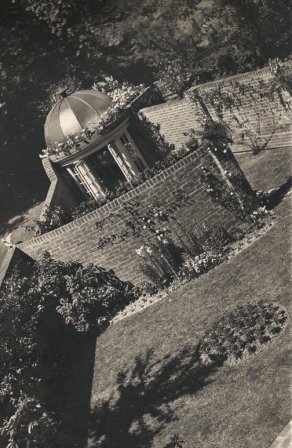
Green Grows the Garden is the fictionalized account of the creation of a very real garden. In 1936, after parting from his beloved country cottage and garden in the village of Glatton, Nichols tried the inner city life, living in a small, gardenless house in the Westminster district of London. Homesick for a bit of green, he tried without success to find a more suitable situation.

I had a hunger for green. I was lonely for the sound of trees by night. I longed to feel the turf beneath my feet, instead of the eternal pavement. Even if it were only a narrow strip of sooty grass, it would be resilient and alive, and would give me some of its own life.

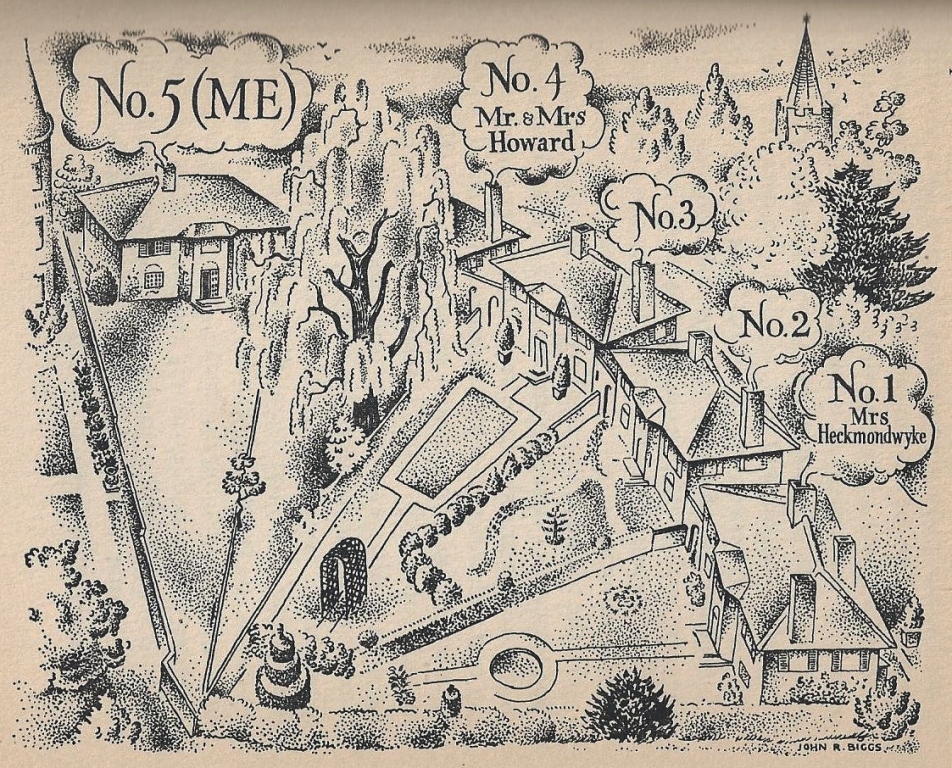
Finally a small semi-detached house is found, in a close in the suburb of Heathstead. There is a garden, of sorts, a triangular-shaped bit of ground which challenges the would-be garden-designer with its peculiar idiosyncracies.

The challenge is accepted, and the transformation begins. Struggles with the site abound, not least of which is the continual protestation of every one of Nichols’ projects by the overbearing “Mrs. Heckmondwyke” of No. 1. The feud between No. 5 and No. 1 drives much of the drama of this microcosmic enterprise, though in the end something of an uneasy truce is attained.

The book is dedicated “To My Friends Next Door”, probably to nip in the bud any idea that any of them were the actual prototype of the overwhelming Mrs. H, and Beverley Nichols quite freely admits, in an evasive forward, that perhaps some of his characters owe more to fiction than to real life. The garden was a real garden, though; as were the cats and the extraordinary, imperturbable, Jeeves-like manservant Gaskin.

As the story draws to a close, the shadow of World War II is looming, and in the last chapter there is sober reference made to the outside world. Watching newsreel footage, Nichols comments:

…Line after line of youths, in brown shirts, black shirts, red shirts, any sort of shirt…marching, always marching. Backwards and forwards, to the North, to the South, to the East and West. Marching with bigger and better guns, to louder and fiercer music. Marching with clenched fists or with outstretched arms, animated by the insane conviction that the fist that is clenched was made for the sole purpose of striking the arm that is outstretched. Marching, always marching, blind to the beauty that is around and above, deaf to all music save the snarl of the drum, marching to a destination that no man knows but all men dread.

And I suspect no one will be found to argue with the often quoted final words of this little book:

…(T)hat if all men were gardeners, the world at last would be at peace.

Read Full Post »

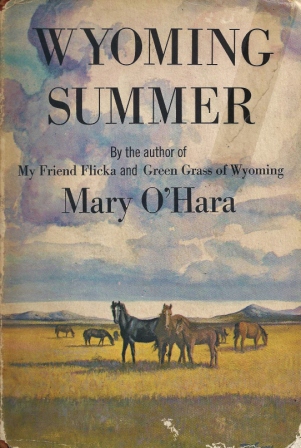
Wyoming Summer by Mary O’Hara ~1963. This edition: Doubleday & Company, 1963. Hardcover. 286 pages.

My rating: 7.5/10. An enlightening backstory of a short period of the author Mary O’Hara’s (1885-1980) life, and details the inspiration for My Friend Flicka, Thunderhead and The Green Grass of Wyoming. It felt rather self-congratulatory at times – my handsome husband, my great natural talent as a composer, my amazing sensitivity to the glories of nature, my important celebrity friends – but to excuse this it seems that most of Mary O’Hara’s boasts were indeed true. This account is also balanced with explanations, and details of the valleys as well as the peaks of the experiences within.

Presented as an autobiography, Mary O’Hara herself notes in the Preface that she has tinkered with her journal entries to make them more cohesive and readable. While the book has a reasonably strong narrative flow, there are frequent times when the entries are a bit disjointed, with out-of-place comments tacked onto longer vignettes. Perhaps this was done to maintain the feeling of a spontaneous journal, but since the work was already being edited I think it might have been stronger if these snippets had either been expanded upon or left out completely.

*****

This book was a surprising find last week in a quick scouting cruise through Nuthatch Books in 100 Mile House. The author’s name was immediately recognizable – for what horse-crazy child of my particular generation has not read My Friend Flicka? – but I was unfamiliar with the title. A lesser-known novel, perhaps? On closer investigation I found that this was an autobiographical account of part of a year spent on the Wyoming ranch that inspired the Flicka bestseller and its two sequels.

Mary O’Hara Alsop was a talented pianist, published composer, and Hollywood script writer when she turned her hand to writing fiction. Inspired by the rugged surroundings of the ranch which she and her second husband, Helge Sture-Vasa, purchased in Wyoming in 1930 and lived on for sixteen years, and the horses and other ranch animals she came to know intimately, O’Hara’s novel My Friend Flicka was published in 1941 to immediate acclaim. It was based on the journals O’Hara had been keeping of her life on the ranch, and the characters were very much drawn from her own family, friends and the ranch workers.

Wyoming Summer is set in the tenth year of she and her husband’s occupation of the Remount Ranch. Their initial scheme of sheep farminghad failed dismally, as prices for livestock dropped catastrophically during the Great Depression. Helge (referred to as “Michael” in Wyoming Summer, and the prototype for “Rob” in the Flicka books) was an experienced ex-Army cavalry officer, and the next enterprise that met with modest success was that of raising and training horses (“remounts”) for the U.S. Army. This was a precarious and not particularly prosperous undertaking, and Mary’s dairy herd and the establishment of a summer boy’s camp catering to the sons of her well-off music and film connections paid many of the bills.

Wyoming Summer details the challenging and exhausting juxtaposition of Mary’s dual worlds: ranch wife baking bread, hand-milking cows and dealing with daily chores combined with aspiring composer eagerly snatching the hours needed for piano practice and composition from her more prosaic duties.

Though this autobiography details both the rewards and drawbacks of life on a remote ranch, it decidedly glosses over the personal crises that Mary O’Hara dealt with throughout her life. A difficult first marriage resulted in two children, one of whom, a daughter, died tragically of cancer in her teens. After her divorce from her first husband, Mary’s second matrimonial attempt seemed happier, at least initially, but it was also doomed. Helge was a handsome, hard-working, hard-drinking man who was not above a certain amount of philandering, and that marriage ended, after the sale of the Remount Ranch and a move to California, in 1947.

Mary continued her work in composing music and working on stage and screen productions, as well as publishing several other novels. The journals kept while at the Remount Ranch had been set aside among Mary’s papers, and when they resurfaced in the 1960s Mary thought she could make something of them, hence the publication of Wyoming Summer. Several other novels met with modest success, but it was the Wyoming trilogy, and in particular the first installment, My Friend Flicka, that ensured Mary O’Hara’s longest lasting acclaim.

Wyoming Summer is interesting both for its window into a specific time and place, and for what its author leaves out. While we are allowed into certain areas of Mary O’Hara’s complex life, we are firmly shut out of others, leaving us with a definite feeling of being a spectator with limited access to the performance being played out.

These few reservations aside, Wyoming Summer is definitely worth reading, especially in tandem with the more purely fictional novels of the same setting.

Read Full Post »

« Newer Posts - Older Posts »