Archive for the ‘Poetry’ Category

The Unhappy People


Professor, may I introduce you

to two of the Unhappy People, whom you’ve described

as inhabiting a cultural vacuum

somewhere between the swamps of Frustration

and the salt sea of Despair.

May I present my wife’s cousins, Corey and Brent.

You will note immediately that their teeth are translucent,

the colour of reconstituted powdered milk,

which can be attributed to hereditary malnutrition,

as their lack of earlobes can be ascribed to inbreeding.

You are free to make notes, if you wish.

At worst, they’ll merely laugh at you.


Professor, I must ask you to forgive

the mandolin, the five-string banjo, the guitar, the fiddle

and the jew’s-harp. I must ask you to bear with

Brent when he dances – he prefers it to walking to

the refrigerator for another beer – and Corey when he

scratches

his groin in symbolic tribute to the girl in the yellow

bathing suit

playing with a frisbee on the grass across the street.

I know it’s distracting when, for no apparent reason,

they break into song. I can understand your not laughing

with them when they talk about driving

four-year-old cars at one hundred and ten

miles per hour down dirt roads with the police behind them,

of overturning and wondering drunkenly how to shut off

the headlights, until logic triumphed and they kicked

them out.

I beg you not to be disturbed when they whoop

at the tops of their voices – it’s in their blood,

I’m afraid, their way of declaring an instantaneous holiday

and, besides, Brent got out of jail this morning

or, as he puts it, got back from his annual vacation,

having been locked up this time because he didn’t

know his own strength, he says, and when he was refused

service

at the liquor store, being drunk, forgot he was carrying

nothing under his left arm to offset the force of his right

pushing open the door on his way out and so, purely by

accident,

drove his fist through the glass:

it could have happened to anybody, Your Honour,

he told the Court. You must excuse Corey, Professor,

like every other member of his family he walks in and out

of rooms without thinking it necessary to offer

any explanation. When they arrive at my house

or any other, they open the door, come in, sit down

and, perhaps, switch on the radio. They’d expect you to do

the same.

If you go to the window, Professor, you’ll see

that he’s talking with the girl in the yellow bathing suit

and already has her laughing. “Once you got them laughing,

you’re as good as in bed with them,” Brent says.

In celebration

he jumps up again and dances. They’ve brought venison

and wild rice and a half-dozen jars of their mother’s

homemade preserves and pickles, fresh loaves of her bread

two double cases of beer and a forty-ounce bottle

of dark rum, having shut down the cannery

where Corey works in honour of Brent’s homecoming.

“I said to hell with ‘er, let’s tie ‘er up.”

and with unanimous approval of his fellows,

conveyed without a word, he tied her up well

by making certain delicate adjustments to the machinery

when the bosses weren’t watching. His laughter and his

brother’s

laughter and the laughter of the girl in the yellow bathing

suit

mingle and rise like water from a garden hose, spraying the

windows

from inside and out. The passersby turn

and smile, a neighbour’s dog runs to see what’s happening,

a host of starlings take wing, the tiger lilies are in flower

at the edge of the parking lot next to this house.

Professor, I don’t suppose you’d care to arm-wrestle?


Alden Nowlan ~ Smoked Glass ~ 1977

This poem is dedicated to some guys I used to know.

Gone, most of them, flamed out and crashed and burned in (mostly) self-imposed self-destruction.

The hard living took its toll, but they had a grand time while it lasted.

And they made a lot of people laugh.

Gone, but definitely not forgotten!
 

Read Full Post »

A happy find yesterday while book-shopping! Two volumes of poetry by Edna St. Vincent Millay, Collected Lyrics and Collected Sonnets, both published by Harper & Row mid-2oth Century, with poems chosen by Millay herself. And while peacefully reading Lyrics this rainy, windy morning, the following struck me as almost too perfectly appropriate.

Enjoy.

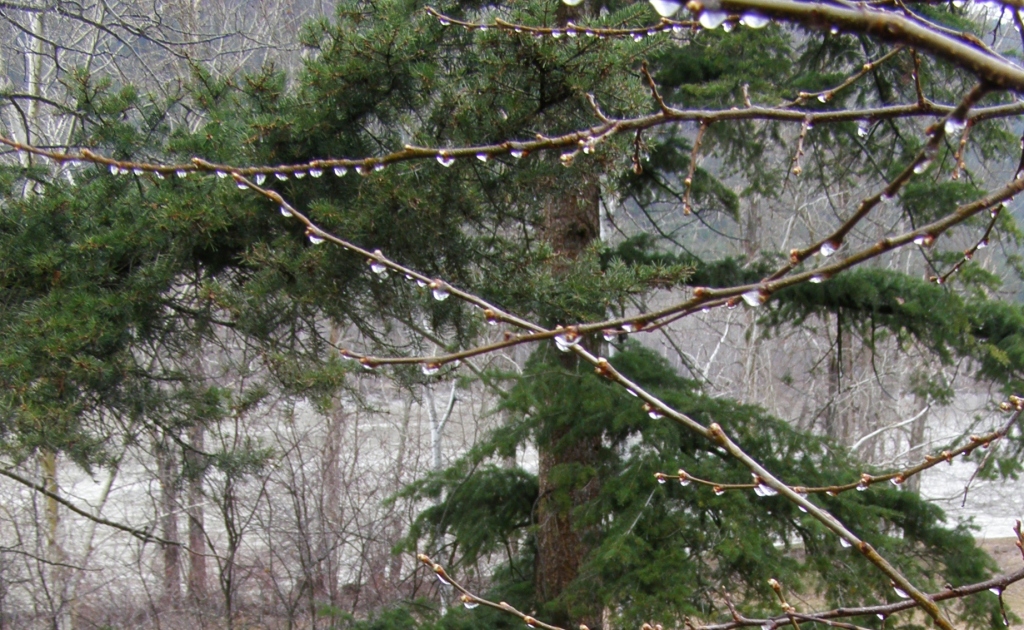
Raindrops turn to icedrops as the wind comes from the north ... Hill Farm, April 5, 2013

Raindrops turn to icedrops as the wind comes from the north … Hill Farm, April 5, 2013

Northern April


O mind, beset by music never for a moment quiet, –

The wind at the flue, the wind strumming the shutter;

The soft, antiphonal speech of the doubled brook, never for a moment quiet;

The rush of the rain against the glass, his voice in the eaves-gutter!


Where shall I lay you to sleep, and the robins be quiet?

Lay you to sleep – and the frogs be silent in the marsh?

Crashes the sleet from the bough and the bough sighs upward, never for a moment quiet.

April is upon us, pitiless and young and harsh.


O April, full of blood, full of breath, have pity upon us!

Pale, where the winter like a stone has been lifted away, we emerge like yellow grass.

Be for a moment quiet, buffet us not, have pity upon us,

Till the green comes back into the vein, till the giddiness pass.


Edna St. Vincent Millay ~ 1928

Read Full Post »

man & nature efb 2012

Thinking of T.S. Eliot tonight, because of the way his poetry has been showing up in my reading lately. I’ve just finished reading Hugh Walpole’s The Joyful Delaneys, and was intrigued by the snippet of Eliot verse on the frontispiece, so I searched it out. It’s from a play, The Rock, written and performed in 1934. I’ve gone through the verses and highlighted those which I found the most compelling; the entire work is 21 pages long, so it is a bit lengthy to include in its entirety here.

The Rock was performed as a pageant to raise money for the building of new churches in London. It speaks to mankind’s relation to God, about the implications of a world lived without religion, and, more to the point, what it means to build a church. The famous “Choruses” are spoken by bands of workmen. The Rock is strongly pro-religion with anti-fascist/anti-communist overtones, in reaction to the looming shadow of the totalitarian regimes building in Europe, and the rumblings of the coming Second World War.

The entire text can be found here: T.S. Eliot – The Rock

Even taken out of context with the whole work, many of these verses are memorable.

*****

The Eagle soars in the summit of Heaven,

The Hunter with his dogs pursues his circuit.

О perpetual revolution of configured stars,

О perpetual recurrence of determined seasons,

О world of spring and autumn, birth and dying!

***

Where is the Life we have lost in living?

Where is the wisdom we have lost in knowledge?

Where is the knowledge we have lost in information?

***

I journeyed to London, to the timekept City,

Where the River flows, with foreign flotations.

There I was told: we have too many churches,

And too few chop-houses. There I was told:

Let the vicars retire. Men do not need the Church

In the place where they work, but where they spend their

Sundays.

In the City, we need no bells:

Let them waken the suburbs.

I journeyed to the suburbs, and there I was told:

We toil for six days, on the seventh we must motor

To Hindhead, or Maidenhead.

If the weather is foul we stay at home and read the papers.

In industrial districts, there I was told

Of economic laws.

In the pleasant countryside, there it seemed

That the country now is only fit for picnics.

And the Church does not seem to be wanted

In country or in suburbs; and in the town

Only for important weddings.

***

The world turns and the world changes,

But one thing does not change.

In all of my years, one thing does not change.

However you disguise it, this thing does not change:

The perpetual struggle of Good and Evil.

***

The desert is not remote in southern tropics,

The desert is not only around the corner,

The desert is squeezed in the tube-train next to you.

The desert is in the heart of your brother.

***

The voices of the Unemployed:

No man has hired us

With pocketed hands

And lowered faces

We stand about in open places

And shiver in unlit rooms.

Only the wind moves

Over empty fields, untilled

Where the plough rests, at an angle

To the furrow. In this land

There shall be one cigarette to two men,

To two women one half pint of bitter

Ale. In this land

No man has hired us.

Our life is unwelcome, our death

Unmentioned in “The Times.”

***

What life have you if you have not life together?

There is no life that is not in community,

And no community not lived in praise of God.

***

And now you live dispersed on ribbon roads.

And no man knows or cares who is his neighbour

Unless his neighbour makes too much disturbance,

But all dash to and fro in motor cars,

Familiar with the roads and settled nowhere.

Nor does the family even move about together.

But every son would have his motor cycle,

And daughters ride away on casual pillions.

***

In the land of lobelias and tennis flannels

The rabbit shall burrow and the thorn revisit,

The nettle shall flourish on the gravel court,

And the wind shall say: “Here were decent godless people:

Their only monument the asphalt road

And a thousand lost golf balls.”

***

When the Stranger says: “What is the meaning of this city?

Do you huddle close together because you love each other?”

What will you answer? “We all dwell together

To make money from each other”? or “This is a community”?

And the Stranger will depart and return to the desert.

О my soul, be prepared for the coming of the Stranger,

Be prepared for him who knows how to ask questions.

О weariness of men who turn from God

To the grandeur of your mind and the glory of your action,

To arts and inventions and daring enterprises.

To schemes of human greatness thoroughly discredited.

Binding the earth and the water to your service,

Exploiting the seas and developing the mountains,

Dividing the stars into common and preferred.

Engaged in devising the perfect refrigerator,

Engaged in working out a rational morality,

Engaged in printing as many books as possible,

Plotting of happiness and flinging empty bottles,

Turning from your vacancy to fevered enthusiasm

For nation or race or what you call humanity;

Though you forget the way to the Temple,

There is one who remembers the way to your door:

Life you may evade, but Death you shall not.

You shall not deny the Stranger.

***

But it seems that something has happened that has never happened before:

though we know not just when, or why, or

how, or where.

Men have left God not for other gods, they say, but for no god;

and this has never happened before

That men both deny gods and worship gods, professing first

Reason,

And then Money, and Power, and what they call Life, or Race,

or Dialectic.

The Church disowned, the tower overthrown, the bells up-

turned, what have we to do

But stand with empty hands and palms turned upwards

In an age which advances progressively backwards?

***

T.S. Eliot ~ 1934

Read Full Post »

INSTRUCTIONS

Touch the wooden gate in the wall you never saw

                                     before.

Say “please” before you open the latch,

go through,

walk down the path.

A red metal imp hangs from the

               green-painted front door,

as a knocker,

do not touch it; it will bite your fingers.

Walk through the house. Take nothing. Eat nothing.

However, if any creature tells you that it hungers,

feed it.

If it tells you that it is dirty,

clean it.

If it cries to you that it hurts,

if you can,

ease its pain.

From the back garden you will be able to see the wild

                                             wood.

The deep well you walk past leads down to Winter’s

                                             realm;

there is another land at the bottom of it.

If you turn around here,

you can walk back, safely;

you will lose no face. I will think no less of you.

Once through the garden you will be in the wood.

The trees are old. Eyes peer from the undergrowth.

Beneath a twisted oak sits an old woman.

                           She may ask for something;

give it to her. She

will point the way to the castle. Inside it

are three princesses.

Do not trust the youngest. Walk on.

In the clearing beyond the castle the

                    twelve months sit about a fire,

warming their feet, exchanging tales.

They may do favors for you, if you are polite.

You may pick strawberries in December’s frost.

Trust the wolves, but do not tell them

where you are going.

The river can be crossed by the ferry.

The ferryman will take you.

(The answer to his question is this:

If he hands the oar to his passenger, he

will be free to leave the boat.

Only tell him this from a safe distance.)

If an eagle gives you a feather, keep it safe.

Remember: that giants sleep too soundly; that

witches are often betrayed by their appetites;

dragons have one soft spot, somewhere, always;

hearts can be well-hidden,

and you betray them with your tongue.

Do not be jealous of your sister.

Know that diamonds and roses

are as uncomfortable when they tumble

                    from one’s lips as toads and frogs:

colder, too, and sharper, and they cut.

Remember your name.

Do not lose hope — what you seek will be found.

Trust ghosts. Trust those that you have

                helped to help you in their turn.

Trust dreams.

Trust your heart, and trust your story.

When you come back, return the way you came.

Favors will be returned, debts will be repaid.

Do not forget your manners.

Do not look back.

Ride the wise eagle (you shall not fall).

Ride the silver fish (you will not drown).

Ride the grey wolf (hold tightly to his fur).

There is a worm at the heart of the tower;

                             that is why it will not stand.

When you reach the little house, the

                      place your journey started,

you will recognize it, although it will seem

                       much smaller than you remember.

Walk up the path, and through the garden

                           gate you never saw before but once.

And then go home. Or make a home.

Or rest.

Neil Gaiman ~ 2000

Read Full Post »

This November 11th, two poems by ex-soldier Danny Martin of Liverpool, who served two tours of duty in Iraq.

CENOTAPH

The

cenotaph

was first made

of wood;

a temporary tree

for the “Glorious Dead”.

Wood can’t hold the will

of the wolf.

So us little pigs

build in stone now, it lasts

longer. It can be added to

that monument to “the war to end all wars”

spawned more.

 Portland stone
is a blank canvas.
It wants to be filled.
It craves names.
It lusts
for the chisel tip.

Danny Martin ~ 2008

(Note about Portland Stone: Portland stone is the preferred material for many war memorials, including the Cenotaph in London and the new National Arboretum in Staffordshire. During a recent visit to the Arboretum I was struck at the sheer size of its main war memorial, and the vast blank slabs waiting to be filled.  – DM)

LESSONS

Do away with medals
Poppies and remembrance parades
Those boys were brave, we know
But look where it got them

Reduced to line after perfect line
Of white stones
Immobile, but glorious, exciting
To kids who haven’t yet learned
That bullets don’t make little red holes

They rip and smash and gouge
And drag the world’s dirt behind them
Remember lads, you won’t get laid
No matter how good your war stories

If you’re dead
So melt down the medals
Fuel the fire with paper poppies, war books and Arnie films
Stop playing the pipes, stop banging the drums
And stop writing fucking poems about it.

Danny Martin ~ 2008

*****

The sentiments expressed here remind me of the thoughts and words of my own father, a World War II veteran, born 1923, died 2006.  A teenage farm boy conscripted as a soldier in the German Army, he and many other young men on all sides of the conflict did what they were told was their duty. And every survivor bore scars, even those who came through physically unmarked.

Dad had been wounded physically and emotionally, and though he recovered to a great degree, he personally took exception to the term “The Glorious Dead”, which is engraved – as it is on so many others across our country –  on the Cenotaph in Quesnel. Every time we passed it, he would soberly say, “There is nothing glorious about war. Nothing. Anyone who tries to dress it up with words is a fool. It’s just a bunch of boys trying to kill each other, by orders of men standing out of the way of the bullets.  All this fuss with the poppies and speeches is covering up the truth of what goes on in war. We are so stupid that we never learn to do things differently, just find new ways to kill each other, then cry and write poems about it.”

I never had any answer to that speech.

What can we say, those of us who haven’t walked that road?

For more: War Poetry by Danny Martin.

Read Full Post »

FIELD OF AUTUMN

Slow moves the acid breath of noon
over the copper-coated hill,
slow from the wild crab’s bearded breast
the palsied apples fall.

Like coloured smoke the day hangs fire,
taking the village without sound;
the vulture-headed sun lies low
chained to the violet ground.

The horse upon the rocky height
rolls all the valley in his eye,
but dares not raise his foot or move
his shoulder from the fly.
The sheep, snail-backed against the wall,
lifts her blind face but does not know
the cry her blackened tongue gives forth
is the first bleat of snow.

Each bird and stone, each roof and well,
feels the gold foot of autumn pass;
each spider binds with glittering snare
the splintered bones of grass.

Slow moves the hour that sucks our life,
slow drops the late wasp from the pear,
the rose tree’s thread of scent draws thin –
and snaps upon the air.

Laurie Lee ~ 1945

Read Full Post »

The Last Days of Summer Before the First Frost

Here at the wolf’s throat, at the egress of the howl,
all along the avenue of deer-blink and salmon-kick
where the spider lets its microphone down
into the cave of the blackberry bush—earth echo,
absence of the human voice—wait here
with a bee on your wrist and a fly on your cheek,
the tiny sun and tiny eclipse.
It is time to be grateful for the breath
of what you could crush without thought,
a moth, a child’s love, your own life.
There might never be another chance.
How did you find me, the astonished mother says
to her four-year-old boy who’d disappeared
in the crowds at the music festival.
I followed my heart, he shrugs,
so matter-of-fact you might not see
behind his words
(o hover and feed, but not too long)

the bee trails turning to ice as they’re flown.

Tim Bowling, 2011

Read Full Post »

Blackberrying

 
Although it would be nice to be prepared
with sun hat, strong shoes, bags galore,
it happens quite by chance –
you see them – a scrummage of brambles,
arching branches alongside an old quarry,
a hedge held hostage by thorns –
you follow a track off a dis-used road,
and there, gleaming through green leaves,
the luscious, shiny, sweet black fruit teases
your fingers with its abundance.
 
No matter how hard you try to fill
your makeshift bag, how far you stretch
to pick each tantalising treasure, you
never get quite enough to satisfy desire.
Next time, you promise, licking blue-black
fingertips and as many scratches as your tongue
can touch, next time we’ll do it properly –
you never do – somehow this furtive game
reaps its own sly pleasure.
 

Anne Clegg ~ 2010

Read Full Post »

How to Eat Raspberries

 
My father taught me about raspberries,
how to pick them, to brave the gloom of green,
where leaves slip rain down your back,
clay sucks at sandalled toes
and your hair is caught and hurting.
‘You’ll find what others have missed’, he said,
‘the deepest are sweetest of all.’
 
My lover taught me about raspberries,
how to eat them, a punnet in each china bowl,
shake on sweet dust, pour cream
to soften and shroud them
wild and bloody, white and gold.
‘Don’t be half-hearted. How long,’ he asked,
‘does summer last?’ Not long. I know.
 

Jo Heather Briggs ~ 2010

Read Full Post »

The Pied Piper of Hamelin

I
 
Hamelin Town’s in Brunswick,
By famous Hanover city;
The river Weser, deep and wide,
Washes its wall on the southern side;
A pleasanter spot you never spied;
But, when begins my ditty,
Almost five hundred years ago,
To see the townsfolk suffer so
From vermin, was a pity.

II
 
Rats!
They fought the dogs and killed the cats,
And bit the babies in the cradles,
And ate the cheeses out of the vats,
And licked the soup from the cooks’ own ladles,
Split open the kegs of salted sprats,
Made nests inside men’s Sunday hats,
And even spoiled the women’s chats
By drowning their speaking
With shrieking and squeaking
In fifty different sharps and flats.
 
III
 
At last the people in a body
To the town hall came flocking:
“‘Tis clear,” cried they, “our Mayor’s a noddy;
And as for our Corporation–shocking
To think we buy gowns lined with ermine
For dolts that can’t or won’t determine
What’s best to rid us of our vermin!
You hope, because you’re old and obese,
To find in the furry civic robe ease?
Rouse up, sirs! Give your brains a racking
To find the remedy we’re lacking,
Or, sure as fate, we’ll send you packing!”
At this the Mayor and Corporation
Quaked with a mighty consternation.
 
IV
 
An hour they sat in council,
At length the Mayor broke silence:
“For a guilder I’d my ermine gown sell,
I wish I were a mile hence!
It’s easy to bid one rack one’s brain–
I’m sure my poor head aches again,
I’ve scratched it so, and all in vain
Oh for a trap, a trap, a trap!”
Just as he said this, what should hap
At the chamber door but a gentle tap?
“Bless us,” cried the Mayor, “what’s that?”
(With the Corporation as he sat,
Looking little though wondrous fat;
Nor brighter was his eye, nor moister
Than a too-long-opened oyster,
Save when at noon his paunch grew mutinous
For a plate of turtle, green and glutinous)
“Only a scraping of shoes on the mat?
Anything like the sound of a rat
Makes my heart go pit-a-pat!”
 
V
 
“Come in!”–the Mayor cried, looking bigger:
And in did come the strangest figure!
His queer long coat from heel to head
Was half of yellow and half of red
And he himself was tall and thin,
With sharp blue eyes, each like a pin,
And light loose hair, yet swarthy skin,
No tuft on cheek nor beard on chin,
But lips where smiles went out and in–
There was no guessing his kith and kin!
And nobody could enough admire
The tall man and his quaint attire.
Quoth one:  “It’s as if my great-grandsire,
Starting up at the Trump of Doom’s tone,
Had walked this way from his painted tombstone!”

VI
 
He advanced to the council-table:
And, “Please your honors,” said he, “I’m able,
By means of a secret charm, to draw
All creatures living beneath the sun,
That creep or swim or fly or run,
After me so as you never saw!
And I chiefly use my charm
On creatures that do people harm,
The mole and toad and newt and viper;
And people call me the Pied Piper.”
(And here they noticed round his neck
A scarf of red and yellow stripe,
To match with his coat of the self-same check;
And at the scarf’s end hung a pipe;
And his fingers, they noticed, were ever straying
As if impatient to be playing
Upon this pipe, as low it dangled
Over his vesture so old-fangled.)
“Yet,” said he, “poor piper as I am,
In Tartary I freed the Cham,
Last June, from his huge swarm of gnats;
I eased in Asia the Nizam
Of a monstrous brood of vampyre-bats:
And as for what your brain bewilders–
If I can rid your town of rats
Will you give me a thousand guilders?”
“One? Fifty thousand!” was the exclamation
Of the astonished Mayor and Corporation.

VII
 
Into the street the Piper stept,
Smiling first a little smile,
As if he knew what magic slept
In his quiet pipe the while;
Then, like a musical adept,
To blow the pipe his lips he wrinkled,
And green and blue his sharp eyes twinkled,
Like a candle-flame where salt is sprinkled;
And ere three shrill notes the pipe uttered,
You heard as if an army muttered;
And the muttering grew to a grumbling;
And the grumbling grew to a mighty rumbling;
And out of the houses the rats came tumbling.
Great rats, small rats, lean rats, brawny rats,
Brown rats, black rats, gray rats, tawny rats,
Grave old plodders, gay young friskers,
Fathers, mothers, uncles, cousins,
Cocking tails and pricking whiskers,
Families by tens and dozens,
Brothers, sisters, husbands, wives–
Followed the Piper for their lives.
From street to street he piped advancing,
And step for step they followed dancing,
Until they came to the river Weser
Wherein all plunged and perished!
Save one who, stout as Julius Caesar,
Swam across and lived to carry
(As the manuscript he cherished)
To Rat-land home his commentary:
Which was, “At the first shrill notes of the pipe,
I heard a sound as of scraping tripe,
And putting apples, wondrous ripe,
Into a cider-press’s gripe:
And a moving away of pickle-tub-boards,
And a leaving ajar of conserve-cupboards,
And a drawing the corks of train-oil-flasks,
And a breaking the hoops of butter-casks:
And it seemed as if a voice
(Sweeter far than by harp or by psaltery
Is breathed) called out, ‘Oh rats, rejoice!
The world is grown to one vast dry-saltery!
So munch on, crunch on, take your nuncheon,
Breakfast, supper, dinner, luncheon!’
And just as a bulky sugar-puncheon,
All ready staved, like a great sun shone
Glorious scarce an inch before me,
Just as methought it said ‘Come bore me!’
— I found the Weser rolling o’er me.”

VIII
 
You should have heard the Hamelin people
Ringing the bells till they rocked the steeple.
“Go,” cried the Mayor, “and get long poles!
Poke out the nests and block up the holes!
Consult with carpenters and builders
And leave in our town not even a trace
Of the rats!”– when suddenly, up the face
Of the Piper perked in the market-place,
With a, “First, if you please, my thousand guilders!”

IX
 
A thousand guilders! The Mayor looked blue;
So did the Corporation too.
For council dinners made rare havoc
With Claret, Moselle, Vin-de-Grave, Hock;
And half the money would replenish
Their cellar’s biggest butt with Rhenish.
To pay this sum to a wandering fellow
With a gypsy coat of red and yellow!
“Beside,” quoth the Mayor with a knowing wink,
“Our business was done at the river’s brink;
We saw with our eyes the vermin sink,
And what’s dead can’t come to life, I think.
So, friend, we’re not the folks to shrink
From the duty of giving you something for drink,
And a matter of money to put in your poke;
But as for the guilders, what we spoke
Of them, as you very well know, was in joke.
Beside, our losses have made us thrifty.
A thousand guilders! Come, take fifty!

X
 
The Piper’s face fell, and he cried,
“No trifling! I can’t wait! Beside,
I’ve promised to visit by dinnertime
Bagdad, and accept the prime
Of the Head-Cook’s pottage, all he’s rich in,
For having left, in the Caliph’s kitchen,
Of a nest of scorpions no survivor–
With him I proved no bargain-driver,
With you, don’t think I’ll bate a stiver!
And folks who put me in a passion
May find me pipe to another fashion.”

XI
 
“How?” cried the Mayor, “d’ye think I brook
Being worse treated than a Cook?
Insulted by a lazy ribald
With idle pipe and vesture piebald?
You threaten us, fellow? Do your worst,
Blow your pipe there till you burst!”

XII
 
Once more he stept into the street
And to his lips again
Laid his long pipe of smooth straight cane;
And ere he blew three notes (such sweet
Soft notes as yet musician’s cunning
Never gave the enraptured air)
There was a rustling that seemed like a bustling
Of merry crowds justling at pitching and hustling,
Small feet were pattering, wooden shoes clattering,
Little hands clapping, and little tongues chattering,
And, like fowls in a farm-yard when barley is scattering,
Out came the children running.
All the little boys and girls,
With rosy cheeks and flaxen curls,
And sparkling eyes and teeth like pearls,
Tripping and skipping, ran merrily after
The wonderful music with shouting and laughter.

XIII
 
The Mayor was dumb, and the Council stood
As if they were changed into blocks of wood,
Unable to move a step or cry,
To the children merrily skipping by–
And could only follow with the eye
That joyous crowd at the Piper’s back.
But how the Mayor was on the rack
And the wretched Council’s bosoms beat,
As the Piper turned from the High Street
To where the Weser rolled its water’s
Right in the way of their sons and daughters!
However he turned from South to West
And to Koppelberg Hill his steps addressed,
And after him the children pressed;
Great was the joy in every breast.
“He never can cross that mighty top!
He’s forced to let the piping drop
And we shall see our children stop!
When, lo, as they reached the mountain-side,
A wondrous portal opened wide,
As if a cavern was suddenly hollowed;
And the Piper advanced and the children followed,
And when all were in to the very last,
The door in the mountain-side shut fast.
Did I say all? No! One was lame,
And could not dance the whole of the way;
And in after years, if you would blame
His sadness, he was used to say,–
“It’s dull in our town since my playmates left!
I can’t forget that I’m bereft
Of all the pleasant sights they see,
Which the Piper also promised me.
For he led us, he said, to a joyous land,
Joining the town and just at hand,
Where waters gushed and fruit-trees grew,
And flowers put forth a fairer hue,
And everything was strange and new;
The sparrows were brighter than peacocks here,
And their dogs outran our fallow deer,
And honey-bees had lost their stings,
And horses were born with eagles’ wings:
And just as I became assured
My lame foot would be speedily cured,
The music stopped and I stood still,
And found myself outside the hill,
Left alone against my will,
To go now limping as before,
And never hear of that country more!”

XIV
 
Alas, alas for Hamelin!
There came into many a burgher’s pate
A text which says that heaven’s gate
Opens to the rich at as easy rate
As the needle’s eye takes a camel in!
The mayor sent East, West, North and South,
To offer the Piper, by word of mouth
Wherever it was men’s lot to find him,
Silver and gold to his heart’s content,
If he’d only return the way he went,
And bring the children behind him.
But when they saw ’twas a lost endeavor,
And Piper and dancers were gone forever,
They made a decree that lawyers never
Should think their records dated duly
If, after the day of the month and year,
These words did not as well appear:
“And so long after what happened here
On the twenty-second of July,
Thirteen hundred and seventy-six;”
And the better in memory to fix
The place of the children’s last retreat,
They called it the Pied Piper’s Street,
Where any one playing on pipe or tabor
Was sure for the future to lose his labor.
Nor suffered they hostelry or tavern
To shock with mirth a street so solemn,
But opposite the place of the cavern
They wrote the story on a column,
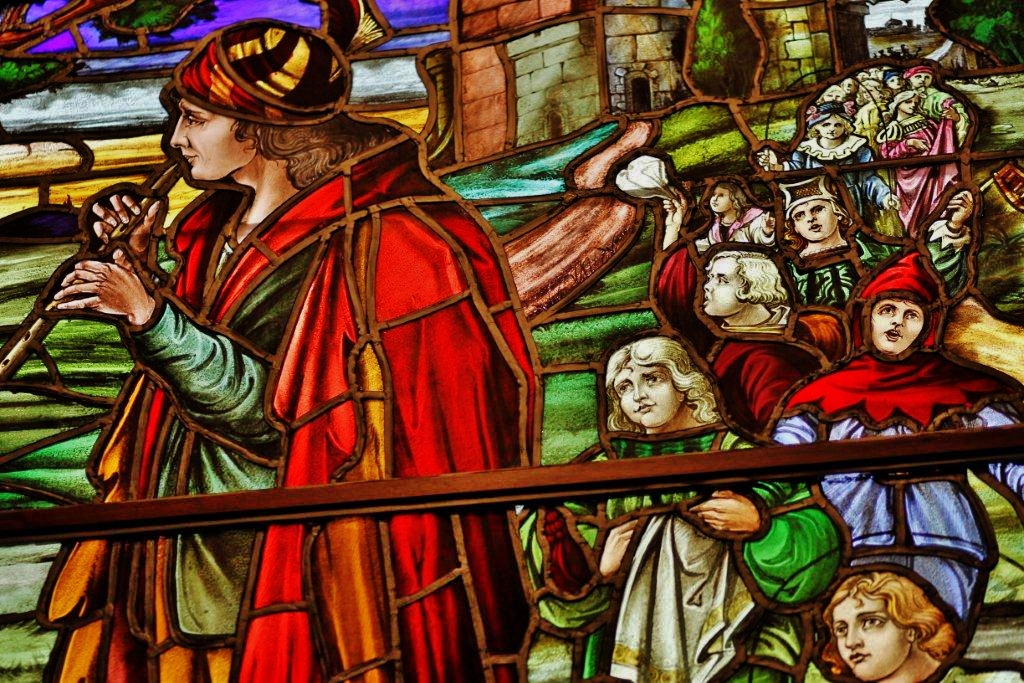
And on the great church-window painted
The same, to make the world acquainted
How their children were stolen away,
And there it stands to this very day.
And I must not omit to say
That, in Transylvania there’s a tribe
Of alien people who ascribe
To the outlandish ways and dress
On which their neighbors lay such stress,
To their fathers and mothers having risen
Out of some subterranean prison
Into which they were trepanned
Long time ago in a mighty band
Out of Hamelin town in Brunswick land,
But how or why they don’t understand.

XV
 
So, Willy, let you and me be wipers
Of scores out with all men–especially pipers!
And, whether they pipe us free, from rats or from mice,
If we’ve promised them ought, let us keep our promise.
 

Robert Browning ~ 1842

Read Full Post »

« Newer Posts - Older Posts »