Archive for the ‘Century of Books – 2025’ Category

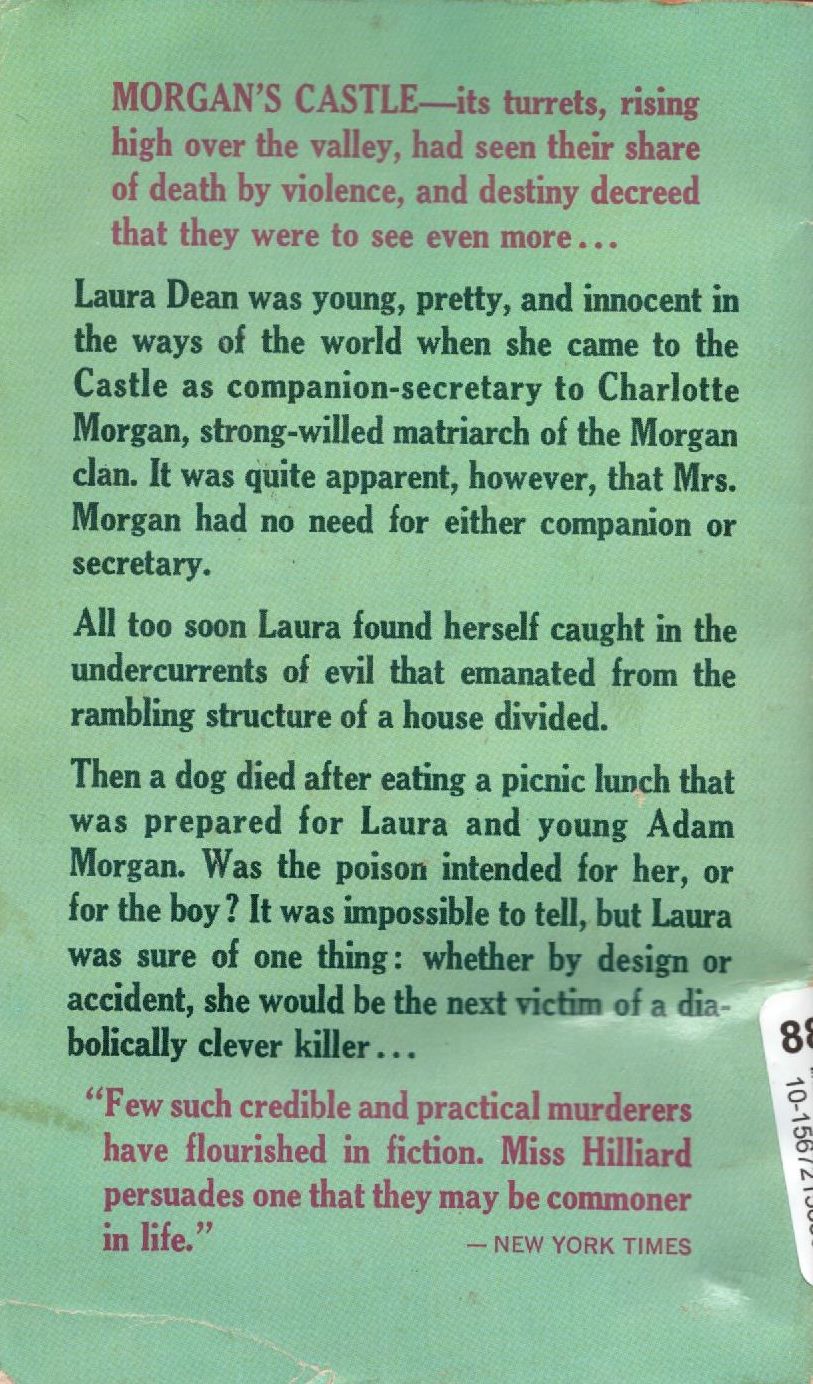
Morgan’s Castle by Jan Hilliard ~ 1964. This edition: Ace, circa 1960s/1970s. Paperback. 142 pages.

Look at that – it’s the last day of January already.

I have been reading quite lavishly all through the past month, but as for posting about those reads, I’m not doing so well. Let’s see if we can remedy that situation with some micro reviews, starting with this strangely entertaining bit of Canadian gothic – more specifically Ontario Gothic – written by the Nova Scotia-born Hilda Kay Grant, under her pen name of Jane Hilliard.

I’ve now read four of Hilliard’s six novels, missing only the Stephen Leacock Award winner The Salt Box, and the rather elusive Dove Cottage, and I have to say it’s been quite the enjoyable ride.

Let’s set the mood with cover scans of my recently acquired vintage Ace paperback edition. (Shout out to Thriftbooks, which I sometimes have recourse to when ABE fails me.)

Our heroine gets the full emotional damsel-in-distress cover portrayal, though that isn’t quite accurate, as sixteen-year-old Laura is remarkably pragmatic and level-headed all through this tale, though sudden death happens behind, in front, and all around her as a dark family secret unravels. This could be because she is a mere teenager, but more likely because, despite her tender age, she has been forced to take on the role of grownup in her relationship with her ne’er-do-well father, Sidney, a mediocre artist over-full of self-regard. Laura’s cynical and seldom-voiced-out-loud observances lend piquancy to this often flat-toned tale.

The Du Maurier comparison on the front cover is vastly inappropriate; this isn’t anything close to that. Hilliard wrote with tongue firmly in cheek, and my impression was rather that this was a full-on parody of the well-explored gothic genre, generously adorned with Canadian references.

I will stop right here; I did say “brief” was my goal.

Takeaway: it’s a Canadiana keeper. It made me heartlessly chuckle all the way through, as the murders got more and more outrageously unlikely. Hilliard shows herself to be divinely callous regarding her lavish disposal of innocent victims – including that dog, a lovable Irish Setter – and if that description intrigues you, and dark humour is your thing, this book might be for you.

My rating: 8/10. Engagingly daft in its predictably unlikely plot.


Read Full Post »

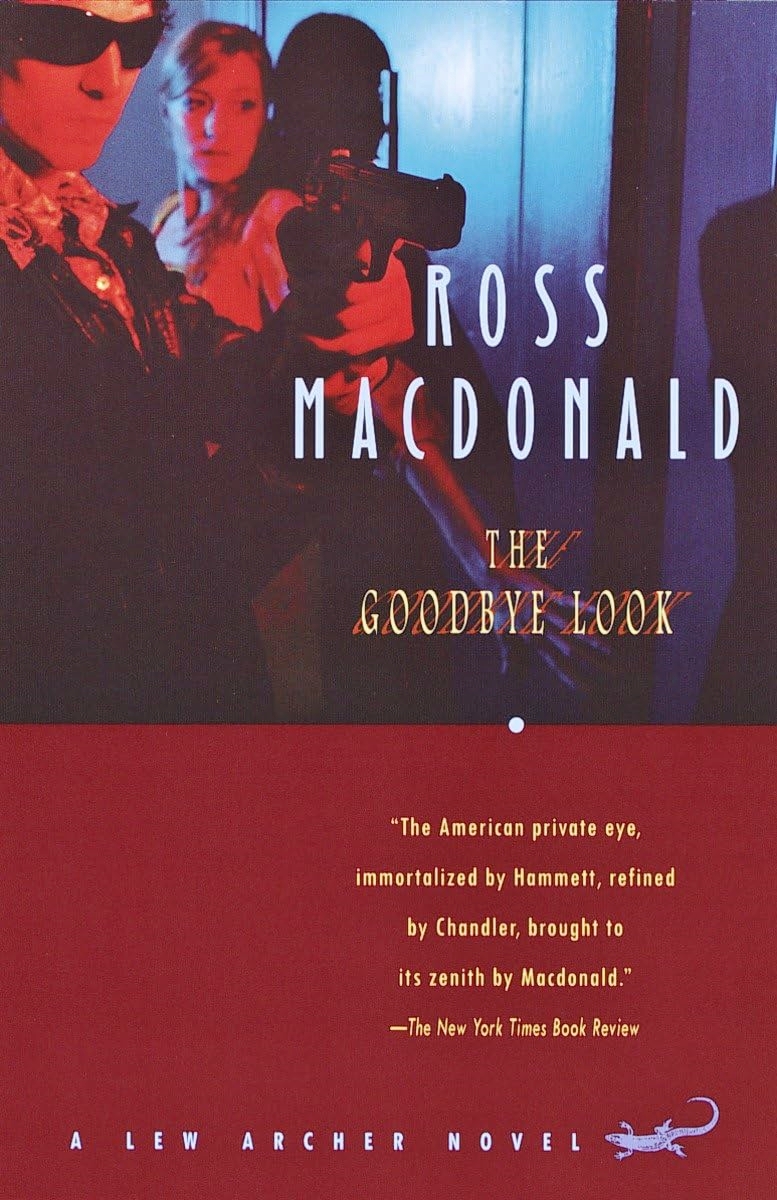
The Goodbye Look by Ross Macdonald ~ 1969. This edition: Vintage Crime/Black Lizard, 2000. Softcover. 243 pages.

The sins of the mothers and fathers are frequently visited upon their children in Ross Macdonald’s masterfully written, shades-of-gray novels concerning the cases of Southern Californian private investigator, Lew Archer. The Goodbye Look is no exception.

In this case, a burglarized safe and a missing golden box containing a son’s wartime letters to his mother leads Archer on a death-plagued pursuit from “California Spanish” mansions to barbed wire fences at the Tijuana border, and back again.

Set in the Los Angeles hills, featuring vivid details and descriptions of the landscape and architecture of a particular place and time, The Goodbye Look feels appropriate reading during this past week of wildfire, destruction and displacement in Macdonald’s beloved corner of the Golden State.

That’s all I’m going to give you of the plot, because what I really want to say about Ross Macdonald is how much of a writer-of-place he is, and how much sheer good writing he packs into these novels. Genre fiction for sure, of the species mystery-noir, but of a decidedly superior sort.

The Goodbye Look is fifteenth in a series of eighteen Lew Archer novels which were published from 1949 to 1976. If you’re not already familiar with Ross Macdonald, pseudonym of American-Canadian Kenneth Millar, I suggest exploring his work. Many of his books are still in print, or are widely available second hand. E-book versions are out there, if that is your chosen format.

My rating: 10/10. Caveat: I re-read Macdonald’s books every few years, so come to them with a certain set of expectations, which are always satisfactorily met. Thinking back to my first introduction to his work, in the late 1970s, as a bookish teenager discovering a well-read paperback copy of The Doomsters on the bookshelf of a family friend while visiting in Los Gatos, California, my recollection is of a doorway opening up into the world of yet another author to explore. Oh, to be ever on the threshold of such discoveries! Such an enduring source of pleasure.

I was enormously pleased to discover, from Brian Busby’s December 2015 post on Kenneth Millar/Ross Macdonald on The Dusty Bookcase, that Kenneth Millar was born in Los Gatos. A full circle moment, as I have a nostalgically good remembrance of that community, and of all of the areas of California I was lucky enough to experience during my childhood and teen years, traveling frequently from our home near Williams Lake, British Columbia (by car, three days each way) to visit my mother’s family and an eclectic array of family friends.

I suspect that one of the personal appeals of Ross Macdonald’s body of work is the evocative experience of recalling those golden days through his writing. Though even if I’d never set foot in California in my life, I’d still rate him as high. Good stuff.

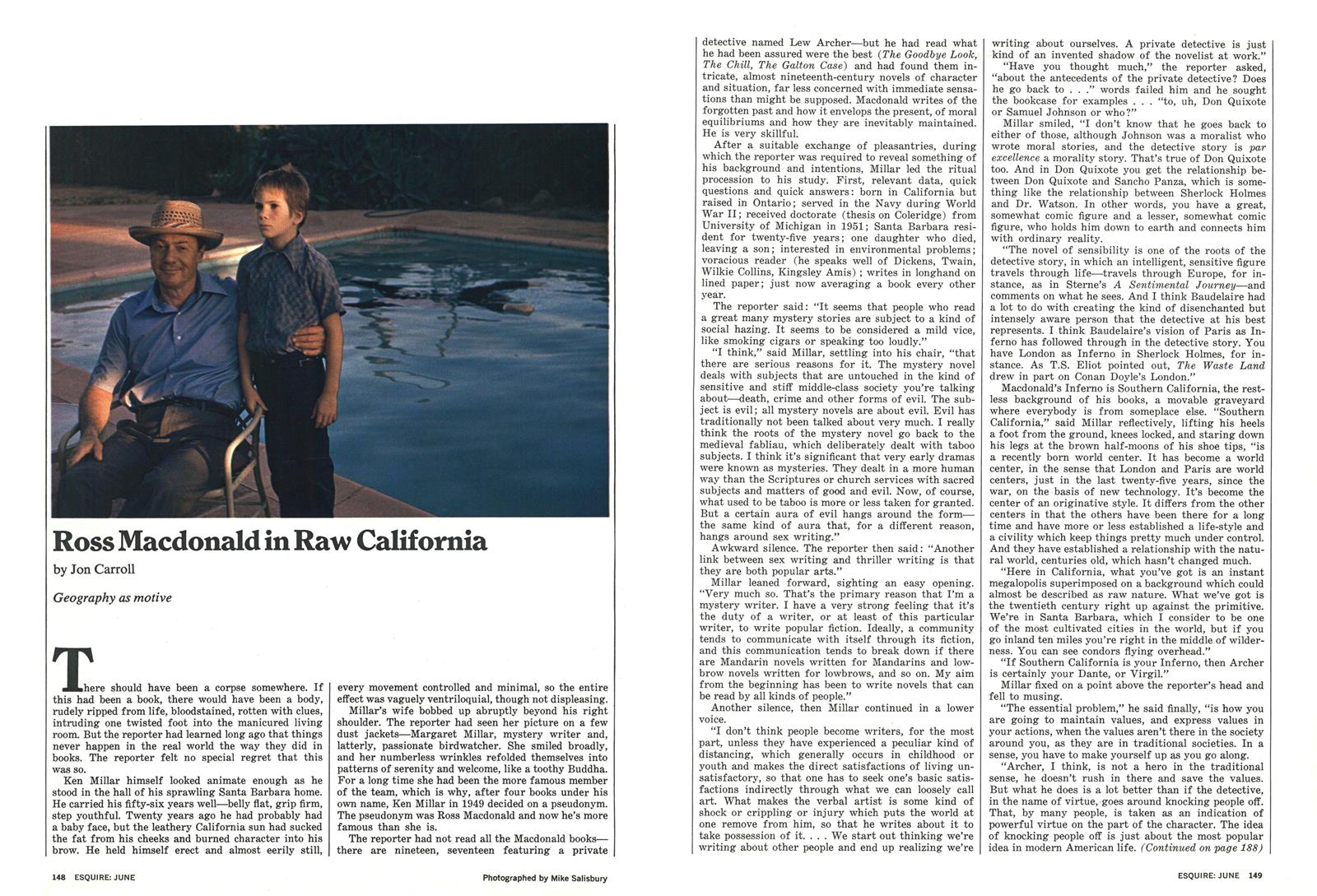
I will leave you with this excerpt from Jon Carrol’s June 1,1972 interview with Kenneth Millar in Esquire magazine. (WordPress is being fussy with linking this morning, but if you Google “Esquire June 1 1972” the whole magazine should pop up in page-by-page format. Be forewarned – you may find yourself reading much more than the Millar article. And possibly mourning the state that physical magazines have come to in these everything-online days.)

“The novel of sensibility is one of the roots of the detective story, in which an intelligent, sensitive figure travels through life—travels through Europe, for instance, as in Sterne’s A Sentimental Journey—and comments on what he sees. And I think Baudelaire had a lot to do with creating the kind of disenchanted but intensely aware person that the detective at his best represents. I think Baudelaire’s vision of Paris as Inferno has followed through in the detective story. You have London as Inferno in Sherlock Holmes, for instance. As T.S. Eliot pointed out, The Waste Land drew in part on Conan Doyle’s London.”

Macdonald’s Inferno is Southern California, the restless background of his books, a movable graveyard where everybody is from someplace else. “Southern California,” said Millar reflectively, lifting his heels a foot from the ground, knees locked, and staring down his legs at the brown half-moons of his shoe tips, “is a recently born world center. It has become a world center, in the sense that London and Paris are world centers, just in the last twenty-five years, since the war, on the basis of new technology. It’s become the center of an originative style. It differs from the other centers in that the others have been there for a long time and have more or less established a life-style and a civility which keep things pretty much under control. And they have established a relationship with the natural world, centuries old, which hasn’t changed much.

“Here in California, what you’ve got is an instant megalopolis superimposed on a background which could almost be described as raw nature. What we’ve got is the twentieth century right up against the primitive. We’re in Santa Barbara, which I consider to be one of the most cultivated cities in the world, but if you go inland ten miles you’re right in the middle of wilderness. You can see condors flying overhead.”

“If Southern California is your Inferno, then Archer is certainly your Dante, or Virgil.”

Millar fixed on a point above the reporter’s head and fell to musing.

“The essential problem,” he said finally, “is how you are going to maintain values, and express values in your actions, when the values aren’t there in the society around you, as they are in traditional societies. In a sense, you have to make yourself up as you go along.

“Archer, I think, is not a hero in the traditional sense, he doesn’t rush in there and save the values. But what he does is a lot better than if the detective, in the name of virtue, goes around knocking people off. That, by many people, is taken as an indication of powerful virtue on the part of the character. The idea of knocking people off is just about the most popular idea in modern American life. But I’m agin it.”

“Well,” said the reporter, “there isn’t anybody in your books who deserves to be knocked off. There aren’t any hiss-and-boo villains.”

“The hiss-and-boo villain died in the nineteenth century,” Millar said. “You know who killed him?” Pause. “Ibsen blamed everybody.”

Read Full Post »

Mrs. Demming and the Mythical Beast by Faith Sullivan ~ 1985. This edition: Macmillan, 1985. Hardcover. 341 pages. ISBN: 0-02-615450-1
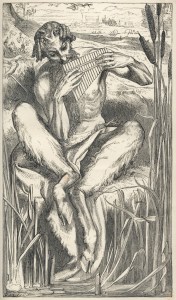
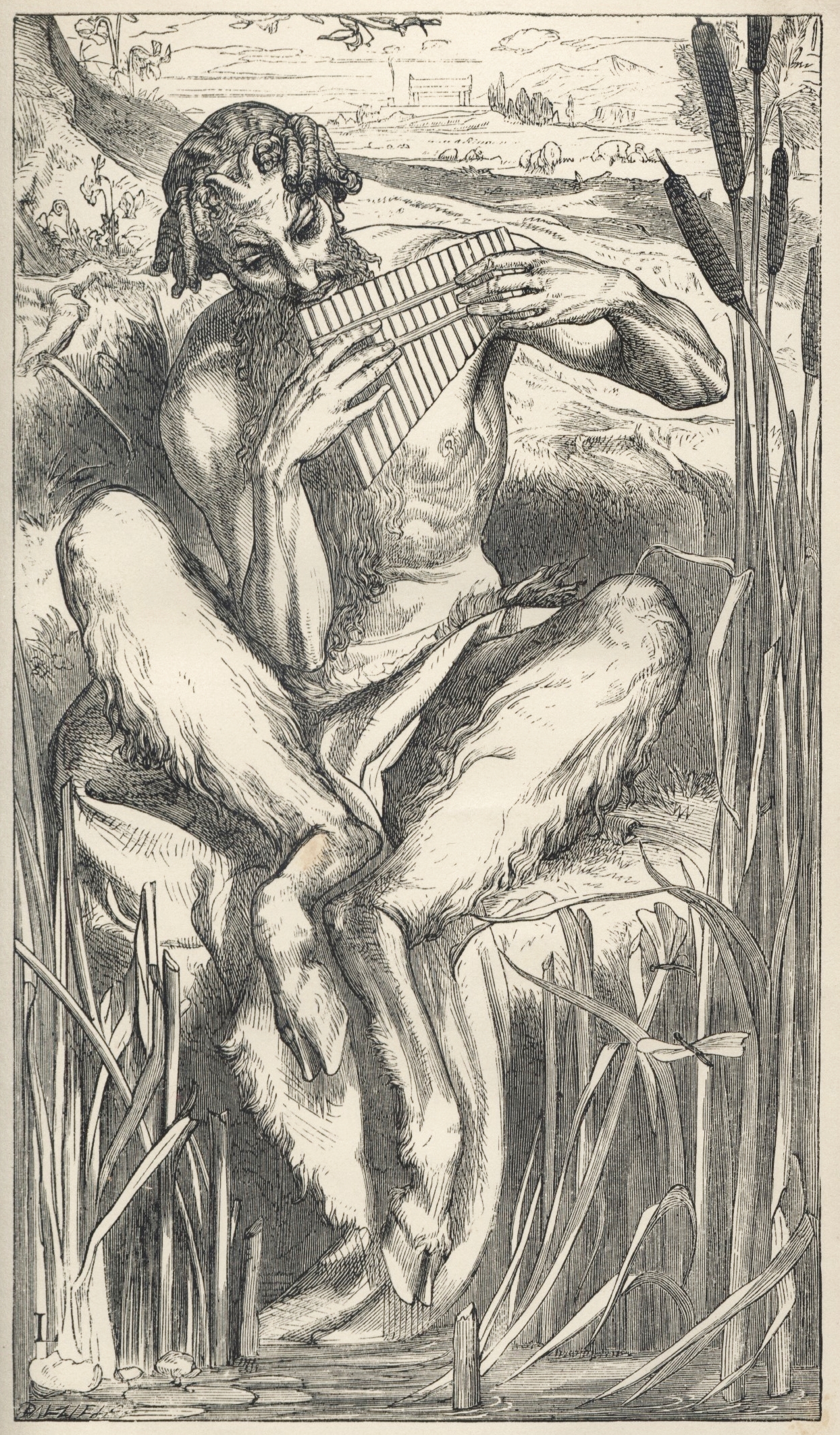
What was he doing, the great god Pan,
Down in the reeds by the river?
Spreading ruin and scattering ban,
Splashing and paddling with hoofs of a goat,
And breaking the golden lilies afloat
With the dragon-fly on the river…

From ‘A Musical Instrument’ by Elizabeth Barrett Browning

It’s my second time round tackling this somewhat wacky concoction by Minnesota writer Faith Sullivan. The first time round I abandoned it early on, before page 22 for sure, because I certainly would have remembered the erotic dream sequence between Larissa and her (so far) platonic (and also married) arms-length lover Harry, if I’d gotten that far along.

This book was recommended to me by a fellow book blogger whose name utterly escapes me – apologies to whoever that was – and I have to thank them for that lead, because this is how we discover hidden gems.

For some readers, this would be that. For me, not so much, though it was a great opportunity for mulling over where the various hits and misses were, always a very individualized response.

Here’s the blurb from Publisher’s Weekly, November 4, 1985:

Larissa [the titular Mrs. Demming] is approaching 50, her children are grown and marrying, her preoccupied husband, Bart, is engrossed in writing a book that threatens to take over his life. For her part, Larissa paints, reads, muses, rows across the river near their Minnesota cottage and picnics on the shore, murder mystery in hand. Until, one day, she looks into the woods and sees a pair of eyes staring back at her. They are the eyes of Pan, an ageless Greek satyr who has been living there since a lovesick Victorian lady brought him to America. Larissa and her Beast discover many affinities, including the satisfaction of sexual passion. Meanwhile, however, Larissa’s domestic life becomes chaotic: a daughter turns hostile; Larissa’s elusive father shows up; a grandchild is born; a love affair with an old friend seems inevitable; a developer threatens the family’s bucolic serenity. Escaping to Greece with her satyr, Larissa confronts the beast within and returns to take up life’s real dramas. Related in a witty, distinctive style and marked by subtle insights, the novel is a pleasure, although occasionally the plot seems contrived. Sullivan also wrote Watchdog and Repent, Larry Merkel.
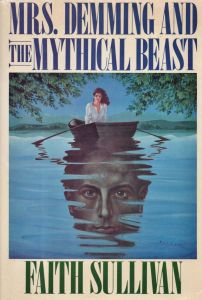
The thing I liked most about this book was the conceit of a transplanted Olympian god – Pan himself! – who finds himself in exile in the New World, dallying with a series of Minnesota mortals, the latest of whom is our protagonist. How did Pan get to America, why is he stalking Mrs. Demming, and, most intriguing to my mind, though never addressed by Faith Sullivan, what the heck is happening back in the Old Country without his Pan-ic supervision of the Grecian woods?

Sullivan tiptoes around most of these queries – though she eventually gives more detail – and keeps re-routing things back to an oddly undeveloped plot based on the threat of a condominium development four miles upstream of bucolic Belleville, a fictional Minnesota town located on the banks of Belle Riviere River, as the locals insist on redundantly calling it, much to the secret annoyance of Larissa, who has some strong opinions, mostly kept well hidden and unvoiced.

Larissa is in a state of internal ferment these days, mostly to do with her daughter Minerva’s upcoming marriage. Minerva, in her twenties and a successful and rising investment banker in the Demming family’s hometown of Minneapolis, just an hour or so away from the Belle Riviere summer cottage where the main action of the novel occurs, is set to wed an absolutely suitable and upright attorney.

Larissa thinks this is a huge mistake, and has made the critical error of voicing this to Miranda. Not that she objects to the young man regarding his husbandly suitability. It’s just that Miranda is living such a safe and organized life, while her mother, projecting wildly, thinks that her beloved daughter should  engage in a year or two of bohemian living (meaning sexual flings, preferably abroad in some more exotic location than staid old Minneapolis) before she settles down.

Miranda disagrees. Strongly. And I found myself rather on her side, though I’m not quite sure if the author had that in mind.

This is a very busy book, and Sullivan throws a lot of things into the mix. It often feels like she loses track of some of her plot strands; they lay about all over the place, tripping up the reader as trot along madly in Larissa’s increasingly frenetic wake, murmuring, ‘Who?! What?! Where?! When?! WHY?!”

Beautifully written in places, not so much in others. Plot twists which fell very flat for me included a well telegraphed “surprise” denouement regarding Larissa’s relationship with her widowed Irish-American father Jamie. (Let’s just say they were very, very close during Larissa’s teen years, after her mother tragically died.) And there was the sacrifice of one of the novel’s most sympathetic characters to what I felt was an unfair demise. And a convenient solving of Larissa’s own too-staid-and-safe marriage issue, which I felt rather too contrived even for this very obvious fiction. And did I mention the cringe-inducing sex scenes? Including a loving description of Pan’s manly bits highlighted by the silky white curls of his goat legs. Ack! Too much, too much!

So, that goat-footed god thing. He’s quite obviously symbolically introduced into the mix to give Larissa the impetus to get her inner life sorted out, but he’s also presented as a very real entity, with the problems that come along with that, such as his transportation both to and from America, a century or so apart, using normal forms of public transit. Spoiler: Baggy pants and a wheelchair factor into this. Luckily no one is moved to pat down the handsome Greek guy at the airport on his repatriation journey…

My rating: 6/10. It did keep me engaged, once I committed to the story and made a conscious decision to disregard plot flaws, and to fast forward through the sexy bits, which I found embarrassing, on the writer’s behalf as much as the reader’s. Consider yourself forewarned.

Internet reviews are very sparse for Mrs. Demming and the Mythical Beast, though “cult classic” and “horror” pop up several times. I’m not sure about that first label, but the second is incorrect. No horror here. If this were published today, cleaned up a bit to rid it of its very occasional, era-expected political incorrectness, it would probably win accolades in certain circles, and get passed around with the bottle of red wine at evening book clubs patronized by those who don’t take these things too seriously.

Mrs. Demming appears to be out-of-print, though it went through several print editions, in hardcover and paperback, and is readily available second hand, and on Kindle.

Faith Sullivan went on to write a number of other novels, all set in Minnesota, and all reportedly well received. I have not read any of them, but would be happy to do so if they came into my orbit.

FAITH SULLIVAN – Biography and Bibliography from Encycopedia.com


Read Full Post »

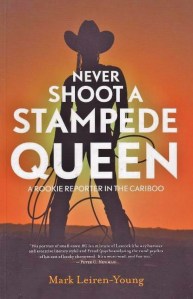
Never Shoot a Stampede Queen: A Rookie Reporter in the Cariboo by Mark Leiren-Young ~ 2008. This edition: Heritage House, 2008. Softcover. 221 pages. ISBN: 978-1-894974-52-3

After a recent reading of Josie Teed’s British Columbiana, I found myself  scanning the shelves for something in the same genre. I was really looking for Will Ferguson’s I Was a Teenage Katima-Victim, but as it proved elusive,  I was pleased to find instead Mark Leiren-Young’s humour-infused collection of anecdotes from his year as a reporter for the Williams Lake Tribune.

I grew up rural, in the central Cariboo-Chilcotin region of British Columbia, and Williams Lake was “town”, location of schools, shops, restaurants, public library and movie theatre, not to mention an impressive array of both churches and drinking establishments.
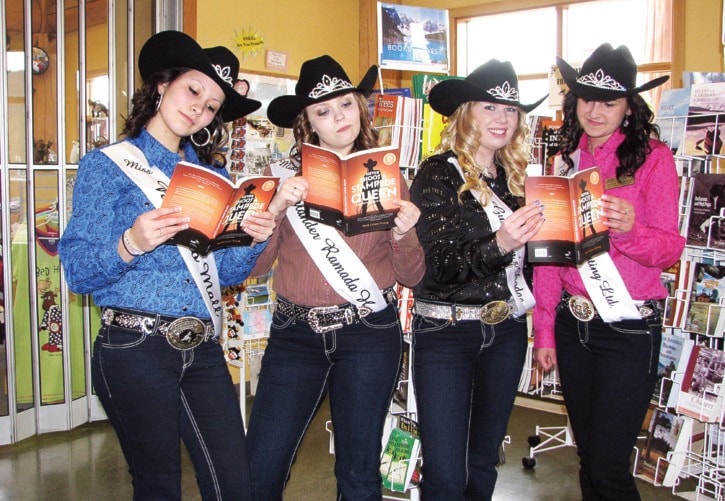


By the time Leiren-Young pulled into town for his newspaper gig in 1985, I had finished with high school, found true love, and relocated to places even more rural, so our paths did not cross, but it was enjoyable to time travel back with him to a place I once knew very well indeed.

Leiren-Young jotted down these memories in 1988, and polished them up enough to send out to friends and family as a holiday gift in December of that year. He resurrected and edited his collection of “true-life tall tales” in 2008, and this book was the result. Never Shoot a Stampede Queen was an immediate success, and, after spending months on the B.C. Bestsellers List, was awarded the 2009 Stephen Leacock Medal for Humour.

Here’s the publisher’s back cover blurb:

The cops wanted to shoot me, my bosses thought I was a Bolshevik, and a local lawyer warned me that some people I was writing about might try to test the strength of my skull with a steel pipe. What more could any young reporter hope for from his first real job?

The night Mark Leiren-Young drove into Williams Lake, British Columbia, in 1985 to work as a reporter for the venerable Williams Lake Tribune, he arrived on the scene of an armed robbery. And that was before things got weird. For a 22-year-old from Vancouver, a stint in the legendary Cariboo town was a trip to another world and another era. From the explosive opening, where Mark finds himself in a courtroom just a few feet away from a defendant with a bomb strapped to his chest, to the case of a plane that crashed without its pilot on board, Never Shoot a Stampede Queen is an unforgettable comic memoir of a city boy learning about—and learning to love—life in a cowboy town.

So, here’s the burning question. Did Leiren-Young get Williams Lake “right”?

In my opinion, that would be a quite solid “yes”, allowing for a certain amount of creative re-telling. The cliché of truth being stranger than fiction certainly applies here, and it is my belief that while enhancing some aspects of Cariboo-Chilcotin life for their laughability, he probably toned things down here and there in the interests of believability.

Leiren-Young states early on that his years of experience as a freelancing journalist, starting in his university days, polished his writing speed and economical-yet-engaging style to a high degree, and this quick read does hit all the buttons.

This collection of related stories starts with Leiren-Young’s hit-the-ground-running initiation into his new job in the “Crime Capital of B.C.”, as Williams Lake was at the time, and had been for some years past, by stopping for fuel and directions at a just-been-robbed gas station, police still in attendance. Leiren-Young scents a story unfolding, and hangs around and gets all the details from the cashier, with the bonus of earning himself the negative attention of the local R.C.M.P. detachment.

As junior reporter, Leiren-Young gets landed with all of the jobs no one else is keen on, but as the weeks go by, he finds himself increasingly immersed in local culture, and writing about some truly newsworthy topics, ranging from the farcically comedic to the very real-and-tragic.

It’s hard to truly do credit to a book written about a place and time one is personally familiar with, and I had to sit back and think hard about my response to Stampede Queen. As with Josie Teed’s British Columbiana, it was easy to identify a lot of the characters, and speculate about who the composites were based on, and it is always edifying to see places one knows in real life through another set of eyes. A major difference here was that though Leiren-Young doesn’t gloss things over, he was by and large quite kind to his co-workers and small town acquaintances in these tales, which isn’t always the case with Teed’s memoir.

Leiren-Young is also a more accomplished writer than Teed, but, to be fair, this account was not sent out into the world fresh from the young writer’s hand, but was allowed to mellow and mature and benefit from a re-working which undoubtedly accounts for its tightness and polish.

My rating: an overall approving 8/10.

A full point was lost by the presence of the raccoon on page 177, a brief reference which knocked Leiren-Young back a notch in my esteem, as it calls into question aspects of verisimilitude. (There were no raccoons in the Cariboo in 1985, though we do hear now, in the 2020s, that they are working their way up from the Coast as our winters warm.)

Another point taken away by what might be slightly excessive virtue-signalling. Leiren-Young comes across as mildly smug and morally superior on occasion, rolling his eyes at some of the un-woke folk north of Hope. (B.C. insider joke, referring to the vast under-populated regions outside of the Lower Mainland.) I get it, and I forgive the writer his understandable bias, but it was possibly a bit too underlined and bolded (figuratively speaking) here and there.

If you wish to explore further, the multi-talented Mark Leiren-Young has an active online presence, and reviews of Never Shoot a Stampede Queen are easy to find. The book is still very much in print, and readily available throughout B.C., and presumably points east as well.

Bonus links:

Williams Lake Stampede Queen Contestants, 2012. Photo by Gaeil Farrar, Williams Lake Tribune.


Read Full Post »

British Columbiana: A Millennial in a Gold Rush Town by Josie Teed ~ 2023. This edition: Dundurn Press, 2023. Softcover. 253 pages. ISBN: 9781459750210

Josie Teed has been sitting on my desk for the past week, giving me the suspicious side-eye while others line up behind her. Josie doesn’t really care what I think, but yeah, wait a minute, she kinda does, and I’ll bet she’s wondering who the heck am I to have the nerve to critique her, all boring old boomer versus woke and anxious millennial.

British Columbiana is causing me no end of angst as I write, erase and rewrite its review. I feel like I have a lot to unpack about what Josie Teed’s Edna Staebler Award nominated creative non-fiction had to say, but as the days roll by, I find myself still struggling with this one, so I’ll just get this thing posted and move on.

Here’s the blurb from the Wilfred Laurier University write-up on the award nominees:

In her first published work, Josie Teed represents her generation’s aspirations and anxieties. What should one do with one’s life? Are feelings trustworthy? Are people genuine? Does this go with that? What does my therapist think? With a sharp comic eye, Teed chronicles her own coming-of-age during a year spent working in the heritage village of Barkerville, deep in the BC interior, dramatizing daily life in a 19th century gold rush town. But the real drama arises from the cast of eccentric Gen-Xers and cliquey Gen-Zedders who spend the summer bringing Barkerville’s past to life while pursuing—much to Teed’s consternation—their own generational predilections. From Boomers to Zedders, Teed’s narrative will engage, bemuse, and amuse readers in equal parts.

Josie Teed, a twenty-four-year-old university grad, freshly delivered of her master’s thesis in medieval archeology, finds a winter gig as an archival intern in Barkerville, British Columbia’s largest “living history” heritage site, situated in a very rural area in British Columbia’s central interior Cariboo region, an hour’s drive by twisting two-lane highway from the small city of Quesnel.

Teed finds shared accommodation in Barkerville’s tiny next-door service community of Wells, permanent population 250-ish, and settles in to her new digs and new job with a mixture of optimism and trepidation. Will this be where she finds some useful resume-padding, insight into next steps after school, a place to find community, and maybe even a yearned-for chance for love?

By the end of what turns into a year-long sojourn, with the internship morphing into a summer position as a costumed reenactor mingling with tourists in the kitchen of a historical home and in the one-room schoolhouse, Josie Teed has had the opportunity to get down deep with exploring all of these goals, and I’ll skip right to the end and tell you know that she mostly finds out what she doesn’t want to do, which is hang around in Wells.

I’m all up for delving into an interesting memoir, and this one had the added attraction of coming from a fresh young voice, sharing a spanking new impression of a community I am rather well acquainted with. Just a few pages in, I found myself taken aback to find that Teed pulled no punches in her snap character assessments regarding her new Barkerville-Wells co-workers and acquaintances, and that some of them were immediately identifiable. I said to myself, “No way! She can’t be going there!”, and I scanned the front pages of the book for the usual disclaimer about the characters not being actual people, but it was nowhere to  be found.

Settling down to get a Josie’s-eye view of this corner of the world, another thing became very evident: it wasn’t about the place, or even the other people. It was all about Teed’s vision of herself, and her every reaction to each new person and experience, and all her various “feels” laid out for self examination.

A fellow reader of British Columbiana who I discussed this with rather sharply dismissed the whole thing as “over-the-top Millennial navel-gazing”, and I have to say they weren’t really wrong. But there were more than a few golden nuggets to be mined from amongst the pebbles of this particular literary stream-bed, certainly enough to keep me engaged and increasingly invested in figuring why some things about Teed annoyed me so much, and, paradoxically, how much I felt empathy with her intense and ongoing inner struggles with insecurity and social anxiety.

Upon finishing the last page, I headed straight to Google to find other insights on Josie Teed. I was immediately rewarded by finding this book review by Forrest Pass in The British Columbia Review, and what he had to say aligned so well with my own impression that I will refer the interested reader to him.

I wanted to love this book, and went into it with high hopes, as I personally have a long and mostly happy relationship with both Barkerville and Wells, and some of the people who live and work there. British Columbiana wasn’t what I had initially expected it to be, which was a more “place-based” sort of memoir, but it did turn out to be mildly compelling in a much different way.

British Columbiana almost went onto the giveaway pile after I finished it, but then I had a rethink. First novels – especially those self-described as “memoirs” – are notoriously about unpacking personal angst and getting in digs at the people who don’t really get you, so I’ll extend some grace to Teed, and I will be keeping an eye out for her next literary effort.

My rating: 6/10


Read Full Post »

Flambards by K.M. Peyton ~ 1967. This edition: Oxford University Press, 2007. Hardcover. 227 pages.

This will be a sketchy sort of review. This novel is so well known that anything I have to say will probably have already been said.

Much of what I do have to say here is reasonably complimentary, with caveats. I do appreciate K.M. Peyton, a prolific and popular writer who died this past December at the age of ninety-four.

Flambards is probably the most prominent of her dozens of youth/young adult novels, but it is not my own personal favourite of her works. I think I would have to say that her Ruth and Pennington arc of six novels is more compelling to me personally. And the stand-alone novel A Pattern of Roses is a bit of a quiet stunner. But more about those later this year, I think. They are all piled up waiting a re-read at some point.

Back to Flambards. Though it’s often relegated to “children’s book” categorization, it’s pretty darned “adult” in many of its themes. Think National Velvet, another “juvenile” “horse book” which really isn’t a horse book, and really isn’t a juvenile, either. The horses are important, but only in relation to the main characters. Four-legged set dressing, in a way.

Twelve-year-old Christina, an orphan since the age of five, is sent to live at her widowed and crippled uncle’s mostly-male-inhabited establishment, a troubled country estate called Flambards. Uncle Russell and his older son Mark are utterly horse-mad. The stables are spotless and up-to-date; the house is decidedly neglected. Younger son William is scorned by his father and brother for his slight stature, his intellectual abilities, and most of all for his lack of true enthusiasm for all things equine, though he’s expected to participate in the usual horse-related activities such as hunting, with devastating results.

Christina enters the house just as William is being brought home on a sheep-hurdle, leg smashed from a mishap while hunting. She forms a rather furtive friendship with William during his recuperation, though she is out of sympathy with him in one major way. Christina finds that she is also enraptured with horses and riding.

There’s a bit of a back story, revealed very early on, which frames the story. Young Christina is something of an heiress, with a fortune held in trust, and the reason she was invited to live with her Uncle Russell was so she might possibly be a suitable husband (once grown up) for her cousin (half cousin?) Mark. The money is already earmarked for sinking into the Flambards estate.

Christina is a survivor, and she further refines her get-through-it technique as the years slide by. Uncle Russell and Cousin Mark continue to bluster and bully, while William quietly crafts his exit strategy from an absolutely toxic family situation, with Christina carefully navigating the territory in between.

The novel starts out with deep drama, and the trend continues right through to the end, which is, in my opinion, a bit too unlikely and awkward feeling. It didn’t sit completely well with me, hence my personal rating of 7.5/10.

Flambards is a decently enjoyable read, but none of the characters ever won my full affection, and by the end I didn’t really care all that much about who ended up with who, or what would happen to Flambards itself.

Turn the page, close the book, set it aside. It did not occupy my thoughts in the days  after reading it, as the best books do. But nonetheless it’s a keeper, and has a permanent shelf space in the K.M. Peyton stack. I’ve read it a few times over the years, and likely will again.

Flambards was a popular success and received several high profile children’s fiction awards. It was followed by two sequels in 1969, a well-received television mini-series in the 1970s, and a fourth postscript novel in 1981.


Read Full Post »

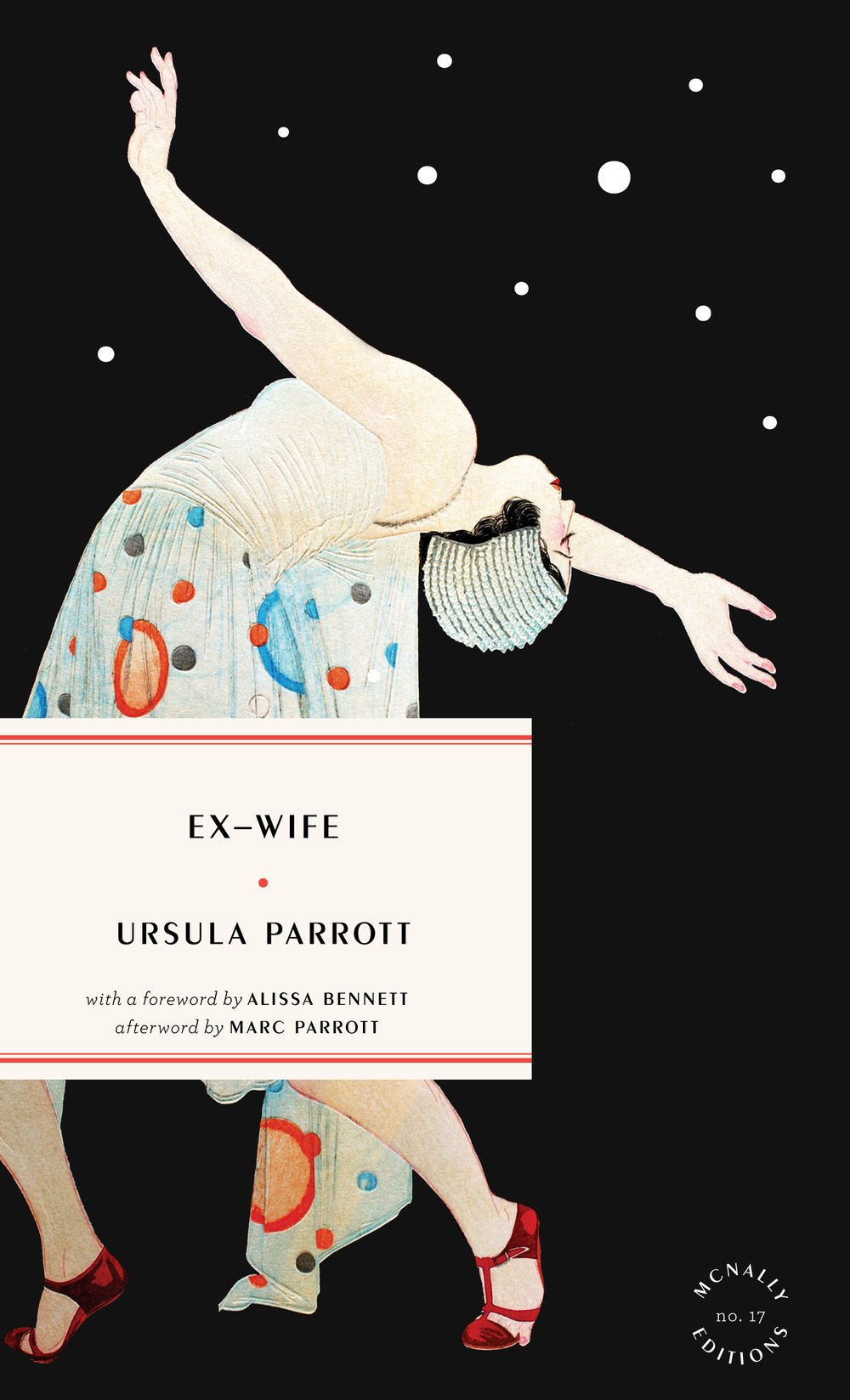
Ex-Wife by Ursula Parrott ~ 1929. This edition: McNally Editions, 2023. Foreword by Alissa Bennett. Afterword by Marc Parrott. Softcover. 218 pages.

I wish I could recall which of my fellow readers recommended this punchy little autobiographical novel, a bestseller immediately upon its anonymous publication in 1929. Described as “scandalous” and “racy” in its time,  it no longer carries the same weight as a “forbidden topic” tell-all, but has become something much more relatable, as the dissolution of marriage has become an unremarked commonplace in our North American culture, with, according to a quick internet search, something like 40% of formalized marital unions ultimately breaking down.

Here’s the flyleaf blurb from the most recent edition of this fascinating snapshot of a certain kind of cultural and personal life in the New York of the 1920s:

It’s 1924, and Peter and Patricia have what looks to be a very modern marriage. Both drink. Both smoke. Both work, Patricia as a head copywriter at a major department store. When it comes to sex with other people, both believe in “the honesty policy.” Until they don’t. Or, at least, until Peter doesn’t—and a shell-shocked, lovesick Patricia finds herself starting out all over again, but this time around as a different kind of single woman: the ex-wife.

An instant bestseller when it was published anonymously in 1929, Ex-Wife captures the speakeasies, night clubs, and parties that defined Jazz Age New York—alongside the morning-after aspirin and calisthenics, the lunch-hour visits to the gym, the girl­talk, and the freedoms and anguish of solitude. It also casts a cool eye on the bedrooms and the doctors’ offices where, despite rising hemlines, the men still call the shots. The result is a unique view of what its author Ursula Parrott called “the era of the one-night stand.”

I wouldn’t exactly call this a “revenge novel”, though seen from Patricia’s viewpoint Peter does not come off well at all. He openly sleeps around, is endlessly and cruelly critical of Patricia’s looks or, when the effects of too much work and partying start to show, her lack of them. He quite openly has a casual antipathy to their baby and is both indifferent and, when the child dies, seemingly relieved to be stripped of the burden of fatherhood. When Patricia gets pregnant a second time, Peter turns physically abusive, at one point throwing her through a glass door. Whatever Patricia’s personal flaws might be, Peter’s seem to exponentially trump them.

Patricia makes many poor decisions in the time we get to know her, but the unforeseen awfulness of Peter as a life partner is something that takes all of us by surprise – Patricia included. It was a love match to start with and passion matched passion, but somehow something changed. Patricia indicts Peter thus: “He grew tired of me, hunted about for reasons to justify his weariness; and found them.”

After a drink-fueled one night stand with Peter’s best friend – Peter doesn’t know “who”, just that it happened, as Patricia after much mental turmoil tells him – Peter gets all dramatic about Patricia breaking his trust and destroying his faith in women. He rattles on at great length about her besmirching her freshness and cleanness and innocence. She’s absolutely dirty (in his eyes)  for basically doing once what he’s been doing with unapologetically casual abandon all along. Apparently it’s different for her. Patricia pleads her case, Peter scorns her every word. Patricia wants a reconciliation. Peter absolutely doesn’t.

The marriage falls irrevocably apart, though years will pass before a divorce happens, with Peter resurfacing now and then to repeat his cutting critiques and knock Patricia out of whatever equilibrium she has attained.

Patricia, emotionally devastated, looks about for ways to dull her pain and finds them, in casual sexual encounters with many willing partners, in her success at her job, in relishing the material rewards of her work, in dressing well, dining out and dancing and and drinking, drinking, drinking. It doesn’t seem enough, though, and ultimately it isn’t.

Does this all sound too dreary for words? Initially I thought it might be, but I very soon became absolutely enthralled by Patricia’s navigation of her unwanted situation. While staying very aware that most of her issues were, at least partly, self-imposed, I soon found myself truly liking her. Her voice is by turns sad, angry, self-loathing, and absolutely cynical, but it’s also exceedingly self-aware, and genuinely humorous, as she muses on the inexplicable realities of being an unwilling “ex-wife” and everything that goes along with that designation.

Trigger warnings: This book contains frank (but not overly explicit) depictions of abortion, rape, and physical and mental abuse. It’s pretty tame stuff in comparison to what a lot of current bestsellers casually contain, but it was outspoken for its time. I felt that Parrott pulled off the tricky task of describing these experiences without crossing the line into needless titillation.

My rating: 9.5/10. The half point is deducted because the ending felt a bit uneven to me; I wanted a different resolution, though I’m not sure what that could have looked like.

An absolutely engaging story, and the characters came to life for me, sketched out and enlarged upon by a very competent writer.

The internet is abundant with elaborations on “the life she really lived”, though you might want to read Ex-Wife yourself before you drop down that particular rabbit-hole.

The afterword by Ursula Parrott’s son Marc is a bonus of the McNally edition. In real life the baby did not die, as the fictionalized child does. That said, the real-life tale of Parrot’s mothering is not exactly admirable. Marc pragmatically relates some aspects of his mother’s life and character with carefully balanced assessment, and appears to hold no grudges.


Read Full Post »

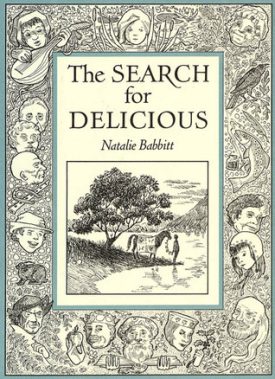
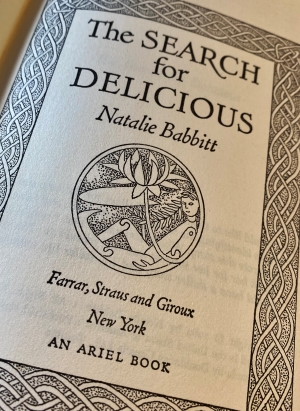
The Search for Delicious by Natalie Babbitt ~ 1969. This edition: Farrar, Straus and Giroux, 1969. Hardcover. 159 pages.

This book is a treasured survivor from my childhood bookshelf, and I hold it in very fond regard. It’s a short and efficiently written morality tale of sorts, and is saved from preachiness by its charm and wry humour.

Some time ago, in a small, imaginary kingdom, the Prime Minister is writing a dictionary. Everything is going swimmingly, until it suddenly isn’t.

The Prime Minister returns to his rooms after showing his progress to the King, and relates what has just happened to his twelve-year-old adopted son Gaylen.

“I went down, you see, to show the King how far I’ve gone with my dictionary. He was pleased with the first part. He liked ‘Affectionate is your dog’ and ‘Annoying is a loose boot in a muddy place’ and so on, and he smiled at ‘Bulky is a big bag of boxes.’ As a matter of fact, there was no trouble with any of the A’s or B’s and the C’s were fine too, especially ’Calamitous is saying no to the King.’ But then we got to ‘Delicious is fried fish’ and he said no, I’d have to change that. He doesn’t care for fried fish. The General of the Armies was standing there and he said that, as far as he was concerned, Delicious is a mug of beer, and the Queen said no, Delicious is a Christmas pudding, and then the King said nonsense, everyone knew the most delicious thing is an apple, and they all began quarreling. Not just the three of them – the whole court…”

This seems like a minor episode, and Gaylen laughs it off, but the Prime Minister isn’t so optimistic. And he’s right. The Court is soon in an uproar, and the ripples are spreading throughout the kingdom. There’s even talk of a civil war, boosted along by the Queen’s wicked brother, Hemlock.

One thing leads to another, as things tend to do in fairy tales, and Gaylen finds himself tasked with undertaking a survey of the entire kingdom, visiting every dweller there within to record each individual’s choice for Delicious. He sets off on his trusty steed Marrow, and it’s all a lovely adventure, until he discovers that Hemlock is out on a mission of his own, stirring up dissent and spreading false tales of the King’s motivation for asking Gaylen to record everyone’s choices.

This is a fast-moving story, and Babbitt packs a lot into it, with characters ranging from the optimistic Gaylen and his fellow human countrymen to an assortment of almost-forgotten creatures, such as the dwarfs in the mountains, woldwellers in the forests, mermaids in the lakes, and winds in the air.

Gaylen’s journey round the kingdom turns dark and dangerous, and disaster looms, but in proper fairy tale tradition, his kind and fair-minded actions and reactions are rewarded, though not without some close calls.

This is a fantastic story to read aloud to your young people, or perhaps to enjoy for yourself on days when you might need cheering up from the woes of the real world. Never mind that it’s classified as a “juvenile” – it’s a well-crafted tale, and that is always worthy of appreciation, and the adult reader will enjoy what Babbitt has done here.

My rating: a staunch 10/10. And if you do find yourself in possession of this little book, I hope it’s a version that includes all of Babbitt’s  original pen-and-ink illustrations in the chapter headings. They are delightful.


Read Full Post »

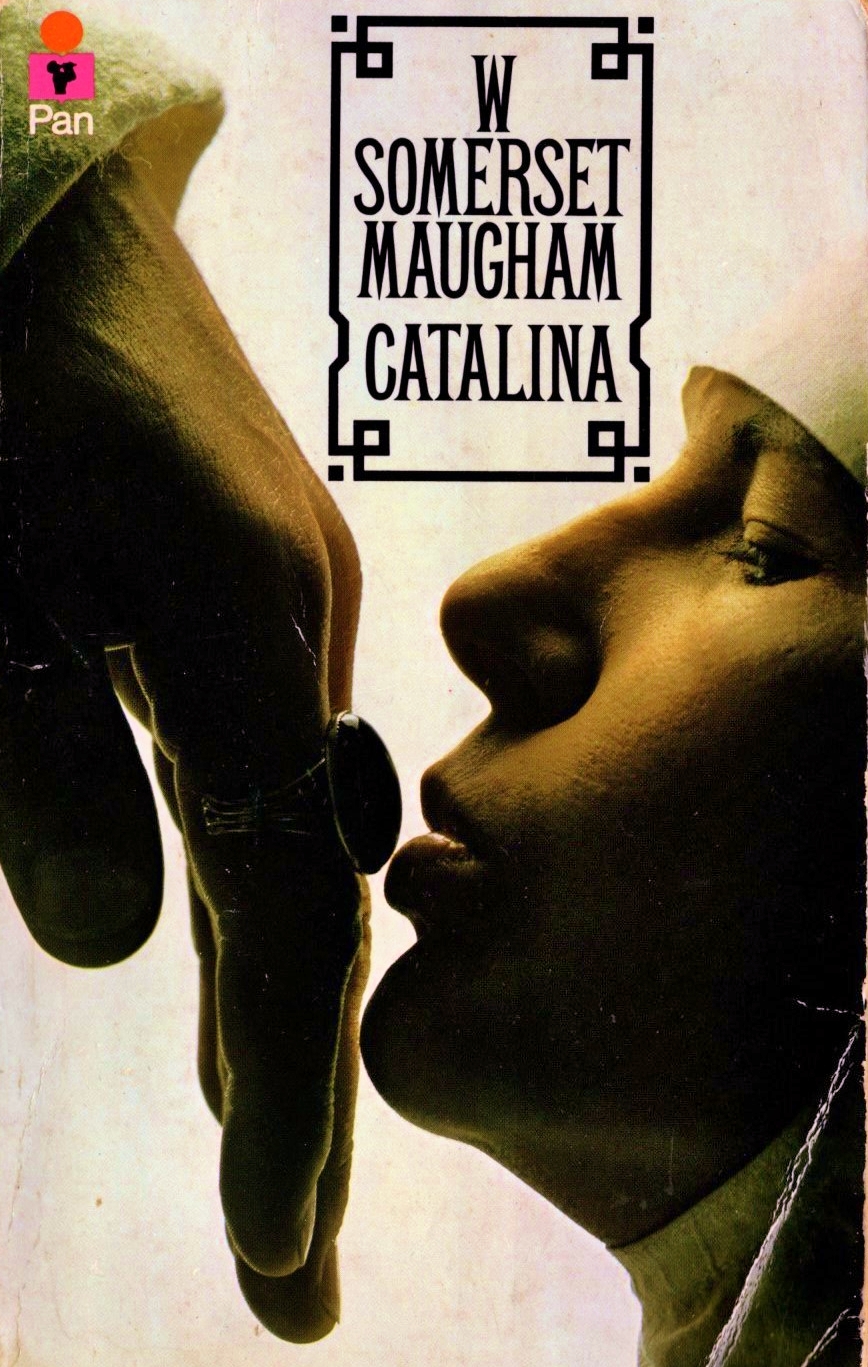
I’ve dipped into Maugham’s more mainstream novels over the years – The Painted Veil and The Moon and Sixpence spring to mind – but this rather frou-frou satire set in Spain during the years of the Inquisition was certainly not what I had expected.

Our young heroine, Catalina, a sixteen-year-old beauty unfortunately crippled after being run over by a bull, prays incessantly to the Virgin Mary to heal her, for when she lost the use of her leg, she also lost her handsome lover. Lo and behold! a vision of the Virgin appears to her with a promise that she can be healed if the right person gets involved. Says Mary, “The son of Juan Suarez de Valero who has best served God has it in his power to heal you. He will lay his hands upon you in the name of the Father, the Son and the Holy Ghost, bid you throw away your crutch and walk. You will throw down your crutch and you will walk.”

Catalina hobbles home and tells her mother of the vision, but the response is dismissive – “probably just a dream!” – and it is also not wise to draw too much attention to oneself in regards to claiming divine visitations, what with it being the height of the Inquisition and all. It’s even more sobering to consider that one of the sons of de Valero referenced by the Virgin, the saintly Bishop Don Blasco de Valero, is a chief Inquisitor.

There are three de Valero brothers, Don Blasco (the priest), Don Manuel (the prominent military man), and Don Martin (the humble baker). When Catalina’s vision inevitably becomes a topic of public discussion, everyone assumes that Don Blasco will be the one to pull off the miraculous cure, but things go a bit awry.

Maugham pads out his tale with many long digressions, many concentrating on Don Blasco’s back story and his current crisis of faith. Don Blasco’s saga is mirrored with that of another prominent member of the Spanish religious elite, Doña Beatriz de San Domingo, Prioress of a Carmelite convent.

Doña Beatriz’s ears perk up when she hears Catalina’s story, and, ever-quick to grasp opportunities to enhance the status of her nunnery, attempts to lay claim to the miracle-about-to-happen, as the vision of the Virgin took place upon the steps of the Carmelites’ church.

There are quite a number of surprises in store for the protagonists of this novel, and some for the reader, too. I was intrigued by Maugham’s mixture of satire and seriousness; there were passages of true emotional appeal here and there that caught at one’s heartstrings, but, as the novel progressed, these became more elusive, as the farcical elements took over.

Catalina’s eventual fate is not as predictable as one would initially think, and the Virgin pops up again to oversee Catalina’s wellbeing.

I thought, for the first few chapters, that I might have found something of a hidden gem with this one, but unfortunately I can’t award it that status. It’s more of a curiousity read, and I suspect it will be relegated to the “read once, don’t think I’ll read it again” stacks.

The last published full-length work by W. Somerset Maugham, Catalina is available on Project Gutenberg, and is relatively cheap and easy to source as a printed version through all the usual online book places, for those wishing to round out their collection of this author’s work.

It’s tough to give a numerical rating, as I truly enjoyed substantial parts of Catalina, but now that ten days or so have passed after my reading, I look back on the overall experience and sadly must settle on a modest 6/10.

Read Full Post »

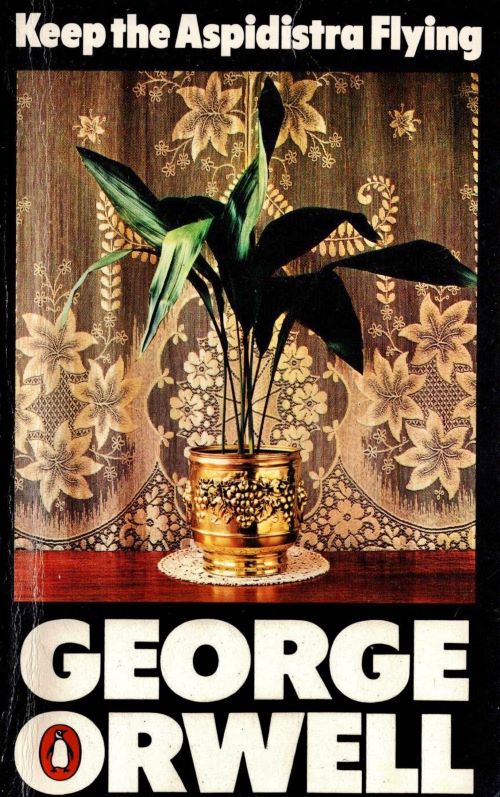
Keep the Aspidistra Flying by George Orwell ~ 1936. This edition: Penguin, 1975. Paperback. 264 pages.

I’m starting my 2024 Century of Books with this satirical novel, centered around a petulantly angry young man who almost manages to succeed at failure by deliberately refusing to take advantage of every chance he is given to advance himself, from his school days onward.

Gordon Comstock, on the cusp of his thirtieth birthday, is the last scion of a large, once-prosperous, middle-class English family. He’s a bit of a weedy chap, living unnecessarily squalidly by his own choice, and he’s very much on a downward spiral.

Having a modest aptitude for literary creativity, Gordon has achieved a small success as a poet, though his one published volume of verse, Mice, is now languishing on the remainder shelves of the bookstore he works at, after selling a meager one hundred and fifty-three copies in the two years since its debut.   

Gordon is pretty miffed about this. He can’t quite come to terms with his unsuccess as a writer, which he wraps up with his bitter condemnation of what he sees as a universal fixation on degrees of social rank, economic status, and the push to attain more money, more things. He feels that if only he were free to concentrate on his writing without the whole wage-slave thing, he would flower forth into his full intellectual potential.

Gordon’s psyche seems to be deeply scarred by his recognition that, as the years go by and the family money disappears – whisked away by the increasing cost of living and unwise investments – his family’s financial status is desperately inadequate to meet with the costs of maintaining a suitable social position without its members seeking paid employment. His way of dealing with this is to “defy the money-god” of conventional society by refusing to play the middle-class game of climbing-the-ladder-and-getting-ahead. Much as he would reject that description, Gordon’s a snob at heart.

Despite the best efforts of his few surviving family members and a stalwart handful of friends and well-wishers to see him settled in a “good job” with “good prospects” for future advancement, Gordon has sworn an oath against participating in what he sees as a dirty game. If he can strip his life of inessentials, take on the most minimal employment possible to provide for his most basic needs, and dedicate his leftover hours to his literary ambitions, he’s sure he will do great things and receive the recognition he secretly desires.

Unfortunately, Gordon lacks the touch of genius which would enable this wishful thinking to become reality, and he is peeved to find that a life of voluntary poverty gets in the way of creative work because of sheer physical discomfort and the desperate realities of being a poor person in sub-par lodgings.

Paradoxically, while rejecting conventional behaviour and scorning those who have, as he sees it, compromised their integrity by embracing the middle class live-to-work ethos, Gordon is bitterly jealous of anyone with money, and passionately wishes that he had some himself.

This is a richly written novel, and even though I had an increasingly strong desire for someone to just give our protagonist a bone-jarring shaking, I was wooed and held by the brilliance of Orwell’s powers of description, his deft character sketches, and his willingness to delve into some very deep places, literally and figuratively.

Oh, and what about the aspidistra of the title? Yes, that’s the ubiquitous Victorian-era houseplant, and the reader of this tale will become well-acquainted with its characteristics and its symbolic importance to Gordon Comstock as he pursues his unhappy spiral into self-inflicted misery.

Am I still rating my reads? Yes, I think I am.

Not a “must read” by any stretch, but I found this little novel intriguing and ultimately enjoyable, though I’m not quite sure about my response to the author’s choice of an ending. I’ll give no spoilers – read it yourself and see what you think!

Let’s give this an 8/10.

Read Full Post »

Older Posts »