Archive for the ‘Century of Books – 2018’ Category

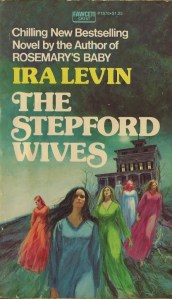
The Stepford Wives by Ira Levin ~ 1972. This edition: Fawcett Crest, 1973. Paperback. 191 pages.

Score a great big point for cultural saturation for this one.

Even those of us who haven’t read Ira Levin’s original novel or watched the 1975 (horror) and 2004 (dramatic comedy) movie versions have a darned good idea of what calling someone a “Stepford Wife” is all about: a scornful put-down right up there with “Little-Suzy-Homemaker” and “June Cleaver”, referring to the unemancipated females who are letting down The Sisterhood by really caring if their floors are glossy and their toilets really clean.

The Stepford Wives is a slight novel, despite its broad fame and its description on the back cover of my edition as a “chiller [with a] clincher of such hard-edged horror as to make his Rosemary’s Baby seem a drawing room comedy” – at least according to Mary Ellin Barrett of Cosmopolitan.

I do vaguely remember reading Rosemary’s Baby way back in the 1970s – I had a school friend who was into “horror” novels and she pressed it upon me – but I must say that the experience was underwhelming. And despite the promise of hard-edged horror from that long-ago Cosmo reviewer, I must say that this one is, on a superficial level, much the same.

After my reading of The Stepford Wives, as I shuddered gently at its implications, I mused that perhaps a tandem reading of the book might be a revealing conversation starter with your nearest and dearest.

Your partner’s response might well be worth noting, particularly if you are the wife in the equation. Will your spouse secretly envy the husbands of Stepford their sudden acquisition of sexually compliant, traditionally shapely, sweet-smelling underlings who don’t mess around with time-wasting outside interests? Who, incidentally, make the very best coffee?

Okay, backing up a bit to run ever-so-briefly over the plot, just in case any of my fellow readers have missed the gist of  this tale.

Joanna Eberhart, her husband Walter, and their two young children have just moved to the pleasant suburb of Stepford, and all are glad to be out of the ever-more-dirty-and-dangerous big city.

Joanna, self-proclaimed Women’s Liberationist and semi-professional photographer, admittedly hasn’t been too impressed by her first experiences with her polite but dull hausfrau neighbour ladies, but she hopes to find some like-minded, “liberated” friends in the area. And so she does, a couple of new arrivals like herself. They shake their heads over the boring house-proudness of their Stepford peers, and speculate on why all of the other women are so unambitious, so boringly polite, so compliant to their husbands’ smallest whims. Could it be something in the water? How about in that wonderful coffee? Are the ladies of Stepford being quietly drugged?

Turns out the truth is a mite more sinister.

Disclosure:

There isn’t a happy ending.

I think The Stepford Wives truly deserves its status as a classic of pop culture. It’s certainly representative of its time, and, for all its slightness, it’s a fantastic sleeper of a pro-feminist piece of literature. Even the most loving of the novel’s “enlightened” husbands eventually show their baser natures, much to my dismay. (I had highish hopes for at least a few of them. Nope. Ira Levin doesn’t pull any punches: all the Stepford men are evil.)

Final thoughts:

If you bump into it in your travels, you should read it, if only to clarify the basis for the pop culture “Stepford Wife” references all around us.

On the plus side, it’s a lightning fast read, a couple of hours at the most.

It’s also quite funny. Levin strikes an amusingly satirical note here, alongside his darker imaginings.

This one gets a shiny gold-plated star. Or, quantified in numbers, a rating of 7/10 from me.

Oh! One last thing. You, dear reader, if you make it through this novel, will never feel quite comfortable with a certain Disneyland attraction again…
 

Read Full Post »

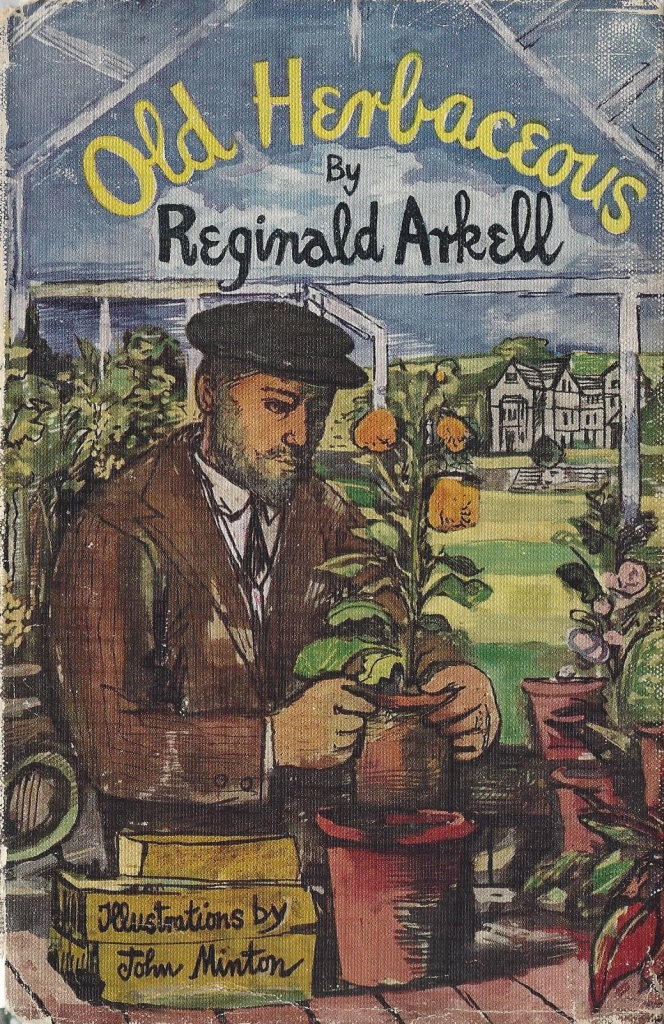
Old Herbaceous by Reginald Arkell ~ 1950. This edition: Michael Joseph, 1951. Illustrated by John Minton. Hardcover. 155 pages.

The second book of 2018 was something of a soft landing after my hair-straight-back initiation into the somewhat frenetic world of Elizabeth Bowen.

This next one is as straightforward as it gets; pure narrative of the simpler sort. I hasten to say it has all of the merits of its genre, that of the nostalgia piece, vide Miss Read and her ilk.

Elderly Bert Pinnegar, lifelong gardener at the “Big House” of his quiet English village, sits at his cottage window musing over his past, from humble beginnings through the stages of promotion from garden boy to head gardener, and on into retirement and inevitable physical decline of old age.

It all started so long ago…

Opening her cottage door, on a May morning some eighty-odd years ago, Mrs. Pinnegar, the cowman’s wife, had received a shock, and no mistake. There, on the door-step, wrapped in an old cotton skirt, was a baby, as newly-born as made no difference. Mrs. Pinnegar, a kindly soul, with six children of her own, passed the village maidens in review. Several of them were ‘expecting,’ but Mrs. Pinnegar, unofficial midwife and friend of all families, knew their dates to a nicety and the problem was not so easily solved. There had been no gipsies through the village for weeks. . . . Being a practical woman, the cowman’s wife picked up the parcel the fairies had brought her; christened it Herbert, after an uncle who was killed in the Crimea, and set about her Monday’s wash. When you had six of your own, one more didn’t matter.

Naturally, there was a bit of chatter at the time, but unexpected arrivals never made front-page news in an English village. A rick fire and talk of the Prussians in Paris were much more exciting. Young Herbert settled down in his new home; seasons came and went; the new self-binder started tying the sheaves with string . . .

Still, being picked up on a door-step did take the gilt off the gingerbread a bit; especially when you’d got along in the world and become someone in the village. True, there was nobody left to throw his birth in his teeth. Everybody was dead—every man Jack of them! Old folk went and new folk came, until you couldn’t find a single soul who remembered anything. Very soon he’d go, too, and then there’d be nothing left but houses—and gardens.

Funny, that! You planted a tree; you watched it grow; you picked the fruit and, when you were old, you sat in the shade of it. Then you died and they forgot all about you—just as though you had never been. . . . But the tree went on growing, and everybody took it for granted. It always had been there and it always would be there. . . . Everybody ought to plant a tree, sometime or another—if only to keep them humble in the sight of the Lord.

I don’t have a whole lot to say about this gentle story which can’t be imagined from the excerpt above. Arkell rambles along, documenting the highs and lows of his invented countryman’s life. There is some garden lore tucked in here and there, but not enough to take it to anything like a “garden” book. It’s a nostalgia piece, pure and simple, and the author makes no attempt to take it beyond that level.

Pleasant enough in its own way, and I passed an evening with Our Bert in mild enjoyment. Engaging enough to keep one entertained. If you like Miss Read, you’ll like Reginald Arkell.

I think I mentioned something of the same regarding the other of Arkell’s bucolic novels which I read during my 2014 Century of Books, Trumpets Over Merriford. And I believe I used the term “quaint” for that one, and it applies equally aptly to Old Herbaceous.

Looking at my rating of Trumpets Over Merriford, I see I gave it a 6.5 rating. I’m feeling rather more generous regarding the tale of the gardener. Let’s say 7.5/10. Because it’s a nice little thing, relaxing to read in between bouts with the seed catalogues this planning time of year for those of us with horticulture as part of our lives.


Read Full Post »

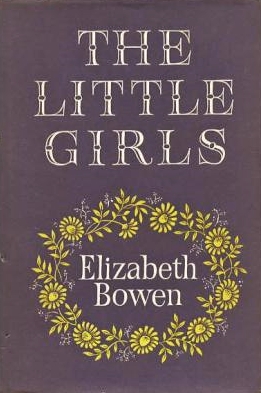
The Little Girls by Elizabeth Bowen ~ 1964. This edition: The Reprint Society, 1966. Hardcover. 256 pages.

The verdict is in regarding me and Elizabeth Bowen.

I do believe she gets the nod.

Though I found The Little Girls rather hard going at times, I came out the other side of this sometimes confusingly complex novel a convert. I can see why she’s such a polarizing writer; people seem to either love her or find her needlessly convoluted.

After this particular reading experience, I have to agree with the convolution-critics, but the end result is a rather compelling thing. Memorable in the longer term, I suspect it will be. And definitely one to re-read, if only to come to it with a questing eye to all of the clues the author provides in relation to its nebulous ending.

Dinah Piggott, a comfortably well-off widow in late middle-age, has embarked upon a project to assemble a collection of objects representing the people of her nowaday, to be sealed up in a cave at the bottom of her garden with a view to eventual discovery by a future race, once this one has vanished. Her friends and family are on the whole cooperative in each donating the requested twelve expressive objects, though Dinah has just come to the realization that her amassing collection contains a discouraging number of duplicates: strings of artificial pearls and pairs of nail scissors (some broken) are conspicuous by their frequency.

No matter, she is firm in her resolve to create her message to the future, though when she is confronted with the logistics of actually sealing the cave up and not being able to mull over the objects, she is taken aback by her own feeling of reluctance to let it all go into the dark, never to be seen (by her) again. Which triggers another train of thought, related to the time capsule concept.

Fifty years ago, Dinah – “Dicey” –  was an 11-year-old schoolgirl at St. Agatha’s, and she and her two closest cronies – accomplices? – had, at Dinah’s instigation, buried (in dead of night) a coffer containing a secret personal object from each of them, a collection of animal bones, and a letter in an invented language written in its creator’s blood.

Now Dinah has had a sudden compulsion to reach back into the past, to find her two friends, to engineer a reunion, and to disinter that long-buried coffer together, as a way to recapture the close companionship of their shared youth.

Dinah posts a series of deliberately provocative newspaper advertisements (…”if alive but in hiding, the two should know they have nothing to fear from Dicey, who continues to guard their secret…”) in five different newspapers which have readership throughout England, hoping for a bite.

And yes, indeed, both old friends respond, though with caution rather than full-out enthusiasm. For fifty years have passed since their shared school days; the Great War and the Hitler War have taken place in the meantime, with subsequent societal reorderings. The headstrong and occasionally wicked “little girls” of 1914 are now sedate older women with certain positions to uphold in their respectable social circles. Whatever they were then has not carried through to the now.

Or has it?

The centrepiece of this multi-layered novel is a flashback sequence to those schooldays, when clumsy, imaginative Diana(Dinah/Dicey), talented and indulged dancer Sheila(Sheikie), and academically gifted Clare(Mumbo), were a triumvirate to be watched with slightly horrified caution by their elders as well as their peers.

Dinah was something of the ringleader in schoolgirl exploits, though the others were hardly follow-blindly types; all contributed something vital to their partnership, and none were afraid to bluntly dismiss anything that approached each girl’s definition of “nonsense”.

This is not a gentle tale, though there are episodes of great tenderness. Dinah, for all of her apparent aggressiveness of character, surprises us by the amount of dedicated love she inspires in those she in turn holds dear, though we don’t find this out until the final episode, after an unwitnessed and undescribed near-tragic mishap befalls one of the key characters.

The novel’s ending is ambiguous, though I chose to interpret it as hopeful. Peace, if not entirely made, is seen as becoming ultimately possible between those of our characters most at odds.

The Litte Girls, for all its challenges to the reader – that sentence structure! – is brilliantly written, frequently humorous, occasionally off-putting, and ultimately deeply poignant. Great gaps are left here and there in the narrative, causing the reader a certain amount of discomfort as one struggles to realign the narrative, but it does all fall into place as episode builds upon episode, and those disparate clues I referred to early on show their importance to the whole.

Ah, yes, and there is a garden, wherein some key scenes take place. It is Dinah’s, and it is one of our clues to her particular character. (This passage also serves as an example of Bowen’s writing style. See if you can get through it all in one go, without backing up here and there to try to find where you’ve strayed outside the lines!)

On each side, the path was overflowed by a crowded border. Mauve, puce and cream-pink stock, double, were the most fragrant and most crushingly heavy: more pungent was the blue-bronze straggling profusion of catmint. Magnificently gladioli staggered this way and that – she was an exuberant, loving, confused and not tidy gardener; staking and tying were not her forte. Roses were on enough into their second blooming to be squandering petals over cushions of pansies. Flowers in woolwork or bright chalk, all shades of almost every colour, zinnias competed with one another. And everywhere along the serpentine walk where anything else grew not, dahlias grew: some dwarf, some giant, some corollas like blazons, some close-fluted, some velvet, some porcelain or satin, some darkening, some burning like flame or biting like acid into the faint dusk now being given off by the evening earth.

Gorgeous, yes?

An auspicious way to start of 2018’s reading year.

The personal rating: 8.5/10


Read Full Post »

« Newer Posts