Archive for the ‘2000s’ Category

jeannie and the gentle giants luanne armstrongJeannie and the Gentle Giants by Luanne Armstrong ~ 2002. This edition: Ronsdale Press, 2002. Softcover. ISBN: 0-921870-91-4. 150 pages.

My rating: 4/10. A completely typical “problem novel” (single parenthood, mental illness, foster children) packed with contrived situations. An eleven-year-old heroine is placed in foster care after her mother has a mental breakdown.

Sadly this one didn’t quite fly. The horse bits were good – the best part of this novel, in my opinion –  but they couldn’t salvage the rest of the completely predictable, cookie cutter story. Despite the favorable back cover blurb by my up-the-hill neighbour, poet, writer, and horse-logger Lorne Dufour (aha! now here’s an interesting Canadian Reading Challenge author) it just didn’t click with anyone here. Too bad. Jeannie is set in Kelowna, B.C., and as a home-province, B.C. Interior-set youth novel I really wanted to love it. (Plus the cover image is fantastic.)

From the publisher’s website:

Jeannie and the Gentle Giants, a novel for readers eight to fourteen, deals with the problems experienced by children when they are taken from their parents and have to make a new life with foster parents in a new community. In Jeannie’s case, the problems begin when her mother falls ill and can no longer care for her. Taken from her home, placed with foster parents and unable to discover the whereabouts of her ill mother, young Jeannie withdraws into herself and can think only of running away.

Gradually her defences are breached by two immensely large and wonderful workhorses and their perceptive and humorous owner. Through the horses and her work on the farm, Jeannie develops new interests, learns to ride and becomes involved in the daily life of the farm, even helping with horse-logging. In turn, Jeannie learns about friendship, love and trust, and ultimately gains the maturity and self-confidence to accept the challenge of becoming herself a care-giver. In this sensitive and moving story, Luanne Armstrong draws us into a world of pain, growth and fulfilment.

Lorne Dufour’s back cover blurb:

In this story, the Gentle Giants slowly walk right through our hearts. We will forever remember their presence in Jeannie’s life and that the great Gentle Giants never forget.

 ~ Lorne Dufour, horse-logger & award-winning author

The author attempted an ambitious level of complexity here, by involving her young protagonist in a rather tangled combination of situations. We have: mentally ill mother, single-parent family with no father in sight, poverty, social stigma as child of mentally ill mother (handled quite well by author in providing heroine with staunch friends who immediately speak up in her favour to school bullies), foster parents who can’t have children, neighbour couple who find they are expecting a baby mid-way through book, heroine’s questioning as to what a family actually is and her conflicting desires to both be with her mother back in the city and to stay in her new, more fulfilling and interesting country life, doctors refusing to allow child to see ill mother – (this didn’t ring true – felt like a plot element to increase tension – mother was experiencing a psychotic episode, some mention of bipolar disorder/manic depression, but once the mother was capable of sending the first letters, why the heck WOULDN”T she be able to have visits from her daughter – wouldn’t that by emotionally beneficial to BOTH of them) – okay, moving on – learning to handle work horses, learning to ride, dealing with an injured horse all by herself, finding a lost child, guilt guilt guilt because heroine feels she has been the cause of the child being lost, feral stray dog tamed and made into pet …  My goodness, what a busy, busy girl.

As I said earlier, I really wanted to like this book, but it just didn’t ever feel “real”. Too much was chucked into the mix, Jeannie’s reactions were not very well portrayed – we were continually given the same set of outward clues that she was all bummed out – she had a “shy look”, “looked down”, “blinked to hold back tears”. The language throughout is overly simplistic, as if keeping it accessible to “poor readers” was a major goal.

Does this seem too critical? I feel like a big old meanie for picking this one apart, but, in all honesty, these were my thoughts as I read.

For the record, I really don’t care for “problem books”, for readers of any age, but in particular for young readers. “This is a book about DIVORCE! MENTAL ILLNESS! CEREBRAL PALSY! DOWN’S SYNDROME! BULLYING! ANOREXIA! ETHNICITY! PREJUDICE! BEING GAY! blah blah blah… If you, dear person/dear young child with a similar issue in your life, will only read this book you will feel so much better because you will see how this marvelous hero/heroine dealt with it in their fictional world and you won’t feel so alone.”

Dear youth authors: Write a STORY first. If there are side issues, so be it, for if naturally included those always interest, verisimilitude and richness to the mix. But don’t pick an “issue” and write a prescriptive “here’s how to deal with it, dear” contrived moral tale. Kids aren’t stupid. They don’t need to be told what to think in such a poorly written way. Yes, definitely acknowledge and include the issues, but don’t build a weak story around them, for the sake of marketing the book to the school library network! This whole “issue story” genre encourages sub-par story-telling.

In my opinion.

Jeannie and the Gentle Giants pushed a lot of my buttons, and not in a good way.

Rant over. (For today!)

Oh, hang on – not quite. “Foster” parents – I always thought that foster parents were those filling a long-term role in a child’s life. Jeannie is in what I would classify as “temporary care”, so the immediate (within days) placement of Jeannie with a new, albeit temporary, “mom” and “dad” didn’t ring true. It is continuously stated that Jeannie will be reunited with her mother once the doctors get her (mother’s) meds figured out. I mean, the actual family placement is okay, but the whole “this is your new family” thing felt rushed and phony. No wonder the poor kid is a basket case – “Here, Jeannie, meet your new mom!”

And another quibble, this with the publisher’s website and back cover plot outline. It sounds as though Jeannie doesn’t know where her mother is through all of this. She’s in the flipping hospital in Kelowna, people. Did you not read the book?!  Jeannie knows this, her social worker knows this, her “foster parents” know this – they make continual phone calls and Jeannie’s mom writes her letters, for crying out loud! So why is this presented in the promotional material as “child torn away from parent and searching for her”? The kid tries running away to go see her mother, but she knows where her mother is. She’s turned away as she tries to buy a bus ticket to Kelowna, to go to the hospital, to see her mother, because Jeannie knows she’s there.

Okay, now I’ll quit. I’d hesitated to review this book, because it let me down so sadly, but I did say I’d review and post every Canadian book I read, so here goes. There are a few more disappointing titles lined up for review, so a heads-up for those wondering why I’m so crabby today. I’ve just been pushing them back in the queue, but have decided to tick them off my deal-with list before 2013 hits.

Read Full Post »

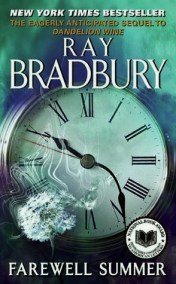
farewell summer ray bradburyFarewell Summer by Ray Bradbury ~ 2006. This edition: Harper Collins, 2007. Paperback. ISBN: 978-0-06-113155-4. 198 pages.

My rating: 8/10. The old Bradbury magic was still in fine working order, in this the last of his published full-length novels. It is really more of a novella; a sequel of sorts to 1957’s Dandelion Wine, picking up with young protagonist Douglas Spaulding in that famously faraway October of 1929.

It took a few pages to settle into Bradbury’s randomly rambling narrative, but once I found the groove the journey was smooth and honey-sweet.

*****

Doug Spalding is thirteen, and poised rebelliously on the edge of a looming maturity, digging his heels in desperately against the advance of time. The old people of the town (barring Grandmother and Grandfather, exempt from their joining their peers in the minds of Doug and younger brother Tim by reason of long familiarity and familial love) are seen as the enemies of the young; especially the four ancient members of the school board, who plot to steal Youth’s time and force the golden boys and girls into the ranks of the elders in their turn.

A war erupts between Doug and his cohorts, and the staid elders of the town, headed by Mr. Calvin C. Quartermain, eighty-one and hanging on to life with both hands even more fiercely after the sudden death of one of his fellow school board members, triggered (possibly) by the actions of one of the boys. The battle takes on epic proportions (though mostly in their collective minds, young and old alike) and is fought with and amongst chessmen and clock towers and haunted houses, until Doug is unexpectedly undone by that age-old adversary of careless youth, the siren song of love.

The very essence of a magical boyhood is conjured up in Ray Bradbury’s vivid words. Visiting the town’s candy shop to prepare for a sacrificial ceremony, the boys find

… honey … sheathed in warm African chocolate. Plunged and captured in the amber treasure lay fresh Brazil nuts, almonds, and glazed clusters of snowy coconut. June butter and August wheat were clothed in dark sugars. All were crinkled in folded tin foil, then wrapped in red and blue papers that told the weight, ingredients and manufacturer. In bright bouquets the candies lay, caramels to glue the teeth, licorice to blacken the heart, cherry wax bottles filled with sickening mint and strawberry sap, Tootsie Rolls to hold like cigars, red-tipped chalk-mint cigarettes for chill mornings when your breath smoked on the air …(D)iamonds to crunch, fabulous liquors to swig. Persimmon-colored pop bottles swam, clinking softly, in the Nile waters of the refrigerated box, its waters cold enough to cut your skin…

Meanwhile, among the old men, Bleak says to Quartermain:

“You remind me of the perceptive asylum keeper who claimed that his inmates were mad. You’ve only just discovered that boys are animals? … We live in a country of the young. All we can do is wait until some of these sadists hit nineteen, then truck them off to war.  Their crime? Being full up with orange juice and spring rain. Patience. Someday soon you’ll see them wander by with winter in their hair…”

The young and old battle with their various metaphorical and actual weapons and eventually make a truce of sorts, as disguises are penetrated and eyes meet and recognize each other under the superficial masks which time has imposed.

An unusual and beautifully written book, likely best appreciated by those whom, at whatever age, have been brought up short by the stranger’s face in the mirror and the sudden realization that the eyes alone are as remembered.

This writer is often thought of as an author for youth, but I think his older readers will appreciate the true poignancy which lies behind the surface stories. This book is for the already-converted, and for those I will say highly recommended.

New to Ray Bradbury? I’d advise you to perhaps start instead with The Martian Chronicles, or some of the short story collections. You’ll need to adjust your brain to his unique voice and way of thinking to make sense of the kind of coloured crystal envisionings which he occasionally indulged in, and which Farewell Summer is a prime example of.

Read Full Post »

the best thing for you annabel lyon 001The Best Thing for You by Annabel Lyon ~ 2004. This edition: McClelland & Stewart, 2004. Softcover. ISBN: 0-7710-5397-5. 322 pages.

My rating: 10/10

Annabel Lyon is absolutely fearless in where she’s willing to go with these novellas, and there wasn’t a single jarring note anywhere. I am in awe.

I liked this collection in the same way I liked her high-profile Giller and Governor General’s Award nominee, and Rogers Writers’ Trust Fiction Prize winner, 2009’s The Golden Mean – sometimes I was deeply disturbed – and occasionally almost offended – by the images she conjured up, but I never, ever – even briefly – looked away. She kept me fully engaged the whole breathless trip.

This woman can write, people. If you haven’t already, you need to check her out.

Highly recommended.

*****

The Best Thing For You is a collection of three novellas. This is a form which I don’t see used much any more, but in this case it works wonderfully well, allowing an ambitious complexity of content and keeping the pace fast without the inevitable fluctuation in energy which occurs in a longer novel.

All three stories are set in Vancouver, British Columbia, the home of the author. The first two are set in contemporary times and the third is set during the ending days of World War II; the celebration triggered by the announcement of the end of the war plays an important part in the narrative.

Be prepared to pace yourself when reading through this one. Each novella deserves as much attention as a novel would; I found that I stopped cold after each one and only was able to turn my full attention to the next after digesting what I’d read for a few days. I wouldn’t recommend reading these in one fell swoop; I personally would have found that overwhelming. This is a collection that deserves – demands! – the reader’s full attention.

  • No Fun – A conventional enough narrative about a respectable middle class family, mother a doctor, father a university professor, well-adjusted, perfectly normal teenage son in high school. That’s the surface picture. When the son is involved (possibly? probably?) and criminally charged in connection with the brutal beating of a mentally handicapped man, the picture perfect impression dissolves into a dramatically realistic portrait of three people in personal crisis. As the mother of a teen boy myself, this novella (cliché alert!) touched me deeply in a very personal way. It made me smile in recognition, it frequently made me laugh, and it made me feel less alone in my occasional confused dismay at what our beautiful babies evolve into without our maternal permission (damn it anyway!) Lyons gets it so very right; how does she do that? The portrait of a marriage going on behind the issues brought about by the child is exceedingly well drawn as well.
  • The Goldberg Metronome – a young couple find a mysterious package taped to the pipes under the bathroom sink in their newly rented apartment. In it is a midnight blue, broken antique metronome. The story of the metronome’s history interweaves with the stories of the lives of the people it has joined tenuously in a thread of possession, passion, desire and loss. Gorgeous story.
  • The Best Thing For You – The strongest (of a strong three) and most elaborately plotted (of a beautifully complex three) of these novellas. A discontented young married woman involves a teenage delivery boy first in an adulterous affair and then in something much deeper and darker. Another teenager in the periphery of the events becomes deeply involved in a very different way. Cleverly noir, I thought as I read; I was vindicated in this assessment by reading in an interview here that film noir was indeed Lyon’s inspiration for the story:

I like film noir, and was interested in creating a femme fatale who’s both less and more than she seems.  Anna is a black-eyed adulteress who murders her husband for his life insurance, but she’s also bookish and melancholy and doesn’t really enjoy sex with her lover.  She’s also curious.  That’s one of her defining characteristics for me.  She doesn’t want to close her eyes and act as though everything’s all right when clearly–as a young woman with little formal education, no job, and no prospects, who is perceived basically as a sexually precocious child by everyone around her–her life looks quite grim.  She doesn’t want to play along, to pretend.  She wants to confront.

I guess the tone of the novella came about because I was constantly thinking about film.  I tried to keep the action quite external, to start scenes in the middle, to cut, to use dialogue in the slightly stylized manner of movies from the forties, and also to convey a sense of black and white through the prose yet with a complexity of texture that is a hallmark of some of the great movies from that era.

Again, here’s the interview link: Book Clubs. ca. Short, but well worth a read after you’ve enjoyed the collection. It added another dimension to my respect for the depth and general excellence of this author’s work.

Read Full Post »

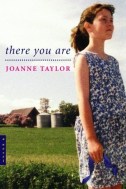
Tthere you are joanne taylorhere You Are by Joanne Taylor ~ 2004. This edition: Tundra Books, 2004. Softcover. ISBN: 0-88776-658-7. 199 pages.

My rating: 4.5/10. Well researched and competently written, but missing that special spark.

*****

Almost-twelve-year-old Jeannie Shaw lives with her family in the Margaree Valley of Cape Breton, Nova Scotia in 1952. School is about to start, and this year Jeannie hopes and prays that there will be a friend for her, another girl who she can walk with and talk with, share secrets and dreams with; someone to heal the deep loneliness that Jeannie has had for far too long.

There are several other girls at Jeannie’s small rural school, but they are a grade older and as far as they are concerned that year or two might well be a century. Word is out that a new family has arrived, with a child Jeannie’s age; but to her dismay the longed for girl turns out to be just another boy.

Jeannie and Cap Parker get off very much on the wrong foot together, a situation made worse by their sharing of the same desk in school. And things at home aren’t going well either. Jeannie’s pesky four-year-old sister Pearl is always getting into her things, and their pregnant mother merely pleads for peace and quiet rather than administering any sort of punishment to Pearl.

When Pearl and her small friend Ella disappear while being in Jeannie’s care, she reluctantly finds herself grateful for Cap’s quick wits and good nature in dealing with the days of uncertainty which follow.

While this was a book which tried really hard, it just never really got off the ground for me. The characters were one-dimensional and predictable in all of their thoughts and actions. A certain success was achieved in the description of the time and setting: 1952 in a peaceful, beautiful, rural Cape Breton Valley. Little historical snippets are distributed throughout.  A few horses still share the roads with cars in this peacefully backwoods part of the world; Cap’s father died in World War II, and Jeannie’s father is a returned veteran; the polio epidemic is widely known and deeply dreaded, and is a key part of an incompletely developed plot twist.

There is not enough historical content to make this a proper historical fiction, or enough character development to make this a satisfactory personality-driven novel; the climax is artificially sustained and unrealistically resolved. A very cookie cutter story, imposed on a potentially unique setting.

This is not so much a bad juvenile novel as it is a disappointing one, at least to this reader. I felt it was missing that elusive spark which truly brings a story to life.

This appears to be a minority opinion. There You Are was nominated for the Canadian Library Association’s Children’s Book of the Year Award for 2005, and was a finalist for the 2005/2006 Hackmatack Award, an Atlantic Canadian “Children’s Choice” award.

An acceptable story for the target audience of eight to twelve suggested by the publisher’s promotional blurb, but not recommended by me with any sort of enthusiasm, though Jeannie’s situation will likely garner some sympathy from younger, less critical readers.

Purchased at a recent library book sale, and going back into circulation to try for another home; it’s just been placed gently in the giveaway box.

Read Full Post »

INSTRUCTIONS

Touch the wooden gate in the wall you never saw

                                     before.

Say “please” before you open the latch,

go through,

walk down the path.

A red metal imp hangs from the

               green-painted front door,

as a knocker,

do not touch it; it will bite your fingers.

Walk through the house. Take nothing. Eat nothing.

However, if any creature tells you that it hungers,

feed it.

If it tells you that it is dirty,

clean it.

If it cries to you that it hurts,

if you can,

ease its pain.

From the back garden you will be able to see the wild

                                             wood.

The deep well you walk past leads down to Winter’s

                                             realm;

there is another land at the bottom of it.

If you turn around here,

you can walk back, safely;

you will lose no face. I will think no less of you.

Once through the garden you will be in the wood.

The trees are old. Eyes peer from the undergrowth.

Beneath a twisted oak sits an old woman.

                           She may ask for something;

give it to her. She

will point the way to the castle. Inside it

are three princesses.

Do not trust the youngest. Walk on.

In the clearing beyond the castle the

                    twelve months sit about a fire,

warming their feet, exchanging tales.

They may do favors for you, if you are polite.

You may pick strawberries in December’s frost.

Trust the wolves, but do not tell them

where you are going.

The river can be crossed by the ferry.

The ferryman will take you.

(The answer to his question is this:

If he hands the oar to his passenger, he

will be free to leave the boat.

Only tell him this from a safe distance.)

If an eagle gives you a feather, keep it safe.

Remember: that giants sleep too soundly; that

witches are often betrayed by their appetites;

dragons have one soft spot, somewhere, always;

hearts can be well-hidden,

and you betray them with your tongue.

Do not be jealous of your sister.

Know that diamonds and roses

are as uncomfortable when they tumble

                    from one’s lips as toads and frogs:

colder, too, and sharper, and they cut.

Remember your name.

Do not lose hope — what you seek will be found.

Trust ghosts. Trust those that you have

                helped to help you in their turn.

Trust dreams.

Trust your heart, and trust your story.

When you come back, return the way you came.

Favors will be returned, debts will be repaid.

Do not forget your manners.

Do not look back.

Ride the wise eagle (you shall not fall).

Ride the silver fish (you will not drown).

Ride the grey wolf (hold tightly to his fur).

There is a worm at the heart of the tower;

                             that is why it will not stand.

When you reach the little house, the

                      place your journey started,

you will recognize it, although it will seem

                       much smaller than you remember.

Walk up the path, and through the garden

                           gate you never saw before but once.

And then go home. Or make a home.

Or rest.

Neil Gaiman ~ 2000

Read Full Post »

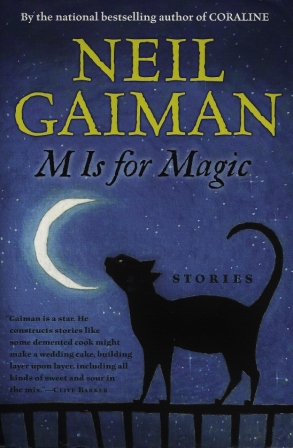
M is for Magic by Neil Gaiman ~ 2007. This edition: Harper Collins, 2007. First Edition. Hardcover. ISBN: 978-0-06-1186424-4. 260 pages.

My rating: 8/10. It’s Neil Gaiman – what else can I say? When he’s good, he’s great. Some of his stuff is a bit out there and twisty for my squeamish comfort, but mostly I’m a solid fan.

But I disagree with the marketing angle for this collection – this is not a book for children. The true audience here is teens and up, in my opinion. Some of the reference are totally aimed at adults. Not to say kids shouldn’t read this – not at all! Like most of Ray Bradbury’s work, whom this collection was inspired by according to Gaiman’s forward, the fact that some of the stuff is over their heads will be immaterial.

None of the material in this book is original to it; the pieces have all been published in other anthologies and collections, with the exception of  The Witch’s Headstone, which is an excerpt from and a teaser for The Graveyard Book, which was about to be published the next year, 2008,  and Gaiman’s Introduction.

*****

  • Introduction ~ “When I was a boy, Ray Bradbury picked stories from his books of short stories he thought younger readers might like, and he published them in R is for Rocket and S is for Space. Now I was doing the same thing, and I asked Ray if he’d mind if I called this book M is for Magic. (He didn’t.) M is for Magic. All the letters are, if you put them together properly. You can make magic with them, and dreams, and, I hope, even a few surprises…” ~ Neil Gaiman, August 2006
  • The Case of the Four and Twenty Blackbirds ~ 1984 ~ A take-off on the hardboiled detective story, a la Dashiell Hammett. The main conceit here is that the characters are nursery rhyme figures. Meh. Cute idea, but it doesn’t really work. (Starting on a low point. Don’t worry, it gets better.) 5/10.
  • Troll Bridge ~ 1993 ~ Omigosh. Angst Alert! A boy encounters a troll at the tender age of seven and bargains successfully for his life. But if you live long enough things may just come full circle. 8/10.
  • Don’t Ask Jack ~ 1995 ~ A pointless little vignette featuring a jack-in-the-box and Time. Methinks the author was reading too much Bradbury before he penned this one. 6/10.
  • How to Sell the Ponti Bridge ~ 1985 ~ Okay, now we’re warming up. The story of the perfect scam, and how to turn lust and greed back on itself. And I award this one a  perfect 10/10.
  • October in the Chair ~ 2002 ~ The Months are telling stories. Beautiful set up, and one of those endings which leaves you just hanging there gasping in mid-air. Nice. 9/10.
  • Chivalry ~ 1993 ~ Mrs. Whitaker finds the Holy Grail in an Oxfam Shop, and things get interesting. Gorgeous! And very funny.  Another 10/10.
  • The Price ~ 1997 ~ This one bothered me, being a cat person. An adopted Black Cat apparently guards his human family against the devil, but the battle is proving too much for him. Sad. 6/10.
  • How to Talk to Girls at Parties ~ 2006 ~ Vic and Enn crash the wrong party. These girls come from a long way away. 7/10.
  • Sunbird ~ 2005 ~ The Epicurean Club finds a new and mostly fatal dining experience. A strangely entrancing tale. 8/10.
  • The Witch’s Headstone ~ 2007 ~ An excerpted chapter from the yet-to-be-published (at the time of this collection) Graveyard Book. Young Bod falls in with the ghost of a witch, and does the perfect thing. 10/10.
  • Instructions ~ 2000 ~ A poem lays out the fairytale guide to life’s journey. 11/10. (No, that’s not a typo. Love this one that much. Hmm, maybe I should post it.)

Read Full Post »

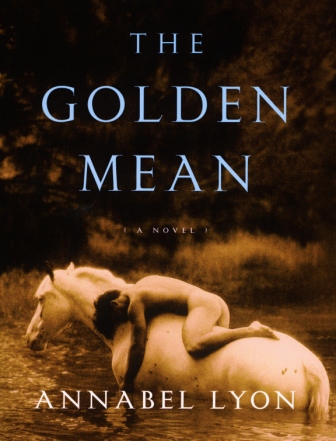
The Golden Mean by Annabel Lyon ~ 2009. This edition: Vintage Canada (Random House), 2010. Softcover. ISBN: 978-0-307-35621-5. 284 pages.

My rating: 9/10. I didn’t give this one a 10, though I considered it,  because it pushed me a bit past my personal comfort level regarding contemporary idiom used in historical fiction. In this particular case, after I got into the story, it worked.

Oh yeah, that, and the very graphic descriptions of sex, and human dissections. But once I was fully engaged, and became comfortable with the “voice” of the narrator, it also worked.

It’s almost a 10. I’m not sure if I’ll re-read it any time soon, but it was genuinely diverting while it was happening, and I’ll be reading the sequel of sorts, The Sweet Girl (2012) when it crosses my path. A keeper.

*****

I came to this book expecting to dislike it, if not downright hate it. After all, my personal standard for ancient Greece era historical fiction is measured by the excellence of Mary Renault‘s works. It is my current opinion that Annabel Lyon, with this book, proves worthy of standing in the same room as Renault. And in her (Lyon’s) acknowledgments she mentions Renault’s stellar Fire From Heaven, so that was another point in favour.

Lyons is no Renault, which isn’t a condemnation. She is a writer of another time altogether, speaking to the readers of her time as Renault spoke to the readers of hers. Whether Annabel Lyon’s work will have the staying power of Renault’s historical fiction classics, time will tell. I suspect perhaps not, but we shall see. I suspect that Lyons will be a writer to watch out for in the years to come, though her blazingly sudden fame (notoriety?) may be something of a detriment to considered reflection of the merit of her subsequent work.

The Golden Mean made the Giller short list in 2009, was plastered all over the mainstream book pages, and was praised for its “sensuous and muscular prose” – it says that right on the front flyleaf – so I was, paradoxically, quite suspicious of what I would find behind that attention-getting cover. (And here’s a snippet of trivia for you: The book was at one point pulled from the shelves of the B.C. Ferries gift shops because of the nudity on the cover. Well, there’s no such thing as “bad” publicity! Personally, I lke the cover, and I “get” why it was chosen. To be completely true to the book though, the horse should be black, and the young man at least partially clothed. But I digress.)

<Several days go by …>

I’m finishing up this review away from home, without the book in front of me. It is, sadly, in the side pocket of my laptop case, which is sitting on the floor next to the kitchen door some 200 kilometers away. I walked out of the house with that naggy “I’m forgetting something” feeling, and was too far to swing back when the penny dropped. Luckily, courtesy of public library internet terminals, I can get onto my WordPress account, and with an hour of time to fill, I’m going to try to get this review off the “waiting” sidebar.

Browsing other readers’ comments in the hopes of freeing up my stuck thought processes, I came upon the review I wish I’d written, by Patricia Robertson on the Canadian Notes and Queries website. Nothing I can come up with this evening can match the scope of this review, so I’m completely cheating and pasting most of it (and it’s long) into this post. Good stuff. I bow in humble admiration. Here’s where the link to the full March, 2010 review: Aristotle Among the Barbarians

And here is a lengthy excerpt. It’s detailed, so I probably should give a possible spoilers warning.

As the book opens, Aristotle is travelling to his homeland of Macedonia after a twenty-five-year absence. “The rain falls in black cords, lashing my animals, my men, and my wife, Pythias, who last night lay with her legs spread while I took notes on the mouth of her sex, who weeps silent tears of exhaustion now, on this tenth day of our journey.” This sentence, the first, functions as a microcosm of the entire novel. The “black cords” that “lash” the little entourage (and Aristotle himself) foreshadow the dark choice he must soon make. When his boyhood friend, King Philip of Macedon, asks him to stay on to tutor his young son Alexander, Aristotle is horrified. He has loftier ambitions: to return to Athens, to the Academy where he was once Plato’s student and which he hopes one day to lead. Compared to the Athenians, the Macedonians are barbarians. Yet how can he refuse Philip?

The same image prefigures Aristotle’s depressive episodes – “his old usual,” he calls it, describing it as “sucking colour from the sky and warmth from the world.” Whether the actual Aristotle suffered from clinical depression, history doesn’t tell us, but Lyon’s intuitive attribution of this disorder to her highly gifted protagonist feels right. As for her wonderful phrase about Aristotle’s notetaking, it can be interpreted two ways: metaphorically – Aristotle the rationalist, making mental notes in the midst of fucking – and literally – Aristotle the empiricist, writing detailed descriptions of the world around him. Already he is a modern, grounding his rationalism in that most modern of enterprises, the scientific method. Poor Pythias, whom he will often treat in the same clinical way, and who (in the same sentence but twenty-four hours later) “weeps silent tears of exhaustion”!

The brilliantly evoked relationship at the heart of the novel is a long way from the Hollywood paradigm – the charismatic and indefatigable instructor who succeeds in catalyzing his pupils against overwhelming odds. Alexander is, sometimes, deeply engaged by Aristotle’s demonstrations of science, drawn in almost against his will by his teacher’s Socratic method. But he’s also of royal birth, destined to rule a kingdom; though he admires Aristotle, he doesn’t (perhaps cannot) flatter him through imitation. To Lyon’s credit she doesn’t pander to contemporary taste by hinting at homosexual attraction, though she makes it clear that homosexual relationships are an accepted norm. (Alexander’s relationship with his lifelong companion Hephaestion is one such.)

The Golden Mean, in fact, shows us just how narrow our dramatic expectations have become. Though sex and intrigue and violence are present, the focus is on two men who exemplify two great life choices: contemplation versus action. Aristotle comes down squarely on the side of apollonian reason against unreason, thinking against unthinking instinct. Early in the book his nephew and apprentice, Callisthenes, recounts an incident from a night out when he’s witnessed the killing of one man by another over a drink. “What kind of a people is that?” he asks his uncle, who says, “You tell me.” “Animals,” Callisthenes answers. “And what separates man from the animals?” asks Aristotle, ever the teacher. “Reason,” Callisthenes dutifully replies. “Work. The life of the mind.” To which Aristotle’s ironic answer – “Out again tonight?” – underlines Callisthenes’ lack of real commitment, in Aristotle’s terms, to being human.

Moments like this – moments that demand full reader engagement to comprehend – occur throughout the novel. We’re forced to pause, to re-read, to think more deeply. Lean, taut, stripped down, The Golden Mean is dense with meaning while also managing to be crisp, direct, and contemporary. Lyon has a poet’s eye without allowing her prose to become poetically languorous. She’s especially good at verbs: “The Athenians sharked up and down the coast,” for example. But she also understands that metaphors in abundance do not make a novel literary – that instead they’re best used sparingly, like salt (a lesson apparently lost on a number of highly acclaimed Canadian writers).

She also rips up the conventions of the historical novel. Instead of the pseudo-realistic “at your service, my liege” school of dialogue, the voices here roar along like a freight train. These are men who use words like “fuck” and “balls” and “bitch,” whose language has the crude vitality it must have had then. Lyon succeeds in making ideas and argument exhilarating, sexy even. She also risks deliberate anachronisms, although occasionally she pushes too hard. “It’s not that he has no boundaries,” Aristotle tells Pythias at one point, speaking of Alexander – using an analyst’s terminology some twenty-odd centuries before Freud! Late in the novel, when Alexander suggests assassinating the new director of the Academy (chosen over Aristotle), Philip’s regent in his absence, a general named Antipater, tells him no. “You are not going alone to Athens to snuff some hundred-year-old egghead with a protractor for a dick. You’re a prince of Macedon. That particular freak show is not for you.” All of this worked for me, except for “freak show.” A matter of individual reader taste, perhaps, but after “snuff” and “egghead” and “dick,” it seemed forced and over the top.

Lyon uses flashback rarely, but late in the book we meet Aristotle as a young man of eighteen when he first entered the Academy. We’re aware of the parallelism here between Aristotle and Alexander, the poignancy of this glimpse of Plato’s potential (but forever thwarted) heir. He’s also a typical adolescent, avid for sexual experience; the chapter ends with “The girl had licked and bitten, licked and bitten, until I didn’t know myself.” It’s a vigour echoed throughout the book, both in Aristotle’s relationship with Pythias, given to him as a gift when she was fifteen – “gods forgive me but I went at her like a stag in rut” – and in his later attraction to Herpyllis, Pythias’s maidservant, whom he marries after his wife’s death.

Lyon’s wonderfully complex Aristotle spends little time simply writing or thinking, apart from those long bouts of depression. He is in the world, even if not always fully of it, as shown by the emotional detachment, almost cruelty, that accompanies his elevation of reason as a virtue above all others. When Pythias is dying, she tells her husband of recurring dreams, sent by the gods, that foreshadow her death. Aristotle, who has never had such dreams – “My mind is too busy in waking,” he tells us, arrogantly, “to suck for fuel during sleep” – treats this as yet another teaching opportunity. He uses scientific explanations rather than affection to comfort her – explanations that, amusingly to us now, are not “scientific” at all. “The body’s sense-organ, the heart, needs natural intermissions, called sleep;… the goal is to give rest to the senses,” he tells her. Pythias, calmed, repeats an earlier lesson about the heavens and “all the spheres, and the outermost sphere that was black but all full of pin-holes, so that the great fire behind shone through as stars.” How foolish, we think condescendingly. And then, as I’m sure Lyon intends, we catch ourselves. What misguided beliefs do we hold today that, centuries hence, will be scoffed at by a more “enlightened” world?

Alexander, too, is a vivid portrait: an impetuous, sulky adolescent, used to getting his own way, yet with a quick and resourceful mind. Along with ethics and rhetoric, astronomy and botany, he studies zoology with Aristotle, who dissects a chameleon for Alexander’s benefit, cutting it open with his surgeon father’s knives. “I detach the bloody nut of the lizard’s heart and hold it out to him. He takes it slowly, looks at me, and puts it in his mouth. ‘I’m sorry I’m late,’ he says. ‘I was with my mother.’ ”

Once again Lyon demonstrates the depth of her characterization and her seamless fusing of image, gesture, and dialogue. How apt that Alexander, in a display of bravado, eats that symbol of courage! And does so while staring defiantly at his teacher, thus undermining his apology. How disturbing, too, that this gesture is linked with his mother, giving his relationship with her an erotic edge. In fact his parents are estranged and he’s been forbidden to see her, so he’s defied his father, too. The same oedipal relationship is played out between Aristotle and Alexander throughout the novel – Alexander wants Aristotle’s approval, yet is ultimately contemptuous of a life of inaction. “You must look for the mean between extremes, the point of balance,” Aristotle tells his student – the golden mean that gives the book its title. But Alexander doesn’t. He chooses an extreme – chooses, in fact, to become his father, as perhaps he must. “I want to fight,” he tells Aristotle, dismissing diplomacy as useless. “War is the greatest means to the greatest end, the glory of Macedon.”

Still, he learns those early lessons all too well. In a searing episode, when Aristotle (for scientific purposes) dissects an enemy corpse after a battlefield victory, Alexander arrives, clearly traumatized by the fighting, and uses those same skills to skin the man’s face. A horrified Philip says to Aristotle, “You teach him this shit. What kind of animal are you, anyway? Who does this to a body?” Another irony, since Philip himself is arguably an animal, a soldier operating not from reason but instinct. And what about Aristotle? Is he self-deluding, just an animal after all? Worst of all, is that what he’s really taught Alexander? It’s clear that the boy, for the second time in the novel, is suffering from post-traumatic stress disorder – “soldier’s heart,” Aristotle calls it. Is it possible to be civilized and a warrior, or does one have to choose? It’s a dilemma we still haven’t resolved.

In real life, Alexander led his father’s troops into battle at sixteen, became king at twenty, and was dead at thirty-two, having conquered Persia and Egypt and reached as far as India. He was also, by then, an alcoholic, prone to depression and fits of violent rage. As for Aristotle, he returned to Athens and founded his own school, the Lyceum, dying in exile on the island of Euboea a year after Alexander, at the age of sixty-one. The novel, however, ends with his departure from Macedonia soon after Philip’s death, with Alexander now king. “No more doctoring, politicking, teaching children; no more dabbling,” Aristotle tells himself. “Soon I’ll be alone in a quiet room where, for the rest of my life, I can float farther and farther out into the world; while my student, charging off the end of every map, falls deeper and deeper into the well of himself.”

Is Aristotle merely justifying his own choices here? Or is he expressing a paradox – that the real act of courage is the journey that leads to knowledge of the Other through engagement with self, while a life of outer engagement leads only to self-entrapment? Perhaps he’s doing both. In any event it’s an apt description of the novelist’s art, that image of floating farther out into the world. But Lyon has already announced her intention, and her novelist’s credo, in the quotation from Plutarch she chooses for the novel’s epigraph. “The most glorious exploits do not always furnish us with the clearest discoveries of virtue or vice in men; sometimes a matter of less moment, an expression or a jest, informs us better of their characters and inclinations, than the most famous sieges, the greatest armaments, or the bloodiest battles whatsoever.

And here are several good web articles about the author, which I found appreciably increased my enjoyment of the book by giving me the background picture of the author’s intentions.

Read Full Post »

This November 11th, two poems by ex-soldier Danny Martin of Liverpool, who served two tours of duty in Iraq.

CENOTAPH

The

cenotaph

was first made

of wood;

a temporary tree

for the “Glorious Dead”.

Wood can’t hold the will

of the wolf.

So us little pigs

build in stone now, it lasts

longer. It can be added to

that monument to “the war to end all wars”

spawned more.

 Portland stone
is a blank canvas.
It wants to be filled.
It craves names.
It lusts
for the chisel tip.

Danny Martin ~ 2008

(Note about Portland Stone: Portland stone is the preferred material for many war memorials, including the Cenotaph in London and the new National Arboretum in Staffordshire. During a recent visit to the Arboretum I was struck at the sheer size of its main war memorial, and the vast blank slabs waiting to be filled.  – DM)

LESSONS

Do away with medals
Poppies and remembrance parades
Those boys were brave, we know
But look where it got them

Reduced to line after perfect line
Of white stones
Immobile, but glorious, exciting
To kids who haven’t yet learned
That bullets don’t make little red holes

They rip and smash and gouge
And drag the world’s dirt behind them
Remember lads, you won’t get laid
No matter how good your war stories

If you’re dead
So melt down the medals
Fuel the fire with paper poppies, war books and Arnie films
Stop playing the pipes, stop banging the drums
And stop writing fucking poems about it.

Danny Martin ~ 2008

*****

The sentiments expressed here remind me of the thoughts and words of my own father, a World War II veteran, born 1923, died 2006.  A teenage farm boy conscripted as a soldier in the German Army, he and many other young men on all sides of the conflict did what they were told was their duty. And every survivor bore scars, even those who came through physically unmarked.

Dad had been wounded physically and emotionally, and though he recovered to a great degree, he personally took exception to the term “The Glorious Dead”, which is engraved – as it is on so many others across our country –  on the Cenotaph in Quesnel. Every time we passed it, he would soberly say, “There is nothing glorious about war. Nothing. Anyone who tries to dress it up with words is a fool. It’s just a bunch of boys trying to kill each other, by orders of men standing out of the way of the bullets.  All this fuss with the poppies and speeches is covering up the truth of what goes on in war. We are so stupid that we never learn to do things differently, just find new ways to kill each other, then cry and write poems about it.”

I never had any answer to that speech.

What can we say, those of us who haven’t walked that road?

For more: War Poetry by Danny Martin.

Read Full Post »

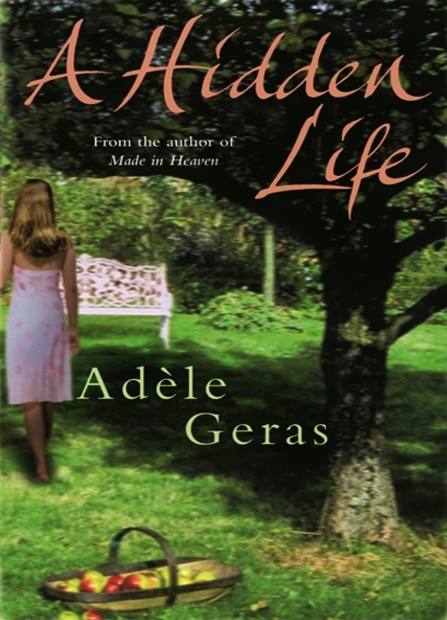
A Hidden Life by Adèle Geras ~ 2007. This edition: Orion Books, 2008. Paperback. ISBN: 978-0-7528-9394-5. 439 pages.

My rating: 3/10. I made it halfway through, right up to the you-could-see-it-coming-from-Chapter-One lesbian love scene, and I speed-scanned the rest just to make sure I wasn’t missing any unforeseen developments. I wonder if the author was paid by the word? This book just went on and on and on. Every prediction I made came out bang on, and the ending was so! gaggingly! upbeat! it! made! me! want! to! scream!

Such a disappointment. I had high hopes for Adèle, having heard good things about her YA novels, in particular Ithaka. But this one was a definite miss. I wish I had my two hours back. I’m going to cut my losses and give a very quick un-review, then into the Sally Ann box – not going to waste any space on this one.

Not completely horrible, hence the generous “3”, but the author could do so much better with every aspect of this attempt.

*****

From the back cover:

When Constance Barrington dies, she leaves behind a wealthy estate and a complex family network. But when the whole family gathers to hear her last will and testament, they are in for a terrible shock. Constance – possessed of a long memory and a spiteful disposition – altered her will shortly before her death. The new provisions are far from fair; some benefit hugely and others hardly at all. Constance’s granddaughter, Louise, is bequeathed the copyright for her late grandfather’s novels (barely remembered, long-since out of print and valuable only as a reminder of the man she loved). It is a paltry inheritance and one that comes to symbolise the inequity at the heart of the Barrington family. Soon, old family feuds and long-hidden resentments come to the surface, and with them, secrets start to emerge. But it is through Louise’s inheritance – those dusty, long-forgotten books – that the most explosive secret of all will come to light, bringing with it a very different future for her and the rest of the family.

Sounds promising, yes?

The reality: no.

The Barringtons and their friends, enemies, in-laws, ancestors and descendents are all a bunch of damp whiners. Even the infidelity and the “passionate” love scenes are yawn-making, and almost everyone is sorry in the morning. A contrived happy ending for one or two of the favoured ones; a final poke in the eye for the vindictive Constance, watching from her celestial cloud.

The in-text excerpts from the grandfather’s prison camp book, “Blind Moon”, were indescribable. This is not a compliment. Constance was right. Her husband wrote dreck.

This is a book for a waiting room, or possibly, if nothing else is about – an old People or Vanity Fair magazine would be more enticing – for the beach or poolside. Go ahead – get it wet!  That’s its natural state, I’m afraid.

Many apologies to those of you who may be Geras fans. Feel free to talk me around – I don’t like to dislike books – it makes me feel all prickly and glum.

Read Full Post »

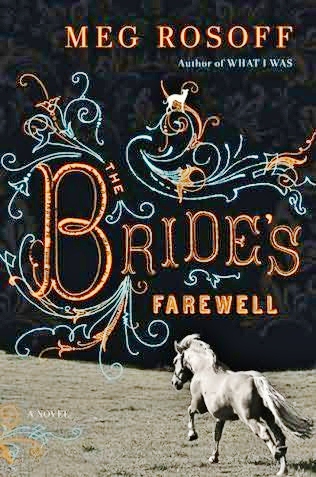
The Bride’s Farewell by Meg Rosoff ~ 2009. This edition: Viking-Penguin, 2009. Hardcover. ISBN: 978-0-670-02099-7. 214 pages.

My rating: 7.5/10. A fast little read. Fairly typical “young adult” adventure-romance, but a well-written and nicely plotted example of its genre.

The author’s name sounded familiar, and looking on her list of previous titles I realize I already own and some years ago read one of her earlier books, How I Live Now. Must delve around for that one – it was quite different in setting – fictional post-apocalyptic Britain versus vaguely historical Industrial Revolution Britain.

I’m tagging this one “alternative world” because though the setting has many real world parallels, it doesn’t feel quite right in a historical sense; it is apparently set in the 1850s, but is almost medieval, or possible mid 1700s, in some of the incidents, and how the people think, talk and live. (Or maybe it is quite historically correct, and the disconnect is just my own take.) For much of the book I was wondering if this was perhaps set in post-modern times, in a newly primitive society, and that was even before I made the How I Live Now connection.

*****

On the morning of August the twelfth, eighteen hundred and fifty something, on the day she was to be married, Pell Ridley crept up from her bed in the dark, kissed her sisters goodbye, fetched Jack in from the wind and rain on the heath, and told him they were leaving. Not that he was likely to offer any objections, being a horse.

Though Pell sincerely loves and respects her childhood sweetheart Birdie, she is repelled by the thought of what marriage means: a subservient position versus her present equality as Birdie’s tomboyish companion, a life of continual pregnancy and childbirth, and the speedy degradation of her body, as typified by her own mother’s sorry example. The morning of her marriage, Pell sneaks out of the family cottage with her few possessions, and accompanied by her horse Jack and her small mute brother Bean, heads into the unknown.

Pell has no real plan but to escape, though she feels that she might find employment at Salisbury Fair, so that is where she heads, narrowly missing discovery by her father who has headed there as well to seek out his errant children. An itinerant fire-and-brimstone preacher, Joe Ridley has a compulsive weakness for strong drink and womanizing, and his neglect of his family has been the root cause of Pell’s decision to flee.

Pell and Bean fall in with a fatherless Gypsy family, and meet with a certain amount of kindness from strangers during their days at Salisbury, though by the end of the fair this hopeful beginning has come to nought. Pell has been stiffed by the man who employed her to help choose some horses, and Bean and Jack have disappeared.

Bad turns quickly worse, as Pell desperately seeks her missing brother (and her horse); she eventually ends up spending the winter living in a shed beside a poacher’s woodland cottage. The poacher, never named but dubbed Dogman by Pell, is a mysterious, silent man who mostly ignores his desperate hanger-on, until she falls afoul of an amorous villager, whereupon Dogman rescues her, brings her into his home, and, inevitably, his bed.

The horse and the boy have their own adventures, and Pell eventually reconnects with both, as well as with two of her younger sisters.

Much angst, tragedy, and drama, and teasing gleams of romance. Pell of course has marvelous hidden abilities – a stereotypical necessity for a classic YA heroine – in her case an almost magical affinity for horses. This is a very horsey book, by the way. In quite a good way.

Suspend your disbelief – and oh, yes, you’ll need to! – and go along for the ride. Nicely diverting tale, for teens and adults. Rosoff gets my nod – good work. (Gorgeous cover, too.)

Read Full Post »

« Newer Posts - Older Posts »