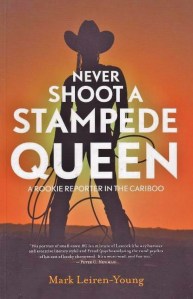
Never Shoot a Stampede Queen: A Rookie Reporter in the Cariboo by Mark Leiren-Young ~ 2008. This edition: Heritage House, 2008. Softcover. 221 pages. ISBN: 978-1-894974-52-3
After a recent reading of Josie Teed’s British Columbiana, I found myself scanning the shelves for something in the same genre. I was really looking for Will Ferguson’s I Was a Teenage Katima-Victim, but as it proved elusive, I was pleased to find instead Mark Leiren-Young’s humour-infused collection of anecdotes from his year as a reporter for the Williams Lake Tribune.
 I grew up rural, in the central Cariboo-Chilcotin region of British Columbia, and Williams Lake was “town”, location of schools, shops, restaurants, public library and movie theatre, not to mention an impressive array of both churches and drinking establishments.
By the time Leiren-Young pulled into town for his newspaper gig in 1985, I had finished with high school, found true love, and relocated to places even more rural, so our paths did not cross, but it was enjoyable to time travel back with him to a place I once knew very well indeed.
Leiren-Young jotted down these memories in 1988, and polished them up enough to send out to friends and family as a holiday gift in December of that year. He resurrected and edited his collection of “true-life tall tales” in 2008, and this book was the result. Never Shoot a Stampede Queen was an immediate success, and, after spending months on the B.C. Bestsellers List, was awarded the 2009 Stephen Leacock Medal for Humour.
Here’s the publisher’s back cover blurb:
The cops wanted to shoot me, my bosses thought I was a Bolshevik, and a local lawyer warned me that some people I was writing about might try to test the strength of my skull with a steel pipe. What more could any young reporter hope for from his first real job?
The night Mark Leiren-Young drove into Williams Lake, British Columbia, in 1985 to work as a reporter for the venerable Williams Lake Tribune, he arrived on the scene of an armed robbery. And that was before things got weird. For a 22-year-old from Vancouver, a stint in the legendary Cariboo town was a trip to another world and another era. From the explosive opening, where Mark finds himself in a courtroom just a few feet away from a defendant with a bomb strapped to his chest, to the case of a plane that crashed without its pilot on board, Never Shoot a Stampede Queen is an unforgettable comic memoir of a city boy learning about—and learning to love—life in a cowboy town.
So, here’s the burning question. Did Leiren-Young get Williams Lake “right”?
In my opinion, that would be a quite solid “yes”, allowing for a certain amount of creative re-telling. The cliché of truth being stranger than fiction certainly applies here, and it is my belief that while enhancing some aspects of Cariboo-Chilcotin life for their laughability, he probably toned things down here and there in the interests of believability.
Leiren-Young states early on that his years of experience as a freelancing journalist, starting in his university days, polished his writing speed and economical-yet-engaging style to a high degree, and this quick read does hit all the buttons.
This collection of related stories starts with Leiren-Young’s hit-the-ground-running initiation into his new job in the “Crime Capital of B.C.”, as Williams Lake was at the time, and had been for some years past, by stopping for fuel and directions at a just-been-robbed gas station, police still in attendance. Leiren-Young scents a story unfolding, and hangs around and gets all the details from the cashier, with the bonus of earning himself the negative attention of the local R.C.M.P. detachment.
As junior reporter, Leiren-Young gets landed with all of the jobs no one else is keen on, but as the weeks go by, he finds himself increasingly immersed in local culture, and writing about some truly newsworthy topics, ranging from the farcically comedic to the very real-and-tragic.
It’s hard to truly do credit to a book written about a place and time one is personally familiar with, and I had to sit back and think hard about my response to Stampede Queen. As with Josie Teed’s British Columbiana, it was easy to identify a lot of the characters, and speculate about who the composites were based on, and it is always edifying to see places one knows in real life through another set of eyes. A major difference here was that though Leiren-Young doesn’t gloss things over, he was by and large quite kind to his co-workers and small town acquaintances in these tales, which isn’t always the case with Teed’s memoir.
Leiren-Young is also a more accomplished writer than Teed, but, to be fair, this account was not sent out into the world fresh from the young writer’s hand, but was allowed to mellow and mature and benefit from a re-working which undoubtedly accounts for its tightness and polish.
My rating: an overall approving 8/10.
A full point was lost by the presence of the raccoon on page 177, a brief reference which knocked Leiren-Young back a notch in my esteem, as it calls into question aspects of verisimilitude. (There were no raccoons in the Cariboo in 1985, though we do hear now, in the 2020s, that they are working their way up from the Coast as our winters warm.)
Another point taken away by what might be slightly excessive virtue-signalling. Leiren-Young comes across as mildly smug and morally superior on occasion, rolling his eyes at some of the un-woke folk north of Hope. (B.C. insider joke, referring to the vast under-populated regions outside of the Lower Mainland.) I get it, and I forgive the writer his understandable bias, but it was possibly a bit too underlined and bolded (figuratively speaking) here and there.
If you wish to explore further, the multi-talented Mark Leiren-Young has an active online presence, and reviews of Never Shoot a Stampede Queen are easy to find. The book is still very much in print, and readily available throughout B.C., and presumably points east as well.
Bonus links:
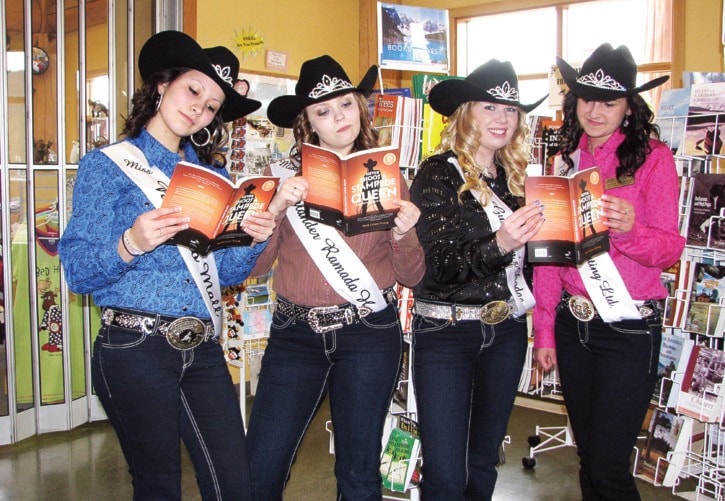
Williams Lake Stampede Queen Contestants, 2012. Photo by Gaeil Farrar, Williams Lake Tribune.







 Leaves & Pages
Review: After the Falls by Catherine Gildiner
Posted in 2000s, Canadian Book Challenge #7, Read in 2013, tagged 1960s Culture, Biography, Canadian, Canadian Book Challenge 7, Cathy McClure, Civil Rights Movement, Gildiner, Catherine, Memoir, Relationships, Social Commentary on November 8, 2013| 8 Comments »
My rating: 8.5/10
Wow. That was unexpected. I was tidying up some books I’d casually piled on a corner of the couch, sorting out already-read from want-to-read, and I leafed through After the Falls to refresh my memory as to how urgently I wanted to read it, or if it could be put on the maybe-someday pile.
It caught me.
Suddenly I was sitting down, and reading away like a mad thing. Clean-up abandoned, outside chores abandoned, and it’s a good thing the roast was already in the oven or cooking my family’s evening meal would have been abandoned, too. It grew dark. I switched on my reading lamp. I read this thing right through to the end. My afternoon was completely lost. Abandoned pell mell, while I lost myself in a book.
My seduction by After the Falls was so unexpected because I knew when I purchased it that it was a sequel to an earlier volume of memoir by Catherine Gildiner, Too Close to the Falls. I had a vague little plan to get the first book and read it, and then continue on with the second if the first one was indeed as great as everyone seemed to think it was. I wasn’t really thinking about it too much; I’m fairly immune to mainstream rave reviews, having been disappointed by banality too many times.
After the Falls is not banal. It is over-the-top, frequently jaw-dropping (“Did she just say that? Did she really do that?” How much of this is fictionalized???!”), and funny and sarcastic and joyful and heart-breaking and occasionally awkward and sometimes vague as major incidents are brushed over with a single sentence or two (this, the occasional vagueness and awkwardness, lost the 1.5 points in my personal ratings system), and rather contrived here and there, but never no mind those last few criticisms. It is a very readable book, and I happily recommend it. And I’ve elevated the need-to-buy status of the first installment to high on the list, and, having learned that a third volume is coming soon, have earmarked it as a buy immediately book.
So now you’re all wondering – those few of you who haven’t already ridden this particular train – what the darned book is about. Well, the internet is seething with reviews (mostly favourable) so I will cheat this morning and steal the flyleaf blurb. (Must address all the chores I neglected yesterday; must cut this short!) It’s a tiny bit inaccurate – do these blurb writers read the whole thing? or do they just ask for the high points? – but it condenses things reasonably well.
Actually that’s a very lame flyleaf blurb. It doesn’t at all catch the spirit of the memoir. Here’s a much better blurb, from Publisher’s Weekly, November 2010:
And I’ll link the author’s website, so you can look around there.
Cathy McClure Gildiner – After the Falls
And here is what my blog friend Jenny had to say: Reading the End: After the Falls. Everything she says, I agree with. But I think you should read Chapter 4, because it explains an awful lot about how the memoirist relates to men from that point forward.
The writer also has a blog, Gildiner’s Gospel, which made me late for bed last night, as it was as compulsively readable as her words on paper. Check it out!
One last thing. The memoir is set in the United States, and at the time she writes about, Catherine was an American citizen. She moved to Canada some forty years ago, though, and reports that she is firmly entrenched in Ontario. In my mind she unquestionably deserves the “Canadian” tag I’ve given her.
Highly recommended.
Read Full Post »