Archive for the ‘1990s’ Category

the strangers next door edith iglauerThe Strangers Next Door by Edith Iglauer ~ 1991. This edition: Harbour Publishing, 1991. Hardcover. ISBN: 1-55017-054-6. 303 pages.

My rating: 10/10 for her subjects – every one truly fascinating. Discounted heavily for the writing style, which I found frequently rather flat. I’m going to give this one a 7.5/10 overall. 10 for content, 5 for style. Worth a look; maybe you’ll find her easier reading than I did. Her topics are worth exploring.

Would I re-read it? Sure, bits and pieces of it. I wouldn’t tackle it cover to cover again, though. Once was enough for many of the articles, though I’m glad I read what Iglauer had to say. I find her prose hard to absorb – it certainly doesn’t “flow”, being more earnest than sparkling – and it’s a lot of work maintaining concentration, though she covers her subjects extremely thoroughly.

I hesitate to say too thoroughly, because I do believe that her tenacious peering into the heart of each of her topics is what enables her to include so many esoteric and absolutely fascinating details. I do wish that she had just a little more flair in her delivery, though.

Edith Iglauer was alive and well – though showing her age a wee bit, at 93 – and still actively writing the occasional article for Geist magazine in 2012. She was living in her own home with her third husband Frank on the B.C. Coast. Here is a vignette featuring Edith and Frank, by Ted Bishop. An inspiring note: Edith and Frank’s combined age was 189 at the time of the article, and they were both very much “with it” in every conceivable way, barring a few physical infirmities related to their age, like bad knees and failing hearing.

*****

Edith Iglauer is an American journalist with a long and varied history of being present during some very interesting times indeed. Born in Ohio in 1917, she decided while in college that she wanted to become a journalist, and persistently pursued that goal until she achieved it. Unable to stomach the requirements of a newspaper reporter’s job – she jibbed at inquiring of grieving parents as to how they felt about their young son’s tragic death earlier the same day – she was advised that free-lance writing might be her forte. Over the next fifty years Edith pursued interesting stories and people, meticulously researching them and becoming intimately familiar with every aspect of her subjects. Her work was published in leading periodicals of the time, such as The New Yorker, Harper’s, Christian Science Monitor, The Atlantic Monthly, Maclean’s, and many others.

The Strangers Next Door is a retrospective look at her long career, including excerpts from key articles and also her books, with added reflections as to how she came to write the pieces, and anecdotes about her subjects.

Several successful and well regarded books grew out of her articles and experiences, most with Canadian settings and themes. Edith travelled widely through Canada, found the country fascinating, and made her home permanently in British Columbia in the early 1970s, though she retained her American citizenship.

From the Introduction to The Strangers Next Door:

Looking over the pieces I have written, I realize that I have been like someone with family in two countries, attempting to acquaint them with one another. I am not just an American journalist writing in Canada for Americans, but a Canadian journalist writing about America for Canadan as well. Both countries, I have discoverd, still regard their neighbors across our common border as “the strangers next door”, and like any concerned relative, I want them to know and respect one another as much as I do.

The Strangers Next Door covers a broad range of topics.

From the 1940s, articles on:

  • Marian Anderson
  • Working in the radio-newsroom of the Office of War Information in Washington, D.C., which included weekly chats with Eleanor Roosevelt.
  • A posting as a post-World War II correspondent in Yugoslavia, during the rise of Marshal Tito
  • The UN Builds Its Home, 1947

From the 1960s, 70s and 80s:

  • The Mounted Men – an indepth look at the training of police horses and mounted policemen in New York City, 1962. (My favourite article in this book.)
  • The Biggest Foundation, 1972. The building of the World Trade Centre complex in New York.
  • Inuit Journey, 1963-1979. The development of Inuit co-operatives for the production and marketing of arts and handicrafts.
  • Baker Lake Art, 1964. A unique style of Inuit art from a remote corner of the Northwest Territories.
  • The Beautiful Day, 1966. A biographical short story inspired by Edith’s father’s death, published in The New Yorker.
  • Denison’s Ice Road, 1975. The article about the men and machines involved in winter-time road building and trucking across a frozen Arctic lake which grew into a bestselling book, and the inspiration for the current “reality” television series, Ice Road Truckers.
  • Don Snowden, 1929-1984. The detailed obituary of a man who worked to alleviate the poverty and hardships faced by Canadian Inuit peoples by helping them develop and profit from their unique skills and knowledge.
  • Prime Minister, 1969. A first-hand look at what makes Pierre Trudeau tick. Eight days travelling with the Prime Minister and countless hours of background research and interviews resulted in this indepth Profile.
  • The Strangers Next Door, 1973. An essay about Canada, for American readers.
  • “Capi” Blanchet. The mysterious author, M. Wylie Blanchet, of a British Columbia classic, the memoir The Curve of Time is researched and profiled for The Rainforest Chronicles # 8.
  • Seven Stones, 1979. A profile of British Columbia architect Arthur Erickson, the man who planned the University of British Columbia campus, and so many more unique structures . This grew into the 1981 book of the same title.
  • Hubert Evans, 1980. Another profile, this one of the esteemed B.C. writer and poet.
  • Bill Reid, 1982. A profile on the iconic Haida carver and goldsmith.
  • Bella Coola, 1975. Anecdotes of a visit to the fjord-side village, unlikely gem of the BC coast.
  • Fishing with John, 1987. An excerpt from the book. In 1974 Edith met and eventually married BC commercial fisherman John Daly. Their happy partnership ended with John’s sudden death only four years later. Fishing with John is Edith’s memorial, started while John was alive as a book about the salmon fishing way of life on the BC coast, and eventually becoming a personal saga.
Read Full Post »

the roaring girl greg hollingshead 001The Roaring Girl: Stories by Greg Hollingshead ~ 1995. This edition: Somerville House, 1995. Softcover. ISBN: 1-895897-53-X. 196 pages.

My rating: 4/10. These are cleverly written, but a little too far out there for me. I wouldn’t re-read any of these anytime soon, and if I’d never heard of Greg Hollingshead it wouldn’t break my heart.

This collection won the 1995 Governor General’s Award for English Fiction – Short Stories, and the contents are undeniably well-written, but most of the stories left me feeling more than a mite confused, and usually a whole lot disturbed. Hollingshead has a creative mind and a grand way with words – some of his phrases lift up off the page and vigorously come to life – but it’s all kind of kinky. Often humorous, but definitely dark. Lots of sex – mostly of the “ew!” nature – and deeply twisted thoughts.

I’m not going to spend any time deeply reviewing this one, because it would require me to spend more time in Greg’s head (as it were) and, quite frankly, I don’t want to.  I’ll be moving The Roaring Girl along to see if it can find a more suitable home.

*****

  • The Side of the Elements – A couple rents out their home for the year they must be away. Stuff goes on in their absence. This one I rather liked.
  • The People of the Sudan – A family is maneuvered into taking temporary care of a box full of Canadian Christian Relief “supplies” for someone going to the Sudan; the rendezvous goes awry and the situation goes surreal. Another good one; downright humorous.
  • Rose Cottage – A young man becomes involved in trying to fix what he believes is an abusive relationship between a nurse and her elderly charge.
  • The Roaring Girl – A transient girl is given temporary haven by a family, deeply affecting the adolescent son.
  • The Age of Reason – Some sort of dysfunctional family saga. I have no idea what this was all about!
  • Rat With Tangerine –  Ditto.
  • A Night at the Palace – This one was a complete nightmare – couldn’t finish it. People behaving strangely. And badly. Hallucinogenic.
  • The Appraisal – Oh, thank goodness – an actual narrative arc! Well, relatively speaking. A cottage appraisal turns into a conversation on the nature of civilization, and its impending collapse. Awesome – loved it.
  • The Death of Brulé – A young boy becomes involved with the older girl next door. Ick.
  • The Naked Man – Another absolutely surreal family tale.
  • How Happy They Were – Sad people; love gone wrong.
  • Walking on the Moon – The view from a roof overlooking the people next door. Odd.

So – out of these twelve there were four I kind of, sort of, almost enjoyed reading. The Appraisal is the only one I’d willingly seek out again. Goodbye, Roaring Girl!

Read Full Post »

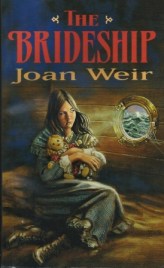
the brideship joan weir 001The Brideship by Joan Weir ~ 1998. This edition: Stoddart, 1998. Paperback. ISBN: 0-7736-7474-8. 218 pages.

My rating: 4.5/10. This one gets a “just missed” from me. It was marred by a seemingly unlikely but at the same time groaningly predictable plot, and a selection of overly stereotyped characters.

I initially questioned the historical accuracy, which didn’t quite ring true to me: a group of teenage girls is apparently sent by the Anglican Church to be prospective brides in the female-starved British Columbia and Vancouver Island colonies in the 1860s. This was indeed correct; I obviously do not know quite as much B.C. history as I like to think I do!

The writing is competent enough but the whole package didn’t do much for me. Some teens may find this an acceptable read, but I would hesitate to recommend it, except for its dramatic focus on a little-known chapter of British Columbia and Cariboo Gold Rush history.

*****

Fifteen-year-old Sarah is an orphan in England in 1862. Uncooperative and outspoken, she is a disruptive presence in the orphanage where she has ended up after the death of her parents and then her uncle, so is recommended with great relief by the orphanage head to join a group of teenage girls who are being sent to the western Canadian gold fields as prospective brides for the miners. This arbitrary emigration is presided over by a (hopefully atypical!) prospective Anglican Church minister, the sinister and vicious Mr. Dubonnet. Sarah’s frail older cousin Maud is also part of the group, as are a number of the usual variety of orphans in this type of fiction, including Lizzie, the cockney ex-pickpocket with a heart of gold, and Arabella, the mean-spirited snooty beauty.

Sarah makes the trip in fine fettle, despite continual run-ins with Mr. Dubonnet and various adventures on board. Poor Maud makes it only as far as the Falkland Islands, before succumbing to her constant cough, as we’ve expected from very early on in the narrative – the girl very obviously has the cloud of doom hanging over her right from the first chapter, with her meek disposition and delicate consitution. The surviving orphans weather the rest of the voyage, which is marked with melodramatic incidents to keep things interesting. They eventually arrive at Vancouver Island, are off-loaded at Esquimalt, and are then shipped up the Cariboo Road to Barkerville.

Sarah refuses to accept her prospective husband, and teams up with Lizzie to start an enterprise of her own as a laundress. Justice in the form of Judge Begbie nails Mr. Dubonnet, true love arrives for Lizzie and Sarah, and everything is looking up as we close the last page.

I was curious as to the verity of the “bride ship” angle, so I did a bit of research, and found that the author did base this tale on true events. See Victoria History – the British Columbia Emigration Society, for a brief discussion.

I’ve included several articles from other sources to balance my not terribly enthusiastic review. The Brideship isn’t a bad book, but compared to other similar works in the genre it is on the lower end of the spectrum, in my one-person’s opinion.

I’ve just been reading Marianne Brandis’ stellar 1830s’ Ontario trilogy of The Tinderbox, The Quarter-Pie Window, and The Sign of the Scales (reviews pending), as well as Suzanne Martel’s The King’s Daughter, following a French fille du roy sailing to Canada from France among a similar shipment of “brides to be” in the 1600s. These other books stand head and shoulders above Weir’s Brideship, at least for this reader, reading like properly engaging novels which just happen to be set in historically important and interesting times versus a packaged up collection of “teachable moments” clothed in stereotype and unlikely melodrama.

*****

In a University of Manitoba author profile, Kamloops, B.C. writer and retired college creative writing instructor Joan Weir talks about some aspects of the process of writing The Brideship.

“Usually when I start, I feel very strongly that, when the whole thing is over, I want to have made some sort of comment that is worth making. (I)n Brideship, I wanted very much to get across the idea for modern kids that, no matter where you find yourself, life’s an adventure and you’ve got to seize the moment and take it and go with and make something out of it… I start with that, and from there I go to character, but I have to know ‘why’ I’m writing the book before I start. I don’t know the ending. I think the ending has to grow out of what happens as your characters suddenly take on a life of their own which is greater than you thought when you started. It’s out of their growth that the ending grows, and very often the ending isn’t what you thought, even in a sort of vague way, that it was going to be at all. It surprised me very much what happened to Lizzie in Brideship. Lizzie becomes almost the strongest character in the book, something I didn’t intend at all when I started. I thought she was going to be very much a secondary character. So many readers, when they talk about Brideship, say, ‘Oh, I really liked Lizzie.’

“In the actual historical story of those girls who came over on the Tynemouth, one girl did die, and I felt committed to put that in because I felt so badly about that poor little orphan, Elizabeth Buchanan, who was buried at sea. Sarah’s cousin, Maud, in Brideship is patterned on Elizabeth. I didn’t dare use Elizabeth’s name because this is fiction, and I didn’t want to get involved in ‘this is true and this isn’t true,’ for Elizabeth didn’t have a cousin with her or someone back in England to marry, as my Maud character does. The Anglican Church organized and sent over three boatloads of girls from orphanages, but the first trip is the only one that there was any sort of information about at all. The conditions were absolutely like I’ve described them in the book. I’ve got an artist’s sketch of the ship which was drawn from pictures on file in the museum. It was a tiny little craft that had over 300 people on it. The girls really were housed down below in the hold compartment with only these little tiny portholes.

“The book’s cover was interesting because often publishers don’t give authors any input at all on covers. Kathryn Cole was wonderful because she sent me sketches of what they wanted to do with the cover which was a picture of Lizzie and Sarah dolled up in Mrs. Worthing’s clothes, with parasols and fancy hats, smiling and tripping around the ship’s deck. When Kathryn asked, ‘What do you think of it?’ I replied, ‘We’ll, it’s a very pretty picture, but I’m afraid that it sets the wrong tone for the book. When you look at it, you’ll think it was a happy journey, and it wasn’t.'” Kathryn then asked Joan for her cover ideas. “‘I would like a picture of Sarah below decks in the storage compartment in which they’re living, looking out that one little porthole. And, if possible I’d like her holding her doll.’ Even though that detail makes Sarah look younger than she is, that doll was the only thing that she owned. I was delighted because the artist did exactly what I wanted. The cover sets the tone, and it was not a happy trip. But, if you’d have had the title Brideship and these girls on the original cover dancing around, you would have thought it was like a Love Boat.

And here is an edited excerpt from the CanLit.ca review of The Brideship.

Four dozen orphans, some of them as young as sixteen, are sent off to the West Coast of Canada on the vague promise that they will find work there. Sarah eagerly volunteers to go; she will do anything to get out of the hated orphanage. An Anglican clergyman has organized the emigration, and this fact alone seems to guarantee that the promised positions will materialize, and that the four dozen girls are in good hands.

Appearances, however, deceive. A few days before their arrival in Canada, the girls find out that “there aren’t as many jobs available” as had originally been thought, and that they are to be “brides instead.” The clergyman, too, is not what he seems: aside from being responsible for deceiving the girls, he is also a thief. He triumphs in the short run, but his dishonesty eventually catches up with him. Sarah, however, never gets to meet the man intended for her. She escapes to Barkerville, sets up a laundry business there, and falls in love with someone she chooses for herself.

The Brideship concentrates more on action than on emotion. Sarah gets somewhat pushed into the background by the question of whether the Anglican Church really did organize shiploads of female orphans under the pretense of getting them positions as governesses, then offering them as brides to the miners working in British Columbia instead. And if, as Weir contends, the answer is “yes,” then one wonders why the author neglects to show some outrage in at least one of the unfortunate “brides.” Not even the heroine expresses any offense at such a monumental deception; she is worried that the husband the clergyman has chosen for her might be a brute, but it does not seem to enter her mind that the clergyman had no right to choose a husband for her in the first place. Although The Brideship has a lot of action, it is short on psychological realism.

Read Full Post »

Coromandel Sea Change by Rumer Godden ~ 1991. This edition: Macmillan London, 1991. Hardcover. ISBN: 0-333-55227-x. 246 pages.

My rating: 6.5/10. Not bad. Decidedly better than the author’s parallel book Cromartie v. The God Shiva Acting Through the Government of India, which I read and reluctantly panned a few weeks ago.

*****

Kirkus sums it up succinctly, in the June, 1991 review. Major plot spoiler in this review, by the way.

They don’t tend to write like this anymore, perhaps with good reason, but nonetheless the latest from Godden, unabashedly sentimental, is an entertaining if nostalgic read.

Patna Hall, a popular hotel on the Coromandel coast of southern India, is owned and run by Auntie Sanni, an Anglo-Indian whose family has been there for generations. Auntie Sanni, a stereotype like all the characters here, is a wise and wonderful old woman who knows exactly what to do with misbehaving guests and servants. In the week the novel covers, a party of scholarly American women, a British honeymoon couple, a British diplomat and his wife, a journalist, a mysterious unattached woman, and the managers of a local political campaign are all guests.

The hotel, right on the beach, where the waves are strong and the sea shark- infested, becomes the stage for the unfolding drama with parts for everyone, including the servants, a donkey, and an elephant. It is soon apparent to all–but especially to Auntie Sanni and Sir John and Lady Fisher, the diplomats–that the young leads, honeymooners Mary and Blaise, are having problems. Mary, entranced with the hotel and all things Indian, gets involved in the political campaign and is especially drawn to the candidate, handsome English-educated Krishnan, who is everything that snobby and insensitive husband Blaise is not. The campaign has its ups and downs as Mary gets closer to Krishnan–which is terrific because they are meant for each other–a(highlight the rest of this section to reveal spoiler)nd as poor Blaise, obviously doomed, conveniently exits in a nasty accident just in time for Auntie Sanni to get the hotel ready for the next week’s guests.

Godden’s lively narrative and her vivid descriptions of the people, places, and customs of a country she loves are more than fair compensation for dated style and stock characters.

I’m rather sorry to say that the only surprise here was which of the characters was doomed; I initially had picked the l(highlight to reveal my choice if you so wish) lovely young Indian hotel manager Kuku as the expendable, but I was wrong.

All of the stock characters from a Godden Indian novel are here, the only ones missing are nuns. We have a young, emotionally mismatched married couple, an intellectual and physically beautiful young man, a sexy, sultry young Indian woman (sometimes she’s Eurasian), precocious children, personable animals, worldly-wise observers – in this case an older Anglo-Indian couple and the omniscient Auntie Sanni – and last, but definitely not least, a sensually rich setting.

The setting is, as always in a Godden tale, almost a character in its own right. Godden’s sharp observational skills and her stellar descriptive talents are put to good use here: the sights, sounds, smells, tastes and textures of this beautifully depicted corner of the world are the best part of this otherwise rather unremarkable story.

This was one of the last novels in Godden’s long list, and, in company with the others of this winding-down period of the writer’s career, is broadly sketched with less of the care and detail of some of her earlier masterpieces. It also has more of an upbeat, consciously humorous tone than some of the older books, especially regarding the shenanigans which the political combatants get up to – a vow of silence, a rally prank involving old umbrellas to discomfit a rival candidate – and even the climactic tragedy is presented with a farcical twist.

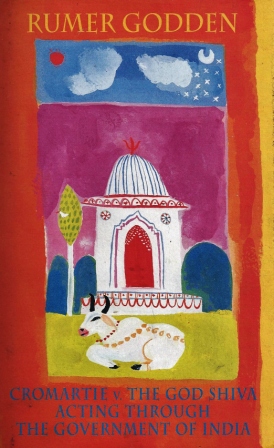
Loved the cover illustration, especially the illustrative references on the back, which the reader will appreciate much more deeply after completing the book.

Recommended for Godden fans rounding out their collections, and for “light” reading. No emotional challenges or deeply moving characters here, but the writing itself  is more than adequate, and sometimes very good indeed.

Read Full Post »

Death by Degrees by Eric Wright ~ 1993. This edition: Bantam/Seal (Doubleday), 1995. Paperback. ISBN: 0-7704-2601-8. 192 pages.

My rating: 5.5/10. A minor effort by well-established Canadian “regional mystery” writer Wright. It has its moments, mostly in the personal narrative sections, and is mildly enjoyable for those already acquainted with Charlie Salter, but that’s about it. I doubt anyone coming to Eric Wright for the first time through this one would be strongly tempted to continue.

*****

From Kirkus, August 1993:

Here, in an outing reminiscent of Final Cut (1991), Toronto Inspector Charlie Salter’s personal life is more absorbing than his caseload–which now includes the murder of moderately unlikable Maurice Lyall, a teacher at Bathurst Community College, and the alibis of various of Lyall’s colleagues on the Search Committee that had just nominated him for Dean of Related Studies. But the case keeps Charlie distracted from his major worry: the progress, or lack of it, that his father is making since suffering a stroke. Days spent listening to academic backbiting and nights spent in a hospital waiting room, peeking in on his dad between stints of writing up a case-in-progress journal, keep Charlie on edge, but a bit of luck narrows the suspect list–just as Charlie’s father’s health rebounds.

Minimalist plot, and few will care about the faculty and its infighting. As a father-son study, however, there’s much to recommend in Charlie’s guilt over not liking his dad, and his sensitive son Seth’s love and liking of both his father and grandfather.

That sums it up well.

This is the tenth installment in the eleven volume Charlie Salter mystery series by Wright, which started with 1984’s award-winning The Night the Gods Smiled. In Salter, Wright has created a flawed but ultimately good protagonist; Charlie’s dilemmas in both his personal and working life are immediately recognizable and relatable to the reader. I find I follow his personal progress through the books with much more interest than the mildly diverting mysteries trigger. A very human and very Canadian hero: conflicted, self-analyzing, often inarticulate, more than mildly cynical, and always polite.

I have never lived in Toronto, so I cannot speak as to the accurate depiction of this book’s setting, but it seems as though the city is as much a character as the humans. The story has its fair share of in-the-know references. Most are easily picked up on, especially if you’ve already read the earlier books in the series, but a non-Ontarian and especially a non-Canadian might well find himself occasionally lost and missing the subtle jokes which abound.

While I appreciated the hospital drama and Charlie’s emotional agony as he faced his father’s potential demise, I initially didn’t care for the lazy solution the author dumped on us. “Oh – he’s recovered surprisingly quickly. You can pick him up tomorrow.” Until I thought about it a little more deeply, and realized that this is indeed what can occur. It has happened to our own family. An elderly person quite literally at death’s door one day – “You should think about making some arrangements” – makes a rather sudden recovery, and without a “Sorry to have worried you so much” apology the dazed relations are informed that the almost-deceased is being released, and needs to be “out of the room by noon – someone else needs the bed.” Charlie’s reaction of confusion and resentment at the offhand attitude of some of the nursing staff, allied with relief at the prospective recovery, and worry about the next stage in the convalescence, now suddenly the family’s responsibility as the medicos turn away, perfectly reflects the real-life scenario we found ourselves in.

Eric Wright was an English professor at Ryerson Polytechnic in Toronto for many years, and he often saves his most satiric “insider” barbs for the educational establishment. I often get the impression that the writer is much more at home in the halls of academe than in the police station with his hero, and that he uses Charlie’s frequent naïvety as an opening to mount his personal hobby-horse and to expound on the ins and outs of the world of “higher education” to his “gee whiz” audience, in this case Salter and by extention the rest of us.

As mentioned above in the Kirkus review, the “mystery” in this mystery is the least of our concerns. The victim is unsympathetic; the murderer, when discovered, faces nothing particularly severe in the way of potential punishment. In general, life goes on.

In the real world, a violent murder such as the one described in this book would have much more traumatic consequences. I know it’s not the fashion for “cozy” murder mysteries to delve too deeply into the after-effects of the murder on everyone concerned, including the neighbours of the murdered man, who seem to view his brutal demise at the hands of what is suspected to be an opportunistic burglar with phlegm verging on cow-like stupidity. In real life, if your neighbour was randomly murdered in the night and if the culprit was still at large, lurking, one would assume, in the same neighbourhood, would you not be a gibbering mass of nerves? I think I would.

Ah well, it’s fiction.

Would I recommend this one? Only to those already interested in the series. Those new to Eric Wright, definitely start at the beginning with The Night the Gods Smiled, and follow along in order. In this case it pays to get to know Charlie Salter and his likeable and sometimes quirky family right from the beginning.

This is a mildly diverting series, for those times when you don’t want to feel too challenged. The violence is generally non-graphic, and though awful things happen we aren’t subjected to too many gruesome details. There’s a bit of sex here and there, often as part of the plot twist, and occasionally as “too much information” about Charlie’s personal life, but again, nothing too graphic. The author drops in a word like “penis” and then immediately shies back, as if in shock at his own temerity in discussing such things.

I keep a stack of Eric Wrights among the huge collection of mystery novels we’ve accumulated over the years, and have no plans on getting rid of them, though if they were to vanish I don’t think I’d be terribly heartbroken, as I would be if I lost my Josephine Tey and Dorothy L. Sayers collections – Wright isn’t anywhere in the same league, though he’s not at all bad reading if your expectations are adjusted suitably.

For those curious about more deeply investigating Eric Wright’s Charlie Salter, here are the books in the series in order of appearance:

  • The Night the Gods Smiled (1984)
  • Smoke Detector (1984)
  • Death in the Old Country (1985)
  • A Single Death (1986)
  • A Body Surrounded by Water (1987)
  • A Question of Murder (1988)
  • A Sensitive Case (1990)
  • Final Cut (1991)
  • A Fine Italian Hand (1992)
  • Death by Degrees (1993)
  • The Last Hand (2002)

Read Full Post »

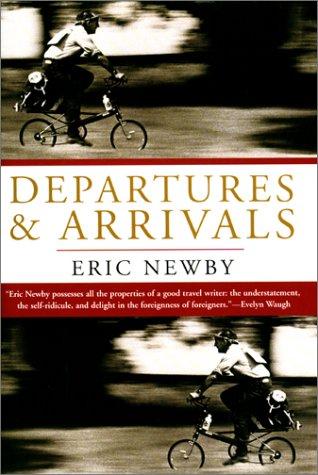
Departures and Arrivals by Eric Newby ~ 1999. This edition: The Lyons Press, 1999. Hardcover. ISBN: 1-58576-224-4. 192 pages.

My rating: 5/10. Some decent essays but not enough of them to swing the balance between “fair” and “very good” reading. A lot of reciting of railway schedules, and short, out of context snippets about trips which blurred together after a while. Travel writing “lite”. I expected more from this writer.

*****

A few essays into this book I was thinking to myself, “Okay, these are obviously excerpts from other works. Where’s the reference page?” Looking through the front and back material, there was no indication that this was the case; it apparently is a stand-alone collection of (mostly) travel tales and short reminiscences of the writer’s earlier life.

There is no context given more many of the trips referenced, which I found disconcerting. “Flying into Coober Pedy…” Yes – okay – so you’re in Australia – but WHY are you there? What bigger trip is this part of? And aside from discovering that opal miners like to be paid in cash, and certain of them have a fondness for personal architecture such as a revolving bed surrounded by mirrors, what other memorable things did you find there that we, your readers, might be interested in?

Though there are well-written, interesting, and amusing passages, the whole thing feels like a selection of truncated pages from a personal journal, bits and pieces of information jotted down in transit to aid in later memory of the trip. Perhaps it is, worked up with a minimum of added information.

I suspect this is a book which was commissioned and published on the strength of the author’s earlier, and much stronger, efforts. A case of selling the name, not the content.

It was readable, but  vaguely unsatisfying. One to borrow from the library for light diversion, hotel room reading on a road trip (which is how I’ve just experienced it), but I’m not left with an urge to rush out to buy it. Not recommended, unless you come by it for a bargain basement price.

Read Full Post »

I Was a Teenage Katima-Victim: A Canadian Odyssey by Will Ferguson ~ 1998. This edition: Douglas & McIntyre, 1998. Softcover. ISBN: 1-55054-652-x. 259 pages.

My rating: 9/10.Funny and thought provoking. This is the book that made me a Will Ferguson fan, way back in 1998, when I plucked it off the “New Releases” bookstore shelf solely for the reference to Katimavik. A few minutes browsing and I was sold. Liked it then, like it now. A very Canadian memoir.

*****

Funny, touching, and never maudlin . . .”     – Montreal Gazette

“A rollicking memoir”     – Globe & Mail

“A coming of age story with a fierce and nationalistic bite.”     – January Magazine

With Will Ferguson in the literary spotlight these days, due to his Booker Prize win for 419: A Novel  just a week ago, I felt the urge to dig through the bookshelves and re-read the my first ever Ferguson book, the now-obscure 1998 coming-of-age-Canadian-style memoir, I Was a Teenage Katima-Victim.

Ah, Katimavik! What a well-meaning and ambitious, oh so Canadian idea!

In my Grade 11 year I too went to one of those earnest presentations in the school gym, listened with deep interest to the bubbly recruiter, and, most importantly, mused over what I could do with the thousand dollar pay-off at the end.

I even went so far as to take a brochure home to my parents, who flicked through it with scornful dismissal. The airy-fairy notion of travelling and seeing Canada basically on the taxpayers’ dime was not something to countenance for one of their children. In my father’s eyes such programs were akin to “those deadbeats collecting welfare”, and he quite literally would have starved on the street rather than apply for a government handout, or anything which could be remotely conceived of as such. To top it off, Katimavik was supported by none other than “that Liberal bastard”,  Prime Minister Pierre Trudeau, who my father hated with a black passion, for reasons I’m still not quite clear on.

By the end of my Grade 12 year Katimavik was a distant memory, a momentary what-if? fairytale I had told myself. I had moved out of my parents’ home into a nasty and dank – but blessedly my own – basement suite in town, and was working full-time waitressing (nights and weekends) while struggling to make it through the tatters of my last high school year to collect that all-important graduation diploma. My love life had unexpectedly taken off, and I was deeply occupied in the here and now. The last thing I now wanted was to rip up those tentaively establishing adult roots and travel. But a soft spot remained for the grand ideas embodied in Katimavik, and my ears ever after were sensitive to the sound of the name.

Will Ferguson took the bait, made the plunge, and survived to tell the tale. Here is a 1999 interview in January magazine:

The book … is delightful: a coming of age story with a fierce and nationalistic bite.
To explain the reference, Katimavik was a Canadian government funded and sponsored program that blossomed in the 1970s. Of course. While the program was active, it brought thousands of young Canadians together to do “meaningful work.” Everything from soup kitchens to nature trails to heritage sites: over 20,000 “katima-victims” went through the program. “The scope of the program was staggering,” writes Ferguson. “1400 different communities across Canada, and more than 200,000 people directly involved or affected. For better of worse, Katimavik helped shape an entire generation.”
For the lavish sum of $1 a day and “all the granola you could eat” these 20,000 17 to 21 year-olds were taken far from their home towns for a year to see first-hand the cultural mosaic of which they were – by birth – a part.
“The thinking about Katimavik was that there is something redeeming about manual labor,” says Ferguson. “And the thing is, it just isn’t true at all. Anybody doing manual labor knows that it’s a tough gig and if they had the option not to do it, they wouldn’t. The second notion is that somehow once we get to know each other, we’ll like each other. This is the biggest flaw and it runs right through a lot of thinking. They think that, just because you and I are enemies, if we got to know each other, we’d like each other: that’s a big flawed premise because – quite often – the more you get to know each other, the more you realize that you have nothing in common.”
Despite his misgivings about the program’s principals, “Katimavik worked on a personal level, despite its good intentions. Just because any time you throw someone into something that big and that intense you come out of it with a rounder personality.”
Now 34, Ferguson’s personality is sufficiently rounded to take us along with him on great rollicking rides. Thus far he’s taken us from the wilds of Canada to the back roads of Japan. Whatever he has in store for us next is sure to be fun: and will hopefully raise still more eyebrows. | Linda L. Richards, January Magazine, February 1999

There is a certain irony in the fact that, soon after Ferguson’s participation in the now-iconic Canadian youth travel-service-work-cultural  program, it was axed in 1986 by the newly elected Mulroney Progressive Conservative government. Katimavik was resurrected in a slightly different form in 1994, and just this year, 2012, has been cut again, this time by the Conservative Harper government. Another rescue mission is afoot, to reimagine Katimavik for yet another generation of young Canadians. I hope it succeeds.

This book has been out of print for years, and is unaccountably ignored in most discussions of Ferguson’s work, which is a shame. Despite the graphically appalling cover, the tale told within is worth reading, especially for anyone who has memories of Katimavik in its sincere and slightly loopy heyday. A bit raw in spots – it was, after all, only Will Ferguson’s second published book, following hard on the heels of surprise bestseller Why I Hate Canadians – it nevertheless gets better and better as it goes along. Laugh out loud funny in places, there is a thread of sincerity running through it which is deeply appealing.

More than a mere curiousity piece and a relic of the author’s youth, it’s a rather grand little read. One of those “Proud to be Canadian” feel-good things. Recommended.

And here is link to the Goodreads page.

Read Full Post »

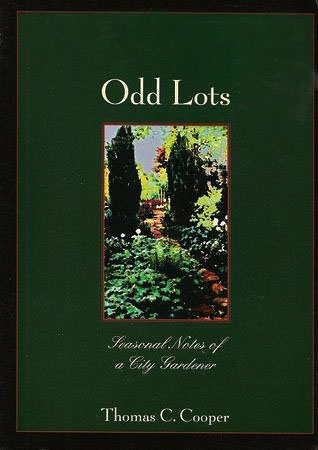
Odd Lots: Seasonal Notes of a City Gardener by Thomas C. Cooper ~ 1995. This edition: Henry Holt, 1995. Hardcover. ISBN: 0-8050-3741-1. 218 pages.

My rating: 5/10. I felt rather brutal giving this rating, because the author writes well, sometimes exceedingly so, and his subject matter is dear to my heart. But somehow this book just didn’t feel like a “keeper” – I had to push myself quite firmly to go on with it after the third chapter or so, and as I did so I found myself skimming much too much, between the bits worth slowing down for and more deeply savouring.

*****

This book of twelve monthly themed garden essays began life as editorials in Horticulture magazine. Thomas Cooper is a passionate and literate gardener, and he writes a perfectly readable style of prose, but for the most part there was nothing here to really stick with this particular reader. A pleasant one-way conversation. I mentally nodded and smiled, while one half of my mind was appreciating Cooper’s thoughts on peonies, mulch and the joys of examining a crocus at child’s eye level. The other half – well – it was thinking about my own garden much of the time, or the progress of the dinner roast, or how I really need to sweep down the cobwebs on the ceiling fan. Oops, bad sign.

This review from Kirkus says it well:

A devoted gardener offers a meandering collection of brief essays that may hold some charm for others of the same ilk.

As the editor of Horticulture magazine, Cooper contributes a regular column whose intent, he says, is “to capture the world in and around a garden.” This translates into fragmentary and scattered musings, mainly about his own backyard gardens in Massachusetts, so don’t look for practical assistance or even the occasional clever idea here. Although the columns are not dated or presented chronologically (for example, the reader sees Cooper’s daughter age eccentrically from three to two to six), they are grouped by month. January finds the author poring over nursery catalogs and drafting resolutions (“Stop accepting plants as gifts, no mater how tempting . . . just imagine they are offering a tray of zucchini seedlings”), while by April he is yearning for a spiffier potting shed and delighting over the arrival of packages from mail-order nurseries. A number of columns are little more than the verbal equivalent of puttering, but then, as Cooper says, gardeners do “raise puttering to the state of high art.” Occasionally, pieces that were written to be read one at a time are diminished by being crowded together: Although July’s articles on water and watering, musing on a watering can, noting the desirability of an efficient soaker hose, and admonishing readers to learn from water shortages out West are separated by forays into other matters, they lose some of their effect when read within the space of half an hour.

This one is for people who nod sagely at the line, “There is only so much Geranium endressii one person can handle,” and whose hours not spent in the garden are spent talking about being in the garden.

What else can I say? Good effort, nice production, but just a titch more miss than hit, at least in this garden veteran’s opinion. And yes, I did read many of T.C.C.’s columns in Horticulture during his 22-year stint as editor which ended in 2001, and enjoyed them in a mild way, as one does when reading the editorial as a sort of appetizer for the much anticipated main course of the longer articles to come.

Tom Cooper knows his stuff, and can turn a neat phrase, and in his time at the helm he oversaw a marvelous gardening magazine, my prized back-issue collection of which I frequently re-read. But when it comes right down to it, I can’t in good conscience wholeheartedly recommend this book. I truly wish I could – it’s that close.

Read Full Post »

Let the Day Perish by Christian Petersen ~ 1999. This edition: Beach Holme Publishing, 1999. First Edition. Softcover. ISBN: 0-88878-400-7. 136 pages.

My rating: 9/10. Strong, vivid and eloquent. “Beautifully crafted”  and “Powerful” may have become clichéd descriptions, but they apply in their most sincere sense to these punchy short stories.

*****

From the back cover:

Christian Petersen beautifully reins in the confusion and displacement of a diminishing band of men facing the daily spectre of an unforgiving land, men enslaved to the grind of the sawmill, hunkered on bar stools, high in the saddle of a John Deere, or wild behind the wheel speeding down dirt roads to the Fraser. Here are fathers, brothers, lovers in search of forsaken children, bygone loves, and memories long faded in the wash of fast-running streams and firelight. Here are the unpardoned, raging against what they might have been, what they are now, and where their paths have led them. Yet Petersen’s characters hollow out a quiet dignity, gentle in the silent truth that they are small in the face of pain – and of change.

Regional literature set in areas familiar to the reader is difficult to view in perspective. I find that I am often so caught up in nodding in recognition of places and people that a crucial distance is hard to maintain in attempting to judge merit of story and style. And this is a very local collection of stories, by a writer who closely shares my own experience of time and place in his formative years, growing up in Quesnel in the 1960s and 70s, leaving the Cariboo for a time, and eventually resettling in Williams Lake, where he has worked (is still working?) as a probation officer. He is obviously a keen observer of local “types” – they are instantly recognizable – but he looks past the superficial surface of the stereotypes to the turmoil within.

A quotation on the opening page gives a clue to the content within:

If a story is not to be about love or fear, then I think it must be about anger.

  • The Look of the Lightning, The Sound of the Birds ~ Diane Schoemperlen

Love, fear and anger are all represented here in their deepest intensity.

A very readable collection of stories, definitely for British Columbians familiar with the Cariboo-Chilcotin settings, and with a broader appeal to universal emotions which should resonate with readers everywhere.

  • Heart Red Monaco ~ Two unlikely friends search for some kind of meaning in their treading-water lives.
  • The Next Nine Hundred Years ~ Vignettes of “working at the mill.”
  • Horseshoes ~ Two brothers: rivalry, conflict and resolution.
  • Come Evening ~ A day with one of the fringe-dwelling “troopers” of Williams Lake.
  • Scout Island ~ From her house overlooking the nature reserve, a horse trainer deals with “getting by”, and a troubling situation initiated by her young son and her elderly great-aunt.
  • Country Boys ~ The brutal world of the high school bully, his victims and, ultimately, his tormenters.
  • Taseko ~ A boy goes moose hunting in the Chilcotin with his father and his father’s friend.
  • Let the Day Perish ~ Life, love and death on the ranch.
  • This is How It Is ~ A divorced father yearns for his young daughter.
  • Thibeau’s Crossing ~ Betrayal changes everything in a peaceful valley.
  • Charity ~ A sincere Baptist Church minister gives in to passion with far-reaching consequences.
  • Men’s Wear (after a fashion) ~ The venerable owner of the town’s “upper crust” men’s wear store is challenged by changed times, and undergoes an epiphany. Great ending note to this collection – left me smiling. Nice to quit on a high point; some of these stories (though not all) were dark.

Petersen has also written a mystery novel, Outside the Line (2009), and another collection of short stories, All Those Drawn to Me (2010). He is currently working on another book, a novel. I will be watching for it. Keep an eye out for this author. This first collection is excellent.

Read Full Post »

Cromartie v. The God Shiva Acting Through the Government of India by Rumer Godden ~ 1997. This edition: Macmillan, 2007. First edition. Hardcover. ISBN: 0-333-71548-9. 170 pages.

My rating: 5/10. Workmanlike, but lacking any sort of the old Rumer Godden magic. If it were by any other author I would have set it aside unfinished, but as the celebrated writer’s last published work, I felt the need to see it through to the end. Not recommended, except to those wishing to round out their Godden collection.

*****

Publisher’s Weekly Review, November 1997:

Based on a real incident that occurred a decade ago, this assured novel by 89-year-old Godden (Black Narcissus, etc.) concerns a sensational case brought by the Hindu god Shiva, “acting through the government of India,” against a wealthy Canadian, Sydney Carstairs Cromartie, who buys a small, 11th-century bronze statue of Shiva in Toronto. Cromartie takes the figurine to a highly reputable London art dealer, where a staff member informs the Indian government that the priceless artifact has likely been stolen. The partners in a prestigious set of chambers in London’s Inns of Court overcome their fear of appearing ridiculous and assign the case to young Michael Dean, who was born and raised in India. Dean returns to his homeland to investigate and stays at Patna Hall, a quaint beachfront hotel in South India, seen before in Godden’s Coromandel Sea Change. Although Dean soon falls for a visiting archeologist, love is not allowed to get in the way of the pursuit of justice; the denouement, however, brings one of the lovers a broken heart. Liberally dabbed with local color, the book is fast-paced–so much so that its concise prose sometimes seems hasty, its simple characterizations verging on the glib. Yet Godden’s fans will probably welcome yet another of this veteran novelist’s tales of India.

I am definitely a Godden fan, but I like to think that this designation does not blind me to the fact that her output can be, on occasion, charitably described as uneven. When she’s good, she’s very, very good,but when she’s bad … well, you know the rest of that tagline.

This book, her last adult novel, and indeed her last published work of any sort, was written at the very end of her long career. Though it is more than competently written, it feels sadly stiff and flat. I did not care for a single one of the characters; they moved behind a wall of smoked glass, with occasional glints of sparkle and colour, but nothing more. The ending was dreadfully contrived, like something out of one of Agatha Christie’s lesser efforts. I can’t help but feel the author shipped this one off to the publisher with a sigh of relief before turning to the fireside and tea-tray, much deserved after so many industrious years. Rumer Godden died a year after the publication of Cromartie v. The God Shiva, at the venerable age of ninety.

I will be reading Coromandel Sea Change, in order to compare the two. Godden refers to that work as the “Siamese twin” of Cromartie, sharing the setting and some of the characters, but diverging in plot. I have heard that Coromandel is the better book. I hope that this is true. I readily forgive Godden and allow her the odd miss, but I’m not going to hide my disappointment about this one.

Read Full Post »

« Newer Posts - Older Posts »