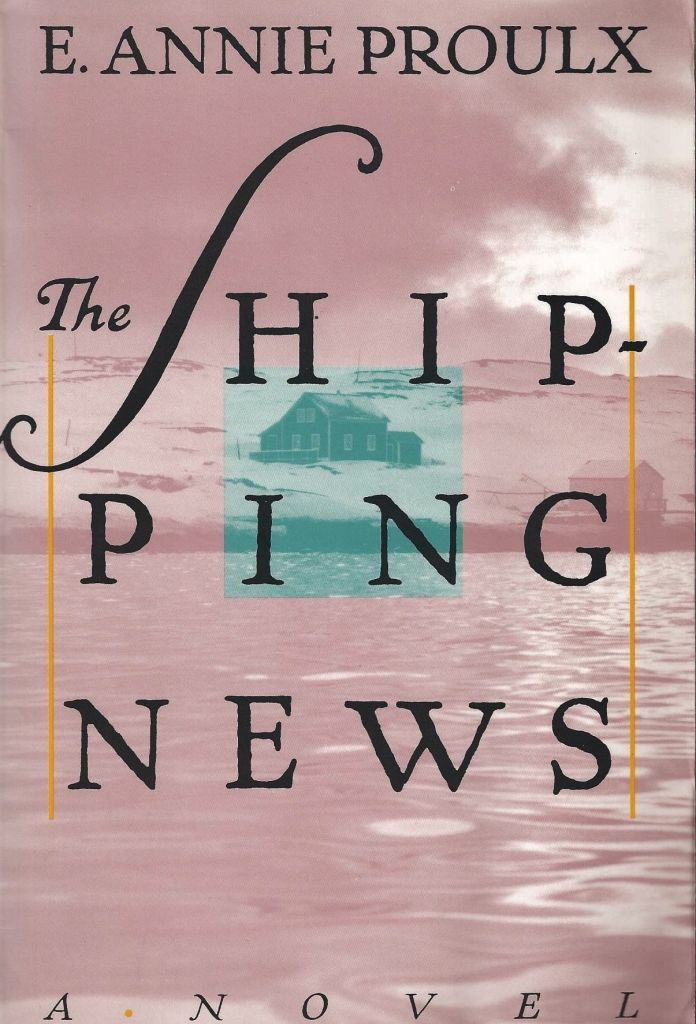
 The Shipping News by E. Annie Proulx ~ 1993. This edition: Scribners, 1993. Softcover. ISBN: 0-684-19337-X. 337 pages.
My rating: 7/10
I’ve finally completely read this Newfoundland-set bestseller, after being defeated only a few chapters in on several previous tries.
What can I say, except that it does get better if one can persevere through the dismal beginning bits, and stumble through the author’s choppy prose until – glory be! – like miraculously deciphering key elements of a foreign language, everything starts to make sudden sense.
Once the cipher was broken, I never looked back, and I ended up rather enjoying this slow-moving tale of the dismal misfit Quoyle and his return to his ancestral Newfoundland roots after the exceedingly well-deserved demise of his sociopathic wife.
Though much of the novel is pure invention – and a good thing too, or there would be no Newfoundlanders left living on The Rock – they’d all be incarcerated for deviant sexual practices, or horribly perished in collisions with the ubiquitous imported moose, or pukingly dead of alcohol poisoning, or, barring all else, simply drowned at sea while a-seeking the vanishing codfish – Proulx catches the distinctive cadence of the regional dialect brilliantly, and her dialogue passages are an absolute joy.
On the negative side of the slate, there’s a completely boring love affair towards the end, all redemptive and meaningful with two sad, spousally-abused people finding each other, which was eye-rolling in its predictable banality. Also an unexpected and artistically over-the-top resurrection of a thought-to-be-deceased mentor figure in our hero Quoyle’s life which I could have happily done without – that bit felt like full-blown farce and jarred, even after all of the many other improbabilities, like the too-mobile ancestral Quoyle family home, and the disgustingly gruesome and never-really-explained fate of a sailor previously met by our hero on the deck of a based-on-reality Dutch-built yacht, once owned (in the story) by Hitler (though in reality the inspirational yacht was supposedly commissioned by Goering – check out this link for a fascinating little side story.)
Quite a mix, this one, of the ridiculous, the sublime, and, on occasion as with all of the details of widespread incestuous child abuse, the just plain distasteful.
Proulx borrows enthusiastically from fact, but never forgets that she is writing fiction, which the reader should also keep in mind throughout.
The internet abounds with reviews and book club discussions and author interviews, so if you’re curious about more detail, go to it. I’ll personally give it an “okay” recommendation, and add that I am quite open to reading some more by this writer, but that I’m not in a terrible rush.
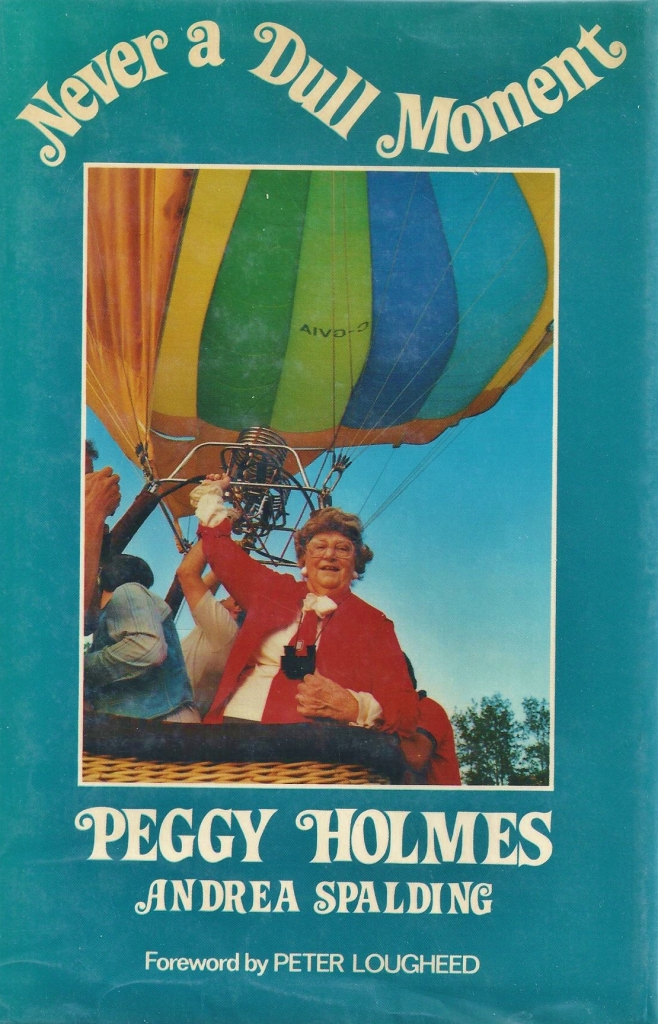
 Never a Dull Moment by Peggy Holmes ~ 1984. Co-authored by Andrea Spalding. This edition: Collins, 1984. Foreword by Peter Loughheed. Hardcover. ISBN: 0-00-217277-1. 188 pages.
My rating: 7.5/10
Peggy Holmes came to Canada after the Great War as an English war bride, settling on a small northern Alberta homestead with her husband Harry, and trying to make a go of farming under dismal conditions. The couple eventually gave up the farming dream and moved to Edmonton, where Harry became a law court transcriptionist, and Peggy raised her cherished young son, cared for her ailing father, and pursued various jobs in order to earn some extra money in order to keep the household afloat.
This is a lively recounting of Peggy’s long life in the heart of Edmonton. It was written, with the help of computer-literate friend Andrea Spalding, in 1984, when Peggy Holmes was 86. She was inspired to try her hand at memoir after taking a creative writing course, which led to her publishing a first volume of homestead memoirs, It Could Have Been Worse, and working as a highly regarded CBC regional radio broadcaster.
As “good old days” memoirs go, well done and very appealing and readable, though probably of greatest interest to those who are familiar to some degree with the Alberta setting and Edmonton local history. There are many local references.
There was a lot of personal tragedy in Peggy Holmes’ life, including several traumatic miscarriages, the loss of twin newborn girls through a doctor’s incompetence, and her elderly father’s death by suicide, but the tone throughout is pragmatically positive. Peggy Holmes must have been a very interesting lady, and she was certainly an interested one, always up for new experiences, such as the pictured hot air balloon ride when she was 85 years old.
Peggy Holmes wrote three memoirs in total, and I would be pleased to come across the two I don’t have, though I doubt that I will go to extraordinary effort to acquire them.
Peggy Holmes died in Edmonton in 1997, shortly before her one hundredth birthday.
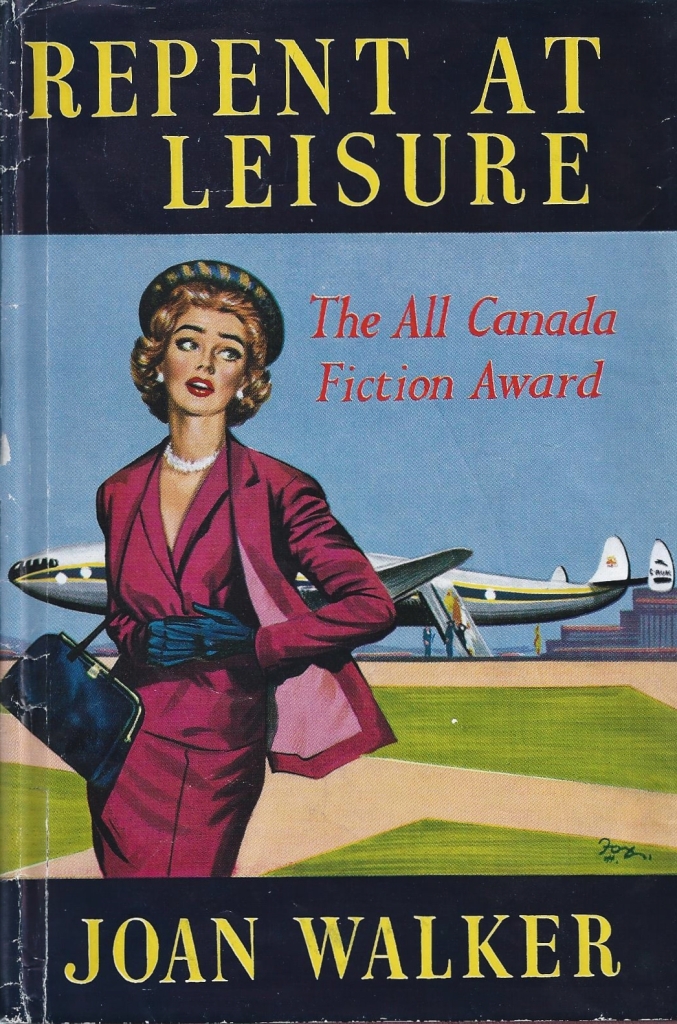
 Repent at Leisure by Joan Walker ~ 1957. This edition: The Ryerson Press, 1957. Hardcover. 284 pages.
My rating: 6.5/10
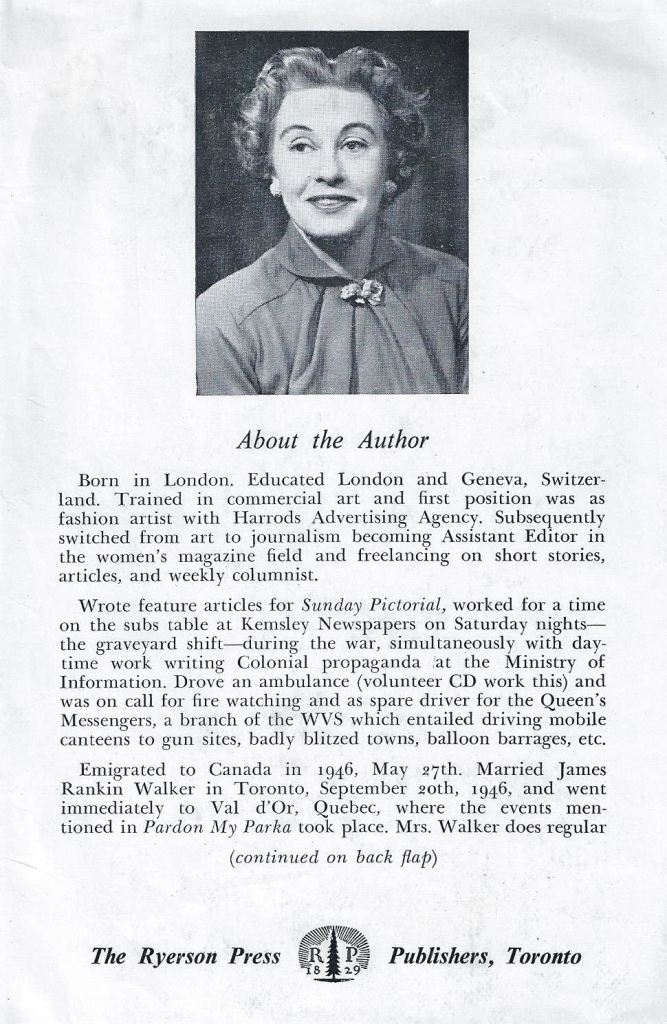
Joan Walker was another English war bride, of a later vintage than Peggy Holmes, coming to Canada in 1946.
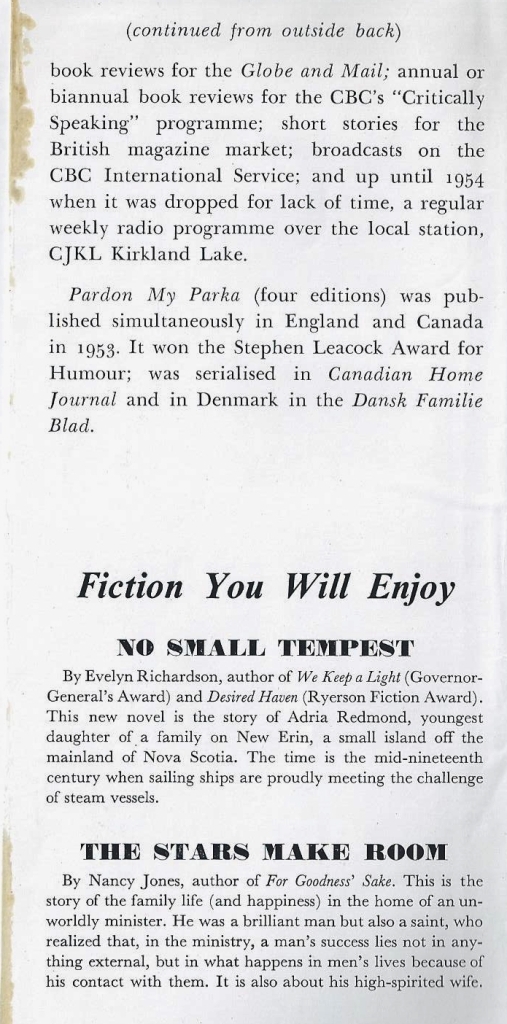
Walker had a background in various sorts of writing, and penned a well-received humorous memoir of her entry in Canadian life, with the Stephen Leacock Award-winning Pardon My Parka in 1953.
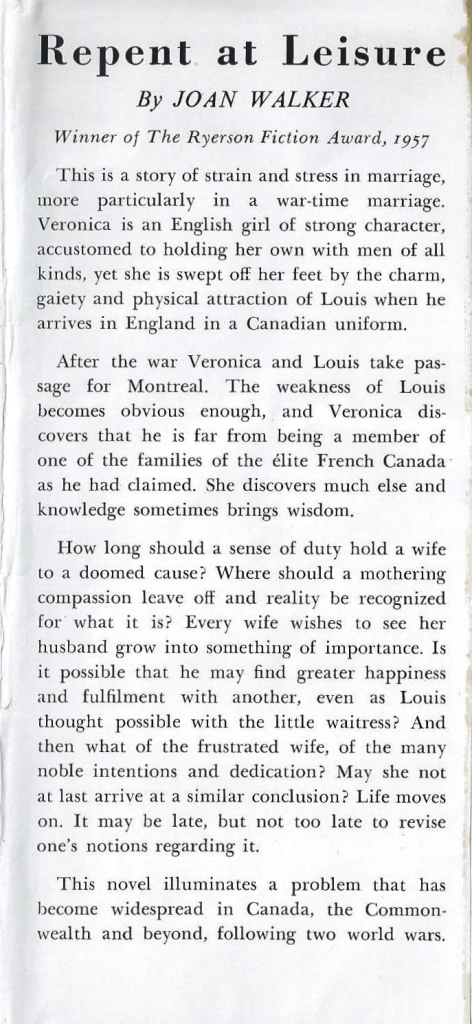
Repent at Leisure was Joan Walker’s attempt at writing a “serious” novel, and it is based on her war-bride, culture-shock observances, though it is fictional in its plotting, and not based on her personal marital tale.
Repent at Leisure is acceptably diverting, and I will be definitely be re-reading it in future.
The novel fits well into the “middlebrow women’s fiction” genre of its day, though I wouldn’t go so far as to enthusiastically recommend it. It was distributed in England as well as in Canada, and seems to have been critically well received, receiving the All Canada Fiction Award in its year of publication.
Walker did publish one more full-length book in 1962, a fictional depiction of the life of Richard Sheridan, Marriage of Harlequin. I can find no mention of further full-length works, though Joan Walker apparently continued writing essays and articles for various publications into the 1960s and 70s.
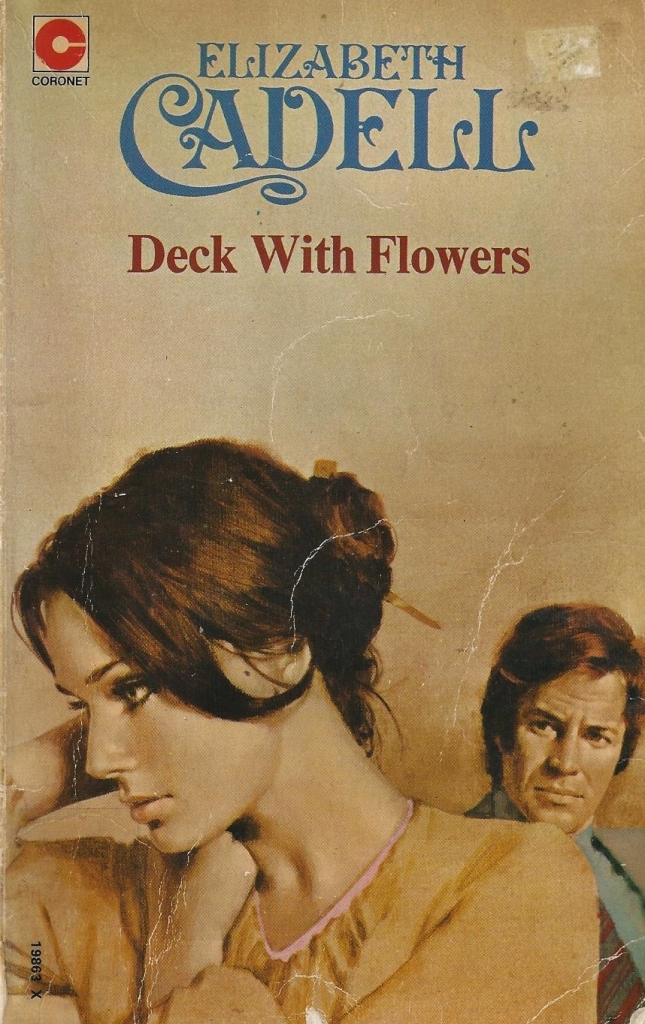
From the front cover illustration I had expected something fairly light-hearted, but the author’s intent seems to have been to write something more serious and dramatic; I can only assume that the cover artist was inspired by the comedic reputation of Pardon My Parka when tackling this new project.
Here are scans of the back cover and flyleaf blurbs from Repent at Leisure, for those of you who are curious about the writer and her work from my brief description.
There are a few copies of this novel on ABE, quite reasonably priced, but, as I’ve already mentioned, I don’t feel it quite worthy of a “must read” recommendation, though there is nothing really wrong with it, either. More of a average-ish period curiosity than a hidden Canadian classic, is my honest opinion.












 Leaves & Pages
Round-Up Post #3-2014 – Absolutely Random – An Anglo-Scottish Country House Romp, A Touch of Stardust, Mother-Envy, and Messing About in Boats
Posted in 1990s, Cavanna, Betty, Century of Books - 2014, Gaiman, Neil, Grahame, Kenneth, Mitford, Nancy, Read in 2014, tagged Almost Like Sisters, Cavanna, Betty, Century of Books 2014, Gaiman, Neil, Grahame, Kenneth, Highland Fling, Mitford, Nancy, Social Commentary, Stardust, The Wind in the Willows on April 4, 2014| 18 Comments »
Poplar catkins, here at Hill Farm, a spring or two ago. Rather tardy this year, as we are still covered mostly in snow, and yearning for a warm wind to take it all away and get those pussy willows and leaf buds started…
Here we have a random grouping of completely unrelated reads: the brightly satirical (Nancy Mitford’s Highland Fling), the contemporary fantasy (Neil Gaiman’s Stardust), the vintage teen girl tale (Betty Cavanna’s Almost Like Sisters), and the enduring anthropomorphic classic (Kenneth Grahame’s The Wind in the Willows).
My rating: 5.5/10
From The Spectator, April 11, 1931, a book reviewer’s summation at Nancy Mitford’s Highland Fling:
Oh, ouch! Talk about your brutal dismissal. Miss Mitford’s first published work was apparently not an instant hit with everyone in her home country, though she appears to have surmounted such dire reviews and gone on to find enduring popularity among the discriminating readers of the next eight decades. There does appear to be something of a cult Nancy Mitford following, if one may use such a term, though I’m standing very much on the edge of such, listening to the gushing praise with serene detachment.
Some of her novels are very good indeed, but this first one is not quite up to the standard of her best. She tries hard, though, and there are flashes of something very interesting going on in amongst the hectic activity and the constant digs at Society types which the young Nancy Mitford has trotted out rather heavy-handedly as a basis to her humorous repartee.
Young married couple Sally and Walter are living well beyond their means, so when they are offered an opportunity to play host and hostess at a relative’s country place in Scotland for the shooting season, they quite contentedly relocate from Town. Joining them are two of their contemporaries, the giddy Jane Dacre and the avante-garde artist Albert Memorial Gates.
The four young folk are quite clever at dodging the bloody amusement of the “grown-ups” of the party, that of going out and killing the local fish and fowl, but the two generations meet over dinner every night, which is good for some sparks-flying conversation of the culture clash type, as the Old Guard holds forth on How Things Should Be, while the younger ones parry the heavy handed pronouncements with their own rapier wit, which quite often fails to even catch the notice of the intended target.
Much merriment ensues, culminating with a conflagration which destroys Dalloch Castle, and sends everybody back to town. An inevitable romantic cat-and-mouse games ends happily for the players, and all’s well that ends well.
While readable enough, this is hardly a masterpiece. A very light entertainment, and I suspect of most interest to the already-won-over Nancy Mitford fan.
My rating: 10/10
This is why I still bother with Gaiman, because he created this sort of thing in his earlier days, and we still get glimpses of it now and then, though the stories are getting increasingly edgier and darker, as well as a little bit lazy here and there.
There is only a small gap in the wall that separates the Real World (where mortals hold sway and a young Queen Victoria sits on the throne) and the Other World where Magic holds sway, and where anything can (and does) happen. Pass through the gap with caution, Mortal…
Young Tristan Thorn, in love with the lovely, manipulative town beauty, Victoria (no relation to the ruling one), sees a falling star and boasts to his lady-love that he will travel into the Other World to the place it has landed and will bring it back to her, in exchange for her giving him his Heart’s Desire.
The star is duly discovered, and turns out to be a creature in the form of a lovely young woman, terribly injured in the fall. Tristan cold-heartedly chains her to himself and the two start the long journey back to the Mortal World – where upon crossing the wall the star will turn into a chunk of stone, something she knows but Tristan doesn’t – with the star proving desperately reluctant to cooperate and Tristan becoming increasingly apologetic but focussed on his goal of winning the fickle Victoria with his successful quest.
Complications ensue, in the form of a triumvirate of witches who are also dead keen on seeking out the star, to cut the heart from her living breast in order to regain their vanished youth. We also have a darkly funny parallel plot about a dead king and his seven fratricidal sons, who are busily bumping each other off – survivor gets the throne.
There are magical transformations, battles to the death (and a fair bit of gore), and helpful creatures here and there, and Tristan and his star eventually do get back to the wall, where he parks the star and passes through to go and find Victoria. However, he’s been away quite a long while, as time is counted in the mortal world, and things have moved on without him…
What a grandly imagined story this is, in the best fairy tale tradition. And the movie made of it back in 2007, starring Claire Danes as the luminescent Yvaine-the-fallen-star, Charlie Cox as an endearingly sincere Tristan, Robert de Niro as the campy captain of a sky-ship (another side plot, don’t worry, it makes sense when you’re reading this thing, sort of) and Michelle Pfieffer as a gloriously wicked witch (equipped with horribly sharp obsidian knives for hacking out Yvaine’s heart) was a rather decent adaptation.
I’ve read both the straight novel edition (no pictures) and the Charles Vess collaboration, and both are marvelous. To get the full effect of the story, go for the print-only one. Vess’s illustrations are brilliant, but horribly distracting, in the very best sort of way.
My rating: 5/10
I confess to a secret fondness for Betty Cavanna’s sincere teen girl tales. The obvious care and attention to setting up the backgrounds and the “educational” details she insistently inserts in to each and every one always win me over, even though there are many cringe-worthy elements throughout, such as the continued harping on anyone who is even the tiniest bit plump, and the sometimes dreadfully pedestrian writing style. Still, something keeps pulling me back to reading these over and over again, and I am obviously not alone, as Cavanna’s books went through many editions and reprintings, are in very strong demand (and are rather high priced) in the vintage book marketplace, and are always almost in tatters when one does find them. Kind of like Betty is the D.E. Stevenson of the mid-20th century teenage set, in fact…
Almost Like Sisters, while definitely readable if you go in for this sort of thing, is not one of the shining stars in this author’s substantial oeuvre, so I won’t go on at length, but will merely share the flyleaf blurb, because it pretty well tells you all you need to know about where this story goes.
Not my personal copy, which is a rebound old school library edition with a boring green cover.
The Wind in the Willows by Kenneth Grahame ~ 1908. This edition: Scribner’s, 1954. Illustrated and with Preface by Ernest H. Shepard. Hardcover. 259 pages.
My rating: 10/10
What can be said about this book that hasn’t already been said, written, or recorded in some way? A true “classic”, in every sense of the word, beloved by children and adults the world over for the century-plus since its first publication.
Grahame’s anthropomorphic characters are most cleverly depicted. They are small humans in animal form, wearing clothes, walking upright when appropriate (though some find this easier to manage than others), and only sometimes following their animal nature. They interact with the humans in their world on a perfectly equal basis (or so they think) while the “real” humans seem to view them with a mildly patronizing attitude. The whole thing is rather complex, when one stops to think about it, and it says much for Grahame’s artistry that we accept his world immediately and without question.
The story itself is a series of linked adventures, starting with the subterranean Mole busily spring cleaning his rather dingy underground home, and throwing down his scrub brush in despair when the scent of Spring wafts through the air and catches the attention of his sensitive little nose. Wandering aimlessly out along the riverbank, Mole meets the cheerful Water Rat, who is appalled that his new acquaintance is unfamiliar with the joys of the river, and decides post-haste to initiate the ground dweller into the thrill of the liquid world, for
The earnest Mole and the carefree Rat go on to have numerous adventures, mostly concerning their bumptious neighbour Toad, who is a wealthy creature much prone to following ever-changing whims full speed ahead until something new catches his short attention. A camping trip in a horse drawn caravan (with decent Mole walking along beside the Horse to keep him company and to try to make up for the fact that the Horse is doing all of the hot, dusty work while Toad lolls in the driver’s seat) goes awry as the group is run off the road by a Motorcar. Toad is seduced immediately, buys his own extra-deluxe motorcar, and with a war cry of “Poop! Poop!” (meant to mimic the klaxon horn of his newest Beloved) gets himself into much more serious scrapes and eventually into Court, where he receives a stern sentence for Driving to the Public Danger, and much more seriously, Cheeking a Policeman. Twenty years in the deepest dungeon of the best-guarded prison in all of England is the fate of Toad. How ever while he get out of this one?!
Good stuff. Read it for your personal pleasure; read it aloud to your children, and continue the long tradition.
That’s all I have to say. If you are looking for scholarly examination, it is freely available in great abundance here, there and everywhere. But not from me. It’s a grand book, undoubtedly an “important” book, and most crucial of all, a fun-to-read book. Go read it. It’s utterly perfect for Spring.
And oh, well, here is a link to a quite lovely blog post regarding it, the sort of thing which I would have liked to have written, but which has already been done to such perfection that I lazily thought, “Why do it again?”
Check this out: Behold the Stars: The Wind in the Willows
Read Full Post »