Archive for the ‘1980s’ Category

The Girl on the Beach by Velda Johnston ~ 1987. This edition: Dodd, Mead & Co., 1987. Hardcover. ISBN: 0-396-09190-3. 189 pages.

My rating: 4/10

A few days ago I reviewed an earlier Velda Johnston book, A Room with Dark Mirrors (1975), which I had mildly enjoyed, enough so that I did a library search for more of Johnston’s titles on the odd chance that I’d find a few. There were two books listed, the one I’m looking at right now – 1987’s The Girl on the Beach – and a 1968 title, House Above Hollywood, which I was unable to locate on the shelf.

I hate to pan any book, because I realize that literary tastes differ wildly and something I find marvelous the next person might shudder at, but, sadly, this second Velda Johnston was deeply disappointing. Formulaic, poorly worded, with nothing like the narrative flow of Dark Mirrors. Dark Mirrors was hardly high literature, but it was an easy, pleasant read. Girl on the Beach was painful to finish. I kept waiting for it to get better, but it quite simply didn’t.

New York advertising artist Kate Killigrew comes to an ocean-side house on a North Carolina island to recover from a car accident and the break-up of her engagement. Her first night there, she wakes in the wee hours and sees a beautiful young woman wandering on the beach and staring at the house; Kate finds this a bit unusual but shrugs it off. The next day a good-looking and obviously troubled young man shows up; he too stares at the house in a strange manner before he realizes Kate has seen him and comes to the door with the explanation that he once lived there.

Turns out that the young woman of the night before is the sister of the murdered wife of the man. The murder took place twelve years earlier, in that very beach house; the man, Martin Donnerly, had been convicted of the crime, and has just finished his prison sentence and returned to the island; the sister has been mentally unbalanced since birth and wanders at will, hence her rambles after midnight.

Of course Kate and Martin fall in love. Due to some inner intuition (wishful thinking?!)Kate insists that Martin could not have murdered Donna Sue (the dead wife); she is sure that Donna Sue’s twin Darleen Mae holds the key to the mystery. Oh yes, there’s a twelve-year-old armoured car robbery mystery intertwined as well, with $50,ooo in missing money floating around somewhere. Might there be a connection? Maybe. Or maybe not. A few red herrings listlessly flop about muddling the plot line.

Various locals with various issues have an abiding interest in the matter; Kate runs afoul of almost all of them, before the “dramatic” conclusion of a violent altercation with the most unexpected of the locals and his predictable “dying breath” confession.

This book is so badly worked out that it seems almost like a parody of the romantic-suspense novel genre. Velda must have been having a bad case of writer’s block when she penned this car wreck. I’ll somewhat forgive her, as I just did the math and realized she was seventy-five when this was published; she might merely have been getting tired of turning these “suspense novels” out at the rate of one (or more) a year since the 1960s, and  rattled this one off in a hurry.

I may give Velda Johnston one more chance, if I can easily get my hands on House Above Hollywood on my next library run, otherwise she’s probably going to be crossed off my list of possibles to search out to add to my mom’s reading list. I wouldn’t cross the street for this one, though the earlier novel showed some promise.
Read Full Post »

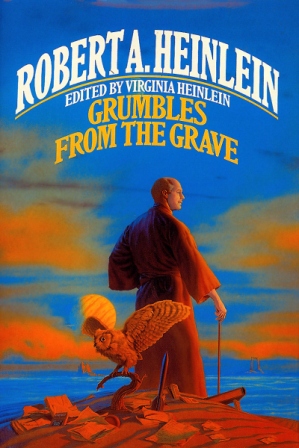
Grumbles from the Grave by Robert A. Heinlein, edited by Virginia Heinlein ~ 1989. This edition: Del Rey/Ballantine, 1989. Hardcover. 281 pages.

My rating: 7/10. What was there was fascinating; what was left out perhaps even more so.

A very brief, rather incomplete biographical introduction by Robert A. Heinlein’s third (and longest-serving) wife Virginia, followed by a collection of excerpts from letters mostly by Heinlein (with some replies); and mostly to his long-time literary agent and representative, Lurton Blassingame. This book was published after Heinlein’s death, by his specific request, apt title previously supplied. Heinlein was very aware of his own mortality and was well prepared for his own demise; he suffered from pulmonary tuberculosis in his twenties, and various related and other serious ailments dogged him for the rest of his life. (Heinlein was born in 1907, and died at the age of eighty-one in 1988 – a longer life than might have been expected, considering the severity of some of his medical episodes.)

This is decidedly a book of most interest to those already very familiar with Heinlein’s body of work. Coming to it cold, expecting to find a conventional autobiography, one would be disappointed. While some effort is made to provide references and brief descriptions of the books under discussion, the assumption seems to be that the reader is already a serious Heinlein fan.

I do not think I qualify as a truly serious fan, though I’ve read most – perhaps all? – of Heinlein’s full-length works, plus several short story collections, and have greatly enjoyed all of some of them, and some of all of them. A few, such as Door Into Summer and The Moon is a Harsh Mistress, are nostalgic favourites and frequent re-reads; I first encountered Heinlein in my high school library and found his works marvelous “escape lit” during a dark, angst-filled period of my teenage life. This said, there are things that make me a bit uneasy in every one of his stories, in particular the later “adult” novels which have a certain patronizing (not quite sure if that is the right term, perhaps “appreciatively leering” is more apt?) view of women out of context with the era of the time of writing.  There are random passages in Heinlein’s books, usually in relation to some of the female characters, which make me suddenly cringe in distaste, all of the author’s commentary about his views of “true equality” taken into consideration.

Heinlein makes no apology for his personal views, which I can best describe as far right-wing with sudden dashes of liberalism when least expected. When he starts to politically pontificate in his books, my eyes glaze over and I scan ahead until we get back to the story at hand; Heinlein himself offers something of an apology for letting himself go on occasion, but his self-awareness of this tendency didn’t stop him from doing it time after time.

It was quite interesting to discover something of the background of some of the best-known novels which I am very familiar with , as well as some of the more obscure juveniles and the vast amount of short stories published early in Heinlein’s career in the sci-fi “pulps” under an array of pseudonyms: Lyle Monroe, Anson MacDonald, Caleb Saunders, and John Riverside. Apparently there was a different rate scale for each of these pseudonyms as well – while “Heinlein” and “MacDonald” might receive a top rate, in 1941, of a cent and a half per word, “stinkaroos” written by “Monroe” were peddled at a lower rate. From a letter to sci-fi magazine Astounding editor John W. Campbell, Jr. in 1941:

…I have a phony name [Lyle Monroe] and a phony address, fully divorced from the RAH persona, under which and from which I am trying to peddle the three remaining stinkaroos which are left over from my earliest writing. For such purposes I prefer editors whom I do not like. It would tickle me to sell off the shoddy in that fashion. I don’t think it is dishonest – they examine what they buy and get what they pay for – but I’m damned if I’ll let my own name appear even on one of their checks.

The editorial voice of Robert’s third wife Virginia, his proofreader, assistant and sometimes-typist as well as his business and financial manager in later years, is apparent throughout. The excerpts that appear are much of a muchness; I have to wonder what was left out of this compilation? Heinlein talks of personally answering all of his fan mail in the earlier years; I would love to see a sampling of some of those early letters, before his sheer popularity made the flow of mail so great that he resorted to one-line, postcard answers.

I generally enjoyed this biography of sorts. It was a glimpse at the back story to the writing some of the novels, and a small window into the life of this passionate, opinionated and very talented writer.

This is a good addition to a shelf of Heinlein’s fiction; I will be keeping it there myself, to one day pass along to my son along with the rest of my collection of vintage sci-fi/fantasy which he has enjoyed dipping into in his own teen reading years.

Read Full Post »

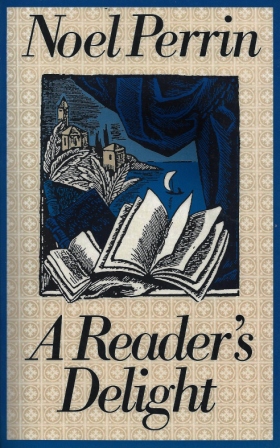
A Reader’s Delight by Noel Perrin ~ 1988. This edition: University Press of New England, 1988. Softcover. ISBN: 0-87451-432-0. 208 pages.

My rating: 10/10

I hold the late Noel Perrin (1927-2004) in very high regard ever since reading several of his thoughtful essay collections (First Person Rural, Second Person Rural) some years ago.

A Reader’s Delight is a high-spirited, and – dare I say – playful collection of writings about literature and the pleasures of reading. Perrin turns his attention to under-appreciated literary gems, or, as he terms them, “possible classics”. His criteria: books published more than (roughly) fifteen years earlier (that is, prior to 1973), and books which no more than two or three of his colleagues had read. (Perrin was a highly respected Professor of English at Dartmouth University, as well as a book reviewer and columnist with the Washington Post.)

Perrin enthusiastically promotes forty books (actually thirty-eight books and two poems),  which he thought deserved greater circulation. His essays are passionate, most often humorous, and exceptionally convincing. A true joy to read all on their own,  with promise of future reading pleasure if one can track these titles down. Some will definitely entail a “quest”, while others are still in general circulation and relatively easily found.

I greatly enjoyed and highly recommend this essay collection. I had already read and appreciated a few of the titles on the list but most were unknown to me. I will be seeking many of these out, or at least keeping them in mind while used-book searching in the future.

Here are the books Perrin recommends, with his essay titles in quotation marks:

  • Indian Summer by William Dean Howells, 1886. “A Nearly Perfect Comedy.”
  • The Valleys of the Assassins by Freya Stark, 1934. “To Awaken Quite Alone.”
  • Kai Lung’s Golden Hours by Ernest Bramah, 1922. “A Thousand and One Chinese Nights.”
  • The Bottom of the Harbour by Joseph Mitchell, 1960. “A Kind of Writing for Which No Name Exists.”
  • The Journal of a Disappointed Man by W.N.P. Barbellion, 1919. “A Book That Could Cure Suicide.”
  • Watch the North Wind Rise by Robert Graves, 1949. “A Future Ruled by Magic.”
  • Fables in Slang by George Ade, 1899 “The Fables of George Ade.”
  • On Love by Stendhal, 1822. “Falling in Love with Stendhal.”
  • Period Piece by Gwen Raverat, 1953. “Moving in Eccentric Circles.”
  • Poem: “The Exequy” by Henry King, 1624. “Lament For a Young Wife.”
  • Wild Animals I Have Known by Ernest Thompson Seton, 1898. “Thinking Rabbits and Talking Crows.”
  • All Hallows Eve by Charles Williams, 1944. “Taking Ghosts Seriously.”
  • Roman Wall by Bryher, 1954. “The Decline and Fall of Switzerland.”
  • Democracy by Henry Adams, 1880. “Gulliver Goes to Washington.”
  • The Blessing of Pan byLord Dunsany, 1928. “Lords and Pagans.”
  • Guard of Honor by James Gould Cozzens, 1948. “The Best American Novel about World War II.”
  • The Semi-Attached Couple by Emily Eden, 1860. “After Jane Austen, Who?”
  • The Diary of George Templeton Strong edited by Allan Nevins and Milton Thomas, 1952. “America’s Greatest Diarist.”
  • The Walls Came Tumbling Down by Henriette Roosenburg, 1957. “The Night-and-Fog People.”
  • The Silver Stallion by James Branch Cabell, 1926. “Irreverence in the Year 1239.
  • The Maker of Heavenly Trousers by Daniele Varé, 1935. “A Tale of Many Virtues.”
  • Many Cargoes by W.W. Jacobs, 1896. “Sailing to London.”
  • Riding the Rails by Michael Mathers, 1973. “Men in Boxcars.”
  • The Best of Friends: Further Letters to Sydney Carlyle Cockerell edited by Viola Meynell, 1956. “A Man of Many Letters.”
  • A Fine and Private Place by Peter S. Beagle, 1960. “Love, Longing and Death.”
  • Poem: “Church Going” by Phillip Larkin, 1955. “Phillip Larkin’s Greatest Poem.”
  • The Three Royal Monkeys by Walter de la Mare, 1910. “Quest of the Mulla-Mulgars.”
  • When the Snow Comes, They Will Take You Away by Eric Newby, 1971. “Prisoner in Wartime Italy.”
  • Bridgeport Bus by Maureen Howard, 1965. “Ugly Ducklings and Unhappy Swans.”
  • Essays in Idleness by Kenko, 1332. “In Medieval Japan.”
  • The Green Child by Herbert Read, 1935. “A Novel About Nirvana.”
  • A Casual Commentary  by Rose Macaulay, 1925. “In an Offhand Manner.”
  • The Adventures of Jonathan Corncob, Loyal American Refugee by Anonymous, 1787; edited by Noel Perrin, 1979. “Two Hundred One Years Old and Still Impudent: The First Novel about the American Revolution.”
  • Instead of a Letter by Diana Athill, 1962. “Over Forty and Just Beginning: An Englishwoman’s Brilliantly Recorded Life.”
  • Islandia by Austin Tappan Wright, 1942. “The Best of all Imaginary Islands.”
  • They Asked for a Paper by C.S. Lewis, 1962. “A C.S. Lewis Miscellany.”
  • Born to Race by Blanche C. Perrin, 1959. “A Girl, a Horse – and for Once a Good Book.”
  • A Genius in the Family by Hiram P. Maxim, 1936. “A Genius Grows in Brooklyn.”
  • My Father’s Glory and My Mother’s Castle by Marcel Pagnol, 1960. “Huck Finn’s French Counterpart.”
  • Far Rainbow by Arkady and Boris Strugatsky, 1964. “Tanya Must Die.”

And there you have it.

Happy hunting, and happy reading!

Read Full Post »

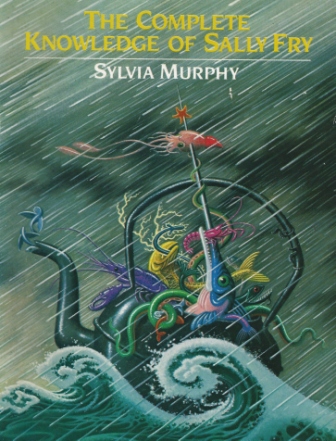
The Complete Knowledge of Sally Fry by Sylvia Murphy ~ 1983This edition: Black Swan, 1984.  Softcover. ISBN: 0-552-99094-9. 174 pages.

My rating: 9/10.

I grabbed this book on a whim during a Sally Ann sweep over a year ago. I was attracted by the intriguing cover, and when I opened the book to the middle for my standard never-heard-of-this-author-before-should-I-gamble-on-this book-30-second-random-excerpt-test it passed quite nicely.

Not quite sure why it’s taken me this long to get around to reading it. The cover blurb might be the reason – a quote from Susan Hill  (which vaguely rings a bell – dark short stories? – or ???)  promises “…no difficulty in laughing out loud….a new, original comic writer…tremendous fun”. I dislike being told I’m going to laugh, and in inner protest I then tend not to. ( “Take that, effusive cover copy writer!” This goes double, no, TRIPLE, for video cover blurbs. Especially foreign films. Never trust the blurb. Just saying.)

Well, shame on me. Picked it up last night, was immediately pulled into Sally Fry’s complicated little world, stayed up way too late reading it, and got up way too early to finish it.

Verdict – very nice indeed. This one’s a keeper. (Though I didn’t laugh out loud. Continual appreciative smiling better describes my response. Maybe I would have laughed out loud – occasional passages are very wryly funny – but I was reading in bed next to my slumbering spouse so I tempered my behaviour accordingly.)

So – how to describe Sally Fry?

Still smiling as I try to condense the essence of this little gem of a story. In brief – here’s the scene. Sally Fry, single mother, behavioural therapist and college lecturer, is working on her PhD thesis. Hoping for a few quiet months of seclusion in her mother’s rented Cornwall cottage, her plans go quickly awry. Her troubled teenage son Sebastian disappears, leaving behind a cryptic note; a sister’s sudden operation means the arrival of Sally’s rather  sweet though boisterous young niece and nephew; another sister shows up on the cottage doorstep on the run from the implosion of her marriage with a Swedish filmmaker, who himself appears shortly thereafter and proceeds to spend his time alternately spying on the household through field glasses and enjoying the generous favours of Sally’s mother’s neighbour’s wife.

The thesis does not progress. What does get done is Sally’s own quirky autobiography, written in passages triggered by alphabetical dictionary-style entries; a form of therapeutic self-expression Sally herself developed and then had scooped by her lover-at-the-time to further his own career. Oh yes, Sally has a back story, and more than a bit of baggage!

If I had the inclination (and, more to the point, the time) I could type in a few of the entries here, but as they really must be read as part of the narrative flow I’ve decided that would be pointless. (Plus the time thing.) So you need to take this on faith. Not a particularly warm and fuzzy book – Sally’s voice is too matter-of-fact and cynical for that – but it made me very, very happy. Good stuff.

I Googled Sylvia Murphy this morning, and  – oh joy! – after this first novel (Sally Fry) she has a nice little collection of subsequent titles which I shall be searching down, though most appear to be out of print. I found Murphy’s personal blog, and the last postings are from 2010; she talks about the difficulties of getting published in the increasingly competitive world of mainstream books as publishers concentrate on potential mega-bestsellers versus a broader catalogue of titles. Though her first works were released by Houghton-Mifflin, it appears that she was dropped at some point; her later works are self-published and she comments that she is now looking at print-on-demand as well. Her bibliography includes several other contemporary novels, memoirs of restoring and ocean-sailing a 1930’s wooden ketch, Nyala, with her late husband, several “cat” tales, and two non-fiction works on coping with death and grieving; in her other life Sylvia Murphy is an administrator in a bereavement counselling service.

More on Sylvia Murphy in the future, I sincerely hope. She’s on my quest list as of right now. I would like to start with her 2008 novel, Candy’s Children.  The description of the plot  is promising: an elderly Palestinian-born Englishwoman dies in a terrorist bombing during a mysterious visit to Tel Aviv; at her funeral five of her children assemble. The catch is that none of them know that they have siblings. I’ll bite; after Sally Fry I have high hopes for Sylvia Murphy; I look forward to spending some more time in her literary company.

Sylvia Murphy. Here she is: http://www.sylviamurphy.co.uk/

Read Full Post »

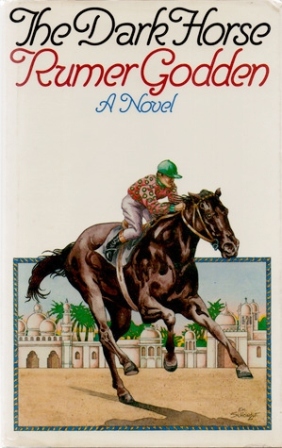
The Dark Horse by Rumer Godden ~ 1981.  This edition: Viking Press, 1982. Hardcover. ISBN: 0-670-25664-1. 203 pages.

My rating: 5.5/10.

Rumer Godden assembles a motley collection of stereotyped characters in this predictable little story, which was apparently based on a true incident of the 1930s Indian racing scene.

Other than the intriguing setting – English-style thoroughbred racing in India during the final days of the Raj –  I found absolutely no surprises here. I would give this slight novel permanent shelf room only to round out a collection of the author’s works, and – yes – I’ll say it yet again –  because even a poor Rumer Godden is worth keeping around for dipping into as a casual light read.

A race horse who has not fulfilled his earlier promise ends up in India with his has-been, sometimes-alcoholic, defrocked-jockey-cum-stable boy. A noble and understanding trainer discovers the reason why the horse won’t perform; after a few ups and downs the big race is run; no prizes are given for predicting the winner. Oh yes, there’s a convent of rather saintly nuns involved as well. (Rumer Godden does do nuns quite well – I’ll give her that.)

This comes out sounding a bit harsh and dismissive, but I’ll temper it. There’s some good stuff in here too, and Rumer Godden obviously drew on her own experiences in India because the setting and time is lovingly portrayed and convincing in its detail. The horses are nicely characterized; the author obviously spent some time paying close attention in the stables during her long and varied life.

Sadly, in this tale, the humans are all a bit too one-dimensional to be quite as believable as the horses. There is a lot of commentary on the social ostracization both of the wealthy “outsider” race-horse owner Leventine, and trainer John Quillan’s lovely Eurasian wife; the point that this is a bad thing is hammered home good and hard as Godden mounts this particular soapbox and lets herself go.

This is one of Rumer Godden’s decidedly minor works. A pleasant enough story, but not up to the standard of her best efforts, either in plot or character development. The whole thing felt a bit distracted, as if the author’s mind was only paying partial attention as she whipped this one off.

Which is how this reader felt as well as she whipped through the story hoping for more engagement than she could muster up. Rumer – I’ll give you a pass because you’ve done so well so many times in the past; I’ll allow a few bobbles in a lifetime of supporting yourself and your family by the written word; the pressure to produce something – anything! – to put food on the table must have been intense. The Dark Horse was written in the 45th year of the author’s long writing career, and is, I believe, the twenty-first adult novel Rumer Godden wrote, in a lifetime output of something like seventy adult, non-fiction and children’s books.

A plea from me – do not judge this author on this book! Like the “A” and “B” girls she references in the novel, her own work falls into decidedly separate categories, though the quality of the writing shines through even in the lowest of the “B”s.

Read Full Post »

Thursday’s Children by Rumer Godden ~ 1984. This edition: Viking Press, 1984. Hardcover. ISBN: 0-670-71196-9. 249 pages.

My rating: 7/10.

During most of her long career, Rumer Godden was widely viewed as a “popular” versus a “literary” writer, and it is her second-string novels such as Thursday’s Children that serve as evidence for that slightly scornful designation.

Her work did vary widely – as she herself commented – between those books she felt “demanded” to be written, and those that she searched out themes for and “chose” to write. This novel has a “Hmmm, what shall I write about?” feel to it. This said, I’ve read and re-read Thursday’s Children with enjoyment over the years because it is, after all, a Rumer Godden book, which means very competently written with flashes of wry humour, even in the most clichéd of her occasional “hack” novels.

Thursday’s Children is listed variously as a children’s book and as an adult novel. In truth it falls somewhere in between, and perhaps might best be categorized as belonging to the nebulous “young adult” genre, though I suspect its true audience is an older generation looking for a comfort read.

The plot is low-key melodrama, reminiscent of the recent popular film Billy Elliot: young boy stumbles into a dance class, realizes his destiny, faces numerous obstacles, wins over scornful/homophobic father/friends/enemies, and ultimately succeeds. The weakness of this scenario is its predictability; we know from the moment that young Doone fumbles through his first steps in the hallway of his sister’s dancing school that he is destined for the spotlight; his subsequent journey is only of interest in seeing how the author has handled the stock situation.

Side note: I was curious as to whether Billy Elliot or Thursday’s Children influenced each other; it appears that Godden was first out of the gate on this one. It was published in 1984, while the Billy Elliot film was released in 2000. The “boy stumbles into dance” situation is hardly exclusive, and – to be fair – many “real life” male dancers have had similar epiphanies.

Set in London, England in an undesignated time, (though clues point to late 1960s or early 1970s), Thursday’s Children is a double narrative of two young dancers, Doone and his older sister Crystal. Crystal is the much-doted upon daughter of the middle-class Penny family, the long-desired girl following four older brothers, while Doone is her younger brother – an unwelcome “afterthought” child – decidedly unplanned for and viewed with bemusement and a shade of resentment by Maud (“Ma”) Penny, whose family yearnings were more than fulfilled by Crystal’s appearance. Turns out that Ma was once a dancing chorus girl, and her maternal ambitions for Crystal are much grander – nothing but ballet lessons with the “Russian” Madame Tamara (who incidentally started out life as plain old English Minnie Price) will do. Doone,  dragged along by an unwilling Crystal to her Saturday morning dance classes, falls in love with the music and the movement, and away our story goes on its predictable little track.

Rumer Godden proceeds to work her charms with the material at hand. Doone is almost too good for belief, for not only is he a piano-playing prodigy and a natural dancer, he is a thoroughly sweet, sensitive, and likably nice child as well, despite his family’s dual neglect and  bullying. Doone, unsupported by his own family in his quest, is providentially blessed with a series of understanding artsy unrelated adults who instantly recognize his budding genius and smooth his path at every turn. I find that though his dogged “goodness” occasionally annoys, in general I quite like Doone; he shows occasional flashes of wit and bad temper which redeem him from total Little Loud Fauntleroyism.

Crystal, on the other hand, is a far from likeable child. Vain, fickle and scheming, she manipulates everyone in her little world, especially her besotted mother. Jealous of Doone’s recognition by their shared teachers, Crystal actively plots his thwarting, though her schemes are immediately recognized by those omnipotent adults as the two siblings rise through the ranks to their eventual placements in the exclusive Royal Ballet School.

Rumer Godden herself had a life-long involvement with dance, as a long-time dance student who returned to England to train as a teacher, eventually running her own dance school in Calcutta, so all of the technical talk rings true. Her scathing portrayal of the “typical dance mother” strikes close to home. Full disclosure: I am a dance mother myself, and I both laugh and cringe at Godden’s commentary on our many collective follies, though she has also given full credit to the difficulty of reconciling the many needs and expenses of the dancer with the needs and desires of the rest of the family – in the Penny family, as in so many real-life families, the dancer takes precedence.

The characters are allowed to develop in a reasonably natural way, and they surprise us occasionally by their responses, which keeps things interesting though in the main our predictions prove to be correct. Crystal is eventually allowed her chance at redemption; rather a Rumer Godden specialty – she does go to some lengths to allow her characters to show multiple personality facets. Many of the figures in the novel are inspired by actual personages in the British dance world; Yuri Koszorz is a direct take-off of Rudolf Nureyev, and the author has dedicated the book to the legendary Ninette de Valois.

This is a novel in which nothing much happens; the characters are important mostly to themselves and their adventures are the small adventures of ordinary people, but as a simple story competently told it can be counted as one of Rumer Godden’s more satisfying minor novels.

Read Full Post »

« Newer Posts