Archive for the ‘1980s’ Category

White Mist by Barbara Smucker ~ 1985. This edition: Puffin Books, 1987. Paperback. Includes research bibliography. ISBN: 0-14-032144-6. 157 pages.

My rating: 5/10. Just barely. It’s more like a 4, but I gave the author an extra point because of her well meaning earnestness. The message is a good one, but the presentation is deeply lacking in finesse.

I wonder what a typical nowadays young reader would think of this one? It might be perfectly acceptable; I’ve read much worse “kid lit”. From my adult perspective it was a tough slog, though. The author tried to pack too much into this one; in my opinion she should have let off a bit on the info-dump and paid more attention to the story.

And the “Indian = good, White Man = bad” thing was oversimplified.

*****

I’ve been trying to cull our overwhelming book collection, and this was one that got a second look when I was sorting through several boxes of kids’ books this week.

Barbara Smucker, as you Canadians with children or schoolroom experience may know, is famously the author of the multi-award-winning Underground to Canada, about the legendary “underground railway” system of helpers and safe houses by which black slaves escaped to freedom in Canada in the mid-19th century. I haven’t read Underground for years; not since my own children were quite young, but in my memory it was a well-done juvenile historical fiction. I may need to review that one after reading White Mist, to see if it holds up to my positive memory of it.

Smucker, born  Barbara Claasen, was a New Order Mennonite from Kansas, where she attended college and received a journalism degree in 1939. After graduation, she married a Mennonite minister, Donavan Smucker, and the two of them, and eventually their three children, travelled widely throughout the United States. In the late 1960s, the Smuckers found themselves in Mississippi, where Barbara became deeply interested in the civil rights movement. As Mennonites, the Smuckers were already passionate about peaceful resolution and non-violent solutions, as well as justice and minority rights. These themes run through every one of  Barbara’s subsequent stories.

In 1969 the Smuckers moved to Ontario, and, while working as a public librarian, Barbara’s writing career took off, at the relatively advance age of sixty-two, with Underground to Canada’s 1977 publication. This was followed by Days of Terror in 1979, about a Russo-Mennonite family fleeing the Russian Revolution in 1917, and Amish Adventure in 1983, about the challenges facing the contemporary Amish. White Mist, 1985, deals with ecological issues, as well as First Nations (“Indian”) displacement and rights.

Here is the plot outline of White Mist, from a review written by Susan Ratcliffe in 1986:

Grades 5-6/Ages 10-11.

The message of Barbara Smucker’s newest novel is clearly stated by one of the main characters: “If we destroy the earth, we destroy ourselves. We are one with the earth.” She has chosen a rather unusual, and somewhat awkward narrative method to convey this theme.

May is a young, dark-skinned, dark-haired teenager, abandoned as a baby on the door-step of the Applebys, who subsequently adopted her. She thus has no knowledge of her parentage or heritage, and suffers the teasing of other kids in her Sarnia [Ontario] school. She feels an outcast from their society. Every summer she and her parents go to work in their nursery on the shores of Lake Michigan, but find the lake changed this year. The beaches are dirty and littered with dead fish; the water is smelly and unfit for swimming. This year too, Lee, an Indian boy from the local reserve, comes to work at the nursery. He and May gradually become the captives of a strange, swirling white mist that eventually takes them back to a time when there were virgin forests on the shores of a clean lake, a thriving lumber town, and a village of the Potawatomi Indians. They are absorbed into the village life and learn pride in their native heritage. May even meets her great-grandmother, and gains a sense of family and roots.

The awkwardness comes in the switch from the present to the past. May and Lee are surprisingly knowledgeable about every detail of the area and people of 1835. At several points in the story, one or the other of them has to give the source of their information: “I studied all winter at the Reserve library about the Potawatomi…”. “I read about it in Uncle Steve’s books on local history…”. “Uncle Steve had told her…”. Their interest and historical retention is astonishing for their age.

The messages of the novel are strong and worthwhile; pollution and the environment, and the prejudices against native peoples. The characters are bright and attractive, but the method chosen to tell the story is too contrived and unbelievable. However, Barbara Smucker’s many fans may forgive her, because of the appeal of the themes.

I was interested to read that this reviewer felt the same way that I did; that the novel was awkwardly presented and the young protagonists unrealistically knowledgeable about local history. I also felt that the “Indian” characters whom May and Lee met in their deeply contrived time travel were presented in a very stereotyped way, as almost impossibly good, noble, and completely in touch with nature at all times, in the literary “noble savage” tradition.

I do appreciate the use of First Nations characters in leading roles, and it was sweet to see May’s relationship with her white foster parents so lovingly depicted. May’s confusion about her racial history and quest for a way to balance her origins and her present life was very exaggerated, but it was good to see those topics addressed head on. Lee’s recent tragic history of losing a close friend to suicide on his troubled reserve doesn’t get much discussion, but is presented in a matter-of-fact fashion; this is Lee’s reality, and explains why he is so ready to embrace a more positive past. Lee’s fierce pride in his ancestry, and his impatience with May’s ambiguity towards her ancestors ring true to Lee’s characterization.

While many of the non-First Nations characters are presented in a negative, one-dimensional way, there are several exceptions: May’s foster parents are seen as unreservedly “good”; May in her distressed first days as a time traveller meets with kindness from a pioneer woman, and from a cook in a logging camp; and many of the “white” lakeside dwellers embrace the ecological message when Lee and May return from their blip into the past and make their heartfelt presentation for a crusade against pollution.

I didn’t enjoy this book, though. Its flaws were too many and too glaring to ignore, and I can’t recommend it.

I give the author a decided nod for her good  intentions, but it’s a very faked-up story, and I ultimately couldn’t get past that. Into the giveaway box.

Read Full Post »

The Lost Continent: Travels in Small Town America by Bill Bryson ~ 1989. This edition: Abacus, 1990. Paperback. ISBN: 0-349-10198-1. 293 pages.

My rating: 7.5/10. An averaged-out rating. I’ll award a 10/10 for the cutting humour, which is frequently snicker-out-loud funny, and sheer readability, but balance that with a 5/5 for the frequently vicious tone, the relentless mockery of almost everyone the author sees through his car window – fat ladies and people driving motorhomes come in for the nastiest comments – and the often needless vulgarity of some of the prose.

He could tone the rudeness down a mite – which he’s done in his later books – and still be clever and funny. I was frequently uncomfortable with myself for reading and enjoying this, as it felt like I was condoning Bryson’s mean streak, but I honestly never even came close to putting it down, and I know I will re-read it.

Bryson’s snark mellows somewhat as his journey progresses, and there are some genuinely poignant moments, mostly regarding his late father, his widowed mother, and his own family, whom he has temporarily abandoned back in England while he pursues his solo journey through America.

*****

This one snuck into my reading pile a few days ago. I’d just purchased it while on a road trip of my own, remembering when I saw it on the revolving rack that this was one Bryson I hadn’t yet read, and also remembering that it had a reputation for being the most offensively outspoken of his decidedly unshy travel memoirs. I opened it just to browse, and was firmly hooked. Undeniably readable, though it made me squirm. I wouldn’t give this one to my dear old mother, or really anyone else, unless I intimately knew their tolerance for crossing-the-line humour.

*****

In September of 1987, 36-year-old Bill Bryson got into the small red Chevette he had borrowed from his mother and headed out on a road trip to re-discover the America of his childhood. His father had recently died, and the subsequent nostalgic angst this engendered spurred Bryson to bid a temporary farewell to his wife and children in England – where he had lived for the past ten years – and take on a solo trip through “small town America”, echoing his childhood’s epic holiday road trips.

Keeping a journal of his pilgrimage, Bryson then wrote up his impressions in this opinionated and brash travelogue, his second book after the now-obscure and outdated The Palace under the Alps and Over 200 Other Unusual, Unspoiled and Infrequently Visited Spots in 16 European Countries (1985). (Here’s a side note for used bookstore browsers. That forgotten travel gem, which introduces the writer as William Bryson, starts at a respectable $40 on ABE, and proceeds well up into the hundreds. Something to keep in mind it if shows up in your travels. Just saying. I’d definitely buy a copy; the reviews on this one are encouraging, and it would be neat to round out the Bryson collection.)

But back to the book at hand.

13,978 miles and cursory stops – or at least drive-throughs – in thirty-eight states make up the sum of Bryson’s expeditions, over two separate periods, one in the fall and the other in the spring. Small towns are the focus, as Bryson searches for the fantasy ideal of the backdrop of the Hollywood movies of his childhood. Looking for utopia, Bryson is predictably and perennially disappointed, and he vents his chagrin freely and scornfully. There are plenty of good experiences, too, but almost every compliment has a bite behind it, of the “truth stings” variety. Bill targets himself as well, and it’s a good thing he does; it is the only thing that makes him bearable when he’s in full sarcastic cry.

Here’s an example of why I kept reading. Morbidly, awfully, very funny, probably because I know a few of these digitally damaged guys too. Bill Bryson sits in a roadside cafe in Palmyra, Missouri, and theorizes as to why so many farmers seem to have missing digits. The farmer sitting next to him has only three fingers on one hand, and Bill realizes that this isn’t terribly unusual.

(T)here is scarcely a farmer in the Midwest over the age of twenty who has not at some time or other had a limb or digit yanked off and thrown into the next field by some noisy farmyard implement.  To tell you the absolute truth, I think farmers do it on purpose.  I think working day after day beside these massive threshers and balers with their grinding gears and flapping fan belts and complex mechanisms they get a little hypnotized by all the noise and motion.  They stand there staring at the whirring machinery and they think, ‘I wonder what would happen if I just stuck my finger in there a little bit.’  I know that sounds crazy.  But you have to realize that farmers don’t have whole lot of sense in these matters because they feel no pain.  It’s true.  Every day in the Des Moines Register you can find a story about a farmer who has inadvertently torn off an arm and then calmly walked six miles into the nearest town to have it sewn back on.  The stories always say, ‘Jones, clutching his severed limb, told his physician, ‘I seem to have cut my durn arm off, Doc.’  It’s never:  ‘Jones, spurting blood, jumped around hysterically for twenty minutes, fell into a swoon and then tried to run in four directions at once,’ which is how it would be with you or me.”

The scope of Bryson’s travels is truly staggering; he does cover an awful lot of ground, and though there are plenty of places he blasts right through, he stops often enough to give glimpses of back road, small-town America in the not-so-distant past. Ronald and Nancy were in the White House, “Say No to Drugs” was the slogan of the moment, a frightening new disease called AIDS was making headlines, and the Black Monday stock market crash of October, 1987 rattled economic foundations worldwide, though Bryson reports that it seemed a no-news event in the towns he drove through, meriting only a passing mention on the small radio stations, while CBC Radio in Canada, which he picked up on his car radio, was broadcasting extensive, serious and sober coverage.

The book ends on a surprisingly optimistic note. Though Bryson finds he can’t find the America of his childhood, he does admit, after all his carping and critiquing, that there are still places in America’s hinterlands where life is slow, good and sweet. This doesn’t quite excuse some of the more bitter commentary that came before, but it helps.

Interesting book, in what it reveals about the author as well as his native land. Recommended, with reservations as stated above. Don’t say I didn’t warn you!

Read Full Post »

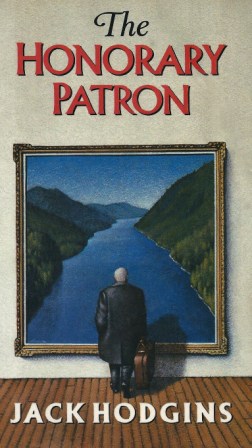
The Honorary Patron by Jack Hodgins ~ 1987. This edition: McClelland and Stewart, 1989. Paperback. ISBN: 0-7710-4190-X. 413 pages.

My rating: 6.5/10. You’ve got to be in the mood to fully appreciate Hodgin’s rather cumbersome playfulness in this one. I guess I’m not quite in the right frame of mind. It was pretty good, and I smiled my way through, but I can’t see myself picking this one up again any time soon. Still a keeper, for a few years hence. Bottom or top shelf – not in the premium placings.

*****

If you liked Timothy Findley’s Not Wanted on the Voyage, or anything by Robertson Davies, you’ll probably look on The Honorary Patron with interest. I think the genre here might be what is termed “magical realism”. Everything is based firmly on solid ground, but the farcical bits go way over the top, tipping the reader off early on that this is not simply an amusing narrative, but something much more playful and far-flying. I get the feeling that Jack Hodgins had a wonderfully self-indulgent time writing this one, and there are more than few cunning digs at his native Vancouver Island and the residents thereof. (Unloading some old baggage, eh, Jack?) But he keeps just this side of spitefulness, so it’s all good.

Not-quite-elderly Professor Jeffrey Crane is settled comfortably into life as a Canadian expatriate in his adopted habitat of Zürich. He has a solid reputation as an accomplished art lecturer, a respectable retirement income from his university teaching days and his still-popular television series, and looks forward to an unbroken future of gentle walks in the park, trips into the countryside to visit his landlady’s family, and long hours spent napping in the sun at his favourite rooftop cafe.

All of this is threatened by the sudden tempestuous arrival of a very-much-alive ghost from the past, his Canadian ex-lover Elizabeth Argent, who bursts in on Jeffrey as he sits up in said cafe, searching frantically for his shoes – which he always kicks off, a running gag throughout the book – so he can escape. He is captured, and thoroughly subdued by vibrant Elizabeth, who has sought Jeffrey out to convince him to come back to Vancouver Island and act as the Honorary Patron of the newly minted Pacific Coast Festival of the Arts. A few speeches, a lot of nodding and smiling, a chance to revisit old haunts, what’s to worry about, Jeffrey?

As it turns out, there are many surprises waiting for the Professor on his long-abandoned home grounds. The coastal rainforest is crawling with old secrets nurtured and embellished, ready for revelation, and unanticipated new situations which Jeffrey, exceedingly unprepared, steps into with bizarre results.

Hodgins paints this picture with a palette brimful of colour and dazzle, using a combination of wildly broad strokes and occasionally the most delicate of detailing where his attention is focussed momentarily.

Does it work? Well, sort of. The Honorary Patron is a bit of a forgotten book, though it did win an award or two – Commonwealth Writers’ Prize for Best Book in the Caribbean and Canada, 1988, for starters. Hodgins is a good writer, no quibbles about that, but I wouldn’t recommend this as a place to begin in exploring his body of work. Spit Delaney’s Island would be my personal recommendation, and then see where (and if) you go from there.

Read Full Post »

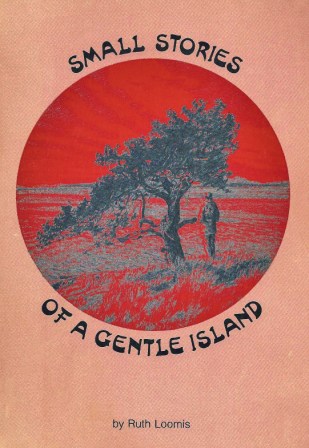
Small Stories of a Gentle Island by Ruth Loomis ~ 1986. This edition: Reflections, Ladysmith, British Columbia, 1986. Illustrated by Carol Evans. Softcover. ISBN: 0-9692570-0-7. 96 pages.

My rating: 7.5/10. I enjoy re-reading up this slight volume of memoirs every few years, and I suspect it will always remain in my permanent collection of British Columbia books. I do wish it were a bit longer; many of the stories stop short, leaving the reader yearning for more. Ruth Loomis doubtless has a fount of knowledge and stories of this area; I would be thrilled to read a longer, more in-depth volume going into more detail. A very personal memoir, this one, and one almost feels as if one were eavesdropping on a private conversation. Well done.

*****

In 1952, young and newly married Ruth Loomis moved with her husband from bustling Seattle to small Pylades Island in the Strait of Georgia, between Vancouver Island and mainland British Columbia. Here an alternative lifestyle moved from dream to reality. A home and garden were established, two babies born, and the challenges and joys of a life intimately connected with the sea and nature were embraced.

Time moved on, and twenty years later the marriage dissolved and the island was left behind. This was shortly followed by the tragic death of Ruth’s eldest daughter, and, after trying to cope with her multiple sorrows by immersing herself in the busy mainland world, Ruth decided to go back to the island alone.

She lived there until 1985, when she left for the last time. Pylades was sold, and Ruth moved to Vancouver Island. This book is a collection of reminiscences and a loving farewell to the dream and the reality.

A slender volume, only ninety-six pages, but it captures the essence of one woman’s thoughts and feelings about a very unique time and place. Having recently returned from a Vancouver Island visit, and after having leaned on the railings of the ferry crossing the Strait, yearning romantically for a chance to explore those wave-surrounded rocky isles glimpsed all too briefly in the ship’s swift passage, I sought out this book on my return. The smell of sea and cedar seem to waft from its pages, among other evocative aromas.

The Gulf Islands are famous for their free spirits and willing experimenters with various relaxants and hallucinogens, and it is apparent from this memoir that Ruth was no exception; some of the vignettes are very much tinted with a haze of unreality, though most are straightforward stories. There is a strong vein of melancholy and sorrow throughout, though it is balanced by remembrances of joy and healing.

In her Introduction, Ruth says

I survived, discovering that life has a healing balm alongside its searing forces. I needed time, time to feel my past dissolve into the present. That love of now Pylades gave, with its interplay of seasons and sea-life. The fantasy that I controlled my life vanished. I became interested in the essence of creation, slowly realizing I was not separate but part of it. Others occasionally came to this gentle island who needed time too, whether a few hours, days or months which Pylades gave.

The stories follow a chronological path, from 1957 to 1986, allowing brief and vivid glimpses of moments now lost in time. Along with the poignancy and the regrets there is plenty of humour and thoughtful musing. This is a slender little volume, an hour or two’s reading, but the stories stay in one’s head long after the book is put back on the shelf.

The Visitor ~ 1957

Butter Money ~ 1959

Today, Tomorrow and the Brother ~ 1961

Fog ~ 1968

Five Days of Nina ~ 1970

Appointment with God ~ 1974

Squatters ~ 1975

Susanne ~ 1978

Mushrooms and the Renaissance Man ~ 1979

Play with the Dolphin ~ 1980

Eagles ~ 1984

The Last Season ~ 1985

B.C. readers, keep an eye out for this one in secondhand book stores. If you find it, open it up and spend a few minutes in Ruth’s lost world, and perhaps give it a home on your own shelves among other records of our past.

A postscript. We were curious about the eventual fate of Pylades Island, and did a bit of internet research. Pylades was on the market again  in 2009, and a lot comprising half of the island, with Ruth’s derelict old home on it, had just sold for something like $2,400,000. I hope Ruth profited to a like degree upon her departure. Here are several picture taken at the time of that sale. Dream away!

Read Full Post »

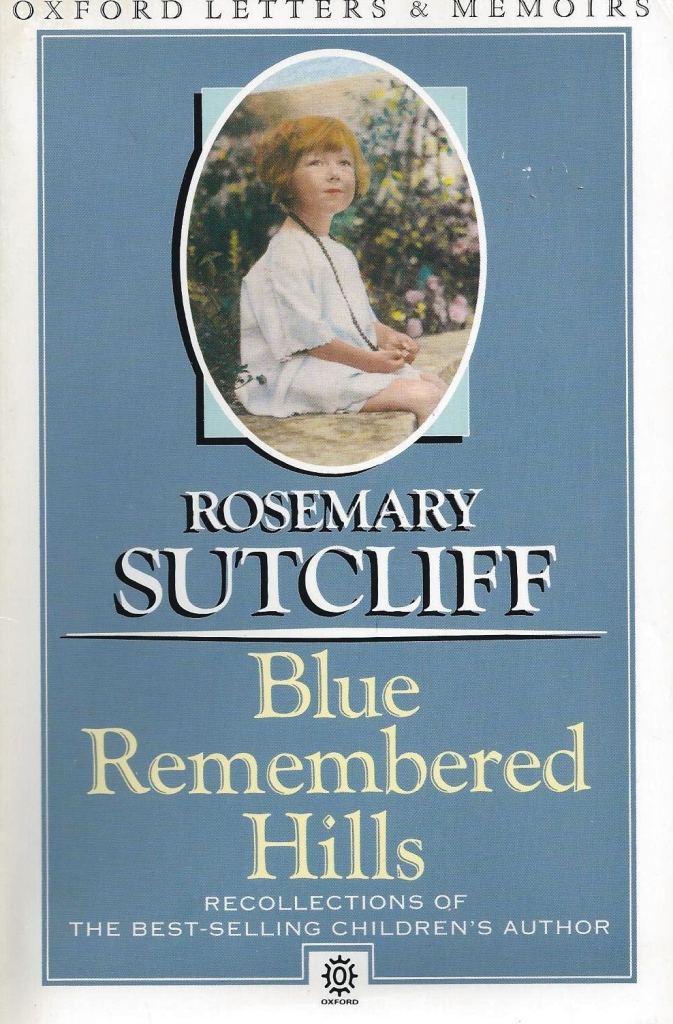
Blue Remembered Hills by Rosemary Sutcliff ~ 1983. This edition: Oxford University Press, 1988. Softcover. ISBN: 0-19-281420-6. 141 pages.

My rating: 10/10. Perfect. My only complaint is that it is too short. A stellar memoir by one of my favourite writers.

*****

Rosemary Sutcliff, 1920-1992, is still very much an icon of the historical fiction world. Author of something like fifty meticulously researched stories, many focussed on Roman-occupation-era Britain, Sutcliff created works which have lasting appeal and interest across a wide age range.

The Eagle of the Ninth (1954), The Silver Branch (1957), and The Lantern Bearers (1959) are possibly the best-known of her works, and have been continuously in print since their original publication.

Rosemary Sutcliff herself was a personality fully as fascinating as any of her fictional heroes and heroines. Her life was marked with great physical suffering, which she dealt with by immersing herself in her creative work. When she was only two years old, Rosemary developed Still’s Disease, a rare and extremely painful form of juvenile arthritis. After the disease subsided, the permanent damage to her joints severely curtailed Rosemary’s physical abilities. She spent most of her adult years dependent upon a wheelchair, and wrote using a modified pen to enable her hands to grasp it.

Her enforced inactivity made Rosemary a keen observer of the world around her, and a great seeker of solace in literature. To while away the long, bed-ridden hours, Rosemary’s mother actively read aloud to her, and Rosemary so enjoyed these dramatic performances that she resisted learning to read herself until she was nine years old. Rosemary’s first written works were retold versions of stories dramatically told to her by her mother.

Blue Remembered Hills is a remembrance of Rosemary’s earliest years, from her first memories until the publication of her first books, The Queen Elizabeth Story, and Robin Hood, in 1950, at which time she started keeping a written journal. These journals have never been published, though they are in the hands of Rosemary’s literary executor, her cousin and godson, Anthony Lawton. He curates a blog and has posted some of the entries from her diary here .

The memoir is wonderfully well written, and contains myriad details of Rosemary’s early life, with a frank sharing of her thoughts and feelings regarding her own situation and the people around her. Discussing her extended family, this passage rather made me chuckle, and is a good example of the subtle humour of Rosemary’s prose.

Aunt Edith was a handsome woman with straight thick brows which remained raven black even after her hair had turned swan’s-wing white, and the bitterest mouth that I have ever seen on anybody. She, alas for them both, had married Archie, weak-willed and amiable, who did not tell her beforehand that he was a quarter Indian – his mother being the product of an Indian Army colonel and a rajah’s daughter – what would have happened if he had told Aunt Edith before it was too late, there’s no knowing. Maybe she would still have married him, but I very much doubt it. As it was, finding out afterwards, she refused to have children – I very much doubt if she even allowed him into her bed! – and set out to make his life a cold hell to his dying day. I have been there at some family gathering myself, puzzled as a dog may be by stresses in the air, the electric discharge of things I did not understand, when he came into the room, and Aunt Edith sniffed loudly and said, ‘There’s a most peculiar smell in this room. One would almost think that somebody black had come into it.’

For many years, the family were quite seriously prepared for Uncle Archie to murder her one day, and prepared, if he did, to go into the witness-box on his behalf and swear that he did it under unendurable provocation.

Rosemary also refers to in the most poignant detail her doomed love affair with Rupert King; the true tragedy of their relationship not in Rosemary’s physical condition, but in Rupert’s polygamous nature. Already married to a much older woman, Rupert persisted in the love affair with Rosemary, and, upon achieving his divorce, immediately married a third woman, suggesting to Rosemary that they carry on some kind of platonic three-way relationship so he would not lose the pleasure of her company. Rosemary actually considered this, and went to London to meet Rupert’s new fiancée, but soon realized that this was not a feasible option for any of them, and the two permanently parted ways, with Rosemary thereafter directing her passion into her work. Though the affair brought her much emotional trauma, Rosemary insisted that she was glad that she had had the experience of being deeply in love, and being beloved in her turn, because it gave her a broader depth of experience and brought forward feelings which she had thought never to experience because of her disability. A gallant lady.

I do so wish that Rosemary Sutcliff had continued this memoir to discuss her later years; this is a teasingly slender though richly filled book. Very highly recommended.

*Edited November 18, 2012 to add a link to a wonderful review I’ve just happened upon, by Steve Donoghue at Steve Reads.

Read Full Post »

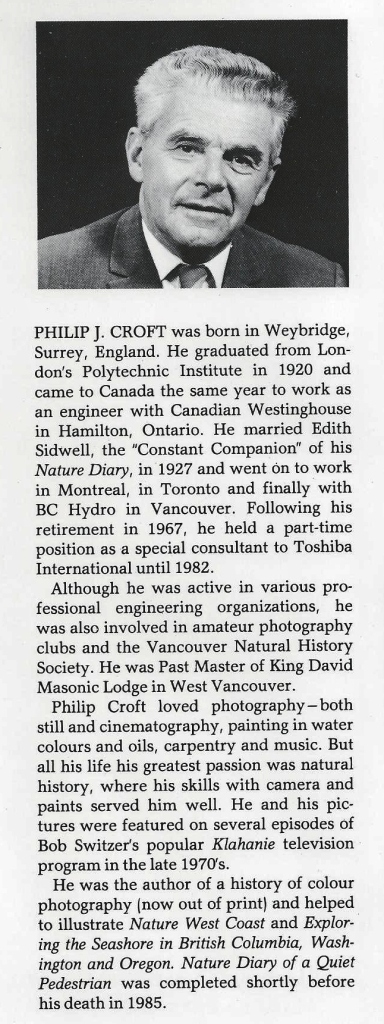
Nature Diary of a Quiet Pedestrian by Philip Croft ~ 1986. This edition: Harbour Publishing, 1986. Hardcover, illustrated by the author. ISBN: 0-920080-87-1. 141 pages.

My rating: 8/10. Occasionally a tiny bit stilted as the author tries hard to keep up his literary momentum, but for the most part the prose flows along just fine. An appealing glimpse into one man’s life, and into the natural history of his personal world.

*****

I spent some days in the Vancouver area earlier this week, and though my free time was limited I did manage to visit several used book stores – used bookstores? used-book stores? – for some reason this does not look right this morning! I am still a bit groggy from sleep, and this is very much a stolen hour at the start of what promises to be a very busy day… Anyway, on the holiday Monday (B.C. Day) evening, when most of the interesting small shops were closed up tight, I nipped into the Langley Value Village to browse their large book section, and, casting about for that elusive 5th book – the “freebie” – this one just sort of slid off the shelf at me in a shyly appealing “Hey, look at me” sort of way. From the title I was thinking – “Hmmm, probably British, another one of those made-for-tourists, Edwardian Lady take-offs, get ready to put it back…” so imagine my delight in finding that it was instead a very appropriate British Columbia book, written about the very region I was visiting.

Amateur naturalist Philip Croft kept a diary of his regular daily walks through his West Vancouver neighbourhood, through a section of forest and down to the beach. Blessed with a keenly observational eye, an artistic hand for illustration, and a gentle sense of humour, Mr. Croft’s year as recorded in this handsome book is very readable indeed. I have visited the coastal areas of B.C. enough to be generally familiar with the setting, but I have often been curious as to some of the interesting plants, insects and seashore creatures unfamiliar to me as a native of the very different, dryland fir zone interior of the province. I found myself browsing through the book in my next few evenings in my hotel room, during breaks from my delighted absorption in The Benefactress by Elizabeth von Arnim.

From the Preface:

I am an inveterate pedestrian. I walk daily for pleasure, exercise and control of the waistline. But mostly for pleasure… I like to walk alone: I prefer to be a quiet pedestrian, to walk and think, not walk and converse. In this respect my hour afoot is apt to be the most useful and productive hour of my day, for it is a time in which I am able, to a measured footfall, to think many things through uninterruptedly, to a logical or practical conclusion… It is my time for meditation and reflection…

…It is not necessary to travel to the out of the way wilderness areas of our province to be confronted by the year-long pageant of natural events in the life cycles of common plants, insects, birds and animals. It is surprising how many species inhabit roadside ditches, patches of woodland, vacant lots, railway embankments and cuttings and similar waste places throughout our area. By following the same limited selection of routes day after day, week in and week out throughout the year, one is enabled to note every phase in the development of wild plants as they spring, grow, flower, seed and make their appearance; when the birds that feed on the insects appear and when they congregate for their annual migrations… a never-ending source of wonder and pleasure…

Something that never ceases to please me is the abundance of natural life surviving and thriving in pockets of our crowded cities; as a dedicated country-dweller who enjoys occasional immersion in city life, I always give silent homage to the urban dandelions growing through cracks in the sidewalk, the fireweed colonizing the sagging roofs and windowsills of derelict buildings, the small birds opportunistically gleaning the road-killed insects from the grills of parkaded cars. And though I view the rural areas as my natural habitat, I have also lived in towns and cities; long enough to appreciate what Mr. Croft is speaking about; that nature surrounds us and goes about its inevitable business quietly and inexorably; if we pause for a moment now and then we can get much joy and encouragement from the steady adaptation of all sorts of organisms in our concrete-filled urban worlds.

This quick trip I noticed the ripening masses of blackberries, the last few foxglove flowers on their impossibly long, seedpod-lined stems, and the forests of Himalayan impatiens and buddleia along the roadsides. Parked in a busy industrial area, waiting for my daughter to emerge from a cavernous, ex-warehouse dance studio, I noticed several small brown rabbits lolloping among the blackberry vines at the edge of the parking lot. A large transport truck pulled up; the driver emerged holding a small plastic container and, without hesitating a moment, went bravely into the thorny thicket and started to pluck the berries; one in the mouth, one in the tub… I chuckled to myself and mentally went through my own belongings; sadly I had no suitable container or I might have joined him!

What joy to then read about Philip Croft’s August ode to walking in blackberry time, taking along a container to fill on the return trip to be subsequently made into a delectable pie, and his investigations of bumblebees pollinating the ubiquitous impatiens! The writer documents his observations, and enriches the narrative with philosophical mullings over of the state of the world and of human endeavour.

This book will join my collection of B.C. natural history titles which we delve into beforehand and take with us on trips and refer to later to answer queries triggered by things we see in our travels. A most enjoyable read. Mr. Croft must have been a delightful person to know; I am glad I stumbled across his natural history memoir.

Read Full Post »

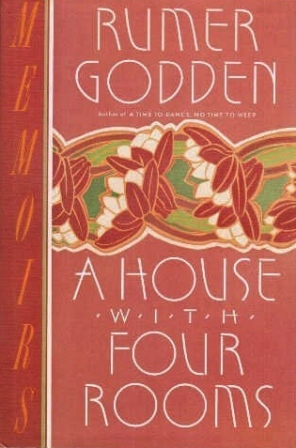
A House with Four Rooms by Rumer Godden ~ 1989. This edition: William Morrow, 1989. Hardcover. ISBN: 0-688-08629-2. 319 pages.

My rating: 7/10

A must-read for any Rumer Godden fan, though in my opinion not nearly as gripping as her first memoir, A Time to Dance, No Time to Weep.

Four Rooms starts with Godden’s permanent return to England, and follows her through her ongoing struggles as a divorced mother of two young children, working to support them with her pen.

Lots of name-dropping ensues as Rumer Godden’s books increasingly grow in popularity and she starts to move in exalted literary and film-making circles; while not terribly offensive this occasionally feels a bit gratuitous. But it was the reality of her life; she did truly gain the high stature her celebrity friends and compatriots suggest, and those circles became her natural habitat, so to pretend she was still a simple soul in a country cottage would be misleading.

She describes the long courtship by her second husband, and her emotional difficulties committing to a second marital experience after the abysmal disaster of her first tragic marriage. The second union had its ups and downs but Godden’s description of James’ final years and death is poignantly sorrowful, if rather briefly referred to. I certainly felt that her love and grief were sincere.

Fascinating glimpses into the backgrounds of many of the novels from The River onwards, plus details of Godden’s growing stature as a children’s writer and advocate for literacy which was a major interest in her later years. She also refers to her conversion to the Roman Catholic faith, and her sincere admiration for the Anglican and Catholic nuns, brothers and priests she met throughout her life, and those she came to know intimately during her research into her masterwork, In This House of Brede.

All in all an enlightening and extremely readable memoir by a gifted and memorable writer. And I do believe she was often her own harshest critic, seeing her work with true clarity, though she occasionally bridled at negative comments from reviewers on the “slightness” of some of her books.

Rumer Godden’s life spanned nearly the whole 20th Century. Born in 1907, she died at the age of 90 in 1998, actively writing almost until the very end. Her last novel, Cromartie vs. the God Shiva, was published in 1997, less than a year before her death. A fascinating and gallant woman, who weathered many personal storms, some of her own creation.

Rumer Godden’s much-quoted words sum up her philosophy in the mature years of her long and creative life:

There is an Indian proverb or axiom that says that everyone is a house with four rooms, a physical, a mental, an emotional, and a spiritual. Most of us tend to live in one room most of the time but, unless we go into every room every day, even if only to keep it aired, we are not a complete person.

Read Full Post »

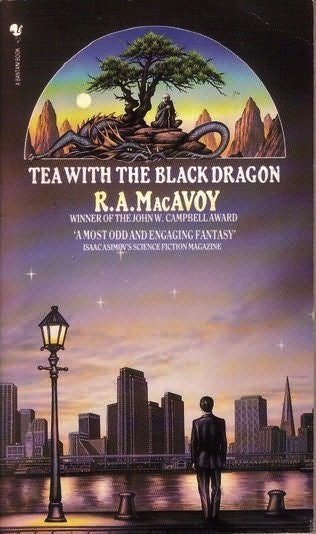
Tea with the Black Dragon by R.A. MacAvoy ~1983. This edition: Bantam, 1987. Paperback. ISBN: 0-553-23205-3. 166 pages.

My rating: 7.5/10

My first introduction to contemporary fantasy writer Roberta Ann (R.A.) MacAvoy was through her alternative world fantasy, Lens of the World (1990). That novel was so satisfactory that I went on to seek out the other two books in the Nazhuret trilogy, King of the Dead (1991) and The Belly of the Wolf (1993).

Now actively chasing down MacAvoy’s work, I was more than pleased with her lone science fiction attempt, the imaginative The Third Eagle (1989), and her epic alternative-Renaissance fantasy trilogy published in 1983-84: Damiano, Damiano’s Lute, and Raphael. Then followed the Celtic-themed  The Grey Horse (1987), and The Book of Kells (1985).

Eventually, going back to the beginning at the end, as it were,  I finally read MacAvoy’s 1983 debut novel (and likely her best-known work), Tea with the Black Dragon, and its 1986 companion, Twisting the Rope.

Then, after that creative 1983-1993 decade, nothing, except for a brief 2005 novella, The Go-Between (re-published in slightly different form in 2009 as In Between), both of which I have sporadically searched for but so far have been unable to obtain.

Doing another routine online search this past month hoping to perhaps come across a printed copy of either of those titles, MacAvoy’s name lit up the page. She’s back in the game, with a brand-new full-length novel: Death and Resurrection, December 2011, in softcover or ebook from fantasy, science fiction and “cross-genre” publisher, Prime Books. Death and Resurrection apparently includes The Go-Between as its first episode, so I can now neatly round off my to-date R.A. MacAvoy collection.

Bibliographical introduction over, I will now focus (briefly! – I need to learn to condense these rambling reviews somewhat – I do tend to run on) on Tea with the Black Dragon, which I have just re-read for the somethingth time with the usual quiet enjoyment. It is not my favourite MacAvoy work by a long shot – that position is jointly filled by Lens of the World and The Third Eagle, which I cannot choose between – I love them both equally for very different reasons – but a few hours spent with Oolong and Martha is never a bad thing.

The internet abounds with longer reviews so anything I say will have already been said, and often much more cleverly, elsewhere. Here is my take.

Middle-aged Martha Macnamara, classical violinist turned Celtic fiddler, has been sent for by her grown daughter, Elizabeth (Liz), with an urgent request for them to meet and talk.

Landing in San Francisco after her flight “racing the sun” from New York, Martha is mystified to find that though her own room in a luxurious hotel is booked and paid for, her daughter has apparently vanished. Not sure how to proceed, and not knowing anything of the pressing concern which Liz wanted to share, Martha falls into an acquaintanceship with a mysterious silk-suited, Eurasian-appearing older gentleman staying at the same hotel, one Mayland Long.

An immediate positive chemistry results, and the two are off on a quest to find Liz which results in a delving into the fledgling 1980s’ computer subculture of Southern California, and encounters with several unlikely gun-toting villains.

More of a suspense thriller than a classic fantasy, the world of Black Dragon is instantly recognizable, if somewhat dated by its 1980s’ references. The fantasy element comes into play as we find out that the mysterious Mr. Long is (perhaps?) the human form of an ancient Chinese Imperial Dragon, with unexpected but rather useful abilities.

An unlikely but perfectly satisfying love story is at the heart of this novel, and that is what we are left with, long after the rather forgettable computer-fraud plot and gunshots and car chases are forgotten. Intriguing Zen references (Martha is a zazen practitioner; Mayland has a long history of association with Buddhist Zen masters) added to the quirky tone (in the very best sense) of the story.

Very much a first novel, with the expected flaws, but there is a certain something about this story that keeps it close to the front of the book stacks. In interview, MacAvoy has said that plot does not interest her as much as characterization and conversation. One can definitely see that in all of her books, what gaps there are tend to be plot-related, nowhere quite as evident, though, as in Black Dragon; the plot is decidedly contrived, and it is interesting to see how this author has dealt with her predilection to concentrate on character in her subsequent novels.

This novel seems to have a very strong fan base on internet book review sites; a bit puzzling as there is not much there; it’s a slender piece of  what might be classified as “urban fantasy” mixed with old-style “thriller”. But it shows this author’s strong promise and unique literary voice, more than fulfilled in her later works. A very thoughtful writer, with a strong sense of humour, though she unflinchingly puts her later characters into positions of deep despair and is not afraid to realistically portray tragedy.

For those of you interested in “official” opinions, Tea with the Black Dragon was nominated for the Phillip K. Dick, Nebula, and World Fantasy awards. MacAvoy won the John W. Campbell Award for Best New Science Fiction/Fantasy writer in 1984.

Recommended, with the reservation that this is not MacAvoy’s strongest work despite the (sometimes) gushing fan base.

Read Full Post »

Playing Beatie Bow by Ruth Park ~ 1980. This edition: Puffin (Penguin Australia), 1998. Softcover. 196 pages.

My rating: 8/10

This well-written coming-of-age, historical fiction juvenile novel by New Zealand-born Australian writer Ruth Park is deserving of all the awards and rave reviews it has garnered through the years.

14-year-old Abigail – Abbie – Kirk is still deeply wounded by the separation of her parents four years earlier. In her anger at her beloved father for his desertion, she has changed her name from his chosen Lynette to “an old name, a witch’s name” – Abigail.

Anger seethes within Abbie, though she is learning to hide it. She is

…a girl who wished to be private.

Outside, she was composed, independent, not very much liked. The girls at school said she was a weirdie, and there was no doubt she was an outsider. She looked like a stick in jeans and a tank top; so she would not wear them. If everyone else was wearing her hair over her face, Abigail scraped hers back. She didn’t have a boyfriend, and when asked why she either looked enigmatic as though she knew twenty times more about boys than anyone else, or said she’s never met one who was half-way as interesting as her maths textbook. The girls said she was unreal, and she shrugged coolly. The unreal thing was that she didn’t care in the least what they thought of her. She felt a hundred years older and wiser than this love-mad rabble in her class.

Her chief concern was that no one, not even her mother, should know what she was like inside. Because maybe to adults the turmoil of uncertainties, extravagant glooms, and sudden blisses, might present some sort of pattern or map, so they could say, ‘Ah, so that’s the real Abigail, is it?’

The thought of such trespass made her stomach turn over. So she cultivated an expressionless face, a long piercing glance under her eyelashes that Grandmother called slippery. She carefully laid false trails until she herself sometimes could not find the way into her secret heart. Yet the older she grew the more she longed for someone to laugh at the false trails with, to share the secrets.

What secrets? She didn’t yet know what they were herself.

So Abbie gets on with her everyday life, going to school, helping her mother in her vintage clothing and memorabilia shop, ‘Magpies’, and occasionally babysitting her neighbour’s younger children.

It is while accompanying one of those children to the playground that Abbie first notices a solitary, crop-haired, strangely dressed child lingering in the shadow of a wall, wistfully watching the others at play. Abbie approaches her, but she cries out and runs away. Abbie is intrigued. Who is the child, and why do none of the others, except for her small charge Natalie, seem to see her?

The next time Abbie sees the girl, she again approaches her, but this time as the child flees Abbie follows close behind. Through a the twisting maze of  The Rocks, Sydney’s historical district, they go, until Abbie realizes that she is completely lost – the atmosphere has somehow changed – evening is coming on – and streets are now lit with gas lights, and down a side-street comes a horse-drawn cab. Terrified now, Abbie continues her flight, following glimpses of the only familiar thing she still recognizes, the fluttering fringes of the mysterious child’s shawl.

Of course, by this time, we have realized that somehow Abbie has crossed through a mysterious portal into a previous time and place, the squalid slums district of 1873 Sydney. Rescued and cared for by the little girl’s family, Abbie goes through a transformation of her own, until at last returning to her own time changed, chastened, older (at least in experience) and wiser.

A highly enjoyable, on the whole well-thought-out time-travel tale; the weakest points are the actual time travel sequences – but these are notoriously hard to write, being, of course, purely imaginative with no real-world references to guide the writer. There are elements of  the supernatural – quite a lot of the plot revolves around the passing on of the powers of something like a ‘second sight’ among a family – and there is a certain amount of realistic romance. The ending is possibly a bit too pat, but in general is well-balanced and satisfying, as it ties up all loose ends but leaves the future optimistically open.

I would recommend this for older children, perhaps 12 and up, to adult. The quality of the writing is very high; the story itself is interesting and creatively presented. An intriguing glimpse into contemporary and historical urban Australia (set, as mentioned earlier, in Sydney, New South Wales), as well as a highly sympathetic protagonist.

Read Full Post »

A Time to Dance, No Time to Weep by Rumer Godden ~ 1987. This edition: Beech Tree Books (William Morrow), 1987. Hardcover. ISBN: 0-688-07421-9. 243 pages.

My rating: 10/10

A must-read for anyone with an acquaintance with  Rumer Godden’s body of work, and a fascinating stand-alone autobiography that will send the reader unfamiliar with her titles on a search to find out more. The first half of her two-volume autobiography, it covers the years 1907 to 1946; Rumer’s childhood in India and her various travels up until her ultimate return to England in 1946.

There is so much packed into this book, as there was in Godden’s life, that I will not attempt to give a detailed overview, merely a blanket recommendation – very good reading.

Rumer Godden was a complex personality; her novels and stories are often drawn directly from her own life and experiences. She could not have been an easy woman to be around, being one of the “driven” writers; she fully acknowledges this in this memoir; in many ways it feels somewhat like an apology to her family and her friends.

The latter part of the book, concerning Godden’s time living at Dove House in the Kashmir hills, was the basis for the novel Kingfishers Catch Fire. The reality was even more intense than the fictional account that it inspired; Godden delves deep into her motivation for that socially astounding retreat from the “proper” Anglo-Indian community, and she comments as well on the effects of that self-imposed isolation on her two young children. Jane and Paula were at that time, I believe, seven and five years old, and it would be fascinating to hear their own childhood memories of their wandering life with their mother. I am wondering if either of them has written about their lives in their turn. Vaguely I am thinking that there is a daughter’s memories of Rumer Godden out there somewhere.

This memoir reads like a novel, only it is so much better than anything fictional Godden wrote, because it is a personal examination of experiences, thoughts and emotions based on the writer’s “truth” (always stranger and richer than fiction), and it therefore shines a radiant light on both the personal life of this extremely talented and passionate writer, as well as showing the framework of her subsequent stories. Keep in mind that this is one person’s version of events, as Godden herself comments in the dedication:

For Jane and Paula.

This book is my life as a young writer; to me and my kind life itself is a story and we have to tell it in stories – that is the way it falls. I have told the truth and nothing but the truth, yet not the whole truth, because that would be impossible.

Most highly recommended.

Read Full Post »

« Newer Posts - Older Posts »