Archive for the ‘1980s’ Category

Here are a few more catch-up reviews from February of 2013.

*****

the elegance of the hedgehog muriel barberyThe Elegance of the Hedgehog by Muriel Barbery ~ 2006
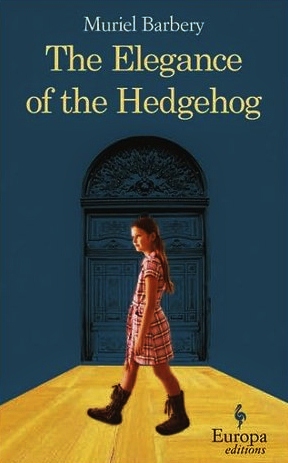
This edition: Europa, 2008. Translated from the French by Alison Anderson. Softcover. ISBN: 978-1-9833372-60-0. 325 pages.

My rating: 8/10

I was moved to read this bestseller by the recommendations of respected fellow bloggers; sadly I cannot recall exactly who those were at this point in time! But to them I must say, “Thank you.”  For this was indeed a charming story.

In an exclusive Paris apartment building there dwells, upstairs, a snobbish upper-class family: mother, father, and two daughters. The youngest of the girls, twelve-year-old Paloma, is a strangely precocious child, given to thoughts well beyond her years. In her diary, which makes up half of the book, we learn that she is seriously disillusioned with life, and plans to commit suicide on her thirteenth birthday, unless something occurs to give her faith in the value of existence.

Downstairs is the stout, plain, elderly, and very obviously unintelligent concierge, Renée. Renée stumps around brusquely carrying out the tenants’ orders; she is blatantly uninterested in improving herself, and she carries out her duties with a sullen disrespect for her “betters”. Hers is the other half of the narrative.

Needless to say, for this novel follows the tried and true formula of loners uniting against the bitter world, Paloma and Renée find each other, and a friendship forms between the two social outcasts, who are soon joined by a third, new tenant Ozu, a wealthy Japanese businessman. And it will come as no surprise to readers that Renée is hiding an interior of the purest gold behind her prickly spikes – for she is indeed the hedgehog of the title, a creature of secret refinement, “deceptively indolent, fiercely solitary—and terribly elegant”.

Predictably, tragedy does indeed strike, but from an unexpected direction.

There is also a cat.

Need I say more?

god grew tired of us john bul dauGod Grew Tired of Us by John Bul Dau & Michael Sweeney ~ 2008
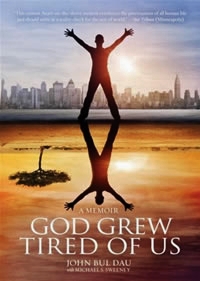
This edition: National Geographic, 2008. Hardcover. ISBN: 978-1-4262-0212-4. 304 pages.

My rating: 7.5/10

In 1987 a young Sudanese teenager was forced out of his home by a brutal raid on his village. What followed was a barefoot 1,000 mile trek through Sudan, Ethiopia, and eventually to Kenya, to a haven in a refugee camp. There John Bul Dau joined thousands of other displaced children, the “Lost Boys” of the Sudanese civil war.

Having no way of knowing the fate of his left-behind, possibly slaughtered family, John eventually immigrated to the United States, where he worked tirelessly to educate himself, all the while striving to raise awareness of the tribulations he himself went through, and to bring assistance to those still suffering from the aftermath of the war back in Sudan.

This book and its associated National Geographic film eloquently describe the situation. An earnest and strongly emotional memoir.

through the narrow gate karen armstrong 001Through the Narrow Gate: a memoir of life in and out of the convent by Karen Armstrong ~ 1981

This edition: Vintage Canada, 2005. Softcover. ISBN: 0-676-97709-X. 350 pages.

My rating: 7.5/10

Intriguing and occasionally bitter memoir of an ex-nun.

In 1962 Karen Armstrong, just seventeen, and child of a not particularly religious family, entered a Roman Catholic convent as a postulant, with the aim of becoming a nun. Seven years later, while attending Oxford under the sponsorship of her order (Armstrong was in training to become a teacher-nun) she realized that she had lost her faith, and she returned fully to the secular world.

Since then, Karen Armstrong has become well known for her writings on religion, and for her outspoken criticism of the Catholic Church’s more archaic practices, and of the confusion brought about by the mandated reforms of Vatican II.

This book, Armstrong’s first, is compelling reading. A very articulate writer.

The Guardian – Profile: Karen Armstrong is well worth reading if you are curious about this now high-profile public character; it references Through the Narrow Gate near the end of the article, with an amusing anecdote from Karen’s sister telling of how the family, after dropping Karen off at the convent for her entrance into her religious life, then went on to watch a production of The Sound of Music. That same sort of dark humour and willingness to smile at oneself is evident in places in this memoir, to leaven its more serious passages.

Sstarting out in the afternoon jill fraynetarting Out in the Afternoon by Jill Frayne ~ 2003

This edition: Vintage Canada, 2003. Softcover. ISBN: 978-0-679311-881. 256 pages.

My rating: 4/10

This is an autobiographical memoir of the author’s mid-life crisis, and of the solace she sought and found in communing with nature.

A solo road trip, hiking, biking, camping, sea kayaking and such all help to salve Jill Frayne’s inner pain at the dual blow of both the break up of her long-term romantic relationship back in Ontario, and the moving away of her young adult daughter. Once she begins to gain a degree of competence in her new pursuits, and to feel herself physically comfortable in nature, Frayne begins a deeper exploration of her own emotions.

While I’m sure that this was a marvelous thing for Jill Frayne herself, but sadly I had trouble relating to her angsty navel-gazing, and I felt more and more like I was reading a very private diary. I eventually lost patience with the “me-me-ME” of the author’s inner dialogue; it coloured my reaction to the book as a whole.

I certainly admire the author’s courage as a woman alone going off into challenging territory by herself, and I would have enjoyed this more it had spent more time on the scenery and nuts and bolts of solo travel, and less on the touchy feely bits. But that’s just me; others may embrace the personal narrative and find meaning there which resonates with their own lives.

Back story: the author had an almost fatal accident several years before she set off on her trip; she had been told she would never walk again. She proved everyone wrong. Extra kudos to her, and I do hope the writing of this very personal book brought her comfort and much-needed inner peace.
Read Full Post »

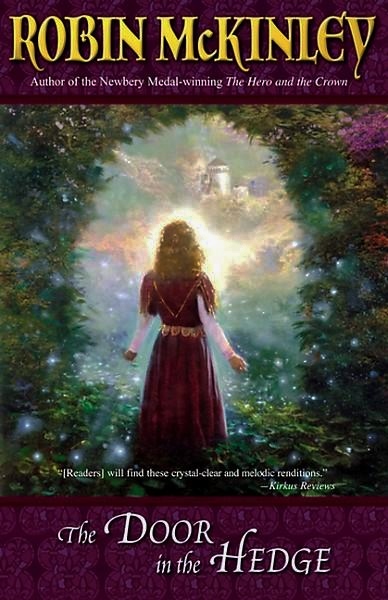
the door in the hedge robin mckinleyThe Door in the Hedge by Robin McKinley ~ 1981. This edition: Firebird (Penguin), 2003. Softcover. ISBN: 0-698-11960-6. 216 pages.

My rating: 6.5/10.

Nudged on by a comment from Jenny (of the former Jenny’s Books, now all spiffed up and better than ever at Reading the End) on my yesterday’s post about Robin McKinley’s later book of short stories, A Knot in the Grain(1994),  I temporarily sidelined (again!) the Agatha Christie (The Murder on the Links) that I was sporadically reading and settled down to a power read of The Door in the Hedge instead.

I knew I’d read this collection of four short fantasy-fairy tale retellings before, but I honestly could not drag up any strong memories regarding it, just that I had mentally filed it in the “wordy” category of McKinley’s writings. And this re-reading proved me right on that count, though I was pleasantly surprised to find that the two stories Jenny liked the most, The Princess and the Frog, and The Twelve Dancing Princesses, were really pretty darned good, and my own favourites of the collection, too.

This was Robin McKinley’s second published work, after her very well-received first novel, Beauty (1978), which was a creative retelling of the Beauty and the Beast fairy tale. The four stories in The Door in the Hedge follow that same pattern, though two of the stories are touted as original creations, versus re-imaginings.

The Stolen Princess

The last mortal kingdom before the unmeasured sweep of Faerieland begins has at best held an uneasy truce with its unpredictable neighbour…

And that uneasy truce is occasionally broken, with the abduction of the occasional child; a rare occurrence, indeed, but frequent enough to be always a nagging “maybe” in the minds of all parents. The faeries (for it must be them) are most interested in baby boys from birth till their first birthday, and in teenage girls in the first flower of blossoming womanhood, between the ages of sixteen and nineteen or so. And they always take the best: the most perfectly formed, the beautiful, the kind, the accomplished,  the wise. Who are never, ever, seen again…

So when the beloved king and queen of the mortal country produce a lovely princess, we just know that this is not going to end well. The princess is predictably spirited away on the eve of her seventeenth birthday, but this time, instead of just casting up hands and sighing forlornly, as this fantastical country’s parents are wont to do in these circumstances, the royal couple set off in pursuit, seeking to find the elusive boundary between the two realms, which, of course, proves to be the titular “door in the hedge”.

A not particularly original “original” tale; seriously overwritten in places, and with an overwhelmingly sweet ending, with every conceivable loose end neatly tied up.

The writing has moments of originality and great readability; the characters are quite genuinely likeable as well as being too beautiful, kind, gifted, nice, etc. for words, but the whole package oversteps my personal tolerance for tis kind of thing. On a scale of 1 to 10, I fear this one gets only an unenthusiastic 4 from me.

The Princess and the Frog

The princess in this case loses a terrible gift from a sinister suitor; a necklace of cloudy grey stones which emanates an awful power. She is afraid to admit she has dropped it in the garden pool; who knows what consequences her carelessness will bring?

She knelt at the edge of the pool and looked in; but while the water seemed clear, and the sunlight penetrated a long way, still she could not see the bottom, but only a misty greyness that drowned at last to utter black…

What a grand contrast this piece is to the first. This is a retelling of the well-known tale in which the young princess loses her golden ball, and then reluctantly adopts the helpful frog as a companion. In this version the princess is older, and she loses something much more crucial; the frog is welcomed with gratitude after his assistance, and the complexities of the scenario are rather more interesting than the usual morality tale about always keeping promises which the original is too often preachily presented as.

The helpful frog has a sense of humour; the princess is the antithesis of the spoiled little rich girl she is usually portrayed as; the suitor is gorgeously wicked; the denouement is absolutely predictable but yet with an element of surprise in the instinctive cleverness of the princess.

Well done, Robin McKinley. I hereby award this story a very respectable 9/10.

The Hunting of the Hind

This is the second “original” tale in the collection; “original” is in quotation marks because it contains strong traditional elements, though Robin McKinley has put together a story that goes in its own direction.

Here we have a beloved prince who becomes infatuated with a quest to follow and confront a beautiful golden deer which appears suddenly to hunting parties. The catch here is that every time someone rides off in pursuit, he comes home disappointed and forever marked by his pursuit; an deep depression descends upon him and he is never the same. Several men have nor returned; the worst is assumed.

The prince follows the deer, comes home raving, and slides into a feared-to-be-fatal decline. His younger half-sister, the kingdom’s neglected princess, then goes off on her own quest to solve the mystery, and to save her brother’s life.

I don’t think it will be a spoiler to mention that of course she succeeds.

This was the weakest tale of the four, to my mind. The characters never came to life; their actions are clumsily presented and then glossed over, and much is asked of the reader in order to accept the progress of the narrative; it never really worked for me. Too many “glowing eyes” and “tall stallions” and (not really explained) “malicious spells” and a weird (and also unexplained) laying on of hands “empty your mind” thing going on at the dramatic climax. The magical happy ending inspired not a contented smile, but a desire to violently chuck the book into the nearest waste receptacle.

This one gets a 3.5/10. It had a certain early promise in the storyline, but it went way past my personal tolerance level for unexplained fantasy magic. And it was, as my daughter would say, way too mooshy at the end.

The Twelve Dancing Princesses

What a relief to turn to the last story, a retelling of the old fairy tale of the same name. In this one, Robin McKinley redeems herself after the overblown slosh of the Golden Hind thing, by presenting an extremely likeable, slightly cynical, tired old soldier as her hero. I loved this guy; he did everything right, for all the right reasons.

We never get to really know the princesses in question, aside from little glances now and again, but the story is so nicely presented that it doesn’t really matter. There is also a cloak of invisibility which has almost as much character as the hero it hides. Here’s the bit where the soldier and the cloak come together, after a predictable good deed to a typically important (in fairy tale world) innocuous-seeming old crone.

“Wait a moment,” said the old woman; and he waited, gladly. She walked – swiftly, for a woman so old and weak that she had trouble drawing up her bucket from the well – the few steps to her cottage, and disappeared within. She was gone long enough that the soldier began to feel foolish for his sudden hope that she was a wise woman after all and would assist him. “Probably she is gone to find my some keepsake trinket, a clay dog, a luck charm made from birds’ feathers that she has not seen in years and has forgotten where it lies,” he said to himself. “But perhaps she will give me bread and cheese for what she has eaten of mine; for cities, I believe, are not often friendly to a poor wanderer.”

But it was none of these things she held in her hands when she returned to him. It was, instead, a cape…”(W)oven of the shadows that hide the hare from the fox, the mouse from the hawk, and the lovers from those who would forbid their love…”

Along with the cloak the crone proffers some useful advice; the soldier files it away in his shrewd mind, and it serves him in good stead once he is locked in the bedchamber with the his king’s twelve daughters, and as he follows them to their sinister dancing floor…

Nicely done. This one rates an approving 8.5/10.

*****

Judging this collection against A Knot in the Grain, I have to admit that I personally liked the later collection better. It was a bit more astringent, and way more “clean” – in an editorial way – tighter and better edited; the writing overall was more assured, and the writer’s unique voice much more developed. And, much as I often find Robin McKinley’s writing a little too over-the-top and descriptively overwritten, I do find it interesting and admirable that she has continued to develop her style as the years go on, and to experiment with new ideas, some of which (ahem – Sunshineabsolutely loved that one, the anti-Twilight vampire novel) work out very well indeed.

Read Full Post »

my discovery of america farley mowatMy Discovery of America by Farley Mowat ~ 1985. This edition: McClelland and Stewart, 1985. Hardcover. ISBN: 0-7710-6624-4. 125 pages.

My rating: 6/10.

High marks for tackling this topic with such eloquent vigour, tweaked downward for the increasingly bombastic posturings of the author, which led me to a sneaking small sympathy for his unwary opponents. As I read I could envision the froth forming at the Mowat’s mouth, perhaps dribbling down his legendary beard, too, as he raved on and on and on. (The conciliatory last chapter, where he thanks his many supporters in the U.S.A., did seem a bit calmer, and appropriately sincere.)

Oh – adding another point back on for that first chapter, in which Mowat describes his airport encounter with the Forces of American Evil, a.k.a. the INS: Immigration and Naturalization Services of the United States of America. It was a truly funny piece of writing, and for this I will forgive the annoyance Mowat so often inspires in me by his ego-driven blusterings, which, in this instance, had plenty of justification.

Okay, here’s the story. On April 23, 1985, as Mowat was setting out on a trip to the West Coast of the U.S.A. on a joint lecture/promotion tour for his just-released Sea of Slaughter (a passionate indictment of the human-caused ecological devastation of the Atlantic shores of North America), he was escorted off the plane as it sat on the tarmac, and notified that he was persona non grata in the U.S.A. Forever and for always. And no, we can’t tell you why, sir. Just go away now, sir.

Mowat storms out of the airport terminal and into the arms of his publisher, where he is met with a shared indignation exceeding even his own. “This is war!” (or words to that effect) cries Jack McClelland, and a press deluge begins, spurred on by the very recent “Irish Eyes are Smiling” Reagan-Mulroney love-fest, and assurances by both leaders that the U.S.A. and Canada are dear, dear friends.

Why does the mighty United States feel that wolf-, whale- and generally nature-loving Mr. Mowat is a security threat? And why do the words “Commie sympathiser” keep coming up, though no one will let Mowat or anyone else take a look at his secret file, the one that led to its abrupt barring from the neighbouring country?

It seems that there is a McCarthy-era law on the books, the McCarran–Walter Act, which allows such arbitrary barring on the most microscopic past “offenses”, such as visiting the USSR (which Mowat had done some  fifteen years earlier, to research his book Sibir), and – oh! that little incident in which Mr. Mowat reported a desire to shoot his .22 rifle at U.S. Air Force planes carrying (possibly) atomic warheads across Newfoundland air space…

125 pages later, not much has changed, except that Mowat is offered a “parole” to allow him a one-time entry into the U.S.A., which he scornfully turns down, “parole” implying some sort of wrong-doing.

In this post-9/11time of ever more stringent border examinations, and many more arbitrary black-listings for undisclosed reasons – “security risk” being the handy catch-all phrase – Mowat’s prior experience sounds sadly like something we’ve all heard before.

Mowat’s horrified indignation echoes so many others; his response was the one every wronged citizen dreams of pulling off. Lucky for Mr. Mowat that his celebrity and many connections allowed him to speak out so vibrantly without losing his livelihood or credibility, a real problem for so many others in the same position, as Mowat points out, and which is one of the reasons he puts forward for his strident rebuttal to his black-list barring.

An interesting read, and with chilling parallels to the situation today between the countries on both sides of the world’s longest – but for how much longer? – undefended border. The razor wire, both literal and figurative, is persistently going up.

Here, FYI, is a very partial list, courtesy Wikipedia and therefore including the related links, of some of the public figures joining Farley Mowat on the McCarran-Walter exclusion list, before its amendment (but not its dismantlement) in 1990:

Read Full Post »

hazel rye vera bill cleaver 001Hazel Rye by Vera and Bill Cleaver ~ 1983. This edition: Harper Trophy, 1985. Softcover. ISBN: 0-06-440156-1. 178 pages.

My rating: 5/10.

A short novel published for the older elementary school ages – it says so right there on the back cover – ages 10 to 12 – and please don’t get me started on such narrowly prescriptive recommendations! Useful as these are to teachers and librarians when “targeting” the books they select for their students, I often wonder how many readers miss out on reading truly diverting and worthwhile stories because they are past the “age limit” so prominently displayed.

Not that I am suggesting that this particular novel is a masterpiece. Far from it. Hazel Rye is a slight novel, one of those “relationship”-slash-“issues”-slash-“problem” tales so common in elementary school libraries. The idea, it seems, is to make sure that any particular problem a child might be facing in his or her life can be eased by referring said child to a book featuring a similar situation. Want to be a football star but didn’t make the team? Here, read this. Being bullied at school because you’re fat/thin/gay/gawky/smart/slow? Super popular but still unhappy because your friends are all so shallow? Adopted and having issues with it? Foster kid? Mom and Dad divorcing?  Pregnant? Big brother dying of AIDS? Best friend dying of cancer? Mother dying of cancer? YOU’RE dying of cancer? You name it, there’s a story that addresses it, usually with a Big Helpful Conclusion of some sort to help the reader cope with the issue by learning that even though bad stuff happens, he/she is not alone.

All of the above being great topics to drive a novel, but so terribly often the storytelling gets lost in the shuffle, what with The Issue taking precedence. The characters exist merely to mouth the words; they’re frequently merely the framework The Issue gets draped over;  we never get to know them, let alone form any sort of personal relationship with them.

What I’m aiming at with my opinionated dismissal of so much well-meaning but misses-its-mark-as-good-fiction juvenile literature is to say that though this particular book fits into the category of an “issues” book, it’s just a little bit different, and it works well as a purely enjoyable read. It also seems aimed at perhaps a more mature audience than that stated on the cover, or maybe I should say “likely to be appreciated by”, rather than aimed at. For Hazel Rye – the book as well as the character – is a bit out of the ordinary.

The titular protagonist is an eleven-year-old girl living in a small community surrounded by orange groves in central Florida. Hazel’s Big Obvious Issue is that she’s slow in school; we find out on the first page that she’s just flunked sixth grade, and though she pretends not to mind all of the evidence points to a sorely bruised psyche.

Hazel’s eighteen-year-old brother Donnie has just been married; he lives nearby and is doing just fine taxi-driving; Hazel holds his financial success in high regard and likes to think that she too could do as well in a few years, once this bothersome school time is over; Donnie dropped out at sixteen and no one seems too concerned about it. Her mother is a fragile hypochondriac, too involved in her woes to take much interest in housekeeping, let alone mothering her daughter. As the story starts, Ona Rye is about to leave for a prolonged visit to her family in Tennessee.  The parental mantle in the household rests firmly on the shoulders of Hazel’s father, Millard, a hard-working and successful carpentry contractor. He and Hazel are not just father-and-daughter but also very close friends – “buddies” – with occasional bouts of flash-in-the-pan violent squabbles to keep things interesting between them. It was after one of these arguments that Millard transferred ownership of his small, neglected orange grove to Hazel, to woo back her attention and affection by an important gift.

Hazel rather likes the idea of being a property owner, though she’s not much interested in the farming aspect of things – too much work, and Hazel is all about taking things as easy as possible – and when an itinerant, fatherless family shows up asking to rent the rundown shack in Hazel’s grove, she enters into an agreement with the Poole family to let them live in her grove in return for young Felder Poole’s assistance in bringing the damaged trees back into production.

Felder Poole is close in age to Hazel, but aside from this similarity he is everything that she is not. Extremely bright, fond of all sorts of learning, he is an accomplished autodidact with a talent and propensity for making things grow. Hazel is at first suspicious and then enthralled with Felder’s plans for the grove; she becomes fascinated with the whole Poole ménage, much to her father’s dismay.

For Millard Rye’s Great Big Issue – which is really part and parcel of Hazel’s Great Big Issue, too – is that he is so emotionally attached to his daughter that he can’t bear to share her with anyone else. As Hazel’s horizons widen with the entry of Felder and the rest of the Pooles into her life, she is continually confronted with her father’s veiled but genuinely deep jealousy, and rather than being flattered by his attachment to her as she has been in the past, is beginning to see that this is an emotionally unhealthy situation for the both of them.

Let me hasten to say that Millard’s interest in Hazel is purely filial; there is no shadow of anything improper in his attachment to her; Millard is also deeply attached to his “nervous” wife Ona, and yearns for her happiness, indulging her in every way possible, hence his willingness to send her off to her parents to regain her fragile equilibrium while Millard and Hazel keep the home fires burning. She’s definitely coming back; whatever the Ryes’ other issues, a permanently split and unhappy family life does not appear to be among them.

As Hazel becomes more and more interested in the orange grove, and in the inner workings of the happy, loving, poor-but-ambitious Poole family, she is moved to change her own life in various ways. The sudden and unexpected resolution of the story rather surprised me, as did Hazel’s reaction to it; a welcome situation for this old cynic where this particular juvenile genre is concerned. Actually, I shouldn’t say “resolution”, as there really isn’t one; Hazel is left poised for her next step as the curtain closes on this brief period in her life.

The language in the book, coming from a third person perspective, is unusual and unique, using what I can only assume is a local Florida dialect and its very distinctive phraseology. Husband-and-wife writing team Vera and Bill Cleaver already had a respectable number of well-reviewed juvenile novels to their credit when they came up with Hazel Rye, and regional emphasis and use of dialect was one of their specialities. (You may find the authors’ names familiar if you were in grade school in the 1970s, as their award-winning Appalachian novel, Where the Lilies Bloom, was ubiquitous in libraries and frequently used for novel study classes. I read it way back then, and remember it vaguely but with admiration; I will be seeking it out for an adult re-read.)

Hazel Rye pleased me. Though it belongs in a genre I frequently hold up to scorn, I happily admit that it was a gently diverting read. The serious themes – the “issues” – were treated with respect and common sense, and the book was jam-packed with good nature and understated humour. A novel perhaps best appreciated by more mature readers than the target identified by the publishers; I would think a lot of the more enjoyable aspects of the language and scenarios would fly right over the head of the typical grade-schooler, and the plot itself isn’t really strong enough to be memorable, among so many other books with much more dramatic storylines.

I wouldn’t suggest that anyone rush out an acquire this one – it’s a very minor story in a read-once-and-move-on sort of way – but if you or your bookish adolescent come across it in your library travels, I’d say that you should give it a go.

Read Full Post »

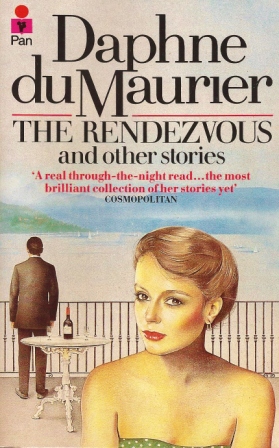
the rendezvous other stories daphne du maurier 001The Rendezvous and other stories by Daphne du Maurier ~ 1980. This edition: Pan, 1981. Paperback. ISBN: 0-330-26554-7. 234 pages.

My rating: The first and last stories in this otherwise rather mild collection elevate my rating to an overall 7/10. Otherwise, probably not more than a 5, or maybe a 6. All are worth reading, but most are not quite top-of-the-line for this particular author.

In the Preface, the author briefly explains her inspirations, and mentions that these stories show her development as a writer. I think a nice addition to this collection would have been dates of writing or of original publication; this would have added much to my own enjoyment as a long-time Daphne du Maurier reader.

*****

Some excellent, some not so much in this 1980 collection of short stories from throughout the author’s long career. All are very well written; the “less excellent” ones are described as such only in comparison to this author’s absolutely brilliant “best”.

  • No Motive ~ Why would a sweet-natured, happily married, expectant mother fatally shoot herself ten minutes after cheerfully ordering new garden furniture? One of the longer stories in this collection, and nicely plotted out. 7/10.
  • Panic ~ A casual love affair goes terribly wrong. Fabulously atmospheric, but ultimately slight. The dénouement comes as no surprise. 5/10.
  • The Supreme Artist ~ An aging actor gives a most superb performance off stage, and comes abruptly to an intimation of his own mortality. 6/10.
  • Adieu Sagesse ~ Two men from the opposite ends of the social spectrum plot their escape from tedious lives. Loved this one; the right people “win”. 8/10.
  • Fairy Tale ~ A slight and unlikely snippet of a story of a ne’er-do-well husband and his adoring wife. “Fairy tale”, indeed! 3/10.
  • The Rendezvous ~ I expected much from the title story of this collection. A successful author who has spent his life in observation finally arranges an “experience” for himself, only to be disappointed at every turn. In general, well done. But I wanted something just a little bit more. 6/10.
  • La Sainte-Vierge ~ Innocence and corruption. A snippet of a story, but very evocative of both. 5/10.
  • Leading Lady ~ Cherchez la femme… Another theatrical setting. Daphne used her eyes and ears well when about the backstage world. 6/10.
  • Escort ~ A maritime ghost story set in World War II. It’s been done before, but this attempt is reasonably decent. Nice detail on board the ghost ship. 5/10.
  • The Lover ~ A damning portrait of a rather vicious “lady’s man”. Didn’t really go anywhere as a story. 4/10.
  • The Closing Door ~ A young man faces up to a dire diagnosis. His lover unknowingly twists the knife. No shortage of symbolic situation in this one; I suspect it is one of the earlier efforts of the author. 5/10.
  • Indiscretion ~ Be careful what you say and who you say it to. Three lives are changed by a single sentence. A mite too contrived for my full enjoyment. 4/10.
  • Angels and Archangels ~ Religion and hypocrisy. The hypocrites win. A bitter little tale. 5/10.
  • Split Second ~ This story is the definite high point of the book. A middle-aged woman goes out for a walk, and comes away from a brush with death to a very different world. Or does she? Brutally pathetic, and perfectly written. 9/10.

Here’s another assessment of this collection:

Savidge Reads – The Rendezvous and other stories

Read Full Post »

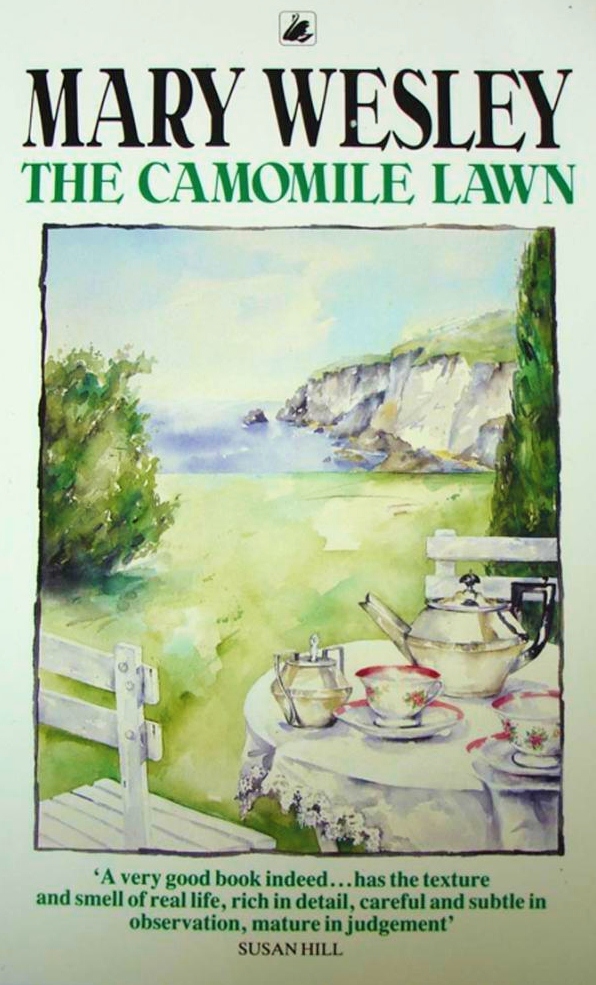
the chamomile lawn mary wesleyThe Chamomile Lawn by Mary Wesley ~ 1984. This edition: Black Swan, 1989. Softcover. ISBN: 0-552-99126-0. 336 pages.

My rating: 4/10.

It had its moments, but not enough to make it a keeper. Into the giveaway pile, to try its luck with other readers.

*****

In the summer of 1939, just before the start of the Second World War, a group of cousins assemble at a Cornish cliff side house. Lazing in the sun, lounging on the fragrant chamomile lawn, they are poised for whatever the future brings. Mary Wesley’s narrative follows them through the war, in a series of extended flashbacks triggered by the surviving cousins preparing to attend the funeral of a mutual acquaintance, a key figure in the family’s  fortunes.

That summer Oliver, newly returned from fighting in the Spanish Civil War, is in love with beautiful Calypso, who professes not to love anyone; 10-year-old Sophy is in love with Oliver. Kind Walter, his indolent sister Polly, and the twins from the nearby rectory, David and Paul, round out the cast of characters lounging the days away and enjoying the hospitality of Aunt Helena and Uncle Richard. When war is declared, the scene shifts to London, where the various marriages, affairs and misalliances of the cousins, the twins, Helena, Richard and Jewish refugees Max and Monika Erstweiler form a complicated and vaguely incestuous moving picture of lust, yearning and self-indulgence.

The Chamomile Lawn became a bestseller when it was first published in the 1980s, and much was made of the fact that the author, Mary Wesley, who apparently based much of the wartime narrative on her own experiences, was over seventy when it was released. A popular television mini-series broadcast in 1992 brought the novel to a much wider notoriety.

I can understand the popularity of the novel, as it does have an ambitious scope, a tangled, soap-opera-like storyline, and a generous enough amount of sexual goings-on to pique the interest of the most reluctant and jaded of readers, but I’m afraid I did not embrace it fully. This might be partly editorial, as the phrasing often seemed awkward to me, and I never entered fully into the story, remaining very much an onlooker as the author soberly and without much flair matter-of-factly related the action with an abundance of smutty detail which couldn’t help but leave me squirming – and not in a good way.

Little girls running about with no underwear and “respectable” gentlemen who should know better putting their hands up under those juvenile skirts; continual references to flatulence and erections and various other bodily functions seemed, after a while, to be over-telling; much too much information! The thing just felt smutty to me, and the story, though reasonably engaging, was completely unrelatable. None of the characters came to life for me, and I couldn’t drum up enough interest to really keep track of who was sleeping with who after a while, let alone try to get inside their rather nasty little heads long enough to work up some personal empathy.

It was hard work to finish this one. Perhaps because right before reading it I had just experienced Vita Sackville-West’s The Edwardians, which is a gorgeously written specimen of this sort of novel, an example of what it could be?

Mary Wesley isn’t even in the same city, let alone the same ballpark, as Vita Sackville-West and her ilk! Apples to oranges, or, rather, an overripe, sickly sweet, partly decayed banana (phallic pun fully intended, inspired by Wesley’s fixation on the male naughty bits) to an opulent bunch of hothouse grapes.

This is a damning review, and I’m sitting here having second thoughts about even posting it, but I think I will go ahead and just put it out there as an example of something which sounded great, received lots of positive press, but just didn’t click with this particular reader.

I didn’t hate the book, and I truly enjoyed some of the details the author shared about life and attitudes in wartime England, but the sexual stuff put me off. Not the fact that there was sexual content in this novel, but how it was portrayed.

Nothing was terribly graphic; I’ve read and happily tolerated – more than that – enjoyed – much more detailed portrayals of people’s fictional sex lives, but this one just felt off somehow. I’d hoped to be able to give The Chamomile Lawn to my elderly mother to read, but I don’t feel comfortable with doing so after reading it; something which seldom happens, as she quite happily tolerates a fairly broad range of “intimate” detail in some of the modern fiction we share and discuss.

I’m open to investigating some of the author’s other titles if they cross my path, because the story itself showed some creativity, but not planning on seeking them out in the near future. I will, however, be making a determined search for Sackville-West’s The Heir, which I know is around here somewhere, and which I desperately want to re-read, because reading All Passion Spent some months ago, and The Edwardians a day or two ago have reminded me what a stylish and clever writer Vita was, and how enjoyable really well-written “personality” fiction can be.

Edited to add: I’ve just registered The Chamomile Lawn with BookCrossing, and will be sending it back out into the big wide world on one of my next trips to town.

Read Full Post »

every day is mother's day hilary mantelEvery Day is Mother’s Day by Hilary Mantel ~ 1985. This edition: Owl Books (Henry Holt), 2000. Softcover. ISBN: 0-8050-6272-6. 225 pages.

My rating: 10/10 for the writing, and 5/10 for the grim plot. Averaging out to 7/10.

Will I ever read this one again? No time soon – too dark and icky, fabulous writing aside. Though I’m tempted to seek out the sequel, Vacant Possession, to see what Muriel gets up to once freed of her mother’s smothering influence.

*****

So here I am this week concurrently struggling with a stupidly busy schedule and battling a vicious virus, and I’m looking for a really good read to escape into in the few bits of down time I’m able to snatch to escape from the chaos of a week-long, much-too-far-from-home dance festival, and I page through the few library books I impulsively grabbed on my last quick visit a few weeks ago, and I tuck this one into my attaché case, because right there on the cover it tempts me with this:

Evelyn Axon is a medium by trade; her daughter, Muriel, is a half-wit by nature. Barricaded in their crumbling house, surrounded by the festering rubbish of years, they defy the curiosity of their neighbors and their social worker, Isabel Field. Isabel is young and inexperienced and has troubles of her own: an elderly father who wanders the streets, and a lover, Colin, who wants her to run away with him. But Colin has three horrible children and a shrill wife who is pregnant again–how is he going to run anywhere? As Isabel wrestles with her own problems, a horrible secret grows in the darkness of the Axon household. When at last it comes to light, the result is by turns hilarious and terrifying.

And I power through this book compulsively, because though the subject matter is grossly unpalatable – unhappy people doing unspeakable things to themselves and to each other, things intimately detailed by the unflinching author – because dark as it is, and much as I want to just put it down and look away, I can’t.

This was Mantel’s first novel, and she must have torn up a lot of first drafts, because it is absolutely excellent; beautifully crafted.

But bleak – oh, so terribly, bitterly bleak! In retrospect, probably not the best choice for cheer-myself-up, forget-that-I’m-ill reading, especially after a course of  engagingly inane D.E. Stevensons with their neat and tidy happy endings. Hide the kitchen knives and the sleeping pills, because I’m just now looking at life through grimy, smoke-coloured glasses, and finding it unutterably futile.

Just kidding.

This isn’t really a review, is it? I’m sitting here pecking away at the keyboard and sniffling, much too sick and tired to form a series of cohesive thoughts, so I’m cheating big time now and referring you over to  Dove Grey Reader – Every Day is Mother’s Day for a really interesting review with lots of personal connections.

And this one, too, which gives more details on the plot: Being Obscure Clearly – Every Day is Mother’s Day.

Also on the library stack is Mantel’s novel Fludd, which my husband just finished and plunked down with a quizzical eyebrow twitch. “Interesting” is all he’ll say when questioned, which could mean almost anything. He did read it all in one sitting, which argues in its favour; this is not a man who hesitates to put a book aside partway through when it ceases to enthrall.

The numerous comparisons between Hilary Mantel and Muriel Spark are apt. And here I must confess that I’ve a rather low tolerance to Spark. Good to read occasionally, for the bitterness of the humour and the deliciously jaded worldview, but I never go on a binge of book after book by her. Mantel joins Spark on this section of my bookshelf, right there beside Margaret Atwood, Elizabeth Taylor, Rosamund Lehmann and others of that sisterhood. “To be taken in small doses.”

Read Full Post »

archer's goon dianna wynne jones 001Archer’s Goon by Dianna Wynne Jones ~ 1984.This edition: Greenwillow Books (William Morrow & Co.), 1984. Hardcover. First American edition. ISBN:0-688-02582-X. 241 pages.

My rating: 9/10. Lost a point at the end. Alpha Centauri – seriously?! Total cop-out, DWJ! But that’s such a minor quibble – I loved this book – slyly humorous the whole way through.

*****

I came to reading Dianna Wynne Jones late in life. Like right now. Of course I’ve long since met Howl (with a very serious anime-fan kid how could I miss Miyazaki’s amazing Howl’s Moving Castle? – and of course we had to read the book – loved both versions – wow wow WOW!) – and the Chrestromanci books, but the yet-to-reads vastly outnumber the already-reads. I’m remedying that.

DWJ’s books were not among the choices in my school library growing up, or, if they were, I was completely unaware of them. We had very well-stocked libraries in my grade school days – times in B.C. were good and there was plenty of school district budget money for books and such, much more so than at present. Looking at the publication dates in DWJ’s Bibliography, I now realize that she really hit her stride after I’d left school, so that logically explains the DWJ-shaped blank spot in my childhood reading experience.

Anyway – Archer’s Goon. Good stuff. Where to start, where to start?

*****

AUTHOR’S NOTE

This book will prove the following ten facts:

  1. A Goon is a being who melts into the foreground and sticks there.
  2. Pigs have wings, making them hard to catch.
  3. All power corrupts, but we need electricity.
  4. When an irresistible force meets an immovable object, the result is a family fight.
  5. Music does not always soothe the troubled breast.
  6. An Englishman’s home is his castle.
  7. The female of the species is more deadly than the male.
  8. One black eye deserves another.
  9. Space is the final frontier, and so is the sewage farm.
  10. It pays to increase your word power.

Got that?

Not quite?

Don’t worry, by the time you’ve finished this story, you will.

So, ultra-brief review, because this is one you’ll want to discover for yourself and figure out as you go.

Thirteen-year-old Howard Sykes comes home from school one day and finds the kitchen full of Goon. Not just any Goon, but this one comes, or so he says, from Archer.

“We don’t know anyone called Archer!” Howard snapped.

The Goon grinned, a daft, placid grin. “Your dad does,” he said, and went back to cleaning his nails.

Turns out Mr. Sykes – Quentin – owes Archer something. Words. Two thousand of them. The quarterly payment hasn’t reached its destination, and Archer is peeved, hence the Goon.

Howard, his little sister Anthea (known widely and appropriately as Awful), au pair Fifi, and Howard and Awful’s mother Catriona are stumped by this strange situation, and things just get more complicated when Quentin arrives. Disclaiming knowledge of anyone named Archer, he miffily remarks that Mountjoy gets the words, and that they were sent on time.

Tracking down the missing words, and the reason they are in such apparently high demand, brings Howard and the rest of the Sykes family into a strange parallel world, and puts them all at the mercy of the mysterious beings who “farm” different sections of the town infrastructure: Archer (Finances and Power, ie. Electricity), Hathaway (Roads, Records and Archives), Dillian (Law and Order), Shine (Industry and Crime), Torquil (Music, Religion, Sports and Commerce), Erskine (Water, Drains and Garbage) and Venturus (Housing, Education and Technology).

The human characters are outstanding, and family relationships (of all sorts) are a key focus of this wonderful story. Don’t let the “kid’s book” designation put you off – it’s a grand read for adults, and very, very funny.

I’m stopping right here, but if you want to know more, the internet abounds with rave reviews. Here are two good places to start.

Jenny’s Books – Archer’s Goon

Green Man – Archer’s Goon

Did I say highly recommended yet? If so, I repeat it. Highly recommended.

Read Full Post »

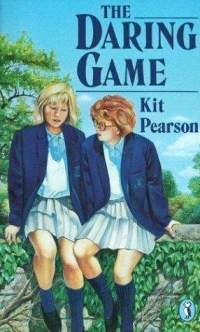
the daring game kit pearsonThe Daring Game by Kit Pearson ~ 1986. This edition: Puffin(Penguin), 1987. Paperback, ISBN: 0-14-031932-8. 225 pages.

My rating: 6.5/10. Rather pedestrian writing, but a decent “school story” with a strongly depicted Canadian setting. The intended audience would likely be preteen girls.

*****

Eleven-year-old Elizabeth – Eliza – Chapman has always dreamed of going to boarding school. She’s been reading English school stories for years, and thinks that wearing a uniform, living in a dormitory, and eluding Matron while having midnight feasts would be much more exciting than going to her boring old Edmonton day school. Her parents’ transfer to Toronto for a year seems like a grand opportunity to fulfill her dream. After much persuasion, Eliza is enrolled in Vancouver’s Ashdown Academy for her Grade Seven year, and with only a minor bout of homesickness enters into communal life with great enthusiasm.

Her fellow roommates are a widely varied lot: prim and bossy Pam, meek and gentle Jean, friendly Carrie and rambunctious, unpopular Helen. Alternately horrified by and attracted to Helen, Eliza finds herself drawn into a friendship which will have some serious consequences before the year is out. The “Daring Game” of the title is invented by Helen, and though some of the dares are simple enough to carry out, the last one goes very wrong and embroils Eliza in an impossible dilemma: stand up for a friend, or tell strict the Headmistress, Miss Tavistock, what is going on.

This was B.C. librarian and veteran kidlit author Kit Pearson’s first novel, and was inspired by her own teenage years at a Vancouver private school. It’s a decent enough middle grade novel, though my own daughter set it aside after the first chapter when I brought it home for her to read during her own Grade Seven year. I read it then and wasn’t terribly enthralled either, and this second reading for the purposes of writing this review (and possibly culling the book from our shelves) hasn’t really changed my mind.

Published in 1986, but set in 1964, The Daring Game attempts to reflect the scene of twenty years earlier, and though all the references are indeed correct, perhaps not enough time had passed to make it truly interesting from a historical point of view. The characters and the situations are competently presented, but this novel remained, to my mind, rather unexceptional from first page to last. Eliza goes through all the motions, but at the end of the story I found I was more than ready to bit her an easy farewell with nary a thought about what was to come next for her.

Kit Pearson has gone on to write a number of other well-regarded juvenile novels, including  the “Guests of War” trilogy involving British children sent to Canada during World War II: The Sky is Falling, Looking at the Moon, and The Lights Go On Again, which I’ve dipped into but not read in their entirety, and a time travel story, Awake and Dreaming, which I read and enjoyed. She’s an author worth keeping in mind if you have middle grade readers looking for something with strong Canadian content and thoughtfully (but not graphically depicted) challenging situations.

While I’m not tremendously enthusiastic about The Daring Game, I will give it a mild “okay”. Worth a try; might be just what your own young reader is looking for. I’m not quite ready to pitch it yet – see why our shelves are groaning! – but will try to read a few other titles by this author before deciding if she’s indeed a general “keeper”. The B.C. connection makes it hard to be heartless, though Pearson’s titles are abundant in local libraries and bookstores, and should be easy to find for the forseeable future even if I relinquish ownership of my personal copies.

Read Full Post »

Fire and Hemlock by Diana Wynne Jones ~ 1985. This edition: Greenwillow, 2002. Hardcover. ISBN: 0-06-029885-5. 420 pages.

My rating: 9.5/10. Half point off because of the typical DWJ ending – a re-read and an explanation by the author almost mandatory. Maddening. So close to perfect!

*****

This one took two tries. The first time I didn’t make it 20 pages in, but the second go, several months later, I was completely enthralled. I knew I would like it (I always end up liking Diana Wynne Jones, but sometimes I really need to work at it), but that the timing would need to be just right. Hit it perfectly, obviously.

Okay, here we go. This is a book that deserves a long, scholarly explanation, but I will try to keep it fairly brief – I need to work on that – brevity – I really tend to ramble on. Stream of consciousness typing. Heh.

College student Polly Whittaker lies on her bed in her room in her grandmother’s house and muses on a number of things. On the coming academic year; on the mysterious photograph on her wall which she has loved since childhood – hay bales burning in a field, with a huge hemlock plant enveloped in smoke in the foreground – as a child Polly remembers seeing people in the picture, but that was surely youthful imagination, because they certainly aren’t there now; and on the book of stories she’s been reading, another childhood favourite, except that the stories are not quite as she remembered. Growing up is so dreary, Polly sighs to herself; you see things as they are.

Or do you?

As she muses and digs deeper in her mind, Polly begins to remember more details that certainly can’t – couldn’t possibly – have happened. But there they are, that second set of memories, emerging from the hidden recesses of her mind and forming as she thinks about them. This set of memories begins at the age of ten, with the meeting of Tom at the funeral…

Flashback! And we’re off. Polly now remembers meeting a rather shy, mildly dreary young man at a neighbour’s house where she has inadvertently trespassed into an after-the-funeral will reading. Tom had looked over at Polly, realized that she really shouldn’t be there, and inconspicuously spirited her away, out of the house. The two are immediately and deeply attracted to each other in some elemental way, though Polly is, as I mentioned earlier, a child of ten, and Tom Lynn is an adult. He’s a musician, a cellist in an orchestra in London, and after returning Polly to her grandmother’s house, with the fire and hemlock picture which he has given Polly from his share of his just-announced inheritance – six pictures – he vanishes from her everyday life, though a letter soon comes from him, and the two then embark on a running epistolary narrative, with Polly reinventing herself as a Hero, or rather, assistant-Hero, to the Tom figure she has embellished into a heroic crusader-for-goodness, Tan Coul.

They write, and occasionally meet, while Polly’s life goes through some shattering events, such as the separation of her parents and her mother’s disastrous relationships with new men; Polly fortunately has a haven in her grandmother’s house, and keeps emotionally afloat though we wouldn’t blame her if she gave up and let herself drown in misery; awful things happen, many of them fantastically unlikely.

This book is, by the author’s own explanation, deeply influenced by a number of legendary tales: Tam Lin is the most obvious, with Polly obviously taking on the role of Janet, and Tom Lynn the doomed hero whom she saves from the sacrificial rites of faeryland. We also have Thomas the Rhymer, who cannot speak a lie, the gift-curse of his particular faery queen; for our tale’s Tom this becomes the gift/curse of whatever Tom imagines taking on reality. Tom’s faery queen is his divorced wife Laurel, an ominous figure who maintains her grasp on Tom even though they are supposed to have parted ways. The Odyssey is in there,  with Tom/Odysseus journeying through the years and often being seduced away from his faithful Polly/Penelope labouring away at home; Cupid and Psyche, and the tragedy of Psyche’s curiosity separating her from her true love; and eventually and most hard to pick up on, unless tipped off by the author’s explanation, as I was, T.S. Eliot’s Four Quartets and this stanza:

In order to arrive there,
To arrive where you are, to get from where you are not,
       You must go by a way wherein there is no ecstasy.
In order to arrive at what you do not know
       You must go by a way which is the way of ignorance.
In order to possess what you do not possess
       You must go by the way of dispossession.
In order to arrive at what you are not
       You must go through the way in which you are not.
And what you do not know is the only thing you know
And what you own is what you do not own
And where you are is where you are not.

And this bit:

What we call the beginning is often the end
And to make and end is to make a beginning.
The end is where we start from.

Confused? Trust me, it will make sense when you get to the last chapter, and chaos ensues, and nothing seems to work by the rules you think you know about, about Janet clinging to Tam Lin to bring about his salvation. Something very different happens.

This is really a non-review, an un-review; you need to read this book, and, if you are in the right time and space, it will be perfect for you, and you will love it. If not, set it aside, for weeks, months, years – but do give it a second try. This may be Diana Wynne Jones masterpiece; the book which elevates her considerable body of work to the next level, to something beyond juvenile fantasy to a very mature level indeed.

(It also works beautifully as a plain and simple story, though that darned ending rather knocks the unwary reader down.)

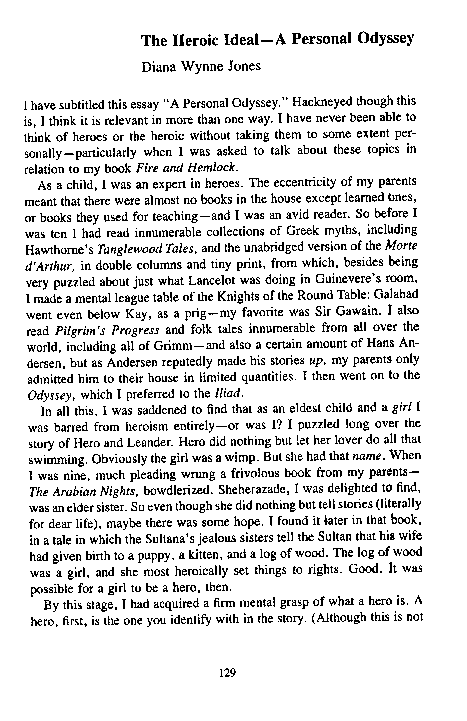
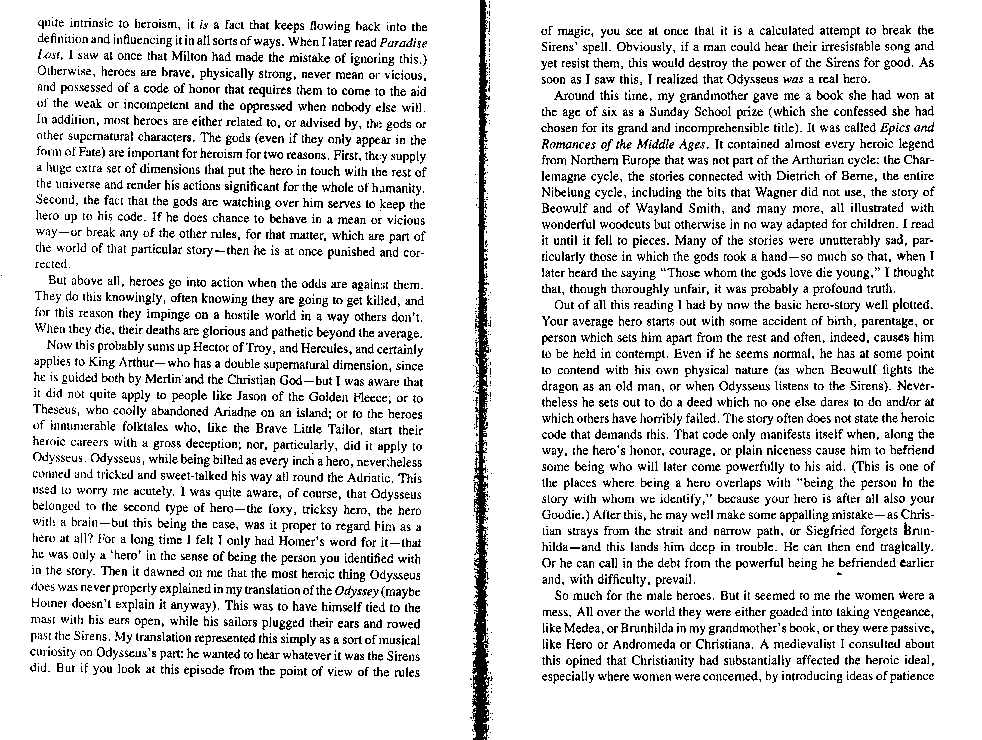
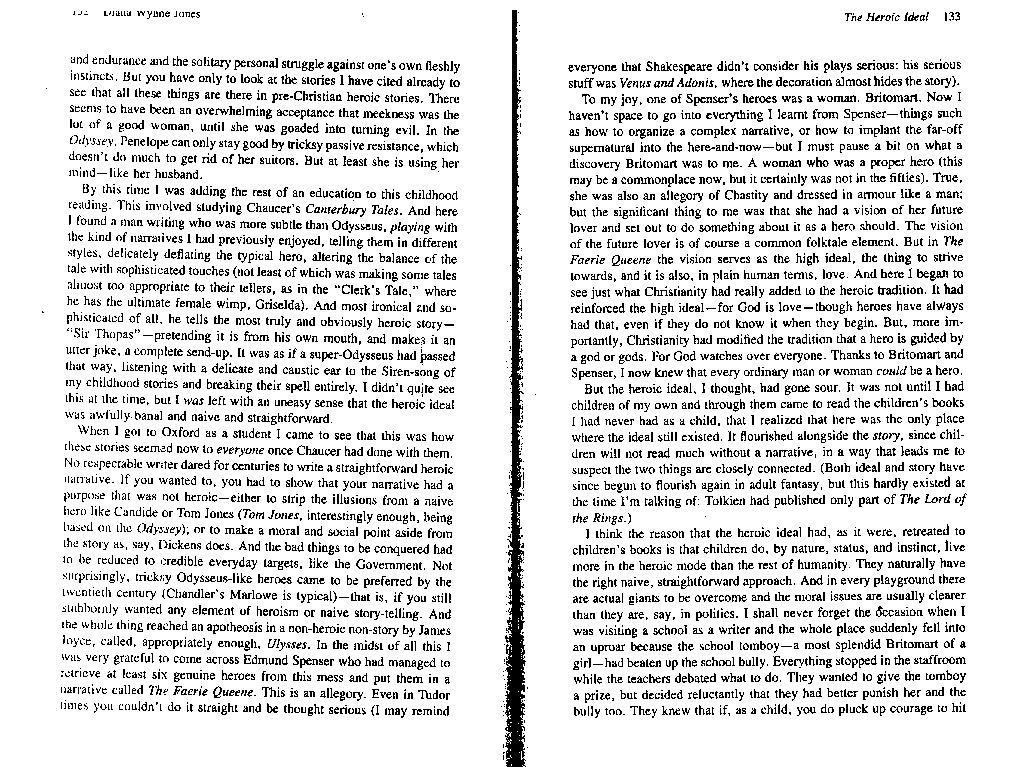
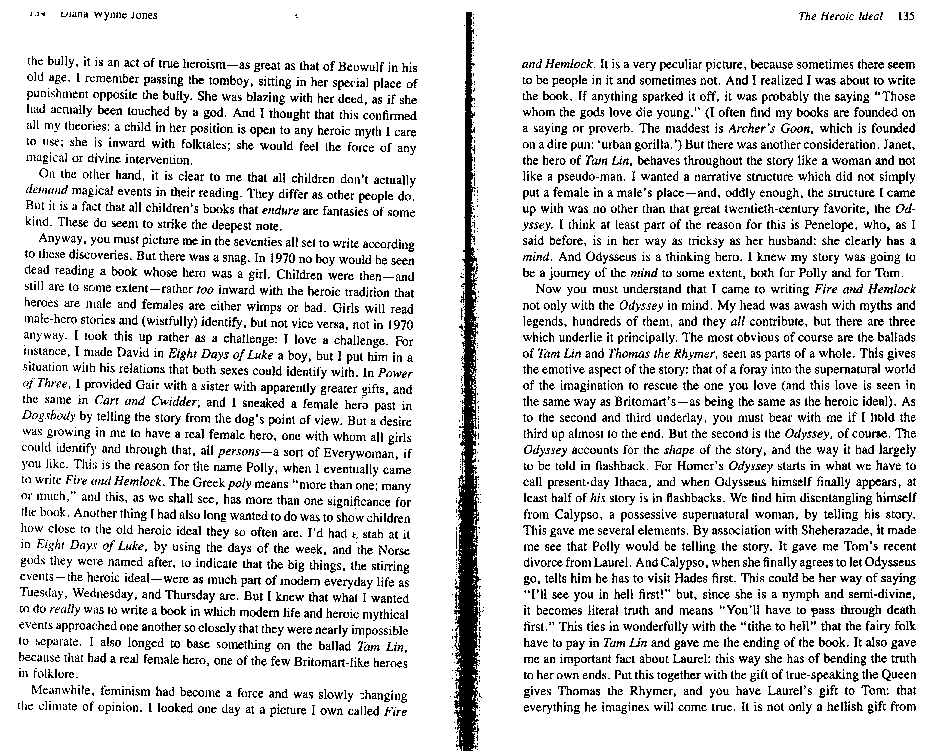
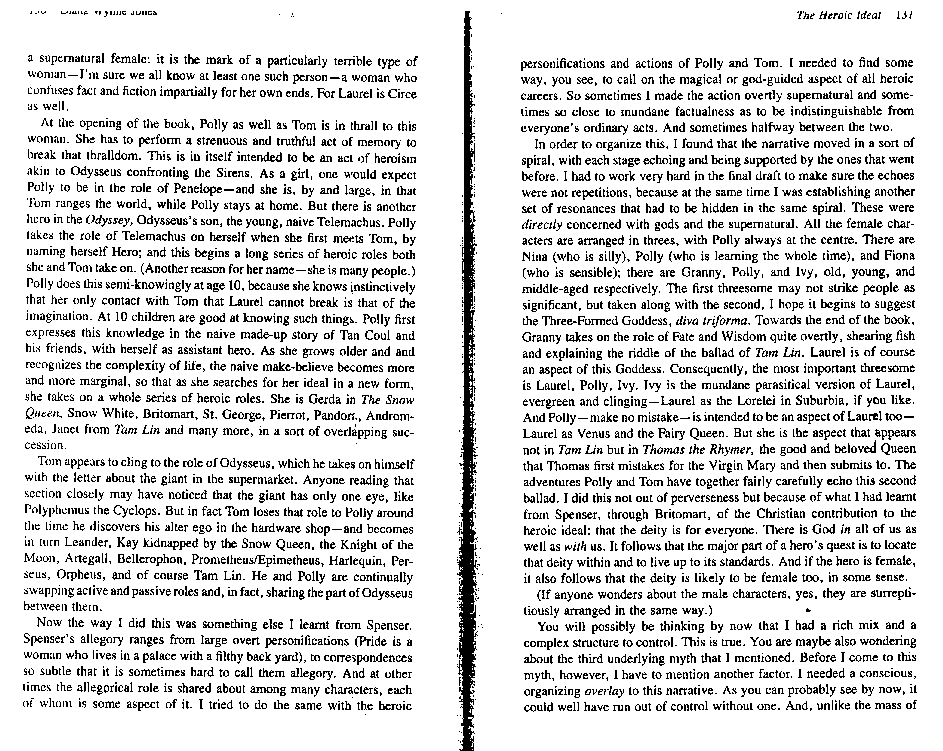
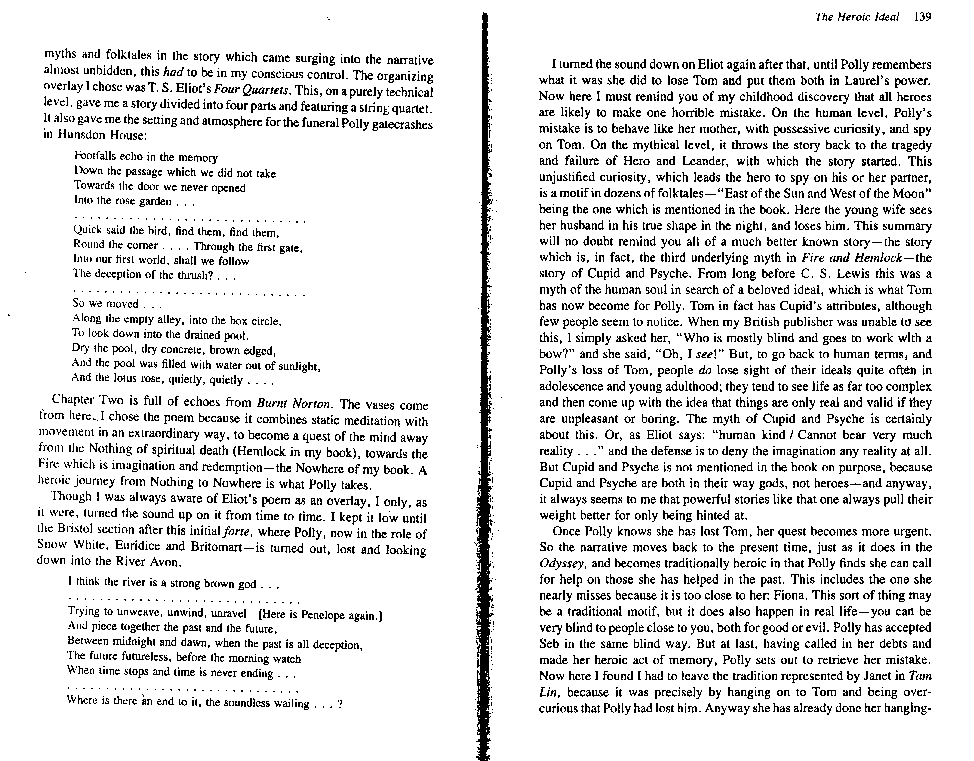
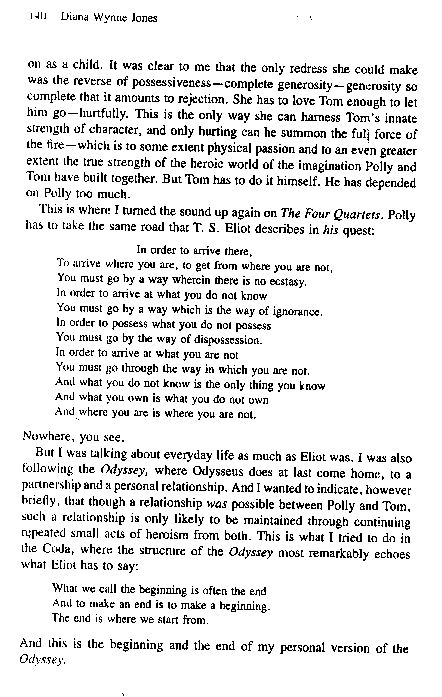
And once you’ve read the book – and NOT before – read the author’s thoughts on Fire and Hemlock here, in an essay called The Heroic Ideal – A Personal Odyssey
http://www.sccs.swarthmore.edu/users/01/kyla/Heroic_Ideal1.gif
http://www.sccs.swarthmore.edu/users/01/kyla/Heroic_Ideal2.gif
http://www.sccs.swarthmore.edu/users/01/kyla/Heroic_Ideal3.gif
http://www.sccs.swarthmore.edu/users/01/kyla/Heroic_Ideal4.gif
http://www.sccs.swarthmore.edu/users/01/kyla/Heroic_Ideal5.gif
http://www.sccs.swarthmore.edu/users/01/kyla/Heroic_Ideal6.gif
http://www.sccs.swarthmore.edu/users/01/kyla/Heroic_Ideal7.gif

Here are some more reviews you will appreciate, because the writers give proper plot summaries (unlike my wishy-washy avoidance of doing so) starting with the one which contains the links to The Heroic Ideal, copied above:

Two Sides to Nowhere – Fire and Hemlock

Valentina’s Room – Fire and Hemlock

Jenny’s Books – Fire and Hemlock

Shelf Love – Fire and Hemlock

A Musical Feast – Fire and Hemlock (a more critical review, worth reading because it puts into words the bothersome flaws in DWJ’s technique)

This is just a small sampling. Happy reading!

Read Full Post »

« Newer Posts - Older Posts »