Archive for the ‘1970s’ Category

enchanted summer gabrielle roy 2 001Enchanted Summer by Gabrielle Roy ~ 1972. Published in French as Cet été qui chantait. This edition: McClelland and Stewart, 1976. Translated by Joyce Marshall. Hardcover. ISBN: 0-7710-7832-5. 125 pages.

My rating: 8/10.

This is a slight and delicate compilation of short (some very short) vignettes written by the esteemed francophone author during one of her summers residing in a little house she had purchased in 1957 in the rural village Petite-Rivière-Saint-François, Charlevoix County, Quebec.

People come and go throughout Gabrielle’s summer; her husband Marcel Carbotte, various acquaintances from far and wide, her local friends, and, most frequently, her closest neighbours, Berthe and Aimé, with whom she peaceably shared a fenceline.

Many of the vignettes are fragmentary glimpses of nature and landscape, snapshots of a moment captured in words. Gabrielle and Berthe walk along the railroad line to a small pool inhabited by a responsive bullfrog, Monsieur Toong; Gabrielle ponders the wild garden which grows on an uncultivated bit of farmland; the intellectual capabilities of Aimé’s placid cows are considered; the gentle life of  Jeannot the crow is captured in words as he sways in the wild cherry tree, and his sad fate is documented.

Wildflowers, birds, domestic animals are all considered and watched with interest and the author’s observations are gently and humorously related to the reader. The beauty of the landscape is frequently detailed, and the sights, sounds and fragrances of what seems to be a time of great peace and contentment; even the occasional storm does not break the mood of repose. These summers by the river were Gabrielle’s time of retreat and (relative) solitude, in which she refreshed herself from the busy social life of her winter residence in Quebec City, and from the cares of her family – two ailing sisters in Manitoba were often visited – and a time of concentrated writing.

Most of these small stories are centered on animals, but the two most poignant, and to my mind the most memorable, involve people.

Elderly cousin Martine comes for a two weeks’ visit in the country; living in a small city apartment and frail to the point of immobility, she longs for a glimpse of the river of her childhood. One day, without telling Martine’s sons what they are planning, Berthe and Gabrielle laboriously support and carry her down to the river, where for a while she revisits her long lost youth.

For my part, the more I looked at her the more I was reminded of those pilgrims of the Ganges in Benares, whom one sees with loincloths tucked up, frighteningly thin but their faces illuminated with fervour…

…Suddenly, barefoot on the rim of the summer sky, she began to ask questions – doubtless the only ones that matter.

“Why do we live? What are we sent to do on this earth? Why do we suffer so and feel lonely? What are we waiting for? What is at the end of it all? Eh? Eh?”

Her tone was not sorrowful. Troubled perhaps at the beginning. But gradually it became confident. As if, though she didn’t quite know the answer, she already senses that it was good. And she was content at last that she had lived…

And, in a remembrance of a long-ago month as a substitute teacher in a very small, poor, rural Manitoba settlement, Gabrielle recounts her visit to the house of one of the school pupils, who has just died of T.B. The other schoolchildren, who have been apathetic towards their temporary teacher, unbend as they tell her about the sadly fated Yolande. With sudden inspiration, Gabrielle suggests they pick the wild roses growing in the clearing outside Yolande’s cabin, to give tribute to their friend.

On our return we pulled them gently apart and scattered petals over the dead child. Soon only her face emerged from the pink drift. Then – how could this be? – it looked a little less forlorn.

The children formed a ring around their schoolmate and said of her without the bitter sadness of the morning, “She must have got to heaven by this time.”

Or, “She must be happy now.”

I listened to them, already consoling themselves as best they could for being alive.

But why, oh why, did the memory of that dead child seek me out today in the very midst of the summer that sang?

Was it brought to me just now by the wind with the scent of roses?

A scent I have not much liked since the long ago June when I went to the poorest of villages – to acquire, as they say, experience.

As I said early on, this is a slight and quickly read memoir, but one that has a decided charm and a strong sense of atmosphere and place. Very well suited to a peaceful summer afternoon read, preferably in the shade of your own particular tree, with birdsong and dancing shadows for counterpoint.

Read Full Post »

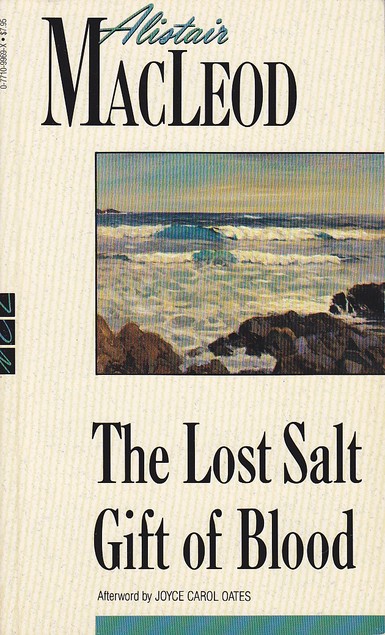
the lost salt gift of blood 2 alistair macleodThe Lost Salt Gift of Blood by Alistair MacLeod ~ 1976. This edition: New Canadian Library, 1989. Afterword by Joyce Carol Oates. Paperback. ISBN: 0-7710-9969-X. 160 pages.

My rating: 10/10 for the writing, no debate there. For reading “pleasure”, which of course is an extremely individual definition, I’m struggling with a rating. I’ll willingly put this on the keeper shelf, but I strongly suspect I may never read it again. The well-turned phrases are lovely in and of themselves, but the subject matter is so very bleak. This book makes me so glad I’m not in high school any more. What a godsend to keen Can-Lit teachers!

I started off reading this book with no foreknowledge of what the tone would be, though I suspected less than frivolous, what with the earnest back cover blurb:

The stories of The Lost Salt Gift of Blood are remarkably simple – a family is drawn together by shared and separate losses, a child’s reality conflicts with his parents’ memories, a young man struggles to come to terms with the loss of his father.

Yet each piece of writing in this critically acclaimed collection is infused with a powerful life of its own, a precision of language and a scrupulous fidelity to the reality of time and place, of sea and Maritime farm.

Focusing on the complexities and abiding mysteries at the heart of human relationships, the seven stories of The Lost Salt Gift of Blood map the close bonds and impassable chasms that lie between man and woman, parent and child.

These seven stories are intense and perfectly crafted; I can easily believe that Alistair MacLeod spent a year writing each one; they feel perfected, pared down, edited for maximum effect to the nth degree. Marvelous writing.

But I came away from my reading – which I spaced out over a week or so because this isn’t the sort of stuff one can take in all at one sitting – feeling so terribly sad, which may in itself be the strongest tribute I can give to the power of MacLeod’s writing.

*****

These are all stories of “place”, very specifically regional, focussed on Cape Breton. The sea and the land are characters as much as any of the sentient creatures that occupy their worlds.

  • In the Fall ~ The teenage narrator, the oldest of six children, remembers the autumn his father was forced to sell his beloved old horse to the knacker. Heart-wrenching.  I have a very low tolerance for betrayal of old animals scenarios – hence my real-life situation of supporting a number of geriatric creatures in various stages of decline – so I almost bailed on the book at this point, but doggedly kept on. Though it never got much more cheerful…people started dropping in the following episodes. But, oh! – the evocative writing!

It is hard to realize that this is the same ocean that is the crystal blue of summer when only the thin oil-slicks left by the fishing boats or the startling whiteness of the riding seagulls mar its azure sameness. Now it is roiled and angry, and almost anguished; hurling up the brown dirty balls of scudding foam, the sticks of pulpwood from some lonely freighter, the caps of unknown men, buoys from mangled fishing nets and the inevitable bottles that contained no messages. And always also the shreds of blackened and stringy seaweed that it has ripped and torn from its own lower regions, as if this is the season for self-mutilation – the pulling out of the secret, private, unseen hair.

  • The Vastness of the Dark ~ A boy leaves home on his eighteenth birthday, with little plan but that he must get away from his here and now, and travel forward into something different.

(After the Cumberland No. 2 coal mine explosion)… I remember again… the return of my father and the haunted greyness of his face and after the younger children were in bed the quiet and hushed conversations of seeping gas and lack of oxygen and the wild and belching smoke and flames of the subterranean fires nourished there by the everlasting seams of the dark and diamond coal. And also of the finding of the remains of men flattened and crushed if they died beneath the downrushing roofs of rock or if they had been blown apart by the explosion itself, transformed into forever lost and irredeemable pieces of themselves; hands and feet and blown-away faces and reproductive organs and severed ropes of intestines festooning the twisted pipes and spikes like grotesque Christmas-tree loops and chunks of hair-clinging flesh. Men transformed into grisly jig-saw puzzles that could never more be solved.

  • The Lost Salt Gift of Blood ~ A successful Toronto businessman returns to the Newfoundland community he has long left behind, to take a look at his illegitimate son who has recently been orphaned by the death of his mother and stepfather. Yearnings of fatherhood stir within him; should he tell the boy who he is?
  • The Return ~ A ten-year-old boy makes the trip from Montreal to visit his Cape Breton grandparents for the first time.
  • The Golden Gift of Grey ~ A teenage boy lives a secret life, visiting the pool hall after classes and forming a friendship with the man who was the cause of his father coming to Cape Breton from Kentucky ten years ago.
  • The Boat ~ An adult son remembers his father, and their life together on their fishing boat.
  • The Road to Rankin’s Point ~ This was the most personally moving and my favourite of all these seven stories. A terminally ill grandson returns to his elderly grandmother’s farm, seeking peace and a place to die.

I could easily have included excerpts from each of these stories – the most difficult task would have been deciding what to highlight among so many memorable passages –  but I will instead leave you to discover them for yourself, if you so choose.

A good review from another blogger is here: City Scrivener – The Lost Salt Gift of Blood

A very readable scholarly examination of the stories is here: SCL – Studies in Canadian Literature – The Lost Salt Gift of Blood

Read Full Post »

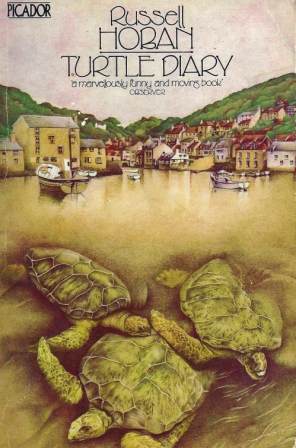
turtle diary russell hoban 001Turtle Diary by Russell Hoban ~ 1975. This edition: Picador, 1977. Softcover. ISBN: 0-330-25050-7. 191 pages.

My rating: 9/10.

The only thing better than looking forward to a read with a cozy preconception as to what the story will bring, and being satisfied with your expectation, is to be blanket-tossed up in the air by a book that tightens up and bounces you unexpectedly into a very different direction, leaving you to freewheel for a while, scrambling for a sense of where you’re going, then catching you and returning you, more or less gently, to solid ground. Turtle Diary is that second kind of book.

The plot is easily condensed. Two middle-aged and currently unattached Londoners, William G. and Neaera H., both struggling with a stagnant state of being, visit the Zoo and are, separately, attracted to the sea turtle tank and the stoic inhabitants within. Musing on the cosmic injustice of these far-roaming creatures being confined to a tiny volume of water, William and Neaera each consider the possibility of somehow freeing the turtles back into the sea. As each of them in turn carry on their separate narrations, we see that their thoughts are uncannily similar, both regarding the turtles and other aspects of their solitary existences, and their relationships (or lack thereof) to those around them. Inevitably William and Neaera meet, speak, share their turtle-liberation impulses, and formulate a practical plan to carry it out, helped by the like-minded zookeeper. Can you guess where we’re going from here? Two lonely people, sharing a joint goal, yearning desperately for love…?

Well, abundant blessings to Russell Hoban. He faces up to and jumps the clichés quite nicely, and while his characters do ultimately find themselves in a different and presumably better emotional place, it’s not their ultimate fate to rest in each others’ arms.

There is so much packed into these strange and wonderful book that the whole turtle thing turns out to be merely a unifying theme, a subplot. This is not as much a book about animal liberation as it is about human liberation. Or, as William G. would doubtless remind us, perhaps there isn’t any difference between the two, humans being just another sort of animal, after all. The trick being to find a state of existence where one can satisfy one’s biological and emotional needs, whether one is sea turtle (source of sea turtle soup) or William G. (source of William G. soup) or octopus or oyster-catcher or water beetle or zookeeper or Balkan expatriate…

It’s so strange (and wonderful) that I picked up an old edition of this book completely at random some weeks ago, merely on the strength of the author’s name. And yes, I already knew who Russell Hoban was – what reading parent could not miss the identity of the originator of the adorably contrary Frances? And of course The Mouse and His Child, which is, most emphatically, not a book for small children, or possibly any age of child, despite the repeated references to it as a “children’s classic”. Whoever has designated it as such has perhaps not read the actual book. But I digress.

As I was saying, I picked up Turtle Diary completely serendipitously, only finding out when another blogger mentioned that he too was reading it that it has been recently reissued by New York Review Books, and is currently receiving much popular press as literary readers “rediscover” Hoban-the-writer-of-adult-fiction.

Without further ado, and without wasting my words in attempted repetition of what Guy Savage of the excellent His Futile Preoccupations book blog has already said, I refer you to that review:

Turtle Diary by Russell Hoban

Guy states that this might well be one of his best books of the year. I know it will be high up on my own list.

And on the strength of Turtle Diary, I will be searching out my copy of The Mouse and His Child, which I acquired when my children were small, thinking that it was a children’s story – it was, after all, shelved in the juvenile section of the bookstore. It was tucked away when an initial reading showed a deep unsuitability for the highly imaginative, nightmare-prone younglings of the household, despite the message of unconditional love yadda yadda yadda. Now that the children in question are in their advanced teen years and decidedly bombproof in their reading habits they might even be interested in exploring Hoban’s adult works for themselves. The dystopian Riddley Walker sounds like something my son in particular might enjoy; must seek that one immediately.

Russell Hoban. If indeed his works are coming in for a time of resurgence, it is because they richly deserve it. Check him out.

Edited July 24, 2013 to add this link to another brilliant review: Seeing the World Through Books – Mary Whipple Reviews Turtle Diary

Read Full Post »

The Unhappy People


Professor, may I introduce you

to two of the Unhappy People, whom you’ve described

as inhabiting a cultural vacuum

somewhere between the swamps of Frustration

and the salt sea of Despair.

May I present my wife’s cousins, Corey and Brent.

You will note immediately that their teeth are translucent,

the colour of reconstituted powdered milk,

which can be attributed to hereditary malnutrition,

as their lack of earlobes can be ascribed to inbreeding.

You are free to make notes, if you wish.

At worst, they’ll merely laugh at you.


Professor, I must ask you to forgive

the mandolin, the five-string banjo, the guitar, the fiddle

and the jew’s-harp. I must ask you to bear with

Brent when he dances – he prefers it to walking to

the refrigerator for another beer – and Corey when he

scratches

his groin in symbolic tribute to the girl in the yellow

bathing suit

playing with a frisbee on the grass across the street.

I know it’s distracting when, for no apparent reason,

they break into song. I can understand your not laughing

with them when they talk about driving

four-year-old cars at one hundred and ten

miles per hour down dirt roads with the police behind them,

of overturning and wondering drunkenly how to shut off

the headlights, until logic triumphed and they kicked

them out.

I beg you not to be disturbed when they whoop

at the tops of their voices – it’s in their blood,

I’m afraid, their way of declaring an instantaneous holiday

and, besides, Brent got out of jail this morning

or, as he puts it, got back from his annual vacation,

having been locked up this time because he didn’t

know his own strength, he says, and when he was refused

service

at the liquor store, being drunk, forgot he was carrying

nothing under his left arm to offset the force of his right

pushing open the door on his way out and so, purely by

accident,

drove his fist through the glass:

it could have happened to anybody, Your Honour,

he told the Court. You must excuse Corey, Professor,

like every other member of his family he walks in and out

of rooms without thinking it necessary to offer

any explanation. When they arrive at my house

or any other, they open the door, come in, sit down

and, perhaps, switch on the radio. They’d expect you to do

the same.

If you go to the window, Professor, you’ll see

that he’s talking with the girl in the yellow bathing suit

and already has her laughing. “Once you got them laughing,

you’re as good as in bed with them,” Brent says.

In celebration

he jumps up again and dances. They’ve brought venison

and wild rice and a half-dozen jars of their mother’s

homemade preserves and pickles, fresh loaves of her bread

two double cases of beer and a forty-ounce bottle

of dark rum, having shut down the cannery

where Corey works in honour of Brent’s homecoming.

“I said to hell with ‘er, let’s tie ‘er up.”

and with unanimous approval of his fellows,

conveyed without a word, he tied her up well

by making certain delicate adjustments to the machinery

when the bosses weren’t watching. His laughter and his

brother’s

laughter and the laughter of the girl in the yellow bathing

suit

mingle and rise like water from a garden hose, spraying the

windows

from inside and out. The passersby turn

and smile, a neighbour’s dog runs to see what’s happening,

a host of starlings take wing, the tiger lilies are in flower

at the edge of the parking lot next to this house.

Professor, I don’t suppose you’d care to arm-wrestle?


Alden Nowlan ~ Smoked Glass ~ 1977

This poem is dedicated to some guys I used to know.

Gone, most of them, flamed out and crashed and burned in (mostly) self-imposed self-destruction.

The hard living took its toll, but they had a grand time while it lasted.

And they made a lot of people laugh.

Gone, but definitely not forgotten!


Read Full Post »

underground to canada barbara smuckerUnderground to Canada by Barbara Smucker ~ 1977. This edition: Puffin (Penguin), 1999. Introduction by Lawrence Hill. Paperback. ISBN: 0-14-130686-6. 144 pages.

My rating: 9/10  – A very good historical fiction novel for its intended audience, middle grade to young teen readers. Older readers may notice the simplified plotting and some plausibility gaps, but in general a well-written story with a gripping main character and dramatic situations, well-researched and well-presented.

*****

Author’s Note:

The escape from Mississippi to Canada by two fictitious characters, Julilly and Liza, could have happened. It is based on first-hand experiences found in the narratives of fugitive slaves; on a careful study of the Underground Railway routes; and on the activities of two Abolitionists: Alexander M. Ross of Canada and Levi Coffin of Ohio.

Twelve-year-old June Lilly – Julilly – is a slave on Massa Hensen’s Virginia plantation. He’s not a bad slave owner, comparatively speaking, but when he gets ill and can no longer oversee his cotton farm, his slaves are offered to a buyer from Mississippi, where conditions are notoriously the worst in the slave-owning states of the South.

Night music droned through the slave quarters of Jeb Hensen’s Virginia plantation. The words couldn’t be heard but they were there beneath the rise and fall of the melody.

Julilly hummed them as she sat in the doorway of her cabin, waiting for Mammy Sally to come home from cooking in the Big House kitchen. She was as still and as black as the night. The words of the song beat in her head.

When Israel was in Egypt’s land
Let my people go
Oppressed so hard, they could not stand
Let my people go.

Old Massa Hensen didn’t like this song. He said it came when there were whisperings and trouble around. There were whisperings tonight. They murmured beneath the chirping of the crickets. They crept from ear to ear as soundless as the flickering of the fireflies.

When the slave trader does indeed come, Julilly is separated from her mother and is sent with a group of other young slaves to a much harsher owner in Mississippi. When an opportunity to escape arises, Julilly and her new friend Liza grasp their chance and set out on an epic trek north, finding help through the network of the “underground railway”, hoping beyond hope to one day reach the far off land called “Canada”, where slavery is outlawed.

They succeed, but not without many hardships.

The ending of the story was realistic though rather optimistically contrived in its reconciliation scene between Julilly and her mother; I found it hard to accept so much “coincidence” in such widely separated characters reuniting with such apparent ease. That was really my only objection, though. Oh – and the lack of complexity with the secondary characters. Even though others share the stage, this book is very much centered on one character only – Julilly.

Julilly is a quite beautifully drawn character, and I found myself completely engaged with her story, much as I already knew the plot line both from previous readings and from the inevitability of the stereotyped story arc.

One of Barbara Smucker’s best novels for young readers, and the one which made her reputation as a writer. A very Canadian novel, though most of the action takes place in the United States. Canada’s presence as a destination for the escaping slaves, and the involvement of real Canadian Abolitionist Andrew Ross are key plot elements.

This would be good for independent readers 10 and older. This would also make a good Read-Aloud, for all ages, though the subject matter is intense and might not be suitable for sensitive younger listeners. Era appropriate use of the derogatory term “nigger” throughout; Lawrence Hill’s short Introduction is a must-read for its discussion of this aspect. Fast paced and engagingly written.

Recommended.

Read Full Post »

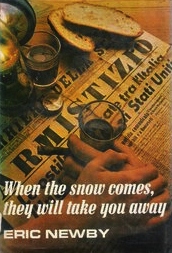
When the snow comes, they will take you away by Eric Newby ~ 1971. This edition: Charles Scribner’s Sons, 1971.  British title: Love and War in the Apennines. Hardcover. ISBN: 684-12486-6. 221 pages.

My rating: 9.5/10. Loses a bit for occasionally awkward phrasing which made me stop and re-read in an attempt to keep the story sorted out. It broke the flow a few times; nothing too serious. Otherwise, a very engaging and sincere memoir.

***** 

I said “sincere” just above, and that is my overall impression of this World War II prisoner-of-war account by the late British travel writer Eric Newby, best known perhaps for his month-long ramble in the Hindu Kush back in 1956. Fourteen years before that famous excursion, Newby was occupied with an even greater adventure after he was interned with his companions in German-occupied Italy after a British Special Forces sabotage mission against a German airfield in Sicily went completely awry.

We were captured off the east coast of Sicily on the morning of the twelfth of August, 1942, about four miles out of the Bay of Catania. It was a beautiful morning. As the sun rose I could see Etna, a truncated cone with a plume of smoke over it like the quill of a pen stuck in a pewter ink-pot, rising out of the haze to the north of where I was treading water.

After being dropped off by a submarine off the Sicilian coast, Newby and five companions had paddled their folbots – portable folding canoes – to the beach, and proceeded to attempt to sneak onto the German airfield and bomb as many of the planes as possible before escaping back to the beach and then a pick-up rendezvous with the sub. Unfortunately for the saboteurs, the Germans were very much on the alert, and the sneak attack ended in a hasty retreat. The canoes sank one by one during the night, leaving the men completely stranded at sea, where they were picked up by Italian fishermen. A year in a rather decent POW camp followed, with numerous unsuccessful escape attempts by various prisoners being attempted, before the Allied-Italian Armistice of 1943 which saw a mass exodus of Allied prisoners and Italian soldiers into the countryside just ahead of advancing German troops.

Eric had unluckily broken his ankle the night before the Armistice, which complicated his movements considerably. Ending up in an Italian hospital, waiting for the inevitable arrival of the Germans, Eric met a young Slovenian woman, Wanda, who initiated a series of language lessons – Italian in exchange for English – which soon led to something more than a disinterested friendly relationship.

When the Germans did show up, Eric was put under guard by Italian policemen, but he managed to escape out of a bathroom window, broken ankle and all, following Wanda’s instructions as to how to find assistance in the town. An underground movement of antifascist/anti-German civilians was mobilizing, and Eric came under their protection and was passed from house to house until his eventual haven in a small mountain village, where he ended up working for a farmer in exchange for shelter and meals.

Wanda kept in occasional contact, mostly by cryptic notes and once by a rare and risky visit, and Eric stayed one step ahead of his potential captors. But as the autumn progressed and the mountain snows began to fall, the period of freedom drew to a close, as it became impossible to hide the presence of Eric and the other temporarily free POWs from the investigative raids of the German patrols.

As the book ends, Eric has been recaptured and is heading to another internment camp, where he will be spending the rest of the war. He and Wanda managed to stay in contact, and were married after the war.

This book is a self-deprecating account of one man’s attempt at maintaining his freedom, though, as Eric himself notes several times, the best thing he could have done both for himself and for the Italian villagers who risked their lives to aid him would have been to surrender. And there was a very real danger to his hosts. Entire families were shot for harbouring fugitives, and though there were numerous people willing to run such a risk, there were others just as eager to turn in both escaped prisoners and those of their neighbours who aided them.

It is also a touching love story, both of a man and a woman who meet and fall in love in most uncongenial circumstances, and of Eric Newby’s deep affection and respect for the Italian peasants who sheltered and fed him at unbelievable risk to themselves and their families.

A sincere and grateful story, written in a modest tone with a good dose of wry humour.

This is one of the recommendations in Noel Perrin’s book about good books, , which I reviewed earlier this year.

I must agree. Highly recommended.

Read Full Post »

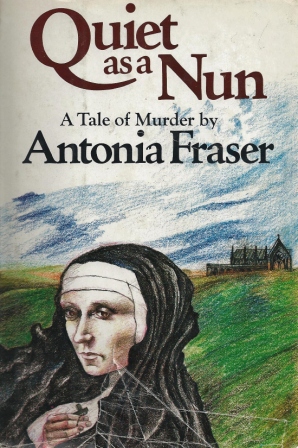
Quiet as a Nun: A Tale of Murder by Antonia Fraser ~ 1977. This edition: Viking Press, 1977. Hardcover. 177 pages.

My rating: 7/10. Not bad at all. I’d definitely read the other mystery novels by this author, and look forward to accumulating the rest of them in my travels, now that I’m on to her, as it were.

*****

Is 1977 “vintage”? Just barely, I suspect, but it was thirty-five years ago – and golly, I remember 1977 clear as a bell – where do the years go? – so I will go ahead and classify it with the oldies.

Antonia Fraser is a well-respected author of scholarly biographies, who branched out into fictional stories with this very novel. From the author’s website:

Since 1969 Antonia Fraser has  written nine acclaimed historical works which have been international  best-sellers.  She began with MARY QUEEN  OF SCOTS (1969) and followed it with CROMWELL: OUR CHIEF OF MEN (1973) and  CHARLES II (1979).  Three books featuring  women’s history came next: THE WEAKER VESSEL: WOMAN’S LOT IN THE SEVENTEENTH  CENTURY (1984); THE WARRIOR QUEENS (1988) and  THE SIX WIVES OF HENRY VIII (1992).  A  study in religious extremism, THE GUNPOWDER PLOT: TERROR AND FAITH IN 1605  (1996) was followed by two books set at the court of Versailles: MARIE  ANTOINETTE: THE JOURNEY (2001) and LOVE AND LOUIS XIV: THE WOMEN IN THE LIFE OF  THE SUN KING (2006).

Antonia  Fraser has also written eight crime novels and two books of short stories  featuring Jemima Shore Investigator.  She  edits the Kings and Queens of England series for Weidenfeld & Nicolson  including her own short illustrated book KING JAMES VI AND I (1974) and the  composite volume KINGS AND QUEENS OF ENGLAND (1975).  She has also edited the following  anthologies: SCOTTISH LOVE POEMS (1974), LOVE LETTERS (1976), HEROES AND  HEROINES (1980) and THE PLEASURE OF READING (1992).

Among  the many awards she has received are the Wolfson Award for History; the James  Tait Black Prize for Biography; the Crimewriters’ Non-Fiction Gold Dagger; the  Franco-British Society Literary Award, and the Norton Medlicott Medallion of  the Historical Association.  She was made  a CBE in 1999.

Antonia Fraser is the eldest child of the Labour politician and prison reformer Lord Longford and the historical biographer Elizabeth Longford. She has six children by her first marriage to Sir Hugh Fraser MP and eighteen grandchildren. She was married to Harold Pinter who died on Christmas Eve 2008.

So that’s the author’s background – rather impressive, so I was expecting great things from this mystery novel. By and large it did not disappoint, though “great” would be an overstatement in reference to this slender diversionary read.

I had hoped for a fairly fast-paced, readable and engaging story, and I had no trouble polishing this one off during the course of one session of lunch break/bedtime/early morning tea break reading. Easy to pick up, easy to put down; the characters stayed fresh and clear in my mind, which is not always the case even during such a short reading span, so that was a point in favour.

From the author’s website:

A nun is dead – her emaciated corpse has been discovered  locked in the tower   of Blessed Eleanor’s  Convent. The tragic consequence of a neurotic young woman committing to a life  of isolation and piety, the inquest concludes. But this young woman held  unusual power over the convent … power she was planning to use.

Jemima Shore tries to keep  her distance from the case, but when her lover cancels their holiday she finds  herself reluctantly getting involved. A violent attack in the dead of night and  another death convinces her that the convent is not the haven of peace it  appears to be. Suspicion and fear hang heavy in the air but how do you solve a  murder no-one will admit happened?

The main character is thirty-something Jemimah Shore, a television investigative reporter who hosts a popular program which touches on various social and cultural topics, and “digs deeper”, hence the tag “Investigator” which has become attached to Jemimah’s name. Widely known through Britain because of her T.V. presence, Jemimah is used to many people from her past reappearing and claiming acquaintance, so she is not terribly surprised when the Mother Superior of her childhood convent school sends her a letter referring in complimentary terms to her present occupation. What does surprise Jemimah is Mother Ancilla’s urgent request that Jemimah visit Blessed Eleanour’s Convent to discuss the recent death of one of Jemimah’s former school companions, who found her vocation and became a nun at the convent after she and Jemimah had parted ways.

Sister Miriam, once the wealthy Rosabelle Powerstock, had apparently died of natural causes, but there is a mystery about her death. Why did she lock herself in the ancient tower attached to the nunnery, and why had she been so insistent that Jemimah be called, before her (Sister Miriam’s) unfortunate demise?

Jemimah is an interesting character, and I thought her a rather admirable private investigator. Cool, calm and collected, thoughtful Jemimah views the world with an eye just the warm side of cynical. No fool, she is well-used to analyzing motivations and actions, and she turns her eye upon herself on occasion with surprising firmness and self-critisism. A non-strident but rock solid feminist, Jemimah gets on with things and has little time or patience for drama in her life, which makes it a bit eye-opening that her romantic involvement is with a firmly married liberal M.P. The relationship is long-lasting and seems stable enough, though we get the strong sense that Jemimah wishes it could be regularized and much more open; it seems well-known among her circle of acquaintances, though the wife of her lover is definitely unenlightened.

The plot itself is a contrived little thing – a missing will, a threat to the convent, and a melodramtically inclined social crusader are all key elements. I figured out the “mystery” almost immediately, though there was a tiny twist at the end which I did not see coming; Jemimah’s reaction was unexpected and made me curious to see what her next mystery will have her doing. (There were eventually ten books in the Jemimah Shore series, written between 1977 and 1995, though and I wonder if that writerly interest is wrapped up; the author’s most recent work is a memoir about her life with the late Harold Pinter, Must You Go?, 2010.)

Thoughtful musings on religion, and the author’s undoubted talent for words raise this novel higher than the plot deserves, to put this first mystery novel nicely into the realm of Patricia Wentworth, and a reasonable compatriot of the slighter works of Margery Allingham, Agatha Christie and Ngaio Marsh. I’ve read much worse.

Read Full Post »

The Devastating Boys and Other Stories by Elizabeth Taylor ~ 1972. This edition: Viking Press, 1972. Hardcover. ISBN: 670-27067-9. 179 pages.

My overall rating: 7.5/10. Competently and beautifully written, this is a quietly memorable collection of subdued short stories, written between 1965 and 1972.

I’m not quite embracing the Jane Austen comparisons though, of which there are two from different reviewers on the dustjacket.

*****

Elizabeth Taylor. Hmm. As a broad statement, I very much like her work, but I don’t indiscriminately love it, with a few stellar exceptions. A mistress of concise, clean and crisply descriptive prose, I find I enjoy her voice the best when she lets herself go with keen, wry humour. The detail she picks up on is one of her best qualities. Thinking a little more about this author, I do think that perhaps her short stories are her best work. Like hyper-detailed miniatures they allow us to focus intensely for brief time on the minutiae which too often blurs in a larger, more ambitious narrative.

Here’s what we have in this collection. I’ve included first paragraphs and a brief summary of each short story.

The Devastating Boys

Laura was always too early; and this was as bad as being late, her husband, who was always late himself, told her. She sat in her car in the empty railway-station approach, feeling very sick, from dread.

It was half past eleven on a summer morning. The country station was almost spellbound in silence, and there was, to Laura, a dreadful sense of elf-absorption – in herself – in the stillness of the only porter standing on the platform, staring down the line: even – perhaps especially – in inanimate things; all were menacingly intent on being themselves, and separately themselves – the slanting shadow of railings across the platform, the glossiness of leaves, and the closed door of the office, looking more closed, she thought, than any door she had ever seen.

She got out of the car and went into the station, and walked up and down the platform in panic. It was a beautiful morning. If only the children weren’t coming, then she could have enjoyed it.

The children are two inner city six-year-olds, coming for a two-week country vacation to Laura and her university don husband. Nothing turns out as anticipated; the experiment refocuses Laura’s conception of her place in the world, and in her marriage. Unexpectedly upbeat ending. 8/10.

The Excursion to the Source

“England was like this when I was a child,” Gwenda said. She was fifteen years older than Polly, and had had a brief, baby’s glimpse of the gay twenties – though, as an infant, could hardly have been really conscious of their charms.

It was France – the middle of France – which so much resembled that unspoilt England. In the hedgerows grew all the wild-flowers that urbanization, ribbon-development, and sprayed insecticides had made delights of the past in the south of England where Gwenda and Polly lived.

Polly had insisted on Gwenda’s stopping the car so that she could get out and add to her bunch a new blue flower that she was puzzling over. She climbed the bank to get a good specimen and stung her bare legs on some nettles. Gwenda sat in the car with her eyes closed.

Gwenda acts as slightly simple, middle-aged Polly’s companion and guardian, and the trip to France is something of a journey into the past for Gwenda as the two retrace the course of Gwenda’s last journey with her late husband. An unexpected stopover in a French village gives Polly a chance to experiment with the pleasures of physical love, while Gwenda pursues her more sophisticated goals. The journey continues to its tragic (?) end. I quite liked this longish, rather rambling dual portrait. 7/10.

Tall Boy

This Sunday had begun well, by not having begun too early. Jasper Jones overslept – or, rather, slept later than usual, for there was nothing to get up for – and so had got for himself an hour’s remission from the Sunday sentence. It was after half past ten and he had escaped, for one thing, the clatter of the milk van, a noise which for some reason depressed him. But church bells had begun to toll – to him an even more dispiriting sound, though much worse in the evening.

West Indian expatriate Jasper leads a starkly solitary life as a labourer in the “better” world of London. A poignant portrait of loneliness. 6/10.

Praises

The sunlight came through dusty windows into Miss Smythe’s Gown Department on the first floor of the building. Across the glass were red-and-white notices announcing the clearance sale. It was an early summer’s evening, and the London rush hour at its worst. Rush hours were now over for Miss Smythe, and she listened to the hum of this one, feeling strange not to be stepping along the crowded pavement towards the Underground.

In a corner of the department some of the juniors had begun to blow up balloons. The last customers had gone, and several of the office staff came in with trays of glasses. With remarkable deftness, as soon as the shop was closed – for the last time – they had draped and decorated Miss Smythe’s display counter, and they set the trays down on this.

The great store, built in the 1860s, was due for demolition. As business slowly failed, like a tide on its way out, the value of the site had gone on growing. The building had lately seemed to be demolishing itself, or at least not hindering its happening. Its green dome still stood with acid clarity against the summer sky; but the stone walls had not been washed for many years and were black with grime and dashed by pigeons’ droppings.

Fastidious, self-contained Miss Smythe prepares for her enforced retirement. 7/10.

In and Out the Houses

Kitty Miller, wearing a new red hair ribbon,bounced along the vicarage drive, skipping across ruts and jumping over puddles. Visiting took up all her mornings during the school holidays. From kitchen to kitchen round the village she made her progress, and this morning she felt drawn towards the vicarage. Quite sure of her welcome, she tapped on the back door..

“Why, Kitty Miller!” said the vicar, opening the door. He looked quite different from in church, Kitty thought. He was wearing an open-necked shirt and an old, darned cardigan. He held a tea towel to the door handle because his fingers were sticky. He and his wife were cutting up Seville oranges for marmalade, and there was a delicious, tangy smell about he kitchen.

Kitty took off her coat, hung it on the usual peg, and fetched a knife from the drawer where they were kept.

“You are on your rounds again,” Mr. Edwards said. “Spreading light and succour about the parish.”

Kitty glanced at him rather warily. She preferred him not to be there, disliking men about her kitchens. She reached for an orange and, watching Mrs. Edwards for a moment out of the corners of her eyes, began to slice it up.

Precocious young Kitty is something of a disturbing element in her village, sharing her “innocent” observations and reporting happenings from house to house, cleverly pinpointing secret weaknesses and touching sensibilities on the raw. Perfect twist in the ending. Good one! 9/10.

Flesh

Phyl was always one of the first to come into the hotel bar in the evenings for what she called her apéritif, and which, in reality, amounted to two hours’ steady drinking. After that, she had little appetite for dinner, a meal to which she was not used.

On this evening she had put on one of her beaded tops, of the kind she wore behind the bar on Saturday evening in London, and patted back her tortoise-shell hair. She was massive and glittering and sunburnt – a wonderful sight, Stanley Barrett thought, as she came across the bar towards him.

Middle-aged barmaid Phyllis has been sent on a solitary holiday by her husband to recover from a hysterectomy; she and widower Stanley inevitably draw together as kindred spirits among the more staid fellow members of their group tour to Malta. Taylor keeps just on the kind side of parody while painting a brutally honest picture of their brief “affair”. 8/10.

Sisters

On a Thursday morning, soon after Mrs. Mason returned from shopping – in fact she had not yet taken off her hat – a neat young man wearing a dark suit and spectacles, half gold, half mock tortoise-shell, and carrying a rolled umbrella, called at the house and brought her to the edge of ruin…

Über-respectable Mrs. Mason’s skeleton in her closet is her long-ago cast-off sister, an author whose fanciful descriptions of their shared childhood brought writerly fame at the cost of familial shame. The young man in question brings up memories long buried, and casts Mrs. Mason into a state of panic. 6/10.

Hôtel du Commerce

The hallway, with its reception desk and hat-stand, was gloomy. Madame Bertail reached up to the board where the keys hung, took the one for Room Eight, and led the way upstairs.Her daughter picked up the heavier suitcase, and began to lurch lopsidedly across the hall with it until Leonard, blushing as he always (and understandably) did when he was obliged to speak French, insisted on taking it from her.

Looking offended, she grabbed instead Melanie’s spanking-new wedding-present suitcase, and followed them grimly, as they followed Madame Bertail’s stiffly corseted back. Level with her shoulder-blades, the corsets stopped and the massive flesh moved gently with each step she took, as if it had a life of its own.

A newlywed couple, nervous, impulsive Melanie and methodical, staid Leonard, are traumatized in their separate ways by an overheard argument in the room next door in their French honeymoon hotel. 6/10.

Miss A. and Miss M.

A new motorway has made a different landscape of that part of England I loved as a child, cutting through meadows, spanning valleys, shaving off old gardens, and leaving houses perched on islands of confusion. Nothing is recognizable now: the guest-house has gone, with its croquet-lawn; the cherry orchard; and Miss Alliot’s and Miss Martin’s week-end cottage. I should think that little is left anywhere, except in my mind.

Looking back to childhood summers forty years ago, the narrator paints telling portraits of the summer visitors she came to know, in particular two schoolteachers, sincere and quiet Miss M. and heedlessly vivacious, manipulative Miss A. Devastating. 9/10.

The Fly-Paper

On Wednesdays, after school, Sylvia took the bus to the outskirts of the nearest town for her music lesson. Because of her docile manner, she did not complain of the misery she suffered in Miss Harrison’s darkened parlour, sitting at the old-fashioned upright piano with its brass candlesticks and loose, yellowed keys. In the highest register there was not the faintest tinkle of a note, only the hollow sound of a key being banged down. Although that distant octave was out of her range, Sylvia sometimes pressed down one of its notes, listening mutely to Miss Harrison’s exasperated railings about her – Sylvia’s – lack of aptitude, or even concentration. The room was darkened in winter by a large fir-tree pressing against – in windy weather tapping against – the window, and in summer by holland blinds, half drawn to preserve the threadbare carpet. To add to all the other miseries, Sylvia had to peer shortsightedly at the music-book, her glance going up and down between it and the keyboard, losing her place, looking hunted, her lips pursed.

I’m not going to tell you anything about this one, except that it’s a perfectly crafted little shocker. 10/10.

Crêpes Flambées

Harry and Rose, returning to Mahmoud Souk, found it a great deal changed. Along the sea road there were neat beds of mesembryanthemum. There were lamp standards, too; branches of globes, in the Parisian manner. Four years before, there had been only a stretch of stony sand, a low sea wall, an unmade road. Now new buildings were glittering along the shore – a hospital, a cinema, a second hotel.

A young couple returns to a memorable holiday destination of the past, expecting a happy, nostalgic visit with their pet “locals”; they find instead that you truly can never go back again. While beautifully written as always, I did think this was perhaps the weakest story of this collection. 6/10.

Read Full Post »
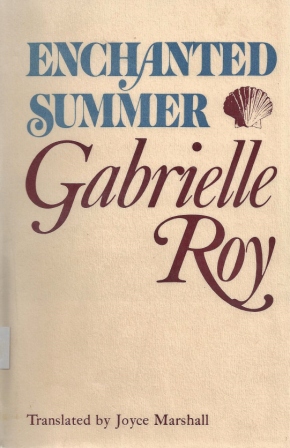
One Woman’s Arctic by Sheila Burnford ~ 1973. This edition: McClelland and Stewart, 1973. Hardcover. ISBN: 0-7710-1825-8. 222 pages.

My rating: 7/10.

This is the account of writer Sheila Burnford’s personal impressions of two summers spent in and around Pond Inlet on Baffin Island, in 1971 and 1972. Burnford had received a Canada Council of the Arts grant to gather material for a book; she accompanied celebrated artist Susan Ross who had been commissioned by the Royal Ontario Museum to create work for an exhibition of art depicting Indian and Eskimo life. The two were longtime friends and travelling companions, having previously spent time living together among the Ojibway of northern Ontario, which she wrote about in 1969’s Without Reserve.

This was a time of cultural shift, as the Inuit embraced and were influenced by modern culture and innovations, while still practicing their traditional way of life to a great extent. Burnford describes her personal impressions, and occasionally tries to pat the larger picture into context, but this is exactly what it says it is in the title – one person’s take on a place too large and complex for generalities to be made, though of course the author occasionally writes as though her observations and conclusions about this small piece of the Arctic apply more broadly. In general, the author keeps to her mandate, which is to tell us about her impressions during her short excursion into the far northern world.

Though it took me a while to work my way through it, now that I’ve completed it I find that ultimately I liked this book, and I enjoyed filling in a few more of the pieces of the author’s life. But it could have been better. What Burnford did so well in The Fields of Noon, though, was talk about herself, her life, her childhood, her family; always in reference to her subject, which made that collection of memoirs so very readable. In One Woman’s Arctic there seems to be more distance between writer and subject, while at the same time the tone is uneven – we’re never sure what “voice” the writer is using because she shifts around so much.

Burnford sometimes maintains an onlooker’s dispassionate view, describing the landscape and the animals and the indigenous people of the small part of the Arctic she visits with a writer’s eye, painting pictures with words. These episodes are very nicely done indeed, and I found that my vision of the scenes from her words were borne out by the pictures I later searched out of the places she visited. Burnford had a rare ability to capture the visual in words.

The weakest parts of the book were when Burnford left the realm of observation and description and ventured into the difficult area of analysis of what she is seeing in regards to the behaviours and motivations of the Inuit (“Eskimos”) she came into brief contact with, or, in the case of the two white mens’ graves at Quilalukan, researched in some depth. Sometimes, as John Mutford points out in his own not particularly favorable review of this book – One Woman’s Arctic by Sheila Burnford – The Book Mine Set Review – the writer falls into the “white man bad/Eskimo good by default” trap. But I felt that she salvaged the situations where she did this by continually acknowledging that she didn’t know if her interpretation was correct; that she was mulling over the situation and trying to make sense of it from her perspective as a very superficial onlooker, and a member of the invading, paternally patronizing race. Burnford never seems to lose sight of the fact that she is a visitor in an alien landscape, and that her comfort and safety rely on the kindness of others.

The episodes I enjoyed the most were when Burnford described the individuals she travelled and stayed with and got to know more intimately. The residents of Pond Inlet, where Burnford and her companion, artist Susan Ross, made their home base in the community’s kindergarten building, are described in lively anecdotal style; Burnford remarks on the fact that no one seems to have anything bad to say about each other, and that she thinks that this is the result of conscious effort on their parts. Referring to the non-Inuit residents of Pond Inlet, the group she and Ross associated with and socially fit in with:

Those who lived here all year round whether teacher, nurse, game warden, R.C.M.P. or administrator, had seemingly developed a safe preservation of peace (outwardly, anyway) attitude to their fellows. One very, very seldom heard any criticism of personalities, but only he/she is so nice/does so much/is wonderful at/ – etc. Occasionally, because one’s antennae were more acutely tuned through being an outsider, one was conscious of tension between certain individuals, but this was rare. I gathered that they had all worked it out during the six months of twenty-four hour darkness…Activities, such as bridge, over which people in cities can tend to become rather maniacal sometimes, were recognized as potential trouble-makers and avoided; and anything involving competition. A good, safe activity, capable of being shared, arousing no jealousy or competition, was that of photography: practically everyone was madly interested in this, and many did their own developing and printing. I have never seen such an impressive array of Hasselblads, Pentaxes, Leicas, etc. as I had up there.

Another contributing factor of harmony – which of course had its overall impact on the general community – was the average age, which was around thirty or under. An age more exposed to today’s precepts of ‘doing your own thing’ and Make Love Not War – precepts very much more in line with the outlook of the Inuit, who have always been a non-aggressive people; and also an age which avoids that difficult menopausal age group, universal elsewhere among those who have made it up to positions of authority, during which strife is commonplace and mayhem (verbal or otherwise) frequent…

An interesting take on the situation, especially as Burnford and Ross were older than the Pond Inlet “white person” average, being in their mid-fifties; one wonders if the menopausal comment was coming from personal experience, or merely through prior observations in the southern world!

Also very readable were the descriptions of the archeological dig at Button Point on Bylot Island under the auspices of the venerable Father Guy Mary-Rousselière; Burnford was present at the discovery of the second Dorset culture (A.D. 500-1000) shaman’s mask found at that site and vividly describes the unique challenges of archaeological exploration in a permafrost zone. Dorset Masks – Canadian Museum of Civilization Treasures Gallery

I found One Woman’s Arctic to be interesting read from my perspective as someone who has never personally experienced the Arctic, though I found it easier to lay aside and read other things concurrently than I did with her other memoirs, Without Reserve and The Fields of Noon. Even though it has some unresolved and unsatisfactory conclusions about northern life and Inuit culture, I think there is much to learn from Burnford’s observations, purely on the natural history aspect of the area she visited. Her descriptions of the human impact on the area, both Inuit and white, are frank and outspoken; Burnford may be looking through wishful rose-coloured glasses occasionally, but she mostly has them off, the better to turn a sharp eye on the details of her surroundings, and she is not afraid to share what she sees.

A snapshot of a time and place now lost in time, from the perspective of a thoughtful and very individual observer. The quality of the writing is excellent through most of the book, though there are occasional awkward phrasings and strangely punctuated passages which I suspect point to lapses on the editor’s part; Burnford, from my past experience with her work, is an accomplished writer not prone to sloppiness.

I would recommend this book to anyone interested in exploring the different regions of Canada, and in particular the far north, though with a reminder that it should be kept in context as one individual’s impressions, and is, unavoidably, now very dated, being written forty years ago.

Read Full Post »

Caught in the rain; vignettes in my July garden. Every afternoon a thunderstorm this past week…

SUMMER STORM

The summer storm comes

        Bolting white lightning; it goes

   Muttering thunder.

Rebecca Caudill, 1976

Read Full Post »

« Newer Posts - Older Posts »