Archive for the ‘1960s’ Category

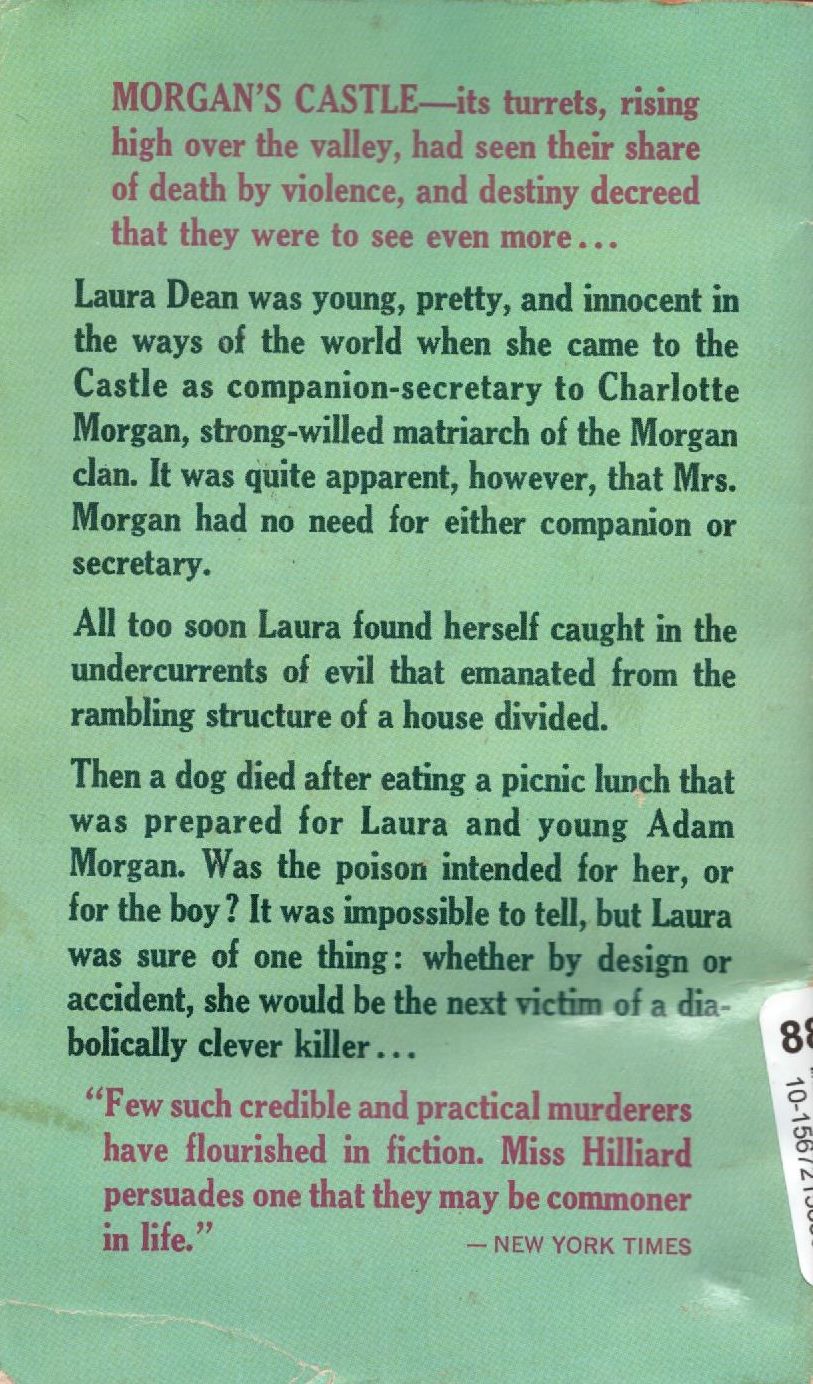
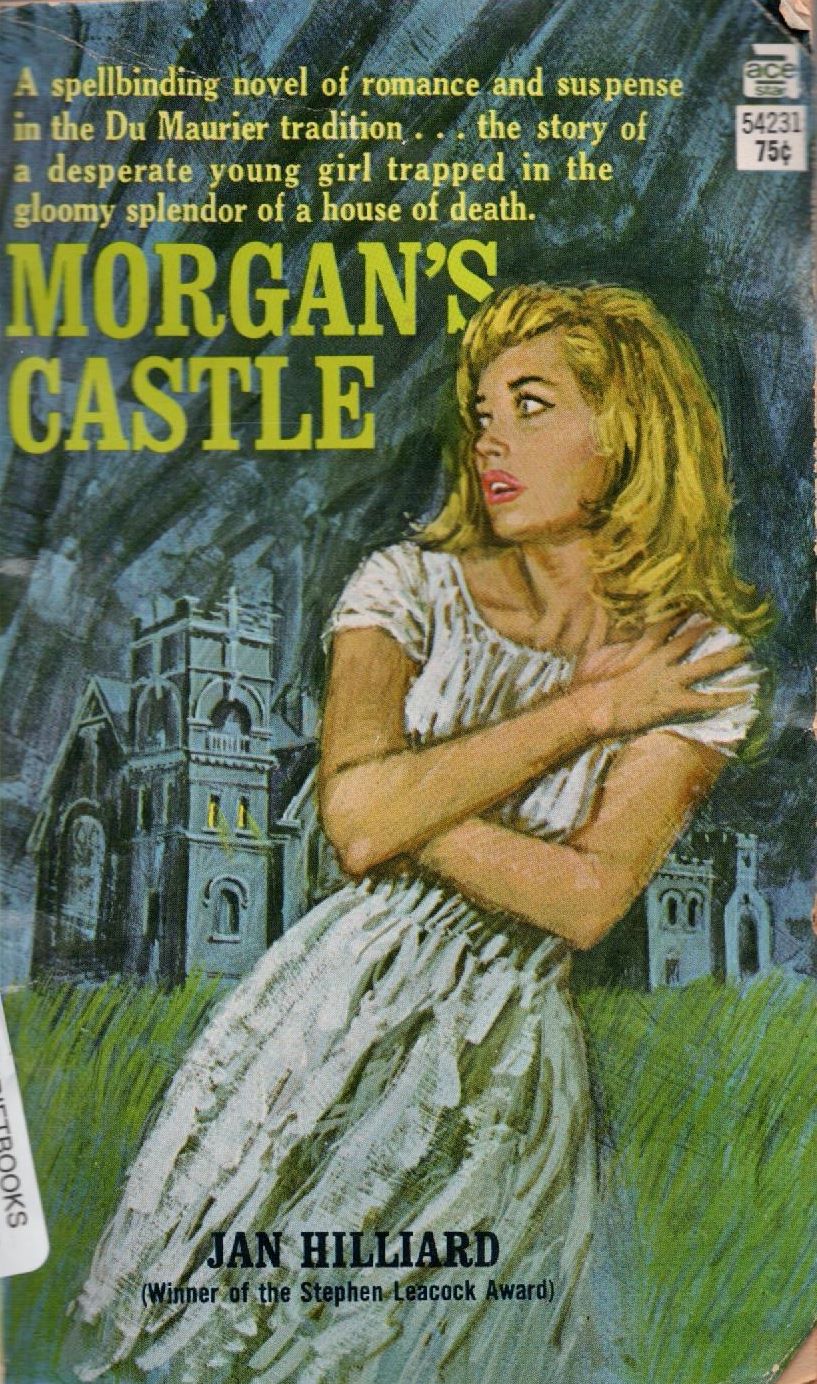
Morgan’s Castle by Jan Hilliard ~ 1964. This edition: Ace, circa 1960s/1970s. Paperback. 142 pages.

Look at that – it’s the last day of January already.

I have been reading quite lavishly all through the past month, but as for posting about those reads, I’m not doing so well. Let’s see if we can remedy that situation with some micro reviews, starting with this strangely entertaining bit of Canadian gothic – more specifically Ontario Gothic – written by the Nova Scotia-born Hilda Kay Grant, under her pen name of Jane Hilliard.

I’ve now read four of Hilliard’s six novels, missing only the Stephen Leacock Award winner The Salt Box, and the rather elusive Dove Cottage, and I have to say it’s been quite the enjoyable ride.

Let’s set the mood with cover scans of my recently acquired vintage Ace paperback edition. (Shout out to Thriftbooks, which I sometimes have recourse to when ABE fails me.)

Our heroine gets the full emotional damsel-in-distress cover portrayal, though that isn’t quite accurate, as sixteen-year-old Laura is remarkably pragmatic and level-headed all through this tale, though sudden death happens behind, in front, and all around her as a dark family secret unravels. This could be because she is a mere teenager, but more likely because, despite her tender age, she has been forced to take on the role of grownup in her relationship with her ne’er-do-well father, Sidney, a mediocre artist over-full of self-regard. Laura’s cynical and seldom-voiced-out-loud observances lend piquancy to this often flat-toned tale.

The Du Maurier comparison on the front cover is vastly inappropriate; this isn’t anything close to that. Hilliard wrote with tongue firmly in cheek, and my impression was rather that this was a full-on parody of the well-explored gothic genre, generously adorned with Canadian references.

I will stop right here; I did say “brief” was my goal.

Takeaway: it’s a Canadiana keeper. It made me heartlessly chuckle all the way through, as the murders got more and more outrageously unlikely. Hilliard shows herself to be divinely callous regarding her lavish disposal of innocent victims – including that dog, a lovable Irish Setter – and if that description intrigues you, and dark humour is your thing, this book might be for you.

My rating: 8/10. Engagingly daft in its predictably unlikely plot.


Read Full Post »

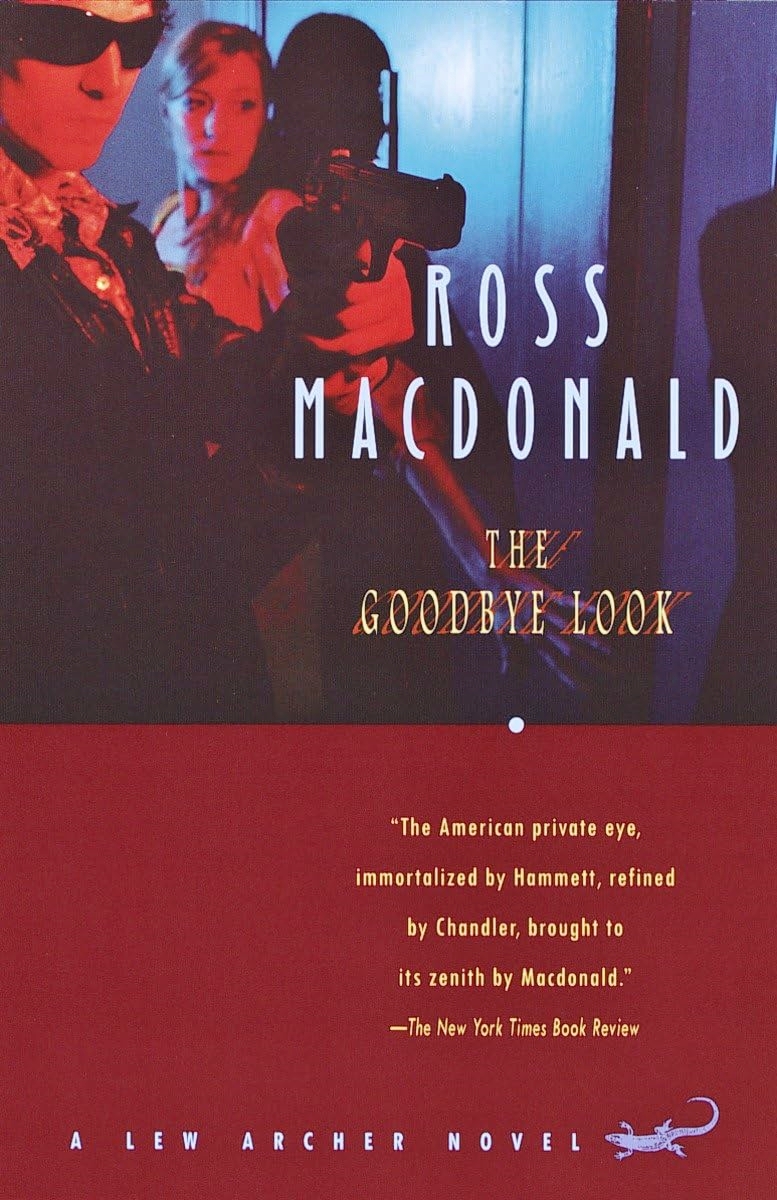
The Goodbye Look by Ross Macdonald ~ 1969. This edition: Vintage Crime/Black Lizard, 2000. Softcover. 243 pages.

The sins of the mothers and fathers are frequently visited upon their children in Ross Macdonald’s masterfully written, shades-of-gray novels concerning the cases of Southern Californian private investigator, Lew Archer. The Goodbye Look is no exception.

In this case, a burglarized safe and a missing golden box containing a son’s wartime letters to his mother leads Archer on a death-plagued pursuit from “California Spanish” mansions to barbed wire fences at the Tijuana border, and back again.

Set in the Los Angeles hills, featuring vivid details and descriptions of the landscape and architecture of a particular place and time, The Goodbye Look feels appropriate reading during this past week of wildfire, destruction and displacement in Macdonald’s beloved corner of the Golden State.

That’s all I’m going to give you of the plot, because what I really want to say about Ross Macdonald is how much of a writer-of-place he is, and how much sheer good writing he packs into these novels. Genre fiction for sure, of the species mystery-noir, but of a decidedly superior sort.

The Goodbye Look is fifteenth in a series of eighteen Lew Archer novels which were published from 1949 to 1976. If you’re not already familiar with Ross Macdonald, pseudonym of American-Canadian Kenneth Millar, I suggest exploring his work. Many of his books are still in print, or are widely available second hand. E-book versions are out there, if that is your chosen format.

My rating: 10/10. Caveat: I re-read Macdonald’s books every few years, so come to them with a certain set of expectations, which are always satisfactorily met. Thinking back to my first introduction to his work, in the late 1970s, as a bookish teenager discovering a well-read paperback copy of The Doomsters on the bookshelf of a family friend while visiting in Los Gatos, California, my recollection is of a doorway opening up into the world of yet another author to explore. Oh, to be ever on the threshold of such discoveries! Such an enduring source of pleasure.

I was enormously pleased to discover, from Brian Busby’s December 2015 post on Kenneth Millar/Ross Macdonald on The Dusty Bookcase, that Kenneth Millar was born in Los Gatos. A full circle moment, as I have a nostalgically good remembrance of that community, and of all of the areas of California I was lucky enough to experience during my childhood and teen years, traveling frequently from our home near Williams Lake, British Columbia (by car, three days each way) to visit my mother’s family and an eclectic array of family friends.

I suspect that one of the personal appeals of Ross Macdonald’s body of work is the evocative experience of recalling those golden days through his writing. Though even if I’d never set foot in California in my life, I’d still rate him as high. Good stuff.

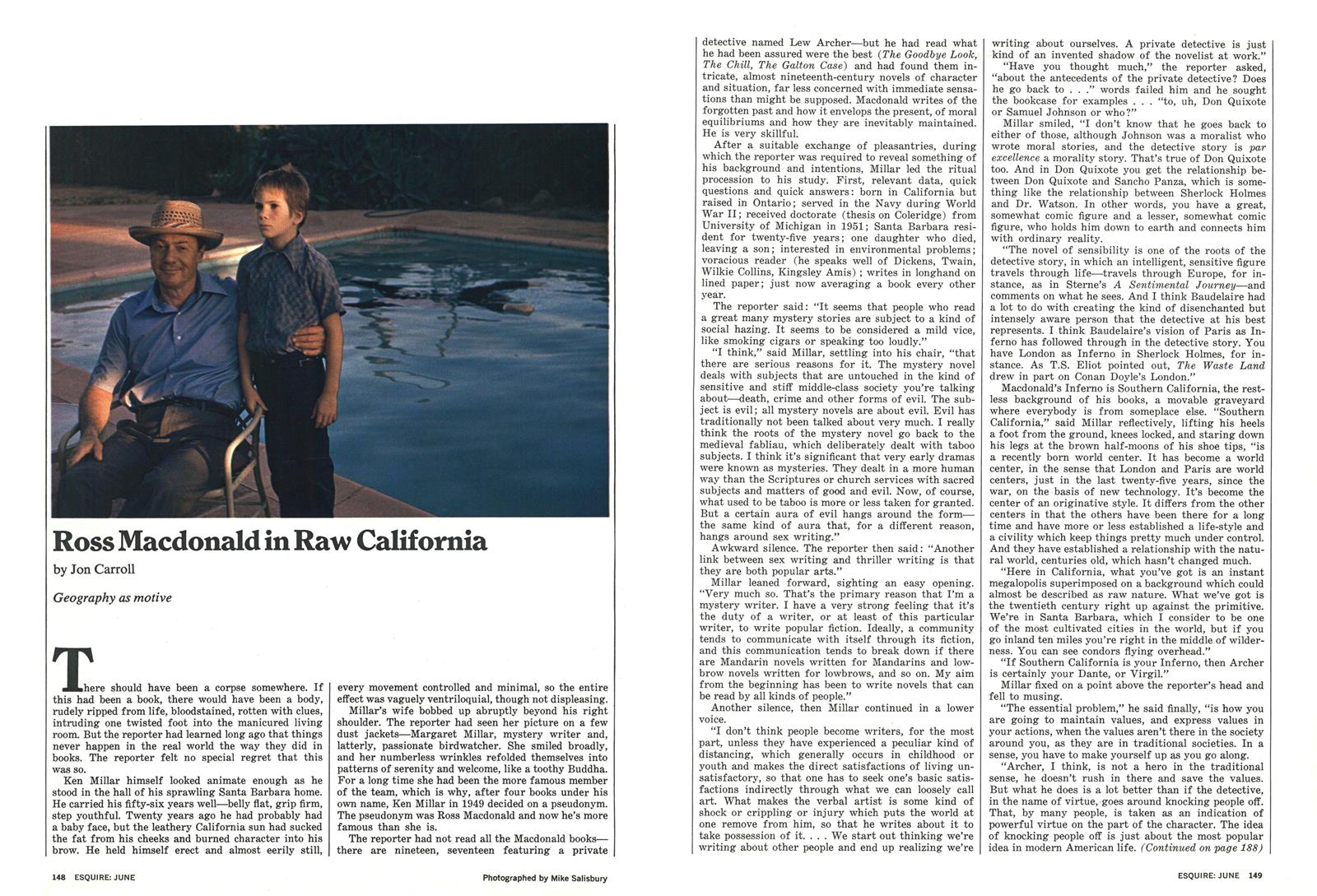
I will leave you with this excerpt from Jon Carrol’s June 1,1972 interview with Kenneth Millar in Esquire magazine. (WordPress is being fussy with linking this morning, but if you Google “Esquire June 1 1972” the whole magazine should pop up in page-by-page format. Be forewarned – you may find yourself reading much more than the Millar article. And possibly mourning the state that physical magazines have come to in these everything-online days.)

“The novel of sensibility is one of the roots of the detective story, in which an intelligent, sensitive figure travels through life—travels through Europe, for instance, as in Sterne’s A Sentimental Journey—and comments on what he sees. And I think Baudelaire had a lot to do with creating the kind of disenchanted but intensely aware person that the detective at his best represents. I think Baudelaire’s vision of Paris as Inferno has followed through in the detective story. You have London as Inferno in Sherlock Holmes, for instance. As T.S. Eliot pointed out, The Waste Land drew in part on Conan Doyle’s London.”

Macdonald’s Inferno is Southern California, the restless background of his books, a movable graveyard where everybody is from someplace else. “Southern California,” said Millar reflectively, lifting his heels a foot from the ground, knees locked, and staring down his legs at the brown half-moons of his shoe tips, “is a recently born world center. It has become a world center, in the sense that London and Paris are world centers, just in the last twenty-five years, since the war, on the basis of new technology. It’s become the center of an originative style. It differs from the other centers in that the others have been there for a long time and have more or less established a life-style and a civility which keep things pretty much under control. And they have established a relationship with the natural world, centuries old, which hasn’t changed much.

“Here in California, what you’ve got is an instant megalopolis superimposed on a background which could almost be described as raw nature. What we’ve got is the twentieth century right up against the primitive. We’re in Santa Barbara, which I consider to be one of the most cultivated cities in the world, but if you go inland ten miles you’re right in the middle of wilderness. You can see condors flying overhead.”

“If Southern California is your Inferno, then Archer is certainly your Dante, or Virgil.”

Millar fixed on a point above the reporter’s head and fell to musing.

“The essential problem,” he said finally, “is how you are going to maintain values, and express values in your actions, when the values aren’t there in the society around you, as they are in traditional societies. In a sense, you have to make yourself up as you go along.

“Archer, I think, is not a hero in the traditional sense, he doesn’t rush in there and save the values. But what he does is a lot better than if the detective, in the name of virtue, goes around knocking people off. That, by many people, is taken as an indication of powerful virtue on the part of the character. The idea of knocking people off is just about the most popular idea in modern American life. But I’m agin it.”

“Well,” said the reporter, “there isn’t anybody in your books who deserves to be knocked off. There aren’t any hiss-and-boo villains.”

“The hiss-and-boo villain died in the nineteenth century,” Millar said. “You know who killed him?” Pause. “Ibsen blamed everybody.”

Read Full Post »

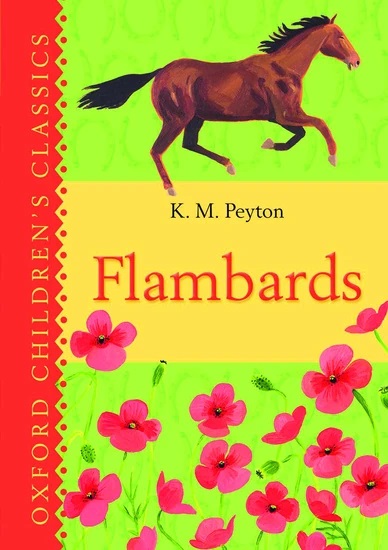
Flambards by K.M. Peyton ~ 1967. This edition: Oxford University Press, 2007. Hardcover. 227 pages.

This will be a sketchy sort of review. This novel is so well known that anything I have to say will probably have already been said.

Much of what I do have to say here is reasonably complimentary, with caveats. I do appreciate K.M. Peyton, a prolific and popular writer who died this past December at the age of ninety-four.

Flambards is probably the most prominent of her dozens of youth/young adult novels, but it is not my own personal favourite of her works. I think I would have to say that her Ruth and Pennington arc of six novels is more compelling to me personally. And the stand-alone novel A Pattern of Roses is a bit of a quiet stunner. But more about those later this year, I think. They are all piled up waiting a re-read at some point.

Back to Flambards. Though it’s often relegated to “children’s book” categorization, it’s pretty darned “adult” in many of its themes. Think National Velvet, another “juvenile” “horse book” which really isn’t a horse book, and really isn’t a juvenile, either. The horses are important, but only in relation to the main characters. Four-legged set dressing, in a way.

Twelve-year-old Christina, an orphan since the age of five, is sent to live at her widowed and crippled uncle’s mostly-male-inhabited establishment, a troubled country estate called Flambards. Uncle Russell and his older son Mark are utterly horse-mad. The stables are spotless and up-to-date; the house is decidedly neglected. Younger son William is scorned by his father and brother for his slight stature, his intellectual abilities, and most of all for his lack of true enthusiasm for all things equine, though he’s expected to participate in the usual horse-related activities such as hunting, with devastating results.

Christina enters the house just as William is being brought home on a sheep-hurdle, leg smashed from a mishap while hunting. She forms a rather furtive friendship with William during his recuperation, though she is out of sympathy with him in one major way. Christina finds that she is also enraptured with horses and riding.

There’s a bit of a back story, revealed very early on, which frames the story. Young Christina is something of an heiress, with a fortune held in trust, and the reason she was invited to live with her Uncle Russell was so she might possibly be a suitable husband (once grown up) for her cousin (half cousin?) Mark. The money is already earmarked for sinking into the Flambards estate.

Christina is a survivor, and she further refines her get-through-it technique as the years slide by. Uncle Russell and Cousin Mark continue to bluster and bully, while William quietly crafts his exit strategy from an absolutely toxic family situation, with Christina carefully navigating the territory in between.

The novel starts out with deep drama, and the trend continues right through to the end, which is, in my opinion, a bit too unlikely and awkward feeling. It didn’t sit completely well with me, hence my personal rating of 7.5/10.

Flambards is a decently enjoyable read, but none of the characters ever won my full affection, and by the end I didn’t really care all that much about who ended up with who, or what would happen to Flambards itself.

Turn the page, close the book, set it aside. It did not occupy my thoughts in the days  after reading it, as the best books do. But nonetheless it’s a keeper, and has a permanent shelf space in the K.M. Peyton stack. I’ve read it a few times over the years, and likely will again.

Flambards was a popular success and received several high profile children’s fiction awards. It was followed by two sequels in 1969, a well-received television mini-series in the 1970s, and a fourth postscript novel in 1981.


Read Full Post »

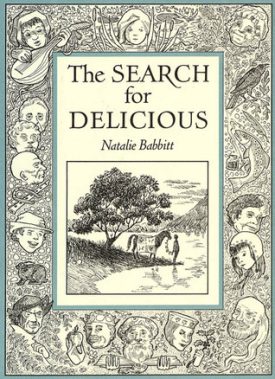
The Search for Delicious by Natalie Babbitt ~ 1969. This edition: Farrar, Straus and Giroux, 1969. Hardcover. 159 pages.

This book is a treasured survivor from my childhood bookshelf, and I hold it in very fond regard. It’s a short and efficiently written morality tale of sorts, and is saved from preachiness by its charm and wry humour.

Some time ago, in a small, imaginary kingdom, the Prime Minister is writing a dictionary. Everything is going swimmingly, until it suddenly isn’t.

The Prime Minister returns to his rooms after showing his progress to the King, and relates what has just happened to his twelve-year-old adopted son Gaylen.

“I went down, you see, to show the King how far I’ve gone with my dictionary. He was pleased with the first part. He liked ‘Affectionate is your dog’ and ‘Annoying is a loose boot in a muddy place’ and so on, and he smiled at ‘Bulky is a big bag of boxes.’ As a matter of fact, there was no trouble with any of the A’s or B’s and the C’s were fine too, especially ’Calamitous is saying no to the King.’ But then we got to ‘Delicious is fried fish’ and he said no, I’d have to change that. He doesn’t care for fried fish. The General of the Armies was standing there and he said that, as far as he was concerned, Delicious is a mug of beer, and the Queen said no, Delicious is a Christmas pudding, and then the King said nonsense, everyone knew the most delicious thing is an apple, and they all began quarreling. Not just the three of them – the whole court…”

This seems like a minor episode, and Gaylen laughs it off, but the Prime Minister isn’t so optimistic. And he’s right. The Court is soon in an uproar, and the ripples are spreading throughout the kingdom. There’s even talk of a civil war, boosted along by the Queen’s wicked brother, Hemlock.

One thing leads to another, as things tend to do in fairy tales, and Gaylen finds himself tasked with undertaking a survey of the entire kingdom, visiting every dweller there within to record each individual’s choice for Delicious. He sets off on his trusty steed Marrow, and it’s all a lovely adventure, until he discovers that Hemlock is out on a mission of his own, stirring up dissent and spreading false tales of the King’s motivation for asking Gaylen to record everyone’s choices.

This is a fast-moving story, and Babbitt packs a lot into it, with characters ranging from the optimistic Gaylen and his fellow human countrymen to an assortment of almost-forgotten creatures, such as the dwarfs in the mountains, woldwellers in the forests, mermaids in the lakes, and winds in the air.

Gaylen’s journey round the kingdom turns dark and dangerous, and disaster looms, but in proper fairy tale tradition, his kind and fair-minded actions and reactions are rewarded, though not without some close calls.

This is a fantastic story to read aloud to your young people, or perhaps to enjoy for yourself on days when you might need cheering up from the woes of the real world. Never mind that it’s classified as a “juvenile” – it’s a well-crafted tale, and that is always worthy of appreciation, and the adult reader will enjoy what Babbitt has done here.

My rating: a staunch 10/10. And if you do find yourself in possession of this little book, I hope it’s a version that includes all of Babbitt’s  original pen-and-ink illustrations in the chapter headings. They are delightful.


Read Full Post »

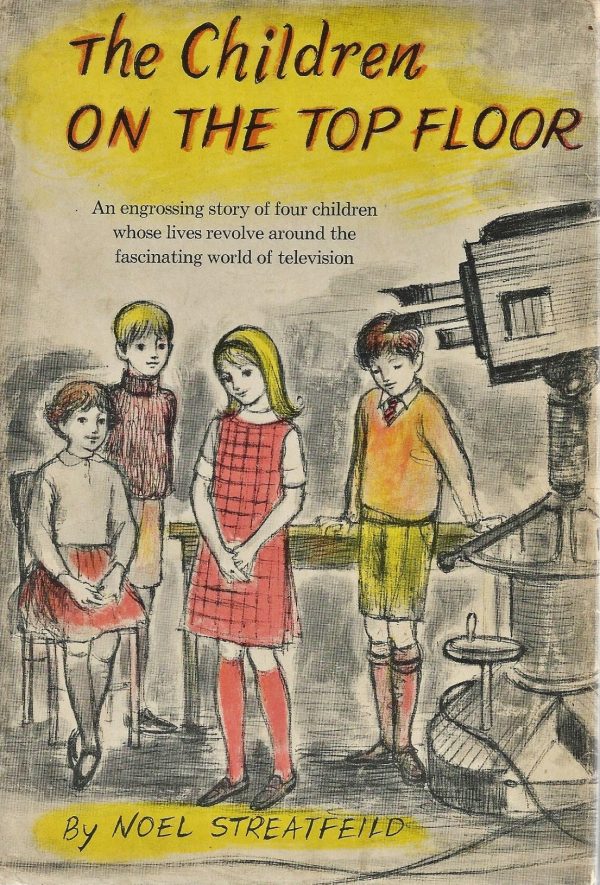
The Family on the Top Floor by Noel Streatfeild ~ 1964. This edition: Random House, 1965. Hardcover. 248 pages.

Goodness, look at that calendar! Almost March. Well, I’ve been getting in a respectable amount of reading time – it’s still dark in the evenings and we are still snowbound, so outside garden work hasn’t ramped up yet – and the pile of books-I-want-to-talk-about is really stacking up. I likely won’t get to them all, unless I whip off a slew of 100-word micro-posts (now there’s a tempting thought!) but hey, we do what we can.

Suspend your disbelief – and maybe your expectation of quality storytelling – when you crack the pages of this deservedly obscure Streatfeild juvenile.

Malcolm Master is a stunningly successful television personality. The whole of England hangs on his every word, and of course his cleverly produced Christmas Eve broadcast is something extra special. Malcolm stares the camera right in the eye that fateful night, and declares in a voice quivering with apparent sincerity,”Christmas is not Christmas without children. You cannot guess what this old bachelor would give to wake tomorrow morning to the squeals of delighted children opening their stockings.”

Be careful what you ask for, Mister Master. Because guess what appears on his doorstep bright and early Christmas morning, just in time for the milkman to carry inside?

Yup. Four wee babies. Two boys, two girls, all of approximately the same age, and each apparently well fed and cared for and accompanied by anonymous and sadly inane Christmas cards from four different mothers.

I was quite enthralled by this development, thinking to myself, “Aha! Children of our hero’s indiscretions, a la The Whicharts!” (For those unfamiliar with that odd little tale, it’s essentially Ballet Shoes for grownups, with the children landed on the doorstep of their father being the offspring of his ex-lovers.)

Well, this idea was soon put to rest, as these random babies do not get any backstory at all, and no one ever seems to inquire about their origins, and they are immediately absorbed into the household which is conveniently staffed with an assortment of “cottage loaf shaped” mother figures who glom on to the babies and whisk them away to be raised in seclusion on the top floor of Malcolm Master’s stately home.

The children are named after nursery rhyme characters and are raised in a certain degree of luxury, because they soon are introduced to the starstruck nation as Malcolm Master’s “quads”, stars of numerous television commercials advertising a wide range of products with attached sponsorship deals which clothe and feed and house the children with the very products they are used in touting.

Malcolm himself really doesn’t have much to do with the children – they’re very much in the background as he goes about whatever it is he does to keep his own star shining bright, so when disaster strikes in the form of a heart attack brought on by overwork, and a subsequent sea journey to recuperate, the children and their well-meaning pseudo-mothers are left to get on with things as best they can. For Malcolm has inexplicably not had the foresight to arrange for the care and feeding of his many human responsibilities, and money starts to get tight. Oh, dear, what shall we do? Who will care for the children now that the Master money has (apparently) run out? They may have to go to an ORPHANAGE!!!

Um, okay. I can think of quite a few options, but hey! – most of them would be quite sensible and not very exciting, plot wise.

This is essentially the hackneyed Ballet Shoes formula, first trotted out to great success in 1936, transposed to 1964, with the Wonderful World of Television and the Master’s children’s eventual preoccupations and probable future careers – actress, costume designer, cameraman, film engineer – taking the place of the Fossils’ performing arts focus.

There’s so much more I could say, meanly deconstructing this flat little fairy tale episode by episode, but I will leave us right there. A peek at the Goodreads page shows quite a few readers retaining very fond memories of this one, and that’s fair enough. I came to reading Noel Streatfeild as an adult, so there is no childhood nostalgia to temper my reactions to the more far-fetched of her literary efforts.

Her best books – of which there are a respectable number – are very good indeed. Her middle-of-the-pack efforts – very readable in a “light entertainment” sort of way. And some never really get off the ground, and for me this was one of those.

The Children on the Top Floor starts out with oodles of promise, and it could have been charming and quite funny, but unfortunately it soon fizzled out. With 248 pages to work with, it’s not as if there were space constraints, but Streatfeild must have been jaded when she picked up her pencil on this one.

To be fair, an awful lot of 1960s’ and 1970s’ children’s books were pretty dire – it was, after all, the beginning of the incredible proliferation of young audience targeted “themed” and “problem novels” still plaguing us today, churned out with hyper-focus on the chosen topic to the neglect of strong character development and vivid storytelling.

My rating: 3.5/10.

My late mother, book-a-day reader extraordinaire, who always was happy to delve into a quality “children’s book”, would have categorized this one as a “dull thud”, and that’s where I sadly have to put it too.  This writer could do better. If you don’t remember it as a favourite childhood read, perhaps best appreciated by the Streatfeild completest.


Read Full Post »

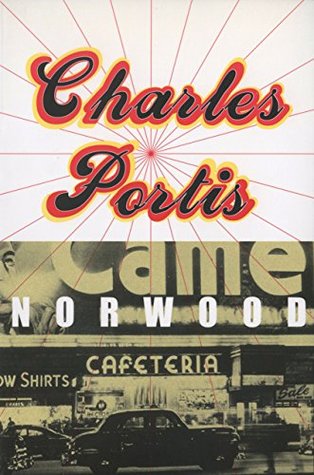
Norwood by Charles Portis ~ 1966. This edition: The Overlook Press, 1999. Softcover. 168 pages.

Trigger warning. I think I need to put this out there in a prominent place – this book has era-expected language, meaning in this case that you will come right up against the n-word, multiple times. It’s generally used in a derogatory way by a key character – not our eponymous protagonist, which was a great relief to me – but one of the unsavories he comes in close contact with.

Reading with 2022 eyes, I have to say I stopped dead when I hit the first occurrence, and thought exceedingly hard about where we’ve come with our current hyper-sensitivity to problematic language.

Which I think is one of the main reasons why we shouldn’t ban or censor books from a time before – we should feel repugnance and we should take time to consider how and why our personal and societal attitudes have changed.

And this is all I will say about that, because I am well aware that opinions on tolerance of and censorship of currently unacceptable language in writings from a prior era will differ. Every reader of vintage fiction is going to have this conversation with themself as things pop up.
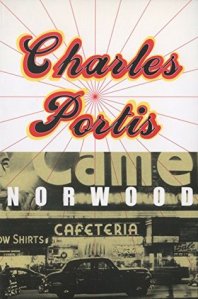
If you’re still wanting to stay with me on this one, let’s take a look at this book, this weird and rather fantastic (in every sense of the word) road trip tale. It’s kind of like a stream-of-consciousness fever dream, and it’s brilliant.

Norwood Pratt, just back from Korea, is now an ex-Marine. He’s also now an orphan – his mother is dead, his father has just died – and the feeling back home in Norwood’s current home town (the family’s moved around a lot) of Ralph, Texas is that Norwood needs to come on back home and look after his sister Vernell. She’s taking things hard, and she never really was that viable a specimen even before the latest bereavement, so there’s nothing for it but that Norwood take a hardship discharge and get back into civilian life.

Norwood is on the bus heading back to Texas from Camp Pendleton in California when he realizes that he’s forgotten to collect a debt owed him by one of his Marine buddies. It’s $70, not exactly a fortune, but it’s the principle of the thing, thinks Norwell, and he decides to settle down for a prolonged sulk as the bus rolls eastward.

The sulk doesn’t last long, as Norwood almost immediately befriends a young couple with a baby, transient vegetable pickers heading back to Texas with their California asparagus-season money. He invites them to come and stay for a few days, and our story is on.

Sometime during the night the Remleys decamped, taking with them a television set and a 16-gauge Ithaca Featherweight and two towels. No one could say how they got out of town with all that gear, least of all the night marshal. The day marshal came by and looked at the place where the television set had been. He made notes.

If Norwood has a weakness, it might be that he’s sometimes too trusting. But as subsequent occurrences go to show, he’s far from naive.

Back to his old job at the Nipper Independent Oil Co. Servicenter, Norwood settles down to looking after his still-depressed sister and doing all the cooking and housekeeping.

Sometimes he sat on the back steps wearing a black hat with a Fort Worth crease and played his guitar – just three or four chords really – and sang “Always Late – With Your Kisses,” with his voice breaking like Lefty Frizzell, and “China Doll” like Slim Whitman, whose upper range is hard to match. The guitar wasn’t much. It was a cheap West German model with nylon strings he had bought at the PX. He also put in a lot of time on his car. He had bought a 1947 Fleetline Chevrolet with dirt dobber nests in the heater and radio for fifty dollars. He put in some rings and ground the valves and got it in fair running shape. He loosened the tappets and put up with the noise so as to keep Vernell – who would race a motor – from burning the valves. She burned a connecting rod instead.

Norwood is good hearted and patient, and a darned good brother, but life feels flat to him.

One night he came home from work and said, “I’m tard of working at that station, Vernell.”

“What’s wrong, bubba?”

“Every time you grease a truck stuff falls in your eyes and your hair and down your back. You got it pretty easy yourself yourself. You know that?”

“Why don’t you get a hat?”

“I got plenty of hats, Vernell. I don’t need any more hats. If all I needed was another hat I would be well off.”

“What do you want to do?”

“I want to get on the Louisiana Hayride.”

Yes, Norwood has a secret longing to be a country and western singer, and the prospects are darned poor for that, and he’s starting to get depressed and even a little bit angry. Brooding away about the injustices piling up in his life, he decides to hunt down the debt owed to him by his old army buddy.

So Norwood leaves Ralph, driving an Olds 98 and hitch-pulling a Pontiac Catalina, both gleaming with fresh new paint. He has a commission from one Grady Fring (“the Kredit King”) to deliver the cars (and an unexpected passenger) to New York and return with another car, his payoff a chance to see the country and $50 in driving fees. Works out good, thinks Norwood, for he has a line on his army buddy who him the $70 – the guy was last heard from in New York. Win-win.

Well, things immediately go sideways, and inside out, and upside down. You have to read this yourself to find out all the many details, but I will tell you that during his travels, Norwood hops a freight train, meets a lot of interesting people, including Mr. Peanut, and the world’s smallest perfect fat man. and a beatnik girl who reads him passages from Kahlil Gibran’s The Prophet but doesn’t commit herself so far as to go to bed with Norwood, which leaves him mildly disappointed but he gets over it. Along the way he loses his precious cowboy boots – thirty-eight dollars, coal-black 14-inchers with steel shanks and low walking heels, red butterflies inset on the insteps – and he never gets on the Hayride, but he gains a few things, too. Including a college-educated chicken and a lady-love. Could be worse.

I will leave you with one of my favourite snippets from this goofy little book. Here’s Norwood in New York, contemplating tattoos.

There was a tattoo parlor and Norwood looked at the dusty samples in the window. He had a $32.50 black panther rampant on his left shoulder, teeth bared and making little red claw marks on his arm. He had never been happy with it. Something about the eyes, they were not fully open, and the big jungle cat seemed to be yawning instead of snarling. Norwood complained at the time and the tattoo man in San Diego said it wouldn’t look that way after it had scabbed over and healed. Once in Korea he sat down with some matches and a pin and tried to fix the eyes but only made them worse. Many times he wished that he had gotten a small globe and anchor with a serpentine banner under it saying U.S. Marines – First to Fight. To have more than one tattoo was foolishness.

Norwood knows what he thinks.

This was Charles Portis’s first published novel, and it was very well received. Very much a product of its free-wheeling time – and one has to wonder if Mr. Portis was indulging in something illicitly mood-enhancing when he rattled this one off, but it comes together just right, in a we’re just along for the ride sort of way. 

I feel like Norwood is very much a dress rehearsal for 1976’s much longer, more complex, but pleasingly similar The Dog of the South, one of my personal secret treasure books.

Now, your own mileage may vary on Charles Portis. My husband, who shares many but not all of my reading tastes, isn’t a huge fan of either Norwood or The Dog of the South, though he laughs along with me at some of the absolutely deadpan humour. Portis can sure nail inner thoughts and dialogue.

No, he (my husband) is something of a traditionalist – he much prefers Portis’s most well-known and likely most popular book, True Grit. (Yes, this is that Charles Portis.)

Me – I like ’em all. Too bad there are so few. Five novels. Not nearly enough.

My rating: 9/10. It would be a 10, but it’s just too short. So many questions left unanswered!

For the record, this novel was made into a 1970 movie starring Glen Campbell as Norwood. Major liberties were apparently taken to Hollywood-ize it – very likely so Campbell could showcase his musical chops. (He also played and sang on the soundtrack.) Full disclosure: I just watched the first ten minutes of this on YouTube. It was…regrettable. Please read the book first. Or better yet, instead of. (Sorry, Glenn.)

Read Full Post »
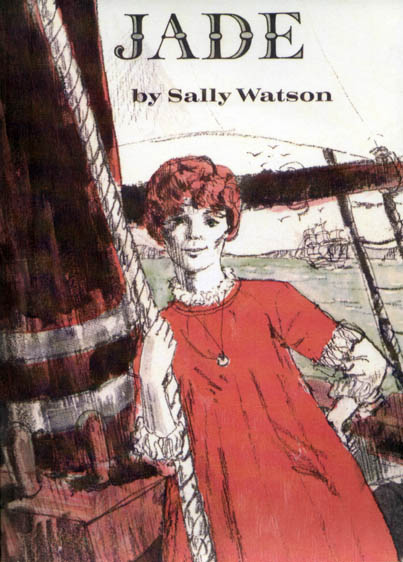
Jade by Sally Watson ~ 1969. This edition: Holt, Rinehart & Winston, 1969. Hardcover. 270 pages.

I had the good fortune to be in elementary and high school during the 1970s, when Canadian public school library budgets were generous and the collections vast and varied.

During these formative reading years, I toted home large stacks of books, many of them fated to be read by illicit flashlight after mandatory lights-out time.

Sometimes my flashlight batteries gave out, and I also remember crouching in the hallway outside my bedroom surreptitiously reading by the faint gleam of a plug-in night light. I tried my best to be silent and unnoticeable, but my timing was sometimes off and I occasionally was busted by my dad, who was not particularly impressed by my initiative. My bookwormish ways were inherited directly from him, but he was the adult and I a mere child, with school and chores the next day, and he chose to view my nocturnal reading activitity as an act of rebellion against his preferred status quo, and his rebukes were memorably stern.

Which perhaps might be one of the reasons I felt such a strong kinship with the heroines of Sally Watson. She specialized in well-researched historical fictions with strong, teenage female leads, and perhaps the most memorable of all of these was the unquenchable Melanie Lennox, a.k.a. “Jade”: green-eyed, opinionated and outspoken sixteen-year-old resident of colonial Williamsburg, circa 1721.

Jade gets up to all sorts of unladylike adventures, and anyone familiar with this genre will nod in recognition when I mention that young Jade gloried in the forbidden-for-females actions of rising astride, dressing up in boy’s clothing,  learning fencing on the sly, and, most audaciously in the society and era that she lived in, railing against the evils of slavery.

Jade finally goes too far and is shipped off to Jamaica to reside with her fluttery aunt and stern Prussian uncle. Uncle Augustus is well known for his mastery of horses, slaves and women; he will surely be able to tame one small teenage girl.

Ha!

Jumping over all sorts of detail, I will merely divulge that after some adventuring our Jade finds herself a member of a pirate ship’s crew, eventually plying her skill with a rapier alongside none other than Anne Bonny and Mary Read.

As far as juvenile fiction of the 1960s and 70s went, Sally Watson’s work was pretty darned decent, enough so that I remember in quite vivid detail, some forty years later, episodes from all of her novels.

Sally Watson’s bent was historical fiction, with characters linked in quite creative ways as she passed through the centuries from the 1500s onward. Though Sally Watson was American, born in Seattle in 1924, she had a special fondness for all things Scottish, and at least two of her novels were set in Scotland, with the ancestors of those heroines popping up in other places in her tales.

I started my current reading of Jade with some trepidation, hoping that it would reward me with the thrill that my long-ago twelve-year-old self experienced during those stolen midnight reading hours. Alas! the magic was not quite recaptured, though every word was as familiar as yesterday.

This said, I would be most open to reacquainting myself with the rest of Sally Watson’s long-lost tales. They were snapped up quickly as library shelves were purged during the great school library downsizings of the 1990s and beyond, and hardcover ex-library copies are ridiculously scarce, but a republishing of some titles by Image Cascade has put Sally Watson back into circulation.

I’ve just ordered a copy of Sally Watson’s autobiography, Dance to a Different Piper, published in 2015, and I must say I am looking forward to learning more about this opinionated and multi-talented writer, as the biographical snippets gleaned from the endpapers of her books are most intriguing: a membership in Mensa, extensive traveling, Highland dancing, judo, cats, fencing and gardening are all noted as strong interests of this well-rounded individual.

Read Full Post »

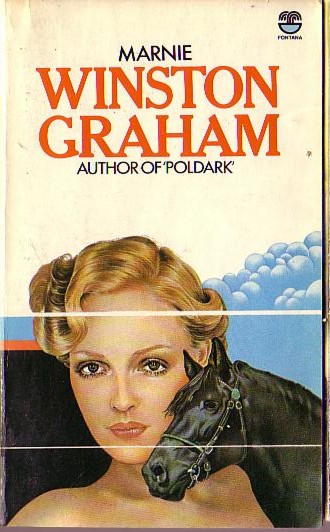
Marnie by Winston Graham ~ 1961. This edition: Fontana, 1980. Paperback. ISBN: 0-00-615964-8. 253 pages.

Does that title sound familiar? It should. This novel was turned into the 1964 Alfred Hitchcock movie of the same name, starring Tippi Hedren and Sean Connery. I seem to recall hearing that Grace Kelly was Hitchcock’s first choice for the title role, but that she turned it down as she was already heavily involved with her arrangements to become Princess of Monaco, and it wasn’t felt quite suitable that she should play the role of a fictional thief.

For that’s what Marnie is, a thief, and a rather good one. Her modus operandi is the same each time: get a bookkeeping job in the office of some small business, plot out an opportunity for quietly absconding with the payroll or a large portion of the week’s income, then vanish, to reappear in another city with a newly invented identity.

Marnie needs money, quite a lot of it, more than she can get her hands on in the course of legitimate office worker employment, for she supports not only her crippled mother in a respectable separate establishment in Plymouth, but her secret (and possibly only) true love, an ex-racehorse, Florio, living at a boarding stable.

Marnie is a woman with twisted and tortuous personal issues, which come to a head on secret identity job number four, in which she attracts the fanatical attention of two of her employers: the recent widower Mark Rutland, and Mark’s despised playboy cousin, Terry Holbrook. Marnie lets herself get involved with these two disparate men, something utterly against her hands-off policy in the past, and things come crashing down, as Mark discovers her embezzlement, covers for her, and then uses his knowledge to blackmail her into marriage.

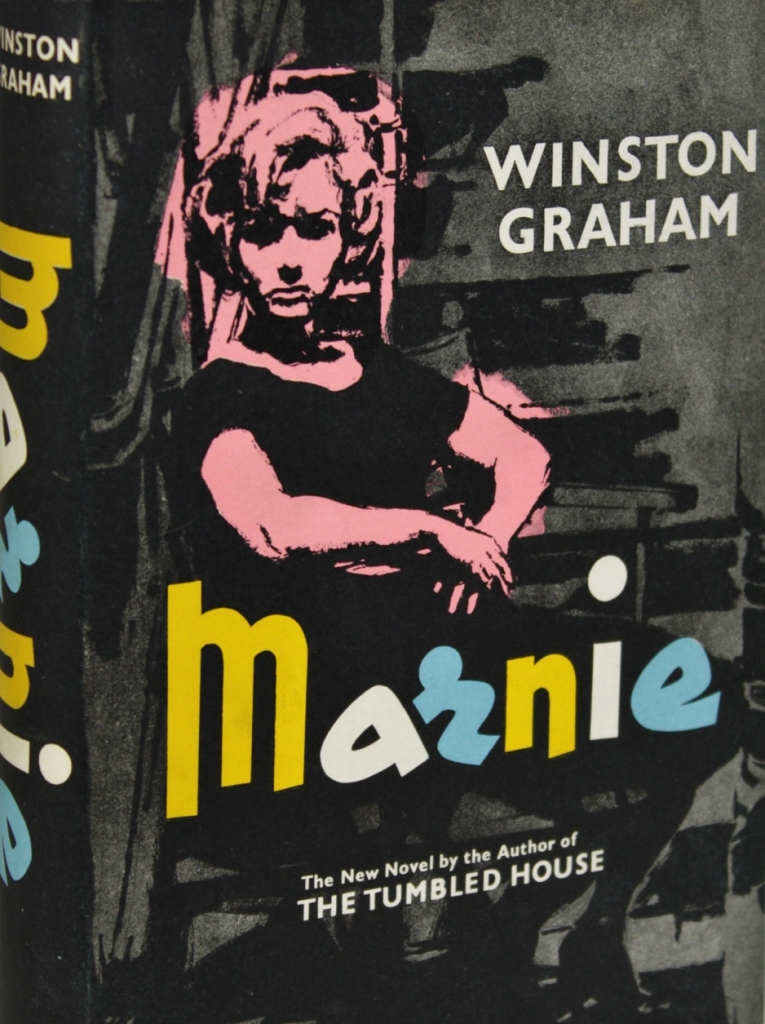
1st edition cover, 1961.

Terry sniffs around, knowing something off is up, and ultimately brings about a full exposure of Marnie’s wicked past, but not before a lot of psychological drama, revealing the true reasons for Marnie’s sexual frigidity and her inability to form normal relationships and so on. (Not very surprising spoiler: Mom’s involved.)

This is a decidedly convoluted novel, and it’s rather a compelling read, though at a few points I was silently shouting to the author, “Stop, already! Don’t add another twist!” It’s all rather dark, and occasionally deeply disturbing (the honeymoon spousal rape scene, the horrible death of Florio), and for quite a while there it looks like the ultimate tragedy will indeed play out, as Marnie mulls over ending it all in the most final of ways.

Winston Graham spares us that, and even offers us a glimpse of the possibility of eventual peace for our desperately damaged heroine, once she has confronted all of the repercussions of her past.

Another interesting novel. Very readable. Definitely a period piece, giving a fantastically detailed picture of a certain segment of 1950s’ British society.

My rating: 9/10. It lost a point because there was a fair bit of tell versus show, and some of the drama flourished into melodrama, but all in all “good job” to Graham for successfully putting forward such an audaciously engaging scenario.

I haven’t actually seen the Hitchcock film version (I understand that it is not particularly true to the novel except in the broader way), but I find it extremely intriguing that the story has just been reworked (again with a lot of liberties regarding the original) into an opera by Nico Muhly. It’s playing at the Met RIGHT NOW. I wish I lived closer to New York; I’d go see this in a flash.

Oh, yes. A word about the author. Winston Graham is indeed that Winston Graham. Poldark, anyone?


Read Full Post »

Hand in Glove by Ngaio Marsh ~ 1962. This edition: Collins (Crime Club), 1962. Hardcover. 256 pages.

Prissy Mr. Pyke Period, elderly confirmed bachelor, delights in his comfortable life and in his reputation as a skilled crafter of charming epistles, in particular the exquisitely tactful condolence letter.

Disturbing indeed to Mr. Period’s carefully nurtured savoir-faire is the discovery that his latest letter has gone somewhat astray, being delivered to the wrong party, whose loved one shortly thereafter turns up gruesomely dead, crushed to death under a sewer pipe in a drainage ditch right outside Mr. Period’s very window.

The usual disparate assortment of potentially suspicious characters for this sort of traditional whodunnit is on hand to spin out the tale and give Ngaio Marsh’s pet team of detectives – Alleyn and Fox – their usual round of interviews, before their inevitable and apparently effortless solving of the crime. (Even easier than usual, one presumes: the clues in this one were large and glaring.)

Suspects include the tittering Mr. Pike, the murderee’s objectionably hearty sister, a pair of vaguely “Beatnik” young degenerates (Moppett and Leonard), Mr. Pike’s sprig-of-the-minor-aristocracy secretary Nicola, aspiring young artist Andrew, Andrew’s mother (Desirée, Lady Bantling, who also happens to be the murderee’s ex-wife), Bimbo Dodds (Lady Bantling’s third and current husband), and a few etceteras.

There are minor red herrings and various complications, including a boisterous scavenger hunt to celebrate April Fool’s Day, during which the fatal event takes place, but it doesn’t take long for our detectives to zero in on the guilty party. Peace presumably now returns to the village.

All in all, not one of Ngaio Marsh’s A-list, though, as with Agatha Christie’s oeuvre, even the B-list is readable. As with most of Ngaio’s books, Hand in Glove is mildly humorous throughout, which makes up for a lot.

By midnight the winning pair had presented themselves with their prize, a magnum of champagne. They were inevitably, Moppett and Leonard, all smiles, but with a curious tendency to avoid looking at each other. Leonard was effulgent in the matter of cuff-links and lapels and his tie was large and plum-coloured. Bimbo looked upon him with loathing, gave them both drinks and put a jazz record on the machine. Leonard with ineffable grace extended his hands towards Desirée. “May we?” he said and in a moment was dancing with her. He was a superb dancer. “Much too good,” she said afterwards. “Like the really expensive gigolos used to be. He smells like them too: it quite took me back. I adored it.”

Bimbo, sulking, was then obliged to dance with Moppett who made business-like passes at him. These exercises were interrupted by the arrival in straggling pairs of the rest of the treasure-hunters, Nicola and Andrew being the last to come in: looking radiantly pleased with themselves…

My rating: 5/10

Read Full Post »

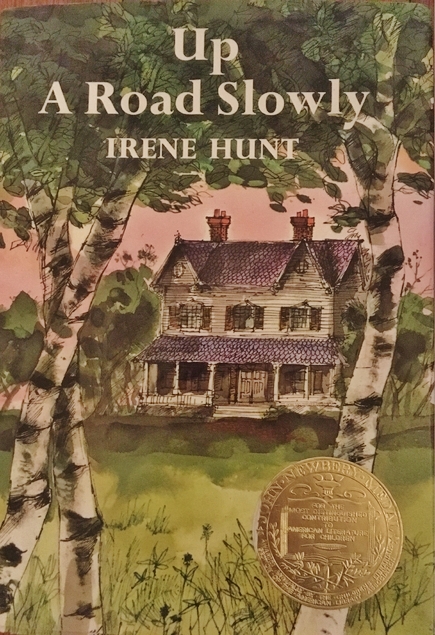
Up a Road Slowly by Irene Hunt ~ 1966. Follett Publishing, circa 1970s. Hardcover. ISBN: 0-695-49009-5. 192 pages.

Here we have that familiar creature, the vintage bildungsroman. A fine example, to be sure, but a member of a vast common flock.

There are numerous other titles of this ilk still to be found on high school library shelves everywhere; this is not a condemnation, merely an observation.

Somewhere in the United States – midwest? New England? – seven-year-old Julie has just lost her mother to an unspecified illness which they both have shared. Youngest of a sibling group of three – older sister Laura is seventeen, brother Chris the middle child – Julie is sent off to the nearby country home of her mother’s unmarried sister, Aunt Cordelia, a stern and highly regarded teacher at a rural school.

The novel follows Julie along as she navigates her way through the usual childhood and adolescent experiences of someone growing up in the American small-town world of the mid-20th Century. (We never get a firm date as to when this all happens, though clues point to it taking place in the 1940s or 50s. Possibly earlier?)

Young Julie has been an indulged small child with all of the expected attitudes and mannerisms thereof; her aunt strives to mold her young charge into responsible and thoughtful personhood. She succeeds, though it takes ten years. We leave teenage Julie as a younger version of Aunt Cordelia, albeit with a happier love affair in hand than Cordelia experienced in her previous turn.

In the course of this well-presented, gently paced micro-saga (there is a major clue in the title, that “Slowly” is most apt), our heroine comes to terms with her inner flaws and weaknesses, and grows into a likeable young woman of some accomplishment.

Bumps in young Julie’s personal road have included that early traumatic loss of her beloved mother, her older sister’s departure into happy married life with diminished focus on a younger sister, a mildly ne’er-do-well alcoholic uncle living in close proximity to her aunt’s house, an episode of dealing with a mentally challenged and uncared for classmate, and a deeply regrettable boyfriend in high school, who eventually gets one of Julie’s peers pregnant.

Luckily true love is waiting for our heroine, in the person of childhood friend Danny, who sticks around and comes through when most needed. Happy married life beckons, once the two of them finish college, etcetera. One wonders if Julie’s writing ambitions (for of course this book is chockfull of what may well be autobiographical verisimilitude) will be eclipsed by her embrace of her upcoming traditionally housewifely role?

Who knows. Perhaps she’ll have it all…

Well-written in general, with a few far reaches as plot threads are neatly gathered together. An engaging read, but nothing to cross the road for, as it were. Enough complexity for an “adult” read; the “young adult” intended audience likely accounts for the occasional stutters in the plotline as things are tweaked to provide moral teachings.

The biggest drawback to me was that there was absolutely no real sense of time or place; the setting is blandly generic. It’s a moderately engaging character study from first to last, but it doesn’t go deep enough for true memorability.

My rating: 6.5/10

Up a Road Slowly did win the Newbery Medal in 1967, and Irene Hunt was a well-respected writer of teen-targetted novels, her most well-known being the Civil War coming of age story of a young man, Across Five Aprils, 1964, which was a Newbery Honor Book (runner-up) in 1965. Six other YA novels published between 1968 and 1985 are well-regarded but not as well-known as the two Newbery recipients.


Read Full Post »

Older Posts »