Archive for the ‘1930s’ Category

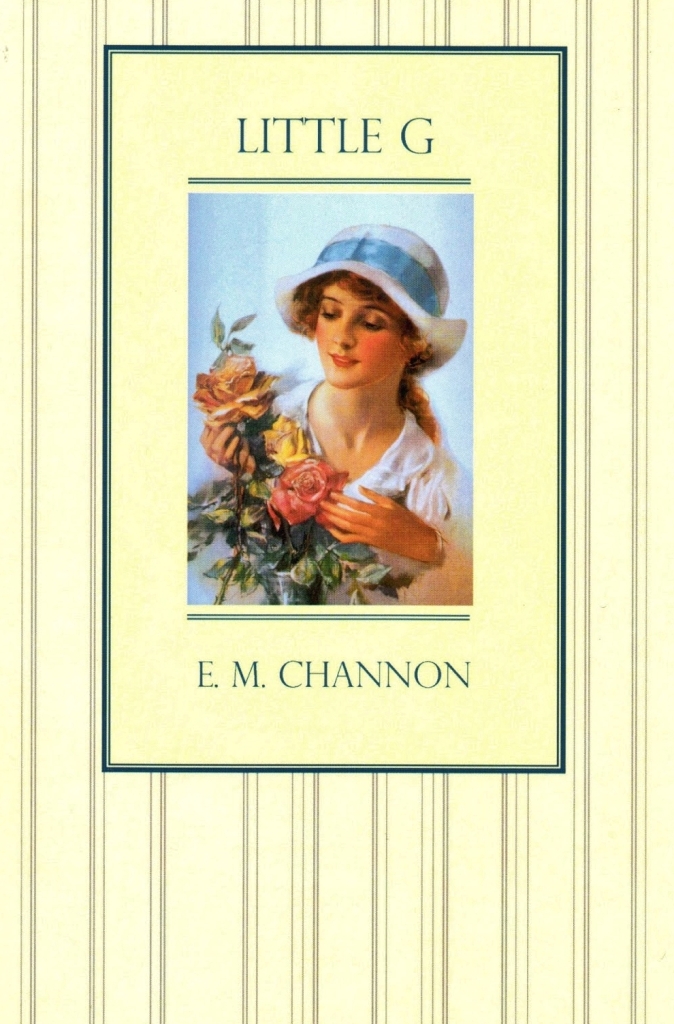
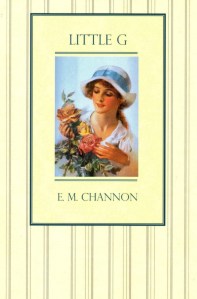
e-m-channon-little-g-1936-greyladies-cover-2012Little G by E.M. Channon ~ 1936. This edition: Greyladies Press, 2012.  Softcover. ISBN: 978-1-907503-21-4. 226 pages.

My rating: 8/10

Still playing catch-up with those January-read books. (Not to mention the ones I’ve got stacked up here from February.) Maybe I should try a bit harder to condense my reader’s responses?

Little G, with its rather mysterious title, was, as I’ve mentioned in an earlier round-up post, a whole lot of fun.

It’s a decidedly charming summer-set fluff piece about a misogynistic (and youngish – this is important) Cambridge mathematics don who is sent off to the country by his doctor, with orders to eschew overtaxing his brain, and to get himself into some habits of healthful exercise.

“And you really want to banish me to this beastly village, Cardew?” he inquired, with pathos.

“You can make your own choice, my man. Six months in Challingley, leading the sort of reasonable life that I’ve suggested, or a real genuine breakdown, with a real genuine rest-cure in a nursing home to follow.”

“Good Lord!” said the Mathematician, in blank horror, with a swift vision of himself quite helpless, at the mercy of innumerable designing young hussies in becoming uniforms.

“I can tell you,” said the Doctor, “that I’d be glad enough to change places with you. I’ve spent more than one holiday in Challingley, and always been sorry to come away. Plenty of people would envy you your luck.”

“Rotten luck,” said the Mathematician, uncomforted.

The Doctor, looking round for inspiration, found it suddenly on his companion’s knee.

“You can keep a cat of your own there.”

The Mathematician did not like cats. He adored them.

His gloomy face relaxed a very little.

“Now you’re talking!” he said.

“A dozen cats, if you like,” said the Doctor, encouraged.

“I’m a monocattist,” said the Mathematician.

He stood up suddenly, putting the black kitten down, but with all possible consideration for its feline feelings.

“It’s no use trying to get round me like that, Cardew,” he said. Im not going. ”

Three days later – considerably alarmed by the recurrence of the unpleasant symptoms which had induced him to call in the Doctor – he went.

So there John Furnival is, domestically settled into a picturesque thatched-roof cottage, cared for by a blithely cheerful cook-housekeeper who rather sets his teeth on edge by her unremitting good nature, and her welcoming in of his numerous neighbours making their polite social calls.

Despite his crankiness, Furnival is absorbed into the community and finds himself not only going out to tea but hosting others in his turn, playing tennis, going for long country walks, and, yes, adopting a cat.

And to his horror (for he carefully inquired as to the presence of predatory females before agreeing to relocate to the village), he discovers that one of his neighbours is a very attractive young widow, one who is doubtless on the lookout for an unattached male such as himself as her next potential victim!

So focussed is Furnival on this (wholly unfounded) threat to his bachelor freedom, that he fails to realize that the true danger to his single state is approaching from a very different direction…

A cheerful, effortless read; witty throughout and wickedly funny in parts. I enjoyed it immensely.

Ethel Mary Channon wrote quite a number of books in her time (she died in 1951), most of them being “school stories” targetting the girls’ market, as well as mysteries and a number of adult novels of varying degrees of seriousness.

Little G is definitely on the “light” side; it is also said to be one of Channon’s best works, which might be seen as a warning off of sorts for her others, but I’d happily sample her “lesser” novels merely on the strength of this likeable concoction.

Long out of print, Little G was reprinted by Greyladies Press in 2012, but that run appears to be sold out as well, and the book is currently rather elusive in the second-hand lists. Perhaps all of its readers are hanging onto their copies for pleasant revisiting? I know I am.

Read Full Post »

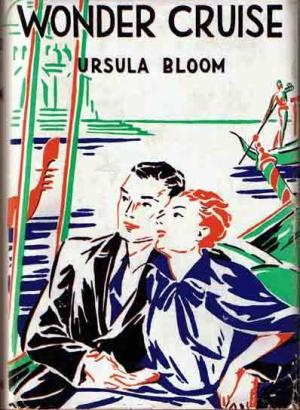
First edition dust jacket illustration, sadly not my copy.

First edition dust jacket illustration, sadly not my personal copy.

Wonder Cruise by Ursula Bloom ~ 1934. This edition: Corazon Books, 2016. Softcover. ISBN: 978-1909752269. 327 pages.

My rating: 7/10

My second-ever Ursula Bloom novel and I enjoyed it, though it never quite breaks into A-list status. Maybe A-minus?

Anyway, I liked it, and it’s a keeper, for those times when one requires an utterly effortless diversionary read. (I also own the equally engaging and so-close-to-A-list 1965 mild psychological thriller The Quiet Village, but I don’t think I have chatted it up here yet.)

I’m keeping my eyes open (in a casual sort of way) for more novels by this supremely prolific writer, and have been for some years. They are surprisingly rare in used book stores, at least on this side of the Atlantic, or at least in the ones I have frequented. There must be stacks of them out there somewhere.

From the About the Author page at the back of this Corazon edition:

Ursula Bloom was one of the most popular bestselling authors of the twentieth century. She wrote over 560 books, a feat which earned her a place in the Guinness Book of World Records for many years, as the world’s most prolific female writer. She also wrote short stories, radio and stage plays, and worked as a Fleet Street journalist.

During her long career, as well as writing books under her own name, Ursula used the pen names Sheila Burns, Rachel Harvey, Lozania Prole, Mary Essex and Deborah Mann.

So what I really want to know now is who bumped Ursula from her “most prolific female writer” spot? Danielle Steele, perhaps? Let’s see what Google says…and oh golly! This Wikipedia page is an astonishing (and slightly troubling) thing. In recognizable names of English-language writers, it looks like both Enid Blyton and Barbara Cartland have surpassed Ursula Bloom, with, respectively, 600+ and 722 published works. Who knew?!

This mind-boggling digression put behind me, here’s a quickie synopsis of Wonder Cruise.

An orphaned daughter of the vicarage, left destitute as is the tradition in these sorts of things, finds herself living in London under the thumb of a bullying older brother. She manages to attain independence through a secretarial job, but  begins to find that the daily grind is just that, with a long bleak vista a years-all-the-same stretching ahead, until a chance sweepstake win triggers a personal reinvention.

The usual sequence of events occurs, with the eventual finding of true love. Absolutely predictable, but decently readable. Sexual awakening is a great part the theme here, stated in those very words. The tiniest bit unexpected for a popular novel from 1934, but then again, not really, when one considers what else was going on in the actual and literary world at the time.

Corazon Books of London (“bringing you great stories with heart”), the republisher responsible for Wonder Cruise once again seeing the light of day, provides this enthusiastic blurb:

Ann Clements is thirty-five and single, and believes nothing exciting will ever happen to her. Then, she wins a large sum of money in a sweepstake and suddenly can dare to dream of a more adventurous life. She buys a ticket for a Mediterranean cruise, against the wishes of her stern brother, the Rev. Cuthbert, who has other ideas about how she should spend her windfall. Ann steps out of the shadows of her mundane life into the heat of the Mediterranean sun. Travelling to Gibraltar, Marseilles, Naples, Malta and Venice, Ann’s eyes are opened to people and experiences far removed from her sheltered existence in the offices at Henrietta Street, and Mrs. Puddock’s lodging house. As Ann blossoms, discovering love and passion for the very first time, the biggest question is, can there be any going back?

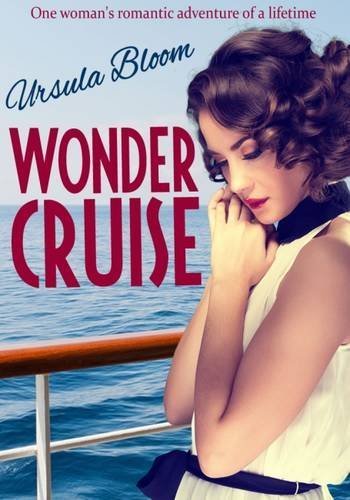
1909752266-01-_sx450_sy635_sclzzzzzzz_You’re going to want to have your brown paper handy if buying this new edition, because it has one of the most gosh-awful covers imaginable. Hard to have people take you seriously when you’re seen with this in your hands!

But the contents are prime, nicely produced and easy to read, with very few (if any?) typos. Whoever reset this did a grand job, and this reader thanks you!

I hope some more Ursula Blooms are forthcoming from this source. I see that Corazon has also republished Bloom’s 1959 wartime memoir (and that would be the First World War, by the way), Youth at the Gate, which I am about to order, because I know it will be readable, and likely wryly funny, if Bloom’s fictional voice remains the same for her reminiscences. Again, Corazon’s cover art leaves something to be desired, but I guess we should be grateful for what’s inside, instead of griping about appearances.

Here’s something extra, a link to a 1974 mini-documentary on Ursula Bloom produced by the BBC. Watch it, it’s a mere 4 minutes long, and it’s rather fascinating to see our author typing away at full speed, producing some of those 5000 eminently saleable words per day!

From the East Anglia Film Archive’s link page:

Author Ursula Bloom sits at her writing desk tapping away on a typewriter, opening this profile of her life and career with old photographs and newly filmed material. Beginning with her extensive bibliography, which ranges from romance novels to biographies, the report highlights her many non-de-plumes, including Mary Essex, Sheila Burns and Lozania Prole, and her prolific output, often averaging 5,000 words a day and easily able to complete a novel within three weeks.

The daughter of a parson who didn’t believe in school-based education, Bloom got an early start on her career, running a children’s magazine at age 10, and had a brief career as a cinema pianist before marrying a wealthy barrister and guards officer. Following his death during the influenza epidemic of 1918, Bloom and her young son continued living in the exclusive seaside resort of Frinton, the summer playground of the rich and famous during the 1920s. During this time she broke into journalism with a successful career as a court reporter, before meeting her second husband, naval lieutenant Charles Robinson Gower, in 1925. Fifty years later, the couple are shown in their sitting room, still happily married, both claiming it was the ‘best thing they ever did’.


Read Full Post »

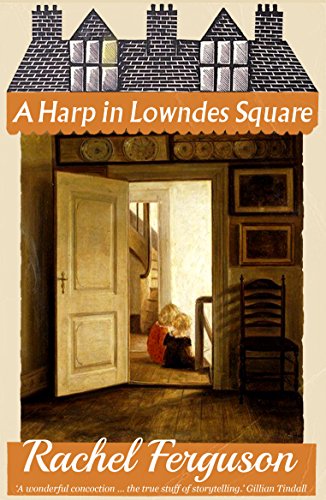
a-harp-in-lowndes-square-rachel-ferguson-1936A Harp in Lowndes Square by Rachel Ferguson ~ 1936. This edition: Dean Street Press, 2016. Paperback. ISBN: 978-1-911413-73-8. 287 pages.

My rating: 10/10

2016 continues to throw an eclectic array of all sorts of unpleasant things our way. Thank goodness for good books. Escape reading has been a slender but strong lifeline in a stormy personal (and societal) sea.

This past week has been particularly rewarding in this aspect, and I found I used up most of my writing time for reading, as I was seduced first by Sinclair Lewis’ highly likeable Dodsworth, then by Will Ferguson’s snarky Generica (aka Happiness™) and, last and best, by Rachel Ferguson’s dense and rewarding A Harp in Lowndes Square.

All three demand discussion. The last-read will be the first. These reviewlets will be short on original analysis, because Real Life is relentless in pounding at the door, but with the thought that any mention is better than none, here we go.

A Harp in Lowndes Square is the most “serious” of the three of Rachel Ferguson’s works I’ve read so far, and the most “conventional” (relatively speaking) in its structure and its plot.

Where The Brontës go to Woolworths was frequently giddy, and sometimes deliberately ridiculous, and A Footman for the Peacock evolved on occasion into pure farce, A Harp transcends the author’s stylistic playfulness in those other works – for to me that is what it often seems, a deliberate, gently ponderous frolicking garbed harlequin-wise in sardonic humour – and attains a higher ground in its characters and its plot.

This despite the reader-challenging dependence on an acceptance of the theory of a parallel stream of time for much of the book. It’s almost what the reviews label it as – a sort-of ghost story – but at heart it’s purely of its time, a self-assessing, slyly humorous, poignantly troubling novel revolving around the thoughts and feelings of a sympathetic narrator.

From the Dean Street Press website, a pared-down précis of the basics of the plot, hinting very slightly at the intricacies of this absorbingly complex novel:

Description

In the schoolroom in Lowndes Square, a child, in her ugly, unsuitable frock of plum-coloured satin, cut down when discarded from one of her mother’s, bent over the cutting out of a doll and its cardboard wardrobe, and shivered as she worked.

Hilarious, shocking, and heartbreaking in turn, A Harp in Lowndes Square is like no other Rachel Ferguson novel. Perhaps her most personal work – and the closest she ever came to a ghost story – it tells of Vere and James, twins gifted with ‘the sight,’ which allows them to see and even experience scenes from the past (including one, at Hampton Court, involving royalty).

The twins are already aware of their mother’s troubled relationship with her own mother, the formidable Lady Vallant, but the discovery of an Aunt Myra, who died young and of whom their mother has never spoken, leads them to uncover the family’s tragic past. Against the backdrop of World War I and Vere’s unexpected relationship with an aging actor (and his wife), and rife with Ferguson’s inimitable wit, the novel reaches a powerful and touching denouement when the twins relive the horrifying events of many years before …

A Harp in Lowndes Square was originally published in 1936. This new edition features an introduction by social historian Elizabeth Crawford.

Praise

‘It is only (now) that I realise how much … my work owes to the delicacy and variety of Rachel Ferguson’s exploration of the real and the dreamed of, or the made up, or desired.’ A.S. BYATT

‘A wonderful concoction … the true stuff of storytelling.’ GILLIAN TINDALL

The above is of course overly dramatized, as is the wont in back cover blurbery, but essentially correct in summation.

I didn’t find much hilarity here, though there was abundant intelligent humour, and the so-called denouement, though indeed powerful and touching, wasn’t particularly surprising as the narrative contained abundant hints as to what it was that actually happened one bitter night in the late 1800s, on the stairs outside the drawing room door.

The real reward of this gem of a novel is in its depiction of the best possibilities of human relationships. Narrator Vere, one of the psychically-sensitive twins, never finds romantic love in the conventional sense, but, looking back on her earlier life from the age of fifty, she reflects on what she did instead experience, and it seems to me to be, in this case at least, an acceptable alternative.

The morally monstrous mother figure in the background – family matriarch Lady Vallant – serves to accentuate the determined rejection of such parental coldness by her youngest daughter Anne, mother of twins Vere and James and the finely-drawn Lalage, their beloved elder sister.

All three of the Ferguson novels read by me to date stand out, despite their sometimes bizarre structure, as warm depictions of familial unity as bulwark against a sometimes-bitter outside world, and these affirmative passages are, to me, perhaps the finest part of these intellectually rich, fascinatingly convoluted novels.

I liked this book much more than I had expected too – and I had high expectations indeed. I’d ordered it with a view to reading it in 2017 as part of my second prospective Century of Books project, but in a moment of weakness I opened it “just to preview”, was drawn in, and here I am, happily contemplating a 1936 replacement on my want-to-read list. Luckily it shouldn’t be too hard to find something else, in that rich literary era.

For more on A Harp in Lowndes Square, I’m going to send you over to this review by Scott at Furrowed Middlebrow, whose fervent hunting out, re-reading, and articulate reviewing of out-of-print mid-century female novelists has led to this particular republication.

Grateful kudos again to Scott, and to Dean Street Press.

Many of us, myself included, hear “print on demand” and our first response is to cringe in disgust, because of the many horrible examples of Gutenberg-mining  hack “presses” so prolifically invading the ABE and Amazon lists, but Dean Street Press is a shining beacon of How To Do It Right. Beautifully produced paper editions, perfectly re-set, with scholarly new forewords and appropriate cover art, made wonderfully (and affordably!) available for those of us who struggle with reading from a screen. Thank you, thank you, thank you.

Full disclosure, in case anyone is wondering at my enthusiastic promotion of DSP: A Harp in Lowndes Square is not a review copy; I bought it with my own hard-earned dollars. Worth every penny. Check these guys out.


Read Full Post »

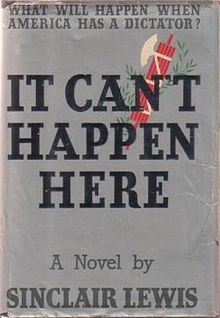
it-cant-happen-here-sinclair-lewis-1935

Not my copy, which is one of the blandly dark blue Collier “Nobel Prize” uniform editions. This is the first edition dust jacket.

It Can’t Happen Here by Sinclair Lewis ~ 1935. This edition: Collier, circa 1938. Hardcover. 458 pages.

My rating: Pretty well have to award a 10/10 for timeliness, but for readability I’m afraid I am stuck fast at 6/10.

It’s well on the “okay” side of the personal rating chart, but that’s all I can honestly give it, when comparing it to some of the writer’s equally thought-provoking but rather more smoothly written A-List books. (Main Street et al.)

I know the Press only too well. Almost all editors hide away in spider-dens, men without thought of Family or Public Interest or the humble delights of jaunts out-of-doors, plotting how they can put over their lies, and advance their own positions and fill their greedy pocketbooks by calumniating Statesmen who have given their all for the common good and who are vulnerable because they stand out in the fierce Light that beats around the Throne.

Zero Hour, Berzelius Windrip.

It Can’t Happen Here is a sardonic alternative history of the United States falling under its own brand of fascist leadership, after the defeat of Franklin Delano Roosevelt by the ravingly populist Berzilius “Buzz” Windrip. (The oft-quoted Zero Hour is Windrip’s own Mein Kampf.)

The novel is chilling in its prescient description of mass rallies and grassroots hysteria, and the comfortable conviction of the optimistic liberals that, well, “it can’t happen here.”

Written as Hitler and Mussolini blazed to their vicious power, the parallels are unhappily contemporary when considering the strange rise of a certain American wanna-be politician. (The world laughed at Hitler, too. At first.)

I’d been saving this one for the elusive “right time”, and what better timing than during this current and deeply disturbing power struggle between political factions in the U.S.A.?

Any of these political platform points sound just a tiny bit familiar?

During the very first week of his campaign, Senator Windrip clarified his philosophy by issuing his distinguished proclamation: “The Fifteen Points of Victory for the Forgotten Men.” The fifteen planks, in his own words (or maybe in Lee Sarason’s words, or Dewey Haik’s words), were these:

(1) All finance in the country, including banking, insurance, stocks and bonds and mortgages, shall be under the absolute control of a Federal Central Bank, owned by the government and conducted by a Board appointed by the President, which Board shall, without need of recourse to Congress for legislative authorization, be empowered to make all regulations governing finance. Thereafter, as soon as may be practicable, this said Board shall consider the nationalization and government-ownership, for the Profit of the Whole People, of all mines, oilfields, water power, public utilities, transportation, and communication.

(2) The President shall appoint a commission, equally divided between manual workers, employers, and representatives of the Public, to determine which Labor Unions are qualified to represent the Workers; and report to the Executive, for legal action, all pretended labor organizations, whether “Company Unions,” or “Red Unions,” controlled by Communists and the so-called “Third International.” The duly recognized Unions shall be constituted Bureaus of the Government, with power of decision in all labor disputes. Later, the same investigation and official recognition shall be extended to farm organizations. In this elevation of the position of the Worker, it shall be emphasized that the League of Forgotten Men is the chief bulwark against the menace of destructive and un-American Radicalism.

(3) In contradistinction to the doctrines of Red Radicals, with their felonious expropriation of the arduously acquired possessions which insure to aged persons their security, this League and Party will guarantee Private Initiative and the Right to Private Property for all time.

(4) Believing that only under God Almighty, to Whom we render all homage, do we Americans hold our vast Power, we shall guarantee to all persons absolute freedom of religious worship, provided, however, that no atheist, agnostic, believer in Black Magic, nor any Jew who shall refuse to swear allegiance to the New Testament, nor any person of any faith who refuses to take the Pledge to the Flag, shall be permitted to hold any public office or to practice as a teacher, professor, lawyer, judge, or as a physician, except in the category of Obstetrics.

(5) Annual net income per person shall be limited to $500,000. No accumulated fortune may at any one time exceed $3,000,000 per person. No one person shall, during his entire lifetime, be permitted to retain an inheritance or various inheritances in total exceeding $2,000,000. All incomes or estates in excess of the sums named shall be seized by the Federal Government for use in Relief and in Administrative expenses.

(6) Profit shall be taken out of War by seizing all dividends over and above 6 per cent that shall be received from the manufacture, distribution, or sale, during Wartime, of all arms, munitions, aircraft, ships, tanks, and all other things directly applicable to warfare, as well as from food, textiles, and all other supplies furnished to the American or to any allied army.

(7) Our armaments and the size of our military and naval establishments shall be consistently enlarged until they shall equal, but–since this country has no desire for foreign conquest of any kind–not surpass, in every branch of the forces of defense, the martial strength of any other single country or empire in the world. Upon inauguration, this League and Party shall make this its first obligation, together with the issuance of a firm proclamation to all nations of the world that our armed forces are to be maintained solely for the purpose of insuring world peace and amity.

(8) Congress shall have the sole right to issue money and immediately upon our inauguration it shall at least double the present supply of money, in order to facilitate the fluidity of credit.

(9) We cannot too strongly condemn the un-Christian attitude of certain otherwise progressive nations in their discriminations against the Jews, who have been among the strongest supporters of the League, and who will continue to prosper and to be recognized as fully Americanized, though only so long as they continue to support our ideals.

(10) All Negroes shall be prohibited from voting, holding public office, practicing law, medicine, or teaching in any class above the grade of grammar school, and they shall be taxed 100 per cent of all sums in excess of $10,000 per family per year which they may earn or in any other manner receive. In order, however, to give the most sympathetic aid possible to all Negroes who comprehend their proper and valuable place in society, all such colored persons, male or female, as can prove that they have devoted not less than forty-five years to such suitable tasks as domestic service, agricultural labor, and common labor in industries, shall at the age of sixty-five be permitted to appear before a special Board, composed entirely of white persons, and upon proof that while employed they have never been idle except through sickness, they shall be recommended for pensions not to exceed the sum of $500.00 per person per year, nor to exceed $700.00 per family. Negroes shall, by definition, be persons with at least one sixteenth colored blood.

(11) Far from opposing such high-minded and economically sound methods of the relief of poverty, unemployment, and old age as the EPIC plan of the Hon. Upton Sinclair, the “Share the Wealth” and “Every Man a King” proposals of the late Hon. Huey Long to assure every family $5000 a year, the Townsend plan, the Utopian plan, Technocracy, and all competent schemes of unemployment insurance, a Commission shall immediately be appointed by the New Administration to study, reconcile, and recommend for immediate adoption the best features in these several plans for Social Security, and the Hon. Messrs. Sinclair, Townsend, Eugene Reed, and Howard Scott are herewith invited to in every way advise and collaborate with that Commission.

(12) All women now employed shall, as rapidly as possible, except in such peculiarly feminine spheres of activity as nursing and beauty parlors, be assisted to return to their incomparably sacred duties as home-makers and as mothers of strong, honorable future Citizens of the Commonwealth.

(13) Any person advocating Communism, Socialism, or Anarchism, advocating refusal to enlist in case of war, or advocating alliance with Russia in any war whatsoever, shall be subject to trial for high treason, with a minimum penalty of twenty years at hard labor in prison, and a maximum of death on the gallows, or other form of execution which the judges may find convenient.

(14) All bonuses promised to former soldiers of any war in which America has ever engaged shall be immediately paid in full, in cash, and in all cases of veterans with incomes of less than $5,000.00 a year, the formerly promised sums shall be doubled.

(15) Congress shall, immediately upon our inauguration, initiate amendments to the Constitution providing (a), that the President shall have the authority to institute and execute all necessary measures for the conduct of the government during this critical epoch; (b), that Congress shall serve only in an advisory capacity, calling to the attention of the President and his aides and Cabinet any needed legislation, but not acting upon same until authorized by the President so to act; and (c), that the Supreme Court shall immediately have removed from its jurisdiction the power to negate, by ruling them to be unconstitutional or by any other judicial action, any or all acts of the President, his duly appointed aides, or Congress.

Sinclair Lewis injects more than a little dark humour into his dystopian fable, and though I appreciated the frequent deliberate ridiculousness of the political rhetoric, it’s not really an amusing read, with our hindsight of the excesses of the Gestapo and the Final Solution, and our fresh and raw here-in-2016 imagery of ranting American rallyers advocating a “return to greatness” which seems to be mostly about kicking others in the teeth.

Current affairs aside, It Can’t Happen Here is a tougher read than many of Lewis’ earlier novels; he pontificates an awful lot, and the individuals of his vivid cast of characters are parodies from start to finish, although always relatable in their human flaws and frailties, and in their sometimes dark desires.

It shouldn’t happen here, but it could, and therein lies the strangely compelling appeal of this vintage work of “what if?” fiction.

Reviews abound, many of them very recent. A casual internet search will net you more than you can comfortably peruse, and I couldn’t decide on which ones to link, so I’ll leave a further investigation (if any) up to you.

Vote carefully, my American neighbours.

Read Full Post »

blue-days-at-sea-h-v-mortonBlue Days at Sea and other essays by H.V. Morton ~ 1932. This edition: Methuen, 1932. Hardcover. 207 pages.

My rating: 7.5/10

This is a slender book of very readable essays by that British one-man phenomenon of mid-20th-century journalistic travel writing, Henry Vollam Morton.

In 1910, at the age of 16, H.V. Morton left school to work for the Birmingham Express and Gazette, where his father was employed as an editor. Young Henry took to journalism as a duckling takes to water, and his rise in the newspaper world was sure and steady.

In 1923, Morton was present at the opening of King Tutankhamun’s tomb, and his scoop of the “official” Times reporter brought him much notice, resulting in a further impetus to his upward progress in his chosen career.

In 1926, after several collections of his travel columns had been published and received with approbation by the English public, Morton set off on a motor trip of the rural areas of the UK, frequenting pubs and country gatherings, and documenting in a strongly nostalgic, rose-tinted way the vision of “our England” that he found.

In Search of England was published in 1927 to immediate acclaim, and H.V. Morton rode the crest of its success for the following five decades, wandering (in a very focussed sort of way) hither and yon, throughout the British Isles, Spain, Italy, North Africa, and into the Holy Land.

With his reporter’s pass card in hand, Morton received entry into all sorts of places, and he followed up his visits with likeable articles and essays, a collection of which make up this particular book.

The leading essay in Blue Days at Sea, in length and importance, details Morton’s time spent on one of the Royal Navy’s largest battleships. He documents his awed introduction to the “floating city” of a massive naval ship housing over 1200 people, and pens generally admiring portraits of some of its various classes of officers, focussing on the lowly midshipmen (rejoicing in the nickname “snotties” among their compatriots), and touching on the others, up to the second-in-command Commander, and the lordly Captain. The regular seamen are occasionally mentioned, mostly as being “down there somewhere” in the bowels of the ship, but Morton doesn’t seem to hobnob with them to any meaningful extent.

This being in 1932, England is officially at peace, but the Royal Navy never relaxes, so ambitious war exercises – mock battles at sea – are frequently being carried out to keep everyone up to speed on operating their deadly ships. Morton’s narration of one of these exercises is fascinating, in particular when viewed with our future hindsight, knowing that only a few short years later those mock battles would be very real, and the torpedoes fully loaded instead of being benign duds.

A moving vignette regarding a funeral at sea caps off this section.

Once this patriotic sample of “Hurray, our England!” journalism is tidied away, Morton turns his hand to a series of humorous sketches regarding various stereotypical versions of the era’s women. The Wife, The Woman Nobody Knows, The Woman of Affairs, The Bad Girl, The Head Huntress…these are just a sampling of the rather stock characters Morton dissects. Modern readers will lift an eyebrow; period humour prevails, and with that excuse we must be content.

Travel pieces cap off the collection, giving glimpses of Rome and Egypt. A particularly good essay is a description of Bonnie Prince Charlie’s tomb in Rome. Well done as well are glimpses of the tourists’ experience of the Nile and the monuments of the long-dead kings, Morton standing well off to the side viewing his compatriots with a cynical eye.

Back to Victoria Station proceeds our writer, and “It’s good to be home.”

With the recent publication of several biographies of H.V. Morton (he died in 1979, still enjoying a mostly positive reputation as a true booster of All Things British, though he had been a resident of South Africa for the last three decades of his life), most notably this one, a rather critical light has been beamed into Morton’s private life, revealing the feet of clay of this one-time literary idol.

Apparently the man was a rather promiscuous womanizer, which comes as no surprise to me after reading the essays on women in this collection, the writer very obviously having a keen eye for the delights of the female form.

More damning are Morton’s pro-fascist views in the pre-War years, according to his private journals. In this he was in common company with certain other public figures of his time; one again must keep the context of the times in mind, for the horrors of the wartime atrocities were a thing of the future.

It is now rather the thing to sneer at H.V. Morton, for both his now-politically-incorrect attitudes and the consistent romanticization in his writings, but one can’t dismiss his wide appeal to his contemporary readers, and the fact that he was an excellent documentarian of places and people now lost in time.

Read Full Post »

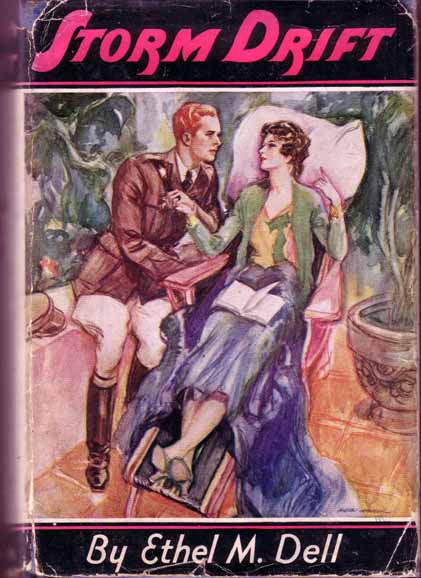
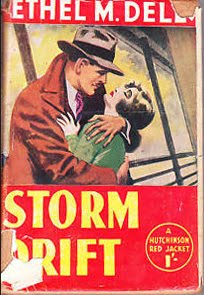
storm drift ethel m dell 1930Storm Drift by Ethel M. Dell ~ 1930. This edition: Ryerson Press, 1930. Hardcover. 376 pages.

My rating: 3.5/10

Picture yourself on a boat on the ocean, just out of Bombay, heading to England…

Here’s Tiggie, our hero. He’s a wealthy bachelor looking forward to a few months of convalescence from his latest bout of some tropical ailment.

Tiggie can’t keep his eyes off a fellow passenger, the ethereally beautiful and frantically anxious Mrs. Viola Norman, whose husband appears to have missed the sailing. Tiggie steps up to soothe the perpetually shrinking Viola, and discovers that her nervous condition is apparently well justified, for not only is she pretty well stone broke and bereft of her (apparent) spouse, she is also in the family way.

The overwrought Viola attempts to end it all by taking a dive off the ship’s railing, but Tiggie intervenes in a dramatic rescue. As he pulls the frail Mrs Norman to safety, he is suddenly overwhelmed by a rush of feelings for her. Full on, instant infatuation. He’s on fire!

Confined as they are to the first class deck of a ship at sea, Tiggie and Viola can’t avoid each other, and Tiggie focuses his ever-more-fevered gaze on the trembling little grass widow. He is rewarded when Viola reveals herself to be a woman with an unexpectedly passionate inner core, as Tiggie discovers when he manages to corner her one post-rescue night on a secluded corner of the deck. As his lips meet hers, and she yields meltingly to his masterful embrace, fireworks go off, volcanoes erupt, etcetera. (Too bad she’s MARRIED. And PREGNANT.)

Storm-Drift

Viola looks a bit green in this cover depiction. Could it be the combined queasiness of pregnancy, the rolling ship, and her recent suicide attempt, or merely the overwhelming effect of the masterful Tiggie’s manly grip and burning lips?

Tiggie belatedly gets a grip on himself and does the Correct Gentleman’s Thing. He pulls himself off with an apology, which Viola whisperingly accepts. They mustn’t see each other once they reach England! Viola, having confessed to being abandoned by the father of her coming child, insists that she will be able to find employment and care for herself, and that she will quickly repay the money which Tiggie forces upon her to tide her over. He’ll never see her again; she won’t be beholden to him; their mutual smoldering passion will just have to be firmly quenched. They must forever part!

Need I go on? (I will, of course. The question is purely rhetorical; I could stop right there and let you guess the rest quite successfully yourself.)

For of course their paths reconnect, and through an elaborately coincidence-ridden plot, the two tortured lovers almost immediately reunite. Viola has a rather convenient miscarriage, just to neaten things up on that end. A whole bunch of stuff happens regarding Viola’s shady past as a cabaret dancer, her surprising familiarity with Tiggie’s artist brother-in-law, and the re-surfacing Mr Norman, who turns out to be not so imaginary as once thought.

The key players in the story – Tiggie, Viola, the lost husband, the artist brother-in-law – all find themselves together in a small coastal village, well-furnished with cliffs convenient for adding an element of potentially fatal danger to the ongoing action. No prizes for guessing the sad fate of Viola’s rejected husband.

Yup. He’s doomed.

Now rid of both incipient unwanted baby and pesky previous relationship, Viola is fully Tiggie’s own. The curtain falls on their happy ending.

My word. I can’t quite believe I made it through this thing. I feel like I deserve a prize. It was, increasingly, a slog, though I do have to give Ethel M. Dell credit for writing just well enough to keep me at it. There was certainly a lot of action, which helped.

I do have to say that if I’d been there in any capacity, I would have happily pushed the whole cast of characters off that tall, tall cliff. By the time their romance came right, I warmly hated both Tiggie and Viola, and Harvey-the-eccentric-genius-artist was push-worthy just by association.

The only character I liked by the end was Harvey’s wife – Tiggie’s sister Janet – who avoids being involved with any of this nonsense by staying sensibly home and running her chicken farm while her male connections are off making idiots of themselves. (Ha! Didn’t expect that little detail, did you? I immediately gave Dell an extra point for the hens. It was so darned unexpected, and really kind of sweet.)

So there you have it. Me and Ethel M. Dell. Oh boy.

A bit of background stuff.

Ethel M. Dell was a highly successful romance novelist of her time – thirty novels from 1911 to 1938 – and her target markets were under-employed spinsters whiling away their long afternoons, and working class women looking for a titillating read for their infrequent leisure hours.

Dell specialized in semi-exotic locations, masterful men, trembling women, and sex-soaked situations. She stopped just short of explicit in her descriptions of romantic encounters, but the veil she left drawn was rather on the thin side.

Those of us who read any amount of early and mid 20th Century middlebrow fiction are very familiar with Dell’s name, and by extension her genre, even if we’ve never cracked the covers of one of her passion-filled productions. Other writers of the time loved to scorn her; occasionally there is the tangy whiff of sour grapes, for Dell did financially very well with her particular  line, one suspects much more so than many of the “serious” writers of her day.

Contemporary fellow writer (and professional literary critic) Rebecca West famously condemned Ethel M. Dell’s work as decidedly “tosh”. (The exact quote, in reference to another of Dell’s torrid romances, 1922’s Charles Rex, was this: “(I)n every line that is written about him one hears the thudding, thundering hooves of a certain steed at full gallop; of the true Tosh-horse”.)

On the abundant evidence of this particular novel, I must agree.

Storm Drift was my first and possibly last Dell, though I may succumb to curiosity and explore this writer some more, just to fill in the details in some of those references. I have a few more specimens of Dell’s work on hand, and, much as I hate to say it, I’ve read worse. Not much worse, but occasionally one is desperate for something – anything! – to read…


Read Full Post »

The book blog has been sluggish lately because my world is utterly crowded with all sorts of crucially time-voracious real-life stuff, but a wicked virus has knocked me around enough this past week to give me some enforced down time and I have happily read my way through a number of okayish novels. Norah Lofts et al., suitably light but reasonably intelligent amusement for someone under the weather.

And then this one.

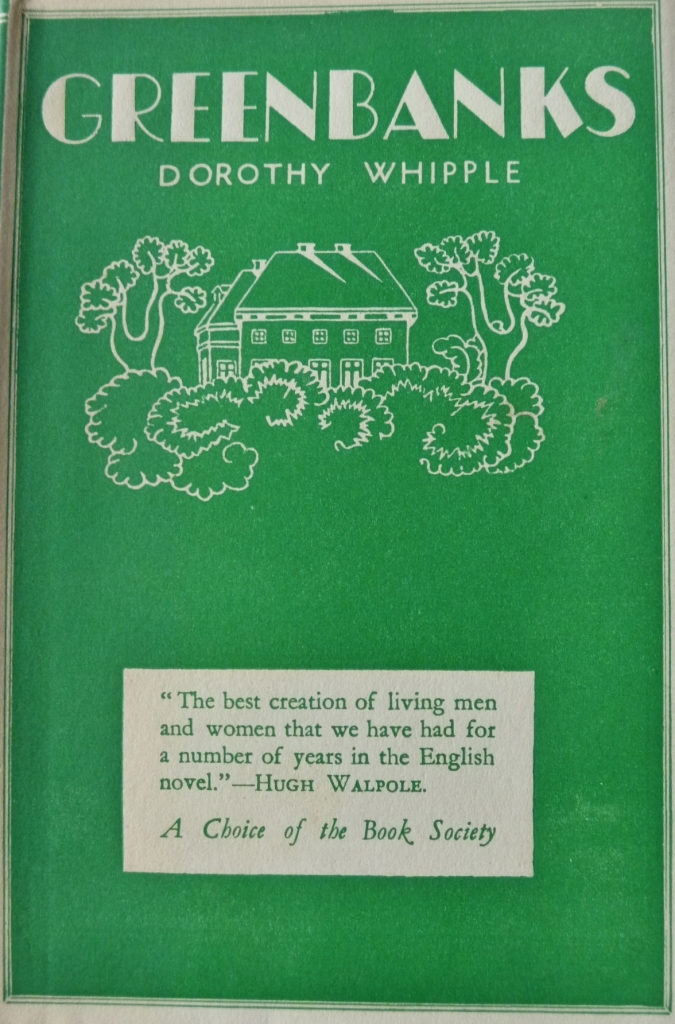
Greenbanks by Dorothy Whipple. Written in 1932, this was Whipple’s second published novel, and the third I’ve now read.

They Knew Mr. Knight (1934) and Because of the Lockwoods (1949) were highly enjoyable, if slightly melodramatic, but Greenbanks was something on a different level.

Greenbanks by Dorothy Whipple. Not my copy - mine is a lovely greyt Persephone - but stolen shamelessly from the internet for the sake of the glowing cover blurb by Hugh Walpole.

Greenbanks by Dorothy Whipple. Not my own copy – mine is a lovely grey Persephone – but borrowed shamelessly from the internet (thank you, Milady’s Boudoir) for the sake of the glowing cover blurb by Hugh Walpole.

Ostensibly a sedate family saga, it evolves into a deeply convincing manifesto on the rights of women to self-determination and social, educational, financial and sexual equality. Set in the decades before, during, and immediately after the Great War, centre stage is shared between a family matron and her granddaughter, representatives of the old world and the new, with sporadic but telling secondary roles played by the adult children of the household, their various spouses, lovers, friends and acquaintances.

The ending was unexpected, and deeply satisfying in its blunt refusal to neaten things up in a conventional way; it shocked me because I’d rather expected Whipple to manufacture an eleventh-hour cluster of pleasantly innocuous solutions to its most pressing dilemmas, and she didn’t go there at all.  And it worked.

I am starting to see why Persephone Press is so dead keen on this writer; those first two books piqued my interest but this third one has given rise to real enthusiasm.

If you’re already a Dorothy Whipple person – and I know many of you are – I’d be most pleased to hear your personal opinions on Greenbanks as it stands in her body of work. Is this as good as she gets? Or am I in for some more unexpected readerly surprises?

Someone at a Distance is here on the shelf; it came in the package with Greenbanks just the other day and I am torn between diving right in, and, alternatively, allowing myself some cooling off time, because I’m still processing the deeper nuances of the book I’ve just devoured with such paradoxically reluctant speed.

It’s time to choose my evening’s reading-in-bed book, and I am at a loss at what to attempt, not wanting to diminish the mood. I’m thinking Elizabeth Cambridge, or maybe Rose Macaulay, or perhaps even a return to one of the previously-read Whipples, sure to be well sauced with the piquancy of this fresh appreciation.

The “Whipple Line”, indeed! Virago, hang your metaphorical head in shame!

Read Full Post »

Today stretches before me as a day of great endeavour, for it has been cleared of all other minor duties – painting those cupboard doors, for example, and cleaning off my desk in preparation for getting at my tax papers – in order for me to finalize the last few seed lists.

As most of you who have frequented this space know by now, I am something of a gardener, and I am chief operater of a small old-style plant nursery – meaning that we grow the plants ourselves, most from seed, versus acting as a retailer for plants grown by larger wholesale enterprises.

The seed lists, therefore, are of immense importance, for they are where everything starts, and the yearly process of chosing what to try has as much agony involved as ecstasy, mainly because there are so many things out there that we want to try, and we must remind ourselves to be practical and go with tried and true – and saleable! – with only a modest breaking out into tricksy and obscure little alpines from faraway countries, and quite frankly weedy-ish wildflowery things which have an exceedingly limited appeal to the public at large, who mostly just want a petunia or a geranium, and who are often already the tiniest bit bemused at the concept of the perennial plant, let alone the biennial – these last two being my staple in trade, with a handful of annuals showing up on my tables, but seldom anything as immediately familiar as a marigold.

My goodness. I am running on a bit. Sentence-wise, and otherwise.

So. Today. Seed lists. They will be done. Most are long since sent and received, but this last crucial lot will fill in the gaps, and I intend also to do a bit of gambling, gardener-wise, by ordering some things I know I likely won’t succeed with, but will get much quiet enjoyment out of attempting.

What a great pleasure then to read the words of a gardener from the past, as she describes her own thought processes while listing her wished-for seeds.

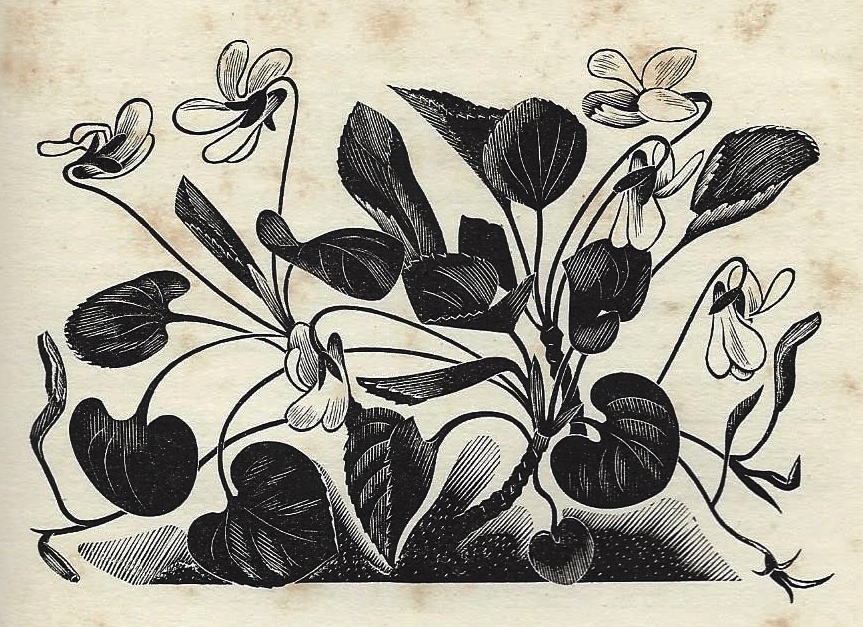
Violet - by John Farleigh - from A Country Garden by Ethel Armitage, 1936

Violet – engraving by John Farleigh – from A Country Garden by Ethel Armitage, 1936

The following excerpt is from Ethel Armitage’s wonderful 1936 A Country Garden, illustrated with engravings by John Farleigh. One of my most treasured “working library” posssessions, a pleasure to read, both for the information it contains regarding English country gardens of its era, and the writer’s highly individualistic voice, which resonates so strongly with me, sharing as we do our relative stage of life and our common occupation, though separated by eighty years. Here she is, on March 9, 1935.

9th. The much debated and discussed seed list has at last been got off, though it was not completed without a certain amount of difference of opinion.

Unfortunately, the world has progressed since those happy days when the choice of flowers was limited, and the belief still held that every seed sown was absolutely certain to come up, and all that was needed for the perfect garden was a nice broad riband of virginia stock backed by canary creeper growing up pea sticks.

Now we ponder over all the beautiful South African annuals, wondering if our soil is too cold for them; think we will try our old favourites, Shirley poppies and sweet sultans once again, as there have not been many slugs about recently; feel it is really scarcely worth while having giant sunflowers as there is no room for them, and no stakes strong enough to hold them up; decide not to raise delphiniums from seed, as the last time we did so all the drab ones flourished, while those we felt sure would be of a heavenly tender indescribable blue all got devoured.

But we agreed to have a packet of Collinsia again, a plant which hails from North America, having been called after Collins, a naturalist. We saw it for the first time growing in the school-children’s gardens. It is one of the prettiest, neatest and most reliable of annuals, and has the charming sobriquet of ‘Chinese houses’, and even looks quite appropriate in the rock garden.

Then blue pimpernel is hard to do without, and blue phacelia is almost a necessity, as is also blue nemophila, and of course neither mignonette nor night-scented stock can be omitted.

The rock garden needs ionopsidium, as well as the nice little Sedum coeruleum.

And so the list goes on increasing, until it grows to such large dimensions that when the little packets arrive, one is appalled at their number and can only hope a place will be found for everything, and they will not be left lying on a shelf in the potting shed until it is too late to do anything with them at all.

The greatest joy ever given by an individual seed packet was one which cost a penny and contained a solitary banana seed, which, when planted, actually came up and in time grew into a very fine plant. It had, of course, to be kept in the greenhouse, where for many years it was the pride of the place, though never a banana did it produce. But all hope of this miracle happening was not abandoned until the plant became too large for its surroundings and had to be cast out, which drastic deed was the cause of many tears and of unutterable, though temporary, despair.

We are now too old to plant banana seeds with the idea of getting any fruit from them, or even to entertain any hope of getting our oranges from the pips we have ourselves saved, or plums from stones that have been thoroughly sucked before planting. We have to content ourselves with things that give a quicker and more certain return, like the homely wallflower and the steady-going Sweet William.


Read Full Post »

November 19, 2015. I have just re-read these two of E.M. Delafield’s books, Humbug (1922) and Thank Heaven Fasting (1932) and was curious to see what I had written about them the first time around, back in March of last year. I was interested to find that I would say much the same after the second reading, so am re-posting a very slightly tweaked version of what I said 18 months ago.

This summer I also read an omnibus collection of  of the Provincial Lady stories published between 1930 and 1940, The Diary of a Provinicial Lady, The PL Goes Further, The PL in America, and the PL in Wartime. The tone throughout these was much lighter than Humbug and Thank Heaven Fasting; at times I struggled to reconcile the two vastly different voices.

The humour in the “straight” novels (versus the diary-type formatted ones) was certainly there, but was much more restrained and bitter. The Provincial Lady books are chiefly amusing, the others disturbingly thought provoking. Delafield is very much on my radar as an author to quietly pursue, though most of her back list is long out of print.

The Provinicial Lady quartet has been republished in various formats and editions and is easy to find; Virago republished both Thank Heaven Fasting and The Way Things Are in 1988; Persephone republished Consequences in 2000. One can only hope that some others of Delafield’s long-neglected novels will catch the attention of either of these two pillars of the feminist press, or of one of the other republishers now so intent on mining the rich literary field of the early to mid 20th century. Preservation and distribution is the starting point of so much more, and it’s always a good thing to hear from those who walked before us, in their own words. Plus a lot of these old books are darned good reading, adding to the appeal for those of us not so much scholarly as merely seeking of interesting things to divert our minds with.

*****

From March 7, 2014: Those of us who are familiar with E.M. Delafield only through her understated and slyly humourous Provincial Lady stories may be in for a bit of a surprise when delving deeper into her more than respectable greater body of work. According to Delafield’s succinct but comprehensive Wikipedia entry – someone has taken the time to briefly summarize each of her titles – she authored something like forty novels, as well as a number of film and radio play scripts.

Delafield’s novels are frequently described as semi-autobiographical. In the two I read recently the sentiments are certainly sincere enough to bear that out, and quietly tragic enough to make me feel a deep chord of sympathy to the young woman Delafield may possibly have been. Though she eventually slipped off the shackles of a strictly conventional upper-class girlhood and young womanhood, she appears from these two novels to be carrying a fair bit on angst-laden baggage from her youthful days. Delafield prefaces Humbug with a disclaimer as to the autobiographical nature of these tale, but if she did not live something similar she certainly observed it at close quarters is my own impression.

humbug e m delafield 001Humbug: A Study in Education by E.M. Delafield ~ 1922. This edition: Macmillan, 1922. Hardcover in reproduction dust jacket. 345 pages.

My rating: 8.5/10

Good women know by instinct that the younger generation, more especially when nearly related to themselves, should be equipped to encounter life by the careful and systemic misrepresentation of the more vital aspects of life.

The mother of Lily and Yvonne Stellenthorpe was a good woman, and had all a good woman’s capacity for the falsification of moral values…

Pretty little Lily, a child of seven as the story opens, is deeply and quietly perceptive, especially when it comes to her older sister Yvonne, who is quite obviously brain-damaged and “sub-normal”, though her parents vehemently deny it. Lily’s passionate defense of Yvonne, and her intuitive realization of Yvonne’s stoically endured pain are brushed off by the adults in her life as “naughtiness and impertinent interference.” Yvonne eventually perishes of a brain tumour, parents in denial to the bitter end. Lily grieves for her beloved sister but also rejoices that “Vonnie” is now pain-free in Heaven. Lily’s outwardly serene acceptance of the loss of her sister – she goes to great trouble to hide her tears from her parents in order to refrain from distressing them – is seen as juvenile callousness, and this crucial misunderstanding is representative of Lily’s parents’ lack of perceptiveness and their persistent misreading of their daughter’s true nature – that of a bright, loving and imaginative child.

A new baby brother appears, to Lily’s deep bemusement – she has been informed of the mystery about to unfold only by an ambiguous instruction towards the end of her mother’s pregnancy that she may pray for a baby brother – and once Kenneth appears Lily is suddenly packed away to convent school. Three months later, her mother dies, and Lily returns home, where she, baby Kenneth and the bereaved family patriarch settle into a muted existence of whispers and extended mourning.

The years go by, with Lily continually coming up against her father’s shocked disappointment in the things she innocently yearns for – storybooks, candy, the company of other children – until at last Lily, honestly thinking that her presence in the household is completely unnecessary, begs to be allowed to go to school. Her father reels in offended horror, clinging to the idea of the tightly-knit family while rejecting Lily’s right to having needs and desires of her own.

Her continual request to be sent to school distressed him profoundly. At one and the same time, he saw Lily convicted of disloyalty in wishing to alter the routine of life instituted for her by her mother, and as heartlessly desirous of abandoning her lonely father and little brother in their changed and saddened home.

At last he said to her:

“I can stand this no longer. Go, Lily, but remember that God Himself will condemn those who blaspheme against the sacred love of mother and father. You can go. I will keep no child at home against its will.”

Lily is, quite naturally, deeply distressed by this heaping on of parentally fabricated guilt, but she perseveres and off she goes to boarding school, where she comes under the thumb of her hearty headmistress, who seeks to mould Lily to yet another standard of acceptable girlhood. Lily does her best, as she always has, to outwardly conform to the expectations of her elders, but inside she is seething with confusion and deep shame. Her intentions are always good, but frequently misunderstood; Lily is the subject of many a lecture on how best to “improve” herself, which she takes to heart, causing further inner conflict as she tries her best to please everyone while still retaining some shred of self.

The years go by, and when Lily is well into her teens an opportunity arises for her to travel to Italy to visit her flamboyant Aunt Clo. Thrown into a very different society, Lily experiences a mild self-aware awakening.  She also meets the man who will become her husband, the much older, exceedingly staid and dull Nicolas Aubray. Once she is married, Lily at last has the opportunity to indulge in a certain degree of introspection, and her conclusions about herself, the way she has been manipulated throughout her life, and the way she will raise own small child bring this rather heart-rending treatise on how not to bring up children to a gently low-key but optimistic conclusion.

A quietly horrifying book in its description of Lily’s psychological and emotional abuse by those who love her too selfishly to be truly kind. Full of keen social commentary, with moments of sly humour. The subtitle, A Study in Education, points the authorial finger directly at the misguided attempts of everyone in Lily’s life – mother, father, nuns at convent school, headmistress and teachers at boarding school, her aunt and finally her husband – to form Lily into something that they think she should be, all the while stifling the natural intelligence and creativity which Lily was born with, and which is almost snuffed out by her extended “education” at the hands of others.

Ten years later, Thank Heaven Fasting examines the inner life of the similarly repressed Monica Ingram, another victim of smothering and misguided parental love and pervasive societal hypocrisy.

thank heaven fasting e m delafield 001 (2)Thank Heaven Fasting by E.M. Delafield ~ 1932. This edition: Virago, 1988. Paperback. ISBN: 0-86068-995-6. 233 pages.

My rating: 8/10

Monica Ingram is on the cusp of young womanhood: she is about to be launched into society and, more importantly, the marriage market. Sweetly pretty, fresh and hopeful, Monica breathlessly awaits the man who will prove to be her socially acceptable mate; his physical attractiveness and intellectual fitness are secondary considerations compared to financial and social standing.

Monica attracts a few approving masculine glances, but bobbles badly in her first season, becoming infatuated with a charming womanizer. Putting herself beyond the pale with an evening of stolen kisses, Monica’s small world condemns her behaviour, and, to her parents’ deep despair, Monica appears unable to recover lost ground. The available men turn their gaze to the newest crop of debutantes, and Monica sits on the shelf, becoming more and more stale with each passing year.

This novel is a bitter indictment of the lack of opportunities for young upper-class women, as well as a stab at traditional Victorian and Edwardian parenting. Educated in a more than sketchy fashion, trained for no occupation or career, having nothing to offer a prospective spouse but their own not particularly rare charms, crowds of daughters jockey for position, politely jostling each other at dinners and balls, and peeping over their shoulders with frightened eyes at last year’s crop of wallflowers who were unable to “get off” successfully.

Monica and her peers are creatures raised by their parents for one purpose only, to make good – or at least good enough – marriages. If they fail to succeed at this, the murmurings about unwed daughters being family liabilities louden to a discontented roar, with previously loving and nurturing parents becoming more and more exasperated and resentful as each year passes.

Both Lily of Humbug and Monica of Thank Heaven Fasting have been severely let down by their families and their society. Their eventual compromises are disappointingly the best they can do. For both of these gentle protaganists, their flounderings to stay afloat after not being taught to properly swim in the unforgiving ocean of the outside world and their gasping gratitude for the few good things that come their way are truly tragic in their absolute banality.

What appropriate reading for International Women’s Day, come to think of it. Flawed as some aspects of contemporary life are, we have indeed (by and large) come a long way, baby!

Both of these books are very readable, thought-provoking, and, yes, more than a little depressing. The heroines show glimmerings of self-actualization, glints of ambition, and a very reasonable resentment against their positions in the societal hierarchy, but ultimately both settle for something less than what they have been groomed to expect. Lily differs from Monica in that she manages to rise above her dismal upbringing – her “education” – and make herself some semblance of a happy life. Monica – well – Monica’s story ends before we can see too far into her future, but we suspect that she has lowered her expectations so greatly that her meek nature will at last find a place of compromised peace, and no aspiration to anything more.

Read Full Post »
These three books were not as diverting as I’d wished them to be.

Perhaps in another mood at another time I would give them better reviews – and I do intend to give Priestley’s Adam in Moonshine a second trial at some point – but today I’m calling them as I see them.

It won’t be a brutal massacre, I hasten to say, as all three had various degrees of enjoyability, but neither do I plan to hide my disappointment in their failings to entirely amuse.

As always, one person’s opinion – please don’t take it to heart if you love these novels, and do try to convince me otherwise if you think I’ve missed the point. One of my favourite things is when someone says, “Hey, wait a minute…” and eloquently defends something I’ve scorned, inspiring a second look from a new perspective.

Here we go.

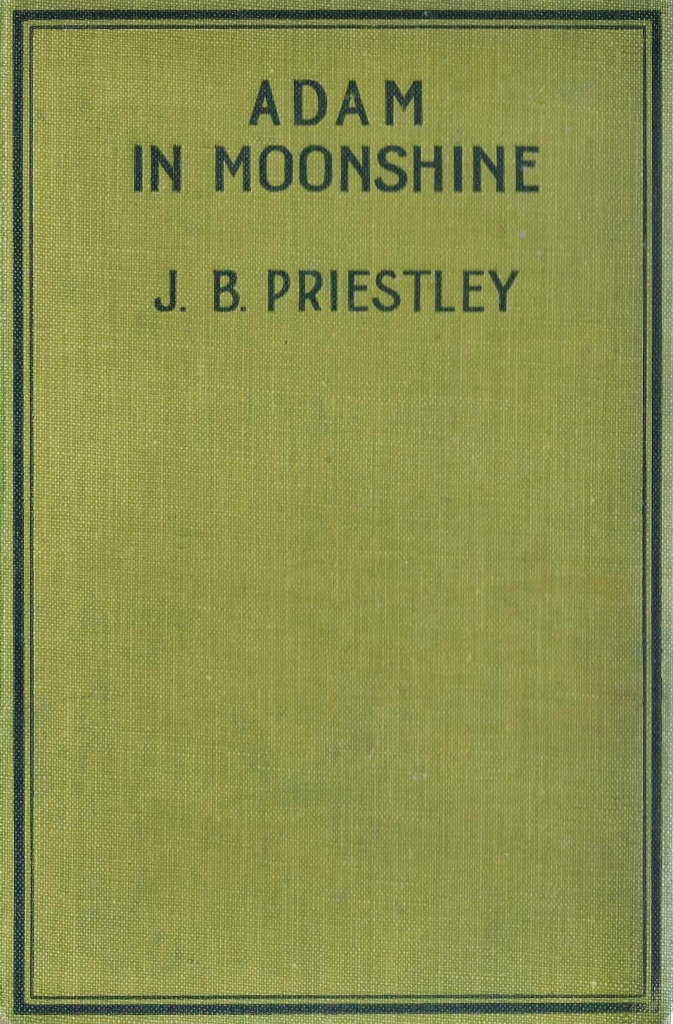
adam in moonshine j b priestleyAdam in Moonshine by J.B. Priestley ~ 1927. This edition: Heinemann, 1931. Hardcover. 293 pages.

My rating: 6/10

That “6” is a very generous rating, given mostly because of Adam in Moonshine’s “first novel” status by a writer I mostly admire, and the more than decent quality of the writing.

The plot, on the other hand, might be described as virtually non-existent. Interesting reading for a Priestley collector, but if the author was someone unknown to me I’m thinking this one would be in the box by the door, waiting to be passed along.

Of course, because it is a Priestley, and because I went to the trouble to seek out and order it from England, and because it is an interesting read in view of the author’s later works, I will keep Adam in Moonshine and, yes, eventually re-read it. But I will not recommend it to the rest of you for amusement purposes, because it is ultimately not even as solid as fluff. Like the referenced moonshine, its genuine but slight pleasures are purely transient.

Handsome young bachelor Adam Stewart, setting off on a country holiday, is in a mopish state. He should be thrilled at the thought of rambling over the dew-fresh North Country moors, hobnobbing with the birds and the bees and the little wild flowers, but he can’t seem to wind himself up to the appropriate mood. And when his railway compartment companion turns out to be a sternly bombastic, pessimistic cleric, the holiday atmosphere deteriorates even further.

But wait – what’s this?! Here comes a third man, flustered and rushing and escorted by a bevvy of lovely young ladies  – well, only three when Adam takes a closer look, but the effect is that of a bevvy – and as the train pulls out to the fervent goodbyes of the girls on the platform, Adam has perked up considerably, because it turns out that there is a rendezvous planned between the mystery man (father of one of the young lovelies) and the girls at the very village which Adam is himself heading for.

The sudden and disastrous opening of an attaché case filled with false beards catapults the action surreally forward, and before he knows it Adam is deeply embroiled in a ridiculous scenario having something to do with a conspiracy to bring back the Stuart line of royalty to the throne of England.

A case of mistaken identity – “Stewart” being assumed to be “Stuart” – takes our Adam into the heart of the not-very-clever plot, and leads to his infatuated and ultimately unfulfilling dalliances with all three of the lovely maidens.

He gets his share of wandering about the moors in all sorts of weathers, and emerges back into the sunlight of his everyday life blinking and bemused. Was it all a dream…?

If so, a jolly solid one, at 292 pages.

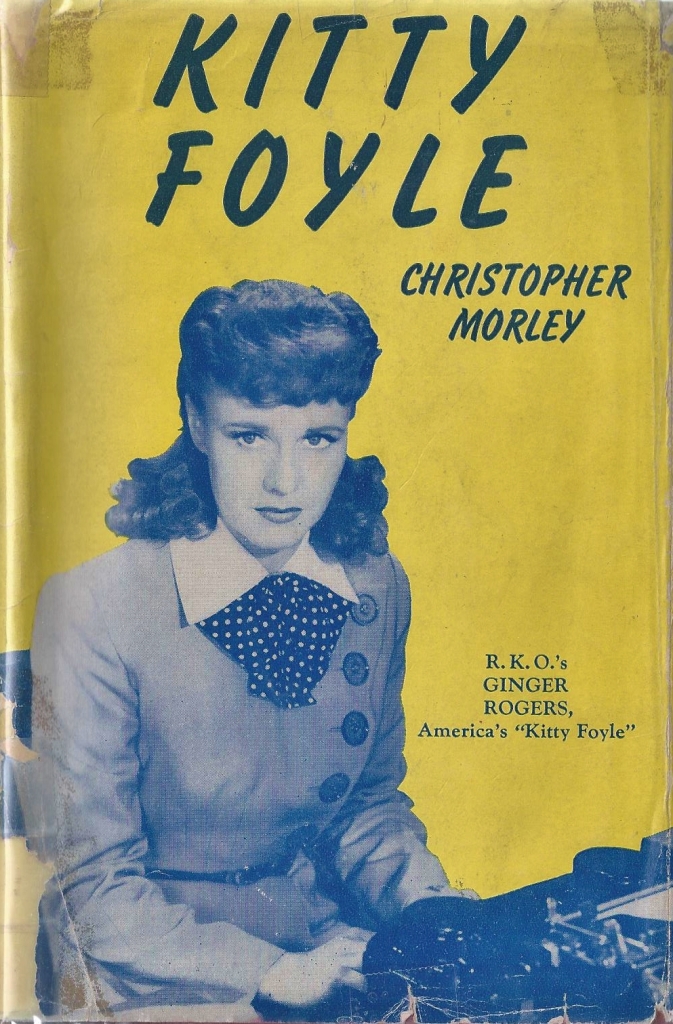
kitty foyle christopher morley 001Kitty Foyle by Christopher Morley ~ 1939. This edition: Grosset & Dunlap, circa 1940, with movie tie-in dust jacket featuring Ginger Rogers. Hardcover. 340 pages.

My rating: 7/10

I enjoyed this one rather uneasily, as Morley’s man-writing-as-a-woman wasn’t entirely convincing, and our heroine’s stream-of-consciousness narration often felt forced.

Chock-full of casual racism towards pretty well everyone of every colour and race, but, to be fair, never in a mean-spirited way.

In our present time, “Kitty’s” casual commentary would be read as utterly politically incorrect – a heads-up for those hyper-sensitive to these nuances – but if taken with a dash of “era-acceptable” tolerance, rather an interesting take on how a character of the time might conceivably think.

The October 1939 Kirkus review had this to say:

Surprise! Surprise! This proves how facile Chris Morley can be, for this is a far cry from everything he has done, whether whimsy, humor or intellectualized satire… This is primarily the story of a shanty Irish girl, how she was born, bred, and put through the mill, done in stream-of-consciousness tough-baby style… But it’s right good reading. Kitty is a high spirited, strong, and very straight young woman. Her early childhood in Philadelphia, daughter of a crude but lovable cricket coach, is nicely done, giving quite a feel of the city, its lethargy, immutable traditions, etc. At sixteen she meets Wyn, a sweet weakling from a blueblood family, whom she is to love for all time. She lives with him, becomes pregnant, but does away with the child because she is unwilling to tie Wyn to her, knowing that he cannot buck his family if he marries her, and knowing that she will be dishonest with herself if she broadens her a’s for him. Career girl on the side, she works later in New York for a cosmetics outfit, and at the close thinks of marriage to a man she does not love for companionship and stability. There’s some telling background detail on Philadelphia, points east and west, there’s some ingenious writing on the stunt side, but all in all it’s semi-light fiction…

There you pretty well have it.

I confess I was a bit taken aback by the frankness of much of Kitty’s narration – she discusses the most sensitive topics with slangy candour – the physical relationship between her parents, her father’s prostate disorder, the realities of living with chamber pots and a “backhouse” for toilet purposes, her own adolescent physical development, including the onset of her first menstrual period while travelling alone on a train, the sometimes very active sex life of the single “white collar” working girl, an unplanned pregnancy and her subsequent abortion of the baby…all in all, rather strong stuff for a popular mainstream novel. No real surprise that it was soon labelled as “filthy” by various church groups once its bestseller hype brought it to their attention.

Mixed with this hyper-realism is a strand of fairy tale fantasy, for Kitty is portrayed as being something of a perfect person – smart, funny, beautiful, and very lucky in her casual acquaintances, and always, despite her frequent hard knocks, falling jam side up.

Sure, she voluntarily gives up her One True Love, the aristocratic Wynnewood Strafford VI, because she is so darned sterling-natured as to want to spare him the disgrace of having a not-quite-top-drawer wife, but it’s not the hardship it might be (aside from the “he and she will secretly pine forever” bit, and that abortion) because going her own way seems to be Kitty’s reward to herself, and fate proves consistently ready to cushion her every fall.

Kitty Foyle was made into a very successful 1940 movie, starring Ginger Rogers in her first “serious” movie role. “Very successful” should be repeated, as her portrayal of Kitty Foyle won Miss Rogers the 1941 Oscar for Best Actress, which would perhaps make this novel one for the vintage movie buff to investigate.

Chock full of period colour, and fast-moving enough to keep one entertained, so I will say “check it out” to those so inclined, but to be completely blunt this is a very minor sort of novel – Kirkus’s “semi-light” says it well. Solid melodrama, in case that hasn’t quite come across.

And oh, yes, this is the same Christopher Morley who wrote Parnassus on Wheels, The Haunted Bookshop, and the very weird (as in featuring anthropomorphic dogs) Where the Blue Begins, among dozens of other novels. Kitty Foyle is nothing like any of these; you have to give Morley credit for not getting stuck in any sort of a “formula” groove!

Of these three novels, Kitty Foyle is the only one I would recommend as worth going to some effort to experience, but mind the caveats and please don’t expect a masterpiece of any sort, though the writing is much more than competent.

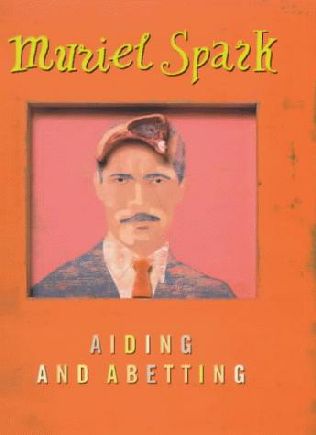
aiding and abetting muriel sparkAiding and Abetting by Muriel Spark ~ 2000. This edition: Viking, 2000. Hardcover. ISBN: 0-670-89428-1. 182 pages.

My rating: 4.75/10

Hmmm. An odd little novel, even taking into consideration the quirkiness of this particular writer.

I occasionally felt the “chuck it across the room” urge, in particular during the cannibal scene near the end (yes, you read that correctly), but I soldiered on and made it to the end with an unwilling smile on my face. Dame Muriel pulled it off yet again, to my reluctant admiration – I finished it despite myself.

So – does everyone remember Lord Lucan? If not, go take a quick gander here.

For summation of the plot of Aiding and Abetting, I am going to fall back on yet another Kirkus review (they are so nicely succinct, when done well) this one from November of 2000.

With her usual and famous narrative economies—though without the deeper energies she’s created in other of her books—Dame Muriel weaves her own fabric out of the real-life bits and threads left by the vile Lord Lucan.

On November 7th, 1974, the seventh Earl of Lucan mistakenly bludgeoned to death his children’s nanny instead of his divorced wife—whom he managed only to wound badly in spite of his feeling that “destiny” called for her death (he was angry, it seems, that she’d been given child-custody). And then? After wreaking his cruel havoc, the shallow Lucan quickly disappeared, wanted for murder and attempted murder but aided by influential friends in escape and hiding. Twenty-five years later, as the present novel opens, there appears in the office of a Paris psychoanalyst a patient claiming to be Lucan—followed by another claiming the same. Which, if either, is the real Lucan? And what does he, or they, want? Money, not surprisingly, which he/they hope to gain by blackmailing the shrink, she being one Hildegard Wolf, herself still wanted for an earlier and successful life of criminal fraud under a previous name—a vulnerability that makes her, think the Lucans, unlikely to turn them in. But of course it’s got to be cleared up as to which Lucan is Lucan—as, meanwhile, other complications ensue, such as Hildegard Wolf’s quick disappearance into hiding in deepest London; the pursuit of the real Lucan by a pair newly in love but connected from far back indeed with Lucan and the horrible murder; and the skilled and timely maneuverings of Pierre, Hildegard’s lover back in Paris, which will result in—well, in the Waughesque end of the story.

Quick, incisive, often entertaining, sometimes mysterious, at a moment or two compelling, but overall and generally, slight…

I nod in agreement with the summation of the last line, except for the incisive bit.

I thought the tale much too repetitive, in fact, and not so much incisive as lazy. Corners were indeed cut, regarding character and plot development, but a certain cluster of sanguinary details was endlessly repeated, and in my opinion needlessly so, for I felt that they weakened the impact, though I suspect the author felt they might have some sort of talismanic effect. (“Blood, blood, blood…”)

The final fate of one of the Lucans is bizarre even for a typically morbid Spark dénouement, and do I detect a certain racist element (the “primitive” Africans) which is out of place even in a purely satirical end-of-the-20th-Century tale?

Rated rather generously at very close to a “5” because of who the author is, for I have enjoyed many of her other novels in varying degrees, though usually with some reservations.

As an example of her end-of-career work (Aiding and Abetting was her second to last published novel) it is acceptably diverting, but it’s not one of her best by a far cry. More of a novella than a novel, and not particularly well-developed or well-edited. In fact, for such a generally crisp writer, this one is sloppy. Firmly on Muriel Spark’s B-list, in my opinion.

What one is left with most memorably is the thought of all that sticky, sticky blood…


Read Full Post »

« Newer Posts - Older Posts »