Archive for the ‘1920s’ Category

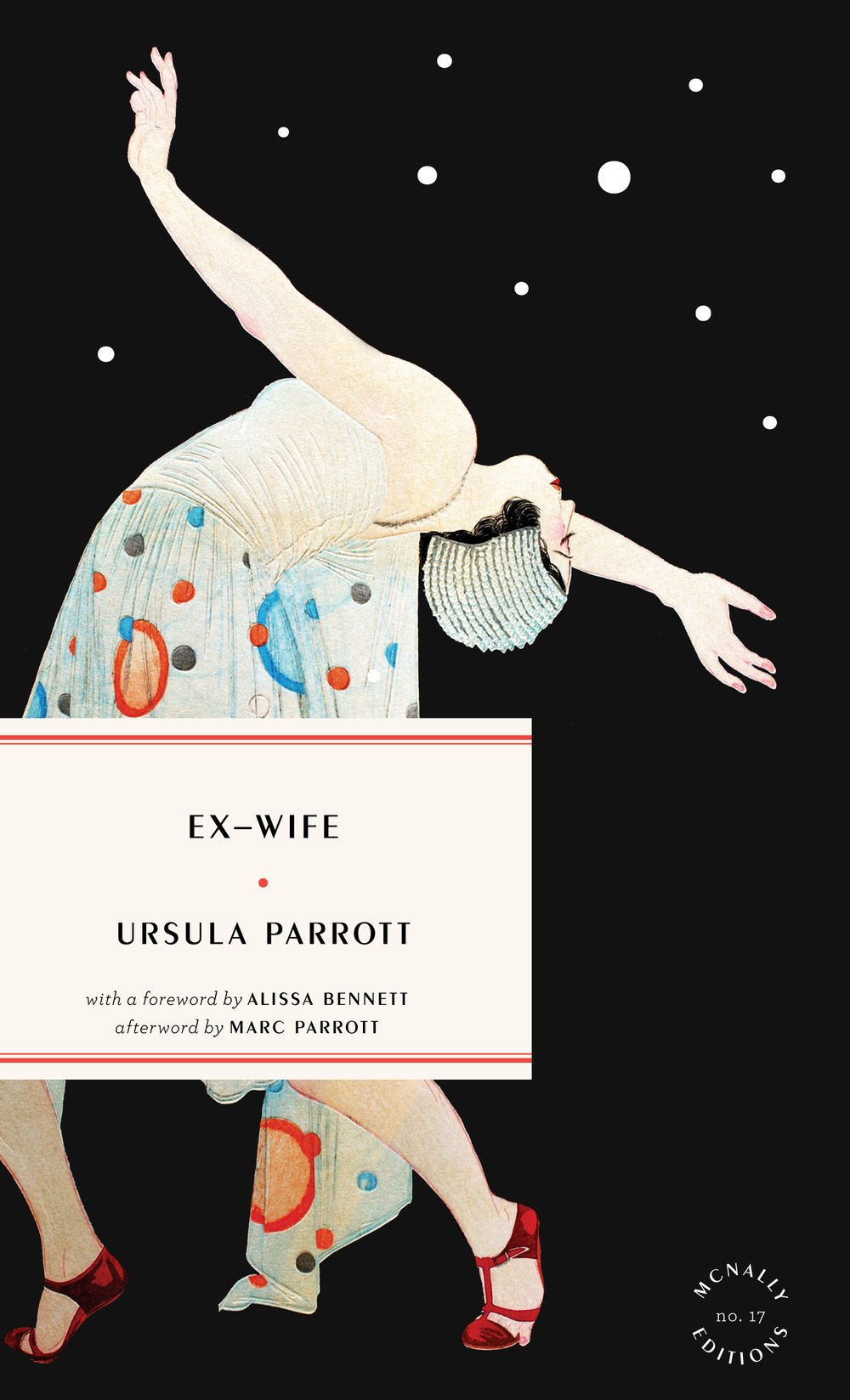
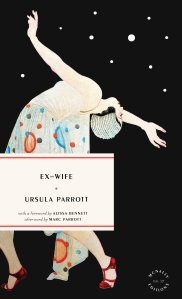
Ex-Wife by Ursula Parrott ~ 1929. This edition: McNally Editions, 2023. Foreword by Alissa Bennett. Afterword by Marc Parrott. Softcover. 218 pages.

I wish I could recall which of my fellow readers recommended this punchy little autobiographical novel, a bestseller immediately upon its anonymous publication in 1929. Described as “scandalous” and “racy” in its time,  it no longer carries the same weight as a “forbidden topic” tell-all, but has become something much more relatable, as the dissolution of marriage has become an unremarked commonplace in our North American culture, with, according to a quick internet search, something like 40% of formalized marital unions ultimately breaking down.

Here’s the flyleaf blurb from the most recent edition of this fascinating snapshot of a certain kind of cultural and personal life in the New York of the 1920s:

It’s 1924, and Peter and Patricia have what looks to be a very modern marriage. Both drink. Both smoke. Both work, Patricia as a head copywriter at a major department store. When it comes to sex with other people, both believe in “the honesty policy.” Until they don’t. Or, at least, until Peter doesn’t—and a shell-shocked, lovesick Patricia finds herself starting out all over again, but this time around as a different kind of single woman: the ex-wife.

An instant bestseller when it was published anonymously in 1929, Ex-Wife captures the speakeasies, night clubs, and parties that defined Jazz Age New York—alongside the morning-after aspirin and calisthenics, the lunch-hour visits to the gym, the girl­talk, and the freedoms and anguish of solitude. It also casts a cool eye on the bedrooms and the doctors’ offices where, despite rising hemlines, the men still call the shots. The result is a unique view of what its author Ursula Parrott called “the era of the one-night stand.”

I wouldn’t exactly call this a “revenge novel”, though seen from Patricia’s viewpoint Peter does not come off well at all. He openly sleeps around, is endlessly and cruelly critical of Patricia’s looks or, when the effects of too much work and partying start to show, her lack of them. He quite openly has a casual antipathy to their baby and is both indifferent and, when the child dies, seemingly relieved to be stripped of the burden of fatherhood. When Patricia gets pregnant a second time, Peter turns physically abusive, at one point throwing her through a glass door. Whatever Patricia’s personal flaws might be, Peter’s seem to exponentially trump them.

Patricia makes many poor decisions in the time we get to know her, but the unforeseen awfulness of Peter as a life partner is something that takes all of us by surprise – Patricia included. It was a love match to start with and passion matched passion, but somehow something changed. Patricia indicts Peter thus: “He grew tired of me, hunted about for reasons to justify his weariness; and found them.”

After a drink-fueled one night stand with Peter’s best friend – Peter doesn’t know “who”, just that it happened, as Patricia after much mental turmoil tells him – Peter gets all dramatic about Patricia breaking his trust and destroying his faith in women. He rattles on at great length about her besmirching her freshness and cleanness and innocence. She’s absolutely dirty (in his eyes)  for basically doing once what he’s been doing with unapologetically casual abandon all along. Apparently it’s different for her. Patricia pleads her case, Peter scorns her every word. Patricia wants a reconciliation. Peter absolutely doesn’t.

The marriage falls irrevocably apart, though years will pass before a divorce happens, with Peter resurfacing now and then to repeat his cutting critiques and knock Patricia out of whatever equilibrium she has attained.

Patricia, emotionally devastated, looks about for ways to dull her pain and finds them, in casual sexual encounters with many willing partners, in her success at her job, in relishing the material rewards of her work, in dressing well, dining out and dancing and and drinking, drinking, drinking. It doesn’t seem enough, though, and ultimately it isn’t.

Does this all sound too dreary for words? Initially I thought it might be, but I very soon became absolutely enthralled by Patricia’s navigation of her unwanted situation. While staying very aware that most of her issues were, at least partly, self-imposed, I soon found myself truly liking her. Her voice is by turns sad, angry, self-loathing, and absolutely cynical, but it’s also exceedingly self-aware, and genuinely humorous, as she muses on the inexplicable realities of being an unwilling “ex-wife” and everything that goes along with that designation.

Trigger warnings: This book contains frank (but not overly explicit) depictions of abortion, rape, and physical and mental abuse. It’s pretty tame stuff in comparison to what a lot of current bestsellers casually contain, but it was outspoken for its time. I felt that Parrott pulled off the tricky task of describing these experiences without crossing the line into needless titillation.

My rating: 9.5/10. The half point is deducted because the ending felt a bit uneven to me; I wanted a different resolution, though I’m not sure what that could have looked like.

An absolutely engaging story, and the characters came to life for me, sketched out and enlarged upon by a very competent writer.

The internet is abundant with elaborations on “the life she really lived”, though you might want to read Ex-Wife yourself before you drop down that particular rabbit-hole.

The afterword by Ursula Parrott’s son Marc is a bonus of the McNally edition. In real life the baby did not die, as the fictionalized child does. That said, the real-life tale of Parrot’s mothering is not exactly admirable. Marc pragmatically relates some aspects of his mother’s life and character with carefully balanced assessment, and appears to hold no grudges.


Read Full Post »

The Girls by Edna Ferber ~ 1921. This edition: Collier, circa 1930s. Hardcover. 374 pages.

It is a question of method. Whether to rush you up to the girls pellmell, leaving you to become acquainted as best you can; or, with elaborate slyness, to slip you so casually into their family life that they will not even glance up when you enter the room or leave it; or to present the three of them in solemn order according to age, epoch, and story. This last would mean beginning with great-aunt Charlotte Thrift, spinster, aged seventy-four; thence to her niece and namesake Lottie Payson, spinster, aged thirty-two; finishing with Lottie’s niece and namesake Charley Kemp, spinster, aged eighteen and a half— you may be certain nobody ever dreamed of calling her Charlotte. If you are led by all this to exclaim, aghast, “A story about old maids!”— you are right. It is.

A story about old maids, indeed, and how rich a field for harvesting by the right author. Edna Ferber is definitely that, garnering a full measure, a basketful – a book full! – of personal stories, mixed joys and tragedies, promises fulfilled and wasted.

We meet our three Charlottes in the early days of the 20th Century, in Chicago. Their family, the Thrifts, is in the upper echelon of that city’s society, even though their finances have of late begun to show signs of stress, what with the war in Europe and all.

In a series of extended vignettes – flashbacks interspersed with the present – we learn the stories of these three women, destined to walk their paths without male partners, though all three are not unloved by men.

The theme which unites these three femmes sole – aside from their warm and sustaining love for each other – is that of war. For Charlotte, the war between the states, taking place as she leaves her girlhood behind, erasing the life of the man whom she loved. For Lottie and Charley, the Great War strikes similarly brutal blows.

Edna Ferber was a gifted storyteller, and The Girls is a perfect example of her ability to stir the full spectrum of her readers’ emotions, from amusement to heartbreak, and everything in between. Some clever technique here, too, in the flashback sequences.

My rating: 9.5/10

Now out of copyright, many of the secondhand copies on ABE are print-on-demand, though a few originals are there as well. If you don’t mind reading from a screen, The University of Michigan has a scanned copy to peruse.

Read Full Post »

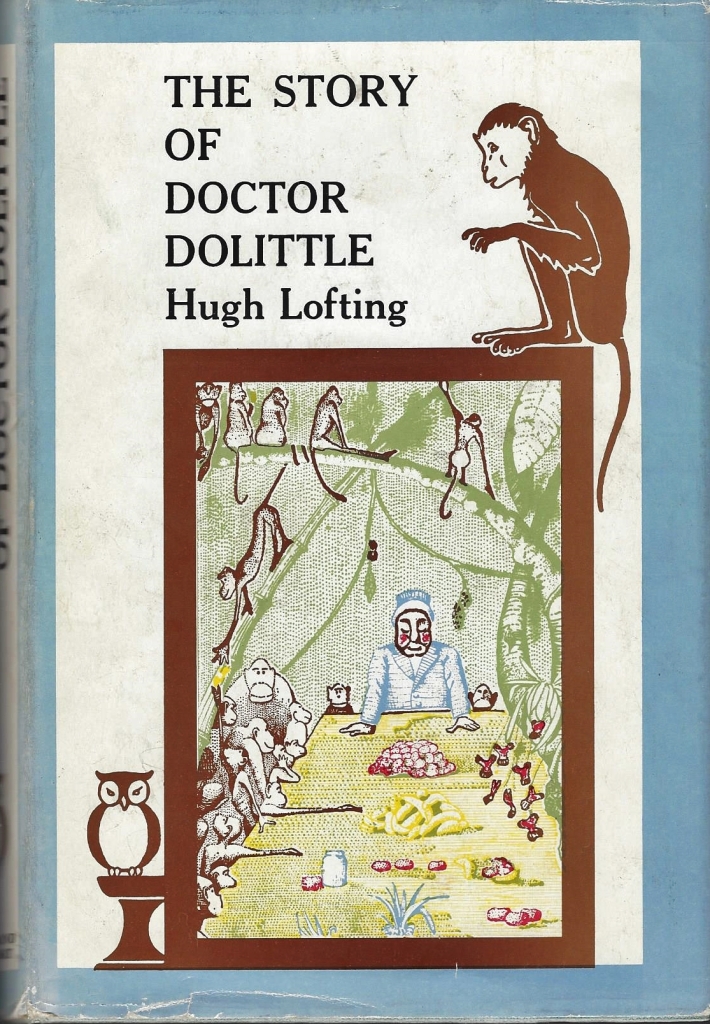
The Story of Doctor Dolittle by Hugh Lofting ~ 1920. This edition: McClelland and Stewart, 1962. Foreword by Hugh Walpole. Illustrated by Hugh Lofting. Hardcover. 223 pages.

Oh boy.

I don’t think I have the resources (time or energy wise) to do this topic – racism in “beloved” vintage children’s books – justice. But I don’t feel right in just passing it over undiscussed, either. So here I go. Bear with me.

The Story of Doctor Dolittle, based on a series of illustrated letters the author wrote from the Great War trenches to his young sons back home in England, was published in book form in 1920, to immediate popularity.

There’s an awful lot to like in here. Written in simple, frequently staccato sentences, the book introduces us to Doctor Dolittle, M.D., who is a prosperous and well-liked physician in the small town of Puddleby-on-the-Marsh. The good Doctor has a fondness for animals, and as he progressively fills his home with creatures, a tipping point is reached when the animal residents start causing problems with patients.  (An elderly lady sits upon a prickly hedgehog and so on.) Business falls off, until Docotor Dolittle’s only client remaining is the local Cat’s-meat-Man, who visits once a year at Christmas to get a remedy for indigestion.

What’s to be done? Doctor Dolittle is bemused. Then an epiphany occurs, when his pet parrot Polynesia, able to converse in English, initiates the Doctor into the mysteries of animal languages. He becomes a highly successful animal doctor, and all seems well, until the adoption of a crocodile sends all of his clients scurrying. Hard times again!

Then a message arrives from Africa. The monkeys there are all succumbing to some terrible disease. Will Doctor Dolittle come to the rescue? Of course he will! Borrowing a boat from a friendly sailor, off goes the Doctor, accompanied by several of his favourite pets, and also that troublesome crocodile, an ex organ-grinder’s monkey, and Polynesia the parrot, those last three intending to be repatriated to their native land.

As soon as they hit the shores of Africa, the reader’s real dilemma starts.

So far all has been quite good clean fun, but for a few casual era-expected racial slurs here and there easily glossed over by the keen-eyed adult reader-aloud – the usual, “We’ll have to work like n******!” pops up at least once.

The Doctor and his animal entourage crash their ship on the rocky shores of Africa, and head into the jungle, where they arrive at the mud palace of the King and Queen of Jolliginki. The King eyes the Doctor with displeasure.

“You may not travel through my lands,” said the King. “Many years ago a white man came to these shores; and I was very kind to him. But after he had dug holes in the ground to get the gold, and killed all the elephants to get their ivory tusks, he went away secretly in his ship— without so much as saying ‘Thank you.’ Never again shall a white man travel through the lands of Jolliginki.”

Then the King turned to some of the black men who were standing near and said, “Take away this medicine-man — with all his animals, and lock them up in my strongest prison.”

Fair enough, we’re thinking, though a bit hard on the beneficient Doctor. But he doesn’t need our concern, for he soon escapes, pursued by the soldiers of the King, and makes his way to the part of the jungle inhabited by the monkeys. There he easily cures the sick ones by means of wide scale vaccinating (Lofting doesn’t bother with pesky details such as how the Doctor comes by and/or manufactures this magical vaccine), and sets off to return to England.

The soldiers of Jolliginki soon capture him, and back into the dungeon he goes. This time he is rescued by a clever plot dreamt up by Polynesia (who is still hanging about, though she intends to stay in Africa when the Doctor departs) concerning the King’s son Prince Bumpo, who is enamoured of European fairy tales, and has been emotionally scarred by an episode so related.

Here, I’ll give you the works:

“Listen,” whispered the parrot, when John Dolittle’s face appeared: “Prince Bumpo is coming here to-night to see you. And you’ve got to find some way to turn him white. But be sure to make him promise you first that he will open the prison-door and find a ship for you to cross the sea in.”

“This is all very well,” said the Doctor. “But it isn’t so easy to turn a black man white. You speak as though he were a dress to be re-dyed. It’s not so simple. ‘Shall the leopard change his spots, or the Ethiopian his skin,’ you know?”

“I don’t know anything about that,” said Polynesia impatiently. “But you must turn this coon white. Think of a way—think hard. You’ve got plenty of medicines left in the bag. He’ll do anything for you if you change his color. It is your only chance to get out of prison.”

“Well, I suppose it might be possible,” said the Doctor. “Let me see—,” and he went over to his medicine-bag, murmuring something about “liberated chlorine on animal-pigment—perhaps zinc-ointment, as a temporary measure, spread thick—”

Well, that night Prince Bumpo came secretly to the Doctor in prison and said to him,

“White Man, I am an unhappy prince. Years ago I went in search of The Sleeping Beauty, whom I had read of in a book. And having traveled through the world many days, I at last found her and kissed the lady very gently to awaken her—as the book said I should. ’Tis true indeed that she awoke. But when she saw my face she cried out, ‘Oh, he’s black!’ And she ran away and wouldn’t marry me—but went to sleep again somewhere else. So I came back, full of sadness, to my father’s kingdom. Now I hear that you are a wonderful magician and have many powerful potions. So I come to you for help. If you will turn me white, so that I may go back to The Sleeping Beauty, I will give you half my kingdom and anything besides you ask.”

“Prince Bumpo,” said the Doctor, looking thoughtfully at the bottles in his medicine-bag, “supposing I made your hair a nice blonde color—would not that do instead to make you happy?”

“No,” said Bumpo. “Nothing else will satisfy me. I must be a white prince.”

“You know it is very hard to change the color of a prince,” said the Doctor—“one of the hardest things a magician can do. You only want your face white, do you not?”

“Yes, that is all,” said Bumpo. “Because I shall wear shining armor and gauntlets of steel, like the other white princes, and ride on a horse.”

“Must your face be white all over?” asked the Doctor.

“Yes, all over,” said Bumpo—“and I would like my eyes blue too, but I suppose that would be very hard to do.”

“Yes, it would,” said the Doctor quickly. “Well, I will do what I can for you. You will have to be very patient though—you know with some medicines you can never be very sure. I might have to try two or three times. You have a strong skin—yes? Well that’s all right. Now come over here by the light—Oh, but before I do anything, you must first go down to the beach and get a ship ready, with food in it, to take me across the sea. Do not speak a word of this to any one. And when I have done as you ask, you must let me and all my animals out of prison. Promise—by the crown of Jolliginki!”

So the Prince promised and went away to get a ship ready at the seashore.

When he came back and said that it was done, the Doctor asked Dab-Dab to bring a basin. Then he mixed a lot of medicines in the basin and told Bumpo to dip his face in it.

The Prince leaned down and put his face in—right up to the ears.

He held it there a long time—so long that the Doctor seemed to get dreadfully anxious and fidgety, standing first on one leg and then on the other, looking at all the bottles he had used for the mixture, and reading the labels on them again and again. A strong smell filled the prison, like the smell of brown paper burning.

At last the Prince lifted his face up out of the basin, breathing very hard. And all the animals cried out in surprise.

For the Prince’s face had turned as white as snow, and his eyes, which had been mud-colored, were a manly gray!

Need I really say more?

Now in the 1960s, after The Story of Doctor Dolittle and its numerous sequels had been selling steadily for some decades without much comment – though presumably not being embraced by families-of-any-sort-of-colour-other-than-white – people started to say “Hey! This is kinda-sorta-maybe-a-little-bit RACIST!”

Yeah, you think?

And so the troublesome bits were bowdlerized.

And Doctor Dolittle continued on as a steady seller in his now altered form.

And I don’t quite know what to say about all of this, being in general quite firmly against censorship and alterations to text of older books in response to subsequent adjustments to social standards of acceptance.

But I didn’t read this to my own children back-in-the-day when they were little because it made me utterly queasy, and I shelved that whole Dolittle series which someone had given to me as “charming children’s tales!”, packing it away in a box which still sits in storage because I wasn’t quite sure what to do with the books.

Does one release something like that back into the world to be acquired by other unsuspecting parents? Destroy them? Which feels wrong too, on a wholly different level, because I think we can get an awful lot out of keeping intact reminders of how we used to think in days gone by, and by being shocked by it (or not, as the case may be) examine our own social consciences.

So there it is, and here I sit, looking at what I’ve written, and at the clock (because I need to be somewhere else very shortly) and wondering if I should just hit “post” and see if this inspires any sort of engagement, or if you, like me, are still wondering how best to deal with this particular issue.

Your thoughts are, as always, exceedingly welcome!

Read Full Post »

Mrs. Harter by E.M. Delafield ~ 1924. This edition: Hutchinson, 1924. Hardcover. 253 pages.

It has taken me several false starts to get past the rather subfusc beginning of this sardonic novel, but once hooked it become so compelling that I stayed up well after midnight last night finishing it off, and quite some time after that lying awake and mulling over my response to it.

Narrated in the first person by Sir Miles Flower, confined to a wheelchair by his injuries during the Great War, Mrs. Harter seems at first a slightly brittle village comedy of the classes, with the arrival in the village of Cross Loman of Diamond Harter from Egypt, who sets eyes flashing and tongues clacking.

Mrs. Harter has come without her husband, and has gone into rather shabby lodgings, and no one (including herself) quite seems to know why she is back home. For Diamond is the daughter of the late village plumber, and the general consensus is that she has boosted herself up a social notch or two by her marriage.

The women in general (with one or two exceptions) greatly resent her arrival, the more so since all of the men seem to find her rather fascinating, and make all sorts of excuses for her, and in a few cases actively seek her out.

Mrs. Harter herself is a stoic character, showing little emotion, being brusque almost to rudeness at all approaches. How odd then that another new arrival, eligible bachelor Captain William (Bill) Patch, seems drawn to Mrs. Harter’s side like a moth to a flame, and it soon becomes apparent that she is in her turn silently infatuated with him.

Sir Miles speculates upon their private lives, going so far as to invent their most private conversations and to indulge in a bit of amateur psychoanalysis, depending on others for most of his information, as he doesn’t actually go out much.

Sir Miles has a complicated relationship of his own with his appalling wife Claire, an overly emotional and deeply egotistical poser of a woman, who turns every conversation to herself, and is capable of nourishing strong resentments towards anyone whom she sees as a competitor for the attention of her social circle, which means just about everyone, and in particular the ex-plumber’s daughter. Claire is decidedly affronted.

Things really get brewing during the production of an amateur theatrical piece; Mrs. Harter proves to have an unexpectedly good singing voice so is dragged into attendance by the universally popular Bill Patch. Open snubs by the snobs are constantly being averted by Sir Miles’ cousin Mary, who is pretty well the only character not to reveal herself to have unpleasant character traits. (Our narrator included.)

There is a lot of dry comedy here, in the character portraits of the villagers – one is reminded of the same sort of thing in the Delafield’s later Provincial Lady novels – but tragedy is never far away.

Mr. Harter shows up unexpectedly, and, being nothing like what anyone expected, his presence sends the simmering situation to a disastrous boil.

E.M. Delafield seems to have had an agenda of sorts in this ironically constructed novel, which seems to be that no one of us can tell what really goes on in the mind of others, and that preconceived notions and even direct observations may often be absolutely wrong. Her narrator has something of an unplanned agenda of his own, the increasing apparent revelation of his deeply buried hatred for his wife, and the disaster that is his own emotional life, brought out into the light during the destruction of the possibility of happiness for Mrs. Harter and Captain Patch.

Not a happy novel, then, but an increasingly fascinating one, well up to the standard we expect from this accomplished writer of the mid-wars period.

My rating: 8/10

Read Full Post »

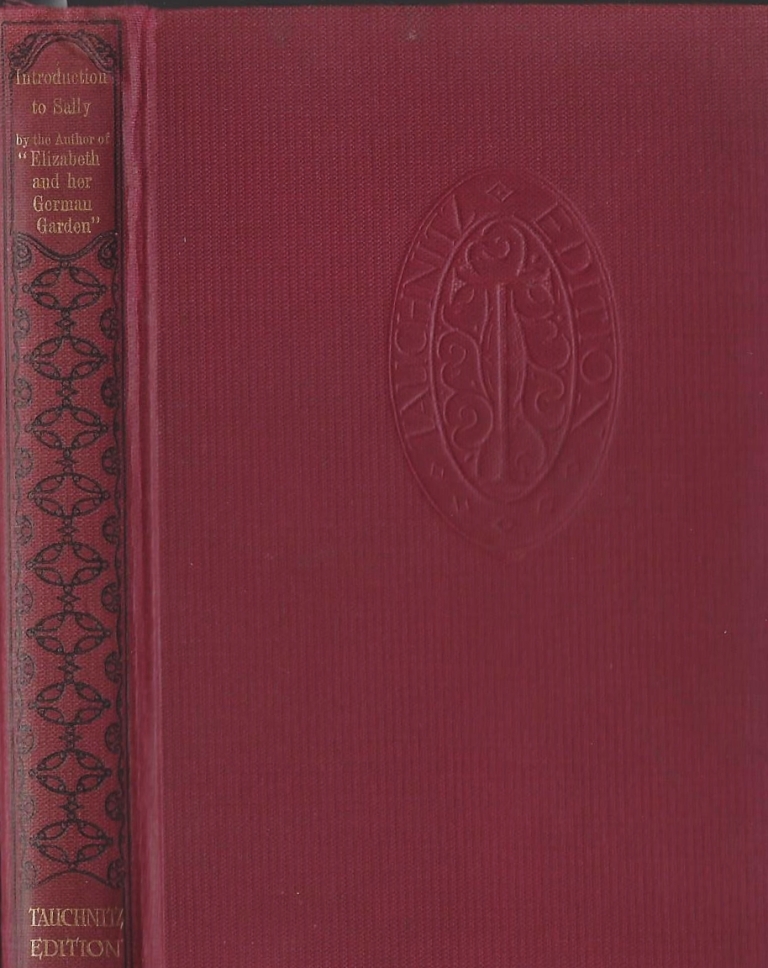
Introduction to Sally by Elizabeth von Arnim ~ 1926. This edition: Tauchnitz, 1926. Hardcover. 303 pages.

What happens when an unbelievably beautiful girl is born into a modestly situated, working class, strictly God-fearing family, unable to fathom how best to protect their jewel of a child from the increasingly lecherous gaze of every man who sees her?

By marrying her off, of course, to the first man who offers for her, thereby shifting the responsibility to other shoulders. Beauty as burden is the theme of this little novel, with a dash of reluctant Eliza Doolittle-ism thrown in.

Goddess-like in appearance, strictly working class in every other way, meek and obedient shopkeeper’s daughter Salvatia (Sally for daily use) is catapulted by her desperately out-of-his-depth (and now widowed) father into an absolute mésalliance with brilliant Oxford student Jocelyn Luke.

Jocelyn is infatuated with Sally, and (at first) cares only for the perfection of her face and figure. During the whirlwind courtship which is rushed along by all parties in the interests of keeping her out of the public eye as much as possible (her beauty literally attracts crowds), Jocelyn hasn’t ever stopped to think of what marriage actually means beyond the sanctioned bedding of the loved one, but once he takes a break from the bedroom, he finds himself caught in an appalling situation. His darling Sally is utterly unable to meet him halfway in thought and in conversation; their minds are as far opposite as fire and water; what has he done?!

Optimistically thinking that he can perhaps remake his wife’s mind and manners (not to mention her speaking voice and limited vocabulary, all dropped aitches and “Pardon”s and “Don’t moind if I do”s), Jocelyn trots Sally off to his mother’s house, hoping to foist his wife off on his ladylike mother for a Pygmalion-like re-education.

It doesn’t take. Sally is unchangeable, and deeply unhappy in her new milieu, as she finds kind Mrs. Luke sadly intimidating, and her speech-and-etiquette lessons completely bemusing.

Sally runs away, all the way back home to her father, who refuses to harbour her for a moment, for he’s been enjoying his newly peaceful life. He loads her onto a train with a pound-note and firm instructions to return at once to her husband’s arms, but Sally unaccountably goes astray, only to pop up again in the company of none other than an elderly (and fortunately deaf) Duke.

I’ve left out an enormous number of Sally’s blundering and innocent adventures. She’s continually being pulled about from here to there by her caretakers and random acquaintances, allowing Elizabeth von Arnim to indulge herself in a gleeful and gently sardonic polemic on English society and its hidebound class distinctions. There’s a secondary courtship going on as well, that of the genteelly impoverished, highly cultured Mrs. Luke and her wealthy but intellectually ignorant neighbour Mr. Thorpe, which provides a delicious counterpoint to the main events, as the lives of both couples intertwine and complicate things exponentially.

This romping tale is mostly farce, but there is a kernel of sincerity present too, with the caricatured characters being allowed their moments of genuine humanity. The author is keen-eyed and sharp-tongued but ultimately kind, and she allows her buffeted heroine a certain amount of self-determination as well, by refusing to allow herself to be changed. Sally is what she is, and the sooner her champions accept that, the happier they all will be.

The ending of this story is only a beginning. It’s merely – as the title makes clear – the introduction of Sally to what will obviously become a gently triumphant progress through life. A home of her own, a kind and contented husband, and a lapful of darling babies being Sally’s stated best ambition, it is happily moved forward by her chance acceptance as a protegé by one of the highest in the land. The fickle fate which endowed Sally with her physical gifts has tried her sorely; she’s gone through her testing time; now that same random fate will smooth her way.

As you may have gathered, this is one of the gleefully ridiculous von Arnims, exceeding in its giddy plot even the deeply silly Enchanted April. To be happy in your reading, you must abandon all 21st Century notions of how Sally should behave, and how people should behave to Sally, and remind yourself that it’s just a fictitious story of a nine decades ago, a fairytale of the Twenties, a mere snippet of a gentle farce.

Elizabeth von Arnim’s writing is always a delight, and I enjoyed Introduction to Sally greatly (to the point of reading it twice in the space of a year) but if I absolutely had to choose I daresay I’d have to go with von Arnim’s slightly more serious novels – The Benefactress being the one that springs first to mind – as my “author’s best”.

My rating: 7.5/10


Read Full Post »

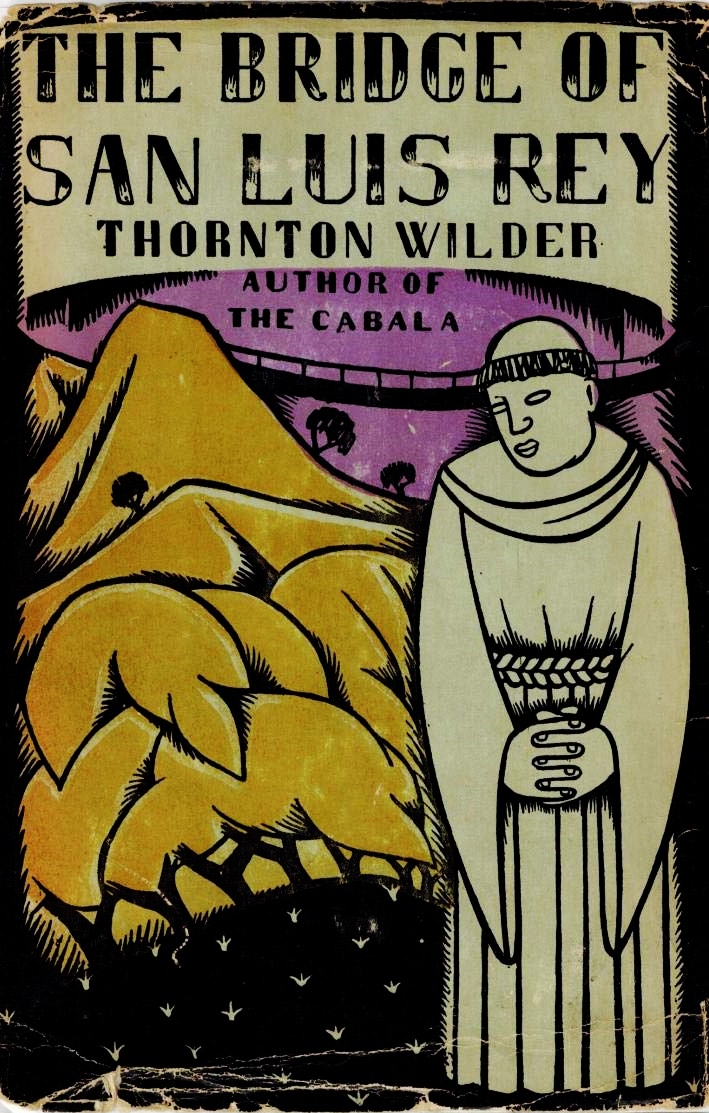
The Bridge of San Luis Rey by Thornton Wilder ~ 1927. This edition: Grosset & Dunlap, 1928 (later printing). Hardcover. 235 pages.

On Friday noon, July the twentieth, 1714, the finest bridge in all Peru broke and precipitated five travelers into the gulf below…

Thornton Wilder’s enduring classic (that clichéd phrase applies most pertinently) consists of a number of separate but increasingly entwined narratives. The accounts of the lives of the five travellers who perished are framed on each end by the ultimately tragic tale of Brother Juniper, who witnesses the disaster and in it finds a question: “Why did it happen to those five?”

If there were any plan in the universe at all, if there were any pattern in a human life, surely it could be discovered mysteriously latent in those lives so suddenly cut off. Either we live by accident and die by accident, or we live by plan and die by plan. And on that instant Brother Juniper made the resolve to inquire into the secret lives of those five persons, that moment falling through the air, and to surprise the reason of their taking off.

The Marquesa de Montemayor, obsessed mother, secret alcoholic, astonishingly accomplished letter writer. Orphaned Pepita, bright hope of her convent home’s Mother Superior, lent to the Marquesa as a maid. Pio, jack-of-all trades and committed non-committer, except for his devotion to one person, the once-famous actress Camila Perichole. Jaime, Camila’s young son, frail and epileptic. Esteban, one of a set of twins, whose brother’s recent death has made his own life worthless in his eyes.

Wilder goes on to detail the lives – secret and otherwise – of the five travellers on the bridge, and delves into why they were there at that particular moment. And yes, everything (and everyone) turns out to be connected.

Brother Juniper, six years of research undertaken, yet not being privy to a few intimate details, concludes that the deaths are not as he had intended to prove, the fitting conclusion to lives attaining “a perfect whole”, but instead that they were random interruptions of lives not yet fully lived. The Inquisition disagrees with his thought processes, and Father Juniper perishes by flame, along with all of the copies of his thesis, except for one…

What a beautifully crafted little novel this is.

I read it for the first time in high school, after finding a dusty stack of discarded English lit books in the farthest corner of a classroom bookcase. In retrospect, I’m very glad that I did not have to “study” The Bridge of San Luis Rey, instead being able to read it from end to end without stopping for analysis, and not needing to dissect it in any way. It was a purely emotional experience, and so memorable that now, forty years later, every phrase is still familiar.

My rating: 9/10


Read Full Post »

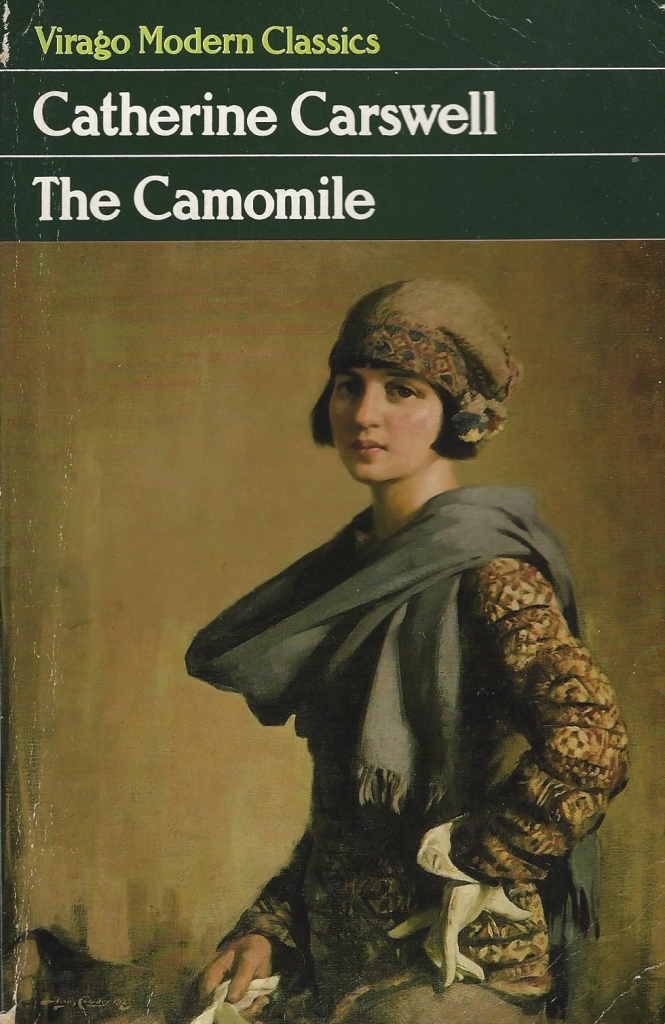
The Camomile by Catherine Carswell ~ 1922. This edition: Virago, 1987. Introduction by Ianthe Carswell. Paperback. ISBN: 0-86068-873-9. 305 pages.

I had already told him about my being an orphan, about my music teaching, and about my writing and Mother’s. Of my writing he said, ‘I see. It is like the camomile – the more it is trodden on the faster it grows.’

This rewarding short novel is written in epistolary form, being made up of two long letters, fore and aft, and journal entries made to be shared with a distant friend.

It starts out as the amusing and somewhat self-absorbed account of a young woman’s journey of self-discovery, of finding her place in the world, and goes on to discuss some of the larger questions which are still pertinent to young people today: Who am I, really? Why am I here? Do I change to meet the desires of others, or stay true to myself?

Our young correspondent is Ellen Carstairs, just back in Glasgow after spending two years studying music in Frankfurt, writing to her London friend Ruby, whom she had met in her first days at the Frankfurt Conservatory of Music.

Ellen has found Ruby to be a kindred soul, for both soon realize that music is not their true métier, though they have some adequate talents in that area to perhaps serve as teachers of novices. They nevertheless do their best to take in their lessons and improve their musical craft, all the while yearning for a truly satisfying occupation, an “art” which will be their one true life’s pursuit, one which they are suited for and which they will excel at.

After their two years of relative freedom in Europe, the friends return home, and get on with the business of earning their livings while at the same time opening themselves up to finding and developing their true callings. For Ruby the true art – the one which chooses the artist – is that of illustration – drawing and painting. And for Ellen, it is writing. Which is a problem, at least as far as her family and friends are concerned.

For Ellen’s mother was a writer. Not a successful one – far from it! She appears to have been (from the clues we are given) a woman obsessed by the need to write without necessarily having enough mastery of the craft to make her scribblings saleable. She has pursued her interest to the exclusion of all else, spending the housekeeping money on self-publishing of pamphlets of sub-par poetry and the like.

This mother inadvertently neglects her two children, to the extent that her young son Ronald is permanently crippled through her heedless actions. Interestingly enough, when she dies when the children are still young, they and their father sincerely mourn her, harking back at her better qualities, and forgiving her (for the most part) her obsession.

Ellen’s missionary father has been absent for much of her childhood and he too is now dead, leaving Ellen and Ronald in the care of his sister Harriet, an Evangelical Presbyterian of unwavering faith. Neither Ellen nor Ronald share the narrow religious beliefs of their father and aunt, but they go along with Aunt Harriet’s wishes in church attendance and such, not wanting to hurt her feelings, for they love her deeply despite their increasing differences.

On her return from Germany, Ellen begins to teach music at her old school and to private students; she earns enough to be able to rent a room and a piano in a neighbour’s house, ostensibly so she can practice undisturbed and undisturbing. Soon she finds that she is using her retreat for writing more than for piano playing; her true art has chosen her and she gives in with secret relief, though she is wary of admitting it to her brother and aunt, and questions herself on the ethical implications of misleading them as to what she is doing.

Ellen fortuitously finds a mentor in an ex-priest, John Barnaby, a brilliant intellectual engaged in quietly, slowly killing himself by drink and near-starvation. John reads Ellen’s manuscripts and encourages her to seek publication, using his past connections in the literary world to push forward her novice submissions.

Just when things seem set for Ellen to commit fully to becoming a professional writer, she falls in love with Duncan, a friend’s brother who is a young doctor on leave from his practice in India. The two become engaged, but though Duncan gives lip service to his wish for Ellen to not give up her own interests, it becomes increasingly obvious that he is oblivious to the importance of her craft to her very identity.

Added to this building dilemma is the fundamental difference in Ellen’s and Duncan’s views towards sex. Ellen believes that people seriously considering marriage should engage in the ultimate intimacy, in order to make sure that they are compatible for a lifetime of marital companionship. Duncan is shocked by this notion, and condescendingly tells Ellen that she is merely a foolish virgin with outlandish ideas; much better to let Duncan guide her in her sexual initiation once they are safely married.

Can you see where this might be going?

Yes, indeed, second thoughts are in order all round…

No surprise that this novel was chosen by feminist press Virago for republication in the 1980s, for it is all about female self-determination in the face of almost universal societal disapproval.

Ellen documents her personal journey with passion and lucidity and not a little humour. This is not in any way a dreary saga of crushed and downtrodden womanhood. No indeed! For like the camomile referenced in the title, the heavy-footed treading here merely makes the flower find another place and way to thrive.

More on Catherine Carswell here.

The Camomile scores a good strong 8/10 from me.

Carswell’s one other novel, Open the Door! (1920) is now firmly on my wish list, as is her partial autobiography Lying Awake.


Read Full Post »

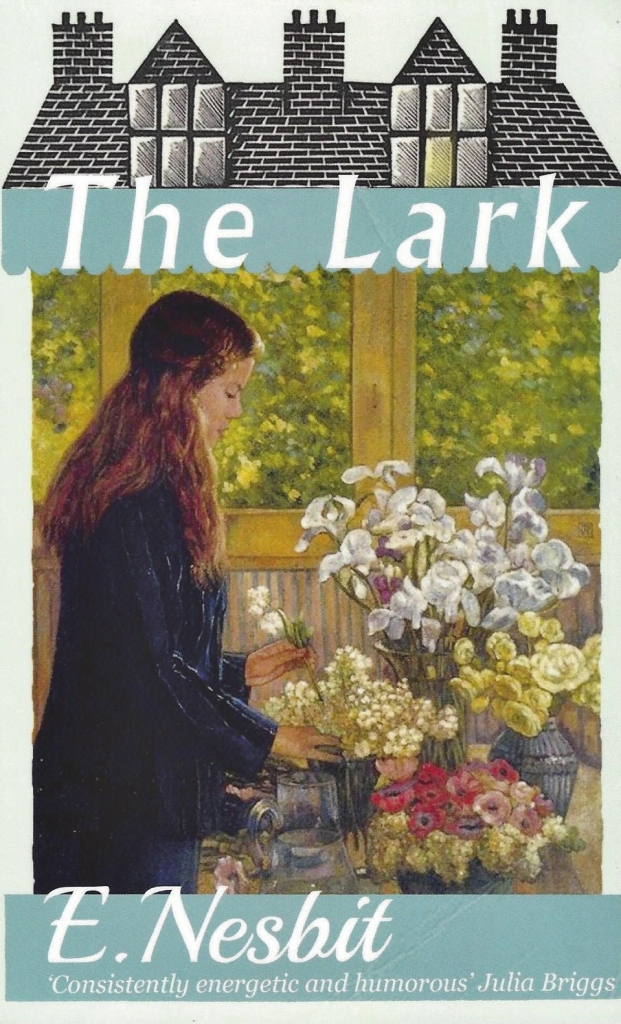
The Lark by E. Nesbit ~ 1922. This edition: Dean Street Press, 2017. Introduction by Charlotte Moore.  Softcover. ISBN: 978-1-911579-45-8. 251 pages.

Looking for a lighthearted frivol, a confection of a novel? Look no further than this small charmer by Edith Nesbit, best known for her deliciously satirical children’s books (Five Children and It, The Story of the Treasure Seekers, The Railway Children, and so on) but also a writer of adult novels, which this one is.

This isn’t a sombre bit of literary fiction, but a fairy tale for grownups, with just enough dashes of cold reality to keep it somewhat grounded in the real world, though most of the plot is driven by the most unlikely set of happy coincidences I’ve yet to come across in a very long history of light-fiction reading.

It’s just what is advertised by the title. It is, in fact, a complete lark.

Two orphaned teenage cousins, Jane and Lucy, happily tucked away in boarding school by their guardian and looking forward to their soon-to-be-attained coming of ages when they will come into what they have been told are substantial inheritances, receive a happy shock when they are informed that their guardian has withdrawn them from the school and asked them to report to a mysterious address in the countryside beyond the fringes of London.

Confidently expecting this to be their introduction to the adult world, presided over by their mysterious patron, they are bewildered at being decanted at the door of a small country cottage instead of the mansion they were expecting.

A perfectly timed letter gives an explanation. Jane and Lucy’s guardian apologizes profusely, but he has squandered their fortunes on unsound financial speculations, and has gone utterly bankrupt. He’s leaving the country before his creditors can catch up to him, but he’s tried to cushion the blow somewhat by arranging for a lump sum of £500 to be put to the cousins’ account, and the afore-mentioned cottage as a residence.

Jane and Lucy soon realize that their rapidly-diminishing nest egg isn’t enough to cover their longer-term needs, and they look about for ways to augment it. The stage is set for all manner of lucky happenings, with helpful young (and not so young) men cropping up like daisies in the spring.

It’a all very amusing, and the lightness is well set off by the running thread of reality, for this book was written not long after the ending of the Great War, and is set in 1919, and the plight of many of the returned soldiers coming home to not much in the way of a future becomes a key element in the extended plot.

Occasionally  (okay, very often) I (figuratively) rolled my eyes at the sillier bits, but I happily kept reading, because the story is as engaging as it is unrealistic, and the realistic bits were shoehorned in with acceptable success.

My rating: Let’s say a nice, solid 7.5/10. A definite keeper.

Read Full Post »

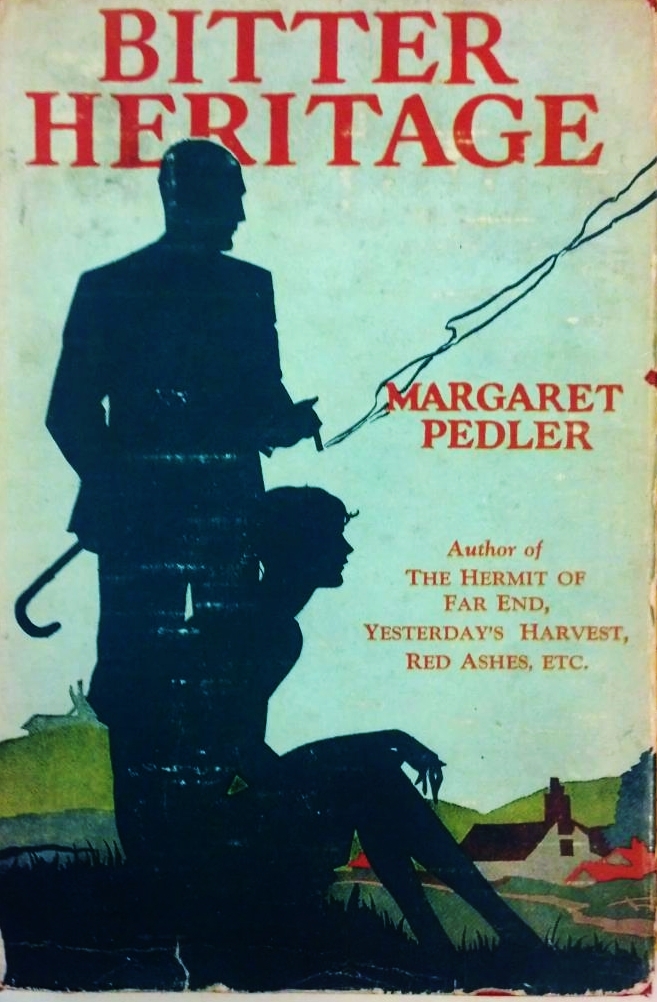
bitter-heritage-margaret-pedler-1928-2Bitter Heritage by Margaret Pedler ~ 1928. This edition: Hodder and Stoughton, 1928. Hardcover. 316 pages.

My rating: 4/10

A hugely predictable melodrama about a young woman whose father has disgraced himself, and by association her, by a massive financial gamble with other people’s money which failed. His subsequent suicide makes things even worse.

Our heroine Herrick -“a child-woman of seventeen” – is brutally dumped by her fiancé who fears disgrace by association – “I can’t put – forgive me – the daughter of a thief, of a swindler, in the place my mother’s held. Or” – his voice dropped a little – “make her the mother of my children.”

Oh, ouch.

But not to worry! Herrick is a plucky young thing (and beautiful, which is useful) and she goes out into the cruel harsh world and makes a new life for herself. We see her next a very few years later in Paris, working as a model for a famous dressmaker.

Herrick impresses all by her natural sweetness, including her money-minded employer (digression: are all Parisian dressmakers as deeply mercenary as vintage English novels make them out to be – think about that one, fellow readers – can you show me an exception?), and in particular an English client, Lady Bridget, who – quelle coïncidence! – turns out to have been the long-ago romantic flame of Herrick’s father, and the possessor of a letter written to her by him just before he pulled the fatal trigger instructing Lady Bridget to look after his darling daughter.

So now all is good. Correct? Herrick can leave her employment and enter into a mutually comforting relationship with Lady Bridget. Who just so happens to have a charming, handsome son…

No, wait. That would be too easy.

The son’s romantic feelings are engaged elsewhere, but he acts as a brother-like chum to Herrick, which comes in handy when she needs a masculine shoulder to cry on. As she does, because her life is soon complicated with not one but two impetuous would-be lovers. One being – all unknown, because Herrick and her sponsor are all being very cagey as to her familial origin – the son of a man who was ruined by Herrick’s father and who was only saved from disgracing himself by suicide by his sudden death by heart failure while written his goodbye letter, revolver on his desk.

When this comes out, hasty words are spoken, and it looks as though Herrick’s “bitter heritage” will stand in the way of her future happiness.

Another plot twist removes all obstacles. Shall I tell it? Or can you guess?

You know, I’m going to leave it unrevealed.

Just in case someone reading this with a view to reading Bitter Heritage wants a surprise.

And with that, I leave you. And this book.

Of “period piece” interest only, and forthwith shelved accordingly.

Note on the author, directly quoting from the very sparse Wikipedia entry which was all I could find about her on my web search:

Margaret Pedler (died 28 December 1948) was a British novelist, who wrote popular works of romantic fiction.

Initially Pedler studied piano and singing at the Royal Academy of Music, and published several songs for which she wrote both the music and lyrics. Over her career as a best-selling writer, from 1917 to 1947, she produced 28 novels.

  • The Splendid Folly: 1917
  • The House of Dreams-Come-True: 1919
  • The Hermit of Far End: 1920
  • The Moon out of Reach: 1921(?)
  • The Lamp of Fate: 1921
  • The Vision of Desire: 1922(?)
  • The Barbarian Lover: 1923
  • Waves of Destiny: 1924
  • Red Ashes: 1925
  • Tomorrow’s Tangle: 1926
  • Yesterday’s Harvest: 1926
  • Bitter Heritage: 1928
  • The Guarded Halo: 1929
  • Fire of Youth: 1930
  • Kindled Flame: 1931(?)
  • Desert Sand: 1932
  • The Greater Courage: 1933
  • Pitiless Choice: 1933
  • Distant Dawn: 1934 – published in England as “Green Judgment”
  • The Shining Cloud: 1935(?)
  • Checkered Paths: 1935(?)
  • Flame in the Wind: 1937
  • No Armour Against Fate: 1938(?)
  • Blind Loyalty: 1940
  • Not Heaven Itself: 1941
  • Then Came the Test: 1942
  • No Gifts from Chance: 1944
  • Unless Two Be Agreed: 1947

Read Full Post »

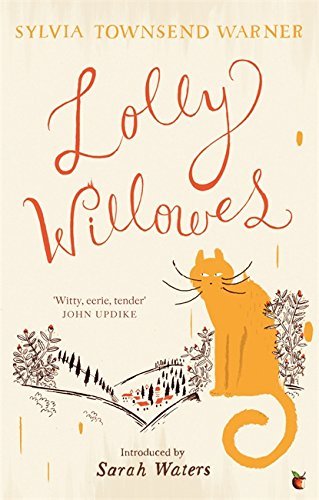
A much too whimsical cover, in my opinion. Though there is indeed a cat, eventually.

A much too whimsical cover, in my opinion. Though there is indeed a cat, eventually.

Lolly Willowes by Sylvia Townsend Warner ~ 1926. This edition: Virago, 2012. Introduction by Sarah Walters. Paperback. ISBN: 978-1-84408-805-8. 203 pages.

My rating: 10+/10

It’s awfully early to be reading the best book of the year, but I suspect this may have just happened. And if not the absolute best – for one can only hope for better, without any assurance whatsoever that that will occur – this one will be high in the top ten. No debate.

I’ve been brooding over a suitable review for days, and I still don’t know how to best express my deep appreciation of this exquisitely written novel. It pushed all my buttons, as it were, and it appears I am not alone, for the most superficial effort at online scouting reveals an astounding number of appreciative reviews.

No review that I have read can adequately express the unique quality of this novel, though many have come close, and those many being the ones which include a generous sampling of excerpts and quotations. It is very likely that my discussion shall follow suit.

SPOILER WARNING! After labouring unsucessfully to produce a thoughtful but vague-on-details analysis, I find that all I’ve done is to basically recite the plot below, so if you want to come to this cold, you will want to stop reading NOW.

Though this novel is so good that even knowing what happens beforehand will not take away from the experience. For those of us who like this sort of thing, it’s a marvelous bit of work.

Okay, giving you time to decide…

.

.

.

.

.

.

.

.

Laura Willowes is born in 1874 into a soberly traditionalist family, well-off brewers who take pride in their prosaic calling, and whose attention to detail has resulted in financial success.

Younger sister of two brothers, Laura lives a quiet country life, contentedly prevented from having to go out into the world by the vague ill health of her mother, which serves to provide an excuse for Laura’s remaining close at hand, though neighbouring matrons cluck in growing disapproval of Mrs. Willowes’ lack of enterprise in seeing that her growing daughter be either formally educated or pushed into the society of other young women, and, more importantly, young men.

Her mother dies, and Laura steps willingly into the place of the woman of the household, putting her hair up and her skirts down, and developing to an even higher degree her demeanour of stillness and decorum.

It was easy, much easier than she had supposed, to be grown-up; to be clear-headed and watchful, to move sedately and think before she spoke. Already her hands looked mnuch whiter on the black lap. She could not take her mother’s place – that was as impossible as to have her mother’s touch upon the piano, for Mrs. Willowes had learnt from a former pupil of Field, she had the jeu perlé; but she could take a place of her own. So Laura behaved very well – said the Willowes connection, agreeing and approving amongst themselves – and went about her business, and only cried when alone in the potting-shed, where a pair of old gardening gloves repeated to her the shape of her mother’s hands.

The years slide by. Brother Henry has established himself as a successful lawyer, stolidly wedded to a suitable wife and now father of two girls; brother James has unexpectedly returned to the family home to take part in the family business; Laura and her father welcome James, and then his wife and a small son, before Mr. Willowes himself takes ill and quietly and quickly dies.

Laura, deeply bereft but stoic in her grief, finds herself being arranged for, packed off without being consulted to live with Henry’s family in London. For London will be exciting for Laura, the refrain goes, she will see all sorts of sights and her horizons will be enlarged. She might even find herself a husband, for she is, after all, only twenty-eight, possessed of a tidy income of her own via her father’s will, and she is attractive enough in her subfusc way. Oh, and she will also be rather handy to have about the house, looking after her young nieces and making herself generally useful…

The smallest spare room is made over to Laura, and into it she transfers what few effects from her old life there can be found room for – not much, really, but Laura takes this in stride, for her loss of her old life and her beloved father have stunned her into a state of gentle acceptance of her lot. Before long she is transformed into something a little less than she was before, “Aunt Lolly”, handy to have about to walk the children and do their mending, and to provide another pair of ears for Henry’s bombastic preening in the bosom of his family.

But Laura nourishes a secret life undreamt of by her utterly unoriginal brother and sister-in-law. She uses her occasional free afternoons to explore London, wandering far afield to strange neighbourhoods, secretly patronizing luxurious tea shops and, in the only outward show of what soothes her inner self, bringing home lavish bouquets of exotic, fragrant flowers, much to the dismay of her familial sponsors, who feel that these indulgences are just a little, well, odd.

They’ve long given up trying to pair Laura up with a prospective husband; she has made it quite clear that her interest in such is null, and it looks like things will go on as they are forever and ever, amen, in an outwardly serene but secretly unsatisfactory way. Henry’s wife had rather expected that her sister-in-law would remove herself to her own establishment, handy as she is to have around the house, and those little outbreaks – those flowers! – continually irritate, in the most well-hidden way.

We come to 1921. Laura has just turned 47 years old. The Great War has been got through, things are settled down again and are going along much as before. “Aunt Lolly’s” nieces are grown now, but their babies will be her new charges, and the walking out of and mending for will keep her happily busy; the family is rather planning on taking continued advantage of Laura’s permanent position as useful auntie.

And then everything changes.

For Laura has an unusual epiphany one day, and decides to return to the country, to remake her life as a woman living alone, far removed from the duties she has so long carried so uncomplainingly.

Henry kicks up the most predictable fuss, for what will people say to his sister going off in such a strange (not to mention ungrateful) manner?  He is undone in his protests by his own ill-dealings; he has rashly lost most of Laura’s capital in sketchy investments, and she demands an explanation and insists on a settlement of what there is left, and the freedom to reinvent her life as she sees fit.

A country residence is obtained, though it is only rooms versus the originally planned-for cottage, due to her diminished finances. Winter passes, and spring arrives in all its glory, and Laura finds herself in a field of cowslips, in the grip of the strongest emotion she has ever permitted herself to feel.

She knelt down among them and laid her face close to their fragrance. The weight of all her unhappy years seemed
for a moment to weigh her bosom down to the earth; she trembled, understanding for the first time how miserable
she had been; and in another moment she was released. It was all gone, it could never be again, and never had been.
Tears of thankfulness ran down her face. With every breath she drew, the scent of the cowslips flowed in and absolved her.

She was changed, and knew it. She was humbler, and more simple. She ceased to triumph mentally over her tyrants, and rallied herself no longer with the consciousness that she had outraged them by coming to live at Great Mop. The amusement she had drawn from their disapproval was a slavish remnant, a derisive dance on the north bank of the Ohio. There was no question of forgiving them. She had not, in any case, a forgiving nature; and the injury they had done her was not done by them. If she were to start forgiving she must needs forgive Society, the Law, the Church, the History of Europe, the Old Testament, great-great-aunt Salome and her prayer-book, the Bank of England, Prostitution, the Architect of Apsley Terrace, and half a dozen other useful props of civilisation. All she could do was to go on forgetting them. But now she was able to forget them without flouting them by her forgetfulness.

Now the tale takes on a rather stranger twist. For the small village Laura has randomly chosen to reside in turns out to be not quite so conventional as it at first appears to be. Everyone is all very live-and-let-live, but things are just a little…well…unusual

Strains of music and odd lights late at night, people gathering together at strange hours, and a certain universal focus on the woods surrounding the village, wherein seems to reside a disturbing (in the broadest sense of the word) presence.

I’ll save you speculation.

Great Mop (for that is the name of the village in question) is under the patronage of the Lord of Darkness himself, and he is most interested in our quiet Laura.

I’ll give you a hint that Laura’s eventual fate is not quite what one would expect.

Satan himself as he manifests in an aura of crushed fennel and deep woodsiness is a character of unusual and unexpected appeal. For he is the “loving huntsman” of the subtitle:

Near at hand but out of sight the loving huntsman couched in the woods, following her with his eyes…But her fear had kept him at bay, or else he had not chosen to take her just then, preferring to watch until he could overcome her mistrust and lure her into his hand. For Satan is not only a huntsman. His interest in mankind is that of a skilful and experienced naturalist. Even human sportsmen at the end of their span sometimes declare that to potter about in the woods is more amusing than to sit behind a butt and shoot driven grouse. And Satan, who has hunted from eternity, a little jaded moreover by the success of his latest organised Flanders battue, might well feel that his interest in a Solitary Snipe like Laura was but sooner or later to measure the length of her nose. Yet hunt he must; it is his destiny, and whether he hunts with a gun or a butterfly net, sooner or later the chase must end. All finalities, whether good or evil, bestow a feeling of relief; and now, understanding how long the chase had lasted, Laura felt a kind of satisfaction at having been popped into the bag.

This novel, Sylvia Townsend Warner’s first, was her very deliberate and self-decribed feminist manifesto, or perhaps one could call it a humanist manifesto, for in it she argues for the right of the individual to choose one’s own happiness, regardless of what others think is best.

Laura Willowes from her earliest years knows exactly what she needs to make her happy, and what she chooses draws the critical hisses of everyone in her personal circle.  Until defeated by Laura’s tenacious refusal to play the game, there are continual urgings to partake in the local social whirl, to “come out of herself”, but Laura isn’t having any of it. Not as a young woman making reluctant duty calls and visits to parties and dances, and not as a middle-aged spinster, as we see when she willingly samples and quickly rejects the eerily similar protocol of her first Witches’ Sabbath in Great Mop.

Peace is what Laura Willowes seeks above all, to be left alone to pursue her solitary interests, to do nothing if she so chooses, and her surrender to Satan offers her just that, a protection against those who seek to meddle with her preferred style of life.

Did she do the right thing with her capitulation? Or not? The reader must decide…

Equal parts conventional novel and far-fetched fantasy, this is one of the most relatable novels I have read in a very long time. The writing, the twisting of the plot partway through, the sensuous descriptions of countryside and flowers and food, the character of Laura Willowes, and that of Satan himself…all combine to create something which sings and resonates, at the same time as it quietly disturbs.

In the very best way, of course.

And it is frequently richly and intelligently funny – I don’t think I’ve communicated that aspect. Another point in favour.

Highly recommended.
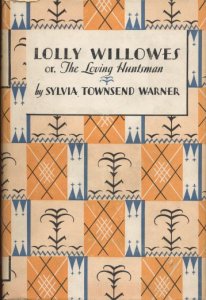
First edition, 1926.

First edition, 1926.

Oh – one last thing. Here’s a snippet of trivia for you. In 1926, Lolly Willowes was chosen to be the first book offered by the newly created Book-of-the-Month Club. And its author was perpetually annoyed by finding some readers reacting to it merely as a “sweet story”, versus the subversively moral tale she meant it to be.


Read Full Post »
Older Posts »