Archive for January, 2024

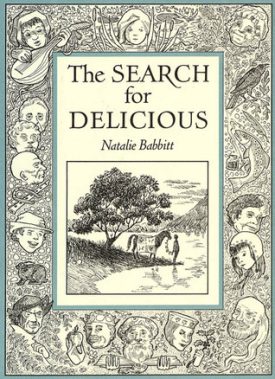
The Search for Delicious by Natalie Babbitt ~ 1969. This edition: Farrar, Straus and Giroux, 1969. Hardcover. 159 pages.

This book is a treasured survivor from my childhood bookshelf, and I hold it in very fond regard. It’s a short and efficiently written morality tale of sorts, and is saved from preachiness by its charm and wry humour.

Some time ago, in a small, imaginary kingdom, the Prime Minister is writing a dictionary. Everything is going swimmingly, until it suddenly isn’t.

The Prime Minister returns to his rooms after showing his progress to the King, and relates what has just happened to his twelve-year-old adopted son Gaylen.

“I went down, you see, to show the King how far I’ve gone with my dictionary. He was pleased with the first part. He liked ‘Affectionate is your dog’ and ‘Annoying is a loose boot in a muddy place’ and so on, and he smiled at ‘Bulky is a big bag of boxes.’ As a matter of fact, there was no trouble with any of the A’s or B’s and the C’s were fine too, especially ’Calamitous is saying no to the King.’ But then we got to ‘Delicious is fried fish’ and he said no, I’d have to change that. He doesn’t care for fried fish. The General of the Armies was standing there and he said that, as far as he was concerned, Delicious is a mug of beer, and the Queen said no, Delicious is a Christmas pudding, and then the King said nonsense, everyone knew the most delicious thing is an apple, and they all began quarreling. Not just the three of them – the whole court…”

This seems like a minor episode, and Gaylen laughs it off, but the Prime Minister isn’t so optimistic. And he’s right. The Court is soon in an uproar, and the ripples are spreading throughout the kingdom. There’s even talk of a civil war, boosted along by the Queen’s wicked brother, Hemlock.

One thing leads to another, as things tend to do in fairy tales, and Gaylen finds himself tasked with undertaking a survey of the entire kingdom, visiting every dweller there within to record each individual’s choice for Delicious. He sets off on his trusty steed Marrow, and it’s all a lovely adventure, until he discovers that Hemlock is out on a mission of his own, stirring up dissent and spreading false tales of the King’s motivation for asking Gaylen to record everyone’s choices.

This is a fast-moving story, and Babbitt packs a lot into it, with characters ranging from the optimistic Gaylen and his fellow human countrymen to an assortment of almost-forgotten creatures, such as the dwarfs in the mountains, woldwellers in the forests, mermaids in the lakes, and winds in the air.

Gaylen’s journey round the kingdom turns dark and dangerous, and disaster looms, but in proper fairy tale tradition, his kind and fair-minded actions and reactions are rewarded, though not without some close calls.
This is a fantastic story to read aloud to your young people, or perhaps to enjoy for yourself on days when you might need cheering up from the woes of the real world. Never mind that it’s classified as a “juvenile” – it’s a well-crafted tale, and that is always worthy of appreciation, and the adult reader will enjoy what Babbitt has done here.

My rating: a staunch 10/10. And if you do find yourself in possession of this little book, I hope it’s a version that includes all of Babbitt’s  original pen-and-ink illustrations in the chapter headings. They are delightful.


Read Full Post »

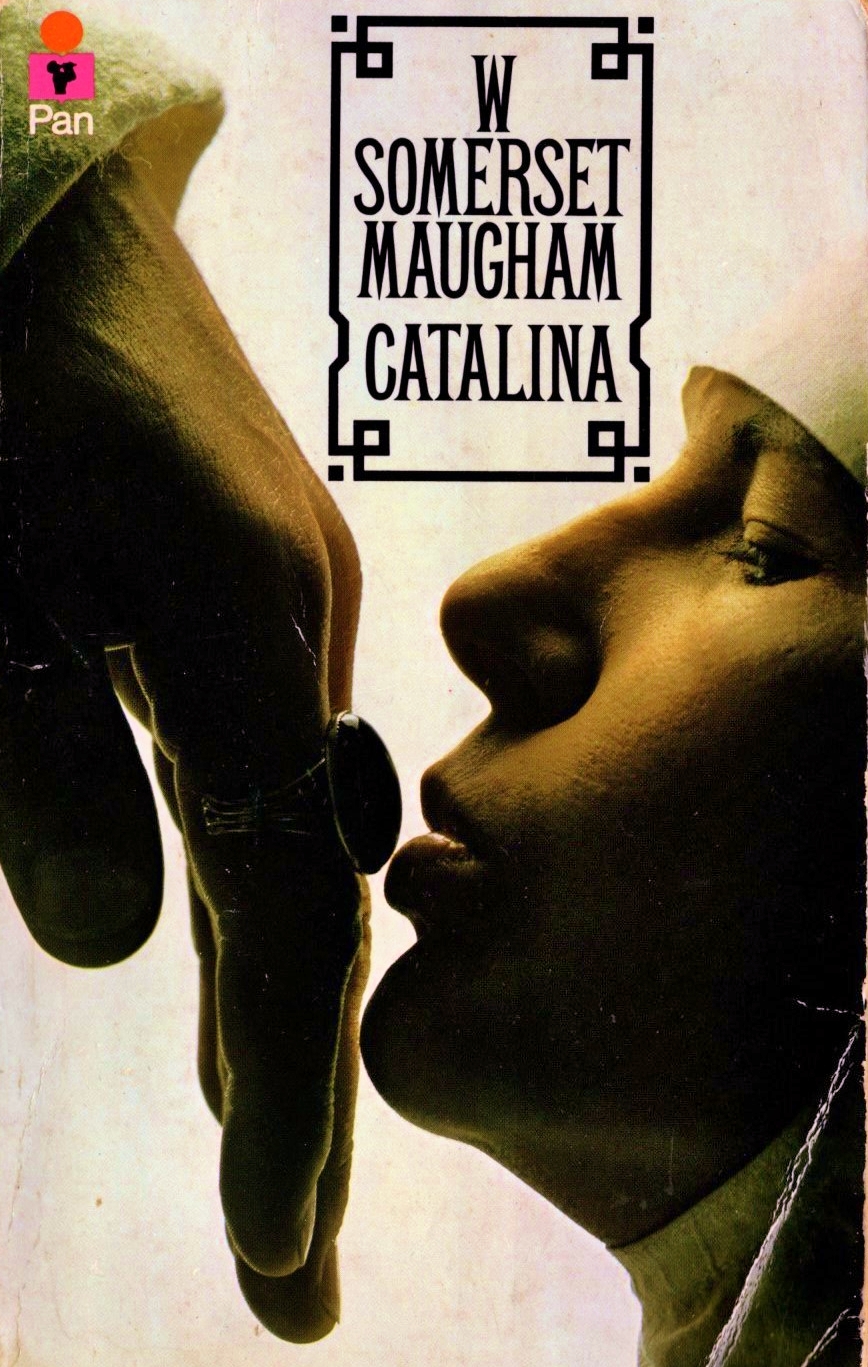
I’ve dipped into Maugham’s more mainstream novels over the years – The Painted Veil and The Moon and Sixpence spring to mind – but this rather frou-frou satire set in Spain during the years of the Inquisition was certainly not what I had expected.

Our young heroine, Catalina, a sixteen-year-old beauty unfortunately crippled after being run over by a bull, prays incessantly to the Virgin Mary to heal her, for when she lost the use of her leg, she also lost her handsome lover. Lo and behold! a vision of the Virgin appears to her with a promise that she can be healed if the right person gets involved. Says Mary, “The son of Juan Suarez de Valero who has best served God has it in his power to heal you. He will lay his hands upon you in the name of the Father, the Son and the Holy Ghost, bid you throw away your crutch and walk. You will throw down your crutch and you will walk.”

Catalina hobbles home and tells her mother of the vision, but the response is dismissive – “probably just a dream!” – and it is also not wise to draw too much attention to oneself in regards to claiming divine visitations, what with it being the height of the Inquisition and all. It’s even more sobering to consider that one of the sons of de Valero referenced by the Virgin, the saintly Bishop Don Blasco de Valero, is a chief Inquisitor.

There are three de Valero brothers, Don Blasco (the priest), Don Manuel (the prominent military man), and Don Martin (the humble baker). When Catalina’s vision inevitably becomes a topic of public discussion, everyone assumes that Don Blasco will be the one to pull off the miraculous cure, but things go a bit awry.

Maugham pads out his tale with many long digressions, many concentrating on Don Blasco’s back story and his current crisis of faith. Don Blasco’s saga is mirrored with that of another prominent member of the Spanish religious elite, Doña Beatriz de San Domingo, Prioress of a Carmelite convent.

Doña Beatriz’s ears perk up when she hears Catalina’s story, and, ever-quick to grasp opportunities to enhance the status of her nunnery, attempts to lay claim to the miracle-about-to-happen, as the vision of the Virgin took place upon the steps of the Carmelites’ church.

There are quite a number of surprises in store for the protagonists of this novel, and some for the reader, too. I was intrigued by Maugham’s mixture of satire and seriousness; there were passages of true emotional appeal here and there that caught at one’s heartstrings, but, as the novel progressed, these became more elusive, as the farcical elements took over.

Catalina’s eventual fate is not as predictable as one would initially think, and the Virgin pops up again to oversee Catalina’s wellbeing.

I thought, for the first few chapters, that I might have found something of a hidden gem with this one, but unfortunately I can’t award it that status. It’s more of a curiousity read, and I suspect it will be relegated to the “read once, don’t think I’ll read it again” stacks.

The last published full-length work by W. Somerset Maugham, Catalina is available on Project Gutenberg, and is relatively cheap and easy to source as a printed version through all the usual online book places, for those wishing to round out their collection of this author’s work.

It’s tough to give a numerical rating, as I truly enjoyed substantial parts of Catalina, but now that ten days or so have passed after my reading, I look back on the overall experience and sadly must settle on a modest 6/10.

Read Full Post »

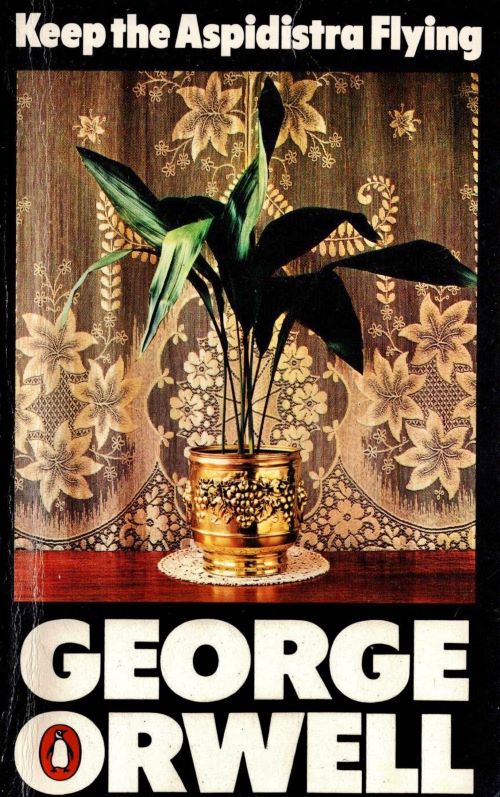
Keep the Aspidistra Flying by George Orwell ~ 1936. This edition: Penguin, 1975. Paperback. 264 pages.

I’m starting my 2024 Century of Books with this satirical novel, centered around a petulantly angry young man who almost manages to succeed at failure by deliberately refusing to take advantage of every chance he is given to advance himself, from his school days onward.

Gordon Comstock, on the cusp of his thirtieth birthday, is the last scion of a large, once-prosperous, middle-class English family. He’s a bit of a weedy chap, living unnecessarily squalidly by his own choice, and he’s very much on a downward spiral.

Having a modest aptitude for literary creativity, Gordon has achieved a small success as a poet, though his one published volume of verse, Mice, is now languishing on the remainder shelves of the bookstore he works at, after selling a meager one hundred and fifty-three copies in the two years since its debut.   

Gordon is pretty miffed about this. He can’t quite come to terms with his unsuccess as a writer, which he wraps up with his bitter condemnation of what he sees as a universal fixation on degrees of social rank, economic status, and the push to attain more money, more things. He feels that if only he were free to concentrate on his writing without the whole wage-slave thing, he would flower forth into his full intellectual potential.

Gordon’s psyche seems to be deeply scarred by his recognition that, as the years go by and the family money disappears – whisked away by the increasing cost of living and unwise investments – his family’s financial status is desperately inadequate to meet with the costs of maintaining a suitable social position without its members seeking paid employment. His way of dealing with this is to “defy the money-god” of conventional society by refusing to play the middle-class game of climbing-the-ladder-and-getting-ahead. Much as he would reject that description, Gordon’s a snob at heart.

Despite the best efforts of his few surviving family members and a stalwart handful of friends and well-wishers to see him settled in a “good job” with “good prospects” for future advancement, Gordon has sworn an oath against participating in what he sees as a dirty game. If he can strip his life of inessentials, take on the most minimal employment possible to provide for his most basic needs, and dedicate his leftover hours to his literary ambitions, he’s sure he will do great things and receive the recognition he secretly desires.

Unfortunately, Gordon lacks the touch of genius which would enable this wishful thinking to become reality, and he is peeved to find that a life of voluntary poverty gets in the way of creative work because of sheer physical discomfort and the desperate realities of being a poor person in sub-par lodgings.

Paradoxically, while rejecting conventional behaviour and scorning those who have, as he sees it, compromised their integrity by embracing the middle class live-to-work ethos, Gordon is bitterly jealous of anyone with money, and passionately wishes that he had some himself.

This is a richly written novel, and even though I had an increasingly strong desire for someone to just give our protagonist a bone-jarring shaking, I was wooed and held by the brilliance of Orwell’s powers of description, his deft character sketches, and his willingness to delve into some very deep places, literally and figuratively.

Oh, and what about the aspidistra of the title? Yes, that’s the ubiquitous Victorian-era houseplant, and the reader of this tale will become well-acquainted with its characteristics and its symbolic importance to Gordon Comstock as he pursues his unhappy spiral into self-inflicted misery.

Am I still rating my reads? Yes, I think I am.

Not a “must read” by any stretch, but I found this little novel intriguing and ultimately enjoyable, though I’m not quite sure about my response to the author’s choice of an ending. I’ll give no spoilers – read it yourself and see what you think!

Let’s give this an 8/10.

Read Full Post »

It’s been quite some time since I’ve been active here, and I sure have missed you guys. Life got a little bit strange for me about eighteen months ago, and it’s taken me till now to get up the gumption to get a post out.

I have a long saga regarding these missing months, but I think I’ll condense it to the basics. I’ll probably be sharing more in the future, but this shall suffice for now.

I have joined The Club That Nobody Wants to Be In.

Yup. The big C. And yeah, it’s been hard. But we soldier on, as one does. There sure are a lot of us dealing with this stuff. It’s not as exclusive a club as one would wish it to be, but on the plus side, the support I’ve been finding from friends and strangers alike has been beyond positive. Adversity does indeed bring us together. All the cliches are true.

My particular situation was a double whammy. First, malignant melanoma – “This is the one that can kill you”, as the diagnosing doctor soberly said – and then, as a totally unexpected bad bonus, the discovery of a rather large brain tumour. That one came as an utter shock, though in retrospect the symptoms were certainly there, and had been worsening for some years, though I had never even contemplated “brain tumour” as a reason for my worsening eyesight and hearing, and some increasingly strange strength and mobility glitches.

In the past year I have had three unpleasant surgeries, including a craniotomy to attempt brain tumour removal, and several facial surgeries for removal of the skin cancer, and subsequent facial reconstruction from my right eye all the way to the corner of my mouth. (I had a marvelous plastic surgeon – I look good – better than any of us expected.) I also have had six intense weeks of radiation therapy to the tumour site at the back of my brain, my “lifetime dose”, which, if I’m one of the fortunate ones, should knock back regrowth of my cranial interloper, at least for some years. It will continue to be a journey.

I feel okay. Not great, but definitely okay. I will likely never feel really great in the “before” sense – brain surgery and then radiation is a pretty big deal and one sure feels it – but I am still standing. Still walking, albeit with a walking stick some days, still talking as coherently as I ever did, albeit with some speech lags when I get too tired, still enjoying cognitive capabilities pretty well what they were pre-surgery, and – big hurrah! – I can still see. I’ve lost about a quarter of my visual range, but things as of my last ophthalmology assessment show no significant changes, so I’m good with that.

I can still read, and books have played a crucial part in keeping me comforted and dare I say “grounded” during these surreal times.

So here’s to the brand new year, and the books we’ll all read in it, and the companionship of others and all of the good things that go along with that.

I have no idea how often I’ll be posting. Everything seems possible this first week of January. I see my friend Simon is once again tackling ACOB – A Century of Books – and I am mulling over joining him. I’ve completed this ambitious project once before, and partially completed two others, and it is a lot of fun.

For the past year and a half it’s been old favourites and “comfort reads” all the way. Nothing too dramatic, or edgy, or tragic. Real life has provided all of those elements, and books have been, and will continue to be, a respite from that.

I do hope to get a handle on my tendency to just ramble on and on once I do get settled at the keyboard. That’s a worthy challenge all by itself. I might set myself a word limit on future book posts, to force brevity. We shall see.

Cheers, book friends! You are all bright stars in sometimes-dark skies. Thank you for the companionship, and for sharing your words, and may this happily continue in 2024 and beyond.

Barb

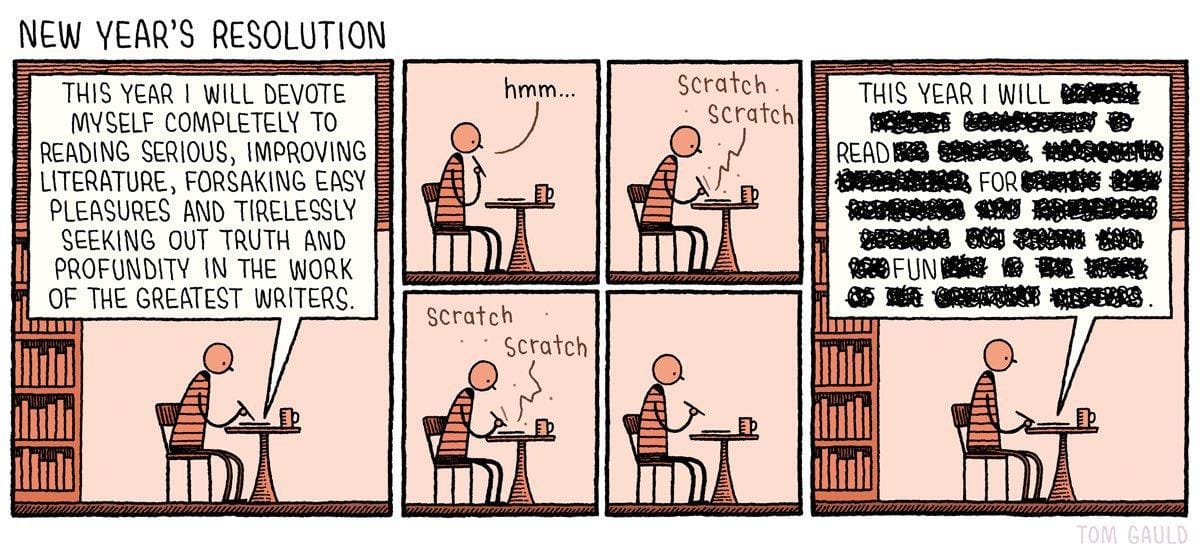
(Credit for the comic goes to Tom Gauld.)

Read Full Post »