Archive for January, 2018

Trouble With Lichen by John Wyndham ~ 1960. This edition: Penguin, 1995-ish. Paperback. ISBN: 0-140-01986-3. 204 pages.
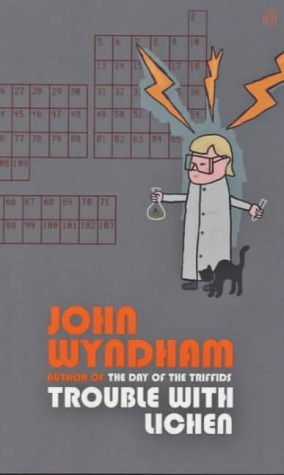
Okay, let me say this right up front, so you’ll know I’m coming from a place of love in the critique which follows.

  1. I am a John Wyndham fan.
  2. I like science fiction as a genre and at one time read an awful lot of it.
  3. I like science fiction because (a.) it can be a whole lot of fun because it allows for creative world building or alternate histories, and (b.) it has some reliable general rules, first and foremost being that the “science” must be logical in relation to whatever the fantastical world is it is taking place in.

This book drops the ball on that last one. So much so that I have to break down and call this a Very Silly Book, even taking into account its pro-feminist theme, which, as a female reader, I find is always a nice thing to bask in.

Trouble With Lichen begins with a funeral, one attended by vast crowds of mourning women, sobbing out their sorrow at the loss of one of their own. “Our beloved Diana…her unfinished work which she now can never finish…irony of fate…will of the Lord…” intones the presiding bishop, as the choir croons and the distaff masses nod and sigh.

Fourteen years earlier, young Diana Brackley is graduating from high school. Both beautiful and brilliant, she breaks the heart of her mother by deciding to go on to university, following the calling of the biochemistry lab rather than the domestic kitchen.

Newly employed at the prestigious research labs at Darr House, presided over by Francis Saxover, a personable middle-aged scientist with a terminally ill wife and two adolescent children, Diana flourishes in her chosen field.

One day, while working with samples of lichen collected in Manchuria, Diana stumbles upon an intriguing discovery, and divulges it to her boss. His interest takes a nosedive when his wife dies, and Diana continues her investigations after hours, as it were, not wanting to involve Francis in what might be pointless investigation when he is still in the throes of grief.

But Francis is not so devastated as all that. He is also tinkering with the lichen, and he and Diana independently come up with the same conclusion: they may have discovered a natural anti-aging compound – “antigerone”.

The implications are astounding, and require some serious consideration, in particular because the lichen in question exists only in a small geographical area, in a Chinese-held territory close to the Russian frontier. Which means that the production of the antigerone will always have to be extremely limited, unless someone can crack the biological code and replicate the active ingredients in the lichen. In the meantime, the antigerone remains a closely held secret, with only Diana and Francis privy to its effects.

Stuff happens. The years roll by. Diana inherits a small fortune, and quits her employment at Darr House in order to set herself up as the head of a an exclusive beauty salon catering to the female connections of wealthy and powerful British gentlemen.

“Nefertiti” is a posh salon indeed, and as the years go by, its longtime clients look better and better in comparison to their peers. Almost like they are, well, younger. Like time has slowed down for them. Very interesting.

Yup. Diana is dosing herself and her best customers with antigerone. But – get this – without their knowledge. Kind of like the way Francis Saxover has been dosing himself and – secretly, without their knowledge – his two children. But that story is about to break.

Francis confesses all to his now-adult children, who are not as shocked as you would think, merely insisting that their respective partners be given the potion as well. Which gives us one of the most delicious episodes of this goofy novel when Francis’s money-hungry daughter-in-law Jane, bitterly disappointed to find out that she may have to wait a very long time indeed for Francis to die and leave his son a lavish inheritance, pulls a very sneaky trick to gain the secret of the antigerone for her own nefarious and profitable purposes.

Diana then divulges her own plot, which is that she has intended her regiment of life-extended rich ladies to be the leading force of a new world for women, in which they will be able to either defer having children until after they have a career, or to have a full life after their offspring are safely raised. Yes, they can now do everything! Antigerone will buy them the one thing that has stood in the way of female empowerment all these centuries: TIME. (Okay, I can kind of buy into that myself. Wouldn’t it be loverly, to have a twice-as-long lifetime to get it all done in?!)

The sticky point for me was that these particular women are all under-employed already. They fritter their days away, la la la la. Diana insists that once the boredom of a century or so of this really sets in these ladies will set themselves afire with enthusiasm for doing world-changing stuff. Me, I don’t think so. Why aren’t they already hopping to it, seeing as their offspring are well off their hands with nannies and all? Negating that little theory about women wasting their best years in child rearing being what’s stopping them from taking part in real world-changing work.

We then proceed to have press conferences, a riot or two, kidnappings, torture, death threats, and, finally, an assassination of sorts. China finally wakes up and takes notice of the lichen situation and proceeds to slam the door shut for any further harvest. End of story? Well, not quite.

What an utter snob Wyndham comes across as with this concoction. Wives, daughters and mistresses of the elite are worthy of the antigerone; all others in the lower strata, so sorry, but you get to maintain the status quo. Because, well, just because. But that’s okay, because it would be wasted on you anyway, and your menfolk would never stand for it.

This tale is so ridiculously illogical. The science is never adequately explained; Wyndham takes the ring road round the core of that particular city. There are great gaps in the narrative. No one reacts as they would in real life. Everybody’s very, very restrained, so über-British stiff-upper-lip, refusing to get too excited, except for the odd well-behaved mob, easily controlled by a handful of stern bobbies. The men are all very cool with the women getting the good stuff; it takes chapters and chapters before someone says, “Hey! Men might benefit from this thing, too!” You think?! The Chinese caught on right away, once they twigged to what they had on their territory. The Brits – well – took them a while.

Whole thing is silly. Silly, silly, silly.

Points off for absolute failure to think the plot through in all of its potentially intriguing ways, and for failure to apply logic where most needed.

Points back on because it is pretty funny in places, and yeah, it is pretty cool to have the women getting all the perks, and because Diana offhandedly dismisses marriage as something she might do later when she gets around to it. (Though that might be up for debate; her anti-marriage stance might not be as absolutely disinterested as she makes out.)

Point in favour for letting our lady-scientist also be deeply interested in beautiful clothes and cosmetics.

Another point in favour, for a fairly decent “surprise” ending. Which I must say I saw coming with flags flying from quite some way away. (Wyndham likes to tidy things up.)

Still silly.

6/10.
 

Read Full Post »

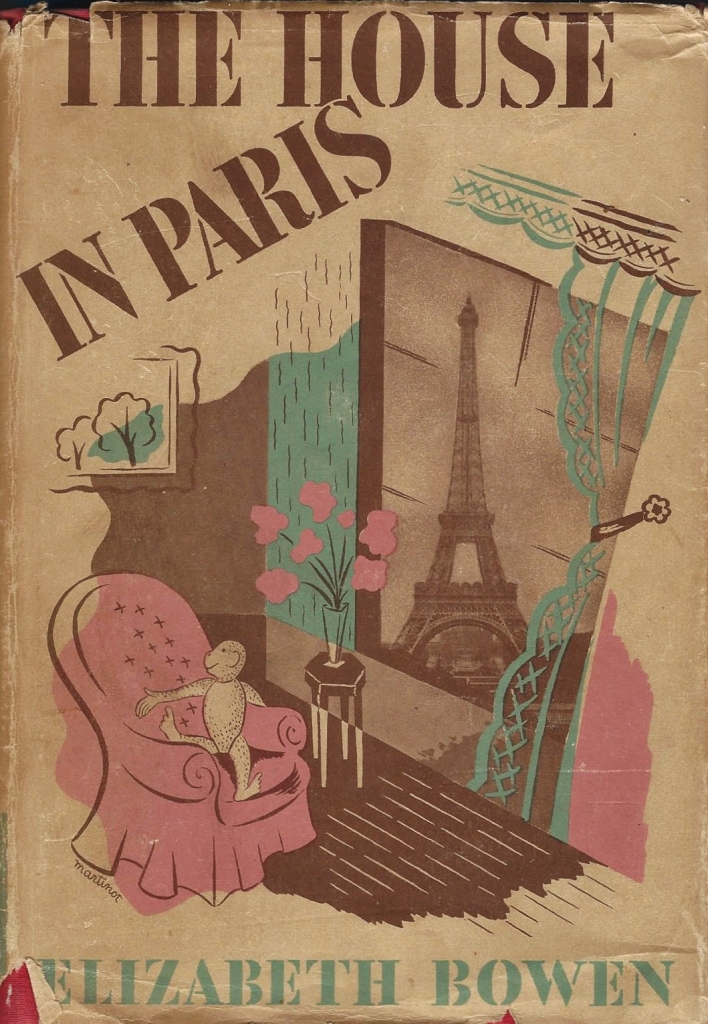
The House in Paris by Elizabeth Bowen ~ 1935. This edition: Knopf, 1936. Hardcover. 270 pages.

This novel is stiff with secrets. Everyone is hiding something, and the frequent silences are screaming with unspoken words.

What a tense novel, and what a compelling one, too. Such beautiful writing by Elizabeth Bowen. Though I found I was always being kept an arm’s-length away; the reader is very much the spectator here, privy to all of the secrets, but never sure quite what the next moment will bring.

A commenter on my recent post on Bowen’s The Little Girls mentioned the Henry James-like qualities of The House in Paris. Bang on, that comparison is. And, though I am a dedicated Jamesian at heart, I do find he can be a challenge to really get one’s head around. As is this novel. I had to pay attention, no room at all for straying thoughts.

The novel is set in three acts, as it were. Present-Past-Present. We are thrown into the middle of a certain situation, given a long flashback episode to explain how we got there, and then returned to the situation in time to see it come to its climax and continue on its way.

In brief:

Two British children meet in a small house in Paris. One, 11-year-old Henrietta, is breaking her journey from England to her grandmother’s home in Mentone. She is there for a few hours only, in between train connections. The other child is 9-year-old Leopold. He has travelled from Italy where he lives with his adoptive American family to meet with his real mother – whom he has never known since his birth – at her request.

There is a vast mystery surrounding Leopold and his origins; Henrietta is provided with the barest of explanations as to who he is and what he is there for, but she is warned not to speak of such things to him, or to anyone else.

The rest of the novel is involved with Leopold’s back story, and that of his mother, culminating with a sudden change in Leopold’s circumstances, which may or may not go well for him. Henrietta fades in to the distance, mute witness to what has gone on.

That’s all I am going to say, because otherwise I’d be here all the night! There’s a lot going on in here; Bowen puts her characters through the works.

One could open this book to any page and find a passage worthy of reading over and over and turning about in your mind like a sharply faceted gem, all a-glint with captured light. I will treat you to several which stood out for me, to give you a sense of the quality of the writing here.

It is a wary business, walking about a strange house you know you are to know well. Only cats and dogs with their more expressive bodies enact the tension we share with them at such times. The you inside you gathers up defensively; something is stealing upon you every moment; you will never be quite the same again. These new unsmiling lights, reflections and objects are to become your memories, riveted to you closer than friends or lovers, going with you, even, into the grave: worse, they may become dear and fasten like so many leeches on your heart. By having come, you already begin to store up the pains of going away.

and

She thought, young girls like the excess of any quality. Without knowing, they want to suffer, to suffer they must exaggerate; they like to have loud chords struck upon them. Loving art better than life they need men to be actors; only an actor moves them, with his telling smile, undomestic, out of touch with the everyday which they dread. They love to enjoy love as a system of doubts and shocks. They are right: not seeking husbands yet, they have no reason to see love socially. This natural fleshly protest against good taste is broken down soon enough; their natural love of the cad is outwitted by their mothers. Vulgarity, inborn like original sin, unfolds with the woman nature, unfolds with it quickly and has a flamboyant flowering in the young girl. Wise mothers do not nip it immediately; that makes for trouble later, they watch it out.

and

On the platform before their long journey, to speak of a next meeting would have been out of place… Good-byes breed a sort of distaste for whomever you say good-bye to; this hurts, you feel, this must not happen again. Any other meeting will only lead back to this. If to-day good-bye is not final, some day it will be; doorsteps, docks and platforms make you clairvoyant…

So there we have it.

Elizabeth Bowen.

Each word carefully, deliberately, elegantly placed where it will have the most impact.

I feel the tiniest bit out of my own humble place in boldly assigning a numerical rating to my reading of the book, but here it is: 9/10.

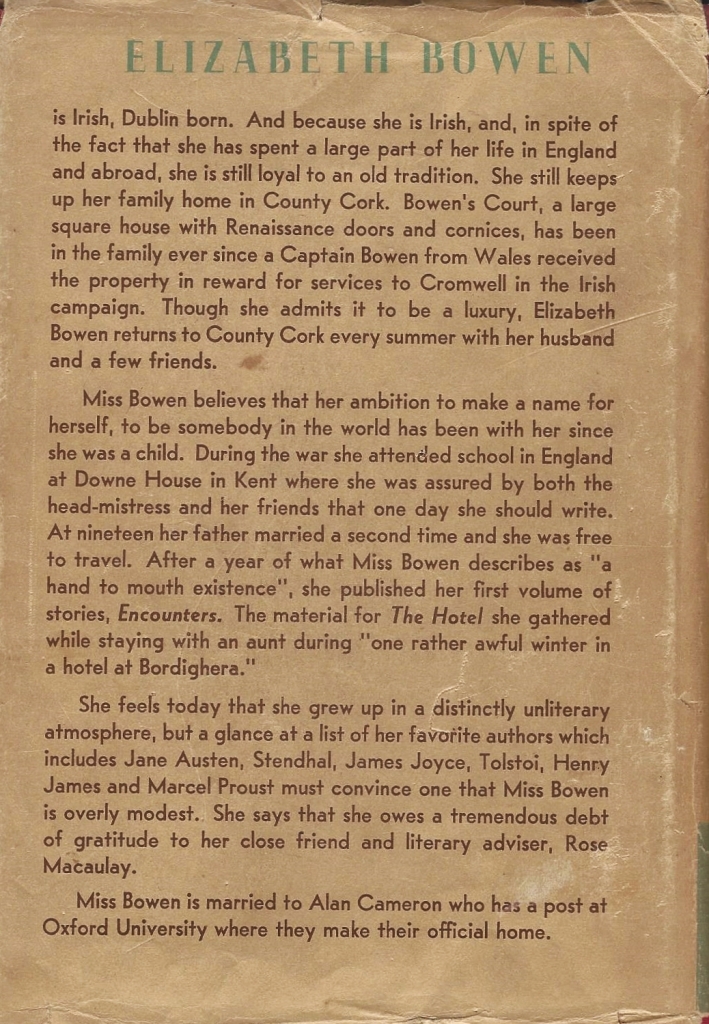
And then there’s this, from the back jacket of my edition. I remember comparing Bowen’s work to that of Rose Macaulay, before I knew of their connection. Called that one right, didn’t I?! I am beyond pleased with myself, as I’d already shelved these two together. Score one for the reader. Now, do I move Henry James, too? 😉

Read Full Post »

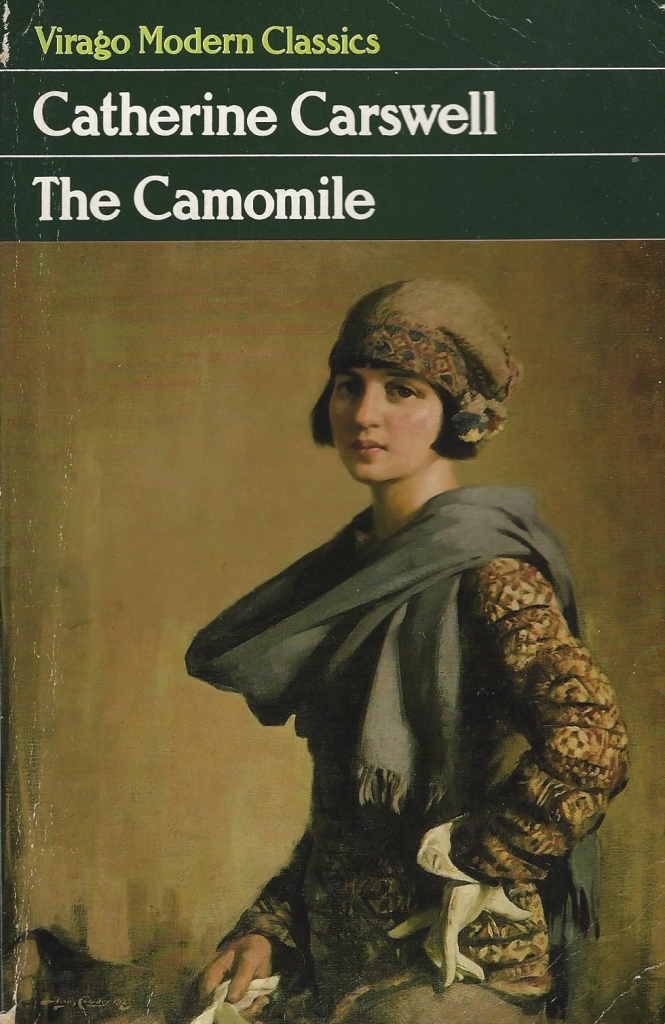
The Camomile by Catherine Carswell ~ 1922. This edition: Virago, 1987. Introduction by Ianthe Carswell. Paperback. ISBN: 0-86068-873-9. 305 pages.

I had already told him about my being an orphan, about my music teaching, and about my writing and Mother’s. Of my writing he said, ‘I see. It is like the camomile – the more it is trodden on the faster it grows.’

This rewarding short novel is written in epistolary form, being made up of two long letters, fore and aft, and journal entries made to be shared with a distant friend.

It starts out as the amusing and somewhat self-absorbed account of a young woman’s journey of self-discovery, of finding her place in the world, and goes on to discuss some of the larger questions which are still pertinent to young people today: Who am I, really? Why am I here? Do I change to meet the desires of others, or stay true to myself?

Our young correspondent is Ellen Carstairs, just back in Glasgow after spending two years studying music in Frankfurt, writing to her London friend Ruby, whom she had met in her first days at the Frankfurt Conservatory of Music.

Ellen has found Ruby to be a kindred soul, for both soon realize that music is not their true métier, though they have some adequate talents in that area to perhaps serve as teachers of novices. They nevertheless do their best to take in their lessons and improve their musical craft, all the while yearning for a truly satisfying occupation, an “art” which will be their one true life’s pursuit, one which they are suited for and which they will excel at.

After their two years of relative freedom in Europe, the friends return home, and get on with the business of earning their livings while at the same time opening themselves up to finding and developing their true callings. For Ruby the true art – the one which chooses the artist – is that of illustration – drawing and painting. And for Ellen, it is writing. Which is a problem, at least as far as her family and friends are concerned.

For Ellen’s mother was a writer. Not a successful one – far from it! She appears to have been (from the clues we are given) a woman obsessed by the need to write without necessarily having enough mastery of the craft to make her scribblings saleable. She has pursued her interest to the exclusion of all else, spending the housekeeping money on self-publishing of pamphlets of sub-par poetry and the like.

This mother inadvertently neglects her two children, to the extent that her young son Ronald is permanently crippled through her heedless actions. Interestingly enough, when she dies when the children are still young, they and their father sincerely mourn her, harking back at her better qualities, and forgiving her (for the most part) her obsession.

Ellen’s missionary father has been absent for much of her childhood and he too is now dead, leaving Ellen and Ronald in the care of his sister Harriet, an Evangelical Presbyterian of unwavering faith. Neither Ellen nor Ronald share the narrow religious beliefs of their father and aunt, but they go along with Aunt Harriet’s wishes in church attendance and such, not wanting to hurt her feelings, for they love her deeply despite their increasing differences.

On her return from Germany, Ellen begins to teach music at her old school and to private students; she earns enough to be able to rent a room and a piano in a neighbour’s house, ostensibly so she can practice undisturbed and undisturbing. Soon she finds that she is using her retreat for writing more than for piano playing; her true art has chosen her and she gives in with secret relief, though she is wary of admitting it to her brother and aunt, and questions herself on the ethical implications of misleading them as to what she is doing.

Ellen fortuitously finds a mentor in an ex-priest, John Barnaby, a brilliant intellectual engaged in quietly, slowly killing himself by drink and near-starvation. John reads Ellen’s manuscripts and encourages her to seek publication, using his past connections in the literary world to push forward her novice submissions.

Just when things seem set for Ellen to commit fully to becoming a professional writer, she falls in love with Duncan, a friend’s brother who is a young doctor on leave from his practice in India. The two become engaged, but though Duncan gives lip service to his wish for Ellen to not give up her own interests, it becomes increasingly obvious that he is oblivious to the importance of her craft to her very identity.

Added to this building dilemma is the fundamental difference in Ellen’s and Duncan’s views towards sex. Ellen believes that people seriously considering marriage should engage in the ultimate intimacy, in order to make sure that they are compatible for a lifetime of marital companionship. Duncan is shocked by this notion, and condescendingly tells Ellen that she is merely a foolish virgin with outlandish ideas; much better to let Duncan guide her in her sexual initiation once they are safely married.

Can you see where this might be going?

Yes, indeed, second thoughts are in order all round…

No surprise that this novel was chosen by feminist press Virago for republication in the 1980s, for it is all about female self-determination in the face of almost universal societal disapproval.

Ellen documents her personal journey with passion and lucidity and not a little humour. This is not in any way a dreary saga of crushed and downtrodden womanhood. No indeed! For like the camomile referenced in the title, the heavy-footed treading here merely makes the flower find another place and way to thrive.

More on Catherine Carswell here.

The Camomile scores a good strong 8/10 from me.

Carswell’s one other novel, Open the Door! (1920) is now firmly on my wish list, as is her partial autobiography Lying Awake.


Read Full Post »

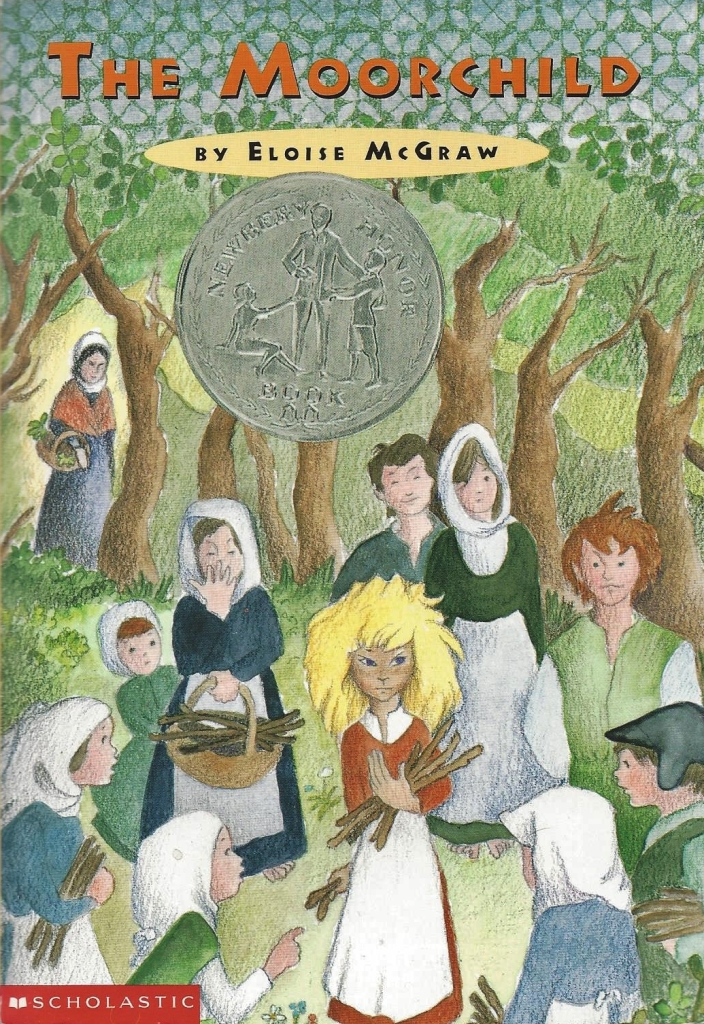
The Moorchild by Eloise Jarvis McGraw ~ 1996. This edition: Scholastic, 1998. Paperback. ISBN: 0-590-03558-4. 241 pages.

What with my recent reading of Greensleeves, Eloise Jarvis McGraw is on my radar, so when I was bookshelf browsing for my next diversion and noticed The Moorchild tucked away with a bunch of other juveniles too good to dispose of though we have no actual children in residence anymore, I thought, “Aha! It’s meant to be.”

The Moorchild is a book aimed at a rather younger crowd than Greensleeves, in both topic and writing style, though McGraw does her intended audience the grace to assume they are capable of absorbing some non-standard vocabulary terms; the book is stuffed full of what can only be termed dialect.

The novel is Medievalish Britainish in setting, but it’s not meant to be historical fiction or anything approaching it; it’s purely fantastical in theme, drawing heavily from Celtic and Old English folklore. It’s a fairy tale, in fact, in the truest sense of the term.

Young Moql, growing up among the Moorfolk – a race of what would be understood to be old-style fairies, tricksy and malicious versus twinkly and benign – is discovered to be deficient in several important skills; namely in making herself invisible and in shape-shifting.

As the possibility of being seen will endanger the Band as a whole when they venture out into the light of day and forage among the humans, this creates something of a problem, though mostly for Moql, as the Moorfolk are not endowed with anything approaching empathy as the humans know it. (Well, neither are the humans in our tale, as we will find out shortly, but I’m getting ahead of myself.)

Turns out that one of the Moorfolk ladies has had a dalliance with a human, and the resulting child – as babies will no matter what the species – shares qualities of both her ancestries. She’s neither this nor that, poor little hybrid, through no fault of her own.

So, what to do with Moql?

Get rid of her, of course, by swapping her with a human baby. Due to time being different inside the Moorfolk’s magical mound, and various powers involved in such exchanges, near-adolescent Moql finds herself trapped in a human infant’s body, surrounded by excruciatingly painful anti-fairy items – salt, rowan wood, various herbs, and in particular iron. Which is really a problem, as her “father” turns out to be the village blacksmith…

Moql, now Saaski (as that was the name of the infant she has replaced) proceeds to make her new parents’ lives sheer hell, until she overhears her “grandmother” putting forth the theory that the baby is indeed a changeling, and that there are some fairly drastic solutions as to getting rid of her.

Saaski mulls this over, there in her confining cradle, and decides that survival is worth adaptation, which forms her basic strategy through the next ten years of her life.

For the humans all around her, with the notable exception of her “parents”, and, eventually, her grandmother (the village herb woman/healer), are not particularly kind to a child with such differences as Saaski soon demonstrates. She’s unusually strong, very fast and agile, her fingers and toes are too long, her skin is dusky and her hair pale blonde, her strangely-set eyes are not blue like those of her parents but a changeable violet in colour. Yup, something’s not right with that one.

You know where this is going, right?

When misfortune strikes the village, Saaski becomes the scapegoat as the superstitious and malicious villagers seek for an easy target for their ire. Luckily she has at least one true friend, and one thing that the Moorfolk want, which turns into a bargaining chip as Saaski, who has slowly become possessed of a conscience and a set of the better human emotions, decides to use it to repay her human foster parents for their own misfortune in losing their true baby and being saddled with Saaski instead.

Being a children’s book, the ending is on a positive note, though with enough mystery to leave the reader wondering what will be happening next with Saaski as she sets out on her greater adventure, cut loose from her ties with both her foster family and her true parents.

This is a well written example of its genre, and it deserves its 1997 Newbery Honor Medal.

I do have a few niggling criticisms, though. I thought that the book bogged down somewhat midstream; it felt like it was coming to its highpoint about half way through, but it took forever for the foregone conclusion to be worked out. For of course Saaski is going to go back into the Moorfolk’s Mound, to retrieve a certain something in exchange for her valuable possession.

What that something is will not be a surprise to anyone even slightly versed in fairy lore and changeling tales, but for quite some time it’s like that problem doesn’t exist, and when it is at last acknowledged we get to breathe a big sigh of relief.

The Moorchild might make a decent Read-Aloud; heads-up to those considering it that the centre section goes on and on and might cause excessive exhaustion in the reader-aloud, though there is enough action that you probably won’t lose your audience.

Bad stuff happens, which is rather the whole point, but good stuff eventually prevails, as long as we don’t think too hard about those intolerant villagers, who get to go on as usual, their gang mentality intact and their target of united malice removed. Can’t help but wonder who they’ll turn on next…

Here’s my rating: 6.5/10.

Probably not a must-read book, though meaty enough for some appeal beyond the junior set. A bit too predictable in its plotting and outcome in my opinion, though that’s not necessarily a demerit in the fairy tale world.

Read Full Post »

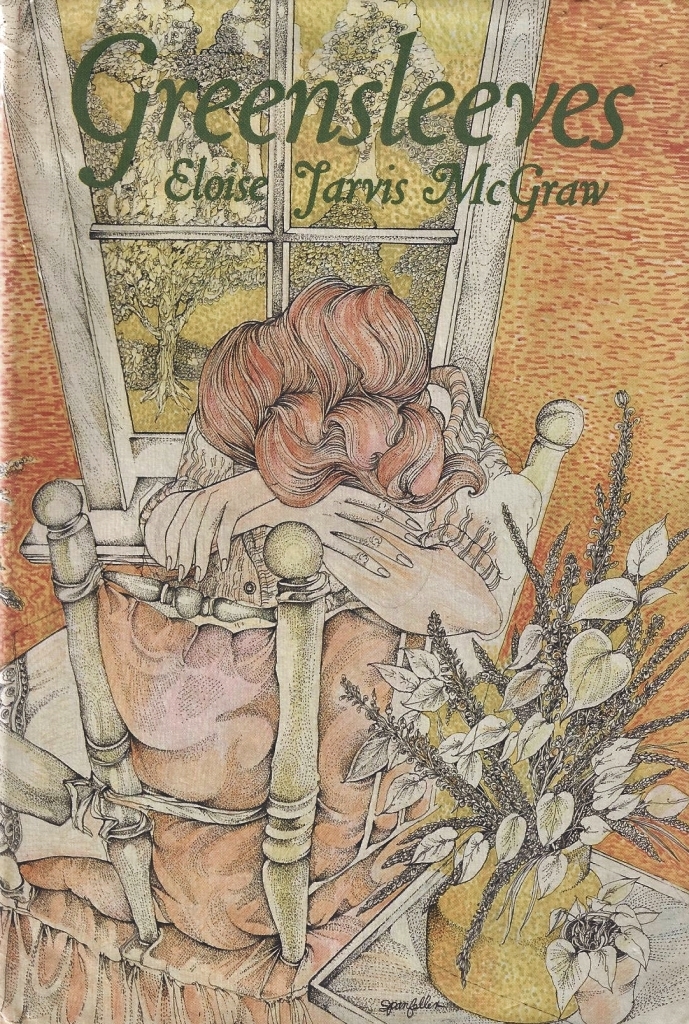
Greensleeves by Eloise Jarvis McGraw ~ 1968. This edition: Harcourt, Brace & World, 1968. Hardcover. 311 pages.

This vintage “young adult” novel  is a gorgeous bildungsroman concerning the daughter of celebrities who is given a chance to temporarily reinvent herself as a nobody.

As a (once-upon-a-time) homeschooling parent I was already familiar with Eloise Jarvis McGraw from her often-recommended books for slightly younger readers such as The Golden Goblet and The Moorchild, and I generally liked her work.

But I’d never heard of her 1968 novel Greensleeves until bumping into my cyberfriend Jenny’s post, wherein she calls Greensleeves one of her favourite books ever, and goes on to review it in glowing terms.

I was immediately interested, as we share similar tastes in a number of genres, and set off on a quest for a long-out-of-print copy for myself. Rare indeed, this one was, with prices as expected, but I took a deep breath and went for it, and by golly, Jenny was right. This is a charmer.

So I’m going to cheat a bit here, and send you over to read what Jenny says, because she’s pretty convincing:

Jenny’s thoughts on Eloise Jarvis McGraw’s Greensleeves

So if you’ve been and done what I said to do and have read Jenny’s post and then come back here to see what else I have to say, I’ll pad things out a bit.

Our heroine Shannon/Georgetta/Greensleeves is an utter mass of insecurities on the inside, though she presents exceedingly well on the outside, a state of affairs I am sure a lot of us can relate to, right? Even well beyond those brutal teenage years, when we’re trying to figure out who the heck we are, and how to find friends, and the complications of romantic love and the freight train of sexual feelings and how to be true to yourself when you don’t even know what that really means because life is so utterly complicated.

Yes? Of course. Yes.

So all of that aside, the story is absolutely entertaining, as Shannon reinvents herself and puts her new persona across with mixed results to a crowd of new acquaintances. She goes into her new world thinking one thing, finds herself rather mistaken, does a mental flip, and then despite her personal epiphany finds out that people are just going to do what they’re going to do regardless of well-intentioned meddling from outside forces. The only cage door you can open is your own, because the trickiest latch is on the inside, and sometimes the cage is where you need to be. And sometimes not.

Okay, that’s the message, which I seem to be stuck on this morning, despite my intentions of telling more about the actual story.

This is my third time reading this book, and it’s still pure pleasure. It belongs on the same shelf as I Capture the Castle, another of my cherished vintage “teen” reads which defies its ghettoization as a “young adult” book, whatever that is supposed to mean.

I mean, good is good, right? Whether “targetted” for a ten-year-old, sixteen-year-old or fifty-year-old. I don’t think we change all that much inside our heads, no matter what the externals do. Or so I am finding in my own case. Essentially I am the same person I was way-back-then, with of course layers of experience and what I like to think of as wisdom <insert smiley face here> tempering the highs and lows of my emotional range.

Greensleeves is sweet but not mawkish, thoughtful but not preachy, frequently very funny, and also a little bit heart-rending in places. It’s utterly relatable in its essentials, in a vintage sort of way. It is an absolute period piece, and I say that with an approving nod, because it captures elements of its era wonderfully well.

So, if this sort of thing appeals to you, you will be happy to hear that the novel has recently been republished (in 2015) and can now be found both new and used at exceeding reasonable prices. It’s part of the “Nancy Pearl’s Book Crush Rediscoveries” reprint series, with a foreword by the aforementioned Nancy Pearl, who I must confess I have zero familiarity with.

Obviously I’m way out of that loop, but here is what Wikipedia says about Nancy Pearl, and on the strength of that, and of her championship of Greensleeves (among other neglected books) I say “Hurray” for her!

Oh, yes. My rating. 9.5/10.

Read Full Post »

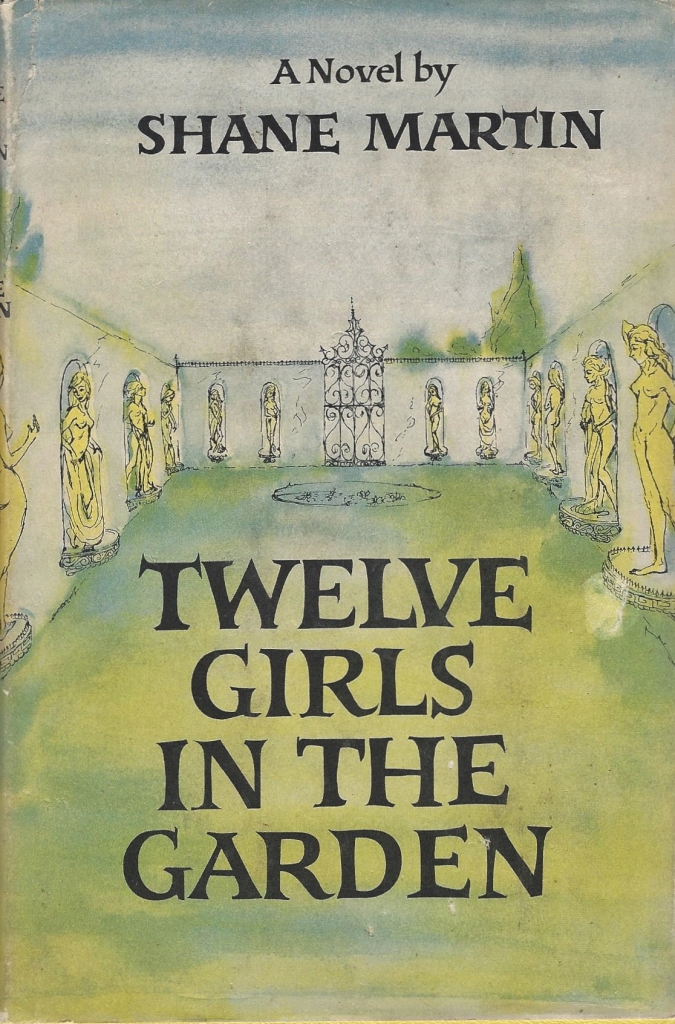
Twelve Girls in the Garden by Shane Martin ~ 1957. This edition: Morrow, 1957. Hardcover. 216 pages.

This satisfactorily beguiling romp of a mystery novel – final body count four-ish, if I’ve added up correctly – stars an elderly American archaeologist, one Professor Challis – who has a nose for curious situations and an unerring talent for chasing down solutions to said problems in a gently circular way.

The Professor, fresh back from some years in Greece (ancient Minoan civilization his speciality) is engaged in writing up his latest findings at the British Museum. Slightly bored with his incarceration (as it were) in the bustling city versus his beloved sun-baked Greek countryside, Professor Challis wanders into a neighbourhood where he once had close friends.

While peering in the window of a house he once knew well, the Professor is accosted by the current owner – the taciturn Mr. Flett – and is immediately embroiled in a rather bizarre scenario involving a mysteriously missing sculptor who disappeared on the eve of a crucial solo exhibition, said sculptor’s twelve masterful statues of beautiful women (all – or at least the heads of all – modelled from life) displayed about a London garden, a beautiful young woman who bears a strong resemblance to one of those statues, and a number of intriguing male characters, some of whom carry firearms as a matter of course.

Suffice it to say that this is a mystery in which art, love, greed and malice play equal parts, and that Professor Chalice faces some danger to life and limb before all is sorted out, with his crucial assistance.

Not bad at all, for a charcter – and a writer – I hadn’t ever heard of before.

Turns out that Shane Martin is the pseudonym of Australian journalist-writer George H. Johnston, whose fictionalized autobiography My Brother Jack is something of a classic of Australian literature.

Moving to the Greek island of Hydra in the 1950s with his wife, the equally talented writer Charmaine Clift, and their four young children, Johnston took to writing “pot boilers” in between his more serious literary attempts, five such light novels under the name Shane Martin, of which Twelve Girls in the Garden is apparently the easiest to find – the rest having dropped out of sight, being virtually invisible on all of the usual used book sites.

I know this because I looked.

Darn.

Okay, now check this out, fellow readers – especially (perhaps) fellow Canadian readers. Here’s an intriguing connection for you to revel in. George and Charmaine were connected in a most intimate way with the late great Leonard Cohen. Read all about it here!

That was unexpected. Everything is connected, isn’t it? How many degrees of separation between everybody on earth? Ha!

Back to the book – head spinning a bit because of Leonard – I was satisfied in that the mystery at the heart of Twelve Girls is hardish to guess – it took me almost to the denouement to figure out the key twists – and the character of Professor Challis is charmingly delightful. I’d happily follow him through the other four companion books –The Saracen Shadow (1957), The Man Made of Tin (1958), The Myth is Murder (1959), and A Wake for Mourning (1962) – if only I could get my greedy hands on them.

Loved the writing in this one – it danced and rollicked and teased and just generally pleased.

Here’s a vignette from a visit to a junk dealer’s shop:

In no way was it particularly different from any other secondhand dealer’s shop that lies outside the orbit of fashionable patronage. It had that dubious air of muddle and secrecy, with a flavor of ignorant stockpiling, that might lead one quite mistakenly to believe in the possibility of discovering a rare Memlinc or a genuine van Eyck or, at worst, a quite good Byzantine icon underneath its coating of discolored varnish and grime. It followed the usual custom of displaying in its windows and on the pavement outside only the tawdriest of trash – cumbersome pieces of furniture which were either blatantly spavined or suspiciously wormy; chamber pots of impressive size and florid decor but quite lacking in handles; chipped saucers filled with wedding rings, synthetic gems, old coins, and unmatched earrings; cases of medals concerned with forgotten gallantries in campaigns against Kaffir, Boer, and Afridi; mid-Victorian specimen cabinets choked either with geological fragments or brittle moths and insects; a tray of surgical instruments that looked as if they must have been used by Crippen; miscellaneous articles of chinoiserie brought from Foochow in that free-enterprising period when taste had declined in inverse ratio to the prosperity of the English tea trade; a varied but rather damaged selection of Spode, Staffordshire, and Rockingham; the usual china dog and Negro boy; a stuffed owl, solemnly dusty; and a group of hideously colored plaster statuettes of girls in the cloche hats, shingles, and alluring postures of the twenties.

The whole goat’s-nest, Professor Challis suspected, was to mislead the gullible into supposing that since no human being who had not been certified could possibly wish to buy anything from a display so ghastly, it followed that the real treasures must be inside, secreted in some glittering Ali Baba’s cavern to which only the cognoscenti had the key…

Yes, wordy and rambling and slightly, deliberately sarcastic, but with the malice tempered with good humour. It takes some time to get to the point, but the journey is worth the trip.

Here’s a nice enthusiastic  8/10, partly because I hadn’t expected the tale to be so erudite.

What would please me even more is a whole stack of Johnston/Martin’s books to pick through for evening amusement when the everyday needs to be escaped from for a bit.

I don’t think I’m done with this writer – this feels like a first step on a book quest journey, in fact.

Anyone else know of him, and his other works? Is he worth pursuing, do you think?


Read Full Post »

Tamarac by Margaret Hutchison ~ 1957. This edition: Macmillan, 1957. Hardcover. 282 pages.

A show of hands, please – who has heard of Margaret Hutchison?

I hadn’t, and it saddens me.

This novel was a pleasant surprise, and it appears to be the writer’s only one, though I found a reference to her working on her “next novel” in a snippet of a Margaret Laurence biography I stumbled on online. Apparently Margaret Hutchison – “Hutch” – was mentoring Margaret Laurence in the writerly sense when they both met in Vancouver back in the 1950s.

Intriguing.

Google draws an utter blank, beyond the secondhand copies of Tamarac for sale. And there aren’t too many of those out there, either.

So was there ever a second novel? I am exceedingly curious, because this first one, rather obviously autobiographical in the way of so many first novels, is beautifully written. Margaret Hutchison is comfortable with her words; it’s a smooth, engaging read, even in the most angst-ridden passages. Which takes some doing, doesn’t it?

Note I mentioned the presence of angst. It’s in there, in spades. Well, expectedly so, regarding the subject and its era.

Sometime between the two world wars, young Janet Cameron grows up with her two sisters in an isolated (and fictional) sawmill town named Tamarac located somewhere in the (real) British Columbia Kootenay region. Her childhood was a golden time; she looks back on it with fond nostalgia and true grief for its passing.

For not only has her childhood vanished, the town itself is disappearing. With the advent of the Second World War and the natural attrition of a resource extraction based industry – the loggers have harvested all the available trees and the most prominent town structures are torn down as the sawmill equipment is removed for installation elsewhere – Tamarac is doubly doomed.

Janet, now grown up and working as a schoolteacher, returns to the area to attend her father’s funeral, and the journey back triggers cascades of memory of her life to date: that golden childhood, and then the harsh reality of working for a living in a career she feels forced into, and eventually a brutally disappointing love affair. The mixture as seen so often, in fact.

Margaret Hutchison handles her saga well; it moves along quite briskly most of the time, with occasional slowings-down to dwell on particularly meaningful episodes.

Tamarac is hard on the heels of novels such as those created by Ethel Wilson; there is a similar concentration on the landscape as a crucial influence on the characters’ psyches. Hutchison approaches Wilson’s style without exactly copying it – the two were in fact writing at much the same time – but falls just the slightest bit short. As a developing writer, what might have been her voice in subsequent works?

Hutchison’s strengths as a more-than-competent writer outweigh her occasional lapses as a plot developer. I liked this novel a lot, and I would be thrilled to find that there is more out there from this thoughtful and articulate author. Sadly, I suspect that she may have been a one-book wonder. I wonder what the rest of her personal story was?

To sum up:

  • Not exactly a bildungsroman; our protagonist experiences most of her growing pains as an adult dealing with adult issues – love and loss and all that deep stuff. Her adolescence is challenging in places but is passed over without wallowing in teen sadness; she grows up fast but not because of any particular trauma; much is asked of her early and she steps forward to shoulder her responsibilities.
  • Tamarac is a thoughtful and appreciative evocation of a particular place and time; the author makes it very clear that she has a keen eye for natural surroundings, as well as the human places – and people – which encroach upon the wild.
  • Much of the melancholy of this novel comes from the time of its setting: Great Depression-era rural Canada, and then the bitter onset of what we all know – characters and readers alike – will be another horrible war.
  • The ending is something of an anticlimax, just a little too perfectly rounded. But it works in the greater context of what comes before it in the story, and is on the whole fairly satisfying. We are certain that Janet will calmly find her own way into whatever is coming next for her; she has proven herself tenacious and resilient so far, and we wish her well in her future.
  • My rating: 7.5/10. (Not a perfect novel, but well on its way, and I liked it.)

And here is our mysterious writer. Does anyone know what happened after Tamarac?


Read Full Post »

The Stepford Wives by Ira Levin ~ 1972. This edition: Fawcett Crest, 1973. Paperback. 191 pages.

Score a great big point for cultural saturation for this one.

Even those of us who haven’t read Ira Levin’s original novel or watched the 1975 (horror) and 2004 (dramatic comedy) movie versions have a darned good idea of what calling someone a “Stepford Wife” is all about: a scornful put-down right up there with “Little-Suzy-Homemaker” and “June Cleaver”, referring to the unemancipated females who are letting down The Sisterhood by really caring if their floors are glossy and their toilets really clean.

The Stepford Wives is a slight novel, despite its broad fame and its description on the back cover of my edition as a “chiller [with a] clincher of such hard-edged horror as to make his Rosemary’s Baby seem a drawing room comedy” – at least according to Mary Ellin Barrett of Cosmopolitan.

I do vaguely remember reading Rosemary’s Baby way back in the 1970s – I had a school friend who was into “horror” novels and she pressed it upon me – but I must say that the experience was underwhelming. And despite the promise of hard-edged horror from that long-ago Cosmo reviewer, I must say that this one is, on a superficial level, much the same.

After my reading of The Stepford Wives, as I shuddered gently at its implications, I mused that perhaps a tandem reading of the book might be a revealing conversation starter with your nearest and dearest.

Your partner’s response might well be worth noting, particularly if you are the wife in the equation. Will your spouse secretly envy the husbands of Stepford their sudden acquisition of sexually compliant, traditionally shapely, sweet-smelling underlings who don’t mess around with time-wasting outside interests? Who, incidentally, make the very best coffee?

Okay, backing up a bit to run ever-so-briefly over the plot, just in case any of my fellow readers have missed the gist of  this tale.

Joanna Eberhart, her husband Walter, and their two young children have just moved to the pleasant suburb of Stepford, and all are glad to be out of the ever-more-dirty-and-dangerous big city.

Joanna, self-proclaimed Women’s Liberationist and semi-professional photographer, admittedly hasn’t been too impressed by her first experiences with her polite but dull hausfrau neighbour ladies, but she hopes to find some like-minded, “liberated” friends in the area. And so she does, a couple of new arrivals like herself. They shake their heads over the boring house-proudness of their Stepford peers, and speculate on why all of the other women are so unambitious, so boringly polite, so compliant to their husbands’ smallest whims. Could it be something in the water? How about in that wonderful coffee? Are the ladies of Stepford being quietly drugged?

Turns out the truth is a mite more sinister.

Disclosure:

There isn’t a happy ending.

I think The Stepford Wives truly deserves its status as a classic of pop culture. It’s certainly representative of its time, and, for all its slightness, it’s a fantastic sleeper of a pro-feminist piece of literature. Even the most loving of the novel’s “enlightened” husbands eventually show their baser natures, much to my dismay. (I had highish hopes for at least a few of them. Nope. Ira Levin doesn’t pull any punches: all the Stepford men are evil.)

Final thoughts:

If you bump into it in your travels, you should read it, if only to clarify the basis for the pop culture “Stepford Wife” references all around us.

On the plus side, it’s a lightning fast read, a couple of hours at the most.

It’s also quite funny. Levin strikes an amusingly satirical note here, alongside his darker imaginings.

This one gets a shiny gold-plated star. Or, quantified in numbers, a rating of 7/10 from me.

Oh! One last thing. You, dear reader, if you make it through this novel, will never feel quite comfortable with a certain Disneyland attraction again…


Read Full Post »

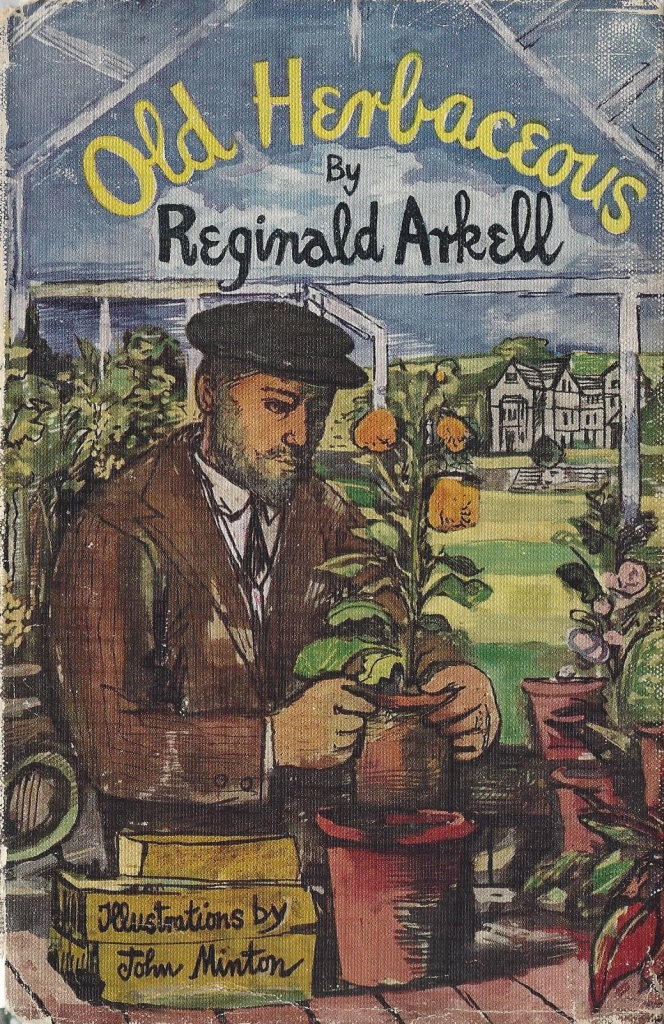
Old Herbaceous by Reginald Arkell ~ 1950. This edition: Michael Joseph, 1951. Illustrated by John Minton. Hardcover. 155 pages.

The second book of 2018 was something of a soft landing after my hair-straight-back initiation into the somewhat frenetic world of Elizabeth Bowen.

This next one is as straightforward as it gets; pure narrative of the simpler sort. I hasten to say it has all of the merits of its genre, that of the nostalgia piece, vide Miss Read and her ilk.

Elderly Bert Pinnegar, lifelong gardener at the “Big House” of his quiet English village, sits at his cottage window musing over his past, from humble beginnings through the stages of promotion from garden boy to head gardener, and on into retirement and inevitable physical decline of old age.

It all started so long ago…

Opening her cottage door, on a May morning some eighty-odd years ago, Mrs. Pinnegar, the cowman’s wife, had received a shock, and no mistake. There, on the door-step, wrapped in an old cotton skirt, was a baby, as newly-born as made no difference. Mrs. Pinnegar, a kindly soul, with six children of her own, passed the village maidens in review. Several of them were ‘expecting,’ but Mrs. Pinnegar, unofficial midwife and friend of all families, knew their dates to a nicety and the problem was not so easily solved. There had been no gipsies through the village for weeks. . . . Being a practical woman, the cowman’s wife picked up the parcel the fairies had brought her; christened it Herbert, after an uncle who was killed in the Crimea, and set about her Monday’s wash. When you had six of your own, one more didn’t matter.

Naturally, there was a bit of chatter at the time, but unexpected arrivals never made front-page news in an English village. A rick fire and talk of the Prussians in Paris were much more exciting. Young Herbert settled down in his new home; seasons came and went; the new self-binder started tying the sheaves with string . . .

Still, being picked up on a door-step did take the gilt off the gingerbread a bit; especially when you’d got along in the world and become someone in the village. True, there was nobody left to throw his birth in his teeth. Everybody was dead—every man Jack of them! Old folk went and new folk came, until you couldn’t find a single soul who remembered anything. Very soon he’d go, too, and then there’d be nothing left but houses—and gardens.

Funny, that! You planted a tree; you watched it grow; you picked the fruit and, when you were old, you sat in the shade of it. Then you died and they forgot all about you—just as though you had never been. . . . But the tree went on growing, and everybody took it for granted. It always had been there and it always would be there. . . . Everybody ought to plant a tree, sometime or another—if only to keep them humble in the sight of the Lord.

I don’t have a whole lot to say about this gentle story which can’t be imagined from the excerpt above. Arkell rambles along, documenting the highs and lows of his invented countryman’s life. There is some garden lore tucked in here and there, but not enough to take it to anything like a “garden” book. It’s a nostalgia piece, pure and simple, and the author makes no attempt to take it beyond that level.

Pleasant enough in its own way, and I passed an evening with Our Bert in mild enjoyment. Engaging enough to keep one entertained. If you like Miss Read, you’ll like Reginald Arkell.

I think I mentioned something of the same regarding the other of Arkell’s bucolic novels which I read during my 2014 Century of Books, Trumpets Over Merriford. And I believe I used the term “quaint” for that one, and it applies equally aptly to Old Herbaceous.

Looking at my rating of Trumpets Over Merriford, I see I gave it a 6.5 rating. I’m feeling rather more generous regarding the tale of the gardener. Let’s say 7.5/10. Because it’s a nice little thing, relaxing to read in between bouts with the seed catalogues this planning time of year for those of us with horticulture as part of our lives.


Read Full Post »

The Little Girls by Elizabeth Bowen ~ 1964. This edition: The Reprint Society, 1966. Hardcover. 256 pages.

The verdict is in regarding me and Elizabeth Bowen.

I do believe she gets the nod.

Though I found The Little Girls rather hard going at times, I came out the other side of this sometimes confusingly complex novel a convert. I can see why she’s such a polarizing writer; people seem to either love her or find her needlessly convoluted.

After this particular reading experience, I have to agree with the convolution-critics, but the end result is a rather compelling thing. Memorable in the longer term, I suspect it will be. And definitely one to re-read, if only to come to it with a questing eye to all of the clues the author provides in relation to its nebulous ending.

Dinah Piggott, a comfortably well-off widow in late middle-age, has embarked upon a project to assemble a collection of objects representing the people of her nowaday, to be sealed up in a cave at the bottom of her garden with a view to eventual discovery by a future race, once this one has vanished. Her friends and family are on the whole cooperative in each donating the requested twelve expressive objects, though Dinah has just come to the realization that her amassing collection contains a discouraging number of duplicates: strings of artificial pearls and pairs of nail scissors (some broken) are conspicuous by their frequency.

No matter, she is firm in her resolve to create her message to the future, though when she is confronted with the logistics of actually sealing the cave up and not being able to mull over the objects, she is taken aback by her own feeling of reluctance to let it all go into the dark, never to be seen (by her) again. Which triggers another train of thought, related to the time capsule concept.

Fifty years ago, Dinah – “Dicey” –  was an 11-year-old schoolgirl at St. Agatha’s, and she and her two closest cronies – accomplices? – had, at Dinah’s instigation, buried (in dead of night) a coffer containing a secret personal object from each of them, a collection of animal bones, and a letter in an invented language written in its creator’s blood.

Now Dinah has had a sudden compulsion to reach back into the past, to find her two friends, to engineer a reunion, and to disinter that long-buried coffer together, as a way to recapture the close companionship of their shared youth.

Dinah posts a series of deliberately provocative newspaper advertisements (…”if alive but in hiding, the two should know they have nothing to fear from Dicey, who continues to guard their secret…”) in five different newspapers which have readership throughout England, hoping for a bite.

And yes, indeed, both old friends respond, though with caution rather than full-out enthusiasm. For fifty years have passed since their shared school days; the Great War and the Hitler War have taken place in the meantime, with subsequent societal reorderings. The headstrong and occasionally wicked “little girls” of 1914 are now sedate older women with certain positions to uphold in their respectable social circles. Whatever they were then has not carried through to the now.

Or has it?

The centrepiece of this multi-layered novel is a flashback sequence to those schooldays, when clumsy, imaginative Diana(Dinah/Dicey), talented and indulged dancer Sheila(Sheikie), and academically gifted Clare(Mumbo), were a triumvirate to be watched with slightly horrified caution by their elders as well as their peers.

Dinah was something of the ringleader in schoolgirl exploits, though the others were hardly follow-blindly types; all contributed something vital to their partnership, and none were afraid to bluntly dismiss anything that approached each girl’s definition of “nonsense”.

This is not a gentle tale, though there are episodes of great tenderness. Dinah, for all of her apparent aggressiveness of character, surprises us by the amount of dedicated love she inspires in those she in turn holds dear, though we don’t find this out until the final episode, after an unwitnessed and undescribed near-tragic mishap befalls one of the key characters.

The novel’s ending is ambiguous, though I chose to interpret it as hopeful. Peace, if not entirely made, is seen as becoming ultimately possible between those of our characters most at odds.

The Litte Girls, for all its challenges to the reader – that sentence structure! – is brilliantly written, frequently humorous, occasionally off-putting, and ultimately deeply poignant. Great gaps are left here and there in the narrative, causing the reader a certain amount of discomfort as one struggles to realign the narrative, but it does all fall into place as episode builds upon episode, and those disparate clues I referred to early on show their importance to the whole.

Ah, yes, and there is a garden, wherein some key scenes take place. It is Dinah’s, and it is one of our clues to her particular character. (This passage also serves as an example of Bowen’s writing style. See if you can get through it all in one go, without backing up here and there to try to find where you’ve strayed outside the lines!)

On each side, the path was overflowed by a crowded border. Mauve, puce and cream-pink stock, double, were the most fragrant and most crushingly heavy: more pungent was the blue-bronze straggling profusion of catmint. Magnificently gladioli staggered this way and that – she was an exuberant, loving, confused and not tidy gardener; staking and tying were not her forte. Roses were on enough into their second blooming to be squandering petals over cushions of pansies. Flowers in woolwork or bright chalk, all shades of almost every colour, zinnias competed with one another. And everywhere along the serpentine walk where anything else grew not, dahlias grew: some dwarf, some giant, some corollas like blazons, some close-fluted, some velvet, some porcelain or satin, some darkening, some burning like flame or biting like acid into the faint dusk now being given off by the evening earth.

Gorgeous, yes?

An auspicious way to start of 2018’s reading year.

The personal rating: 8.5/10


Read Full Post »

« Newer Posts